




Abstract
This study sought to examine the evolution of educator empowerment within the higher education system of the Kurdistan Region of Iraq under the framework of the Bologna Process. Specifically, it examined the role of pedagogical content knowledge in shaping educators’ sense of empowerment, with a particular focus on the contribution of pedagogy courses and the mediating role of technological pedagogical content knowledge. Data were gathered from 223 pre-service and in-service educators. Analysis through structural equation modeling showed that both pedagogical content knowledge and technological pedagogical content knowledge strengthen educators’ sense of empowerment, while technological pedagogical content knowledge plays a clear mediating role. Pedagogy courses, serving as a modality of professional development, were identified to strengthen the correlation between pedagogical content knowledge and educator empowerment. These results give insights from a developing-country perspective, carrying implications for both theory and practice and offering directions for future work. Beyond this, the study adds to discussions on the Bologna Process by showing how educator development in the region can be brought into closer alignment with European standards for quality, mobility, and lifelong learning.
Plain Language Summary
This study examined how the Bologna Process influences teacher development in the Kurdistan Region of Iraq. It focused on how pedagogical content knowledge (PCK) and technological pedagogical content (TPACK) affect educators’ sense of empowerment. Results from 223 teachers indicated that both PCK and TPACK enhance empowerment, with TPACK acting as a mediator. Pedagogy courses further strengthened this effect, highlighting the importance of professional development. The findings offer insights from a developing-country perspective and suggest ways to align teacher training with European standards of quality and lifelong learning.
Keywords
Introduction
The modern educational environment is marked by the paradigm shift of learning being student-centered and is accompanied by the need to support the teachers in adapting to new and demanding and sometimes challenging learning approaches (Reeves et al., 2016). Teacher empowerment and professional development are the two concepts that have been given long-standing academic interest over the decades (Blount, 2018; Dail et al., 2018; Lindvall et al., 2023; Shen, 2001; Zhang et al., 2021). Teacher empowerment is generally considered to be the process where teachers, as employees of an institutional system, gain agency and capability to direct their own growth and have the capacity to deal with the complicated challenges within their day-to-day practice (Short and Rinehart, 1992). With the changing education systems, it is important to know the levers of empowerment to achieve successful reform.
The urgency of this need is especially strong in those contexts where educational reform is significant and fast, as is the case in the Kurdistan Region of Iraq (KRI). The KRI is a region located in northern Iraq and has formally committed to the Bologna Process, a comprehensive European framework for higher education reform aimed at enhancing quality assurance, degree comparability, student mobility, and, fundamentally, competency-based teaching (LFU, 2024; Qadir & Saeed, 2023; Sharif & Abdulrahman, 2025). In practical terms, Bologna-aligned institutions require teachers to define clear learning outcomes, use student-focused pedagogies, such as problem-based learning, and make digital tools an inseparable part of their instructional design (European Commission, 2020).
These mandated pedagogical shifts, however, are an uphill implementation task. The implementation of the Bologna reforms depends on whether the teachers are professionally prepared or not to implement it. Yet, the definite mechanisms by which instructors gain this perception of efficacy and autonomy in this new paradigm remain inadequately understood. These heightened pedagogical expectations render specific knowledge domains not merely beneficial but essential. Specifically, Shulman’s (1986) concept of Pedagogical Content Knowledge (PCK)—that unique amalgam of content and pedagogy that constitutes the special province of teachers—is foundational (Berry et al., 2016). Furthermore, in an increasingly digital age, Mishra and Koehler’s (2006) Technological Pedagogical Content Knowledge (TPACK) framework, which elucidates the intricate, synergistic relationships between technology, pedagogy, and content, becomes equally critical. The development of TPACK moves beyond instrumental tool use, requiring an understanding of the complex interplay between digital artifacts, user behaviors, and pedagogical strategies (Koehler and Mishra, 2005). Consequently, both PCK and TPACK are regarded as fundamental to satisfying the demands of the Bologna reforms and are therefore likely to play a crucial role in fostering teachers’ awareness and adaptability within the new paradigm of professional empowerment. In this context, empowerment will be recognized when instructors experience enhanced self-efficacy, confidence, professional autonomy, and competence in their teaching practice (Ismaniati et al., 2025). According to emerging international research, effective Pedagogical Content Knowledge (PCK) enhances teachers’ instructional confidence, while the developed Technological Pedagogical and Content Knowledge (TPACK) framework fosters greater autonomy and creative application of digital tools—both of which are recognized as key components of teachers’ psychological empowerment (Su, 2023; Yadav and Singh, 2023).
A substantial body of scholarly literature has been devoted to examining both PCK and TPACK. Seminal and contemporary research on PCK, spanning from Shulman (1986) to contributors such as Hill (2016), Brown et al. (2013), and Abell et al. (2009), has conclusively demonstrated its critical importance for effective teaching. Similarly, the TPACK framework has generated substantial research, with scholars such as Voithofer et al. (2019), Joo et al. (2018), and Chaipidech et al. (2021) examining its measurement, development, and influence. Nevertheless, a thorough examination of this corpus uncovers two important and interconnected gaps. Initially, the primary emphasis of PCK and TPACK research has been on their influence on student achievement and learning outcomes. Although exceptions exist (e.g., Jang & Chen, 2010), few studies explicitly examine the direct correlation between these knowledge domains and teachers’ empowerment. Second, and more importantly, the current literature predominantly regards these knowledge bases as autonomous predictors. There is a limited amount of research examining their interrelationship within a single framework, especially in investigating the hypothesis that TPACK may serve as the mechanism through which foundational PCK is transformed into empowerment within a newly digitalized educational setting. Furthermore, although there is an expanding body of literature on teacher professional development within Western contexts, research examining how PCK and TPACK serve as mechanisms for empowerment in non-Western, reform-driven environments remains notably scarce. The distinctive socio-cultural and educational environment of the Middle East, particularly the KRI, where this study is situated, signifies a significant contextual disparity.
To address these deficiencies, this study introduces and evaluates a conceptual model that synthesizes the constructs of PCK and TPACK within the framework of teacher empowerment theory. The model suggests a direct impact of PCK on empowerment but proposes that its main influence is mediated indirectly via the development of TPACK. Therefore, TPACK is regarded as a critical mediating variable. Additionally, acknowledging the formal frameworks for skill development, this study examines the moderating effect of Professional Development Attendance (PDA), particularly through pedagogy courses, to assess whether such structured involvement enhances the relationships within this proposed pathway. This comprehensive model facilitates a detailed examination of not only whether these knowledge domains are significant but also how and under which conditions they influence empowerment. Therefore, this research is directed by the following research questions (RQ):
The importance of this investigation is tripartite. First, it offers essential, evidence-based insights for educational policymakers in the KRI, assessing whether educators are adequately endowed with the requisite competencies to fulfill the pedagogical and digital requirements of the Bologna Process. Establishing a significant correlational link from PCK and TPACK to empowerment would convincingly advocate for reform initiatives that emphasize ongoing, high-caliber professional development focused on these knowledge domains. Second, it highlights the potential of the region’s teacher education framework, particularly through pedagogy courses, to promote professional growth and to empower both novice pre-service graduates and seasoned in-service educators. Finally, by thoroughly examining these intricate relationships within a distinctive, non-Western context, this study substantially broadens the applicability of existing research, primarily conducted in Western settings, and offers a valuable case study to the global literature on teacher empowerment and educational reform.
The subsequent sections of this paper are organized as follows. The subsequent section delineates the theoretical framework and literature review, culminating in the formulation of our hypotheses. This is succeeded by a comprehensive description of the research methodology, the presentation of the results, and an analysis of the findings. The paper concludes by delineating the implications of the study, recognizing its limitations, and proposing avenues for future research.
Theoretical Framework
The Bologna Process (BP) is the policy framework within the context of this research. It is a leading intergovernmental initiative aimed at the creation of a cohesive and harmonized system of higher education in Europe to promote uniformity, accessibility, and competitiveness (Bartelse & Huisman, 2008; Brøgger, 2019). The driving force behind this reform is an agile combination of action lines: the introduction of the two-cycle degree structure, the European Credit Transfer System (ECTS) to ease the mobility of students, the radical change of student-centered learning (SCL), and quality assurance (European Higher Education Area and Bologna Process, 2022). However, as research in the KRI and beyond has shown, the introduction of these changes in the form of structure faces significant drawbacks, including poor facilities, overcrowding in classrooms, and a lack of awareness and training among employees and students (Abdulrahman & Sharif, 2022; Ade, 2021; Ameen & Ahmed, 2024). These hurdles outline the fact that the BP is not a bureaucratic obligation but a radical pedagogical revision that necessitates a radical change in teaching methodology, which makes academic members of the staff central to its effective implementation.
In such a challenging reform setting, the idea of teacher empowerment gains primary significance. Empowerment is described as a complex phenomenon, which includes such aspects as the active involvement of teachers in important decision-making, the respect and appreciation of colleagues and the organization, the freedom in the professional field, the opportunity to develop professionally, and the self-confidence to effectively improve student learning (Short & Rinehart, 1992). This definition is quite close to the fact that the Bologna Process, in its turn, places an essential role on institutional autonomy and the development of academic staff as the essential factors that would allow improving the level of education (European Commission/EACEA/Eurydice, 2018). Empirical research has cited empowerment as an essential resource that helps educational institutions in change management since empowered teachers tend to be more innovative, reflective, and determined to the reform process (Avidov-Ungar & Shamir-Inbal, 2013; Magen-Nagar & Avidov-Ungar, 2014). Teacher empowerment is therefore theorized not only as a result but also as the key driver that drives the profound pedagogical involvement that the Bologna reforms demand.
These domains of knowledge that are empowered and required by the BP fall within the frames of Pedagogical Content Knowledge (PCK) and Technological Pedagogical Content Knowledge (TPACK). PCK, in the sense in which it was proposed by Shulman (1986), is the primordial synthesis of content and pedagogy that defines the knowledgeable teacher. It involves the knowledge about teaching methods of certain subject matter, a grasp of student conceptions and learning challenges, curriculum knowledge, and assessment knowledge (Berry et al., 2016; Forsler et al., 2024). PCK is dynamic; it evolves with time as a result of experience and contemplation, thus allowing qualified teachers to apply appropriate pedagogies to meet the demands of different student groups (Hashweh, 2005; Sarkar et al., 2024; Wallace & Loughran, 2012). Such complex PCK becomes invaluable because of the advocacy of the BP on SCL and improved instructional efficacy. Based on this fact, the TPACK framework (Koehler & Mishra, 2005) focuses on the modern requirement of the desire to be integrative in terms of technology by claiming that successful teaching should be an integrative understanding of the interplay between content, pedagogy, and technology.
The relationship between these constructs is a dynamic, reciprocal relationship. On the one hand, an empowerment-based environment, that is, one that gives teachers independence, involvement, and the possibility to develop professionally, creates motivation and reflective practice needed by the educator to actively build their PCK and TPACK. Conversely, effective acquisition of this integrated knowledge is the direct cause of improvement in professional self-efficacy and perceived competence, which are the central aspects of empowerment in teachers (Short & Rinehart, 1992). Teachers who feel confident in their abilities to structure their lessons in a manner that emphasizes students and their skills in the use of technology (i.e., are high TPACK teachers) strengthen this sense of professional empowerment. This forms a virtuous cycle in which empowerment and knowledge start to support each other, and a synergy is created, which is essential to cope with the change of pedagogy required by the Bologna Process.
PCK to Teacher Empowerment
PCK, a concept first discussed in the literature by Shulman in 1986, refers to the complex combination of in-depth content knowledge and teaching practices that enable students to learn. PCK plays the most important role in a teacher’s psychological sense of efficacy and effectiveness and thus plays a pivotal part in a teacher’s autonomy in terms of psychological efficacy and effectiveness (Gess-Newsome, 2015; Short & Rinehart, 1992). As Gess-Newsome (2015) contends, PCK is the transformative and integrative knowledge base that teachers enact, and its mastery is a foundational pillar of psychological empowerment.
The crucial PCK and the process of empowerment in teaching take an even more essential form in the current educational reform movements and in the link to the process of the Bologna reform in particular. Namely, the student-centered learning concept, cognitive learning competencies, and flexible learning entail a radical student and teacher adjustment concerning the teacher’s traditional transmission-of-knowledge function and the need to adjust the process of teaching in terms of the PCK needed in facilitative learning. According to Brennan and King (2022), the current education reform cannot be achieved through the provision of PCK alone (Aina, 2023; Efendioğlu, 2018). It also requires embedding innovative learning practices that are closely linked to teaching and ensuring that teaching aligns with the goals of the reform so that educational institutions provide a form of education consistent with the new expectations for teaching and learning (Park & Oliver, 2008).
Although the relationship between PCK and motivational outcomes has been examined, the specific contribution of PCK to the broader concept of teacher empowerment—particularly within a unique context such as the KRI, a region undergoing its own process of educational modernization—remains a notable gap in the literature. Overall, existing research suggests that a deep understanding of PCK provides the essential foundation that enhances teachers’ sense of efficacy, autonomy, and agency—qualities that are critical for navigating educational reform. Accordingly, this study proposes that PCK exerts a positive influence on teachers’ sense of empowerment, as articulated in the following hypothesis:
Technological Pedagogical Content Knowledge (TPACK): Mediating the Path to Empowerment in the Digital Age
The Technological Pedagogical and Content Knowledge (TPACK) model, developed by Mishra and Koehler in 2006, moves to a higher level of understanding the interconnection and application of Content Knowledge (CK), Pedagogical Knowledge (PK), and Technological Knowledge (TK) in a much more integrated and applied manner than traditional views of CK, PK, and TK (Joo et al., 2018; Schmidt-Crawford et al., 2009). This model of knowledge is deeply connected to the concept of educator empowerment, the many dimensions of a teacher’s feeling of empowerment and professional strength, including their sense of efficacy, autonomy, and responsibility for results, and their ongoing development and growth (Short & Rinehart, 1992). The teacher in the 21st-century learning environment requires a sense of empowerment connected to the effective working and application of technology and thus is directly impacted by TPACK.
Essentially, TPACK enhances the basic competencies of the educator. Though PCK encompasses the basic knowledge required to teach a topic in an effective manner, TPACK is the bridge through which this effective know-how is transformed into a modern and innovative process. Studies confirm that a teacher with high TPACK values their capacity and readiness to tackle the current teaching environment, thus heightening their sense of self-efficacy, an important factor in the process of personal and, thus, educational empowerment (Abbitt, 2011; Joo et al., 2018). Perhaps because of their well-developed basic and applied competencies in the area of modern technology, teachers feel that they are more autonomous in their teaching practices and thus provide access to and the creative development of a wider variety of educational means and solutions to teaching problems, thus reinforcing their feelings of developing a sense of their own professional power and efficiency.
The significance of TPACK in the process of PCK-empowerment is further supported through wider scholarly works. Findings suggest that TPACK functions as a facilitator in the process of aligning the bodies of knowledge of the educator and the effective implementation of practice (Chai et al., 2017). The basic TPACK model, in fact, states that the application of this integrative form of knowledge gives the educator the capability to creatively solve a complex teaching issue, a process in and of itself a source of educator empowerment (Mishra & Koehler, 2006). The process and application of TPACK, in fact, do not function in a vacuum but are instead heavily influenced by the environment in and through which the educator operates and functions, such as the design of an institutional environment and resultant policies (Porras-Hernández & Salinas-Amescua, 2013; Rosenberg & Koehler, 2015).
The Bologna Process explicitly stresses the importance of digital skills for academic staff, aligning with the goal of fostering empowered and adaptable educators (Hâj & Curaj, 2024). The design and implementation of effective educator training activities, in fact, has been demonstrated to provide effective results in increasing the levels of TPACK in educators, a process demonstrating how the educator environment might be designed to generate and produce educator knowledge. Therefore, this study hypothesizes that TPACK has a positive relationship with the educator’s sense of empowerment and, crucially, that it plays a mediating role in the relationship that exists between PCK and a sense of the educator’s professional empowerment:
Moderating Role of Professional Development Attendance (PDA)
The stringent educational reforms required by the Bologna Process (BP), such as the uniform implementation of student-centered teaching methodologies and the proficient integration of digital technologies, render certain knowledge domains essential for educators (European Commission, 2020). PCK and TPACK are critical frameworks for meeting reform demands and are crucial for enhancing teachers’ professional empowerment (Mishra & Koehler, 2006; Shulman, 1986). However, the development of these complex, linked knowledge bases is not a natural process; it requires methodical and structured support. Professional Development Attendance (PDA), particularly via specialized pedagogy courses, is considered an essential means for improving teachers’ PCK and TPACK (Brennan & King, 2022; Tondeur et al., 2020).
This is especially pertinent within the context of the KRI, which has officially pledged adherence to the Bologna Process (LFU, 2024; Qadir & Saeed, 2023). In response, several KRI institutions have initiated the offering of pedagogy courses designed for both pre-service and in-service instructors (Amin et al., 2021). These courses frequently include modules on student-centered learning, information and communication technology (ICT), and competency-based education, thereby directly aligning with the fundamental principles of the BP (LFU, 2024). Consequently, numerous instructors within the KRI regard participation in these courses as a mandatory prerequisite for formal certification. Nevertheless, this compulsory participation has also attracted criticism, with concerns expressed regarding the applicability of pedagogical principles formulated for the European context within the unique socio-cultural and educational environment of the KRI. This critique highlights important concerns regarding the widespread implementation of instructor training and its efficiency in fulfilling the specific empowerment requirements of teachers in non-EU settings. Despite this policy focus, a considerable vacuum persists in academic analyses regarding the influence of the Bologna Process on the development of PCK and TPACK and, ultimately, on educator empowerment within the KRI. This research examines this disparity by exploring the moderating influence of PDA. It is hypothesized that active participation in formal professional development enhances the links between teachers’ knowledge foundations and their sense of empowerment. Pedagogy courses offer a structured setting for educators to critically examine and enhance their instructional methodologies, thereby potentially increasing the beneficial impact of PCK on empowerment. Similarly, these courses may provide the practical, hands-on experience essential for transforming technological knowledge into effective classroom practices, thereby reinforcing the connection between TPACK and empowerment. Aligned with the principles of competency-based approaches (Korthagen, 2016), this study proposes the following hypotheses:
Figure 1 illustrates the conceptual model.
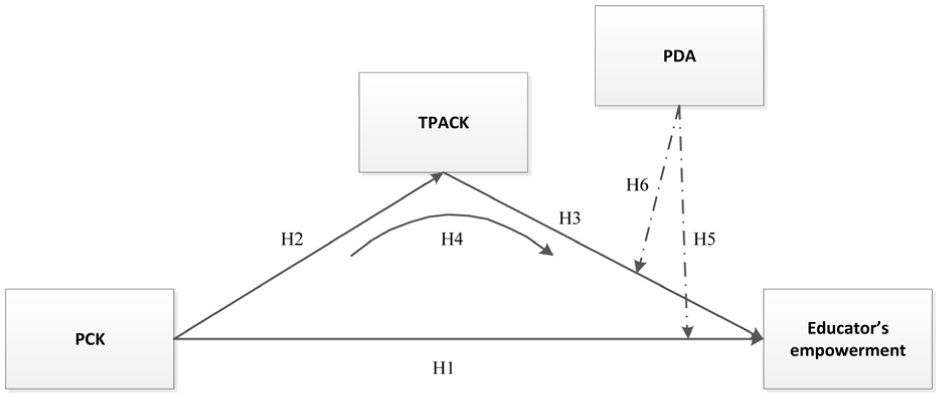
Conceptual model.
Method
Research Design
This research utilized a multi-wave cross-sectional design to examine the correlations among PCK, TPACK, PDA, and teacher empowerment (Menard, 2002). This method was specifically selected to evaluate the stability of the proposed model and monitor population-level trends within the evolving context of the Bologna Process reforms in the KRI, thereby delivering comprehensive, policy-relevant insights beyond a single temporal sampling (Lynn, 2018). Data collection proceeded across three survey phases, commencing with the contact of 903 individuals in the first wave, resulting in 451 valid responses. From this initial cohort, 333 educators participated in the second wave, and ultimately, 223 respondents completed all three phases, constituting the final sample after attrition. Control variables and PCK were assessed at baseline on May 1, 2024, whereas TPACK and PDA were implemented over the subsequent 3 months. Teacher empowerment was evaluated at the 12-month interval in May 2025, thereby addressing potential issues related to reverse causality.
Although this research does not explicitly examine the model across different time periods, the use of multi-wave data collection was specifically implemented to enhance the study’s validity. By aggregating predictor, mediator, and outcome variables across distinct cycles, we established temporal precedence, thereby supporting the justification of the proposed causal direction within our model. Furthermore, this approach substantially reduces the likelihood of common method bias by avoiding the artificial amplification of relationships that may arise when all variables are assessed by a single respondent simultaneously. The employment of independent samples for each phase is ideal for assessing system-level development; however, it prevents the analysis of individual-level change. This trade-off is consistent with the study’s emphasis on macro-level pedagogical reform rather than on individual trajectories (Ployhart & Vandenberg, 2010).
Population, Sample, and Sampling Strategy
The population of interest for this study comprised university novice pre-service and in-service teachers in the KRI who are subject to the pedagogical reforms of the Bologna Process. Pre-service teachers are defined as individuals who are currently undergoing training, recent graduates, or novice educators with limited experience (less than 2 years). Conversely, experienced instructors possess substantial years of teaching service, typically defined as a minimum of 4 to 5 years in numerous academic publications (Gatbonton, 2008). Although this approach may restrict generalizability, it was essential to reach the target population, and we aimed to enhance diversity by utilizing extensive professional networks.
A combination of convenience sampling and snowball sampling was employed to recruit participants. This non-probability method was selected out of necessity owing to the lack of a comprehensive sampling frame and was pragmatically adopted for its effectiveness in recruiting an adequate number of participants within the logistical limitations of the study (Creswell & Creswell, 2018). Recruitment was conducted by disseminating the survey via accessible university platforms and professional networks. Snowball sampling was subsequently promoted by requesting initial participants to distribute the survey to qualified colleagues, thereby utilizing professional networks to improve the diversity of the sample (Biernacki & Waldorf, 1981). The gender distribution was approximately evenly split, with females constituting 50.7% and males accounting for 49.3% of the sample. In terms of experience, 39.0% were novice pre-service teachers with less than 2 years of experience, whereas 61.0% were experienced in-service teachers with more than 4 years of experience.
Data Collection
The survey was administered in English. This was justified, as the participants are university academics who operate in a professional environment where English is the primary language of instruction for the pedagogy courses that are the focus of this study and is widely used in tertiary education in the KRI, particularly within reform-oriented contexts (Ali & Mohammadzadeh, 2022). Following ethical approval, the survey link was distributed via the sampling strategy outlined above. The survey began with an informed consent page, clearly outlining the study’s purpose, the voluntary nature of participation, and confidentiality assurances. Proceeding with the survey was taken as consent. The instrument was structured into distinct sections: demographics, followed by the scales for PCK, TPACK, and teacher empowerment. This procedural separation of constructs was implemented to reduce potential common method bias (Podsakoff et al., 2003).
Measures
PCK: In line with the conceptualization of PCK in this study, the five-item scale adapted from Nilsson and Karlsson (2018) was used to operationalize PCK. Nilsson and Karlsson (2018) classify PCK as the knowledge of instructional strategies for teaching specific topics, the knowledge of the students’ understanding of the subject matter, the knowledge of the curriculum content and materials, the knowledge of assessment, and the knowledge of teaching orientations. The items designed to collect data include: I use varied instructional strategies to engage students and promote deeper understanding of content; I believe it is important for teachers to have awareness of students’ prior knowledge, misconceptions, difficulties, and interests and a strong understanding of subject matter; I am familiar with assessment methods and criteria for evaluating students’ learning and performance in the subject; I am confident of my ability to explain complex concepts in a way that is understandable to students; and I adapt instructional curriculum content and materials to meet the needs of diverse learners in your classroom.
TPACK: The TPACK was measured using seven items selected from Koehler et al. (2013). They defined TPACK as: Understanding of technology-content integration; integration of technology into teaching practices; adaptation of technology for diverse learning needs; alignment of technology with learning objectives; selection of appropriate technological tools; utilization of technology for engaging instruction; professional development for technological integration: The items included: I understand the relationship between technology and the subject/content I teach; I am confident in my ability to integrate technology effectively into my teaching practices to enhance student learning outcomes; I adapt technology tools and resources to meet the needs of diverse learners in my classroom; I effectively align technology with specific learning objectives and content standards in your teaching; I am confident in my ability to select and utilize appropriate technological tools and resources to support diverse teaching and learning activities; I frequently engage in using technology to create engaging and interactive instructional materials for your students; I frequently participate in professional development activities to enhance your technological pedagogical content knowledge.
Teacher Empowerment: The teacher’s sense of empowerment was measured using seven items, adapted from Short and Rinehart (1992). Respondents were asked to rate their level of agreeableness in the following categories: participation in decision-making: the involvement of teachers in critical decisions that directly affect their work; influence: the degree to which teachers influence school life; prestige-professional respect: the professional respect that teachers receive from colleagues; autonomy: the extent to which teachers can control certain aspects of their work life; professional development: the opportunities for teachers to enhance their skills and knowledge; self-efficacy: the perception of teachers that they have the ability to help students learn. The items included: I feel empowered to make decisions about instructional methods and strategies in my classroom; I feel I have autonomy in adapting curriculum materials and resources to meet the needs of my students; I feel I have support from school administrators and colleagues in implementing innovative teaching approaches, including the integration of technology; I feel valued by my colleagues and administrators for my contributions to the teaching profession; I perceive I have influence in shaping school policies and practices related to teaching and learning; I feel my professional accomplishments and achievements are recognized and celebrated within my school; I am overall satisfied with my role and experiences as a teacher in my current school.
PDA: PDA was operationalized as a binary categorical variable, where ‘1’ indicated participation in at least one formal pedagogy course aligned with the Bologna Process reforms, and ‘0’ indicated no participation. This measure was designed to capture the fundamental threshold of formal engagement with the institutional professional development framework. In essence, this dichotomous measure was used to capture the fundamental threshold of formal engagement with the Bologna-aligned pedagogical framework, suitable for an initial test of its moderating role in the structural model. While this measure does not capture qualitative aspects such as course duration, content specificity, or instructional quality, it provides a clear and parsimonious indicator of a teacher’s formal exposure to the pedagogical principles central to the reforms under investigation (Desimone, 2009). This approach is consistent with initial, exploratory studies aiming to establish whether a basic level of formal PD engagement plays a significant role in teacher development before investigating more complex, qualitative dimensions (see more in the limitations section, last paragraph).
Result
Preliminary Analysis
Prior to testing the structural model, preliminary analyses were conducted to ensure the robustness of the data. To further assess the threat of common method variance (CMV), both procedural and statistical remedies were employed. Procedurally, respondent anonymity was guaranteed, and scale items were separated in the survey design (Podsakoff et al., 2003). Statistically, Harman’s single-factor test was performed, revealing that a single factor accounted for 34.52% of the total variance, which is below the critical threshold of 50%, suggesting that CMV was not a pervasive issue in the dataset. Furthermore, to address potential omitted variable bias, the model incorporated key control variables—age, gender, education level, and teaching experience—that have been established as influencing teacher knowledge and empowerment (Zee & Koomen, 2016).
Validation of Measurement Model
SPSS Amos version 26 was used to validate the measurement model and ensure the specificity of the key variables in the study. This statistical technique was employed to ascertain that the measurement model accurately represents the data. These included the loading factor of each indicator, the minimum fit function (χ2), and the ratio of χ2 to its degrees of freedom (χ2/df), with values below 3 considered acceptable (Carmines & McIver, 1981). Furthermore, the Comparative Fit Index (CFI), Incremental Fit Index (IFI), Tucker-Lewis Index (TLI), Goodness-of-Fit Index (GFI), and Adjusted Goodness-of-Fit Index (AGFI) were used.
After testing several models (one-factor model, two-factor model, and three-factor model), the result of the conceptualized three-factor measurement model yielded an acceptable model fit (Table 1), as indicated by the following indices. χ2/df = 1.240 (good fit < 3), CFI = 0.966 (good fit > 0.90), IFI = 0.967 (good fit > 0.90), TLI = 0.961 (good fit > 0.90), GFI = 0.920 (good fit > 0.90), AGFI = 0.901 (acceptable fit ≥ 0.90), RMSEA = 0.033 (good fit < 0.06). These results collectively suggest that the measurement model adequately fits the data (Browne & Cudeck, 1992; Hair et al., 2010; Hu & Bentler, 1999). The loading factor for all indicators of the 3-factor measurement model was also demonstrated to be an acceptable value of greater than 0.5 (Table 2).
Measurement model comparison.

Indicators Loading Factor.

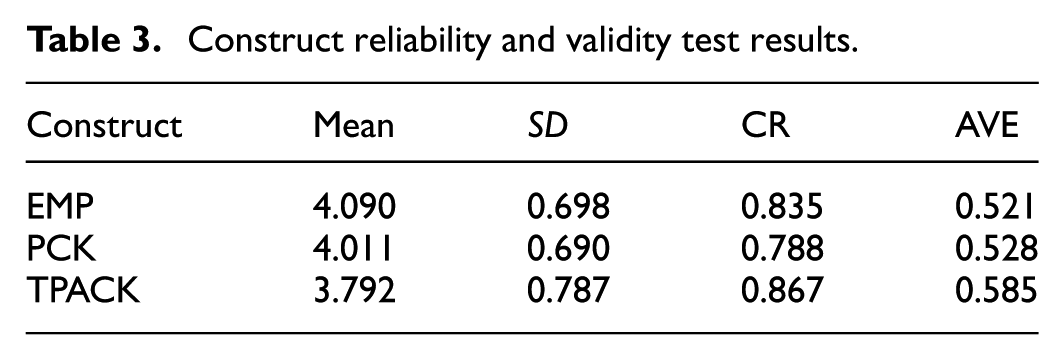
The reliability and validity of the adapted measures and hypotheses test were further evaluated (Dash & Paul, 2021). Construct reliability was assessed using composite reliability (CR), while convergent validity was examined through the Average Variance Extracted (AVE), and discriminant validity was assessed using the Heterotrait-Monotrait (HTMT) ratio. The results presented in Table 3 indicate that all three main constructs used in this study met the criteria for reliability. The CR values ranged from 0.788 to 0.867, both of which are above the required threshold of 0.7 (Henseler et al., 2009). The AVE values ranged from 0.521 to 0.585, which is ideally expected to be above 0.5; therefore, they are considered acceptable (Fornell & Larcker, 1981). This suggests acceptable levels of convergent validity for all constructs (Henseler et al., 2009). Furthermore, discriminant validity was assessed using the HTMT criterion, as established by Henseler et al. (2009). Previous studies point to two typical HTMT cut-offs, 0.85 as a conservative and 0.90 as a more liberal cut-off (Fornell & Larcker, 1981; Rönkkö & Cho, 2022). A value that is less than either of these values implies that the correlation between distinct constructs is low enough when compared to the same construct. As shown in Table 4, the HTMT values among EMP, PCK, and TPACK range from 0.596 to 0.891. While most values fall below the conservative threshold of 0.85, all values are below the more liberal threshold of 0.90. Accordingly, discriminant validity is adequately established for all constructs.
Construct reliability and validity test results.
Discriminant validity test results.

Hypothesis Test
The hypothesis testing includes the standardized coefficients, t-values, and p-values for the direct, mediation, and moderation relationships examined in this study. This study employed a bootstrapping method with 5,000 bootstrap samples and a 95% confidence level, providing robust estimates for mediation and moderation analyses. The results in Table 5 demonstrate that all direct and mediation relationships are significant. Specifically, the findings for hypotheses H1 and H2 indicate that PCK has a direct and positive influence on both educators’ empowerment (EMP) and TPACK. The coefficients for these relationships are 0.325 and 0.671, respectively, with both having p-values below 0.05, highlighting the importance of PCK in enhancing educators’ technological competencies and their sense of empowerment. Moreover, the results for H3 (β = 0.289, p-value < 0.05) show that TPACK itself has a positive and significant direct effect on EMP, further emphasizing the critical role of TPACK in fostering teachers’ EMP. When TPACK is introduced as a mediator in the relationship between PCK and EMP, the results for H4 reveal a mediation effect with a positive coefficient of 0.194 and a p-value below 0.05. This indicates that TPACK significantly and positively mediates the relationship between PCK and the teacher’s EMP, suggesting that PCK is further influenced by TPACK to achieve EMP. These findings indicate the interconnectedness of PCK, TPACK, and EMP and highlight the pivotal role of TPACK in mediating the relationship between PCK and educators’ empowerment. The R-squared value reflects how effectively exogenous latent variables predict endogenous latent variables (Cohen et al., 2017). In the current study, the variance in endogenous factors was found to be sufficient. The R2 value for EMP is 0.346. This suggests that PCK and TPACK explain 34.6% of the variation in EMP.
Results of direct hypotheses.

The results demonstrated in Table 6 (Model 2) show that the moderation effect of PDA on the relationship between PCK and EMP is positive and statistically significant. The coefficient for this relationship is 0.111, with p-values below 0.05. This suggests that PDA programs positively strengthen the direction of the relationship between PCK and EMP. The R2 value for EMP is 0.324. This suggests that PCK and TPACK explain 32.4% of the variation in EMP. Conversely, the result of model 3 shows that the moderation effect of PDA on the association between TPACK and EMP does not yield a statistically significant result.
Results of Moderation Hypothesis.

Additionally, we estimated moderation effects using AMOS. The product-indicator method was used: the moderator and the independent variable indicators were mean-centered, and the product of the products was used as interaction indicators. These product indicators acted as manifest indicators of a latent interaction construct, which was incorporated in the structural model (Thaden & Kneib, 2017). At the same time, the main effects were estimated, and structural paths between the latent interaction term and the dependent variable were estimated using maximum likelihood. To mitigate the multicollinearity and enhance the model stability, all latent constructs that were lower-order were mean-centered, and thereafter, the interaction term was constructed. The standardized path coefficients and p-values were used to assess the significance of the moderation effects. Standard AMOS identification constraints were used to estimate the model, and convergence diagnostics were checked to ensure sufficient stability (Figure 2).

Moderation effect of PDA.
Discussion and Conclusion
This study tested a model examining how PCK and TPACK contribute to teacher empowerment and whether formal PDA moderates these relationships within the KRI Bologna Process context. The fact that PCK has a strong direct influence on teacher empowerment (β = 0.325, p = 0.001) strongly supports the first hypothesis of the study and provides a background assumption when the issues of teacher development are considered within the framework of the KRI Bologna Process. This finding highlights the idea that empowerment is not only a psychological aspect but also something that is associated with professional competence. As Shulman (1986) originally argued, PCK constitutes the “special amalgam” that defines the teaching profession, and its mastery provides the bedrock for a teacher’s sense of self-efficacy and impact—core dimensions of empowerment per Short and Rinehart (1992). This finding becomes especially relevant in the demanding context of the Bologna reforms, which require a change in the model of knowledge transmission to learning centered on the students. Teachers who have strong PCK do not only have a set of strategies that they can use to teach particular topics; they also have the knowledge of how students think and what they should know in the curriculum to make this pedagogic shift successful. This is consistent with Nilsson (2024), whose finding shows that reflective resources such as the Content Representation (CoRe) render PCK explicit, thus assisting student teachers in learning the what, how, and why of their instruction, which, per se, leads to the development of confidence and the sense of professional agency. Even in the conditions of extensive challenges to the system, such as the ones reported by Abdulrahman and Sharif (2022) and Ameen and Ahmed (2024), a solid base of pedagogical content knowledge can be considered a valuable internal asset that helps teachers to introduce reform-oriented practice.
The analysis further reveals a more complex, mediated pathway to empowerment, where PCK has a strong positive impact on TPACK (β = .671, p = 0.000), which itself has a significant effect on empowerment (β = 0.289, p = 0.001). The substantial indirect effect (β = 0.194, p = 0.004) establishes the fact that TPACK is not just an additive skill but an essential mediator. This result is a significant extension of the study by Mishra and Koehler (2006), as its empirical dimension involves the ability to mobilize the empowering power of a foundational PCK by the ability to integrate technology in 21st-century classrooms. An example study, Nilsson (2024), illustrates the approach to the methodological representation of this relationship. The modified Technological Content Representation (T-CoRe) tool makes the conscious integration of technology and certain science big ideas, thus making technological knowledge not be constructed in a vacuum but be transactional with pedagogy and content. This is what TPACK is all about: being an integrative knowledge base. In the same vein, Backfisch et al. (2024) emphasize that knowledge integration is a challenging cognitive task, and their utility-value intervention was an effective stimulus to more integrated navigation between knowledge areas existing in a hypermedia learning study. In the KRI context, this mediation suggests that teachers who can leverage technology to make abstract concepts visible (Nilsson, 2024) are able to actualize their PCK in novel and effective ways, thereby experiencing a greater sense of professional competence and autonomy in the face of modern educational demands.
PDA is a moderating factor that provides a critical boundary condition to this model. The positive moderation value of the PCK-Empowerment relationship (β = 0.111, p = 0.028) is significant, which shows that the formal courses of pedagogy offer a well-organized environment to guide the teachers in reflecting on and substantiating their pedagogical logic, which strengthens the association between their knowledge and their sense of agency. This aligns with the consensus that professional development is vital for meaningful change (Guskey, 2002). Nevertheless, the non-significant result of TPACK-Empowerment moderation is analytically important. It posits that the sheer short attendance is not enough to make a difference in the impact of TPACK toward empowerment. This may be very much undone by reckoning the nature of TPACK. The engagement with an intervention (e.g., the level of reflection in an essay on utility values) was determined to be decisive to its effectiveness, and not mere participation, as Backfisch et al. found (2024). The tool-oriented workshop that is several hours long, often used in many settings, is unlikely to bring about the profound and integrative knowledge that TPACK needs, which Mishra and Koehler (2006) subscribe to as a result of design-based and collaborative learning. Moreover, Tondeur et al. (2020) underline that to become a developing phenomenon, TPACK should not be taught in isolation, and technology should be integrated into the curriculum in its entirety. Therefore, the teachers in the KRI can learn to empower TPACK through self-organized learning or through cooperation with other teachers instead of taking formal courses, or the empowering impact of their TPACK might be subject to other aspects of the practice instead of training, including dependable access to technologies and institutional innovation support, which Ameen and Ahmed (2024) identify as challenges in the KRI. This finding resonates with Young and Asino (2020), who not only emphasize that cultural attitudes and institutional context are key mediators of technology adoption but also imply that even in the KRI with a high TPACK, empowerment may be moderated by a larger set of system-wide barriers that course attendance alone would not have mitigated.
The negative effect of education on empowerment indicates that instructors with higher formal qualifications report lower levels of empowerment. This pattern, while initially counterintuitive, is consistent with research suggesting that higher academic qualifications (Liu et al., 2024) often elevate expectations for autonomy, influence, and institutional support. In contexts such as the KRI, where systemic constraints, bureaucratic structures, and resource limitations remain significant (Abdulrahman & Sharif, 2022; Ameen & Ahmed, 2024), these expectations might go unmet, resulting in reduced perceptions of empowerment among more educated staff. Additionally, highly qualified instructors often face greater reform-related pressures and workload demands, which further diminish their sense of control and agency.
Theoretical Implication
This study makes several significant contributions to the theoretical literature on teacher knowledge and empowerment:
First, it advances the PCK and TPACK frameworks by empirically establishing a relational pathway between them and teacher empowerment. The results go further than viewing these areas of knowledge as predictors of student achievement and show that they constitute the core of professional agency in the teachers themselves. In particular, the research is an extension of the original research by Shulman (1986) that demonstrates that the empowering potential of PCK in a 21st-century, reform-based setting is greatly directed and enhanced by TPACK. The study does not make TPACK an optional addition but instead the key mediating process, with the help of which background pedagogical knowledge is recast as the sense of empowerment in digitalized classrooms. Second, it clarifies the conditional and context-dependent nature of the knowledge-empowerment relationship. The fact that PDA moderates the relationship between PCK and empowerment and does not moderate the relationship between TPACK and empowerment enhances theoretical knowledge. It implies that though systematic reflection (such as in pedagogy courses) may empower how basic pedagogical knowledge powers empowerment, the route between integrated technological-pedagogical mastery (TPACK) and empowerment is more complicated. It means that the empowering effect of TPACK can be conditioned by other elements not related to formal training, including institutional support, access to resources, or cultural attitudes, and thus the ecological character of teacher agency suggested by Priestley et al. (2015). The findings challenge the assumptions that formal professional development equally boosts all knowledge-empowerment pathways. Third, it empowers and puts the theory of teacher empowerment in context within its relationship with specific and measurable knowledge constructs. The study offers a more detailed insight into the way empowerment is constructed by combining the multidimensional empowerment model developed by Short and Rinehart (1992) and the PCK and TPACK models. It empirically confirms that self-efficacy, autonomy, and impact dimensions of empowerment are energized by expertise in professional knowledge. Moreover, the fact that this test is conducted in the understudied, non-Western setting of KRI undertaking the Bologna Process indicates that although the fundamental theoretical relationships are the same, they are manifested and conditioned by particular socio-cultural and reform-specific variables, thus providing more depth and comprehensiveness to the power of empowerment theory.
Practical Implication
This study’s results have a number of practical implications for educational institutions, policymakers, and PD practitioners in the KRI and beyond. Firstly, the revealed positive impact of PCK on teachers’ sense of EMP re-establishes the necessity to encourage the development of PCK among teachers. Educational institutions should emphasize initiatives that enhance instructor learning about those subject matters and effective learning methods, as it not only enhances the outcomes of student learning but also teachers’ confidence and performance satisfaction of their responsibilities (Hwang et al., 2018). Second, the mediating role of TPACK in the relationship between PCK and EMP asserts the need for tailored PD programs that include both pedagogical and technical capabilities. PD practitioners should offer courses that will inform the instructors in the way technology should be properly introduced into their teaching methods, giving them more confidence and control over the educational process (Dalal et al., 2017).
PCK and educators’ EMP have significant practical implications for educational institutions and policymakers. It implies that PD programs, such as courses in pedagogy designed to aid in developing PCK, can bring even more advantageous outcomes when educators actively engage in such programs (Hubers et al., 2022). As such, schools and colleges must keep on fostering and encouraging teachers to participate in quality pedagogy programs aimed at developing their PCK (Patfield et al., 2022). Furthermore, the institutional policymakers must also maintain funding and provision of effective pedagogy courses to enhance the adoption of PCK and eventually instill the concept of educator EMP. They should facilitate the overall professional development and EMP of educators by encouraging their active involvement in PD activities and improving the overall teaching performance and student achievement.
Limitations and Future Research
Several limitations should be taken into account when reading the results of this study. First, the research outlined the interaction between PCK, TPACK, PDA, and EMP pathways of 223 pre-service and in-service teachers who volunteered to take part in the research. The sample demographic fits well with the demographic of KRI instructors in the context of the higher education system; however, the full generalizability should be exercised with caution. Second, the study aimed to develop a structural equation model framework, necessitating further examination of educators’ perceptions through in-depth interviews and classroom observations, which was beyond the scope of this study. Therefore, the pathways described need further validation through qualitative studies and investigation into alternative models of the structural relationships.
Third, the survey questionnaire utilized in this study was adapted based on the definitions provided by Nilsson and Karlsson (2018) of PCK, Koehler et al. (2013) of TPACK, and Short and Rinehart (1992) of the sense of empowerment of the educators. Although the results for reliability, validity, and model fit were satisfactory, no previous research had made use of these survey questionnaires as the research base. Hence, the research design and the findings of this study require further investigation to validate them.
The fourth limitation concerns the measurement of PDA. PDA in this study was operationalized as a binary (attended vs. did not attend) variable, which, although convenient for preliminary analysis, fails to reflect some qualitative aspects of professional development. The variation in quality, duration, pedagogical focus, or relevance of the pedagogy courses is difficult to explain through this simplistic measure, all of which are likely to be significant moderators of teacher knowledge and empowerment (Desimone, 2009; Guskey, 2002).
Finally, the lack of significant moderation effects of PDA in the relationship between TPACK and EMP should be interpreted with caution. The assortment of other exogenous factors could influence the results of the current research. Therefore, further studies are needed to explore these relationships, considering other factors such as cultural attitudes, institutional support, and individual differences. The results also could become statistically significant with the increase in the sample size. It implies that the research may be improved in the future by adding more explanatory exogenous constructs as well as expanding the sample size in order to evaluate the moderation effect more precisely.
Footnotes
Acknowledgements
The authors would also like to thank Dr. Wala, PhD, Director of the Pedagogy Center at Salahaddin University–Erbil, and Dr. Sheraz Ibrahim, PhD in International Law, Head of the School of Humanities and Social Sciences at the British International University Erbil, and a pedagogical trainer, for their valuable help and assistance during the data collection process. Their experience, advice, and collaboration were major factors in the successful completion of this study.

Ethical Considerations
This study involved a voluntary survey of adult participants, did not include any intervention, and did not collect sensitive or personally identifiable information. Regardless of the study procedures, they were conducted in the spirit of internationally recognized ethical standards for research involving human subjects, including the Declaration of Helsinki. Throughout the study, ethical considerations, including voluntary participation, confidentiality, and anonymity, were strictly adhered to.
Consent to Participate
All participants were informed about their participation beforehand. Participation was voluntary, and respondents were informed that their responses would be kept confidential. The online questionnaire was completed and submitted as implied electronic consent. Participants were made aware that their data would only be used for academic research; no personal data (including names, personal IDs, or contact information) would be collected or stored; their participation involved no anticipated risks; and they could withdraw or skip any question at any time.
Author Contributions
All authors significantly contributed to this work, including its conception, study design, execution, data acquisition, analysis, and interpretation. They participated in drafting, revising, and critically reviewing the manuscript; provided final approval of the version to be published; and agreed to the journal’s submission. All authors have taken full responsibility for all aspects of the work and have reviewed and approved the final manuscript.
Funding
The authors received no financial support for the research, authorship, and/or publication of this article.
Declaration of Conflicting Interests
The authors declared no potential conflicts of interest with respect to the research, authorship, and/or publication of this article.
Data Availability Statement
The data for this research will be available upon request.