




Abstract
Students’ academic engagement in higher education, especially in Economics, is crucial for their success. However, the interaction effect of gender and academic level on the academic engagement of Economics students remains unexplored. This study used a descriptive cross-sectional survey design to examine the academic engagement of Economics students in Ghanaian higher education, with a particular focus on variations based on academic level and gender. Using a census method, the research involved 452 students from different academic levels. This study employs a census method to involve 452 students across various academic levels. Also, a “multidimensional academic engagement scale” was utilized as the data collection instrument. Descriptive (“mean and standard deviation”) and multivariate analysis of variance (“two-way MANOVA”) were used to analyze the research objectives. The study found that Economics students showed high levels of cognitive, emotional, and behavioral engagement. However, their agentic engagement was moderate. Also, the study revealed no significant variations in academic engagement based on gender and academic level. However, at the univariate level, significant differences were found in agentic engagement based on gender. In addition, there were significant differences in both behavioral and agentic engagement based on academic level. It is recommended that higher education educators, especially Economics educators, focus on creating a supportive environment to increase students’ agentic engagement.
Plain language summary
Engaging in studies is important for students’ success in higher education, especially for those studying Economics. This study looked at how academic engagement among Economics students in Ghana might differ by gender and academic level (such as first-year or second-year). A survey was conducted with 452 students, who were asked about different types of engagement, including cognitive (thinking), emotional (feelings), behavioral (actions), and agentic (self-driven) engagement. The results showed that students had high levels of thinking, feeling, and active participation, while self-driven engagement was moderate. The study found no major differences in engagement levels based on gender or academic level overall. However, there were some specific differences: agentic engagement varied by gender, and both behavioral and agentic engagement differed by academic level. The study suggests that educators focus on creating a supportive learning environment to help boost students’ self-driven engagement in Economics.
Keywords
Introduction
Student engagement plays a crucial role in an individual’s success in higher education and serves as a reflection of their overall educational experience (Kelly et al., 2024; Meng & Zhang, 2023; Pepple, 2022). It is closely linked to key outcomes such as learning achievement, persistence, satisfaction, and academic success (Acosta-Gonzaga, 2023; Al-Obaydi et al., 2023; Buzzai et al., 2021; Estévez et al., 2021; Tao et al., 2022). At its core, student engagement in a higher education course signifies the energy and effort students invest in their learning and course-related activities; it embodies “how students act, feel, and think” within the academic context (Ajabshir, 2024; Heilporn et al., 2020, 2021).
In an increasingly interconnected and dynamic global landscape, the importance of academic engagement extends beyond individual student success to broader societal and economic impacts (Sá, 2023). Engaged students are better equipped to navigate the complexities of the modern world, to develop the skills, knowledge, and perspectives needed to thrive in diverse professional environments, and to contribute meaningfully to global challenges and opportunities (Schnitzler et al., 2021). Higher education institutions that prioritize and cultivate a culture of academic engagement are well placed to advance knowledge, promote social mobility and foster innovation (Bowden et al., 2021). By fostering a vibrant community of engaged learners, these institutions serve as vital hubs of intellectual inquiry and social change, driving progress and prosperity on a global scale.
Student engagement is often viewed through a multidimensional lens, encompassing various dimensions such as emotional response (affective), mental commitment (cognitive), focus and involvement (behavioral), interactions and relationships (social), and active participation (agentic) (Ajabshir, 2024; Bond et al., 2020; Reeve & Jang, 2022; Reeve et al., 2020). Of these, the most frequently examined dimensions in the academic literature are behavioral, emotional, and cognitive engagement (Bond et al., 2020; Shih, 2021). Recent studies have also suggested the inclusion of the agentic dimension, which refers to students’ proactivity and active participation in course activities (Bowden et al., 2021; Heilporn et al., 2020; Reeve et al., 2020). Behavioral engagement relates to the time students spend in class, their focus, attention, participation in activities, and the effort they invest in the course (Heilporn et al., 2020; Shih, 2021). Emotional engagement refers to students’ positive affective reactions, enthusiasm, and interest in the course (Bond et al., 2020; Li, Guan, et al., 2024; Li, Zhang, et al., 2024; Liu et al., 2024; Zhou & Hou, 2024), while cognitive engagement refers to the extent to which students engage in deep thinking, problem solving, and critical analysis of course material (Bond et al., 2020; Peng et al., 2024; Xiao & Hew, 2024). The agentic dimension, as highlighted by scholars such as Fredricks et al. (2016) and Reeve (2012), refers to students’ proactive contributions, including expressing ideas, voicing preferences, and seeking help to improve their learning (Reeve, 2013; Reeve et al., 2020, 2022). Given the multidimensional nature of student engagement, the present study focuses on the four dimensions of academic engagement and their interaction with academic level and gender among Economics students in Ghana.
Ghana’s higher education sector has experienced significant growth and transformation in recent years, driven by efforts to widen access and improve quality. In the midst of this progress, it is imperative to closely examine the students’ academic engagement, particularly in specialized disciplines such as economics. Economics as a discipline plays a crucial role in shaping socio-economic development, so it is essential to understand how students at different academic levels and across gender boundaries engage with its principles, theories, and methodologies.
The academic trajectory of students in Economics programmes typically spans multiple levels, from introductory courses at “level 100” to specialized courses at advanced level (“level 400”). Each level presents unique challenges and opportunities for student engagement, shaped by academic preparation, disciplinary knowledge, and career aspirations (Yidana & Arthur, 2022). Furthermore, previous research has identified gender differences in students’ academic engagement (King, 2016; Lietaert et al., 2015; Santos et al., 2021). However, the interaction effect of academic level and gender on students’ academic engagement in economics remains underexplored. Understanding how academic engagement develops across these dimensions can provide valuable insights into the effectiveness of pedagogical approaches and curriculum design in the discipline of Economics.
Scholars have emphasized the importance of considering multiple dimensions of academic engagement to gain a more holistic understanding of students’ experiences (Engels et al., 2021; Kelly et al., 2024; Moreira et al., 2020; Yidana & Arthur, 2022). This highlights the need for further research into the academic engagement of economics students across all four dimensions in higher education. Furthermore, gender, as an important dimension of diversity in higher education, influences students’ experiences, expectations, and opportunities for engagement. In contexts such as Ghana, gender norms and societal expectations may influence how male and female students navigate academic spaces and interact with course material. Examining gender differences in academic engagement can shed light on potential inequalities and inform strategies to promote gender equity and inclusivity within the discipline of economics. Therefore, this study aims to contribute to the existing body of knowledge on academic engagement by examining the interplay between academic level and gender among Economics students in Ghanaian higher education.
Theoretical Foundation
Astin’s (1999) theory of “student involvement” serves as a useful framework for examining academic engagement in higher education, particularly in Economics programmes. This theory suggests that students’ learning and personal development are largely influenced by their level of involvement, defined as the amount of physical and psychological energy invested in academic pursuits (Sá, 2023; Trowler, 2010). Astin emphasizes that higher developmental gains occur when students are deeply engaged in their academic environment, investing time and effort in their studies. Thus, institutions can promote student development and achievement by fostering curricula that encourage active engagement (Boulton, 2019). This study uses Astin’s theory to examine academic engagement among Economics students in Ghana, considering engagement as both a driver of academic success and a measure of students’ commitment to their studies.
Building on Astin’s (1999) theory, which views student time as a critical institutional resource, this study examines the level of engagement among Economics students, specifically examining differences by gender and academic level. According to the theory, students who invest more time and energy in academic activities are more likely to succeed and fulfill their developmental potential (Kahn, 2014; Lynam et al., 2024). The theory suggests that student engagement is shaped by multiple factors, including individual characteristics and environmental influences (Smith & Tinto, 2024). Using this theory, the study explores whether gender differences in academic engagement exist. In addition, the theory facilitates an exploration of how academic level influences engagement, as students at different stages of their academic journey may exhibit different levels of engagement based on their developing competencies, experiences and institutional exposure (Canchola González & Glasserman-Morales, 2020). Canchola González and Glasserman-Morales also observed that the level of academic engagement among students may be influenced by certain demographic profiles, including gender and academic level. By analyzing engagement across different student demographics, this research provides insights into how gender and academic level can influence engagement in economics education. In addition to providing empirical data on the engagement of Economics students in Ghana, this study also applies Astin’s engagement theory to interpret how demographic differences may affect students’ academic experiences and outcomes.
Empirical Studies
Students’ Level of Academic Engagement
Existing research on academic engagement offers a mixed picture, with studies reporting varying levels of engagement among students across different disciplines and contexts (Appiah-Kubi et al., 2022; Ayub et al., 2017; Bayoumy & Alsayed, 2021; Effah & Nkwantabisa, 2022; Estévez et al., 2021; Mahama et al., 2022; Torto, 2020; Yidana & Arthur, 2022). While some studies have found low (Mahama et al., 2022), moderate (Ayub et al., 2017; Bayoumy & Alsayed, 2021; Estévez et al., 2021), and high (Effah & Nkwantabisa, 2022) levels of engagement, others have identified areas of concern, particularly in specific domains like Economics (“Anonymized”, 2022). For instance, in Malaysia, Ayub et al. (2017) observed moderate levels of overall mathematics engagement among secondary school students, with behavioral engagement being the strongest dimension. However, Torto’s (2020) study in Ghana revealed a predominance of emotional engagement among students, suggesting a potential imbalance in the dimensions of engagement.
Furthermore, studies exploring the relationship between engagement and academic outcomes have yielded varying results. Estévez et al. (2021) found that students with high levels of engagement achieved better grades and exhibited more effective self-regulated learning strategies. In contrast, Bayoumy and Alsayed (2021) reported moderate levels of engagement among university nursing students, without a definitive link to academic performance. The influence of individual characteristics on academic engagement has also been investigated. Effah and Nkwantabisa (2022) found that older accounting students performed better academically and were more dedicated to their studies. Mahama et al. (2022) explored personality traits as predictors of engagement and self-regulated learning, discovering that college students generally exhibited lower levels of engagement. Moreover, Yidana and Arthur (2022) focused specifically on cognitive engagement among Economics students, finding high levels of engagement. However, they acknowledged the need for further research to examine behavioral, emotional, and agentic dimensions of academic engagement.
Differences in Students’ Academic Engagement Based on Gender and Academic Level
Existing research (e.g., Hartono et al., 2019; Santos et al., 2021) on academic engagement suggests that both gender and academic level can influence student engagement. While some studies have found differences between male and female students, others have identified variations based on academic year. Lietaert et al. (2015) examined gender differences in behavioral engagement in Dutch language classes, finding that boys were less engaged than girls and reported receiving less teacher support. Likewise, Santos et al. (2021) revealed that females had a higher level of engagement compared to males. King (2016) also observed gender-related differences in motivation, engagement, and achievement in the Philippines, attributing these disparities to peer attitudes. However, Hartono et al. (2019) found that both gender and grade level influenced student engagement in high school history classes. In contrast to the findings of Lietaert et al. (2015) and King (2016), Amoah et al. (2021) did not find significant gender differences in engagement levels among college of education students in Ghana. Zhao et al. (2023) also reported no significant gender differences in behavioral engagement among students in a blended learning environment, although they did observe differences in cognitive and emotional engagement.
Regarding academic level, Hartono et al. (2019) found that students in lower grades demonstrated higher levels of engagement than those in higher grades. However, Ganiyu (2021) observed no significant differences in overall engagement levels among college of education science students at various academic stages. In conclusion, the literature on gender and academic level differences in students’ engagement presents a mixed picture. The literature on academic engagement presents a complex and multifaceted picture. While some studies suggest no variation in students’ academic engagement based on gender and academic level, others highlight the variability of engagement levels across academic levels and individual characteristics. Further research is needed to elucidate the factors that influence engagement and to develop effective strategies for fostering it among students.
Purpose of the Study
The current study examines academic engagement among higher education Economics students in Ghana. Specifically, the study sought to:
Examine Economics students’ level of academic engagement.
Determine variations in Economics students’ academic engagement based on their gender and academic level.
Methodology
Research Design
The study employed a descriptive cross-sectional survey design, a method selected because of the nature of the variables under scrutiny, which were observed in their natural states or conditions (Siedlecki, 2020; Yidana & Arthur, 2024). This design was deemed appropriate as it allowed for a comprehensive examination of academic engagement among Economics students in Higher Education (HE) without any deliberate manipulation. By utilizing this approach, this study aimed to capture a snapshot of academic engagement patterns within a specific timeframe, facilitating a broad understanding of the subject matter without intervening variables. Moreover, given the inherent diversity and complexity within the academic environment, a descriptive cross-sectional survey design enables the collection of data from a large and diverse sample, offering valuable insights into the current state of academic engagement among Economics students in HE.
Population and Sampling Procedure
This study focused on a complete cohort of BEd Social Sciences (Economics major) students at a Ghanaian university, comprising 497 students. The census method was employed to encompass the entire population, ensuring a comprehensive representation of a robust analysis of academic engagement among economics students in the context of Higher Education. This method was selected to ensure inclusivity and precision by encompassing the entire population of BEd Social Sciences (Economics major) students, thus minimizing sampling error and providing a comprehensive portrayal of academic engagement within the specified cohort (Kothari, 2004).
Measures
The academic engagement scale (AEGS) was adapted and used to gather data on Economics students’ level of academic engagement. This instrument was developed by Maroco et al. (2016) and Veiga (2016). The AEGS comprises 20 items with four dimensions: “emotional engagement” (EE; five items; e.g., “I am interested in the Economics course work”), “behavioral engagement” (BE; five items; e.g., “When I have doubts, I ask questions and participate in activities in the Economics class”), “cognitive engagement” (CE; five items; e.g., “When I read an Economics textbook (or handout), I reflect on it to make sure I understand the concept I am reading about”), and “agentic engagement” (AE; five items; e.g., “I offer suggestions to my Economics lecturer about how to make the Economics class better”). The items are measured on a “5-point Likert scale: 1 (Strongly Disagree), 2 (Disagree), 3 (Moderately Agree), 4 (Agree), and 5 (Strongly Agree).”
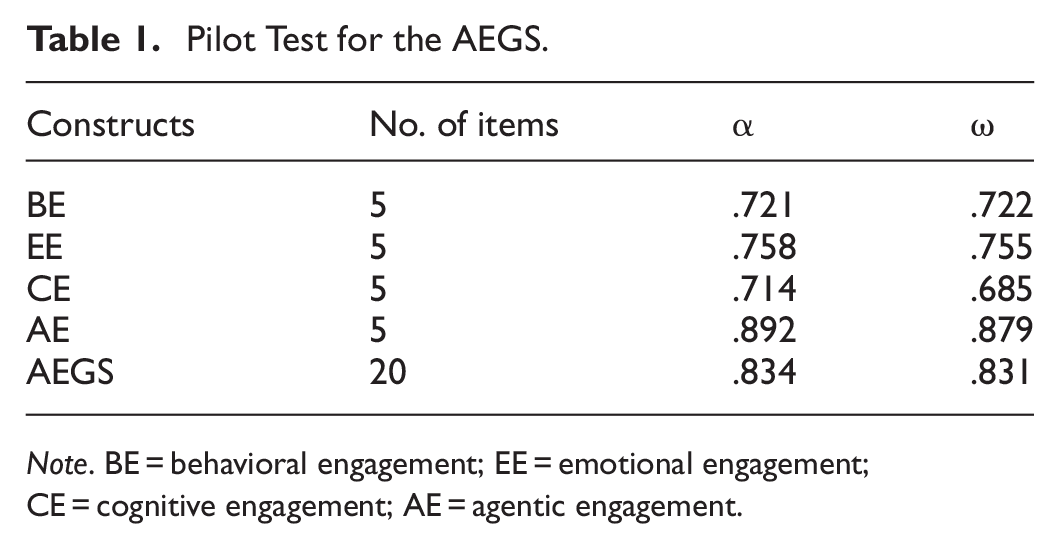
A pilot test was conducted utilizing a sample of 50 Economics students from a distinct university. For the pilot test of the instrument, a sample of items was evaluated across dimensions of BE, EE, CE, and AE, comprising five items each. The reliability coefficients (α and ω) ranged from .685 to .892, indicating acceptable internal consistency within the respective scales (Hajjar, 2018; Raharjanti et al., 2022). Additionally, the overall AEGS, comprising 20 items, demonstrated satisfactory reliability with coefficients of .834 (α) and .831 (ω). Table 1 provides an overview of the results obtained from the pilot test.
Pilot Test for the AEGS.
Note. BE = behavioral engagement; EE = emotional engagement; CE = cognitive engagement; AE = agentic engagement.
Academic Engagement Scale
The data utilized for the assessment of academic engagement was subjected to CFA. The CFA model for the academic engagement construct is depicted in Figure 1.

A four-factor CFA model for AEGS.
The results of the CFA for the four-factor AEGS were computed using the Maximum Likelihood (ML) technique, and the outcomes were ascertained using goodness-of-fit indices. These indices determined the feasibility of an exact fit or an approximate fit (SRMR ≤ 0.08) based on the criteria set forth by Asparouhov and Muthen (2018). This assessment is crucial for evaluating loading and AVE to establish construct validity. The results of the goodness-of-fit are presented in Table 2.
Goodness of Fit Indices for AEG Scale.

The evaluation of the goodness-of-fit indices, which assess the suitability of an exact or approximate fit (with an SRMR of ≤.08) to determine the validity of the standardized regression weights (i.e., loadings) and AVE for evaluating construct validity, is crucial. These indices indicate that the Academic Engagement (AEG) Scale exhibits an approximate fit (with an SRMR of ≤.08) for the four-factor AEG construct, as shown in Table 2. Also, all the other model fit indices were within the recommended threshold (
Items, Factor Loadings, Reliability, and AVE of AEG Scale.

Note. α = Cronbach alpha; ω = McDonald omega; AVE = average variance extracted; CR = composite reliability.
p < .01.
From Table 3, only item EE1 had low factor loading and it was deleted based on the recommendation of Pallant (2020). It can be observed that all the regression estimates were significant (Awang, 2014). The values of α (e.g.,
Discriminant Validity for AEG Scale
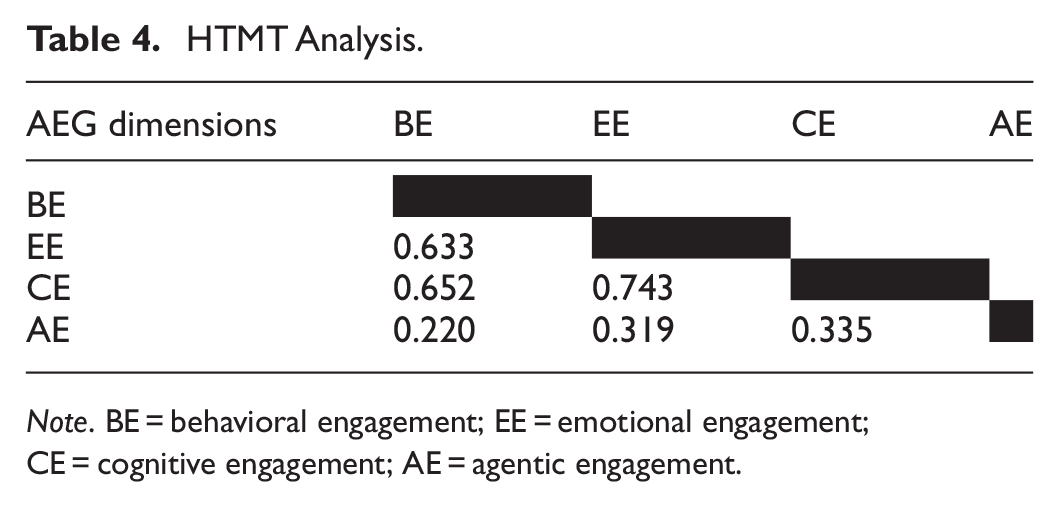
The discriminant validity for the AEG scale was examined using HTMT criterion. Table 4 shows the results of the HTMT ratio.
HTMT Analysis.

Note. BE = behavioral engagement; EE = emotional engagement; CE = cognitive engagement; AE = agentic engagement.
Table 4 reveals that the HTMT ratio of the constructs vary between 0.220 and 0.743, all falling below the recommended threshold of 0.85 as suggested by Henseler et al. (2015). As a result, the fulfillment of discriminant validity is confirmed based on adherence to the HTMT criterion.
Procedure for Data Collection
The data collection process required the active involvement of three trained research assistants, who were thoroughly briefed on the contents of the questionnaire and administration protocols. The questionnaires were distributed in the lecture theatres of the University in Ghana, with permission from the lecturers in charge of the classes. This method allowed access to a diverse and representative sample of students from various academic settings within the university. The collaboration of lecturers not only facilitated the logistical aspects of data collection but also created a conducive environment for research participation. The data collection process took place over 2 weeks in August 2023, during which participants completed questionnaires lasting 25 to 30 min each. This timeframe was considered sufficient to encourage thoughtful responses while maintaining efficiency during the data collection process. Upon completion, the research assistants collected all questionnaires and ensured confidentiality by sealing them securely in brown envelopes.
Data Processing and Analysis
The demographic profiles of the respondents were analyzed using clustered bar graph after coding and entering the data into the “Statistical Product for Service Solutions (SPSS) 28.” Descriptive statistics, including “means and standard deviations,” and “one-way repeated-measures ANOVA” were used to analyze research objective 1. Inferential statistics, specifically a “two-way multivariate analysis of variance (MANOVA),” was used to analyze research aim 2 in order to robustly assess the variation in economics students’ academic engagement (including “behavioral, emotional, cognitive, and agentic engagement”) across gender and academic level. “MANOVA” was particularly appropriate for this analysis as it allows the simultaneous examination of multiple dependent variables (the four dimensions of academic engagement) and their interactions with two independent variables—gender and academic level. By using a “two-way MANOVA,” the study was able to identify both the main effects of gender and academic level on the different types of engagement, as well as any interaction effects between these factors, providing a nuanced analysis that could not be achieved using a univariate approach. Also, to ensure the validity of the MANOVA results, assumptions such as normality, homogeneity of variance-covariance matrices (Box’s M test) and absence of multicollinearity were tested. Robustness checks, including Levene’s test for equality of variances and post hoc analyses, were performed to confirm the stability of the results. In addition, effect sizes (such as partial eta squared) were reported to provide insight into the practical significance of the observed differences. A total of 452 questionnaires were received from 497 distributed to the students, resulting in a return rate of 90.95%.
Ethical Considerations
The study upheld ethical standards, as demonstrated by obtaining ethical clearance from the “Institutional Review Board (IRB) of the researchers’ university (Ethical Clearance—ID [UCCIRB/CES/2023/154]). in the sentence “The study upheld ethical…”.].” Before participation, the students were provided with informed consent forms to ensure transparency and voluntary involvement in the research process. Additionally, rigorous measures were enforced to ensure the confidentiality and anonymity of the respondents’ inputs, thus protecting their privacy and maintaining the ethical integrity of the study. These ethical measures underscored the dedication to adhering to research principles and respecting the rights and well-being of participants involved in the study.
Results
Demographic Characteristics of the Respondents
The number of male Economics students (n = 308, 61.1%) was more than twice the number of the females (n = 144, 31.9%). According to the results, a larger proportion of higher education Economics students were male. Moreover, the majority (n = 195, 43.1%) of the students were in Level 100, while the minority (n = 81, 17.9%) of were in Level 400. Furthermore, a clustered bar chart was utilized to analyze a combination of academic level and gender. Figure 2 shows a joint analysis of the academic level and gender of Economics students.
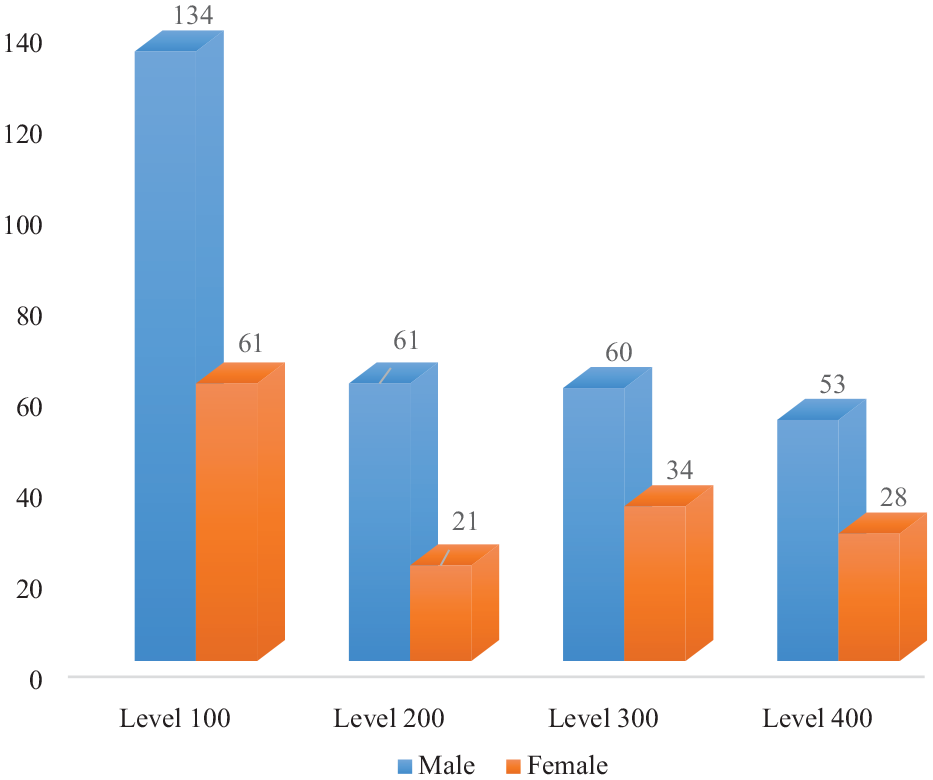
A clustered bar chart for a coordinated analysis of academic level and gender.
From Figure 2, the results reveal the majority of male (n = 134) and female (n = 61) Economics students are in Level 100. On the contrary, a minority of male students (n = 53) and female students (n = 21) were in Levels 400 and 200, respectively.
Economics Students’ Level of Academic Engagement
The Economics students’ level of academic engagement was examined. This helped to gauge their academic engagement in the learning of Economics. In order to achieve this objective, the following research question was formulated: What is Economics students’ level of academic engagement? The academic engagement scale (AEGS) was employed to collect this data. The data were analyzed and discussed using mean and standard deviation. The summarized descriptive results are presented in Table 5.
Economics Students’ Level of Academic Engagement.

Note. Scale: 1.00 to 1.49 (Very Low); 1.50 to 2.49 (Low); 2.50 to 3.49 (Moderate); 3.50 to 4.49 (High); 4.50 to 5.00 (Very High). BE = behavioral engagement; EE = emotional engagement; CE = cognitive engagement; AE =agentic engagement.
Generally, the results in Table 5 show that the academic engagement of Economics students was notably high (
Also, it can be observed from Table 5 that the academic engagement dimension that recorded the highest mean (M = 4.22, SD = 0.94) was “BE.” Concerning behavioral academic engagement, the students indicated that “they follow rules and regulations in the Economics class” (M = 4.37, SD = 0.86) and “usually do their assignments on time” (M = 4.30, SD = 0.88).
With regard to “emotional engagement,” the students stated that “Economics classroom is an interesting place to be” (M = 4.05, SD = 0.91) and “they are interested in the Economics course work” (M = 4.00, SD = 0.93). In summary, the level of academic engagement of Economics students was high on all the defining academic engagement dimensions except for “AE.” The means of the academic engagement factors suggested that they had high level of behavioral academic engagement (M = 4.22, SD = 0.94) as compared with “emotional engagement” (M = 3.97, SD = 0.96), “cognitive engagement” (M = 4.08, SD = 0.88), and “agentic engagement” (M = 3.39, SD = 1.28). Currently, making simplistic and broad assertions about these mean differences appears unfeasible, primarily due to the ambiguity surrounding their statistical significance. Therefore, a “one-way repeated-measures ANOVA” was performed, and the results are detailed in Table 6.
Repeated ANOVA Tests of Within-Subject Effects for Academic Engagement.

Note. AEG = academic engagement;
The “Mauchly’s test” revealed that the assumption of sphericity had been violated, with χ2(5) = 310.772, p < .001. The “Greenhouse-Geisser statistic” was used to correct the degrees of freedom based on the recommendation of Pallant (2020). Hence, using the Greenhouse-Geisser corrected estimate of sphericity, the results reveal that the mean scores for the AEG factors were statistically significantly different, F(2.109, 910.378) = 127.979, p < .001,
Pairwise Comparisons of Academic Engagement Dimensions.

Note. 1 = behavioral engagement; 2 = emotional engagement; 3 = cognitive engagement; 4 = agentic engagement; AEG = academic engagement; SE = standard error; LLCI = lower limit confidence intervals; ULCI = upper limit confidence intervals.
Mean difference is significant.
It can be observed from Table 7 that “behavioral engagement” (1) is statistically higher than emotional engagement (2), “cognitive engagement” (3), and “agentic engagement” (4). Also, a significant disparity is evident between “emotional engagement” (2) and “cognitive engagement” (3). Consequently, it can be inferred that Economics students exhibit a higher level of BE compared to their EE, CE, and AE.
Variations in Academic Engagement based on Gender and Academic Level
This research hypothesis was meant to determine the variations in academic engagement based on gender and academic level. The differences in academic engagement based on gender and academic level was examined through a “two-way factorial MANOVA.” The “two-way factorial MANOVA” was used because the independent variables (gender and academic level) in this hypothesis are two and the dependent variable (academic engagement) has four dimensions. The skewness values for all variables are within the acceptable range of −2 to +2 (Hair et al., 2022), while the kurtosis values are within the ±10 threshold (Collier, 2020), indicating that the data meet the assumptions of normality (see Table 8). In addition, the correlation between the dependent variables were examined prior to conducting the MANOVA (Grice & Iwasaki, 2008; Tabachnick & Fidell, 2019). Table 9 shows correlation matrix for the dimensions of academic engagement (AEG).
Normality Results of the Variables.

Note. SE = Standard error.
Correlation Matrix for Dimensions of AEG.

Note. BE = behavioral engagement; EE = emotional engagement; CE = cognitive engagement; AE = agentic engagement.
p < .001.
The significant correlations among dependent variables in Table 9 supported the use of MANOVA to assess differences in Economics students’ academic engagement across gender and academic level. Descriptive statistics for academic engagement by gender and academic level are shown in Table 10.
Descriptive Statistics for AEG Dimensions Based on Gender and Academic Level.

Note. BE = behavioral engagement; EE = emotional engagement; CE = cognitive engagement; AE = agentic engagement.
As indicated in Table 10, it appears that Economics students who are males have high BE (M = 4.23, SD = 0.79), EE (M = 3.99, SD = .85), CE (M = 4.09, SD = .66), and AE (M = 3.48, SD = 1.13) as compared to females. Additionally, it seems that Economics students who are in level 200 have higher BE (M = 4.60, SD = .40) and CE (M = 4.22, SD = .49) than those in levels 100, 300, and 400. Moreover, from Table 10, it appears that Economics students who are in level 100 have higher AE (M = 3.75, SD = .99) than those in levels 200, 300, and 400.
In addition, the results from Levene’s test suggested that error variances were equal. Table 11 displays the results for variations in academic engagement among Economics students according to gender and academic level.
MANOVA Results for Difference in AEG Based on Gender and LES.

Note. Box’s M = 253.105, F(70, 68762.495) = 3.470, p < .001; V = Pillai’s trace;
The “Box’s M test” assessing the equality of homogeneity of variance-covariance matrices yielded a statistically significant result (M = 253.105, F(70, 68762.495) = 3.470, p < .001; see Table 11), indicating a violation of the assumption of equal homogeneity of variance-covariance (Tabachnick & Fidell, 2019). In such instances, Pallant (2020) suggested employing Pillai’s Trace. Consequently, the Pillai’s Trace test was employed to examine statistical significance, as it is considered more robust in cases where the assumption has been violated, as advised by Pallant (2020).
The results in Table 11 indicate that “there are statistically significant differences in Economics students’ academic engagement based gender” (main effect), F(4, 441.000) = 2.786, p = .026; V = 0.025,
Pallant (2020) recommended employing the Bonferroni adjustment to ascertain the significance level due to the distinct analyses at the univariate level. Therefore, the initial p-value of .05 underwent division by the number of dependent variables, yielding .05/4 = .0125, approximately equal to .013. Significance is attributed to results only when the p-value is less than .013. The results of the univariate analysis are summarized in Table 12.
Tests of Between-Subjects Effects.

Note. Bonferroni adjustment at p < .0125 (0.05/4). BE = behavioral engagement; EE = emotional engagement; CE = cognitive engagement; AE = agentic engagement.
In Table 12, the corrected models for AEG dimensions were not statistically significant except for BE, F(7, 444) = 4.446, p < .001; and AE, F(7, 444) = 7.883, p < .001 were statistically significant. Also, significant difference was observed in Economics students’ agentic engagement, F(1, 444) = 10.388, p = .001,
Moreover, significant difference was found in Economics students’ behavioral engagement, F(3, 444) = 7.907, p < .001,
Furthermore, no significant differences were found in Economics students’ academic engagement for the two-level interaction effect (gender × academic level [G × LES]). In order to identify the specific academic levels at which differences in students’ BE and AE occur, a “post hoc analysis” was carried out. Table 13 presents a summary of the “post hoc analysis.”
Multiple Comparison of Differences in BE and AE Based on Academic Level.

Note. Bonferroni adjustment at p < .0125 (0.05/4). BE = behavioral engagement; AE = agentic engagement.
Mean difference is significant.
In Table 13, the “Turkey’s HSD post hoc test” shows that there is a statistically significant difference in students’ BE between those who are in level 100 and 200 ([I − J] = −0.5341, p < .001); 200 and 300 ([I − J] = 0.4006, p = .002); and 200 and 400 ([I − J] = 0.3950, p = .004). This result suggests that Economics students who are in level 200 have higher BE compared to those in levels 100, 300, and 400.
Additionally, there are a statistically significant differences in Economics students’ agentic engagement between those in level 100 and levels 200, 300, and 400 (see Table 13). Interestingly, this result suggests that although agentic engagement was moderate, level 100 students had higher AE as compared those in levels 200, 300, and 400.
Discussion
The current study examined academic engagement among Economics students in higher education in Ghana. Research objective one examined Economics students’ level of academic engagement. The study found out that Economics students had high level of academic engagement. Firstly, a high level of academic engagement among Economics students suggests a strong connection and investment in their academic pursuits. This may indicate that students in the field of Economics are motivated and actively participating in their learning experiences, demonstrating a genuine interest in the subject matter. The high level of academic engagement aligns with research suggesting that when students are engaged in their studies, they are more likely to achieve better academic outcomes and develop a deeper understanding of the material. This finding supports Astin’s (1999) theory of “student involvement” by suggesting that students with higher levels of involvement in learning activities—such as attending lectures, participating in discussions and engaging in self-directed study—are more likely to exhibit greater academic engagement.
Additionally, the findings of the current study present a noteworthy departure from the conclusions drawn in several prior investigations, including those conducted by Appiah-Kubi et al. (2022), Bayoumy and Alsayed (2021), Mahama et al. (2022). This discrepancy in the results prompts a thorough exploration of the contextual and methodological disparities that may account for these variations. Appiah-Kubi et al. (2022) and Bayoumy and Alsayed (2021) reported a moderate level of academic engagement among students, a finding divergent from the current study. It is crucial to note the differences in the sampled populations and the educational levels assessed in these studies. Appiah-Kubi et al. focused their investigation on 315 SHS students, whereas Bayoumy and Alsayed concentrated on university students. The shift from high school to university often involves a transition in academic expectations, instructional methodologies, and overall educational environments, potentially influencing observed levels of academic engagement.
Moreover, the nuanced differences in academic engagement levels reported by Appiah-Kubi et al. (2022) and Bayoumy and Alsayed (2021) could be attributed to the unique characteristics and demands associated with these distinct educational stages. A comprehensive examination of the factors contributing to academic engagement requires consideration of how they manifest and evolve across diverse academic settings. Additionally, the study conducted by Mahama et al. (2022) stands in contrast to the findings of the current research by asserting that college of education students exhibited a low level of academic engagement. This raises questions regarding the potential impact of a specific educational context on academic engagement levels. Differences in programme structures, curricular emphases, and teaching approaches within college of education settings may contribute to these disparate outcomes.
From an institutional perspective, the finding highlights the potential effectiveness of the educational programmes and teaching methods within the Economics curriculum. It implies that the content and delivery of the courses may be resonating well with the interests and goals of the students, fostering a positive and engaging learning environment. Additionally, it suggests that the educational institutions providing higher education in Economics may have implemented strategies or initiatives that promote student involvement, participation, and enthusiasm for their studies. Recognizing the high level of academic engagement can guide educators and institutions in identifying successful practices and areas for potential improvement within the Economics education curriculum.
Also, the observation of a high level of academic engagement in higher education Economics students underscores the importance of maintaining and further enhancing the factors contributing to this positive learning environment. Institutions may consider continuous evaluation and refinement of their teaching methodologies, incorporating interactive and participatory approaches that stimulate students’ interest and involvement. Moreover, educators can leverage the students’ enthusiasm by incorporating real-world examples, case studies, and practical applications in the curriculum. The finding invites a deeper exploration into the specific aspects of the Economics education experience that contribute to this high level of engagement, fostering a more comprehensive understanding of effective teaching and learning practices within the discipline.
Specifically, Economics students had high level of behavioral, cognitive, and emotional engagement. When Economics students exhibit high level of emotional engagement in a learning endeavor, it signifies a significant allocation of their affective resources toward the assigned tasks. This suggests a deep involvement and investment in the subject matter, wherein students manifest a heightened level of emotional connection and commitment to the learning process (Weng & Chiu, 2024). Such emotional engagement reflects a dynamic interaction between the individual’s affective responses and the learning context, potentially influencing their overall learning outcomes and academic performance. In addition, an elevated degree of cognitive engagement among Economics students implies a propensity for reflective consideration regarding their commitment to exert efforts in comprehending learning materials and honing skills (Li et al., 2021; Weng & Chiu, 2024). This phenomenon underscores a scholarly dedication wherein students actively contemplate and deliberate upon their readiness to invest intellectual resources toward grasping the subject matter and refining their competencies within the discipline of Economics. This heightened level of engagement underscores a profound commitment to academic pursuits, reflecting a conscientious approach toward academic endeavors characterized by a diligent pursuit of comprehension and skill acquisition.
The finding concerning high cognitive engagement of higher education Economics students validates that of Yidana and Arthur (2022), who discovered that SHS Economics students exhibited high level of cognitive engagement. It is important to note that the recent finding pertains to higher education Economics students, while Yidana and Arthur study focused on SHS Economics students. The transition from high school to higher education often involves changes in curriculum, teaching methods, and student expectations, which can impact cognitive engagement. Hence, caution should be exercised when comparing the findings of the two studies. Additionally, other studies (Cornell et al., 2016; Delfino, 2019) have demonstrated that students exhibit a high level of cognitive engagement. Nevertheless, Ayub et al. (2017) discovered that the degree of students’ involvement in Mathematics was of a moderate magnitude. In contrast to the findings of the current study, several studies (Estévez et al., 2021; Mahama et al., 2022; Shukor et al., 2014) have demonstrated that students typically exhibit low levels of cognitive engagement.
Conversely, higher education Economics students exhibited a moderate level of agentic engagement. This finding suggests that within the context of higher education, Economics students demonstrate a discernible level of agentic engagement, albeit at a moderate intensity. Agentic engagement, pertains to the proactive endeavors undertaken by individuals to actively contribute to their own learning and the teaching process (Reeve et al., 2020, 2022). The moderate level of agentic engagement observed among Economics students indicates a degree of proactive involvement in their academic pursuits, where they are inclined to communicate their requirements for effective learning experiences. This manifestation underscores a constructive relationship between students and educators, wherein students play an active role in shaping their learning environment by articulating their educational needs. The moderation in agentic engagement might be influenced by various factors, including the complexity of the subject matter, individual learning preferences, and the academic culture within the Economics programme. This finding underscores the importance of recognizing and supporting students’ autonomy and agency within the learning environment while also prompting educators and institutions to explore strategies that may further enhance students’ self-directed learning skills in the context of Economics education.
The second research objective determined the variations in academic engagement among Economics students based on gender and academic level. The study showed that there was no significant variation in cognitive, behavioral, and emotional engagement based on gender. This suggests that Economics students’ cognitive, behavioral, and emotional engagement were not susceptible to their gender. This finding confirms that of Appiah-Kubi et al. (2022) and King (2016), who found no substantial variation in academic engagement based on gender. Although the findings of the current study, Appiah-Kubi et al., and King are similar, it is worth noting that their studies focused on SHS students. Also, the study revealed that, at the univariate level, although agentic engagement was moderate, males exhibited higher agentic engagement compared to females. The finding suggests that, when examined individually (at the univariate level), there is a noticeable difference in agentic engagement between male and female Economics students. Specifically, despite both genders demonstrating a moderate level of agentic engagement, males displayed a higher degree of this type of engagement compared to their female counterparts. This observation implies potential gender-related distinctions in the way Economics students approach and participate in agentic aspects of their academic pursuits. The term “agentic engagement” often involves self-driven, proactive, and goal-oriented behaviors, indicating that male students, on average, may exhibit a greater degree of initiative, self-motivation, or proactive involvement in their academic activities within the context of the Economics discipline. This finding is not in harmony with that of Ganiyu (2021) who found that male students had high level of behavioral engagement as compared to females. Similarly, this finding is not consistent with that of Santos et al. (2021), who found that women had higher levels of engagement than men.
Furthermore, significant differences were identified in both behavioral and agentic engagement based on students’ academic level. Specifically, students at the 200 academic level demonstrated higher levels of behavioral engagement compared to their counterparts at levels 100, 300, and 400 within the Economics programme. This finding suggests that Economics students’ behavioral engagement is sensitive to their academic level. This finding lends credence to the assertion of Canchola González and Glasserman-Morales (2020) that academic engagement among students may be influenced by certain profile characteristics such as academic level. On the contrary, Ganiyu (2021) observed no differences in engagement levels among college of education science students at various academic stages. The higher level of behavioral engagement among 200-level Economics students may be due to several factors, including their transition from basic to discipline-specific courses, which may increase interest and motivation. At this stage, students are more familiar with university expectations and are likely to have developed better study habits than first-year students who are still adjusting. In addition, teaching styles and assessment methods at this level may be more interactive, incorporating case studies, discussions, and problem-solving activities that encourage engagement. Unlike students at levels 300 and 400, who may experience an increased academic workload and stress related to graduation requirements, students at level 200 may have a relatively balanced academic experience, allowing for greater participation. In addition, the stronger social and academic support networks developed by this stage could increase motivation and peer collaboration, contributing to higher engagement. Future studies could further explore these factors to gain deeper insights into the differences in behavioral engagement across academic levels.
Moreover, it was unexpected to observe that students in level 100 exhibited higher agentic engagement than those enrolled in levels 200, 300, and 400. This finding is consistent with that of Hartono et al. (2019) found that students in lower grades demonstrated higher levels of engagement than those in higher grades. This unexpected finding suggests that, contrary to expectations, students at the 100 academic level display higher levels of agentic engagement than their counterparts in higher academic levels (200, 300, and 400). One plausible explanation for this finding may involve the novelty of the academic environment for level 100 students. As students transition into higher academic levels, the initial exposure to new and challenging concepts may foster a heightened sense of autonomy and proactivity in their learning approach.
Additionally, it is conceivable that students at the 100 academic level perceive their coursework as foundational, sparking a greater intrinsic motivation to take initiative and be self-directed in their studies. The absence of more advanced or specialized content at this stage could potentially lead to a stronger focus on agentic engagement as students establish their academic footing. Furthermore, individual differences and the diverse academic backgrounds of students entering the programme might contribute to variations in agentic engagement across different levels. This observation underscores the need for a nuanced understanding of factors influencing agentic engagement, challenging assumptions about its linear progression with academic advancement. However, gender and academic level had no interaction effect on students’ academic engagement. This is a novel finding since no study has determined the interaction effect of gender and academic level on Economics students’ academic engagement. The absence of an interaction effect implies that any differences in academic engagement between genders or across academic levels are not dependent on or influenced by the combination of both factors. For example, it suggests that the effect of gender on academic engagement is consistent regardless of whether students are at lower or higher academic levels within the Economics discipline. Similarly, the academic level’s influence on engagement is not modified by gender.
Conclusions
Economics students demonstrated a notably high level of academic engagement, emphasizing their active participation, and commitment to academic endeavors within the discipline. It was also found that there was no significant difference in academic engagement based on gender or academic level. Therefore, it can be concluded that gender and academic level had no interaction effect on the academic engagement of HE Economics students. However, at the univariate level, it was discovered that there was a significant gender difference in the agentic engagement of Economics students. Additionally, significant differences were identified in both behavioral and agentic engagement based on students’ academic level. Hence, we can conclude that agentic engagement depends on gender and academic level. Lastly, we conclude that the behavioral engagement of HE Economics students is susceptible to their academic level.
Recommendation
In order to further increase the academic engagement of Economics students, the study recommends that, higher education institutions should adopt participatory teaching methods that actively involve students in the learning process. Lecturers should incorporate interactive lectures, group discussions, and problem-based learning to create a more engaging classroom environment. Encouraging students to work on real economic problems, analyze case studies and participate in simulations can make learning more practical and relatable. In addition, the use of peer learning strategies, such as structured debates and collaborative projects, can promote deeper engagement by encouraging critical thinking and teamwork.
Given the differences in academic engagement between genders and academic levels, institutions should implement tailored support systems to meet the diverse needs of students. For example, mentoring programmes and peer-assisted learning initiatives can provide personalized academic support for students who may struggle with engagement. Flexible teaching approaches, such as flipped classrooms and differentiated instruction, should be adopted to accommodate different learning styles and abilities. By using learning analytics, teachers can track student participation and provide targeted interventions for those at risk of disengagement.
Additionally, to ensure that Economics students remain engaged, curriculum design should emphasize practical and experiential learning opportunities. Incorporating internships, field projects, and industry collaborations into the curriculum allows students to apply theoretical knowledge in real-world settings, making learning more meaningful. In addition, the integration of technology-enhanced learning tools such as AI-based tutoring systems, gamified learning activities, and interactive online platforms can sustain engagement, especially for students in distance or hybrid learning environments. Lastly, higher education leaders and policymakers should support faculty development programmes that equip educators with evidence-based teaching strategies to increase student engagement. Institutions should invest in workshops and professional development initiatives that train faculty in assessment strategies that promote engagement, and the use of analytics to monitor and improve student participation.
Limitations of the Study
The study employed a quantitative approach to examine academic engagement among Economics students in Higher Education. However, this design may have limited the depth of understanding regarding the nuanced and subjective aspects of academic engagement. Additionally, factors such as sample size could affect the generalizability of the findings. Future research should consider mixed methods to integrate quantitative data with qualitative insights, providing a more comprehensive understanding of academic engagement in Higher Education.
Footnotes
Acknowledgements
None.

Ethical Considerations
Ethical approval was sought from the “Institutional Review Board (IRB) of the University of Cape Coast (Ethical Clearance—ID [UCCIRB/CES/2023/154]).”
Funding
The author(s) received no financial support for the research, authorship, and/or publication of this article.
Declaration of Conflicting Interests
The author(s) declared no potential conflicts of interest with respect to the research, authorship, and/or publication of this article.
Data Availability Statement
Data will be made available upon request from the corresponding author.