



Abstract
This study investigates the factors influencing university students’ intentions to pursue careers in the Bangladeshi media industry, concentrating primarily on the socio-economic background, personal attributes, sectoral interests and negative insights of the profession. The study uses a cross-sectional survey to collect data from 340 students of the journalism discipline at 16 public and private universities based on stratified random sampling. Chi-square tests, ordinal regression and the Spearman rank-order correlations were employed to observe the relationships among major variables. The results indicate that students from affluent families exhibit a greater interest in media careers. The academic year was a major factor, with first-year students being more likely to work in media than students in later years. In addition, Students who wanted to work in newsrooms, digital media and news presentation were more likely to make a career in media. On the other hand, negative perceptions, particularly ethical considerations, the job environment and corporate intrusion, were strongly interconnected to lower career goals in media. This study provides a theory-driven explanation of how self-efficacy, structural resources and perceived barriers influence the decisions regarding media careers in the Global South, integrating Human Capital Theory and Social Cognitive Theory into research design and interpreting the findings. These results further underscore the difficulties of making professional decisions in the media industry and highlight the importance of overcoming structural barriers, increasing industry standards, and providing precise support toward a media career.
Keywords
Introduction
Bangladesh, a rapidly developing South Asian country with a population of 172.92 million (Bangladesh Bureau of Statistics [BBS], 2023), has seen its media landscape change dramatically since gaining independence in 1971. Following decades of tight government control, the country began a steady process of media liberalization in the 1990s, marked by the growth of private broadcasting and the proliferation of news platforms (Genilo & Shafi, 2013; Mursalin, 2019; Shoesmith & Genilo, 2013). This evolution was fueled by advances in information and communication technologies, globalization, the rise of a new middle class, and an increasingly literate population (Khan, 2020; Shoesmith & Genilo, 2013; Ullah, 2016). Today, Bangladesh boasts a diverse media ecosystem comprising over 39 television channels, hundreds of online news portals, numerous radio stations, and more than 580 daily newspapers and periodicals, supported by widespread internet and mobile access (Bangladesh Telecommunication Regulatory Commission [BTRC], 2024; Ministry of Information and Broadcasting [MIB], 2023).
However, this quantitative evaluation of growth is seldom the entirety of the scene, it needs to be coupled with a qualitative growth of professionalism within the journalism and media industry as well. Despite the institutionalization of journalism and media studies through dedicated programs at 32 higher educational institutions across the country (Mursalin & Huda, 2025), the industry is still facing a critical shortage of qualified and ethically and intellectually committed media professionals (Donsbach, 2014; Saleem, 2021). This is especially worrisome given the critical role that journalism occupies within any functioning democratic culture for ensuring transparency and public accountability (Fenton, 2010; McNair, 2009; Sulzberger, 2023). The current surge within digital media and algorithm-driven journalism platforms, media consumption behavior trends and the existence of more rewarding career alternatives have downtrodden the exuberance of traditional journalism (Pereira, 2019; Wallis et al., 2019).
The causes and consequences of such a gap in professionalism and professionals can be understood from multiple dimensions within the framework of micro-, meso-, and macro-parameters. Some such parameters at the micro-level include career-orientation dimensions for students within the context of socio-economics and positional parameters such as exposure and perceptions on career and journalistic services that include concerns for ethical ambiguity and impermanence within journalistic profession parameters (Cohen, 2015; Cushion, 2007; Deuze, 2005; Hardin & Whiteside, 2009; Quinlan & Corbin, 2023; Wallis et al., 2019). On the other hand, at the macro-level parameters for such a profession gap include lack of public trust within media houses and survival priorities within journalistic professionalism for corporate media with the emphasis on acquisition and maximization of profits and media-related market trends and ambiguity (Ashton, 2015; Chowdhury & Akhther, 2017; Hanitzsch et al., 2017; Lewis & Usher, 2013; Newman et al., 2023). Research and studies declare that untying such socio-psychic parameters is necessary for recasting journalism-based curricular parameters and restructuring career development frameworks (Gondwe & Awami, 2024; Muringa & Adjin-Tettey, 2025; Mursalin & Huda, 2025).
In this context, this research initiates a comprehensive exploration on the socio-economic factors and preferences that influence the willingness among Bangladeshi university students to take up a career in the media industry. In this endeavor to harness the meticulous interplay between the motivational processes at the micro-level and the structural trends at the macro-level within the context of the media economy across the nation, this research hopes to produce informed and fertile knowledge for all stakeholders concerned with the eventual nurturing and production of a critical and conscientious community of media professionals equipped to meet the needs arising out of the dynamically changing and complex media environment within Bangladesh.
The research will also focus on providing an elaborate description of the factors that influence the decision of pursuing media career among university students. To begin with, the study aims to explain the connection between the income of a family and the tendency of students to choose jobs in the media. It also measures the impact of personal factors, which include academic year, gender, academic achievement and residence on the probability that students would pursue a future in media. It also investigates the relationship between general career ambitions of students and their preference of certain media industries including newsroom, reporting, production, digital, and news presenting. In addition, the study focuses on and evaluates the major negative attitudes and institutional obstacles that can discourage students from considering the media as a possible occupation. Taken together, these aims position the study to speak not only to empirical patterns in Bangladesh but also to broader theoretical debates about how structural resources, perceived returns, and self-efficacy shape career decision-making in precarious media labor markets. Based on these insights, the study aims to provide practical recommendations for educational institutions and policymakers to more effectively support and guide students interested in media professions.
Literature Review
Theoretical Approaches to Career Choice
There is no single and unified theoretical framework that can be used to comprehend media career choices; therefore, scholars have resorted to using outside frameworks to examine the factors that influence the aspirations of students who have chosen to pursue this career (Mursalin & Huda, 2025, p. 3). The Human Capital Theory (HCT) is a primordial theory, which assumes that people make investment in education and training in an attempt to maximize the returns which are expected, in research studies it has been proven that higher education pays off in terms of better lifetime income (Becker, 1964; Schultz, 1961). Various fundamental forms of human capital, such as training, education, and individual progress, boost income as well as productive capacity, which is significant for the development of personal growth and national financial progress (Aliaga, 2001; Nafukho et al., 2004; Tan, 2014). Reflecting on the HCT, students who think media education can bring brighter career outcomes are likely to pursue a career in media.
Nevertheless, returns vary by degree type, major subject, and labor market context because the advantages of education are changeable (Oreopoulos & Petronijevic, 2013). Students generally strive to acquire additional skills to remain competitive in the labor market because they frequently view degrees as diminishing in value (Tomlinson, 2008). In addition, socio-economic status, gender, and the academic setting also affect employability, reflecting challenges as economic means (Moreau & Leathwood, 2006; Tan, 2014). Furthermore, Marginson (2019) criticized HCT for failing ‘the test of realism due to weaknesses of method’ (p. 5), and for explaining the complex interplay of education and work by imposing a single linear lens. He also argues that the theory cannot explain how education increases productivity, the issue of unequal salaries, or the role of status.
While HCT emphasizes the role of external structural factors like educational investment and Skills acquisition in shaping career choices, Social Cognitive Career Theory (SCCT) supplements by elucidating the psychological mechanisms, such as self-efficacy and interest, that influence how students interpret and respond to these investments.
SCCT focuses on the dimensions of social anticipation, individual interests, and self-efficacy, which influence the decisions of career (Lent et al., 1994; Lent & Brown, 2019). The theory suggests, students with higher perceived competence in media production are more likely to pursue a media career. Together with the educational investment and acquisition of skills, the notion of passion, creativity, and inherent inspiration in the context of media and journalism are also major factors regarding the pursuit of a career (Iyer & Siddhartha, 2020). This context is critical for comprehending the role of individual choices and external determinants in shaping a career. So together, HCT and SCCT offer complementary lenses, yet prior work has rarely integrated them systematically to explain media career decisions in the Global South, leaving a conceptual gap that this study addresses.
Socio-Economic Factors Shaping Media Career Aspirations
Career decision-making has been extensively examined in higher education and professional contexts, but it has received less systematic attention in journalism studies. Powers (2025) contends that academic works on journalism have not focused much on why individuals choose to pursue media careers in journalism even though despite low salaries and perilous environments. In addition, he criticizes that the existing scholarships ignore the key social factors, including class, family upbringing, and job market chances, on the side of paying attention to newsroom rules and desire-based enthusiasm. Powers proposes a revitalized sociology that studies the process through which journalists develop and sustain the perception that journalism is a rewarding profession. He contends that this belief is shaped by long-term social factors such as family background, class, education, and national labor conditions, which influence both entry into journalism and decisions to remain.
Journalism faces devaluation due to low pay, insecure contracts, and barriers to entry that advantage the middle class and marginalize the less privileged (Cushion, 2007). On the other hand, other studies (Croll, 2008; Hardin & Whiteside, 2009; Saha & Bala, 2024) have focused on factors that exacerbate structural inequalities, including commercial pressures and technological change in media industries, and disproportionately disadvantage women and individuals from lower socio-economic backgrounds. Family income, parental occupation, and access to resources all have a substantial impact on students’ career ambitions and scope (Saha & Bala, 2024). However, these current geo-specific or scattered studies do not comprehensively cover the socio-economic dynamics that shape students’ career choice worldwide, yet in the south-Asian context.
While ambition and academic performance can help overcome some disadvantages, other studies (e.g., Hardin & Whiteside, 2009) indicate that the constraints of class, caste, and gender persist, especially in the South Asian context, which can lead to more conservative career aspirations among marginalized groups. For instance, female journalists frequently face occupational challenges in meeting the requirements of professional rules and norms, and many females do not endure in the field due to conflicts during working time and industry unpredictability (Hardin & Whiteside, 2009).
Cushion (2007) and Hardin and Whiteside (2009) demonstrate systematic barriers that limit the dissemination of journalism, but Quinlan and Renninger (2022) point out individual agency and passion as offsetting factors. So, students who are interested in a subject and have ‘career decidedness’ are far more inclined to turn their passion into career ambitions. But students need to get supportive career and academic guidance (Quinlan & Renninger, 2022). This tension between structural constraint and individual resilience is well recognized in Western and minority-world contexts but remains under-examined in Bangladesh, where media labor markets are highly precarious and classed. Yet, this conflict between systematic limitation and individual resilience remains inadequately examined, particularly in the contexts of the Global South.
Educational Trajectories and Evolving Aspirations
The educational development affects the job expectation of students significantly because it was found out that desires and determinations of students often change because of academic curriculum, workplace cognizance, and extracurricular participation (McKenzie & Bennet, 2022; Quinlan & Corbin, 2023). At the time of joining higher education, students normally have the general career goals and the university is the place where they get to experiment with a variety of careers. Thus, this concept explains the complexity of the career choice situation in the university years where universities are instrumental in providing career guidance.
Conversely, the individual and psychological factors, including parental imprisonment, maternal instinct, and self-confidence, also influence career progression, apart from the role of educational development (Bhatia et. al., 2023). Similarly, through conducting a longitudinal study, Helwig (2004) highlights the close linkages between career goals and parental relationships, age, and gender.
While Laguador (2013) focuses on the role of organizational support, active assignation, and prompt leadership for the success of students’ careers, Powers (2025) claims that the student’s career in journalism is formed by various social and national contexts, including backgrounds and trajectories. Despite such kinds of scholarship efforts, the impact of educational progress on career choices stayed scattered, in that the existing scholarships primarily represent the Western setting. In particular, little is known about how academic progression within journalism programs in Bangladesh may recalibrate students’ self-efficacy, outcome expectations, and perceived risks in line with SCCT and HCT. The current study investigates the linkages between educational paths and socio-cultural circumstances in shaping career choices of the students in Bangladesh to address the research gap.
Sectoral Preferences Within the Media Industry
Media career aspirations are significantly influenced by sectoral preferences, including interest in news, digital, and production roles. Ashton (2015) explains how entry-level positions like “runner” in movies and television are frequently seen as rites of passage, despite the fact that students gradually question the worth of these low-status, repetitious works in regard to higher learning speculation. Wallis et al. (2019) contend that the volatility and instability of careers in media compel numerous graduates to pursue impermanent, freelance, or low-wage employment, where networking and placements frequently outweigh conventional career trajectories. This brings up the matter of how students are dealing with their passions, the need for creativity in the job market, and the way the media functions in the country.
Wallis et al. (2019) also argue that although some individuals seek enduring industry relationships, the widespread job insecurity and temporary “short-life” careers compel many to depart from the sector, despite ongoing demand stemming from the creative synergy between media works and students’ skills and interests (p. 13).
In this context, Pereira (2019) indicates that journalists need to adjust to changes in technology and the demands of their jobs. Some are diligently acquiring new skills for digital roles, while others are substituting jobs because of pressure in the job market in different countries. Existing research, however, rarely quantifies how specific sectoral aspirations (e.g., newsroom vs. digital roles) statistically predict overall career likelihood once socio-economic factors and perceptions are controlled, which is a key contribution of the present study.
Perceptions and Barriers in the Media Industry
Students’ desire to pursue media careers is shaped by their perceptions of the media sector, particularly in terms of ethics, job environment, ownership and job security (Mursalin & Huda, 2025). In particular, political or corporate middling and market-oriented journalism can erode media credibility and lower job satisfaction (Andaleeb & Rahman, 2014; Chowdhury & Akhther, 2017). In Bangladesh, private media are highly commercialized and profit-driven, putting political bias and entertainment ahead of public interests (Haq, 2012; Mursalin, 2019; Rahman & Alam, 2014). As a result, these structural challenges, alongside negative perceptions regarding work surroundings and corporate control, dissuade many ambitious professionals (Mamun, 2025).
These viewpoints highlight how urgently structural changes are needed to enable ethical consideration, employment stability, and a sound workplace in order to draw diverse talent to the media sector. This study therefore, examines how such negative perceptions shape students’ decisions to pursue media careers and identifies specific structural changes that may address these concerns. Despite these insights, few empirical studies have simultaneously modeled negative perceptions alongside socio-demographics and sectoral interests within a multivariate framework, leaving open questions about which barriers exert independent effects on media career intentions.
Research Questions
Methodology
Study Design and Sampling
In this study, a cross-sectional survey was conducted to obtain a quantitative perspective of what motivates media career objectives in journalism majors in Bangladesh. We established it to gather information at a single time point when all the answers of everyone were at the same level regardless of their location (Babbie, 2020). In order to ensure that we included a broad sample of the population without draining the bank and getting stuck in isolated locations, we used stratified random sampling (Lohr, 2021). To begin with, we have drawn the list of 32 universities that have a Bachelor of Journalism and divided them into two groups: public (n = 12) and private (n = 20). We then randomly selected 16 universities (6 public and 10 private), which were half of each group. That combination was a balance that allowed us to cover a sufficient distance and remain cost-efficient, and keep the sample healthy at the same time.
Sample Size Determination
For a known population of 2,250 media students, Yamane’s (1967) formula was used to determine the sample, with a 5% margin of error. The calculation yielded a minimum required sample of approximately 340 respondents:



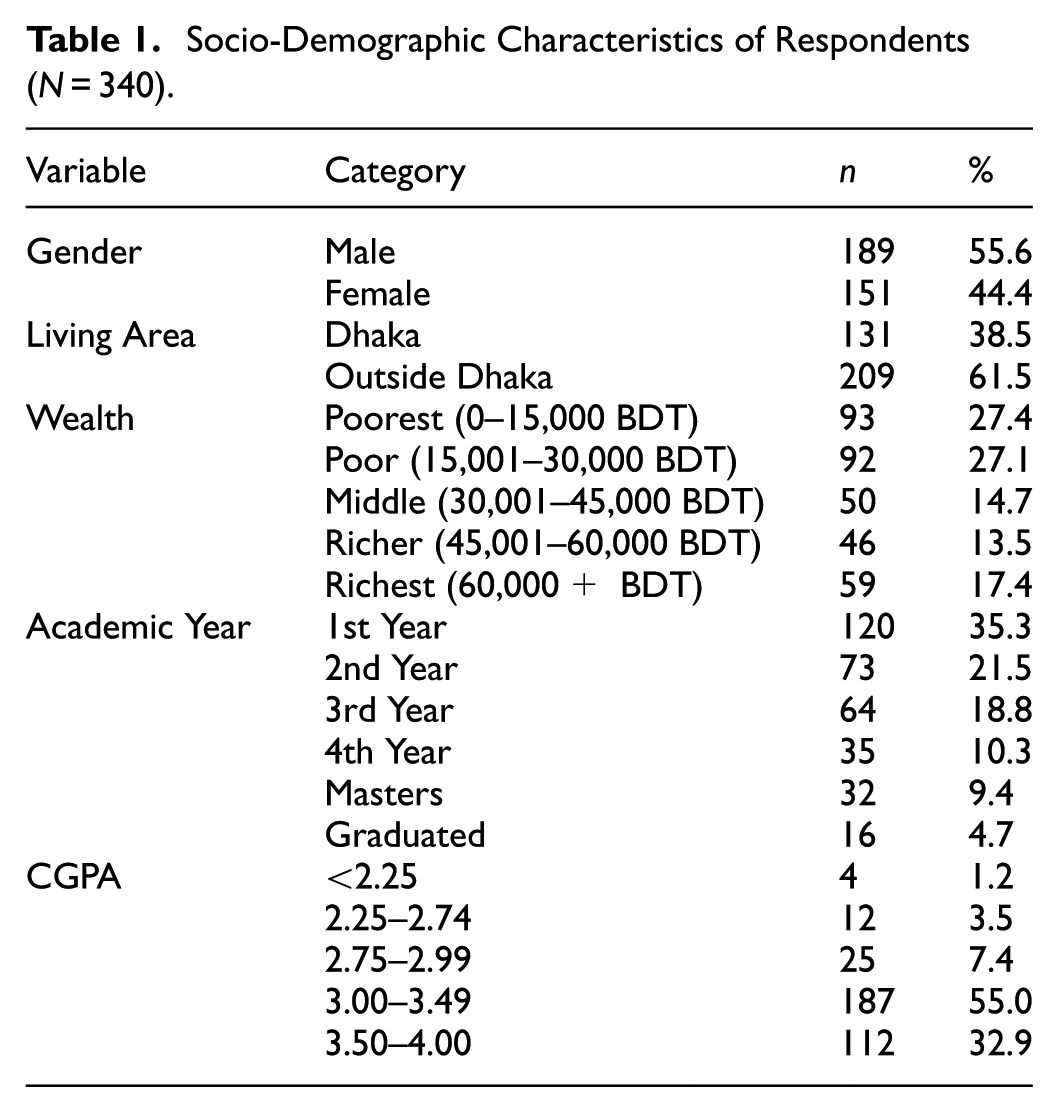
In this formula, n represents the sample size, N is for population size (2,250) and e is the margin of error (0.05). Eventually, the final sample are of 340 students with a relative balance of gender including male (55.6%) and female (44.4%). Geographic diversity was also observed in the sample, where 61.5% of the respondents reside outside the capital city-Dhaka.
Data Collection
This study employed a structured questionnaire to gather data including demographic variables such as age, gender, family income, place of living, and academic information, including year of study, program of study, and academic results. The questionnaire was developed following the early scholarly works of Cretser-Hartenstein et al. (2024), Mishra et al. (2017), Carpenter et al. (2016), Maksl et al. (2015), and Seibert et al. (2013). To assess the career motivation, the respondents were asked to answer a Likert scale question, “How likely are you to pursue a career in media?” together with preferred media sectors, including reporting, digital media, photojournalism, and news presentation. Moreover, respondents’ perceptions about the media industry have been measured using variables like media ethics, working conditions, job stability, and political pressure in this profession. The data were gathered through the online survey between April and May 2024, using university networks and social media platforms. Before that, a pilot test was conducted with 30 participants to ensure the clarity and reliability of the study. The statistical analyses were conducted between June and December 2024.
The dependent variable in the study was the likelihood of pursuing a career in media, measured on a 5-point Likert scale ranging from “Extremely Unlikely” to “Extremely Likely.” Likert-type scaling is widely used in social science research to capture ordered attitudes and intentions (Boone & Boone, 2012), and follows established practice in studies of media literacy and career intentions (Cretser-Hartenstein et al., 2024; Maksl et al., 2015). The independent variables have included socioeconomic factors, such as family income, individual factors like gender, academic year, living area, sectoral preferences, perceptions of media ethics, work environment, and job security. Family income was grouped into five categories to approximate income quintiles and align with prior research on socio-economic groupings (Fidah et al., 2023), while reflecting Bangladesh’s per-capita monthly income benchmark (BBS, 2025). Data analysis has been conducted using cross-tabulation to examine the relationship between family income and media career aspirations. Ordinal regression has been used to investigate the impact of personal characteristics (e.g., academic year, gender, family income) on the likelihood of pursuing a media career. Bivariate associations between the ordinal outcome and perception items were assessed using Spearman’s rank-order correlation, which is more appropriate than Pearson’s r for ordinal dependent variables. All statistical analyses have been carried out using SPSS v25, with a significance level set at p < .05 for hypothesis testing.
Result
Socio-Demographic Characteristics of Respondents
In this study, A total of 340 students participated. The socio-demographic outline of this sample is presented in Table 1. Among the participants, 55.6% were males and 44.4% females. A major proportion of the respondents were from outside Dhaka city (61.5%). For identifying socio-economic position for the sample, five wealth indices were used: Poorest (27.4%), Poor (27.1%), Middle (14.7%), Richer (13.5%), and Richest (17.4%). Students from first-year undergraduate level (35.3%) to graduates (4.7%) have been considered for academic status. Interestingly, the majority of them stated CGPA scores ranged from 3.00 to 3.49 (55.0%) and from 3.50 to 4.00 (32.9%).
Socio-Demographic Characteristics of Respondents (N = 340).
Family Income and Interest in Media Careers
At first, a chi-square test was done to examine the influence of family income on the interest of students in choosing a media career. Income categorization was based on the per-capita monthly income benchmark of Bangladesh (USD 234 ≈ BDT 28,500; BBS, 2025). Table 2 represents the interest levels distribution across different wealth groups. From the test, with statistical findings of χ2(4) = 11.31, p = .023, a significant association was found between wealth and career interest. Comparatively higher income groups (middle, richer, and richest) showed higher interest in media careers than those from the two lowest income groups, despite modest overall enthusiasm. These outcomes indicate that there exists a moderate association between the socioeconomic advantage of students and their career preferences toward media sectors.
Interest in Media Careers by Family Income.

Negative Perceptions of Media and Career Aspirations
In the next step, we performed a Spearman rank-order correlation to determine whether there is any negative perception effect of the media industry on reduced career interest in this sector. Quite a few perceptions were found to have a significant negative correlation with the prospect of choosing a media career. Concerns regarding pressure from media owners (ρ = −.213, p < .001), perceived lack of ethical standards in media houses (ρ = −.200, p < .001), poor work environments (ρ = −.156, p = .004), low salaries (ρ = −.154, p = .005), and lack of professional security (ρ = −.148, p = .006) were significantly related to lower career aspirations. Perceptions of an uncertain professional future also had a smaller yet significant effect (ρ = −.117, p = .032). Government interference and perceived misalignment with academic interests were not significantly associated with career likelihood. These results demonstrate that structural and ethical concerns are meaningful deterrents to entering the media profession.
Model 1: Ordinal Regression With Socio-Demographic Predictors
The ordinal regression model was used to identify the extent to which gender, residential area, socioeconomic status, academic year, and CGPA forecasted the possibility of preferring a media career. The model significantly improved prediction over the intercept-only model, χ2(15) = 51.44, p < .001, and showed no evidence of misfit (Pearson χ2 = 621.49, p = .836; Deviance χ2 = 515.14, p = 1.000). It explains approximately 15% of the variance in career interest (Nagelkerke R2 = .150).
Among all, only the academic year emerged to be a significant predictor. Additionally, compared to graduates, third-year students showed a marginal effect (β = 1.01, p = .055). First-year (β = 1.97, p < .001) and second-year students (β = 1.67, p = .002) were significantly found to demonstrate greater aspiration for pursuing a media profession. Gender, living area, wealth, and academic performance were found to be insignificant while the academic year was controlled. This overall pattern indicates a diminishing enthusiasm of students for media careers as they step closer toward graduation (Table 3).
Ordinal Regression Model With Socio-Demographic Predictors (Model 1).

This model significantly enhanced estimation over the intercept-only specification, χ2(15) = 51.44, p < .001, which indicates significant collective contribution of the included variables for explaining variation in career choice. Absence of any model misfit is confirmed with Goodness-of-fit statistics (Pearson χ2 = 621.49, p = .836; Deviance χ2 = 515.14, p = 1.000), which suggests that the model ensured adequate representation of the observed data. Alongside, this model reflected modest explanatory power with the variance of 15.0% in media-career likelihood (Nagelkerke R2 = .150).
Model 2: Integrated Ordinal Regression With Sectoral Preferences and Negative Perceptions
To get a more inclusive multivariate explanation, with socio-demographic factors, this study incorporated sectoral preferences and negative perception variables for an extended ordinal regression model. The integrated model provided significant improvement in explanatory power, where χ2(50) = 222.65 and p < .001. It also demonstrated excellent fit with Pearson χ2 = 1,178.18, p = .995 and Deviance χ2 = 698.43, p = 1.000. Additionally, in the new model, variance in career likelihood stood at 51.5% (Nagelkerke R2 = .515), representing a notable rise from the base model.
Sectoral preferences appeared as the most significant independent variables. Students interested in working in the newsroom (β = −2.688, p < .001), reporting (β = −1.184, p = .001), or digital media (β = −1.133, p = .001) were significantly dominant in expressing students’ interest in pursuing a media career related to those having no such aspirations (Note: Negative coefficients replicate for the reference category with “No”).
Amid negative perceptions, concerns about government interference (β = −1.947, p = .006) as well as ethical standards in media organizations provided significant effects. Particularly, students with disagreement that media houses lack ethics (Strongly Disagree vs. Strongly Agree: β = 1.371, p = .024; Agree vs. Strongly Agree: β = .620, p = .042) showed a greater likelihood of pursuing a media profession. This indicates that ethical concerns meaningfully shape career interests.
Academic year also emerged as a significant variable in the integrated model, with continuously higher interests of first-year students in media careers (β = 1.804, p = .002) than graduates. Other academic-year groups and all residual socio-demographic factors were found to be non-significant (Table 4).
Integrated Ordinal Regression Model With Sectoral Preferences and Perceptual Predictors.
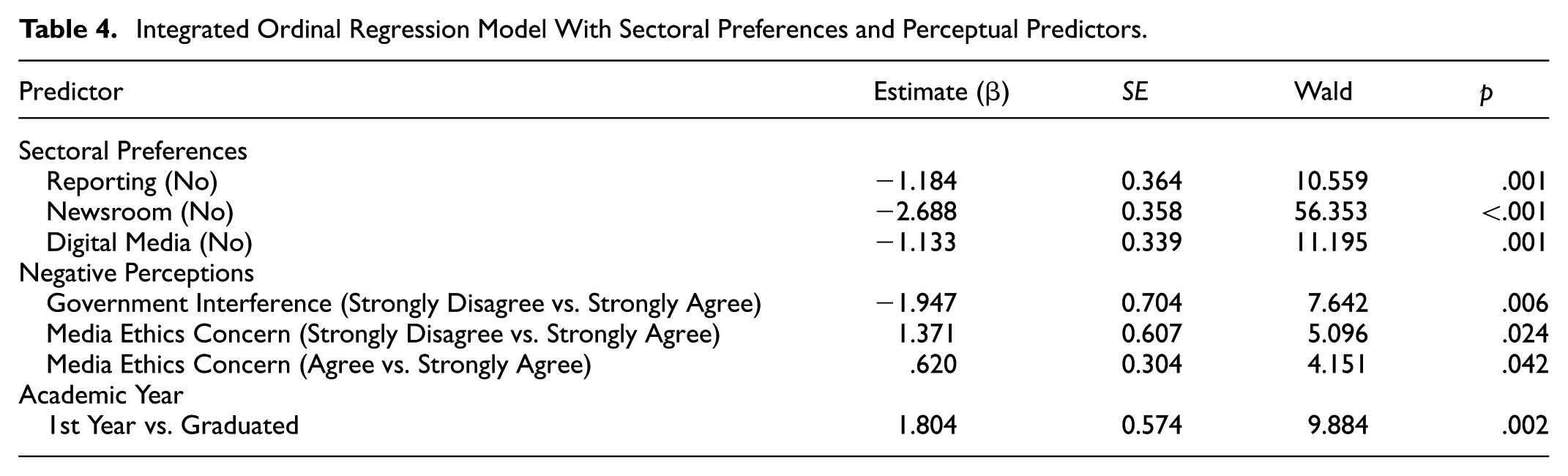
The findings collectively explain that media-career preferences in Bangladesh are influenced by a blend of socioeconomic, perceptual, and professional-choice factors. Whereas family income reflects a modest correlation with media sector interest, academic progression leaves a much stronger effect, with a sharp decline in enthusiasm by graduation. Sectoral preferences, notably, aspirations to work in the newsroom, reporting, or digital media, stand as the strongest predictors of media-career choice. Alongside, negative perceptions regarding political interference and lack of ethical standards reduce the likelihood further. Accounting for more than half of the variance in students’ career goals, the integrated regression model delivers a robust portrayal of these dynamics.
Discussion
The current research will attempt to explain the influence of socioeconomic background, academic progression, sector preferences and industry perception in understanding media career choice decisions among university students in Bangladesh empirically, thus contributing to the theoretical literature. Basing the findings on Human Capital Theory (HCT) and Social Cognitive Career Theory (SCCT), the results provide a comprehensive insight into the areas of media studies and journalism as a subject of career choice. The study explains the choice of structural resources and psychosocial processes to explain how media-career decisions are informed by an interplay of empirical patterns and these frameworks in a precarious labor market.
Socio-Economic Status and Media Career Aspirations
This paper has found that family earnings greatly correlate with the probability of students pursuing a career in media, as per HCT, which suggests that the decision of individuals to invest in education and training is informed by imminent returns (Becker, 1964; Schultz, 1961). Cross-tabulation reveals that students from wealthy families are more likely to explore the option of a career in media compared to those from lower-income families, which aligns with previous literature that emphasizes the importance of socioeconomic background, parent occupation, and the accessibility of resources in defining career path (Croll, 2008; Saha & Bala, 2024). On the other hand, statistics indicate that students with less privileged backgrounds are less interested in media careers, which is consistent with the findings of Cushion (2007), who argues that the less financially well-off have fewer opportunities to access the media and that the media has been devalued, thus discouraging them.
The unstable nature of the media industry serves as a disincentive, as students with lower-income families in Bangladesh prefer stable and secure jobs, usually a government position. On the other hand, more students in higher strata of income tend to focus on their passion or interest instead of economic security. Regarding an HCT perspective, these observations would assume that students with more resources view the risk-reward trade-off of media work as less painful and that students with fewer resources view the expected returns as low enough to justify the risk of involvement in a vulnerable industry.
Educational Progression and Declining Interest
Ordinal regression shows that the higher the level of study that the student has been pursuing, the lower the desire to pursue a career in the media. Students in higher years show less interest than first-year students. This finding aligns with the changing nature of career aspirations over time (Helwig, 2004; Quinlan & Corbin, 2023). This may indicate the cumulative effect of the perception of the media industry, becoming aware of employment challenges, and uncertainty about the occupational prospects as students acquire more experience. The Bangladeshi media industry is often characterized by the lack of job security, lower entry-level pay, worse working environment, and politicization, which may discourage senior students from pursuing a media career. Besides, social pressure for a ‘real job’ led them to switch fields. This trend also highlights that journalism education, in fact the media industry itself, fails to indicate inspiring and futuristic career pathways, partly by creating an ambiguity for students between the idealism they develop and the realities of the industry practices. In SCCT terms, exposure to industry realities may diminish students’ self-efficacy and positive outcome expectations, while in HCT terms, it may lower perceived returns relative to alternative careers. The findings reveal a probable gap in university career counseling and the urgency for specific guidance to reinforce students’ aspirations and address issues as they advance their academic progress.
Sectoral Preferences and Aspirational Pathways
The aspirations of being in a particular sector form a dominant factor in media career choices. Empirical research suggests that students who declare their intentions to work in newsroom settings, digital media outlets or as news presenters are significantly more likely to follow a media career, with newsroom being the strongest forecast. To the extent that sectoral preferences can be viewed as a key factor in the vocational trajectories of students according to the theoretical supposition (Ashton, 2015; Wallis et al., 2019), this observation can be defined as plausible. These preferences might be based on a set of factors, such as personal professional abilities, socioeconomic background, and creative capabilities, as well as anxieties about career security. Students with clear career orientations would therefore seek opportunities that would help them to achieve their fullest potential. Therefore, they would prefer jobs that require more passion and fulfillment rather than looking at traditional places of work. These results support the Social Cognitive Career Theory (SCCT) that has focused on the interdependence of self-efficacy, interest, and social context in career choice (Lent et al., 1994; Lent & Brown, 2019). The strong effects of newsroom, reporting and digital media aspirations in the integrated model indicate that sectoral interests function as powerful expressions of both intrinsic motivation and perceived capability, even after controlling for socio-demographic factors and negative perceptions.
Perceptions, Barriers, and Structural Challenges
In the research, the perception of students toward the media industry, especially with the aspects of ethical practice, workplace setting, and corporate intrusion, has a strong negative impact on the inclination to follow a media career. This result highlights the preventive value of ethical imperatives, workplace challenges, and barriers enforced by the media owners, which is in line with the previous studies on the issue of commercialization and politicization of the media in Bangladesh (Andaleeb & Rahman, 2014; Mamun, 2025; Rahman & Alam, 2014). Within the SCCT framework, these negative perceptions can be interpreted as contextual barriers that lower outcome expectations and diminish the translation of interest into concrete career intentions. At the same time, the fact that some perception items were not significant in the integrated model suggests that students may ponder certain structural concerns, such as ethics and owner pressure, more heavily than others when deciding whether to enter media work.
These understandings shed light on the need to have structural changes in the media institutions and the entire industry. This means that there should be greater emphasis on strengthening ethical practices, the working conditions, and reducing the interference of the owners, which will help to attract the top graduates, especially those who would belong to the disadvantaged communities. Universities and policymakers ought to work together to develop mentorship, internship and support programs that deal with both physical difficulties and perception difficulties. On a larger scale, the evidence is an indicator that reinforcing the self-efficacy of students and offering plausible ways of entering the profession of ethically committed, secure media professionals can be as important or even more important than emphasizing remuneration.
Theoretical and Empirical Contributions
This research contributes to the existing literature by jointly mobilizing HCT and SCCT to explain media career aspirations in a Global South context. Empirically, it provides a multivariate model that integrates sociodemographic factors, sectoral preferences, and negative perceptions, proving that the sector-specific interests and essential structural issues, such as government interference and ethics, can still be regarded as robust predictors even taking academic year and wealth into account. As such, the research paper includes a subtle, theory-influenced explanation of the factors that have the biggest and most independent influence on the choice by students to work in media in Bangladesh.
Conclusion
This study investigated the influences on media career ambitions among the Bangladeshi university students and employed a cross-sectional survey of 16 institutions in which the authors compared the roles of the socioeconomic background, academic progressions, sector interests, and industry perception. Applying Human Capital Theory and the Social Cognitive Career Theory, the outcome of the analysis shows that students from wealthier families have a much larger inclination to show interest in media careers, and this interest decreases as they advance through their studies. It turns out that sectoral preferences, particularly to work in a newsroom and in digital media turn out to be significant predictors of ambition in media careers. On the other hand, having a negative perception toward industry ethics, workplace environment and employer intrusion are significant obstacles toward the longing to follow media professions. The present results give their contribution to the literature because the results are used to demonstrate a highly complex mix of economic, educational, and perceptual variables that influence career choices and the need for educational institutions to provide more specific support and enhance the industry standards to attract and maintain new talent in the media industry of Bangladesh. Placing these tendencies in the context of HCT and SCCT, the research clarifies that the availability of resources, anticipated returns, self-efficacy, and contextual restraints work out cumulatively during media career choice and gives us a template that can be applied by other upcoming media markets.
Limitations and Future Research Direction
The research uses the proportional stratified sampling to gather information through the Internet. Although great efforts have been taken to maintain their strong image of representation: 16 out of 32 universities are represented, a fact that can be seen as protective, there is still the risk that such a choice might be prejudiced simply because other institutions are not represented. In addition, using the online survey is vulnerable to both selection bias and social desirability bias and hence may undermine the generalizability of the results. The sample, while diverse, is confined to journalism students from universities, which may not reflect the full range of perspectives among students in related fields or from other regions. Therefore, future studies may include an adequate number of samples to significantly reduce the biases. The cross-sectional design of the study restricts causal inference, capturing students’ media career aspirations and perceptions at a single point in time rather than tracking changes as they progress through university or encounter shifts in the industry. A longitudinal study may help track the changes in career aspirations between two points of time and provide a more robust understanding of its very changing nature. The study did not adequately examine the effects of variables such as parental attitudes, curricular experiences, or exposure to internships. Future studies may shed light on these variables. As there is a lack of unified theories, it is barely arguable that Human Capital Theory and Social Cognitive Career Theory are adequate to understand the Socio-economic and individual factors in pursuing media careers in Bangladesh. In the future, a better theory could provide a more comprehensive understanding in this regard. A qualitative study would explore first-hand causalities from the students behind their desire or unwillingness to pursue a media career. On the other hand, comparative studies could be carried out to test the generalizability of the current findings across different countries.
Footnotes

Ethical Considerations
At the time of this research, the University of Dhaka did not have a formal Institutional Review Board (IRB) or ethics committee in place. Nevertheless, all data collection procedures were designed and conducted according to internationally recognized ethical standards for research involving human participants.
Consent to Participate
Before participation, all respondents were fully informed about the purpose of the study, the voluntary nature of their participation, and their right to withdraw at any time without penalty. Informed consent was obtained from each participant, and all responses were treated as strictly confidential and anonymized during data analysis and reporting. No personal identifiers were collected, and all data were securely stored to protect participant privacy. The study posed no foreseeable risks to participants, and every effort was made to ensure their comfort, autonomy, and well-being throughout the research process.
Author Contributions
Khandakar Rubyat Mursalin: Principal Researcher, Conceptualization, Data Analysis and data interpretation. Md. Nasimul Huda: Data Collection, Literature Review, Discussion. Saddam Hosen: Literature Review, Theoretical Framework, Discussion.
Funding
The authors received no financial support for the research, authorship, and/or publication of this article.
Declaration of Conflicting Interests
The authors declared no potential conflicts of interest with respect to the research, authorship, and/or publication of this article.
Data Availability Statement
The data that support the findings of this study are available from the corresponding author upon reasonable request. Due to privacy and confidentiality agreements with research participants, the dataset is not publicly available. Interested researchers may contact the corresponding author to discuss possible access, provided all ethical and confidentiality requirements are met.*