



Abstract
This study aims to investigate the influence of interaction on undergraduates’ continuance intention to use Massive Open Online Courses based on the Expectation Confirmation Model (ECM) and to examine the moderating effect of gender. 235 undergraduates were randomly sampled and surveyed, providing self-reports on 10 constructs (student-student interactions, student-teacher interactions, student-content interactions, controllability, responsiveness, confirmation, perceived usefulness, satisfaction, and continuance intention). The Partial Least Squares Structural Equation Modelin was employed for data analysis. The findings indicate that student-teacher interactions, student-content interactions, controllability, and responsiveness have a significant positive impact on undergraduates’ continuance intention to use Massive Open Online Courses. However, student-student interactions do not show a significant relationship with continuance intention. Additionally, no significant gender differences were found concerning the influence of perceived usefulness and satisfaction on continuance intention. The study also discusses the theoretical and practical impacts of undergraduates’ use of Massive Open Online Courses.
Plain Language Summary
1. Aims and purpose of the research There are three research questions: (1)In the MOOCs learning, what are the critical INT elements? (2)How do these key INT elements affect CI? (3)Is there a significant gender difference in undergraduates’ CI towards MOOCs? In order to address the above issues, this study proposes the hypothesis model, which consists of a total of 12 research hypotheses. 2.Background of the research With the rapid advancement of the internet and digital technologies, the global educational landscape is undergoing a profound transformation. Massive Open Online Courses (MOOCs) have emerged within this context, offering learners unparalleled advantages. MOOCs provide not only open, flexible, and high-quality educational resources, allowing learners to access top-tier education regardless of their location, but also enhance the online learning experience significantly due to their rich interactive features and personalized learning paths. Furthermore, MOOCs have established a platform for learners, educators, and industry experts worldwide to communicate and collaborate. These characteristics emphasizing personalization and interactivity distinguish MOOCs from traditional online education methods. However, despite the critical role of interactivity in MOOCs, research on how it specifically influences students’ continuance intention (CI) to participate remains a gap. Thus, delving into the relationship between interaction factors and students’ CI in MOOCs holds significant research value. 3.Methods and research design 3.1 Participants This research garnered data via the Wenjuan Star platform (https://www.wjx.cn/) from three distinguished Chinese institutions: Jiangxi Agricultural University, Jiangxi Normal University, Nanchang Hangkong University. Those engaged in this investigation had undertaken MOOCs coursework for at least one academic term. The samples were selected by random sampling. Through a digital inquiry form, 235 responses were gathered.
Keywords
Introduction
The rapid development of internet and digital technologies has reshaped global education, with Massive Open Online Courses (MOOCs) emerging as a transformative model. MOOCs provide open, high-quality resources that enhance accessibility to premier education, irrespective of location (Duru et al., 2021; Tan et al., 2022; Y. Zhang et al., 2021). Unlike traditional online education, MOOCs emphasize interactivity and personalization, fostering engagement among learners, educators, and experts (Alyoussef, 2021; de Moura et al., 2021; Gökdemir et al., 2022).
A key challenge in MOOCs lies in sustaining learners’ engagement, termed continuance intention (CI), which reflects their long-term commitment (Alyoussef, 2023). While research has explored factors influencing CI—such as satisfaction (SAT), motivation (MOT), and perceived usefulness (PU) (He et al., 2023; Mailizar et al., 2021; Y. Wang et al., 2020)—there is limited focus on how specific interaction (INT) dimensions affect CI. In MOOCs, interaction comprises student-teacher interactions (STI), student-student interactions (SSI), student-content interactions (SCI), as well as system-related factors like controllability (CONT) and responsiveness (RES). These interaction elements are essential for enhancing learning experiences and sustaining participation (Mubarak et al., 2021; B. Wu, 2021).
This study also explores the role of gender, which has been recognized as a factor that may influence learners’ engagement and CI. However, whether gender moderates the relationships among key constructs such as PU, SAT, and CI remains underexplored. Addressing these gaps can provide a more nuanced understanding of how interaction influences undergraduates’ use of MOOCs.
This study aims to explore the impact of specific interaction elements—STI, SSI, SCI, CONT, and RES—on undergraduates’ CI to use MOOCs. Furthermore, it investigates whether gender moderates the relationships between PU, SAT, and CI. To achieve these objectives, the study addresses the following research questions:
In MOOCs learning, what are the critical interaction elements influencing CI?
How do these specific interaction elements (STI, SSI, SCI, CONT, and RES) affect CI?
Does gender moderate the relationships between PU, SAT, and CI among undergraduates in MOOCs?
This research makes three key contributions. First, it identifies the specific interaction elements that significantly influence CI in the context of MOOCs, providing a detailed understanding of their effects. Second, it examines the moderating role of gender in the relationships between key constructs such as PU, SAT, and CI, addressing an existing gap in the literature. Third, it offers practical recommendations for the design of effective MOOCs platforms, aiming to enhance student SAT and engagement. These findings contribute to both theoretical advancements in online education and practical improvements in MOOCs system development.
Literature Review
Expectation Confirmation Model
The Expectation-Confirmation Theory (ECT), proposed by Oliver (1980), provides a foundational framework for understanding consumer SAT by examining the relationships among performance, expectations, confirmation (CON), and SAT. Building upon this, Bhattacherjee (2001) introduced the Expectation-Confirmation Model (ECM) within the context of information systems, integrating elements from the Theory of Planned Behavior (TPB), the Diffusion of Innovations Theory, and the Technology Acceptance Model (TAM). The ECM comprises four key components: PU, CON, SAT, and CI.
In the ECM framework, PU reflects the perceived value of a technology or service, CON assesses whether expectations align with the experience, SAT measures user SAT based on system performance and interaction quality, and CI indicates the user’s intent to continue usage. These components are widely applied in user behavior research, influencing educational outcomes, sustained learning, and engagement(Alturki & Aldraiweesh, 2023; Rekha et al., 2022).
Recent studies have expanded the ECM to deepen its application in various contexts, integrating constructs such as PU, attitudes, compatibility, and system quality to explore their influence on CI (Ashrafi et al., 2020; Taghizadeh et al., 2022; H. Yang et al., 2023). These extensions reveal how user motivation, system performance, and interaction quality shape CI, particularly in online learning and educational technologies.
Another significant observation is that many studies have explored the integration of the ECM with other models, expanding on the ECM’s foundation to incorporate theories and models like ISSM (H. Yang et al., 2023), UTAUT (Taghizadeh et al., 2022), TTF (T. Wang, Lin, et al., 2021), TPB (Rajeh et al., 2021), and TAM (Ashrafi et al., 2020). This suggests that researchers attempt to provide a more comprehensive explanation for CI by merging different theoretical models. Over the years, the ECM has been widely regarded as a robust and refined model, extensively applied in various domains, including online learning and distance education (Calvo et al., 2020; Duru et al., 2021; Y. Li et al., 2021), mobile application and technology adoption (Alismaiel et al., 2022; Meng & Li, 2023; Togaibayeva et al., 2022), healthcare (Cheng, 2020), and entertainment and gaming (Rohan et al., 2021; L. Zhang et al., 2021). For instance, Taghizadeh et al. (2022) extended ECM by incorporating constructs from the UTAUT model, revealing that hedonic motivation and facilitating conditions significantly enhance CI through their influence on SAT. Similarly, T. Wang, Lin, et al. (2021) combined ECM with the TTF framework, demonstrating that task-technology fit positively impacts PU and CI, emphasizing the importance of aligning system capabilities with user needs. These studies highlight ECM’s robustness while identifying gaps in understanding how its components, particularly CI, operate in specific contexts. For instance, limited research has examined the role of user interactions (e.g., teacher-student, student-content) and system characteristics (e.g., CONT, RES) in shaping CI within educational technologies. To address these gaps, this study investigates the nuanced mechanisms influencing CI, focusing on the interplay between interaction factors and ECM components in MOOCs.
Interaction
INT refers to the mutual activities, information exchange, and dynamic feedback processes between users and computer systems or applications. It drives user perceptions and SAT with specific learning systems or platforms (Wei et al., 2015). Research on INT has progressed from traditional to modern dimensions, integrating both interpersonal and technological interactions to explore their influence on users’ perceptions of the usefulness and their CI to use e-learning systems (Alshammari & Alshammari, 2024; X. Li et al., 2022; Pan et al., 2024; Yin & Lin, 2022). Moore (1989) identified three kinds of INT types: SSI, STI, and SCI, which have been widely applied in traditional educational contexts to examine their effects on users’ acceptance and intention to adopt e-learning systems or new technologies (Karaoglan Yilmaz & Yilmaz, 2020; Kim & Kim, 2021; X. Li et al., 2022; Whitelock-Wainwright et al., 2021; Q. Yang & Lee, 2021; Yin & Lin, 2022). For example, Yin and Lin (2022) demonstrated that various interaction features in mobile banking—such as human–human interaction, human–information interaction, and human–system interaction—positively and significantly influenced users’ PU and perceived ease of use. Similarly, X. Li et al. (2022) confirmed that social interaction in online learning systems has a significant positive effect on the CI of vocational college students to use these systems.
With the emergence of modern learning platforms such as MOOCs, human-computer interaction has become central to online learning. Human-computer interaction emphasizes dimensions of learner-system interactions, including CONT and RES. CONT refers to the user’s ability to control the learning process, such as adjusting preferences or freely navigating content, while RES describes the system’s timely feedback, such as providing instant help or adaptive responses (Alturki & Aldraiweesh, 2023; Chen, 2023; Y. Li et al., 2021; Salta et al., 2022; Shi et al., 2022; Q. Yang & Lee, 2021). These characteristics not only improve user experience but also strengthen CI through seamless interaction design. Q. Yang and Lee (2021) investigated the role of human-computer interaction in MOOCs, demonstrating that user-friendly system design and clear functionalities significantly enhance SAT. Alturki and Aldraiweesh (2023) highlighted that SSI and STI are equally crucial in boosting learner engagement and academic performance. Additionally, Salta et al. (2022) indicated that SSI, STI, and SCI are significant factors affecting student online learning.
In this study, we categorize interaction into two dimensions: human-computer interaction and interpersonal interaction. Interpersonal interaction encompasses three key dimensions—SSI, STI, and SCI—highlighting their roles in fostering knowledge sharing and collaborative learning. Meanwhile, human-computer interaction emphasizes the importance of designing user-friendly systems with features such as CONT and RES to enhance the overall learning experience and meet user needs.
Research Hypotheses
Student-Student Interactions, Student-Teacher Interactions, Student-Content Interactions and Confirmation
Numerous studies have explored the relationship between INT and CON in online learning (Al Mamun & Lawrie, 2023; Chen, 2023; Kim & Kim, 2021) and e-learning (Cheng, 2020; Owusu-Agyeman et al., 2018; Sumi & Kabir, 2021). Specifically, Cheng (2020) introduced a comprehensive research model based on ECM and flow experience, examining the antecedents of the CI of healthcare professionals towards cloud-based e-learning. The findings indicated that INT among learners significantly influences cloud-based e-learning systems’ CON. In addition, Kim and Kim (2021), as well as Alismaiel et al. (2022), argued that STI contribute to the confidence of learners, making them more willing to invest time and effort in learning, which in turn enhances the CON of their expectations of the learning system. A study by Owusu-Agyeman et al. (2018) indicated that in an e-learning environment, the course content positively impacts e-learners’ cognition. Furthermore, Chen (2023) suggested that active INT between students and learning content can foster a deeper understanding and application of textbooks and multimedia resources. In this study, the more active the INT (SSI, STI, and SCI), the higher the CON of the learning system by students. Based on the aforementioned research findings, the following hypotheses are proposed:
H1a: SSI has a significant positive influence on CON.
H2a: STI has a significant positive influence on CON.
H3a: SCI has a significant positive influence on CON.
Student-Student Interactions, Student-Teacher Interactions, Student-Content Interactions and Perceived Usefulness
Previous research has explored the relationships between SSI, STI, SCI, and PU. INT can influence learners’ perceptions of the actual value of educational technology, courses, and learning content by enhancing the learning experience (B. Wu, 2021), garnering feedback from teachers (Bradley-Dorsey et al., 2022; Owusu-Agyeman et al., 2018), and boosting learning motivation (Çebi, 2023; Togaibayeva et al., 2022). B. Wu (2021) focused on SSI, asserting that such INT can spark interest, foster positive learning experiences, strengthen student engagement, and subsequently enhance their PU of the learning activities. Bradley-Dorsey et al. (2022) underscored the significance of STI in online learning environments, highlighting their considerable impact on the classroom atmosphere and the perceived learning experience. Xianhan et al. (2022) found a significant positive correlation between SCI and PU. Through multimedia resources or online platforms, INT amplifies learners’ motivation and autonomy, reinforcing their acknowledgment of the system’s usefulness. In this study, the more active the INT (student-student, student-teacher, student-content), the higher the students’ PU of the learning system. Therefore, based on the aforementioned research findings, the following hypotheses are proposed:
H1b: SSI has a significant positive influence on PU.
H2b: STI has a significant positive influence on PU.
H3b: SCI has a significant positive influence on PU.
Controllability, Responsiveness, and Confirmation
CONT refers to the extent to which users can control a technology, product, or service (Tan et al., 2022). It describes an individual’s subjective perception of the difficulty of a particular action or behavior. Conversely, RES refers to the degree to which a system rapidly responds to user actions and requirements in an academic context (Purwanto et al., 2020). Previous studies have discussed CONT and RES in e-learning (Çebi, 2023; Y, Li & Shang, 2020; Rajeh et al., 2021; Sumi & Kabir, 2021), health behavior (Hagger et al., 2022), and gaming INT (Xue et al., 2023). Firstly, CONT gives users a sense of autonomy. A study by Rajeh et al. (2021) revealed that if learners perceive an e-learning system to have poor CONT, it might result in dissatisfaction with the system, thus reducing their CON of it. Çebi (2023) also noted that when learners have greater control over the learning system, their expected learning outcomes are likely to align more closely with their actual results. This, in turn, enhances their CON of the system. These studies provide robust evidence of the positive impact of CONT on CON. Secondly, RES ensures the system’s prompt reaction. Sumi and Kabir (2021) researched how online learners evaluate e-learning tools and found that the system’s RES positively impacted learners’ perceptions. Further supporting this notion, a study by Y. Li and Shang (2020) indicated that when a learning system rapidly addresses learners’ needs and answers their questions, their expected CON of the system improves. This encourages long-term utilization of the tool. Specifically, the stronger a student’s perception of system CONT and the system’s RES, the higher their expected CON of the system. Based on these findings, the following hypotheses are proposed:
H4a: CONT has a significant positive influence on CON.
H5a: RES has a significant positive influence on CON.
Controllability, Responsiveness, and Perceived Usefulness
Several scholars have conducted extensive research exploring the effects of CONT on PU (Çebi, 2023; Hagger et al., 2022; Rajeh et al., 2021). For instance, Çebi (2023) that CONT is a primary predictor of PU in e-learning systems. Rajeh et al. (2021) investigated the factors influencing the adoption of e-learning by general practitioners and found a significant correlation between CONT and PU.
Additionally, the influence of RES on PU has also been discussed among scholars (Alturki & Aldraiweesh, 2023; Ndzinisa & Dlamini, 2022; Sumi & Kabir, 2021). According to Alturki and Aldraiweesh (2023), if learners believe the system can rapidly respond to meet their needs and address their queries, they are more inclined to view the system as useful. Xue et al. (2023) examined the moderating role of gamification in social INT domains, and the results revealed that RES positively impacts PU. In this study, the stronger the students’ sense of system CONT and RES, the higher their PU of the system. Therefore, based on the aforementioned research findings, the following hypotheses are proposed:
H4b: CONT has a significant positive influence on PU.
H5b: RES has a significant positive influence on PU.
Constructs of the Expectation Confirmation Model
In the ECM, CON, PU, SAT, and CI are the main constructs. Relationships between these constructs have been well-documented in various studies. Firstly, CON has a significant positive influence on PU and SAT(Ashrafi et al., 2020; Cheng, 2020; Meng & Li, 2023; Rohan et al., 2021; T. Wang, Lin, et al., 2021; H. Yang et al., 2023). For instance, H. Yang et al. (2023) found that CON significantly enhances PU among beginners in blended higher education, while Q. Yang and Lee (2021) observed that higher levels of CON increase students’ SAT in sustainable education MOOCs. Similarly, Rohan et al. (2021) demonstrated that CON significantly impacts SAT by integrating motivation and gamification into the ECM. PU also has a strong positive influence on both SAT and CI, as it directly affects users’ SAT with technology, products, or services (Alturki & Aldraiweesh, 2023; Ashrafi et al., 2020; T. Wang, Lin, et al., 2021; X. Wang, Liu, et al., 2021; J. Zhang et al., 2023). For instance, Ashrafi et al. (2020) identified PU as the strongest predictor of students’ CI toward e-learning systems, while J. Zhang et al. (2023) emphasized its importance in enhancing user SAT within online learning systems. Finally, SAT plays a crucial role in promoting CI, as supported by findings from H. Yang et al. (2023) in a blended learning context and Rohan et al. (2021), who confirmed that SAT significantly affects CI in MOOC environments.
In summary, the ECM emphasizes the interactions among CON, PU, SAT, and CI. These relationships explain users’ acceptance and SAT levels with information systems and effectively predict their CI. Therefore, this study proposes the following hypotheses:
H6: CON has a significant positive influence on PU.
H7: CON has a significant positive influence on SAT.
H8: PU has a significant positive influence on SAT.
H9: PU has a significant positive influence on CI.
H10: SAT has a significant positive influence on CI.
The Moderating Role of Gender
Existing studies have identified gender as a moderating factor in the relationship between PU, SAT, and CI in e-learning systems (X. Li et al., 2022; J. Zhang et al., 2023). Research spans domains such as online education (Shihan Izkair & Modi Lakulu, 2023; T. Wang, Lin, et al., 2021; Q. Zhang et al., 2023), behavioral psychology (Al Mamun & Lawrie, 2023; Şahin et al., 2022), and social interaction (Y. Li & Shang, 2020; L. Zhang et al., 2021). For example, in the context of online education, X. Li et al. (2022) found that males prioritize task completion and performance, making them more influenced by PU in forming CI. Similarly, Kaur and Kaur (2022) observed a stronger correlation between PU and behavioral intention among males, suggesting that gender moderates this relationship. In the context of MOOCs. Additionally, gender differences are evident in SAT. Shihan Izkair and Modi Lakulu (2023) reported that females are more affected by social support, which can enhance SAT in online learning environments. However, these differences depend on the context.
Based on the above studies, we propose the following hypotheses:
H11: Gender positively moderates the relationship between PU and CI.
H12: Gender positively moderates the relationship between SAT and CI.
In this research, the model and hypotheses are depicted in Figure 1.

Research models and hypotheses.
Methods
Participants
This study collected data through the Wenjuan Star platform (https://www.wjx.cn/) from three distinguished Chinese institutions: Jiangxi Agricultural University, Jiangxi Normal University, and Nanchang Hangkong University. These institutions were selected based on their active involvement in MOOCs, which include diverse course content, such as general education, business, engineering, and arts. The MOOCs varied in format, ranging from fully asynchronous to blended models with scheduled live sessions. Each course typically spanned 14 to 16 weeks per semester, with an average of 2 to 3 hr of online instruction per week. This ensured that the sample was representative of a diverse group of students enrolled in MOOCs across different academic backgrounds.
To participate in this study, students were required to have completed at least one semester of MOOCs coursework, accumulating 28 to 48 hr of online learning. Data collection took place from February to August 2023, yielding 256 responses. To ensure data quality, a rigorous screening process was applied. Incomplete questionnaires were excluded first, followed by an analysis of response times. Questionnaires completed in less than 5 min were deemed invalid. After excluding 21 incomplete or excessively fast responses, 235 valid questionnaires were retained for analysis.
Data Collection
The sampling process followed a stratified random sampling method to ensure representativeness of different academic backgrounds and levels of MOOCs participation. The research team collaborated with instructors from Jiangxi Agricultural University, Jiangxi Normal University, and Nanchang Hangkong University to introduce the survey and randomly select participants. Both mandatory and elective MOOCs were included, ensuring diverse participation. Students in mandatory courses participated as part of their curriculum, while those in elective courses voluntarily registered, motivated by reasons such as earning credits, improving skills, or personal interests.
To confirm the sample’s representativeness, a chi-square test for gender distribution was conducted (male = 43.06%, female = 52.11%; p = .517) (Table 1). The results indicated no significant difference between the sample and the overall population, suggesting a strong representativeness of the sample. This approach ensured randomness and representativeness across various academic disciplines and participation levels.
Demographic Characteristics of the Sample.

Measurements
The assessment is bifurcated into two segments. Initially, we gathered participants’ demographic details such as gender, age, educational level, and discipline. Subsequently, we examined nine elements based on the theoretical framework. To elaborate, the latter section encompasses 27 items, as depicted in Table 2. Employing a 7-point Likert scale, responses could vary from 1 (strongly disagree) to 7 (strongly agree). Each question was sourced directly from pertinent academic works.
Construct Measurement and Source.

Note. SSI = student-student interactions; STI = student-teacher interactions; SCI = student-content interactions; CONT = controllability; RES = responsiveness; CON = confirmation; PU = perceived usefulness; SAT = satisfaction; CI = continuance intention.
Furthermore, we provided detailed descriptions of the items and constructs in the measurement model to enhance transparency and reproducibility. For instance, the construct SSI was measured using three items adapted from Cardoso et al. (2011), including statements like “MOOCs allowed me to learn from other students.” Similarly, STI was measured through items such as “My teacher encouraged me to voice my opinion in MOOCs,” while SCI included items like “MOOCs have given me a deeper understanding of what I’m studying,” adapted from Y. Li et al. (2021). Other constructs, such as CONT from Rajeh et al. (2021), PU, SAT from Sumi and Kabir (2021), and CI from J. Zhang et al. (2023), were similarly operationalized using multiple items adapted from prior literature. These items and their sources are detailed in Table 2 to ensure transparency.
Statistical Analysis
The data was scrutinized employing the Smart Partial Least Square 4.0 (Smart PLS) tool. This software was chosen for its ability to efficiently analyze complex models and latent variables, making it well-suited for this study’s analysis of 9 constructs with 235 samples. Smart PLS is particularly advantageous for its capacity to handle both reflective and formative indicators and its suitability for small to medium sample sizes (Hair et al., 2021).
Results
Measurement Model
In line with the principles outlined by Hair et al. (2021), we executed a procedure to examine the model scales’ reliability and validity. At the outset, we gauged the reliability of every aspect using both indicator loadings and composite reliability (CR). According to Hair et al. (2021), the indicator loadings should surpass 0.708 to ensure satisfactory item reliability. Simultaneously, we employed Cronbach’s alpha to determine the internal consistency of the scales, which ought to be above 0.7. As illustrated in Table 3, all measurements, such as indicator loadings, composite reliability, and Cronbach’s alpha, were above .7, signifying reliable scaling.
Reliability and Convergent Validity.

Following this, we evaluated both these scales’ convergent and discriminant validity. We appraised convergent validity via the Average Variance Extracted (AVE) metric, which needs to be greater than 0.5. We employed the classic Fornell-Larcker approach (Fornell & Larcker, 1981) and cross-loadings benchmarks to determine discriminant validity. As dictated by these benchmarks, the external loading of an indicator on its given construct must outstrip any cross-loadings–essentially, its correlations with alternate constructs (Table 4). Moreover, correlations among the aspects should remain below the AVE’s square root, as illustrated in Table 5. Collectively, this data underscores robust discriminant validity for each aspect.
Discriminant Validity (Cross-Loadings Criterion).

Note. The boldfaced values represent the factor loadings of the items on their respective constructs.
Discriminant Validity (Fornell-Larcker Criterion).

Note. The bold numbers on the diagonal are the square root of AVE.
Common Method Variance
A dual-method approach was taken to evaluate the Common Method Variance (CMV). The initial assessment was through Harman’s single-factor test, revealing that no factor dominated the variance (Podsakoff et al., 2003). It was discerned that the predominant factor contributed to 28.127% of the variance, a figure much below the recommended 50% benchmark (Podsakoff et al., 2003). As a secondary measure, the marker variable method was implemented. An unrelated marker variable, one not intrinsically linked to the research model, was incorporated to scrutinize any potential common method variance (Lindell & Whitney, 2001). The maximal variance shared with other factors was a mere 0.0189 (1.89%)—a figure considered minimal (Johnson et al., 2011). Hence, from the outcomes of both evaluations, the presence of a significant common method variance seems unlikely.
Structural Model Evaluation
Collinearity
The Variance Inflation Factor (VIF) values were employed within the predictive constructs to examine collinearity. Hair et al. (2021) posited that optimal VIF values remain beneath 5, but preferably less than 3, to confirm negligible collinearity impact on the model’s estimations. As depicted in Table 6, the VIF values ranged from 2.543 to 4.186, aligning with the prescribed criteria.
VIF Values of Predictor Constructs.

Significance of the structural model relationship
The significance of the structural model relationship was assessed using the bootstrapping algorithm in Smart PLS. According to Hair et al. (2021), t statistics (t > 1.96), p values (p < .05), and confidence interval (excluding zero) were used to test the significance of the relationship. Table 7 indicates the path coefficient, confidence interval, t statistics, and p values. Specifically, the relationship between PU (β = .221, t = 2.335, p = .020), SAT (β = .679, t = 7.567, p = .000), and CI was positive. Likewise, CON (β = .213, t = 2.353, p = .019) and PU (β = .706, t = 8.582, p = .000) was positively related to SAT. The relationship between CONT (β = .195, t = 2.070, p = 2.070), RES (β = .466, t = 5.741, p = .000), STI (β = .144, t = 2.269, p = .023), and CON was positive. Meanwhile, CON (β = .429, t = 4.464, p = .000), CONT (β = .289, t = 3.440, p = .001), SCI (β = .171, t = 2.016, p = .044) was positively related to PU. Finally, the non-significant relationships were as follows: RES with PU (β = .063, t = 0.735, p = .462), SCI with CON (β = .160, t = 1.686, p = .092), SSI with CON (β = .022, t = 0.293, p = .769), SSI with PU (β = −.040, t = 0.616, p = .538), and STI with PU (β = .044, t = 0.577, p = .564). Therefore, the results of this study support H2a, H4a, H5a, H3b, H4b, H6, H7, H8, H9, and H10, but do not support H1a, H3a, H1b, H2b, H5b, H11, and H12. This indicates that in the context of MOOCs learning, STI, SCI, CONT, RES, CON, PU, and SAT are important interactive elements, all of which significantly and positively influence CI either directly or indirectly. However, gender does not play a moderating role in the relationships between PU and CI, or SAT and CI.
Result of the Significance of the Structural Model Relationship.

Explanatory Power and Predictive Relevance
In the presented model, the explanatory power is delineated by the R2 values linked with the endogenous constructs, while the predictive relevance is highlighted by Stone-Geisser’s Q2 value (Hair et al., 2021). As reflected in Table 8, the model showcases a commendable capacity for explanation through its R2 value. Specifically, the R2 value for CI reveals an explanation of 77.7% of the variance therein. Similarly, the variance in SAT is roughly 80.8%, explained by its predictors, as evidenced by its R2 value. Furthermore, every Q2 value, as presented in Table 8, exceeds zero, underscoring the empirical model’s potent predictive accuracy (Hair et al., 2021).
Explanatory Power and Predictive Relevance.

Multi-Group Analysis
Measurement Invariance Analysis
This research utilized a multi-group PLS methodology to discern and evaluate gender differences in path coefficients. Prior studies have widely recognized such a technique (Zhou et al., 2014). Before delving into the moderating impacts, we checked for potential consistency issues using the MICOM procedure (Henseler et al., 2016).
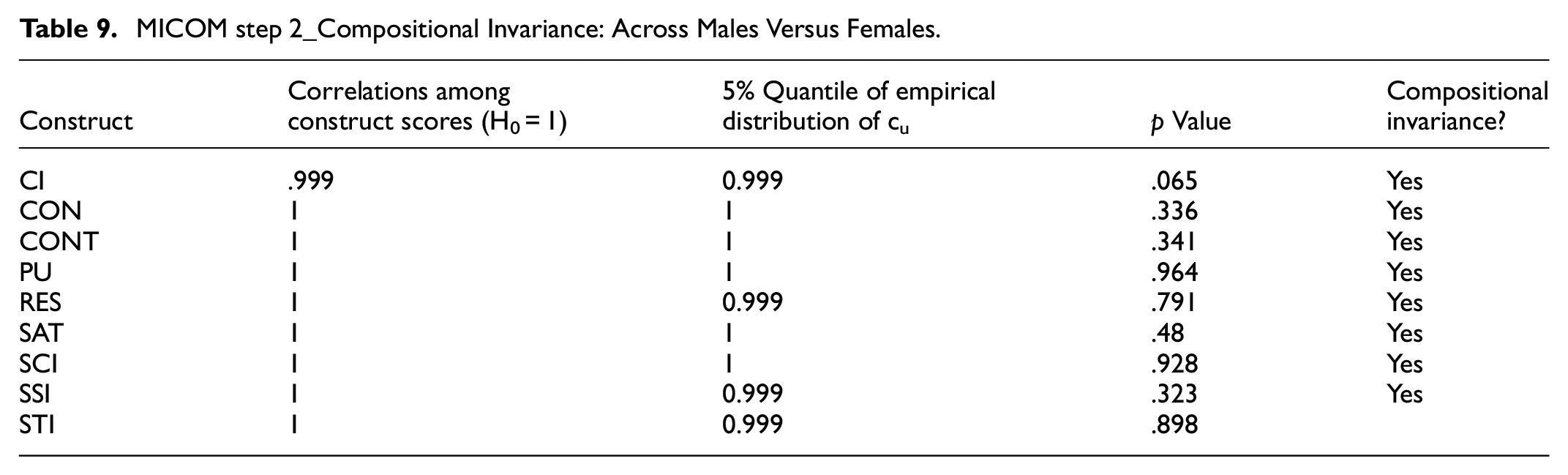
Guided by Hair et al. (2021), undertaking a multi-group analysis requires CON of both structural invariance (i.e., uniform parameters and calculation methods) and compositional invariance (i.e., stable indicator proportions). In Smart PLS 4.0, the former is preset. Meanwhile, the latter is gauged using a permutation method as Hair et al. (2021) outlined. The path frameworks and analytical procedures applied to various gender categories in our research were analogous, setting the groundwork for structural consistency (Henseler et al., 2016). Furthermore, structural invariance was confirmed since both group evaluations operated on identical algorithm configurations (Henseler et al., 2016). Compositional consistency is validated when computed correlation metrics surpass the empirical distribution’s 5% quantile (Henseler et al., 2016). Referencing Table 9, the intrinsic correlations between composite evaluations exceeded the empirical distribution’s 5% threshold, bolstering the argument for compositional consistency (Hair et al., 2021). Consequently, measurement consistency across both sets was verified.
MICOM step 2_Compositional Invariance: Across Males Versus Females.
Multi-Group Analysis
Upon confirming measurement invariance, we conducted a comparative analysis across groups. A binary variable was used to distinguish between genders, referencing males and females (Venkatesh & Morris, 2000). The comparative group analysis in this research assessed paths among distinct groups, as suggested by (Zhou et al., 2014). Table 10 showcases the results from the path coefficient analysis segregated by gender. Data suggests that gender variations in the impact of PU (β_male = .389, β_female = .135, p = .221) and SAT (β_male = .556, β_female = .728, p = .392) on CI are not statistically significant. Thus, the hypotheses previously mentioned are not validated.
Comparison of Path Coefficients (Males and Females).

Discussion
This research investigates the impact of interaction factors on undergraduates’ CI to use MOOCs and explores the moderating effect of gender. Through a comprehensive review of the existing literature, this study posits that factors such as SSI, STI, SCI, CONT, RES, CON, PU, and SAT significantly influence students’ CI towards MOOCs. The proposed research model’s validity was assessed using Smart PLS. Most hypotheses were confirmed, and collectively, all facets explained 77.7% of the total variance in undergraduates’ CI towards MOOCs’ learning systems. Detailed discussions of the research results concerning the initially proposed research questions will be addressed in subsequent sections.
Student-Student Interactions, Student-Teacher Interactions, Student-Content Interactions, Confirmation
In the context of undergraduates using MOOCs, the effects of SSI, STI, and SCI on CON vary significantly. This study found that SSI did not significantly impact students’ CON, which contrasts with Cheng (2020) findings, where SSI positively influenced the CON of healthcare professionals toward cloud-based e-learning. This inconsistency may arise from differences in engagement levels, as some students actively participate in SSI while others remain passive, diluting the positive effects of interaction. Additionally, the asynchronous nature of MOOCs imposes time and spatial constraints, making effective peer interaction challenging, thereby hindering deep learning and communication. Conversely, STI demonstrated a significant positive impact on CON, consistent with the findings of Alismaiel et al. (2022); Kim and Kim (2021). STI facilitates personalized guidance, timely feedback, and motivation for learning, allowing educators to address individual needs and provide feedback that enhances students’ learning outcomes and motivation, thus strengthening their CON. However, SCI did not significantly affect CON in this study, diverging from Çebi (2023) findings, which highlighted SCI’s positive impact in distance education. This discrepancy could stem from the quality and diversity of MOOCs’ resources or technological limitations. Monotonous or low-quality content and insufficient interactive features may hinder students’ engagement, reducing their CON toward MOOCs. These findings emphasize the nuanced roles of different interaction types in shaping students’ CON in online learning environments.
Student-Student Interactions, Student-Teacher Interactions, Student-Content Interactions, Perceived Usefulness
In the context of undergraduates using MOOCs, the impacts of SSI, STI, and SCI on perceived usefulness (PU) vary significantly. This study found that SSI does not significantly influence PU, contrasting with B. Wu (2021) findings that SSI in MOOC discussion forums enhances students’ PU towards learning activities. This discrepancy may stem from variations in the quality and effectiveness of SSI. Some interactions may involve superficial communication lacking substantive content and support, preventing students from gaining sufficient knowledge and information. Additionally, time and resource constraints might limit students’ ability to fully participate in SSI, diminishing their PU of MOOCs. Similarly, STI does not show a notable influence on PU in this study, diverging from the findings of Bradley-Dorsey et al. (2022), who reported a significant impact of STI in online learning environments. One explanation is that MOOC platforms cater to large student populations, limiting teacher resources and making it challenging to provide personalized interactive experiences. Consequently, students may feel that their interactions with instructors do not align with their learning objectives, reducing their PU for MOOCs. Furthermore, individual differences in learning preferences could influence the effectiveness of STI. Some students may prefer independent learning, while others may require more instructor support, leading to varied perceptions of PU. Moreover, the quality and outcomes of STI may vary across courses, as the nature of instructor interaction and feedback can produce differing results, further diminishing PU for MOOCs. In contrast, SCI demonstrates a significant positive influence on PU, consistent with the findings of Xianhan et al. (2022). SCI facilitates personalized learning, deep learning, and interactive experiences. Through diversified SCI, learners can tailor their education to meet their preferences and needs, fostering a deeper understanding and assimilation of knowledge. This enriched interaction enhances students’ appraisal of the usefulness of learning content in MOOCs, ultimately strengthening their PU. These findings highlight the nuanced roles of SSI, STI, and SCI in shaping students’ perceptions of usefulness in online learning environments.
Controllability, Responsiveness, Confirmation
In the context of undergraduates utilizing MOOCs, both CONT and RES exhibit significant positive impacts on CON, reflecting their essential roles in shaping students’ perceptions of MOOCs. CONT was found to positively influence CON, aligning with Çebi (2023) findings that highlighted the role of online learning readiness and motivation in fostering interaction and enhancing CON in remote learning environments. Two potential reasons explain this impact. Firstly, CONT provides students with a sense of autonomy and proactivity, enabling them to tailor their learning experience by choosing content, timing, and methods that align with their pace and requirements. This autonomy fosters confidence in managing their learning journey, thereby reinforcing their support for MOOCs. Secondly, CONT facilitates personalized learning, allowing students to adapt their learning strategies to their unique circumstances, further enhancing their CON. Similarly, RES significantly influences CON, consistent with the findings of Y. Li and Shang (2020), who demonstrated that system responsiveness positively affects learners’ evaluations of online learning tools. RES meets students’ real-time needs during their learning process; when problems or questions arise, timely solutions and support from the system make students feel their needs are addressed effectively. This responsiveness fosters a sense of reliability and satisfaction, bolstering their approval of MOOCs. Moreover, RES contributes to a positive learning experience by providing swift feedback and assistance, enabling a smoother and more enjoyable learning process, which further strengthens students’ CON towards MOOCs. These findings underscore the importance of both CONT and RES in enhancing students’ confidence and approval of MOOCs.
Controllability, Responsiveness, Perceived Usefulness
When undergraduates use MOOCs, CONT significantly positively affects PU, consistent with the findings of Rajeh et al. (2021), who reported a strong correlation between CONT and PU in e-learning. This can be attributed to two key factors. Firstly, CONT enables students to personalize their learning by tailoring it to their interests and objectives, enhancing engagement and perceived utility. Secondly, CONT fosters motivation and active participation, increasing students’ confidence in MOOCs’ usefulness. In contrast, RES does not significantly impact PU in this study, differing from Sumi and Kabir (2021) findings. This discrepancy could stem from variations in RES quality, with responses occasionally lacking substantive information. Furthermore, RES alone cannot compensate for shortcomings in other areas, such as content quality or interactivity. These findings highlight the distinct roles of CONT and RES in influencing students’ perceptions of MOOCs’ usefulness.
Constructs of the Expectation Confirmation Model
In the context of MOOCs, this study confirms that CON significantly positively affects PU and SAT, consistent with findings by Meng and Li (2023); T. Wang, Lin, et al. (2021); H. Yang et al. (2023). When students’ expectations are met or exceeded, they perceive the system as more useful and experience greater SAT. For instance, Q. Yang and Lee (2021) demonstrated that higher CON enhances SAT by fostering positive emotions and psychological fulfillment. Similarly, PU has a significant positive impact on both SAT and CI, as reported by Alturki and Aldraiweesh (2023). Students who perceive MOOCs as effective in meeting their academic needs are more satisfied and have a stronger intention to continue using them. Moreover, SAT plays a crucial role in influencing CI, aligning with findings by Rohan et al. (2021). Satisfied students are more likely to develop a favorable attitude toward MOOCs, reinforcing their commitment to continued use. These results collectively highlight the interconnectedness of CON, PU, SAT, and CI within the ECM framework. By meeting students’ expectations and demonstrating practical utility, MOOCs can enhance SAT and foster long-term engagement. This underscores the importance of optimizing MOOC design to align with learners’ needs and expectations, thereby sustaining their CI.
The Moderating Role of Gender
In the context of undergraduates using MOOCs, gender does not significantly moderate the relationships between PU, SAT, and CI. This contrasts with findings by X. Li et al. (2022) and Shihan Izkair and Modi Lakulu (2023), who reported significant gender differences in PU and SAT influencing CI in other online learning contexts. Several factors may explain these discrepancies. First, MOOCs primarily focus on academic and professional skills, where PU and SAT are determined more by course quality, interactivity, and platform stability than by gender. Second, increasing gender equality in education and the uniform user experience provided by MOOC platforms reduce the likelihood of gender-specific differences in PU and SAT. Finally, intrinsic motivation to acquire knowledge and skills, which drives most students to use MOOCs, is largely independent of gender. These findings suggest that gender plays a minimal role in moderating the relationships between PU, SAT, and CI in MOOCs.
Implications
This study established a comprehensive model to examine the influence of interaction factors on undergraduates’ CI to use MOOCs. Empirical results accounted for 77.7% of the total variance in the students’ CI to use MOOCs. This research further strengthens the theoretical underpinnings and practical feasibility in online learning. Consequently, the findings have significant theoretical and practical implications.
Theoretical Implications
The research results unveiled several significant findings, which hold substantial implications for the future development of the MOOCs. Firstly, we focus on the performance of the constructed model. This model displays strong predictive power between CON, PU, and SAT and has a moderate prediction for CI. The model explains 85.6%, 82.8%, and 80.8% variances in CON, PU, and SAT in MOOCs learning, respectively. Meanwhile, it exhibits 77.7% explanatory power for CI, which is still substantial, though not as pronounced as the previous three variables. This suggests that the model is highly reliable in interpreting these pivotal variables, and, compared to earlier models, it brings some novelty.
Secondly, the innovative nature of the research theory is highlighted. Under the framework of the ECM, various traditional human-human, human-content, and human-computer INT factors have been incorporated (Al Mamun & Lawrie, 2023; Bradley-Dorsey et al., 2022; Çebi, 2023; Owusu-Agyeman et al., 2018; Q. Zhang et al., 2023), constructing a comprehensive and structured model predicting undergraduates’ CI in MOOCs. On the one hand, our study has refined the research category of MOOCs learning INT, offering a more comprehensive theoretical perspective for the MOOCs learning domain. On the other hand, the rationale behind the extended ECM proposed in this paper has been validated through quantitative analysis. This innovation aids in broadening and enriching interactive theory, offering a more detailed and multi-layered analytical approach to better understand the influence of various types of INT on CI.
Thirdly, our research contribution also lies in its comprehensive analysis of interaction factors. This study integrates multiple interactive elements such as SSI, STI, SCI, CONT, and RES. It unveils the causal relationship between INT and MOOCs’ CI and lays the theoretical foundation for researchers to delve deeper into how learners continuously learn and apply knowledge in MOOCs. This aids in filling the research gap in this field (Y. Li et al., 2021; X. Wang, Liu, et al., 2021; Q. Yang & Lee, 2021).
Lastly, we underscore the innovative aspect of examining group differences. This study, gender is introduced as a potential factor to moderate the relationships among PU, SAT, and CI. Notably, our findings reveal no significant gender differences in how PU and SAT impact CI, and we extensively discuss the reasons behind this outcome. This innovative research fills the void of previous MOOCs CI studies that inadequately considered gender differences.
Practical Implications
The findings of this study offer fresh insights and practical implications for MOOCs platform administrators, educators, and learners.
Firstly, for MOOCs platform administrators, this research underscores the positive influence of STI, SCI, CONT, and RES on undergraduates’ CI to use MOOCs. Educational technology companies and MOOCs learning platforms can enhance INT and personalization by refining course design and interactive features, such as online discussions, Q&A sessions, and real-time tutorials, and by providing personalized learning suggestions and progress-tracking tools (X. Wu & Wang, 2018). These measures can assist students in planning their learning objectives more effectively, thus amplifying their CI of using MOOCs.
Secondly, educators can gain a better understanding of students’ needs and expectations and adjust MOOCs course design and teaching methodologies to increase the appeal and quality of their courses. Emphasizing STI and SCI, proactively participating in online discussions, providing instant feedback, and creating interactive course content can enrich the student’s learning experience.
Additionally, educators can enhance the PU of MOOCs courses by elucidating their practical application and value, fortifying students’ sense of identification with MOOCs, and raising SAT and CI. They can also employ personalized teaching approaches to provide targeted guidance and support according to individual student needs and progress, aiding them in comprehending the course content more effectively.
Lastly, in terms of the learners themselves, the empirical results of this study will facilitate them in engaging more effectively with MOOCs, elevating their SAT and CI. On one hand, learners can optimize their learning strategies by selecting MOOCs courses that offer high-quality interactive opportunities and content, thereby improving their learning experience and SAT levels. On the other hand, learners can sustain their interest and motivation by actively participating in INT with educators and content, fostering enthusiasm for using MOOCs (X. Wu & Tian, 2022). This will assist learners in better tackling the challenges of online learning, improving their learning outcomes, strengthening their CI of using MOOCs, and consequently enhancing their educational attainment and career progression.
Limitations and Future Research Directions
While this study offers a framework for an in-depth investigation into the CI to engage with MOOCs, it is not without limitations. Firstly, the research solely relies on a sample from a specific region in China. This may introduce geographical and cultural biases, consequently limiting the generalizability of the findings. Future studies should consider expanding the sample to include students from diverse geographical and cultural backgrounds to validate the universality of the results. Secondly, this study might not have comprehensively examined other critical interaction factors in MOOCs, such as personalized learning support, assessment feedback mechanisms, and community INT. Future research could delve into the interplay of these elements in MOOC learning. Lastly, regarding the CI to use MOOCs, researchers should not only focus on undergraduates. Incorporating perspectives from teachers, MOOC platform designers, and other stakeholders will also be a worthy avenue of exploration. Considering teachers, students, and designers, this multidimensional approach will help provide a comprehensive understanding of how interaction factors influence undergraduates’ CI to use MOOCs, offering a solid foundation for MOOC design and practice.
Conclusion
In this study, we examined the influence of interaction factors on the CI of undergraduates to engage in MOOCs. Using the ECM as a foundation, we incorporated factors of SSI, STI, SCI, CONT, and RES to construct a structured model for undergraduates’ CI. The empirical findings of this study reveal the following conclusions: STI, SCI, CONT, and RES indirectly positively influence undergraduates’ CI towards MOOCs. CON and PU significantly mediate SAT, directly impacting undergraduates’ CI to engage in MOOCs. SSI does not directly or indirectly affect undergraduates’ CI in MOOCs. Moreover, gender differences do not significantly modulate the relationships among PU, SAT, and CI. Consequently, the study of CI regarding MOOCs is influenced by multiple factors. Understanding the interplay of these factors can assist educators and platform developers in better meeting students’ needs. By continually enhancing the quality of service in MOOC learning systems, we can elevate university students’ CI to MOOCs.
Footnotes
Abbreviations
MOOCs: Massive Open Online Courses, CI: continuance intention, SAT: satisfaction, MOT: motivation, PU: perceived usefulness, INT: interaction, STI: student-teacher interactions, SSI: student-student interactions, SCI: student-content interactions, CONT: controllability, RES: responsiveness, ECT: Expectation-Confirmation Theory, CON: confirmation, ECM: Expectation Confirmation Model, TPB: Theory of Planned Behavior, TAM: Technology Acceptance Model, VIF: Variance Inflation Factor.

Ethical Considerations
The researchers confirms that all research was performed in accordance with relevant guidelines/regulations applicable when human participants are involved (e.g., Declaration of Helsinki or similar). This study was approved by the Ethics Committee of Chongqing City Vocational College, with the approval number: CCVC-2022-03-0009.
Consent to Participate
Informed consent was obtained from all subjects involved in the study.
Funding
The author(s) disclosed receipt of the following financial support for the research, authorship, and/or publication of this article: Chongqing Municipal Education Commission, NO.: CZ223143; Chongqing Municipal Education Commission, NO.: KJQN2021.
Declaration of Conflicting Interests
The author(s) declared no potential conflicts of interest with respect to the research, authorship, and/or publication of this article.
Data Availability Statement
The data that support the findings of this study are available on request from the corresponding author.