




Abstract
Cultural globalization has promoted consumer buying behavior toward imported products, especially in Asian countries. By extending optimal distinctiveness theory and acculturation theory, the authors aim to investigate the impact of the need for distinctiveness (NFD), acculturation to global consumer culture (AGCC), and brand reputation (BR) on consumer purchase behavior toward imported products (PB). This study applies the convenient random sampling method with a sample size of 764 Vietnamese consumers. A quantitative research method is applied, and structural equation modeling is analyzed using SmartPLS Software. The results show that NFD partially mediate the impact of AGCC on PB, which is crucial in exploring consumer behavior. Moreover, this study reveals that BR significantly moderates the relationship between AGCC, NFD and PB, proving the novel angle of BR in exploring PB. Then, the managerial implications will be proposed, providing marketing strategies to the managers of companies in the import industry to promote PB.
Keywords
After the Doi Moi in 1986, Vietnam moved from an economy based on Soviet subsidies to the globally integrated economy (Hien, 2019). This policy marked the transition from an economy dependent on the Soviet Union to a socialist market economy in which the government played a leading role (Pincus, 2015). This process marked a turning point in economic reform and opened the door to globalization for the Vietnamese people to interact and absorb foreign culture through policies promoting international exchanges and increasing tourism and foreign investment.
The transformation helped Vietnam become an upper middle-income country from being poor (World Bank Group, 2024b). Despite many risks and challenges, Vietnam's economy is still growing strongly (World Bank Group, 2018), and the total output of imported products has always achieved stable growth. Specifically, in 2018, Vietnam's total import value reached only 253,442 million USD (World Integrated Trade Solution, 2018). However, in 2023, this number has increased to 339,767 million USD (World Bank Group, 2024a). The data shows that the Vietnamese demand for imported products proliferates yearly. However, identifying consumption patterns through analyzing their needs is important to promote economic development more strongly (World Bank Group, 2020). As a country with rapid social and demographic change, Vietnamese people’s consumption behavior is also constantly changing (Vigani & Dudu, 2021). Culture is crucial in shaping consumer attitudes and behavior toward brands and products (Cleveland et al., 2015). However, mixing traditional cultural values with other cultures due to cultural interactions leads to significant changes and fluctuations in consumption models (Mann & Byun, 2011; Ozer et al., 2017). According to Manish and Charles (2020), globalization favors direct and indirect interactions with other cultures worldwide. Besides, this condition also creates a favorable environment for the development of international trade (Yadav, 2024). Furthermore, globalization encourages multinational companies to target international customers, facilitating international marketing strategies (Westjohn et al., 2012). However, the strategies are not easily applied due to the existing and intense competition among domestic enterprises in providing products/services. Therefore, it requires marketers of multinational enterprises to constantly strive to win consumer hearts, support, and loyalty in different countries (Segev et al., 2014). Therefore, to promote the development of international economic integration, it is necessary to clarify consumer purchase behavior globally. This study is designed to explore the effect of the need for distinctiveness and acculturation on consumer buying behavior of imported products.
Compared to other factors, culture is the factor that has the most significant impact on consumer lifestyle, attitudes, and behavior (Cleveland & Laroche, 2007). Thus, analyzing the cultural context is necessary to fully understand customer consumption behavior (Solomon & Russell, 2023). Culture is associated with a single territory or country and spreads globally so that consumers can absorb different aspects of global culture (Cleveland & Laroche, 2007; Dana et al., 1999). Therefore, analyzing the impact of culture on consumer behavior is also very challenging due to the complexity and nature of cultural influences (Solomon & Russell, 2023). In emerging economies, consumers with higher living standards and income levels often seek to differentiate themselves from domestic individuals. They integrate and associate with other successful individuals by adopting the lifestyle and culture of Western countries (Batra et al., 2000; Varman & Belk, 2012). Previous research has shown that in emerging markets or developing countries, consumers tend to buy products from Western countries or luxury goods to demonstrate their superior social status (Gupta, 2012; Shukla et al., 2015), and these arguments are also consistent with the optimal distinctiveness theory. According to other authors, the need to affirm status involves desiring to associate with a high-ideal group while simultaneously seeking to distance oneself from a less-ideal group, known as the need for distinctiveness (Brewer, 1991; Gupta, 2012; Mann et al., 2018), and the group considered as a high-ideal can adopt the behavior of using products from the West. Thus, previous studies have shown that the need for distinctiveness (NFD) influences Western cultural integration, leading consumers in that country to mimic behaviors similar to those of consumers in Western countries (Gupta, 2012; Mann et al., 2018).
Previous research has explored the relationship between the acculturation of Western culture (AWC) and consumption behavior toward Western or foreign products (Manish & Charles, 2020; Mann et al., 2018). However, there are very few studies examining AGCC (Acculturation to Global Consumer Culture) because of the complexity of its measurement scale (Al-Issa et al., 2024; Al-Issa & Dens, 2023; Cleveland & Laroche, 2007; Cleveland et al., 2016, 2022; Czarnecka & Schivinski, 2019). Specifically, these studies stated that the measurement of AGCC is diverse and complex, with many aspects and scales that need to be adjusted to suit each cultural context. Therefore, the AGCC process constantly changes over time and is influenced by many factors, including social, economic and political changes.
In fact, AGCC and NFD have been proven to change consumer behavior in many markets in the long term, which promoted Vietnamese consumers to purchase more self-design or imported products from foreign countries. Until now, only a few studies have explored a direct relationship between AGCC and NFD in the context of consumer behavior, which requires future studies to explore this relationship and prove how NFD positively impact AGCC. In addition, current studies only examine the moderating role of materialism (Cleveland et al., 2022; Manish & Charles, 2020) and ethnocentrism (Manish & Charles, 2020) in the relationship between AGCC to behavior. The authors of this study found that the moderating factors in previous studies all belonged to the subjective factors of consumers without considering objective factors. Thus, a gap in the relationship between AGCC, NFD and consumer behavior may be filled by future studies.
According to Cleveland et al. (2016), although there are proven similarities across countries, most cases are different, showing that globalization is uneven. Then, other practical variables as moderators related to country and brand must be explored due to different countries and cultural contexts. This study responds to calls by Manish and Charles (2020), Cleveland et al. (2016), and Mann et al. (2018) to examine how the changes in culture (AGCC) affect consumer behavior (NFD and PB) in Asian countries, which provide the theoretical contribution to the relationship between AGCC and NFD. In addition, by examining the moderating effect of BR (brand reputation) and COO (country of origin) in the relationship between AGCC, NFD, and PB, this study is designed to fill the gaps from previous research (Manish and Charles (2020); Cleveland et al. (2016); Mann et al. (2018), which provides the novelty approach to exploring the correlation between AGCC, NFD and PB. In addition to theoretical contributions, this study also provides empirical contributions to the imported industry of Vietnam when the total import output increases over time.
By reviewing previous studies, the authors found that the optimal differentiation theories (OPT) and acculturation theories (AT) are suitable for explaining the impact of AGCC and NFD on PB. Specifically, Mann et al. (2018) suggested that ODT can explain how consumers seek to balance the need for integration and the need for differentiation when exposed to other cultures. To satisfy that need, they choose unique products, such as imported products, which help affirm their identity while maintaining their connection with the community. Therefore, this theory will help explain the relationship between NFD and AGCC, as well as NFD and PB. In addition, Cleveland (2018) also suggested that AT can explain consumer purchase behavior toward imported products. Specifically, when exposed to other cultures, consumers acculturate and integrate cultural elements of these countries into their identity and consumption behavior. Therefore, this theory helps explain the relationship between AGCC and PB. Finally, Spence (1973) argued that brands (company, product, country brands) are signals that help consumers evaluate product quality and reduce uncertainty. In the context of imported goods, signaling theory (ST) would influence buying decisions, especially when consumers want to show off wealth and social status (Chung & Kalnins, 2001; Rao et al., 1999). This theory thus supports the explanation of the effect of BR and COO on the impact of NFD and AGCC on PB.
By integrating three theories OPT, AT and ST, the authors aim to explore the impact of AGCC and NFD on PB, and the moderating role of COO and BR. To address the above research gaps from the studies by Manish and Charles (2020), Cleveland et al. (2016), and Mann et al. (2018) and explore the relationship between the above factors, four main research questions need to be answered:
By answering the research questions, this study may provide valuable insights to help retailers and managers of foreign companies penetrate and develop in Vietnam more effectively. The content of this study is as follows: the introduction section explains the theoretical and practical background of the study by analyzing the imported market of Vietnam and the ODT, AT and Signaling theories. Then, the literature review section presents the concepts, theories and development of hypotheses; the research methods section contains the questionnaire development, data collection method and the reason for choosing PLS-SEM; the results section mentions how AGCC significantly impact NFD, thereby promoting PB, and the moderating role of BR to fill the above research gaps. The conclusion section presents the limitations, a summary of the findings, and the theoretical implications for future studies to consider employing the theories of ODT, AT and ST to explore consumer behavior and managerial implications for imported companies in Vietnam to promote consumer purchase behavior toward imported products.
Literature Review
Theories
ODT (Optimal distinctiveness theory)
The ODT, developed by Brewer (1991), explains the motives that lead to opposing needs within each individual and how each individual can balance their competing motives (Brewer, 1991). ODT assumes that individuals can identify with social groups to satisfy their needs; however, there are still two competing and fundamental motives: inclusion and differentiation (Hornsey & Jetten, 2004). The first is the need to assimilate with a group of people in society that have similar characteristics to oneself, such as religion, ethnicity, language, and other shared attributes (Leszczensky et al., 2019). Conversely, the second is the need to want to be different from those in that group (Leszczensky et al., 2019). When individuals feel that they are different from those in the group, they will seek ways to increase their level of relatedness, asserting the characteristics they perceive as similar to others in the group (Brewer & Pickett, 1999; Pickett et al., 2002). On the contrary, individuals will develop new needs if their current needs have been satisfied. When they feel too assimilated and have all the characteristics everyone in the group has, individuals will find ways to reduce similarity by separating from group members by emphasizing one's uniqueness and differences (Slotter et al., 2014). Slotter et al. (2014) also consider those behavior that create differences to be completely normal and appropriate to the needs of the individual because they only want to express their personality, not belittle or devalue others in the group. Thus, ODT can be extended to explain the acculturation that can occur through exposure to different cultures (Mann et al., 2018).
AT (Acculturation Theory)
Previous studies have suggested that acculturation theory takes place in a unidirectional and bipolar process, meaning that when people come into contact with and learn values from another culture, they will gradually lose their original cultural values due to the influence of the new cultural values, a phenomenon known as assimilation (Cleveland & Laroche, 2007). However, by viewing acculturation as a multifaceted phenomenon, Berry (1980) advocates the use of a two-dimensional model to assess individuals' adjustment to the alternative culture, as the degree to which individuals maintain the important cultural values they have worked to achieve and the degree to which they adapt and participate in a new culture. This model accurately explains the adaptation and access of individuals to a culture, absorbing new values but not necessarily eliminating the original values (Cleveland & Laroche, 2007). According to Berry et al. (2006), people can absorb the values of a new culture by living together and being exposed to activities such as trading, education, slavery, and others. In addition, acculturation can also occur through indirect contact methods such as the media, social networks, and other forms of communication (Craig et al., 2009). In globalization, consumer culture has been developed across national borders and cultures, reflecting the diffusion of consumer values, symbols, and behaviors adopted by global individuals and industries, mainly from Western countries (Akaka & Alden, 2015; Dana et al., 1999). Therefore, consumers have more and more opportunities to contact many different cultures, both directly and indirectly, creating conditions for the acculturation process to occur more quickly (Arnould & Thompson, 2005; Faber et al., 2006; Manish & Charles, 2020).
ST (Signaling Theory)
Signaling theory, proposed by Spence (1973), has been applied to consumer buying behavior toward luxury goods when individuals want to signal wealth and high social status (Chung & Kalnins, 2001). In the marketing context, signaling theory focuses on communicating positive information about the quality and reputation of a company to consumers. In particular, brands can serve as a symbol of reliability and excellence, allowing consumers to quickly assess the quality of a company (Erdem & Swait, 2001). Spence (1973) also argued that a company could use the brand as a signal to provide information to its recipients, helping them to predict the quality of the brand's products, thereby reducing uncertainty about the brand. According to Connelly et al. (2011), receivers will be interested in signals that have significant quality and are directly linked to the reputation and credibility of the signal transmitter, highlighting the importance of these aspects (Kreps & Wilson, 1982; Trevis Certo, 2003). Thereby, brand signals will be useful for products whose quality is unknown to customers before purchasing (Kirmani & Rao, 2000). These brand signals can ensure the quality of unobservable items or information that customers expect and influence their future purchase decisions (Rao et al., 1999; Schena et al., 2015). As signalers, companies should try to communicate the best quality signals to their stakeholders, which impacts the perceptions and behavior of their receivers (Zmud et al., 2010). Since then, Jia et al. (2023) have suggested that businesses can enhance brand image by communicating information to customers using effective brand signals.
In this study, signaling theory helps explain the moderating roles of COO and BR in the correlation between NFD, AGCC and PB. Precisely, in the international retail environment, COO and BR can act as signals that convey information about product quality and reputation, helping consumers make accurate purchasing decisions (Rahman et al., 2024). When consumers have NFD, they tend to choose products from well-known countries or prominent brands to express their personal style and identity, through which high COO and BR can promote that process more firmly. In addition, COO and BR also help them achieve a combination of self-expression, product quality, and value assurance.
AGCC (Acculturation to Global Consumer Culture)
In order to survive and develop in a multicultural society, the acculturation process is considered very important (Ndika, 2013). Initially, acculturation was considered a unidirectional and bipolar process in which people gradually lose their old cultural values when adopting a new culture, which is called assimilation (Cleveland & Laroche, 2007). However, since the early 1980s, psychologists have realized that adopting a new culture does not mean abandoning the old culture (Schwartz et al., 2010). From there, acculturation is considered a general process that includes all phenomena that occur when individuals come into continuous, direct contact with different cultures, and cultural exchange is considered a typical example of acculturation (Gentry et al., 1995). Acculturation is the process by which individuals learn and apply the values and norms of a culture different from the one in which they were born and raised (Cleveland & Laroche, 2007). However, the acculturation process is not simply replacing one set of norms with another but rather a complex process that requires constant adjustment and adaptation (Sanders et al., 2018). In globalization, behavioral culture has developed beyond the national borders and become global (Arnould & Thompson, 2005), enabling the acculturation process to occur more easily (Faber et al., 2006). Based on this, (Cleveland & Laroche, 2007) have defined AGCC as acquiring skills, knowledge, and behaviors that reflect the evolving global culture. Additionally, Czarnecka and Schivinski (2019) defined AGCC as the process by which consumers acquire skills, knowledge, and behaviors that are representative of the developing global culture.
Cleveland and Laroche (2007) have conceptualized and measured AGCC as a multidimensional variable: (1) exposure to marketing activities of multinational corporations; (2) Cosmopolitanism; (3) social interaction; (4) exposure to or use of the English language; (5) Openness to and desire to emulate global consumer culture; (6) global or foreign mass media exposure; and (7) self-identification with global consumer culture. However, based on different fields, contexts, scopes, and research objects, previous studies measure AGCC as a multidimensional variable with only some aspects Manish and Charles (2020); Mann et al. (2018). In this study, the authors have conducted qualitative research through in-depth interviews with 40 consumers from various classes and occupations to gain insights into the issue. Accordingly, after screening opinions, the authors found that the majority of consumers agreed to 3 out of 7 aspects of measuring acculturation by Cleveland and Laroche (2007) were agreed by the majority of consumers. In reality, these three dimensions of AGCC scales have proven to be highly suitable for the context, scope, and research object in Vietnam, which are: (a) exposure to multinational or global corporations' marketing activities; (b) foreign mass media exposure, and Openness to; and (c) desire to emulate global consumer culture.
NFD (The need for distinctiveness)
NFD is expressed through a dual desire that includes the need for difference and belonging (Mann et al., 2018). Distinctiveness stems from the separation of individuals from others, which can be psychological or social status-based (Becker et al., 2012). The need for difference is manifested at the individual level through the desire to own products and services that differ from others (Lynn & Harris, 1997; Simonson & Nowlis, 2000; Snyder & Fromkin, 1977; Tian et al., 2001). Consumers with a high need for differentiation will seek uniqueness and choose to buy less popular products; they will need more than mass-produced options to satisfy them (Chan et al., 2012). On the other hand, the need for belonging is the individual’s desire to be in contact, belong to a social group, and receive satisfaction from relationships (Murray, 1938; Veroff & Veroff, 2013).
In summary, in this research, NFD is the desire to be different from others of the same social status within the same territory by owning characteristics that others in the same social class do not have. It is composed of two aspects: the need for difference and the need for belonging.
Consumer purchase behavior (PB)
Consumer buying behavior is the decision-making process through which consumers select from various products and services to meet their needs, minimizing costs to achieve the highest satisfaction (Willman-Iivarinen, 2017). Purchase behavior refers to a process that includes three stages: pre-purchase, purchase, and post-purchase (Kotler, 2009). Ali et al. (2021) argue that purchase behavior is a process in which consumers may choose and purchase a specific product based on resource constraints to satisfy their needs. Based on this, PB (purchase behavior toward imported products) can be understood as a process in which consumers choose and purchase products imported from different countries to meet their own needs.
Hypotheses development
NFD and AGCC
Technological advances and global telecommunications have made it easier for consumers to access global culture (Cleveland, 2018). When the consumer comes into contact with a different culture, it will lead to internal and external changes: the internal includes attitudes and emotions, and the external is behavior (Gupta, 2013). The change depends more or less on each individual’s acceptance of acculturation. When the level of acculturation is high, individuals will apply the values, attitudes, and norms of the new culture they are exposed to in their usage behavior (Berry, 2005; Luedicke, 2011).
Although globalization and modernization may encourage consumers in developing countries to adopt modern values in developed societies, traditional values play an important role in shaping culture and consumer behavior (Inglehart & Baker, 2000). Rather than being mutually exclusive, global and local values often interact and complement each other, creating specific and localized consumer behavior patterns (Cleveland et al., 2016). This integration suggests that they seek to balance maintaining their identity and identifying with a social group that has a modern lifestyle while still retaining traditional elements. From there, to satisfy their need for differentiation, consumers increasingly assimilate and imitate the consumption ideals of more developed cultures and see it as a way to express their social status (Gupta, 2012). Through the arguments, we can understand that when an individual wishes to seek differences by learning about other cultures around the world, their level of acculturation tends to be higher. Mann et al. (2018) also provided evidence demonstrating a positive impact of the need for difference on consumer acculturation. Based on the above insights, NFD would significantly predict AGCC in Vietnam.
H1. NFD is positively and directly correlated with AGCC.
AGCC and PB
The culture of other countries can influence consumer behavior through various means, such as exposure to mass media or commercial communications (Gentry et al., 1995). Thereby, the marketing activities of multinational companies are crucial in transmitting cultural values from one country to another, imprinting them in the minds of consumers and creating conditions for the acculturation process to take place more easily (Cleveland & Laroche, 2007). Ger and Belk (1996) have argued that multinational corporations' marketing and advertising activities could significantly influence the development and homogeneity of global culture. Thereby, increased exposure to these marketing activities leads consumers to integrate more into other cultures, which can promote their understanding of the culture and identity of countries. At the same time, exposure to global mass media, including movies and television shows, is crucial in shaping global consumer culture. This exposure also impacts how consumers perceive a culture, subsequently affecting their purchasing decisions (Cross & Smits, 2005; Dana et al., 1999; Hargreaves & Tiggemann, 2003).
In addition, according to Bandura (2009), when exposed to different cultures, people will learn many aspects from those cultures, influencing their consumption behavior. Gupta (2013) has argued that exposure to another culture influences consumer internal (values, attitudes) and external (behavioral) changes based on their acceptance of acculturation. Therefore, consumer consumption behavior is influenced by the values, attitudes, and norms of other cultures, especially when their level of acculturation is high (Berry, 2005; Luedicke, 2011). Based on the above perspectives, authors can argue that exposure to marketing activities of multinational companies, combined with openness to global culture, enhances the ability to explore and learn about global cultures. Furthermore, each individual’s cultural acceptance level can significantly impact their consumption behavior.
Many previous studies show that acculturation affects consumer behavior. Buhamra et al. (2017) concluded that when consumers go to another country, integrating with that country's culture changes their behavior. The study of Kizgin et al. (2017) also shows that when consumers are exposed to a culture, there will be a positive impact on purchasing products in that culture. In particular, research by Manish and Charles (2020) shows that Western cultural acculturation positively impacts consumer purchase intention toward luxury fashion items in the Asia Pacific countries. Studies by Sobol et al. (2018), Cleveland et al. (2016), and Cleveland et al. (2015) also show results that exposure to cultures significantly affects consumer purchase behavior (PB). Based on the above insights, AGCC would significantly predict PB through the mediating role of NFD in Vietnam.
H2. AGCC is positively and directly correlated with PB.
H3. NFD is indirectly associated with PB through AGCC.
NFD and PB
Consumers always seek a balance between wanting to belong to a group and asserting their individuality (Chan et al., 2012). Consumers need for respect, and self-expression will increase when they possess different characteristics compared to people of the same age and social class. In a consumption context, they can choose a product to communicate a desired social identity while creating differentiation within the group (Chan et al., 2012). As a result, consumers in developing countries often adopt the consumption behaviors of individuals in developed countries to demonstrate their social status and achievements (Batra et al., 2000; Varman & Belk, 2012). Moreover, the desire for uniqueness can explain and motivate consumer behavior toward purchasing rare or luxury items to enhance similarity among high-status group members and differentiate themselves from individuals with lower status (Han et al., 2010; Mann et al., 2018). This phenomenon is particularly suitable in nations with collectivistic cultures, where consumers exhibit their social status and lifestyle by purchasing rare products (Ajitha & Sivakumar, 2017). For example, consumers may choose modern and luxury products as symbols of success. However, their meaning or use may reflect traditional values, such as gift-giving as a way to show filial piety. This shows that culture constantly evolves and is shaped by combining global and traditional elements to suit local social identities. Besides, Chan and Wang (2015) have also argued that the need for uniqueness greatly influences consumer decisions to buy luxury products when they view the purchase behavior toward luxury products as a way to express their status. Research by Shukla et al. (2015) corroborates these arguments, indicating that consumers in emerging markets frequently purchase luxury goods from developed economies to demonstrate their high social status. Based on the above insights, NFD would be the factor that significantly predicts PB in Vietnam.
H4. NFD is positively and directly correlated with PB.
Moderator: COO (Country of origin)
COO is understood as the consumer perception of products from a particular country based on their understanding of the strengths and weaknesses of that country’s production and marketing of products (Roth & Romeo, 1992). Chinen et al. (2000) have defined COO as the perception and way that consumers perceive the products of a particular country. Phau and Cheong (2009) defined the term COO as the country where a brand or business is headquartered. However, Aiello et al. (2009) argued that origin should be the country consumers typically associate with an item, regardless of where the product is produced. In contrast, Lee and Lee (2009) stated that COOs can be evaluated by considering the location of production, manufacturing, and product assembly. To conclude, COO can also be the place of design, production, and origin of products or brands (Astuti & Asih, 2021).
Therefore, COO is essential for consumers to make an initial judgment about product quality (Samantha Kumara & Canhua, 2010). Consumers often perceive country of origin as a criterion to quickly evaluate whether or not to decide to buy brands and products produced in that country (Swaminathan et al., 2007). Consumers often associate product quality with the country of origin and rely on them to judge a product because they reflect that country's reputation for producing high or low-quality products (Gürhan-Canli & Maheswaran, 2000b). Roth and Romeo (1992) stated that consumers would prefer buying products from countries with a distinctive image for that product over those without outstanding characteristics. Therefore, if the COO of the product demonstrates its advantages in production, it will further promote consumer purchase behavior toward that imported product.
On the other hand, COO is crucial in determining consumer attitudes and behavior (Gürhan-Canli & Maheswaran, 2000a; Papadopoulos & Heslop, 1993). In particular, when consumers are motivated to buy a product, they will consider and evaluate the its country of origin. The information about the country of origin will become more important to consumers when they have enough time and want to learn more about the product (Gürhan-Canli & Maheswaran, 2000b). Previous studies by Kemp et al. (2010) and Vukasovič (2014) show that COO positively influences consumer purchase decisions. Therefore, consumers want to buy products from developed countries to demonstrate their status and distinction (Gupta, 2012; Shukla et al., 2015). Therefore, trust in developed countries will partly guide consumers' buying intention for imported products in emerging markets. In addition, they tend to assimilate with the culture of developed countries to show their uniqueness and wealth (Gupta, 2012) this assimilation tendency can be expressed through the buying behavior of products imported from those countries. Based on the above insights, the authors can conclude that a higher COO will strengthen the correlation between AGCC to PB and NFD to PB in Vietnam.
H5a. COO positively moderate the correlation between AGCC to PB.
H5b: COO positively moderate the correlation between NFD to PB.
Moderator: BR (brand reputation)
BR is the consumer perception of product quality related to the brand image (Rindell & Iglesias, 2014). Moreover, Fombrun (2015) suggests that brand reputation is the immediate perception of the brand formed through images compiled by both external and internal stakeholders over time. According to Hewett et al. (2016), the collective brand experience shapes brand reputation, reactions to brand events, and individual perceptions, ranging from positive to negative. BR is additionally defined as the reflection of consumers’ perceptions of a reliable and trustworthy brand (Agmeka et al., 2019). Moreover, Rust et al. (2021) also consider BR as the overall impression of how stakeholders feel, think and discuss the brand.
When consumers in emerging markets become more exposed to foreign culture and media, their purchase behavior of imported products may be increasingly enhanced (Akbarov, 2022; Diamantopoulos et al., 2019; Okoe et al., 2016). Most consumers tend to favor imported products even with high prices for the quality they offer (Akbarov, 2022; Balabanis & Diamantopoulos, 2004; Diamantopoulos et al., 2019; Kumar & Paul, 2018). However, in the current consumption context, along with absorbing foreign culture, consumers also pay attention to the brand reputation of imported products. According to Han et al. (2010), consumers often choose reputable brands to bond with or separate from individuals who use common brands to create their mark. In addition, according to the ST, a reputable brand will reduce hesitation and promote consumer purchase behavior when they feel skeptical about the products during the buying process (Roland & Antje, 2007). Moreover, products with a reputable brand often carry lower levels of risk (Agmeka et al., 2019). At the same time, a reputable brand is considered useful for products whose quality is unknown to customers before purchasing (Kirmani & Rao, 2000), especially imported products.
Besides, consumers in emerging markets often view imported products as status symbols compared to domestic goods (Rojas-Méndez & Chapa, 2020; Zebal & Jackson, 2019). At the same time, imported products are also considered a link between consumers in developing countries and other consumers worldwide (Makri et al., 2019), thereby partly expressing their need for distinctiveness. BR significantly influences consumer behavior driven by NFD when consumers seek to display their status and wealth through their purchasing choices. This is because consumers aiming to display their status and wealth tend to buy imported products with strong brand reputation (Iglesias & Rindell, 2014), as it signals their social class and uniqueness to those around them (Agmeka et al., 2019).
From the above arguments, the authors strongly believe that brand reputation strongly and positively impacts the relationships between AGCC and PB and NFD and PB. In other words, the higher the BR of imported products, the stronger the relationship between AGCC and NFD on the PB of imported product.
H6a. BR positively moderate the correlation between AGCC to PB.
H6b: BR positively moderate the correlation between NFD to PB.
The proposed research model with hypotheses is proposed in Figure 1.

The proposed research model.
Methods
Research Process
This study applied quantitative research methods; the authors collected data using the questionnaire.
Development of the questionnaire: First, the authors discussed with ten consumers who had purchased or used imported products, which identified the research problems and objectives. Next, the authors have reviewed the reputable studies related to the topic to identify research gaps, which led to the proposal of the research model and the adopted measurement scale. Later, many in-depth interviews were conducted based on the proposed model, then a measurement scale was adopted. The first in-depth interview was conducted with 40 consumers who had purchased imported products and belonged to different demographic groups. This interview aimed to identify whether factors in the research model are suitable for the research objectives. Additionally, this interview was also crucial for adjusting the adopted measurement scales. The authors eliminated inappropriate factors and observed variables based on the interview results. During the second in-depth interview, 1 Associate Professor, three lecturers specializing in economics and marketing, and two Marketing department managers confirmed that the questionnaire's content after the first interview was suitable for the context of Vietnam. Finally, to make the survey question ideal for most consumers, a discussion with 15 consumers (not included in the official survey) was held to adjust the wording of the questionnaire. After three in-depth interviews, the authors obtained a final survey questionnaire.
Pilot survey: In the preliminary study conducted with 60 respondents (not included in the official survey), only 51 valid votes were retained. The results show that Cronbach's Alpha (CA) of all factors are over 0.7, and no observed variables have the Corrected Item-Total Correlation under 0.3, meaning that all the factors in the model achieve high reliability and validity. In addition, all the respondents agree with the questionnaire items, so all the items in the questionnaire remain unchanged.
Formal quantitative research: To test the hypotheses, the authors collected data from the Southeast provinces of Vietnam. In these provinces, people have higher living standards and the highest ratio of buying imported products compared to other provinces in Vietnam. The authors applied both offline and online survey methods. The offline survey was conducted at shopping centers, universities, parks, imported stores, … because these locations were crowded with consumers who had purchased or were interested in buying imported products. At the same time, online surveys were held on social media networks such as Zalo, Facebook and Instagram. In addition, the authors also applied the questions when taking online or offline surveys right from the first page of the survey: “I agree that the survey and data collection are for scientific research only; all my personal information will be kept confidential” to comply with informed consent, and “Have you ever bought or used the imported products?” and to filter respondents who have never bought or used the imported products. At the end of the survey period, about 1,000 questionnaires were sent out, but only 917 were received (483 online and 434 offline). Then, the authors employed Excel software to filter out invalid responses from the received questionnaires. Finally, the remaining 764 valid respondents were retained to conduct tests to evaluate the proposed model and SEM (Structural Equation Modeling) using SPSS 24.0 and SmartPLS 4.0 software.
Measurement scale
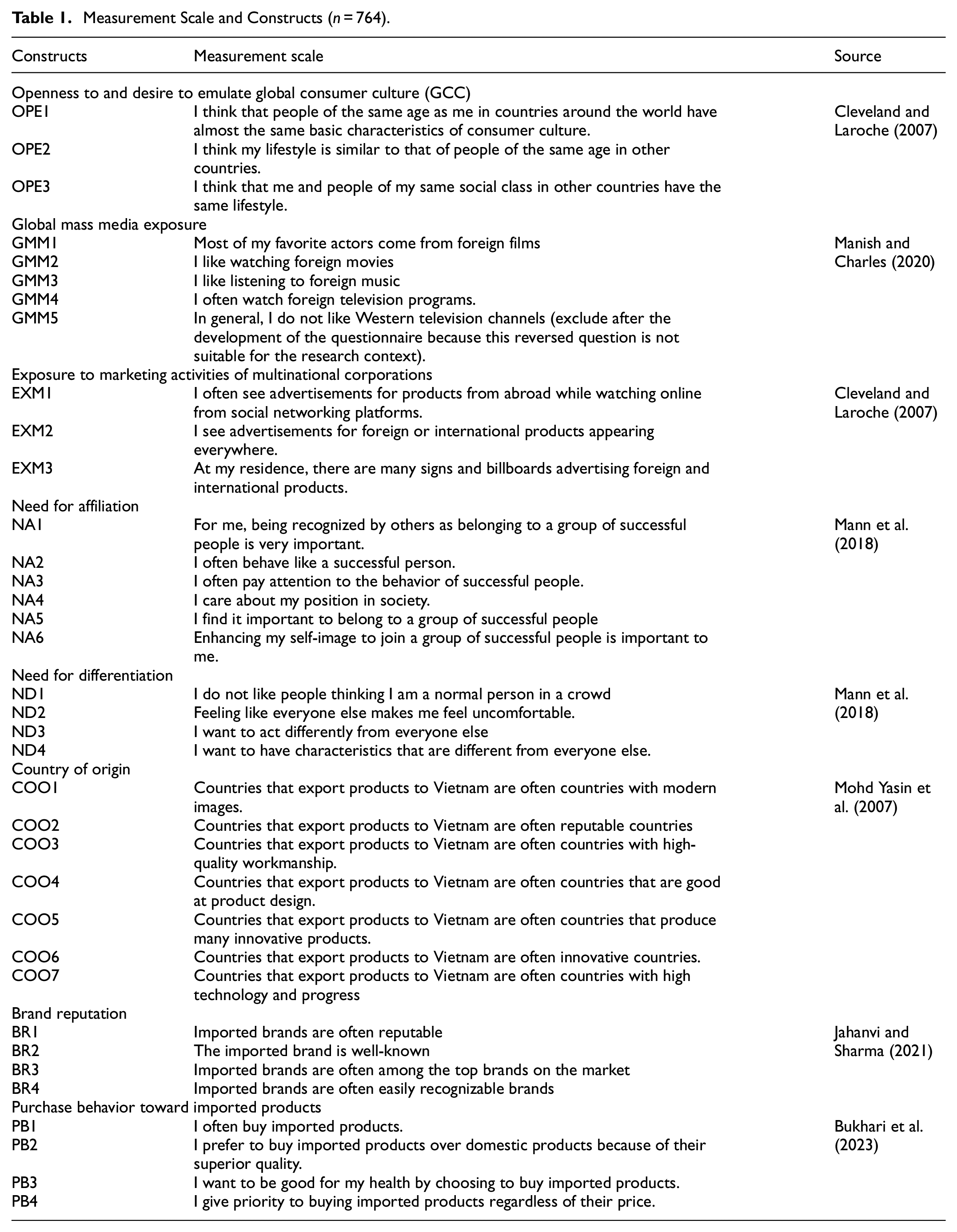
To ensure the high reliability of the results obtained, the authors adopted measurement scales from reputable research articles from high-ranking journals in the Scopus or ISI database. The proposed research model has seven variables with 35 observed variables, including one independent variable, one mediating variable, and two moderating variables. There were 7 variables measured by 35 observed variables, including one independent variable, one mediating variable, two moderating variables, and one dependent variable. The questionnaire measures consumer opinions using a 5-point Likert scale: 1 (Completely disagree) to 5 (Completely agree). The final measurement scale is presented in Table 1.
Measurement Scale and Constructs (n = 764).
Data collection
To test the hypothesized model, the authors have collected data from consumers residing in the Southeast provinces of Viet Nam (Ho Chi Minh City, Ba Ria–Vung Tau, Binh Duong, Binh Phuoc, Dong Nai, Tay Ninh) of Vietnam, an area with a particularly important strategic position in economics, politics, society, defence, security, foreign affairs and is considered a large, dynamic, and the most creative region in the country (Hoang, 2024). Additionally, the high imported-exported turnover ratio of Southeast provinces also represents 31% of Viet Nam’s trade (moit, 2024), and the provinces’ population of approximately 19 million people, constituting 18.9% of the country’s total population (GSO, 2023). Therefore, the sample in this area can represent the Vietnam region, and many people from other localities are coming to live and work in the Southeast region. Hence, the findings in this study also reflect well for other regions of Vietnam. Therefore, all the respondents participating in the survey are suitable for the scope of the research.
To ensure easy access to the survey group and save time, the authors employed a cross-sectional research method and a convenient random sampling approach with the limitation of generalizability. However, due to the limited resources and time, this method allows quick data collection and accurate representation of the target population. Moreover, determining the sample size is crucial to solve the above limitation as it significantly increases the reliability and generalizability of the research findings. Then, the authors seriously examined this issue from various reputable sources, such as the studies of Tabachnick and Fidell (2007), to ensure a robust research approach. According to Tabachnick and Fidell (2007) sample sizes are categorized based on their quality: 100 (poor), 200 (fair), 300 for good; 500 for very good; and 1,000 or higher for excellent, providing a structured approach to determining sample size. Hence, for this research topic, the authors opted for a sample size of 1,000 respondents, aligning with the research context and the survey’s requirements to guarantee thorough data collection and in-depth analysis.
PLS-Sem Method
This study combines three behavioral theories to analyze the impact of AGCC and NFD on consumers’ purchase behavior toward imported products. Due to the exploratory nature of this research and the presence of many high-oder constructs, mediator and moderators, a partial least squares structural equation modeling (PLS-SEM) is chosen for its ability to handle complex models with many relationships and provide robust results (Hair et al., 2022), which is more suitable in the complex model than CB-SEM. Subsequently, SmartPLS software was employed to assess hypotheses and conduct data analysis through SEM.
Results
Descriptive Statistic
After the investigation process, with 1,000 questionnaires distributed, the authors received 917 returned questionnaires. After processing and eliminating invalid answer sheets, the authors compiled 764 valid respondents to conduct tests (a good rate of 76.4%).
From the results of Table 2, we can see that the total number of female respondents is 429, accounting for 56.2%, while the number of male respondents only accounts for 335 people, about 43.8%. Regarding age, the majority of respondents, 362 people (47.4%), are in the 25 to 29 age group. This is followed by 158 people (20.7%) in the 30-34 age group, 154 people (20.2%) in the 18 to 24 age group, 66 people (8.6%) in the 35 to 50 age group and only 24 people (3.1%) in the over 50 age group. Regarding marital status, 475 people (62.2%) are single, and 289 (37.8%) are married. Most respondents have university degrees (49.5%), followed by intermediate-level and college degrees (34.2%). Additionally, 66 people (8.6%) have middle—high school degrees, and 59 (7.7%) have postgraduate degrees. Regarding income, the income group from 15 million VND to under 30 million VND is the highest, with 279 people accounting for 36.5%, followed by the group from 7.5 million VND to under 15 million VND with 183 people accounting for 24.0%, the third highest group is from 4.5 million VND to under 7.5 million VND with 144 people accounting for 18.8%. The fourth place is 119 people in the group from 30 to under 45 million VND, accounting for 15.6%, and finally, the group from 45 million VND or more, up with 39 people accounting for 5.1%. The survey sample focused mainly on the 18 to 34 age group due to their ability to quickly accept new trends and the leading role of young people in entertainment and consumption. Young people are the primary users of technology and social networks, which are important channels for transmitting and absorbing culture. In particular, women in Asian countries such as Vietnam often take on the primary shopping role and are suitable for surveys at import stores or shopping malls.
Demographic Characteristics (n = 764).

USD = 25.335.00 VND (exchange rate on July 22, 2024).
CMB (Common Method Bias) Test
To check the data set, the authors applied the common method bias test using SPSS software. The test results show that a single factor accounts for 34.083% of the total variance, less than 50%. Therefore, the data set does not encounter the common bias problem due to the factor’s contribution being less than 50% (Cooper et al., 2020). The authors have also tested normality with Kurtosis and Skewness tests. The research is within ±1, indicating that the data achieves a normal distribution (Hair et al., 2022).
Evaluation of Second-order Variables
With all the first-order variables achieved reliability, discriminality and validity, the authors obtained the higher-order variables’ latent variables (AGCC and NFD). From there, the authors continued to test the second step of the model.
Results of Table 3 show that all the latent variables meet reliability requirements when CA (Cronbach's alpha) coefficients and rho_c (composite reliability) are both greater than .7 (Hair et al., 2022). The AVE (average variance extracted) has a significance greater than .5, meaning that all the factors have convergent validity (Hair et al., 2022). The indicator loadings of latent variables are more significant than 0.708, and the VIF values are all less than 3, showing that the latent variables meet the requirements (Hair et al., 2022). In addition, according to Table 4, all the HTMT values of latent variables are 0.85, which means all the measurement scales achieved discriminant values.
Validity and Reliability Test.

HTMT (Heterotrait-Monotrait Ratio of Correlation).

The results of Table 5 show that the SRMR (standardized mean square residual) of the model is 0.054 (less than 0.08), and the NFI is 0.839 (higher than 0.8), which means the model is good fit with market data (Henseler et al., 2015).
Fit of the Model.

The results of SEM (Structural Equation Modeling)
The authors employed the bootstrapping method to test the structural model with a sample size of 10,000. Based on the recommendations of Chin (1998), and Hair et al. (2022), the authors analyzed the multicollinearity coefficient (VIF), coefficient of determination (R2), variance inflation values (VIFs), as well as the statistical significance and the path coefficients. The results of the bootstrapping test are presented in Table 6.
Path Coefficients of the Hypotheses.

Based on the results of Table 6, the bootstrapping results also show that all the VIF values of the hypotheses are under 3, meaning that all the hypotheses are not multicollinearity. In addition, the standardized β of the direct relationship between NFD → AGCC is 0.660; AGCC → PB is 0.413; NFD → PB is 0.279, which fall within the confidence interval, and the t-statistic is greater than 1.96, meaning hypotheses H1, H2, and H4 are all supported.
The standardized β of the indirect relationship between NFD → AGCC → PB is 0.273, within the confidence interval threshold, and the t-statistic is greater than 1.96; therefore, hypothesis H3 is supported. At the same time, the moderating role of BR in the relationship between BRxAGCC →PB and BRxNFD → PB is also statistically significant when the standardized β are .138 and .169, with p < .05 and the t-statistic > 1.96. Therefore, hypotheses H6a and H6b are accepted, meaning that higher BR can strengthen the impact of AGCC and NFD on PB: when BR is at mean or +1 SD, the impact of AGCC and NFD on PB are stronger than BR at -1 SD, which are shown in Figures 3 and 4 below. On the other hand, the moderating role of COO in the relationship between COOxAGCC →PB and COOxNFD → PB is not statistically significant when the standardized β are -0.007 and -0.049, with p > .05 and the t-statistic >1.96. Therefore, hypotheses H5a and H5b are both rejected.
The adjusted coefficient of determination R2 of AGCC is 0.435, showing that the NFD variable explains 43.5% of the variance of AGCC. The adjusted coefficient of determination R2 of PB is 0.521, showing that the variables AGCC and NFD explain 52.1% of the variance of PB. According to Hair et al. (2022), the impact of independent factors on the dependent factor (f2) varies from 0.02 (weak) to over 0.35 (strong). In Table 6, the results show that NFD has a strong impact on AGCC (f2 of NFD → AGCC = 0.772) and has a weak impact on PB (f2 of NFD → PB = 0.085), AGCC has a medium impact on PB (f2 of AGCC → PB = 0.170), BRxAGCC and BRxNFD → PB have a weak impact (f2 of BRxAGCC → PB = 0.024 and f2 of BRxNFD → PB = 0.034). Meanwhile, COOxAGCC → PB and COOxNFD → PB have no effects (f2 of COOxAGCC → PB = 0.000 and f2 of COOxNFD → PB = 0.002).
In conclude, the results show that there are two direct effects, one indirect effect, and two moderating effects in Figure 2.

The path coefficients of the hypotheses.
Prediction power of the model
The results of Table 7 show that the Q2 values of all observed variables (AGCC and PB) are greater than 0, meaning the model has a level of prediction (Shmueli et al., 2019). The number of observed variables with PLS-SEM_MAE index less than LM_MAE is 4/7 observed variables. Therefore, the proposed model has an medium prediction ability (Shmueli et al., 2019).
Prediction Power of the Model.

Discussion
Hypothesis H1 is accepted, meaning that NFD positively and directly impact AGCC with a β of 0.660, which is similar to previous research of Mann et al. (2018). Mann et al. (2018) argued that the higher the need for distinctiveness among young consumers in urban areas of India, the greater the acculturation with Western culture, which is also similar to the results of this study, showing that the greater NFD, the higher AGCC. The result is also consistent with the context of Vietnam. As a developing country, the NFD of Vietnamese consumers are high, and their adaption to AGCC can also increase. This finding contributes to solving the research objective of exploring the impact of NFD on AGCC. In addition, the strong impact of NFD on AGCC (f2 = 0.772) shows that NFD are crucial in explaining the change in AGCC. This finding is also consistent with existing theories such as AT and OPT, which reaffirm previous studies' findings of the relationship between NFD and AGCC (Mann et al., 2018). This finding once again strengthens and expands the understanding of these theories.
Hypotheses H2 and H4 are supported, which means that AGCC and NFD positively and directly impact PB with β of 0.413 and 0.279, respectively. The results show that higher AGCC and NFD, the more consumers will be motivated to buy imported products. That means that the higher the level of AGCC, the more likely consumers are to buy imported products. Similarly, the higher the level of NFD of consumers, the more motivated they are to buy imported products to satisfy and balance the two needs of affiliation and differentiation. The findings contribute to the objective of demonstrating the impact of NFD and AGCC on PB.
Hypothesis H3 is supported, which means that AGCC mediates the relationship between NFD and PB with a β of.273. This result shows that, with the rapid economic growth based on a unique collective culture, Vietnam has recently witnessed a change in consumer behavior, especially under the influence of AGCC. In this context, consumers’ NFD, especially in the younger generation, is subtly expressed through purchasing imported goods, which helps them affirm their personality and position while harmonizing community values. Increased exposure to global trends through media, e-commerce, and economic integration makes AGCC an important bridge that converts NFD into PB. In short, NFD not only directly affect PB but also indirectly affect PB through AGCC as a mediator. The higher the consumers’ NFD, the greater their AGCC level, thereby increasing PB to satisfy NFD. The supported H3, H6a, and H6 also provide theoretical contributions in the research field of acculturation to global consumer culture, which previous studies have not explored.
Hypotheses H6a and H6b are supported, which means that BR impacts the relationship between AGCC to PB and NFD to PB with β of.138 and.169, respectively. The results show that BR positively and significantly moderates the above relationship. In other words, when consumer buying behavior of imported products is influenced by acculturation to global consumer culture and the need for distinctiveness, the higher the brand reputation, the higher the purchase behavior toward imported products. The result is also consistent with the Signaling theory, which contributes to solving the proposed objective by finding the moderating role of BR in the relationship between NFD and PB as well as AGCC and PB. Regarding f2 values (H6a = 0.024, and H6b = 0.036), the moderation effect of BR is weak. However, regarding β (H6a = 0.138, and H6b = 0.169), BR still has sufficient effects to strengthen the relationships between AGCC and PB, NFD and PB when BR is at mean or +1 SD (please refer to Figures 3 and 4). The result shows that although the impact of BR is weak, it can still regulate the relationship between the NFD and PB, as well as AGCC and PB. In addition, it also reflects that besides BR, other objective and subjective factors can regulate these relationships well.
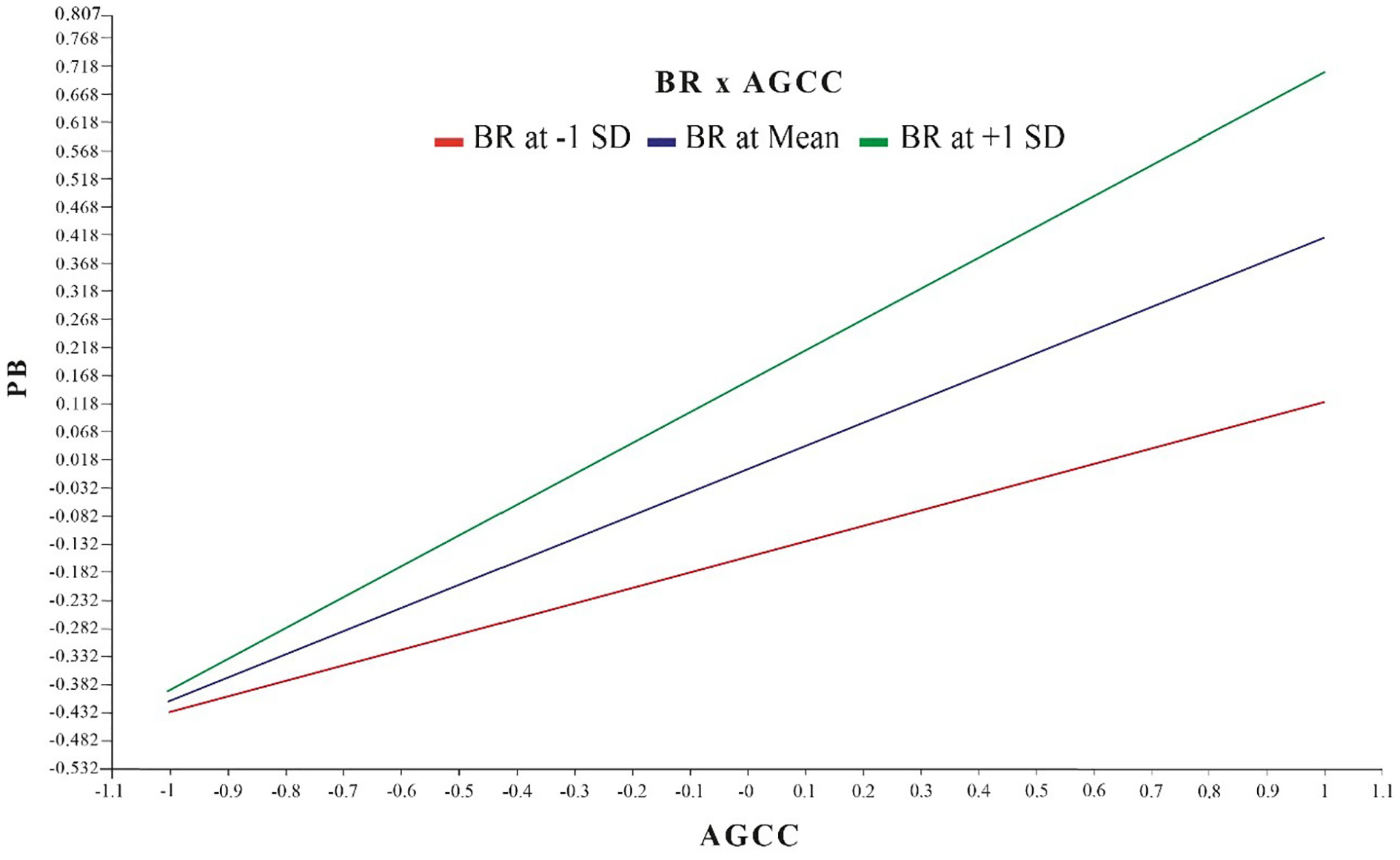
BR positively moderate the correlation between AGCC and PB.

BR positively moderate the correlation between NFD and PB.
Hypotheses H5a and H5b were rejected (p-value > .05), indicating that COO did not moderate the correlation between AGCC, NFD and PB. Several reasons can explain the result: In contrast to developed countries, where consumers often consider both quality, reputation and COO of the product, most Vietnamese consumers prioritize popular products widely used in developed countries without paying too much attention to COO of these products. The reason is that they believe that these products are guaranteed in quality, meet global standards, and they will achieve differentiation when purchasing imported products. In addition, the scope of the adaptation in this study does not focus on a specific region or country (e.g., AWCC) but covers the whole world (AGCC). This scope can make it difficult for consumers to understand the competitive advantages of each country that exports products to Vietnam in depth. At the same time, a country often exports many different products and brands, making the country of origin factor less important in product evaluation. Instead, Vietnamese consumers rely on the brand name and reputation to decide on product selection because these factors help them to evaluate and compare the products more efficiently. In addition, the shift in consumption approach of Vietnamese consumer reflects the trend of the international market, where trust in global brands gradually replaces local factors such as country of origin.
Conclusion
This research has fully accomplished the initially set goals of filling the gap between culture and consumer purchase behavior by measuring the impact of NFD and AGCC on PB. The study also examines the mediating role of AGCC, and the moderating role of COO and BR.
The results show that AGCC has the strongest impact on PB with a β of .413. Next, NFD also significantly influences PB with a β of .279. Besides, AGCC also partially mediates the relationship between NFD and PB, with a β of .273. In addition, BR significantly moderates the relationship between AGCC → PB and NFD → PB with β of .138 and .169, respectively. Meanwhile, the COO has no impact on relationships between AGCC → PB and NFD → PB with β of −.007 and −.049. Finally, NFD also has a strong impact on AGGG with β of.660.
In summary, this study has contributed to understanding acculturation and optimal differentiation theories by showing that AGCC and NFD significantly affect PB behavior. Specifically, AGCC was identified as the factor with the most substantial impact on PB, while NFD also played an important role. The mediating role of AGCC and moderating role of BR suggests that global acculturation factors and brand reputation can shape consumer behavior, while COO does not significantly influence these relationships. These findings clarify how cultural factors and the need for differentiation influence purchase decisions, thereby enriching acculturation theory (AT) and optimal differentiation theory (ODT).
Theoretical implications
This research has contributed to the knowledge base of the academic world in several aspects, as follows:
First of all, this study would expand the optimal distinctiveness theory of Brewer (1991) by integrating the AGCC factor to explain PB. The findings of this study also reaffirm that NFD is a fundamental driver of consumer behavior in Vietnam through individuals' dual desire to be similar to ideal groups and different from less ideal groups. Besides, this study also discovered a new relationship between NFD and AGCC. In summary, this study extends acculturation theory by showing the impact of AGCC on PB, suggesting that AGCC not only influences consumers’ perceptions and attitudes but also shapes actual behavior. This finding provides a new perspective on how AGCC influences consumer behavior. In addition, the finding of the relationship between NFD and PB is an important contribution, confirming and enriching the optimal differentiation theory.
Second, the study also found a positive moderating role of BR in the relationship between AGCC and PB and NFD and PB, which fills the research gap between culture and consumer behavior. Since the moderating factors in previous studies have mainly focused on subjective factors of consumers without considering objective factors such as brand reputation, these new and important findings will have implications for future research. In addition, the significant moderation of BR on consumer behavior also helps to expand the understanding of signaling theory because BR is an important signal in the international retail environment, helping businesses build trust and influence global purchasing decisions.
Third, through the literature review, the authors found that the concept of purchase behavior toward imported products needs to be clearly defined. Thus, this study would provide a new definition of the purchase behavior toward imported products, which would become a helpful reference source for future research.
Managerial Implications
Through the results, the authors would propose some important management implications to help foreign companies, retailers, and marketers penetrate the Vietnamese market.
First, the need for distinctiveness of consumers can motivate them to use products and services that are different from domestic products. In addition, consumers believe that using foreign products can give them a higher social status. Therefore, Vietnamese businesses and retailers may import design products with an international trend, unique styles, designs or features that are still unpopular in the current market. At the same time, design personalized or limited edition products to increase appeal and scarcity, thereby meeting the different needs of customers. At the same time, retailers should promote products with a luxurious and classy image associated with the lifestyle of successful people. Companies can cooperate with successful celebrities or people with high social status to promote products in luxurious settings such as conferences and events so that consumers can feel successful when using the product.
Second, AGCC is an important factor because this factor not only directly affects PB but also mediates the correlation between NFD and PB. Therefore, imported enterprises can build marketing campaigns associated with style, culture, and actors appearing in famous movies. In addition, the companies can cooperate with famous actors in movies that consumers love as product representatives. At the same time, enterprises should place signs, banners, and advertising posters in strategic locations with many people passing by, such as shopping malls, residential areas, universities, and social networking platforms, which are consistent with the brand's positioning strategy.
Third, the moderating role of BR is crucial in promoting PB. Therefore, businesses must promote their brands through films, global media, and advertising when expanding to foreign markets. Therefore, consumers can easily recognize, know and trust the brand. In addition, consumers' preferences, behaviors or perceptions of imported products and services may vary between provinces and cities. Then, companies can integrate with Vietnamese culture by deeply understanding the culture in each country or province they target. Businesses can also cooperate with key opinion leaders (KOLs) and opinion-leading consumers (KOCs) in Vietnam to create unique video trends that attract consumers: businesses do not follow trends; they create trends. Besides, businesses must deeply understand the culture in each country or province they target. Apart from the differentiation strategy mentioned, companies can also integrate with Vietnamese culture. For example, the high-end Chinese hot pot brand Hadilao succeeded in Vietnam due to cultural similarities between the two countries. This success was based on the introduction of the TikTok video trend from China to Vietnam. Businesses can replicate these video trends or partner with KOLs–Key Opinion Leaders or KOCs–Key Opinion Consumers in Vietnam to create distinctive video trends that appeal to consumers.
Limitation and Future Research
Although this study has resolved some problems from previous studies. However, the research still has some limitations as follows:
First, a cross-sectional design and convenient random sampling method were applied in this study, which partly affected the representativeness of the population. Although the authors used a large sample size and then eliminated 236 no or invalid respondents (rejection rate at 23.6%) to overcome the disadvantages of the convenience and non-probability sampling method, the drawbacks can only be partially addressed because the respondents' income, education and age differences are significant, which could compromise the data set's reliability. Thus, to concentrate on specific groups like Generation Y or Generation Z, the authors advise that future research use different and other sampling techniques like quota sampling and stratification to ensure a more representative sample. Furthermore, identifying additional factors influencing purchase behavior toward imported products may be limited due to the random selection of interview respondents. Future researchers can consider employing longitudinal designs to capture changes in consumer behavior, such as personal preferences, cultural conflicts, or nationalism.
Second, the study was limited to surveying consumers in one region of Vietnam. Therefore, future studies should expand research on a larger scale to consider consumer behavior, for example, in other areas in Vietnam or across many different countries. In addition, this research does not focus on a specific industry so that future research can focus on particular industries or products like the automotive sector (electric motorbikes, electric cars, hybrid cars) or home and household appliances (energy-saving lightbulbs) that can enhance the accuracy of observing consumer behavior. The lack of support for the moderating effect of COO could be attributed to demographic differences. In addition, many countries export goods to Vietnam, which challenges consumers to recognize and evaluate imported products in detail. Future research should concentrate on a specific imported product or exporting country to reevaluate the moderating effect of COO. At the same time, future studies could also add other variables to the research model, such as greenwashing, skepticism, and confusion when researching green products (electric motorbikes, electric cars, and hybrid cars). Additionally, exploring how cultural differences influence consumer perceptions and behaviors toward green products could offer valuable insights for future research.
Footnotes
Acknowledgements
The authors would like to sincerely thank the Industrial University of Ho Chi Minh City. Their assistance has been a great motivation in completing the study on time.

Ethical Considerations
There is no ethics or institutional committee in place at a researcher's institution when the study was conducted. However, the authors declare that all research conducted as part of this work involving human participants has been performed in strict accordance with the principles stated in the Declaration of Helsinki. We adhere to the highest ethical standards in conducting human research, ensuring the safety, dignity, and privacy of all subjects involved in our study. All the human participants in the study are anonymous. Prior to their participation, all subjects were fully informed about the nature and purpose of the research and were made aware that they could withdraw their participation at any time before submitting their responses. Only those participants who voluntarily submitted their responses were included in the study.
Author Contributions
Conceptualization, Nguyen Le and Sang Tan Huynh; methodology, Nguyen Le, Quy Duy Do, Sang Tan Huynh; software, Nguyen Le; validation, Nguyen Le and Thanh Thi Bui; formal analysis, Nguyen Le, Sang Tan Huynh and Quy Duy Do; investigation, Sang Tan Huynh, Quy Duy Do and Truong Xuan Nguyen; resources, Sang Tan Huynh, Quy Duy Do and Truong Xuan Nguyen; data curation, Nguyen Le; writing—original draft preparation, Nguyen Le, Sang Tan Huynh, Quy Duy Do and Truong Xuan Nguyen; writing—review and editing, Nguyen Le and Thanh Thi Bui; visualization, Nguyen Le and Sang Tan Huynh; supervision, Nguyen Le and Thanh Thi Bui; project administration, Nguyen Le; funding acquisition, Nguyen Le and Thanh Thi Bui. All authors have read and agreed to the published version of the manuscript.
Funding
The author(s) disclosed receipt of the following financial support for the research, authorship, and/or publication of this article: This article is funded by Industrial University of Ho Chi Minh City and University of Economics Ho Chi Minh City.
Declaration of Conflicting Interests
The author(s) declared no potential conflicts of interest with respect to the research, authorship, and/or publication of this article.
Data Availability Statement
The data used to support the research findings are available from the corresponding author upon request.