




Abstract
Employees are one of the most important factors in business. Therefore, enterprises should account for the expectations of employees, particularly their perception of the enterprise, and their behavior. This study investigates the importance of employees’ perceived corporate social responsibility (CSR) and also examines the potential role of predicting employer brand, brand image, and corporate reputation. The study’s participants comprise employees working in different departments of various corporations. A total of 559 surveys were collected from randomly sampled company employees working in small and medium-sized enterprises (SMEs) in Turkey, and the responses were analyzed using component-based least squares modeling. The model was analyzed and validated by Smart partial least squares software. Employee-oriented CSR activities have a positive effect on employer brand and brand image perceptions among employees in SMEs. Perceived corporate reputation mediates this relationship.
Introduction
In recent years, the importance of corporate social responsibility (CSR) has been increasing in the academic and business world (DeNisi et al., 2014). Studies on the efficiency and benefits of CSR interventions and applications conventionally focus on issues such as the efficiency of enterprise operations, employee productivity, and financial performance. Furthermore, CSR provides firms with improved corporate appeal, social status, and external prestige (Hameed et al., 2016). It has been suggested that CSR positively affects employee performance and perception of work experiences (Clark et al., 2017; Mory et al., 2015), and further, that inconsistent CSR strategies have negative effects on employees (Anselmsson et al., 2016; Fassin & Buelens, 2011; Scheidler et al., 2018).
CSR, which is used as a tool by enterprises for reaching their organizational purposes, has been studied along four dimensions: economic, legal, ethical, and volunteering (Carroll, 1991). Recently, an increasing number of studies have considered the impact of CSR on the psychology of employees (Powell et al., 2013; Rupp & Mallory, 2015), and the effect of CSR on employee performance and attitudes has also been investigated (Barrena-Martínez et al., 2017; G. Davies et al., 2018; Gond et al., 2017; Hansen et al., 2011; Morokane et al., 2016; Tavassoli et al., 2014). These studies have evaluated the attractiveness to job seekers and potential employees of signals taken from the corporate social performance of companies. A four-dimensional structure was created to measure employees’ perception of CSR. These four dimensions were interpreted as responsibilities toward (a) social and non-social stakeholders, (b) employees, (c) consumers, and (d) the state/government (Turker, 2009). The effect on the financial performance of companies is included through the economic dimension of CSR (Fifka & Pobizhan, 2014; Reverte et al., 2016; Rusmanto & Williams, 2015; Waworuntu et al., 2014). The social dimension of CSR is an important factor when the relationships between the enterprise, society, and employees are considered (Bakos, 2014; Duff, 2016; S. Kim & Lee, 2012). Studies have shown that the environmental dimension of CSR increases innovation in enterprises, reduces costs, protects resources, and provides a competitive advantage (Cho & Patten, 2013; Flammer, 2013; Graafland & Smid, 2017; Searcy et al., 2016; Wahba, 2008).
CSR provides the opportunity, innovation, and a competitive edge (Porter & Kramer, 2006) to the enterprises by contributing in commercial, ethical, and social responsibility areas; aiding in the development of high-quality products and services; and ensuring fulfillment of their obligations, both legal and to their stakeholders (J. Singh et al., 2008). Another important advantage of CSR is its effect on brand awareness and brand image (BI; Hsu, 2012; Tian et al., 2011). Consequently, many studies in the literature have examined how CSR affects various criteria, such as employee commitment to the organization, job satisfaction, intention to leave, and corporate image.
The employer brand (EB) is defined as a long-targeted strategy to manage the awareness and perceptions of employees, potential employees, and all relevant stakeholders in companies (Sullivan, 2004). EB is the image of an institution perceived by stakeholders, shareholders, and employees (Sehgal & Malati, 2013). The EB is a necessity for companies to acquire and retain key employees. The EB is divided into internal and external EB. Internal EB focuses on activities that provide opportunities for employees to develop within the institution. As a result, the employee becomes the customer of the company. External EB aims to offer brand awareness and fulfillment of CSR goals (Kozłowski, 2012).
Employee-oriented CSR activities help motivate companies to build a strong EB by keeping their existing employees (Dokania & Pathak, 2013).
It is only possible for institutions to have their products and services accepted in the domestic and foreign markets in a competitive environment and turn them into a financial value by having a good corporate BI. While the institutions are trying to reach their goals, the corporate BI perceptions of the employees and the values they give to the institution are of great importance. While a positive BI will enable employees to integrate their identities with the organization, it will make the institution attractive for future employees (H. Kim et al., 2015).
Corporate reputation (CR) is defined as a valuable and abstract asset that affects stakeholders’ perceptions and preferences about the organization. It is a summary view of all the perceptions of the relevant stakeholders about the organization. It is the beliefs of stakeholders about what the institution is and how it connects with it. It is the cognitive and affective assessments of the past performance of the institution and the estimates of its future behavior. According to (Chun 2005, p. 105), “corporate reputation is an umbrella structure related to the cumulative impressions of internal and external stakeholders.” Having a positive reputation is based on the institution’s employees perceiving the institution as more attractive than its competitors. Institutions should develop effective programs to protect their CR. Trust in an institution’s services and product is realized through the performances of the employees. Therefore, the reputation of the institution they work through is always very important. The beliefs, loyalty, and thoughts of the employees regarding their institutions are of great importance for the construction and continuation of the company’s reputation. It creates the necessity to conduct employee-oriented CSR activities in its organizations that want to have a strong reputation and maintain the existing reputation.
According to the cognitive dissonance theory (Festinger, 1957), which states that individuals are seeking internal consistency between expectation and reality, companies are expected to help employees develop positive behaviors among their employees and reduce their negative perceptions about their employers. Such practices that are compatible with employee values and expectations will help deter employees’ incompatibility and negative behavior (Okolocha, 2020). CSR is recognized as a tool to attract and maintain talent by enhancing the EB, strengthening an organization’s reputation.
Qualitative and quantitative research on CSR in small and medium-sized enterprises (SMEs) in developing countries is limited and has received little scientific interest (Liu & Fong, 2010). Most CSR-related studies focus on large-scale companies (Chon & Yoo, 2013). It is also revealed that employees in medium-sized organizations are not aware of CSR (Bashir et al., 2012). As a result, this study focuses on CSR perceptions of employees because CSR perception affects employees’ attitudes and behaviors. It aimed to fill the methodological research gap by examining the mechanism that CSR activities in SMEs help create CR, EB, and BI among employees. It aims to answer the following questions with these identified gaps: (a) What is the relationship between employee-oriented CSR activities, perceived CR, EB, and BI? (b) Do employee-oriented CSR activities have a positive impact on EB and BI perceptions among SMEs? (c) Does the perceived CR mediate the relationship between employee-oriented CSR activities and EB and BI perceptions in SMEs?
This research contributes to the literature in two ways. First, most extant research has focused on the impact of CSR on external stakeholders, such as consumers, competitors, and suppliers. However, these studies have not been focused on employee perceptions and attitudes. In recent studies, employee views, opinions, and perceptions of companies’ CSR activities have shown significant benefits. The fact that employees are more involved in organizational culture and that they have more real information about their company than other stakeholders supports this view. This study evaluates the CSR efforts of companies according to employees’ perceptions, attitudes, and behaviors. Second, it contributes to the perception of CSR being linked to the EB, BI, and CR. To further explore the importance and potential role of CSR in predicting the EB, BI, and CR of SMEs in this study, the current employees were selected as stakeholder groups.
Literature Review and Conceptual Model
CSR and EB
EB is defined as the functional, economic, and psychological benefits of the employment provided by the employer (Ambler & Barrow, 1996). It has been defined as a concept that differentiates an enterprise from other enterprises (Backhaus & Tikoo, 2004) and also as the values attributed to the workplace by the employees, which manifests as a high-quality employment experience wherein employees feel secure and develop a close relationship with their employer (Martin et al., 2011). Enterprises with a strong EB benefit from increased commitment and retention of employees and increased job performance (Knox & Freeman, 2006). Every company must build and consciously shape its EB to improve its competitiveness in the market. EB of companies is determined by factors such as the company’s reputation, product and service quality, opportunities provided to employees, working environment, payment, and economic conditions. Recently, companies use CSR as a more effective tool to express their operational identity and strengthen their sustainable development in the labor market communication. The impact of a company’s EB strategy depends on how CSR messages are perceived and interpreted. Studies have shown that EB has a positive effect on employees (Aguinis & Glavas, 2012; Highhouse et al., 2009; Lievens & Slaughter, 2016; Tkalac Verčič & Sinčić Ćorić, 2018). Employee perception of CSR is crucial in the formation of EB (G. Davies et al., 2018; Jones et al., 2014; Lievens & Slaughter, 2016). This leads to the first hypothesis:
CSR and BI
They revealed that the first thing affected by CSR is BI and if it is perceived positively, it has an effect on BI (Swaen & Chumpitaz, 2008). Big companies realize that strong brands cannot be built without the constant support and management of employees (Lange et al., 2011). They have suggested that a good BI attracts customers and employees, and that companies will become stronger. A. Singh and Verma (2017) concluded that CSR is an opportunity to achieve a better corporate value and will increase the brand value by having a positive effect on the BI. It enhances the emotional aspect of the BI of CSR and provides a competitive advantage and protects it from competitive risks (Martínez et al., 2014). Employees are critical for the success of the BI. One of the first and most direct points of contact of a company with its customers is its employees. At all levels of an institution, employees have the opportunity to influence the perception of a company’s brand during these critical touch points. Regardless of their job descriptions, employees have two jobs, one is the job they do and the other is to convey the BI of the company to the outside world, as ambassadors of the brand. Employees serving as strong brand ambassadors need to be integrated into the corporate brand management program. It is accepted that CSR and BI are interconnected and there is a strategic requirement that positively affects (Wu & Wang, 2014). An organization’s responsibility is to develop an effective tool to convey the company’s corporate brand identity to all employees. When employees understand their roles as brand ambassadors and receive appreciation and reward for their roles, they can be successfully integrated into a corporate image program. There are many ways to create a corporate infrastructure that supports the role of a company as a brand ambassador. Employee-oriented CSR activities are one of these ways. As the positive effect of CSR on corporations and brands is known and becoming increasingly important worldwide, sensitivity (or insensitivity) to issues reflects on the brand. Enterprises’ ethical and social events are known to enhance relations with the brand (J. Singh et al., 2008). CSR strengthens BI and contributes to brand value (Melo & Galan, 2011). Nowadays, increased consumer and employee awareness fostered through CSR-related social activities has an important effect on increasing the corporate brand’s value. It has been argued that CSR is a highly important factor in creating a BI (Green & Peloza, 2011). Theoretical and empirical evidence has shown a link between CSR and BI (Lange et al., 2011; Pfarrer et al., 2010), and these relations are found to be positive and meaningful (Ellen et al., 2006; Maon et al., 2009; Porter & Kramer, 2006). This leads to the second hypothesis:
CSR and CR
Employees and CR are crucial tools for achieving sustainable competitive advantage. CR for companies is vital and plays a key role in managing it in employees (Gotsi & Wilson, 2001). Realizing the strategic role that employees can play in positioning CR can have significant consequences for companies to achieve their goals. It will affect the CR perceptions of the corporate culture, which enables the protection and promotion of reputation in companies. CR of businesses can also affect employees’ perception and attitude toward their business. There have been a limited number of studies related to institutional reputation (Ozdora-Aksak et al., 2016). Extant studies have focused mainly on external stakeholders and institutional and organizational levels (Aguinis & Glavas, 2012). Studying at the micro level to discover the importance and potential effects of CSR is becoming an increasingly popular topic (Glavas & Kelley, 2014). CSR was found to be a strong pioneer of CR and has shown positive effects on employee and stakeholder behaviors (Maden et al., 2012). In the analysis of the effect of CSR on CR, it was obtained as a result of the study that companies have a higher CR in countries with higher CSR levels (Lu et al., 2020).
CR as a Mediating Variable
CR is the result of an overall assessment of the total views of an organization by all stakeholders (Cornelissen, 2011). CR acts as a signal with the products and services of the companies, attracting more qualified employees in the labor market, and preferring to work in highly reputable companies, which is a high-level factor that enables employees to develop their loyalty and attitude positively. Reputation is all about a company’s corporate actions. Podnar and Balmer (2013) stated that they can have a direct and indirect effect on establishing and influencing CR, focusing on the employer’s brand and corporate BI. There is an overlap in the literature on conceptual, empirical, and methodological studies of EB, and CR. The concept of reputation is often used to express the EB (Cable & Turban, 2003). Ruiz et al. (2016) state that the EB was associated with CR and was interconnected, defined as its protector and pioneer. Studies have shown that CR positively affects EB (Tkalac Verčič & Sinčić Ćorić, 2018). Having good CR is an important factor for gaining competitive advantage (Sánchez & Sotorrío, 2007). CR reveals the quality of products and services, and it allows for the creation of BI by differentiating it from its competitors. Although BI and reputation are two different things, they are clearly strongly related and tend to be in the same direction, especially in times of crisis. In some cases, a strong BI can overcome reputation problems, and reputation problems can also damage a strong brand. CR is used as an overview of all stakeholders (Tischer & Hildebrandt, 2014). Hoejmose et al. (2014) stated that reputation is more permanent than image, and reputation is a source of support in negative situations. It is seen as a signal that guides stakeholders’ perceptions of the organization. It is concluded that CR has a mediating effect on the relationship between CSR and brand performance (Lai et al., 2010). According to the results, it is stated that employee-oriented CSR activities will increase the CR perceptions of an institution positively. It is assumed that employees’ CR perceptions will also mediate the impact of employee-oriented CSR activities on employees’ EB and BI perceptions. This leads to the third and fourth hypotheses:
The potential effects of CSR on EB and BI are investigated. In addition, the study also examines the role of the mediating effect of CR between CSR, EB, and BI. Based on the theoretical framework and purpose of the study, a conceptual model of the research is portrayed in Figure 1.

Conceptual model.
Research Method
The main aim of the study is to empirically test the effectiveness of employee-oriented CSR activities of companies on EB and BI perceptions and the mediating effect of CR on this event.
Data Collection and Measurement Instruments
A survey was used to collect data from the study population of employees from various enterprises. Survey items were measured on a 5-point Likert-type scale (from 1 = strongly disagree to 5 = strongly agree), and the survey contained two sections. The first section contained demographic questions, such as participant gender, age, education, and department; the second section contains items known to measure all constructs examined in the study. Twenty different SMEs, which have 50 to 250 numbers of employees and located in the Marmara region from Turkey, are selected. Evaluation is done among employees who have worked in the company for more than a year, at least 10 people from each company. The reason for this is that employees who stay in their companies for more than a year have more information about their CSR activities. During the data collection process, 20 SMEs, which agreed to participate in our survey, were determined as a result of the interview from SMEs operating in the production area in the Marmara region using the random sampling method. The total number of employees of these SMEs is 3,000. Questionnaires were sent online to SMEs. Return was received from 725 employees; 559 of these employees worked more than 1 year. According to the random sampling method, approximately 3,000 employees in total need 341 in the 5% error and 95% confidence intervals, and 543 employees in the 5% error and 99% confidence intervals; 559 employees responded to the survey. Demographic characteristics are as follows: 75.5% of the respondents are men and 24.5% are women. In terms of the departments of respondents, 25.6% were from production, 22.5% from engineering/design, 14.8% from research and development, 12.3% from a department not listed elsewhere, 8.9% from marketing, 7.5% from management, 5.7% from accounting/finance, and 2.5% from human resources. The distribution of highest educational attainment among respondents was as follows: undergraduate degree, 64.8%; graduate degree (except doctoral degree), 12.7%; 2-year college degree, 9.3%; high school, 8.8%; and doctoral degree, 4.5%. The items in the second part of the study were taken from scales with proven validity and reliability. As seen as in Appendix, the scale to measure employee-focused CSR was adapted from Turker (2009). The employee-focused CSR was measured by means of an 11-item scale. The scale to measure EB was adapted from Knox and Freeman (2006) and Lievens et al. (2007). The EB was measured by means of a four-item scale. The scale to measure BI was adapted from Bravo et al. (2010). The BI was measured by means of a seven-item scale. The scale to measure CR was adapted from Ponzi et al. (2011). The CR was measured by means of a four-item scale.
Data Analysis
The partial least squares (PLS) method, a variance-based method used to estimate composite-based path models, was used for data analysis. It is a multivariate statistical technique that can infer causal relations (Henseler et al., 2016). PLS data analysis is separated into two phases (outer and inner) and uses a structural analysis model wherein hypotheses are tested by examining the relations among latent variables and path coefficients with confirmatory factor analysis (CFA) used to test the reliability and validity analyses of the measurement model.
Assessment of Outer Measurement Model
Two types of assessments of the conceptual model were conducted using the PLS structural modeling system. These assessments are in the form of an assessment of the internal structural model, which characterizes the relations among unobservable variables, and an assessment of the external measurement model, which characterizes the relation between unobservable and observable variables. The analysis of these models was performed using Smart PLS program, which was also used to check the model validity. In the assessment of the external measurement model, both convergence and discriminant validity need to be evaluated when studying the relationship between activators and their indicators. Convergence validity, an indicator of internal consistency, requires that each indicator measures only the activator it is assumed to measure (i.e., indicators should not measure other activators). The assessment of convergence validity was based on Cronbach’s alpha, the composite reliability index (CRI), and the average variance extracted (AVE) values. The distinctiveness validity was based on discriminant validity and activator loadings. A model is conventionally considered good if Cronbach’s alpha is at least .60 and the CRI score is higher than .70 (Rahman et al., 2013). Alternatively, an AVE of at least .50 can be considered sufficient for convergence validity (Fornell & Larcker, 1981). Discriminant validity, which is used in evaluating distinctiveness validity, requires that the correlation between an unobservable variable and other unobservable variables be smaller than the square root of the AVE (Fornell & Larcker, 1981). Furthermore, for convergence validity, the loadings of basic variables should be higher than .70 (Hulland, 1999).
As seen in Table 1, the AVE values are higher than the threshold value of .50, Cronbach’s alpha values are higher than the threshold value of .60, and the CRI values were higher than the threshold value of .70. Thus, it was concluded that all the convergence criteria were met. In Table 2, in the discriminant analysis used in the assessment of the distinctiveness criteria, the values shown in bold letters indicate the square root of AVE values. The other values indicate the between-variable correlation coefficients. For all criteria, the square root of the AVE values was higher than the correlation values, indicating that the model satisfies this distinctiveness criterion. The loadings applied to the activators of each indicator (as another distinctiveness criterion) should be higher than the cross-loadings to other activators. As seen in Table 2, all indicators can be grouped by taking the highest loading among the assumed activators, so the measurement model satisfies this distinctiveness criterion also.
Measurement Model.
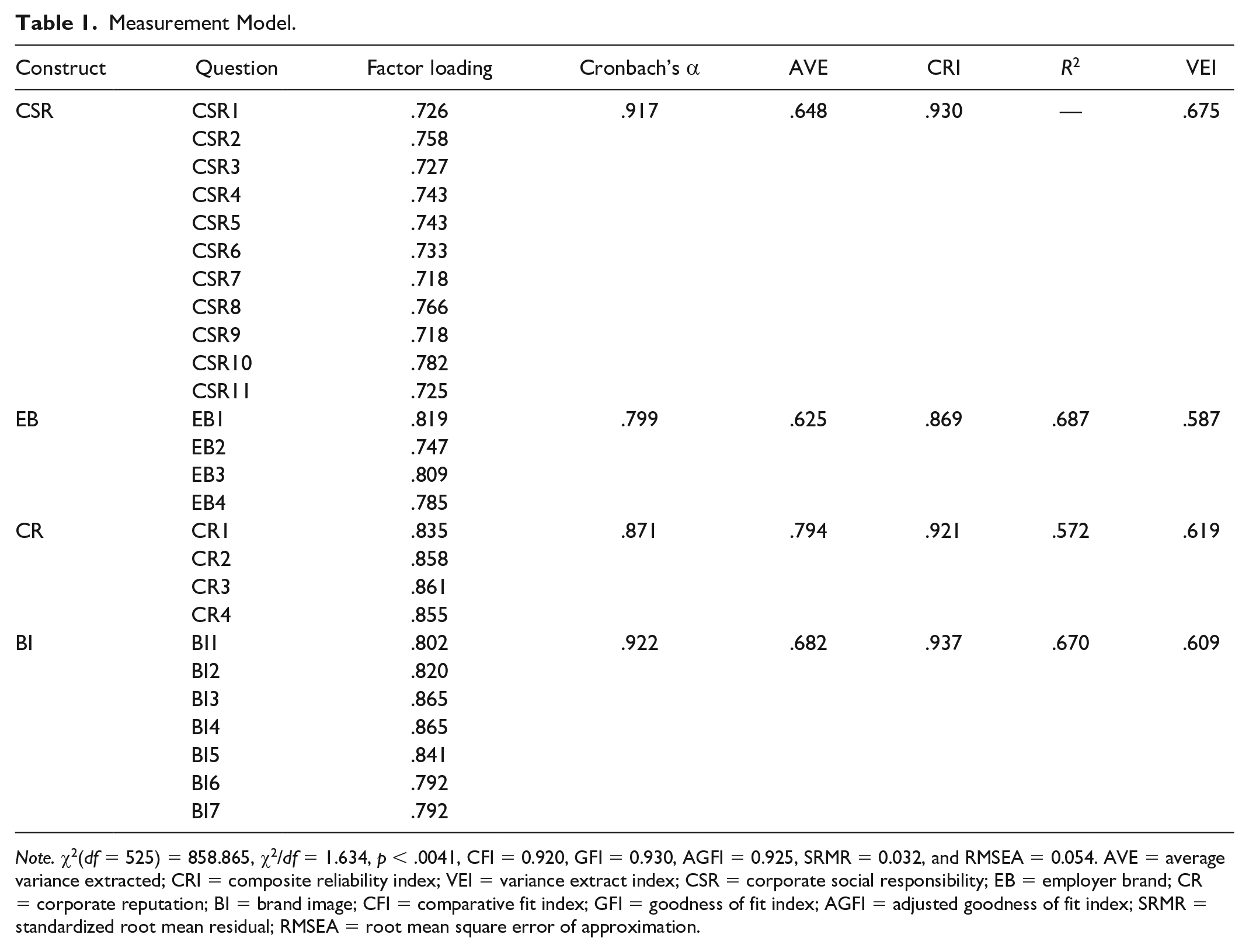
Note. χ2(df = 525) = 858.865, χ2/df = 1.634, p < .0041, CFI = 0.920, GFI = 0.930, AGFI = 0.925, SRMR = 0.032, and RMSEA = 0.054. AVE = average variance extracted; CRI = composite reliability index; VEI = variance extract index; CSR = corporate social responsibility; EB = employer brand; CR = corporate reputation; BI = brand image; CFI = comparative fit index; GFI = goodness of fit index; AGFI = adjusted goodness of fit index; SRMR = standardized root mean residual; RMSEA = root mean square error of approximation.
Discriminant Validity.
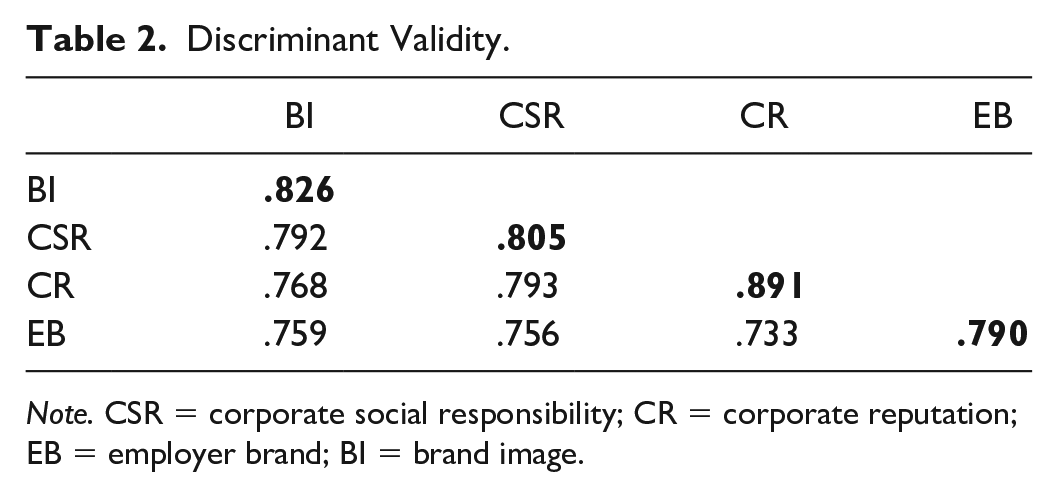
Note. CSR = corporate social responsibility; CR = corporate reputation; EB = employer brand; BI = brand image.
The reliability and validity of the four scales used in this study were carried out with the second-order CFA using the maximum likelihood method. In the reliability analysis, it was evaluated with Cronbach’s alpha and CRI. CFA results are presented in Table 1. The results suggested in the literature were obtained for model compatibility of CFA. In our measurement model, it was concluded that all of the general goodness-of-fit (GOF) measures were acceptable, and therefore structural validity was provided. It is seen that all the factors of the relevant factors are important (p < .001), the loads of all factors are more than .60, Cronbach’s alpha and CRI are more than .70, and the variance extract index (VEI) is more than .50. All values show evidence that the validity of reliability and convergence is sufficient, justifying the internal reliability of the scale used.
Assessment of Inner Structural Model
After confirming the reliability and validity of the model in terms of convergence and distinctiveness validity, the structural validity, which indicates the model’s relations among the structures, was conducted. In this assessment of the internal structural model, the following were performed for the controlled variables: multicollinearity assessment, t-statistic, path coefficient (β value) testing, and evaluation of effect size and predictive relevance.
Measuring the value of R2
For the squared correlation value (R2), which indicates the model’s predictive power, it is suggested to consider values of .67, .33, and .19 as the boundaries for substantial, moderate, and weak predictions, respectively (Hair et al., 2011). For the unobservable variables, from the analysis results shown in Figure 2, EB (.572), BI (.687), and CR (.670) all had substantial predictive power.

Structural model in path coefficients estimation, measuring the value of R2.
Path Coefficients (β Values) and t-Statistic Values, Effect Size f2
Hypotheses obtained from research based on the assessment models were tested using Smart PLS software. To obtain a large sample, the minimum sample bootstrapping number was set to 5,000, and the path coefficients (β values), which indicated the strength of the relation between the dependent and independent variables of the model, and the values determining the significance of relations between structures (i.e., the t-values) were examined. The critical t-value is 1.96 for a significance level of 5% and 2.58 for a significance level of 1% (all two-tailed, Figure 3; Hair et al., 2011). As seen in Table 4, the path coefficients of both the inner and outer models were significant (p < .01). As seen in Table 3, for the effect sizes (f2), when the independent structure of the model is ignored, the effect sizes of independent values on dependent values are determined by measuring changes in the value of R2. It is recommended to set the effect size thresholds (at the structural level) for f2 to .35 for large, to .15 for medium, and to .02 for small (Hair et al., 2011).


Structural model in t-value estimation.
Effect Size f 2.
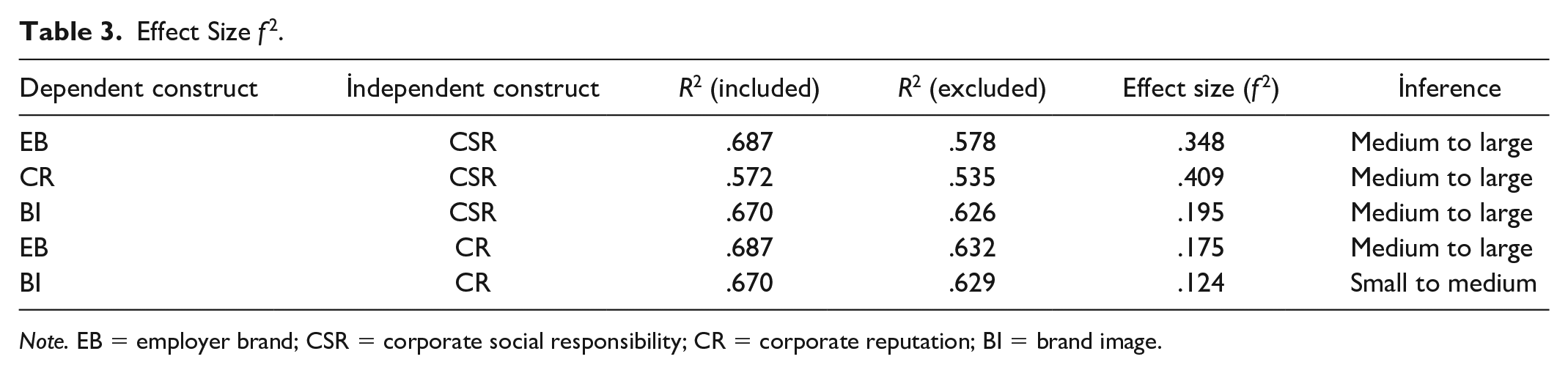
Note. EB = employer brand; CSR = corporate social responsibility; CR = corporate reputation; BI = brand image.
Direct Hypothesis Relationships.

Note. χ2(df = 548) = 908.865, χ2/df = 1.659, p < .000, CFI = 0.912, GFI = 0.915, AGFI = 0.918, SRMR = 0.042, and RMSEA = 0.060. CSR = corporate social responsibility; EB = employer brand; BI = brand image; CFI = comparative fit index; SRMR = standardized root mean residual; RMSEA = root mean square error of approximation; GFI = goodness of fit index; AGFI = adjusted goodness of fit index.
In the path model (Figure 2), EB has an R2 value of .687, CR has an R2 value of .572, and BI has an R2 value of .670, but the value of R2 for EB (respondents [resp.], for CR) with CSR excluded is .578 (resp., .535), for CR (resp., for CR) with CSR excluded is .572 (resp., .535), and for BI (resp., for CR) with CSR excluded is .578 (resp., .535). Hence, the value of f2 is .348 for EB, .409 for CR, and .195 for BI. Consequently, the effect of the CSR construct is large. Excluding CR, the R2 value for EB (resp., CSR) was .632 (resp., .687), and the R2 value for BI (resp., CSR) was .629 (resp., .670). Hence, the values of f2 are .175 for EB and .124 for BI. Hence, the CR construct has a medium to large effect on EB and a small to medium effect on BI.
Model’s GOF
GOF testing is used to verify the general consistency of the model. GOF values are between 0 and 1 with thresholds at .1 (low GOF), .25 (medium GOF), and .36 (high GOF), following Akter et al. (2011).

Results
The measurements and structural models were tested using a second-generation multivariate data analysis method called structural equation modeling (SEM), focusing on the PLS method. To test our model, we conducted CFA, followed by evaluating convergence and discriminant validity. As seen in Table 1, convergent validity was supported by all factors, and, as seen in Table 2, discriminant validity was also supported by the findings. As seen in Table 3, we calculated the effect size between the variables. In our model, the global fit index was .68, indicating that the empirical data fit the model very well. As seen in Table 4, all relations were positive and significant. H1, concerning the relationship between CSR and EB, was accepted, with β = .557, t = 6.702, p < .01, and f2 = .409. Thus, CSR had a positive impact on EB. H2, concerning the relationship between CSR and BI, was accepted, with β = .508, t = 4.875, p < .01, and f2 = .195. Thus, CSR had a positive impact on BI.
Mediation Analysis
Mediation analysis can be done with multiple regression and SEM analyses. Although both methods have the same logic, it is the most preferred SEM method in terms of controlling measurement errors, providing information about the entire model and being more flexible than regression (Frazier et al., 2004; MacKinnon et al., 2002). According to Baron and Kenny (1986), the following steps were used to test the CR mediation effect.
Step 1: To test the relationship between independent variable (CSR) and dependent variable (EB).
Step 2: To test the relationship between independent variable (CSR) and dependent variable (BI).
Step 3: To test the relationship between independent variable (CSR) and mediating variable (CR).
Step 4: To test the relationship between dependent variable (EB) and mediating variable (CR).
Step 5: To test the relationship between dependent variable (BI) and mediating variable (CR).
Step 6: To test the relationship between independent variables (CSR and CR) and dependent variable (EB).
Step 7: To test the relationship between independent variables (CSR and CR) and dependent variable (BI).
Step 8: To test the mediation effect using Sobel test.
The mediating effect of CR between CSR on EB and BI performance is shown in Table 5. As seen, the mediating effect of CR is significant, with all path coefficients significant (p < .01). Step 1 and Step 2 results are shown in Table 4. Step 3, concerning the relationship between CSR and CR, was accepted with β = .758, t = 14.881, p < .01, and f2 = 0.409. Thus, CSR had a positive impact on CR. Step 4, concerning the relationship between CR and EB, was accepted, with β = .312, t =3.367, p < .01, and f2 = 0.175. Thus, CR had a positive impact on EB. Step 5, concerning the relationship between CR and BI, was accepted, with β = .375, t = 3.413, p < .01, and f2 = 0.124. Thus, CR had a positive impact on BI. According to the data shown in Table 5, Step 6, CR plays a mediator role in the relationship between CSR and EB (β = .841, t = 21.2411, p < .01). Moreover, Step 7, CR plays a mediator role in the relationship between CSR and BI (β = .735, t = 18.873, p < .01). Step 7, Sobel test, was performed to confirm the importance of the mediator (CR) in explaining the relationship between CSR and EB and BI. According to the data shown in Table 6, when the mediation effect of CR is examined through the Sobel test, it is seen that the intermediary variable is significant (p < .05; Hayes, 2012).
Mediation Analysis.

Note. CSR = corporate social responsibility; EB = employer brand; BI = brand image; CR = corporate reputation.
Sobel Test Analysis.

Note. CSR = corporate social responsibility; CR = corporate reputation; EB = employer brand; BI = brand image.
Discussion
CSR offers increasing and improved opportunities for new research in support of organizational prosperity. Most existing literature on CSR has focused on the macro level (Lee, 2008). However, some studies have shown interest in the micro level of CSR (Rupp et al., 2013). Discussions regarding the roles of firms in society are also taking place at the micro level. CSR employees are asking more questions about the role of their work. These questions will greatly change how employees perceive CSR and its importance for their own lives. Organizations having higher CSR generally provide better working conditions and benefits to employees, so that they perceive CSR as advantageous to their own interests. In the CSR literature, there have been gaps between CSR theory and practice, and there remains a great potential for difference in how employees perceive CSR. Thus, further studies are needed to understand how CSR affects employees (Glavas, 2016). Therefore, it is important to go beyond the simple direct impact of CSR results to understand why, how, and when employees are affected. Although we can learn a lot from hypothetical employees, further research is needed on actual employees at work.
The effects of CSR activities in large-scale companies have been investigated in the literature. The results obtained in this study provided evidence on the benefits of employee-oriented CSR activities in SMEs. It was supported in the proposed four hypotheses. The perceived CSR is defined as the forerunner of EB and BI among employees. Consistent with the results obtained in the literature, employee-oriented CSR activities were positively correlated with the employees’ perception of EB and BI. In academic literature, CR is mostly defined from the perspective of the customer, and the perspective of employees working as internal stakeholders is often overlooked. In this study, the pioneers, effects, and results of company reputation were evaluated from an employee perspective. Unlike the customers, the results of the CR perception among employees are defined as the result of trust among employees. It is concluded that CR and CSR activities focused on employees in SMEs have a positive mediating effect on employees’ EB and BI perceptions.
Employee perceptions of CSR are the central variable that mediates the impact of CSR actions, and, consequently, CSR perceptions can change the dynamics of the social organization. This study focuses on influencing the internal mechanisms of CSR on employees and explains how employee perceptions of CSR in the workplace trigger attitudes affecting EB, CR, and BI. Company executives are required to consider employees perceive CSR activities, and these perceptions are very important as they will positively affect organizations. CSR can help an organization gain a better reputation among employee and create an EB by motivating workers. The results support the idea that social welfare and environmental responsibility from CSR activities positively affect the attitudes of employees. Higher levels of CSR lead to higher chances of attracting quality employees. Employee job-selection decisions depend on CR, and better CSR helps potential employees gather more pertinent information about their employers. CSR is understood by employees and contributes to EB. Furthermore, it is an important structure in understanding the reputation.
Limitations
There are some limitations in design of the study. Data is collected from SMEs operating in the manufacturing sector in the Marmara region in Turkey. It depends on its repetition in more than one sector and multiple organizations to generalize what is foreseen. Another challenge is that it has been selected from employees who have worked in the company for more than a year.
Recommendations
Employees are affected by CSR in numerous ways. In our study, only the mediating effect of perceived CR on CSR perception was investigated. As an outcome, the effect of employees’ perceptions was only measured according to EB and BI. Further research should also include other scales to confirm these results. To generalize the results, investigations are recommended to study the current problem in other developed countries.
Footnotes
Appendix

| Variables of the study | Number of items |
|---|---|
| CSR | |
| Social and non-social stakeholders responsibility | CSR1. Our company tries to invest in future generations. |
| CSR2. Our company tries to contribute to organizations and projects that will contribute to society. | |
| CSR3. Our company targets sustainable growth that will take care of future generations. | |
| CSR4. Our company attaches importance to social responsibilities aimed at the community. | |
| CSR5. Our company invests in research and development aimed at protecting and improving the natural environment. | |
| Employee responsibility | CSR6. Our company has a management that attaches importance to the requests and needs of employees. |
| CSR7. Our company has policies that encourage employees to develop their talents and careers. | |
| CSR8. Our company supports its employees who need training and contributes to their development. | |
| CSR9. Our company adjusts working conditions that are harmful for the health of employees and which are unsafe and allows flexible work hours. | |
| Legal and ethical values responsibility | CSR10. Our company attaches importance to fulfillment of its legal obligations to the state on time and in full. |
| CSR11. Our company attributes great importance to customer satisfaction. | |
| EB | EB1. I’m in a good relationship with my superiors in the institution where I’m working. |
| EB2. In the institution where I’m working, the managers care about the employees. | |
| EB3. In the institution where I’m working, the managers are sincere with the employees. | |
| EB4. Competent employees are selected for this institution. | |
| CR | CR1. This firm is an organization I have a good feeling about. |
| CR2. This firm is an organization that I trust. | |
| CR3. This firm is an organization that I admire and respect. | |
| CR4. This firm has a good overall reputation. | |
| BI | BI1. This enterprise has better product/service quality than its competitors. |
| BI2. This enterprise has better environmental responsibility than its competitors. | |
| BI3. This enterprise is more innovative than its competitors. | |
| BI4. This enterprise has a more qualified workforce than its competitors. | |
| BI5. This enterprise invests more in its employees than its competitors do. | |
| BI6. This enterprise/company provides high-quality, innovative products or services. | |
| BI7. This enterprise/company has a clear vision of its future and provides excellent leadership. | |
Note. CSR = corporate social responsibility; EB = employer brand; CR = corporate reputation; BI = brand image.
Declaration of Conflicting Interests
The author(s) declared no potential conflicts of interest with respect to the research, authorship, and/or publication of this article.
Funding
The author(s) received no financial support for the research, authorship, and/or publication of this article.
