




Abstract
The external purpose of Employer Branding is attraction, that is, the brand’s capability to be preferred to its competitors through attractiveness and reputation. This study aims to (1) propose the Italian adaptation of the Employer Attractiveness scale (EmpAt scale) in its “real” version; (2) propose a tool to evaluate employer reputation; and (3) measure the convergent and predictive validity of these two measures. An online survey was administered to a sample of convenience (N = 407; 56% were women). The results of exploratory and confirmatory factor analyses are presented for both scales, including correlations and regression results to demonstrate reliability and validity. Organizations could use these two tools to perform preliminary analyses to improve their employer branding, being aware of their own image’s strengths and areas for improvement, and thus differentiating themselves from competitors.
Introduction
The ability of companies to attract talent, hire them, and achieve good retention levels is the primary source of success within the so-called “war of talent” (Elving et al., 2013). Talent is a good match between the available expertise and the job description of a vacancy, and also important for corporate reputation, given the role of insiders as potential “brand ambassadors” (De Stobbeleir et al., 2018). Therefore, it is crucial to build an attractive brand, that is, to identify Employer Value Propositions (EVPs) to be associated with the corporate image and communicated to external stakeholders. The literature offers many examples of studies on the importance of brand and reputation within the product market (Sivertzen et al., 2013), but it is equally important to consider them from the perspective of the labor market, where the strength of the Employer Branding (EB) strategies can be identified in the company’s ability to both attract and retain talents (Backhaus & Tikoo, 2004).
EB emerges from the transposition of marketing concepts into the field of Human Resource Management (Cable & Turban, 2001; Lievens et al., 2007). It is a transversal concept concerning a set of actions relating to the construction of the image of the brand as an employer. There are multiple definitions of this construct, referring to value (Berthon et al., 2005) and identity (J. L. Aaker, 1997), dimensions that make the company’s image as an employer unique and distinct from its competitors. Ambler and Barrow (1996) define EB as “the package of functional, economic and psychological benefits provided by employment, and identified with the employing company” (p. 187), while Backhaus and Tikoo (2004) define it as “the process of building an identifiable and unique employer identity, and the employer brand as a concept of the firm that differentiates it from its competitors” (p. 502). Lastly, for Bendaravičienė (2017), EB is “a set of particular employment experience attributes that makes an organization distinctive and attractive as an employer (to existing and potential employees)” (p. 653). Several conceptual frameworks can be found in the literature regarding the theoretical foundation of EB (Edwards, 2010; Lievens et al., 2007). Furthermore, in the literature, there are studies that analyze and propose EB’s dimensions (Berthon et al., 2005) and others that focus on attractiveness (Highhouse et al., 2007).
Usually, the notion of EB is linked to the concept of reputation (Tkalac Verčič), since it is one of the aspects job seekers consider to apply for a firm (Soeling et al., 2022). Even though these two constructs consist of different components. Indeed, while EB contains both a cognitive (cf. instrumental-symbolic framework; Lievens et al., 2007) and a holistic affective component, reputation is generally narrowed to an affective one (Lievens & Slaughter, 2016). The literature actually places these dimensions under the same umbrella, that is, “employer knowledge” (Lievens & Slaughter, 2016), which refers to job seekers’ beliefs about a potential employer. Employer knowledge increases (or diminishes) the value of organizations, since it affects job seekers’ reactions to recruitment activities (e.g., whether or not they would apply) and their expectations of the organization they are applying to (Cable & Turban, 2001). In practice, EB strategies are aimed at creating an image of the company that job seekers might see as the “best place” to work (Tkalac Verčič & SinčićĆorić, 2018).
In the literature, there are overlaps not only between the concepts of EB and reputation, but also between them and attractiveness. Indeed, some authors consider reputation as “the overall attractiveness [emphasis added] of an organization” (Hendriks, 2016, p. 7). However, some recent theoretical frameworks (Bendaravičienė, 2017; Eger et al., 2019) highlight how attractiveness and reputation, conceptually different from each other, are involved in enhancing the ability of companies to attract. The present study intended to contribute to the clarification of these differences and propose HR managers two measures to detect employer attractiveness and reputation, respectively. In the following sections, a theoretical background about the notions of EB, attractiveness and reputation is provided. Firstly, we explore the construct of EB and the features of one of the most used tools to assess attractiveness, that is, the Employer Attractiveness (EmpAt) scale (Berthon et al., 2005). Hitherto, the tool has been used asking respondents to think about an ideal firm; we propose a new version which asks participants to think about a “real” firm. This switch to encourage people to think about a real company may be in line with the company’s aim to investigate job seekers’ opinions about itself, useful for the design of an EB campaign.
Then, we discuss the blurred use of the notions of EB, attractiveness, and reputation, providing a specific definition for each dimension. Next, a brief review of some tools evaluating reputation is provided in order to anticipate our aim of building a new measure.
Therefore, the overall objective of this study was to provide companies with two tools useful to evaluate their strength in relation to the external goal of EB (i.e., attraction), which theoretical models (e.g., Eger et al., 2019) suggest is enhanced by both attractiveness and reputation.
Literature Review
Employer Branding (EB) and Employer Attractiveness
The definition proposed by Ambler and Barrow (1996) sees the concept of EB consisting of three types of benefits: functional (e.g., development opportunities), economic (e.g., monetary rewards), and psychological (e.g., belonging and direction). Based on this definition, Berthon et al. (2005) developed a scale for measuring an EB-related concept, namely employer attractiveness. The authors defined it as “the envisioned benefits that a potential employee sees in working for a specific organization” (p. 156), closely linked to the concept of brand equity (Theurer et al., 2018). Brand equity means, in marketing terms, “a set of brand assets and liabilities linked to a brand that add to or subtract from the value provided by a product or service to a firm” (D. A. Aaker, 1991, p. 15). When applied to EB, brand equity refers to the effect that brand knowledge has on job seekers in making them want to apply for a job, such that “employer brand equity is the desired outcome of employer branding activities” (Backhaus & Tikoo, 2004, p. 504). Therefore, the more attractive the company is, the stronger its brand equity becomes. Moreover, attractiveness is considered in the literature as an outcome of an effective external EB campaign, as it is also deemed “the degree to which potential and current employees perceive the organization as a good place to work” (Eger et al., 2019, p. 523).
Based upon the definition of Ambler and Barrow (1996), Berthon et al. (2005) developed the EmpAt scale, consisting of 25 items that detect five dimensions of EB, known as “values.” This label refers to the first of the three steps in constructing an EB campaign described by Backhaus and Tikoo (2004), that is, the development of EVP to be incorporated into the brand image. EVPs are the values embodied by the brand which the firm offers to externals, “central message that is conveyed by the brand” (p. 502).
The EmpAt scale by Berthon et al. (2005) has been widely used in research on EB (Eger et al., 2019; Pološki Vokić et al., 2023; Sivertzen et al., 2013), and it asks respondents how important the proposed features of an ideal employer are to them, and aims to measure five values. The (i) interest value measures the attractiveness of a firm based on innovative working practices, develop creativity, foster an exciting working environment; the (ii) social value refers to the opportunity of finding a positive working environment; the (iii) economic value considers the extent to which applicants are attracted by a satisfactory salary and a good remuneration and benefits package, as well as foster job security; the (iv) development value refers to employees’ opportunity to be recognized for their work, to benefit from opportunities for professional and individual growth, but also to consider the firm as a springboard for their future; and lastly, the (v) application value refers to firm’s ability to encourage the application of employees’ knowledge acquired in the past and its transmission to others.
Berthon et al. (2005) initially created the EmpAt scale by asking participants to think about their ideal company and to evaluate the importance of the proposed factors. Later, in the conclusions of their work, the authors suggested that the EmpAt scale could also be used as an instrument to outline the longitudinal fluctuations of internals toward the company and to address them to different targets of potential future employees (e.g., students, graduates, professionals; Benraïss-Noailles & Viot, 2021; Eger et al., 2019). Extending this very practical intention, we hypothesized using the EmpAt scale to measure the attractiveness of a real firm by asking participants which of the proposed factors they believed they would find if they worked for a given company, that is, a real (rather than an ideal) one. Therefore, we named our scale “real EmpAt,” which does not change in terms of the structure and formulation of the items (except for the Italian translation), but in the initial instruction.
Employer Attractiveness and Reputation
Distinction Between Constructs
In the same way that the concept of EB is linked to its external objective, that is, the employer attractiveness (Backhaus & Tikoo, 2004; Eger et al., 2019), reputation is also often linked to the concept of attractiveness (Cable & Turban, 2003) and more generally to EB (Eger et al., 2019; Hendriks, 2016). In literature, it is highlighted that these concepts are often interchanged, sometimes generating a conceptual overlap (Hendriks, 2016; Tkalac Verčič & SinčićĆorić, 2018). For example, in her review, Hendriks (2016) states that organizational reputation is sometimes conceptualized as part of the EB, while “some authors see organizational reputation as the overall attractiveness of an organization and others see it as an employer brand or a part of employer branding, and there are still several other definitions of organizational reputation” (p. 7).
Reputation is a notion that is “inherently subjective since it is based on perception” (Tkalac Verčič & SinčićĆorić, 2018, p. 445) and can be defined in several ways. Some studies state that reputation can refer to the overall experience of a stakeholder with an organization; from this perspective, Highhouse et al. (2009) define reputation as a global and relatively stable evaluative judgment of a firm over time which is shared among job seekers (Lievens & Slaughter, 2016). In general, reputation can be considered a very important intangible asset (Tkalac Verčič & SinčićĆorić, 2018) that can provide “firms with sustainable competitive advantage in the marketplace” (Ponzi et al., 2011, p. 15).
Before analyzing some theoretical frameworks, it is useful to make some order at a conceptual level, going beyond the overlap, helped by the Hendriks’ (2016) review. Organizational reputation relates to stakeholders’ perceptions and judgments about the capability of firms to create value based on past actions and provides visibility for the firm. Attractiveness refers to the individuals’ beliefs regarding an organization that lead them to seek and recommend that organization as an employer. Finally, EB“is a process of creating the perception that an organization is a desirable place to work in order to attract, retain and motivate employees and therefore differentiate from competitors” (p. 27). This clarification seems important in order to provide firms and HR managers with tools evaluating the right dimension for a specific purpose. Considering that EB and attraction are often confused with reputation, it seems necessary to theoretically distinguish them. In sum, while attractiveness is the degree to which a job seeker would personally apply for a firm rather than another, reputation is an overall judgment regarding a firm based on its past activities.
In light of this literature, more recent theoretical frameworks highlight that attractiveness and reputation intervene separately in influencing a firm’s power of attraction. In Eger et al.’ (2019) and Bendaravičienė’s (2017) frameworks, employer reputation affects employer attractiveness, thus enhancing the ability of attraction; in Sivertzen et al.’ (2013) study, on the other hand, the opposite is true, as the five dimensions of attractiveness affect the intention to apply for a job via enhancing corporate reputation. However, considering these findings, it can be said that both attractiveness and reputation are conceptually different dimensions which intervene in the same process, namely the external purpose of EB to attract potential candidates. Practitioners may fall into the pitfall of evaluating reputation when they are only evaluating the attractiveness, and vice versa. Considering that these are indeed two dimensions that intervene to improve EB, but that they are conceptually different and act on two different levels (i.e., emotional for reputation and cognitive for attraction; Lievens & Slaughter, 2016), it seems necessary to provide a distinction between attractiveness and reputation, first at a theoretical level and then at the level of tools for practitioners. For these reasons, it is important to measure them separately.
Measures of Reputation
A number of tools assessing reputation from different perspectives are present both in the practitioners and academic worlds. To name some, the pioneering survey on reputation is World’s Most Admired Companies by Fortune, released since 1982. In this survey, executives, directors, and analysts are involved in rating firms with eight questions regarding investments and social responsibility. This survey was subsequently criticized due to its lack of methodological rigor (Ponzi et al., 2011). Shifting to the academic world, examples of reputation measures include the “Reputation Quotient” by Fombrun et al. (2000), assessing a number of aspects (e.g., appeal, product impact, leadership, operational capability), trying to capture the perceptions of corporate reputation performance from a variety of stakeholders in the USA. Furthermore, another contribution was that by Davies et al. (2004), whose reputation measure referred to both internal and external perspectives. The authors followed J. L. Aaker’s (1997) theory of brand personality related to the “personification metaphor (organization as person)” (Davies et al., 2004, p. 127), according to which people refer to firms using terms usually related to people, as if organizations had a personality. Thus, they use a set of characteristics (i.e., traits) to assess both internal and external views about corporate reputation, focusing on the emotional attachment stakeholders have with firms.
Given this multitude of measures, methodological approaches, kinds of stakeholders and geographic contexts, our aim was to develop a reputation measure, exclusively addressed to external people, to assess corporate reputation focusing on their perception of the quality of work in a given organization.
Reputation-Related Dimensions
In the literature, there are several dimensions linked to the notion of organizational reputation. One of these is employer familiarity, seen as “the level of awareness that a job seeker has of an organization” (Cable & Turban, 2001, p. 124). Familiarity is necessary for the other dimensions of job seekers’ knowledge to foster organizational awareness. Familiarity with an employer acts as a channel for obtaining additional information about the employer itself. It can be linked to positive feelings and influence reputation (Cable & Turban, 2001).
When considering companies to which to submit their applications, job seekers refer to corporate reputation as a source from which to obtain information (Sivertzen et al., 2013). Therefore, having defined the EVPs, as the first step of the EB process (Backhaus & Tikoo, 2004), the company should communicate with them externally in order to build its reputation. An effective communication channel, in addition to traditional ones such as websites and social networks, is that of word of mouth (Sivertzen et al., 2013). Word of mouth can be defined as “an interpersonal communication, independent of an organization’s direct marketing activities, about an organization and its products, and about what it is like to work there” (Lievens & Slaughter, 2016, p. 418). Word of mouth has a greater impact on employer brand than other media, such as advertising and sponsorship, going beyond the activities sponsored by the firm because of its company-independent nature, which makes it more credible in the eyes of others (Lievens & Slaughter, 2016).
Job seekers may also be attracted by the organization’s policies, demonstrating that the firm not only focuses on its financial results, but also on non-financial aspects, such as its environmental impact. Therefore, another indicator of reputation may be corporate social responsibility (CSR; Shin et al., 2016; Tkalac Verčič & SinčićĆorić, 2018). Perceptions of a company’s reputation can also be influenced by how it acts in terms of social welfare, creating a community focus or, particularly in recent times, its actions in favor of environmental protection, for example, “contributing to charitable causes, developing non-polluting products, achieving equal opportunity employment” (Fombrun & Shanley, 1990, p. 239).
According to the instrumental-symbolic framework (Lievens et al., 2007), the attractiveness of a firm is linked to more subjective and intangible aspects, which concern the company’s traits, such as innovation and prestige. The symbolic attributes associated with a company’s brand communicate subjective aspects regarding the company’s traits, and in the same way job seekers refer to companies using personality traits, as if they were addressing people (J. L. Aaker, 1997; Lievens & Highhouse, 2003). In the literature, the notion of prestige has been linked to that of reputation (Tkalac Verčič & SinčićĆorić, 2018). In order to build a good reputation it could be useful to ensure that prestige can also be included among the symbolic aspects of the company’s brand. The importance of organizational prestige to employer attractiveness can be found in identity theory (Dutton & Dukerich, 1991) and in social identity theory (Tajfel & Turner, 1979): individual identity is partly formed by social identity, relating to membership in groups, including organizations (Jones et al., 2014). Therefore, identifying with an organization perceived as prestigious enhances one’s self-esteem, a prelude to being proud to be in that organization (Riketta, 2005).
One of the EVPs most associated with reputation is work-life balance (Melin, 2005). Greater flexibility when working in the company, also with a view to fostering a better work-life balance, is, in recent times, one of the most significant aspects demanded by Generation Y (born in the 1980s; Elving et al., 2013; Daniel et al., 2020) and Generation Z (born between 1995 and 2004; Sánchez-Hernández et al., 2019). This notion is one of the sources of employees’ job satisfaction (Tanwar & Prasad, 2016) and the literature shows that this applies even more so lately, considering the studies conducted in light of the effects of the COVID-19 pandemic (Molino et al., 2020). Therefore, work-life balance is one of the values closely associated with EB and reputation (Tanwar & Prasad, 2016).
Recently, firms build their reputation by way of social networks (Sivertzen et al., 2013). The purpose of a good reputation and smart social media management is to influence the intention to apply (Collins & Han, 2004). The literature shows that social media management can be a moderator of the relationship between corporate reputation and intention to apply (Sivertzen et al., 2013).
Conveying information about the company is important and can be delicate, as it can influence the sense of honesty linked to the company. The external communication of realistic or unrealistic details about job opportunities and positive or negative information on the company creates expectations that must subsequently be respected, once externals become internals (Backhaus & Tikoo, 2004). Meeting such expectations will create trust in employees, who, given their function as ambassadors of the corporate reputation and brand (De Stobbeleir et al., 2018), will engage in positive word-of-mouth and create a positive image of the company, whose values will include honesty.
A firm’s profitability of a firm is perhaps the most tangible construct related to corporate reputation. In the literature, it is considered both an antecedent of organizational reputation and its outcome (Hendriks, 2016).
Finally, another dimension linked to reputation is workplace climate (Miotto et al., 2020). In the literature, it appears among the instrumental attributes (namely “team climate”; cf. Theurer et al., 2018) and is one of the targets assessed by the Great Place to Work® survey (De Stobbeleir et al., 2018).
In light of the literature presented, the second objective of this study is to propose a tool to measure a firm’s reputation. This tool could be added to the reputation measures that currently exist (Ponzi et al., 2011), suggesting an updated version which could include all these literature findings.
In summary, this study pursued three objectives:
Objective 1: to propose the initial results of the adaptation analyses of the Italian version of the EmpAt scale by Berthon et al. (2005). More precisely, we tested the factorial structure of the Italian version which we have called “real EmpAt” expecting to replicate the original penta-factorial structure.
Objective 2: to build and validate a scale in order to measure reputation by considering nine constructs revealed by the literature to be related to it, expressed in 13 initial items. We provided statistical properties of our Reputation scale, expecting a monofactorial structure of the items.
Objective 3: literature has shown that reputation and attractiveness are closely related and both intervene in enhancing the firms’ power of attraction (Bendaravičienė, 2017; Eger et al., 2019; Sivertzen et al., 2013); thus, we aimed to measure convergent and predictive validity of the five dimensions of the real EmpAt scale and our measure of reputation.
Methods
Procedure and Participants
An anonymous online questionnaire was administered on the official platform of the University called Uniquest (LimeSurvey), spread across the social networks (Facebook, LinkedIn, and Instagram). A convenience sample was reached with the “snowball” sampling method, made of both job seekers and workers. Only participants who knew the firm the real EmpAt scale (described below) refers to were considered for analyses. All participants gave informed consent through the questionnaire: research’s aims, data treatment information, the voluntary and unpaid participation, and instructions to complete the questionnaire were described in the cover letter. The study followed the Declaration of Helsinki (World Medical Association, 2013) and did not involve any treatment or other procedures that might affect the psychological or social well-being of the participants. For this reason, an ethical permission was not needed.
Considering the bias of careless responses to online surveys, we followed one of the suggestions present in Curran’s (2016) work, that is, to work with the timing of the response. The mean time of the responses in our sample was 8.65 minutes (SD = 5.00). We performed ten additional careless responses to the survey (M = 1.27 minutes, SD = 1.25). Our concern was to identify the faster responses rather than the longer ones, because it seems more reasonable to reach the end of the questionnaire in a longer time having understood all the items than in such a short time. Furthermore, it is more plausible that participants with longer response times may have been interrupted for many reasons. So, we aimed to delete the cases whose response times were above the mean plus one standard deviation of careless responses. Our final sample was formed by 407 participants.
The sample was made up of 43.7% by men and 56.3% by women. Most of the sample (65.6%) was distributed in the age range from 21 to 25 years old, while 26.8% was distributed in those aged from 26 to 50 years and 6.6% in the over 50s. With regard to geographical distribution, the respondents were mostly located in Northern Italy (77.1%), with Central (12.5%) and Southern Italy (10.4%) being less represented. In terms of educational level, the sample was fairly equally distributed: 27.5% had completed high school, 49.1% had gained a Bachelor’s degree, and 21.1% had gained a Master’s degree. Of the 70.2% of the sample who held a degree, 46.9% had a degree in Humanities/Law, 30.1% in Science/Technology, 2.8% in Arts, 8.4% in Health, and 11.9% in Business.
Measures
A back translation process (Brislin, 1970) was followed to develop both the Italian version of the EmpAt scale and to build the reputation scale. The original 25 items of the Berthon et al.’s (2005) scale were initially translated into Italian by the authors and then translated blindly back into English by a native speaker. Minor divergences from the original wording were resolved in order to make the items easily understandable for the participants. To ensure that the authors’ Italian translation was understandable, we also performed a pilot administration of the questionnaire. About 80 participants consisting of university students attending the last year Master’s degree and a group of job seekers in stage positions were involved, asking them to give us feedback about the questionnaire, from which no further changes were found to be necessary.
The real EmpAt consists of 25 items assessing the extent to which respondents believe they would find the proposed values in a real company by measuring their perceptions on a 7-point Likert scale. (1 = “to a very little extent” to 7 = “to a very great extent”). The “real company” was chosen by referring to national reputation rankings. An example item of each dimension is proposed: “the organization both values and makes use of your creativity” (development value); “having a good relationship with your colleagues” (social value); “an attractive overall remuneration package” (economic value); “gaining career-enhancing experience” (development value); “humanitarian organization—gives back to society” (application value). Table 1 shows the English and Italian versions of the items.
Original and Italian Versions of EmpAt Scale.

Items of the final real EmpAt scale.
In order to build the Reputation scale, the constructs most commonly associated with it, those enlisted and analyzed in the previous theoretical paragraph, were examined. Specifically, the 13 items of the initial scale referred to: awareness (two items); word of mouth (two items); perceived corporate social responsibility (two items); prestige (two items); work-life balance (one item); use of social networks (one item); profitability (one item); honesty and fairness (one item); and working climate (one item). Items were both adapted from existing scales in literature and created ad hoc. As for the translation and back-translation processes performed for the “real” EmpAt scale, the adapted items of our Reputation scale were translated into Italian by the authors, the same who created the ad hoc items, directly formulated in Italian. Then, a back-translation of all items blindly back into English was made by a native speaker. Minor divergences from the original version of adapted items were resolved. Finally, Reputation items were included in the previous pilot administration, in order to check their Italian comprehensibility.
A maximum of two items per dimension were chosen. As regards items retrieved from the literature, those with the highest factor loadings were chosen, considering also their comprehensibility and applicability to the Italian context (e.g., for CSR, the two out of three items with the highest standardized factor loadings were chosen; Shin et al., 2016). Ad hoc items were created by drawing on the reference literature.
Table 2 summarizes the details and characteristics of the 13 items and their related constructs; Table 3 shows items’ English and Italian versions.
Dimensions and Bibliographic References for Reputation Scale Construction.

English and Italian versions of Reputation scale.
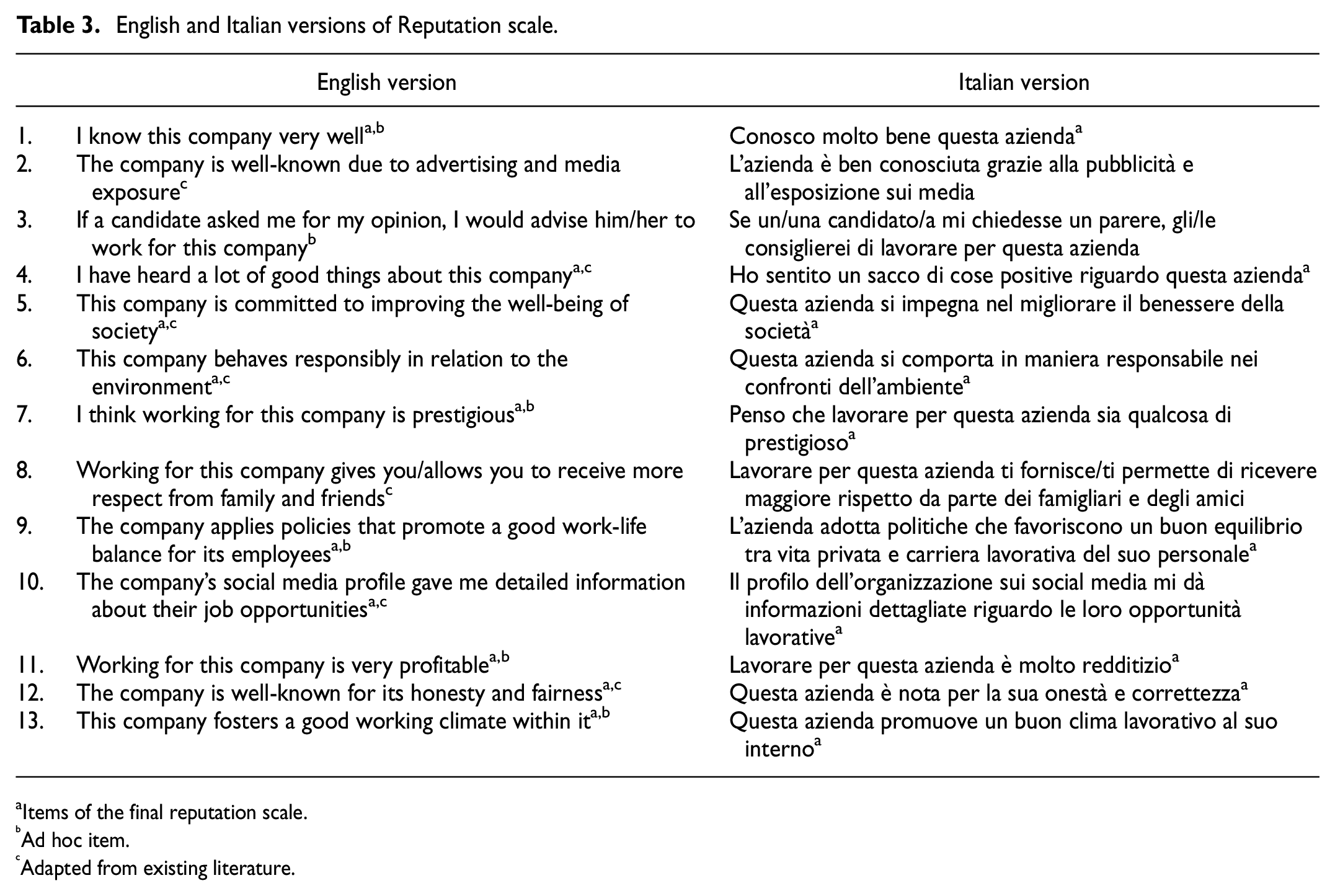
Items of the final reputation scale.
Ad hoc item.
Adapted from existing literature.
Data Analysis
Analyses were performed using SPSS 27 (IBM, Armonk, NY, USA) and MPlus 8 (Muthén & Muthén, Los Angeles, CA, USA) software. The datasets generated and analyzed during the current study are available from the corresponding author under request. SPSS 27 was used for descriptive analyses of the sample, descriptive analyses of the single items, reliability analyses (Cronbach’s α), correlation, regression, and Exploratory Factor Analysis (EFA). Through MPlus 8, Confirmatory Factor Analysis (CFA) was performed using a robust statistical extraction method (MLR, Maximum Likelihood Robust), as the assumption of normality in the data distribution was violated (Li, 2016). CFA was used to test the construct validity of the scales, to confirm the penta-factorial structure of EmpAt (Berthon et al., 2005), and to confirm the monofactorial structure of our Reputation scale. We used MPlus because it allowed us to use MLR and calculate standard errors and significance tests for factor loadings.
According to the literature (Bollen & Long, 1993) the following goodness-of-fit criteria were considered: the χ2 goodness-of-fit statistic; the Root Mean Square Error of Approximation (RMSEA); the Comparative Fit Index (CFI); the Tucker Lewis Index (TLI); the Standardized Root Mean Square Residual (SRMR). Values of both RMSEA and SRSM lower than .08, and CFI and TLI values greater than .90 indicate a good fit.
To address the common method variance issue, Harman’s single-factor test (Podsakoff et al., 2003) has been tested by a CFA that included all items from both scales. According to the results, one single factor could not account for the variance in the data [χ2(495) = 2,164.96, p < .001, CFI = 0.74, TLI = 0.72, RMSEA = 0.09 (90% CI: [0.09, 0.10]), SRMR = 0.07]; thus, common method variance was not a major problem in the study.
Validation Steps
For the real EmpAt scale, we firstly performed CFA in order to reproduce the penta-factorial structure of the scale as Berthon et al. (2005) did. Then, we also modeled the EmpAt scale both as unidimensional and with a second-order factor, comparing results.
For the Reputation scale, we first performed an EFA in order to test the chance to obtain a monofactorial structure of our starting 13-item scale; then we deleted some items which did not fit well with this purpose. The subsequent CFA of the 10-item scale was performed in order to confirm the monofactorial structure of this last scale.
Finally, correlation and regression analyses were conducted to analyze convergent and predictive validity, to evaluate the capability of the two scales to discriminate among different groups.
Results
Statistical Properties of the Real EmpAt Scale
Descriptive Statistics
Table 4 provides descriptive analyses of each item of the real EmpAt scale, showing a mean from a minimum of 4.52 and a maximum of 5.69 (SD from 1.13 to 1.57).
Descriptive Statistics of Real EmpAt Scale’s Items.

Note. N = 407.
Confirmatory Factor Analysis
CFA of the penta-factorial structure of the real EmpAt scale showed a not-good-enough fit to the data: χ2 = 774.38; df = 265; p < .001; CFI = 0.89; TLI = 0.88; RMSEA = 0.07 (90% CI [0.06, 0.07]); SRMR = 0.05. Thus, according to modification indexes, we tried to test alternative models deleting the following items, in this order: item 16 of the development value dimension (M2); item 12 of the economic value dimension (M3); item 1 of the interest value dimension (M4); item 9 of the social value dimension (M5); item 23 of the application value dimension (M6). The Chi-square difference test showed for all models a significantly better fit compared with the previous model (Table 5).
Results of Alternative CFA Models of the Real EmpAt Scale.
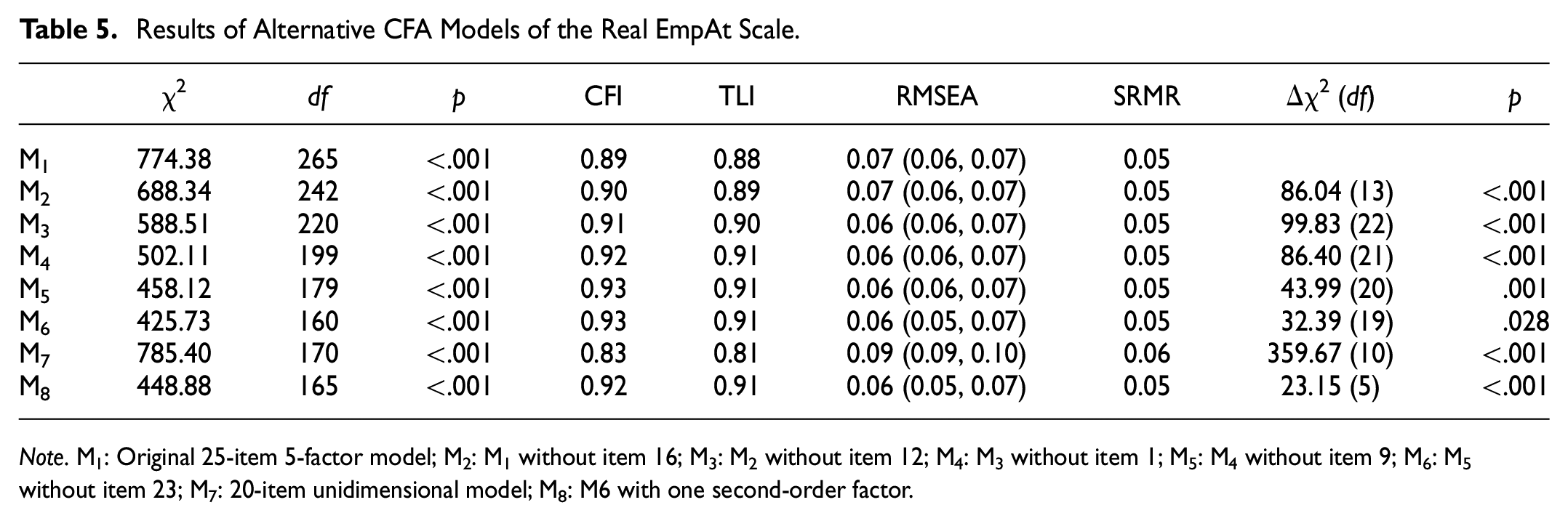
Note. M1: Original 25-item 5-factor model; M2: M1 without item 16; M3: M2 without item 12; M4: M3 without item 1; M5: M4 without item 9; M6: M5 without item 23; M7: 20-item unidimensional model; M8: M6 with one second-order factor.
We also tested a unidimensional model (M7) which fitted worse than the 5-factor model. Finally, in model 8 we tried to explain the correlations between the five dimensions in terms of a second-order factor. Despite the fit being good, it was not significantly better compared with the fit of the 20-item 5-factor model (M6). However, the differences of model fitness were minimal: ΔCFI = −0.005, ΔTLI = −0.003, ΔRMSEA = 0.001, ΔSRMR = 0.003. When there is virtually no difference between two models’ fit, the more restricted one should be taken; thus, in our study we took model 8 as the final one, which reflected a higher dimension. The final model (M8), with five first-order factors (four items each) and one second-order factor, had the best fit to the data and is shown in Figure 1; factor loadings ranged between .59 and .89.

Standardized solution of the CFA (maximum likelihood estimation) for the real EmpAt scale (N = 407).
Table 6 shows reliability and validity coefficients for each dimension. In order to evaluate the internal consistency of the scales, exploring to what degree the scores are free from random measurement error, composite reliability (CR) and average variance extracted (AVE) were also calculated. CR values >.70 indicate satisfactory scale reliability, while AVE values <.50 indicate a low amount of explained variance (Fornell & Larcker, 1981; Niclasen et al., 2013). Alpha and CR coefficients were higher than .70, while AVE values were greater than .50, except for application value which showed an AVE slightly lower than .50. This last result does not represent an issue, since, according to Fornell and Larcker (1981), the average variance extracted may be considered a more conservative estimate of the validity of the measurement model (Lam, 2012). Furthermore, “on the basis of ρη [i.e., composite reliability] alone, the researcher may conclude that the convergent validity of the construct is adequate, even though more than 50% of the variance is due to error” (Fornell & Larcker, 1981, p. 46). Therefore, since the CR of the Application value is above the recommended level, the internal reliability of these measures could be considered acceptable. In addition, all CR values were higher than AVE values confirming convergent validity.
Test of Reliability and Convergent Validity.

Statistical Properties of the Reputation Scale
Descriptive Statistics
Table 7 provides descriptive analyses of Reputation scale’s items, showing a mean from a minimum of 3.96 and a maximum of 5.59 (SD from 1.25 to 1.74).
Descriptive Statistics of Reputation Scale’s Items.

Note. N = 407.
Exploratory Factor Analysis
An EFA was performed, using a maximum likelihood extraction method. This analysis, performed on the 13-item initial scale, revealed a two-factor structure (Table 8), which does not match our aim, that is, to measure a single latent factor we would name “Reputation.”
Factor Matrix of EFA on the 13-Item Reputation Scale With Loadings.
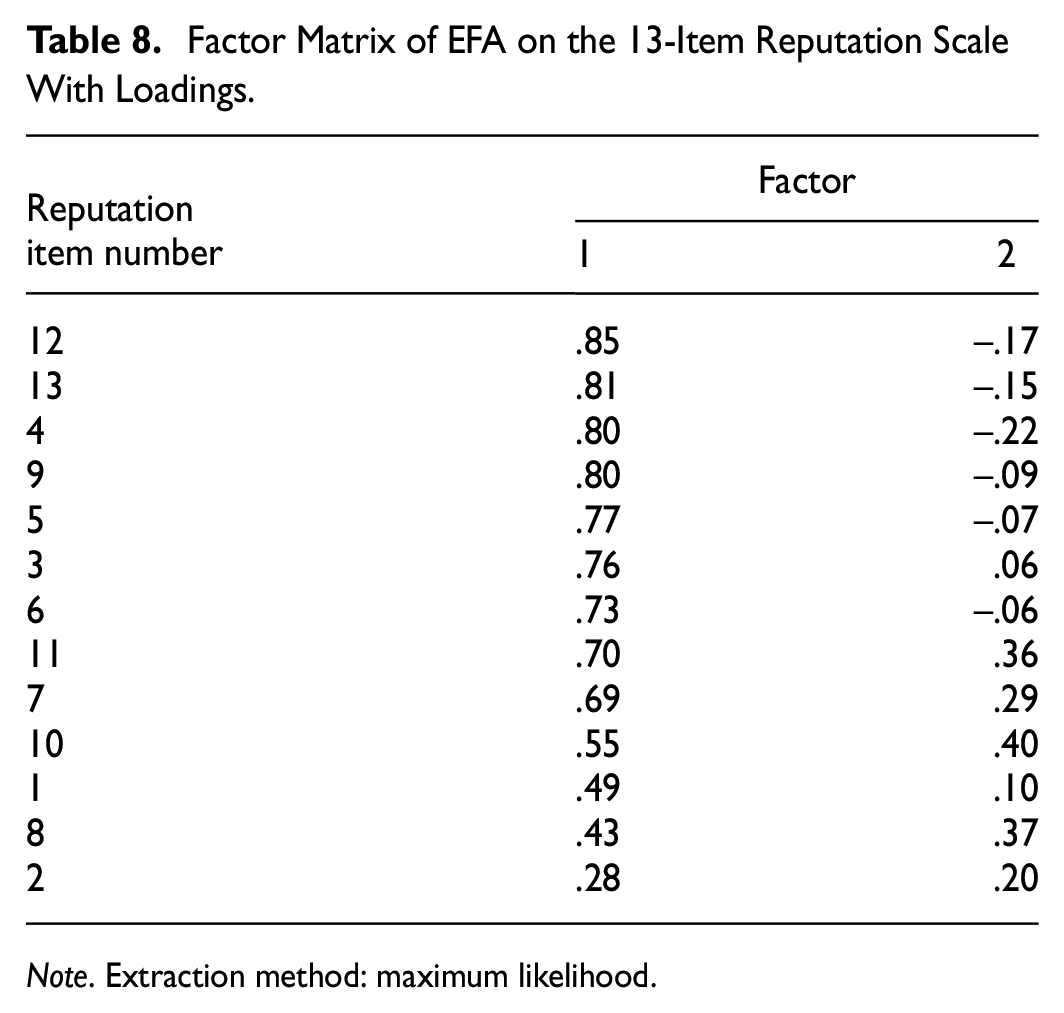
Note. Extraction method: maximum likelihood.
By observing loadings, items with scores greater than .40 (Yong & Pearce, 2013) load into the factor 1, except for item 2. Therefore, in order to reach better statistical properties, that is, to build a scale loading into a single factor, we consider both EFA results and semantic properties of the items as criteria to delete them. Using only the first criterion, item 2 has been eliminated. Subsequently, we considered the remaining dimensions represented by two items, that is, positive word of mouth (items 3 and 4), perceived CSR (items 5 and 6), and prestige (items 7 and 8), and then we decided to delete the item with the lower loading. Consequently, items 3 and 8 were deleted. We decided to maintain both items referring to CSR since they refer to two different aspects, one of which is particularly topical in these times (i.e., company’s concern toward the environment).
Thus, removing those three items, the subsequent EFA on the 10-item scale (Figure 2) showed a monofactorial item structure (52.16% of total variance explained), with factor loading from .47 to .86 (Table 9). Lastly, Cronbach’s α analysis was performed, showing a good internal consistency of this 10-item scale (α = .91).

Scree-plot of the EFA on the final 10-item Reputation scale.
Factor Matrix of EFA on the 10-Item Reputation Scale With Loadings.

Note. The numbering of the items follows that of the starting 13-item scale. Items are listed in descending order of the associated loading value. Extraction method: maximum likelihood.
Confirmatory Factor Analysis
CFA results confirmed the 10-item solution with a good fit to the data: χ2 = 65.47; df = 33; p < .001; CFI = 0.98; TLI = 0.97; RMSEA = 0.05 (90% CI [0.03, 0.07]); SRMR = 0.04. The solution is represented in Figure 3; factor loadings ranged between .47 and .87. Alpha and CR coefficients were higher than .70 (alpha = .91; CR = 91), while AVE value was equal to .51.

Standardized solution of the CFA (maximum likelihood estimation) for the Reputation scale (N = 407).
Modification indexes suggested correlating the error terms between two pairs of items, that is between items 5 and 6 and between items 10 and 11. The first couple of items refer to the same dimension of corporate social responsibility. However, they capture two different and equally important purposes of this dimension (i.e., respectively, the overall well-being of society and respect of the environment), thus, we decided to keep both items in the final version of the scale. The second couple refers to, respectively, the company’s presence on social networks with a clever management of the job posting and the profitability of the firm. These two items may overlap in meaning, as job seekers who perceive that the company gives detailed information on their online profile and job posting may be a firm that pays attention to these aspects and this could be associated with the image of a profitable company, especially taking into account the high impact of social media in recent times. Since the two items belong to two different dimensions of reputation, we decided to keep both of them in the final version of the scale, although they are correlated.
Validation Analyses
Convergent and Predictive Validity
After creating and analyzing statistical properties of the Reputation scale, the convergent validity of the two main constructs of this study was analyzed. Reputation and the five dimensions of the 20-item real EmpAt scale correlated positively with each other (Table 10).
Correlations Between Reputation and Values of Real EmpAt Scale (Four Items Each).

Note. N = 407. Cronbach’s α on the diagonal in brackets.
p < .05. **p < .01. ***p < .001.
In order to assess predictive and convergent validity, a two-step hierarchical regression was performed (Table 11).
Results of Multiple Hierarchical Regression of the Values of Real EmpAt on Reputation.

Note. N = 407. Age (dummy) = 1 (people up to 25 years).
p < .05. **p < .01. ***p < .001.
In the first step, the five dimensions of EmpAt scale were used as independent variables in order to show their impact on the Reputation; this choice was made following the example of Sivertzen et al. (2013) who considered the EmpAt values as antecedents of corporate reputation. In the second step, we added two control variables (i.e., gender and age) to the model. The occurrence of multicollinearity between variables in the two models was verified through the tolerance index (1/VIF). No signs of multicollinearity were found, since for each independent variable the values fell between .30 and .41 in the first step, and between .30 and .97 in the second step (potential issues can occur when values are lesser than .20; Field, 2009). At Step 1, the overall amount of variance explained by the model (i.e., adjusted R2) was .54. Four values of EmpAt were found to be positively associated to Reputation, that is, Interest (β = .29; p < .001), Social (β = .21; p < .001), Economic (β = .14; p < .05), and Application (β = .16; p < .01), except Development, which showed a non-significant relationship. At Step 2, after adding the control variables (Method: Enter), the amount of variance explained was almost the same (ΔR2 = .009, p < .05); furthermore, no changes were observed in terms of direction and significance of the associations between study variables. As regards controls, only age less than 26 years was significantly and positively associated with Reputation, in line with recent research highlighting that new workforce (i.e., Gen Y and Gen Z) give importance to organizational reputation when choosing a firm they want to apply to (Mostafa, 2022).
Discussion
EB has a dual aim: on one hand, the external purpose, that is, to attract job seekers, and, on the other, the internal purpose, that is, to retain employees (Backhaus & Tikoo, 2004). The two processes operate in sync and influence each other. External EB consists of understanding the firm’s values and what to focus on when communicating the company culture externally; this process creates expectations which must then be confirmed once the job seeker becomes an employee. Any discrepancy between the promises made and the reality of the facts within the company may lead to a breach in the psychological contract and thus the intention to leave (Backhaus & Tikoo, 2004).
The literature shows that reputation is a concept linked to, and often integrated with, EB (Tkalac Verčič & SinčićĆorić, 2018). The relationship between these two constructs has not been well established in the literature, as different models put them in different positions (Bendaravičienė, 2017; Eger et al., 2019; Sivertzen et al., 2013). However, it is clear that both employer reputation and attractiveness refer to the external outcome of EB, that is, recruitment (Eger et al., 2019).
This study concentrated on the outcome of attraction, establishing three objectives. The first objective was to confirm the pentafactorial structure of the EmpAt scale also in the Italian version. The fit indices resulting from the CFA analysis demonstrate that this structure can also be replicated in the Italian version of the scale, even by changing the initial statement, referring to a real firm. The aim of the “real” version of EmpAt is to refer to a company that actually exists in the labor market. The initial statement, in fact, asks respondents (usually externals) to describe the extent to which they believe they would find the characteristics, possibilities, values and opportunities listed in the scale, when hypothesizing that they worked for company “X.” In this way, firms can gain an overview of the values on which companies should focus in order to improve their own employer image, thus designing an effective communication strategy.
The second objective was to build an instrument to measure reputation. Considering the literature, we referred to nine constructs related to reputation. The first version of the scale numbered 13 items; following the results of EFA and CFA and maintaining one item for each dimension (except for perceived CSR), the final version of the Reputation scale consisted of 10 items.
Furthermore, the results of correlation and regression analyses between reputation and values composing real EmpAt confirmed convergent validity. The regression showed that only the development value did not display a significant relationship with Reputation. This result may be explained considering the formulation of items, which refer to a specific fragment of the organization (such as the supervisor) or to issues related to the individual respondent, rather than to a global evaluation of the firm (Highhouse et al., 2009). Results of this regression analysis confirms both convergent validity of EmpAt and Reputation scales, measuring a similar construct, that is, the employer capability to attract job seekers, the external purpose of EB (Eger et al., 2019), and the predictive validity of EmpAt related to Reputation, in line with Sivertzen et al.’ (2013) model, which showed how these dimensions could be predictors of job seekers’ intention to apply. These results allow our study to achieve the third objective. All in all, we can conclude that the two measures assess two different constructs and are useful for the external purpose of EB (Eger et al., 2019).
Our study focuses on the attraction process of EB, precisely on the validation of tools that could help companies analyze their attractiveness and reputation, to enhance an effective external EB campaign. The EmpAt scale by Berthon et al. (2005) is one of the most popular employer attractiveness assessment tools used in different contexts (Arachchige & Robertson, 2011; Benraïss-Noailles & Viot, 2021; Eger et al., 2019; Sharma & Prasad, 2018). The authors’ original scale asks the respondents how important they consider certain job features and values when thinking about working for their ideal employer. Otherwise, the version proposed in this study asks the respondents to consider a real firm, indicating to what extent they believe they would find the listed attributes when working for that employer, selected from some national reputation rankings.
Research about employers’ attractiveness could follow this route, asking target job seekers their willingness to apply for and the attractiveness perceptions about a real existing firm. Considering that nowadays people seek for new jobs on LinkedIn, Glassdoor, and other platforms, and rely on peer reviews on social networks to build their own organizational reputation (Mostafa, 2022), it seemed anachronistic to ask people their image about an ideal firm, while it could be useful to understand the image people have built about one specific and real organization.
With regard to reputation, the literature shows that it is a concept related to the external outcome of EB, that is, to attract job seekers in order to find talents (Eger et al., 2019). Moreover, despite these two constructs sometimes overlapping (Tkalac Verčič & SinčićĆorić, 2018), theoretical models demonstrate that they are two separate dimensions, both necessary to enhance the capability of attraction of an employer (Bendaravičienė, 2017; Eger et al., 2019). Our reputation tool gathers different important aspects for employees, which contribute to defining the overall judgment of the employers. This approach and our results could help and suggest further research to consider a range of issues related to, for example, welfare, to identify those to build their reputation based on the needs of each generation of employees (Daniel et al., 2020), and, consequently, help companies calibrate their EB strategies.
Theoretical and Practical Implications
From a theoretical standpoint, this study firstly proposes validation analyses of the EmpAt scale, widely studied and used in the literature, also for the Italian context. The five-factor structure, as shown by Berthon et al. (2005), was reproduced and confirmed, suggesting that a 20-item scale (i.e., deleting one item for each EmpAt value) could be a better and shorter tool due to its better fit. In addition, this study proposes a reputation measure, consisting of dimensions that are generally associated, in the literature, with corporate reputation, referring to soft aspects related to brand image (e.g., positive word-of-mouth, prestige, honesty, and fairness), and corporate features (e.g., CSR, work-life balance, profitability, and working climate). Given its psychometrical properties, our scale could be a measure of corporate reputation, adding to those already existing in the literature as we highlighted in the theoretical background of this study. Our Reputation scale, with its monofactorial structure, seems to be useful to evaluate the reputation dimension in the way explained in the Eger et al.’ (2019) model, that is linked to the employer attractiveness (measured with EmpAt scale), both measuring the external goal of EB, that is, the attraction.
In fact, the analyses carried out in this study reveal that the real EmpAt scale, even in its Italian and “real” version, is associated with corporate Reputation. For this reason, on a practical level, companies could use these tools in order to assess their ability to attract a target population. More specifically, with real EmpAt, firms could assess the values that job seekers (or a specific target of externals) believe the firm can provide to its employees; on the other hand, with the Reputation scale, firms could assess their global reputation in the eyes of externals. These processes can be considered a preliminary analysis for the creation of an EB strategy. In fact, the tools could highlight both the strengths and areas for improvement related to EB, according to a specific sample. An example of practical use could be HR managers mapping their firm’s attractiveness and reputation to the eyes of the new Generations (i.e., the new workforce; Mostafa, 2022), which have different characteristics and needs to be fulfilled also regarding the work domain (Daniel et al., 2020).
Limitations and Future Developments
This study has some limitations. First of all, its cross-sectional nature; secondly, the use of a sample of convenience and the heterogeneous characteristics of the sample, which is not representative of Italian job seekers (e.g., in terms of age and education level). Future studies should be used to confirm our findings, especially for the new Reputation scale; in particular, longitudinal data might be collected to also calculate test-retest reliability. Moreover, the functioning of the real EmpAt could also be tested in other national contexts. The same suggestion is true for the Reputation scale, for example, by testing its link with other reputation measures more widely used in the literature. It would also be interesting to observe longitudinal fluctuations and test-retest validity in the attractiveness of a real company by administering real EmpAt and Reputation scales before designing an EB strategy and at least three months after its implementation, in order to monitor their attractiveness and reputation over time, also correlating them with some outcomes of interest, that is, turnover intentions, employees job satisfaction, in-role and extra-role performances (Lievens et al., 2007).
Conclusions
In conclusion, according to the different theoretical frameworks in the literature (Backhaus & Tikoo, 2004; Eger et al., 2019), EB strategies consist of creating an employer image that is perceived externally as being attractive to the target population. The outcome of these processes is that talents on the labor market are motivated to apply to a certain company rather than its competitors, thanks to the differences with the latter conveyed by corporate EVPs (Theurer et al., 2018). Being perceived as a great place to work is the goal to be achieved (Eger et al., 2019) in order to gain that competitive advantage in the labor market.
Footnotes
Declaration of Conflicting Interests
The authors declared no potential conflicts of interest with respect to the research, authorship, and/or publication of this article.
Funding
The authors received no financial support for the research, authorship, and/or publication of this article.
Ethical Approval
Participation in the study was anonymous and voluntary, and all participants were adults. Ethical review and approval was not required for the study on human participants in accordance with local legislation and institutional requirements.
Informed Consent
Participants gave their written informed consent to participate in this study.
