




Abstract
As diversity becomes more widespread within teams, it is crucial to examine the dynamics of person-team fit and its effect on team creativity. By exploring the interplay between complementary fit and supplementary fit, this study aims to shed light on how these two dimensions of person-team fit contribute to the creative processes within teams based on the optimal distinctiveness theory (ODT). A two-wave field survey was conducted among 363 frontline employees within 113 teams in hotels. The regression results indicated a positive association between complementary fit and team creativity. Furthermore, the mediating role of information elaboration in this relationship was observed. Supplementary fit played a positive moderating effect between complementary fit and team creativity whereby teams with higher levels of complementary fit demonstrated higher levels of team creativity, particularly when supplementary fit was also high. Our findings thus provide significant implications for organizations seeking to enhance team creativity, that is, ensuring an inclusive climate that promotes the emergence of shared perceptions regarding both complementary and supplementary fit.
Plain language summary
Propose: this study seeks to explore how the interaction between two types of person-team fit (i.e., complementary fit and supplementary fit) influences team creativity based on the optimal distinctiveness theory (ODT). Methods: A two-wave field survey was conducted among 363 frontline employees within 113 teams in hotels. Conclusions: complementary fit was positively related to team creativity. Information elaboration mediated the above relationship. Supplementary fit played a positive moderating effect between complementary fit and team creativity in such a way that when supplementary fit was high, teams with higher complementary fit showed higher team creativity. Implications: our study enriches the fit literature by simultaneously considering two types of person-team fit and figuring out their effects on creativity.
Keywords
Introduction
The significance of creativity in enabling organizations to adapt to dynamic and competitive environments is widely acknowledged (Amabile & Pratt, 2016; Qi et al., 2022). In addition, teams are extensively employed in various workplace settings (De Cooman et al., 2016). Since teams can serve as an important vehicle for the development of creative ideas, many organizations have turned to team-based work systems to increase their ability to foster creativity and innovation (Awan, 2019; Begum et al., 2022; Leroy et al., 2022). How to spur high levels of team creativity within teams thus holds considerable significance for both practitioners and scholars (Wang et al., 2019). Team creativity is defined as the collaborative process through which a team of employees generates novel and valuable ideas that pertain to services, products, procedures, and processes (Shin & Zhou, 2007). Taking the input-process-output theoretical model as overarching framework, existing literature has suggested that team characteristics and processes are increasingly important factors that may promote or hinder team creativity (e.g., Aggarwal & Woolley, 2019; Amabile & Pratt, 2016; Leroy et al., 2022).
At the same time, the trend of diversity is becoming increasingly prevalent in teams (De Cooman et al., 2016; Kristof-Brown et al., 2014; Qi et al., 2022), which can be observed in various demographic information (e.g., gender and age) and underlying factors like values and skills (De Cooman et al., 2016). A pivotal research area entails examining the relationship between objective (dis)similarities among team members and their corresponding team attitudes and behaviors (e.g., Mannix & Neale, 2005; Qi et al., 2022). However, subjective differences and similarities also present challenges to team effectiveness (De Cooman et al., 2016). The perception of each team member’s fit with the group as a whole, also known as perceived person-team fit, is a significant factor to consider (Chatman, 1989; Kristof, 1996). The psychological traits of team members are compared to those of other team members to determine how well they fit into the group, including their values, objectives, and personality traits. It thus raises the growing research attention on person-team fit (De Cooman et al., 2016; Ehrhardt & Ragins, 2019; Kristof-Brown et al., 2014). Despite the theoretical significance and potential impact of person-team fit on team creativity, there remains a scarcity of studies examining the relationship between the two, as well as the underlying processes that influence this relationship. Consequently, there is a gap in our understanding of how person-team fit specifically shapes team creativity. We thus strive to address the theoretical gap by answering the following research question: whether and how person-team fit influence team creativity?
Person-team fit includes both supplementary fit and complementary fit. While supplementary fit pertains to individuals feeling more positively about and being attracted to those who share similar values, interests, and preferences (Piasentin & Chapman, 2007), complementary fit occurs when individual attributes compensate for weaknesses (Muchinsky & Monahan, 1987), or create a uniquely balanced team by combining diverse abilities, values, and personality traits (Ehrhardt & Ragins, 2019). Among these two fundamental dimensions, we first propose the positive association between complementary fit and team creativity from the information/decision-making perspective, which indicates teams comprised of diversified members can take advantage of complementary fit, which brings in different perspectives, in-depth communication, and innovative knowledge, and ideas relevant to work team tasks, leading to enhanced team creativity (Park et al., 2018).
It is noteworthy that team processes facilitated by complementary fit play a pivotal role in harnessing the potential of diversity (Ehrhardt & Ragins, 2019; Hoever et al., 2012). The availability of information alone is not sufficient; it is the utilization of this information in promoting group creativity that forms the foundation of diverse teams’ potentially superior performance (van Ginkel & van Knippenberg, 2008). Information elaboration is a collaborative process wherein team members actively share, process, and integrate diverse information and ideas within their teams (van Knippenberg et al., 2004). In light of this, we propose that information elaboration is the primary mechanism underpinning the beneficial impacts of complimentary fit on team creativity.
Additionally, we propose that supplemental fit acts as a moderator in the association between complementary fit and team creativity. The coexistence of two types of fit can both be explained by the optimal distinctiveness theory (ODT; Brewer, 1991), which indicates that individuals have two opposite needs (i.e., need for similarity to others and need for being unique from others) that occur simultaneously and must be balanced with one another. Based on ODT, we propose that supplementary fit may interact with complementary fit to satisfy individuals’ fundamental needs of belonging while maintaining their uniqueness in the team (Brewer, 1991), thereby determining the perceived inclusiveness of a team (Shore et al., 2011). Teams that have an inclusive culture can foster a constructive work environment where diverse views and perspectives can be openly shared and encouraged (Shore et al., 2011). This, in turn, can promote information elaboration (Leroy et al., 2022) and subsequently facilitates creativity.
Overall, the current study builds a theoretical model (see Figure 1) and use the on-site survey research method to figure out the effect of person-team fit on team creativity empirically. The current work significantly advances both theory and practice. Theoretically, a significant limitation of the existing fit literature is the lack of examination regarding the interaction between the two primary conceptualizations of fit (De Cooman et al., 2016; Ehrhardt & Ragins, 2019; Kristof-Brown et al., 2014). Consequently, our study aims to advance the fit literature by concurrently investigating individuals' perceptions of fit in terms of both similarity (referred to as supplementary fit) and complementarity (referred to as complementary fit). In addition, our study tries to enhance our understanding of how complementary fit and supplementary fit help enhance team creativity within team context based on ODT. Moreover, to differentiate it from other potential precursors of creativity, we identify information elaboration that emphasizes the constructive exchange and integration of ideas, as a distinct information-sharing process through which complementary fit facilitates team creativity, thus enriching our knowledge of the relationship between these two variables in this study. Practically, by figuring out how person-team fit influence team creativity, our research may have significant ramifications for businesses and managers trying to boost team innovation.
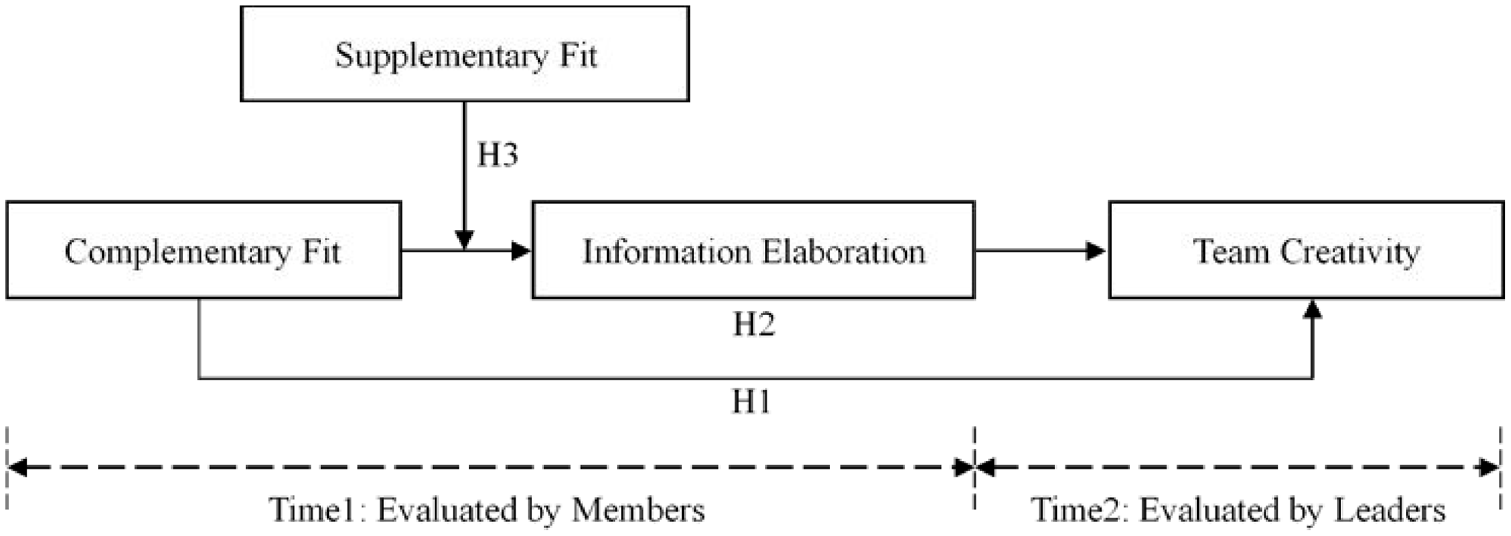
The theoretical model.
Literature Review And Hypotheses Development
Optimal Distinctiveness Theory
According to the optimal distinctiveness theory (ODT; Brewer, 1991), human beings have two competing needs that define self-identification in social groups. The first need is a need for similarity with others that facilities a sense of belonging to social groups (Snyder & Fromkin, 1980). The other need is a need for individuation and differentiation from others (Baumeister & Leary, 1995). The need for distinctiveness is closely related to levels of inclusiveness. In other words, individuals whose self-identity is deindividuated feel included in a social group while having a high-level need for distinctiveness (Shore et al., 2011). Meanwhile, these two opposing needs are independent and should have an equilibrium. The point at which said needs are equally met is called optimal distinctiveness (Brewer, 1991). When deviation from optimal distinctiveness in either direction occurs, individuals revert to an old state. ODT suggests that individuals might react differently to a loss of inclusiveness as the tolerance of these two needs varies across individuals-for instance, based on their cultural background or recent experiences (Leung et al., 2008).
The use of ODT to better understand group and team functions at work has occasionally been recommended by organizational scholars. For example, in a comprehensive analysis of the inclusion and diversity literature, Shore et al. (2011) used ODT to create a social inclusion model which illustrates how the need for uniqueness and belonging can interact with each other and determine the perceived inclusiveness of a team (Shore et al., 2011). If a team is highly inclusive, individual needs for similarity can be easily met while differentiated needs are activated (Brewer, 1991). This is consistent with our claim that building an inclusive team requires both supplementary fit and complementary fit.
Person-Team Fit
Person-team fit can be derived from an individual’s perception of both similarities and differences between self and team (Piasentin & Chapman, 2007), leading to complementary and supplementary fit (Kristof, 1996; Seong et al., 2015).
Supplementary fit stresses the match between individuals and team members in terms of perceived values, tastes, and interests. While supplementary fit is commonly evaluated based on the similarity of values or personality traits, such as value congruence, it is important to note that in a team setting, similarities in needs or abilities among team members may also arise (De Cooman et al., 2016). The similarity-attraction paradigm (Byrne, 1971), which postulates that people are innately attracted to and tend to prefer others who demonstrate similarities to them, serves as the theoretical underpinning for the influence of perceived supplemental fit. This is due to the fact that these connections are more gratifying and encouraging (Cable & Edwards, 2004). Empirical studies have shown that perceived supplementary person-fit is significantly related to coworker-focused outcomes such as coworker cohesion, job attitudes including job satisfaction, as well as behaviors like organizational citizenship behavior (e.g., Guan et al., 2011; Kristof-Brown et al., 2014; Leroy et al., 2022).
Complementary fit emphasizes individual differences that can complement deficiencies in teams (Muchinsky & Monahan, 1987; Marstand et al., 2017). Although ability- or need-based fit is often analyzed at the job level (e.g., demands-abilities fit), complimentary fit may also emerge on values or personality attributes in a team setting. The psychological process of need fulfillment is at the foundation of how complimentary fit is seen (Edwards, 1991). According to this process, work-related attitudes and behaviors are enhanced when an employee's need or weakness is met by a strength in the workplace, and vice versa (Kristof-Brown et al., 2014). Empirical studies have demonstrated that, in addition to the effects of perceived similarity, perceptions of fitting in by being different from the organization have a significant positive impact on job satisfaction, affective commitment, and turnover intentions (e.g., Leroy et al., 2022; Piasentin & Chapman, 2007).
In particular, we concentrate on how team members’ shared perceptions of perceived person-team fit relate to the conception of person-team fit as a group construct. The mix of beliefs of fit among team members may be a key factor in understanding team efficiency because a team environment is a complex system. Perceived person-team fit has been shown to be relevant as a useful group-level concept in previous studies (e.g., Kristof-Brown et al., 2014; Seong & Choi, 2014; Seong et al., 2015). For instance, if a team member feels they fit in well with the rest of the group, they may perform better. However, the team is unlikely to work successfully as a whole if other team members do not feel like a good match, which consequently affects team-related outcomes (De Cooman et al., 2016). In other words, teams perform well and elicit team-related well-being when all team members share the notion that they fit the team (Seong et al., 2015). Individuals perform well or feel good when they believe they fit the team. Because of this, we regard group-level supplementary and complementary fit as common perceptions of the two fit categories in the current investigation.
Complementary Fit and Team Creativity
Team creativity refers to the development of “valuable, useful new product, service, idea, procedure, or process by individuals working together in a complex social system” (Woodman et al., 1993, p. 293). Researchers have continued to prioritize understanding the elements that support team creativity and how they interact (see, for example, Shin & Zhou, 2007).
The positive association between complementary fit and team creativity can be explained from the information/decision-making perspective (van Knippenberg et al., 2004). The fundamental tenet of the information/decision-making perspective is that diverse groups are more likely to have a variety of distinct and nonredundant knowledge, skills, and abilities that are relevant to the task at hand as well as various opinions and perspectives on it (van Knippenberg et al., 2004). As a result, varied groups have access to a wider variety of resources, which may have additional positive outcomes (De Dreu & West, 2001). Complementary fit within teams means diversity in team members’ properties like personal dispositions, expertise, and talents (De Cooman et al., 2016). This gives team members access to a variety of knowledge, skills, abilities, and viewpoints inside teams, which may further inspire fresh approaches and more creative ideas (De Dreu & West, 2001). High level of complementary fit also helps circumvent the rigidity and stagnation inherent in many organizations by decreasing the normative pressure for uniformity and compliance (Vogel & Feldman, 2009). Therefore, teams comprised of dissimilar team members can solve problems and seek alternative solutions more effectively and creatively than teams with low levels of complementary (Kurtzberg, 2005). Thus, we propose:
H1. Complementary fit within teams is positively related to team creativity.
Mediating Role of Information Elaboration
We suggest that the key mechanism driving the beneficial impacts of complementary fit within teams on team creativity is information elaboration. According to Kearney et al. (2009), information elaboration is the process of exchanging information and perspectives, processing that information and perspective at the individual level, feeding the results of that processing back into the group, and discussing and integrating the implications (van Knippenberg et al., 2004). Teams that engage in such in-depth information processing integrate various pieces of information (Harvey, 2015), share their individual perspectives and expertise, which promotes cognitive flexibility (Brown & Paulus, 2002), broadens a team's knowledge base (Stasser & Birchmeier, 2003), and fosters collaboration. As a result, it might improve a team's processes related to creativity (Amabile, 1988). Scholars claimed that elaboration and integration of information or ideas not only can generate new ideas at the individual level (Mumford & Gustafson, 1988) but also facilitate team performance in a more complex or dynamic context that particularly requires innovative work (Homan et al., 2008).
High levels of complementary fit within teams are more likely to engender this information elaboration. A team member that is a complementary fit will have a wider range of diverse and nonredundant task-relevant knowledge, skills, and abilities as well as varied thoughts and viewpoints on the current task. Conflicting opinions may require the group to consider facts more carefully and may prevent them from making a hasty decision on a course of action where there appears to be agreement (van Knippenberg et al., 2004). Additionally, varied groups may have greater access to fresh information and a potential for a bigger basis of support for decisions than homogenous groups due to their larger social networks (Ancona & Caldwell, 1992). We therefore suggest that high complimentary fit levels are favorably associated to the information elaboration, which subsequently increases team creativity.
H2. Information elaboration mediates the relationship between complementary fit and team creativity.
Supplementary Fit’ Moderating Role
We propose that supplementary fit may interact with complementary fit to satisfy individuals’ fundamental needs of belonging while maintaining their uniqueness in the team (Brewer, 1991), thereby determining the perceived inclusiveness of a team (Shore et al., 2011). Teams with an inclusive culture can foster a productive work environment where different points of view can be encouraged to be expressed without fear of interpersonal conflict (Shore et al., 2011), thus facilitating greater levels of communication and information sharing among diversified members within teams (Acquavita et al., 2009; Leroy et al., 2022), thus facilitating creativity.
As we mentioned earlier, high levels of complementary fit (which are reflective of the uniqueness) prompt information elaboration among team members and subsequently increase team creativity. In spite of the fact that we acknowledged the differences among team members and valued those differences (Ely & Thomas, 2001), the need for belongingness is also a crucial component of this information-exchange process because it promotes incorporating those differences into the operation of a work group. Specifically, higher levels of supplementary fit-where team members share certain similarities-can satisfy individuals’ sense of belonging within teams (Shore et al., 2011), making team members more positively inclined towards their teams (Williams & O’Reilly, 1998). Higher levels of supplementary fit thus create more trust and cohesion, and less conflict and tension among diverse teams (De Cooman et al., 2016). They all encourage team members to freely share their thoughts and ideas, that is, facilitating the information elaboration process within teams. This hypothesis is also supported by research demonstrating that creativity is boosted in varied groups that collaborate (Levine & Moreland, 2004) and in groups where various viewpoints are communicated (Simonton, 2003). Therefore, we propose:
H3. Supplementary fit moderates the indirect relationship between complementary fit and team creativity via information elaboration such that the indirect relationship will be stronger under high supplementary fit.
Method
Samples and Procedures
Our study team received approval and assistance from pertinent officials of a major hotel chain where the on-site survey was conducted to use a convenience sample based on existing social networks. We explained the survey’s goal and provided a confidentiality guarantee for the responses. We sought out willing hotel front-of-house staff members for this study. Among these hotels, each department manager in general oversaw 3 to 10 employees. One hundred sixty-five teams were invited to take part in the poll, with a team being defined as individuals reporting to the same manager. We gathered data from many sources and at various periods in order to reduce any potential common method variance (Podsakoff et al., 2003). On the one hand, we developed two targeted questionnaires, one for leaders and another for subordinates. We labeled each questionnaire with a unique identification number, allowing us to match the responses of subordinates with corresponding leaders’ ratings. A brief letter was attached to each questionnaire stating that it was solely meant to be used for academic research and reassuring participants that their responses would remain confidential. On the other hand, we distributed two separate questionnaires with a one-month time lag. At Time 1 (October 2022), employees completed the subordinate questionnaire, which included items on their demographic information, complementary and supplementary fit, and information elaboration within their teams. At Time 2 (November 2022), leaders completed the leader questionnaire, which included items measuring the size and creativity level of each team. To earn their trust, we attentively responded to any queries the participants had while filling out the survey. The Internal Review Board of the researchers’ affiliation gave its approval to our research. Before taking each survey, every participant supplied signed, informed consent.
561 frontline employees received questionnaires, while 165 were given to leaders. We received completed questionnaires from 132 leaders and 414 subordinates, with response rates of 80% and 73.8%, respectively. The final sample was made up of 113 leaders and 363 subordinates, with response rates of 68.5% and 64.7%, respectively, after eliminating those who failed to meet our inclusion criteria (i.e., the questionnaires could not be matched or the responses were consistently the same). We focused on the demographic characteristics of team members. Among them, 41.2% were male and 58.8% were female. 50.3% of respondents was below 25 years of age and 34.2% between 25 and 35 years of age. Regarding educational level, 66.2% had completed junior college or below, and 25.8% of participants got their bachelor’s degree. 37.2% of respondents had been at their current positions for less than 6 months, 49.5% for 1 to 3 years, and 13.3% for four or more years. The average team size was 4.29 (SD = .65).
Measures
Based on previously established scales, we created a questionnaire. To assure the accuracy of the translation, Brislin’s (1986) translation and back-translation technique was used to translate the original English into Chinese. The questionnaires used a five-point Likert scale, with 1 denoting “strongly disagree” and 5 denoting “strongly agree.”
Person-team Fit
The nine-item scale developed by De Cooman et al.’s (2016) was adopted, which consists of two sub-scales, with four items for complementary fit and five items for supplementary fit. Sample items include “Since I have certain abilities they do not have, other members within our team would rely on me” (complementary fit) and “My personality is similar to certain members within our team where I work” (supplementary fit). Cronbach’s alpha of complementary fit and supplementary fit were .92 and .91, respectively.
Information Elaboration
Kearney et al.’s (2009) four-item scale was adopted to measure this construct. One sample item: “The unique information provided by one team member would be carefully taken into account by other members within my team.” This construct yielded a Cronbach’s alpha of .93.
Team Creativity
The six-item scale developed by Jia et al.’s (2014) was adopted to measure team creativity. Team leaders rated the level of creativity as a team. A sample item reads: “This team would search for new ideas and methods to solve problems.” This construct yielded a Cronbach’s alpha of .89.
Control Variables
In line with earlier studies on person-team fit (such as De Cooman et al., 2016), we took into account demographic data, team size, and the length of time that team members had been on the team.
Results
Measurement Model Analysis and Descriptive Analysis
In order to determine whether our primary variables were distinctive, a number of confirmatory factor analyses (CFAs) were conducted. The comparison results in Table 1 show that the four-factor model we proposed suited the data more closely than other competing models (X2/df = 2.13, CFI = .93, TLI = .89, RMSEA = .05, SRMR = .05). Table 2 shows our main variables’ descriptive (i.e., means and standard deviations) and correlations results.
Comparison of Measurement Models.

Notes. N = 337; CF = Complementary fit; SF = Supplementary fit; IE = Information elaboration; TC = Team creativity; “+” represents two factors merged into one.
Means, Standard Deviations, and Correlations among Variables.
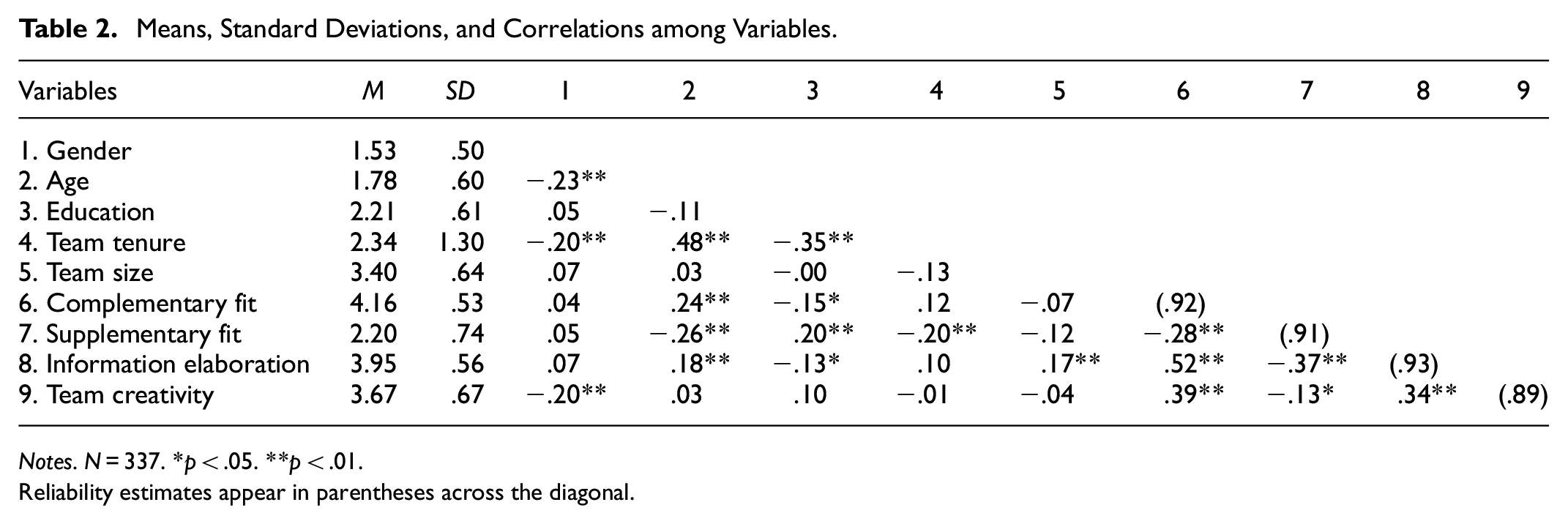
Notes. N = 337. *p < .05. **p < .01.
Reliability estimates appear in parentheses across the diagonal.
Data Aggregation
Aside from team creativity, which is rated by team leaders regarding the whole team, the other three constructs (i.e., complementary fit, supplementary fit, and information elaboration) are evaluated by individuals, thus producing individual data.
To deal with these individual data, we used a referent-shift model (Chan, 1998). The team-level data for our following analysis was calculated using the average value of the data for each team for these three factors. According to Bliese (2000), the combined data had to meet the following requirements: Rwg, ICC (1), and ICC (2) for appropriate inter-rater agreement scores and intraclass coefficients. A mean of Rwg(j) of complementary fit, supplementary fit, and information elaboration across teams was .94, .95, and .93 (>.70), respectively; the ICC (1) was .28, .28, and .42 (>.05), respectively; and the ICC (2) was .57, .57, and .71 (>.05), respectively.
Hypothesis Testing
First, we conducted SPSS software to investigate the mediation effect according to the four conditions suggested by Baron and Kenny (1986). As shown in Table 3, complementary fit is positively related to information elaboration (see Model 1, β = .37, p < .001), as well as team creativity (see Model 2, β = .48, p < .001). Hypothesis 1 was supported. Information elaboration is positively associated with team creativity (see Model 3, β = .48, p < .01). When information elaboration was added, the complementary fit was weaker but significantly associated with team creativity (see Model 4, β = .40, p < .01). We further applied the inserted Model 7 of PROCESS (Hayes, 2012) to test the indirect effect. Results confirmed that the indirect effect of complementary fit on team creativity via information elaboration was significant (indirect effect = .17, 95% CI[.02, .53]). Hypothesis 2 was confirmed.
Hierarchical Linear Modeling Results.

Notes. N (team) = 102.
p < .05. **p < .01. ***p < .001.
Gender, age, eSducation, team tenure and team size were all aggregated (the average value of each team).
Second, we assess the moderated mediation effect by examining four conditions (Preacher et al., 2007) to test Hypothesis 3: namely, (a) there exists a significant influence of complementary fit on team creativity, (b) there exists a significant interacting effect of complementary and supplementary fit on information elaboration, (c) there exists a significant influence of information elaboration on team creativity, and (d) between low and high levels of supplementary fit, there must be a different conditional indirect influence of complementary fit on team creativity via information elaboration. Our finds for Hypotheses 1 and 2 supported Conditions 1 and 3. The findings in Table 3 demonstrate a substantial interaction effect between complementary fit and supplemental fit in predicting information elaboration (see Model 6, β = .25, p < .01). Simple slope test (in Figure 2) indicates that the relationship between complementary fit and information elaboration is significant and positive (β = .54, SE = .12, p < .001) under a relatively higher supplementary fit (1SD above the mean), but such a relationship is not significant (β = .09, SE = .17, n.s.) under a relatively low supplementary fit (1SD below the mean).

Interaction between complementary fit and supplementary fit on information Elaboration.
We examined Condition 4 using the inserted Model 7 of PROCESS (Hayes, 2012). Complementary fit was significantly related to team creativity through information elaboration (indirect effect = .35, 95% CI = [.02, .56]) in the high-level condition of supplementary fit, but such conditional indirect effect was nonsignificant (indirect effect = .05, 95% CI = [−.15, .42]) in the low-level condition of supplementary fit. Significant indifference existed while estimating these two mediation effects (Δ = .30, 95% CI = [.03, .54]). Figure 3 plots these moderated indirect effects. Hypothesis 3 was confirmed, that is, the indirect impact of complementary fit on team creativity through information elaboration is bigger when supplementary fit is higher.

Indirect interaction between complementary fit and supplementary fit on team creativity via information elaboration.
Discussion
Based on the ODT, this study investigated how complementary fit enhances team creativity through information elaboration, and how the interplay of supplementary fit and complementary fit can facilitate this process, thus increasing team creativity. Data analysis based on 363 hotel frontline staff members within 113 teams demonstrated that complimentary fit has a positive association with team creativity. Information elaboration mediated the above relationship. When supplementary fit was high, teams with higher complementary fit displayed higher team creativity. Numerous theoretical and practical consequences are drawn from our investigation.
Theoretical Implications
First, the current study enriches the person-team fit literature by simultaneously considering two types of person-team fit and figuring out how they affects creativity. On the one hand, Prior research almost entirely focused on supplementary fit, although supplementary and complementary fit are two separate dimensions that deserve study because of how they interact to explain team outcomes (De Cooman et al., 2016; Kristof-Brown et al., 2014). Future research has been advised to take into account people’s perceptions of fit simultaneously in terms of complementarity (labeled complementary fit) and similarity (labeled supplementary fit, the dominant operationalization of person-team fit) (De Cooman et al., 2016; Leroy et al., 2022). On the other hand, existing studies found that person-team fit exert an ambivalent effect on creativity. Considering the influence of supplementary fit, from the similarity-attraction perspective (Byrne, 1971), team members with supplementary fit contribute to innovative behaviors by experiencing less task and relationship conflict in working environments (Collins & Smith, 2006). However, from the value-in-diversity perspective (Leroy et al., 2022), such similarities among team members cannot inspire members to explore heterogeneity and obtain information that is conducive to creativity. Rather, complementary fit significantly expands the knowledge pool, increasing a team's likelihood of making wiser judgments or producing more creative ideas (Aggarwal, & Woolley, 2019), while a possible negative relationship was also verified by the potential relationship conflict and disrupted team communication (e.g., Ancona & Caldwell 1992; Troyer & Youngreen, 2009). Therefore, the relationship and functioning process of both types of fit remains unclear. By clarifying the different roles of two types of person-team fit, our study enriches the understanding of how person-team fit affects team creativity in the process.
Further, previous research has shown that the heterogeneity and homogeneity of a team can have varying effects on work outcomes at the team level (Collins & Smith, 2006). However, this study suggests that an inclusive team, created through the interplay of complementary and supplementary fit, can significantly improve work outcomes. We propose that the coexistence of these two types of fit can be explained by the ODT (Brewer et al., 1991). We believe that the interplay of complementary and supplementary fit can satisfy the personal social needs for belonging and uniqueness, while also creating a team with the trait of “compatibility” that enhances the process of information elaboration and increases creativity.
Finally, Our study contributes to a more thorough understanding of how creative teams work by illustrating how information elaboration matters. Besides the theoretical support for the coexistence of both types of person-team fit, it is still unclear how the underlying mechanism work and how complementary and supplementary person-team fit balance each other out and under what conditions they could facilitate creativity at the collective level (De Coomean et al., 2016; Seong & Choi, 2014). Our study suggested that information elaboration is different from other mediation (e.g., information sharing and information exchange), the important aspects of the team members' productive talks about one another’s various proposals and incorporating from others are captured during the elaboration process (Hoever et al., 2012), thus taking advantage of complementary fit and strengthens its positive role in creativity.
Practical Implications
The results of this study have important ramifications for human resources operations in businesses. Organizations often adopt either a supplementary fit or a complementary fit strategy when selecting employees. The supplementary fit technique entails choosing team members who share traits with potential hires, while the complementary fit strategy involves selecting employees whose characteristics complement those of other team members. However, our findings imply that when choosing new team members, it is important to take into account both supplemental and complementary person-team fit. As a result, while choosing personnel, care should be taken to consider how much the employee complements other team members and how much they resemble other team members in terms of particular qualities (like personality, for example). In order for the shared perceptions of both supplemental and complementary fit to emerge, companies must secondly make sure that the necessary conditions are met. Repeated social contacts will most likely make this process easier (Kristof-Brown et al., 2014). Organizations should therefore give teams plenty of opportunity to engage, such as through team-building exercises. Finally, information elaboration is recognized as a critical mechanism. To enhance competitiveness, organizations should proactively create a team atmosphere that fosters risk-taking and failure, supports new ideas, and rewards innovators, ensuring the flow of information elaboration among team members. For instance, employees should be encouraged to engage in deep-level communication among members during both working and non-working hours, believing that good ideas can be generated in an instant (Huang et al., 2017).
Limitations and Future Directions
We acknowledge certain restrictions that require attention in future research. First, because our participants were limited to frontline employees in the hotel industry, the generalizability of our findings may be limited. Therefore, we advise that future studies replicate our findings in various organizational contexts and, if practical, with a larger sample size in order to resolve this constraint. Our study may also be limited by the fact that it used a cross-sectional survey approach, which only established correlations among the variables rather than demonstrating causal effects. Therefore, future research should consider using a more experimental approach to investigate the antecedents of team creativity. Finally, we did not analyze whether complementary teams have a potentially negative influence when the dissimilarities among team members are extremely large. Prior research has indicated that deep-level diversity within teams may hinder effective communication and integration among team members more so than in more homogeneous teams (Harvey, 2015). Therefore, future research should examine the degree of heterogeneity in complementary teams.
Conclusion
How to stimulate creativity within teams remains a highly relevant issue for both practitioners and scholars. Taking the ODT as an overarching theoretical framework, this study clarified how complimentary fit and supplementary fit, two different types of person-team fit, can affect team creativity. According to our research, information elaboration plays a significant role as an intervening mechanism in the relationship between complementary fit and team creativity, and supplemental fit is a key factor in determining how much a team will gain from complimentary fit. Therefore, this research offers a platform for a more thorough knowledge of person-team fit and the factors that encourage the best team outputs (team creativity).
Footnotes
Declaration of Conflicting Interests
The author(s) declared no potential conflicts of interest with respect to the research, authorship, and/or publication of this article.
Funding
The author(s) disclosed receipt of the following financial support for the research, authorship, and/or publication of this article: This project was supported by the Humanities and Social Science Research Planning Fund of the Ministry of Education of China under grant number 22YJA630015.
Ethical approval
This study was approved by the Internal Review Board of the School of Business and Management, Shanghai International Studies University.
Informed Consent
All participants provided written informed consent before taking each survey.

Data Availability Statement
Data was available upon request.