



Abstract
How people face changes in their lives depends on a series of factors, encompassing individual (cognitive, psychological and emotional) and collective (i.e., cultural) aspects, which originate positive and negative perceptions that help individuals organize the reality around them. These perceptions are of crucial importance in processes involving cultural transitions of indigenous communities as the former may influence life-changing decisions and the communities’ cultural identity. This is the case of the indigenous communities of Collas in the northern region of Atacama (Chile) who, for several reasons, have, over the last decades, migrated back and forth between the Cordillera1 and the city. In this paper, we investigate the positive and negative perceptions of nature for both, the Cordillera and the city, settings as a fundamental aspect of Collas’ identity, and discuss the similarities and differences of these perceptions according to participants’ geographical location, age and gender.
Introduction
Transitions are part of life. Some transitions have an influence on us at the personal level and they may involve, for instance, changing jobs, while others involve whole communities or groups of people such as in the case of company mergers and a family moving to a different country. These levels of transitions (the individual and the collective) intertwine and often involve some kind of cultural adjustment. Transitions involving a great deal of cultural adjustment have been defined as cultural transitions (consider Lazzaro-Salazar, 2021; Sussman, 2000), since the person has to ‘reorganize his/her social roles, and to cope with temporal and structural changes in daily life, which will often be associated with changes in identity structure’ (Manzi et al., 2010, p. 970). Cultural transitions then cause people to revise and re-conceptualize their identity and views of the world vis á vis the new context and social structures (e.g., new roles in society). Their stances, cultural beliefs, norms and social practices are re-signified in light of those of the new context and, consequently, the new culture (consider reflections in Doyon et al., 2021; Lazzaro-Salazar, 2013; Lazzaro-Salazar & Zayts, 2023).
In this context, the adjustments involved in life transitions bring about some reactions that guide the way individuals face such changes, that is, the way people face the new. These can be either positive or negative evaluations and reactions, and they strongly depend on how people reason, think, make decisions and see life in general. Typically, research on attitudes and emotions in the field of social psychology tend to consider that positive or negative inferences and evaluations of daily life events strongly depend on people’s personality traits and temperament (Dewberry et al., 2013). For instance, an extroverted individual could be expected to face ‘the new’ with more openness with respect to an introverted person (Bardi & Ryff, 2007; Searle & Ward, 1990). Moreover, reasoning differences may also be accounted for at the cultural level (Norenzayan et al., 2002), considering that the context itself plays a role in how individuals learn to reason or think in their own culture and society or to consider big changes in their lives (consider ‘culturally mediated internalized models of a life’ in Fivush, 2008).
From a cognitive perspective, some studies show the existence of a so-called ‘negativity bias’ (Peeters & Czapinski, 1990) which occurs regardless of individuals’ attitudes and personality traits, and might even have an evolutionary explanation (Lazarus, 2021) to support this particular kind of defeasible reasoning (Gazzo-Castañeda et al., 2016). According to this view, the negativity bias allows individuals to recognize dangerous situations and avoid hostile environments (Peeters & Czapinski, 1990; Vaish et al., 2008). Negative information is then potentially more informative than positive one (Gazzo-Castañeda et al., 2016) and has a stronger weight in decision-making evaluations (Kahneman & Tversky, 1984). From this perspective, people might pay more attention to the negative aspects of the new context because they have a greater effect on their lives and identity. Individuals may, thus, experience a tension between what they consider a positive condition and what they consider a necessary but mostly negative situation in which every reasoning process and every decision is biased by the (emotional) negativity towards the new context or situation involving their transition.
This interplay between cognitive, psychological and cultural factors guide the way people face not only life in general, but also their reactions to changes in life, that is, to transitional moments, which moulds people’s identity. In this light, transitions are not always permanent, but may rather be recurrent or ongoing. An example of this involves people commuting for work to different cities or even countries, moving each time to one or another according to the situational requirements. In the case of such ongoing transitions, positive and negative situations help individuals to organize the information about both contexts without losing their sense of identity, depending on the internal or external motivations that trigger their feelings of happiness, sadness, satisfaction and so on.
This may be the case of the Collas, a group of indigenous communities in the north of Chile, some of whom have moved from their original territories in the Andes mountains to settle in nearby cities to be able to provide educational and job opportunities for their children and family, while others are in a constant transitioning state as they live in the city during the week and move back to the mountains on weekends and holidays (see Rubio-González et al., 2023). For both these groups, living in the city or in the mountains has a direct impact on their culture as Collas since the environment in which they live either allows or constrains the way they can do being Collas, that is, the way they enact their identity through their cultural practices and rituals. In this regard, a vital aspect of what it means to be Colla involves their relationship with nature and natural elements that surround their communities (consider Alarcón et al., 2018; Leff, 2000). In the words of a Colla interviewee: The good thing about being a colla and living in the mountains is being in contact with nature, feeling free, feeling in the territory, and breathing the air, being in contact with the ancestors, with our natural elements—oreidare, as we call them, the earth, the moon, the wind. Everything that makes us happy, because an indigenous person without land, without territory is not happy.
Naturally, the positive and negative perceptions these communities have of the way they relate to nature and to their natural environment and surroundings has a direct influence on their cultural identity, and often display some degree of tension when weighing the pros and cons of life-changing decisions involving the urban and the Cordillera.
Though scholarly efforts have been made to investigate different kinds of transitions experienced by a number of indigenous communities around the world (e.g., educational transitions in Australia, Cuervo et al., 2015; nutrition transitions in Ecuador, Chee et al., 2019, and in Canada, Damman et al., 2008; energy transitions in New Zealand, MacArthur & Matthewman, 2018), to our knowledge this is the first study to empirically address the relationship of the Colla community with their natural environment as they face the tensions of the urban-Cordillera divide in cultural transitions. In this paper, then, we explore the narratives of a group of Collas from the Atacama region in Chile who reflect on those positive and negative aspects of their cultural transitions between the Cordillera and the city that have profoundly influenced their lives and cultural identity. We then compare and contrast participants’ positive and negative perceptions of nature according to their gender, geographical location and age.
The Colla Communities
The Collas is a group of indigenous people whose origins can be found in Chile, Argentina and Bolivia (Molina, 2014). Their presence in the Atacama region of Chile (located between 26° and 29°20′ south latitude) has been documented since the early 19th century, and they have been found to live in foothills and mountain ranges between the Pedernales salt flats in the north and the Maricunga salt flats in the south. For decades, their territorial location has been cyclically regulated by livestock transhumance, and the search for forage for their animals in the winter and summer periods, which prompted them to constantly move between the mountain range and the middle parts of the Cordillera, also reaching current Argentine territory. Initially, the Cordillera provided them with products for basic economic activities such as hunting, maintaining livestock, supporting agricultural practices, finding firewood to sell and manufacturing charcoal through pirquinearía 2.
However, these practices have been deeply affected by the socio-economic transformations that began in 1973 as a result of the accelerated development of mining in the area, for instance, in addition to the transit difficulties between Chile and Argentina due to the territorial conflict between both nations in 1978 (Gleisner & Montt, 2014). This has led to conflicts over the use of land and water, climatic events, segmentation of their territories by mining companies and environmental pollution. Because of this, some Colla communities in the Atacama region have had to change their lifestyle and economic activities and they abandoned their territories, and dispersed and migrated to other parts of the Cordillera or into the city (Molina, 2003). Very importantly, the need and/or obligation to provide formal education for their children, access to healthcare and salaried work also led many Colla families to initiate a process of urban settlement in a more determined way from the 1970s onwards. This has prevented the cultural transmission of ancestral knowledge and values to the new generations, which today are in the process of searching and recovering their Colla identity.
From the State point of view, the Collas remained in the shadow in the eyes of the Chilean government and society in general up until the 1990s, but they were still present within the local society as the people from the Cordillera (Aravena Reyes, 2014). In those times, for the Collas, the city symbolized a place where they could sell their products and buy other essential products to sustain life in the mountains. However, their economic interaction with the city involved some degree of prejudice and discrimination, and often their ethnicity was questioned or ignored, especially regarding legal matters (Molina, 2019). It was not until 1995 (25 years after they started settling in the city) that the Colla communities gained legal recognition as an ethnic group (Molina, 2014). This recognition of the ethnic background has formally given them access to indigenous lands and the right to preserve their own culture.
Nowadays, the different Colla communities mainly live in the following urban localities of the Atacama region: Copiapó, Paipote, Tierra Amarilla, Los Loros, Inca de Oro, Diego de Almagro and El Salvador. The older men in the communities often live in the mountains and occasionally visit their family in the city, while the rest of the family, that is, younger men and women and their children, lives in the city and moves to the communities in the Cordillera during the summer or on holidays. The family organization of the Collas is patriarchal (Rodríguez Venegas & Duarte Hidalgo, 2018). However, very often, work aged men need to commute or spend long periods of time in the Cordillera to work in the mines or to develop their agricultural activities, which is why the communities have now become more matriarchally oriented, as women are in charge of the family in the city, have assumed organizational leadership within government institutions and keep the family ties between the Cordillera and the city.
The cosmovision3 of the Colla people is deeply rooted in their relationship with nature. The vision of their productive activities, their economy, and their ancestral and spiritual practices is built on the basis of the way they value and relate to their natural territory and its elements, all of which they consider sacred (consider Meneses, 2019). As can be seen in this brief history of the Colla people, cultural transitions from the Cordillera to the city and vice versa are a central aspect of their modern daily lives, and, in this context, the way they relate and value the different natural aspects of their urban/mountain environment heightens the tension inherent in these transitions and can be expected to mould their cultural identity.
Methods
Thirteen participants of different age groups who identify themselves as Collas were interviewed, including at least one man and one woman in each group (Table 1). The selection of the cases was intentional, and followed recommendations of a qualitative research approach, where the saturation of the information generally occurs between 10 and 15 interviews (Maharik & Fischhoff, 1993). Participants were contacted and interviewed by the second author of the article, who has an already established collaboration network with the Colla communities residing in the foothills of the Atacama Region. Following the snowball sampling technique (Goodman, 2011), the researcher first contacted community representatives who then passed on the contacts of other community members interested in participating in this study. This study was approved by the Ethics Committee of the Universidad Catálica del Maule (records 169/2018 and 58/2021) and all participants signed a consent form.
Distribution of Participants According to Gender and Age Range.

Source: Own elaboration.
During the semi-structured interviews, participants were asked about the positive and negative events they could identify in their daily lives in regards to living in the Cordillera (or mountains) and in the city. The procedure was based on what is called a ‘funnel design’, which begins by asking general questions that progressively move towards more focused questions (Granger-Morgan et al., 2001). The opening questions were ‘Tell me about the good and bad things you experience on a daily basis’ or ‘What are the negative and positive events for you or for the people who live in this place?’ Based on the answers to this initial question, further questions were asked to clarify and expand on participants’ responses. Each interview was audio-recorded and transcribed verbatim for analysis, and field notes were taken during the interview to record and verify the topics covered by the participants.
Data Arrangement and Codification
The data depuration and emergent codification was carried out using the NVivo10® software following the recommendations for content analysis of Leech and Onwuegbuzie (2011). This software is employed for detailed analyses of spoken texts, since it allows the structuring, navigation and processing of qualitative data, which can be organised and encoded in semantic networks, indexes, occurrences and associations. Thus, using this software, participants’ perceptions of the natural environment were first selected from the interviews by carrying out a sentiment analysis using separate lexicons to classify positive and negative perceptions, such as ‘love’ and ‘enjoy’ for positive perceptions and ‘sad’ and ‘awful’ for negative ones (consider Pudaruth et al., 2018). This resulted in 304 positive and 296 negative references overall. Following this, each recorded perception was then grouped into two different environmental settings: Cordillera and Urban, to later sub-classify them into a set of positive and negative perceptions for each setting. Each extract for each setting was then independently coded by four of the authors and checked against the results of the nodes identified using NVivo10®, which resulted in the positive and negative categories for each setting that are presented in the results section. We then created a consolidated matrix of all positive and negative categories and summed up the number of references made for each in the complete data set according to the independent codification of the four authors.
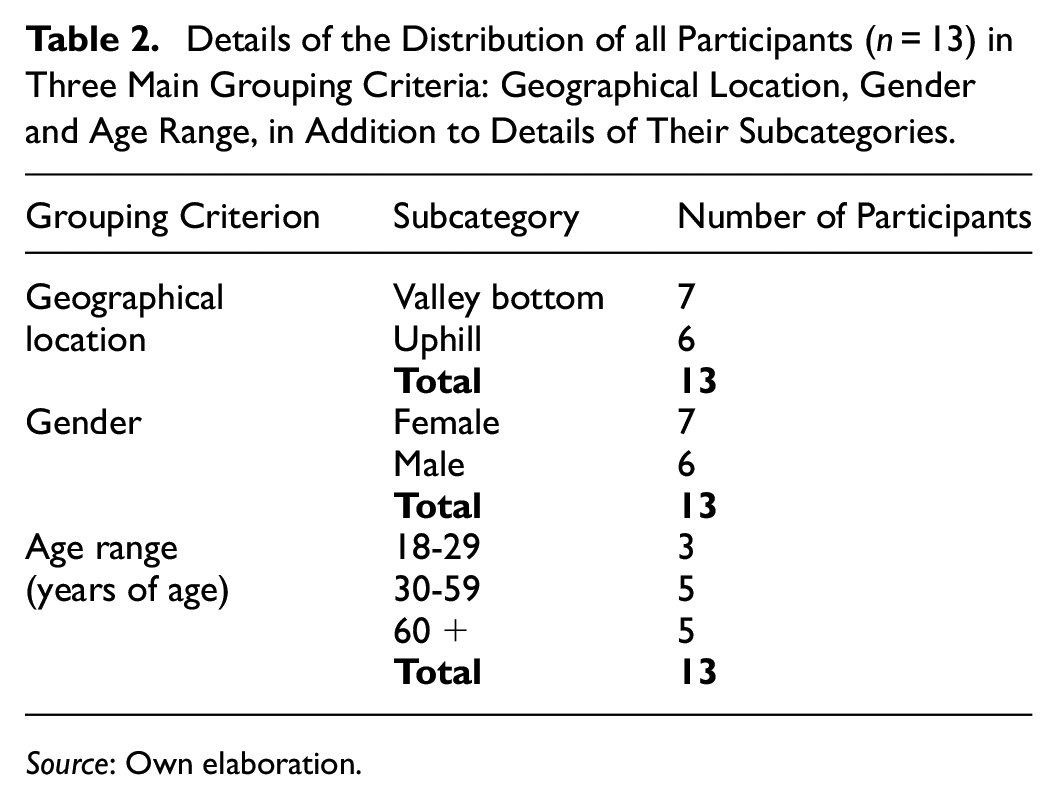
Moreover, in order to analyse differences among such perceptions, we grouped the thirteen participants following three main criteria: Geographical Location, Gender and Age Range. Gender and Age were, at the same time, divided into subcategories based on the demographic data provided by the participants (Table 2). Geographical Location subcategories, on the other hand, were determined based on the localities where participants live. Thus, using GoogleEarth® software we identified the location of the residential area declared by each participant and classified them according to their geographical location and elevation, in the following two categories: (a) Valley Bottom (participants living in an area located lower than 1,200 m.a.s.l.) and (b) Uphill (participants living in or frequently visiting Colla territory located above 1,200 m.a.s.l.).
Details of the Distribution of all Participants (n = 13) in Three Main Grouping Criteria: Geographical Location, Gender and Age Range, in Addition to Details of Their Subcategories.
Source: Own elaboration.
Data Analysis
In order to carry out the structural analysis of the perceptions, identified by the participants in each grouping criterion, we considered the subcategories for each grouping criterion as variables and the presence/absence of perceptions in each subcategory as samples. We then recorded the number of times each perception was mentioned by the participants within each grouping criterion. We recorded these data for both, positive and negative, types of perception in both environmental settings.
To analyse the structure of the answers (perceptions) in each participant’s grouping criterion, we carried out a Non-Metric Multidimensional Scaling (nMDS) analysis, which is a multivariate ordination method (Clarke, 1993) used to identify groups based on their differences (or dissimilarities). The nMDS analysis allows the representation of multidimensional data in a reduced number of dimensions (in this case, two), handling non-linear relationships without assuming a particular distribution of the data. This analysis was run using the Bray-Curtis Dissimilarity Matrix, which weighs the number of mentions per perception given by each participant within the subcategories of each grouping criterion. Then, the clusters resulting for each analysis were determined by adjusting convex envelope figures, in this case Convex Hulls, allowing us to translate complex relationships into a 2D plot, which is easier to visualise. A key output of an nMDS analysis is the Stress Value of Kruskal (1964), which indicates how well the reduced-dimensional representation matches the original data. Lower stress values (e.g., <0.2) indicate a good fit. Hence, we chose the nMDS analysis because it allowed us to identify distances and groupings based on the dissimilarities between the subcategories for each participant’s grouping criterion of each environmental perceptions (positive/negative) recorded for each environmental setting (Cordillera/Urban).
To assess the differences between the clusters, resulting from the Bray-Curtis Dissimilarity Matrix, generated by the nMDS analysis, a One-Way Analysis of Similarity (ANOSIM), based on the distance measures of the Bray-Curtis dissimilarity, was calculated. The ANOSIM compares distances between nMDS resulting groups allowing to validate statistically the dissimilarity between them and has proven to be particularly useful for datasets where the assumptions of normality and homogeneity of variances cannot be met, as it does not rely on these assumptions. Finally, a SIMPER (Similarity Percentage) analysis, to show the percentage in which each perception mentioned by the participants during the interviews contributed the most to the dissimilarity between a pair of groups, was calculated. This analysis was performed only for those grouping criteria where clusters showed by the nMDS analysis were significantly grouped by the ANOSIM analysis. All analyses were performed using PAST® v3.20 (Paleontological Statistics software) (Hammer et al., 2001).
Analysis and results
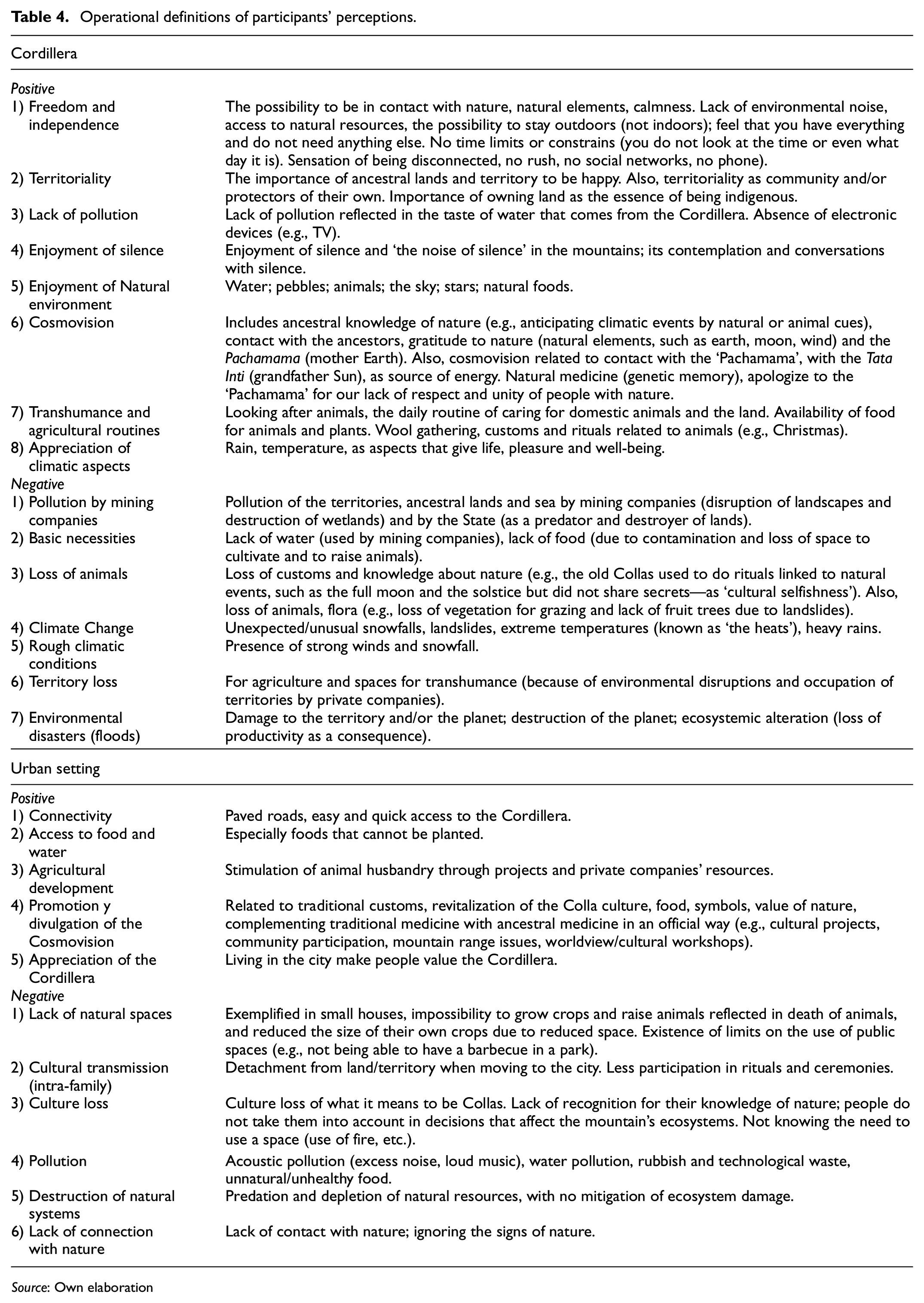
Positive and negative perceptions of the total number of participants (n = 13) were identified in two environmental settings, namely, the Cordillera and Urban settings. In the Cordillera, we identified a total of eight positive perceptions and seven negative perceptions; similarly, in Urban settings we identified a total of five positive and six negative perceptions regarding the natural environment during the participants’ interviews (Table 3; for the operational definition of each perception see Table 4).
List of Positive/Negative Perceptions by Categories Identified in the Interviews to the Participants (n = 13) in the Cordillera and Urban Settings.

Source: Own elaboration.
Operational definitions of participants’ perceptions.
Source: Own elaboration
For the Cordillera, the nMDS and subsequent ANOSIM analysis did not show any differences among the positive perceptions expressed by the 13 participants living in different geographical locations (i.e., Valley Bottom and Uphill), belonging to a different gender (i.e., male/female) or belonging to a specific group age (i.e., between 18 and 29, 30 and 59 or older than 60 years old) (Table 5). Similarly, through the nMDS analysis we were not able to identify any differences or groupings of negative perceptions when sorted into Geographical Location or Age. On the other hand, the nMDS and subsequent ANOSIM analyses showed that participants belonging to different gender (subcategories Female and Male) exhibited a difference in the type of negative perceptions related to the Cordillera, displaying a differentiation regarding the perceptions expressed by Females and by Males (Figure 1). Regarding the contribution of each perception to the difference between males and females, the SIMPER analysis showed that perceptions regarding Territory Loss, Pollution and Natural Disasters are the most important perceptions, contributing to more than 60% of the observed differences between both groups (Figure 2).
Results of nMDS and ANOSIM Analysis of Perceptions, Showing the Positive and Negative Perceptions for all Participants (n = 13) When Arranged in Three Different Grouping Criteria: Geographic location, Gender and Age.

Source: Own elaboration.
Stress Value between 01. and .02: Fair fit.
R-values closer to +1 indicate greater differences between groups, and values closer to −1 indicate greater similarities between groups.
Statistically significant value (p < .05).

Non-metric multidimensional scaling (nMDS) plot showing groups formed by the participant’s perceptions (Gender grouping criterion) of Negative perceptions in a Mountain Range Setting.

SIMER (Similarity Percentage) analysis showing ranked data the percentage contribution of each perception to the dissimilarity between each two formed groups, female and male.
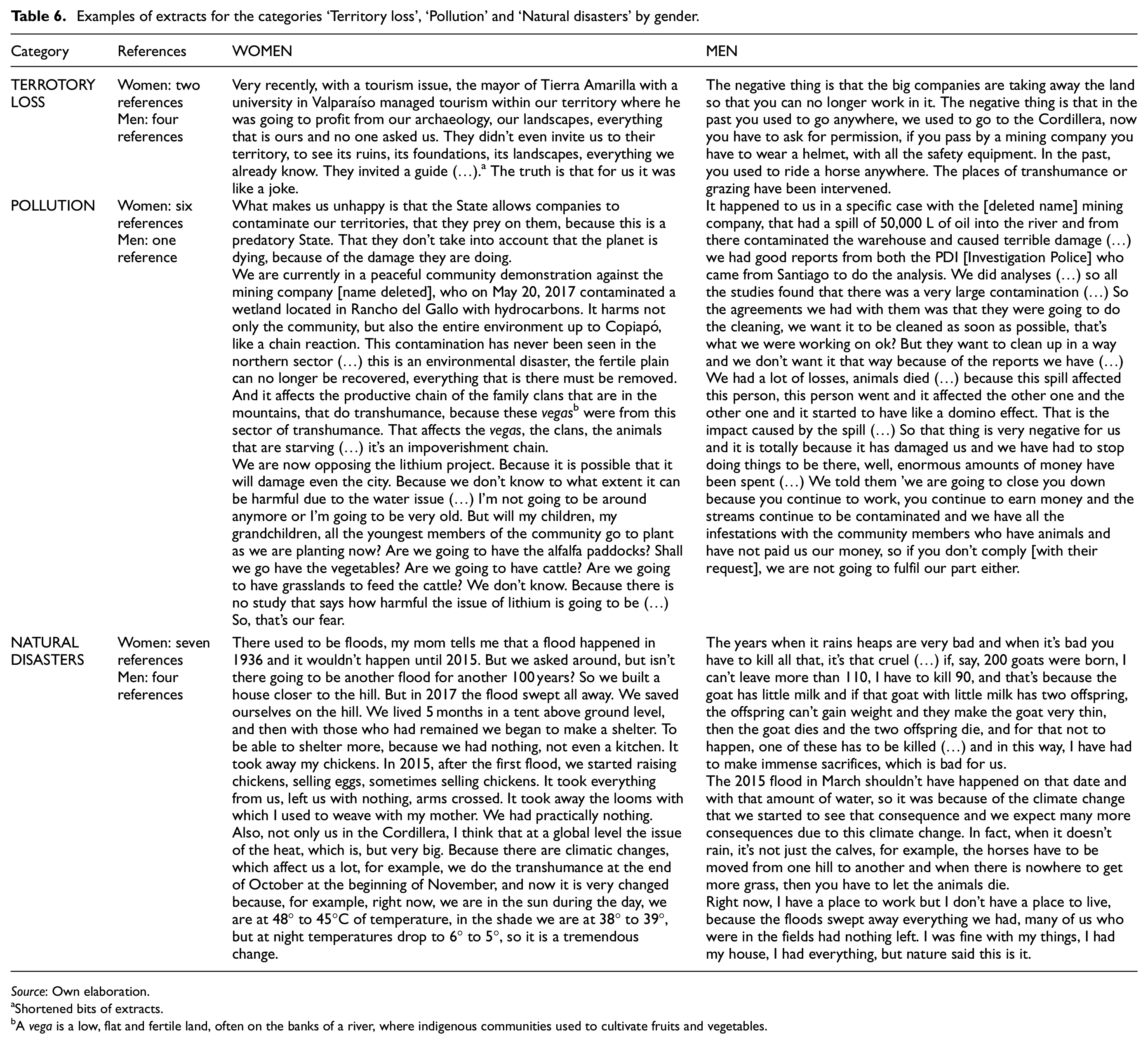
A closer look at the perceptions shared by participants shows that in addition to the differences in the number of references found for each topic by gender (column two of Table 5), there are some other subtle discursive differences (e.g., kinds of concerns expressed and the orientations of the reflections) offered by men and by women. Regarding the category ‘Territory Loss’, for instance, women seem to reflect on the lack of recognition of their community as a sign of symbolic territory loss as the Colla communities are not taken into account concerning environmental and cultural transmission decisions and activities that affect their territories (see example in column three of Table 5). Men, on the other hand, reflect upon the issue of territory loss in terms of their lack of access to lands and their concern for the development of economic activities of transhumance and agricultural management (column four of Table 6). Regarding the category ‘Pollution’, women seem to be mainly concerned with its consequences in terms of the wellbeing of the clan and the legacy to the family and future generations, partly blaming the State for allowing mining companies to do this kind of environmental damage. In this regard, men continue to express their concern for the loss of animals and the harm to their economy, only this time their narratives focus on the negotiations undertaken by the Colla communities with different government offices and mining leaders, and the push for power over the mining companies. Finally, regarding the category ‘Natural disasters’, while both men and women reflect on the effects of climate change, women’s narratives focus more on the loss of their homes to the floods and how they also affected the transhumance, whereas men focus mainly on cattle losses and its economic impact.
Examples of extracts for the categories ‘Territory loss’, ‘Pollution’ and ‘Natural disasters’ by gender.
Source: Own elaboration.
Shortened bits of extracts.
A vega is a low, flat and fertile land, often on the banks of a river, where indigenous communities used to cultivate fruits and vegetables.
Last but not least, similarly to what was observed for the Cordillera, we did not find any differences (neither positive nor negative) in the perceptions expressed by the participants when arranged in any of the grouping criteria (i.e., Geographical location, Gender or Age). A significant difference was detected, however, by the ANOSIM analysis for negative perceptions grouped by Gender (Table 4). We nevertheless dismissed such result as the stress level reported by the nMDS was higher than 0.2 (Table 4), indicating a poor fit and the absence of separated clusters.
Discussion and Conclusions
This paper explored the positive and negative perceptions of nature of a group of Collas from the Atacama region in Chile in the context of the communities’ cultural transitions between the Cordillera and the city. To this end, we investigated similarities and differences among participants’ positive and negative perceptions of nature according to their gender, geographical location and age. The results show that positive and negative perceptions of nature for the Cordillera and Urban settings are similar for two of the grouping criteria (namely, geographical location and age), while significant differences have been found only in the negative perceptions for the Cordillera settings when grouped by gender.
Regarding the former, the fact that positive and negative perceptions of nature for the Cordillera and Urban settings are similar regardless of participants’ geographical location and age (and also gender in the case of positive perceptions of the Cordillera) may suggest that the ‘identity union’ (Sp. unidad identitaria) among the members of the different Colla communities is stronger than often assumed (consider point 3 of negative perceptions of urban settings; see also Bujes, 2008; consider Shaari & Abd Rahman, 2017). In this light, while the existing literature makes a vital point in showing the communities’ identity fractures and tensions regarding the transculturation efforts at the heart of the hegemonic, uni-national and mono-cultural discourses of the State that derive from capitalist and colonial structures (Rodríguez Venegas & Duarte Hidalgo, 2018), the data here shows that the Colla communities seem to still share the same cosmovision (i.e., worldview) when reflecting upon nature and their natural environment. Thus, in general terms, participants’ alignments concerning the topics they discussed and narrated reflect the main traits of the Colla culture and worldview (Molina, 2013) and display a strong sense of belonging and cultural unity. The participants appear to enjoy the freedom and silence of the Cordillera, and share a common concern for the pollution caused by the mining companies in the Cordillera and the lack of natural spaces in urban settings, among other topics.
Nonetheless, results showed significant differences involving the negative perceptions of the Cordillera when grouped by gender, especially in three categories, namely, Territory Loss, Pollution and Natural Disasters. Overall, the topics mentioned by both, men and women, are similar (e.g., they both worry about the floods, climate change and the pollution caused by the mining companies), but the perspectives from which they reflect on these topics are different. Thus, while women seem to be more oriented towards sharing more explicitly their concern for the wellbeing of animals, their community, their clans and family, men’s narratives converge on practical concerns for economic losses and local economies. Women then are more focused on the emotional impact of negative events upon their communities, animals and nature, while men seem to dissociate from negative events (and, thus, negative emotions) on the practical level. This works to show that the negativity bias may occur at different levels in women than in men (emotional vs. practical, respectively), and that by paying closer attention to the different negative aspects of the Cordillera-city divide, the Colla community manage (possibly more successful) cultural transitions (consider reflections on Gazzo-Castañeda et al., 2016; Lazzaro-Salazar & Zayts, 2023).
These orientations seem to be in line with the traditional roles that men and women have in indigenous populations (Aparicio & González, 2018), and specifically in the Colla culture, where women are considered the pillars of the family, the keepers of ancestors’ traditions and the caregivers of the whole community and men are the providers who perform economy-related agricultural activities (Rodríguez Venegas & Duarte Hidalgo, 2018). This finding is in line with studies that show that gender differences affect the psychological associations made among negative and positive events (Bagozzi et al., 2010). In this light, women are more likely than men to construct a negative event as central to their identity, especially those events which are collectively and culturally shared and become part of the so-called ‘self-defining memories’ (Singer, 1990), which may be the reason why they made more negative references when reflecting upon territory loss, pollution and natural disasters than men. This, naturally, also influences the way narratives are processed (Singer & Blagov, 2004), which also helps to explain women’s empathic and emotional orientation in their narratives about their negative perceptions of the Cordillera. These different perspectives on the same negative transition experience might highlight how gendered roles in indigenous societies (and especially in the Colla one) reinforce specific priorities and responses to shared adversities. Women often embody the emotional responsibility of community resilience and integrity, family and clan cohesion. This tendency is supported by findings showing that women often exhibit stronger negativity bias in relational contexts, emphasizing the emotional repercussions of disruptions to social harmony and nurturing or caregiving roles (LaFromboise et al., 1990; Wood & Eagly, 2002). On the other hand, men are more concerned with the material aspects of survival, resource provision and risk-management as well as the pragmatic coping mechanisms for recovery. Thus, women’s heightened attention to emotional losses may stem from a deeper evolutionary and cultural investment in maintaining social bonds, whereas men’s focus on economic concerns reflects an emphasis on survival strategies linked to resource control and provision (Bornstein & Putnick, 2008; Lew-Levy et al., 2018).
Although these findings on the differences of women and men’s perceptions can be regarded as individual differences, they seem to actually orient towards achieving a collective goal. In this light, when comparing the two narratives from a gender perspective, there is room to argue that these ‘differing’ views are, in fact, a synergistic way of facing adversities in a community, where each societal role faces different aspects of the collectivity while pursuing the common, shared objective of survival, cohesion and stability. In other words, while each gender group focuses their efforts (emotional or practical) on different negative aspects of the environment that challenge and/or endanger their practices and existence, they complement each other to face cultural transitions collectively.
Future studies may explore these narratives from a discursive perspective in order to provide a nuanced analysis of speakers’ self-positionings and epistemic stances in their perceptions of nature. Such analyses would complement the findings reported in this paper and would continue to highlight the importance of including the ‘voices’ of the participants to ensure a strong advocacy for them so that their perspectives become part of not only academic endeavours but also reach relevant stakeholders in the wider community and the State. Moreover, future research should also explore other confounding factors (e.g., employment history/status, reasons for migrating between the regions, marital status, number and age of children, and other lifestyle factors) that could influence the Colla communities’ positive and negative perceptions of nature in Cordillera and urban settings. We further suggest that future studies approach the matter from the lens of environmental psychology to determine the impact the environmental challenges reported by the Colla communities have on their wellbeing and, in particular, how these environmental/wellbeing perceptions may vary according to individuals’ gender.
Last but not least, although the sample size (that is, thirteen participants) is appropriate for a qualitative design and an exploratory study such as this one, yielding interesting insights into the cultural transitions of the Colla community, we recognise the fact that it limits the generalizability of the findings. Thus, future studies should expand the sample size in order to provide more robust results that further support the findings reported in this study.
Footnotes

Ethical Considerations
This study was approved by the Ethics Committee of the Universidad Católica del Maule (records 169/2018 and 58/2021) and all participants signed a consent form.
Funding
The author(s) disclosed receipt of the following financial support for the research, authorship, and/or publication of this article: This work was funded by ANID ATE230028 and by Anillos SOC180040 projects, of the Agencia Nacional de Investigación y Desarrollo (ANID).
Declaration of Conflicting Interests
The author(s) declared no potential conflicts of interest with respect to the research, authorship, and/or publication of this article.
Data Availability Statement
Data sharing not applicable to this article as no datasets were generated or analyzed during the current study.