



Abstract
Unmet or thwarted belonging needs have been implicated in multiple studies of women in engineering in college and in the engineering workforce. A wide range of other challenges that women face in engineering are tightly linked to deficits in belonging. Furthermore, many women face intersectional factors across race and ethnicity that make it even more difficult to belong. This literature review looks at women’s struggles in engineering in the context of the fundamental psychological need to belong. Studies that investigate belonging are reviewed, as are major contributors to unmet or thwarted belonging including gender identity threat and normative and numerical male dominance. Belonging is not the only psychological need that is inadequately met for women in engineering, but it is a common factor in multiple contexts and the situation worsens as women progress in their career pathways. Studies of belonging among women in engineering underscore the importance of supporting women in fulfilling this basic need even when the cultural transformation of engineering into a gender-balanced environment is not yet a reality.
Introduction
A sense of belonging has been defined by social psychologists Baumeister and Leary (1995) as having interpersonal connections that are both positive and frequent and are accompanied by a conviction that the underlying relational bond is caring, stable, mutual, and lasting. Having a psychological sense of belonging within a particular social context is critical for positive psychological and performance outcomes. Persons in an under-represented group are particularly vulnerable to not belonging as their minority status can contribute to a negative feedback cycle associated with unmet or thwarted belonging needs. Research has shown that in college, individuals who feel that they may not be accepted based on their gender, race, social class, or other under-represented status suffer negative impacts both to their academic performance and to their likelihood of persistence in their chosen major. The very anticipation of exclusion can trigger anxiety and cause an individual to feel threatened and anticipate discrimination, thereby drawing attention away from academic tasks and hurting academic performance (Mendoza-Denton et al., 2002). Furthermore, emotional and physiological responses to feeling threatened can further disrupt academic life over time, causing under-represented individuals to cope by choosing to disengage and de-identify from the domain which threatens them (Pinel, 1999; Steele et al., 2002). Thus, while feelings of belonging are important to everyone, they can be especially impactful for members of historically under-represented groups (Walton & Cohen, 2007a).
One such under-represented group is women within the field of engineering. Despite significant and varied efforts over the past several decades to increase women’s participation in engineering, men continue to greatly outnumber women. Women bring diversity of thought to engineering and their continuing under-representation in these disciplines introduces a cost—“in products not built, in designs not considered, in constraints not understood, in processes not invented” (Wulf, 1998). Thus, if present methods to increase women’s participation in engineering are not working, it is important to assess alternative approaches. If women are unable to feel belongingness within engineering, then programs that offer “band-aid” solutions to address individual structural barriers are likely to prove futile. To approach gender parity (both in numbers and in career thriving), it may be that a fundamental paradigm shift within engineering culture is needed. Thus, understanding what is known and not known about how women engineers experience belongingness could bring significant insight into interventions that would be differentially impactful. This article presents a review of existing literature that has studied women’s belongingness within engineering contexts (both academic and professional). The goal of the review is to identify whether and how women do (or do not) experience a sense of belonging in engineering.
The stubborn and persistent gender gap in a wide range of engineering fields is a problem that both limits the diversity of the engineering workforce and prevents many women from pursuing technical interests in engineering jobs or in related careers that require an engineering background. Across the globe, there is substantial variation in women’s engineering participation, but under-representation remains almost universally consistent. For example, engineering undergraduates are 5% female in Japan, 15% in the United Kingdom, and 25% in India. Women are even less present in the workplace, although the degree of under-representation also varies by country. The U.K. engineering workforce, for example, is less than 10% women, whereas Bulgaria is over 30% and China is 40% female (Singh & Peers, 2019).
The picture in the United States, while not the bleakest, remains highly imbalanced. While women make up 50.8% of the population in the United States (U.S. Census Bureau, 2019), they earn only 19.8% of all bachelor’s degrees in engineering and 24.2% of masters degrees (National Science Foundation, n.d.). In the workforce, they represent only 15% of engineers (Martinez & Christnacht, 2021). Engineering remains stubbornly resistant to providing a compelling and welcoming environment for women, even while other STEM fields like biology and math have advanced to much greater gender balance, with 60% and 42% of bachelor’s degrees granted to women, respectively (American Physical Society, n.d.).
It is important to note that engineering is not a monolithic discipline. Engineering is similar to professions like law and medicine in its non-homogenity, such that gender parity varies widely among subdisciplines. In fact, in the most populous engineering fields, the numbers look the most dismal. For instance, mechanical engineering grants over 30,000 Bachelor’s degrees in the United States every year, with less than 15% of those degrees going to women. Similarly, electrical and computer engineering collectively grant over 16,000 Bachelor’s degrees every year but just over 14% go to women. In contrast, the much smaller field of environmental engineering grants fully half of its 1,301 Bachelor’s degrees to women (although still only about a third of its workforce is female). Environmental engineering is a fairly new degree field whose formation was stimulated by concerns over air and water pollution in the middle of the 20th century, compared with mechanical and electrical engineering which have offered degrees since the late 1800s. Thus, environmental engineering may be less hampered by traditional male dominated workplace cultures that favor a “good old boys” club or similar mentality that excludes many women from feeling that they belong. Environmental engineering may also provide a broader range of opportunities for women to directly benefit society with their engineering work. Similar advantages are likely in biomedical and biological engineering, both relatively new engineering fields where women represent almost a quarter of the workforce (Table 1).
Representation of Women by Discipline.

Regardless of engineering subdiscipline, however, the proportion of women in the workforce consistently lags the proportion of women earning degrees in each engineering subdiscipline. This is true both for fields that have been around for a long time (e.g., mechanical engineering) and those fields that are relatively new on the engineering landscape (e.g., environmental engineering). Many women also leave engineering after earning a degree in engineering, and do so in larger numbers than men who earn engineering degrees. The Project on Women Engineers’ Retention (POWER) studied such exits from the engineering workforce and largely dispelled the myth that women who leave engineering jobs also leave the workforce altogether to raise families (Fouad & Singh, 2011). Among the 3,700 women studied who were employed in the engineering workforce, the POWER study found that of all the women who left engineering prior to 2010, 45% are still working but are doing so in non-engineering positions—more than 50% in executive management positions, 15% in a managerial role, and 30% in individual contributor positions. Among younger female engineering graduates that leave engineering, even higher numbers remain in the workforce but in non-engineering positions. For example, for women who graduated in the 1990s, 70% of those who left engineering are still working and for women who graduated in between 2000 and 2010, 78% of those who left are still working and doing so in non-engineering positions (Fouad & Singh, 2011). Furthermore, women leave engineering at much higher rates than men, particularly at mid-career. The retention rate for women in engineering drops from almost 80% in early career to just over 60% in mid-career while the retention rate for men from early to mid-career drops from about 90% to only 87% (Frehill, 2012). Thus, not only do women enter into engineering at lower rates than men, they also tend to leave engineering at higher rates than men and this trend remains consistent through college and into early and mid-career, suggesting that one or more negative elements of the engineering environment may have an increasingly detrimental effect on women over time. Lacking a sense of belonging is one such factor which may wear on women over time, amplifying negative feelings and reducing intentions to persist in the engineering workforce.
The Importance of Belonging
“Much of what human beings do is done in the service of belongingness.” (Baumeister & Leary, 1995, p. 498)
Belonging is a fundamental human motivation that is experienced to some degree across all human cultures and different types of people (Baumeister & Leary, 1995). In ancestral human history, going it alone was to be avoided and belonging to a group was critical to survival. Hunting, cooking, protection, and other essential activities were more successful when pursued by groups rather than by individuals. Thus, the need to belong evolved to support the survival of the human species. And, while in many Western cultures belonging may no longer support a critical evolutionary purpose, the need to belong nevertheless persists and motivates human beings to seek and maintain social bonds. Many psychological theories support the importance of interactions and social bonds. Freud supported the need to belong as fundamental to human behavior, albeit motivated by sexual needs (Freud, 1930). The need to belong is also a critical element of Bowlby’s attachment theory in that the relationships and bonds that children form or do not form with their caregivers early in life predicts their future ability to form and satisfy these bonds as adults (Bowlby et al., 1989). Maslow placed the need to belong explicitly in his hierarchy. The need to belong occupied the middle layer of his pyramid of needs, following directly after physiological and safety needs and requiring fulfillment before self-esteem and self-actualization needs could be met (Maslow, 1943). While empirical evidence for the hierarchical structure of Maslow’s theory is lacking (Soper et al., 1995), the need to belong remains central in psychological needs theories. Self-determination theory (SDT) does not take a hierarchical approach but instead maintains that relatedness (similar to the need to belong), autonomy, and competence are basic psychological needs that are fundamental to well-being in a given setting (Deci & Ryan, 2012).
Baumeister and Leary (1995) propose that belonging is fulfilled by several specific characteristics of social bonds. First, the quality of contacts with others is more important than the quantity (i.e., Facebook is inadequate). In fact, the need for belonging can be satiated, meaning that after a certain number of friendships, seeking new relationships is stressful and no longer desirable. Furthermore, relationships that satisfy the need to belong must involve interpersonal connections that are both positive and frequent and are accompanied by a conviction that the underlying relational bond is caring, stable, mutual, and lasting (Baumeister & Leary, 1995). When an individual’s need to belong is not met, a range of negative consequences can result. For example, deficits in psychological sense of belonging have been shown to be a greater predictor of depression lack of social support, conflict, and loneliness (Hagerty & Williams, 1999). Fulfilled belonging needs are also correlated to physical health. Female college students who reported a greater sense of belonging also reported better perceptions of their physical health and male college students reported fewer health symptoms overall (Hale et al., 2005). Individuals who lack belonging are less sensitive to pain, exhibit reduced empathy, and are less able to think clearly and deeply (Baumeister et al., 2007). Furthermore, a lack of belonging not only impacts the physical, cognitive, and emotional health of an individual, but in the workplace, leads to self-defeating behaviors such as angry outbursts which reduce future opportunities for belongingness (Thau et al., 2007). And, finally, evidence suggests that men and women fulfill belonging needs in different ways: women tend to invest in smaller numbers of close relationships while men are more likely to display a larger scope of social relationships (Baumeister & Sommer, 1997). This difference can be important both in the interpretation of gender differences among measures of belonging as well as in the design of initiatives targeted toward strengthening belonging in classes, labs, and workplaces for women.
Method
This review followed the steps included in the framework for guiding literature reviews described by Templier and Paré (2015): “formulate” the problem, “search” the literature, “screen” for inclusion, “assess” quality, “extract” data, and “synthesize” the data.
“Formulate” the Problem
As discussed previously, the importance of belongingness in promoting well-being and productivity is fundamental to all human beings. Thwarted or unmet belonging needs can be a significant barrier to not only retaining people in engineering but enabling them to thrive in engineering careers. Based on this premise, this study sought to understand if the literature supports belongingness among women in engineering. To this end, we sought to address four research questions, two in the educational environment and two in the workplace:
RQ1: Do female students feel that they belong in engineering majors?
RQ2: Do female engineering students feel a different sense of belonging than male students?
RQ3: Do women feel that they belong in the engineering workplace?
RQ4: Do women feel a different sense of belonging than men in the engineering workplace?
“Search” the Literature
The term belonging is problematic because it is interpreted in the English language across a much broader scope than the fundamental psychological construct posited by Baumeister and Leary (1995). To reduce the number of articles retrieved from the literature as part of this review that were far afield from the psychological definition of belonging, we restricted the majority of our searches to Engineering Village, a research database developed by Elsevier to balance breadth and depth of literature in engineering and related fields. We built simple search strings and applied them across all fields (including but not limited to titles and keywords) to cast the net as broadly as possible within this engineering research database. Three extensive searches were performed in the following order:
(women)(belonging)(engineering) | (women)(belonging)(STEM)
(gender)(belonging)(engineering) | (gender)(belonging)(STEM)
(women)(workplace)(engineering) (belonging | isolation)
Each search excluded the results of previous searches and was complemented by snowball searches of both relevant literature reviews and empirical research articles that emerged from the initial database searches.
“Screen” for Inclusion
Inclusion criteria were similar for empirical research articles, dissertations, and institutional reports, allowing qualitative, quantitative, and mixed research methods. Included studies were restricted to those that examined engineers (or engineering students) and those that focused on women or included women as a distinct sub-population. Studies of a broader population (e.g., STEM) were included only if engineers were a significant sub-population. Quantitative studies which did not use a distinct measure of belonging were also excluded as were qualitative studies where belonging or isolation did not emerge as a major theme in data analysis and coding. Mixed method studies which did not meet at least one of these criteria were also excluded as were studies which were not original empirical research articles. Since the goal of this review was to study women’s existing feelings of belonging in engineering, those studies that evaluated the impact of an intervention or strategy to improve belonging were also excluded from the review. Using these criteria, the screening process generated 36 (6.62%) useful results from 544 articles (Table 2).
Results of Search and Screening.

“Assess” Quality
This review included only peer reviewed research from journal articles; peer-reviewed research from established national or international conferences; doctoral dissertations; and reports without formal peer review when published by reputable organizations (e.g., The Athena Report from the Harvard Business Review [Hewlett et al., 2008]).
All included articles were categorized according to quantitative (Quan) or qualitative (Qual) research methods used to study belonging. Mixed methods studies were denoted as both Quan and Qual and entered separately into results tables. A majority of studies involved quantitative research methods and were assigned three category labels: type (reports or doctoral dissertations [1], peer-reviewed conference proceedings [2], or peer-reviewed journal articles [3]); breadth (the study population was drawn from fewer than three [A] or at least three organizations or institutions [B]); and statistical power (did [Y] or did not [X] report medium or strong effect sizes in the chosen quantitative analysis methods related to belonging). In general, qualitative research studies lack generalizability to larger populations of individuals but instead research questions go deeper into understanding how (e.g., how do women find a sense of belonging sufficient to persist in engineering?)—labeled category 1—or why (e.g., why do women struggle for belongingness in certain engineering environments?)—category 2. Typically, Qual1 studies involved deeper investigations of a small number of individuals while Qual2 studies involved larger sample sizes. Qualitative studies were also categorized by the population breadth (A from fewer than three workplaces or institutions; B from three or more).
“Extract” Data
Data extracted for analysis included the scales used to measure belonging (when applicable) and data that were directly relevant to the four research questions. Supporting data for significant themes or statistically significant gender differences were also collected to support discussion of overall trends in the results.
“Analyze and Synthesize” Data
The data were first analyzed to understand answers to the four research questions and then to probe why belonging issues persist in certain environments. Answers to the research questions were then synthesized in the context of how deficits in women’s belonging in engineering are likely to be influenced by numerical male dominance, normative male dominance, and gender identity threat.
The Measurement of Belonging
The construct of belonging for this review is frequent, positive, caring social bonds (Baumeister & Leary, 1995). As a result of belongingess, people experience feelings of inclusion and support. In the higher education and workplace literature, belonging has sometimes been measured using scales that explicitly use the word belonging, raising possible bias among participants’ interpretations of the word belong. Some scales instead focus on the manifestion of belonging, emphasizing a “sense of fit” or community “membership.” Other scale items, reflecting the importance of approval as a prerequisite for forming the social bonds that fulfill belongingness needs (Baumeister & Leary, 1995), refer to a sense of acceptance or respect within a group. Among quantitative studies of the workplace, formal surveys that include belonging scales were scarce. To evaluate belonging in these settings, this review looked at survey scales that evaluated known antecedents to and manifestations of belonging in the workplace (Figure 1).

Psychological sense of belonging manifested in school and in the workplace.
Across a wide range of contexts and studies, there is a surprising degree of similarity among the scales used to measure belonging. While scope and context vary (e.g., class, department, institution, workplace), the items across multiple scales tend to focus on perceptions of fit, acceptance, and support as well as on explicit references to belonging. Table 3 presents sample items from the scales used to measure belonging among women in engineering and related fields, as reflected in the studies included in this review.
The Measurement of Belonging, Its Antecedents and Manifestations.
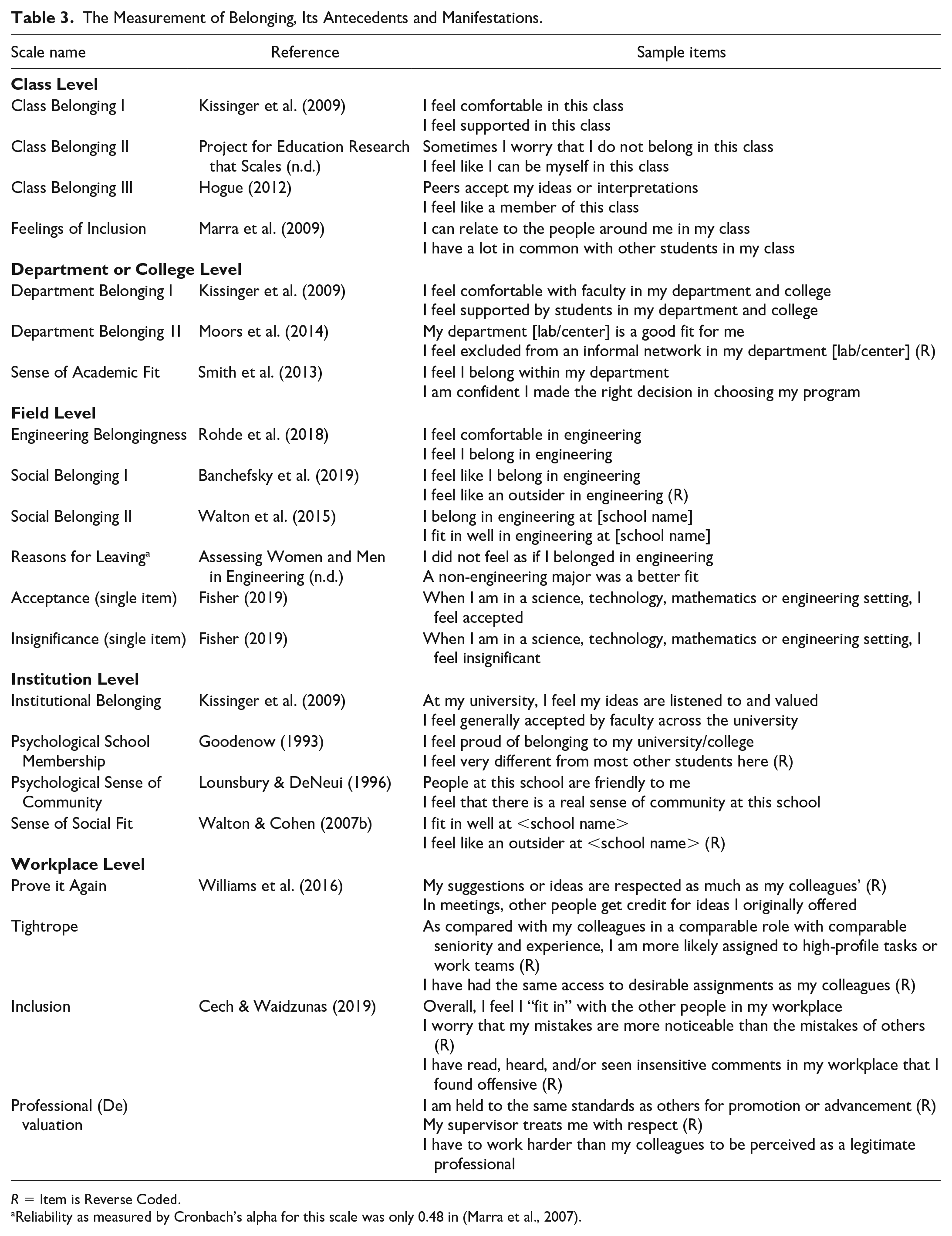
R = Item is Reverse Coded.
Reliability as measured by Cronbach’s alpha for this scale was only 0.48 in (Marra et al., 2007).
Results
Engineering Students
Do women belong in engineering education? When young women are first starting out in engineering as undergraduates, studies of belonging suggest a promising story. Of nine studies of undergraduates, five report a (full or limited) sense of belonging among women (Table 4). Another sixteen studies considered relative belongingness in comparing women and men undergraduates; on balance, these have failed to show a gender difference in multiple contexts (Table 5).
(RQ1) Do Female Students Feel That They Belong in Engineering Majors?

Eng = Engineering; CS = Computer Science; STEM = Science, Technology, Engineering, Math.
Notes:
Belonging decreased over time and more so for Black women.
All participants were persons of color.
All participants were Black women at one Historically Black College/University (HBCU).
All participants were persisting in graduate school but had changed research labs due to experiences of bias.
See Methods for Type classifications.
Among Undergraduates: (RQ2) Do Female Engineering Students Feel a Different Sense of Belonging Than Male Students?

Eng = Engineering; LS = Life Science; M = Math; PS = Physical Science; STEM = Science, Technology, Engineering, Math.
Notes:
Sense of belonging for engineering students was measured in an (out-of-major) physics class.
No significant differences in belonging were found by gender or by race.
Belonging for both men and women decreased over time.
No significant change in belonging occurred over a 6-month period.
Study population was drawn from a single large Hispanic-Serving Institution (HSI).
Belonging at small private institution was significantly higher than at large public institution.
White women expressed similar sense of belonging to men in gender-balanced major in this study, while students of color (including women) expressed lower sense of belonging.
Gender differences were found among persistors and non-persistors in STEM.
See Methods for Type classifications.
Several studies even reported higher belongingness for women. In a quantitative study at a single, predominantly white institution, women’s belongingess to their overall institution was similar to men’s, but women actually had a significantly higher sense of belonging than men in their engineering classes (Kissinger et al., 2009). And, sense of social fit and belonging for engineering majors at a predominantly Hispanic institution was significantly higher for women than men (Rhee et al., 2017).
Conversely, among 736 students in an introductory physics course at a large university, female students from a wide range of pSTEM majors (physical sciences, technology, engineering, and mathematics) reported lower levels of belonging than male students. Furthermore, for women, belongingness more strongly predicted intentions to persist in the chosen major than was the case for men (Lewis et al., 2017). This link between belongingness and engineering persistence was also reported in studies of exclusively engineering majors, although no gender differences were found (Marra et al., 2007, 2012) Collectively, reduced opportunities to belong could impact persistence in engineering education for both men and women. Notably, belongingness may not be consistent between engineering subdisciplines. Women in a major with a higher percentages of females (civil engineering) reported greater belonging than women in the more male-dominated field of electrical engineering (Kissinger et al., 2009).
Nowhere is this belongingness deficit in engineering education more evident than in studies of racially under-represented groups in engineering. While the studies by Marra et al. (2007, 2012) found no gender differences among the factors that students reported as influencing their decision to leave engineering, racial differences did emerge. Non-white students (male and female) tended to report lack of belonging as more of a factor in leaving engineering than white students. Godbole et al. (2018) also reported that students of color felt much less belongingness than their white classmates. Dortch and Patel (2017) interviewed Black women undergraduates in STEM at predominantly white institutions; isolation and alienation were major concerns. Not only did all students of color in pSTEM majors (including engineering) report less belongingness than white students, the frequency for women of color was more pronounced than for men (Rainey et al., 2018). This result has been echoed in quantitative studies reporting that being a woman of color in STEM negatively predicted a sense of belonging in the major (Johnson, 2012).
Apart from important concerns for students of color, strong engineering belongingness among women undergraduates is encouraging. In contrast, the few studies of graduate student belonging present an unclear story (Table 6).
Among Graduate Students and Postdoctoral Scholars: (RQ2) Do Female Engineering Students Feel a Different Sense of Belonging Than Male Students?

Eng = Engineering; LS = Life Science; M = Math; STEMM = STEM plus Medicine; PS = Physical Science; STEM = Science, Technology, Engineering, Math.
Notes:
Study focused on Black women.
See Methods for Type classifications.
Two studies interviewing women graduate students of color attributed lack of belongingness to race as much as or more than gender (Bahnson et al., 2019; Dortch & Patel, 2017). Also, construct measurement is key for belonging studies; Fisher et al. (2019) reported more feelings of insignificance and lack of acceptance for female than for male graduate students while Smith et al. (2013) determined that women actually experience a greater sense of belonging than men through academic fit with their discipline. The conflicting results in these studies underscore the need for more research on belonging among graduate students and postdoctoral scholars.
If women do belong, how do they do it? A majority of studies have indicated that women who persist in engineering majors do find a sense of belonging in their disciplines, at least while still in school. Women’s sense of belonging to a classroom was connected to social bonds that directly meet needs for belonging, either by positive recognition from the course instructor or friends in the course (Kalender, 2019), or via positive, supportive interpersonal relationships with peers or faculty members (Berry & Fenn, 2018; McKoy, 2019; Rainey et al., 2018). Students who remained disconnected from their classroom were still able to develop a sense of belonging to engineering though participation in extracurricular professional organizations (e.g., SWE, NSBE, ASME) where they were able to make personal connections and experience feelings of similarity with other students (Benson et al., 2019). Students of color also experienced belonging via professional organizations, but sometimes felt excluded there as well and would instead turn to social organizations (e.g., sororities) where they could develop institutional belongingness by bonding with students who they viewed as more similar (Berry & Fenn, 2018; McKoy, 2019).
In summary, studies of belonging among engineering students suggest that many undergraduate women who remain in engineering majors develop a sense of belonging that is on par or greater than that expressed by men. And, while women do leave engineering majors due to a lack of belonging, they do not do so at levels that are significantly greater than male leavers (Marra et al., 2012). The minority of studies that demonstrate significantly lower levels of belonging for women rather than men have focused on women of color (Dortch & Patel, 2017; Johnson, 2012) or do not isolate engineering as a separate discipline among a wide range of STEM majors (Lewis et al., 2017; Rainey et al., 2018). Belongingness among female graduate students looks more concerning, but additional research is certainly needed. Thus, while there is no doubt that there is room for improvement in facilitating a greater sense of belonging for engineering students, most women students who remain in engineering find ways to belong that sustain them to completion of their degrees.
Engineering Workplace
Do women belong in the engineering workplace?
Unfortunately, unlike engineering students, women often do not have a sense of belonging in the engineering workplace (Table 7). Approval needs that would facilitate belonging are unmet, the stable social bonds that directly form belonging are largely lacking, and the workplace climate for women lacks the desirable characteristics that would result from belongingness (Figure 1). Instead, women describe a workplace in which they experience isolation, are not valued, and do not feel free to be themselves.
(RQ3) Do Women Feel That They Belong in the Engineering Workplace? and (RQ4) Do Women Feel a Different Sense of Belonging Than Men in the Engineering Workplace?

Eng = Engineering; LS = Life Science; PS = Physical Science; STEM = Science, Technology, Engineering, Math; STEMM = STEM plus Medicine; NS = Not Studied.
Notes:
Studied Australian engineers who had persisted to mid-to-late career; number of workplaces not specified.
Participants in many workplaces but all recruited from one professional organization (AIChE).
Studied “millennials” who earned a bachelor’s degree after 1998.
Included 1 U.S. and 4 U.K. worksites, within three different types of engineering industries.
Studied tenure-track faculty members.
See Methods for Type classifications.
A common theme among workplace studies was isolation—an indicator of unmet belonging needs. According to a multinational survey of over 4,400 professionals, 44% of female engineers feel extreme isolation in their workplaces (Hewlett et al., 2008). More recently, a qualitative study investigating engineering workplace culture for millennials concluded that women continue to report feelings of isolation, and much more often than men (Yonemura & Wilson, 2016). In a large-scale mixed-methods study, women indicated it is challenging to “fit in with the guys” and report loneliness from having no friends at work (Williams et al., 2016).
In addition to isolation, the engineering workplace fails to provide women with feelings of respect, recognition, and being valued—the “prove-it-again” bias named in Williams et al. (2016). Based on surveys of over 3,000 engineers, women were twice as likely as men to express that their technical abilities are called into question in each new interaction and that their contributions frequently go unrecognized. Similarly, women expressed a sense of marginalization due to both having their technical abilities doubted and being “tuned out” by men in conversations and decision making (Hatmaker, 2013).
A subtle but significant impediment to workplace belongingness is the strain between being seen as a woman or an engineer. As Faulkner (2009) points out, “the largest cultural group will tend to shape the workplace culture.” The substantial gender imbalance means that engineering work has come to be defined as masculine. Consequently, women must constantly negotiate their own identity, as a woman or as an engineer. An in-depth ethnographic study of 71 female and male engineers found that women suffered from an “in/visibility paradox” where they were on the one hand, highly visible as women, yet as engineers, nearly invisible as they struggled to be recognized as belonging in their communities of practice (Faulkner, 2009; 2011). Hatmaker (2013) described the engineering workplace as “amplifying gender,” such that women are constantly pointed out as different, implying their otherness as compared with “real engineers.” This “tightrope bias,” as named by Williams et al. (2016), requires women to find a delicate balance between these identities, which women describe as being “assertive but not bitchy”; “helpful but not a doormat.” Wherever women strike this balance, they end up feeling that they are never free to just be themselves in the workplace, which thwarts the fulfillment of belonging needs.
In summary, out of seven workplace studies that included women engineers and explicitly studied belonging, its antecedents, or manifestations, six reported that isolation or lack of belonging were major concerns among the female participants. The only workplace study that did find belongingness among engineering women intentionally studied only women who had happily persisted in civil engineering work into mid-career (Ayre et al., 2013); the researchers inferred that those women who were unable to develop a sense of belongingness had already left engineering. Although conducted using different research methods among different populations of engineers, these workplace studies share a common theme—that belonging is important to working women engineers and that a lack of belongingness often impedes satisfaction, advancement, and other important career outcomes.
Discussion
If women feel that they do not belong, why not?
A review of the literature suggests that once women graduate with engineering degrees and move into the workforce, more of them struggle to develop a sense of belonging. In subsequent sections, we suggest three primary reasons why this may be the case. In the workplace, women are represented in lower numbers in almost all engineering fields than is the case among students in engineering (Table 1); this decreased representation going from college to the workplace increases the potential for isolation which inherently reduces opportunities to develop the positive, stable social bonds necessary to belong (Baumeister & Leary, 1995). The presence of men in higher proportion is often compounded by entrenched male normative cultures which can lead to hostile or chilly climates for women. Such normative male dominance prevents women from expressing their opinions freely, feeling that their work is valued, gaining recognition for their accomplishments, receiving unbiased feedback for professional growth, and feeling cared about at work. All of these factors have emerged from workplace surveys as important to developing a sense of belonging in the workplace (Huppert, 2017). As importantly, when women are highly underrepresented in the engineering workplace, they often face gender identity threat which forces them to choose between being themselves and fitting in—a no-win situation with regard to developing an adequate sense of belonging.
Women face numerical male dominance
Numerical male dominance in an environment is simply defined by the presence of substantially more men than women. Normative male dominance exists when the normative culture values traditionally masculine traits or characteristics (Gruber & Morgan, 2005), a form of cultural sexism (Capodilupo, 2017). Although distinct concepts, numerical male dominance has been shown to be highly correlated with normative male dominance (de Haas & Timmerman, 2010), meaning it can be difficult to separately identify which dominance is the source of observed outcomes. Regardless, numerical male dominance by its very nature increases the number of women who are the only women in the room and these “lonely onlys” feel left out and on guard (Cooper, 2018) as they suffer a lack of belonging that their majority peers take for granted.
The impact of numerical dominance can be understood through the concept of tokenism, one of three major theories of organizational behavior put forth by Kanter (1977) as a result of extensive observations and interviews conducted within a large corporation. According to Kanter, tokenism exists and causes negative impacts when the “token” group of workers make up less than 15% of an overall workgroup. Women in engineering are often “token” workers by gender, as is indicated by the discipline-specific workforce percentages indicated in Table 1. Tokenism in engineering varies both by discipline and by individual work group, which makes it difficult to untangle its impact from most studies of the engineering workforce. However, Kanter’s tokenism theory suggests a mechanism by which being a member of a token group escalates to negative impact on group belonging. In particular, women experience inherently high visibility as token workers in numerically male dominated environments. Because women tend to be more noticed, their actions and performance are examined more thoroughly, leading to a divergence into underachievement or overachievement. This in turn leads to a phenomenon called boundary heightening, where the dominants (men) may amplify gender differences in the workplace, leaving women with a choice to accept being an outsider or pursue entry into the insider’s group. Remaining an outsider allows women to benefit from the support of other women but distances them from the informal interactions among male coworkers. Striving to be an insider gains women access to these informal interactions and the potential advancement opportunities that they provide but can alienate women from their female coworkers. Either way, Kanter’s theory suggests that the token worker must isolate herself from one group or another to gain acceptance within either the dominant (men) or token (women) group. By its very nature, such isolation distances an individual, whether psychologically, physically, or both, from connected relationships with others, thereby inherently reducing opportunities to develop a sense of belonging and resulting in the loss of place or fit within a group (Biordi & Nicholson, 2013). This is not a sacrifice that most of the dominant men have to make and the result is that women in fields which are male dominated experience greater physiological stress and negative health outcomes, resulting in part from the barriers to belonging that social isolation stemming from tokenism present to women in these fields.
There is an added layer of complexity that further amplifies the negative impact of male dominance in the engineering workplace. Simply improving the numerical gender balance beyond Kanter’s suggested threshold for tokenism does not overcome the problems associated with numerical dominance. For example, it has not been conclusively demonstrated in subsequent literature that exceeding the 15% tipping point eliminates barriers for the minority group (e.g., Stichman et al., 2010). And while performance pressure and social isolation stemming from numerical dominance tend to emerge from studies of occupations that have been historically dominated by men, Kanter’s theory failed to account for the backlash that arises when the proportion of token workers (e.g., women in male dominated fields) increases. Blalock (1967) theorized how increasing the representation of a minority group threatens the dominant group and thus leads to discriminatory behaviors, which in a gender-imbalanced work environment would include sexual harassment, unequal wages, limited advancement opportunities, and other forms of individual, cultural and institutional sexism. Thus, improvements in gender parity (i.e., reductions in numerical dominance) can exacerbate normative male dominance, thereby trading isolation for hostile, chilly, or unsupportive masculine cultures (Yoder, 1991; Yoder & Kahn, 2003) in which negative interactions with coworkers overshadow or replace any frequent positive interactions that are necessary to develop a sense of belonging.
Studies of critical mass embrace the idea that a certain percentage representation of a minority group is necessary for the culture in which the minority lives, works, or plays to change. Recent research has shown that the tipping point in social convention for a minority group to overturn a majority viewpoint is surprisingly abrupt at 25% (Centola et al., 2018). This means that in a social or civic setting, when the number of individuals that hold a minority viewpoint exceeds 25% of the overall group, they then have the necessary momentum to change the voice and position of the larger group to which they belong. In contrast, in studies of engineering education, it has been shown that even when women represent 37% of the engineering population, women still report less self-efficacy and less freedom to express their ideas than men (Stolk et al., 2017). Thus, there may be something particularly confounding in engineering subcultures. However, the situation is not hopeless. This same study also demonstrated that despite 37% being insufficient to level the playing field, the engineering school was partially successful in creating a counterculture that disrupted the status quo and masculine norms that typically dominate engineering environments, both in school and in the workforce. Unfortunately, research that explicitly investigates at what level of representation minority groups develop a sense of belonging comparable to the majority group have not yet been conducted. But, consistent with studies of critical mass, it is reasonable that at some point, sufficient numbers of women are present in engineering workplaces to disrupt masculine norms and develop new norms that enable women to gain the approval and acceptance which are necessary antecedents to developing a sense of belonging.
Women Face Normative Male Dominance
While numerical male dominance leads to isolation (Cooper, 2018) that inherently holds back women from developing a sense of belonging in the engineering workplace, the cultures that have evolved from historically male dominant engineering work environments create further barriers to belonging for women. Male normative cultures exist when the expectation is that all workers will be male, or at least conform to stereotypical male traits. By their very nature, male normative cultures reject or undervalue female traits and in so doing, deny women the approval and acceptance that are essential to developing the social bonds necessary to feel that they belong in the workplace (Figure 1).
Male normative cultures are highly correlated with the terms “hostile culture” and “chilly climate,” used frequently in studies of women in the engineering workplace. These descriptors can refer to several types of situations. The most blatant hostile culture refers to a macho or “locker room” environment that isolates women (at best) or condones or even encourages overt sexual harassment expressed as sexual coercion or unwanted sexual attention (Gutek & Cohen, 1987). Sexual coercion is probably most recognizable as harassment; it predicates favorable professional treatment on sexual activity. Unwanted sexual attention includes verbal or physical sexual advances including but not limited to sexual assault (National Academies of Sciences, Engineering, and Medicine, 2018). Both of these forms of sexual harassment threaten basic needs for safety. And while a recent review (Vansteenkiste et al., 2020) has concluded that the positive impacts of meeting basic psychological needs including relatedness/belonging can be realized independently of safety needs, a wide range of studies underscore the negative impacts that sexual harassment at work has on professional, psychological, and physical health (National Academies of Sciences, Engineering, and Medicine, 2018). Overt acts of sexual harassment impair psychological health even after accounting for other job stressors, job features, personality, and demographics (Cortina & Berdahl, 2008). Thus, although psychological needs for relatedness and belonging can be met even when unwanted sexual attention or sexual coercion are at play, the resulting threat to safety and damage to overall psychological health can overwhelm any gains in belonging achieved elsewhere in the workplace.
Male normative cultures also cultivate workplaces where a third form of sexual harassment, gender harassment (National Academies of Sciences, Engineering, and Medicine, 2018), thrives. Gender harassment is less overt and recognizable in the workplace but can be just as insidious as unwanted sexual attention and sexual coercion in undermining psychological health. Gender harassment poses a different barrier to belonging, in part because it is most likely to be dismissed as “boys will be boys” behavior. It includes words and actions that convey hostility, objectification, exclusion, or second-class status about members of one gender. Gender harassment is often a consequence of gender bias. Gender bias represents belief systems (often unconscious) of the people in a workgroup which assign certain traits or abilities or “appropriate” behaviors according to gender. Gender bias is not illegal, but it is likely to be a precursor to acts of gender harassment and a normalizing influence on unwanted sexual attention and sexual coercion. While both gender bias and gender harassment do not threaten physical safety, gender bias inherently rejects women and denies them the approval necessary to pursue a sense of belonging in the workplace. Gender harassment, on the other hand, replaces positive social interactions with hostile, chilly, or negative interactions and thereby more directly denies women a sense of belonging.
There is ample evidence in the research literature that hostile workplace cultures of both kinds (those that encourage or tolerate overt sexual harassment and those that enable gender harassment) exist for women in engineering. A quantitative study of engineers reported that one in three women left engineering altogether because they did not like their workplace climate or boss or culture. Also, another one in three of those who had never entered engineering work after earning their degree reported that they had stayed out of engineering careers because they expected to encounter non-supportive workplace cultures (Fouad & Singh, 2011). This is not only a problem of an older generation of engineers, either; in a study of millennial (early-career) engineers, a hostile work climate, specifically due to gender, was the top problem identified by the women (Yonemura & Wilson, 2016). Even for the most severe forms of hostile culture, the numbers are significant. A U.S. study found that 33% of women engineers reported experiencing a hostile “hard hat” or normative male culture, including pervasive sexual humor and vulgarities. Fully 69% reported having experienced sexual harassment at some point and this was stable across age categories from 25 to 60 years, indicating the problem is not getting better for younger workers (Hewlett et al., 2008).
While gender harassment, sexual coercion, and unwanted sexual attention in the workplace are illegal in the United States (U.S. Equal Employment Opportunity Commission, n.d.), hostile climate can be experienced as gender bias which is more subtle than sexual harassment and not necessarily illegal. When gender bias exists in a workplace, it impairs outcomes that workplace studies have pointed to as critical to developing a healthy sense of belonging (Figure 1; Huppert, 2017). Women working in technology often believed that their companies failed to objectively identify and develop talent, thereby failing to recognize and value their contributions. Twenty percent of these women reported feeling stalled in their career because of gender bias (Foust-Cummings et al., 2008). Women were much less likely than white men engineers to report having equal access to desired assignments, leading to feelings that their work was not important (Williams et al., 2016). This is not surprising, given that women believe they are judged to be less competent simply because of their gender. One-quarter of women engineers say they work with men who believe women are less capable for technical work (Hewlett et al., 2008) and twice as many women as white men engineers report having to prove their competence repeatedly to get the same level of respect and recognition as their coworkers (Williams et al., 2016). These problems also show up in more formal venues; 44% of women engineers perceived a gender bias in their performance evaluations (Hewlett et al., 2008). In a later study, a comparable percentage of women and white men felt their performance evaluations had been fair, but women felt like they got less honest feedback at work, overall (Williams et al., 2016). Some of these types of gender bias may be subtle and difficult to objectively confirm via external observations. Since belonging is a personal and subjective measure, however, objective confirmation is not necessary. The mere perception of bias is likely to compromise the perception of belonging. Women who perceive these slights are likely to feel less of the approval that is a necessary precursor to developing a sense of belonging.
When gender bias is combined with numerical male dominance in the workplace, the result can be a workplace that might not be described as hostile but would meet the definition of a “chilly climate.” In a chilly climate, women are isolated, rejected, or left out of the mainstream culture. This has sometimes been identified as women lacking a sense of belonging or relatedness in the workplace (Plett et al., 2011), a natural result of the rarity of women in the workplace and the tendency for men to formally and informally socialize with each other. It is important to note that chilly and hostile climates work in different ways to subvert satisfaction of belonging needs. The isolation associated with numerical dominance fails to meet belonging needs by limiting opportunities to develop bonds with coworkers. However, the rejection and disapproval that is inherent to gender bias more actively thwarts belonging. Taken together, workplace climates that are both chilly and hostile can present formidable barriers to belonging for women engineers.
Hostile or chilly climates can be offset by effective mentors or sponsors in the workplace. These allies not only provide potential social bonds that contribute to fulfilling belongingness needs but also make career paths and company policies more transparent—something that workers in general cite as important to belonging (Huppert, 2017). A qualitative study of mid-to-late career U.S. women in engineering identified a key reason to leave as difficulty in “recognizing the options to navigate the workplace” (Buse et al., 2013). Men face these same structures but are much more likely to have a mentor or champion to help them negotiate their path. Women reported that female mentors were scarce (Preston, 2004) and older males seemed reluctant to “pal around” with younger women because of concerns of sexual inappropriateness (Hewlett et al., 2008); unfortunately, the recent #MeToo movement is unlikely to make this easier for women engineers. The management literature has also identified the challenges women face if their mentors are male (Kalbfleisch, 2000), even while revealing that female mentors can be less effective because they tend to be less well-connected to the power centers of the organization (Powell & Mainiero, 1992). Also, while it is becoming more common for women in SET to not be “the only one” in their workgroup or location, they still lack role models and they still feel excluded from the male “buddy system” (Hewlett et al., 2014). Thus, despite the clear benefit that effective mentors or sponsors can provide to fulfilling needs to belong, they remain out of reach for many women in engineering.
As more women enter the engineering workplace, it seems logical to think that sufficient suitable female mentors would be available to bring women into the mainstream. However, many engineering women still face gender identity threat as they navigate and move up the corporate ladder. Not only does this threat submarine their own belongingness needs by forcing them to choose between being themselves and fitting in, but it also prevents them from helping other women fit in.
Women Face Gender Identity Threat
In general, social identity threat is a response to feeling as if one is treated as less as a result of being a member of an out-group. This manifests both in terms of performance evaluation and behavior demonstrated by the in-group (Turner & Tajfel, 1986). Social identity threat thwarts belonging in the present and also undermines future satisfaction of belongingness needs. Women in engineering face social identity threat (with respect to gender) when women as a group feel that they are treated worse than men or devalued as a result of being a woman. Gender identity threat can emerge from sexual harassment and gender bias or from stereotypes that cause women engineers to feel that they are being judged more on their gender than on their professional competence.
The self-perpetuating nature of gender identity threat along with its negative outcomes in STEM work settings has been highlighted in a recent study by van Veelen et al. (2019). The authors showed that women who face both numerical and normative male dominance (by working in technology sectors where women are highly under-represented) report high levels of gender identity threat compared with men who work in these fields, and to women who work in non-STEM fields where gender stereotypes are weaker. Furthermore, women who strongly identified with their gender (those who attach “more importance or self-relevance” to their gender identity) reported even higher levels of gender identity threat. Gender and other forms of social identity threat have been shown to reduce women’s interest in quantitative domains and careers (Davies et al., 2002), diminish self-control in domains outside of engineering expressed in such behaviors as unhealthy eating patterns (Inzlicht & Kang, 2010), subdue interest in the fields in which they experience the threat, and reduce overall sense of belonging (Thoman et al., 2013). Compounding these negative outcomes, reduced belonging has been linked to an increased sense of gender and social identity threat, suggesting a potentially damaging feedback loop for women in normative male dominated environments (Hall et al., 2015) that causes feelings of belonging to decline even further over time.
As a result of gender identity threat, women may try to protect themselves by distancing themselves from their gender at work (Derks et al., 2011; Faniko et al., 2017). Women who distance themselves from other women, in turn, may not advocate as well for other women, leading to significantly reduced support for actions that improve the low-status positions of women in masculine work cultures (Derks et al., 2011). In doing so, they also thwart their belonging needs by denying their own needs to be comfortable to be themselves in the workplace. The situation then becomes triple trouble. The numerical and normative dominance of males in engineering, combined with the older, more experienced women engineers (those who have persisted and survived in the field) distancing themselves from younger female engineers—these all thwart and fail to meet belongingness needs, making it increasingly difficult for younger, early career women to achieve an adequate sense of belonging in their places of work.
Implications
The recent literature provides ample evidence that many women face a lack of belonging during their education and their work in engineering. These belonging deficits seem to be amplified for women in the engineering workplace (as compared with the engineering classroom) and for women of color (as compared with race/ethnicities that are not under-represented in engineering). While reductions in both the numerical and normative dominance of males (and related gender identity threat) are likely to provide more opportunities for belonging to women, such transformative changes in both classrooms and workplaces have been slow in coming to fruition. Fortunately, recent literature suggests that belonging needs can be met for women in other ways that may not be dependent on such cultural transformations. For example, one controlled research study (Walton et al., 2015) demonstrated that presenting a different narrative to female engineering students in male dominated engineering fields resulted in women developing more social bonds with male engineers during their educational experiences than those who entered into the major without such narratives. These social bonds are a critical element in developing a sense of belonging within a community (Baumeister & Leary, 1995). The narrative that promoted these increased social bonds included materials that conveyed a sense that both men and women were concerned about being treated with respect in engineering and about belonging in engineering but that these feelings would dissipate over time.
While the study by Walton et al. (2015) provided support for addressing preconceptions women may hold about finding a sense of belonging in engineering, other researchers have suggested alternative pathways to belonging that can compensate for the absence of communal relationships and close social bonds that traditionally fulfill belongingness needs. Hirsch and Clark (2019) suggested three such alternative pathways to fulfilling the need to belong. The first pathway involves general-approbation behaviors such as striving to accomplish, acquiring materialistic goods, and outperforming others to substitute for a lack of close social relationships at work. Other alternative pathways are group membership both within the workplace and outside of it (e.g., strong family ties) and minor-sociability experiences where even brief moments of social connectedness can contribute to meeting the need to belong.
Most would agree that more gender-balanced engineering workplaces, with fewer instances of gender bias or gender identity threat, would go a long way to eliminating isolation, loneliness, and other threats to belonging for women in these environments. However, short of gender-parity and equity, alternative pathways can also provide group leaders, managers, and human resource specialists, in both academic and non-academic engineering settings, with a diverse toolbox to meet belonging needs.
Conclusion
A review of the belonging literature indicates that many women who remain in engineering majors in college do in fact experience a sense of belonging that is either greater than or not significantly different than their male peers. For those women who leave engineering majors, however, lack of belonging is often among the reasons for leaving. Furthermore, as women advance into graduate school and into the workplace (both academic and private sectors), women who leave and women who stay frequently express a lack of belonging. The combination of both numerical and normative male dominance in engineering settings is likely to compound the struggle to belong and the resulting gender identity threat that women experience triggers a feedback cycle that leaves a true sense of belonging even further out of reach over time. Increasing the numbers of women in the engineering workplace, in and of itself, is unlikely to “fix” the problem because normative male dominance (including hostile and chilly cultures) is as much or more of a threat to women’s gender identity and sense of belonging in these cultures. True transformational change can only come when the numbers of women who retain their identity as women exceed critical mass in the workplace and when normative male cultures change to become more welcoming and inclusive of women at a deeper level, extending the invitation to belong to all genders, regardless of the level to which women express their femininity or men express their masculinity.
Footnotes
Declaration of Conflicting Interests
The author(s) declared no potential conflicts of interest with respect to the research, authorship, and/or publication of this article.
Funding
The author(s) received no financial support for the research and/or authorship of this article.
