




Abstract
Academia has been characterized as traditional, hierarchical, and selective, founded on patriarchal, imperial, and colonial values that construct and maintain gendered roles and regulations. This has been proposed to disadvantage how women experience, and identify within, academia. A narrative review was conducted to review the literature on women’s academic identities and experiences, and critique the dominant ways of knowing, being, and doing in academia. Thematic synthesis was conducted on 56 qualitative studies (published 2010–2019), illustrating the impact of these values on women’s academic identities and experiences, and normative gendered stereotypes and practices that impact women academics. Furthermore, existing literature is critiqued, exploring the influence of dominant ways of being and knowing (on how questions are asked, the constructs explored, the design decisions made). By providing this commentary, future research can focus on problematizing the system and dismantling the problematic conditions (e.g., underrepresentation, discrimination, and gendered stereotyping) for women in academia.
Introduction
Academia has been constructed as a highly institutionalized environment, characterized by a culture that is traditional, hierarchical, and selective (Bomert & Leinfellner, 2017). Within academia, individuals are categorized at different levels, for example, as students, academics, support, and/or administrative staff, which can all have different positionings, responsibilities, and access to opportunities that both exacerbate and reproduce social and institutional inequities (Read & Leathwood, 2018). Academia was founded on patriarchal, imperial, and colonial values that worked to construct and maintain gendered roles and regulations, which have been proposed to disadvantage women (Blackburn, 2017). This is based on the persistence and maintenance of gendered processes and structures which can be influenced by heteronormative practices, that are partly ascribed to the construction and operation of the academic institution that works to attribute and legitimize neutrality to these particular processes (Blackburn, 2017; Göktürka & Tülübaş, 2021). These institutional, gendered processes have been suggested as invisible to most academics as they are based on knowledge and belief systems that work to explain and justify current patriarchal and heteronormative practices (Cumings Mansfield et al., 2014). Justifying the current practices maintains how academia operates, to inform the academics’ view of “the way that things exist” (Bomert & Leinfellner, 2017, p. 108).
Women academics are considered a minoritized group that experience disadvantage in the academic setting based on their gender. Historically, women have been underrepresented in the fields of Science, Technology, Engineering, Mathematics, and Medicine (STEMM) within higher education. Globally, women comprise 53% of PhD university graduates and early-career academics, however, only occupy 15% of senior academic positions (United Nations Educational, Scientific, and Cultural Organization, 2021). This can be compounded by the influence of gendered identities, governance, power differentials, and the broader academic context, on the experiences, expectations, and roles of women academics. While women’s representation in higher education, and the work force, has significantly improved over time, the representation of women in STEMM fields is still a prevalent issue that has received increasing attention among researchers and policymakers (Nash & Moore, 2018; Science in Australia Gender Equity [SAGE], 2020). Additionally, many gendered inequities still exist between men and women in many key STEMM occupations, institutions, and industries (e.g., working in higher education; SAGE, 2020). This can impact how women identify within the academic, and personal, context.
The Academic Identity
The academic identity is the view of oneself, embedded within the norms, values, and beliefs that encapsulate discipline-based work structures and govern how individuals engage in academic work (Gaus & Hall, 2015). The identity formation process is complex; identities evolve over time and can be tested, adopted, and refined throughout one’s academic career (Gaus & Hall, 2015). Women academics receive conflicting messages about academic role expectations that compete with their identities, and attempts are made to incorporate these identities with changes in academia (Zhao & Jones, 2017). This is compounded by the pressure to act in accordance with normative standards, and to obscure any aspects perceived to be of little value to the institution (Esnard et al., 2017). The conceptualization of an academic identity can also be influenced by tensions in balancing personal and institutional interests, such as women balancing multiple roles (e.g., being a teacher, researcher, advocate, and mentor), working harder to be recognized for academic achievements, the self-perceived ability to engage in making systemic changes in academia, and the pressure to be the “ideal worker” (Esnard et al., 2017).
Tensions in Women’s Academic Identities and Experiences
Women academics are influenced in higher education, not only by the neoliberal qualities of globalization that all academics experience (e.g., the construction of being a product providing a service to students, emphasizing marketable knowledge and research skills, having a lack of agency; Adam, 2012), but additionally, by the exacerbation of these qualities with the responsibilities that women are forced to complete based on gendered expectations. Women academics have also been suggested to experience the “proverbial trinity of faculty roles” to varying degrees, for example, having to engage in teaching, service, and research responsibilities (Reybold & Alamia, 2008, p. 108). How the women academics engage, and to what extent they engage, in these roles depends on the positioning of the woman within the higher education institution. This is further compounded for women academics by the balancing of home, familial, and caring responsibilities with the academic role (Zhao & Jones, 2017), where, in comparison to men, women can be subjected to higher expectations from other individuals in their lives, academic, or otherwise (Green & Myatt, 2011). It has been suggested that, while balancing outside personal responsibilities, women academics are expected to generate revenue and capital for the higher education institution and meet the research performance targets to appear favorable within, and maintain the functioning of, the setting (Connell, 2013). There also appear to be conflicts for women in academia between conducting “good research” (enjoying the process of the work, fostering motivation, achievement, self-expression, creativity, and self-interest), and what it means to be a “good researcher” (increasing research outputs and conforming to ideals that meet the goals and needs of the university, such as applying for, and receiving grants, publications in high impact journals, and citations) in STEMM fields (Kachchaf et al., 2015). Where the discrepancy lies is how women academics are expected to engage in teaching and service roles to a greater extent than male academics, who are presumed to be afforded more time to focus on their research responsibilities (Westring et al., 2016). Faculty positions are bound to specific university contexts, as well as specific duties, but the individuals who hold these positions are not (Reybold & Alamia, 2008).
Gender in Academia: The Impact on Women Academics
Gendered preconceptions, such as the expectation of women performing caring, and service roles, have been noted by women academics. These preconceptions imply that women are natural teachers and administrators (Bryson et al., 2014), yet this may not necessarily be the role that women desire to take on or are best at. Leadership responsibilities, on the other hand, are perceived as masculine; this aligns with the fact that men hold the majority of senior leadership posts in academia (Westring et al., 2016). Furthermore, men are frequently judged on their competence, but women are judged on their likeability (Moss-Racusin et al., 2015; Thompson, 2015). Encouraging women to take up caring and service roles may provide limited opportunities for career development (Denmark & Williams, 2012; Thompson, 2015). These stereotypes limit the types of roles that women academics are expected to take on (Fox, 2013).
When women academics act inconsistently with feminine stereotypes (e.g., not adopting nurturing, pastoral care roles), and consistently with masculine ones (e.g., being self-promoting, or assertive), they acknowledge experiencing negative consequences such as limited opportunities for career development for not aligning with the traditional, expected academic way of being (Williams et al., 2015). Consequently, identity conflicts may be experienced by women between their STEMM workplace and other settings, which can lead to invalidation and conflict in their academic identities (Reybold & Alamia, 2008; Westring et al., 2016). Women’s academic identities conflict with messages about academic role expectations, and attempts are made to incorporate these identities with changes in academia (Zhao & Jones, 2017). This is compounded by the pressure to act in accordance with normative standards, and to obscure any aspects perceived to be of little value to the institution (Esnard et al., 2017). As such, there appear to be significant impacts on women academics’ self-perception, and perspective of how others see them, in relation to their work performance and productivity (Thompson, 2015).
Additionally, if women engage with roles and identities outside of academia, there is a perception that their competency and commitment to the academic setting will be reduced or threatened (Macoun & Miller, 2014; Williams et al., 2015). Further, women who balance work with other commitments, roles, and competing identities (e.g., but not exclusive to, motherhood, and/or caring roles) are perceived by their colleagues as stretching themselves too thin (Knights & Clarke, 2014; Macoun & Miller, 2014). Comparatively, men are celebrated for their attempts at balancing the work and home life and are viewed by other academics as more responsible and accountable than their women counterparts (Dubois-Shaik & Fusulier, 2017). It appears that men do not face the same bind or negative consequences from occupying multiple roles in the academic setting (Foschi, 2000). Comparatively, it has been suggested that women must work harder to have their contributions and achievements recognized both inside, and outside of, academia (Knights & Clarke, 2014). These tensions appear to be further enhanced by the complexities of navigating the broader higher education research context, which has been proposed to contribute to the challenges experienced by women in STEMM, with a focus on the increasing pressure to be productive compounding with the tensions surrounding the amount of time available to balance with one’s other commitments (e.g., teaching, service tasks, mentoring, familial, and/or caring responsibilities; Saunders, 2007). Overall, these changes have called into question how the operation of the academic system impacts on women academic’s identity formation.
The “So What”: Why Is This Important?
Despite the global importance of increasing the representation of women academics in STEMM, there is still no review to date of studies in the global literature focused on identifying as a woman academic within the higher education institution. Without a clear understanding of how academic identities can be conceptualized for women academics, and additionally, what influences this conceptualization, improving the representation of women in STEMM, as well as how they identify, will be difficult. Therefore, adopting a social constructionist, critical perspective, the first aim of this study is to review the research that has been conducted on women’s academic identities and experiences worldwide. Additionally, while we do not contest the literature is abundant with research on the academic setting, and women’s experiences and identities within it, what is presented is research influenced by the privileged way of being and doing in academia (L. Smith, 1999). Knowledge systems constructed in academia influence the questions that are asked and the ways in which research is conducted (Ward & Wolf-Wendel, 2016). Certain knowledge and ways of being are viewed as common sense. This leads us to question what is influencing the conceptualization of women’s academic identity, how women experience and navigate academia, as well as how privileged knowledge systems and ways of being can be challenged. Therefore, the second aim of this narrative review is to critique the chosen studies to explore how ways of being and doing currently exist in academia.
Method
Research Design
The narrative review used a synthesis process, embedded within a qualitative research design. As the research team, we take a critical theoretical perspective, embedded within the epistemology of social constructionism. Social constructionism asserts the existence of multiple realities, and through exploring these realities, social rules, and norms that govern the world can be identified (Gergen, 1985). The critical theoretical perspective guiding our epistemology identifies dominant societal values and considers their influence on certain groups of individuals (Teo, 2015). This critical deconstruction allows for dominant values, and the institutions that may enforce them (e.g., academic settings) to be critiqued and challenged.
Researcher positionality
The research team consisted of three academics (MP as the doctoral student, and two supervisors [PD and EC]). Two members of the team currently work in academia, and one has experience working in academia, but now works within a professional, clinical psychology context. We acknowledge that academia is a setting that consists of contextual systemic inequities. We come from the discipline of psychology, and all share an interest in exploring gendered experiences through research. MP identifies as an Anglo-Australian, Cis-gender male, within the LGBTIQA+ identity, a PhD candidate, and an early-career academic in a sessional teaching role. PD identifies as a White-Australian colonizer, Cis-gender female, mother, and carer with invisible chronic illness, middle-career academic in a tenured teaching-research role. EC identifies as an Anglo-Australian, Cis-gender female, early-career academic in an adjunct role, and a practicing psychologist.
Procedure
The narrative review was conducted in six steps (Lachal et al., 2017): (1) Defining the criteria entailed systematically reviewing the extant literature to define the research questions and relevant inclusion and exclusion criteria; (2) Study selection involved exploring the extant literature, defining the search terms and databases, and deciding on the studies to be used; (3) Quality assessment used the Critical Appraisal Skill Program (CASP; Noyes et al., 2015) to determine whether the chosen studies were of sufficient quality; (4) Data extraction and presentation provided details on the aim, context, demographic information, methods of data collection, analyses, and findings of the selected studies; (5) Data synthesis entailed the synthesis of findings of the selected studies; and (6) Writing up reviewed the synthesis findings, and reflected on the review process to provide critiques and future suggestions.
Defining the criteria and study selection
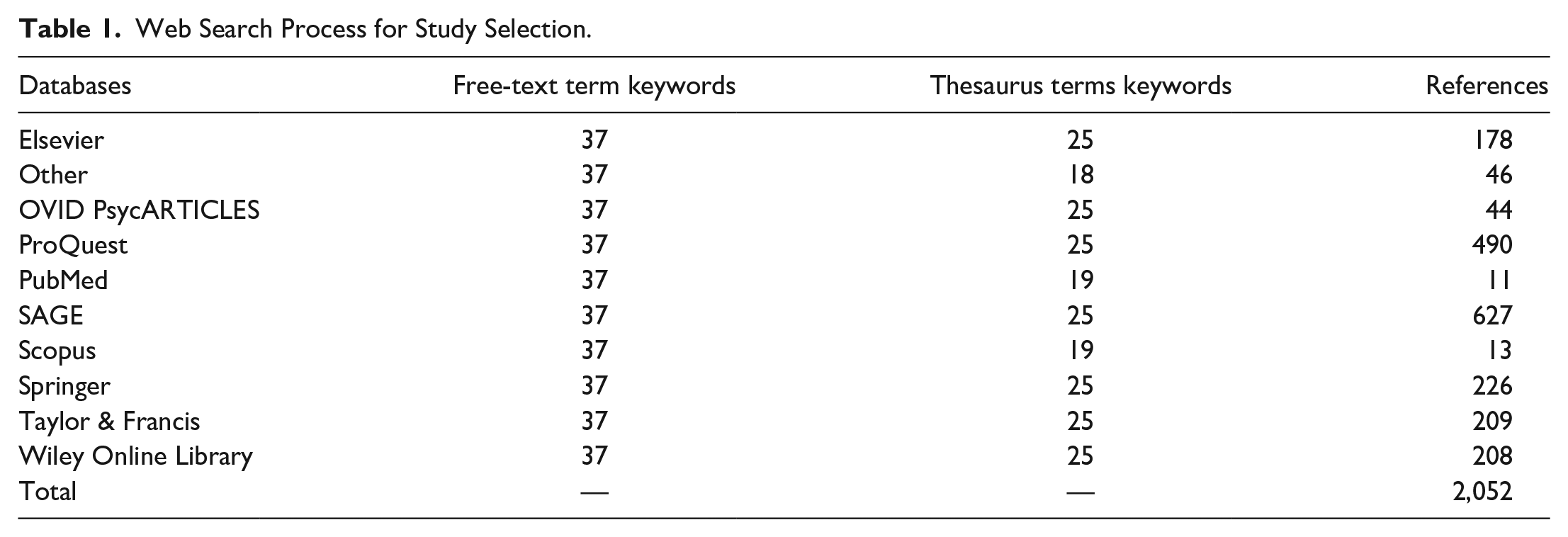
The data selection phase was conducted from July 2018 to February 2019. The initial literature search enabled the identification of search terms. Databases were electronically searched. Tables 1 and 2 provides the detailed search strategy. Table 3 provides the reader with information on the sampling strategy, the type of study conducted, the approaches to sampling, the year range of the search, any limits, inclusions and exclusions, the terms used, and the databases searched (embedded in the STARLITE principles).
Web Search Process for Study Selection.
Search Terms Used for Study Selection.

STARLITE Principles of Study Selection.

A total of 2,052 studies were retrieved, 1,863 of which remained after the removal of duplicates and those outside the date range. MP screened the titles and abstracts. If the abstract was not sufficient to understand the rationale of the study, then the full text was read. Discussions within the research team (MP, PD, and EC) assisted with clarity surrounding the types of studies included, the search terms and databases used, inclusion and exclusion criteria, and the analytical framework adopted. MP performed a second selection, excluding studies with ineligible participants, methodological issues (i.e., were purely quantitative studies or mixed methods in nature), and thematic issues (i.e., the findings or context of the research were not specific to the topic under investigation), and 239 studies remained. MP then reviewed the full text of 239 studies and further decisions were made to exclude 183 of the 239 studies (151 based on further methodological and thematic review, and 32 based on the CASP). About 56 studies remained which were included as the final selection (2.73% of the original studies screened). For clarity, the selection process is presented in a flow chart (see Figure 1).

Study selection process.
Quality assessment
The CASP assessed the quality of the studies chosen for potential review (Noyes et al., 2015; Tong et al., 2012). A preliminary evaluation of five studies was performed to ensure the appraisal tool was appropriate, and all authors appraised a further subset (24 studies) independently. The inter-rater agreement for the quality of the subset of articles was fair at 83.3% (Tong et al., 2012). All authors discussed their findings and arrived at a consensus through discussion of the CASP criteria, agreeing on the studies to be excluded based on poor quality. The CASP was completed for 88 studies, excluding a further 32 studies based on poor quality. Table 4 provides a brief summary of the CASP.
Summary of the CASP.

Source. Noyes et al. (2015) and Tong et al. (2012).
Number of studies = 88.
The following is a detailed summary of the qualities of the 88 studies reviewed with the CASP. The authors provided explicit statements of their research aims/questions, accompanied by relevant contextual information (e.g., exploring the context experienced, or the specific issues for women in academia) that constructed the research rationale (N = 79). The qualitative methodology was appropriate for addressing the research aims provided (N = 83). Information was provided to assess the appropriateness of the research design (e.g., exploring the theoretical frameworks, data collection, and analysis methods; N = 63). Content provided suggested that participants were an appropriate sample for their study, which was linked to the study rationale (N = 70). The appropriateness of the data collection method was evident (N = 73); most studies used semi-structured interviewing (N = 63), although other methods were identified (e.g., diary entries [N = 5], narratives [N = 13], and observational data [N = 8]). Content stating how many interviews were conducted (N = 74), the duration of the interviews (N = 57), and a detailed exploration of the analytical method was evident (N = 52). Findings were relevant, detailed, and sufficiently supported by multiple participants (N = 72). Higher quality studies outlined the use of rigor and credibility strategies (e.g., triangulation of sources, researchers, respondent validation, peer coding; N = 49). Relevant literature was integrated to support the findings, and the studies referred to logical future research directions (i.e., rather than providing a generalist claim [e.g., more interviews need to be conducted; N = 66]). Overall, the studies were novel and valuable to the field of knowledge.
Data extraction and presentation
The main characteristics of the reviewed studies, including the aim, location, sample size, age range of participants, data collection and analytical methods used, and findings of the selected studies, were extracted, and are summarized in a Supplemental Table.
Thematic synthesis data analysis
Thematic synthesis was conducted on the final 56 studies using Thomas and Harden’s (2008) five steps. (1) Data familiarization entailed a careful active reading and re-reading of each study, extracting the characteristics and findings of each study. The intention is to appraise, familiarize, identify, extract, record, organize, compare, relate, map, stimulate, and verify, to collate a synthesizable account of the studies. (2) Descriptive theme development involved the line-by-line extraction of codes from the entirety of the manuscripts, relevant to the review objectives. (3) Data grouping entailed comparing the descriptive codes, ensuring they translated across the studies to match codes from one article to another, ensuring the codes were representative of the overall data. (4) Analytical theme development involved interpreting the descriptive codes into higher-order themes, which required going beyond the original content of the studies. Finally, (5) Writing up entailed articulating the findings, with accompanying commentary, critique, and recommendations.
Thematic Synthesis Findings
Thematic synthesis generated four themes relating to women’s experiences and identity conceptualization in academia—(1) You Better Work! The Organizational Culture of Academia, (2) Women’s Work Versus Academic Work: Gendered Experiences in Academia, (3) The Struggle: Shifting Between the “Personal” and the “Professional” Identity, and (4) Strategies and Support to Navigate the Academic System.
You Better Work! The Organizational Culture of Academia
Some participants described the organizational culture of academia as research-driven and competitive, influencing how they engaged in academic and professional work (Van Lankveld et al., 2017). Academic norms, values, and behaviors were perceived as guided by the majority demographic (i.e., white, cis-gender, heterosexual, male academics; Wright et al., 2017) with the expectation that academics adhere to the guidelines set out by the neoliberal episteme (Harris et al., 2017; Yaacoub, 2011). As such, some participants suggested the academic context systematically disadvantages women based on these expectations (Leyerzapf et al., 2018; Settles et al., 2019; Zhao & Jones, 2017).
A number of participants suggested neoliberalism has influenced academia by the proliferation of market-based principles (Gaus & Hall, 2015; Wright et al., 2017). For example, participants perceived themselves cast as “. . .intellectual actors. . .” within an economized education system, compelling them to behave in a market-driven manner that met the expectations of their institution, and the government (Gaus & Hall, 2015, p. 666). These market-driven expectations were bounded in the lexicon of “accountability, efficiency, performativity, and quality assurance,” reflective of a corporate style of academic governance (Gaus & Hall, 2015, p. 666; Yaacoub, 2011).
Participants in the reviewed studies outlined how they acted according to prescribed role responsibilities, expressing neoliberal academia emphasizes the importance of conducting research over other activities (e.g., teaching; Esnard et al., 2017; Rockinson-Szapkiw et al., 2017). Some participants reported they did not have enough time to devote to research-related tasks given the myriad of other academic (e.g., teaching, service) and personal (e.g., parenthood) demands (Harris et al., 2017; Rockinson-Szapkiw et al., 2017). This “juggling” of multiple demands, for various participants, compounded the difficulties surrounding their capacity to engage in, and prioritize research (Alwazzan & Rees, 2016; Wright et al., 2017).
Tensions arise between what the institution perceives as “good research” compared to an academic’s individual interests (Park & Schallert, 2018, p. 6). Some participants described feeling disempowered when asked to conduct research outside their field of interest (Amon, 2017; Carra et al., 2017). With the rise in value attributed to research and little value attached to teaching, some studies explained the complexities in executing these roles (Arar, 2018; Van Lankveld et al., 2017). For example, some participants outlined that the institution expected they engage in all responsibilities of their roles to the higher neoliberal standard (regardless of the value attached to the role; Arasa & Calvert, 2013; Beard & Julion, 2016).
Various participants expressed service roles (e.g., committee membership, mentoring students) were the least valued within academia and were perceived by academics as burdensome in terms of expended time and effort (Hart, 2016; Settles et al., 2019; Wolf-Wendel & Ward, 2015). Some participants also felt obligated to complete these tasks (Hart, 2016; Wolf-Wendel & Ward, 2015), and suggested service roles were frequently allocated to women (Hart, 2016; O’Shaughnessy & Burnes, 2016). Participants questioned the value of service tasks that did not contribute to academic promotion but acknowledged service tasks were necessary to the functioning of neoliberal academia (Hirshfield & Joseph, 2012; Mabokela & Mlambo, 2015).
Women’s Work Versus Academic Work: Gendered Experiences in Academia
It was suggested that the influence of neoliberalism on academia was the “new sexism,” implying women were allocated specific roles that limited their career progression (Marine & Aleman, 2018, p. 234). Additionally, studies suggested women were underrepresented within academia, and that they might be appointed in a tokenistic manner to meet the quota of women’s representation (Dickens & Chavez, 2018; K. Smith & Gayles, 2018). The inequities within women’s academic experience were more likely to be identified by women, rather than men (who may not be as conscious of the inequality), which some participants suggested can maintain the subordination of women within academia (Gonsalves, 2018; Rhoads & Gu, 2012; Settles et al., 2019).
Relatedly, participants in the reviewed studies engaged in gendered roles in a prescribed manner, evident in the notion of “women’s work,” consisting of mentoring, teaching, and interacting with students (Case & Richley, 2013; Charleston et al., 2014; Lester, 2011), which some felt upheld the stereotypes of traditional feminine roles (e.g., being maternal and emotionally responsive; Alwazzan & Rees, 2016). Participants also suggested reinforcement of the maternal stereotype through being the “go to” when listening to students’ personal issues, and issues relating to “minorities” (with the normative assumption that one “minority” understands the experiences of all; Settles et al., 2019; Wright et al., 2017). The pressure to perform in these additional roles was evident where various participants felt overburdened and had to give up other roles of personal importance (Drame et al., 2012; Marine & Aleman, 2018).
In some studies, participants expressed that they were not taken seriously by their academic colleagues (Nixon, 2017) with their perspectives viewed of lesser status compared to men (Trahar, 2011). The acceptance and integration of ideas offered by men, compared to the disregarding of women’s ideas left some participants feeling excluded, incompetent, and questioning their self-perception as an academic (Dickens & Chavez, 2018; Zhao & Jones, 2017). Various studies suggested that women academics had to continually prove their academic competency, fight to retain their employment, and work harder to build legitimacy and gain respect from those in leadership (Arar, 2018; Rogers, 2017). Further, some participants note their response to these experiences (e.g., engaging in self-blame and criticism, viewing themselves as the “problem”) can leave the source of the discrimination unaddressed (Charleston et al., 2014; Nixon, 2017; Trepal & Stinchfield, 2011).
Participants acknowledged parenting responsibilities were confounded by societal gendered roles (e.g., colleagues assuming participants would stay home to care for their children), viewed to slow the progression of women’s academic careers (Martsin, 2018; Trepal et al., 2014). Some participants also experienced anxiety about challenging gendered parenting roles (e.g., having children and returning to work), expecting it to affect their colleagues’ perceptions of them (Beddoes & Pawley, 2014). Participants in the reviewed studies assumed academics thought women worked outside of working hours with other commitments, such as family responsibilities and parenting (Levin et al., 2014; O’Shaughnessy & Burnes, 2016). Finally, some participants articulated that their colleagues viewed parenthood as a choice, and that they should accept any subsequent consequences from this identity on their career (Arasa & Calvert, 2013; O’Shaughnessy & Burnes, 2016).
The Struggle: Shifting Between the “Personal” and the “Professional” Identity
Various studies suggested tensions in the conceptualization of personal versus professional identities (Alwazzan & Rees, 2016; Hurst, 2010; Levin et al., 2013). Some participants acknowledged their personal identities related to age, gender, nationality, ethnicity, parenthood, and/or being a spouse (Alwazzan & Rees, 2016; Hurst, 2010). In comparison, other participants identified their professional identities being informed by engaging in leadership, managerialism, research, teaching, clinical work, and/or institutional roles (Alwazzan & Rees, 2016; Hurst, 2010). Participants suggested having to make sense of their experiences, positions, and perspectives to understand what was seen as “valued” identities within their occupied contexts (Elkington & Lawrence, 2012; Hurst, 2010; Levin et al., 2013).
Participants in the reviewed studies proposed the institution viewed the personal and professional identities as incompatible, placing a higher value on the professional role (Harding et al., 2010; Zhao & Jones, 2017). Participants then outlined how the professional identity was reinforced by neoliberal norms of professionalism, and as such, the individual could retain esteem as a member of the institution to the detriment of personal aspects of identity (Harding et al., 2010; Kolade, 2016). The emphasis of the neoliberal professional identity in academia was suggested by some participants to reproduce problematic dominant practices (e.g., putting the institutional needs first, and not questioning these ideals) which can reinforce the acceptability of enacted behaviors (Harding et al., 2010; Kolade, 2016).
Various participants explained the neoliberal “ideal” academic completes all organizational tasks, places work before personal responsibilities, has minimal health-related issues, meets academic performance requirements, and does not question the neoliberal standards (Bennett et al., 2016; Kachchaf et al., 2015). As such, these participants expressed the pressure to meet these expectations (Bennett et al., 2016), and acknowledged few academics achieve this “ideal” as the standards are perceived as subjective, fluid, constantly changing, and impossible to achieve (Esnard et al., 2017; Harding et al., 2010). Participants suggested achieving this standard appeared more of a tension for those groups less favored (Case & Richley, 2013) as they are viewed by the institution as wanting to challenge the norms that have disadvantaged them (Leyerzapf et al., 2018).
Some participants attempted to combine their personal and professional identities, which involved success and satisfaction in personal and professional relationships, a healthy work-life integration, and a sense of control over their identities (McCutcheon & Morrison, 2018; Pololi & Jones, 2010). Exercising agency both personally and professionally allowed for these participants to find meaning in their work (Amon, 2017), but a tension in this agency was identified. While participants suggested a “choice” in what they valued within the personal and professional domains, they also suggested consequences of putting personal responsibilities before their professional roles, which paradoxically denoted “a lack of choice” (Amon, 2017; Esnard et al., 2017). Participants in the reviewed studies expressed changing identities can be influenced by pressures experienced within neoliberal academia (e.g., putting work-related roles before personal roles; Kachchaf et al., 2015; Levin et al., 2013); as such, the discourse surrounding this shift reflected a challenging experience for them (Dickens & Chavez, 2018; Harding et al., 2010).
Strategies and Support to Navigate the Academic System
In the reviewed studies, participants outlined how their family, friends, mentors, and colleagues were important support networks (Gale, 2011; Hacifazlioglu, 2010) indicative to their well-being, success, and value in academia (O’Shaughnessy & Burnes, 2016). However, participants suggested women, especially mothers, were the most supportive, aligning with the stereotyped maternal role (Johnson et al., 2011; Trepal et al., 2014). Relationships with other academics ranged from being natural and genuine, to feeling fragmented and tokenistic in nature (Johnson et al., 2011; Szelenyi et al., 2016). Additionally, the ease of access and quality of these networks differed (Rogers, 2017). Participants outlined the difficulties with the gendered nature of these peer networks (i.e., men drinking together and sharing advice), suggesting that they felt excluded from this support (Nixon, 2017; Rogers, 2017). Exclusion added another burden onto the participants; however, the building of a support network was still suggested as worthwhile to navigate (Johnson et al., 2011; Szelenyi et al., 2016).
The use of particular strategies allowed for some of the participants to cope with the demands of academia, which was framed by the authors of the respective studies as (1) assimilative and (2) transformative strategies (Ford, 2011; Wheat & Hill, 2016). Assimilative strategies concealed differences between individuals, allowing participants to adapt to normative practices and integrate into academia (Ford, 2011). For example, some participants made changes to their presentation to “fit in” with the dominant group (e.g., wearing a business jacket and pants [perceived as masculine] compared to a blouse and skirt [perceived as feminine]; Ford, 2011). Additionally, other participants outlined how they remained silent, rather than providing suggestions to change academia (considered effective), rather than speaking up and crossing the well-defined systemic boundaries which resulted in punishment (Hinojosa & Carney, 2016; Mabokela & Mlambo, 2015). In this way, silencing allowed for protection against potential ramifications and was used as a strategy by some participants to gain acceptance in the academic setting (Hinojosa & Carney, 2016).
Transformative strategies allowed a few participants to address the perpetuation of gendered standards and renegotiate the cultural and social norms that were embedded within academia (Ford, 2011; Wheat & Hill, 2016). For example, instead of engaging in unpaid domestic duties themselves, some participants renegotiated their duties to the extended family or domestic help which allowed for them to pursue other professional interests (Mabokela & Mlambo, 2015). Further, various participants suggested needing to pragmatically prioritize what was important to engage in at any given time (e.g., engaging in academic tasks at work, and looking after the family and the household at home; O’Shaughnessy & Burnes, 2016; Wheat & Hill, 2016). Participants suggested this provided them with more time to engage in other tasks and responsibilities (Mabokela & Mlambo, 2015; O’Shaughnessy & Burnes, 2016).
Discussion
Our qualitative synthesis of 56 studies aimed to review the research that had been conducted on women’s academic identities and experiences worldwide and critique the chosen studies to explore how ways of being and doing currently exist in academia. The findings suggest that being accountable, efficient, and engaging in quality work is the ideal that women are encouraged to strive for within academia. Further, it appears that women experience unique complexities and tensions in striving for this ideal. To navigate academia, it appears that some women feel pressured to prioritize the professional identity over the personal. Finally, support networks (e.g., family, peers, and colleagues) and useful strategies were identified as crucial to the progression of women in academia. Reviewing the research that has been conducted has illuminated how dominant ways of being and doing exist in academia and how this has shaped the research conducted in this area. It is important to consider and critique these practices, to allow for suggestions of future research practices to come to light.
The Homogenization of Women Academics
Higher education operates through neoliberal practices that promote a singular understanding of what it means to be an “academic” (L. Smith, 1999). In the context of academic identity, the literature perpetuated the gender binary and inferred there was “one type of woman” and “one type of man” within academia. Additionally, the neoliberal episteme governed the academics in terms of their ways of being and doing and underpinned the singular “ideal” standard that was perpetuated (Peck et al., 2018). The one “ideal” standard assumes everyone has the same experience within their identities (Beddoes & Pawley, 2014). This assumption lacks an acknowledgement of intersectionality, which can result in the framing of women and their identities as one-dimensional (Quiddington, 2010). The construction of women as a homogenous group who share a singular understanding and experience of the academic role, rather than as a diversity of individuals and identities that can be forever changing, can fail to integrate multiple intersectional perspectives and knowledge systems that may not be privileged in academia (Williams et al., 2015).
Within the literature base exploring women’s identities, an example focused on the motherhood identity, constructed by the reviewed studies as a dominant socio-cultural expectation, and “natural” role for women. Ward and Wolf-Wendel (2016) focused on the motherhood identity being common for most women to experience in academia, to the neglect of discussing other identities. Although acknowledging motherhood is important, the focus on one element of identity (to the exclusion of others) can serve to erase women’s multiple identities (academic, professional, or otherwise). Dimensions of identity obscured by a lack of intersectional perspectives can include age, ethnicity, abilities, sexualities, and cultural and social class locations (Quiddington, 2010). Martsin (2018) suggested research that fails to acknowledge the experiences associated with these dimensions can reproduce, rather than dismantle the neoliberal episteme within academia. Furthermore, when agitating for change, it is evident that particular positionalities can infer certain privileges compared to others, and as such, some individuals may be required to part with some of their power, privilege, and decision-making capacity. In this case, some of these individuals may be women, giving up their power for the good of the collective, and to assist in setting conditions in academia that reflect a fair and equitable experience for all. Finally, the demographics of the participants in the reviewed studies were not reported in a format that identified the standpoint of whom was speaking. Missing the intersectional nature of experiences and identities does not recognize the multiple dimensions of identity and treats categories as homogenous and fixed in nature (Quiddington, 2010).
Grounded in Gender-Normative Assumptions
The ways in which research questions were asked within the reviewed literature appeared influenced by gendered assumptions. For example, it was inferred in Kachchaf et al., (2015) and Martsin (2018) that the experience of women includes caring responsibilities and motherhood as an innate disposition for all women (by generalizing the role of motherhood using discourse encompassing “all women”). Doing so leaves little room for women who are childfree. Gonsalves (2018) and Hart (2016) explored the influence of gendered assumptions in academia and stated that these assumptions were constructed as normative due to individuals repeated following and unquestioning of such standards. For example, some participants in Harris et al.’s (2017) study suggested the teaching role is primarily occupied by women as it is perceived as easier to balance with other responsibilities, as well as being a stereotypically maternal, caring role. This example appears to perpetuate normative assumptions surrounding women’s roles in academia. Such recommendations do not question the status quo and, while they may not be intended to harm, they can limit the career progression of women academics through reducing their autonomy and maintaining their positioning within the context.
Additionally, within the literature base, some of the women academics revealed tensions between the professional and personal lives of women, as well as the nature of the hierarchical, gendered higher education setting, that were interwoven and complex. Currently, these issues appear to exist and build according to the changing social, political, and workplace culture (Blackburn, 2017). For example, thus far, the literature base proposes that academia maintains traditional workplace norms that appear to conflict with the assumed caring responsibilities of women academics. Tensions arise where women academics then center their lives on a full-time, life-long occupation, while also balancing their caring responsibilities, to the detriment of other responsibilities and identities. The literature supports this and presents commentary surrounding how these norms coexist with the culture of neoliberalism that emphasizes competition and productivity, versus the responsibility of the individual for success and failure in each domain (e.g., Berry, 2008; Webster, 2010).
The Individualistic Focus of Solutions
Strategies to navigate academia tended to place the individual academic as responsible for resolving institutional issues. For example, in their discussion of effective change strategies in academia, Leyerzapf et al. (2018) suggest needing to “challenge the normalization practices evident in higher education” but then later suggest “diverse ‘othered’ identities need to adapt to current ‘normal’ practices within academia” (p. 147). Additionally, Hart (2016), Johnson et al. (2011), and Wright et al. (2017) have proposed current solutions to gender inequity in academia assist women in being authoritative, gaining respect, establishing credibility, and maintaining interpersonal academic relationships, however, these solutions emphasize an individualistic focus. We ask the reader to question who is setting the standards by which these solutions are constructed and that suggesting the individual is solely responsible for change is counterintuitive. We argue that placing individual blame de-emphasizes reflecting on the neoliberal episteme of academia, and potentially poses resolutions of gender inequity as being “a woman’s issue” (evident in Leyerzapf et al., 2018). Focusing the onus of responsibility on one individual, or group of individuals, deflects responsibility from the institution and the system, to the individuals experiencing the issues as being responsible to potentiate change. Recommendations should be recast to critique the institutional cultures women are embedded within, and work to pose new ways of being and subjectivities for all in academia.
When posing new ways of being and subjectivities for all in academia, it is critical that the system, and its ways of being and doing, are examined and critiqued. As such, change that could occur over time within university policies, guidelines, and protocols is important, where the underlying issues surrounding organizational culture, context, office politics, and impact of emotional labor should be considered. Understandably, these changes that are systemic in nature and that problematize the system, are considered easier to acknowledge, but harder to implement (Watzlawick et al., 1974). Practical implications, which, while ideal, would take time to employ within the academic setting, should reflect the creating of cultural change within academic institutions to make the setting workable. Self-care initiatives, guidelines surrounding working hours to limit overworking, expectations surrounding productivity, providing professional and personal development opportunities, building social networks and collaborations, and the reducing of workload to allow for employees to engage in self-care would all be important in re-establishing an academic system that separates the worker from the work, and maintains the importance of care above all else.
Acknowledging the Past, Changing the Future
The reviewed literature base focused on legitimizing the issue that academia is gendered and disadvantages women, seemingly to convince the academic audience of these inequities. While establishing this understanding is important, this has limited the ability for research to engage in a critical deconstruction of how to address these issues, ensuring the existing conditions for power and inequity exist (Morley, 2014). We suggest a multi-level analysis needs to be conducted, to explore not only the individuals within this setting, but also, examination of the functioning of the academic system itself. To assist with this, there needs to be a shift surrounding how academics view the academic context and environment, as well as the individuals within it. Academia has historically been exclusionary, patriarchal, imperial, and elitist in nature, and acknowledging how this operates, and proposing how it needs to change, is of importance here. While the “issue” has been legitimized, the focus should now be on problematizing the neoliberal academic system, rather than the women academics.
Further to this, we propose that the focus should shift to a strengths-based perspective, to consider how the STEMM institutional environment can remove the systemic barriers that present academics such as women, and those with diverse identities and perspectives, to engage effectively. Changing the prototype of what it means to be an academic should be achieved when considering the restructuring of the system, to allow for a system that is more inclusive to the multiplicity of ways to be an academic. Additionally, when problematizing the system, we need to develop more of an awareness of the practices that currently exist to negatively impact women and minority groups within STEMM. The STEMM environment was perceived in the literature as hostile for women, which led to negative mental and physical health outcomes (Johnson et al., 2011; Szelenyi et al., 2016). As such, developing this awareness means all academics should be educated on why language and discourse is problematic, and to disrupt the taken-for-granted assumptions within academia. This should then allow for all academics to exist in a safe and collaborative environment.
To disrupt these taken-for-granted assumptions relies on an awareness of one’s individual practices and ways of doing and being as a STEMM academic. Through the literature base working to legitimize the issue, equality, and equity has been suggested as needed within academia. Extending on this, we question how academics acknowledge and suggest how this would be achieved. We call on all faculty members within STEMM to use the findings and critiques within this review as a catalyst, an opportunity, to reflect on their own assumptions, understandings, and commitments to promoting gender equity. As such, to be able to engage in this practice, academics need further opportunities to identify and reflect on their own implicit assumptions, privileges, and biases. These opportunities must be engaged in, maintained, and sustained; transformative change cannot be implemented without this consistency. We need to transform the biases, attitudes, and privileges of academics more effectively, by engaging in these practices on a consistent and regular basis.
The Romanticism of Resistance
Finally, within the literature base, women were prompted to resist the status quo, constructed as an aspiration which may appear useful to begin a conversation about how to potentiate change. The literature suggests a limited critical exploration of the consequences for women when engaging in this resistance (Dickens & Chavez, 2018, Kelly & McCann, 2014; Levin et al., 2014). There needs to be an exploration of the potential consequences for women if they choose to engage in resistance (e.g., challenges to career progression, being isolated, excluded, and discriminated against). Williams et al. (2015) suggest resistance could perpetuate the positioning of women as a group viewed as differing from the norm who want to change these normative conditions. This could exclude women from the dominant group and limit their ability to progress further (Dickens & Chavez, 2018; Williams et al., 2015).
Strengths and Limitations of the Review
The design and process of this review provides a unique contribution to the literature base. It is based on a rigorous method that meets the criteria used when synthesizing qualitative research (Noyes et al., 2015; Tong et al., 2012) with the systematic review of databases allowing for the large selection of studies to be assessed, based on studies of fair quality. The findings described the experiences of 1,230 women, larger than any previous review or meta-analysis in this field known to the authors. The themes presented in the synthesis are evident across the studies, which ensured the content was representative and cohesive of the overall data set. The findings reflect the interpretations of multiple researchers in many contexts (e.g., from different countries, career stages, and gendered identities). Triangulation of the data (e.g., taken from women at different career stages and from different specialties) and theoretical concepts (e.g., comparing the findings from multiple studies) adds to the credibility of this review by acknowledging our relationship to the research process, assessing the applicability to the context in which it was conducted.
Conclusion
Our review suggests the neoliberal episteme has had a widespread impact on women’s academic experiences and identities embedding a culture which has impacted the career advancement, role opportunities, identities, and overall status of women in academia. Specific attitudes and practices limit the ability for women to achieve a satisfying experience within academia and beyond. If teaching and service roles, and familial care continue to be viewed as women’s roles, rather than the work of any person, there will be an ongoing cost to women, science, and society. Finally, it is important to acknowledge that academics suffer to different extents in the current neoliberal context; some more than others. The neoliberal episteme allows for power, order, and discipline to be expressed as definitive aspects in academia. These boundaries leave little room for women academics to negotiate, learn, participate on one’s own terms, and to define their personal and professional identities within academia. Future research should adopt a critical, intersectional perspective to focus on problematizing the system and assist in dismantling the practices that have perpetuated these problematic conditions (e.g., underrepresentation, discrimination, and gendered stereotyping) for women in academia.
Supplemental Material
sj-docx-1-sgo-10.1177_21582440221096145 – Supplemental material for Exploring and Critiquing Women’s Academic Identity in Higher Education: A Narrative Review
Supplemental material, sj-docx-1-sgo-10.1177_21582440221096145 for Exploring and Critiquing Women’s Academic Identity in Higher Education: A Narrative Review by Matthew J. Phillips, Peta L. Dzidic and Emily L. Castell in SAGE Open
Footnotes
Acknowledgements
The authors wish to acknowledge the expertise, feedback, advice, and guidance of Associate Professor Lynne Roberts in refining and submitting the final manuscript.
Author Contributions
The corresponding author wrote the article, as it is being written primarily as a component of the author’s thesis. All authors contributed to the study conception and design. Material preparation, data screening, quality checking, and analysis were performed by Matthew Phillips. All drafts of the manuscript were written by Matthew Phillips and all authors commented on versions of the manuscript. All authors read and approved the final manuscript.
Declaration of Conflicting Interests
The author(s) declared no potential conflicts of interest with respect to the research, authorship, and/or publication of this article.
Funding
The author(s) disclosed receipt of the following financial support for the research, authorship, and/or publication of this article: the authors declare that the research was conducted in the absence of any funding.
Ethical Approval
Specific approval for this review was not needed (as no new data was collected).

Supplemental Material
Supplemental material for this article is available online.
References
Supplementary Material
Please find the following supplemental material available below.
For Open Access articles published under a Creative Commons License, all supplemental material carries the same license as the article it is associated with.
For non-Open Access articles published, all supplemental material carries a non-exclusive license, and permission requests for re-use of supplemental material or any part of supplemental material shall be sent directly to the copyright owner as specified in the copyright notice associated with the article.
