



Abstract
Metacognition cannot develop on its own; therefore, teachers should teach this skill to their students. Teachers should provide appropriate models and guidelines so pre-service teachers can gain awareness of metacognition before starting their profession. This service sought to determine how a holistic approach affects Turkish pre-service teachers’ awareness of metacognitive listening strategies through a case study. An 8-week plan was implemented, including 3 weeks of theoretical information on metacognitive listening. Pre-service teachers were then divided into groups, and courses on micro-teaching practices were conducted for 5 weeks. The participants were 17 pre-service teachers in their third year at university. Criterion sampling, a purposeful sampling method, was used for sample selection. Data were collected using semi-structured interviews, observation forms, and researcher and participant diaries. Descriptive and content analyses were also conducted. As a result, pre-service teachers’ perceptions of metacognitive awareness and holistic listening strategies improved and they reported a positive relationship between holistic listening strategies and metacognition. Unlike previous studies, the current study emphasized controlling affective readiness in planning strategies. To better comprehend the text, the pre-service teachers suggested incorporating monitoring and problem-solving strategies with supportive cognitive strategies. Peer assessment was also found to be an important aspect of the evaluation strategy.
Plain language summary
This study aimed to investigate the impact of holistic approach-based listening lessons on the use of metacognitive strategies by preservice Turkish teachers during the listening process. The study utilized a case study method with 17 third-year university students as participants, selected through criterion sampling. Data collection involved semi-structured interviews, observation forms, and researcher and participant diaries, followed by descriptive and content analyses. The findings indicate a positive correlation between holistic listening strategies and metacognitive awareness in teacher education. Specifically, preservice teachers reported that incorporating affective readiness checks as a planning strategy before listening, employing monitoring and problem-solving strategies concurrently during listening, and utilizing peer assessment for evaluation after listening affect the listening process positively.
Introduction
Metacognition refers to “one’s thinking about one’s own thinking process” (Livingston, 2003, p. 1). Although there are many different definitions in the literature, the common denominator is that metacognitive awareness includes information about cognitive states and processes and control or executive aspects of metacognition (Paris & Winograd, 1990). According to Flavell (1976), who created a theoretical model on this subject, metacognition means “actively monitoring cognitive objects or processes related to data, usually in the service of a concrete aim or goal, and organizing and evaluating the results” (p. 232).
Metacognition refers to the conscious regulation of learning processes (Baker & Brown, 2002). It is widely acknowledged that metacognition plays a significant role in language learning (Li et al., 2022). Veenman et al. (2006) found that metacognition explains 17% of the variance in learning. According to C. C. M. Goh and Hu (2014), metacognitive awareness at the university level can impact listening performance by 13% to 22%. These findings indicate that developing metacognitive knowledge, metacognitive skills, and strategies with appropriate training in the learning process will benefit students (C. C. M. Goh & Vandergrift, 2021).
In listening, metacognition relates to how people think about a process; that is, how listeners plan, monitor, and evaluate the listening task and think about what they can do to overcome the problems they encounter while listening (C. Goh, 2008; Vandergrift et al., 2006). A teaching approach based on metacognitive theory and learner-centered listening teaching includes metacognitive knowledge about the nature, requirements, and strategies of listening tasks and ensuring learners are aware of their own listening process (Vandergrift, 2003).
Holistic listening strategies are strategies that can be applied before, during, and after listening to a specific listening task in conjunction with each other. C. C. M. Goh and Vandergrift (2021) stated that a holistic approach to the listening process improves students’ ability to understand new information and increases their awareness of the listening demands and processes expected from them. This approach, based on metacognitive theory and learner-centered teaching, aims to develop self-regulated listeners who can control and evaluate listening processes and outcomes (C. Goh, 2010; Vandergrift, 2003). As part of this process, activities that increase students’ metacognitive knowledge of listening tasks are integrated into normal listening input and comprehension activities in the classroom. Liu (2020) emphasized the need to integrate metacognitive strategies with cognitive strategies, noting that there is no change in students’ listening performance when the metacognitive pedagogical cycle is not combined with cognitive strategies.
C. Goh (2010) stated that an approach that integrates student-centered listening tasks with content based on experience will be effective in teaching listening holistically. Metacognitive awareness activities are integrated into listening activities in textbooks and classes, and when designing the activities, a metacognitive listening sequence is followed. A metacognitive listening sequence creates a course flow/content that includes pre-listening, during-listening, and post-listening so that students can regulate the metacognitive processes underlying successful listening (Vandergrift, 2003). Activities that increase students’ metacognitive listening awareness of the listening task are integrated into normal listening input and comprehension activities in the classroom. Each lecture stream aims to teach students how to use their listening strategies. In this process, teacher scaffolding and modeling, peer cooperation, and individual application methods can be applied. The point to be considered here is that students are not exposed repeatedly to the same pedagogical routine for a long time (C. Goh, 2008). For this reason, some have suggested that the prepared teaching models be combined with listening-oriented teaching approaches in different educational contexts and used in course materials and teaching objectives (C. Goh, 2010).
Various models have been studied to improve listeners’ metacognitive awareness and learning and comprehension skills (Anderson, 2002; Gu, 2018; Vandergrift, 2003). Most were designed for second language (L2) learners, and empirical and theoretical studies have shown that holistic listening models based on the metacognitive approach improve students’ listening performance and/or awareness of the listening process in L2 (Bozorgian & Shamsi, 2023; Chero, 2023; C. C. M. Goh & Vandergrift, 2021; Robillos & Bustos, 2022; Tanewong, 2019).
Contextualizing the Study
Listening is accepted as a process in the Turkish curriculum (Ministry of National Education, 2019). Gaining proficiency in the “learning to learn” skill has been a goal for the first language (L1) listening skill. Listening is the primary mode of learning in daily life and school. To become lifelong learners, individuals must be good listeners who can accurately understand what they hear. Studies have shown that most university students are unable to spontaneously develop strategy knowledge in their skill areas (Hartman, 2001; Nokes & Dole, 2004; Pintrich, 2002). For this reason, teachers must explain which strategy to use and how to use it, especially to students unfamiliar with a particular subject (Archer & Hughes, 2011; Veenman et al., 2006). Researchers have studied various models to develop metacognitive listening skills for learning and listening comprehension (Anderson, 2002; Chamot, 2007; C. Goh & Taib, 2006; Vandergrift, 1997). Although there is no common teaching model designed for listening in L1 in Turkish education, different in-class models/applications were carried out by taking into account the principles of metacognitive teaching, and positive results were obtained (Harmankaya, 2017; Katrancı, 2012; Kılınç, 2021; Kıvrak, 2019; Melanlıoğlu, 2011).
However, few studies have examined L1 pre-service teachers’ awareness of metacognitive listening strategies. A few studies have used quantitative methods to determine pre-service teachers’ metacognitive listening awareness levels (e.g., using pre-listening strategies more frequently) or their relationship with metacognitive listening awareness using different variables (e.g., gender and class level; Baki, 2020; Lüle Mert, 2016). However, these studies did not collect information about the strategies pre-service teachers actually use. Thus, although these studies are important, they do not reveal the effective strategies.
Janusik and Varner (2020) found that university students did not express the same metacognitive strategies in qualitative interviews as they did with the Metacognitive Listening Strategies Instrument (MLSI), which is a quantitative measurement tool (Janusik, 2018; Janusik & Keaton, 2011, 2015). This suggests that listeners’ responses to predetermined quantitative strategies may not accurately reflect their actual listening strategies or their effectiveness.
An important aspect in the use of strategies is knowing which strategies work in which situations. Teachers who know the strategies used by good listeners should be able to guide or model students on what they should pay attention to in the listening process so that they can be more effective listeners. The success of a teaching program based on the metacognitive awareness of listening is directly related to the teacher who applies the program. In this respect, pre-service teachers, who will implement the program in the future, should be aware of what metacognitive strategies are and why they are important in the development of listening skills before starting their profession as explaining them to students is key to solving the problems students face.
Studies on metacognition in listening have generally focused on second language learning. However, recent studies have shown that listening awareness in the mother tongue can be transferred to listening in the second language and that this has positive effects on second language learning. The second language prevalent in the Turkish education system is English. In this context, the study focuses on Turkish pre-service teachers, a group that is particularly important given the role they play in shaping the next generation of English language learners.
Turkey’s education system has seen significant reforms since 2005 aimed at aligning with global language teaching standards. One notable achievement is the recognition of the role of metacognition in listening in the mother tongue, as highlighted in the curriculum prepared by the Ministry of National Education (2024). It is emphasized that teachers should provide explicit instruction to guide students in this area. However, many English language teaching (ELT) programs still focus on memorization and controlled practice rather than interactive and communicative methods. According to Perry et al. (2018) in their comprehensive study on ELT, the potential benefits of metacognitive awareness for students, as noted by Baas et al. (2015), are often overlooked within education curricula in England, and teachers’ awareness of this issue is inadequate.
In Turkey, pre-service teachers typically undergo rigorous training in pedagogical knowledge and language proficiency. Nevertheless, their exposure to metacognitive strategies—such as planning, monitoring, and evaluating their own listening comprehension—is frequently limited (Karagol & Ilgun, 2022). Therefore, this study’s findings have significant implications for teacher preparation programs, addressing an important pedagogical gap in the ELT curriculum.
This study determined how listening lessons planned using a holistic approach affect the metacognitive strategies used by pre-service Turkish teachers during the listening process. The specific research questions were as follows:
(1) After the holistic approach-based listening lessons, how did pre-service Turkish teachers’ knowledge of metacognition change?
(2) After holistic approach-based listening lessons, how did pre-service Turkish teachers establish the relationships between holistic listening strategies and metacognition?
(3) What metacognitive strategies do pre-service Turkish teachers use in the listening process (pre, during, and post) after listening to lessons based on a holistic approach?
Methods
A case study was conducted for this research. Case studies are research designs in which the researcher deeply analyzes a situation, often a program, event, action, process, or individual (Creswell, 2013). In this case study, metacognitive teaching of listening lessons was conducted using a holistic approach to determine how this approach affects the awareness and use of metacognitive listening strategies in a listening education lesson. Specifically, we attempted to describe the changes that the holistic approach brought about in the awareness of metacognitive listening strategies of pre-service teachers (who are also third-year university students).
This study has potential societal benefits, as metacognitive awareness is crucial in 21st-century education. For effective lifelong learning, individuals need to understand their learning processes. Research shows that while listening skills develop naturally in one’s native language, there is often a lack of strategic awareness. Enhancing metacognitive awareness among pre-service teachers’ can positively impact their language proficiency and that of their future students. Ethical approval for the study has been obtained.
Participants
Many Turkish teachers may lack the confidence and awareness to teach listening effectively, as they were trained in a system that did not sufficiently emphasize listening comprehension and strategy use. Skills acquired in the mother tongue are known to be transferred to the second language learning process. The study focuses on Turkish pre-service teachers, a group that is particularly important in mother tongue teaching given their role in shaping the next generation of English language learners.
The participants were 17 pre-service teachers in their third year of Turkish teaching (L1) at a state university in Turkey. Participants were enrolled in a listening training course (4 hr per week), which is a compulsory course in the third-year curriculum of Turkish language teaching (L1). Participants were selected by criterion sampling. The entire class consisted of 43 people who participated in practice within the listening training course. At the end of the semester, no absence was defined as a criterion for inclusion. Among the 24 students who attended all courses, 17 participated in the interviews. Seven of the students participating in the interviews were male, and 10 were female. Participants were aged between 20 and 21 years. After reaching data saturation, this study effectively identified 17 participants. Code saturation was also achieved using the obtained data, which helped highlight all significant points in the data. Furthermore, the available data demonstrated that meaning saturation had been achieved.
To reduce risks to participants, we informed them about the study and confirmed their involvement was voluntary. Participants could withdraw at any time, even after interviews, and their data would remain confidential and not be shared with third parties. They also had the opportunity to review the raw data collected, with anonymization and unique code numbers used to protect personal information. Written and verbal informed consent was obtained, with verbal consent recorded before the interviews began.
Procedures
Through an 8-week plan, this study evaluated how the holistic approach used in listening education courses affects pre-service teachers’ awareness of metacognitive listening strategies. In the first 3 weeks (4 hr a week), students were given theoretical information on metacognition (first week), listening strategies (second week), and holistic listening strategies (third week). In the remaining 5 weeks, the groups gave a sample 2-hr macro lesson presentation, which lasted 2 hr, in the classroom on the listening task assigned to them. During this macro lesson, each pre-service teacher in the group performed micro-teaching. First, students were divided into eight groups of five to six people. Each group was randomly given one listening text from Turkish textbooks. The pre-service teachers in each group prepared and presented their listening tasks using micro-techniques within the prepared macro lesson plan. The stage of preparing and presenting the lesson plan was left entirely to the students, and the researcher did not intervene. While presenting the lesson, a group of pre-service teachers played the role of teachers, while other pre-service teachers in the classroom played the role of students. The groups were asked to prepare a lesson plan by following the order of metacognition covering before, during, and after listening and to present a lesson in the classroom according to the plan they prepared. In designing the lesson plans, the pre-service teachers followed Vandergrift’s (1997) strategy, which consists of four steps: planning, monitoring, evaluating, and problem identification.
(1) Planning: Before listening, the pre-service teacher distributed worksheets to the students that provided information about the activities to be performed in the lesson. Before listening, they used various strategies (e.g., using visuals, asking questions, relating texts, making guesses) to attract students’ attention to the lesson and activate their prior knowledge. The purpose of listening was determined, and the activity area in the worksheet was filled. Before listening, the students were informed about the strategies and rules to be considered to facilitate their understanding while listening.
(2) Monitoring: The pre-service teacher encouraged the students to use strategies to understand what they are listening to (e.g., checking predictions before listening, taking notes, asking and answering questions, using a dictionary). While listening, they paused at regular intervals to ask the students if they had understood. When students had difficulty understanding a text, they were directed to use various strategies (e.g., rereading, demanding clarification) to improve their understanding. Teacher-student and student-student interaction in the classroom facilitated students’ understanding of the text. The lesson was not continued until any misunderstandings or ambiguous parts had been resolved.
(3) Evaluation: After listening to the text, the students answered questions about the text. In addition, students could check whether their answers and their guesses were correct and listen to the text again to correct their mistakes. After completing the activities related to evaluating the text, the pre-service teacher asked the students to fill in a self-evaluation form on the worksheet, which consisted of the four questions created by C. Goh and Taib (2006) for students to self-evaluate their progress after listening. In this way, students evaluate how much they can use the strategies and which strategies are useful to them. The questions are as follows (C. Goh & Taib, 2006):
• What were you listening to? (Confirm comprehension)
• What helped you to understand the text? (Eliciting task knowledge: factors that influence listening)
• What prevented you from getting the correct answers? (Eliciting task knowledge: factors that influence listening)
• What did you do to understand the text as well as possible? (Eliciting strategic knowledge and strategies that facilitate listening)
(4) Problem identification: After the listening process was completed, other pre-service teachers, who were students in the classroom, evaluated the presentations and explained the practices and activities that made understanding the text difficult, distracting, or boring with the notes they had taken while listening. The students who were not presenters listened to their peers’ speeches, commented on it, and provided them with feedback on the lesson presentations they had prepared.
Data Collection Tools
Case studies use multiple data sources to gain an in-depth understanding of a situation. In this study, a semi-structured interview technique was used to determine students’ implementation-oriented views. Students and researchers’ diaries and observational forms were used. The diaries were used for a detailed comparison of the data obtained from the interviews as they contained comparisons of participants’ progress in certain situations. During the implementation period, the researcher played the role of non-participant observer.
The research created an observation form of 10 questions to ascertain whether the micro-teaching practices of the pre-service teachers in each group reflected the basic features of metacognitive teaching. Based on five expert opinions, the form was reduced to seven questions. For reliability, the researcher and pre-trained students observed five students in a class. Observed situations were coded as 1, whereas unobserved situations were coded as 0. Miles and Huberman’s (1994) reliability formula, which is given by [Reliability = Consensus/(consensus + disagreement) × 100], was then applied. The results showed reliability between the two raters (R = 32/35 × 100 = 91%).
The observation form provided a general perspective on how well the pre-service teachers understood metacognitive teaching. The numbers of participants for the observed items was calculated as a percentage. Table 1 presents details on the data gathered from the observational forms.
Percentages of Pre-Service Teachers to Perform Basic Metacognitive Teaching Practices.

The interviews were conducted face-to-face in the researcher’s office in fall 2019. Each interview was recorded on a voice recorder for 10 to 20 min and transcribed. The students were informed about the interview, and their permission was obtained prior to recording. Pre-service teachers’ perceptions of metacognitive and holistic listening strategies and the strategies they used in the metacognitive listening process (before, during, and after listening) were determined using a semi-structured interview form. The details of the interviews were prepared by consulting the literature on metacognition and metacognitive listening (Flavell, 1979; C. Goh, 2010; Vandergrift et al., 2006). Following feedback from experts, the following questions were asked:
(1) Are you familiar with the concept of metacognition? Can you explain this after the implementation?
(2) What is the relationship between holistic and metacognitive listening strategies? Why?
(3) What strategies do you typically use before listening to a text after implementation?
(4) What strategies do you plan to teach your students as a teacher and why?
(5) What strategies do you use while listening to a text after the application, and what do you do when you have difficulty understanding the text while listening? Why?
(6) What strategies do you use after listening to a text after implementation? Why?
Analysis
Descriptive and content analyses were also conducted in the study. After transcribing the data, we determined the text units that met the research questions and created themes and categories (codes) using exploratory and confirmatory coding (Guest et al., 2012). Categories related to the listening process were created according to the metacognitive model of Vandergrift et al. (2006), namely, planning, monitoring, problem-solving, and evaluation.
After coding participants’ views on the listening process, we determined the strategies they used. Validity was ensured by constant communication while coding and evaluation by different researchers while adhering to the interview forms and documents during the category and/or theme determination process, checking raw data with the data source, and including direct quotations.
Reliability was ensured by encoder compatibility. First, two evaluators independently evaluated the data and created categories. Then the researchers held meetings to compare categories and discussed contradictions until they reached a consensus (Patton, 2002). The categories determined from the interviews were expressed in common terms and a code booklet was created. Researchers 1 and 2 and assigned text units to the determined codes, and coding consistency between the two raters was examined. According to Cohen’s kappa number, agreement was found above K = 0.80. This ratio shows that there was significant agreement between the two raters. (Landis & Koch, 1977). The coders consistently coded the identical text units within the same category. The detailed procedure to ensure reliability is as follows: If Pr(a) is the sum of the agreements observed for the two raters and Pr(e) is the probability of this agreement occurring by chance, the formula used to find the Cohen kappa coefficient is as follows:

Two evaluators re-evaluated the 54 subcategories created as a result of the consensus. Each subcategory was evaluated as compatible or incompatible. The results obtained after examination of the 54 subcategories by these two evaluators are shown in the rows for Evaluator A and in the columns for Evaluator B.
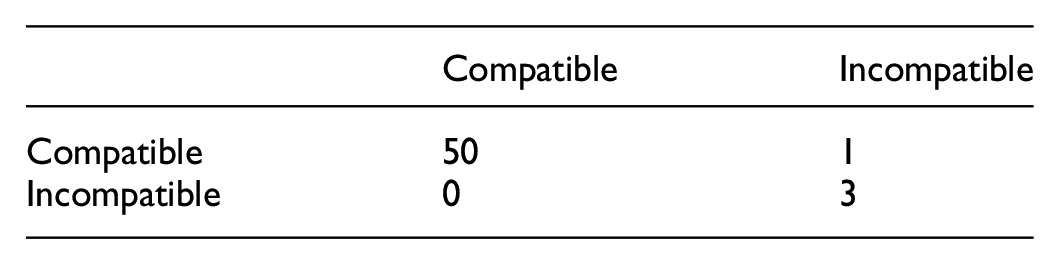
Fifty of the 54 subcategories were deemed “compatible” by both Evaluators A and B, and three subcategories were deemed “incompatible” by both A and B. Thus, the number of subcategories that both raters agreed on is (50 + 3 = 53), and the observed agreement ratio becomes Pr(a) = (50 + 3)/54 = .98. To find the probability of agreement at random; that is, the value Pr(e), we consider the following:
Evaluator A matched compatible content in 51 subcategories and found incompatibility in three subcategories. Thus, Evaluator A made a “compatible” appraisal 94.4% of the time. Evaluator B matched compatible content in 50 subcategories and found incompatibilities in four subcategories. Thus, rater B gave a 93% “compliant” valuation.
Therefore, the probability of both raters randomly making a compatible evaluation is .94 * .93 = .87; the probability of both raters randomly making an incompatible evaluation is .06 * .07 = .004; and the probability of completely random agreement is Pr (“e”) = .87 + .004 = .87.
If these are put into Cohen’s kappa coefficient formula, the following result is obtained:

K = 0.98 − 0.87/1 − 0.87 = 0.85 (0.85 indicates that there is a significant agreement.)
We included direct quotations to ensure transferability of the study by describing the codes and categories. All participants were assigned a number to ensure confidentiality.
Results
The categories in the tables were obtained from the interview form and supported by information in the diaries. The observation form provided a general perspective on how well pre-service teachers understood metacognitive teaching. Table 1 presents the results. The purpose of the observation form was to show that the participants (who were the data sources) could use the basic metacognitive listening strategies. For this reason, the observation form is not examined separately in the results section.
RQ 1: Table 2 shows how participants explained the concept of metacognition before and after the listening lesson based on a holistic approach.
Pre-Service Teachers’ Views on the Concept of Metacognition.

Table 2 shows that most students were unfamiliar with metacognition before the holistic approach-based listening lessons. The researcher explained the concept during the first week, and recorded the following in their diary: “I asked them if they were familiar with metacognition. Most had not heard of it.”
After the application, over half of the participants noted the importance of being aware of their learning and mental processes, with an emphasis on metacognitive knowledge. P9 explained, “Metacognition explains what and when the student can learn; that is, how they realize their own learning. The student should be aware of this.”
P11 said in his/her diary, “I initially found metacognition boring, but later understood its importance through classroom practice and gained awareness by questioning my own comprehension process while reading or listening outside the classroom and applying listening strategies to other areas.”
It was observed that the conceptual perceptions of the prospective teachers improved with a series of activities carried out throughout the study (there was no intervention by the researcher in these activities and the process). This is important because conceptualizing metacognition also improves people’s awareness of tasks and strategies. This situation provides clues about the effectiveness of the practices carried out in the classroom in teaching. As P11 stated, even a student who was bored in the lesson realized the effect of the practices on him and tried to transfer them to different skill areas in real life. This situation may indicate that we need to think about how metacognition affects the sustainability of language skills in real life beyond basic literacy skills. P13 expresses the impact of the practices implemented in the classroom on metacognitive awareness in his diary as follows: I believe these activities are much more effective in the long term because they allow for practice based on holistic listening strategies taught in the lessons. As a result, I find the lessons to be quite productive. If we had not prepared the presentation ourselves, we might have simply memorized the material and forgotten it after some time. However, by creating the presentation, we see sample implementations—not only our own but also those of our classmates. Observing various examples raised our awareness as teachers about which strategies to use in different contexts and how to implement them effectively …
The above explanations show us that metacognitive awareness is positively influenced by social learning environments. These insights guide us in improving listening education in our mother tongue.
RQ 2: The second research question aimed to determine how pre-service teachers established a relationship between a holistic approach and metacognition. Students were asked whether there was a relationship between the concepts of metacognition and holistic listening strategies (if any), the level of this relationship, and how it was possible. Table 3 presents these explanations.
Pre-Service Teachers’ Views on the Relationship Between a Holistic Approach and Metacognition.

As shown in Table 3, 11 students reported that holistic listening strategies centered on practice-based activities helped them become aware of their cognitive processes. P2 explained this relationship as follows: “Because this process is student-centered, most of the activities are student-oriented … The student becomes more aware of what they are doing because they actively participate in the lesson.”
Participants reported that using both holistic listening strategies and metacognition systematically reinforced the relationship between the two concepts. Together, these strategies also made students aware of their strategy use. An explicit teaching approach should be used to teach these strategies effectively. P3 stated the following: A systematic combination of several strategies … the use of this strategy also improves cognitive awareness. Choosing the right holistic strategy also provides self-awareness … a holistic strategy needs to be taught or explained to students before starting the listening lesson. The lesson should be taught so that students know what they are doing. In this way, students are also aware of why they are using the strategy.
In the third week, the researcher explained holistic listening strategies. When the diary data between weeks 4 and 8 were examined, we found that the students had difficulty preparing a lesson plan combining metacognition and holistic strategies, but as time passed, the plans prepared by the students improved. P3 wrote the following in his diary: I had hesitations about how to integrate cognitive strategies with metacognitive strategies before starting the applications, but I understood how to do this in the process. I guess I will benefit from holistic strategies in listening activities when I become a teacher.
P9 emphasized that “…holistic strategies facilitate the metacognitive listening cycle. These strategies can be viewed as a roadmap for both teachers and students. They provide students with clearer guidance on where and how to implement the strategies. What stands out to me the most is the step-by-step approach that leads to a conclusion, with each stage having a clear cause-and-effect relationship.” This situation suggests that holistic listening strategies effectively assist pre-service teachers in gaining insight into metacognitive strategies.
RQ 3: The third research question sought to determine the metacognitive listening strategies used by participants after the holistic approach-based listening lessons. Specifically, we asked them what they did before, during, and after listening and when they had difficulty understanding the text. Table 4 illustrates the strategies used for listening.
Metacognitive Strategies Used by Pre-Service Teachers Before Listening.

Strategies such as predicting, preparing, attracting attention, activating prior knowledge, determining the purpose of listening, and controlling readiness for listening tasks were included in the planning category. The strategy for determining listening purpose was used most frequently. P3 stated that determining a listening purpose creates awareness to fulfill the requirements of the listening task: “But I think the most important thing is to determine our listening purpose by being aware of why we listen.” Similarly, P5 said that determining the purpose of listening activated attention skills: “If we can determine the purpose of listening, we can listen to the text more carefully.”
P10 noted in their diary that they were familiar with most listening strategies except setting a listening purpose beforehand. They considered determining the purpose of listening the most important because it increased their attention to the text. The researcher also observed that pre-service teachers initially paid no attention to determining the purpose of listening but later incorporated it into their activities. When the observation form was also examined (see Table 1), we observed that pre-listening metacognitive practices were emphasized more by pre-service teachers.
One of the most commonly employed strategies before listening is being prepared. Pre-service teachers’ define preparation as “having the materials ready, being cognitively prepared, and being affective prepared.” P14 described the strategies he uses before listening as follows:
“We need to activate our prior knowledge before listening. Additionally, we should ensure that the necessary materials are prepared, clarify the purpose of the listening activity, and determine the appropriate strategies and stages to follow. It is also important for a person to prepare themselves psychologically.” In general, preparation involves cognitive readiness and environmental setup. However, findings indicate that we should also focus on affective readiness before beginning listening.
We asked participants what they did while listening to a text and when they had difficulty listening to it. Table 5 presents the strategies used for listening.
Metacognitive Strategies Used by Pre-Service Teachers During Listening.

Table 5 shows the strategies pre-service teachers used to ensure comprehension while listening. Most take notes, predict, and answer questions to activate cognitive processes. Participants reported using a prediction strategy to engage their cognitive processes, including visualization and creative thinking.
P2 suggested pausing the text to encourage creative thinking: “Sometimes predictions can be made by stopping at certain places. In this way, students’ creative thinking skills can be developed.” Participants found note-taking and asking questions helpful for comprehension. P3 suggested asking questions to check comprehension in large, crowded classrooms with long texts: “If the class is crowded, I can only understand whether everyone understands the text by stopping and asking questions.”
P8 recorded in their diary that they never paused at certain spots when asking questions while listening. They noted that questioning their understanding while listening helped them remember and take notes. Likewise, the researcher emphasized the importance of taking notes while listening.
When asked how they handled difficulties in understanding while listening, most students said that they listened again and sought help from another source. P5 explained, “If there is anything I do not understand, I first ask my teacher. I would like to explain the part that I did not understand or I would like to listen to the text again.”
The researcher reported that after listening to the text, students re-listened to the parts they had not understood. Additionally, they reported that actively solving problems while listening helped them better understand the material.
When listening in one’s mother tongue, it is generally recommended that the text not be interrupted. Techniques such as note-taking, making predictions, marking important points, and consulting sources should be performed automatically during or after the listening activity. In mother tongue listening lessons, the texts tend to be longer compared to those in a second language. Contrary to common literature, our findings indicate that interrupted listening during the initial listening session is actually more beneficial for listening comprehension, strategy use, and metacognitive awareness.
We asked participants what they had done after listening to the text. Table 6 lists the strategies used after listening.
Metacognitive Strategies Used by Pre-Service Teachers After Listening.

Participants stated that after listening they generally evaluated whether they had understood the text and evaluated themselves (see Table 6). When the results of the observation form (see Table 1) were examined, most pre-service teachers paid attention to strategies for evaluating the application (text) and self-evaluation after listening.
Participants stated that they used various strategies (e.g., self-assessment, peer assessment, and association with daily life) to evaluate themselves. P11 summarized what they did after listening as follows: Can I summarize what I have listened to after listening? I can pay attention to whether I can express what I understand with my own words. I can check the accuracy or inaccuracy of the predictions. I can check the answers to the questions repeatedly. I can perform self-assessment to evaluate myself and whether I understand the text (In other words, where are my mistakes, where are my shortcomings?) and to see if I understand the text correctly, where am I correct?
In their diary, P16 reported they answered text questions before practice and sometimes made summaries. They had not heard of self-evaluation and did not know how to do it. After the application, they checked their deficiencies and mistakes through self-evaluation, to become a more conscious listener. P13 learned a lot from the peer discussions with the entire class, especially after completing all of the worksheet activities.
The results show that pre-service teachers are not aware of self-assessment, which provides important implications for skill development, but at the end of the study, they realize the importance of self-assessment and peer assessment. Self-assessment and peer-assessment are generally criticized by instructors because they think that students cannot make accurate assessments. However, it can be said that a self-assessment process with certain goals and implications positively affects metacognitive listening awareness.
The researcher also stated in a diary that the pre-service teachers were initially hesitant to evaluate themselves without a form. However, they said they would use self-evaluation to evaluate themselves. Pre-service teachers did not initially participate in peer discussions after listening due to the fear of mistakes, but almost the entire class participated in the evaluation toward the end of the application.
Discussion
The study results indicate that pre-service teachers gained an awareness of the metacognitive knowledge category of metacognition. Furthermore, pre-service teachers stated that there was a positive relationship between metacognition and a holistic approach and that their awareness of metacognitive strategies that can be used before, during, and after listening increased. These results support the view that listening to lessons using a holistic approach improves pre-service teachers’ awareness of metacognitive listening strategies.
A review of the literature on metacognitive listening reveals that studies have tended to focus on students learning English as a second language. In recent years, however, the importance of metacognition in native language listening has been emphasized. This is because students who develop metacognitive awareness when listening in their mother tongue can transfer this to different disciplines (Bozorgian et al., 2021; Fakhri Alamdari & Hosnbakhshan, 2022; Razavi et al., 2023; Zhang et al., 2024). The differences and similarities in students’ learning styles were investigated in the study conducted by Pranowo et al. (2024), which involved English language learners from different countries (Indonesia, Vietnam, and Thailand). As a result, it was concluded that learner autonomy is positively influenced in the language learning process of students who can use metacognitive strategies such as planning, monitoring and evaluation in their mother tongue.
It is essential to develop metacognitive strategies by implementing metacognitive listening interventions in the context of the mother tongue, using a metacognitive pedagogical series integrated into the classroom. This approach involves planning, monitoring and evaluating processes throughout the educational experience. A study by Zhang et al. (2024) used a metacognitive approach based on the categories of the Metacognitive Awareness Listening Questionnaire (MALQ) to improve the Chinese listening skills of Singaporean high school students, as Chinese is one of the four officially recognized mother tongues in Singapore. The results indicated that MALQ-focused strategy training effectively improved students’ listening comprehension and metacognitive awareness. Therefore, it is recommended that strategy-based metacognitive approaches - which treat listening as an ongoing process - should be incorporated into listening instruction.
Bozorgian et al. (2021) investigated the effects of metacognitive intervention in the mother tongue on the listening performance of young adult learners of English as a Foreign Language (EFL) in Iran. Quantitative data indicated that this intervention significantly enhanced the students’ overall listening abilities. Furthermore, interviews with participants revealed that the metacognitive pedagogical sequence and strategies introduced during mother tongue listening lessons effectively improved students’ listening skills. Other studies support these findings, demonstrating that metacognitive intervention in the mother tongue positively influences several factors, including students’ listening performance, second language acquisition, motivation, and awareness of metacognitive strategies (Fakhri Alamdari & Hosnbakhshan, 2022; Razavi et al., 2023).
Specifically, the pre-service teachers gained an awareness of the person, the task, and strategic knowledge through a holistic approach. Metacognitive knowledge improves the learning process by recognizing weaknesses, determining strategies (Cotterall & Murray, 2009; Pintrich, 2002; Wenden, 1998), motivating listeners, and contributing to the learning process. After the study, pre-service teachers showed an increased awareness of holistic listening strategies and reported a positive relationship between holistic listening strategies and metacognition. The holistic approach centers on students and promotes active learning improving comprehension and retention (Carter, 2011). C. C. M. Goh and Vandergrift (2021) noted that holistic listening strategies improve students’ understanding of new information and their awareness of listening processes, allowing them to manage their learning. Studies have shown that metacognition-based holistic listening models improve students’ listening performance and awareness across different levels of education (Lau, 2017; Tanewong, 2019; W. Wang, 2016; Zhang et al., 2022).
Pre-service teachers prioritize pre-listening activities to determine the purpose of listening and plan strategies accordingly. These activities are important for the acquisition of metacognitive skills and self-regulation during the learning-to-listen process. From this perspective, C. Goh (2010) argued that the holistic approach created by listening to text aids in the teaching/development of planning strategies, which are necessary metacognitive strategies for acquiring self-regulation skills in the learning-to-listen process. One of the most significant steps in planning is determining the purpose of listening involved and then using the strategies required by the listening task to accomplish the learning objectives. Pre-service teachers reported that determining the purpose of listening allowed them to listen to texts with greater care. Similarly, Imhof’s (1998) research revealed that students who did not establish a goal before listening experienced difficulties comprehending and assessing the listening text.
Attention is a sub-strategy of planning (Vandergrift, 2003) that requires focusing on the text. Pre-service teachers claimed that they used a range of techniques such as asking and preparing questions, using visuals and different sources related to the subject, and discussing how to draw attention to the text. C. Goh (2010) also stated that process-based discussions could be conducted before listening to predict the difficulties that might be encountered and figuring out in advance how to cope with them. Activating prior knowledge helps students understand texts (Ahmadi Safa & Motaghi, 2024). Good listeners use elaborate inference strategies (Stein, 1999). Pre-service teachers use various strategies to predict content and activate prior knowledge such as guessing, brainstorming, associating, and asking/preparing pre-listening questions based on titles and images.
As in Anderson’s (2002) model, participants determined preparation to be a planning strategy. In addition to cognitive preparation, as in the CALLA model, materials and listening environments should be prepared for listening (Chamot, 2007; Razavi et al., 2023). In Lau’s (2017) study, students emphasized the importance of eliminating distractions. Notably, readiness control has not been described in previous studies (Canpolat et al., 2015; Imhof, 2001; Janusik & Varner, 2020; Razavi et al., 2023; Stein, 1999). Although Imhof's (2001) study mentioned the importance of preparation, it did not discuss checking readiness. Janusik and Varner (2020) emphasized cognitive readiness; however, affective and psychomotor readiness are just as important in achieving the goal of a learning task. Berne (2004) stated that activities designed before listening should aim to activate prior knowledge and motivate listening. In contrast, affective readiness control was emphasized in this study. For example, P8 mentioned the need to be psychologically ready before listening.
The researchers asked pre-service teachers about their use of metacognitive strategies while listening and categorized their responses into monitoring and problem-solving strategies. According to C. Goh (2010), monitoring involves checking, confirming, or correcting comprehension during a listening task (Vandergrift, 2003) and is used unconsciously in the mother tongue. Table 1 shows that pre-service teachers paid the least attention to metacognitive teaching practices while listening. Listening to pay attention and focusing are key strategies for improving self-awareness in the metacognitive listening process and have been highlighted in previous studies (Canpolat et al., 2015; Lau, 2017).
Problem-solving involves identifying and removing obstacles that hinder a listening task from achieving its goal. This category includes difficulties understanding the text and unfamiliar words that require top-down and bottom-up processes. Good listeners use both processes, depending on the text (Field, 2009; C. C. M. Goh & Vandergrift, 2021). Ahmadi Safa and Motaghi's (2024) study shows that metacognitive scaffolding strategies positively affect students’ skills such as comprehension, readiness, and problem-solving, and also claims that students are pleased to receive structured support from their teachers for their listening development and find this method innovative and instructive.
The current study found that pre-service teachers were aware of word meanings. The Turkish curriculum (Ministry of National Education, 2019) for listening in secondary schools may have contributed positively to this aspect as learning objectives regarding word meanings occur at all of its levels. Vocabulary exercises were included in all listening lessons, which may have increased the students’ awareness of constructing meaning from context. Repeated exposure to words may increase students’ ability to construct meaning from context. Previous studies have reported that students’ exposure to repeated input during the study period may increase their awareness of constructing meaning from context (Tanewong, 2019; Vandergrift & Tafaghodtari, 2010). Bozorgian et al. (2021) stated that metacognitive intervention improved students’ note-taking and constructing meaning from context.
Evaluating listening comprehension is crucial to successful learning outcomes (C. Goh, 2010). Pre-service teachers typically evaluate their understanding of a text through self-evaluation, which involves assessing one’s own or others’ performance after completing a task (Buck, 2001). Peer assessment is as important as self-assessment when evaluating performance to avoid biased judgments. Seeking feedback from peers or attempting to understand others’ perspectives can aid in accurate self-evaluation.
Metacognitive listening studies on Turkish teaching (L1) are limited. In Turkey, listening skills were first included in the mother tongue curriculum in 1981 (Ministry of National Education, 1981). This curriculum was an important step in recognizing listening as a skill within a behavioral framework, but it proved to be insufficient to teach listening effectively. Since 2005, a constructivist approach to listening education has been adopted. The revised curricula between 2005 and 2019 included metacognition in their vision and mission statements but failed to integrate it with the skill areas.
However, in the most recent curriculum study (Ministry of National Education, 2024), in the listening skill, students’ ability to provide metacognitive control in listening and learning metacognitive strategies were determined as listening outcomes (p. 60). The curriculum clearly states that teachers should provide students with strategies and methods to help them develop metacognitive awareness in listening, enabling them to become independent listeners who can choose appropriate strategies for their own learning and comprehension processes (p. 60). This update shows that the positive effects of metacognitive awareness on listening are now recognized in Turkish educational policy. It also emphasizes the responsibility of teachers in promoting this awareness. Recent studies have shown that Turkish pre-service teachers struggle with high-level listening skills (Karagol & Ilgun, 2022). Eyüp (2019) pointed out that it is concerning that these pre-service teachers remain inadequate in listening skills despite having taken courses specifically focused on this area. Interviews with these pre-service teachers’ revealed that the listening training provided was insufficient for developing their teaching and learning skills. Additionally, the training lacked practical components, such as strategies, methods, and techniques. Y. Wang and Yang (2024) concluded that metacognitive methods help students develop their listening skills (EFL), and therefore teachers should emphasize the teaching and use of learning strategies with metacognitive strategies.
Teaching listening is difficult because it is natural in one’s first language and cannot be observed directly (Graham, 2006; Vandergrift, 2003), so studies on this subject are limited (Field, 2009; Janusik, 2018; Purdy, 2010). Metacognitive awareness is crucial in improving listening skills, and the success of a metacognitive curriculum is directly related to the teachers who implement it. Therefore, in higher education, pre-service teachers should teach metacognition, its importance, and listening strategies to improve students’ metacognition. In addition, English is widely used as a second language by students starting from primary school in the Turkish education system. Recent studies on metacognition in listening report that metacognitive awareness skills acquired in listening in the mother tongue are useful for second language learning (Ahmadi Safa & Motaghi, 2024; Y. Wang & Yang, 2024; Zhang et al., 2024). Considering the young population in Turkey and their learning English to take their place in the global world in every sense, developing the metacognitive awareness of pre-service Turkish teachers will contribute to structuring listening education according to the metacognitive framework. It can be said that this situation will play an important role in shaping the next generation of English learners.
Conclusion
This study examined the effect of a holistic approach on Turkish pre-service teachers’ awareness of metacognitive listening strategies from a qualitative perspective. The study highlights the positive aspects of the relationship between holistic listening strategies and metacognition. It also questioned how listening lessons structured using a holistic approach change the pre-service teachers’ metacognitive knowledge of and the kinds of relationships they establish between metacognition and holistic listening strategies. As a result of the holistic approach, pre-service teachers gained an awareness of metacognitive knowledge, including person, task, and strategic knowledge. Also, pre-service teachers reported an increase in awareness of metacognitive strategies related to the listening process (before, during, and after).
It was found that the pre-service teachers were not familiar with the concept of metacognition, metacognitive strategies, and how to incorporate them into listening lessons before the study. The sequential steps in the holistic approach used during the training process were similar to the metacognitive strategy steps, which naturally led the pre-service teachers to understand the concept of metacognition and metacognitive strategies. They acknowledged a positive relationship between presenting the strategies in a holistic structure and metacognition. In terms of metacognitive strategy categories, the pre-service teachers described the control of affective readiness as a planning strategy, stating that it could positively impact listening performance. In the monitoring category, they suggested that checking their understanding of the text by listening in parts and repeatedly, rather than listening to the entire text at once, would be more beneficial. They also emphasized the advantage of using monitoring and problem-solving strategies along with other supportive cognitive strategies. In the evaluation category, they highlighted the importance of peer evaluation in addition to self-evaluation, suggesting that metacognition can be developed not only through an individual’s awareness of their learning process but also by becoming aware of the learning and thinking styles of those around them.
Native language teachers need to develop metacognitive awareness about listening. This is important because pre-service teachers will be responsible for implementing the curriculum in the future. To effectively teach students how to learn in a specific area, teachers must first have a strong awareness of this issue. As a result, pre-service teachers should learn about metacognitive strategies and their importance in developing listening skills before entering the profession.
Extended Implications
It is a view that accepts that metacognitive methods have a positive effect on students’ listening performance in both their native language and foreign language (Ahmadi Safa & Motaghi, 2024; Y. Wang & Yang, 2024; Zhang et al., 2024). While these studies directly show us the importance of holistic practices and metacognitive strategy awareness in listening in the native language from the learner’s perspective, they also indirectly show that the knowledge and application awareness of teachers in the instructor position on this subject is also effective in this process. If you pay attention, the same teacher taught the control groups in the experimental processes but did not transfer his knowledge and experience on metacognition to the students and did not guide the students on this subject. As a result, there was no change in the students in the control group. It can be said that for teachers to activate metacognitive awareness in their students, they must first be aware of its importance and receive practical training on the subject during the teacher education process. Ellis et al. (2020) stated in their research examining studies on teacher education that emphasis should be placed on practical training to increase the quality of teacher education.
These results also show us that metacognitive strategies in listening can be taught. It has been stated in the literature for many years that very few students develop metacognitive awareness on their own and many need instruction in this regard (C. C. M. Goh & Vandergrift, 2021; Pintrich, 2002). However, it is still unclear how metacognitive methods will be integrated into the content of the course and how this will be included in the curriculum and textbooks (Y. Wang & Yang, 2024). Therefore, it can be said that teacher training faculties, curriculum developers, textbook writers, and those who determine educational policies in the country should work in coordination on this issue.
Limitations
The study is limited to the model steps developed by Vandergrift (1997) and the Turkish language pre-service teachers included in the study. The study is also limited to the metacognitive strategies (planning, monitoring, problem-solving, and evaluating) category of metacognition in the listening process.
