




Abstract
This article presents a review of the literature on the current policies and practices in the Arabian Gulf region related to the provision of education to students with Autism Spectrum Disorder (ASD) in the context of the movement toward inclusive education (IE). The six member states of the Gulf Cooperation Council (GCC)—Bahrain, Kuwait, Oman, Qatar, Saudi Arabia, and the United Arab Emirates—still struggle to provide students with ASD with appropriate educational opportunities. The findings indicate that certain factors contribute to these difficulties, including (a) inadequate facilities for the provision of special education programming and services; (b) limited resources, such as assistive technology; (c) lack of ASD-accessible classrooms, curricula, and materials and/or failure to implement Evidence-Based Practices (EBPs) for teaching those with ASD; and (d) limited numbers of teachers/professionals with special education training. The United Nations Sustainable Development Goals for 2030 include the provision of “quality education,” which emphasizes the importance of providing equal and IE to all children with disabilities. Implications of the findings are presented in support of the GCC countries creating and implementing a unified policy that improves educational access, formalizes IE policy, sets teacher accreditation standards, and directs the adoption of appropriate teaching strategies to meet the needs of students with ASD.
Keywords
Introduction
The Gulf Cooperation Council (GCC), which was established in 1981, comprises the six member states of Bahrain, Kuwait, Oman, Qatar, Saudi Arabia, and the United Arab Emirates (UAE). The group recently adopted the name Cooperation Council for the Arab States of the Gulf, but this title is little used. The organization is typically referred to as the GCC, which is the name that will be used throughout this article. These countries share political, sociocultural, and economic characteristics, and through these shared traits aim to create similar regulations in various fields (e.g., economy, finance, trade, tourism, legislation, and education). For example, the GCC has created a common market, similar to the European Union, and has also considered the development of a common currency (Editors of Encyclopaedia Britannica, 2023; Low & Salazar, 2010). The group consists of a Supreme Council, comprising the heads of state of each of the six member states; a Ministerial Council, comprising the six member states’ foreign ministers; a Secretary General who is an individual recommended by the Ministerial Council and appointed by the Supreme Council to a 3-year term; and the Supreme Council’s presidency, which is rotated among the six countries (Cooperation Council for the Arab States of the Gulf, 2023). Due to the composition of the group, policy decisions can be voted on by the GCC and, if there is agreement, then directly implemented by the member state.
Autism Spectrum Disorder
As is the case around the world, the increase in diagnoses of autism spectrum disorder (ASD) has caused the GCC countries to recognize the need to provide appropriate educational services to this specific population of students (Al-Hendawi et al., 2023; World Health Organization [WHO], 2023). ASD is a neurodevelopmental disorder characterized by differences in social interaction and communication development, as well as repetitive behaviors (American Psychiatric Association, 2013). In the United States, the Centers for Disease Control and Prevention (CDC) reported approximately 1 in 36 children is diagnosed with ASD, with boys being four times more likely to be identified as having the disorder than girls (Maenner et al., 2023). However, in recent studies, authors have asserted that this gender-based discrepancy is likely related to under-diagnosis in girls rather than different incident rates. Factors such as how diagnostics were developed, societal assumptions and pressures on females, and—most significantly—tendencies among girls with disabilities to camouflage their condition by hiding difficulties and challenges are among those identified in recent research (McCrossin, 2022; Organization for Autism Research, 2018; Ratto et al., 2018). The WHO (2023) reports that the global prevalence of ASD varies within and across regions, but overall calculates a median rate of prevalence globally of 1% (Zeidan et al., 2022). Although there is limited data on the prevalence of ASD in the Arab world—of which the GCC countries are a part—the authors of a recent study on rates in North Africa and the Middle East stated:
The number of prevalent cases of ASD in North Africa and Middle East was 1105,582 (911,505–1326,857) in 1990 and increased by 70.0% (68.7–71.5) to 1879,528 (1550,850–2261,649) in 2019. It forms 6.6% of the whole world’s cases of ASD in 2019 … Age-standardized prevalence rate (ASPR) per 100,000 in males (446.6; 369.4–536.3) was 2.9 times greater than females (151.4; 122.3–184.1) in 2019. (Meimand et al., 2023, p. 3)
Currently, the recommendation is to diagnose ASD as early as possible so that severity can be determined and appropriate interventions can be implemented (National Institute of Mental Health, 2023). With the development of the spectrum diagnosis, individuals are now assessed and categorized according to three levels of severity and functionality, where those with Level 1 require the least amount of support and accommodation and those at Level 3 are considered to have the most severe form of the disorder and require the greatest amount of support (Centers for Disease Control and Prevention, 2022).
Education Challenges for Students With ASD
While ASD is not a learning or intellectual disability, the characteristics of the disorder can interfere with learning. Issues such as social and communication skills delay can make it complicated for students with ASD to participate as expected in the classroom, such as in response to questions from the teacher, in the processing of non-verbal cues, or when group activities are occurring (National Institute on Deafness and Other Communication Disorders, 2020). As a result, these students may encounter a range of difficulties that may impact academic performance (Van Der Steen et al., 2020). Moreover, it is recommended that students with ASD be taught using specific Evidence-Based Practices (EBPs) that have been proven to be more appropriate and effective for their learning (Van Der Steen et al., 2020). In fact, the Individuals with Disabilities Education Act (IDEA) of 2004, requires that EBPs be incorporated into special education programming for the benefit of students with special educational needs (Office of Special Education Programs, 2024). (See Table A2 in the Appendix for a list of these practices.) Despite the availability of such strategies, studies suggest that educators face challenges in implementing these approaches effectively in inclusive classrooms (Leblanc et al., 2009). According to Able et al. (2015), specific teaching strategies may not work unless teachers understand how to support each student with ASD.
As attitudes evolve regarding effective practices for educating children with ASD, inclusive education (IE) has been identified as integral to the successful teaching of this population of students with disabilities (Beghin, 2021). IE recognizes that all children, including those with disabilities that involve special educational needs such as ASD, have a right to be educated in the general education classroom. These rights have been included in certain global initiatives and declarations, including (a) the Salamanca Statement, which emphasizes IE (United Nations Educational, Scientific and Cultural Organization [UNESCO] and Ministry of Education and Science Spain, 1994); (b) the United Nations 2030 Agenda for Sustainable Development, which includes among its 17 goals to globally improve human life, “IE” as stated in the text “Build and upgrade education facilities that are child, disability and gender sensitive and provide safe non-violent inclusive and effective learning environments for all” (United Nations Educational, Scientific and Cultural Organization, 2015); and (c) the United Nations Convention on the Rights of Persons with Disabilities (CRPD, 2006), which through its provisions on the basic human rights of those with disabilities also provides for standards in accessibility of education.
Similarly, countries around the world have enacted legislation to ensure the rights of those with disabilities are protected within their borders. Of these, the Individuals with Disabilities Education Act of 2004 of the United States is often cited as a guide regarding steps to take to ensure that students with disabilities can be successful in school. This type of legislation generally includes a requirement for an Individualized Education Plan (IEP). Such plans are necessary, especially with students with ASD, to obtain accurate insights into the unique needs and strengths of each student so that appropriate steps can be taken to support them.
Inclusion and Models of Disability
Traditionally, two dominant models of disability have been recognized: the medical model and the social model. The conceptual understanding of disability has shifted from the medical model, which views disability as primarily a physical or mental “impairment,” to the social model, which considers disability to be a socially-constructed phenomenon influenced by various social, political, historical, and environmental factors (Haegele & Hodge, 2016; Moore & Dunn, 1999). For instance, barriers within school environments contribute to the challenges faced by students with disabilities including those with ASD. Within the social model, the rights of individuals with disabilities are dependent upon societal attitudes and systemic barriers (Morley et al., 2005; Oliver, 2017). This shift has made the social model the one which is the foundation for IE. In addition, some have asserted that reliance on the social model shifts the focus from the “difficulties” created by the presence of the individual with disabilities and the need to accommodate them and onto the inadequacies of schools and classrooms that have traditionally been developed without the objective of accommodating every child (Shakespeare, 2017).
There are differing opinions regarding whether IE is the most effective setting for all students with disabilities (Kauffman et al., 2018) However, research has consistently demonstrated that IE has numerous benefits for students with ASD, including positive social and academic outcomes (Beghin, 2021; Van Der Steen et al., 2020). Additionally, IE can help break down barriers and stereotypes, leading to greater understanding and acceptance of individuals with ASD (Ainscow, 2020; Beghin, 2021; Humphrey & Symes, 2013; Lindsay et al., 2014). Nonetheless, there remain challenges to the implementation of the practice, including funding and a lack of universal special education training in university teacher education programs (Tsai & Wu, 2023). One of these is that to be comfortable and productive in the general education classroom, students with ASD require early assessment and appropriate intervention, both of which are often lacking (Guldberg et al., 2019; Manolis, 2016; see Tables A3 and A4).
Furthermore, to successfully implement IE and interventions for these students, it is necessary to employ proven evidence practices, along with other tools for accommodation, in the delivery of instruction (Conallen & Reed, 2016; Guldberg et al., 2019; Symes & Humphrey, 2011; Wong et al., 2015). The following is a partial list of tools and practices that are recommended for use with this student population, either in combination or alone, which allow classrooms and schools to meet the academic, social, and communication needs of those with ASD.
Universal Design for Learning (UDL): UDL is a framework on which educational programming is built so that instruction within the classroom is delivering the curriculum in a way—or ways—that are accessible to the widest possible number of students, with and without disabilities. Due to UDL’s applicability to such a large range of student requirements, it is considered one of the foremost approaches for implementation of IE. This approach can provide a road map for IE and foster greater student engagement and participation (Zehner et al., 2017).
In the US, the Individuals with Disabilities Education Act (IDEA) of 2004 recommends using EBPs with students with disabilities. EBPs have also been provided in the Teachers’ Manual across the GCC countries. EBPs are grounded in research studies and have been shown to be the most effective in providing interventions for those with ASD (Guldberg et al., 2019). These practices underwent another review in 2015 (Wong et al., 2015). Table A2 provides a summary of these practices that can be implemented in school classrooms for students with ASD. Examples of EBPs include Applied Behavior Analysis (ABA), a method developed by Lovaas in the 1960s that breaks down skills into smaller, teachable steps to support functioning in IE settings (Smith & Eikeseth, 2011). It incorporates techniques like Discrete Trial Training, Pivotal Response Training, and the STAR Curriculum (Autism Integrated Care Unit, 2022). Another example is the Picture Exchange Communication System® (PECS), introduced by Bondy and Frost in 1985, which supports functional communication for students with speech delays or who are non-verbal. Comprising six phases, it helps students progress from basic picture exchanges to forming structured sentences, enhancing communication though not necessarily speech (Anderson, 2010; Flippin et al., 2010; Ostryn et al., 2008).
Assistive Technology (AT): Students with ASD may have certain characteristics that require accommodation to be successful; in the modern era such tools may involve digital technology (i.e., tablets) or even artificial intelligence (AI; i.e., robots). For example, some research has found that technology such as noise-canceling headphones can be useful to students with ASD to improve focus and allow them to better participate in the general education classroom (Rosen, 2023). Similarly, AT in the form of “socially assistive robotics (SARs)” can help students with ASD develop social skills (Syriopoulou-Delli & Gkiolnta, 2022, p. 73).
Background on the Topic of Study in the GCC Countries
Along with their common cultural heritage and similar shared sociocultural values, the GCC countries are often associated with the oil industry as these six countries are the world’s largest oil producers. The discovery of oil fields in the 1950s enabled these countries to begin to invest heavily in various areas, including health, infrastructure, and education (Aljabreen & Lash, 2016). As a result, education in the region has made some advances, especially in recent years (Al-Hendawi et al., 2023). However, despite significant efforts in recent decades, GCC countries still face considerable challenges in delivering IE to students with ASD. These challenges encompass the provision of appropriate special education (Alnemary et al., 2017; Gulf Arab States Educational Research Center [GASERC], 2021; Ibrahim, 2023). Contributing factors include (a) a lack of policies regarding IE, (b) challenges in providing special education and rehabilitation facilities, and (c) inadequate funding, accessible schools, curricula, materials, and appropriately-trained teachers (Alkhateeb et al., 2016; Emam & Farrell, 2009; Hummerstone & Parsons, 2021; Saggers et al., 2018; Simpson et al., 2003). Moreover, there is a lack of research conducted in the GCC states on not just IE for those with ASD but also on the use of specific EBPs for students with ASD. In addition, a major challenge to the use of EBPs in the region is the lack of adapted systems for the GCC context, and a lack of understanding among parents and teachers of how to implement these practices (Alnemary et al., 2017; Safi et al., 2022).
Study Aims and Objectives
The goals of this study were to clarify the status and breadth of research on IE practices for students with ASD in the GCC region in order to identify areas that require additional study and, if indicated, to make the case for widespread implementation of identified practices in the region. To accomplish this, the author examined the available literature from the region regarding the best and most current practices for educating students with ASD and IE in general using a number of databases, standard web searches, and other established methods (e.g., examinations of reference lists, reviews of various websites of ASD advocacy programs). Next, the findings of the identified works were compared with the current policies and practices in place in each of the six GCC countries regarding how students with disabilities—including ASD—are to be educated.
Methodology
To accomplish the above-stated goals, a systematic review of the literature was conducted to explore the current state of IE for those with ASD in the six Arabian Gulf countries of the GCC. First, the available information regarding the current policy governing the education of students with ASD in each of the six countries was located through an online web search. The government reports and websites obtained during this search were carefully reviewed to ensure accuracy. Next, a search of the literature related to IE practices for students with ASD in the GCC region was conducted using a number of databases and other internet-based methods. The combined review of available information allowed for the development of a comparison of IE research, policies, and practices across the six countries. The decision was made to limit the timeframe to 2010 to 2024 for two reasons: (a) the fact that many changes have occurred in the region in just the last 10 to 15 years due to the acceptance of the CRPD and related policies established in response, and (b) to avoid overlap with other systematic reviews with similar scope.
Inclusion and Exclusion Criteria
To ensure that as much relevant literature as possible was captured, the searches were not limited to only peer-reviewed works. For example, student research is recognized as a valuable source of information, especially on under-explored topics (Page et al., 2021). In addition, although the primary sources for the literature were recognized academic research databases, the author endeavored to supplement the findings as much as possible by conferring with colleagues and experts in the field, conducting web searches using Google, and by reviewing the reference lists contained in certain highly relevant articles that had been identified by the database searches. Therefore, the inclusion criteria were (a) published research from the years 2010 to 2024 (b) that examined at least in part educational policy (c) regarding students with ASD (d) that was conducted on and/or in the GCC region in general or one of the six GCC member states, specifically. The exclusion criteria were: (a) unpublished research and/or research published before 2010, (b) research conducted at the master’s thesis level or below, (c) research that examined education policy on students with disabilities in general and did not substantially focus on those with ASD, and/or (d) research that did not involve all or one of the GCC countries.
Search Process
Searches were conducted in part via the Saudi Digital Library Database; the final searches were conducted in August and September of 2024 with the last access to results occurring on September 18, 2024 at Google Scholar. This means a substantial portion of relevant research for 2024 could be captured. For the literature review search, the following databases were used: ERIC, Google Scholar, and EBSCO (which comprises 45 databases, including the Psychology and Behavioral Sciences Collection and ScienceDirect). These were utilized to locate appropriate items that met the inclusion criteria on IE policies and practices in the GCC member states of relevance to students with ASD. For each database search, the custom date range of 2010 to 2024 was set prior to entering the search terms.
Different sets of keywords and terms were utilized to conduct searches, which included phrases such as “education policy in the Gulf Cooperation Council countries for students with autism spectrum disorder,” and search strings such “Gulf + Cooperation + Council + countries + education.” Other variations were employed, such as “Gulf Cooperation Council countries + education policy + autism spectrum disorder” and “Gulf Cooperation Council countries + autism spectrum disorder.” In order to achieve the most comprehensive results, some experimentation was employed with all of these combinations with “education + Gulf Cooperation Council countries + autism spectrum disorder + policy” tending to result in the most accurate and appropriate results. Next, to ensure that items that might refer to the region with other terms (e.g., Arab Gulf), the individual names of the six GCC member states were added (i.e., “Saudi Arabia” OR Bahrain OR Kuwait OR Oman OR Qatar OR “United Arab Emirates”). The search process is described by a flow chart that is presented in Figure 1.

Flow chart of the search process.
Search Results
The ERIC search initially yielded 1,285 studies. Eliminating all results that did not involve one of the six GCC countries resulted in 115 items, of which 73 were excluded as they were found to be duplicates. A total of 42 of the 115 items were found to be unique titles that had been published within the study timeframe of 2010 to 2024 and that required further review to determine relevancy to the study.
The next search was conducted using EBSCO, which as stated comprises 45 databases. Using the same keyword string returned no results. Therefore, a broader search was run using fewer of the terms (i.e., “Gulf Cooperation Council”+ countries + education) which produced 424 results. Among these, 48 studies were determined to be relevant to the GCC of which three were found to be specifically relevant to the topic of interest. more intensely searched; however, no additional relevant items were returned in this process.
Following this, Google Scholar was accessed and the search was again run using the standard terms of [education + Gulf Cooperation Council countries + autism spectrum disorder + policy +“Saudi Arabia” OR Bahrain OR Kuwait OR Oman OR Qatar OR “United Arab Emirates”]. This returned a total of 2959 items. This number was reduced to 1260 by limiting the timeframe of the study to 2010 to 2024, and to 148 by requiring the inclusion of the phrase “inclusive education.” Out of these, 56 studies were found to be relevant. Once the lists from each search had been narrowed to only relevant studies, all duplicates were eliminated. After this, the items on the final single list were cross-checked with experts in the field of IE to ensure relevance and accuracy. The last date searches were run and analyzed was September 19, 2024.
Next, each title/abstract was carefully reviewed to confirm that each article was relevant to the study and met the inclusion criteria. During this process, articles were excluded due to (a) falling outside the timeframe established for the study, and/or (b) being found to not have any relevancy to the specific case of students in GCC member states with ASD, even as a subset of individuals with disabilities in the GCC or in the Middle East. Through this elimination process, which also included adding studies that were mentioned in items located through the initial searches that were found to be relevant, the final pool of 26 studies was obtained. Table A1, located in the Appendix, presents the data on this final pool.
Thematic analysis was used to identify certain themes and categories regarding IE practices in the review of the literature—which was bolstered by a review of prevailing best practices and legislation in other regions of the world. All chosen studies were categorized into clusters based on their research focus. The methodology as described by Braun and Clarke (2006) for thematic analysis was followed. These guidelines direct that the researcher begins by thoroughly familiarizing themself with the content of all the selected studies through multiple readings. Initial notes were made during this process. Subsequently, relevant phrases/sentences related to the research objectives were coded. The data were then organized into similar categories to form initial themes. These themes then underwent further scrutiny to ensure coherence, prominence, and distinctiveness. Following this, the themes were defined and named.
Results
The review of the literature and available data on policies in the six countries highlighted certain ongoing challenges to implementing successful education policy for individuals with disabilities in general and those with ASD in particular. The results of the thematic analysis regarding the themes are presented in the following sections. A summary of each of the identified studies is presented by Table A1 in the Appendix.
Themes Identified Through the Review
Theme 1: GCC Policies Support IE for ASD, but Implementation Lags
One notable finding during the investigation of current policy on the education of individuals with ASD in the region was that some GCC government reports and websites described planned initiatives and programs that are not yet fully operational as if they are already in place (GASERC, 2021). Alrawkan (2022) also found that, for example, while Saudi Arabia’s Vision 2030 policy, which includes a goal of IE, actual implementation of IE across the country lags behind. This disparity highlights a significant shortfall in ensuring IE services for individuals with ASD throughout the GCC region. Despite recognizing the critical importance of IE and expressing intentions to introduce such programs, the failure to take concrete action and the delays in implementation continue to maintain barriers that hinder access and support for individuals with ASD. Furthermore, at least in the context of Saudi Arabia, Alanzi (2024) found that the elementary school teachers who participated in the study “cited … unclear policies related to inclusion” as an issue that created challenges for implementation (p. v). Moreover, it was found that there is a lack of consistent terminology related to IE and the specific condition of ASD in English and Arabic that presents a challenge to cross-country analysis. There is also a need for a shared understanding of the terminology used in the field of IE across the GCC countries. Standardizing the terminology in this way will help ensure clear communication and understanding of IE practices and policies in the region.
Theme 2: Use of IE al Practices in the GCC Countries Are Lacking
While there is increasing understanding and awareness of the importance of IE among the Arab states, current practices in the region are lacking and tend to be at best limited to only partial inclusion. For example, researchers found that in the GCC countries, even when students with ASD attend general education schools rather than private special education institutes, they tend to spend most of their day in dedicated special education classrooms and only join their peers without disabilities for non-academic activities and classes (Alanzi, 2024; Alborno, 2017; Alrawkan, 2022; Alshemari, 2023; Battal, 2016; Elhoweris & Efthymiou, 2020; GASERC, 2021). In this setting, children with ASD are not experiencing the benefits of true inclusion, which include improved social skills development through the experience of the general education classroom (Ainscow, 2020; Aldabas, 2020; Elhoweris & Efthymiou, 2020).
Alkhateeb et al. (2016) found that research on how IE theories are interpreted and implemented in the region are lacking in their systematic review of the research on IE in Arab countries, including the GCC countries. Their results found that most research was published in only the previous 6 years before the study, meaning the region lags behind developed countries in studying IE practices. In addition, the authors found that most of the research had been conducted in only three countries: Jordan, Saudi Arabia, and the UAE. Furthermore, all the studies reviewed involved survey methodology, and none was experimental. IE research in Arab countries addressed three main topics: (a) attitudes toward IE, (b) outcomes of IE programs, and (c) barriers to IE. Similarly, AlQahtani (2023), which involved a review of the literature on practices related to students with ASD in the GCC, also found that research on ASD in the context of the GCC is lacking.
The results of the studies that reported positive attitudes toward IE for children with disabilities noted that there are still challenges to successful implementation, including limited teacher training, a lack of qualified practitioners, and inadequate support (Alanzi, 2024; Alborno, 2017; Alkhateeb et al., 2016; AlQahtani, 2023; Alrawkan, 2022). Certain barriers were also identified, including overcrowded classrooms, a lack of educational materials and supportive devices, inflexible curricula, and inadequate teacher training (Alanzi, 2024; Alkhateeb et al., 2016; Alrawkan, 2022). It is notable, however, that most studies that examined the outcomes of IE reported that children with disabilities had better academic and social development when educated in general education schools (Alkhateeb et al., 2016).
In 2021, the Gulf Arab States Educational Research Center (GASERC) conducted an exploratory study to examine the current status of IE for students with disabilities within the six member states of the GCC. The study’s results revealed a pronounced lack in the implementation of IE, despite the formal acknowledgment of the rights of individuals with disabilities to access education. Specifically, four of the six GCC countries have yet to develop a robust framework to guarantee the provision of free and IE for individuals with ASD (GASERC, 2021).
Moreover, studies conducted by Alshemari (2023) in Kuwait, Alrawkan (2022) in Saudi Arabia, and Hassanein et al. (2021) in Qatar revealed that IE has not been fully implemented in those countries. In the UAE, a case study conducted by Alborno (2017) examined the implementation of IE regarding the “School for All” IE initiative launched in UAE in 2010. The author identified challenges and dilemmas faced by Emirati primary schools. The study utilized interviews and observations to gather data and highlighted a “Yes…But” dilemma, where the benefits of IE were recognized alongside concerns and challenges. Participants expressed concerns about limited resources, insufficient teacher training and support, inadequate policies and guidelines, and cultural barriers that hindered successful implementation of IE practices (Alborno, 2017).
In Saudi Arabia, the government has set in motion investigation of the practice of full inclusion in a pilot study on IE practices known as The Tatweer Project. Between 2016 and 2020, six public schools were established in the country to implement an IE approach, with one school specifically focusing on students with ASD (Tatweer Company for Education Services, 2016). Alkhunini (2021) conducted a study to explore the practices involved in the implementation of IE (Tatweer Project), specifically with regard to students with ASD, in one of these primary-level IE schools. Document review, observation, and interviews with teachers and staff members were employed to collect data. The study identified a number of issues that impacted the success of the project, including a lack of guidelines for IE, inadequate direction on appropriate teaching strategies, limited collaboration among staff members, and a shortage of teaching assistants. Alkhunini (2021) concluded that addressing issues such as teacher training and leadership requirements is crucial to the successful implementation of IE.
In the UAE, Safi et al. (2022), investigated the perceptions of parents and teachers regarding the effectiveness of PECS for children with ASD. The authors found “uncertainty or neutrality” among the study participants regarding using PECS with these children. They therefore recommended that the country make available training on the method for both educators and parents to improve the use of PECS with children with ASD.
Theme 3: Inadequate Knowledge of IE Practices Among Educators
Keller et al. (2016) examined university offerings in the GCC member states in teacher education programs on special education. In another study identified herein, the understanding of teachers regarding IE practices was investigated (Alkhunini, 2021). Similarly, Usman (2019) examined teacher education programs and the perceptions of administrators regarding IE. Each of these studies identified a lack of comprehensive certification of teachers in their university studies. Furthermore, the research found that when teachers lack understanding of special/IE practices or even the unique needs of students with disabilities, this hampers the implementation of inclusion (Aldabas, 2020; Alanzi, 2024). The concept of IE in general seems to be under-investigated in the GCC context, perhaps because full inclusion is typically not the practice in the region. Glazzard (2013) noted that how people understand and define inclusion affects its implementation.
Alrawkan (2022) conducted a comprehensive investigation of IE with focus on students with ASD in Saudi Arabia from three perspectives, one of which was teachers’ perceptions of their own competency to implement IE. The author found that the majority of the 166 teachers who participated in the study self-rated as only having low levels of competency to integrate students with ASD into the general education classroom (Alrawkan, 2022).
Similarly, Armstrong et al. (2010) asserted that unless understanding grows, the quality of education for—and the degree of inclusivity experienced by—students with disabilities is unlikely to improve. Furthermore, researchers note that teachers often state they do not have a strong enough understanding of IE (Alborno, 2017; Lindsay et al., 2014; Van Der Steen et al., 2020). On a related note, AlQahtani (2023) found that while preschool teachers are in a unique position to support early identification of students with ASD, they lack assessment tools specifically designed for the context of the GCC countries. In particular, this systematic review emphasized the need for developing culturally-appropriate diagnostics rather than relying on adapted tools from, for example, the Western context (AlQahtani, 2023). These different findings again highlight how expansion of teacher education curriculum, training, and tools—which result in greater understanding on the part of teachers once in service—can make a notable difference in efforts to expand inclusion (Burke & Sutherland, 2004).
Theme 4: Divergent Policies on IE Within GCC States
The literature indicates that there is no unified approach toward special education in the Arab nations. Instead, each country has implemented its own systems and policies that on a continuum range from complete segregation to different levels of partial inclusion (Hadidi & Al Khateeb, 2015). There is also no GCC-wide common educational policy on how students with ASD should be taught (Al-Hendawi et al., 2023; Alkhunini, 2021; AlQahtani, 2023; Elhoweris & Efthymiou, 2020; Emam & Al-Bulushi, 2021; Gaad, 2019; Usman, 2019; Weber, 2012). Due to these issues, GCC countries encounter several obstacles in achieving effective IE for students to achieving appropriate IE for students with ASD:
Absence of a unified GCC educational strategy for students with ASD.
Lack of GCC policies that formalize IE across schools in each country.
Insufficient of required supports for the implementation of IE: (a) Resources (e.g., program guides/structure, teaching guides, materials, equipment, and technology). (b) Availability of IE curriculum in university teacher education programs (pre-service) and professional development/continuing education (in-service). (c) Personnel (e.g., speech therapists, occupational therapists, psychologists, teacher’s assistants). (d) Curriculum modification to accommodate all students, including those with ASD.
Discussion
Although IE is on the GCC agenda, this review found that special education is still in the developmental stage in the GCC countries as there are no comprehensive agreement processes or legislative standards to assist in developing IE practices in the member states (Al-Hendawi et al., 2023; Weber, 2012). The identified themes highlighted some of the contributing factors to this issue.
Discussion of Individual Issues/Themes
Shared Sociocultural Characteristics of GCC Countries
Unlike the countries of the European Union, the GCC countries share similar sociocultural characteristics. The shared cultures, traditions, languages, and identities across GCC nations translate to greater homogeneity in terms of cultural practices, language, and societal norms. These shared attributes can facilitate the development of a cohesive strategy for the implementation of inclusion. For example, this cultural coherence provides a foundation upon which a unified approach to IE can be built within the GCC Supreme Council, fostering collaboration and mutual understanding among member states.
Practice Lags Behind Policy
As noted, the review found that while policy on the education of students with disabilities has greatly evolved in the region, putting such policy into practice has not occurred as quickly. This is disappointing given that the economic growth in the region due to the discovery of oil would easily allow for the implementation of certain advancements in the education sector. Specifically, it was found that advancements in policy in the individual countries have at times been substantial, especially in Saudi Arabia, Qatar, and the UAE. In fact, these countries are now considered regional educational hubs through initiatives such as Education City in Qatar (Weber, 2012). All the GCC countries were found to have signed the CRPD, which aims to enable students with disabilities to reach their full potential (Al-Hendawi et al., 2023; United Nations, 2006). A key component of the CRPD is Article 24, which begins:
States Parties recognize the right of persons with disabilities to education. With a view to realizing this right without discrimination and on the basis of equal opportunity, States Parties shall ensure an IE system at all levels and lifelong learning. (United Nations, 2006)
As member states of the United Nations, the GCC countries also adopted the 2030 Agenda for Sustainable Development. Goal 4 is titled “Quality Education,” which includes a commitment to IE as well as the goal of eliminating gender and socioeconomic disparities in education access (United Nations, 2015). The GCC nations were also found to be committed to implementing best practices based on international frameworks and developing their capacities for knowledge building (e.g., education, science and technology research, publishing, and literacy; GASERC, 2021; Tatweer Company for Education Services, 2016; Weber, 2011).
In addition, although it is not available in English, the GCC established “The Unified Guiding Law/Regulation for Empowering Persons with Disabilities in the Gulf Cooperation Council (GCC) Countries” of (2019). Although this law establishes the right of those with disabilities to be educated and stresses that “it is important to provide them with an appropriate learning environment,” this policy does not specify that this environment should be the IE classroom. This unfortunately allows for the continuation of the existing practice of educating students with disabilities in dedicated institutes of special education or in segregated classrooms in general education schools where they do not interact with peers without disabilities during academic classes.
Each of the GCC countries also individually upholds the right to education for all citizens, including those with disabilities, through policy and legislation. For example, in the UAE, the Constitution and the Disability Act guarantee equal opportunities in education for people with disabilities (Gaad, 2019). Dubai, which is one of the emirates in the UAE, ensures access to education at all levels for individuals with disabilities (Community Development Authority, 2016), Similarly, Oman has legislated the provision of educational services through higher education for students with disabilities through the Persons with Disability Welfare and Rehabilitation Act (Royal Decree No. 63/2008; Emam & Al-Bulushi, 2021). The educational rights of children with disabilities are protected under Oman’s The Child Act (Royal Decree No. 22/2014) and outlined in Oman Vision 2040, as well as in the Qatari National 2030 Vision (Al-Hendawi et al., 2023; Emam & Al-Bulushi, 2021). Similarly, Saudi Arabia established the Regulations of Special Education Programs and Institutes (RSEPI) in 2001, which lays out the requirements for the delivery of special education to students with disabilities (Ministry of Education, 2001). Saudi Arabia’s Vision 2030 further commits the country to providing comprehensive education and job opportunities for people with disabilities, to support their success, independence, and integration into society (Kingdom of Saudi Arabia, 2016). In 2023, Saudi Arabia released the Rights of Persons with Disabilities Act, which establishes a comprehensive set of measures aimed at ensuring equal access for individuals with disabilities (The Care of People with Disabilities [APD], 2023). However, it is essential to acknowledge that, although this new act represents a significant step forward, it does not guarantee IE in Saudi schools. Bahrain’s constitution guarantees those with disabilities the right to an education; and the Kuwait Ministry of Education asserts that the right to education is guaranteed to all under the country’s constitution (Al-Hendawi et al., 2023). However, despite policy directives for IE, actual implementation of the practice is rarely found in the region. This is in spite of the fact that education researchers, including Al-Hendawi et al. (2023), have identified the substantial benefits of such policies for all students in the region, including those with ASD, in terms of accessing high-quality education.
Perceptions of Educators and Other Stakeholders
In terms of the identified lack of understanding on the part of teachers regarding IE and particularly the needs of students with ASD, as Glazzard (2013) noted, the way people comprehend IE directly influences its implementation. Similarly, Armstrong et al. (2010) asserted that unless a better understanding of inclusion is fostered, the quality of education for students with disabilities is unlikely to see improvement. Therefore, there is a need for training and education for teachers on IE practices. This review found that these issues appear to be primarily related to offerings at universities rather than a lack of interest among researchers in the region on the topic or on investigating the effectiveness of different practices to support these students. For example, Sefen et al. (2020) investigated the use of physical activity to support children with ASD in mitigating the behavioral challenges that sometimes prevent their successful integration into the IE classroom. This research was conducted by investigators at the Royal College of Surgeons in Ireland (RCSI)-Bahrain, showing that while the GCC member states may lag in actual implementation of fully-IE and the practice of EBPs for those with ASD, research into methods for supporting teachers with more knowledge and practices can substantially aid educators in better meeting the needs of this population of students in the region.
Recommendations From the Study
Through this review and the analysis of other materials and policies, certain recommendations were developed to improve the state of education for students with ASD in the GCC countries while also providing the group with a comprehensive proposal to create and implement a unified policy. Specifically, we endeavored to provide policymakers and education stakeholders with a list of detailed steps that can be taken to achieve IE in all six GCC countries through the creation of a single policy statement that all can agree to and implement. Due to the structure of the governments of these countries and their existing Ministries of Education, the process of further establishing the need for a formal shared policy could be easily facilitated through regional conferences in each of the six member states.
Each component of the policy is described in the following list.
Throughout the GCC countries, implement standardized accreditation and qualification frameworks for both pre-service and in-service educators specializing in special and IE. This initiative would involve the reform of university-based teacher education programs and the provision of structured professional development opportunities. University teacher education departments would oversee the implementation of a two-semester certification program, which would be mandatory for pre-service teachers and offered at no cost to in-service teachers, thereby ensuring consistent training and expertise in the field.
Throughout the GCC countries, establish programs to provide early assessment of children to screen for ASD, and follow-up on ASD diagnoses by connecting parents/caregivers to early intervention programs for the disorder (Alnemary et al., 2017). In conjunction with this recommendation, public awareness programs to reduce/eliminate the stigma of an ASD diagnosis should be implemented through Ministries of Education and Health in each country.
Create a single technical and implementation manual for use throughout the GCC member countries that details the specifications of an IE school, including: (a) overview of what IE comprises; (b) descriptions of the different disabilities and the EBPs and other practices that have been found to support each; (c) a single template for the Individualized Education Plan (IEP), that describes all the necessary requirements for a successful and useful IEP; (d) recommended AT for supporting students with disabilities, including those with ASD; (e) a description of Universal Design for Learning and a sample of activities based on UDL that are appropriate for all students, with and without disabilities; (f) recommended assessment(s) to monitor student progress in the IE environment; (g) strategies and tools for services delivery to students with special education needs in the IE setting; (h) recommended curriculum and instruction designs; and (i) recommended classroom management practices (Alkhunini, 2021; Emam & Al-Bulushi, 2021; Tatweer Company for Education Services, 2016).
Recommend all-IE programs involve the use of EBPs, including those established as being useful for students with ASD; and that as part of teacher accreditation programs, all teachers are trained in effective EBPs and how to implement them (Able et al., 2015; Kasari & Smith, 2013).
Conclusion
Although the findings indicate there is significant progress is still needed in the GCC states in moving toward comprehensive implementation of IE for all students with disabilities, including those with ASD, the findings show that the structures for achieving this goal are in place in all six countries. For example, research is ongoing to understand how IE practices can be successfully implemented in the Arab World context. Moreover, governments can rather easily apply existing policies to practice at universities throughout the region by directing that teacher education programs be modified to train future teachers in effective practices and curricula that better accommodate the needs of students with ASD. Finally, the development of a comprehensive, GCC-wide policy might allow for this evolution to occur more smoothly and easily in each of the member states.
Implications of the Research
All of the GCC countries have recognized the rights of students with ASD to access education. However, despite these good intentions, this review found that none of the six countries has implemented fully-IE for even just students with Level 1 ASD, who require the least amount of support. Given this and given the obligations these countries have to individuals with disabilities, including ASD, the GCC should implement comprehensive education reform policy to be directed and funded by their individual Ministries of Education, using the ample existing education budgets of these economically prosperous nations. Such a document would fulfill the commitment these six countries made when they individually ratified the Convention on the Rights of Persons with Disabilities and signed onto other global declarations that ensure access to education for those with ASD.
In addition, this policy would provide specific direction for the six member states, direction that has been lacking despite each country’s sincere commitment to the concept of inclusion. All of the following should also be included: requirements for teacher education/accreditation, professional development, introduction of assistive technology, implementation of EBPs established as useful for those with ASD, and dedicated funding for special education sufficient to fully implement IE.
Recommendations for Future Research
Further research is needed to obtain more data on the specific practices currently implemented in each of the six GCC countries for IE. This study is limited to a timeframe of less than 15 years of research. It would be useful to conduct a 25-year systematic review of the literature in the region using several databases to confirm that all relevant articles are identified. In addition, the research on successful practices for the education and inclusion of students with ASD would benefit from in-depth studies of such programs in each GCC member state.
Limitations of the Study
This research focused on three databases to identify studies, and complemented other internet-based methods such as exploring websites and organizations. However, it is possible that the use of other terminology for the search terms would have returned additional relevant research. In addition, the research might have benefited from a survey of Arabic databases to locate additional relevant studies that might not be available in English. It is also likely that the search process might have missed research conducted by individuals from the GCC countries while they were pursuing graduate degrees in countries where English is the national language, such as the United Kingdom. Often, when such individuals return to their native countries, their future articles on the work they conducted while students is only published in Arabic.
Footnotes
Appendix
Six Tips for Teaching Students With ASD.
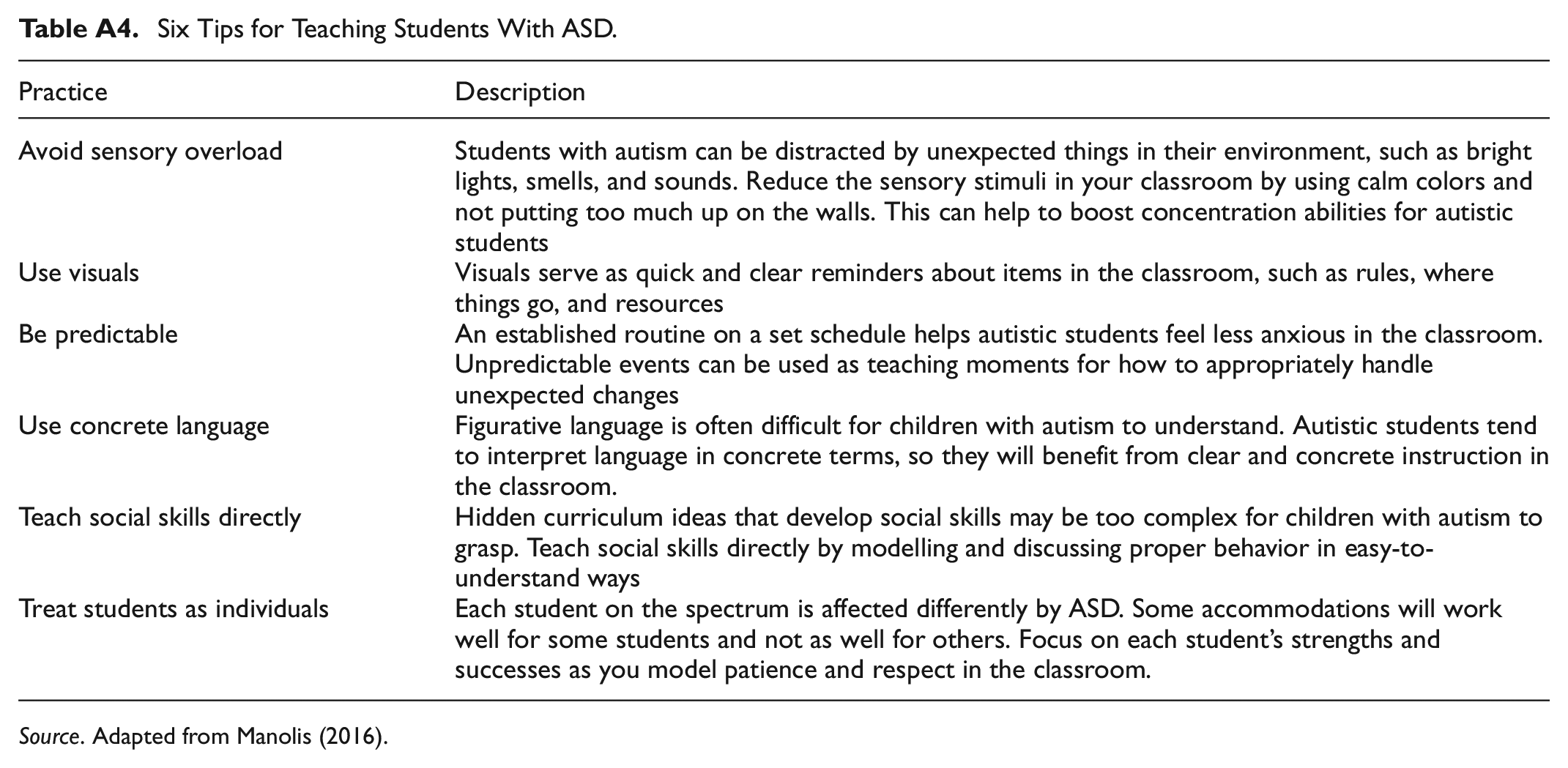
| Practice | Description |
|---|---|
| Avoid sensory overload | Students with autism can be distracted by unexpected things in their environment, such as bright lights, smells, and sounds. Reduce the sensory stimuli in your classroom by using calm colors and not putting too much up on the walls. This can help to boost concentration abilities for autistic students |
| Use visuals | Visuals serve as quick and clear reminders about items in the classroom, such as rules, where things go, and resources |
| Be predictable | An established routine on a set schedule helps autistic students feel less anxious in the classroom. Unpredictable events can be used as teaching moments for how to appropriately handle unexpected changes |
| Use concrete language | Figurative language is often difficult for children with autism to understand. Autistic students tend to interpret language in concrete terms, so they will benefit from clear and concrete instruction in the classroom. |
| Teach social skills directly | Hidden curriculum ideas that develop social skills may be too complex for children with autism to grasp. Teach social skills directly by modelling and discussing proper behavior in easy-to-understand ways |
| Treat students as individuals | Each student on the spectrum is affected differently by ASD. Some accommodations will work well for some students and not as well for others. Focus on each student’s strengths and successes as you model patience and respect in the classroom. |
Source. Adapted from Manolis (2016).

Funding
The author disclosed receipt of the following financial support for the research, authorship, and/or publication of this article: This work was supported and funded by the Deanship of Scientific Research at Imam Mohammad Ibn Saud Islamic University (IMSIU) (grant number IMSIU-DDRSP2502).
Declaration of Conflicting Interests
The author declared no potential conflicts of interest with respect to the research, authorship, and/or publication of this article.
Data Availability Statement
Data and materials supporting the results and/or analyses presented in this paper available upon reasonable request.