




Abstract
With the expansion of computer science (CS) education, CS teachers in K-12 schools should be cognizant of student misconceptions and be prepared to help students establish accurate understanding of computer science and programming. Digital tools, such as automated assessment systems, can be useful and supportive in teaching CS courses. This two-stage design-based research (DBR) study investigated the effects of targeted feedback in an automated assessment system for addressing common misconceptions of high school students in a Java-based introductory programming course. Based on students’ common errors and underlying misconceptions, targeted feedback messages were designed and provided for students. The quantitative analysis found that with targeted feedback students were more likely to correct the errors in their code. The qualitative analysis of students’ solutions revealed that when improving the code, students receiving feedback made fewer intermediate incorrect solutions. In other words, the targeted feedback messages may help to promote conceptual change and facilitate learning. Although the findings of this exploratory study showed evidence of the power of digital tools, more research is needed to make technology benefit more CS teachers.
Keywords
Introduction
The development of computing technology and its role in driving innovation and economic development in the 21st century has brought the need for expanding computer science (CS) education (Webb et al., 2017). Many countries have included CS courses in their K-12 curriculum, such as the United States, the United Kingdom, and others (Brown, Sentance, Crick, & Humphreys, 2014; desJardins, 2015). Introductory CS courses, however, are difficult for beginners (Guzdial, 2015; McCracken et al., 2001), and students often exhibit misconceptions that impede their learning of programming (Altadmri & Brown, 2015; Qian & Lehman, 2017; Sorva, 2013). CS teachers in K-12 schools should be prepared to help students establish accurate understanding of CS and programming (Qian & Lehman, 2017). One means of supporting CS teachers’ instruction is to use technology such as an automated assessment system, which is a tool that can automatically evaluate the correctness of students’ programs and provide immediate feedback (Douce, Livingstone, & Orwell, 2005; Gerdes, Heeren, Jeuring, & van Binsbergen, 2017). This exploratory design-based research study investigated the effects of targeted feedback in an automated assessment system for addressing common misconceptions of high school students in a Java-based introductory programming course.
Literature Review
Student Misconceptions in Introductory Programming
In the learning of programming, student misconceptions are students’ deficient or erroneous understandings of programming concepts (Qian & Lehman, 2017; Sorva, 2013; Taber, 2013). Previous studies on student misconceptions in introductory programming have cataloged a broad range of student misconceptions including syntax errors and other difficulties caused by misconceptions (Altadmri & Brown, 2015; Denny, Luxton-Reilly, & Tempero, 2012; du Boulay, 1986; Guzdial, 1995; Kaczmarczyk, Petrick, East, & Herman, 2010; Qian & Lehman, 2017; Ragonis & Ben-Ari, 2005; Simon, 2011; Sleeman, Putnam, Baxter, & Kuspa, 1986; Sorva, 2013). For instance, novice students often make syntactic mistakes in their code, such as mismatching parentheses, missing semicolons, failing to declare variables, using malformed Boolean expressions, mistakenly using the assignment operator (=) instead of the comparison operator (==), and so forth (Altadmri & Brown, 2015; Jackson, Cobb, & Carver, 2005; Sirkia & Sorva, 2012). Variables are a very basic concept in most of the programming languages, but novices may mistakenly believe that the computer understands variables by the English meanings of their names, even though variable names are arbitrary (Kaczmarczyk et al., 2010; Sleeman et al., 1986). In addition, students usually lack well-established programming strategies (Clancy & Linn, 1999; Davies, 1993; Lister, Simon, Thompson, Whalley, & Prasad, 2006; Sajaniemi & Prieto, 2005; Soloway, 1986) leading to difficulties with planning, composing, and debugging programs.
To address students’ misconceptions in introductory programming, researchers and educators have developed various instructional tools, such as novice programming environments that help to prevent syntax errors (Kelleher & Pausch, 2005; Resnick et al., 2009), debugging tools that improve students’ understanding of their errors (Becker et al., 2016; Ko & Myers, 2005), and visualization tools that illustrate programming concepts and program execution (Guo, 2013; Sorva, Karavirta, & Malmi, 2013). Of particular interest for this study is the development of automated assessment systems, which have been widely used in introductory programming classes to support teaching and learning (Douce et al., 2005; Pettit, Homer, & Gee, 2017). An automated assessment system is a tool that can automatically evaluate the correctness of students’ programs and provide immediate feedback (De-La-Fuente-Valentín, Pardo, & Delgado Kloos, 2013; Gerdes et al., 2017). Using student data, especially students’ erroneous programs, two types of feedback systems have been developed and integrated into automated assessment systems.
The first type of feedback system uses artificial intelligence (AI) techniques to analyze students’ programs and generate personalized feedback for students (Barnes & Stamper, 2010; Rivers & Koedinger, 2017; Xu & Chee, 2003). With such an intelligent feedback component, an automated assessment system becomes an intelligent tutoring system that can not only grade students’ programs but also provide automated feedback. iSnap is an intelligent tutoring system that can automatically generate hints for Snap programming learners (Price, Dong, & Lipovac, 2017). Price et al. (2017) reported that hints generated by iSnap were helpful to address simple problems in students’ code. Although such systems seem to be an ideal solution to help teachers identify and address student misconceptions, they are difficult to develop, not mature yet, and can only handle simple programs.
The other type of feedback system uses manually designed feedback messages for common student errors identified using the student data in the automated assessment system (Becker, 2016; Denny, Luxton-Reilly, & Carpenter, 2014; Pettit et al., 2017). Decaf is such a system (Becker, 2016). In a study of using Decaf to teach a Java-based CS1 class, Becker (2016) first used student data in the automated assessment system to identify 30 common compilation errors and then designed feedback by enhancing the raw Java error messages. His results showed that the 30 compilation errors accounted for 78% of all errors, and the group receiving feedback messages made 32% fewer errors than the group seeing only the raw Java compiler error messages. Although these results are promising, there are two issues with prior studies on automated assessment systems with such feedback components. First, previous studies using this type of feedback component have only focused on students’ compilation errors (Pettit et al., 2017). Second, the effectiveness of using enhanced compiler error messages as feedback is still questionable (Denny et al., 2014; Pettit et al., 2017).
Misconceptions and Conceptual Change Theories
In science and mathematics education, researchers and educators have developed conceptual change theories to understand the development of student conceptions. Conceptual change denotes the process through which learners’ existing (mis)conceptions develop into intended normative conceptions (Duit & Treagust, 2003; Vosniadou & Skopeliti, 2014). Conceptual change theories inform the process of modifying student misconceptions to help students establish normative understandings of the academic concepts to be learned (Vosniadou & Skopeliti, 2014).
Two theoretical perspectives, revolutionary conceptual change and evolutionary conceptual change, have emerged over the decades of research (Abimbola, 1988; Özdemir & Clark, 2007; Taber, 2013). The revolutionary conceptual change perspective posits that learners’ existing naïve knowledge is organized in a theory-like manner, and learners use their naïve theories to interpret and construct new concepts (Özdemir & Clark, 2007; Posner, Strike, Hewson, & Gertzog, 1982). From this viewpoint, successful instruction needs to help students confront their misconceptions by presenting the academic concept to students in a way that produces cognitive conflicts, and then help students abandon their misconceptions and adopt the new conceptions (Abimbola, 1988; Posner et al., 1982). In contrast, the evolutionary conceptual change perspective postulates that learners’ prior naïve knowledge consists of relatively unstructured collections of quasi-independent elements (Abimbola, 1988; diSessa, 1993). Thus, conceptual change is an evolutionary process of correcting and enhancing existing knowledge elements and establishing and refining the relationships among conceptions (Abimbola, 1988; diSessa, 2013, 2014).
Although debate between the two perspectives is ongoing (see diSessa, 2013; Vosniadou, 2013), the current trend in conceptual change research has shown convergence (Vosniadou & Skopeliti, 2014). Nowadays, researchers of conceptual change theories share the ideas that (a) learners’ own preinstructional conceptions (also called naïve knowledge) are based on their daily experience, (b) learners’ existing knowledge has an impact on the acquisition of new knowledge, and (c) student misconceptions are often entrenched and conceptual change is time consuming (Özdemir & Clark, 2007; Taber, 2013). Before students successfully understand the new academic concept, the interaction between the new concept and their existing knowledge results in various synthetic models, which are intermediate states of knowledge with partially correct interpretation (Vosniadou, 1994; Vosniadou & Skopeliti, 2014). Hence, success in conceptual change requires tracking the development of learners’ (mis)conceptions using real-time data (diSessa, 2014; Vosniadou, 2013). With precise understanding of the nature and current status of student (mis)conceptions, instructors can choose proper strategies for accomplishing conceptual change (Taber, 2014).
Although conceptual change theories have been widely adopted to understand the development of student knowledge in math and science (Vosniadou & Skopeliti, 2014), they have received relatively little attention in CS education to date (Qian & Lehman, 2017). This study applied conceptual change theories to understand student misconceptions in introductory programming.
Feedback for Conceptual Change
Feedback is information provided by an agent to correct learners’ errors and misunderstandings for the purpose of facilitating learning (Butler & Winne, 1995; Hattie & Timperley, 2007; Kulhavy & Wager, 1993; Shute, 2008). Researchers have developed different models of feedback to explain how feedback facilitates learning and provide guidelines for designing effective feedback (Bangert-Drowns, Kulik, Kulik, & Morgan, 1991; Clariana, Wagner, & Murphy, 2000; Hattie & Gan, 2011; Kulhavy & Stock, 1989). One widely accepted model is the visibility model of feedback focusing on visualizing learners’ current knowledge states (Hattie & Gan, 2011; Hattie & Timperley, 2007). According to the visibility model, feedback reduces “the discrepancy between what is understood and what is aimed to be understood” (Hattie & Gan, 2011, pp. 257-258). Visibility means that effective feedback design needs to make the discrepancy visible to both the instructor and the learner. According to Hattie and Gan (2011), the problem with traditional feedback design is that it neglects to examine learners’ current (mis)conceptions. Effective feedback design requires scrutinizing learners’ erroneous responses, to grasp their common misconceptions, and provide corrective information targeted at addressing misconceptions (Hattie & Gan, 2011; Hattie & Timperley, 2007). Procedures for designing effective feedback include (a) clearly describing the desired learning outcomes, (b) precisely analyzing learners’ current knowledge states, and (c) identifying students’ misconceptions and providing information for promoting conceptual change and enhancing learning (Hattie & Gan, 2011; Hattie & Timperley, 2007).
Summary
Previous studies have cataloged a broad range of student misconceptions and explored the effects of a variety of tools that can help to address student misconceptions. However, most of the studies have focused on college students (e.g., Altadmri & Brown, 2015; Becker, 2016; Jackson et al., 2005; Pettit et al., 2017). This study focused on misconceptions among high school students taking an introductory programming course. Moreover, although many automated assessment systems have been developed and tested by researchers, most systems to date either provide direct feedback for correcting simple errors in code (e.g., Gerdes et al., 2017) or provide feedback based only on compiler errors (e.g., Becker, 2016). Furthermore, the effectiveness of using enhanced compiler error messages as feedback is still questionable (Denny et al., 2014; Pettit et al., 2017). This study focused on designing and providing targeted feedback for addressing student misconceptions based on the analysis of both compilation and test errors in students’ programs. Finally, this study adopted conceptual change theories and the visibility model of feedback as the theoretical framework for understanding and addressing student misconceptions. Conceptual change theories suggest using learner data to understand current states of student (mis)conceptions before choosing proper strategies for accomplishing conceptual change. According to the visibility model, the first step to design effective feedback for promoting conceptual change is to analyze the discrepancy between the students’ current knowledge states and the intended outcomes using learner data. Both conceptual change theories and the visibility model emphasize the importance of understanding current states of learner knowledge and tracking the evolution of student (mis)conceptions using learner data. Although previous studies in CS education have discussed student misconceptions from a variety of perspectives, little work has drawn on our understanding of conceptual change and appropriate use of data-driven feedback to promote conceptual change (Qian & Lehman, 2017).
Purpose of the Study
The purpose of this study was to investigate how targeted feedback based on student data in an automated assessment system affected the evolution of common (mis)conceptions of high school students in an introductory programming course. The following research questions guided the study:
Method
This study used design-based research (DBR) (Anderson & Shattuck, 2012) as the overarching methodological framework. DBR is a methodology that guides the design, implementation, evaluation, and refinement of interventions to complex educational problems in real educational contexts (Anderson & Shattuck, 2012; McKenney & Reeves, 2014). DBR studies seek to design and test interventions iteratively in classroom settings using both quantitative and qualitative data and develop principles or theories for helping others facing similar situations (Anderson & Shattuck, 2012; McKenney & Reeves, 2014). This exploratory DBR study consisted of two stages and investigated the effects of targeted feedback in an automated assessment system for addressing common misconceptions of high school students in a Java-based introductory programming course.
Participants and Research Settings
Participants in this study were two groups of high school students, a total of 23, who took a Java-based introductory programming class in two different sections of a summer residential program. This summer residential program has been offered by an established center (GERI) for gifted and talented students at a major university in the U.S. Midwest. The 2017 summer program consisted of two 2-week sections. Section 1 was from July 2 to July 15, 2017. Section 2 was from July 16 to July 29, 2017. The student recruitment was conducted by GERI. To be accepted by this summer residential program, students had to be identified as high ability according to the GERI criteria (GERI Website, 2018). Group 1 of this study, students who were in Section 1, originally had 15 students, and Group 2, students who were in Section 2, had 10 students. However, one student of Group 1 was found to have cheated when solving problems and another student of Group 1 was an outlier in terms of ability who was the champion of a programming competition in his hometown and solved all the problems in the automated assessment system within 2 days. Therefore, these two students were not considered as participants of this study and were excluded from the data analysis. In the end, the participants of this study were 13 students in Group 1 and 10 students in Group 2. Although the number of participants in this exploratory study was not large, as explained in section “Results,” the participants created a substantial data set of student problem solutions for analysis.
The automated assessment system used in this study was called Mulberry, which is designed for Java learners and developed by the author. Compared with existing automated assessment systems, Mulberry has two distinct features. First, Mulberry is designed and developed using gamification principles. Students need to create avatars to solve problems in Mulberry. When solving a problem, a student’s avatar gains experience points and rewards (represented as gold). When the student’s avatar accumulates sufficient experience points, his or her avatar will level up and unlock more difficult tasks. Figure 1 shows the major user interface (UI) of Mulberry. This gamification design can increase students’ motivation of using the system to practice programming. Second, Mulberry provides targeted feedback when students make mistakes in their code. Most existing automated assessment systems only provide assessment results to inform students about the correctness of their programs (e.g., failed to compile). Some systems such as Decaf provide elaborated feedback for common compilation errors to help students fix their programs. The distinct feature of Mulberry is that it provides elaborated feedback messages for both common compilation and noncompilation errors in students’ code. This is an advance over other similar systems, and the effect of the feedback component is the focus of this study.
User interface (UI) of Mulberry.
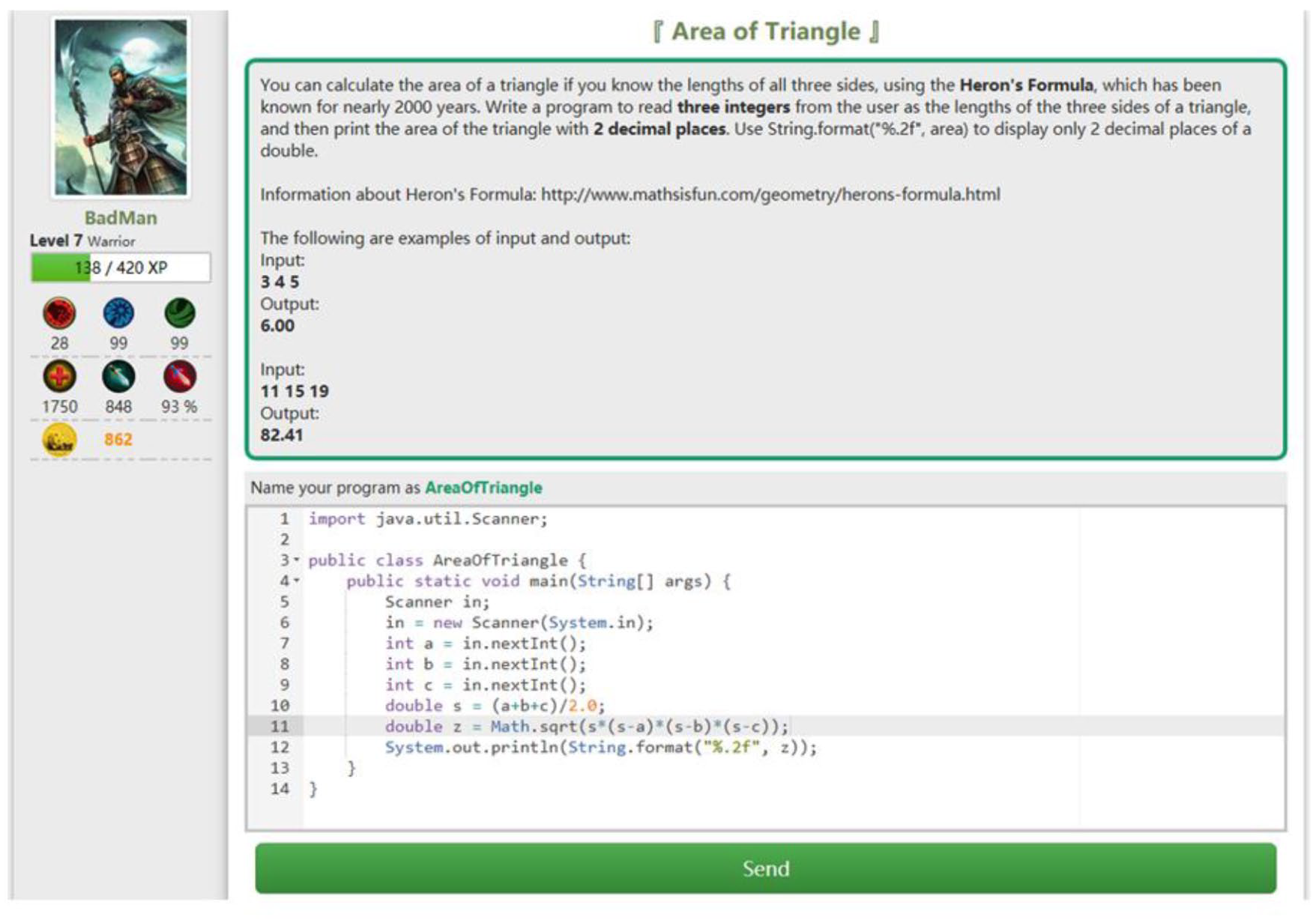
Mulberry has a pool of 51 programming problems, and students are required to write short programs to produce the correct output to solve the problems. Every problem has several test cases, which are pairs of input data and expected output. Figure 2 shows an example problem in Mulberry and its test cases. Mulberry automatically assesses students’ solutions to each problem using test cases and comparing the output of their programs with the expected output. A student solution is considered as correct when its output matches the expected output for all the test cases. When a student submits a program producing the incorrect output, he or she receives immediate feedback from the system and can try multiple times until his or her solution is correct. Mulberry collects all the programs from students when they attempt to solve the problems.

Example problem Area of Triangle and its test cases.
The Java-based introductory programming class in this study was called Programming and Computational Thinking and was offered to high school students in both sections of the summer residential program in the morning from 8:30 to 11:30 every weekday. The researcher was the instructor of the course. The major topics covered in this course were Program Structure, Input/Output (I/O), Variables and Operators, Conditionals, and Loops. Typically, during every class session, the instructor started with a 30-min lecture to review previously learned content and introduce new course content. After the lecture, the instructor used worked-out examples to show how to solve problems with the programming statements students had learned about. When the demonstration was done, students had about an hour to solve problems individually using Mulberry. After all the topics were introduced (the first week), students started individual and team projects based on their choices (e.g., design a text-based interactive game). The IDE (integrated development environment) used in the class was DrJava (version: drjava-20160913-225446). The JDK (Java SE Development Kit) version was JDK 8.
Procedures
In the first stage, students of group 1 took the introductory programming class and used Mulberry to practice their programming skills. The goal of the first stage was to identify common misconceptions students exhibited in the introductory programming course. When students of Group 1 had errors in their solutions, they were told that errors existed in their code and were encouraged to try again. After the first group’s course ended, data analysis was conducted to identify students’ common misconceptions in this introductory programming course using all the student solutions collected by Mulberry, including student solutions of Group 1 and previous student solutions in Mulberry. As the focus of this article is the effects of targeted feedback for addressing common student misconceptions in this introductory programming course, details of how the common misconceptions were identified are not reported here. See Qian (2018) for detailed procedures and results. Table 1 presents the identified common errors and relevant misconceptions.
Common Errors and Relevant Misconceptions (Qian, 2018).

In the second stage, students of Group 2 took the same introductory programming class. When they solved problems in Mulberry and submitted solutions producing incorrect output, they received the targeted feedback to address their misconceptions. Before students of Group 2 started the class, targeted feedback messages to address student misconceptions identified in Stage 1 were designed using principles from conceptual change and feedback theories (diSessa, 2014; Hattie & Gan, 2011; Vosniadou & Skopeliti, 2014) and added to Mulberry. Because common student misconceptions were identified based on common compilation and test errors in student solutions, targeted feedback was designed and provided for every common compilation or test error. However, when several common errors were related to the same misconception, the targeted feedback for addressing them was identical or similar. In addition, feedback for addressing common compilation errors and common test errors was also designed differently.
Feedback for compilation errors
As compilation errors are not specific to particular problems, targeted feedback for addressing them contained general information about possible problems in the student’s solution and potential ways of improving the solution. For instance, the
When several common compilation errors were caused by similar mistakes and related to the same misconception, the same feedback message was provided. For example, the common compilation errors
The common compilation error
Finally, compilation errors are not always precisely caught by the compiler and described in the compiler error message. For example, mistakes such as missing a single semicolon, missing braces, or missing the right-hand side of an assignment statement may all result in the common compilation error
Feedback for test errors
Targeted feedback for addressing common test errors was designed to contain information regarding the specific problem and potential ways of improving the solution. For example, the

Two different students’ solutions producing the same wrong output.
This feedback message was designed to let students know the current status of their solution and provide guidance about how to fix the error. Other feedback messages for addressing common test errors were designed and provided in a similar way. In the end, 10 unique feedback messages were designed for the common test errors (see the appendix).
Data Analysis
Both quantitative and qualitative data analysis were conducted to see whether and how the targeted feedback made a difference in students’ solutions and so may have contributed to conceptual change.
Quantitative data analysis
The goal of the quantitative analysis was to check whether the targeted feedback had positive effects on addressing common student misconceptions to answer RQ1. To check the effects of feedback, erroneous student solutions of both Group 1 and Group 2 were categorized into two types: improved and not improved. When the next solution of an erroneous solution for solving the same problem was correct, this means that the student had improved this erroneous solution. Hence, this solution was labeled as improved. When an erroneous solution had compilation errors, and its next solution was successfully compiled but failed to pass the test, this also means that the student had improved this erroneous solution, because at least the compilation errors were fixed. Such erroneous solutions were also labeled as improved. When an erroneous solution had compilation errors, and its next solution also had compilation errors, it was labeled not improved. When an erroneous solution had test errors, and its next solution had compilation or test errors, it was also labeled not improved.
After the categorization was done, three different kinds of improvement rates were calculated and compared. First, overall improvement rates of both groups were calculated, which were the proportion of improved solutions. Second, each group’s improvement rate of solutions with common errors was calculated, which was the proportion of improved solutions among the solutions with common errors. Third, for Group 2, improvement rates of solutions with and without feedback were calculated, which were the proportion of improved solutions among the solutions with and without feedback, respectively. Chi-square tests were conducted to see whether the differences in improvement rates were statistically significant.
Qualitative data analysis
The goal of the qualitative analysis was to understand how targeted feedback affected the evolution of students’ (mis)conceptions to answer RQ2. Analyzing students’ programs qualitatively is vital to complement quantitative analysis and provide further insights into students’ conceptual understandings (Fields, Quirke, Amely, & Maughan, 2016). Four feedback cases were selected for the qualitative analysis. The case selection was based on the following procedures. First, for each feedback message, a feedback improvement rate (FIR) was calculated using the following formula:

Feedback messages with the best and worst FIR were selected as cases. Cases for compilation errors and test errors were selected separately, so four cases were selected. As certain feedback messages only occurred once or twice, and so had FIRs of either 100% or 0%, case selection only used the feedback messages with an above-average number of occurrences.
When the cases were selected, student solutions of both Group 1 and Group 2 were extracted from the Mulberry database. Although students of Group 1 did not receive any feedback (other than standard compiler messages), their solutions that had the same error as students in Group 2 who got the targeted feedback were used. The patterns of evolution of (mis)conceptions of students from Group 1 and Group 2 were compared in detail to determine if targeted feedback affected conceptual change as demonstrated via their solutions. Figure 4 shows an example of how a student revised his or her solutions to the

A student’s solutions to the Area of Triangle problem.
Results
RQ1: Does Targeted Feedback Have Positive Effects on Addressing Common Student Misconceptions?
Difference in overall improvement rates
Students’ solutions of the two groups were used to analyze the overall effects of feedback. In total, Group 1 and Group 2 made 529 and 399 erroneous solutions, respectively. When calculating the improvement rate, student solutions with no “next solution” were excluded from the analysis, because without a “next solution,” the improvement of an erroneous solution could not be determined. In the end, Group 1 had 521 erroneous solutions, and 176 of them were improved. Group 2 had 397 erroneous solutions, and 177 of them were improved. Thus, the improvement rates of the two groups were 34% and 45%, respectively (see Figure 5). A chi-square test was performed to examine the relationship between group and improvement rate. The improvement rates of the two groups were significantly different, χ2(1, N = 918) = 11.11, p < .001. Overall, students of Group 2 were more likely to improve their erroneous solutions than those of Group 1.

Overall improvement rates.
Difference in improvement rates of solutions with common errors
As students of Group 2 received targeted feedback when their solutions had common errors, it was expected that students of Group 2 would have a better improvement rate of solutions with common errors than students of Group 1. Among the 521 erroneous solutions of Group 1, 310 had common errors, and 119 of them were improved. Among the 397 erroneous solutions of Group 2, 170 solutions showed common errors and received feedback, and 99 of them were improved. Hence, the two groups’ improvement rates of solutions with common errors were 38% and 58%, respectively (see Figure 6). The results of a chi-square test indicated that the difference in improvement rates was significant, χ2(1, N = 480) = 17.45, p < .001. The results suggest that when a student solution had common errors, a student who received targeted feedback was more likely to effectively improve his or her solution.

Improvement rates of common errors.
Difference in improvement rates of solutions with and without feedback
For Group 2, while 170 erroneous student solutions received feedback, the other 227 solutions, which had noncommon errors, did not receive targeted feedback. It was also expected that solutions with feedback would have a better improvement rate than those with no feedback. The results confirmed the hypothesis. For solutions with targeted feedback, 99 were improved with an improvement rate of 58%; for solutions without targeted feedback, 78 were improved with an improvement rate of 34% (see Figure 7). The results of a chi-square test indicated that the difference was significant, χ2(1, N = 397) = 22.42, p < .001. In other words, when a feedback message was presented, a student of Group 2 was more likely to effectively improve his or her erroneous solution.

Improvement rates of Group 2’s solutions without and with feedback.
RQ2: How Does Targeted Feedback for Promoting Conceptual Change Affect the Evolution of Students’ (Mis)conceptions?
Qualitative analysis of student code was used to address RQ2. Four feedback cases were selected for the qualitative analysis according to the case selection procedures described in the “Method” section. First, for each feedback message, its FIR was calculated. Table 2 presents the FIRs of feedback messages for compilation and test errors. In addition to the FIR, the number of occurrences of the errors and the number of improvements are also included in the tables (see the numbers within the parentheses). Although students of Group 1 did not receive targeted feedback messages for the common errors, their FIRs are also presented in the tables to make comparisons. As no student in Group 2 made the common test errors TE6 and TE9, relevant feedback messages TFB6 and TFB9 are not included in Table 3. According to the case selection procedures, the four selected cases were CFB4, CFB3, TFB4, and TFB1. CFB4 and CFB3 were the compilation error feedback messages (CE Feedback) with the best and worst FIR. TFB4 and TFB1 were the test error feedback messages (TE Feedback) with the best and worst FIR. Table 3 presents the details about the four feedback messages.
Feedback for Compilation and Test Errors.
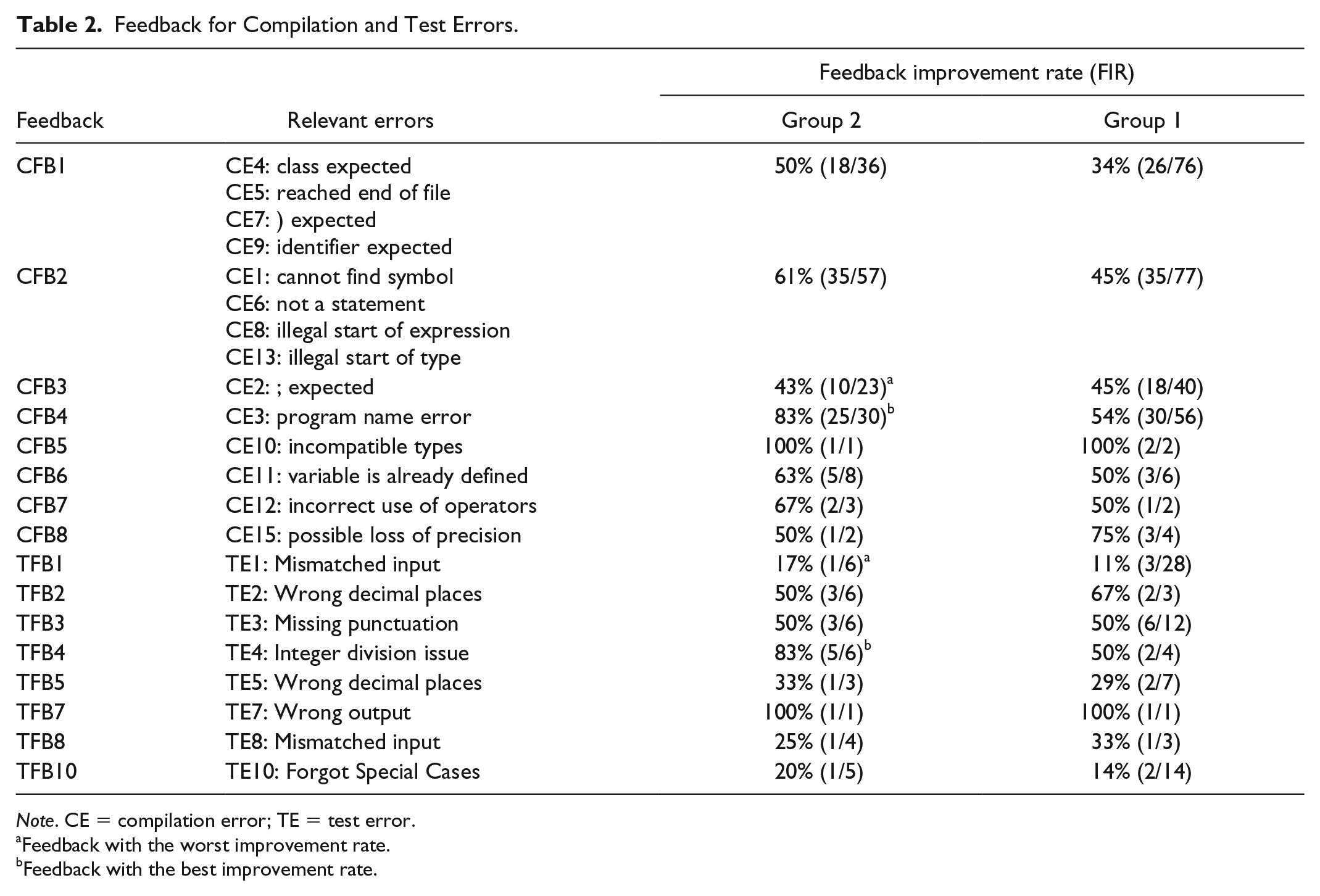
Note. CE = compilation error; TE = test error.
Feedback with the worst improvement rate.
Feedback with the best improvement rate.
Selected Feedback Cases.

Note. XXX will be replaced by the required program name of a problem. FIR = Feedback Improvement Rate; CE = compilation error; TE = test error.
Compilation error feedback message with best FIR
The feedback message for addressing the
When students of Group 2 had the

Group 2 student code example of improvement of program name error.
Although this feedback message was simple, it helped students understand what was wrong with the program and how to fix it. The program naming rule was introduced in the class and repeatedly practiced during problem-solving. Hence, students probably knew this rule. However, without a targeted feedback message, they might have difficulties to understand or notice the error. The feedback helped to reduce the number of intermediate solutions during the code improvement process.
Compilation error feedback message with worst FIR
The feedback message for addressing the
Figure 9 presents two continuous solutions of the student Mike in Group 2. In the first solution, he missed the semicolons in line 6 and 7. Thus, this solution failed to be compiled, and the feedback telling him to add the semicolons was presented. In the next solution, this student added the necessary semicolons. Although the
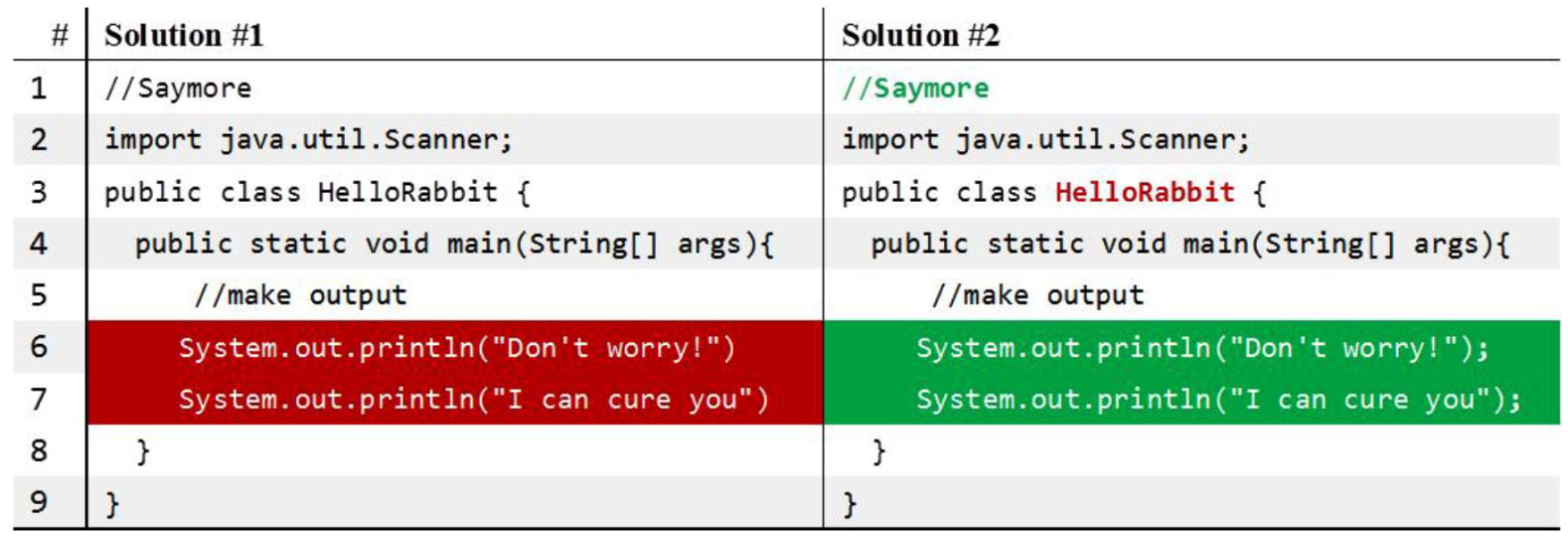
Mike’s code example of improvement.
Test error feedback message with best FIR
The feedback message with the best FIR for addressing test errors was TFB4. It was designed to address the test error
According to the quantitative data, students of Group 2 made this error 6 times, and five of them were successfully improved with the feedback. The analysis of the one failed case showed that the student also fixed this error, but the fix of the error led to another problem. Thus, this was not considered as an improved solution in the quantitative analysis, even though the error for which the feedback was given was successfully fixed.
When students in Group 1 tried to fix this error, they tended to have more intermediate solutions. For example, one student Emily made this error in her program. In the next solution, she changed the type of the variable “s” from int to double. She was on the right track, but this change did not completely fix this error, because the division expression “sum / 2” would still return an integer value and ignore the decimal places. Finally, she fixed the error completely in the third solution. If she had received the feedback message, she might have fixed the error in Solution #2, instead of Solution #3.
Test error feedback message with worst FIR
The feedback message with the worst FIR for addressing test errors was TFB1. It was for addressing the test error
According to the quantitative data, students of Group 2 made this error 6 times, but only one of them successfully improved with the feedback. The analysis of student code showed that among the five “not improved” solutions, four actually fixed this error but still had other errors. Figure 10 presents such an example. This student, Alan, had the mismatched input error in Solution #1 and fixed this error in Solution #2. However, his second solution output the wrong variable; he should have printed the variable result rather than the variable area. This caused Solution #2 to get the test error

Alan’s code example of improvement.
In contrast, students of Group 1 made this error 28 times with only three successful improvements. Among the other 25 failed cases, only three identified the error immediately and made some partial improvements. Most students made this error in one solution, but they did not fix this error in the next solution and made several erroneous intermediate solutions. If the feedback message had been presented, they might not have required those intermediate solutions.
Discussion and Conclusion
Overall Effects of Targeted Feedback
The results of this study indicated that targeted feedback messages enhanced students’ improvement rates of erroneous solutions to programming problems. Students of Group 2 (the group receiving targeted feedback messages) showed significantly higher improvement rates in all erroneous solutions and solutions with common errors than students of Group 1. Within Group 2, students also showed a significantly higher improvement rate in solutions with targeted feedback messages compared with solutions without targeted feedback messages. All these results suggest that with targeted feedback messages, students were more likely to correct errors in their code. This finding is consistent with previous research (Becker et al., 2016).
In the study of Becker et al. (2016), researchers provided feedback for 30 common compilation errors by enhancing the compiler error messages. They found that the group receiving feedback messages made 32% fewer errors than the group only seeing the original Java compiler error messages. Although the study of Becker et al. (2016) only investigated students’ compilation errors, its overall research approach and results are similar to this study. However, two prior studies reported ineffectiveness of feedback using enhanced compiler error messages (Denny et al., 2014; Pettit et al., 2017), but their research design was different from Becker et al.’s (2016) and this study, and this may account for the lack of significant results. In the study of Denny et al. (2014), students only had to complete the method body of a given method header. Hence, students did not have to write a program from scratch and would not encounter all possible Java compilation errors (Becker et al., 2016). In the study of Pettit et al. (2017), their feedback messages only covered 30% of compilation errors, which may make the effects of their feedback insignificant. Although many factors may contribute to the ineffectiveness of feedback in the two studies, one key issue is that the feedback messages they offered may not have addressed the common student errors in their instructional settings.
In this study, targeted feedback messages were designed and provided for both common compilation and test errors. The results suggest that one important step of designing the feedback component of an automated assessment system is to identify the common errors students make, which are representative of common difficulties students encounter in learning to programming. Without a good identification of common student errors that account for most student errors, the feedback system of an automated assessment system may not work as expected. As the visibility model of feedback suggests, designing effective feedback requires precisely analyzing and understanding learners’ current knowledge states (Hattie & Gan, 2011; Hattie & Timperley, 2007). If the design of feedback messages is not based on students’ current knowledge states and only addresses a limited number of student errors, the feedback may not be as effective as expected.
Evolution of Students’ Misconceptions
The qualitative analysis of students’ solutions of four selected cases showed that when improving the code, students of Group 2 made fewer intermediate incorrect solutions than students in Group 1. In other words, the targeted feedback messages appear to have helped to promote conceptual change. According to the qualitative analysis, students of Group 1 usually noticed the error but often only fixed part of the error in the next attempted solution. In contrast, with the targeted feedback message, students of Group 2 often could completely fix the same error in the revised solution (see Figure 10 for an example). According to conceptual change theories (Taber, 2013; Vosniadou, 1994; Vosniadou & Skopeliti, 2014), before students develop correct understanding of an academic concept, they may gain certain intermediate states of knowledge because of the conflicts and interactions between their existing knowledge and the new concept. Such intermediate states of knowledge are called melded concepts (Taber, 2013) or synthetic models (Vosniadou & Skopeliti, 2014) and consist of both correct and erroneous knowledge elements (diSessa, 2014). From this viewpoint, both students of Group 1 and Group 2 formed certain melded concepts, but the targeted feedback messages appear to have helped students of Group 2 correct the erroneous knowledge elements and reduce the intermediate states. Conceptual change is an evolutionary process of correcting and enhancing existing knowledge elements and establishing and refining the relationships among conceptions (Abimbola, 1988; diSessa, 2013). Therefore, when providing feedback for students, it is important to analyze students’ melded concepts and consider their (mis)conceptions as resources, rather than trying to replace them (Smith et al., 1994).
In addition, the qualitative analysis revealed that quantitative analysis in this study failed to detect certain improvements in student code, and the targeted feedback messages may have worked even better than the quantitative results suggested. When analyzing the two feedback message cases with the worst improvement rates, the results showed that the quantitative analysis labeled some solutions as “not improved” because some errors were still present even though the error related to the feedback was fixed. This is a limitation of quantitative analysis (Fields et al., 2016) and also highlights the value of qualitative analysis of student code. Therefore, it is important to find new techniques or algorithms to improve the accuracy of the quantitative analysis, because manually conducting qualitative analysis of every student solution is time-consuming and difficult.
Implications
An effective CS teacher needs to have both knowledge of the subject matter and pedagogical content knowledge (PCK; Hubwieser, Magenheim, Mühling, & Ruf, 2013; Shulman, 1986; Yadav, Berges, Sands, & Good, 2016). PCK refers to the knowledge that enables teachers to transform instructional content into a comprehensible form to students (Shulman, 1986). Teachers’ knowledge of and ability to address student misconceptions is a key component of their PCK (Carlsen, 1999; Saeli, Perrenet, Jochems, & Zwaneveld, 2011; Shulman, 1986). Unfortunately, research on CS teachers’ PCK is limited (Saeli et al., 2011; Yadav et al., 2016), and CS teachers often lack sufficient knowledge of student misconceptions (Brown & Altadmri, 2017; Guzdial, 2015). The results of this study indicate that designing feedback based on common student misconceptions by analyzing student data in an automated assessment system can be effective to address student misconceptions and has the potential to help teachers develop their PCK.
Automated assessment systems have been widely used in introductory programming classes (Douce et al., 2005; Pettit et al., 2017). They can not only reduce teachers’ grading workload but also collect a large amount of student data including all errors students make. The student data in automated assessment systems can be a good resource for analyzing common student misconceptions (Becker, 2016; Denny et al., 2012; Qian & Lehman, 2017). Based on the common misconceptions, designing and adding targeted feedback using the approach suggested by this study can be effective to address student misconceptions and facilitate learning. Hence, researchers and developers of automated assessment systems should consider the common misconception identification component and the targeted feedback design component as built-in components when designing and improving their systems. Meanwhile, future professional development programs for CS teachers should pay attention to teachers’ ability to use automated assessment systems and help them learn to design and provide targeted feedback based on common student errors and difficult problems using student data in such systems. We believe the ability to effectively identify and address common misconceptions based on student data will be vital to quality CS teachers.
Limitations
Although plausible results were found, this study has several limitations. First, the generalizability of findings from this study is limited. In this study, participants were high-ability students in a non-school-based summer enrichment program that was not formally graded. Their misconceptions may not be representative of the population of high school students in formal educational settings.
In addition, there was no control group in this study. Although the use of a control group is not typical in design-based studies, without a control group, it is not possible to establish a causal relationship between the observed changes and the intervention.
Finally, the number of participants of this study was relatively small. We only analyzed 23 students’ programs to investigate the effects of targeted feedback. However, the overall size of the data set used in this research project was not small. The design of the targeted feedback messages was based on the common misconception analysis of 4,873 student solutions from 55 students (see Qian, 2018 for details). Moreover, we analyzed 928 student solutions to examine the effects of targeted feedback; in other words, about 40 solutions per student were analyzed. In addition, because our research involved a manually implemented qualitative component to assess how the feedback affected students’ conceptual change, a larger sample was not feasible. This exploratory study was a “proof-of-concept” study, in which we tested the targeted feedback design model. We believe that our overall data set size was substantial and sufficient for the purpose of the study. For our future research, we will test targeted feedback component with a larger number of participants.
Conclusion
With the expansion of CS education, CS teachers in K-12 schools should be cognizant of student misconceptions and be prepared to help students establish accurate understanding of CS and programming. Digital tools, such as automated assessment systems, definitely can be useful and supportive in teaching CS courses. This two-stage DBR study investigated the effects of targeted feedback in an automated assessment system for addressing common misconceptions of high school students in a Java-based introductory programming course. Based on students’ common errors and underlying misconceptions, targeted feedback messages were designed and provided for students. The quantitative analysis found that with targeted feedback students were more likely to correct the errors in their code. The qualitative analysis of students’ solutions revealed that when improving the code, students receiving feedback made fewer intermediate incorrect solutions. In other words, the targeted feedback messages may help to promote conceptual change and facilitate learning. Although the findings of this exploratory study showed evidence of the power of digital tools, more research is needed to make technology benefit more CS teachers.
Footnotes
Appendix
Declaration of Conflicting Interests
The author(s) declared no potential conflicts of interest with respect to the research, authorship, and/or publication of this article.
Funding
The author(s) disclosed receipt of the following financial support for the research, authorship, and/or publication of this article: This work was supported by the Fundamental Research Funds for the Central Universities under grant JUSRP11982 and 2019JDZD08.
