



Abstract
Oral corrective feedback (OCF) has emerged as a focal point of research in the realm of English language teaching and learning. However, the relationship between EFL teachers’ and students’ beliefs about OCF has not been thoroughly explored yet. Furthermore, it remains largely unclear whether EFL students at different proficiency levels viewed OCF differently. Thus, this study aims to fill these gaps by examining both EFL students’ and teachers’ OCF beliefs across four dimensions encompassing feedback efficacy, feedback timing, error types, and feedback types as well as investigating the influence of students’ proficiency levels on their OCF beliefs. The participants involved 248 EFL undergraduates at higher and lower proficiency levels and 20 EFL teachers at a Vietnamese university. Via validated questionnaires (for students only) and semi-structured interviews (for both students and teachers), it was found that both groups perceived OCF positively and had a desire for delayed feedback. These educational stakeholders also emphasized the importance of the corrections of major errors in speeches or those that hinder communication. For feedback types, although teachers and students leaned more toward implicit feedback, they also valued explicit feedback. Moreover, there were no significant differences in the four aspects of OCF beliefs between high-proficiency and low-proficiency students. The findings entail several implications for pedagogy in OCF practices and the expansion of this research domain.
Plain Language Summary
Research on oral error correction in English learning has become important, but we still do not fully understand how teachers’ and students’ views on this topic compare. It is also unclear if students at different English levels see these corrections in the same way. This study aims to explore these gaps by looking at four aspects of correcting mistakes: how effective it is, the types used, when corrections are given, and what types of mistakes are corrected. The study involved 248 university students in Vietnam, both with higher and lower English levels, and 20 English teachers. Through the use of surveys and interviews, it found that both teachers and students valued oral error corrections and preferred getting feedback after the conversation (delayed feedback). They also agreed that correcting major errors is important. Both groups preferred indirect forms of feedback. There was no significant link between students’ English levels and their views on oral error corrections. These results have important implications for teaching and future research in this area.
Introduction
Corrective feedback is considered an effective tool to help students identify their errors and thereby promote their linguistic development (Sakiroglu, 2020; Uysal & Aydin, 2017; Wang et al., 2018; Yu, 2024). It includes two main types: written corrective feedback (WCF) and oral corrective feedback (OCF). While the former has been researched widely, especially in the second language (L2) setting, over the past three decades (see Crosthwaite et al., 2022; Nguyen et al., 2024; Yu, 2024), the latter has received considerably less attention from scholars (Ha, Murray, et al., 2021). Since OCF plays a pivotal role in language learning (Irfani & O’Boyle, 2024; Li & Vouno, 2019), further research on this area is needed.
Indeed, OCF, which refers to teachers’ oral responses to learners’ errors in spoken tasks, has gained an increasing attention linguists and educators (e.g., Brown, 2016; Ha & Murray, 2023). This is probably due to its salient role in promoting L2 development (e.g., Ha, 2017; Irfani & O’Boyle, 2024). A meta-analysis by Li and Vouno (2019) reveals that OCF has a positive impact on L2 learning, with medium to large effect sizes. However, most studies on OCF primarily focused on its efficacy (e.g., Li & Vouno, 2019; Lyster & Saito, 2010; Nassaji, 2017) or either teachers’ (Ha & Murray, 2023; Uludağ, 2024) or students’ perceptions (e.g., Duklim, 2023; Leontjev, 2016; Zhu & Wang, 2019) alone; scholarship on the relationship between teachers’ and learners’ OCF beliefs is still underexplored (Ha, Murray, et al., 2021; Ye & Hu, 2024). The scarcity in this research line highlights the need for further studies as it is pivotal for teachers to “find out about their students’ beliefs, to help their students become aware of and to evaluate their own beliefs and to address any mismatch between their and their students’ belief systems” (Ellis, 2008, p. 24). Incongruence between these two key agents’ OCF beliefs can have a negative impact on language learning (Roothooft & Breeze, 2016). Thus, delving into the (mis)alignment is crucial for L2 development (Bui & Vo, 2024; Irfani & O’Boyle, 2024), especially since this domain is still underexplored (Ye & Hu, 2024).
Previous research on L2 teachers’ and students’ OCF beliefs mainly revolved around four key areas including feedback efficacy, feedback type, feedback timing, and error types. Nevertheless, such works did not consider the role of learners’ L2 proficiency, which may play a role in OCF beliefs (Ha, Nguyen, et al., 2021). Furthermore, research on OCF beliefs in the Vietnamese context is relatively limited. Ha, Murray, et al. (2021; Ha, Nguyen, et al., 2021) attempted to explore this topic, yet their focus was on English as a Foreign Language (EFL) secondary students, not on the demographic of learners in higher education. Thus, further investigation into OCF beliefs at tertiary levels in Vietnam is warranted, given that OCF beliefs have been demonstrated to be contextually sensitive (Bui & Vo, 2024; Ha, Murray, et al., 2021). To address these gaps, the current study aims to explore the (in)congruencies between Vietnamese EFL teachers’ and students’ beliefs about OCF in terms of efficacy, type, timing, and error types, taking learners’ L2 proficiency into consideration. Such an investigation is crucial as it offers deeper insights into how teachers can adapt their oral corrective feedback (OCF) to align with diverse student preferences, thereby enhancing the effectiveness of feedback delivery in L2 classrooms.
Literature Review
Theoretical Frameworks
The use of OCF can be framed within both cognitive-interactionist and sociocultural theories. From a cognitive-interactionist lens, Swain’s (1985) Output Hypothesis postulates that through producing output, learners are able to identify their knowledge gaps or holes, motivating them to search for ways to convey their intended message. At this point, teachers’ OCF functions as comprehensible input that helps learners resolve their previous issues. Via repeated noticing, hypothesis testing, and metalinguistic processing, learners can understand the connection between form and meaning (Swain, 2000), which may lead to L2 development. The Output Hypothesis (Swain, 1985) is further supported by Schmidt’s (1990, 2001) Noticing Hypothesis, which articulates that noticing (of problems or new linguistic features) facilitates language gains. Additionally, Long’s (1991) Interaction Hypothesis claims that negative feedback occurring during interaction (here being in the form of OCF) fosters the development of L2, “at least for vocabulary, morphology, and language-specific syntax, and essential for learning” (Long, 1996, p. 414).
From the sociocultural theory (SCT), drawing on the work of Vygotsky (1978), learning is considered as socially situated. SCT consists of three main tenets: an activity, mediation, and Zone of Proximal Development (ZPD) (Storch, 2018). During communicative tasks in L2 classrooms (an activity), teachers (or peers) provide students with scaffolded assistance (mediating tool–OCF) to help them realize their errors and achieve their communication. Notably, this scaffolded support should be placed within a learner’s ZPD, referred to as “the distance between the actual developmental level as determined by independent problem solving and the level of potential development as determined through problem solving under adult guidance or in collaboration with more capable peers” (Vygotsky, 1978, p. 86) for learning gains to occur. Via the appropriate help of teachers (more competent users of L2), students can overcome their problems and transfer their intended message more effectively, contributing to their interlanguage development. However, different students have diverse ZPD, and even the same learner may have different ZPD for different features of L2 (Aljaafreh & Lantolf, 1994). This is probably the reason why OCF is contextually sensitive (Bui & Vo, 2024) and influenced by individual factors (Gass & Lewis, 2007). Thus, taking context and both teachers’ and learners’ beliefs (individual aspects), as the current study intends to do, is essential in exploring OCF.
Taxonomies of OCF
OCF has been categorized in various ways by different scholars. Ellis et al. (2006) grouped OCF into two types including implicit and explicit feedback. The former refers to the absence of obvious indicators of errors made whereas the latter alludes to apparent signals of errors. However, Lyster and Ranta (1997) established six principal types of OCF, comprising explicit corrections, recasts, clarification requests, elicitations, repetitions, and metalinguistic feedback. Explicit corrections pertain to students’ errors which are detected and corrected by the teachers who clearly introduce the correct form. Recasts involve the teacher’s repetition of what students have said, while clarification requests indicate the teacher’s requirement for the explanation of utterances which are confusing or inaccurate. Metalinguistic feedback contains the teacher’s comment, information, or questions to help students correct errors themselves instead of explicitly providing the accurate form. Comments such as “Can you find your error?” are used to help students raise awareness of their errors. Elicitations refer to the teacher’s expectation for students’ completion of their utterance via hint provision. Repetitions point to the teacher’s repetition of students’ incorrect utterance but with signals such as raising intonation to emphasize the error.
Based on the classifications of Ellis et al. (2006) and Luster and Ranta (1997), Sheen and Ellis (2011) attempted to divided OCF into two major tenets: implicit (recasts, repetitions, and clarifications) and explicit (explicit corrections, metalinguistic cues, and elicitations) feedback. Examples of this taxonomy are illustrated in Table 1.
Examples of OCF Taxonomy (based on Sheen & Ellis, 2011).

Empirical Research on L2 Students’ and Teachers’ Beliefs About OCF
Albeit relatively limited (Ye & Hu, 2024), research probing into the relationship between L2 students’ and teachers’ OCF beliefs has been on a steady growth. The following sections delineate the (mis)alignment between the two agents’ beliefs about OCF across four categories encompassing feedback efficacy, timing, error types, and feedback types.
OCF’s Efficacy
In general, research has shown that both students, across various ages, language proficiency levels, or educational backgrounds, and their teachers share positive thoughts about OCF (e.g., Ha, Murray, et al., 2021; Ha, Nguyen, et al., 2021; Ye & Hu, 2024; Zare et al., 2022; L. J. Zhang & Rahimi, 2014). Regarding students’ beliefs, a large-scale study by Zhu and Wang (2019) involving 2670 Chinese students in different tertiary educational establishments showed that EFL students were willing to be orally corrected no matter how proficient they were. This is because they held a belief that OCF contributed to their improvements. In the same vein, Zare et al. (2022) explored how 60 Iranian female students (aged 11–22 at an English institute with various proficiency levels) perceived OCF efficacy. It was found that students at all examined proficiency levels “liked their errors to be corrected” (p.15) because the correction practices could lead to effective learning.
Teachers’ beliefs about OCF exhibit a similar landscape as they view this kind of feedback positively (e.g., Ha, Nguyen, et al., 2021; Nhac, 2022; Ye & Hu, 2024). For example, Nhac (2022) reported that teachers considered OCF crucial for the improvement of language accuracy. Similarly, a recent study by Ye and Hu (2024) also demonstrated that 87 Chinese EFL teachers at junior secondary schools emphasized the importance of OCF in language learning. Despite such positivity, there have been some concerns among teachers that OCF may impede students’ fluency while triggering these learners’ anxiety (Kartchava et al., 2020; Roothooft & Breeze, 2016).
These findings highlight the salience of OCF in L2 classrooms; however, only a few (e.g., Nhac, 2022; Ye & Hu, 2024) have attempted to directly examine students’ and teachers’ beliefs. Therefore, further investigation is warranted.
OCF Timing
There are two primary types of OCF timing: immediate and delayed feedback (Li et al., 2016). While the former takes place right when students make mistakes, the latter encompasses four scenarios: (i) feedback after students finish a sentence, (ii) feedback after students finish talking, (iii) feedback after the activity, and (iv) feedback at the end of the class (J. Zhang et al., 2022; L. J. Zhang & Rahimi, 2014; Zhu & Wang, 2019). Overall, findings in previous studies about students’ and teachers’ beliefs about OCF timing remain inconsistent.
Students’ preferences for OCF timing have been demonstrated to be mixed. On the one hand, many students were inclined to receive immediate feedback. The intermediate-level learners at different language institutes in Iran in L. J. Zhang and Rahimi’s (2014) study preferred to be corrected immediately. This preference aligns with the choices made by Chinese EFL students in Zhu and Wang’s (2019) study and even younger learners, specifically secondary school Vietnamese students in Ha, Nguyen, et al.’s (2021). These participants indicated that immediate OCF was more effective than delayed feedback due to its benefits in memory retention and comprehension support. On the other hand, findings from a study conducted by Sakiroglu (2020) on English-major students in a Turkish university revealed that students preferred delayed OCF. A few students even pointed out that they wanted to be corrected privately when the class was over. Similarly, English-major students in Nhac’s (2022) study leaned toward delayed correction, elaborating that when teachers provided feedback at the end of the oral activity or at the end of the class, they would be able to “recognize, remember and avoid committing errors” (p. 1650). They also shared that immediate corrections would interrupt their efforts, which were compatible with teachers’ concerns about fluency mentioned earlier. This finding was supported by a recent study by Ye and Hu (2024), highlighting students’ choice of delayed feedback.
Concerning teachers, they were found to show a strong desire for delayed OCF. For example, in their study, Ha, Nguyen, et al. (2021) observed that Vietnamese EFL teachers at a secondary school tended to correct errors at the end of their students’ speaking or when the speaking activity was completed. Similarly, the teachers in the study by Nhac (2022) would wait until the end of the class for OCF provision. The teachers in both studies claimed that they preferred delayed OCF because immediate feedback could demotivate students and make them afraid of speaking in front of the class. These findings were corroborated by subsequent studies (e.g., Ha, 2022a).
Taken together, it can be inferred that there was partial misalignment between students’ and teachers’ preferences for OCF timing. However, most of these studies did not either take students’ proficiency levels into consideration or perform direct comparisons between students’ and teachers’ beliefs, which necessitates further research.
Feedback Types
As illustrated earlier in Table 1, feedback has been categorized into six types encompassing recasts, repetitions, clarifications, explicit corrections, metalinguistic cues, and elicitations (Sheen & Ellis, 2011). Prior research indicates that students had a quite consistent preference for explicit corrections (Al-Faki & Siddiek, 2013; Bao & Wang, 2023; Muslem et al., 2021; Tarigan et al., 2023J. Zhang et al., 2022; L. J. Zhang & Rahimi, 2014;). Specifically, the study by Muslem et al. (2021) showed that a group of students including high and low achieving learners favored receiving explicit feedback since identifying the mistake and recalling the correct form was straightforward. In the same vein, repetitions and elicitations were favored by many students (Al-Faki & Siddiek, 2013; Ananda et al., 2017; Ha, Nguyen, et al., 2021; J. Zhang et al., 2022; Zhu & Wang, 2019). For instance, Ananda et al. (2017) found that students showed a preference for repetitions (65%), followed by elicitations (56%).
Nonetheless, students’ beliefs regarding other types of OCF varied. As for clarification requests, while university students favored this type of feedback (Ananda et al., 2017; Bao & Wang, 2023; Muslem et al., 2021; Zhu & Wang, 2019), secondary and high school learners exhibited a dispreference for this kind (Al-Faki & Siddiek, 2013; Ha, Nguyen, et al., 2021) as it caused confusion and worries in students (Ha, Nguyen, et al., 2021). Similarly, preferences for metalinguistic feedback were also mixed. Whereas Nhac (2022) and Zhang et al. (2022) concluded that students showed a strong preference for explicit and metalinguistic feedback, the participants in the study of Muslem et al. (2021) did not favor this type since they felt that teachers did not respect them or underestimated their ability to understand the material. There have also been mixed attitudes toward recasts. While many students showed enthusiasm for this type (Al-Faki & Siddiek, 2013; Bao & Wang, 2023; Ha, Nguyen, et al., 2021; Nhac, 2022; Zhu & Wang, 2019), others (Ananda et al., 201; Muslem et al., 2021) did not favor it. To illustrate, Muslem et al. (2021) explained that students expressed a dislike for recasts because teachers consistently provided the correct answers without helping students notice their own errors.
Regarding teachers’ preferences, the findings in previous studies also demonstrate considerable disparities. On the one hand, many teachers tended to choose recasts and prompt strategies (Al-Faki and Siddiek, 2013; Argüelles et al., 2019; Ha, Nguyen, et al., 2021; Ha, 2022a; Ha & Murray, 2023; Tarigan et al., 2023). For example, a qualitative case study of Argüelles et al. (2019) reported that some implicit strategies such as recasts were seen more positively by university teachers than explicit ones. This is because recasts enabled teachers to correct students’ errors immediately without hurting students’ feelings (Argüelles et al., 2019). Ha, Nguyen, et al. (2021) also explained that recasts helped teachers correct students’ errors quickly and easily. On the other hand, other teachers had a tendency to use more explicit corrections to correct learners’ errors (Ha & Murray, 2023; Tarigan et al., 2023). One possible reason is that the teachers in Ha and Murray (2023) worked with children at primary school. The learners were probably too young to process implicit feedback which is more cognitively demanding.
In brief, there are still mixed findings about students’ and teachers’ preferences for OCF types. Generally, it can be inferred that students are more likely to favor explicit feedback whereas teachers tend to provide implicit feedback. However, whether EFL students at different proficiency levels may perceive OCF types differently or not remains largely unclear. A recent study by Ye and Hu (2024) attempted to tap into this topic and reported that while low-achieving learners preferred explicit feedback, high-achieving counterparts opt for implicit feedback. Prominent as this study (Ye & Hu, 2024) is, it did not explore the specific types of OCF, which required more investigations.
Error Types
Prior research has indicated that students preferred all or most of the errors to be rectified (Muslem et al., 2021; Zhu & Wang, 2019), whether they were phonological, grammatical, morphosyntactic (Muslem et al., 2021), pragmatic, or lexical errors (Zhu & Wang, 2019). This could be because students wanted to avoid error fossilization (Weekly et al., 2022). Correcting all errors is particularly favored by high-achieving learners who had to take high-stakes examinations (Ye & Hu, 2024). However, some students only expected their teachers to pay attention to serious and frequent problems which might hinder understanding (Argüelles et al., 2019; Nhac, 2022; J. Zhang et al., 2022; L. J. Zhang & Rahimi, 2014). The reason can be attributed to the time-consuming and demotivating nature of all-error corrections (Nhac, 2022).
As for teachers, they often focused on errors which could impede communication (Argüelles et al., 2019; Bao & Wang, 2023; Ha, 2022a; Ha & Murray, 2023). Teachers favored selective error corrections possible because of several constraints such as limited time, large class sizes, exam preparation, and learner anxiety (Ha, Nguyen, et al., 2021). Nevertheless, this also depends on the focus of the lessons. For instance, teachers were found to be more likely to rectify grammar errors in grammar lessons (Ha, 2022a).
Taken together, it is apparent that there are misalignments between students’ and teachers’ preferences for error types to be corrected. Nonetheless, the attitudes of students at various proficiency levels toward error corrections in OCF remain underexplored. Thus, more research is necessitated.
The Present Study
The literature review has analyzed several gaps in previous OFC studies. First, most prior research centered on a specific cohort of participants’ beliefs, either teachers (Al-Faki & Siddiek, 2013; Argüelles et al., 2019; Ha, 2017, 2022a; Ha & Murray, 2023) or students (Duklim, 2023; Zare et al., 2022; L. J. Zhang & Rahimi, 2014; Zhu & Wang, 2019). Only a handful of studies attempted to compare the perspectives of teachers and students on OCF (e.g., Nhac, 2022; Ye & Hu, 2024). Second, there has been a paucity in research delving into the roles of students’ proficiency levels in their OCF beliefs in terms of feedback efficacy, timing, types, and error types. Third, the majority of research employed questionnaires to measure participants’ perceptions, but most of these tools were not validated via the use of Exploratory Factor Analysis. Finally, research on OCF beliefs and students’ proficiency levels in the Vietnamese context was still limited. Given the important roles of teacher-student belief congruence (Ellis, 2008), language proficiency (Ha, Murray, et al., 2021), and context in OCF (Bui & Vo, 2024), further research is needed to address these issues.
To fill these gaps, the present study aims to explore the OCF beliefs held by Vietnamese EFL students at different English proficiency levels as well as their teachers. Therefore, it seeks answers to the following research questions:
Do Vietnamese EFL learners and their teachers view OCF differently in terms of feedback efficacy, timing, error types, and feedback types?
Do Vietnamese EFL learners at varying proficiency levels view OCF differently in terms of feedback efficacy, timing, error types, and feedback types?
The present study holds significant value in addressing the limited research on OCF preferences, contributing to the existing literature by filling a critical gap in understanding both learner and teacher perspectives. Furthermore, it may help teachers to adapt their OCF beliefs, and even practices, to better meet learners’ preferences. This alignment has the potential to enhance learning experiences, foster a positive classroom environment, and promote language development, thereby offering practical implications for improving L2 instruction. Additionally, it exhibits a validated questionnaire, ensuring more reliable and valid results that strengthen the credibility of the obtained findings.
Methodology
Research Design
This study employed an explanatory sequential mixed-methods research design to examine the perspectives of EFL students and teachers of OCF in speaking activities. The quantitative phase was conducted through a questionnaire for students, followed by the qualitative phase involving semi-structured interviews with both students and teachers. This mixed-methods approach allows researchers to enhance the reliability and validity of their data by mitigating the limitations inherent in using quantitative methods alone (e.g., limited depth of information) or qualitative methods alone (e.g., reduced objectivity) (Creswell & Creswell, 2018).
Educational Context and Participants
The current study was conducted at a private university in Vietnam where students were required to achieve a proficiency level of B2 (according to the CEFR) before pursuing their disciplinary training. English courses were offered to help students reach the target level. Speaking (oral communication, including fluency) was one of the major foci of these courses, capsulating various oral types such as class discussions, group presentations, role-plays, and debates. These activities were designed to maximize practice opportunities for students to sharpen their speaking skills.
Participants included 248 students whose ages ranged from 19 to 27 (156 males and 92 females). They came from English classes of two different levels: higher (85) and lower (163) English proficiency levels (henceforth HP and LP, respectively), as determined by the school’s placement test. Apart from students, 11 teachers of the HP classes and 9 teachers of LP classes were also recruited. The teachers (5 males and 15 females in their 30s) all held a master’s degree in TESOL (Teaching English to Speakers of Other Languages) with 8 to 12 years of teaching experience. All the participants joined the research on a voluntary basis and agreed to sign a written consent form. Their demographics were illustrated in Table 2.
Participants’ Demographics.

Instruments
There were two main instruments employed in the current study: questionnaires for students and semi-structured interviews for both students and teachers. The questionnaire included two parts: students’ background information and perspectives on OCF. The latter part adapted from the study by Ha, Nguyen, et al. (2021) comprised 27 five-point Likert-scale items elaborating the students’ viewpoints of OCF’s different aspects in EFL classrooms. As this study focused on teachers’ OCF, some items related to peer review were removed. To avoid language barriers and any possible misunderstanding for students, the questionnaire was written in Vietnamese. After being revised through multiple rounds of meetings and discussions between the authors and an expert with a Ph.D. degree in applied linguistics, the questionnaire was piloted with the participation of 50 other students with a similar profile to those of the target participants, which showed a satisfactory reliability and consistency (Cronbach’s a = .80) (Pallant, 2020). The final version of the questionnaire, besides the demographic part, included 27 items on different aspects of students’ OCF beliefs: (1) the efficacy of OCF (Q1–Q7), (2) timing of OCF (Q8–Q14), (3) error types (Q15–Q19), and (4) OCF types (Q20–Q27).
For qualitative data, the interviews were semi-structured and included five open-ended questions related to the main themes in the survey (beliefs of OCF regarding efficacy, timing, error types, and feedback types). Follow-up questions, where necessary, were raised to elaborate respondents’ perspectives for data enrichment. To ensure content validity, the questions were also reviewed by the mentioned expert before being piloted and modified accordingly by the researchers.
Data Collection Procedure
Initially, a pilot study was performed with 50 students having similar profiles to the participants of the main study to determine the language accuracy and feasibility of the questionnaire. Following the students’ concerns and feedback when completing the questionnaire, some terms and structures were modified to enhance the statements’ clarity. As for the full-scale research, 262 students completed the questionnaire, which was administered via Google Forms, at their convenience. Within 1 week, 248 complete responses were returned.
Following this, 20 HP students and 20 LP students were randomly invited to participate in one-on-one interviews conducted either online or in person as logistically allowed. The authors also conducted individual interviews with 11 teachers of the HP group and 9 teachers of the LP group, taking place face-to-face in a private room. Each interview, lasting about 30 min, was also audio recorded under the participants’ consent. To address language concerns, the authors decided to conduct all the interviews in Vietnamese to maximize understanding between the interviewers and interviewees (Cortazzi et al., 2011). The whole interview procedure was completed in 1 month.
Data Analysis
SPSS version 27.0 was used to analyze the data from the questionnaire. Cronbach’s alpha coefficient for the whole questionnaire was .893, indicating good internal consistency for the instruments (Pallant, 2020). Then, an exploratory factor analysis (EFA) was conducted to further examine the questionnaire’s validity. The results showed that all question items were correlated with each other. The Kaiser-Meyer-Olkin (KMO) statistic was .865 (>.50), ensuring the appropriateness of the exploratory factor analysis. Additionally, Bartlett’s test of sphericity yielded significant results (p < .001), confirming the correlations between variables. In communalities, variables’ extraction ranged from .517 to .722, making them strong data for EFA. With Kaiser’s criterion of eigenvalues greater than 1.0, seven factors were extracted, accounting for a total variance of 62.334%. The 27 variables were grouped into seven factors, namely efficacy (importance), immediate feedback timing, delayed feedback timing, major error correction, minor error correction, explicit feedback types, and implicit feedback types. Cronbach’s alpha values for the seven constructs of OCF indicated that the items were consistent with acceptable reliability (Pallant, 2020): efficacy (α = .883), immediate feedback timing (α = .724), delayed feedback timing (α = .642), major error correction (α = .656), minor error correction (α = .711), explicit feedback types (α = .804), and implicit feedback types (α = .650). These seven constructs were grouped into four categories: feedback efficacy, feedback timing (immediate and delayed), error types (major and minor), and feedback types (explicit and implicit). Following this, descriptive analysis with mean (M) and standard deviation (SD) was chosen to obtain information about students’ beliefs about OCF. As for comparisons between the HP and LP groups, inferential analysis inlcuding independent-samples t-tests was performed.
The analysis of qualitative data followed the model proposed by Creswell and Creswell (2018) (Figure 1). Particularly, recorded interview responses of both teachers and students were manually transcribed and sent back to the participants for accuracy confirmation. Key points were then highlighted and coded. After the coding step, the researchers compared the codes to identify common categories before putting them into themes. To ensure inter-rater reliability, the first and second researchers coded two transcripts together before working independently on 12 others (20%). The total agreement percentage between the two raters was 84.33%, indicating a substantial consensus (McHugh, 2012). Any discrepancies in the process were addressed through discussions between the two researchers before the second researcher coded the remaining of the interviews.

Qualitative data analysis.
Results
Do Vietnamese EFL Learners and Their Teachers View OCF Differently in Terms of Feedback Efficacy, Timing, Error Types, and Feedback Types?
The results of the student questionnaires are interpreted following the guidelines of Nguyen and Vu (2024), based on Oxford and Burry-Stock (1995). Specifically, mean scores are considered as low if they are under 2.5, medium if they range from 2.5 to 3.49, and high if they are at 3.5 or higher.
Feedback Efficacy
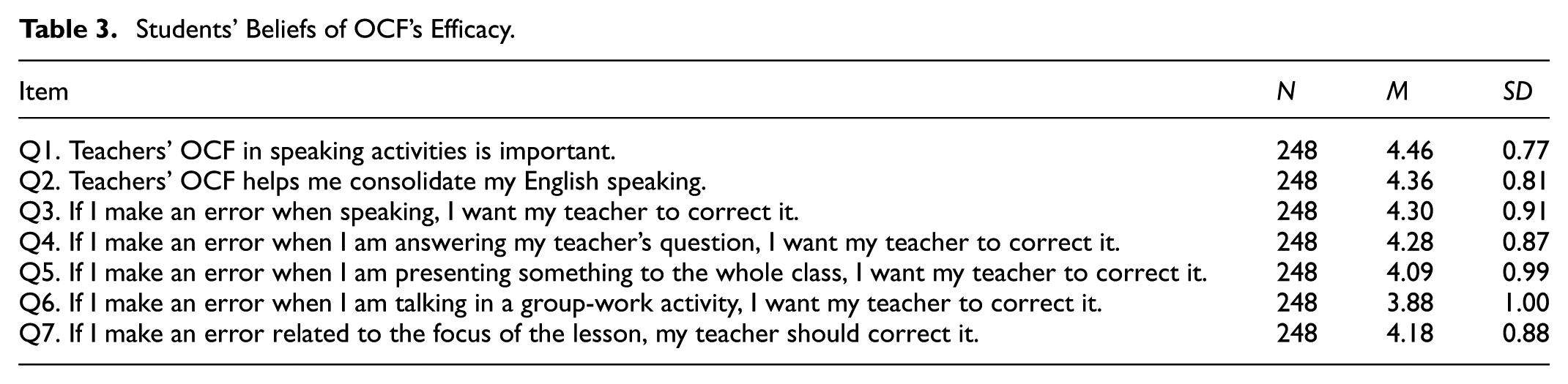
In general, students had highly positive attitudes toward teachers’ OCF with the mean scores ranging from 3.88 to 4.46 (Table 3). The highest mean scores, 4.46 (SD = .77) and 4.36 (SD = .81) of Q1 and Q2, respectively, showed that students valued OCF and appreciated its importance to their English speaking.
Students’ Beliefs of OCF’s Efficacy.
In the interviews with 40 students, all of them agreed that teachers’ OCF was essential and emphasized its contribution to their improvement and accuracy. For example, student 5 stated “OCF is important since my teachers have knowledge and competence to pinpoint my errors, so I can increase the level of accuracy in my speeches.”
As for interviews with teachers, similar results were obtained. All instructors considered OCF helpful because this approach helped students know “their strengths and weaknesses” so that their learning could be improved. Teacher 1’s remark illustrated this finding, “OCF helps students to understand how their performances are assessed. It also helps students to improve their speaking, especially accuracy.”
Feedback Timing
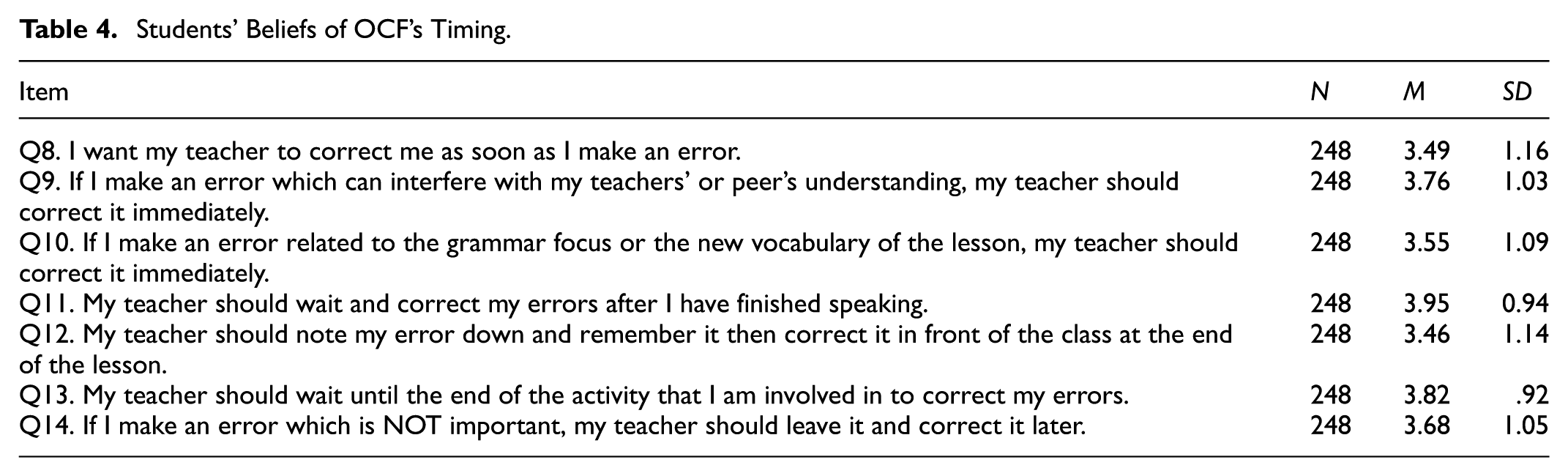
Table 4 shows that both delayed and immediate feedback were chosen by the students, but there was a prevalent inclination toward delayed feedback, particularly with the highest figures for Q11 (M = 3.95, SD = .94) and Q13 (M = 3.82, SD = .92). This signifies an expectation among students for their instructors to allow them to finish their utterances and tasks before feedback was given. With slightly lower mean scores, students also expressed a desire for immediate corrections of errors impeding comprehension (Q9, M = 3.76, SD = 1.03), and for delayed corrections of minor errors at the end of the lessons (Q14, M = 3.68, SD = 1.05).
Students’ Beliefs of OCF’s Timing.
In the interviews, a majority of the students (36/40) articulated a preference for delayed feedback due to concerns that immediate correction could adversely affect their emotional state because of potential interruptions. The remark of student 10 illustrated this point: I want to be corrected after my speaking turn so that I will not be interrupted and get confused. Only when I finish my ideas, teachers can know exactly whether I am correct or not to give feedback.
Nevertheless, a subset of students (11 out of 40) also considered immediate feedback to be acceptable when errors had the potential to lead to communication breakdowns. Student 6 confirmed this perspective: If the errors are so serious that they can impede understanding among listeners, teachers should interrupt students and correct the errors.
Analyses of the teachers’ interview data also revealed that more than half (11/20) preferred delayed feedback. Their rationale was articulated with consensus, emphasizing that providing feedback while students were in the midst of speaking could exert adverse effects on emotional states, performance, fluency, and time management. Illustrative comments from the teachers underscored this perspective: I wait until the students finish their speech to give OCF because interrupting them when they are speaking may affect their performance and confidence, and possibly cause negative feelings. (teacher 10)
The remaining number of the teachers (9/20) advocated for not only delayed feedback but also immediate feedback where errors could induce confusion or when a heightened emphasis on accuracy was prioritized. For example, teacher 4 said, “I usually correct errors that cause misunderstandings right away,” and teacher 5 commented, “Activities that prioritize accuracy will receive immediate feedback.”
Error Types
In Table 5, it is clear that major errors received greater attention than minor ones. Specifically, the question addressing the correction of common errors (Q15, M = 3.83, SD = .95) and errors related to lesson focus (Q16, M = 3.90, SD = .97) garnered the highest levels of agreement. With slightly lower mean values, there was a desire for teachers to focus on errors that did not impede understanding (Q17, M = 3.70, SD = .88), uncommon errors (Q18, M = 3.69, SD = .78), and errors not related to lesson focus (Q19, M = 3.55, SD = .87).
Students’ Beliefs of OCF’s Error Types.

These beliefs were also reflected in the interviews. The majority of the students (30/40) emphasized the importance of rectifying errors that significantly affected message delivery. This finding is demonstrated in student 4’s sharing, “Vocabulary, grammar, and pronunciation errors need correction as they impact audience comprehension.” However, they believed that minor errors including minor grammatical ones could be overlooked. For instance, student 1 elucidated, “I believe some grammatical errors such as adding s or es to plural nouns can be overlooked as they do not significantly impact comprehension.” On the other hand, a quarter of the participants (10/40) expressed an expectation for comprehensive error correction to prevent the recurrence of mistakes. Student 10 emphasized, “I expect my teachers to rectify all errors to prevent repetitive mistakes because I want my language to be as correct as possible. When I go to work, I will not make mistakes.”
Regarding teachers, the majority (15/20) believed that serious and common errors, particularly in pronunciation, word choice, ideas, and organization, should be addressed. Teacher 5 noted, “OCF is essential for repeated student errors, as these may ultimately lead to language fossilization.” They also explained that minor errors and grammatical mistakes should not be highlighted, as the main messages were still comprehensible. Teacher 4 elucidated, “I tend to overlook errors that do not impede the meaning that students are attempting to convey, as the primary purpose of the speech is to aid listeners in understanding the intended information.” Additionally, selective errors were preferred because four teachers expressed worries that too many corrections could detriment students’ efforts, motivation, and fluency, as demonstrated below: However, when teachers correct every error made by students, it can really demotivate students, especially low and shy students. Students can become hesitant in speaking. (teacher 7)
As for the remaining number of teachers, they expressed a flexible approach, contingent on the lesson’s focus. For instance, Teacher 2 remarked, “When teaching grammar or guiding students in English communication, I concentrate on the errors that are related to grammatical points or structures integral to the lesson.”
Feedback Types
The questionnaire’s results showed that students were generally inclined to implicit feedback. In Table 6, the mean scores of most questions were more than 3.50, expressing strong agreement among students. They preferred the integrated recasts the most when being corrected (Q25, M = 3.72, SD = .98), followed by explicit corrections (Q27, M = 3.70, SD = 1.05) and other recast types (Q23, M = 3.69, SD = .94 and Q24, M = 3.63, SD = 1.01).
Students’ Preferences for OCF Types.

In the interviews with 40 students, half answered that they preferred implicit feedback from their teachers because this feedback type allowed them to “recognize and correct their mistakes on their own” (student 8) and “review what they had learnt, understand the structure and therefore, they could remember the mistakes and the correct form longer” (student 15). Similarly, most teachers (15/20) endeavored to implicitly correct students’ errors before switching to explicit feedback. They argued that the former feedback type boosted self-recognition of errors, making students understand them and not commit the same mistakes in the future. Moreover, indirect OCF would not hurt students’ well-being. When correcting students’ errors, teachers frequently used clarification requests, metalinguistic cues, and repetitions, believing that these techniques could “elicit the errors in students’ utterances” (teacher 1).
The other half of the student interviewees opted for explicit feedback type as it “is not confusing, and it makes me easily see how my mistakes are corrected” (student 11). As for teachers (5/20), only when “students’ linguistic competence was low and could not recognize their own mistakes” (teacher 14) and “the class time was too limited” (teacher 7 and teacher 8), explicit feedback would be employed.
Do Vietnamese EFL Learners at Varying Proficiency Levels View OCF Differently in Terms of Feedback Efficacy, Timing, Error Types, and Feedback Types?
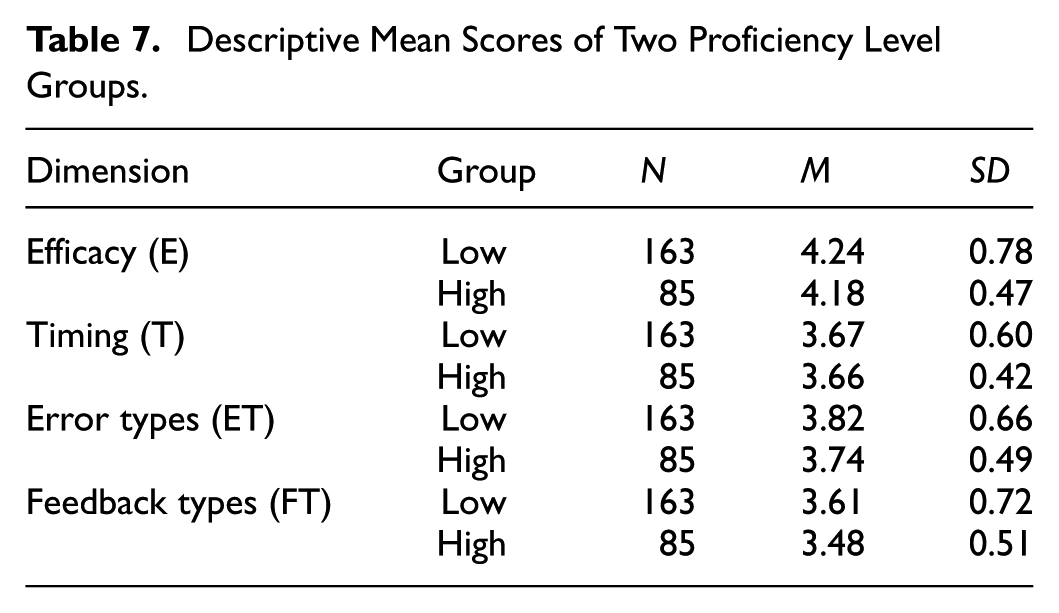
Tables 7 and 8 showed that HP and LP students had similar beliefs of OCF in terms of efficacy, timing, error types, and feedback types. Independent-samples t-tests revealed that the differences among the two groups were non-significant (all p values >.05). In other words, proficiency levels did not play a role in channeling students’ beliefs of OCF.
Descriptive Mean Scores of Two Proficiency Level Groups.
Results for Independent Samples t-tests.

Note. E = efficacy; T = timing; ET = error types; FT = feedback types.
Discussion
Do Vietnamese EFL Learners and Their Teachers View OCF Differently in Terms of Feedback Efficacy, Timing, Error Types, and Feedback Types?
Feedback Efficacy
It was found that there were considerable alignments between students’ and teachers’ beliefs in OCF’s significance and efficacy. Results from both the questionnaires and interviews revealed that OCF was necessary in English language teaching and learning for its positive impact on students’ improvement. This result is similar to the findings of Ha, Nguyen, et al. (2021), Zare et al. (2022), L. J. Zhang and Rahimi (2014), Zhu and Wang (2019), as well as Ye and Hu (2024), confirming that OCF is an indispensable part of foreign language learning and teaching, especially in the EFL context where these studies occurred. The cognitive-interactionist and sociocultural theories can provide support for the positive attitudes toward OCF efficacy. From a cognitive-interactionist perspective, OCF allowed students to realize their errors and aim to resolve these issues to achieve their communicative goals (Long, 1996; Swain, 1985). By noticing these errors, they were able to perform better in subsequent speaking tasks (Schmidt, 2001). From an SCT viewpoint (Storch, 2018; Vygotsky, 1978), teachers’ corrections were regarded as scaffolded assistance, helping learners to reach their potential ZPD and develop their interlanguage.
OCF Timing
Another notable finding lies in the preference for delayed feedback by both EFL students and teachers. Regarding students’ perspectives, they showed the most agreement for the statements that teachers should give them feedback after utterances and after the activities, at M = 3.95, and M = 3.82 respectively. Additionally, 36/40 student and 11/20 teacher interviewees favored delayed feedback in the interview since the learners’ speeches were not interrupted by their teachers’ comments. The findings were consistent with those by Ha, Nguyen, et al. (2021) and Nhac (2022) in which teachers advocated for delayed feedback to avoid adversely affecting students’ motivation and feelings. A recent study by Ye and Hu (2024) also demonstrated this congruence between students’ and teachers’ beliefs about delayed feedback.
However, the preferences of students in this study diverged from the immediate tendency reported by L. J. Zhang and Rahimi (2014) as well as Zhu and Wang (2019). One plausible explanation for this is that the current study’s participants (both non-English majors and English-major university students) leaned toward delay feedback because they tended to value fluency and intelligibility which played an important role in their courses’ speaking assessments. Meanwhile, the participants of the previous studies were non-English majors (L. J. Zhang & Rahimi, 2014; Zhu & Wang, 2019), and secondary school learners (Ha, Nguyen, et al., 2021) whose focus was placed on accuracy.
Error Types
A noteworthy outcome of the present study is the similarity between teachers’ and students’ preferences for error types. Both groups focused on addressing significant and recurring errors that had a substantial impact on comprehension. The statements associated with common errors garnered the most agreement (Q15 with M = 3.83, and Q16 with M = 3.90). The majority of the participants (30/40 students and 15/20 teachers) also preferred common and important errors that can hinder the intelligibility of utterances. There were two possible explanations for these results. First, students’ choice of error types, as reflected in previous studies (J. Zhang et al., 2022; L. J. Zhang & Rahimi, 2014), is consistent with their fluency-centeredness mentioned earlier. As for teachers, concerns about students’ being overwhelmed by too much feedback induced them to perform error corrections selectively, which is echoed in studies by Argüelles et al. (2019) as well as Ha and Murray (2023). Second, time-consumption might also be the reason why selective corrections were preferred by both groups (Nhac, 2022).
Nevertheless, some students expressed a different viewpoint from their teachers. In the current study, 10 student interviewees chose to have comprehensive corrections as they had a desire to deliver correct speeches and avoid as many mistakes as possible, which could be important for their future work performance. This preference is also recorded in the study by Zhu and Wang (2019), which reported that 69.3% of international students studying Chinese expected most or all errors to be corrected. High-stakes examinations (Ye & Hu, 2024) or fear of error fossilization (Weekly et al., 2022) may account for such a favor of corrections.
Feedback Types
Teachers’ and students’ preferences for feedback types parallel, reflected in both questionnaires and interviews. However, within each group, disparities were found. On the one hand, the two groups believed that indirect correction brought long-term educational benefits to students including knowledge consolidation and improvement. Teachers also added that implicit feedback did not embarrass students the way explicit feedback might. This finding does not align with Ha, Nguyen, et al. (2021)’s study results in which both teachers and students leaned toward explicit OCF. It is most likely that the learning context can influence participants’ partiality. At tertiary education (as in this present study), students would like to have a firm progress in language acquisition for their study and profession later, and teachers would like to assist learner autonomy and proactive approach by using prompts, questions, etc. rather than immediately giving correct forms. This is supported by other scholars’ studies which pointed out that teachers of secondary education usually provided feedback more explicitly than teachers of higher education (Ha & Murray, 2023; Tarigan et al., 2023).
On the other hand, half of the student participants in the current study also favored explicit corrections, which is in accordance with the findings previous studies such as Al-Faki and Siddiek (2013), Bao and Wang (2023); Ha, Nguyen, et al. (2021), Muslem et al. (2021), L. J. Zhang and Rahimi (2014), and J. Zhang et al. (2022). The reason behind this similarity lies in the explanation that explicit corrections were more straightforward and easier to understand for EFL students (Muslem et al., 2021). Regarding teachers, they also employed explicit corrections when students could not correct the errors or when time was limited. Although students and teachers opted for explicit corrections based on different grounds, this alignment suggests that this feedback technique should be maintained.
Do Vietnamese EFL Learners at Varying Proficiency Levels View OCF Differently in Terms of Feedback Efficacy, Timing, Error Types, and Feedback Types?
It was found that varying proficiency levels did not significantly affect students’ beliefs about OCF’s efficacy, timing, types, and error types. Specifically, all LP and HP students appreciated the OCF’s benefits to their understanding of their strengths and weaknesses, hence improving their speaking abilities. This result aligns with previous studies (Ha, Nguyen, et al., 2021; Zare et al., 2022; L. J. Zhang & Rahimi, 2014; Zhu & Wang, 2019). As defined by Ellis et al. (2006) and Lyster et al. (2013), OCF is used to improve students’ speeches by pointing out or correcting their mistakes. This is probably why it is appreciated by students regardless of their linguistics competence. As for timing, the preferences among LP and HP students gravitated toward delayed feedback. Similar to participants of Nhac (2022) and Sakiroglu (2020), the participants in the current study claimed immediate feedback could distract them and caused embarrassment.
Regarding error types, both LP and HP students asserted that instructors should prioritize addressing major and substantial errors that impeded comprehension. This finding parallels the conclusions drawn in the studies conducted by Muslem et al. (2021), Bao and Wang (2023), Nhac (2022), L. J. Zhang and Rahimi (2014), and J. Zhang et al. (2022) in which the main purpose of speaking is to deliver messages, meaning that minor errors which do not affect meaning can be overlooked. However, this result contrasts the study by Ye and Hu (2024) in which high-achieving learners preferred all errors to be corrected. The difference can be attributed to contextual factors; that is, the current study’s participants valued fluency while HP learners in Ye and Hu (2024) were exam-oriented, focusing on accuracy. Such a disparity underscores the importance of taking contexts into consideration when examining OCF (Bui & Vo, 2024).
In terms of feedback types, varying English proficiency levels do not influence students’ choice of OCF implicit types. This result contrasts the study by Muslem et al. (2021) in which high and low-achieving participants preferred explicit corrections for its straightforwardness and intelligibility. The discrepancy could be due to learners’ autonomy, highlighting the need to take individual factors into account (Gass & Lewis, 2007). The students in the current study may have higher autonomy than those in Muslem et al. (2021). However, as both studies did not examine learner autonomy, further research is warranted to shed greater light on this difference.
Overall, we found that students’ and teachers’ beliefs about OCF were consistent regarding the efficacy and timing of this approach. However, findings concerning feedback types and error types were only partially aligned. Therefore, teachers should adapt their feedback beliefs and practices in accordance with students’ expectations to help learners enhance their L2, as emphasized by Ellis (2008) and Bui and Vo (2024). Indeed, Ha (2022b) reported that Vietnamese EFL teachers changed their OCF strategies after being informed of their students’ beliefs, which could meet learners’ needs. Notably, feedback timing and types should not be viewed separately, but should be considered alongside error types because different types of errors could trigger different expectations for feedback timing and types. For example, Nhac (2022) found that delayed feedback was preferred by the participants but errors that impeded communication should be corrected immediately. Regarding students’ proficiency levels, although there were no significant differences obtained between HP and LP learners, this finding should be interpreted with caution. That is, similar beliefs might not necessarily mean that these expectations were correct. Instead, contextual (e.g., lesson focus, classroom size) and individual (e.g., learner autonomy, ages) factors should be taken into careful consideration (Bui & Vo, 2024; Gass & Lewis, 2007) when delivering OCF.
Pedagogical Implications
This study offers several important pedagogical implications for English language teaching and learning. First, since there are misalignments between teachers and students regarding preferences for feedback and error types, teachers are recommended to discover their students’ beliefs as soon as possible and try to modify their OCF delivery accordingly. This is because incongruence between students’ and teachers’ beliefs may result in negative impact on language learning (Roothooft & Breeze, 2016). Second, teachers should take students’ ZPD, which is crucial for their L2 development (Storch, 2018; Vygotsky, 1978) into consideration since different students may have different ZPD (Aljaafreh & Lantolf, 1994). Notably, ZPD should also be viewed alongside other aspects such as feedback types and context. For example, if a student repeats the same mistake multiple times, it may mean that the learner cannot fully understand why it is incorrect. In this case, teachers can try to provide explicit feedback first, before implementing more implicit one. Additionally, if the focus of the lesson is on fluency, delayed feedback should be preferred. Third, although students at different proficiency levels exhibit similar OCF beliefs, it does not equate with the notion that these beliefs are correct. Instead, teachers can focus on tailored feedback for individual needs. For instance, low-proficiency students may require more immediate and explicit feedback to avoid fossilizing errors, while high-proficiency students might benefit more from implicit feedback to promote autonomy (Ye & Hu, 2024).
Limitations and Recommendations for Future Research
Insightful as it is, the current study is still limited in some ways. The first limitation is that teachers’ beliefs were collected through interviews only with a small number of participants; this might limit the generalizability of the results. Therefore, future studies can generate data from a questionnaire with a larger sample of teachers to assure statistical power. Secondly, although the present study aimed to compare the perspectives of students at different proficiency levels, there was a discrepancy in the participant quantity of HP and LP groups. Size gap can be a confounding factor in data analysis; consequently, it is recommended that future researchers recruit an equal number of participants for different groups. Finally, as Ha, Murray, et al. (2021; Ha, Nguyen, et al., 2021) underscored, the complexity and dynamics of participants’ beliefs cannot be well-grasped through one-shot questionnaires and interviews. Thus, subsequent researchers can employ a longitudinal approach, combined with diary writing and serial follow-up interviews, to comprehensively uncover the dynamism of OCF beliefs.
Conclusion
The current study aimed to examine the perspectives of both EFL teachers and students regarding the significance of OCF and their preferences concerning the timing, error types, and forms of feedback. While both groups of participants expressed favorable attitudes toward OCF efficacy and preferences for delayed feedback, corrections of major and severe errors, and implicit feedback, disparities emerged in relation to error and feedback types. Furthermore, while most previous studies did not take the role of different proficiency levels into account, the present research delved into this topic and found that proficiency levels might not have a significant impact on EFL learners’ OCF beliefs. These insights provide valuable implications for refining OCF practices in EFL settings, emphasizing the importance of considering both teacher and student perspectives in the feedback process. Hopefully, when students’ and teachers’ beliefs are better aligned, the provision of OCF by teachers is more likely to address students’ needs effectively, potentially resulting in greater learning gains.
Footnotes

Ethical Considerations
All participants voluntarily provided written informed consent to partake in this study. Research approval was granted by FPT University (QĐ669/ĐHFPT).
Funding
The authors received no financial support for the research, authorship, and/or publication of this article.
Declaration of Conflicting Interests
The authors declared no potential conflicts of interest with respect to the research, authorship, and/or publication of this article.
Data Availability Statement
Available upon reasonable request.