




Abstract
This study investigates how poll-based emotion consensus messaging influences American support for various policies during the 2022 Russian invasion of Ukraine, with an aim to unpack the cognitive-emotional mechanisms behind this influence. Employing a between-subjects factorial experiment with a national sample of U.S. adults (N = 1,087), the research method involved randomly assigning participants to one of five consensus message conditions: seriousness, anger, sadness, anxiety, or control. The results demonstrated that emotion consensus messaging indirectly influenced policy support through a sequential process: first, by shaping perceived emotion consensus, and then by altering individual emotional responses. Specifically, anger consensus messaging increased support for punitive policies, sadness for humanitarian aid, and anxiety for risk-averse options like concessions. In line with the heuristic-systematic model, this study revealed that the influence of consensus messaging was moderated by perceived issue importance, with significant effects observed primarily among participants who considered the issue to be of low importance. This study concludes that poll-based emotion consensus messaging can indirectly shape public policy support, particularly when the issue at hand is not deemed critical by the audience.
Introduction
Opinion polls are a fundamental tool within democratic societies, capturing the pulse of public sentiment on key social and political issues. Their integration into the fabric of media reportage has been bolstered by advances in polling methodologies and the advent of data-driven journalism, heightening their influence on public discourse and decision-making (Larsen & Fazekas, 2021). The significance of opinion polls extends beyond mere descriptors of public opinion, influencing behaviors and attitudes in both electoral and non-electoral realms (Moy & Rinke, 2012). Notwithstanding their recognized import, academic inquiry into the emotional ramifications of these polls—how they communicate and stir collective emotions within the electorate—remains surprisingly scant (Neyazi & Kuru, 2022). This lacuna in research restricts our comprehensive understanding of opinion polls, notably underestimating their potential to elicit a spectrum of emotional reactions and the consequent sway on behavior (Neyazi & Kuru, 2022; Niedenthal & Ric, 2017).
This study seeks to address this gap by incorporating established frameworks from the realms of social norms (Cialdini & Goldstein, 2004), appraisal theories of emotion (Lazarus, 1991), political and science communication (Moy & Rinke, 2012; van der Linden, 2021), and the heuristic-systematic model (HSM; Chaiken, 1987). The research is anchored by four principal objectives, each serving to illuminate a different facet of the relationship between opinion polls and public perception. Firstly, this study will examine the cognitive and emotional pathways through which consensus messaging within published poll results shapes policy support. Secondly, it will dissect the direct and indirect effects of collective emotions conveyed in polls—referred to herein as emotion consensus messaging—on policy attitudes. Thirdly, it will delineate the impact of varied emotional content (specifically, messages of anger, sadness, and anxiety) on policy support, considering the differential cognitive appraisals associated with these emotions. Finally, it aims to segment audiences based on their perceived issue importance, analyzing the variegated effects of emotion consensus messaging across these segments.
The necessity for this investigation is underscored by the recent geopolitical conflict—specifically, the 2022 Russian invasion of Ukraine—which has captured global attention and generated a multitude of emotion-laden opinions. This pivotal event provides a contemporary and urgent context to assess the potency and nuances of opinion polls’ emotional impact. By addressing the outlined knowledge gap, this research intends to refine the strategic use of opinion polls in shaping public policy support. Ultimately, it aspires to deliver insights that can aid media practitioners and policymakers in crafting and disseminating poll-based messages that not only inform but also resonate emotionally, fostering well-timed and decisive policy responses in times of international crises.
Theoretical Background
Public Opinion Polls and Consensus Messaging
Research has shown that public opinion polls impact various aspects of social life, from voting behavior to civic participation. However, the influence of these polls is not always straightforward; they can sometimes have contradictory effects (Moy & Rinke, 2012). These polls are especially crucial in societies where people rely on media to understand public sentiment, as they play a role in shaping societal views and reinforcing democratic values (Mutz, 1998).
The heuristic-systematic model (HSM; Chaiken, 1987) proposes two ways people process information: either heuristically, which is quick and requires little effort, or systematically, which is more deliberate and detail-oriented. When it comes to opinion polls, people may take time to thoughtfully consider the majority opinion shown in the poll, or they may use it as a quick gauge of what most people think, based on heuristic cues (Darke et al., 1998). These majority opinions in polls serve as a form of consensus messaging that has been proven to shape public attitudes in various situations (Cialdini & Goldstein, 2004; Darke et al., 1998).
Despite the knowledge about these effects, there lacks comprehensive models that explain how people process opinion polls and how these influence their beliefs and behaviors. The Gateway Belief Model (GBM) by van der Linden (2021) does offer a step-by-step explanation of how scientific consensus affects policy support, suggesting that this process is usually indirect, shaped by both thinking and feeling, and often heuristic because it does not explicitly persuade. Notably, applying this model to non-scientific polls—like those on public opinion—needs some adaptation since it involves different levels of authority perception and relatability in terms of the referent group compared to scientific consensus (Lu, 2023).
Emotion Consensus Messaging
Opinion polls do more than just reflect what people think; they also capture how people feel. Emotion consensus messaging, a term used for poll results that communicate public emotions (Sabherwal et al., 2021), often does not get as much attention as traditional opinion polling, even though it frequently appears in the media (e.g., Quinnipiac University Poll, 2022). This oversight might be due to a common belief that emotions are less rational than opinions (Niedenthal & Ric, 2017), which could lessen their perceived significance in polls. Yet, emotions have a powerful effect; they spread easily among people, especially within groups, and can shape decision-making significantly (Hatfield et al., 1993; Niedenthal & Ric, 2017). This dual nature of emotions as both contagious and influential means that there is a need to look more closely at how emotion consensus messaging affects public and political life.
Previous research into the impact of such messaging on policy support has produced mixed results. Sabherwal et al. (2021) found that anger had a direct effect on policy support, while Lu (2023) suggested this influence is indirect, going through people’s perception of the consensus and their emotional responses. These conflicting findings, along with the focus on a narrow range of emotions and contexts, signal a gap in our understanding. These prior studies have often centered on scientific or environmental issues and on the emotion of anger, which is known to drive action (van Doorn et al., 2014). This leaves open questions about other more socially or politically charged contexts, which might be potentially more emotion-laden, and other emotions, like sadness, which might motivate people differently. Additionally, how these emotions interact with various policy issues and whether they affect all individuals in the same way have not been fully explored.
Anger, Sadness, and Anxiety
The present study seeks to bridge these gaps by utilizing the appraisal theories of emotion (Lazarus, 1991). It focuses on anger, sadness, and anxiety because these emotions are distinct in how they arise and influence behavior. Anger often follows when people feel personally attacked, leading to actions that aim to punish or correct (Lazarus, 1991). Sadness usually comes from loss and can result in withdrawal, yet it may also spark an urge to help others (Fultz et al., 1988; Lazarus, 1991). Anxiety arises in the face of uncertain threats and can lead to behaviors aimed at avoiding risk (Lazarus, 1991).
Previous findings have shown that these emotions have specific effects: anger can drive people to support punitive actions and be less willing to help victims, while sadness can lead to greater willingness to aid (Kühne & Schemer, 2013; Small & Lerner, 2008). Anxiety is known to make people more cautious and prefer actions that reduce risks (Lerner & Keltner, 2000; Raghunathan & Pham, 1999). For example, in the context of terrorism, anxiety has been linked to a preference for negotiation over aggressive military responses (Iyer et al., 2014; Lambert et al., 2010; Skitka et al., 2006). Despite this understanding, there is a lack of research comparing how these three emotions, when communicated through opinion polls, might differently impact public policy preferences. This study intends to address this gap, exploring how poll-based emotion consensus affects public support for various policy actions.
Motivation to Process as a Moderator
People’s reactions to opinion polls can be shaped by various personal factors (Moy & Rinke, 2012). One key factor is their motivation to process the information. The HSM assumes that people either process information through a quick, heuristic route or a slower, more systematic one (Chaiken, 1987). Which route people take often depends on how motivated and able they are to engage with the information (Chaiken, 1987). When either motivation or ability is low, people tend to rely on heuristic processing as their default mode (Chaiken & Ledgerwood, 2011). This is also observed in how people react to polls: if they have low processing motivation—stemming from factors like low issue commitment or personal relevance—they are more likely to take poll results at face value and gravitate toward the consensus cues presented in the polls without much scrutiny (Darke et al., 1998; Kang, 1998). However, when it comes to the ability to process, such as understanding polling methods or having political knowledge, the influence on how polls are interpreted is not as clear (Kang, 1998).
This research steps into new ground by focusing on how motivation to process affects reactions to polls that communicate emotions, not just beliefs. It operationalizes motivation as perceived issue importance—essentially, how important people think the issue is (Chaiken & Ledgerwood, 2011). Given that emotions can be seen as both less rational and more contagious than beliefs (Hatfield et al., 1993; Niedenthal & Ric, 2017), this study aims to find out if people’s motivation changes their response to emotion-driven consensus messages, compared to belief-oriented ones.
The Present Study and Hypotheses
This study examines how American reactions to the 2022 Russian invasion of Ukraine might be influenced by different types of consensus messaging in opinion polls. The invasion, which began on February 24, 2022, led to a major refugee crisis and significant civilian casualties. Several factors informed the choice of this context for investigation. The invasion has been a subject of intense media coverage and numerous public opinion polls, offering an opportunity to study a current and high-profile international issue (e.g., Ipsos, 2022; Quinnipiac University Poll, 2022; YouGov/The Economist poll, 2022). Notably, American views on the invasion have been less divided compared to other contentious issues like climate change or abortion (Quinnipiac University Poll, 2022). This lack of polarization may amplify the influence of majority opinions on policy support. Additionally, the physical distance of the conflict from the U.S. suggests that American perceptions of the event and its emotional impact could vary widely. Finally, media representations of the invasion are stirring a range of emotions and actions—from anger and calls for punitive actions against Russia to sadness for Ukrainian refugees, prompting calls for aid, and anxiety that may favor negotiations over military responses (e.g., Ipsos, 2022; YouGov/The Economist poll, 2022). An array of U.S. public opinion polls have specifically highlighted the public’s emotional response to the invasion, thus enhancing this study’s ecological validity (e.g., Ipsos, 2022; Quinnipiac University Poll, 2022; YouGov/The Economist poll, 2022).
This study aims to test a theoretical model shown in Figure 1a, with Figure 1b offering an operational depiction. It not only examines the effects of emotion consensus conditions like anger, sadness, and anxiety but also includes a condition for measuring how serious people think a situation is for comparison. This setup allows for an analysis of whether messages that convey emotional agreement might be more influential than those that simply reflect a general agreement on the seriousness of an issue. Given the plausible correlations between perceived seriousness and the feelings of anger, sadness, and anxiety, Figure 1b lays out all possible relationships between how serious people think an issue is and their emotional reactions.

(a) Proposed theoretical model. (b) Proposed theoretical model operationalized in the current study.
According to the GBM framework (van der Linden et al., 2019), this study suggests that emotion consensus messages are expected to most strongly influence people’s perception of how widespread these emotions are. This perceived agreement on emotions then leads to changes in how serious people think the situation is and their emotional reactions, eventually affecting their support for certain policies. This study anticipates that the effect of messages conveying emotional agreement on policy support will mostly be indirect, particularly because these messages are brief and come at a time when the public is already highly aware of the issue. Additionally, this study suggests that how important people think the issue is will also play a role in shaping the influence of emotion consensus messages on policy support.
In summary, based on the review so far, it is predicted that:
Method
Participants
This study was approved by the Institutional Review Boards at the University of Michigan. From March 23rd to March 25th, 2022, a national sample of U.S. adults (N = 1,100) was recruited based on the census-matched (i.e., sex, age, and race and ethnicity), cross-stratified quota sampling strategy adopted by Prolific (Palan & Schitter, 2018), an online participant recruitment platform. These participants received 1.59 U.S. dollars for participating in this study. After removing 10 participants who failed to answer correctly one of two attention check questions and 3 participants who had missing data on key variables, the final sample size for analyses became 1,087. This study lasted for 14.55 minutes (SD = 7.14). Of these participants, 48.5% were male, 49.9% were female, 0.6% were transgender and 1.1% were other gender types. The average age was 45.59 (SD = 16.15) and the median education level was a bachelor’s degree. The median annual household income was between $50,000 and $74,999. The distribution of the racial or ethnic background was: White 73.7%, Black 13.1%, Asian 6.8%, Hispanic or Latino 4.0%, American Indian or Alaska Native 0.5%, Other 1.7%, and 0.4% preferred not to answer.
Procedure and Stimuli
Following informed consent, participants completed a questionnaire regarding their personality traits and the perceived relevance of various social issues. They were then informed that they would be shown a public opinion poll conducted by a reputable survey company and instructed to carefully review the poll results. Participants were randomly assigned to view one of five consensus messages (control vs. seriousness vs. anger vs. sadness vs. anxiety) on a separate page. In all conditions, participants viewed a line graph depicting a progressive increase from 67% on February 26th to 80% on March 20th (see Supplemental Materials for full message stimuli). Previous research has demonstrated that dynamic consensus messaging, such as the one employed in this study, is more effective in inducing conformity among viewers compared to static majority depictions (Sparkman & Walton, 2017). The percentages used were based partly on real-world statistics indicating the proportion of Americans concerned or stressed about Russia’s invasion of Ukraine (American Psychological Association, 2022; YouGov/The Economist poll, 2022).
In the seriousness condition, the graph was titled “Percentage of Americans who think Russia’s invasion of Ukraine is a very serious issue.” In contrast, this title was “…who feel very angry about …” in the anger condition, “… who feel very sad about …” in the sadness condition, and “… who feel very anxious about …” in the anxiety condition. For participants in the control condition, the graph depicted the increasing trend of Americans dining out at restaurants. It is important to note that the seriousness condition was utilized to isolate the effects of emotion in emotion consensus messaging, while the control condition served as an information-irrelevant condition, presenting participants with the same graph but with a different topic title and description.
To strengthen participants’ engagement with the line graph, an elaboration prompt followed immediately on a separate page (Sabherwal et al., 2021). Participants were asked to provide reasons for why most Americans thought, felt, or acted in accordance with the displayed line graph. Finally, participants proceeded to answer questions that assessed the variables described in the following section.
Measures
Perceived Issue Importance
Before exposure to the line graph, participants were asked on a 5-point scale (1 = Not at all to 5 = A great deal) how important to them was each of three different issues (i.e., COVID-19 pandemic in India, gun violence in the U.S., and Russia’s invasion of Ukraine). Three issues were presented to participants to disguise the focal issue and reduce concerns about demand characteristics (adapted from Lu & Yuan, 2022). Understandably, gun violence in the U.S. (M = 3.85, SD = 1.10) was perceived as most important, followed by Russia’s invasion of Ukraine (M = 3.71, SD = 1.17) and COVID-19 pandemic in India (M = 2.44, SD = 1.17).
Perceived Consensus
To measure perceived seriousness consensus, participants were asked, “To the best of your knowledge, what percentage of Americans think Russia’s invasion of Ukraine is a very serious issue?” (M = 78.88, SD = 15.27). Similar wording was used to measure perceived anger consensus (i.e., “… feel very angry about…”) (M = 71.46, SD = 18.75), perceived sadness consensus (i.e., “… feel very sad about…”) (M = 74.70, SD = 18.03), and perceived anxiety consensus (i.e., “… feel very anxious about…”) (M = 69.15, SD = 19.19). These questions were adapted from Sabherwal et al. (2021) and presented in a randomized order. Participants responded by using a slider that went from 0 to 100.
Perceived Seriousness
Participants were asked to indicate on a 5-point scale (1 = Not at all to 5 = A great deal) how serious an issue they thought Russia’s invasion of Ukraine was (M = 4.46, SD = 0.86).
Emotions
Participants were asked how much they felt a range of emotions on a 5-point scale (1 = Not at all to 5 = A great deal) when they thought of Russia’s invasion of Ukraine. Anger was measured as angry, outraged, and enraged (M = 3.41, SD = 1.27; α = .93; Sabherwal et al., 2021), sadness as sad, downhearted, and depressed (M = 3.13, SD = 1.15; α = .85; Lu, 2016), and anxiety as anxious, afraid and nervous (M = 2.87, SD = 1.19; α = .92; Huddy et al., 2021).
Policy Support
Participants were asked how much they favored or opposed a list of policies or actions proposed to handle Russia’s invasion of Ukraine on a 5-point scale (1 = Strongly oppose to 5 = Strongly favor). Five items (M = 3.63, SD = 0.97; α = .83) corresponded to sanctions (e.g., “Keeping strict economic sanctions on Russia”), two items (M = 2.52, SD = 1.24; rSB = .80) represented U.S.’s military actions (e.g., “Sending soldiers to Ukraine to fight Russian soldiers”), five items (M = 3.99, SD = 0.87; α = .81) measured actions to help Ukraine or Ukrainians (e.g., “Admitting thousands of Ukrainian refugees into the U.S.”), two items (M = 3.89, SD = 1.00; rSB = .64) were related to peace talks (e.g., “Seeking peace talks with Russia”), and three items (M = 1.83, SD = 0.87; α = .75) exemplified concessions (e.g., “Avoiding further foreign conflict by agreeing to Russia’s demands”). These policy or action items were created based on items used in public opinion polls assessing American public’s opinions on Russia’s invasion of Ukraine (e.g., Ipsos, 2022; YouGov/The Economist poll, 2022). The full list of policies is provided in Supplemental Materials.
Analytic Procedure
Structural equation modeling (SEM) with a maximum likelihood estimator in Mplus 8.7 was used to test the proposed theoretical model and hypotheses. Mediation analyses were performed using the MODEL INDIRECT command with 5,000 bootstrap samples and 95% bias-corrected confidence intervals (CIs), assessing conventional indirect effects (i.e., products of regression coefficients; Hayes, 2017). Four dummy variables were created for the experimental conditions with the control condition coded as −1 (i.e., the reference group), and seriousness, anger, sadness, and anxiety consensus conditions as 1 in their respective dummy variable and as 0 in the other three dummy variables. Two SEM models were constructed. In the first model that focused on the effects of the experimental conditions (Model 1), these four dummy variables served as the exogenous variables. In the second model that examined the moderating role of perceived issue importance (Model 2), the four dummy variables, perceived issue importance, and their two-way interaction served as the exogenous variables. In both models, perceived seriousness, anger, sadness and anxiety consensus, perceived seriousness, anger, sadness, anxiety, and support for the five different types of policies served as the endogenous variables. Their placement in the models matched what is shown in Figure 1b. In addition to the paths shown in Figure 1b, there were also direct paths from the exogenous variables to perceived seriousness, anger, sadness, anxiety and support for the five types of policies, and from the four perceived consensus variables to support for the five types of policies. Notably, anger, sadness and anxiety, and support for the five types of policies were treated as latent variables, while the rest were observed variables. The error terms of four perceived consensus variables were covaried. In addition, the error terms of perceived seriousness, anger, sadness and anxiety, and of the five types of policy support were covaried. Finally, to improve model fit, the error terms of a few indicators of the same emotion, and of the same type of policy support were also covaried.
Results
Figure 2 presents the results from Model 1. This model showed good model fit (Kline, 2016): χ2(422) = 1,425.88, p < .001, RMSEA = .047 (90% CI [0.044, 0.049]), CFI = .951, SRMR = .042. Model 1 explained 49.2% of sanction support, 13.5% of military action support, 53.7% of helping support, 5.5% of peace talk support, and 35.0% of concession support. Figure 3 presents the results from Model 2. This model also showed good model fit (Kline, 2016): χ2(512) = 1,547.34, p < .001, RMSEA = .043 (90% CI [0.041, 0.046]), CFI = .951, SRMR = .038. Model 2 explained 49.6% of sanction support, 13.9% of military action support, 54.6% of helping support, 6.7% of peace talk support, and 35.3% of concession support.
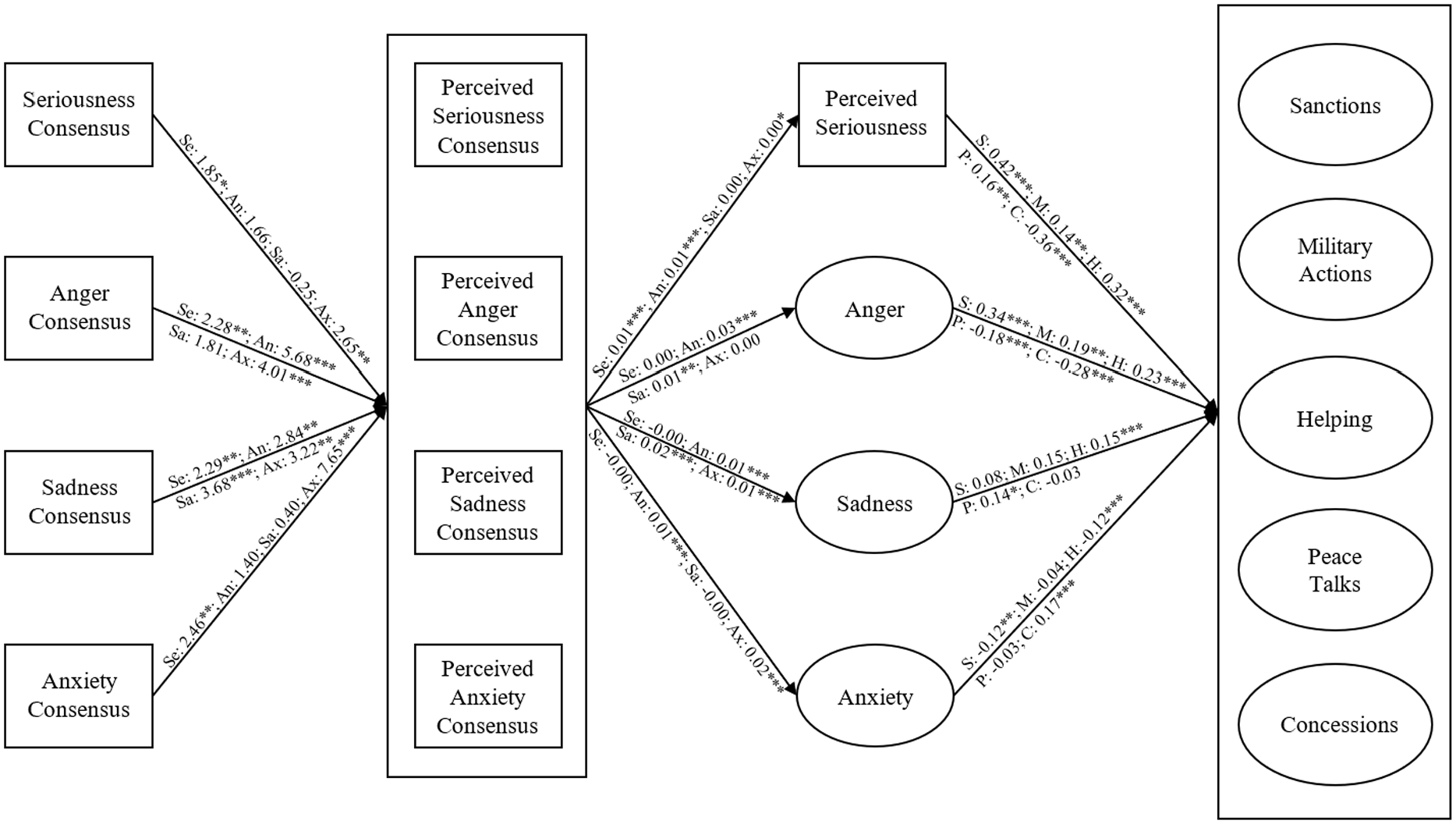
Structural equation modeling results (Model 1).

Structural Equation Modeling Results (Model 2).
A few relationships involving two-way interaction effects from Figure 3 need additional descriptions. First, there was a significant two-way interaction between the seriousness condition and perceived issue importance on perceived seriousness consensus and perceived seriousness, respectively. Specifically, as perceived issue importance increased, the significant difference between the seriousness and the control conditions decreased for both perceived seriousness consensus (M−1SD: B = 3.18, SE = 0.98, p = .001; M: B = 1.53, SE = 0.68, p = .025; M+1SD: B = −0.12, SE = 0.94, p = .894) and perceived seriousness (M−1SD: B = −0.15, SE = 0.05, p = .002; M: B = −0.04, SE = 0.03, p = .255; M+1SD: B = 0.07, SE = 0.04, p = .100), eventually becoming non-significant. Second, there was a significant two-way interaction between the anger condition and perceived issue importance on perceived anger consensus. Specifically, as perceived issue importance increased, the significant difference between the anger and the control conditions decreased, eventually becoming non-significant (M−1SD: B = 9.05, SE = 1.15, p < .001; M: B = 5.55, SE = 0.82, p < .001; M+1SD: B = 2.04, SE = 1.16, p = .079). Third, there was a significant two-way interaction between the sadness condition and perceived issue importance on perceived sadness consensus. Specifically, as perceived issue importance increased, the significant difference between the sadness and the control conditions decreased, eventually becoming non-significant (M−1SD: B = 6.51, SE = 1.11, p < .001; M: B = 3.60, SE = 0.81, p < .001; M+1SD: B = 0.70, SE = 1.15, p = .543). Finally, there was a significant two-way interaction between the anxiety condition and perceived issue importance on perceived seriousness consensus, perceived anger consensus, perceived anxiety consensus, and support for helping. Specifically, as perceived issue importance increased, the significant difference between the anxiety and the control conditions decreased for perceived seriousness consensus (M−1SD: B = 4.07, SE = 0.94, p < .001; M: B = 2.44, SE = 0.68, p < .001; M+1SD: B = 0.82, SE = 0.98, p = 0.404), perceived anger consensus (M−1SD: B = 3.59, SE = 1.13, p = .001; M: B = 1.38, SE = 0.82, p = .091; M+1SD: B = −0.84, SE = 1.17, p = .472), perceived anxiety consensus (M−1SD: B = 10.84, SE = 1.15, p < .001; M: B = 7.58, SE = 0.83, p < .001; M+1SD: B = 4.32, SE = 1.19, p < .001), and support for helping (M−1SD: B = −0.09, SE = 0.04, p = .037; M: B = −0.01, SE = 0.03, p = .738; M+1SD: B = 0.07, SE = 0.04, p = .108), eventually becoming non-significant in most cases. Based on these findings,
Below, the specific interaction patterns of a few indirect effects are mentioned (see Supplemental Materials for all indirect effects). First, the indirect effects of the anger condition moderated by perceived issue importance through perceived anger consensus and then anger on all five types of policy support were significant. Specifically, as perceived issue importance increased, the indirect effects of the anger condition on sanctions (M−1SD: B = 0.07, SE = 0.02, 95% CIs [0.04, 0.11]; M: B = 0.04, SE = 0.01, 95% CIs [0.03, 0.07]; M+1SD: B = 0.02, SE = 0.01, 95% CIs [0.00, 0.04], military actions (M−1SD: B = 0.04, SE = 0.02, 95% CIs [0.02, 0.08]; M: B = 0.03, SE = 0.01, 95% CIs [0.01, 0.05]; M+1SD: B = 0.01, SE = 0.01, 95% CIs [0.00, 0.03], helping (M−1SD: B = 0.05, SE = 0.01, 95% CIs [0.03, 0.08]; M: B = 0.03, SE = 0.01, 95% CIs [0.02, 0.05]; M+1SD: B = 0.01, SE = 0.01, 95% CIs [0.00, 0.02]), peace talks (M−1SD: B = −0.04, SE = 0.01, 95% CIs [−0.08, −0.02]; M: B = −0.03, SE = 0.01, 95% CIs [−0.05, −0.01]; M+1SD: B = −0.01, SE = 0.01, 95% CIs [−0.03, −0.00]), and concessions (M−1SD: B = −0.06, SE = 0.01, 95% CIs [−0.10, −0.04]; M: B = −0.04, SE = 0.01, 95% CIs [−0.06, −0.02]; M+1SD: B = −0.01, SE = 0.01, 95% CIs [−0.03, −0.00]) all decreased. Second, the indirect effects of the sadness condition moderated by perceived issue importance through perceived sadness consensus and then sadness on support for helping were significant. Specifically, as perceived issue importance increased, the indirect effects of the sadness condition decreased (M−1SD: B = 0.01, SE = 0.00, 95% CIs [0.01, 0.03]; M: B = 0.01, SE = 0.00, 95% CIs [0.00, 0.02]; M+1SD: B = 0.00, SE = 0.00, 95% CIs [−0.00, 0.01]). Third, the indirect effects of the anxiety condition moderated by perceived issue importance through perceived anxiety consensus and then anxiety on sanctions, helping and concessions were significant. Specifically, as perceived issue importance increased, the indirect effects of the anxiety condition on sanctions (M−1SD: B = −0.03, SE = 0.01, 95% CIs [−0.05, −0.01]; M: B = −0.02, SE = 0.01, 95%CIs [−0.03, −0.01]; M+1SD: B = −0.01, SE = 0.00, 95% CIs [−0.02, −0.00]), helping (M−1SD: B = −0.03, SE = 0.01, 95% CIs [−0.05, −0.01]; M: B = −0.02, SE = 0.01, 95% CIs [−0.03, −0.01]; M+1SD: B = −0.01, SE = 0.00, 95% CIs [−0.02, −0.01]), and concessions (M−1SD: B = 0.04, SE = 0.01, 95% CIs [0.02, 0.06]; M: B = 0.03, SE = 0.01, 95% CIs [0.01, 0.04]; M+1SD: B = 0.02, SE = 0.01, 95% CIs [0.01, 0.03]) all decreased. Overall, these findings generally support the theoretical proposals that perceived issue importance moderated the effects of the consensus messaging conditions on policy support such that the stronger the perceived issue importance, the weaker the effects of the consensus messages, and that these moderation effects took place through the mediation of perceived emotion consensus and then the corresponding emotion. Thus,
Discussions
This research investigates the role of public opinions in democratic societies, with a specific focus on the outcomes of opinion polls and their emotional impact. It aims to deepen the understanding of how opinion polls influence the general public. Highlighting the role of consensus messaging found in polls, this study introduces a model based on perceived consensus, making a notable addition to the literature. The findings closely follow this new model, which is rooted in the GBM framework (van der Linden, 2021), but places greater emphasis on emotions and covers a wider range of policy issues. This study contributes significantly to the fields of communication, political science, and psychology by clarifying how emotion consensus messaging functions within the context of public opinion polls.
Although the GBM has effectively explained the influence of scientific consensus on public attitudes and behaviors, this research takes it a step further by applying it to emotion consensus messaging in contexts beyond science. It shows that messages conveying emotional agreement follow a similar mediated process—starting from shaping what people believe others think, moving through emotional and cognitive responses, to eventually impacting support for policies. This expansion of the GBM highlights its flexibility and potential to include various types of consensus messaging, especially those based on emotions. The findings confirm that the path from disseminated poll results moves from perceived consensus to emotional reactions, supporting the idea that being exposed to shared emotions indirectly influences individual feelings, in line with earlier research (Moons et al., 2009).
By examining emotion consensus messaging, the research expands on previous work in the field of public opinion polls and social norm communication. Prior studies like those by Lu (2023) and Sabherwal et al. (2021) have laid the groundwork, but this investigation uncovers a possibly greater effect of emotional messaging over belief-based messaging on policy support. Consensus messages were found to indirectly sway policy preferences. Anger and sadness consensus messages impacted all five policy areas, while those based on anxiety affected four, and messages based on seriousness influenced three. This more extensive effect of emotion consensus messaging, compared to that of seriousness, aligns with expectations, given that strong emotions often also signal the gravity of the issue. Thus, an emotion-laden message could skillfully combine belief and emotional consensus. Therefore, using emotion consensus messages strategically could effectively influence widespread support for policies.
This research explores how different emotions, specifically anger, sadness, and anxiety, affect people’s views on policies, based on appraisal theories of emotions (Lazarus, 1991), which suggest that emotions lead to specific thoughts and actions. By studying how these three emotions differently impact people’s opinions on policy matters, the research adds depth to the understanding of emotional reactions’ role in political messages. It suggests that the way emotions are conveyed in messages can actually change how people feel about policies, not just how they say they feel. This calls for more studies on a wider range of emotions and how they guide our thoughts and actions in political contexts. This study found that emotions like anger, which usually motivates people to act (van Doorn et al., 2014), can also increase support across various policies, challenging some previous findings that anger reduces willingness to help others (Small & Lerner, 2008). This might be because anger sometimes encourages helpful behaviors (van Doorn et al., 2014). Sadness was linked to more support for peace initiatives, suggesting it could inspire efforts to solve conflicts peacefully. However, higher anxiety levels were connected to a lower willingness to help, possibly due to fears of worsening the situation. These insights open new directions not covered in earlier research (Iyer et al., 2014; Kühne & Schemer, 2013; Lambert et al., 2010; Skitka et al., 2006; Small & Lerner, 2008). It is important to note that the policies examined in this study were based on real examples (e.g., Ipsos, 2022; YouGov/The Economist poll, 2022), which may not align perfectly with specific action tendencies associated with different emotions, possibly explaining some of these unexpected findings.
This study found that the perception of an issue’s seriousness was consistently linked with support across all five policy areas. This may not be surprising, given that viewing an issue as serious is a key part of how people assess risks or threats, known to generally affect support for policies (Sheeran et al., 2014). However, its relationship was different from that of the three emotions examined. This underlines the importance of considering both thought processes and feelings in understanding how poll results impact policy views. The unique influence of perceived seriousness might come from its broad push toward action across different policy areas, unlike the specific motivations driven by distinct emotions. Recognizing an issue as serious can prompt a wide range of actions. Furthermore, this study highlights that a message focusing on one emotion does not only highlight that particular feeling but also influences other emotions and perceived consensus, ultimately shaping policy support. Despite their different natures, anger, sadness, and anxiety—all negative emotions sparked by the same situation—were closely linked. Therefore, focusing on anger in messaging does not limit its impact to anger-related actions; a message centered on sadness could have similar effects. This indicates that media professionals have a wide range of choices when selecting emotional angles to effectively reach their goals.
This study makes a significant contribution by highlighting how the perceived importance of an issue moderates the effect of poll-based emotional messages, a topic not widely addressed before. It reveals that, aligning with the HSM, individuals who consider an issue to be of low importance are more influenced by opinion polls, whether these polls convey seriousness or emotional consensus. This tendency toward heuristic processing—using simple cues to form opinions—is observed even when the issue is widely covered in the media, such as the Russian invasion, which differs from previous research showing that opinion polls predominantly affected issues or candidates with which audiences had low familiarity (Mutz, 1998). This indicates that the impact of consensus messages varies among individuals, depending on how relevant they find the issue. Such an understanding suggests that communication strategies could be more effective if they are tailored to match the audience’s level of interest in the issue. Looking ahead, it would be interesting to see how incorporating explanations or reasons in polls might affect their influence. It is possible that people who are more engaged with an issue might scrutinize these details more closely, basing their opinions on the strength of the arguments presented. Since this research measured how significant people thought an issue was, future studies could experimentally alter this perception or explore other factors that motivate information processing, providing stronger evidence of how these aspects moderate the effect of consensus messages. Additionally, this study points to the need for considering a wider set of socio-demographic and psychological factors in how people process emotional consensus messages. For example, an individual’s ability to interpret graphs or statistical data, commonly used in polling information, could affect their understanding. According to the HSM, people with a better grasp of such information tend to engage in more systematic processing (Kang, 1998). Therefore, future research should investigate various potential moderators, particularly those that are theoretically grounded, to gain a deeper insight into how different groups of people respond to emotion consensus messaging.
This study faces several limitations worth noting. First, it focused solely on the context of the Russian invasion of Ukraine. While this event was suitable for exploring this study’s theories, its unique and prominent nature during the research period suggests the need to test these theories in different contexts to see if the results hold up elsewhere. Additionally, the research was limited to participants in the U.S., prompting questions about how these findings might translate in other countries or cultures, especially in places with strong collective values which might influence responses to consensus messaging differently. Future research should look at how emotion consensus messaging works across various cultural and national settings. Building on earlier work (Lu, 2023; Sabherwal et al., 2021), this study expanded the range of emotions analyzed, mainly focusing on negative ones. However, positive emotions like hope and pride also deserve attention in studying emotion consensus messaging. A broader investigation into both positive and negative emotions would provide a fuller picture of how these messages affect public opinion.
Second, this research did not check participants’ initial opinions or perceived consensus about the invasion before showing them poll results. This is a common method in GBM studies (van der Linden, 2021), and without it, it is hard to say how or if participants’ views changed after seeing the poll outcomes. Also, it remains unknown whether individuals whose initial opinions matched the poll findings experienced a stronger impact (a reinforcing effect) or if the effect was weaker because their attitudes had little room to change (a ceiling effect). These areas merit further exploration.
Third, this study’s use of cross-sectional data for serial mediation analyses limits the ability to draw firm conclusions about cause and effect. Future studies should consider directly manipulating each mediator for clearer insights into causality (Rohrer et al., 2022). The experimental conditions only directly affected participants’ perception of consensus, indirectly influencing their emotions and policy support. This fits with the expected role of non-persuasive consensus messages as described by van der Linden (2021), but future research could find ways to make these messages more impactful. For example, incorporating elements that tap into a shared national identity might more directly influence audience emotions.
Lastly, this study did not explore how different platforms affect the delivery and impact of emotion consensus messaging. The role of social media, given its vast reach and influence in shaping public opinion, offers a promising area for future study. Social media’s ability to quickly spread and amplify messages could heighten the emotional effect of consensus messaging. Understanding how these platforms affect the reception and spread of emotionally charged content could provide important insights into how public sentiment is formed and changed online. Additionally, this study only looked at the short-term effects of emotion consensus messaging, leaving the long-term impacts unexamined. For these messages to effectively support lasting policy change, they need to have a lasting impact. Future research should investigate what factors, like message framing, specific emotions, or dissemination platforms, lead to more lasting effects.
The findings from this research on emotion consensus messaging carry important implications for policymakers and media professionals. The findings indicate that adding emotional content to poll communications can significantly influence public opinion, even with short exposures. Here are some strategies suggested for policymakers and media professionals based on this study’s results. Policymakers should design their messages to reflect the emotional reactions observed in polls. For instance, if there is a strong emotional reaction to an issue in poll results, policy communications could mirror these feelings to boost public support. For media professionals, the recommendation is to create stories that connect statistical data with the public’s emotional responses. This method can engage the audience more deeply and increase the impact of news reports. Furthermore, recognizing how the importance of an issue affects the power of emotion consensus messaging, media stories should address different levels of audience interest to make their content more relevant and engaging. Adding visuals and interactive features that emphasize the emotional content of poll data can also make complicated information more appealing, especially online. By applying these insights into their communication strategies, policymakers and media professionals can foster a deeper and more effective engagement with their audiences. Leveraging the emotional cues from polls can do more than just inform; it can inspire and involve the public in significant ways.
To sum up, this study connects communication theories, emotion research, and political science, providing a comprehensive view of the effectiveness of emotion consensus messaging. Its theoretical contributions set a foundation for more research into how emotions, thoughts, and communication work together to shape public opinion and policy support. This offers crucial insights for both researchers and practitioners looking to understand and utilize the dynamics of political communication in today’s digital world.
Supplemental Material
sj-docx-1-sgo-10.1177_21582440251340343 – Supplemental material for Emotional Public Opinion and Its Indirect Influence on Americans’ Policy Support During the 2022 Russian Invasion of Ukraine
Supplemental material, sj-docx-1-sgo-10.1177_21582440251340343 for Emotional Public Opinion and Its Indirect Influence on Americans’ Policy Support During the 2022 Russian Invasion of Ukraine by Hang Lu in SAGE Open
Footnotes

Ethical Considerations
This research was exempt from ongoing IRB review at the University of Michigan (HUM00215099).
Funding
The author received no financial support for the research, authorship, and/or publication of this article.
Declaration of Conflicting Interests
The author declared no potential conflicts of interest with respect to the research, authorship, and/or publication of this article.
Data Availability Statement
The data supporting the findings of this study are available from the author upon request.
Supplemental Material
Supplemental material for this article is available online.
References
Supplementary Material
Please find the following supplemental material available below.
For Open Access articles published under a Creative Commons License, all supplemental material carries the same license as the article it is associated with.
For non-Open Access articles published, all supplemental material carries a non-exclusive license, and permission requests for re-use of supplemental material or any part of supplemental material shall be sent directly to the copyright owner as specified in the copyright notice associated with the article.
