




Abstract
This paper examined the role of honor codes and severity of punishment on the students’ perception of cheating seriousness in order to assess the effectiveness of institutional policies on preventing the academic misconduct. In order to further put into perspective the obtained results, two moderating factors were included in the empirical analysis—students’ understanding and support of cheating policies. Empirical analysis of our survey including 486 students of University of Montenegro revealed that honor code has positive but mild effect on students’ perception of cheating seriousness while severity of punishment has no impact at all. In addition, understanding university’s cheating policies moderates positively the effect of both honor code and severity of punishment on cheating deterrence. Support of university’s cheating policies was found to amplify the positive relation between honor code and perceived cheating seriousness, but does not moderate the correlation between severity of punishment and students’ perceived cheating seriousness. Our results indicate that policy makers in the field should strive to enhance impact of honor codes and sanctions by consistently acknowledging, communicating, and involving students in design and implementation of institutional integrity policies.
Plain language summary
This paper examined the role of honor codes and severity of punishment on students’ perception of cheating seriousness in order to assess the effectiveness of institutional policies on preventing academic misconduct. In order to further put into perspective, the obtained results, we included in our empirical analysis two moderating factors—students’ understanding and support of cheating policies. Empirical analysis of our survey including 486 students from the University of Montenegro revealed that honor code has positive but mild effect on students’ perception of cheating seriousness while severity of punishment has no impact at all. In addition, understanding university’s cheating policies moderates positively the effect of both honor code and severity of punishment on cheating deterrence. Support of university’s cheating policies was found to amplify the positive relation between honor code and perceived cheating seriousness, but does not moderate the relation between severity of punishment and students’ perceived cheating seriousness. Our results indicate that policy makers in the field should strive to enhance impact of honor codes and sanctions by consistently acknowledging, communicating, and involving students in design and implementation of institutional integrity policies.
Keywords
Introduction
Academic dishonesty represents a critical challenge to higher education in the 21st century, undermining the quality of education, institutional credibility, and the integrity of learning process (Juan et al., 2022; Pekovic et al., 2021). The devastating impact of cheating, plagiarism, and other forms of academic misconduct has raised significant concerns across both developed and developing countries (Osipian, 2021; Witmer & Johansson, 2015). Contemporary literature suggests that academic misconduct poses a long-term threat to societal values, with dishonest behaviors likely extending beyond academia into professional environments (Mulisa & Ebessa, 2021; Vučković et al., 2020).
Recent technological advancements, increased student populations, the COVID-19 pandemic, and the widespread adoption of artificial intelligence tools have undoubtedly exacerbated the problem of academic dishonesty (Cojocariu & Mares, 2022; Cotton et al., 2023; Khan et al., 2022; Openo, 2019). Scholars consistently report rising rates of cheating and plagiarism in different countries (Khoury et al., 2007; Pekovic et al., 2020), highlighting the urgent need to strengthen institutional mechanisms that promote the culture of academic integrity (e.g., Cronan et al., 2017; Eury & Treviño, 2019; Hamlin et al., 2013; Pekovic et al., 2021). However, despite efforts to address these issues, the effectiveness of institutional policies, such as honor codes and punitive measures, remains contentious. While some studies demonstrate the positive impact of honor codes (e.g., Fishbein, 1994; Malesky et al., 2022; McCabe et al., 1999, 2001; Shu et al., 2011) and severe punishments (e.g., Elliott et al., 2014; LaSalle, 2009; Molnar & Kletke, 2012) others question their effectiveness, citing limited or context-dependent impacts (e.g., Arnold et al., 2007; Freiburger et al., 2017; Hall & Kuh, 1998; Konheim-Kalkstein et al., 2008; Megehee & Spake, 2008; Miller et al., 2011; Sabbih, 2019; Salter et al., 2001; Vandehey et al., 2007).
The literature thus reveals an ambiguous landscape regarding the efficacy of institutional policies in reducing academic dishonesty. This inconsistency prompts the critical question: what enables some institutions to benefit from these policies while others cannot? Indeed, in order to design efficient, relevant and impactful institutional policies, it is important to understand the factors that influence their effectiveness and the context in which they are implemented. This understanding can guide the development of strategies that not only deter academic dishonesty but also foster a culture of integrity within educational institutions. To address this important question, this study builds on Caldwell’s (2010) insight that the effectiveness of academic integrity policies is significantly influenced by how well they are communicated and understood by students. We argue that seeking a direct relationship between honor codes, severity of punishment, and academic misconduct may be oversimplified, as numerous additional factors affect the prevalence of dishonest behavior (Dix et al., 2014; Miller et al., 2011; Tatum & Schwartz, 2017).
In response to the identified research gaps, the paper aims to question the impact of institutional integrity policies (honor codes and severity of punishment) on the students’ integrity, or more precisely, on their perception of cheating seriousness. Additionally, we include into debate additional impacts and interrogate what is the effect of other relevant factors—such as students’ understanding and support of cheating policies on the correlation between integrity policies and students’ academic integrity (measured by students’ perception of cheating seriousness). Using a sample of 486 Montenegrin students, the study addresses the impact of honor code and severity of punitive measures on the students’ perceived seriousness of cheating and further examines how their understanding and support of cheating policies moderate (or not) the relationship between these policies and academic dishonesty.
The objectives of this research are threefold. First, it reassesses the direct effect of honor code and severity of punitive measures on the cheating deterrence, analyzing the institutional factors which may reduce dishonest behavior. Second, it examines students’ understanding and support of cheating polices as potential moderators to provide a more comprehensive framework for understanding factors that may lead to success or failure of institutional policies to enhance integrity culture. Third, it addresses the under-researched context of honor codes and punitive measures in developing countries, offering insights that could align these systems more closely with European Higher Education Area (EHEA) standards.
To address these issues, this paper is structured as follows. The first section reviews relevant literature on academic dishonesty, including the role of honor codes and the impact of punitive measures on cheating deterrence. Subsequent sections outline the hypotheses, and detail the research context and empirical methodology employed. The findings are then discussed in relation to the existing theory and practice. Finally, the paper concludes with an exploration of the implications of the findings for educational theory and practice, along with suggestions for future research.
Theoretical Background
Academic Dishonesty
Academic integrity, as one of the most important concepts in higher education, is anchored in ethics and relies on moral behavior. Foundational theories, such as Kohlberg’s (1984)Theory of Moral Development or Piaget’s (1977)Theory of Cognitive Development offer valuable insights into cognitive processes involved in making ethical decisions and moral reasoning across different societal circumstances. These theories suggest that an individual’s moral reasoning is shaped by societal influences, and therefore, education should challenge students with various moral dilemmas to enhance their moral reasoning skills—a concept often referred to as “sociological imagination.” In a similar vein, The Economic Theory of Crime by Becker (1968) assumes that the decision to engage in dishonest behavior, such as cheating, is made after weighing the negative consequences (guilt, loss of one’s moral character, punishment, the possibility of social exclusion), against the potential benefits (saving time and effort) of such actions. Becker’s (1968) theory has been instrumental in developing models that seek to understand and prevent academic dishonesty, suggesting that potential offenders make economically rational decisions by balancing the advantages of breaking the rules against the risks associated with getting caught (in terms of both probability and severity of punishment; Becker, 1968; Garoupa, 2014).
Due to the prevalence of the dishonest behaviors in contemporary academia, scholars systematically analyzed mechanisms for enhancing culture of integrity in higher education and compared strategies for combatting academic misconduct. Specifically, researchers point out the importance of systematic and comprehensive approach to combating academic dishonesty, arguing it is essential to consistently and continuously enhance students’ understanding of academic honesty and institutional policies in this field (Tatum & Schwartz, 2017). Accordingly, interventions at institutional level, such as the adoption of honor codes, ethical guidelines and punitive measures need to be disseminated at all levels, and in particular amongst student population. Therefore, it is crucial for institutions to clearly define and communicate the boundaries of acceptable behavior, as students may not always fully understand what constitutes acceptable and unacceptable actions (e.g., Aasheim et al., 2012; Burrus et al., 2007). Supporting this concern, a study on academic integrity at an Australian university by Busch and Bilgin (2014) revealed that as much as 62% of the academics estimated that students had low or very low understanding of integrity policies. Consequently, it becomes crucial to explore the impact of not only particular integrity policies, but also the students’ understanding of these policies on reducing academic dishonesty.
Honor Code
Honor code could be understood as a declaration of institutional values, developed to protect and enhance a culture of integrity by establishing rules, regulations, and expected behavior from all members of the academic community (Turner & Beemsterboer, 2003). The aim of an honor code is to communicate to students both the institutional expectations and the consequences for non-compliance with the code. Therefore, it is considered as a mechanism that could be used to frame cheating as a morally unacceptable issue (Roberts et al., 2018), since the code system increases the responsibility of students for their own behavior and the behavior of others (Arnold et al., 2007).
As early as 1964, Bowers’ (1964) influential study revealed that students enrolled in honor code environments reported less cheating compared to their peers from schools without an honor code. Consequently, the presence of honor codes is considered as an indicator of a better students’ understanding of academically dishonest behavior (Schwartz et al., 2013) and a reduced likelihood of cheating (Jordan, 2001; McCabe et al., 2001). Thus, honor code is expected to reduce academic dishonesty by clarifying what constitutes a violation of integrity and calling upon students’“moral compasses” (McCabe et al., 1999). In line with this, Jones (2011) identified honor code as one of the most frequently cited mechanisms for combatting academic misconduct.
Empirical studies exploring the relationship between honor codes and academic misconduct have reported positive, moderate or neutral effects. Studying behavior of over 6,000 students from 31 colleges and universities (14 schools with honor codes, 17 schools did without), McCabe and Trevino (1993) found that 53% of the students in schools without honor codes self-reported one or more instances of test cheating, compared to 29% at schools with honor codes. Additional analyses by McCabe and Bowers (1994) and McCabe and Pavela (2000) confirmed that students in honor code systems generally cheat less. Shu et al. (2011) found that participants who read honor code are less likely to cheat than their peers in the no-honor-code environment, but this impact was even higher for the students who signed the honor code, which nearly eliminated cheating behavior. Schwartz et al. (2013) contended that traditional honor systems, with specific rules and regulations in place, are more effective in promoting academic integrity among students than modified and non-honor-code systems. Recently, Malesky et al. (2022) provided evidence indicating that students who were not exposed to the honor code were more likely to cheat than students who were exposed to the code. What more, the authors suggested that by presenting an honor code to students before completing an assignment increases students’ cognitive dissonance which is negatively reflected on their intention to cheat.
In contrast, Hall and Kuh (1998), analyzing data from students at three U.S. universities concluded that honor codes have only a mild effect in reducing academic dishonesty. Furthermore, Arnold et al. (2007) reported comparable levels of academic misconduct regardless of the existence of honor code, yet the students’ perception of cheating significantly differed across these institutions. The study of Vandehey et al. (2007) also suggested that honor codes do not reduce students’ cheating. Similarly, Engler et al. (2008) found that students did not believe that the honor code would have significantly influence their cheating behaviors. O’Neill and Pfeiffer (2012), working on the sample of 700 students, revealed that students who did not understand what constitutes cheating are more likely to engage in it, regardless of whether an honor code is in place or not. In addition, the authors stated that for an honor code to be effective, it must be embraced by the entire college community, as an honor code by itself does not reduce cheating. Drawing on the scholarly debates cited in this literature review, we propose two competing hypotheses:
H1a: Having read honor code improves students’ perceived seriousness of cheating.
H1b: Having read honor code does not improve students’ perceived seriousness of cheating.
Severity of Punishment
According to the deterrence theory, increasing the severity of punishments should discourage students from cheating, since students generally weigh the potential risks and rewards of cheating behavior (McCabe & Trevino, 1993). Similarly, drawing on the crime control theory, Awad et al. (2016) indicated that offenders act as a rational agents who will refrain from committing an offense if the perceived severity of punishment and the likelihood detection probability are sufficiently high to compensate the benefit of committing the offence. Consequently, Awad et al. (2013) further argue that absolute deterrence occurs only when the expected punishment exceeds the maximum potential reward. In other words, the severity of punishment for cheating serves as a value which a student must evaluate against the potential benefits, in case he/she gets caught (O’Neill & Pfeiffer, 2012).
Several empirical studies have confirmed that the severity of punishment is negatively related to the likelihood of students’ cheating. Michaels and Miethe (1989) found an inverse correlation between cheating and the perceived severity of punishment. This was further supported by McCabe and Trevino (1993, 1997, 2002), McCabe et al. (2006), and LaSalle (2009) who argued that increasing severity of punishment will reduce the probability of cheating. The findings of Elliott et al. (2014) also corroborated that when students perceive punishments as severe, they are significantly less likely to engage in dishonest behavior.
However, other studies have contradicted these findings. For instance, Salter et al. (2001) found that while punishment and the threat of punishment effectively reduce cheating behavior among the U.S. students, the same does not hold true for the U.K. students. Bisping et al. (2008) similarly argued that the severity of punishment is not a significant predictor of most types of misconduct. Working on the sample of 1,086 graduate and undergraduate students, Miller et al. (2011) revealed that focusing on punitive consequences as a deterrent from cheating may actually be associated with higher levels of cheating. In the same vein, Freiburger et al. (2017) indicated that the severity of punishment will not deter students from academic misconduct. Sabbih (2019) also found no significant correlation between severity of penalties and the likelihood of cheating, adding to the contradictory scholarly findings in the field. In order to bridge these inconsistencies, we propose following competing hypotheses:
H2a: Students’ perception of the severity of punishment improves students’ perceived seriousness of cheating.
H2b: Students’ perception of the severity of punishment does not improve students’ perceived seriousness of cheating.
The Moderating Effects: Students’ Understanding and Support of Institutional Cheating Policies
While exploring the impact of honor codes and severity of punishments on students’ propensity to cheat remains an important task, due to mostly conflicting empirical results in scholarly research, it is important to take in consideration additional moderating effects. For example, Schwartz et al. (2013) argued that the mere existence of honor code is not enough to create a culture of honesty and effectively deter students from cheating. Indeed, while honor codes could be considered as a tool for reducing academic dishonesty, scholars consistently remind that in order for them to be effective, the codes must be deeply integrated into the campus culture and embraced by the entire community (Dix et al., 2014; O’Neill & Pfeiffer, 2012; Tatum & Schwartz, 2017). In other words, the effectiveness of honor codes depends on various factors (Dufresne, 2004). For instance, Hall and Kuh (1998), as well as Cronan et al. (2017) concluded that academic honor code will not decrease academic dishonesty without the strong endorsement and widespread support from all the members of the academic community. Therefore, the success of an honor code relies on active participation and support from all members of the academic community in its implementation (Dufresne, 2004). This is consistent with findings of McCabe and Trevino (1993) who discovered that students’ perceived understanding of the code is negatively correlated with academic dishonesty. Similarly, it is believed that students should actively participate in development and elaboration of integrity policies and provide support to foster the academic integrity culture (Wangaard & Stephens, 2011).
As argued by Grimes and Rezek (2005) while most students fear the consequences of cheating, a substantially smaller proportion actually believed that cheating is ethically wrong. Thus, punitive measures need to be complemented by more comprehensive strategies for strengthening culture of integrity in order to be efficient (Devlin, 2003). The severity of punishment alone is often insufficient to deter students from cheating (e.g., Freiburger et al., 2017; Sabbih, 2019), mostly because even when the students are aware of consequences, they still might engage in dishonest behavior due to the lack of awareness and understanding of what constitutes academic misconduct (Saddiqui, 2016). According to Newman (2020), punitive measures may be justified in cases of extreme dishonesty, but for less serious infractions, a combination of penalties and constructive feedback aimed at improving the assignment should be more appropriate. Similarly, Devlin (2003) recommended that enhancing students’ knowledge and engagement are the main mechanisms for preserving academic honesty, which should be implemented alongside the punitive measures. Therefore, in order to effectively combat academic dishonesty, it is essential not only to enforce penalties for cheating behavior, but also to ensure that students understand and support academic integrity regulations.
Accordingly, in order to be effective, academic integrity policies must be consistently acknowledged, disseminated, and applied (Anohina-Naumeca et al., 2020). According to Prenshaw et al. (2001), students’ perception of cheating will be strongly influenced by the structure of the university’s integrity policy. Consequently, Jordan (2001) reported that students with lower understanding of institutional cheating policies are more likely to cheat compared to those who have a better grasp of these policies. For Wangaard and Stephens (2011) students will be more likely to support integrity policies when they understand how such policies promote fairness, justice, and equal opportunities for all.
In line with these scholarly findings, we may hypothesize that for any institutional policy in the field of academic integrity, students’ understanding and support are the essential pre-conditions for successful implementation. In other words, the effectiveness of honor code and punishments will depend on how well students understand and support these policies. Consequently, we hypothesize that students’ understanding and support of university cheating policies will moderate the relationship between honor code, severity of punishment and students’ perceived seriousness of cheating. The hypotheses will be thus presented as follows:
H3a: Students’ self-reported understanding of university cheating policies moderates the relation between honor code and students’ perceived seriousness of cheating.
H3b: Students’ self-reported support of university cheating policies moderates the relation between honor code and students’ perceived seriousness of cheating.
H4a: Students’ self-reported understanding of university cheating policies moderates the relation between severity of punishment and students’ perceived seriousness of cheating.
H4b: Students’ self-reported support of university cheating policies moderates the relation between severity of punishment and students’ perceived seriousness of cheating.
Empirical Methodology
To test our hypotheses, we sampled students from the University of Montenegro, the largest and only public university in Montenegro, enrolling approximately 80% of the total student population (23 000 students) in the country. In the Council of Europe Platform’s ETINED (Ethics, Transparency, and Integrity in Education) 2018 Report on academic integrity Montenegrin HEI reached a level of 2 on a scale 0 to 4. That measuring was supported by opinions of Montenegrin respondents, who claimed that: there is the lack of clear guidelines on academic integrity issues; HEIs do not have consistent procedures for the cases of academic integrity violation; there is no software checking of written works; students’ cheating is not seen as a big problem; there is no significant training on academic writing during the bachelor studies and beyond (ETINED, 2018). However, following the report, several important actions in the field of academic integrity have been undertaken—such as the joint project of the European Commission and the Council of Europe Strengthening Academic Integrity and Combat Corruption in Higher Education (Pekovic et al., 2021), adoption of the national Law on Higher Education (adopted in March 2019); implementation of a text-matching software iThenticate at the University of Montenegro; and online courses for students on academic integrity were created (Vučković et al., 2020), all of which resulted in University of Montenegro receiving certification for the academic integrity by the Institute of Research and Action on Fraud and Plagiarism in Academia (IRAFPA).
Data
The data used to conduct our research were collected through a questionnaire inspired by the previous scholars which examined academic integrity issues (e. g. Alleyne & Phillips, 2011; Curtis et al., 2013; McCabe, 2005). The questionnaire was distributed to students of all faculty units of the University of Montenegro, regardless of gender, age, and level of education, between December 2019 and March 2020. The respondents were selected using a stratified random sample. By setting the coefficient of variation to 5% and the probability to ½, we arrived at a sample size of gross sample 501. To ensure highly accurate results, the sample was stratified based on gender, level of studies (bachelor, master, and PhD), and fields of science, including natural-technical sciences, social-humanity sciences, and arts, resulting in a total of 12 strata. Proportional allocation was employed to allocate the sample. This enables full representativeness on all levels. Data was mainly collected using Google forms (approx. 80%), while other questionnaires (approx. 20%) were distributed during the lectures. The survey was fully anonymous. No identification was requested. The overall response rate was 97%. The final sample for this study included 486 students with all necessary information that are relevant for our analysis.
Measure
Cheating
We expect that the students’ perception of cheating reflects their intention to cheat and thus the overall incidence of academic dishonesty, as this is consistent with findings of number of scholars (e. g. Whitley & Keith-Spiegel, 2001) that attitudes about cheating are an important predictor of cheating behavior.
We measured our dependent variable, named CHEATING, using items proposed by Christensen (2011), Aaron and Roche (2013), and Blau and Eshet-Alkalai (2017). All measurements were presented using 5-point Likert-type scales indicating how seriously students perceive academic misconduct where 1 = not at all to 5 = serious. The variable contains following 17 items: (1) Copying on test from other without their knowledge; (2) Copying on test from another with their knowledge; (3) Using unpermitted crib notes (cheat notes) during a test; (4) Turning in a paper obtained in large part from a term paper “mill” or website that did not charge this information; (5) Fabricating/falsifying a bibliography; (6) Altering a graded test and submitting it for additional credit; (7) Turning in work done by someone else; (8) Using a calculator on an exam when instructed not to; (9) Using a textbook during an exam when instructed not to; (10) Getting a copy of the questions for an exam ahead of time; (11) Getting a copy of the answers for an exam ahead of time; (12) Having a friend pretend to be me to take an exam; (13) Giving a fake excuse for missing an exam; (14) Buying a paper online to submit; (15) Submitting the same paper for two classes; (16) Listing sources in a bibliography after only reading the abstract of an article; and (17) Listing sources in a bibliography that were not actually read. The Cronbach’s alpha for this measure is .96.
Honor Code
Noteworthy, the honor code may vary in forms and names (i.e., code of ethics, code of conduct), but all those codes have the same objective, which is to protect the academic honesty (Alahmad, 2013; Frenkel, 2016). The honor code of the University of Montenegro, named the Code of Ethics, was adopted by the University Senate in September 2019. The Code is harmonized with the Law on Academic Integrity and defines principles of moral and professional conduct in academia. The Code prescribes professional responsibilities of faculties and students in regard with academic integrity preservation and determines the procedure for violation of moral principles.
Our independent variable HONOR CODE presents binary variable indicating if the student has read the honor code.
Severity of Punishment
At the University of Montenegro, punitive measures are most explicitly defined in the University Statute. It is stipulated that student who cheats may be sanctioned in one of the following ways: public reprimand, public condemnation, prohibition to take the exam during one semester and expulsion from the University.
The variable SEVERITY OF PUNISHEMENT specifies to which extent student perceives the penalties for cheating as severe. A 5-point Likert-type scale is used where 1 = very low to 5 = very high.
Understanding of Cheating Policies
The variable UNDERSTANDING OF CHEATING POLCIES reflects students’ perception of the average understanding that students have regarding university policies on cheating. The variable is measured on a 5-point Likert-scale where 1 = very low to 5 = very high.
Support of Cheating Policies
Using information on students’ perception of general levels of support for cheating polices amongst student population, we create variable SUPPORT OF CHEATING POLICIES which ranges from 1 = very low to 5 = very high.
In addition, we include several control variables that have been identified as significant determinants of students’ perceived seriousness of cheating (e.g., Alleyne & Phillips, 2011; Christensen, 2011; Pekovic et al., 2020; Salehi & Gholampour, 2021): (1) gender; (2) age; (3) level of education; (4) cumulative grade point average; (5) if the student repeated the academic year; (6) Erasmus mobility experience; (7) students’ participation in clubs or organizations; (8) students’ participation in sport club; (9) students’ participation in academic club or group; and (10) students’ participation in student parliament.
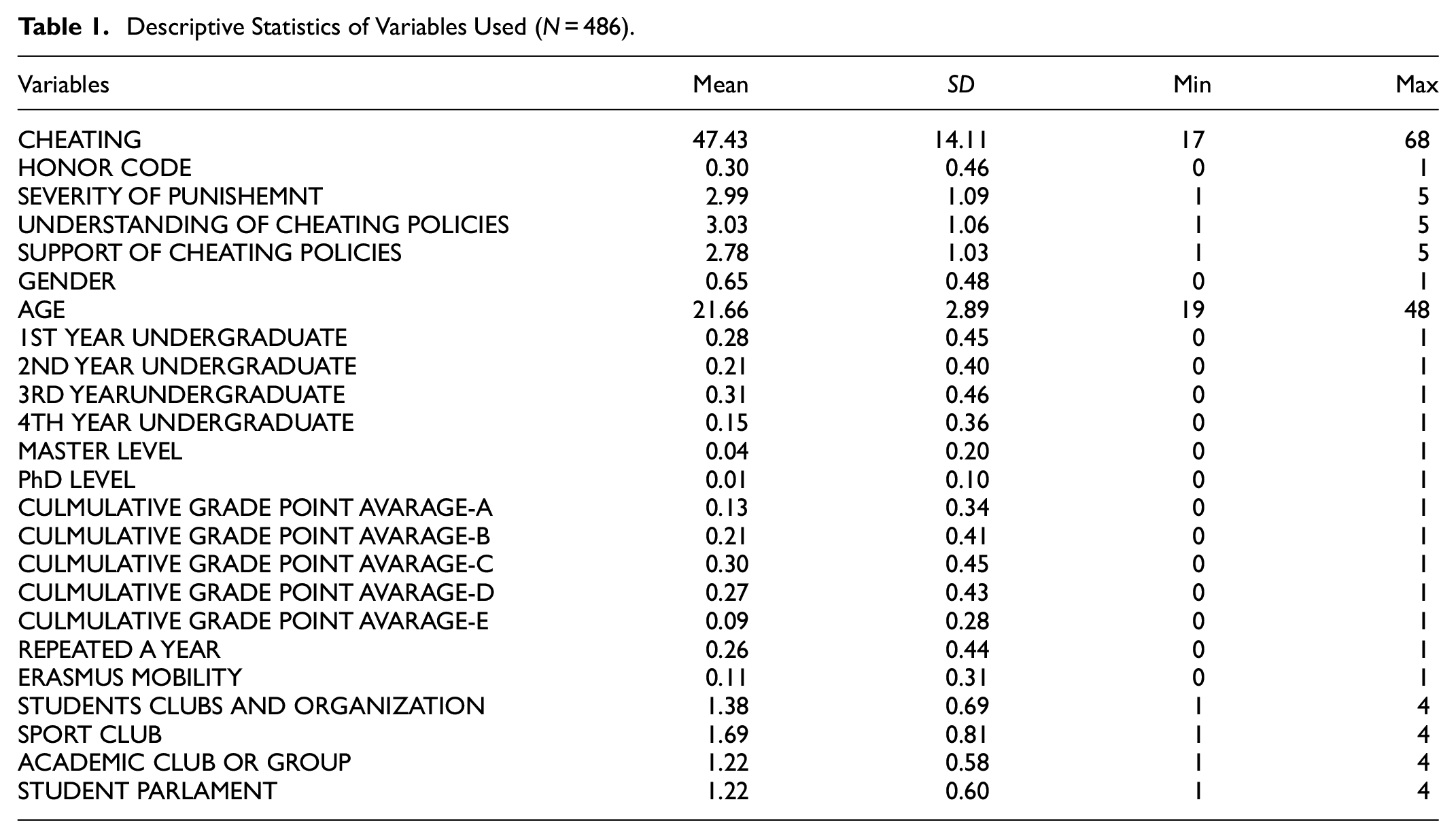
Table 1 displays descriptive statistics for the overall sample.
Descriptive Statistics of Variables Used (N = 486).
Empirical Model
We employ a Tobit regression model to empirically test our hypotheses. As Wooldridge (2002) explained, the Tobit regression model is an econometric method considered as a censored regression.
Our model can be expressed as
The observed variable
Noteworthy, as proposed by Aiken et al. (1991) for analyses of moderating effect, we mean-center the direct terms by subtracting the mean of each variable from the values of each observation which permits us to avoid multicollinearity between the interaction terms and their components.
Findings
Table 2 displays results of Tobit model. More precisely, Model 1 contains findings regarding the direct effect of honor code on students’ perceived seriousness of cheating.
Tobit Estimates of the Effect of Honor Code on Cheating: Direct and Moderating Effect.

*, **, and *** indicate parameter significance at the 10%, 5%, and 1% levels, respectively.
Our findings reveal a positive relationship between reading honor code and students’ perceived seriousness of cheating (b = 2.74, p = .10). While these results are consistent with findings of, for example, Arnold et al. (2007) who also contended that students in honor code environments demonstrate increased perception of cheating seriousness, our study also revealed the limited scope of the effect, aligning more closely with Hall and Kuh’s (1998) findings. The limited effect might be attributed to several factors. While reading the honor code arguably enhances students’ understanding of academic dishonesty, it seems to be insufficient on its own to foster a culture of academic honesty and significantly reduce cheating behavior. Potential reasons for this might relate to the inherent flaws in the code itself, but also inadequate students’ understanding, or the lack of more comprehensive approach towards reducing dishonest behavior. Overall, Hypothesis 1a is partially supported.
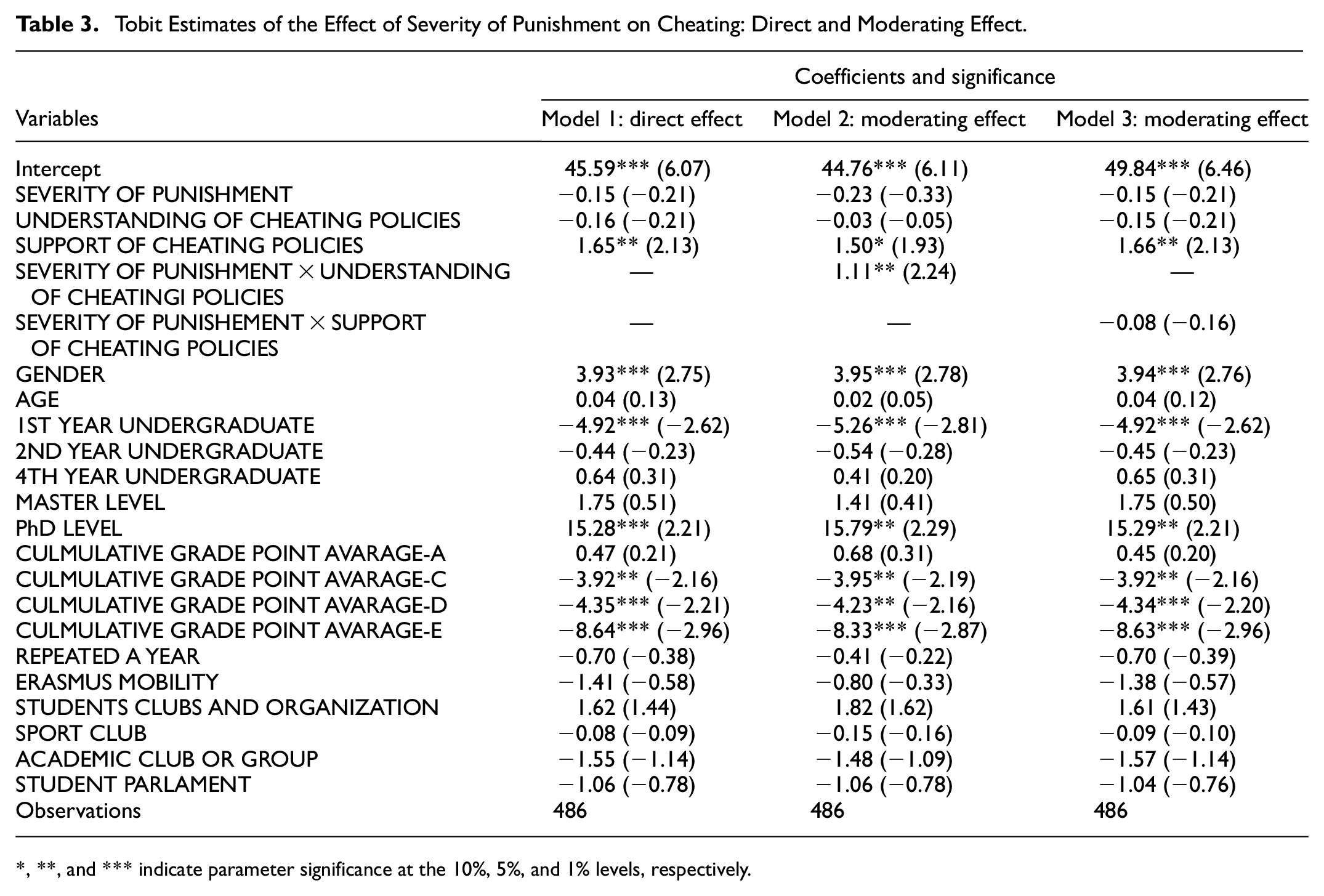
Consistent with previous research in the field (e.g., Bisping et al., 2008; Freiburger et al., 2017; Miller et al., 2011; Sabbih, 2019), our findings presented in Table 3 (Model 1) indicate no significant relationship between the perceived severity of punishment and the perception of cheating seriousness (b = −0.15, ns). These results suggest that increasing the severity of punishment may not be an effective strategy for combatting academic misconduct, in particular when students are not well-informed about the specific rules and regulations in the field. Hence, regardless of how severe the punishment is, students might cheat due to the lack of understanding of what constitutes breach of academic integrity (Newman, 2020). Hypothesis 1a is rejected based on these findings while Hypothesis 1b is supported.
Tobit Estimates of the Effect of Severity of Punishment on Cheating: Direct and Moderating Effect.
*, **, and *** indicate parameter significance at the 10%, 5%, and 1% levels, respectively.
Our findings from Table 2 (Models 2 and 3, respectively) revealed a positive and significant impact of the moderating variables—the level of understanding and support of cheating policies—on the relationship between the honor code and the perceived seriousness of cheating (b = 3.20, p = .01; b = 3.90, p = .00, respectively). Namely, not only that students who read honor code are more likely to perceive cheating as serious issue, but they will do so even more if they understand and/or support academic integrity policy. This is consistent with existing literature which suggests that the effectiveness of honor codes can be enhanced through a more integrated approach to academic integrity issues (Dix et al., 2014; O’Neill & Pfeiffer, 2012; Schwartz et al., 2013; Tatum & Schwartz, 2017). Since academic integrity policies are only efficient if students are aware of them (Eaton & Stoesz, 2020), understanding and supporting these policies shall strengthen the positive impact of the honor code on reducing academic misconduct. Indeed, it has been demonstrated that academic policies are most impactful when students are involved in their formulation and implementation (McCabe & Trevino, 1997; Melgoza & Smith, 2008; Smith-Crowe et al., 2015). Consequently, when students understand and support institutional integrity policies, they are more likely to adhere to the honor code and adjust their behavior to meet integrity rules, regulations, and expectations. Therefore, Hypotheses 3a and 3b are supported.
While our results indicated that severity of punishment did not significantly impact the perception of cheating seriousness, the analysis of the moderating variable, presented in Table 3, Model 2, demonstrated that students’ self-reported understanding of institutional cheating policies positively moderates the relationship between the severity of punishment and the perceived seriousness of cheating (b = 1.15, p = .02). These findings support the notion that students who are knowledgeable about academic integrity are more likely to perceive cheating as a serious issue when faced with the severe punishments, as suggested by Devlin (2003). Therefore, students who are aware of university policies related to academic integrity are likely to view severe punishment as a credible deterrent and thus perceive cheating as a more serious issue compared to their peers who do not fully realize the importance of institutional academic integrity policies. Therefore, based on the obtained findings, we accept Hypothesis 4a. Yet, our results did not confirm Hypothesis 4b which proposed that support for institutional cheating policies moderates the relationship between perceived severity of punishment and cheating seriousness as demonstrated in Table 3, Model 3 (b = −0.00, ns.). This suggests that while understanding cheating policies is crucial in shaping the perception of punishment severity, it is not the level of support for these policies that will drive students to change their attitude towards cheating.
To further investigate the moderating effects, we plotted interactions from the models with significant effects, using one standard deviation above and one standard deviation below the mean of understanding and support for cheating policies (Aiken et al., 1991). Figure 1 illustrates the interaction between the honor code and the understanding of cheating policies. We may observe that the effect of honor code on students’ perceived seriousness of cheating becomes stronger as the level of understanding increases. Figure 2 depicts the interaction between the honor code and the support for cheating policies. The results suggest that the effect of the honor code on the students’ perceived seriousness of cheating becomes more pronounced as the level of support increases. Finally, Figure 3 demonstrates that when the level of understanding of cheating policies increases, the effect of the severity of punishment on the students’ perceived seriousness of cheating becomes positive and significant.

Interaction plot of the moderation effect of understanding of cheating policies on the relationship between honor code and students’ perceived seriousness of cheating.

Interaction plot of the moderation effect of support of cheating policies on the relationship between honor code and students’ perceived seriousness of cheating.
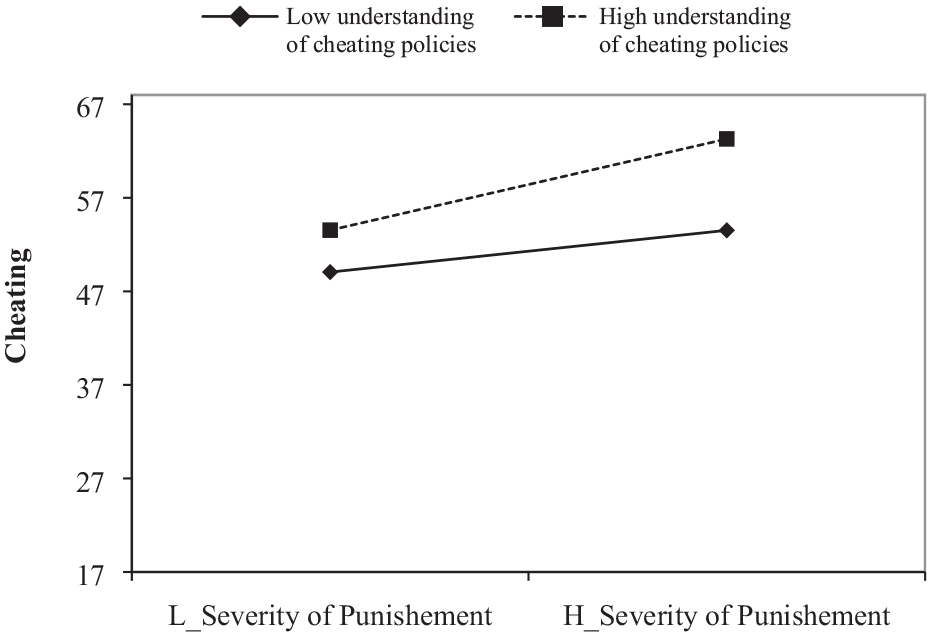
Interaction plot of the moderation effect of understanding of cheating policies on the relationship between severity of punishment and students’ perceived seriousness of cheating.
Turning to control variables, we may generally conclude that gender, level of education and cumulative grade point average are significant predictors of students’ perceived seriousness of cheating.
In the context of hypothesis testing within logistic regression, we employ two widely utilized statistical tests: the Wald test and the Likelihood Ratio Test (LRT). These tests serve as crucial tools for evaluating the validity of hypotheses and assessing the significance of model parameters. In the evaluation of Hypothesis 1a, both the Wald test (3.82) and the likelihood ratio test (LRT) (3.84) yielded significant results at the 5% level, confirming the significance of the tested hypothesis.
For Hypothesis 3a, both the Wald test (6.02) and LRT (6.05) produced highly significant values at the 1% level, indicating strong evidence against the null hypothesis. Additionally, for Hypothesis 3b, the Wald test (9.25) and LRT (9.22) resulted in significant values at the 5% level, further supporting the rejection of the null hypothesis.
In the case of Hypothesis 4a, both the Wald test (4.98) and LRT (5.01) demonstrated significance at the 1% level, providing robust evidence to reject the null hypothesis.
Discussion
Our findings provide valuable insights into the processes affecting the efficiency and impact of institutional policies aimed at preventing academic dishonesty. In the first place, the study attempted to nuance and contextualize contradictory findings related to the honor code—as scholars still have not reached the agreement regarding the effectiveness of honor codes when it comes to reducing the academic dishonesty. Hence, the paper empirically examined whether students who have read honor code are more likely to behave in ethical way, by measuring how serious cheating is according to their perception. The findings indicated that students who have read the honor code indeed perceive cheating as a more serious offense compared to those who have not read it. However, this effect is relatively mild, suggesting that merely reading the honor code does not provide sufficient incentives for students to avoid cheating and other unethical behaviors.
To better understand the effectiveness of honor codes in deterring cheating, we explored additional factors that might actually enhance their impact. Specifically, we hypothesized that honor codes which are understood and/or supported by students will be more likely to have positive impact on academic integrity and hence reduce cheating behaviors. Our findings indicated that understanding and support for cheating policies amplify the correlation between honor code and cheating seriousness. This is indeed consistent with other empirical results in the field, which corroborated that when students understand and internalize the values and consequences associated with honor code, they will be more likely to adhere to these rules, especially if they have also been involved in their development (Eaton & Fishman, 2023; Keener et al., 2019). Our findings thus support the Tatum and Schwartz’s (2017) argument that it is essential to consistently and continuously enhance students’ understanding of academic honesty and institutional policies in the field in order to reduce dishonesty. In that sense, institutions are required to clearly communicate the boundaries of acceptable behavior and make sure students fully understand what constitutes misconduct (e.g., Aasheim et al., 2012; Burrus et al., 2007). Given that previous research has consistently found low levers of students’ understanding of honor codes (Busch & Bilgin, 2014; Sledge & Pringle, 2010), our results underscore the importance of improving students’ understating and support of academic integrity policies in order to reduce cheating.
In a similar vein, the paper explored punitive policies as a mechanism for preventing academic dishonesty, by measuring the impact of punishment severity on students’ perception of cheating seriousness. Results indicated that the severity of punishment alone did not significantly influence how seriously students perceived cheating. However, their self-reported understanding of cheating policies positively moderates the correlation between the severity of punishment and the perceived seriousness of cheating. Namely, students who understand cheating policies are more likely to be deterred from cheating when faced with the threat of being punished, compared to those who lack this understanding. This is consistent with literature which constantly emphasized the limitations of purely punitive approach (Saddiqui, 2016), arguing that sanctions and penalties can only be effective when students are aware of exact acceptable and unacceptable behaviors and fully familiar with institutional cheating policies (Devlin, 2003; Holden et al., 2021). These results also seem in line with recent findings of Zhao et al. (2023) who concluded that reminding students of the honor code and the cheating punishments prior to the exam led to substantially less cheating. However, the support for cheating policies did not have a significant impact on the correlation between the cheating seriousness and the severity of punishment, suggesting that regardless of the level of students’ support for cheating policies, the severity of punishment alone will not have significant impact on the cheating deterrence.
Our results suggest a need to rethink how institutions design and implement integrity policies. Actually, the implementation of ethical actions will be beneficial for institution only if those actions support a changed understanding of the ethical culture (Dufresne, 2004). Simply exposing students to honor codes and punitive measures is insufficient, and the institutions must develop comprehensive, holistic, iterative, and inclusive policies (Kier & Ives, 2022) that foster a deeper understanding of academic integrity and ensure these policies are effectively communicated and embraced by students. Indeed, recent scholarship highlighted that students often reported difficulties to understand integrity policies which are both inconsistent and non-inclusive (Davis, 2022). The importance of understanding and support for the cheating policies hence sheds light once again on the necessity to combine institutional practices with “pedagogies of integrity” (McNeill, 2022). By combining robust integrity policies with educational approaches that actively engage students in understanding and supporting academic integrity, institutions can enhance the effectiveness of their policies and promote a more ethical academic culture.
Conclusion
As argued by Glendinning, Foltýnek, et al. (2017) and Glendinning, Lancaster, et al. (2017), in Southeast European countries there is a significant lack of communication regarding the academic integrity policies. In this context, our study explores the role of institutional integrity policies, such as honor codes and the severity of punishment, in shaping students’ perceptions of the seriousness of cheating. This perception serves as an indicator of the overall academic integrity culture and the propensity for dishonest behavior. As indicated by Salehi and Gholampour (2021), universities need to make honor codes widely accessible and ensure that students are familiar with the associated consequences and penalties. While both honor codes and sanctions have been extensively analyzed as important tools for combating cheating, ambiguous results in previous literature warn that potentially their effect may be contingent on the other factors influencing students’ decision to cheat. Thus, upon our knowledge, this is the first study to empirically analyze e moderating effects of students’ understanding and support of cheating policies on the relationship between honor codes/ severity of punishment and the perception of cheating. By introducing these moderating variables, we aim to better understand how students’ comprehension and endorsement of academic integrity policies affect the impact of honor codes and punitive measures on their perceptions of cheating.
Our findings underscore the importance of effectively acknowledging, disseminating, communicating and facilitating the adoption of university cheating policies to enhance the effectiveness of honor codes and punishments in combatting dishonesty. In other words, students who understand university cheating policies will be more likely to perceive cheating as a serious issue (and thus behave in a more ethical way) when presented with honor code or severe punishments. In addition, students’ support for cheating policies is found to positively moderate the relationship between the honor code and their perceived seriousness of cheating. Contrary, students’ support for cheating policies does not significantly moderate the relationship between the severity of punishment and students’ perceptions of cheating. This suggests that while understanding and support of academic integrity policies can strengthen the impact of honor codes on students’ perceptions of cheating, support alone does not significantly influence the deterrent effect of punitive measures.
Overall, the obtained findings might be of great interest for the university policymakers and administrators, who are supposed not only to define and implement AI policies, but also to ensure that students are aware of their existence and content. Building understanding, commitment and support for these policies appears to be essential for spreading the culture of integrity and encouraging ethical behavior among. Thus, policymakers shall strive to involve students in both the design and the implementation of academic integrity regulations and procedures, thereby strengthening their effectiveness and promoting a more robust ethical culture within the academic environment.
Limitations and Future Directions
While our results might provide important insight into how AI policies should be defined, implemented, and amplified, it is important to acknowledge some of the limitations of the study that provide further directions in this research area. First and foremost, just like most of the scholarly work in the field, our study also relies on the self-reported behavior and not the actual one. While this measure is considered to be relatively reliable estimate of the actual cheating behavior, perceived seriousness of cheating is nonetheless only a personal report, which may be biased and give distorted image of whether and how many students would actually cheat. Thus, the validity of our results is conditioned by the objectivity and sincerity of our respondents in evaluating their capacities and perceptions. Furthermore, our study sample is comprised only by students of University of Montenegro, and thus the conclusion might not necessarily be relevant for other academic environments. Indeed, perceptions of academic integrity might be different in different national and institutional frameworks (Yukhymenko-Lescroart, 2014), just like the overall cultural (and integrity) patterns and design of institutional policies. Moreover, we only analyzed the impact of two moderators, students’ understanding and support of institutional cheating policies. Undoubtedly, further scholarly work in the field might complement this study by analyzing different moderating effects, such as the peer influence or use of online tutorials (and other educational interventions). Additionally, it is noteworthy that we only examined the impact of understanding and support of cheating policies on the relationship between honor codes/penalties and cheating deterrence, but not the actual ways of enhancing students’ engagement with such policies. Thus, exploring the mechanisms for providing students with information and ways of enhancing their support and understanding of cheating policies might be a fruitful avenue for future research. Finally, it would be also rewarding to further interrogate and contextualize our results by exploring the lived experience of staff members and perception of academics on the interactions between honor code, severity of punishment and cheating deterrence in classroom setting.
Footnotes
Declaration of Conflicting Interests
The author(s) declared no potential conflicts of interest with respect to the research, authorship, and/or publication of this article.
Funding
The author(s) disclosed receipt of the following financial support for the research, authorship, and/or publication of this article: This manuscript has been produced in the framework of the national project entitled “Strengthening Academic Integrity—Interdisciplinary Research-based Approach to Ethical Behaviour in Higher Education” which was financed by the Ministry of Science of Montenegro.

Data Availability Statement
Research data available from the corresponding author upon reasonable request.