




Abstract
Due to geopolitical factors, Eurasia is at the center of gravity in international relations and has become the core area of the game of great powers. Focusing on the Syrian and Ukrainian issues, we conduct event research by looking for relevant literature and news materials, and organize and analyze the theme of international organization meetings dedicated to solving these two issues. By creating complex networks, we use quantitative data to analyze the geopolitical forces in central Eurasia and reflect the evolution of the political landscape in the region. We have found that: First, Eurasia is still the center of geopolitics in the world, and the status of land-powered countries will rise. Second, the geopolitical structure of the Eurasian center has begun to take shape as a quadrilateral relationship between the United States and its Asia-Pacific allies (Japan and Australia), the European Union, Russia, and China. Third, the political influence of the United States in Eurasia is declining and its hegemonic status is weakening. China’s political influence has gradually increased, and Russia’s geopolitical influence has declined significantly. The study, on the one hand, clarifies the evolution of the political landscape of the region and gives the reader a clear idea of the involvement of geopolitical forces. On the other hand, it provides some guidance for the future development of the Eurasian countries, especially China.
Introduction
Geopolitics is to analyze and predict the strategic situation of the world or region and the political behavior of relevant countries according to various geographical factors and the regional form of the political pattern, and then formulate a national strategic layout (Aras, 2001). Therefore, geographical factors have become a basic element influencing the political behavior of the country. Eurasia is the most densely populated area in the world. Due to its large population, complex races, diverse religious beliefs, cultural differences and other factors, it has become the core area of the strategic game between major powers in Eurasia, attracting the attention of many scholars (Kobenko, 2016). In the “Heart Theory” of the continent, the British scholar Mackinder (1943) stated that whoever rules Eastern Europe can dominate the heartland, whoever rules the world-island can command the world. Eurasia is located to the west of China, while Central Asia, the Middle East, and Eastern Europe are the heart of Eurasia. After the cold war, the importance of Eurasia’s status has become increasingly more prominent. Many scholars commonly identify states such as Russia, Turkey, Brazil, China, India, and South Africa as “regional powers” (Köstem, 2018) which have greater political and economic impact in the region. The domination of the Eurasian continent, particularly its “heart” and “weakness” zone will definitely have a huge impact on the international political landscape of Eurasia and, by implication, the rest of the world (Clark, 2011).
Some scholars believe that the geopolitical center of the world has shifted from west to east (Yan, 2012). The geopolitical center of international politics is not determined by its natural geographic location. A region must have two conditions to become a world center. First, the region must include the most influential countries in the world. That is, one or several countries should have world-class military and cultural power and become a model for other countries in the world to imitate. Secondly, the world center should also be the region with the most concentrated international conflicts (Yan, 2016). As the owner of the “central zone,” Eurasia’s natural oil energy advantage has been a prone zone of international disputes since ancient times.
Competition for Political Influence
The power and political games of the United States (USA), the European Union (EU), Russia, and China as regional powers in Eurasia are driving the evolution of the region’s geopolitical landscape (Han et al., 2019). Some scholars point out that the USA, Europe, and Russia, and the USA, Russia, and China already have a classic triangular relationship, and that the relationship between Europe, Russia, and China is accumulating (Mastanduno, 2019). Russia’s Greater Eurasian Partnership gradually shifted Russia’s diplomacy to Eastern Eurasia, shrinking its power in Eurasia, withdrawing from the Caribbean, Cuba, and Africa, and focusing on its surroundings—that is, the “heartland” and “weakness” zone (Sengupta, 2009). In order for the USA to establish a new world order and to maintain its status, it must take the lead in fighting for “dominance” in Eurasia and lead in the drive to contain other countries. Therefore, the USA and Russia as the opponents in the game, the game between the USA and Russia in the Eurasian region is constantly changing, leading to frequent conflicts and local wars, and a highly unstable political environment.
As the geopolitical relationship between Europe and Asia shifts, economic and cultural integration gradually increases the ties between the two sides. European countries also recognize that China’s opportunities and challenges are gradually changing (Buszynski, 2019). In 2013, China implemented “The Belt and Road” initiative, which covers and runs through central Eurasia. The continuous construction of “The Belt and Road” for the past several years has not only promoted the connection and interconnection of the countries along the route, but also improved the economic and trade environment of the region, and increased China’s political influence in the region (Tracy et al., 2017). This increasing investment in political resources for global governance will, to a certain extent, affect the geopolitical pattern of the central region of Eurasia. Political stability in Eurasia directly affects the connectivity and cultural exchanges of “The Belt and Road” as well as the business environment it serves. The study of the topic will help to identify the evolutionary trend of the region’s political influence, respond scientifically to China’s political events in the region, and reduce “The Belt and Road” risk. Therefore, Eurasia is also a key area for China’s competitiveness.
In addition, the political influence of international organizations on Eurasia has also gradually increased. With the establishment of the G20 and BRICS organizations, many international organizations have participated in international political competitions. International organizations such as The Shanghai Cooperation Organization (SCO) and the EU also agree that Eurasia has incomparable political, economic, and geographical advantages and has great development potential and prospects (Dutkiewicz et al., 2018). Therefore, international organizations also frequently participate in the political game of Eurasia.
In 2011, the geopolitical game of Eurasia led to the Syrian issue (Hinnebusch, 2012) and the Ukrainian issue in 2013. Syria’s geographical location is an important basis for Russia’s international competition (Zhao, 2019). The evolution of these two events reflects the changes in the geopolitical pattern and influence in the region. The most important political event in the Eurasia region is the Syria issue. The North Atlantic Treaty Organization (NATO) countries represented by the USA and the EU have expanded their political influence, compressed Russia’s influence, and increased their penetration and influence within Ukraine, which compounded the Ukrainian crisis. The crisis in Ukraine reflects the profound contradictions in the development of the situation in Europe (Y. Shuai et al., 2019). The major global powers and influential international organizations in the region have both invested in and gamed political assets around these two major events, affecting the associated negotiation processes and promoting the evolution of these two issues. Therefore, this research uses Ukraine and Syria as the unit of analysis.
Overall, the intense political game in the region can lead to major political events. Geopolitical forces within and outside the region will participate in the events, driving the evolution of the events and thus influencing the political landscape of the entire region. As far as Eurasia is concerned, after the events in Ukraine and Syria, political forces such as countries and international organizations were involved in the resolution of the events. How these political forces will use these two events to drive the political landscape of the entire region and where the political landscape of Eurasia will go in the future are issues of our concern. The analysis of these issues will provide us with an explanation of the main causes and future trends of conflict in the Eurasian continent, which is of great significance for understanding the future development of the region and related countries.
Eurasia is the core region where the great powers play their games. Countries within and outside the region have important political and economic interests in the region, and these countries form complex networks based on political and economic relationships. Nodes (countries) in the network interact with each other and economic benefits are transferred or exchanged along the links between countries. The structure of the relationship network will change as a result of important events (e.g., the adjustment of important national strategies in the network), which in turn affects the entire regional political landscape. The social network method has unique advantages in the study of relationships. First, the social network has many nodes with flexible connections, which can represent the heterogeneous characteristics of real networks and are more in line with many real networks in reality. Second, the connections in a network can change over time, which can reflect the evolution of node connections in social networks (Xu et al., 2021). These two features are consistent with the study of political relations in Eurasia. In addition, the method has been applied in the field of politics (Zech & Gabbay, 2016). Therefore, this paper uses the approach of social network analysis (SNA) to study the evolutionary trends in Eurasia.
This research first introduces the importance of Eurasia’s geographic location. The background of countries and international organizations competing for Eurasia is organized in Section 2. The Section 3 introduces the research method of complex networks to study the influence of countries and international organizations on Eurasia based on relevant international events. The Section 4 presents the data analysis through the calculation of network centrality and load value, followed by the discussion and conclusion.
Methodology
In recent years, the Network has received great attention from international relations studies (Gökçe et al., 2014). Network approaches are widespread in political science (Zech & Gabbay, 2016), and scholars have sought to understand how networks of inter-governmental organizations affect cooperation and conflict between nations (Michael, 2012). Social network is a method used to analyze social relations, which well describes various connections between nodes in the relational network and reflects the changes in relations. This paper uses the social network analysis method to analyze the political influence of regional powers in Eurasia. SNA analyzes and processes relational data, and the unit of analysis is relational. The core of social network analysis is to study the social-economic structure from the perspective of “relationships” (J. Liu, 2009). Social network methods are generally applied in the fields of professional mobility, the impact of urbanization on individual happiness, the world’s political and economic systems, and international trade (Vidmer et al., 2015). Since the “911” incident, the descriptive and explanatory potential of SNA in political group research has attracted many scholars (Perliger & Pedahzur, 2011). With the increasing recognition in academic circles of the important links between group dynamics and social structures and the motivations and behaviors of their members, SNA has continued to develop in researching political issues (Perliger & Pedahzur 2011). SNA can better capture the theoretical patterns we would expect to observe (Gade et al., 2019). Most literature applies qualitative methods to discuss the policies and influence of related countries in the research on Eurasia. Russia and China have been pursuing the “Eurasian Economic Union” and “The Belt and Road” initiative since the early 2010s, employing two distinct sets of practices in their respective influence-building endeavors (Kaczmarski, 2017). Uzbekistan is the only central Asian country to pursue an active and independent foreign policy, and its strategic values and its role as a regional player are crucial to the security of the Eurasian continent (Cornell, 2000). Only limited literature describes the development of political games between important countries in Eurasia from a quantitative perspective.
The topological characteristics of network analysis methods are important because their interactions directly affect the function of a particular network. These characteristics make SNA extremely valuable in the political context (Hämmerli et al., 2006). There are many nodes in the network, each country is a small node, and the connections between nodes are not random (Kenney et al., 2017). When there is an influence between two countries, a line is formed between the nodes. The more connections there are, the greater the impact of that node on the other nodes. The SNA method used in this paper effectively analyzes the cooperative game between important node countries and the Eurasian continent, as well as the future development trends. The evolution of political events in a certain region is often the result of a game between political groups and forces, and also a comprehensive reflection of the role of international organizations and national political influence. Major global powers and influential international organizations have participated in the resolution of these two events. The process of gaming and negotiation of various political forces directly affects and promotes the evolution of these two issues. International organizations often adopt negotiations and meetings to coordinate political issues. Therefore, the participation issues and results of relevant international organizations can be used to judge their degree of participation and attitude.
Most research into political networks has relied on either specialized survey data or data collected by government agencies. Data collected through local networks is an alternative to ensuring a continuous flow of information, with less reliance on global news sources and less control of mental institutions (Schrodt et al., 2005). Gibson (2001) used data from nationwide interviews to study the spread of democratic ideas in Russia through social networks. The purpose of this article is to collect and analyze Internet data on the conflict in Ukraine and the events in Syria. Therefore, news reports represent the original data source. Thus, this article summarizes the news from the political conferences and events to resolve the Syrian and Ukrainian issues that have been reported since 2011, and conducts research through complex networks.
The analysis process of this article is divided into three steps: First, international news reports the facts of what has been happened. News as first-hand information is authentic and logical. Therefore, this research uses news reports as the source of information. We searched the Syrian crisis and the Ukrainian crisis through reliable websites (Xinhua News Agency, Tencent News, Sina International, Russian Satellite News Agency, etc.), sorted by year (Tables 1 and 2) to record the events from the Syrian crisis and the Ukrainian crisis. Second, we used the information collected above to draw a social network map using UCINET software. The degree of closeness between nodes reflects the level of influence of the country’s participation. Third, we analyzed the influence of geopolitical forces in the central region of Eurasia based on the social network map, and judged the evolutionary trend of the political pattern in the region using quantitative methods for comparison and verification.
International Organizations’ Participation in Syria Events.

International Organizations’ Participation in Ukraine Events.

The Political Events in the “Central Eurasian Region”
Tables 1 and 2 summarize our search results of the major events in the two issues—Syria and Ukraine.
Data Analysis
The Evolution of Political Patterns in the Central Eurasian Region
An analysis of the conference topics in Tables 1 and 2 reveals that: First, the SCO and BRICS countries have been actively involved in the discussion of these two issues since 2013. Second, G7 and G20 international organizations composed of big countries have a greater degree of participation in the mediation and settlement of the two issues. The big countries have a greater influence on the evolution of the situations in Syria and Ukraine. Third, regional international organizations in Eurasia have greater political interests in the region and have all participated in the discussion of these two issues to a certain extent.
The “Eurasian region” is an arena for the game of great powers. These countries have important political and economic interests in the region. The interest game between them directly affects the stability and development of the region and directly affects the political and economic evolution of the countries in the region. The exchange of political and economic interests has formed a complex network between the great powers outside the country and the countries within the region. The structure of the network restricts the exertion of the influence of relevant countries and organizations. According to the geographic region where the country is located and whether the country has important strategic interests and influence in the westward strategic region, the main political participating countries in the region are sorted as shown in Table 3.
Countries With Significant Interests and Influence in the Eurasia Region.

Employing social network law and UCINET software, and using the relationship structure in Tables 1 to 3, we draw a complex network of the Syrian problem and the Ukrainian crisis since 2011 (Figures 1a–7b).

A network of major countries participating in the Syria event in 2011(a) to 2012 (b).

A network of major countries participating in the Syria event in 2013 (a) to 2014 (b).

A network of major countries participating in the Syria event in 2015 (a) to 2016 (b).

A network of major countries participating in the Syria event in 2017 (a) to 2018 (b).

A network of major countries participating in the Ukraine event in 2013 (a) to 2014 (b).
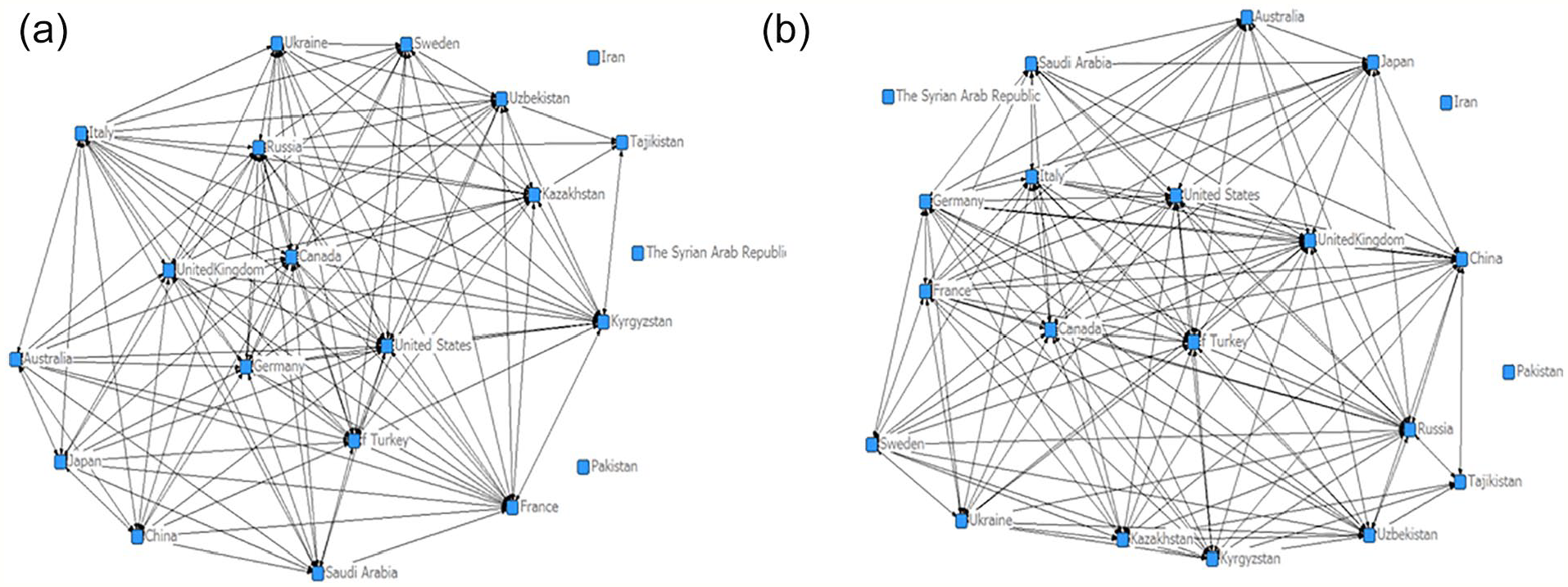
A network of major countries participating in the Ukraine event in 2015 (a) to 2016 (b).

A network of major countries participating in the Ukraine event in 2017 (a) to 2018 (b).
Some scholars try to explain the political influence in international relations by the closeness of nodes in the network (Murdie, 2014). The number of isolated nodes in the Syria event network is increasing, and the density of the network is decreasing. With the evolution of the Syrian incident, some countries are no longer involved due to the constraints of their strength and political resources, and their political exchanges with other countries on this issue have been reduced. They have been isolated by political relations networks as isolated nodes. The political network of Ukraine began in 2013. The density of the network has been increasing, the number of isolated nodes has gradually decreased, and the network structure has stabilized since 2013.
Analysis of National Political Influence in the Eurasian Central Region
According to the 1-mode network diagram constructed in Figures 1 to 7, the singular value decomposition (SVD) method is used to calculate the singular values and load values of major countries and international organizations in Tables 1 to 3. The singular values (Table 4) in the network of the events of Syria and Ukraine are shown to indicate the magnitude and importance of the events’ influence in the network. The larger the singular value, the greater the influence of the event.
Singular Values of Events in Syria and Ukraine in 2011 to 2018.

Since 2011, the Syria event has received attention from relevant international organizations and major global powers, and such attention has continued to rise until 2014. This shows that the event has had a significant impact on global politics and the economy (Torosyan & Vardanyan, 2015). The game and struggle over the Syrian issue have become more intense. Regarding the second reported event, since the outbreak of the Ukrainian crisis in 2013, its singular value has continued to rise, and actually surpassed the Syria event in 2014. This shows that the Ukrainian crisis has a greater impact on international organizations and major powers around the world. Its importance and strategic conflict surpass those of Syria event. Ukraine is closer to Russia, which was part of the former Soviet Union, and, since independence, has been regarded as a backyard by Russia. Furthermore, the Westernization of Ukraine poses a direct threat to the national security of Russia (W. Shuai, 2020). In addition, Ukraine is located in Eastern Europe and is one of the largest countries in Europe. It is close to major European powers such as Germany, Italy, and France, and is affected by the economic and political influence of the EU. The large European continent is regarded as an important area for influence expansion. From the perspective of geographical proximity, Ukraine is more important to Russia and EU countries than Syria. The load value illustrates the problem-solving ability and political influence of relevant international organizations and countries in the events in Syria and Ukraine. Tables 5 and 6 show the relevant country’s load on the events in Syria and Ukraine: The larger the value, the higher the country’s participation.
Load Values of Countries in the Syria Event in 2011 to 2018.

Load Values of Countries in the Ukraine Event in 2013 to 2018.
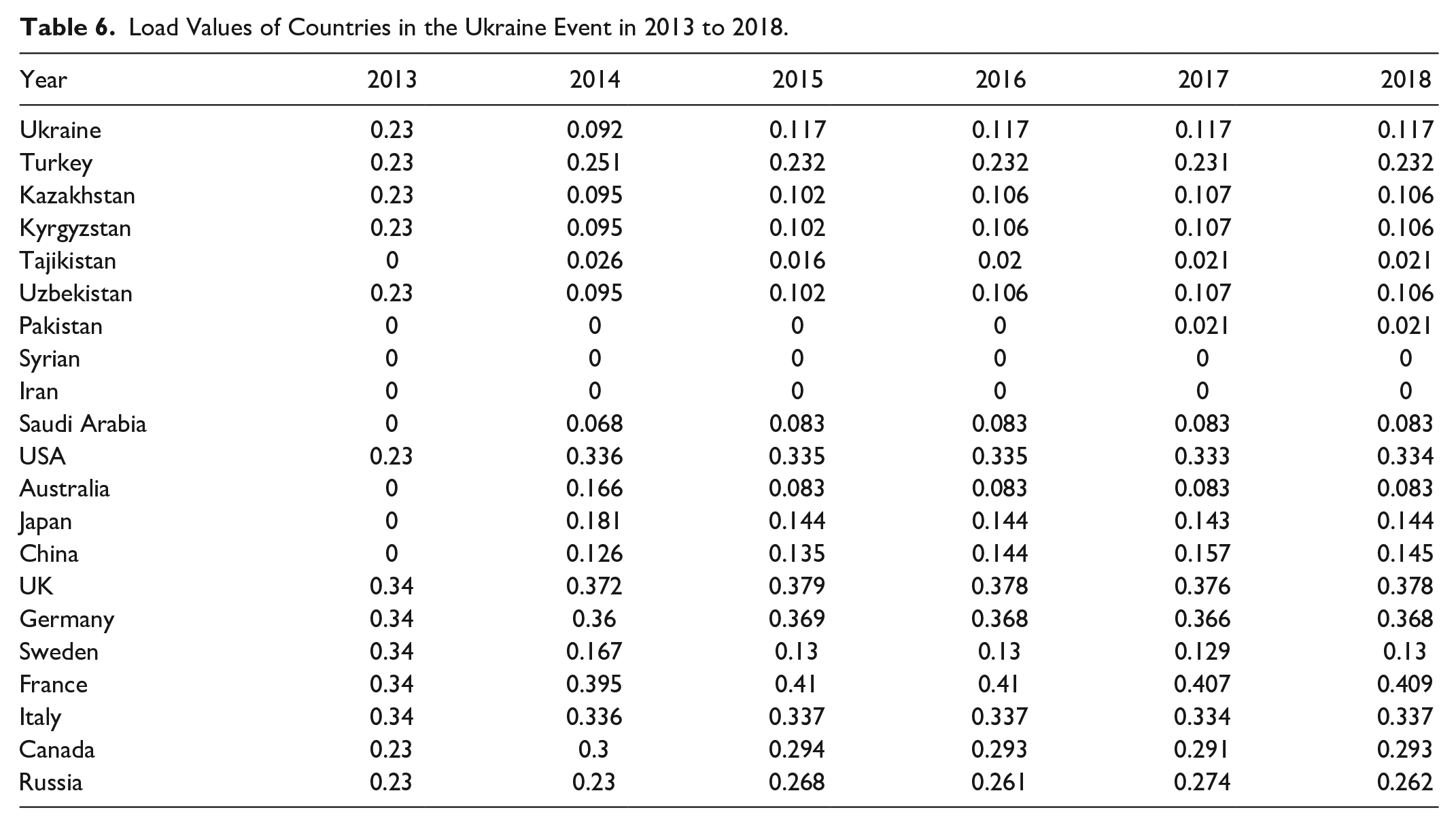
From Tables 5 and 6, we can conclude that, first, China’s load on the Syria event was significantly larger than on the Ukraine event, with the exception of “2018,” where Ukraine’s load was higher than Syria’s. China’s load on the Syrian event continued to increase to its highest value in 2013, and then rose slowly after falling. In the Ukraine event, it gradually increased, and declined in 2018. By judging from the ranking of the load value, the rise of China’s ranking indicates that China’s strategic interests and political influence in the region are rising. Second, Turkey’s load value and its rankings are significantly higher than those in Central Asia and the Middle East, reflecting Turkey’s significant geostrategic interests in both Syria and Ukraine. Turkey has actively participated in the handling of political events in these two central regions of Eurasia. Third, Russia ranked first in the value on the issue of Syria in 2013 and 2014, and declined in subsequent years, but its load has always been higher than those of China and countries in Central Asia and the Middle East. Russia has significant geopolitical and economic interests in this region, and is a major player in geopolitical games in the region. Fourth, the major powers of the USA and the EU, primarily Britain, France, and Germany, have always been at high levels. On the whole, the geopolitical game in the center of Europe and Asia is a triangle game between the USA, the EU, and Russia. The EU has significant geopolitical interests in the region and has invested the most political capital in the region.
What is more, in recent years, the Central Asian countries’ load on the Ukrainian issue is significantly higher than that on Syria, indicating that the Central Asian countries have higher geopolitical interests in the Ukrainian issue and have invested more political resources in the Ukrainian issue. The two major powers in the Middle East are Saudi Arabia and Iran. Iran has a load value of zero on the Ukrainian issue and a smaller load value on the Syrian issue, and Saudi Arabia has a load value on both issues. Saudi Arabia is a USA ally and a member of more international organizations, which makes it more politically influential than Iran on the two issues.
In general, the geopolitical structure of the Eurasian Center has begun to form a quad-lateral relationship between the USA and its Asia-Pacific allies (Japan and Australia), the EU, Russia, and China. At the same time, Turkey has gradually become an independent geopolitical body in this region. The influence continues to increase. The multi-polar trend of geopolitical structure in the central region of Eurasia has gradually formed, and the triangle structure relationship between stability and balance has been broken. Therefore, the formation of a new stable structure is urgently needed.
Analysis of the Political Influence of International Organizations
Tables 7 and 8 show the load of international organizations on the events in Syria and Ukraine: The larger the value, the higher the participation of the organization and the more obvious the effect.
Loads of International Organizations on Events in Syria in 2011 to 2018.

Loads of International Organizations on Events in Ukraine in 2013 to 2018.
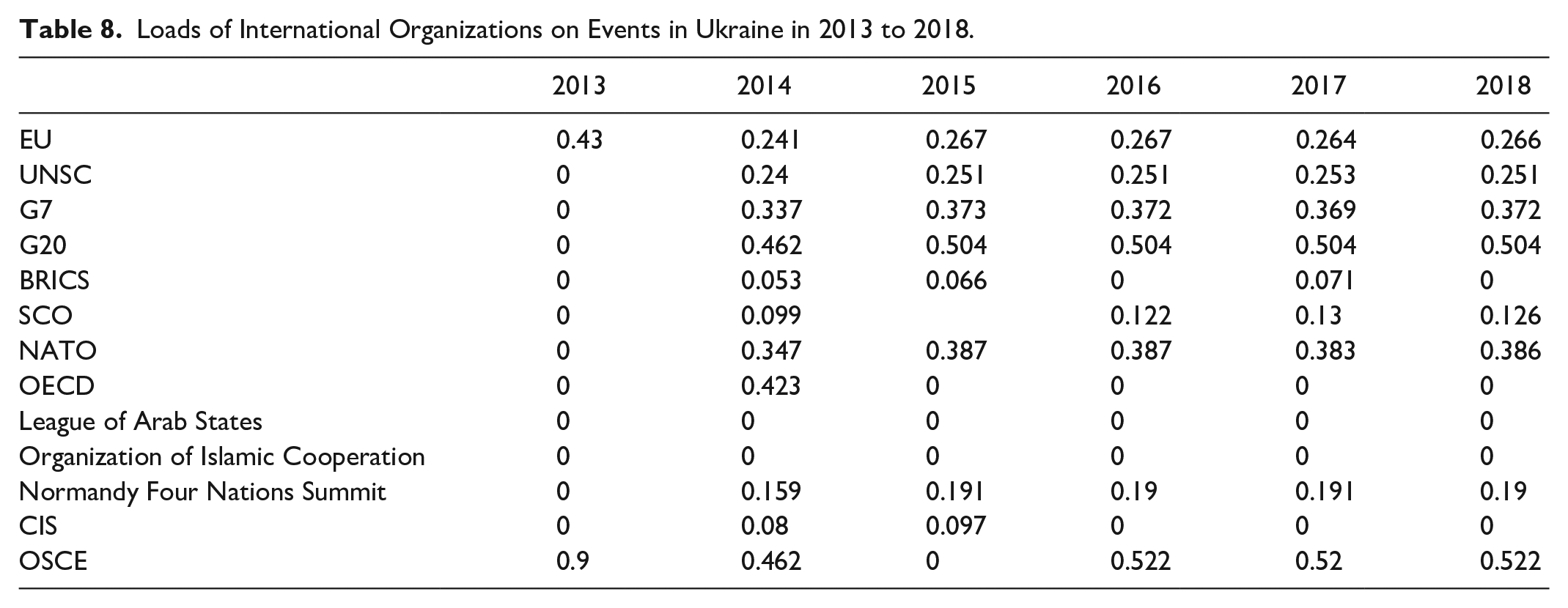
From Tables 7 and 8 we can conclude that, first, on the Syrian issue, except in 2011, the OSCE had the highest load value, and in 2012 to 2015, the G20 had the highest load value, followed by G7, the United Nations, and then the EU and Shanghai Cooperation, while Arab League, Islamic Cooperation Organizations, the most regional organizations in the Middle East, have relatively small load values. Second, in the event of Ukraine, the OSCE and OECD were the largest players in 2013, followed by the EU. The largest load values in 2014 were G20, OSCE, followed by OECD, NATO, and G7, followed by the UN Security Council, the EU, Normandy Four Nations Summit, CIS, Shanghai Cooperation Organization and other organizations. Since 2015, the G20 and the OECD have been major players in Ukraine. Third, the highly professional organizations such as the NATO, OECD, and the Normandy Four-Nations Summit only have a load value in the Ukrainian incident, not in the Syria issue. This reflects that professional organizations have a relatively limited influence and ability to solve problems in global political events. Relevant major countries use this platform to discuss and solve problems only on events of great global significance. Fourth, the load of the United Nations on the events in Syria and Ukraine is decreasing year by year, which reflects the gradual decline in the international influence and problem solving capacity of the UN Security Council. In addition to the five permanent members of the UN Security Council, non-permanent members are elected and often change. Sometimes some major powers and powers such as Germany and Italy are not in the Security Council, which reduces its influence to a certain extent.
Finally, the more members of an international organization there are, the more powerful the country is, the wider the political power it exerts, and the stronger its ability and influence to solve international political issues, such as the G20. Conversely, the fewer members of an international organization there are, the fewer large and powerful countries, the smaller its international political influence, such as the CIS, the Arab League, and so on. This shows that global politics is still essentially the politics of the game of big powers, and they need to take responsibility for major global political and economic problems and conflict resolution.
China takes part in various international organizations including the UN Security Council, G20, SCO, and BRICS. China’s influence in the G20 and UN Security Council does not have the ability to dominate and control. China has the right to collaborate with other entities to solve many global issues and problems but it is not strong. Therefore, although the two organizations have strong ability and influence in solving global political problems, China’s political influence in the central region of Eurasia is not great. China has a relatively large political and economic influence in the SCO and BRICS organizations. China’s leading SCO has limited ability and influence to resolve political conflicts in the central region of Eurasia. Since China proposed “The Belt and Road” initiative, the SCO and BRICS countries have increased their political resources on Syria and Ukraine, and have actively participated in the discussion of these two issues. The construction of “The Belt and Road” has, to a certain extent, influenced and promoted the changes in the geopolitical pattern of the central region of Eurasia.
Discussion
On the basis of the above analysis, the article further discusses the evolution of the geopolitical structure and the changes in the structure of relations between countries inside and outside the region, and provides suggestions for China’s future development in Eurasia. In addition, it provides suggestions for China’s future development in Eurasia.
A New Geopolitical Structure Is Being Formed
From the perspective of data analysis, a new geopolitical structure is being formed, and the responses of major powers to the evolution of the new structure are different. The geopolitical structure of the Eurasian Center has begun to form a quad-lateral relationship between the USA and its Asia-Pacific allies (Japan and Australia), the EU, Russia, and China. At the same time, Turkey has gradually become an independent geopolitical body in this region.
Evolution of the relationship structure among major extra-regional countries
Under the influence of the “sea power” strategic thinking (Buszynski, 2019), the USA shifted its strategic focus to the “Indo-Pacific” region, adjusted its strategic opponent from Russia to China and Russia, and focused on curbing China’s rise (Yan, 2016). The response of China and Russia to the new structure is to strengthen strategic cooperation and maintain global peace and stability. The economic, political, and military cooperation between the two countries is more stable, and the triangular balance between the USA, China, and Russia has stabilized. The EU is affected by Brexit, and strategic differences have emerged with its long-time major ally, the USA. The EU’s pursuit of strategic independence and a reduction in its dependence on the USA has become increasingly apparent. The strategic actions of the EU and the USA have diverged on Iran. Since the “Ukraine” incident, the triangular relationship between the EU, the USA, and Russia has changed, and Russia’s geopolitical influence has begun to decline significantly. The triangular relationship between the EU, Russia, and the USA has changed from balanced to unbalanced, and a new balanced relationship has yet to be formed. Promoted by the initiative of “The Belt and Road,” China’s economic ties with Europe have strengthened (H. Liu, 2017), Russia-Europe relations have also eased due to economic development needs, China-Russia relations are sound and stable, and political and economic ties are constantly strengthened, which is a strategic response of Russia to the adjustment of the geopolitical structure of Eurasia. The positive balance of the new China-Russia-Europe relationship has begun to take shape. The new geopolitical pattern of Eurasia will be peaceful and stable with the gradual withdrawal of the USA.
Evolution of the relationship structure among major countries in the Eurasian central zone
The structure of political relations among the countries in the Eurasian central zone has changed and the geopolitical landscape has also been continuously adjusted. Turkey is actively involved in the handling of the two political events in Syria and Ukraine and has gradually become an independent geopolitical institution in the region. Turkey has used its central position among the great powers and geopolitics to carry out balanced diplomacy, and has steadily improved its political influence and status. Kazakhstan, Kyrgyzstan, Uzbekistan, and Tajikistan have actively participated in the construction of “The Belt and Road” (Howard & Howard, 2016), and their economic ties with Russia have also been significantly strengthened, maintaining geopolitical stability in Central Asia. Iran and Saudi Arabia are competing for geopolitical influence in the Middle East, but they are both constrained and affected by powers outside the region.
The political influence of international organizations participating in the development of large powers in this region has continued to increase. The active participation of these powers (international organizations and big countries) has promoted the formation of a multi-polar trend of geopolitics in the center of Eurasia. The formation of a new stable structure in the central region of Eurasia is a long-term process. Stakeholders of the previous stable structure played a game with the participants of the new structure for political interests, and the game will achieve equilibrium over a relatively long time in order to ensure the formation of a stable structure.
China’s Response Strategies
From the perspective of geopolitical events, the “Eurasia Central Zone” has always been regarded as one of the most important regions, and it is also the focus of competition and control by major global powers. This geographical advantage has not brought peace, stability, and economic development to the region, but rather the hardest hit area of war, conflict, chaos, and poverty. However, this region is the core area of “The Belt and Road” and directly affects the initiative. The construction of the five links (Five Connections in “The Belt and Road” initiative) has increased the risks of the construction of “The Belt and Road.”
Based on the above outcomes, China can take the following response measures: It can make reasonable use of international political rules to improve its status and influence in the G20, the UN Security Council and other international organizations. China should strengthen economic cooperation with Russia, Germany, and Kazakhstan, promote economic development in the “central region of Eurasia,” and lay the foundations for the construction of the Silk Road Economic Belt. Guided by the principle of “make a difference” at the 18th National Congress of the CPC, China will adjust its foreign policy, actively participate in the mediation of international disputes and conflicts, and expand her influence on the international political stage. With regard to the Syrian incident and the Ukrainian crisis, China can use its economic influence and economic demands to initiate and arrange multi-party coordination meetings to try to resolve the two major disputes through negotiations and maintain political and economic stability in the region.
Conclusion and Prediction
This paper adopts the research method of social network analysis, with the Syria and Ukraine issues as the center. It organizes and analyzes the theme of the meetings of international organizations to solve these two problems by referring to relevant literature and news materials, and using the method of event research. Through the establishment of a dynamic complex network, the geopolitical power in central Eurasia is analyzed with quantitative data to reflect the evolution of regional political patterns. On the one hand, the paper gives the reader a clear idea of the evolution of the Eurasian landscape and. On the other hand, it provides some guidance on the evolution of political relations between countries. Based on the load and singular values of relevant interested countries and international organizations, the following conclusions are drawn.
A New Geopolitical Structure Is Being Formed
The geopolitical structure of the Eurasian center has begun to take shape as a quadrilateral relationship between the United States and its Asia-Pacific allies (Japan, Australia), the European Union, Russia, and China. However, countries inside and outside the region are reacting to it differently. First, for extraterritorial States, the political influence of the United States in Eurasia is declining and its hegemonic status is weakening. China’s political influence has gradually increased, and Russia’s geopolitical influence has declined significantly. However, we need to be clear that the position of the United States is a relative decline. That is, the absolute strength of the United States is rising, but because China’s strength is rising faster than the United States, its gap with China is narrowing. The decline of the United States will not change its superpower status for at least the next 20 years (Yan, 2016). In addition, China and Russia have strengthened political cooperation. The European Union has significantly reduced its dependence on the USA. Second, as for countries within the domain, Turkey uses the central position of big powers and geopolitics for balanced diplomacy, and continuously improves its political influence and status. The four Central Asian countries have also joined the ranks of those maintaining stability in Central Asia. The political influence of international organizations participating in the development of regional powers has been continuously enhanced, and the active participation of major powers has promoted the formation of the multi-polar trend of geopolitics in the center of Eurasia.
Eurasia Is Still the Center of Geopolitics in the World, and the Status of Land-Powered Countries Will Rise
Eurasia is the world’s center of geopolitics, both in the past and (it is predicted) in the future. Traditional geopolitics is based on the mutual balance between the powers of sea power and land power states. In the future, we can predict that land rights in Eurasia will rise. Jeffrey D. Sachs wrote in the Boston Globe that China’s important “The Belt and Road” initiative can strengthen trust and economic and trade relations between Eurasian and African countries.
Eurasia is a huge geographical space for China to implement “The Belt and Road” initiative, and China will invest more political forces in it in the future. For East Asia to become the center of the world, it needs to surpass Europe’s strength and influence in general, and East Asia’s future overtaking of Europe mainly depends on the rise of China (Yan, 2016). Russia and China are current stabilizers for world development. China and Russia will strengthen military cooperation in Eurasia in the future, which will definitely increase the political influence of the entire Eurasia region. Due to the rising status of Eurasia, the world attaches great importance to the region. With the introduction of “The Belt and Road” initiative, the importance of geopolitical status in Eurasia has become more prominent. There is no doubt that China’s rise will threaten the USA’s hegemonic position in Eurasia and the conflict between the USA and China will continue (Chen, 2019). However, with the occurrence of new events, the trend of relations between China and Central and Eastern European countries on the Eurasian continent is still uncertain, and the future status of China and the USA is still unknown.
This study uses the events that international organizations have participated in and payed attention to the events of international political conflicts. Due to the limitation of information sources, the network relationship was determined without evaluating the effectiveness of the implementation of the program after the international organization’s meeting. Although the establishment of complex networks can basically reflect the degree of attention and influence of international organizations and countries on related political conflicts, some deep-level political issues may not be fully reflected.
Footnotes
Acknowledgements
We acknowledge the editors and the anonymous reviewers for insightful suggestions on this work.
Declaration of Conflicting Interests
The author(s) declared no potential conflicts of interest with respect to the research, authorship, and/or publication of this article.
Funding
The author(s) disclosed receipt of the following financial support for the research, authorship, and/or publication of this article: This research was supported by the China Postdoctoral Science Foundation (2021M690654), the Jiangsu University Philosophy and Social Science Research Major Project (2021SJZDA033), and the National Natural Science Foundation of China [Grant No.
