




Abstract
This study aimed to analyze the social perceptions of risks and harm to the human body from electromagnetic waves, which have increased due to the era of the fourth Industrial Revolution and the development of information and communication technology (ICT), and to suggest alternatives. This study applied big-data-based text-mining analysis techniques to collect and analyze 10,681 Korean media reports and portal big data over the last 10 years. As a result, social perceptions shown in the media and portal big data recognized that national policies, such as THAAD, nearby facilities, electronic products used in daily life, and smartphone electromagnetic waves harm the human body and health. Therefore, to establish proper perceptions of electromagnetic waves, this study suggests policy implications, such as strengthening publicity activities for the public on electromagnetic wave safety, expanding the provision of relevant information on electronic products, and establishing a specialized organization for electromagnetic waves.
Keywords
Introduction
The fourth industrial revolution and the development of ICT technology have brought great changes to all areas of society, which are characterized by high speed and hyper-connection. Wireless communication technologies such as 5G using radio waves have become indispensable elements in building and utilizing core infrastructure such as big data, AI, and clouds for a hyper-connected society. In general, people have a very positive view of such scientific technology, but with the introduction and development of new technologies, there is controversy over the risks and harmful effects of technology on the human body, and concerns over the harmful effects of electromagnetic waves on the human body are also increasing (Kul, 2008). According to research on ordinary people, perceptions of the risk of electromagnetic waves vary depending on environmental factors (K. H. Kim et al., 2013), and various studies have suggested the need to develop proper communication strategies and institutional management to solve this problem (J. S. Lee, 2020). Examples of the controversy, in 2018, the San Francisco Mill Valley City Council in the United States completely banned the installation of 5G communication equipment and the deployment of base stations in residential areas because of the residents’ concerns over the exposure to 5G electromagnetic waves, and in Korea, there were controversies over the safety of electromagnetic waves for residents living around transmission towers, the military THAAD deployment process in 2018, and the construction of Naver data center in Yongin (Chung, 2020), 5G electromagnetic wave rumors, and even fake news related to the spread of the coronavirus. Thus, the spread of misinformation regarding the safety of electromagnetic waves has become a national concern. Here, THAAD is the acronym for Terminal High Altitude Area Defense and is a missile intercepting weapon system developed by the United States. Because the system detects missiles using radar, it has triggered serious social controversy in Korea because of the risk of electromagnetic waves it may generate.
Therefore, vague anxiety and negative perceptions of electromagnetic waves negatively affect national security, policy implementation, and people’s lives. Therefore, it is considered an important task for the development of electromagnetic wave technology and policy to resolve negative perceptions of electromagnetic waves and establish the right social perception of the safety of electromagnetic waves.
A large number of studies on electromagnetic wave awareness have not yet been conducted, and this study was conducted on a limited sample using a survey method to determine the awareness of electromagnetic waves (Choi et al., 2020). The purpose of this study was to analyze the social perception in Korea regarding the risks of electromagnetic waves in a social environment in which the use of electromagnetic waves is increasing, and to suggest an alternative. To collect diverse and comprehensive social opinions, we used data from media reports and portal big data and applied a text-mining research method to suggest an alternative and policy development direction through empirical analysis using keywords. This study has academic significance in that it confirms society-wide discussions on electromagnetic wave risks through media reports and portal big data, and the analysis results are expected to provide implications for improving electromagnetic wave-related policies.
Theoretical
The Concept of Electromagnetic Waves
THAAD is the acronym for Terminal High Altitude Area Defense, and is the missile intercepting weapon system developed by the United States. Because the system detects missiles using radar, it has triggered serious social controversy in Korea because of the risk of electromagnetic waves it may generate. Electromagnetic waves are composed of electric and magnetic fields and have a wide range of wavelengths; they can be divided into living electromagnetic waves (low frequency, medium/short wave, ultra-short wave, millimeter wave), infrared light, visible light, ultraviolet light, gamma rays, and X-rays, depending on the wavelength range (S. G. Lee, 2015). Electromagnetic waves are generated from both natural and artificial sources. Animals can sense the direction of naturally occurring magnetic fields on Earth. Since the 1970s, many electromagnetic waves have been generated from artificial sources, such as human-made home appliances and communication equipment. Accordingly, interest in the impact of electromagnetic waves on the human body has rapidly increased. People have a misconception that electromagnetic waves accumulate in the human body when they are not seen and felt, unlike general environmental pollution (Karaboytcheva, 2020). For this reason, they are also called the fourth pollution, and organizations in countries around the world, including the WHO, have set specific standards for protection of human body from electromagnetic waves and are using electromagnetic environment regulations as non-tariff trade barriers. In Korea, the basis for enacting the standards for protection of human body from electromagnetic waves has been established through the Radio Wave Act in 2000, and related research and cooperation are being actively carried out (Sungkyunkwan University Research & Business Foundation, 2009), and the notification of the Ministry of Science and ICT stipulates necessary matters regarding the standards for protection of human body from electromagnetic waves (MSIT, 2019).
Concepts of the Risks of Electromagnetic Waves and Risk Perception
To date, studies on perceptions of the risks of electromagnetic waves have mainly been conducted using the survey method (K. Kim et al., 2014), and these studies have suggested the need to lower concerns about the risks of electromagnetic waves and to adopt a risk communication strategy to fully explain the safety of electromagnetic waves using the resident participation program and others. In particular, research on ordinary people has found that their risk perceptions increase and decrease depending on environmental factors. In areas of high fear and uncontrollable responses, radar and 5G base stations appeared, while in areas of high fear but controllable responses, household appliances, including hair dryers and microwaves, appeared (Choi et al., 2020). The lexical definition of risk is “a possibility of harm or loss, or such state.” A disaster is predictable; however, risk is also defined as the unit probability of time and behavior that a specific action and skill differentiated from the disaster will lead to a specific result (Kasperson & Pijawka, 1985), which is subjectively defined by individuals affected by psychological, social, and institutional factors (Slovic, 1987). By combining various definitions, risk can be seen as a concept formed through a social process, rather than an objective concept. Perception of risk is a cognitive process based on an individual’s psychological and subjective aspects of risk. In the past, risk was viewed from a science-centered perspective; therefore, its social aspect remained secondary. Recently, however, various studies have been conducted on the gap and conflict between the scientific expertise of experts and the knowledge of the general public using a sociological approach. Experts and the public have contrasting perceptions of risk. Experts perceive risks analytically and quantitatively, whereas ordinary people perceive them intuitively and qualitatively (Cho, 2007), indicating that the emergence of new technologies following the development of science and technology, particularly the risk perception of technologies related to electromagnetic waves, can be perceived differently by groups of people with different characteristics.
Big Data Analysis and Text Mining
Big data analysis and text mining, which are scientific and objective research methods, are very useful for identifying the overall discourse, opinions, and social perceptions in society (D. H. Kim & Kim, 2022). In a hyperconnected society based on ICT, vast amounts of data are produced and distributed in real time. In particular, on websites such as portals, a diversity of documents in the form of SNS, news, and various posts containing diverse opinions and information exchanged among users have been formed around keywords. Therefore, in various data that can be searched using a specific keyword, the social discourse and perception formed in relation to the keywords can be objectively and clearly grasped. In addition, media are traditionally characterized by objectively projecting social perceptions and perspectives on specific issues. What is common in these portals and media reports on big data is that they appear in texts. By structuring large amounts of unstructured data, we can extract patterns from the data, find the values, information, and patterns hidden in the words, as well as the relationship between the extracted words using various analysis techniques, such as Social Network Analysis (SNA), and analyze the relationship between the words constituting the text using text mining. In this study, we performed an analysis using the TF-IDF value, degree centrality, and CONCOR. TF-IDF is the weight used in information search and text mining and is the statistical value indicating the importance of a certain term in the collection of documents. Consequently, it is a very useful technique for extracting key terms in a document and determining their importance and characteristics (Salton & McGill, 1983). Accordingly, in this study, to identify perceptions of the risk of electromagnetic waves through specific keywords detected in big data documents related to the risks of electromagnetic waves, we focused on TF-IDF values. TF (Term Frequency) refers to the number of times a specific term occurs in an entire document and DF (Document Frequency) refers to the number of documents containing a particular term. IDF (Inverse Document Frequency) is the inverse number of DF. When the DF value is large, the IDF value decreases, whereas when the DF value is small, the IDF value increases. The formula is
Research Tasks
The purpose of this study is to identify the perceptions and discourses related to the risks of electromagnetic waves formed in Korean society using media and portal big data, and to suggest policy implications for the formation of correct perceptions and attitudes related to the risks of electromagnetic waves. To achieve this purpose of study, the following research tasks were established:
Research Task 1: What are the social perceptions and characteristics of the risks of electromagnetic waves that appear in big data media reports?
Research Task 2: What are the social perceptions and characteristics of the risks of electromagnetic waves that appear in portal big data?
Research Task 3: What policy alternatives can be identified from this analysis?
Methods
Data Collection
A total of 10,681 data related to the risk of electromagnetic waves, such as 2,261 Korean media report data and 8,420 portal data, which included the risk of electromagnetic waves as a keyword, were collected after setting the past 10 years as the analysis period. Tables 1 and 2 show the details of the media and portal channels.
Media Reports on the Risk of Electromagnetic Waves (2012.7.1–2022.06.30).

Source. Use of Korea Press Foundation’s news analysis system “Big Kinds,”https://www.bigkinds.or.kr/.
Portal Big Data on the Risk of Electromagnetic Waves (2012.7.1–2022.06.30).
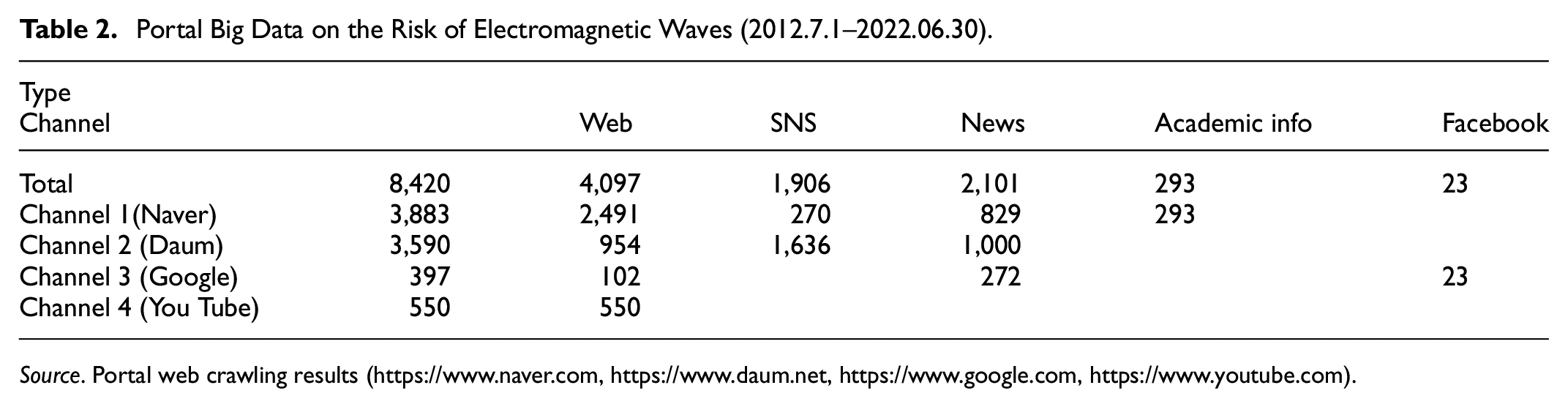
Source. Portal web crawling results (https://www.naver.com, https://www.daum.net, https://www.google.com, https://www.youtube.com).
Research Process and Analysis Method
The top 50 keywords based on the TF-IDF value were derived from the data collected through portal and media report big data, and the keyword data, 1-Mode Matrix was analyzed using the UCINET-6 program to analyze the semantic network, degree centrality, and CONCOR results. The TF-IDF value is used to classify the importance of words using the method of aligning words with high weights by calculating the weights to extract keywords from documents. Therefore, in this study, we suggest which keywords appear through an analysis of keywords with high TF-IDF values in the collected data on “the risk of electromagnetic waves” appearing in portals and media reports. In addition, we identified keywords with a high degree of centrality through a matrix analysis to identify keywords with many connections and relative superiority within the keyword network. The perceptions of portals and media regarding “electromagnetic wave risk” were identified objectively. Furthermore, we objectively identified the perceptions of portals and media regarding “the risk of electromagnetic waves” by performing a CONCOR cluster analysis to classify the top 50 keywords into clusters with similar properties.
Results
Analysis of Keywords in Media Reports on the Risk of Electromagnetic Waves
The results of analysis of the top 50 keywords based on TF-IDF values and the degree centrality through purification and pre-processing process from 2,261 data in Korean media reports containing the risk of electromagnetic waves as a keyword are shown in Table 3, and the results of semantic network and CONCOR cluster analysis are shown in Figure 1.
Analysis of TF-IDF and Degree Centrality of the Keywords Appearing in Media Reports on the Risk of Electromagnetic Waves.
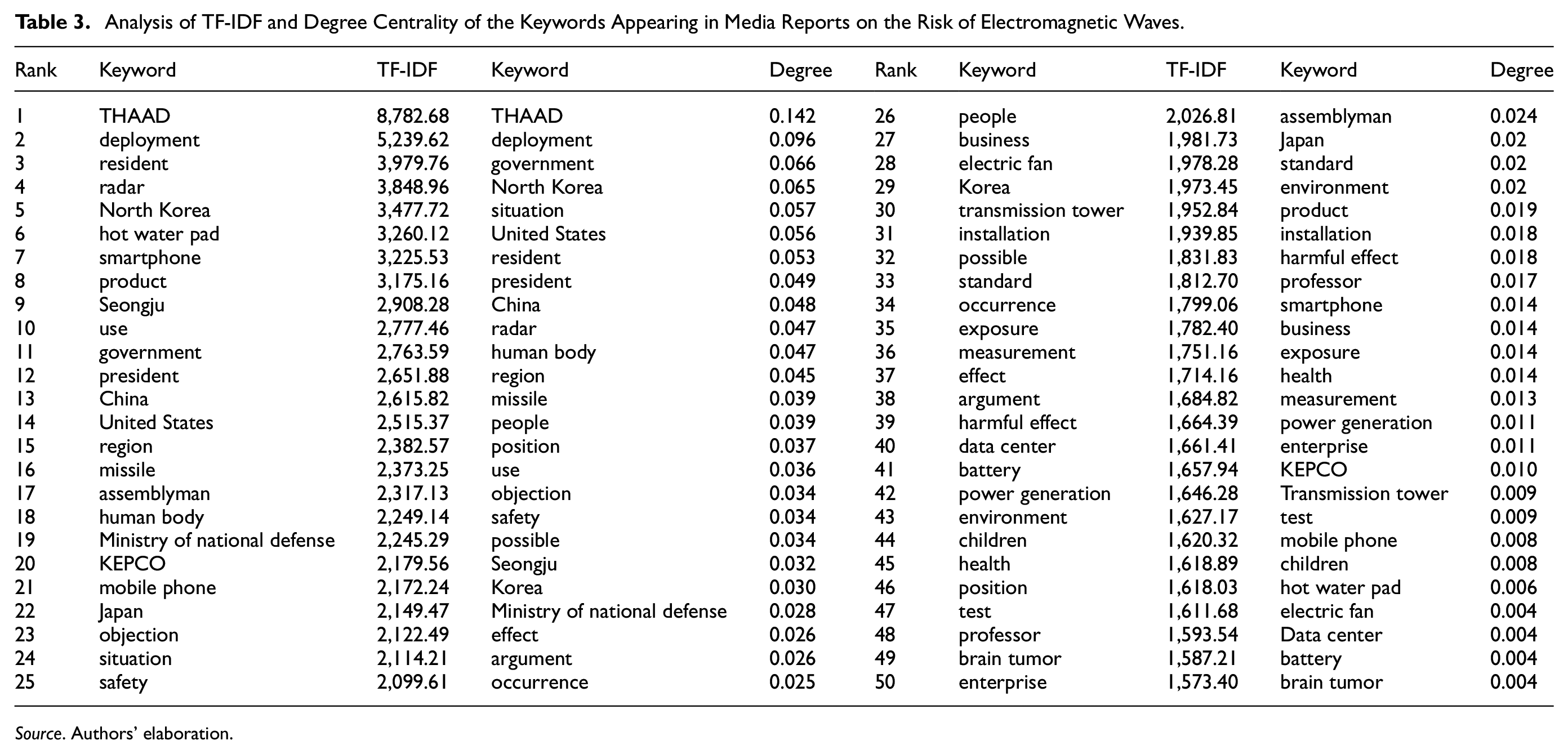
Source. Authors’ elaboration.

The framework of research analysis.
It was found that the keyword “THAAD” had the highest value both in TF-IDF and degree centrality in related media reports over the past 10 years. This indicates that the media reports focused on the risk of electromagnetic waves in relation to the deployment of THAAD on the Korean Peninsula in 2016–17, and the risk of electromagnetic waves was treated as a matter of concern not only for residents of Seongju but also for the entire nation. In addition, related keywords such as “North Korea,” “deployment,” “radar,” “United States,” “China,” “missile,” “president,” and “Ministry of National Defense” also ranked high. Looking at the top keywords related to the risk of electromagnetic waves in terms of devices, it was found that “hot water pad,” “smartphone,” “mobile phone,” “electric fan,” “transmission tower,” “battery,” etc., were intensively covered by media in relation to the risk of electromagnetic waves. Keywords related to the concerns and harmful effect of electromagnetic waves on human body, such as “human body,” “harmful effect,” “safety,” “children,” “environment,” “brain tumor,” and “exposure,” ranked high. Looking at the structural properties of the semantic network in Figure 1, it was found that it was connected to a total of 50 nodes and 2,388 connecting lines, with an average connection strength of 47.760, density of 0.975, average connection distance of 1.025, components of 1, and diameter of 2. The results of the keyword semantic network and CONCOR cluster analyses are shown in Figures 2 and 3.

Analysis of big data keywords in media reports on the risk of electromagnetic waves: Semantic network of the media reports on the risk of electromagnetic wave.

Analysis of big data keywords in media reports on the risk of electromagnetic waves: CONCOR of media reports on the risk of electromagnetic waves.
The keyword “THAAD” showed the largest node size, and “deployment,” “residents,” “hot water pad,” and “smartphone” also showed relatively large node size. Examining the connection strength of each node in detail, it was found that the connection strength between keywords related to the deployment was high. Table 4 presents the results of the CONCOR cluster analysis. A total of eight clusters were classified, and in Cluster 1, keywords related to the use of home appliances, such as hot water pads, batteries, and electric fans, formed one cluster. In Cluster 2, keywords such as health, children, and brain tumors, which were related to concerns about exposure to electromagnetic waves from mobile phones and smartphones, formed one cluster. In Cluster 3, the keywords related to facilities and electrical equipment that generate electromagnetic waves, such as the transmission tower, KEPCO, and data center, formed one cluster, and the keywords related to THAAD deployment formed three clusters, Clusters 6 to 8.
CONCOR Cluster Analysis of Keywords in Media Reports on the Risk of Electromagnetic Waves (2012.7.1–2022.06.30).

Source. Authors’ elaboration.
Analysis of Keywords in Media Reports on the Risk of Electromagnetic Waves
The results of the analysis of the top 50 keywords based on TF-IDF values and the degree centrality through purification and pre-processing from 8,420 data points in major domestic and foreign portals containing the risk of electromagnetic waves as a keyword are shown in Table 5, and the results of the semantic network and CONCOR cluster analysis are shown in Figures 4 and 5.
Analysis of TF-IDF and Degree Centrality of the Keywords in Portal Big Data on the Risk of Electromagnetic Waves.

Source. Authors’ elaboration.

Analysis of keywords in portal big data on the risk of electromagnetic waves: Semantic network of the portal big data on the risk of electromagnetic waves.

Analysis of keywords in portal big data on the risk of electromagnetic waves: CONCOR of portal big data on the risk of electromagnetic waves.
The keyword with the highest TF-IDF value and degree centrality was “mobile phone,” and “smartphone” also ranked high. The top keywords related to the risk of electromagnetic waves in terms of the device were “earphone,” “hot water pad,” “electric mat,” “electric pad,” “computer,” and “microwave oven.” The top keywords related to the concerns and harmful effect of the electromagnetic waves on the human body were “human body,” “exposure,” “safety,” “harmful effect,” “concerns,” “body,” “health,” “head,” “brain,” “humans,” “children,” “fatal,” “damage,” and “kid.” The structural properties of the semantic network show that it is connected to a total of 50 nodes and 2,220 connecting lines, with an average connection strength of 44.400, density of 0.906, average connection distance of 1.094, component of 1, and diameter of 2. The keyword “mobile phone” had the largest node size, and the keywords such as “THAAD,” “occurrence,” “product,” “human body,” and “smartphone” also had relatively large node sizes. Looking at the connection strength of each node in detail, it was found that the connection strengths around the keywords ’electromagnetic waves’ and ’mobile phones were high. A total of 7 clusters classified by the CONCOR analysis are summarized in Table 6. In Cluster 1, the largest number of keywords related to the harmful effects of products generating electromagnetic waves, such as “microwave ovens” and “smartphones” on children and the human body formed a cluster. In Cluster 2, a single keyword “mobile phone” formed an independent cluster, and in Cluster 3, keywords related to electronic and electronic products such as hot water pad, electric pad, and computers, including the keyword “concerns,” formed a cluster. In Clusters 4 and 5, keywords related to the deployment of THAAD formed a Cluster, whereas in Clusters 6 and 7, keywords related to “head” and “brain” formed a cluster.
CONCOR Cluster Analysis of Keywords in Portal Big Data on the Risk of Electromagnetic Waves (2012.7.1–2022.06.30).
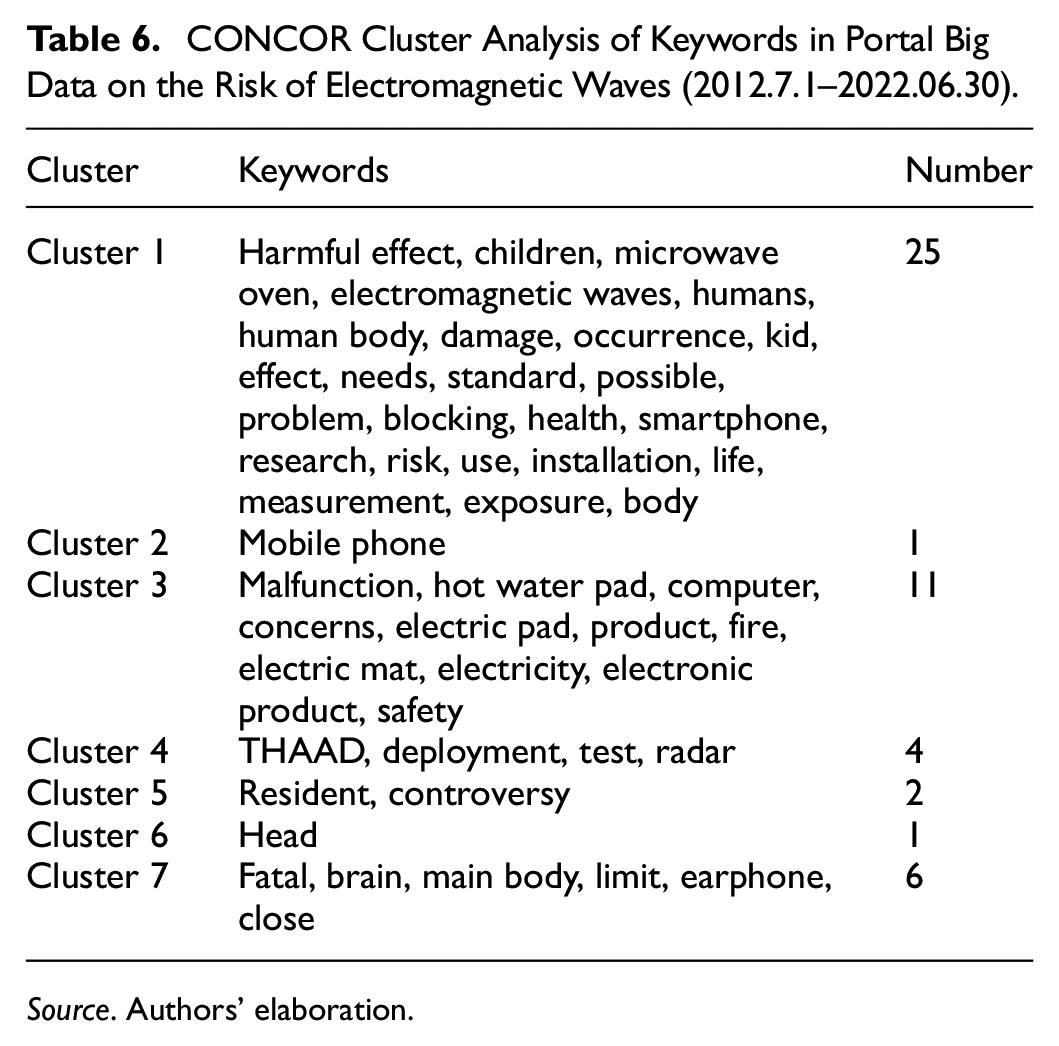
Source. Authors’ elaboration.
Discussion
The results of this study confirmed that the social perception of the risk of electromagnetic waves is an important factor that has a wide range of influence on social infrastructure, such as electric and electronic products people use in their everyday lives, transmission towers, communication facilities, and security policies such as THAAD, and that various worries and concerns about the harmful effects of electromagnetic waves are embedded in social perception. Based on the results of this study, the characteristics of the objective perception and discourse on the risk of electromagnetic waves in Korean society are summarized as follows. Through data analysis, this study identified three major social perception factors related to the risks of electromagnetic waves: state and social policies, effects of surrounding facilities, and the electromagnetic effects of household appliances on health.
Looking at the perceptions and characteristics related to the risk of electromagnetic waves that have appeared in Korean media reports over the past 10 years, we found that keywords related to THAAD deployment have been intensively dealt with in media reports. As a result of cluster analysis, three out of eight clusters and nearly half of the top 50 keywords were related to THAAD deployment, which indicates that the biggest issue related to the risk of electromagnetic waves in the media over the past 10 years was THAAD deployment. In addition, through the results of this study, which derived keywords on the risk of electromagnetic waves generated from electronic products that are mainly used in people’s everyday life, such as mobile phones, hot water pads, electric fans, and batteries, we were able to infer that the Korean media’s perception of the risk of electromagnetic waves and their characteristics have a close relationship with social infrastructure, such as electric and electronic products used in everyday life, transmission towers, communication facilities, and security policies such as THAAD. In addition, looking at the characteristics of the Korean society’s perception of the risk of electromagnetic waves through portal big data analysis, we found that Koreans had the highest interest in the effects of mobile phone use on the human body. We also found that all the keywords related to THAAD deployment were highly ranked. As a result of the CONCOR cluster analysis, it was found that a number of keywords on the effects of electronic products, such as smartphones, hot water pads, electric mats, and earphones, which are frequently used in everyday life, on children and the human body were intensively dealt with in portal big data. Through the results of the analysis of keywords that appeared in media reports and portal big data related to the risk of electromagnetic waves, it was confirmed that, as the main perception factors related to the risk of electromagnetic waves in Korean society, three aspects of keywords appeared in common: impact by national and social policy as well as surrounding facilities, aspects related to products used in people’s everyday life, and the harmful effects of electromagnetic waves on people’s health. Focusing on these factors, we suggest the implications of policies related to the perception of electromagnetic waves through media reports and portal big data analysis results as follows. First, to enhance the public understanding of the safety of electromagnetic waves, it is necessary to strengthen active publicity and expand the provision of electromagnetic wave-related safety information. In particular, correct information such as the effects of electromagnetic waves on the human body should be provided by strengthening the risk communication activities, and publicity on current standards for electromagnetic wave human body protection, conformity assessment process, and regulations need to be strengthened. Vague concerns about the harmful effects of electromagnetic waves should be resolved by spreading the social perception that electromagnetic wave-related products and facilities are being managed safely according to strict standards and procedures. In addition, electromagnetic wave measurement results should be disclosed for household products and major facilities perceived by the society as having a high risk of electromagnetic waves, and efforts should be made for two-way communication to increase information accessibility to the measurement results. Efforts should be made to resolve civil complaints and conflicts caused by the harmful effects of and hypersensitivity to electromagnetic waves. For this purpose, a professional communication channel that can exclusively handle electromagnetic-wave-related complaints should be established, and its functions should be strengthened. Currently, various organizations, including the National Radio Research Agency and the Korea Communications Agency, handle electromagnetic-wave-related complaints in Korea by splitting their work. However, to efficiently respond to civil complaints related to electromagnetic waves, it is necessary to establish a professional civil complaint response system with expertise by integrating and concentrating on related functions. Third, a specialized organization or agency must be established to strengthen the proper perception and communication of electromagnetic wave information. In the case of Japan, in 2008, a neutral and private permanent organization called the “Japan EMF Information Center” was established to promote risk communication in order to solve various problems caused by the failure of delivery of accurate knowledge on the effects of electromagnetic wave exposure on human body. Korea also needs to establish a private permanent organization that can professionally fulfill this role and work closely with related ministries and government-affiliated organizations to provide accurate information on electromagnetic waves for various issues and promote professional communication activities to secure social trust in human safety. Fourth, it is necessary to prevent the spread of misinformation about the risks of electromagnetic waves via social media and strengthen monitoring activities. Nowadays, various types of information circulate through social media, greatly influencing the public. Thus, it is necessary to prevent the development of anxiety among people regarding the risk of electromagnetic waves caused by the circulation of incorrect information.
Conclusion
This study objectively examined perceptions related with risks of electromagnetic waves through big data analysis, and, based on it, suggested four policy alternatives as mentioned section discussion. To create a foundation for a safe electromagnetic wave environment to actively cope with the future radio wave environment, the formation of a correct social perception of electromagnetic waves is a very important policy factor. However, this study has a limitation because it was conducted in a limited range by limiting the analysis targets to only keywords related to “the risk of electromagnetic waves” that have appeared in Korean media reports and major portal big data over the past 10 years. In addition, the limitation lies in the fact that it was not possible to separate and analyze periods to examine changes in perception in setting the study period. However, this study has academic significance and strength because we made efforts to more objectively analyze society’s electromagnetic wave-related perception using big data analysis techniques and presented policy implications, going one step further beyond the existing survey and research method on electromagnetic wave perception based on questionnaire surveys.
The findings of this study will be used in the future as basic data for choosing object products to conduct research on the risks of electromagnetic waves, and if in-depth research on major devices revealed in this study is conducted in the future, they will contribute to the development of electromagnetic wave-related policies. We hoped that follow-up studies related to the perception of electromagnetic waves using various types of big data, such as detailed perception surveys on major devices, will be actively conducted in the future, contributing to improving the correct social perception of the electromagnetic waves.
Footnotes

Funding
The author(s) received no financial support for the research, authorship, and/or publication of this article.
Declaration of Conflicting Interests
The author(s) declared no potential conflicts of interest with respect to the research, authorship, and/or publication of this article.
Data Availability Statement
Data sharing not applicable to this article as no datasets were generated or analyzed during the current study.