




Abstract
This study used the QNARDL model to examine how government expenditure affected economic growth in 92 countries during 1992 to 2021. Unlike traditional models, this study decomposes government expenditure into positive and negative changes, estimating their impacts across different growth quantiles. The QNARDL model provides more detailed information than linear models such as the threshold autoregressive model, panel threshold method, quadratic form, and data envelopment analysis. The findings reveal that both positive and negative government expenditure changes hamper economic growth at most quantiles, with only a few positive effects observed at certain quantiles. This study’s novel contribution lies in its methodological approach as it uses the QNARDL model to capture the nuanced and complex relationship between government expenditure and economic growth, providing crucial information for policymakers on the efficacy of fiscal policy across different economic conditions.
Introduction
The role of fiscal policy in driving economic growth has long been a subject of intense debate, particularly as the global economic landscape becomes increasingly interconnected (Sosvilla-Rivero & Rubio-Guerrero, 2022). The potential for government expenditure to either stimulate or stifle growth depends heavily on the economic context and how fiscal interventions are implemented. Fiscal policy is traditionally seen as a double-edged sword: while increased government spending can boost demand and foster growth, it can also burden the economy through increased borrowing costs and taxation (Hajamini & Falahi, 2018). This duality highlights the complexity of assessing the long-term effects of fiscal interventions on economic performance. Thus, considering the impact of fiscal policy is crucial to ensure a country’s future financial sustainability.
Although many studies have examined the impact of fiscal policy on economic activity, the role of government spending remains controversial. Traditional perspectives on the role of fiscal policy in economic dynamics are deeply rooted in contrasting economic theories. Keynesian economics, for instance, champions the idea that government spending can mitigate business cycles, particularly during recessions (Rotheim, 1981); it posits that in times of economic downturn, increased government expenditure can stimulate demand, create jobs, and lead to economic recovery. This perspective underscores the proactive relationship between fiscal policy and economic stabilization and fostering growth. However, classical and neoclassical theories argue that excessive government intervention can have detrimental effects. The crowding out effect suggests that increased public sector borrowing raises interest rates, reducing private sector investment (Alfada, 2019; Asimakopoulos & Karavias, 2016; Barro, 1991; Bin Mohd Aznan et al., 2022; Chiou-Wei et al., 2010; Christie, 2014; Meyer et al., 2017; Hajamini & Falahi, 2018; Vveinhardt & Sedziuviene, 2022). Furthermore, excessive spending can lead to an increased debt burden, which may have long-term fiscal sustainability risks, especially if debt grows faster than the economy (Hajamini & Falahi, 2018; Khan & Reinhart, 1990; Makuyana & Odhiambo, 2018; Mankiw et al., 1992; Suhendra & Anwar, 2014). Resource misallocation and inefficiency can also occur, whereby politically motivated government projects divert resources from more productive uses, reducing overall economic efficiency (Goh and Mohd Aznan, 2023; Sosvilla-Rivero & Rubio-Guerrero, 2022).
Moreover, excessive fiscal spending often leads to higher taxes, which can have distortionary effects on labor supply and investment, further stifling economic growth (Afonso & Sousa, 2012; Alexiou, 2009; Blanchard & Perotti, 2002; Bose et al., 2007; Ghose & Das, 2013; Jawadi et al., 2016; Pata et al., 2023; Romero-Avila & Strauch, 2008). Inflationary pressures are another risk associated with excessive government spending, particularly when this spending is financed by borrowing or monetary expansion. When the government expenditure exceeds the economy’s productive capacity, inflation can erode purchasing power and disrupt economic stability (Afonso & Sousa, 2012; Alexiou, 2009; Blanchard & Perotti, 2002; Bose et al., 2007; Ghose & Das, 2013; Jawadi et al., 2016; Pata et al., 2023; Romero-Avila & Strauch, 2008). Furthermore, sustained government intervention in the economy can create dependency and reduce the private sector’s initiative to innovate and grow independently, as businesses become reliant on public support rather than market competition (Asimakopoulos & Karavias, 2016; Chen & Lee, 2005; Chiou-Wei et al., 2010; De Witte & Moesen, 2010; Hajamini & Falahi, 2018).
Although these concerns highlight the potential drawbacks of government spending, Keynesian economics presents a contrasting view. Keynesians argue that increased government expenditure is essential during economic downturns because it stimulates demand, reduces unemployment, and fosters economic recovery (Rotheim, 1981). This view underscores the countercyclical role of fiscal policy in stabilizing the economy, particularly in times of crisis.
These divergent stances underscore the need for detailed approaches to understanding the relationship between government expenditure and economic growth. A one-size-fits-all fiscal policy is unlikely to succeed across diverse economic conditions (Meyer et al., 2017; Vveinhardt & Sedziuviene, 2022). Thus, the complex, context-dependent nature of fiscal interventions necessitates a tailored approach, one that considers both the short- and long-term effects of government expenditure on growth (Eyraud & Weber, 2013).
Most previous studies have used linear or nonlinear models, such as the threshold autoregressive model, panel threshold method, quadratic form, and data envelopment analysis, to determine the optimal threshold for government spending (Alfada, 2019; Asimakopoulos & Karavias, 2016; Barro, 1991; Bin Mohd Aznan et al., 2022; Chiou-Wei et al., 2010; Christie, 2014; Meyer et al., 2017; Hajamini & Falahi, 2018; Vveinhardt & Sedziuviene, 2022). Nevertheless, these approaches may be unable to capture all the impacts of changes in government expenditure on economic growth.
Thus, to overcome the limitations of previous studies, this paper employs the quantile nonlinear autoregressive distributed lag (QNARDL) model (Cho et al., 2015; Shin et al., 2014) to capture the asymmetric effects of government expenditure on economic growth. As a result, this study makes several major contributions. First, the short- and long-term effects of changes in government expenditure are comprehensively identified at different stages of economic growth. Second, changes in government expenditure are decomposed into positive and negative partial series sums and fully explored across quantiles, highlighting the asymmetric nature of fiscal policy effects, which simpler linear or nonlinear models cannot capture. Unlike conventional models, the QNARDL model allows for assessing how changes in government spending affect the entire growth distribution, uncovering crucial insights that previous approaches could not reveal. In addition, this model offers a comprehensive view of the asymmetric relationship between government expenditure and economic growth, providing valuable information for policymakers seeking to optimize fiscal strategies in a complex global economy. Additionally, to strengthen this study’s findings, we conduct a robustness test using the system generalized method of moments (SGMM) model. To achieve this objective, the study uses a panel dataset of 92 economies, including both OECD and non-OECD countries, covering the period from 1992 to 2021. The findings provide practical knowledge for policymakers, enabling them to design targeted and effective fiscal strategies tailored to specific economic contexts. Thus, the insights generated by this analysis will help policymakers optimize their fiscal interventions to achieve sustainable economic growth.
Literature Review
The debate on the effectiveness of government expenditure remains unsettled, with empirical evidence supporting both Keynesian and classical perspectives under different conditions. Proponents of government intervention argue that strategic public expenditure can stimulate economic growth by investing in infrastructure, education, healthcare, and other areas that may increase productivity and improve the citizens’ quality of life (Afonso & Sousa, 2012; Alexiou, 2009; Blanchard & Perotti, 2002; Bose et al., 2007; Ghose & Das, 2013; Jawadi et al., 2016; Pata et al., 2023; Romero-Avila & Strauch, 2008). On the other hand, critics of government expenditure contend that excessive spending can lead to inefficiencies, resource misallocation, and increased debt, which could harm the economy; they advocate for limited government intervention, emphasizing the role of the private sector in driving innovation and growth through competition and market forces (Afonso & Furceri, 2010; Dar & AmirKhalkhali, 2002; Fatás & Mihov, 2010; Fölster & Henrekson, 2001; Hasnul, 2015). Furthermore, some studies have encountered challenges in establishing a clear relationship between government expenditure and economic growth (da Silva & Vieira, 2017; Onabote et al., 2023) or suggest that government expenditure may have a disproportionate effect on economic growth (Asimakopoulos & Karavias, 2016; Chen & Lee, 2005; Chiou-Wei et al., 2010; De Witte & Moesen, 2010; Hajamini & Falahi, 2018). Table 1 summarizes previous empirical studies.
Summary of Empirical Studies of the Effect of the Government Size on Economic Growth.

Methodology
The empirical model used to examine the effect of government expenditure on economic growth was constructed based on a published method (Mehdi Hajamini, 2018). Zaghdoudi et al. (2023) and Kim (2024) argue that macroeconomic shocks, such as the 2008 financial crisis and the COVID-19 pandemic, affect the data structure. Therefore, to better capture the relationship between government expenditure and economic growth, the empirical model in this study incorporates the effects of these two macroeconomic shocks and is expressed as equation (1).

Where
QNADRL Model
This study uses an advanced econometric approach to investigate the asymmetric impact of the
The basic autoregressive distributed lag (ARDL) model developed by Pesaran et al. (2001) was used to quantitatively express these relationships and is expressed as equation (2):

This equation allows us to analyze how past values of

Where:


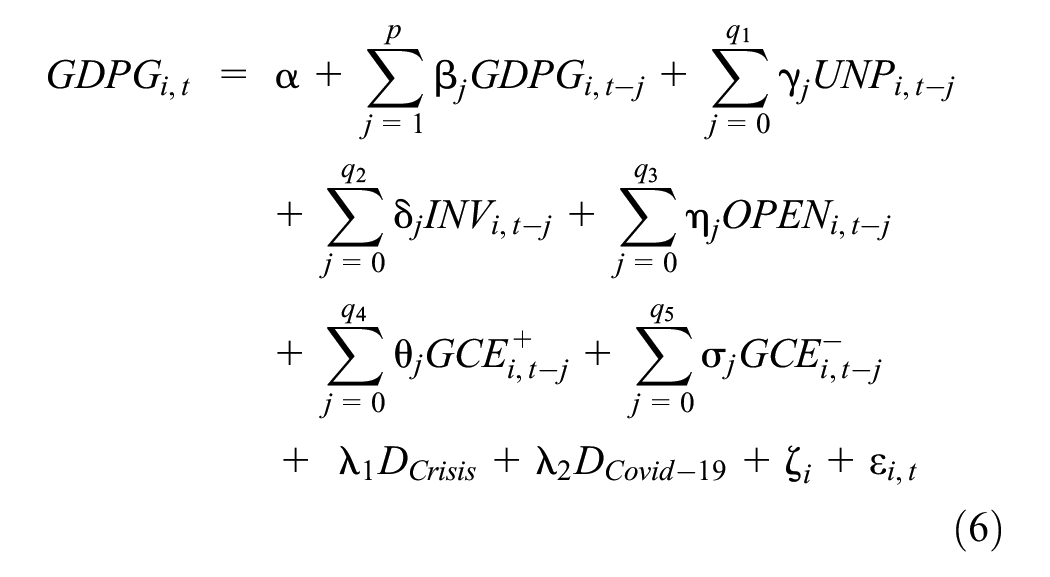
Breaking down government expenditures allows us to separate the impact of positive and negative changes on economic growth. Hence, the model was modified to include these asymmetric effects:
Where
Where

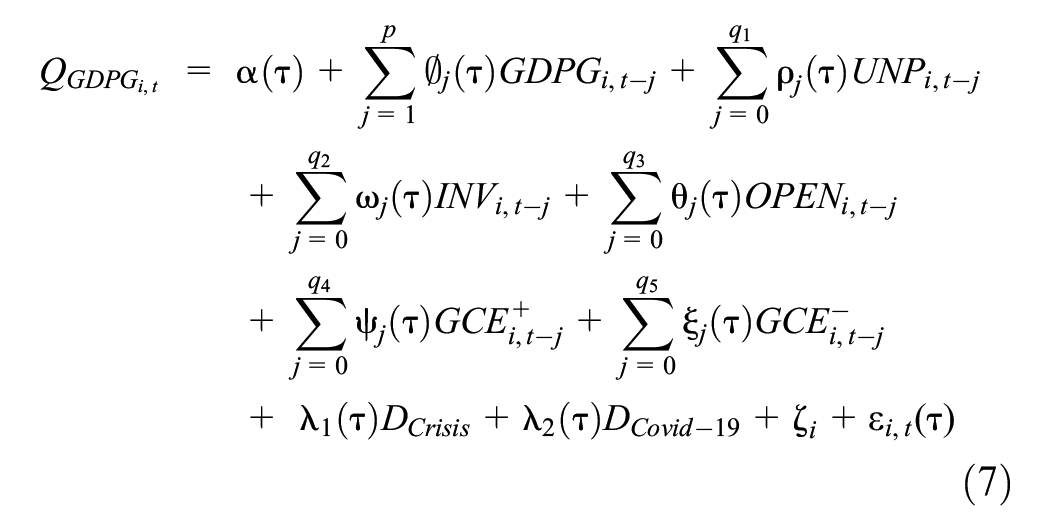
The short-term combined impact of these parameters was calculated by
The nonlinear and asymmetric effects of the
Regarding the long-term parameters, the null and alternative hypotheses are as follows:
As suggested by Cho et al. (2015),

Data Selection
Consistent with the methodologies employed in the recent econometric literature, the secondary data were sourced from the World Bank’s comprehensive database, ensuring robustness and reliability. This study used yearly observations from 1992 to 2021 for 92 countries (Table A1). This extensive timeframe allows for analyzing long-term trends and assessing the effect of government consumption expenditure on economic growth across various global contexts. This study includes variables such as GDP growth, the unemployment rate, gross fixed capital formation, and government consumption expenditure. Trade openness is calculated as the sum of exports and imports divided by the GDP, with data sourced from both the World Bank (WB) and the Direction of Trade Statistics of the International Monetary Fund (DOTS-IMF) (Table A2). Table 2 presents the descriptive statistics of the variables used in the model.
Descriptive Statistics of the Model’s Variables.

Note. ***p < .01.
Empirical Analysis
Unit Root Test
This study applied the Levin, Lin, and Chu (LLC), Im, Pesaran, and Shin (IPS), augmented Dickey–Fuller (ADF), and Phillips–Perron (PP) tests to search for the unit root. In particular, PP is critical to ensure the validity of the subsequent econometric analysis. Table 3 details the results of the panel unit root tests. The null hypothesis of a unit root for the variables
Results of the Unit Root Tests.

Note. LLC, IPS, ADF, and PP are the Lin and Chu test, Im, Pesaran and Shin test, augmented Dickey–Fuller test, and Phillip–Perron test, respectively.
p < .05. ***p < .01.
Results of the QNARDL Model
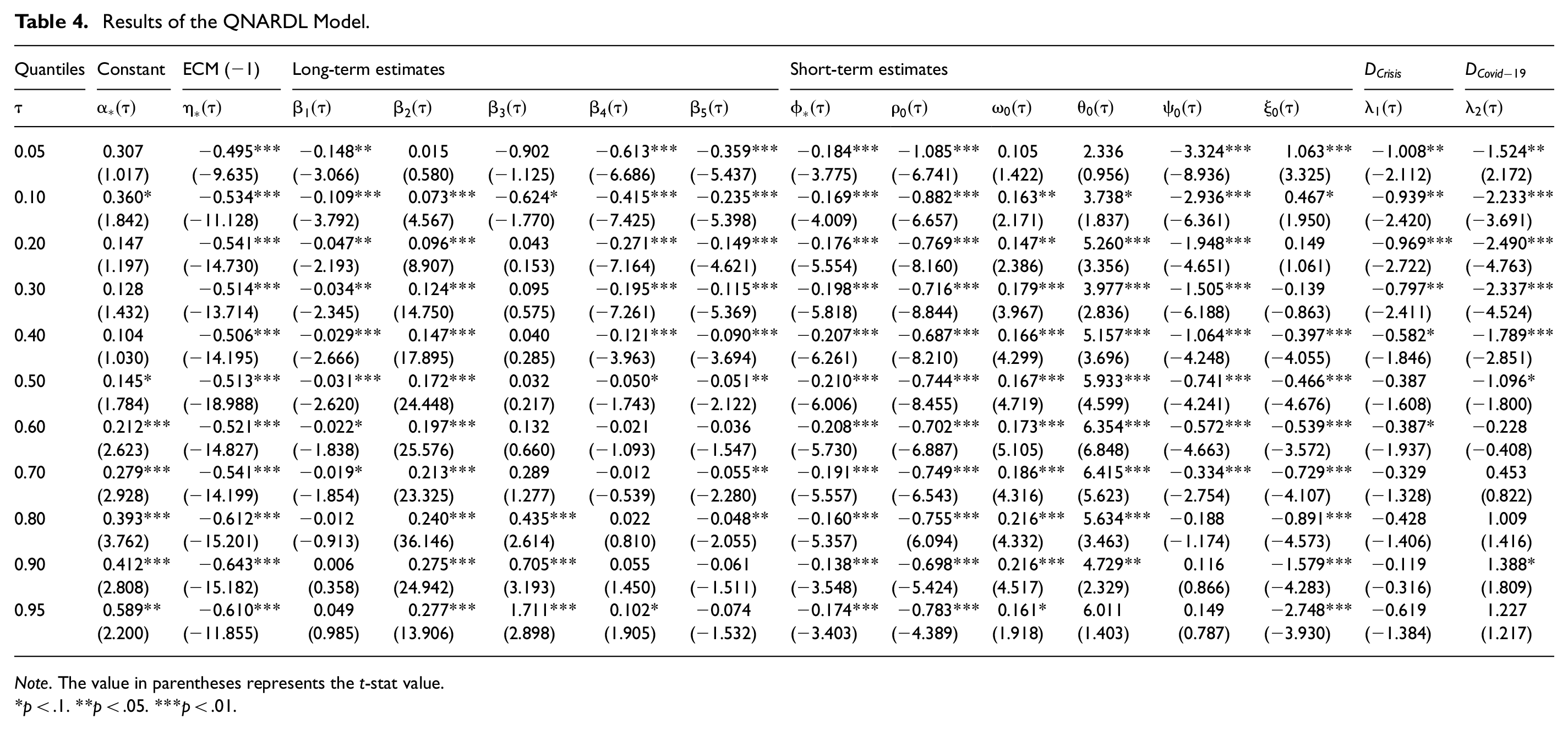
Table 4 reports the findings from the QNARDL model, which evaluates the threshold effect of the
Results of the QNARDL Model.
Note. The value in parentheses represents the t-stat value.
p < .1. **p < .05. ***p < .01.
The
The
The Wald test was used to assess the asymmetries of the parameters across the quantiles examined in the QNARDL model. The Wald test can detect instability for both the intercept and coefficient. Moreover, it can identify structural changes with both known and unknown breakpoints. Table 5 presents the results of the Wald test. The null hypothesis stated that coefficients are equal across different quantiles of the dependent variable, in this case, economic growth.
Results of the Wald Test.

p < .1. ***p < .01.
Table 5 also presents the parameters’ coefficients (

Quantile parameter estimates.
Robustness Tests
To ensure the validity of this study’s findings, we conducted a comprehensive robustness check to address potential endogeneity and heterogeneity in the data. We applied the SGMM model developed by Blundell and Bond (1998) for this purpose. SGMM’s advantage was that it provided efficient estimates for dynamic panel data models Adebayo et al. (2023) and overcame issues such as endogeneity, autocorrelation, heterogeneity, and fixed effects (Konstantakopoulou, 2022; Roodman, 2009). The SGMM model estimation results in Table 6 show that both
Results of the SGMM Model.

Note. The values in parentheses are the p-values.
p < .05. ***p < .01.
Discussion
Few studies have investigated the asymmetric impact of government expenditure on economic growth in terms of quantiles. Thus, this study has made a notable contribution regarding methodology because the QNARDL model was applied to a sample of 92 countries from 1992 to 2021.
The results in Table 4 show that, in the long run, both
By comparing our results with previous studies (Afonso & Furceri, 2010; Dar & AmirKhalkhali, 2002; Fatás & Mihov, 2010; Fölster & Henrekson, 2001; Hasnul, 2015), we can conclude that an increase in government size and expenditure hampers economic growth because of inefficiencies and the inhibition of private investment. In other words, excessive government expenditure results in volatility and negative effects on economic stability and growth. This study builds on these perspectives by providing empirical evidence of these negative impacts across various economic conditions, emphasizing the need for a more detailed approach to fiscal policy.
The significant negative coefficients of the error correction mechanism
Furthermore, our results reveal that there are still a few quantiles where there is a positive relationship between government expenditure and economic growth, such as
These findings’ implications are manifold. For policymakers, the challenge lies in identifying the appropriate level and timing of government consumption expenditure to optimize its impact on economic growth. The evidence suggests that a one-size-fits-all approach to fiscal policy is unlikely to be effective. Instead, a context-dependent strategy that considers the current economic conditions and the unique characteristics of the economy in question is required. The threshold effect of government expenditure also has ramifications for economic forecasting and modeling. Traditional linear models may fail to capture the complex dynamics uncovered in this study. Hence, economic models need to incorporate nonlinearities and asymmetries to better predict the outcomes of fiscal policy interventions.
Finally, the analysis of the threshold effect of government consumption expenditure on economic growth reveals a sophisticated interplay between fiscal policy and economic performance. The results highlight the importance of tailoring government expenditure to the prevailing economic conditions and recognizing the nonlinear and asymmetric responses of economic growth to fiscal stimuli. These insights are vital for formulating effective fiscal strategies that can adapt to the fluctuating tides of economic activity and steer countries toward sustainable growth.
Conclusion
We conducted a detailed econometric analysis to elucidate the nonlinear effect of government expenditure on economic growth. The findings obtained with the QNARDL model provide detailed insights into the asymmetric effects of government expenditure on economic growth across different quantiles. Contrary to traditional views of fiscal policy as a consistent stabilizer, our results demonstrate that accumulated changes in government expenditure have a significant and negative impact on economic growth. Furthermore, the short-term impact is more widely observed than the long-term impact. This aligns with classical economic theories that posit that excessive government intervention can lead to inefficiencies, increased borrowing costs, and a crowding-out effect on private investment. The fiscal policy should vary depending on the economic situation, advocating for a more granular policy formulation. The coefficients’ significance across different quantiles demonstrates the varying impact of changes in government expenditure on economic growth. The effect of changes in government expenditure is more pronounced on lower quantiles than on higher quantiles. This study confirms that both positive and negative variations in government expenditure are significant determinants of economic growth, but their effects are not uniformly distributed across different economic conditions. This comprehensive understanding of the threshold effect provides valuable knowledge for policymakers, as it indicates that the effectiveness of government expenditure in stimulating economic growth varies depending on the current economic conditions.
Policy Implications
This study’s policy implications are profound. The results suggest that government expenditure is a potent tool for economic management, capable of influencing growth rates in both expansionary and contractionary phases. However, the effectiveness of government consumption expenditure is contingent upon the economic environment. Thus, policymakers should consider the economy’s position relative to its growth distribution when deciding on the scale and direction of fiscal interventions.
At low quantiles, negative changes in government expenditure can serve as effective stimuli in the short run. By contrast, at higher quantiles, the marginal benefit of additional government expenditure decreases. Furthermore, at the highest quantile, changes in government expenditure may result in a marginal boost to economic growth in the long run, but this effect is limited. This underscores the need for context-specific fiscal strategies. A one-size-fits-all fiscal policy is inadequate because it fails to consider the specific dynamics of different economic environments. Therefore, the proposed approach challenges the efficacy of universal fiscal policies and advocates for tailored interventions that consider each country’s unique economic conditions and characteristics. These findings provide policymakers with a framework for crafting more adaptable and effective fiscal strategies, considering their economies’ unique characteristics and growth stages.
Limitations and Future Research
While this study’s findings offer insightful contributions to our understanding of the relationship between changes in government expenditure and economic growth, the limitations that may influence the interpretation and application of these results should be considered. First, the expansive dataset covering 92 countries over nearly three decades represents a strength. However, the variability in data quality and availability from different sources introduces a layer of complexity to our analysis. Second, this study focuses on the aggregate level of
Future research should address the abovementioned limitations by incorporating a more diverse set of economic variables, using alternative econometric approaches, and examining the composition of government expenditure. Furthermore, more studies are needed to understand the global factors that influence the effect of government consumption expenditure on economic growth. Dividing the data between OECD and non-OECD countries may produce more detailed information. With these improvements, the economic literature can provide detailed guidance to policymakers seeking to harness fiscal policy for economic stabilization and growth.
Footnotes
Appendix
Variables’ Definitions and Sources.

| Notation | Variable | Details | Source |
|---|---|---|---|
| Gross domestic product growth | Gross domestic product growth | WB | |
| Unemployment rate | Unemployment rate | WB | |
| Investment | Percentage of gross fixed capital formation to GDP | WB | |
| Trade openness | Ratio of total exports and imports to GDP | WB, DOTS-IMF | |
| Government expenditure | Percentage of general government final consumption expenditure to GDP | WB |

Funding
The author(s) received no financial support for the research, authorship, and/or publication of this article.
Declaration of Conflicting Interests
The author(s) declared no potential conflicts of interest with respect to the research, authorship, and/or publication of this article.