



Abstract
In recent years, the fast-food sector has experienced a significant surge in the United Arab Emirates (UAE), establishing itself as the most relevant channel in foodservice. While previous literature has studied factors such as service quality, customer satisfaction, and positive word-of-mouth (WOM) as determinants of customer loyalty, little attention has been paid to the moderating effects that relational benefits could have in this context. To address this gap, the present study aims to explore how relational benefits moderate the relationship between service quality and customer satisfaction to strengthen customer loyalty. We employed a Partial Least Squares Structural Equation Modeling (PLS-SEM) approach to analyze data collected from a sample of 303 customers in Fujairah (UAE). The results confirm that both service quality and relational benefits are significant predictors of customer loyalty through customer satisfaction and positive word-of-mouth. Additionally, we verified the moderation hypothesis, but with a negative sign, suggesting the need to balance strategies concerning relational benefits to harmonize customer perception.
Introduction
In recent years, the fast-food industry has experienced a considerable boom in the United Arab Emirates (UAE), becoming the most important foodservice channel. According to reports from specialist consultancy GlobalData (2022), fast-food restaurants have played a key role for the industry, partly due to the significant increase in home deliveries and takeaways during the most challenging moments of the COVID-19 pandemic. Interestingly, a report released prior to the pandemic showed a slight decline in the frequency of visits to fast-food restaurants, pointing to a possible shift in consumption habits. Specifically, in 2018, the percentage of respondents who said they ate at fast-food restaurants less than once a week, the lowest frequency category, increased by more than 10% compared to 2017 (Statista, 2021). Now that the safety measures have been relaxed and the UAE population has adapted to the “New Normal”, it is uncertain how demand will evolve. As a result, the success of fast-food restaurants will depend largely on their customer loyalty and retention (Singh et al., 2021; Slack et al., 2021).
Customer loyalty to restaurants is a crucial determinant of their financial performance, as has been pointed out by restaurant managers, marketing professionals, and academics (Singh et al., 2021). Various variables have been considered as antecedents or determinants of customer loyalty in the literature. Among these, the most significant factors are restaurant service quality, customer satisfaction and word-of-mouth (WOM), which have been consistently highlighted as key drivers of loyalty in various meta-analytic studies (Ismagilova et al., 2021; Prayag et al., 2019; Shin et al., 2021; Tanford, 2016). Another significant factor is the relational benefits that the establishment can offer its customers (Gremler et al., 2020). These benefits refer to the rewards that customers receive for their long-term commitment to the restaurant and that go beyond basic good service, including trust benefits, social benefits, and special treatment (Gwinner et al., 1998). In the field of service research, these three relational benefits have been shown to be a robust antecedents of loyalty, mediating the relationship between loyalty and perceived value and quality (Gremler et al., 2020). Despite this, except for the recent works of Dandis et al. (2022 and 2023), this aspect has remains largely unexplored in fast-food research.
On the other hand, in the UAE’s rapidly evolving fast-food market, effective marketing and loyalty strategies are crucial to staying competitive (Ababneh et al., 2022; J. Hanaysha, 2016). Despite a significant increase in academic research on customer behavior in the region, limited attention has been given to the study of customer loyalty in fast-food restaurants (Ponnaiyan et al., 2021). Notably, the UAE has a population of almost 10 million, mostly expatriates, with a high percentage of internet users (GlobalData, 2022; Statista, 2023b). Fathelrahman and Basarir (2018) found that customers who use the internet to order food for home delivery in the UAE preferentially use social networks such as Facebook, Twitter, and Instagram to obtain information about reliable restaurants and leave their opinions and comments on the quality of the service provided by the restaurant.
Based on the above, this study attempts to address two gaps in the field of fast-food research. First, it responds to the call made by Singh et al. (2021) for new evidence on the factors that influence customer loyalty to fast-food restaurants in emerging economies. Second, this study examines the impact of relational benefits offered by fast-food restaurants as a key antecedent of customer loyalty (Dandis et al., 2022; Gremler et al., 2020). This analysis is grounded in the hypothesis that relational benefits, such as trust, social connections, and special treatment, influence customer loyalty by serving as antecedents to customer satisfaction, while also playing a moderating role in the relationship between service quality and customer satisfaction. This moderating role suggests that when customers perceive additional benefits in their relationships with restaurants—beyond the satisfaction derived from service quality—their loyalty may either strengthen or weaken, depending on how these relational benefits are managed and perceived. Therefore, the aim of this study is to explore the role of relational benefits as a moderator in the relationship between service quality and customer satisfaction, and how they ultimately impact loyalty. In doing so, this research contributes to previous studies on consumer behavior by introducing relational benefits as a novel factor within the fast-food restaurant context. In line with Dandis et al. (2022) and marketing theory, this study suggests that fast-food establishments can enhance their ability to achieve sustainable success through the optimal combination of relational benefits.
Consequently, this study is positioned at the intersection of relationship marketing and consumer behavior theories (Daries et al., 2024; Edwards & Baker, 2020; To & Leung, 2023). As businesses increasingly integrate relational benefits into their strategies, it becomes essential to delve deeper into their effects on customer loyalty, both in theory and practice. In this context, relational benefits are proposed as a catalyst that can be capable of reshaping customers’ perceptions of service quality and satisfaction, serving as a strategic tool to enhance customer relationships and foster loyalty. Unlike previous studies, this study investigates the moderating effect of relational benefits and how they translate into loyalty. In this way, we contribute to the literature in several ways. First, we develop and validate a model based on relational marketing theory (Edwards & Baker, 2020), integrating well-established variables on consumer behavior and examining mediating relationships between service quality, customer satisfaction, and word-of-mouth (WOM). Second, we contribute to the body of literature on marketing in the service sector by examining the interaction between relational benefits and customer perceptions of satisfaction. Third, we investigate the moderating role of relational benefits in the relationship between service quality and customer satisfaction. In practice, the findings of the study offer fast-food restaurants a valuable guide for managing and implementing relational benefits more effectively. By enhancing understanding of how these benefits impact and moderate the relationship between service quality and customer satisfaction, managers can design more targeted strategies and improve customer experience, thereby boosting loyalty. Through the proper modulation of these benefits, fast-food restaurants can optimize their customer service approach, enhancing overall satisfaction and fostering a deeper and more enduring commitment from customers to the brand.
The rest of the document is structured as follows. First, a literature review is presented, which includes the background, the constructs incorporated in the model, and the proposed hypotheses are justified. Second, the methodological aspects of this research are described, including the measurement scales, participants, and data collection procedures. Third, the main results are presented. Finally, the discussion and conclusions follow, along with theoretical and managerial implications, limitations of the study, and future lines of research.
Literature Review and Hypothesis Development
In line with previous research, in this study we refer to fast-food restaurants as establishments that serve quickly prepared food in a standardized manner, offering a limited menu with options for both dine-in and takeout (Fleischhacker et al., 2011; Slack et al., 2021). We do not assume that fast food is always synonymous with poor quality, as this varies depending on the restaurant and ingredients used (Ali-Alsaadi et al., 2023; Chen et al., 2018; Namin, 2017).
Background
From a theoretical standpoint, relational marketing theory emerged to address the underlying reasons for customers to establish and maintain lasting relationships (Edwards & Baker, 2020; Hunt et al., 2006), moving away from a focus on episodic transactions to embrace ongoing relationships, grounded in trust, commitment, and customer satisfaction (Dandis et al., 2023; Lăzăroiu et al., 2020). This theory highlights the importance of consistently understanding and meeting consumer needs and expectations to create value from the succession of relational exchanges (K. Hidayat & Idrus, 2023; Hunt et al., 2006; Lăzăroiu et al., 2020). Within this framework, there is consensus about the importance of consumer behavior analysis models based on mediation relationships between service quality, customer satisfaction, and word-of-mouth (WOM), and how these relationships ultimately determine customer loyalty (Ali et al., 2020; Khoo, 2022; Marcos & Coelho, 2022). Recent studies support this view, showing that when consumers perceive that their expectations are met with a satisfactory product or service experience, they tend to promote the product or service among others (WOM) and become more loyal (Khoo, 2022; Marcos & Coelho, 2022; White, 2010). Ahmed et al. (2023) and Camilleri and Filieri (2023) highlighted that the more satisfied customers are with the quality of service, the more loyal they become. Previous research has established positive correlations between customer loyalty and satisfaction (Arora & Narula, 2018; Gopi & Samat, 2020). Moreover, there is widespread agreement on how favorable perceptions of service quality lead to greater satisfaction (Arora & Narula, 2018; Khoo, 2022; Konuk, 2019). The theoretical justification for these links, as pointed out by Cronin et al. (2000), can be attributed to Bagozzi’s (1992) emotional response evaluation and coping framework, which suggests that initial service evaluations (valuation) lead to an emotional reaction that subsequently drives satisfaction behaviors (Dandis et al., 2023), recommendation (Jalilvand et al., 2017), and loyalty (Ahmed et al., 2023; A. Hidayat et al., 2019; Uddin, 2019).
While relational marketing perspectives (Edwards & Baker, 2020; Hunt et al., 2006) affirm a robust and established explanatory framework for customer loyalty deriving from direct relationships between service quality, customer satisfaction, and word-of-mouth (WOM; (Ali et al., 2020; Khoo, 2022; Marcos & Coelho, 2022), the ties of relational benefits offered by fast-food establishments in their loyalty programs, such as through social media, remain underexplored, aside from the works of Dandis et al. (2022 and 2023). These studies have shown direct impacts on various antecedents of loyalty: repurchase intention, willingness to pay more, WOM, customer satisfaction, commitment, and trust. In contrast, in other sectors, empirical evidence supports the premise that relational benefits are a prominent predictor of satisfaction and loyalty: “Research consistently shows that these two constructs can be predicted by the RBs that customers receive across a wide range of contexts. …it seems safe to say that the links between RBs and customer satisfaction and loyalty are well established” (Gremler & Gwinner, 2015, p. 50; Ju Rebecca Yen & Gwinner, 2003; Najjar & Najar, 2022). Thus, as a tool of relational marketing (Gremler et al., 2020; Najjar & Najar, 2022), the implementation of relational benefits through actions or loyalty programs significantly influences customer perceptions of satisfaction and loyalty (Gremler et al., 2020; Gremler & Gwinner, 2015). This suggests that relational benefits, in addition to directly impacting satisfaction and loyalty variables, could also alter perceptions of service quality and satisfaction, thereby moderating these relationships (Gremler & Gwinner, 2015) and thus enhancing their scope and effectiveness as a relational marketing strategy.
In this work, in line with Gremler and Gwinner (2015), we argue that relational benefits complete the perception of relational switching costs (Evanschitzky et al., 2022), understood as those a customer assumes when ending a relationship with one service provider and switching to another. Relational benefits represent the perceived advantages of maintaining the relationship with the provider. The combination of perceived relational benefits and switching costs offers a holistic understanding of how customers value their relationships with the company. As Chang and Chen (2007), and Jones et al. (2007) suggest, the relational benefits perceived and valued by customers generate switching costs (loss of special offers, promotions, or social bonds). This dynamic indicates that relational benefits provide direct advantages, and act as barriers to change, ultimately strengthening customer loyalty. Dagger and David (2012), Stan et al. (2013), and more recently Evanschitzky et al. (2022) have empirically shown the moderating effects exerted by relational costs on the relationships between service quality, satisfaction, and loyalty. Accordingly, the moderating mechanism of relational benefits should similarly affect perceptions of quality and satisfaction. For example, in a fast-food restaurant, where staff, through a mobile app, recognizes, greets, and wishes a customer a happy birthday, offering special promotions. This recognition is a significant relational benefit. On days when the restaurant is exceptionally busy, and service quality might decline (longer waiting times), customers who receive this personalized treatment may continue to feel satisfied due to the personal connection they have developed. Despite variations in quality, relational benefits help maintain and even improve satisfaction, which in turn fosters stronger loyalty to the restaurant.
Influence of Restaurant Service Quality on Positive WOM
Providing high-quality service is a critical success factor for restaurants (Ponnaiyan et al., 2021; Slack et al., 2021; Zibarzani et al., 2022). It requires a conscious effort by the restaurant staff to satisfy customer needs and desires and deliver a service that meets expectations (Ahmed et al., 2023; Clow & Vorhies, 1993). The customer’s experience of quality is an assessment of the overall excellence of a restaurant’s products and services (A. Hidayat et al., 2019). It is generally accepted that service quality refers to the customer’s perception of the gap between their expectations and the actual service received (Slack et al., 2021).
Lehtinen and Lehtinen (1991) seminal work on service quality presented two possible approaches to conceptualizing this variable: one is based on physical, interactive, and corporate quality dimensions, and the other on process and product quality dimensions. Building on this conception, recent research has shown that restaurant customers primarily value three attributes: food quality, physical environment, and employee service quality (Wall & Berry, 2007). These three dimensions have been widely explored in recent studies within the specific context of fast-food restaurants (Namin, 2017; Slack et al., 2021; Wu & Mohi, 2015). In this regard, Wu and Mohi (2015) noted that the influence of these three dimensions can vary significantly depending on the type of restaurant and customer culture. For example, Namin (2017) provided evidence from the United States that customer satisfaction improved based on food quality and price-value ratio, whereas Slack et al. (2021), focusing on the Republic of Fiji, found that food quality and the physical environment were determinants of perceived value, but not employee service quality. These cultural and contextual differences in the perception of service quality have a direct effect on how customers communicate their experiences to others, leading to the concept of word-of-mouth (WOM; Liao et al., 2023).
Customers tend to communicate with others about the products, establishments, and brands they consume, seeking to influence the attitudes and behaviors of potential customers (Mikalef et al., 2013). This communication, known as word-of-mouth (WOM), is an informal, person-to-person interaction between a perceived noncommercial communicator and a receiver regarding a brand, product, organization, or service (Harrison-Walker, 2001). Positive WOM about a service company’s offerings is considered a key relational outcome (Ng et al., 2011). Customers’ experiences in restaurants are influenced by their knowledge or observations of the establishment’s attributes acquired throughout the dining process (Jeong & Jang, 2011). In addition, service quality has been shown to affect customers’ satisfaction and their intention to engage in positive WOM about the restaurant. (Jalilvand et al., 2017; Konuk, 2019). Conversely, WOM can also be negative, reducing favorable outcomes for the restaurant (Wetzer et al., 2007). With the advent of the internet and social media, this communication has undergone a significant transformation, leading to a surge in electronic word-of-mouth (eWOM; Bai et al., 2017).
Positive WOM is considered a powerful marketing tool for restaurants (Jalilvand et al., 2017; Konuk, 2019). The impact of WOM on customer behavior in the restaurant industry has been widely studied (W.-L. Lee et al., 2022). Customers are more likely to trust and act on recommendations from family, friends, or online reviews than on traditional advertising methods (Ismagilova et al., 2021; Jalilvand et al., 2017). It is important to note that the quality of the restaurant experience plays a crucial role in generating positive WOM (W.-L. Lee et al., 2022; Longart, 2010). Customers are more likely to share their positive experiences with others when they perceive high levels of service quality, food quality, and atmosphere quality (Jeong & Jang, 2011; Wetzer et al., 2007). Moreover, the impact of WOM on customer behavior is stronger when it comes from a trusted source or is perceived as credible (Bai et al., 2017; Ismagilova et al., 2021). Bulut and Ulema (2022) highlight that WOM is shaped as an input of perceived service quality, as well as an outcome of it. WOM appears as a dependent variable in various studies, demonstrating that high perceived service quality leads to positive WOM (Bulut & Ulema, 2022; To & Leung, 2023). To and Leung (2023) emphasize that key aspects of the culinary landscape, such as service quality and physical environment, are strongly associated with customer satisfaction and positive word-of-mouth. Thus, for restaurants to benefit from positive WOM, it is crucial to provide a high-quality dining experience that meets or exceeds customers’ expectations (Kim et al., 2015; Longart, 2010). The direct relationship between service quality and positive WOM has been empirically demonstrated on several occasions. For example, Babin et al. (2005), focusing on Korea, found positive relationships among hedonic value, customer satisfaction and WOM. In the context of the UK, Longart (2010) showed that satisfaction with food and beverages is a key driver of positive WOM. Similarly, for fast-food restaurants on the east coast of Malaysia, J. R. Hanaysha and Pech (2018) showed that price fairness, the physical environment and customer service have positive effects on WOM. Thus, it can be posited that:
H1. The quality of the restaurant’s service has a positive influence on positive WOM.
Influence of Restaurant Service Quality on Customers’ Satisfaction
Managers in the hospitality industry know that customers’ satisfaction with the products and services provided by restaurants, cafes, and bars is critical to the success of those establishments (Ahmed et al., 2023; W.-K. Liu et al., 2017; Slack et al., 2021; Zibarzani et al., 2022). From the point of view of customer behavior, satisfaction refers to the “consumer’s fulfillment response…”, that is, “the overall subsequent psychological state following appraisal of the consumer experience against prior expectations” (Oliver, 2010, p. 13). Consequently, customer satisfaction refers to customers’ emotional and cognitive response once they have experienced the product or service and compared it with their previous expectations, or some predetermined standard (Slack et al., 2021). When customers feel that the product or service exceeds or meets their expectations, they feel satisfied (and vice versa; W.-K. Liu et al., 2017). There is extensive meta-analytic evidence on the relationship between service consumers’ quality experience and user satisfaction (Ladeira et al., 2016; Prayag et al., 2019; Shin et al., 2021).
Numerous empirical studies of the foodservice industry have demonstrated the close link between service quality and a variety of customer satisfaction outcomes, including direct effects on satisfaction, service value, and customers’ behavioral intentions (Dandis et al., 2023; Ghosh et al., 2023; Khoo, 2022; Marcos & Coelho, 2022; Zibarzani et al., 2022). Omar et al. (2016) investigated the relationship between five dimensions of service quality (tangibles, reliability, responsiveness, assurance, and empathy) and customer satisfaction in Arabic restaurants, finding positive relationships with all five dimensions. Similarly, Nguyen et al. (2018) found that tangibles, responsiveness, and assurance were the most important factors driving customer satisfaction in the UK fast-food industry. More recently, Gopi and Samat (2020) reported similar results in the context of food truck services in Kuala Lumpur. In addition, To and Leung (2023) emphasize that personalized attention, food quality and variety, such as freshness, temperature, presentation, and taste, and the design of the premises and restaurant service, significantly impact customer perceptions, emotions, and satisfaction. Therefore, in line with previous findings, the following hypothesis is proposed:
H2. The quality of the restaurant’s service has a positive influence on customers’ satisfaction.
Influence of Relational Benefits on Customers’ Satisfaction
Relational benefits are a key factor in customer retention, since they affect users’ perception of the quality of the service and influence their satisfaction and loyalty (Dandis et al., 2022; Gremler et al., 2020; Y.-K. Lee et al., 2014). Gwinner et al. (1998) define relational benefits as the group of benefits offered by the supplier that go beyond basic services and contribute to creating a stable bond with the customer. The relational benefit approach is based on the fact that both parties, the supplier and the customer, benefit mutually from the relationship (Hennig-Thurau et al., 2002); the supplier increases profitability in the medium-long term by moving on from occasional sales to create a stable, ongoing relationship with the customer (Han & Kim, 2009); and the customer enjoys specific relational features such as a pleasant environment, personalized service, extra attention, faster service, or price discounts (Han & Kim, 2009; Hennig-Thurau et al., 2002; Y.-K. Lee et al., 2014). The marketing literature has highlighted three key dimensions of relational benefits: psychological (confidence), social, and special treatment (Gremler et al., 2020; Gwinner et al., 1998; Y.-K. Lee et al., 2014). In this respect, psychological benefits (confidence) include safety, comfort, and services that reduce customers’ anxiety, for example, when they are given a celiac menu or a quick answer to a query about ingredients. Social benefits refer to the personal bond that is established in the restaurant, for example, familiarity with customers, personal recognition indicated by using their name. Special treatment benefits include extra attention and access to special promotions and services (Dandis et al., 2022; Gwinner et al., 1998; Han & Kim, 2009; Hennig-Thurau et al., 2002; W.-L. Lee et al., 2022).
As indicated by Y.-K. Lee et al. (2014), positive experiences of relational benefits are associated with higher customer satisfaction. Recent meta-analytic evidence confirms relational benefits as antecedents of customer satisfaction and loyalty (Gremler et al., 2020; Najjar & Najar, 2022). Specifically, Najjar and Najar (2022) showed the positive effects of relational benefits on loyalty through the mediating effect of satisfaction. Gremler et al. (2020), for their part, explained that while the absolute and relative strengths of the different dimensions of relational benefits on customer satisfaction are unclear, the sequential path through perceived value and quality is clearly among the strongest. This relationship has also been found in the field of fast-food restaurants; while Dandis et al. (2023) showed insignificant links in the case of social benefits, they found that customers assigned importance to financial savings when participating in loyalty programs. To pick up on the current trend of restaurants introducing relational benefits online and through apps (Hwang & Choi, 2020; Patsiotis et al., 2020), this research explores relational benefits as a single construct that captures functional (e.g., information about promotions, online communication, sharing experiences) and financial (e.g., discounts, offers, and food and drink coupons) dimensions (Gremler et al., 2020).
Considering the fundamental role that social media plays in forging relationships between the brand and the customer, this study concurs with the insights of Tsimonis et al. (2019), acknowledging that social media channels are among the most effective means for executing customer loyalty initiatives (Ibrahim & Aljarah, 2023; Stourm et al., 2020). Consequently, we focus on the relational benefits that restaurants offer through their social media platforms. This approach acknowledges the power of digital engagement in today’s marketing landscape and specifically addresses how restaurants utilize these interactive platforms to enhance customer relationships and foster loyalty. Based on the above, we propose the following hypothesis:
H3. Relational benefits (from participating in the restaurant’s social media) have a positive influence on customer satisfaction.
Influence of Positive WOM on Customer Loyalty
Customer loyalty is considered a fundamental factor in the management of fast-food restaurants (Ahmed et al., 2023; Uddin, 2019). Oliver (1999, p. 33) defines customer loyalty as a deeply rooted commitment that leads the customer to opt for the same product or service again to satisfy the need for which it was designed. This pioneering work explored the complex relationship between satisfaction and loyalty concluding that “satisfaction is a necessary step in loyalty formation but becomes less significant as loyalty begins to set in through other mechanisms. These mechanisms, omitted from consideration in current models, include the roles of personal determinism ("fortitude") and social bonding at the institutional and personal level”. In this way, he introduced social elements in the configuration of the relationship between loyalty and customer satisfaction. Indeed, social communication, through positive WOM, generates an attractive image of the restaurant and enhances its reputation, leading to increased patronage, customer loyalty, and positive brand image (Jalilvand et al., 2017). Favorable reviews of or comments about a restaurant help raise the likelihood of attracting new customers (Bai et al., 2017; Jeong & Jang, 2011; Kim et al., 2015); thus, the possibility of securing the loyalty of those new customers arises, depending on factors such as their degree of satisfaction with the products and services offered by the establishment (Oliver, 1999, 2010).
Previous research has shown the link between positive WOM and loyalty (Awad & Ragowsky, 2008; Babin et al., 2005), with loyal customers being more likely to spread positive information in the form of recommendations (Awad & Ragowsky, 2008). In their meta-analytic review, de Matos and Rossi (2008, p. 591) explored the most significant antecedents of WOM, showing a strong connection between loyalty and WOM, although they report that “satisfaction has a stronger relationship with positive WOM than loyalty”. In turn, Kim et al. (2011) pointed out that WOM affects the opinions of other customers, and that positive attitudes leading to loyalty are generated on the basis of favorable WOM communications. In this regard, the evidence reported by Balakrishnan et al. (2014), among others, confirmed the positive and significant relationship between brand loyalty and eWOM among Malaysian customers. However, the direction of the relationship is unclear; that is, whether loyalty generates positive WOM, or vice versa, or even whether there is a two-way link between the two (de Matos & Rossi, 2008). In line with the idea that these two constructs reinforce one other, Serra-Cantallops et al. (2018) argued that the intention to spread positive comments has a positive impact on brand loyalty, since positive comments enhance reputation and build loyalty, creating a “virtuous circle.” In the same vein, Casidy and Wymer (2016) found evidence of the effects of positive WOM on loyalty. Based on the above, the following hypothesis is proposed:
H4. Positive WOM has a positive influence on customer loyalty.
Influence of Customer Satisfaction on Customer Loyalty
The relationship between customer satisfaction and loyalty has been extensively studied in various fields (Arora & Narula, 2018). Prior research has consistently found a positive and significant association between these constructs (Oliver, 1999). Meta-analytic studies conducted by Ladeira et al. (2016), Tanford (2016), Prayag et al. (2019), and Shin et al. (2021) provide strong evidence of this relationship. In addition, there are scientific papers that support this relationship in fast-food restaurants; for example, W.-K. Liu et al. (2017), Uddin (2019), A. Hidayat et al. (2019), and Ababneh et al. (2022). Thus, we propose the following hypothesis:
H5. Customer satisfaction has a positive influence on customer loyalty.
Moderating Effects of Relational Benefits on the Relationship Between Restaurant Service Quality and Customer Satisfaction
Very few empirical studies to date have used the relational benefits variable as an indicator of relational strength and moderating construct in conceptual models of consumption behavior. It is more common to see analyses of the moderating effect of the age difference of consumers (see e.g., Na et al., 2021). The extensive use of social media (Instagram, Facebook, Twitter) has transformed the interaction between customers and restaurants (Fathelrahman & Basarir, 2018; Patsiotis et al., 2020). The customer uses this medium to share experiences, opinions and recommendations, while the restaurant can offer relational benefits to promote this behavior (Fathelrahman & Basarir, 2018; Hwang & Choi, 2020); by so doing, the restaurant gathers information and gains a better understanding of the perceptions of its customers. In this context, the relational benefits to be gained by participating in social media become increasingly important (Dandis et al., 2023; Gremler et al., 2020). Based on the pioneering work of J.-S. Lee et al. (2013), we propose that relational benefits could moderating the effects of the relationship between service quality and customer satisfaction. J.-S. Lee et al. (2013) pointed out that relational benefits are a prominent factor in maintaining successful customer relationships (Gwinner et al., 1998; Najjar & Najar, 2022). Therefore, it would seem reasonable to think that relational benefits may have effects on the relationship between restaurant service quality and satisfaction. Indeed, by offering relational benefits, the restaurant can influence its customers’ perceptions of its service quality, which would ultimately affect their satisfaction (Dandis et al., 2023). Moreover, in line with the dynamics of relational benefits as outlined by Gremler and Gwinner (2015), these perceived and valued advantages by customers not only provide direct benefits but also establish a psychological barrier to change. These benefits can represent an opportunity cost, manifested in the loss of special offers, promotions, or social ties (Chang & Chen, 2007; Jones et al., 2007). Therefore, relational benefits might exert a psychological influence in a manner similar or complementary to relational switching costs. Research conducted by Dagger and David (2012), Stan et al. (2013), and more recently by Evanschitzky et al. (2022) has shown that relational switching costs can moderate perceptions of quality, satisfaction, and loyalty. In this context, implementing relational benefit strategies through social media in a fast-food restaurant can significantly impact on how customers perceive the quality of service and their overall satisfaction. For example, if the establishment implements a loyalty program, this could contribute to improving the perception of service quality and boost customer satisfaction. However, the opposite effect could also emerge: the relationship between service quality and satisfaction could weaken because customers who perceive high levels of relational benefit might be inclined to forgive some deficiencies in service quality, which in turn could affect their overall perception of their satisfaction. Following this reasoning, we propose the last hypothesis:
H6. Relational benefits moderate the relationship between restaurant service quality and customer satisfaction.
Summarizing the hypotheses set out above, Figure 1 graphically depicts a model of the relationships between the proposed constructs.

Restaurant loyalty model.
The conceptual model builds on a well-established theoretical foundation within relationship marketing (Edwards & Baker, 2020; Hunt et al., 2006), demonstrating verified mediating relationships between restaurant service quality, customer satisfaction and positive word-of-mouth (WOM), which together converge to determine customer loyalty, our dependent variable. The primary interactions among these constructs are visually emphasized in blue, highlighting their recognition in prior literature (Ali et al., 2020; Khoo, 2022; Marcos & Coelho, 2022). The gap addressed by this study is represented in white, incorporating the direct influence of relational benefits on customer satisfaction and their moderating role in the relationship between service quality perception and customer satisfaction.
Methodology
In order to achieve the main objective of this study—to explore how relational benefits moderate the relationship between service quality and customer satisfaction to strengthen customer loyalty in the UAE—a survey was designed to collect primary data. In the absence of an adequate sampling frame on the customers of this type of establishment in the country, non-probability sampling techniques were used, while following the indications provided in previous studies in this field (Namin, 2017).
Sampling Strategy and Measurement Scales
In line with the objectives of the study, the target population consisted of adult customers. The study was conducted with customers of a local fast-food restaurant located in Fujairah. Prior to the fieldwork, permission was obtained from the establishment’s director, informing them about the research objectives. Numerous reports have highlighted the growing surge in the loyalty management ecosystem (Statista, 2023a). This is particularly evident in the case of the United Arab Emirates, which exhibits an annual compound growth rate close to 12%, with millions of Emiratis enrolled in such programs (Research&Markets, 2023). Fujairah demonstrates the greatest potential for future economic growth, driving the increase in income and expenditure of the city’s population (EuromonitorInternational, 2023).The researchers introduced themselves to the potential participants before they entered the establishment, informing them of the purpose of the research, informed consent, and the anonymous nature of the data processing. Data were collected at three different times (breakfast, lunch, and dinner), from 1 to 30 June 2022. Those who agreed to participate were provided with a link (generated by the SurveyMonkey platform) with access to an online questionnaire in two versions: English and Arabic (a native translator was used to produce the second version).
All questionnaire items were adapted from previous research, and a pre-test was conducted with 20 customers of the fast-food restaurant (convenience sampling) before developing the final version. Three marketing academics were asked to analyze the results, and based on their guidance, questions were reformulated, and any ambiguities were resolved. To avoid possible bias, these 20 responses were discarded. Only one filter was introduced: participants had to have eaten/ordered food at the restaurant at least once but not more than 10 times in the last 6 months, to avoid the inclusion of sporadic visitors and/or those who were extremely loyal to the establishment. No additional restrictions were imposed to ensure the highest degree of randomness in the sample. The study employed convenience sampling as the data collection method. This approach presents several advantages, particularly when focusing on a specific target population for an initial exploratory approach (Penn et al., 2023). It also offers sufficient flexibility to adapt to fast-paced environments and variable customer flows (Ali-Alsaadi et al., 2023; Dandis et al., 2022). However, it is important to note, as discussed in the limitations section, that convenience sampling may introduce selection bias, as it does not provide a representative cross-section of the entire population. This could limit the ability to generalize the findings to a broader population. A total of 356 responses were collected, but 53 were discarded as they did not pass the filter question.
The structured questionnaire included questions on the sociodemographic profile of restaurant customers (nationality, income and educational level, employment status and gender). These variables were measured on a nominal ordinal scale, as shown in Table 1. The second part included questions on the five constructs on which the research is focused: quality of service in the restaurant, WOM, relational benefits, customer satisfaction, and loyalty to the restaurant. As this was an exploratory study, the first construct (restaurant service quality) was measured with six items including three highly correlated dimensions (food quality, physical environment, and employee service quality; Lehtinen & Lehtinen, 1991), adapted from Namin (2017) and Slack et al. (2021). For the second construct (positive WOM), a single item was used, in line with Fait et al. (2023). According to J. F. Hair et al. (2019), when using PLS-SEM, constructs can be measured with a single item if it is a simple concept. Thus, the core WOM item adapted from W.-L. Lee et al. (2022) was used. The third construct (relational benefits) was measured with five items adapted from Dandis et al. (2022) and Gremler et al. (2020), capturing both functional and monetary dimension of the variable. The fourth construct (customer’s satisfaction) was measured with three items adapted from Omar et al. (2016) and Slack et al. (2021). For the fifth construct, three items adapted from Uddin (2019) were used. These five constructs were measured on a Likert scale from 1 = strongly disagree to 5 = strongly agree.
Participants’ Profile.
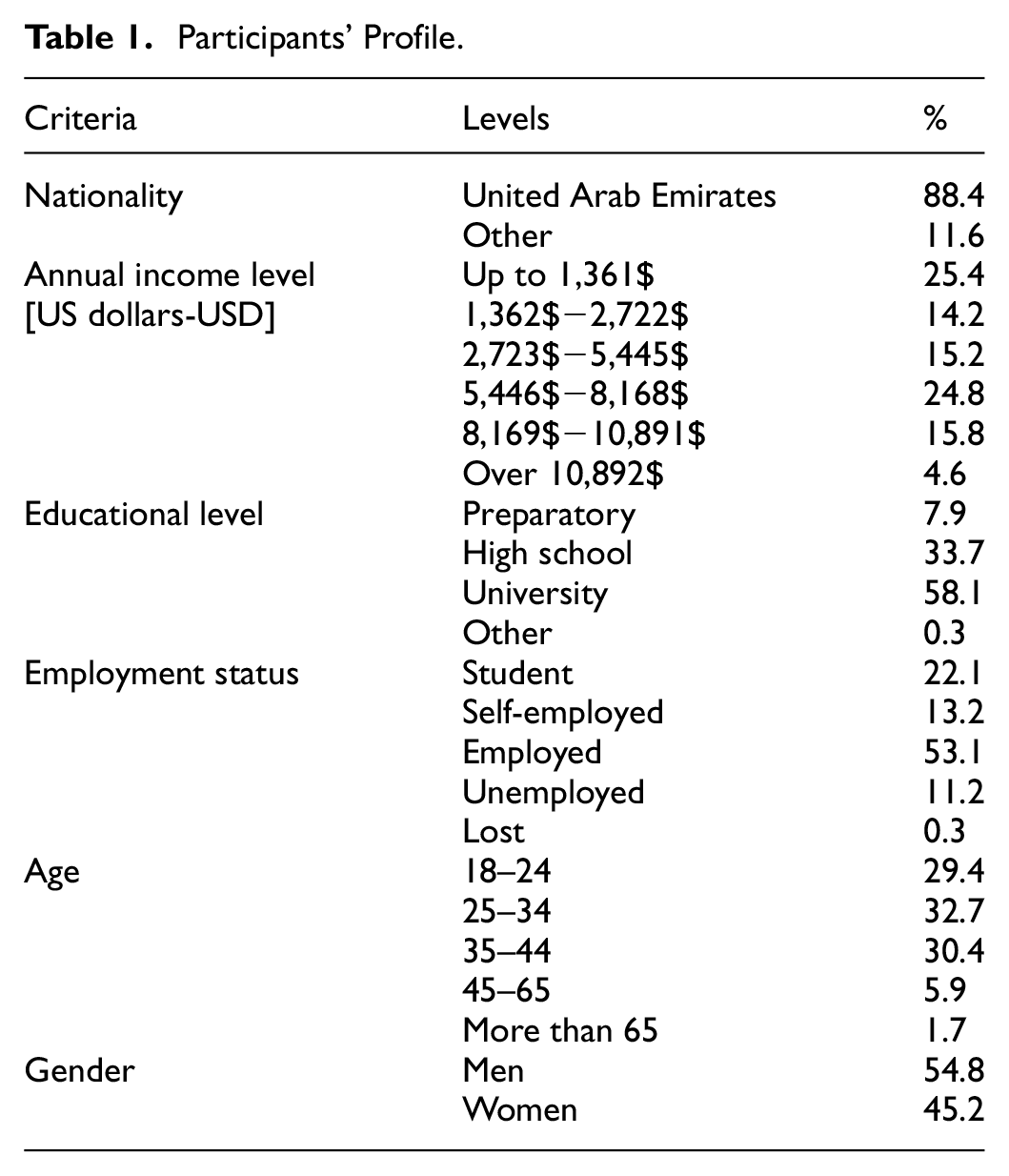
Overall, the survey yielded 303 useful responses with no missing values or outliers. Table 1 presents the demographic data of the participants. Most of the participants were born in the Emirates (88.4%) and had an annual income that could be classified as moderate, with more than 50% reporting incomes below $5,445 per year. Most participants had a university (58.1%) or high school (33.7%) academic level, and more than 50% were employed. The most represented age group was respondents between 25 and 34 years old (32.7%), followed by those between 35 and 44 (30.4%). There was a slightly higher proportion of male participants (54.8%) than female participants (45.2%).
Data Analysis
The Partial Least Squares (PLS) technique was employed to analyze the proposed structural equation model. PLS is a variance-based approach (Sarstedt et al., 2022) that allows an assessment of the measurement model, the structural model, and the proposed hypotheses. Specifically, the SmartPLS 4.0 software (Ringle et al., 2022) was used.
Analysis of Results
In accordance with the guidelines proposed by Benitez et al. (2020), we applied mode A for a consistent estimation of the reflective model (Figure 1). In this approach, each latent variable of the model is obtained as a combination of its constituent elements. The measurement of these constructs in mode A allows correlation between their indicators. As J. Hair and Alamer (2022) point out, for structural equation models with this type of latent variable, the assessment of the measurement model is as important as the validation of the structural model.
Thus, the following issues must be considered. First, it must be checked that each individual item of each construct registers an adequate level of reliability (factor loadings equal to or greater than 0.7, as recommended by Carmines and Zeller (1979). Second, the reliability of each variable (internal consistency) is measured through several indices such as Cronbach’s alpha (α), and composite reliability (ρc) ≥.70 J. Hair and Alamer (2022). Third, the average variance extracted (Stourm et al., 2020) is used to assess the convergent validity for each construct, with AVE values equal to or greater than 0.5 confirming convergent validity (Fornell & Larcker, 1981). The results regarding the individual reliability of the items, the reliability of each construct, and their convergent validity are provided in Table 2. According to the abovementioned criteria, the configuration of the latent variables in the model is acceptable.
Construct Evaluation.

In relation to the discriminant validity of the constructs of the model shown in Figure 1, the data presented in Tables 3 and 4 confirm discriminant validity for all the latent variables assessed by the Fornell–Larcker criterion and Heterotrait–Monotrait (HTMT) relationships. Table 3 shows Fornell-Larker criterion, with all the values above 0.7 in the main diagonal (Fornell & Larcker, 1981), and Table 4 shows the HTMT values below 0.9, which fulfill the recommended general rules (J. F. Hair et al., 2019). The results shown in Tables 2 to 4 corroborate the validity of the measurement model, meaning that we can continue with the evaluation of the structural model.
Discriminant Validity (Fornell-Larker Criterion).

Note. RSQ = restaurant service quality; RB = relational benefits; CS = customer’s satisfaction; CL = customer loyalty; PWOM = positive word-of-mouth.
Diagonal (in bold): Discriminant validity with the Fornell–Larcker criterion; Above the diagonal: correlations between constructs with level of significance; p < .01 and p < .05.
Discriminant Validity (HTMT Ratio).
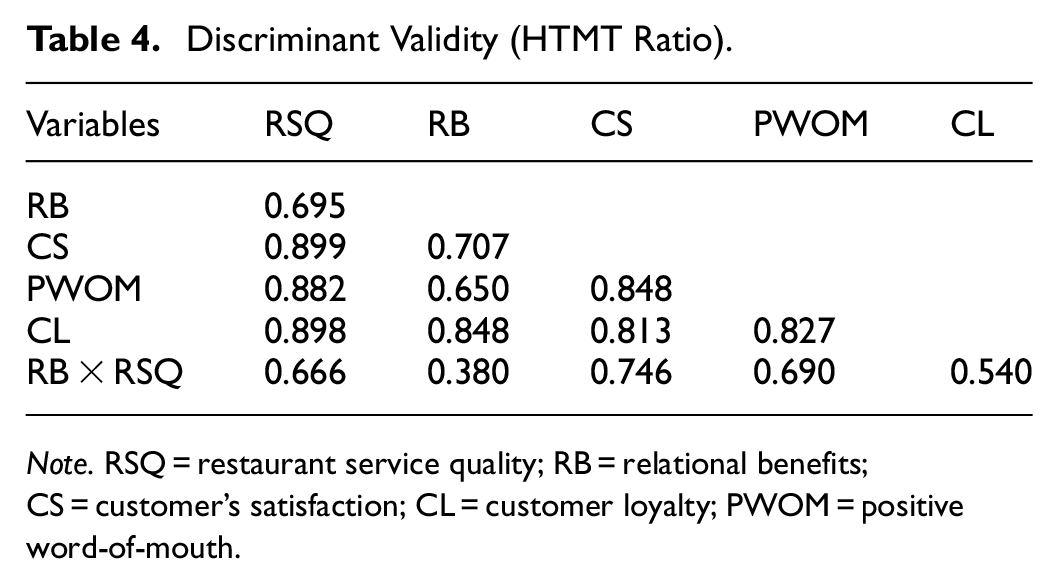
Note. RSQ = restaurant service quality; RB = relational benefits; CS = customer’s satisfaction; CL = customer loyalty; PWOM = positive word-of-mouth.
For the validation of the structural model, we followed the steps suggested by the literature (J. Hair & Alamer, 2022; Sarstedt et al., 2022). The first step is to confirm the absence of collinearity between the variables that predict a construct and said construct. For this check, variance inflation factor (VIF) values must be below 5, according to J. F. Hair et al. (2019). In our case, the following VIF values have been calculated: BEN-SAT (1.789), QE-SAT (2.724), QE-WOM (1), SAT-RL (3.173), and WOM-RL (3.173). Figure 2 provides a graphical overview of the relationships between the variables in the model and shows that all path coefficients are statistically significant, thereby supporting the proposed hypotheses.

Estimated parameters of the structural model.
The testing of the hypotheses, assessment of statistical significance and determination of the significance of the effects was carried out using the bootstrapping technique with 5.000 subsamples (J. Hair & Alamer, 2022; Sarstedt et al., 2022). Table 5 shows the values of the path coefficients, t-statistics, and confidence intervals of the six hypotheses proposed in our model. The results confirm all the hypotheses relating to both the direct and the moderating effects.
Validation of the Proposed Hypotheses.

Note. RSQ = restaurant service quality; RB = relational benefits; CS = customer’s satisfaction; CL = Customer loyalty; PWOM = positive word-of-mouth.
p < .001; t (0.001; 4999) = 3.106644601. Sig. denotes a significant direct effect at .001.
The confirmation of hypothesis 1 (β = .864, p = .000) suggests that the customers tend to share favorable comments about the establishment due to the quality of the services they experience. This includes a pleasant atmosphere, the quality and taste of the food on offer, and competent, attentive service by the employees.
Hypotheses 2 and 3 indicate that customer satisfaction is conditioned by both the restaurant service quality, and the benefits achieved (functional and monetary) because of engagement with the restaurant’s social media. The values of the beta coefficients (H2, β = .511, p = .000; H3, β = .219, p = .000) indicate that the effect of service quality is almost three times higher than the effect of the benefits obtained by engaging with the company’s social networks. The hypotheses corresponding to customer loyalty to the restaurant are also supported since the path coefficients are positive and statistically significant. Therefore, it should be noted that favorable WOM about the establishment increases loyalty to the fast-food restaurant (H4, β = .450, p = .000); and that customer satisfaction also positively affects loyalty to the establishment (H5, β = .298, p = .000). The values indicate that the effect of favorable comments is greater than that of satisfaction when it comes to generating loyalty to the restaurant.
Regarding the moderating effect of benefits on the relationship between service quality and customer satisfaction (H6), the results confirm a negative moderating effect (β = −.221, p = .000). This means, first, that higher levels of relational benefits weaken the relationship between service quality experiences and user satisfaction; and second, that lower levels of benefits strengthen the relationship between quality experiences and satisfaction with the restaurant. All these moderate effects are shown graphically in Figure 3.

Moderating effect of relational benefits on the relationship between service quality experience and customer satisfaction.
The predictive power of a model is evaluated through the coefficient of determination (R2). This coefficient can be used to measure the amount of variation in a construct explained by its predictor variables (Table 6). According to the criterion proposed by J. F. Hair et al. (2019), the explanatory power of the model is significant for the variable customer’s satisfaction, and moderate for the latent variables WOM and customer loyalty. Additionally, the effect sizes, measured using the Cohen (1988) f2 statistic, are all significant. In fact, with respect to the direct relationships (H1 to H5), large effects are observed in two cases (the relationships between restaurant service quality and customer’s satisfaction, and between restaurant service quality and WOM), and small effects in the other three cases. On the other hand, in the case of the moderating hypothesis, the effect is large. Finally, since all the values of Q2 are positive and greater than zero, it can be said that the proposed model has predictive relevance.
Effect on the Endogenous Variables and Prediction Assessment.

Note. RSQ = restaurant service quality; RB = relational benefits; CS = customer’s satisfaction; CL = customer loyalty; PWOM = positive word-of-mouth.
Finally, the standardized root means square residual (SRMR), serving as an indicator of the average standardized residuals between observed and hypothetical covariance, yielded a value of 0.062. This value falls below the threshold of 0.10 suggested by Ringle et al. (2009), indicating that the model demonstrates a good fit.
Discussion
In recent years, the hospitality industry has witnessed significant transformations, driven by digitalization and changes in consumption patterns (Andronie et al., 2021; X. Liu et al., 2023; Zwanka & Buff, 2021). These changes have compelled restaurants to reevaluate and redefine the customer experience to retain an increasingly informed and demanding consumer base (Ran et al., 2022). In this context, customer satisfaction and loyalty, rooted in service quality, emerge as vital indicators of success and survival in a highly competitive market (Ahmed et al., 2023; Arora & Narula, 2018; Shin et al., 2021). In this environment, relational aspects of the customers-businesses interactions signal a shift toward marketing strategies centered on fostering long-term relationships and loyalty (Evanschitzky et al., 2022; Leverin & Liljander, 2006), marking a significant transition in business practices (Obaze et al., 2023). A tangible example can be seen in the fast-food segment, where loyalty programs and mobile applications meet relational and transactional needs aiming to increase long-term customer loyalty (Jang & Mattila, 2005; X. Liu et al., 2023; Sahagun & Vasquez-Parraga, 2014). In this area, it is relatively common to offer additional advantages such as discounts, special promotions, and personalized attention and treatment. These benefits align with customer expectations (Dandis et al., 2023; Gwinner et al., 1998; Najjar & Najar, 2022).
Focusing on a context where businesses commonly use social networks and mobile apps to promote relational benefits (Fathelrahman & Basarir, 2018; Hwang & Choi, 2020; Patsiotis et al., 2020), we test an exploratory model focused on UAE customer loyalty to a fast-food restaurant. The analysis explores relationships identified in previous literature between service quality, customer satisfaction, and positive WOM, with the novel inclusion of the moderating effects of relational benefits on the relationship between customer perceptions of quality and customer satisfaction. The results reported here contribute to the knowledge base in the field of marketing and loyalty for the fast-food restaurant industry (J. Hanaysha, 2016; J. R. Hanaysha & Pech, 2018; Uddin, 2019). The proposed model offered moderate and high levels of predictive and explanatory power, with the ability to explain 50% of the variation in loyalty to the establishment, 81% of the variation in customer satisfaction, and 74.7% of the variation in the WOM variable. From this, several interesting findings can be noted.
First, the results showed that the experience of service quality in the fast-food restaurant has a significant influence on the likelihood of positive customer reviews. Although this finding may not be surprising, it reaffirms those reported by Babin et al. (2005), Longart (2010), and J. R. Hanaysha and Pech (2018) in different contexts, supporting the cross-cultural nature of the relationship. In the same vein, the second proposed relationship (between restaurant service quality and customers’ satisfaction) confirms the effects previously identified by Omar et al. (2016), Nguyen et al. (2018), or Gopi and Samat (2020), as well as by meta-analytic studies of the influence of service quality on customer satisfaction (Ladeira et al., 2016; Prayag et al., 2019; Shin et al., 2021).
Second, the two predictor variables proposed in the model, WOM and customer satisfaction, were found to be significant determinants of loyalty to the establishment. This finding is in line with previous work in the marketing field. The first predictor variable, WOM, showed a positive and significant influence, confirming the evidence shown by de Matos and Rossi (2008), Kim et al. (2011), and Balakrishnan et al. (2014), and pointing to the need to explore the bidirectionality of the relationship. The second predictor variable was customer satisfaction, which has widely recognized effects on loyalty (Ababneh et al., 2022; Ladeira et al., 2016; Tanford, 2016; Uddin, 2019), although surprisingly its effect was smaller than that of WOM. This could be partly due to the fact that WOM was measured with only one item in this study (J. F. Hair et al., 2019).
As can be seen so far, the findings align with previous research in the field of relational marketing (Edwards & Baker, 2020; Hunt et al., 2006), as hypotheses 1, 2, 4, and 5 have been verified (see Figure 1 and Table 5) and are widely contrasted (Ali et al., 2020; Khoo, 2022; Marcos & Coelho, 2022).
Thirdly, unlike previous studies, this work primarily focused on exploring the moderating effects of relational benefits on perceptions of quality and satisfaction (H6), as well as verifying the direct relationship between relational benefits and customer satisfaction (H3), and how these relationships translate into customer loyalty. We confirmed that relational benefits are a reasonable predictor of customer satisfaction, in line with what was proposed by Y.-K. Lee et al. (2014), and Dandis et al. (2023). Previous literature has shown that relational benefits have a direct impact on customer satisfaction (Gremler et al., 2020; Najjar & Najar, 2022), and that customer satisfaction is a key predictor of customer loyalty (Hennig-Thurau et al., 2002). This same effect, previously identified in sectors such as financial services (Dimitriadis, 2010; Fatima & Mascio, 2020; Molina et al., 2007) and tourism (Ruiz-Molina et al., 2015), shows nuances when disaggregating different types of relational benefits. In the banking sector, benefits related to trust, competence, and convenience were highlighted as key drivers of satisfaction (Dimitriadis, 2010; Molina et al., 2007). In contrast, within travel agencies and their service providers, trust and special treatment benefits emerged as the main drivers of value (Ruiz-Molina et al., 2015). However, in the fast-food restaurant industry, Dandis et al. (2023) found that although trust and special treatment benefits were influential, the latter demonstrated a negative coefficient. This finding implies that increased relational benefits do not always necessarily lead to greater customer satisfaction (Gremler & Gwinner, 2015), highlighting the need for a balanced and contextually adapted approach to these benefits, depending on the sector and customer expectations. In our study, this complex dynamic is reflected in the negative moderating relationship that was identified.
Finally, the moderation hypothesis was confirmed, but with a negative sign, indicating that while the implementation of relational benefits may foster customer satisfaction, they do not necessarily improve the relationship between service quality perceptions and satisfaction. This partially supports the research of J.-S. Lee et al. (2013), since it appears that the relationship between perceptions of quality and satisfaction may weaken if customers are incentivized by functional/financial benefits. This finding could be explained by the reflections of Gremler and Gwinner (2015), who suggested that in certain contexts, relational benefits might not always be positive or relevant. Concerns about privacy and the time required to participate in loyalty programs or social media activities could lead customers to value these benefits less, thus affecting their overall perception of service quality and satisfaction. This suggests that relational benefits could be seen as a barrier in certain circumstances. This outcome supports the idea proposed by Gremler and Gwinner (2015, p. 60) that “relational benefits and relational switching costs are two sides of the same coin.” In line with the findings of Evanschitzky et al. (2022), who studied the non-linear moderating effect of relational switching costs, it could be hypothesized that Relational Benefits might behave similarly. This implies that, like relational switching costs, relational benefits could follow an inverted U-shaped curve, where they increase their positive impact on customer satisfaction and loyalty until reaching an optimum point. However, beyond this optimal level, additional benefits might start to have a negative impact, weakening the relationship between service quality and customer satisfaction. This pattern suggests that there is a delicate balance in the management of relational benefits, where an excess of them could be counterproductive.
Theoretical Contributions
This study is pioneering in presenting a model that explores the influence of relational benefits on customer loyalty from two key perspectives: first, by examining their direct effects on customer satisfaction; and second, by investigating their role as a moderating variable in the interplay between service quality and customer satisfaction. This dual framework provides a dynamic comprehension of how relational benefits can shape the customer experience and ultimately affect their loyalty toward fast-food restaurants. This extended understanding challenges conventional interpretations in the field of relational marketing, where traditionally, relational benefits have been viewed as influencing customer satisfaction and loyalty in a linear and direct manner. By shedding light on the moderating nature of relational benefits, our study suggests that the relationship between service quality and customer satisfaction is more dynamic and susceptible to external influences than previously recognized. On the other hand, the model proposed in this study reinforces and contextualizes direct relationships already established in the domain of relational marketing, specifically within the emerging economy of the United Arab Emirates and the vibrant fast-food sector. It underscores the positive correlation between restaurant service quality and positive word-of-mouth (WOM), as well as the direct influence of service quality and relational benefits on customer satisfaction, which in turn correlates with customer loyalty. The direct relationships presented form a solid and established foundation of relational marketing dynamics even within specific contexts. This holistic approach allows for precise adaptation to the nuances and particularities of the fast-food industry in a rapidly developing region.
Managerial Implications
The practical implications of this research offer applicable insights for managers in the fast-food industry, especially in the context of the United Arab Emirates. Findings suggest that while relational benefits, such as loyalty programs, personalized customer engagement, and social media interactions, have a direct positive impact on customer satisfaction, their excessive extension could potentially dilute the perceived quality of service. For instance, a fast-food restaurant that places too much emphasis on rewards might inadvertently lower customers’ service quality expectations if those rewards are perceived as compensation for average service. Moreover, the negative moderating effect of excessive relational benefits implies that there is a threshold beyond which additional benefits do not enhance but can damage customer satisfaction. For example, when a customer receives constant notifications about promotions or is frequently asked to engage on social media, the perceived value of these interactions may diminish, leading to a form of “benefit fatigue.” Therefore, managers must carefully calibrate the level and frequency of the relational benefits offered. They must find a delicate balance between providing enough value to maintain customer interest and loyalty, without overwhelming customers to the point of diminishing returns. To achieve this, it is essential to segment customers based on their level of engagement and preferences, tailoring loyalty programs to what they truly value. This could involve segmenting customers based on their engagement and tailoring relational benefits to match their preferences, thus maintaining the effectiveness of these programs. Additionally, leveraging data-driven personalization and linking these benefits to broader values, such as sustainability initiatives, can be an effective way to strengthen relationships with customers.
Limitations, and Future Lines of Research
While this study has provided valuable insights into the antecedents of restaurant loyalty, there are some limitations that must be acknowledged. First, the results may not be generalizable beyond the specific geographic area and restaurant where the data were collected. Therefore, future research should aim to expand the scope of the study by surveying customers from different geographic areas of the UAE and various restaurants, as well as conducting similar research in different countries and cultural settings. Second, the absence of control variables in the model may limit the ability to draw definitive conclusions. Future research could incorporate various control variables, such as age, gender, level of participation in the virtual community, and frequency of social media use, to identify potential differences between different groups of customers. On the other hand, it should be noted that relational benefits are a multidimensional construct and may be context specific. In this paper we have focused on only two aspects: functional and monetary benefits. Therefore, future research could explore the possibilities they offer when implemented through loyalty programs. Another limitation pertains to the measurement of positive WOM. In this study, positive WOM was assessed using a single item, as suggested by Fait et al. (2023). While J. F. Hair et al. (2019) contend that constructs can be measured with a single item if the concept is straightforward, this approach might oversimplify the construct and fail to capture the full extent of WOM. Therefore, future studies could benefit from using a multi-item scale to measure WOM, allowing for a more comprehensive assessment of its nuances and impact. Lastly, it could be worth extending the current model to include variables such as intention to visit the establishment, attitude toward advertising on social media, and trust toward the brand, among others. Doing so could enable a more comprehensive understanding of the factors that influence restaurant loyalty, which in turn could provide valuable insights for managers seeking to improve customer retention.
Conclusions
This study extends relationship marketing theory by examining the nuanced role of relational benefits as both direct antecedents and moderators within the interplay of service quality, customer satisfaction, and loyalty in the UAE’s fast-food sector. Findings reveal that while relational benefits directly enhance customer satisfaction, their moderating influence on the service quality-satisfaction link yields unexpected outcomes, indicating a negative moderating effect. This underscores that excessive relational benefits may inadvertently diminish the perceived value of service quality. Furthermore, the study demonstrates that service quality and positive word-of-mouth (WOM) are pivotal drivers of loyalty, with WOM exerting a stronger influence than satisfaction, emphasizing the power of customer recommendations in fostering loyalty. By integrating these dimensions, this research enriches our understanding of how relational strategies must be balanced to optimize customer perceptions and loyalty outcomes. This novel perspective highlights the dynamic and context-dependent nature of relational benefits, offering theoretical and practical insights for enhancing loyalty strategies in competitive service environments.
Footnotes
Acknowledgements
The author, Miguel González-Mohino is a postdoctoral researcher contracted through the Margarita Salas 2021 Requalification call, for the training of young PhDs, funded through the University of Castilla-La Mancha, UCLM.

Funding
The author(s) received no financial support for the research, authorship, and/or publication of this article.
Declaration of Conflicting Interests
The author(s) declared no potential conflicts of interest with respect to the research, authorship, and/or publication of this article.
Data Availability Statement
Data sharing not applicable to this article as no datasets were generated or analyzed during the current study.