




Abstract
In 2014, mandatory national service for male Emiratis was first introduced in United Arab Emirates (UAE). Youths’ perceptions of national service influence their expectations of and subsequent adjustment to service life. This study examined perceptions of male Emirati youths on enlistment propensity and motivation, interest in a military career, and information sources on national service. Eighty male Emiratis from two age groups (high school students, employed youths) were surveyed 4 months post-implementation of the law. It found that younger participants were more negatively propensed toward the service than older participants. Regardless of propensity, benefits, dignity, family, and fidelity were main factors in youth enlistment decision. Most participants were ambivalent toward a military career post-national service. Younger participants’ main information sources were limited to immediate family relations. These findings would contribute to national capability development and could be used by the UAE Armed Forces to adapt its recruitment and advertising strategies.
Keywords
Introduction
In 2014, mandatory national service for male nationals (Emiratis) was introduced in the United Arab Emirates (UAE). Conscription affects education and career plans of youths as the waiting period before active service incurs costs as lost opportunities for employment and skills acquisition. Future conscripts’ perceptions of national service influence their expectations of and subsequent adjustment to service life. Studies on perceptions of national service have largely been conducted in countries with extended military histories. However, in the UAE, there is scarce research in this area given the recent implementation of service law. This study aims to examine perceptions of Emirati youths on the UAE national service program and specifically compares the perceptions of Emirati high school students with employed youths on enlistment propensity and motivation, interest in a military career, and information sources on national service.
As the law allows for temporary service exemption for individuals enrolled in higher education programs, Emirati male youths who otherwise would have dropped out of school may opt for further studies to avoid enlistment. Hence, findings from this study on enlistment propensity and its effects on youth educational attainment would contribute to national capability development and reduction of Emirati unemployment to support economic growth. It would also enable universities to more effectively determine the demand for higher education. Results on youth interest in a military career would enable the UAE Armed Forces to develop strategies for effective recruitment and retention of Emirati military personnel. This study captured perceptions toward the service law at the critical initial implementation stage which could be used to develop an annual survey for tracking changes in perceptions post-implementation of the law. The annual surveys would build a historical dataset that could be used by the UAE Armed Forces to adapt its recruitment, advertising, and public information dissemination strategies to the target population.
Literature Review
Background to Mandatory National Service
Mandatory national service has been actively enforced for decades in Europe (Austria, Russia, Switzerland), Asia (China, South Korea, Singapore), and the United States. In the Middle East, compulsory national service programs are in place for countries such as Algeria, Egypt, Syria, and Iran. In response to rising geopolitical tensions and declining number of volunteer recruits, some European countries have reinstituted compulsory national service: Ukraine in 2014, Lithuania in 2015, and Sweden in 2017. Among the Gulf Cooperation Council (GCC) states, Kuwait reinstituted compulsory national service in 2017 that was suspended in 2001 (Sophia, 2015) whereas the UAE and the State of Qatar implemented for the first time compulsory national service in 2014 (International Labour Organization, 2014a, 2014b).
The U.S. military has one of the longest histories in the world that spans over two centuries. It has long experienced a combined conscript and volunteer force. The Military Selective Service Act was enacted in 1940 that established the Selective Service System (SSS), which is an independent agency within the Executive Branch of the U.S. Government. The role of the SSS is to provide trained/untrained manpower to the U.S. Department of Defense (DoD) in the event of a national emergency and to manage alternative service programs for conscientious objectors. Although the SSS is responsible for the military service registration process and maintenance of database records of registrants, the “draft” is the actual call to serve in the military. In times of mobilization, individuals registered with the Selective Service who are deemed eligible would then be inducted or drafted into military service. Although registration was suspended in 1975, it resumed in 1980 under President Carter and currently, male U.S. citizens and aliens, aged 18 to 25 years and living in the United States, must register by law with Selective Service within 30 days of their 18th birthday (Wikipedia, 2018). In modern U.S. history, the last draft call was in 1972 that ended in June 1973 after which the United States adopted an all-volunteer force (AVF).
Although compulsory national service policies and practices vary across countries and historical periods, service regulations typically require male citizens from 17 to 18 years old to register and undergo a medical examination to determine level of fitness for service. If declared able-bodied and not eligible for permanent exemption, recruits serve in military branches for a period of time determined by factors such as their level of physical fitness or education.
Mandatory National Service in the UAE
On June 2014, Sheikh Khalifa bin Zayed Al Nahyan (President of the UAE) introduced the Federal Law No.6 of 2014 on the National Military Service and Reserve Force, which stated that all male Emiratis aged 18 to 30 years are obliged to undergo national service while it is optional for female nationals. Since the law’s inception in 2014, several amendments were made by the UAE National Reserve Service Committee (NRSC) on service length and voluntary national service. On March 7, 2016, service length was increased from a minimum of 9 months to 12 months (both genders). On March 15, 2016, the NRSC announced a new initiative whereby Emiratis aged 30 to 40 years (both genders) could apply to undergo 15 weeks of voluntary national service. Individuals who complete either compulsory or voluntary service become part of the reserved forces and can be called for further training (Kokhar, 2016). The main features of the law are summarized in Table 1.
Main Features of UAE Mandatory Military Service Law in 2016.

Note. UAE = United Arab Emirates; GCSE = General Certificate of Secondary Education; GPA = grade point average.
US$1 = 3.67AED.
The UAE Armed Forces General Command held the official position that the initiation of national service did not mean that the country was under threat (The National, 2014) and a conscription-based military force would bring positive geopolitical, economic, and social effects (Reilly, 2014). For instance, it would build a new pool of military reservists who could rapidly increase available manpower and decrease reliance on foreign support, hence, enabling the country to protect its sovereignty and wealth. Also, conscription could help in nation-building by developing a sense of national identity and patriotism particularly in times of regional conflict. Emiratis receive generous state benefits such as free medical care and public education, subsidized housing, and job priority. Ironically, state support enabled Emiratis to lead affluent lifestyles but led to high unemployment rates (12% in 2005; Lim, 2014). With such privileged backgrounds, the sudden exposure to the rigors of national service would present adjustment challenges for Emirati youths.
Impact of National Service on Education and Career Plans
National service and college enrolment are highly time-sensitive life events occurring at overlapping ages and can be competing alternatives to high school graduates (Kleykamp, 2010, 2013; Teachman, 2005). Bauer, Bender, Paloyo, and Schmidt (2014) study on the effect of conscription on university degree attainment showed that draft-eligibility raised the probability of completing a degree by 15%. It also found that draft-avoidance increased the propensity for college enrolment by 1.7%. Hence, the presence of a military draft tends to increase college enrolment (draft avoidance strategy). However, MacLean’s (2005) study on Korean War veterans found that those who planned to go to college after military service failed to do so suggesting that enlistment may have hindered opportunities for pursuing higher education.
In Abu Dhabi (UAE), the literacy rate for males is lower (91.3%) compared with females (93.6%) and in terms of educational attainment, male graduates are outnumbered by females at secondary, university, and master’s degree levels (Statistical Centre–Abu Dhabi, 2011). As the service law allows temporary service exemption (Table 1), Emirati male youths who otherwise would not have considered university education may opt to pursue further studies to avoid the draft. Hence, it is important to understand youth enlistment propensity for its impact on college enrollment. Moreover, examination of youth enlistment motivations (reasons) can shed light on their expectations of and subsequent adjustment to service life. The concept of propensity is defined here as the likelihood that a youth will enlist in the military in the next few years and the measure of propensity estimate is assumed to predict actual enlistment (Wilson, Greenlees, Hagerty, Hintze, & Lehnus, 2000).
Besides affecting college enrollment, conscription could also affect career plans of youths. The waiting periods before enlistment and active service incur career costs as lost opportunities for employment and skills acquisition. Imbens and van der Klaauw (1995) found that the cost of serving 14 months in the military of the Netherlands is equivalent to losing a year of potential work experience. During the service period, individuals also experience deterioration of study habits and specialized job skills as well as loss of previously acquired knowledge and skills (Chiang, 2012). However, for unemployed Emirati youths without career direction, national service offers a path toward a military career and helps develop valuable work skills as youths shoulder responsibilities seldom assigned at that age. The service induction period is typically used by military recruiters to identify high-quality individuals to undergo leadership and management training toward careers as commissioned officers. Hence, it is important to understand youth interest in a military career, which can enable the UAE Armed Forces to successfully recruit and retain Emirati military personnel.
In some cases, employed individuals who enlisted face job insecurity and/or monetary loss as the service allowance usually does not commensurate with their original salary (Chiang, 2012). Studies on post-service earnings of White American Vietnam War veterans drafted through the lottery were found to be 15% lower than comparable nonveterans who were exempted (Angrist, 1990; Bryant, Samaranayake, & Wilhite, 1993). Interestingly, the job insecurity and wage penalties associated with re-entry into the civilian workforce do not apply to the UAE as the service law specified that employed enlistees continue to receive all salaries, bonuses, promotions, other job benefits as if there was no absence from work (Table 1).
Influence of Information Sources on National Service
Unlike the UAE, the U.S. military has long experienced a combined conscript and volunteer force. When the last draft call ended in 1972, an AVF was adopted. This change led to increased attention by the U.S. DoD on recruiting high school graduates in face of competing alternatives, that is, college enrollment or getting a civilian job as opposed to military service. The Youth Attitude Tracking Study (YATS) was implemented from 1975 to 1999 by the U.S. DoD to examine enlistment trends. Lehnus and Wilson (1996) reported pre-1996 YATS data on information sources of American male youths that influenced their perception of military service and the most cited sources were friend (peer), movies/TV, father, older friend. Unlike conscripts from countries with established national service programs, Emirati recruits have no recourse to individuals who have completed national service or are currently serving to base their preservice expectations. Assuming that youths’ perceptions of national service are typically based on their socialization experiences at home, in school, and society (Chiang, 2012), and the reliability of the sources, it is important to identify information sources utilized by Emirati youths as these sources shape the views of enlistees and the formation of positive or negative attitudes toward national service.
In conclusion, although the United States has decades of historical datasets and studies that track youth attitude toward military service (Bailey et al., 2002; Lancaster & Lehnus, 1996; Lehnus & Wilson, 1996; Wilson et al., 2000), no such research data are available in the UAE given the recent implementation of the national service law in 2014 and the admission of the first batch of recruits for induction training only in August 2014. Hence, there is a need for this study on perceptions of Emirati youths on the UAE national service program that would contribute to national capability development and could be used by the UAE Armed Forces to adapt its recruitment and advertising strategies.
Method
Constructs and Measures
This study aims to examine perceptions of Emirati youths on the UAE national service program. Table 2 lists the main constructs, their definitions, and measures. It should be noted that data collection was conducted from October to November 2014, which was 4 months post-implementation of the service law and 2 months after the first batch of recruits enlisted. Hence, data from this time frame captured perceptions of Emirati youths toward national service at the initial implementation stage.
Constructs, Definitions, and Measures in This Study.

Measurement of enlistment propensity and motivation is based on participants’ preference to defer enlistment (negative propensity) or enlist as soon as possible (positive propensity) and reasons selected to support their choice. Table 3 lists the motivators used in this study that were adapted from YATS (Wilson et al., 2000). YATS is an established instrument used by the U.S. DoD from 1975 to 1999 to examine trends in enlistment propensity and service-specific propensity such as the National Guard and the Reserves. While the original YATS factors were more extensive, a smaller set of factors that were more relevant to the research context were selected for this study.
Enlistment Propensity Motivators in This Study.

Source. Adapted from Wilson, Greenlees, Hagerty, Hintze, and Lehnus (2000).
Identification of information sources on military/national service is based on participants’ ranking of most to least preferred sources ranging from people, governmental, and media sources. The list of information sources was adapted from YATS (Lehnus & Wilson, 1996; Table 4).
Sources of Information on Military/National Service in Survey Questions (Lehnus & Wilson, 1996).

Sampling Strategy and Size
As the project is located within a qualitative research framework, a nonprobability heterogeneous sampling strategy was used to identify two groups of Emirati participants with certain characteristics (Table 5). The purposive sample is not intended to be statistically representative (Ritchie, Lewis, & Elam, 2003) and the sampling approach is appropriate for locating specific participants who would be affected by the service law. Also, the use of heterogeneous sampling (Patton, 2002) based on the selection criteria of sociodemographic characteristics (nationality, age, gender, education, employment) enables an exploration of different perspectives from a range of age groups regarding the national service program. For instance, Group A participants (students in Grades 11-12) who are obliged to serve after graduation would likely have different concerns about national service compared with Group B participants who would have their careers or part-time studies interrupted by enlistment.
Criteria for Emirati Participant Selection.

The total sample size was 86 with a response rate of 97.7% (84). Survey questionnaires were administered to 84 participants and four survey returns were discarded due to indiscriminate answers and withdrawal of consent. Total usable returns were 80 and the findings were based on 40 returns per group (Table 6).
Sample Size and Usable Returns (Groups A and B).

Instruments and Validity Issues
The survey method is a conventional approach for gathering information about people’s experiences, beliefs, and behaviors that entails the following assumptions: respondents are available, willing to cooperate, and able to respond; and respondents understand the questions and have the knowledge, opinions, attitudes, or facts required (Aaker, Kumar, & Day, 2004). In this study, the participants were available, indicated willingness to cooperate by providing informed consent, had the knowledge required as the questions pertained to personal attributes, experiences, and attitudes toward national service which is an issue that is both relevant and of interest to them. Although self-reported data could also be obtained from interviews, surveys were used in this study as they are less vulnerable to the effects of interviewer presence whereby response quality and/or response rate are negatively affected by interviewer variables such as gender, race, facilitation style, and so on (Singer, Frankel, & Glassman, 1983). Surveys are also less time-consuming than interviews and allow for more flexibility in question design that involves complex branching question sets. When surveys are limited to mainly closed questions, it avoids the difficulty faced by participants in expressing their views in written form and the quantitative data can be analyzed quickly (de Vaus, 2013). However, survey data may be affected by validity issues when researchers lack opportunities to clarify questions perceived by respondents as unclear or sensitive. This study used two self-administered survey questionnaires with slight variations of questions for each group. Each questionnaire comprised three parts (Parts A-C) with mainly closed questions on demographics and the constructs examined for the group (Table 7).
Organization of Survey Questionnaire (Groups A and B).

Several measures were taken to overcome possible validity issues in the survey development process: (a) piloting and (b) providing an Arabic translation of the questions. Construct validity, as ensuring that operational measures for the concepts being studied are correct, was addressed by piloting and refining the instruments. The questionnaires were piloted on 19 participants (nine to 10 participants for each questionnaire) prior to actual data collection to identify possible areas of deficiencies. Prior to piloting the instruments, research team members were trained on survey protocols particularly in participant screening, handling informed consent and permissible responses to participant questions. After piloting the questionnaires, de-briefing sessions were held where team members shared their experiences and perceptions of problems with the questionnaires (Presser et al., 2004). The feedback highlighted two main problems: a missing response option for a closed question and general difficulty in understanding the questionnaire instructions and questions worded in English. Hence, the problematic question was refined by adding a third option and an experienced Arabic Language faculty was consulted for translating the questionnaires to Arabic. The researcher held several meetings with the translator to ensure that the researcher’s semantic and pragmatic intentions, as expressed in the English-worded questions, coincided with the meaning and communicative effects of the translated questions. As it is difficult to determine exactly an acceptable degree of translation freedom (Behr & Scholz, 2011), the finalized questionnaire sets were printed in English (odd pages) and Arabic (even pages) which ensured that participants had recourse to the language they were most comfortable.
Actual data collection activities involved identification and recruitment of participants, obtaining participant consent, and administration of finalized questionnaires to the full sample. Post-data collection procedures involved verifying that consent forms were signed and confirmation of final dataset sizes. To avoid contamination of the main study data, pilot participants were not included in the main study datasets as they would have prior exposure to the questions and procedures (van Teijlingen & Hundley, 2001). Two types of closed questions were mainly used in the questionnaires: (a) nominal measurement scale with dichotomous categories and (b) ordinal scales with itemized categories (Likert-type attitudinal scale) that enable respondents to express judgment on own experiences, attitudes, and beliefs (Table 8). Generally, the provision of noncommittal response options is avoided due to errors of central tendency (Ary, Jacobs, & Razavieh, 2002) which is the consistent selection of neutral points in rating scales that could be attributed to several causes: reduced motivation as a form of satisficing behavior (Krosnick & Alwin, 1987), the establishment of a comfortable pattern of responding reinforced by unchanging response format (Herzog & Bachman, 1981), and confidentiality concerns (Aaker et al., 2004). However, based on pilot feedback, a not sure option was included in a closed question pertaining to interest in a future military career (Table 9) to reduce respondent frustration and avoid unfounded assumptions about the extent of knowledge possessed by the respondent (Kahn & Cannell, 1957/2004). The final question in both questionnaires was an open-ended question that asked participants to describe other concerns about national service to capture themes not explicitly covered in project scope.
Examples of Closed Questions.

Note. UAE = United Arab Emirates.
Closed Question With Noncommittal Response Option.

Data Analysis Approaches
Qualitative responses to the open-ended question on other concerns about national service were subjected to thematic analysis. The data analysis process involved a bottom-up approach to sort responses into broad themes that emerged from the data. Then subthemes were developed to refine the main themes. In the coding scheme, frequency of theme occurrence was assumed to indicate importance of the idea. Excel software was used to sort the responses and calculate frequency of theme occurrences. Reliability of coding between coders was checked before coding the complete datasets. Finally, the meanings underlying the themes were interpreted based on the research aims. The qualitative findings were presented as themes and verbatim quotes included in places to more accurately reflect the voices of participants, offer greater understanding of their views through their actual words (Corden & Sainsbury, 2006). The original language use was retained in the quotes. Quantitative responses to closed questions are presented as descriptive statistics. Quantitative findings on enlistment propensity motivators were analyzed based on a preliminary framework of youth goals described in the next section.
Analytical Framework: Preliminary Framework of Youth Goals
The U.S. DoD initiated a review of YATS in 1999, and based on the recommendations, a quick polling methodology was used from 2001 whereby participants were interviewed using computer-assisted telephone interviewing technology. Other modifications included selection of a younger sample aged 15 to 21 years instead of 16 to 24 years; an expansion of topics beyond propensity, education, and employment; and renaming the survey as Youth Polls (Bailey et al., 2002). Using datasets from the 2001, 2003, and 2004 Youth Polls, Eighmey (2006) identified two major themes and their subthemes that consistently appeared in youth goals based on exploratory factor analysis (EFA) and confirmatory factor analysis (CFA). The themes were consolidated into a framework of Youth Occupational and Institutional/Social Goals (Table 10).
Youth Occupational and Institutional/Social Goals (Eighmey, 2006).
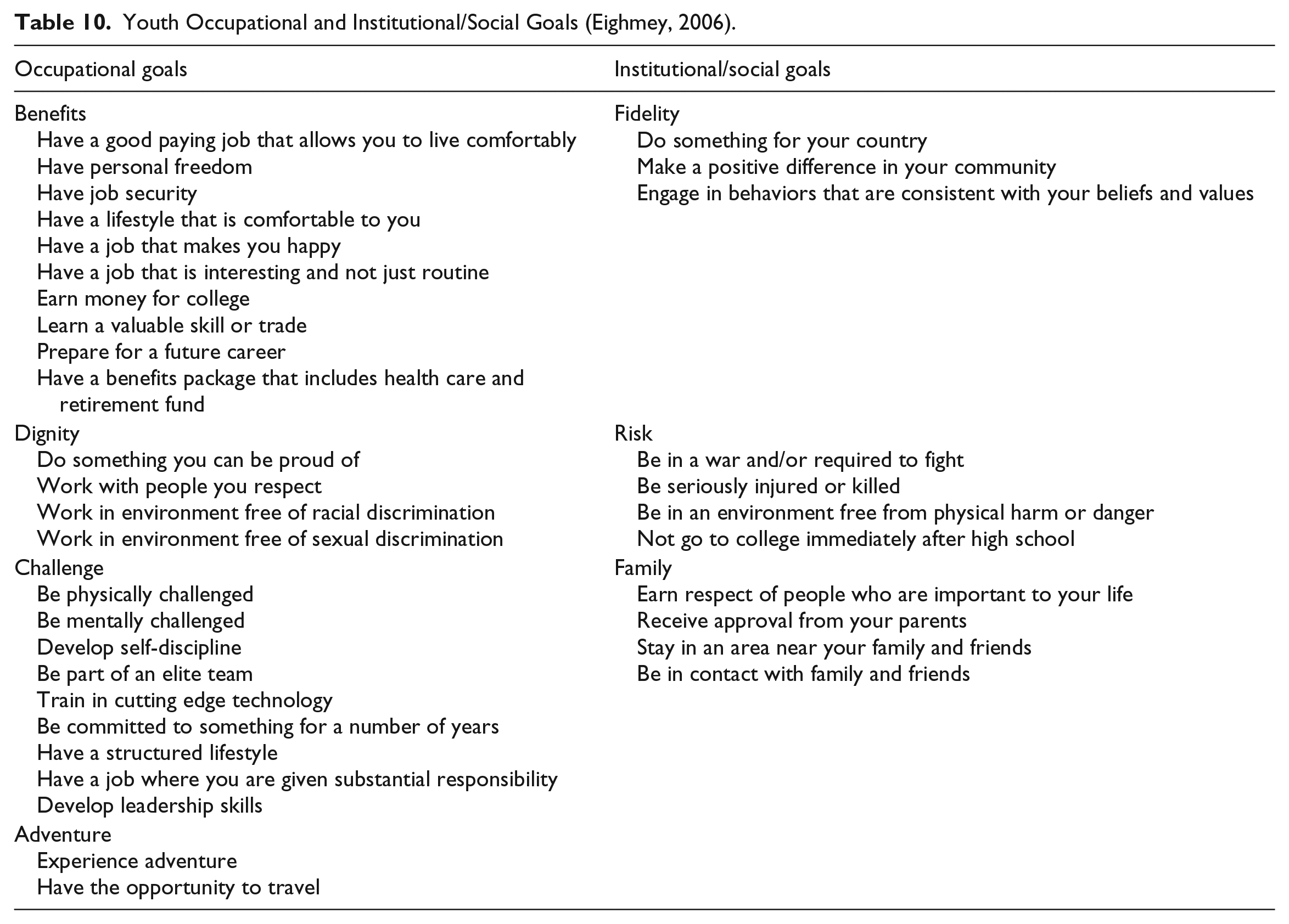
Occupational goals are extrinsic benefits sought by youths and determined by the job market such as salary, job security, skills development for career advancement. Subthemes in the category include the following:
Benefits (salary, job security, skills acquisition)
Dignity (self-actualization, personal accomplishment, work conditions that respect individuals)
Challenge (personal growth from skills development or meeting commitments)
Adventure (exploration of new places and experiences)
Institutional/social goals are intrinsic benefits sought by youths and derived from the core values of the organization or society. Subthemes in the category include the following:
Fidelity (loyalty/commitment to mutual goals and others)
Risk (exposure to danger that comes with military service)
Family (maintenance of family and social ties)
Through factor analysis, Eighmey (2006) found that value-based themes in institutional/social goals (fidelity, in particular) were leading factors in American youths’ consideration of a military career. In this study, the motivators for enlistment propensity adapted from YATS (Table 3) were integrated into a preliminary framework of youth goals (Table 11) to be refined in light of findings.
Preliminary Framework of Youth Goals in This Study.

Ethical Issues
Ethics in research refer to the obligation and accountability of the researcher to respect the rights, dignity, and safety of participants and society as a whole. It involves the observance of fundamental and moral principles of nonmaleficence, beneficence, autonomy, and justice (Bromseth, 2002; Flick, 2006). The main ethical considerations in this study were participant protection, confidentiality, and informed consent. This research did not pose risks of placing participants in physical danger or causing participant emotional/mental distress. Confidentiality of identity was ensured by not gathering real names of participants, removing identifying details, using codes to replace participants’ actual names in data processing and publications. All participants read, understood, and signed an informed consent form that provided a description of the project, assurances of confidentiality, voluntary participation, and right to withdraw consent anytime without penalty.
Results and Discussion
Participant profile
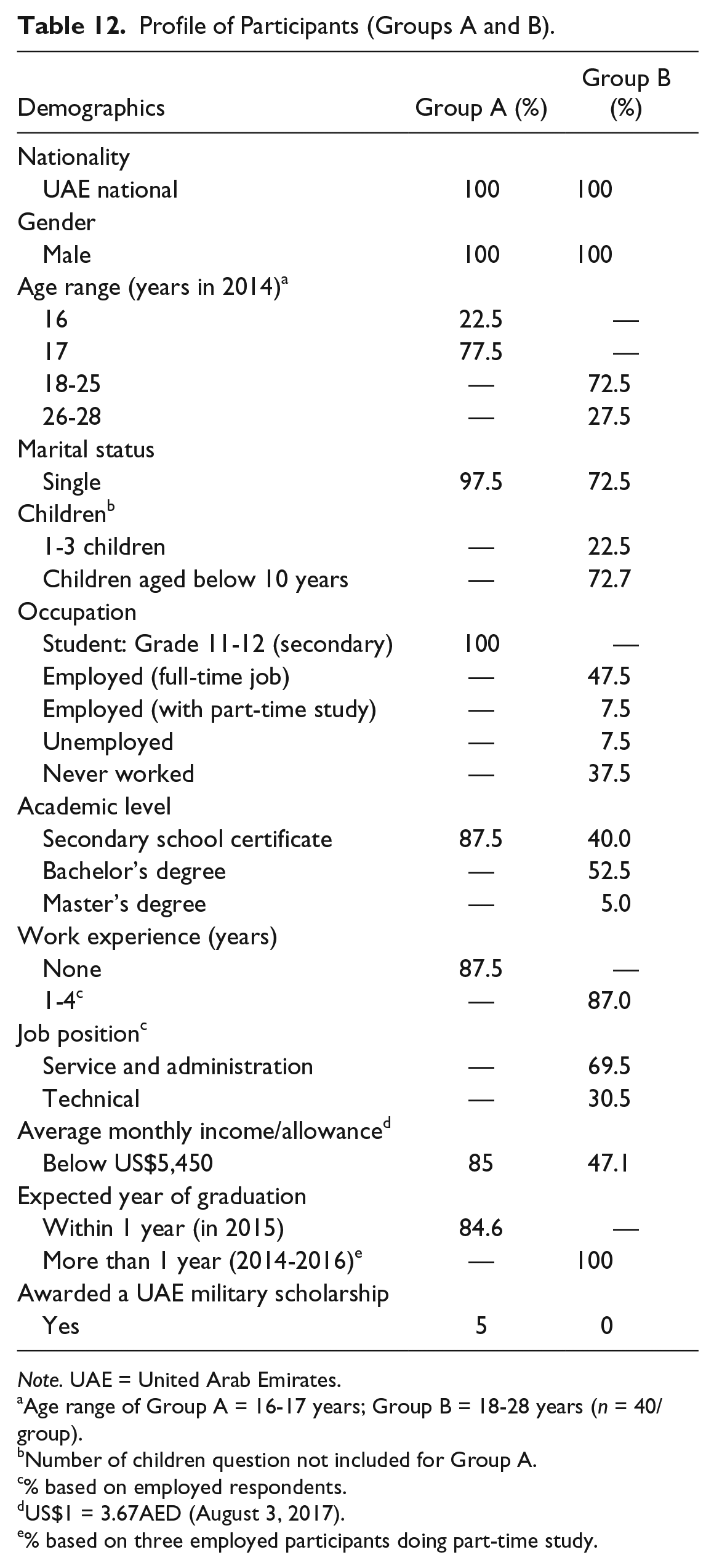
The 80 participants surveyed were male Emiratis segmented into two groups (Table 12):
Group A (n = 40; born between 1998 and 1997; 16 to 17 years in 2014)
Group B (n = 40; born between 1996 and 1986; 18 to 28 years in 2014)
Profile of Participants (Groups A and B).
Note. UAE = United Arab Emirates.
Age range of Group A = 16-17 years; Group B = 18-28 years (n = 40/group).
Number of children question not included for Group A.
% based on employed respondents.
US$1 = 3.67AED (August 3, 2017).
% based on three employed participants doing part-time study.
As explained earlier, segmentation of the sample into two age groups enabled comparison of different concerns about national service. Group A participants were all high school students (Grade 11-12). Most participants were single (97.5%), with a monthly allowance below US$5,450 (85%), expected to graduate within a year (84.6% in 2015), and two participants received a scholarship from the UAE military. In contrast, most Group B participants were employed on full-time basis (47.5%) with 7.5% in full-time employment and enrolled in part-time study. Also, most participants had 1 to 4 years work experience (87%) in service or administrative jobs (69.5%).
Compared with Group A, more Group B participants were married (27.5%) with children aged below 10 years (72.7%), had a bachelor’s degree (52.5%), and reported a monthly income above US$5,450 (52.9%), which were consistent with their age and qualifications. None of Group B participants received a scholarship from the UAE military. The military scholarship question was included based on the assumption that recipients would more likely have favorable perceptions of the military.
Enlistment Propensity (Positive/Negative) and Motivation
Based on the YATS concept of enlistment propensity as the likelihood that a youth will enlist in the military in the next few years, participants were first asked to indicate their preference for either deferring enlistment to a later age (negative propensity) or enlisting as soon as possible (positive propensity) in a branching question. Depending on the response, participants indicated the importance of a set of reasons for their preference. It should be noted that the UAE national service law allows temporary service exemption for individuals below 29 years old, with at least 90% grade point average (GPA) in their General Certificate of Secondary Education (GCSE), enrolled in secondary schools or higher education programs (Table 1).
For enlistment propensity, the results showed that more Group A participants (65%) preferred to defer military enlistment to a later age compared with Group B (47.5%; Figure 1). The four main reasons given by both groups for deferring military enlistment were the same: want to continue studies, other career plans, family obligations, need to work (after graduation) for money (Table 13). Consistent with the literature, the findings showed that negative enlistment propensity is motivated mainly by education and career plans. The widest differences in importance between the groups were found for two reasons: need to work after graduation for money was more important to Group A (higher by 14.2%) whereas regimented military lifestyle was more important to Group B (higher by 20.4%) as reasons for deferring enlistment. This finding could be attributed to the participants’ age groups. Group A participants were high school students expected to graduate within a year. Hence, obtaining a job with a regular salary would be a priority. In contrast, most of the older Group B participants were employed and would likely be more concerned with the changes in lifestyle during service.

Enlistment propensity: Groups A and B.
Negative Propensity Motivators: Groups A and B (Ranked by Importance).

Combined responses for most important and important points of scale. Group A % based on 26 responses; Group B % based on 19 responses.
The four main reasons given by both groups for enlisting as soon as possible were the same: duty to my country, support national defense, want to develop new job skills/self-esteem (Table 14). The largest differences in importance between the groups were found for two reasons: job security, salary, benefits was a more important reason for enlisting to Group A (higher by 28.6%) while time to change my life/unhappy with personal living circumstances was more important for Group B (higher by 7.1%).
Positive Propensity Motivators: Groups A and B (Ranked by Importance).

Combined responses for most important and important points of scale. Group A % based on 14 responses; Group B % based on 21 responses.
These two reasons were not duplicated but specific to each group.
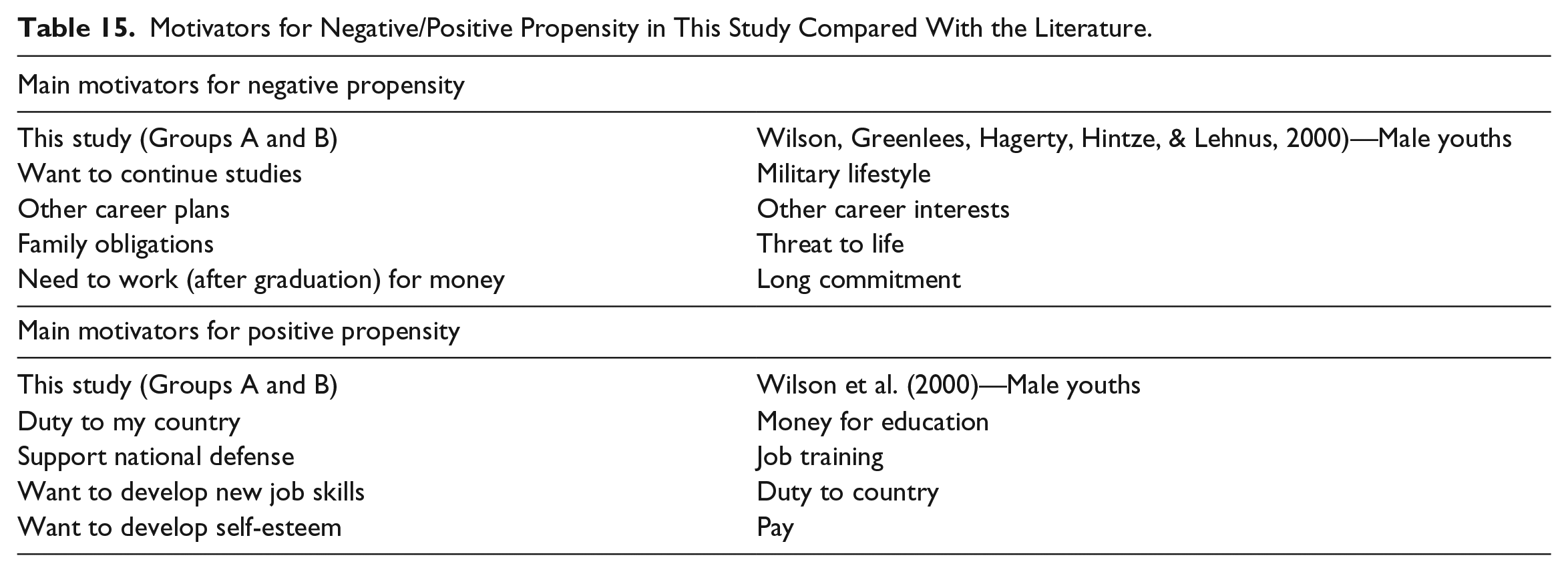
The 1999 YATS conducted 10,054 phone interviews with men and women (16-24 years) who were neither in the service nor in attending military college. The study covered enlistment propensity and reasons (Wilson et al., 2000). It found that regardless of propensity, American male youths were mainly motivated by tangible factors (money, training, military lifestyle, other career interests, long commitment time) in enlistment decision. Other career interests/long commitment time are considered tangible factors as the service period incurs opportunity costs as loss of alternative career options and time available for other activities (Table 15). Similar to the YATS results, negative propensity in this study (for both groups) was mainly motivated by tangible factors (money, further education, other career plans). However, positive propensity for UAE participants was more strongly motivated by intangible factor of fidelity (duty to country, support national defense).
Motivators for Negative/Positive Propensity in This Study Compared With the Literature.
As discussed earlier, the motivators for enlistment propensity adapted from YATS (Table 3) were integrated into a preliminary framework of youth goals (Table 11), and in light of the findings, the framework was refined. Table 16 shows that regardless of propensity, the dominant subthemes reflecting youth goals in the UAE context are benefits, dignity, family, and fidelity. Specifically, positive propensity is associated with benefits, dignity, and fidelity factors whereas negative propensity is associated with benefits and family.
Refined Framework of Youth Goals.

In the refined framework of youth goals, risk was not a dominant subtheme in the UAE context. This is interesting because the service training period entails an element of danger that can lead to the death of new recruits. In Singapore, 25 military personnel were reported to have died during active duty between 2001 and June 2008. Forty-eight percent of these deaths were classified as sudden deaths during strenuous training and the rest were due to accidents and malpractice (Tan, 2008). In the UAE, official statistics on fatality rate of new recruits are not widely publicized but three deaths were reported in the national media from 2014 to 2016 (Ahmad, 2015; Al-Subaihi, 2014; Nagraj, 2016). The restrained publicity and honoring of casualties as martyrs and heroes who served their country could account for the findings that threat to life and against my moral/religious beliefs were the two least important reasons for negative propensity.
Although challenge and adventure were also not dominant subthemes, the findings showed that regardless of propensity, older participants are more likely to consider opportunities for challenge (regimented military lifestyle) and adventure (time to change my life) in their enlistment decision compared with younger participants. In contrast, younger participants are more likely than older participants to regard benefits (money, job security, benefits) as important considerations in their enlistment decision (Tables 13-14).
Interest in Military Career
To measure and track changes regarding youth interest in a military career, participants were asked to indicate level of interest in a military career after completion of national service then compare their current (2014) interest level with the previous year (2013). The results showed that for both groups (Table 17),
most participants were not sure (50%-55%) about pursuing a military career post-national service;
where a clear stand was taken, the position was disinterest in a military career (32.5% Group A; 30% Group B);
most participants (57.5%) reported an increased interest in a military career in 2014 compared with the previous year (2013).
Interest in Military Career: Groups A and B.

The findings showed that most participants were ambivalent toward a military career post-national service but reported an increased interest in pursuing a military career compared with the previous year (2013). As data collection for this study was conducted 4 months post-implementation of the service law, the extensive media coverage of the national service program could have heightened youth interest in a military career.
Information Sources on Military Service
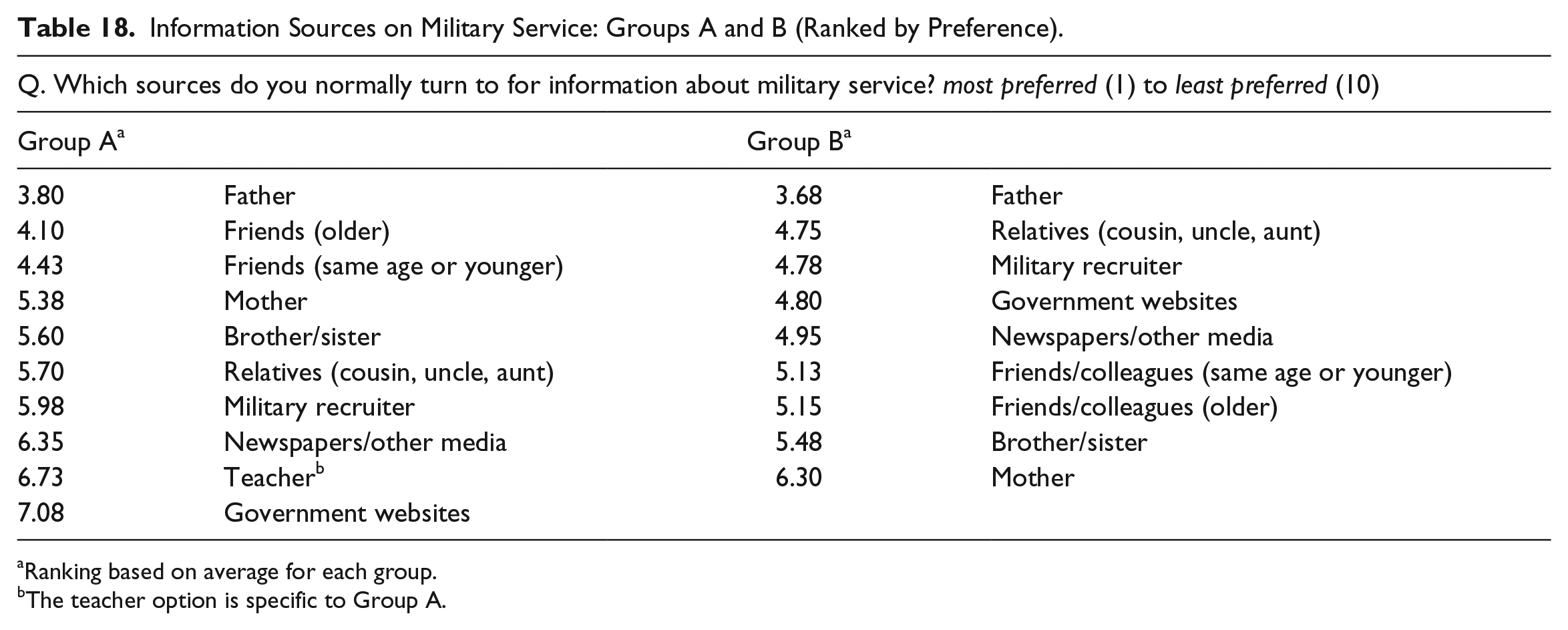
Participants were asked to rank their most to least preferred sources of information on military service ranging from people, governmental, and media sources. The findings showed that father is the most preferred information source for both groups (Table 18) reflecting the patriarchal and hierarchical structure of Arab families (Barakat, 1993). Interestingly, while Group A’s main information sources were limited to immediate family relations (parents) and close social circles (friends), the older Group B participants’ sources are more diverse, extending to nonfamily contacts such as military recruiter and government websites. When compared with the literature, the YATS data showed that the most frequently cited sources impacting American male youths’ perception of military service were friend (peer), movies/TV, father, older friend (Lehnus & Wilson, 1996), which is similar to the UAE younger participants’ choices with its concentration on friends and father as most influential information sources.
Information Sources on Military Service: Groups A and B (Ranked by Preference).
Ranking based on average for each group.
The teacher option is specific to Group A.
Other Concerns About Military Service
The final question in each questionnaire was an open-ended question that asked participants to describe other concerns they may have when they enlist for national service to capture themes not explicitly covered in the analytical framework. The two main concerns common to both groups were separation from family and friends and difficulty in adapting to military lifestyle/harsh training conditions (Table 19).
Main Concerns When Enlisting for National Service (Ranked by Importance).

Verbatim quotes were included here to represent participants’ views in their words. The original expression is retained in the quotes. For clarity, some quotes were edited (Note. A = Group A respondent; B = Group B respondent).
Separation from family and friends
I’ll be away from my family which is a hard situation to be in. (B04G2#2) I could be doing something more important with work or family. (B04G2#9) No connection with the outer world. (B04G2#16)
Difficulty in adapting to military lifestyle
Strict discipline [and] gain bad habits. (A04G3#1) How to change [from] the civil environment to military environment? (B03G4#2) The quality of food, poor shelter, no air-conditioners, humid weather (B03G4#3)
Harsh training conditions
[I worry] If I will be abused during military service or treated like a human being by seniors in military service, they like to show off by picking on newcomers. (B04G2#13) Whole week work and no enough rest [and] hot weather. (A03G1#7) Worried to get an injury. (A04G3#4)
Conclusion
Summary of Findings
This study compared the perceptions of Emirati high school students with employed youths on the UAE national service program focusing on enlistment propensity and motivation, interest in a military career, and preferred sources of information on national service. Regarding enlistment propensity and motivation, it found that younger participants (16-17 years) were more negatively propensed toward the service than older participants (18-28 years). Consistent with the literature, negative enlistment propensity for both groups was motivated mainly by desire for further education and career plans. This suggests that college enrolment by Emirati male high school graduates is likely to increase due to draft avoidance behavior. While negative propensity was mainly motivated by tangible factors (money, further education, other career plans), positive propensity was more strongly motivated by intangible factors (duty to country, support national defense). Consistent with Eighmey (2006), fidelity was the leading factor for positive enlistment propensity in this study. Regardless of propensity, the main factors affecting male youth enlistment decision in the UAE were benefits, dignity, family, and fidelity.
While findings on enlistment propensity can help predict the number of Emirati youths who intend to serve, this study also examined youth interest in pursuing a military career after completing national service. The results showed that most participants (both groups) were ambivalent toward a military career post-national service. However, there was an increased interest in a military career compared with the previous year which could be attributed to the increased media publicity associated with the service law implementation. The UAE Armed Forces has invested time and resources to train recruits and it constitutes a loss when most recruits leave after national service. Hence, the finding that most participants were undecided, yet interested, about a military career presents an opportunity for military recruiters to influence youth career decision making.
Unlike countries with established conscription programs, Emirati recruits lack opportunities to interact with those who have previously served or those currently serving, whose behaviors, attitudes, and experiences would influence recruits’ expectations of national service. Hence, this study identified youths’ most preferred information sources on military service as they can influence the formation of positive or negative attitudes toward the military and national service. It found that while younger participants’ main information sources were limited to immediate family members (parents) and friends, older participants’ sources were more diverse including nonfamily contacts: military recruiter and government websites.
Finally, the specific concerns of youths regarding national service were separation from family and friends, difficulty in adapting to military lifestyle, and training conditions. Having spent most of their lives in school or at work, national service represents a significant change for Emirati youths from civilian life. Service induction brings challenges to recruits that include separation from family and friends due short/infrequent furloughs, restricted freedom and privacy, compliance with military norms, regimentation, and physical demands (Cheok, Ang, Chew, & Tan, 2000; Scharf, Mayseless, & Kivenson-Baron, 2011). The period of service also affects family relationships. Chartrand, Frank, White, and Shope (2008) examined the effect of wartime deployments on the behavior of young children in military families. It found that children aged 3 years or older with a deployed parent showed clearer stress and depression symptoms compared with peers without a deployed parent. In the UAE context, the absence of male parent during the 3-week induction period of service and future deployment could strain familial relations especially with the children. An understanding of these concerns of youths regarding national service can enable the UAE Armed Forces to help recruits transition successfully to the military environment.
Future Research Directions
The author acknowledges that this study has limitations particularly in the sampling that may not be representative of the entire Emirati youth population in the UAE was well as the limited scope of the project. However, these limitations do not detract from the value of the findings and naturally form the basis for future research directions.
In future work, several modifications in research methodology and scope are suggested. As the sample in this study was limited to Emirati male youths, future research could include parents with children eligible for national service. An examination of parental perceptions of the military work environment and support of a military career could determine the extent of parental influence on youth career decision making. Also, the finding that “against my moral/religious belief” was the second least important factor in deferring enlistment suggests an avenue in future research in the approaches applied by the military to accommodate religious beliefs and practices in service training. Even though national service is optional for female Emiratis, future research could sample both genders to identify differences in youth goals and expectations of the service. Four years post-service law in 2018, longitudinal studies using cohort study design could be conducted to examine whether enlistment hindered opportunities for pursuing higher education by focusing on the extent to which recruits who planned for college enrollment after military service failed to do so. The findings from this study which captured youths’ perceptions toward national service at the initial implementation stage could be used to develop an annual survey tracking changes in youth and parental perceptions post-implementation of the law.
Footnotes
Acknowledgements
The author acknowledges the Arabic translation assistance provided by Dr. Elrashid Yousif Abbas, College of Arts & Sciences, Petroleum Institute (a part of Khalifa University of Science and Technology), Abu Dhabi, United Arab Emirates.
Declaration of Conflicting Interests
The author(s) declared no potential conflicts of interest with respect to the research, authorship, and/or publication of this article.
Funding
The author(s) received no financial support for the research, authorship, and/or publication of this article.
