



Abstract
The disruption caused by the COVID-19 pandemic has had lasting effects on students’ mental health, including issues related to social isolation and reduced interaction with peers and advisors. However, there remains a research gap in understanding how institutional communication and individual coping mechanisms affect student emotional exhaustion in such contexts. This study addresses this gap by investigating the impact of macro-organizational factors, such as the quality of university crisis communication, and micro-organizational factors, including social support and coping strategies, on emotional exhaustion among college students. We collected survey data from 314 participants using Prolific Academic and analyzed it with structural equation modeling (SEM). The results indicate that perceived uncertainties mediate the relationship between crisis communication quality and emotional exhaustion. Additionally, social support moderates how perceived uncertainties affect the quality of crisis communication while coping strategies moderate the relationship between perceived uncertainties and emotional exhaustion. These findings provide valuable insights into improving institutional support and enhancing student well-being during and after crises. Both theoretical and practical implications are discussed.
Introduction
University students are typically recognized as vulnerable populations owing to their positionality within the higher-education organizations’ hierarchy. The COVID-19 crisis, which disrupted major operations across the globe, amplified the vulnerability of university students. For instance, major shifts in learning, such as emergency remote learning, caused emotional and mental turmoil in students (Bao, 2020; Murphy, 2020; C. Wang et al., 2020). In addition, college students have reported that COVID-19 drastically affected their mental health and finances, especially after most of the students lost their jobs (Fernández-Olmos et al., 2021). Moreover, the crisis caused a lot of uncertainty regarding students’ workload and psychological well-being, especially due to the changes from in-person classes to Zoom classes in most US-based universities.
Given the high levels of both anxiety and stress that COVID-19 has caused in addition to the resulting negative consequences, universities have been compelled to find innovative ways to mitigate the effects of the COVID-19 crisis among students. This study aims to explore how crisis communication, social support, and coping strategies influence emotional exhaustion and perceived uncertainties among college students during the COVID-19 crisis. Crisis communication has emerged as one of the ways universities have been trying to manage the global pandemic and reduce stress levels among students (Aristovnik et al., 2020). For instance, the frequency of official communication regarding the measures universities are taking to help students cope with the crisis has increased since the pandemic started (Mohlman & Basch, 2021).
To address the gaps in current research, this study specifically aims to: (1) assess the role of crisis communication from university management in affecting students’ emotional exhaustion and perceptions of uncertainty; (2) evaluate how social support from advisors and peers impacts students’ emotional well-being and their ability to manage uncertainties; and (3) analyze whether coping strategies employed by students can buffer against emotional exhaustion and mitigate the effects of perceived uncertainties. Although universities have made positive strides in reducing uncertainties among students and ensuring learning goes back to normal, uncertainties surrounding the COVID-19 crisis still prevail among college students. For instance, the lack of clear information regarding masks and vaccines has made students anxious about the situation regarding the crisis. Further, the growing number of the virus’ variants such as Delta and Omicron contribute to the students’ uncertainties. As COVID-19 is still a new phenomenon, there is a need for more research to understand the influences of universities’ crisis communication on students’ well-being in times of COVID-19.
Prior research suggests that managerial practices can help internal publics such as students to cope with the negative effects of a crisis (Ndone, 2023; Nekmat & Kong, 2019; Zhang & Borden, 2017). As crises are often characterized by uncertainties, effective communication from management plays a vital role in reducing the negative effects of the crisis such as burnout (Nekmat & Kong, 2019). Indeed, uncertainty reduction theory (URT) posits that effective crisis management can help the publics better cope with a crisis (Grace & Tham, 2020). During this uncertain-laden and stressful COVID-19 period, examining the role of effective crisis communication is meaningful and timely to both theory and practice.
Understanding the influence of crisis communication within the higher-education setting could be important for various reasons. First, colleges are considered sites of stress given that adjusting to college requires developing skills for managing new assignments and the new environment (Maykrantz & Houghton, 2020). Second, the overwhelming academic workload contributes to stress and burnout among college students. In the face of COVID-19, the shift in learning modalities from in-person to Zoom, and now partly back to in-person creates another layer of stress among college students. As such, there is a need to investigate the role of university management, through its crisis communication, in helping students manage the adverse effects of COVID-19.
Further, as a type of formal communication, crisis communication is critical given it reduces uncertainties surrounding the crisis event (S. Xu, 2018). Beyond formal communication, college students also engage in informal communication with their advisors and peers. Such interactions act as avenues for social support that have the potential to alleviate uncertainties in times of crisis (Charoensukmongkol & Phungsoonthorn, 2020). Indeed, organizational research has documented that supervisors and coworkers provide emotional support to employees. Thus, we expect advisor support and peer support to play a critical role in helping students cope with a crisis (Lucia-Casademunt et al., 2018). In this regard, it is necessary to examine whether crisis communication messages provided by university management, advisors, and fellow students (peer support) can help students deal with the effects of COVID-19.
In this context, understanding how social networks contribute to information dissemination and emotional support becomes crucial for a comprehensive view of student support systems during the pandemic. Social networks can be critical platforms for disseminating preventive information among younger audiences such as university students. These networks have facilitated the rapid spread of health-related information, enabling students to stay informed about preventive measures (Burstin et al., 2023; Faus et al., 2022). However, the potential for misinformation on these platforms also poses a risk, potentially exacerbating stress and uncertainty. Understanding the dual role of social networks as both beneficial and potentially harmful information sources is essential for comprehensively addressing the factors affecting student stress during the pandemic.
Taken together, this study aims to provide insights into how universities can effectively use crisis communication, social support, and coping strategies to mitigate emotional exhaustion and manage uncertainties among students during crises.
Literature Review
Crisis Communication and Emotional Exhaustion Among Students
A crisis refers to ‘a sudden and unexpected event that threatens to disrupt an organization’s operations and poses both a financial and a reputational threat’ (Coombs, 2007, p. 164). Extant literature suggests that crises induce high levels of uncertainty among the involved publics (Coombs, 2007; Lesch & Millar, 2021). Also, crises create information vacuums, and the publics’ need for information during a crisis is amplified (Woon & Pang, 2017). As the information vacuum creates uncertainty among the publics, organizations engage in crisis communication to help the publics manage the uncertainty brought forth by the crisis. Crisis communication involves a dialog that an organization engages in with its publics to inform them about the crisis and what the organization is doing to mitigate the effects of the crisis. This dialog involves collecting, processing, and distributing crisis information to the publics as a way of reducing the uncertainty generated by the crisis and repairing the damaged reputation (Fearn-Banks, 2017).
Effective crisis communication aims to reduce the psychological impact of crises, such as emotional exhaustion (Charoensukmongkol, 2017; Liu et al., 2016). Emotional exhaustion refers to a persistent condition of feeling emotionally weary due to personal demands and accumulated stress (Wright & Cropanzano, 1998). Emotional exhaustion leads to the depletion of emotional energy, which in turn results in physical fatigue (Brotheridge & Lee, 2003; Wright & Cropanzano, 1998). During a crisis, emotional exhaustion occurs when the publics are exposed to psychological anxiety and cannot cope with the issues stressing them (Thompson et al., 2020). College students have been experiencing emotional exhaustion due to COVID-19 (Zis et al., 2021). Particularly, the disruption of normal schedules, shifting to virtual learning, and lack of clear information about mask mandates contribute to emotional exhaustion among college students (Gritsenko et al., 2020).
The situational crisis communication theory (SCCT) posits that an organization has an information duty to fulfill during a crisis. Organizations in crises accomplish this duty by providing both instructing and adjusting information (Coombs, 2007). By providing instructing information, an organization strives to tell the publics what they should do to shield themselves from the crisis. For example, if the crisis involves a product, the organization may use news media outlets to warn the publics about the product. On the other hand, adjusting information seeks to address the publics’ psychological needs, like the measures the organization has undertaken to avert the reoccurrence of the crisis. SCCT argues that organizations should first deal with the publics’ information needs before shifting address to the organization’s reputation.
Just like any other organization, universities are expected to offer guidance to their publics (students, faculty, and staff) during a crisis such as COVID-19. During a crisis, the publics turn to organizational leadership for guidance, which intensifies the need for more effective crisis communication (van der Meer et al., 2017; van Zoonen & van der Meer, 2015). The quality of both instructing and adjusting information is an indicator of the organization’s efforts to get the crisis under control (Allen et al., 2007). Organizations that provide timely updates during the time of the crisis tend to thrive and recover from the crisis, compared to organizations that leave the information vacuum to be filled by information from the media which may be inaccurate (Claeys et al., 2010). Crisis communication researchers argue that crisis communication needs to be handled effectively and efficiently to reduce uncertainty and fill the information void created by the crisis (Luoma-aho et al., 2017). Effective crisis communication helps to reduce uncertainty, and in turn improves how publics rate the organization (reputation) as such communication helps the publics understand how the organization is handling the crisis and provides some coping strategies that the publics can adapt to reduce uncertainties (Ndone & Park, 2022; Neuliep, 2017). Moreover, effective crisis communication boosts the publics’ confidence regarding how the management is handling the crisis (Bordia et al., 2004).
When applied in an academic context, universities should provide timely updates about a crisis such as COVID-19. Offering guidance to students promptly can help reduce uncertainties among students (Brown & White, 2011). Providing students with both instructing and adjusting information bolsters confidence among students and indicates that the university management has the students’ interests. For example, by providing timely and unambiguous updates on vaccines’ accessibility, mask mandate, and social distancing, the management helps students to cope with the COVID-19 crisis. This reduces uncertainty among college students (Adjodah et al., 2021).
Effective Crisis Communication and Emotional Exhaustion Among Students
Prior research suggests that the quality of crisis communication from universities lessens perceived uncertainties among employees (Charoensukmongkol & Phungsoonthorn, 2020). Borrowing from the URT, the current study seeks to explore how crisis information regarding COVID-19 coming from universities affects students. The URT posits that when people interact, each party needs information about the other party to reduce uncertainty and predict the other party’s behavior (Berger & Calabrese, 1975). According to the theory, people feel comfortable when they know what to expect from existing circumstances (Berger & Bradac, 1982). The theory has been used in crisis communication research to explain people’s information-seeking behavior during crises (Liu et al., 2016; S. Xu, 2018). According to the theory, when individuals face uncertainties, an information gap emerges. As a result, individuals search for more information to reduce uncertainty. During crises, reducing uncertainties allows the publics to create a general understanding and make sense of the information from an organization (Reynolds & W. Seeger, 2005). In the same vein, effective crisis communication from universities’ management could reduce the magnitude of perceived uncertainties and reduce emotional exhaustion among students. The university is trying to manage the crisis and ensure the continuity of operations (Grace & Tham, 2020; Reynolds & Seeger, 2005).
Management literature suggests that quality crisis communication is negatively associated with emotional exhaustion among employees (Charoensukmongkol & Phungsoonthorn, 2020). From the existing literature and the rationale of the URT, the current study predicts that when university management provides high-quality crisis communication, students will have low perceptions of uncertainties. For instance, by providing clear and accurate information about mask mandates, vaccination, and other policies being implemented to curb the spread of COVID-19, the university gives its students a clear understanding of COVID-19. In return, such quality information alleviates students’ uncertainties regarding COVID-19. With effective communication from university management reducing perceived uncertainties among students regarding the COVID-19 crisis, the possibility of students developing emotional exhaustion is reduced. Therefore, we hypothesize that:
H1: The perceived uncertainties of students about COVID-19 will be negatively associated with the quality of crisis communication provided by their universities.
H2: Students’ perceived uncertainties will be positively associated with emotional exhaustion.
H3: The relationship between the quality of crisis communication and students’ emotional exhaustion will be mediated by perceived uncertainties.
The Moderating Role of Social Support and Coping
Social Support
The effects of crisis communication on perceived uncertainties among college students may be moderated by social support received from advisors as well as classmates/peers. Indeed, a large corpus of literature has explored the role of social support in buffering stress (Cohen et al., 2004). Social support involves communication of messages that foster feelings of love, care, and acceptance of the other person (Zimmermann & Applegate, 1994). Thus, recipients of social support are provided with psychological and physical resources that enable them to manage stress through coping (Amason et al., 1999). In educational contexts, students can receive social support from both professors/advisors as well as their peers. Such social support may mitigate the negative effects of stressful life events such as COVID-19.
Advisor support entails students’ perceptions of the quality of their interactions with advisors or supervisors. Prior work indicates that supervisor/advisor support plays a critical role in times of stressful events such as a crisis (Charoensukmongkol & Phungsoonthorn, 2020). As supervisors have easier access to resources due to their more powerful position within organizations, they offer social support to individuals through providing information and resources that aid in alleviating uncertainties that characterize crises (Skiba & Wildman, 2019). Further, in the absence of formal communication from the university, advisors step in to fill the information gap. In doing so, the advisors ease the concerns surrounding the crisis (Charoensukmongkol & Phungsoonthorn, 2020). Therefore, social support from advisors can play a vital role in reducing the perceived uncertainties (Tummers et al., 2016). Building on this line of work, we advance the following hypothesis:
H4: Advisor support will moderate the relationship between quality of crisis communication and perceived uncertainties such that the relationship will be weaker when advisor support is higher than lower.
Beyond advisor support, peer support has the potential to shape perceptions of uncertainties during crises. Extant literature documents that peer support buffers stress and depressive symptoms and improves students’ well-being (Killgore et al., 2020; Rastegar Kazerooni et al., 2020; Sun et al., 2020). In fact, the effect of peer support is more pronounced than that of advisors owing to the relatively low power distance between peers, which allows peers to engage in open communication (Kram & Isabella, 1985). Additionally, as peers are more likely to experience similar difficulties and are easily accessible given they spend more time together in classes and dorms, they may be more readily available to provide support to one another (Tompkins et al., 2016; Tullis & Goldstone, 2020). Further, their time together may offer additional opportunities for building trust and socially supporting one another. As peers provide a social context in which sensemaking occurs especially in times of uncertainties (Peroune, 2007 ), peer support is likely to lead to low perceptions of uncertainties among the recipients. In this regard, we propose:
H5: Peer support will moderate the relationship between the quality of crisis communication and perceived uncertainties such that the relationship will be weaker when peer support is higher than when it is lower.
Coping
Although stressful events and their resulting uncertainties are predictors of emotional exhaustion, some people exhibit remarkable resilience despite the prevailing stressors. One approach to explaining this resilience is coping. Coping is conceptualized as cognitive and behavioral adjustments that people use to manage stressful situations that exceed their resources (Lazarus & Folkman, 1984). There are two general types of coping: problem-focused and emotion-focused coping. When individuals engage in problem-focused coping, they attempt to manipulate the environment to reduce stress (Jin, 2010). On the other hand, emotion-focused coping entails reappraisal of the environmental stimuli through venting of emotions or interpreting the negative events positively (Jin, 2010). Coping is also characterized by different strategies including cognitive restructuring and optimism (Vizoso et al., 2019).
College mirrors corporate organizations in terms of stress level. For instance, college students are obligated to engage in structured activities such as attending classes and working on multiple assignments/class projects simultaneously (Schmidt et al., 2013). Thus, students may experience stress in the face of a demanding academic workload. Given the nature of stress within academia, students are compelled to develop coping skills to navigate college. Indeed, college students use a variety of coping strategies depending on the nature of the stressful event (Maykrantz & Houghton, 2020). For example, Hatchett and Park (2004) reported that college students use problem-solving to manage stressors. Further, Vizoso et al. (2019) found that university students who utilize problem-solving and emotional coping strategies did not experience burnout. Put simply, coping buffers burnout (Lewin & Sager, 2009). Considering the enhanced coping abilities among college students, we predict that coping serves as a condition that mitigates the relationship between perceived uncertainties and emotional exhaustion. As such, we advance the following hypothesis:
H6: The positive relationship between perceived uncertainties and emotional exhaustion will be moderated by coping abilities such that this relationship is weaker when college students have coping abilities.
Method
Participants
The study targeted current university students who had to be at least 18 years of age. A total of 320 were surveyed; however, six participants (n = 6) were eliminated from the final analysis leaving 314 participants. Criteria for elimination included duration taken to complete the study and incorrect answers to attention check questions. All participants were from the US. The sample included 135 males and 179 females. The participants’ average age was 22.7 (SD = 7.94). Of the sample, 23 identified as graduate students, 56 as seniors, 97 as juniors, 63 as sophomores, and 75 as freshmen. See Table 1 for the demographics.
Sociodemographic Characteristics of Participants (N = 314).

Procedure
All procedures were reviewed and approved by the institutional review board (IRB) from a large eastern university. Participants were recruited through Prolific Academic (ProA), an online crowdsourcing service. ProA allows participants to complete surveys online and get paid for doing so and it is preferred over other crowdsourcing services like MTurk when a researcher wants to collect diverse data (Peer et al., 2017). We paid our participants $1.59. As required by IRB, all participants read informed consent information before participating in the study. The informed consent document explained the purpose of the study, the procedures involved, potential risks, and the confidentiality of their responses. Participants were assured that their responses would be anonymous and used solely for research purposes. Additionally, the study adhered to ethical guidelines for research involving human subjects, ensuring that participants’ privacy and rights were protected throughout the study. To ensure clarity and consistency in responses, instructions were provided at the top of each section of the survey. These instructions were specifically tailored to guide respondents on how to interpret and answer the questions. For instance, in sections addressing topics like advisor support or peer support, the instructions clarified the concepts and directed respondents to consider their experiences during the COVID-19 pandemic. This approach helped to ensure that participants understood the context and focus of each set of questions, facilitating more accurate and relevant responses.
Measures
Quality of Crisis Communication
We used Bordia et al. (2006) scale to measure the quality of crisis communication. The 7-item scale assessed students’ perceptions of the quality of crisis communication received from the university. Sample items from this scale included, “The university gives us as much information as possible about COVID-19” and “The university communicates the actions they are taking to deal with COVID-19.” Participants were asked to rate each statement following a five-point Likert-type scale, ranging from 1 = strongly disagree to 5 = strongly agree (M = 3.30, SD = 0.85, a = 0.88).
Perceived Uncertainties
We adapted Allen et al.’s (2007) scale to measure perceived uncertainties. Originally, the scale was developed to assess uncertainties during organizational change, thus, we adapted it to reflect uncertainties stemming from COVID-19. The adapted scale included five items such as “I am uncertain that the COVID-related problems will be solved.” The respondents were asked to rate each statement on a five-point Likert-type scale, ranging from 1 = strongly disagree to 5 = strongly agree (M = 3.17, SD = 0.89, a = 0.85).
Emotional Exhaustion
We measured emotional exhaustion using the scale developed by Maslach and Jackson (1981). The 9-item scale included items such as “I feel used up at the end of the school day” and “I feel emotionally drained from my schoolwork.” Participants were asked to rate each statement following a five-point Likert-type scale, ranging from 1 = strongly disagree to 5 = strongly agree (M = 3.67, SD = 0.89, a = 0.92).
Advisor Support
We assessed advisor support using the scale developed by Cole et al. (2006). Specifically, we were interested in academic advisor support and our instructions included that part to distinguish academic advisor support from other advisors. The four-item scale measured students’ perceptions of their academic advisor’s support. Sample items included “My advisor assures me that help is available if it is needed” and “I can fully rely on my advisor”. Participants were asked to rate each statement following a five-point Likert-type scale, ranging from 1 = strongly disagree to 5 = strongly agree (M = 3.26, SD = 1.05, a = 0.92).
Peer Support
Peer support was measured using the scale developed by Tews et al. (2013). The scale included five items such as “My fellow students (peers) take time to listen to my COVID-19 concerns” and “My fellow students (peers) listen to me when I have to get something off my chest regarding COVID-19”. Participants were asked to rate each statement following a five-point Likert-type scale, ranging from 1 = strongly disagree to 5 = strongly agree (M = 3.15, SD = 0.86, a = 0.95).
Coping
We assessed students’ coping mechanisms using a scale adapted from Carver (1997). The scale included seven items such as “I concentrate my efforts on doing something about it” and ‘I take direct action to get around the problem.” Participants were asked to rate each statement following a five-point Likert-type scale, ranging from 1 = strongly disagree to 5 = strongly agree (M = 3.18, SD = 0.86, a = 0.83).
Control Variables
We controlled some demographic variables for all possible confounders that could skew the results of the study (Valeri & VanderWeele, 2013). These variables were age, gender, year in school, and education level.
Results
Dimensionality Checks
As a preliminary analysis, the researchers conducted bivariate correlations among all study variables. See the results in Table 2. Secondly the researchers ran a confirmatory factor analysis (CFA) to examine the dimensionality of the multiple items using Lavaan in R statistical software (Rosseel, 2012). A CFA was ideal at this stage to help in verifying the factor structure of the multi-item variables (Netemeyer et al., 2003). These variables were quality of crisis communication, advisor support, peer support, perceived uncertainties, coping, and emotional exhaustion. Based on the Hu and Bentler (1999) cut-off criteria, the CFA model had an acceptable model fit, χ2(274) = 968.78, p < .001, robust root mean square error of approximation (rRMSEA) = 0.03, 95% CI = [0.01, 0.05], robust comparative fit index (CFI) = 0.98, robust non-normed fit index/Tucker–Lewis index (rNNFI/TLI) = 0.97, and standardized root mean square residual (SRMR) = 0.04. An adequate model fit needs to have a CFI of at least 0.095, TLI of 0.95, RMSEA of not higher than 0.08, and an SRMR of not higher than 0.08 (Hu & Bentler, 1999; Little, 2013). Further, we inspected the local model fit using residual matrix and indices like correlated residuals and cross-loadings. This inspection did not reveal areas of local misfit.
Correlations Among the Variables.
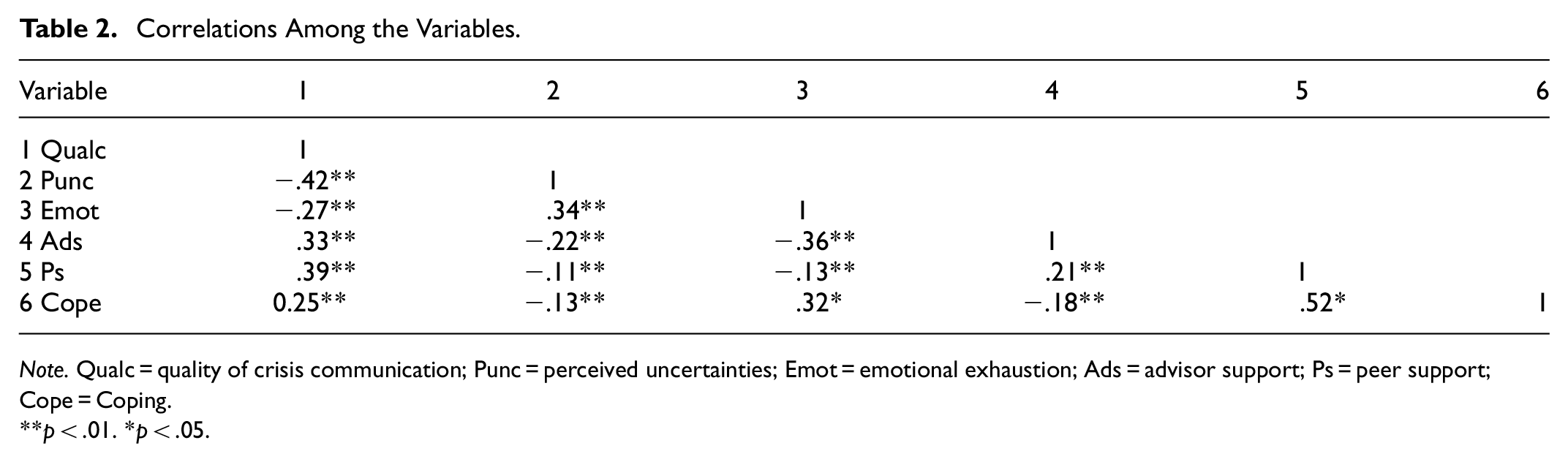
Note. Qualc = quality of crisis communication; Punc = perceived uncertainties; Emot = emotional exhaustion; Ads = advisor support; Ps = peer support; Cope = Coping.
p < .01. *p < .05.
To examine the model’s convergent validity, factor loadings were used. All factor loadings were greater than 0.05 and therefore, the model achieved convergent validity. To assess discriminant validity, the square root of the average variance extracted (AVE) was used. For a model to achieve discriminant validity, the square root of AVE for each construct must be greater than the construct’s correlation with any other construct (Hair et al., 2019). As shown in Table 3, the square roots of AVEs met this criterion. Moreover, the average shared squared variance (ASV) values were less than the AVE values for each variable, further confirming discriminant validity. Composite reliability (CR) was successfully established, and all measurement items had good reliability that was above 0.70 (Hair et al., 2019). In addition, the composite reliability coefficients were greater than 0.70. See Table 3 below.
Square Root of the Average Variance Extracted (AVE) and Variable Correlations.

Note. Square root of the AVE is in parenthesis.
CAF = Cronbach’s alpha coefficient.
CRC = Composite reliability coefficient.
Qualc = quality of crisis communication; Ads = advisor support; Ps = peer support; Punc = perceived uncertainties; Cope = coping; Emot = emotional exhaustion; Gen = Gender; Yis = year in school; Educ = education.
Correlation is significant at the .01 level (2-tailed).
Correlation is significant at the .05 level (2-tailed).
Potential violations of multicollinearity and homoscedasticity were also assessed. Multicollinearity can minimize the power of significance tests in regression analyses (Hayes, 2015). Both multicollinearity and homoscedasticity were evaluated using the Variance Inflation Factor (VIF) and tolerance (TOL). There was no overlap as all tolerance statistics were above the 0.25 threshold and none of the VIF statistics was above the 4.0 threshold. The VIF value should not exceed 4.0 and the TOL value should be above 0.25 (Hair et al., 2019). VIF was also used to assess common method bias (CMB), since our findings were based on single-source data. Full collinearity test was used to assess common method bias. All VIF values were lower than 3.3, indicating common method bias was of low concern (Kock, 2017).
Hypotheses Testing
All hypotheses were tested using Lavaan in R statistical software (Rosseel, 2012). The first hypothesis (H1) predicted that the quality of crisis communication that a university provides to the students will be negatively associated with the perceived uncertainties of students regarding COVID-19. The results indicated that the quality of crisis communication was negatively associated with students’ perceived uncertainties (β = −.26, t = −5.62, p < .001). Therefore, H1 was supported. The second hypothesis (H2) predicted that perceived uncertainties will be positively associated with emotional exhaustion of students. The results indicated that perceived uncertainties were positively associated with the emotional exhaustion (β = .08, t = 1.64, p < .001). Thus, H2 was supported.
The third hypothesis (H3) sought to test the mediating role of perceived uncertainties on the relationship between the quality of crisis communication and emotional exhaustion of students. The path was estimated using the bootstrapping technique (N = 5,000; Hayes, 2009; Preacher & Hayes, 2008). The results show that perceived uncertainties positively mediated the relationship between the quality of crisis communication and emotional exhaustion, (β = .19, p < .001, 95% CI [0.16, 0.39]. Therefore, H3 was supported.
The fourth hypothesis (H4) predicted that advisor support would moderate the effects of crisis communication on perceived uncertainties. The results reveal advisor support significantly moderated the relationship between crisis communication and perceived uncertainties positively, β = .19, p < .001, 95% CI [0.10, 0.29]. Therefore, H4 was supported. The regression line drawn was created by plotting the scores of the quality of crisis communication scores on the mean, one standard deviation below the mean and above the mean across high advisor support (+1.00 SD) and low advisor support (-1.00 SD). From the graph, the negative relationship between the quality of crisis communication and perceived uncertainties was evident for students who had low advisor support. On the other hand, students with high advisor support did not exhibit signs of uncertainties. See Figure 1 below.

Moderation effects of advisor support on the relationship between the quality of crisis communication and students’ perceived uncertainties.
The fifth hypothesis (H5) predicted that peer support would moderate the effects of crisis communication on perceived uncertainties. The results show that peer support moderated the effects of crisis communication on perceived uncertainties positively, β = .22, p < .001, 95% CI [0.11, 0.34]. The regression line was plotted using the same procedure as the one used for advisor support. From the graph, the negative relationship between the quality of crisis communication and perceived uncertainties was evident for students who had low peer support. On the other hand, students with high peer support exhibited low uncertainties. See Figure 2 below.
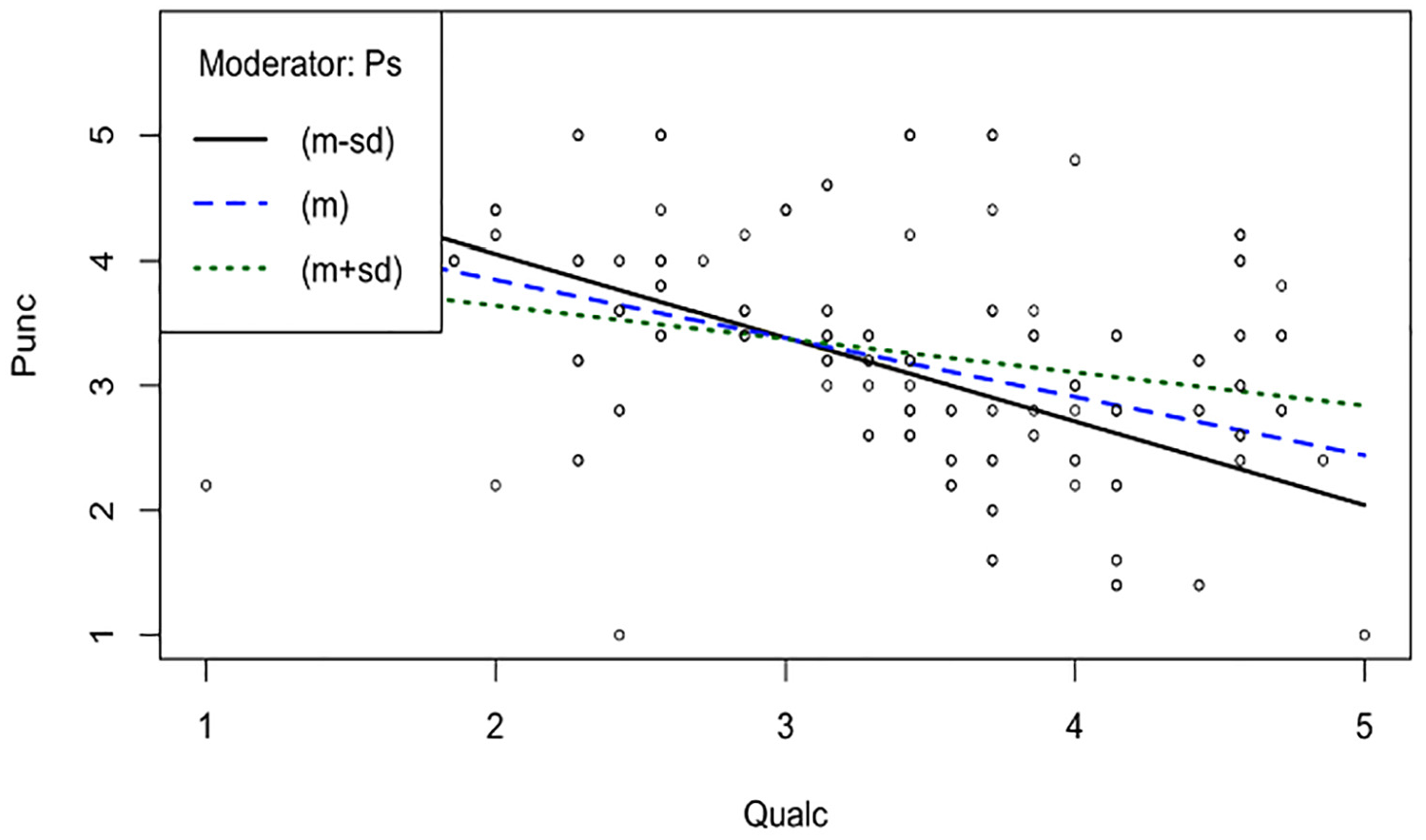
Moderation effects of peer support on the relationship between the quality of crisis communication and students’ perceived uncertainties.
The last hypothesis (H6) predicted that coping will moderate the effects of perceived uncertainties on emotional exhaustion. The results reveal that coping moderated the positive relationship between perceived uncertainties and emotional exhaustion positively, β = .27, p < .01, 95% CI [0.11, 0.43]. That is, the positive effects of perceived uncertainties on emotional exhaustion were less pronounced when students exhibited high coping. Therefore, H6 was supported. See Figure 3 below. The standardized coefficients are reported in Figure 4.

Moderation effects of coping on the relationship between students’ perceived uncertainties and emotional exhaustion.

Hypotheses testing (standardized coefficients are reported).
Discussion
This study sought to explore how the quality of crisis communication coming from university management affects students’ perceived uncertainties and emotional exhaustion during the COVID-19 crisis. Also, the current study examined the moderating role of advisor support and peer support on the relationship between the quality of crisis communication and perceived uncertainties. In addition, the study tested the moderating role of coping on the relationship between perceived uncertainties and emotional exhaustion. The results reveal that when universities share quality crisis communication with their students, the students’ perceived uncertainties dissipate.
The results align with Uncertainty Reduction Theory (URT), which suggests that obtaining information during a crisis reduces uncertainty and improves psychological well-being (Berger & Calabrese, 1975). Our findings support this theory, showing that students who received high-quality crisis communication experienced lower levels of uncertainty and emotional exhaustion. This is consistent with previous research that underscores the importance of effective crisis communication in reducing uncertainty and managing psychological distress during crises (Charoensukmongkol & Phungsoonthorn, 2020; Coombs, 2007; Denner et al., 2019; Kim et al., 2019). The presence of an information vacuum during a crisis, as noted by Coombs (2007), can negatively impact mental health, reinforcing the need for timely and accurate information.
The study also highlighted that advisor support moderated the impact of crisis communication on perceived uncertainties. Specifically, students with lower advisor support reported higher levels of uncertainty, despite the quality of crisis communication. This suggests that while effective communication is crucial, its impact can be diminished without sufficient support from advisors. This finding is consistent with previous research indicating that social support can buffer against psychological stress during crises (Killgore et al., 2020; Sun et al., 2020).
The current study also found that having supportive peers (classmates) moderated the negative effects of quality crisis communication messages on perceived uncertainties. When students had supportive peers, their uncertainties about COVID-19 were lower. In contrast, at lower levels of peer support, the negative association between the quality of crisis communication and perceived uncertainties was more pronounced. This suggests that the effectiveness of crisis communication in reducing uncertainties is influenced by the level of peer support students receive. Specifically, the magnitude of the negative association between quality of communication and perceived uncertainties was greatest among students with lower levels of peer and advisor support. The efficacy of high-quality crisis communication in reducing uncertainties was most pronounced among those with less peer and advisor support, whereas those with higher levels of peer support might not experience as strong an impact from the quality of crisis communication. This finding aligns with existing research that highlights the role of peer support in buffering psychological distress during challenging periods (Killgore et al., 2020; Sun et al., 2020).
Moreover, the study confirmed the moderating role of coping strategies on the relationship between perceived uncertainties and emotional exhaustion. Students with higher coping abilities reported lower levels of emotional exhaustion, even in the face of significant uncertainties. This finding supports the broader literature on coping strategies, which emphasizes their effectiveness in managing stress and reducing psychological strain during crises (James et al., 2019; Jin, 2010; Rabelo et al., 2016; Wasil et al., 2021).
Lastly, the study found support for the moderation effects of coping on the relationship between perceived uncertainties and emotional exhaustion. Students who were able to cope with the effects of the COVID-19 crisis reported low levels of emotional exhaustion, as shown in Figure 3 below. From the graph, the positive relationship between perceived uncertainties and emotional exhaustion was evident for students with low levels of coping. On the other hand, students who had high levels of coping reported low emotional exhaustion.
Implications
The current study has several theoretical and practical implications. From a theoretical perspective, this study reinforces the significance of both SCCT and URT in guiding crisis communication practices. SCCT emphasizes the importance of providing clear and actionable information during crises (Coombs & Holladay, 2009 ), and URT supports the role of information in reducing uncertainty (Berger & Calabrese, 1975). Our study confirms that effective crisis communication can alleviate uncertainties and emotional exhaustion, aligning with these theoretical frameworks. SCCT calls for providing both instructing and adjusting information to help the publics manage a crisis (Coombs, 2009). The current study found support for the importance of quality crisis communication from universities’ management during a crisis, which is in line with SCCT (Coombs, 2007). Researchers argue that URT can be used in crisis communication as a normative framework to guide crisis communication managers in managing the uncertainty brought forth by a crisis (Grace & Tham, 2020). The current study found support for the use of URT in reducing students’ uncertainties regarding COVID-19.
The current study contributes to the extant literature on social support (peer and advisor) during the time of a crisis. From this study, both peer and advisor support can reinforce the messages coming from university management in mitigating the negative effects of perceived uncertainties and emotional exhaustion of students during a crisis. Moreover, peer and advisor support could supplement official communication coming from universities’ management especially when the official information is not timely. Therefore, advisors and instructors should create assignments and activities that provide opportunities for students to work with their peers, and consequently feel comfortable seeking help from their peers.
The current study suggests that coping helps to reduce the effects of perceived uncertainties on emotional exhaustion. This finding is in line with existing research that coping helps reduce psychological stress and uncertainties (James et al., 2019; Jin, 2010; Jin et al., 2012; Spence et al., 2007). During a crisis like COVID-19, the publics enact their coping strategies to deal with the negative feelings. Coping is one of the most effective ways to handle widespread community stress such as natural disasters and epidemics (Rabelo et al., 2016; Wasil et al., 2021; J. Xu & He, 2012). Therefore, universities should come up with interventions that equip students with coping skills since coping helps in reducing emotional exhaustion during a crisis like COVID-19.
The results of the current study also reveal that universities’ management should provide information to its students during a crisis to address students’ concerns and their psychological well-being. At the same time, universities should encourage advisors to provide information to students during a crisis. In addition, students should seek information from fellow students (peers) during a crisis as this also helps to lower uncertainties. In other words, it is not just university management that should be providing information to the students during a crisis; advisors and peers can also help students mitigate the negative effects of a crisis like COVID-19. Therefore, advisors should step up during a crisis to provide timely informational support for students.
Limitations and Directions for Future Research
The current study has several limitations. First, the time element for the current study is a limitation. Although COVID-19 is no longer considered a pandemic, and cases have significantly reduced with widespread vaccinations, it was challenging to draw definitive conclusions about the effects of COVID-19 on students at the time of data collection. For instance, new variants such as Delta and Omicron were emerging during the study period. Thus, the current findings should be considered preliminary due to the evolving nature of the pandemic and the shifting information about the virus. In other words, more research is needed in this area to understand the dynamics of crisis communication during and after COVID-19. Second, the researchers collected data from universities in the United States. Therefore, the generalizability of the results may be limited to universities in the USA. Future research could replicate the current study using student populations from other countries and cultures, including non-Western cultures.
Moreover, although students’ perceptions are important in understanding students’ satisfaction with learning and university communication patterns (Mullen & Tallent-Runnels, 2006), the findings of the current study should be interpreted with caution. This is because the current study only measured students’ perceptions of effective crisis messaging in the context of COVID-19 and therefore, the results should be interpreted in that context. Lastly, our current study provided support for the extant literature on the importance of peer support during a crisis (e.g., see Charoensukmongkol & Phungsoonthorn, 2020), peer support should be examined further, especially given that it could also facilitate the spread of misinformation (Tan et al., 2021).
Another limitation of our study is the cross-sectional nature of our data. Since the data were collected at a single point in time, it restricts our ability to make causal inferences. Specifically, while our mediation analyses suggest potential pathways through which the quality of crisis communication influences perceived uncertainties, these results should be interpreted with caution. The lack of temporal data limits our ability to establish temporal precedence—a crucial factor in confirming mediation effects (Bollen & Bauldry, 2011). Future research should consider employing longitudinal or experimental designs to more accurately assess the directionality of these relationships over time. Such approaches would strengthen the ability to draw causal conclusions and further validate the findings presented in this study.
In conclusion, the current study provides insights on how universities can help students to manage the negative effects of the COVID-19 crisis. Universities should provide timely information to reduce uncertainties among students. Also, universities should help students cope with the COVID-19 crisis by providing coping interventions. Advisors should support students to supplement information coming from universities’ management. Students should also seek support from their peers (fellow students) as this can help minimize the negative effects of the COVID-19 crisis.
Footnotes

Funding
The author(s) disclosed receipt of the following financial support for the research, authorship, and/or publication of this article: This research was supported by Coastal Carolina University.
Declaration of Conflicting Interests
The author(s) declared no potential conflicts of interest with respect to the research, authorship, and/or publication of this article.
Data Availability Statement
Data available on request.