




Abstract
This study investigates the role of machine-translated instant messaging (IM) during a cascading crisis, taking foreigners, who constitute the linguistic minority community in China, as the participants. Informed by the information-seeking behavior theory, the study assesses the extent to which participants machine-translated pandemic-related IMs they received via WeChat, the popular IM platform in China and their perception of the quality of translated IMs. From a cultural perspective, the study evaluates the language and timing of the messages as well as the degree of integration of foreigners into the pandemic messaging apparatus. Based on data gathered via a questionnaire (430 respondents) and semi-structured interviews (15 interviewees), it was found that participants overwhelmingly machine-translated pandemic and non-pandemic-related IMs and perceived the quality to be good. In contrast, they had an unfavorable perception of the timing and tone of IMs, as well as their extent of involvement in the crisis information apparatus. Based on the findings, recommendations are proposed to better integrate members of linguistic minority communities, especially those with knowledge of the mainstream language, into crisis information management.
Plain language summary
Purpose The study investigates machine-translated instant messaging (IM) use by linguistic minorities during a cascading health crisis. Based on the information-seeking behavior theory and taking foreigners, who are the linguistic minority community in China, as the subject of investigation, the study assesses if participants machine-translated the pandemic-related IMs they received via WeChat, what they thought about the quality, and, culturally, whether they felt integrated into the pandemic messaging apparatus. Methods A mixed method, consisting of analyzing data from a questionnaire and semi-structured interviews, was adopted in the study. The questionnaire was completed by 430 foreigners living in China and 15 interviewees. Conclusions It was found that participants overwhelmingly machine-translated pandemic-related IMs, mostly into English, perceived the quality to be acceptable, and believed the ability to translate IMs influenced compliance with COVID-19 protocols. However, they believed that the timing of crisis information was inappropriate, that IM language lacked empathy, and that they were not integrated into the pandemic messaging structure. Implications The study demonstrated that machine-translated IM can be relied upon in crises, where human translators are not readily available to ensure information reaches linguistic minority communities. Recommendations are suggested to ensure that authorities factor in the cultural and linguistic backgrounds of minorities during crises. Limitations The authors did not analyze real IMs disseminated during COVID-19, hence the analysis is based on perceptions and interviews. Furthermore, the study did not include foreigners in China who are fluent in Chinese and did not need to translate the IMs they received.
Keywords
Introduction
During a crisis, it is crucial for much-needed information to reach the most vulnerable communities. That means individuals and communities should have access to information to understand the evolution of the crisis and follow preventive measures and protocols. Taking advantage of technological, advances, crisis managers have capitalized on the ubiquity of smartphones to disseminate crisis information via the Internet and social media applications. According to Ahmad et al. (2016), smartphones could “become the most likely (in many cases, only) means to obtain essential information” (p. 1411) during a crisis. Smartphones offer multiple advantages in crisis information dissemination because they are popularly used and support multimodal messages, including text, voice, video, pictures, and various file formats. In addition, smartphone users can access email, social media platforms, and many of applications, including machine translation (e.g., Google Translate and Baidu Translate).
However, even in large metropolises where most inhabitants possess a smartphone, information disseminated during a crisis does not always reach the most affected because communities are “becoming increasingly multicultural and multilingual, mainly due to economic migration and displacement” (Rossetti et al., 2020, p. 1). In other words, non-native speakers of a mainstream language may encounter challenges accessing crucial information (Sherly et al., 2015) if the information is not translated into the language(s) they understand and use. The presence of translators in the immediate aftermath of a crisis is crucial to ensuring that information reaches all members of society, irrespective of their linguistic and cultural backgrounds. However, as studies have demonstrated, there are hardly enough professional translators during a crisis, forcing authorities to rely on volunteers and machine translation (MT) systems. For instance, when COVID-19 broke out in China in 2020, volunteers and international students were recruited to translate information into foreign languages (Jiang, 2021; Luo, 2021) partly due to a shortage of professional translators. However, as the pandemic wore on, efforts to have volunteers translate pandemic information decreased, making it challenging for those in linguistic minority communities to access pandemic information disseminated principally via WeChat, the government-preferred social media instant messaging (IM) platform. The platform has a built-in MT system capable of translating messages into 20 world languages. However, despite the expanse of research on the role of MT in crisis information dissemination, IM platforms with a built-in MT system have not been adequately investigated. This research contributes to bridging this gap.
The study investigates how foreigners in China, that is, members of the linguistic minority community, accessed pandemic-related information at the peak of the Omicron outbreak (May–June 2022), which triggered lockdowns, travel restrictions, and an unprecedented search for pandemic information (Dyer, 2022). Informed by the information-seeking behavior theory, the study adopts a mixed method qualitative and quantitative data approach to understand: (1) whether foreigners in China utilized WeChat’s built-in MT system to translate pandemic-related IMs; (2) how they perceived the quality of machine-translated IMs; (3) how they felt about the language and timing of pandemic-related IMs, and; 4) whether they felt integrated or alienated from the crisis information process. The study’s findings provide fodder for recommendations likely to increase access to crisis information for members of linguistic and cultural minority communities.
Theoretical Background
The Information-Seeking Behavior Theory
The theorization of information-seeking behavior was reinforced by the increased dissemination of scientific and technical information after the Second World War. The concept’s various models owe their definitions to several factors, including personal reasons, position of the information seeker, information source(s), type of information required, and circumstances surrounding the need for information (Lalazaryan & Zare-Farashbandi, 2014). For instance, information-seeking behavior has been perceived as personal (Tidwell & Sias, 2005) or the totality of interactions with a system, including accidental exposure to information, access due to a specific need, information selection and utilization, and even information refusal. However, irrespective of the rationale, the common trait of information-seeking behavior includes a seeker, in specific circumstances, for specific motivations and stimuli, involved in a process to obtain information using a specific method (Foster, 2004; Lalazaryan & Zare-Farashbandi, 2014; Marton & Wei, 2012).
In over 30 years of theorization, researchers have examined information-seeking behavior from multiple perspectives. Ellis (1989) and Kuhlthau (1993), for instance, were among earlier investigators who conceived information seeking as a linear process comprised of “stages and iterative activities” (Foster, 2004, p. 228). Interdisciplinarity has also been examined as a context of information-seeking behavior, with Mote (1962), Catalano (2013), and Niu et al. (2010) highlighting different investigative strategies adopted by various interdisciplinary researchers. More recently, research on information-seeking behavior has been grounded in technology, given the advances in and the ubiquitous influence of emergent data-based devices through which information is disseminated (Ernest et al., 2005; Kubb & Foran, 2020; Ybarra & Suman, 2006).
With regard to studies on health information-seeking behaviors, researchers have focused on the attitudes of individuals in various age groups, including older adults (Manafor & Wong, 2012), within the broader context of the aging strategy and adolescents (Gray et al., 2005), within the framework of how to redress information “poverty” among students enrolled in both professional and non-professional training institutions (Duncan & Holtslander, 2012). Meanwhile, from the cultural perspective, research on information-seeking behavior has tended to underscore behavioral patterns among individuals and groups of different social backgrounds. For instance, Kim et al. (2015) have evaluated the information-seeking behavior of Korean Americans, emphasizing that social network channels constitute part of the “cultural factors that influence health information acquisition and access to social support for ethnic minorities” (p. 1). Meanwhile, the cultural elements of information-seeking behavior have predominantly been researched among tourists (Gursoy & Umbreit, 2004; Jordan et al., 2013; Lee et al., 2005), with most researchers concluding that the national culture of travelers significantly underpins their information search behavior.
Additionally, there has been a significant increase in research motivated by and conducted within the context of the recent COVID-19 pandemic. Broad-based investigations of general information-seeking patterns in specific geographical and cultural settings (Li & Zheng, 2022; Moreno et al., 2020) and within various age groups and genders (Chen et al., 2024; Lund & Ma, 2022) have been predominant. In addition, researchers have focused on the behavior of members of specific professional groups within given contexts. For example, Oyovwe-Tinuoye & CLN (2020) and Suzuki et al. (2023) have investigated the information-seeking behavior of health professionals in and out of hospital settings. Researchers have been drawn to information-seeking behavioral patterns among socio-cultural groups (Berdida et al., 2022) and ethnic minorities, including African Americans, Hispanics (Kim et al., 2022), minority groups within student communities, and other linguistic minority communities. For instance, Ahmadinia et al. (2022) investigated the information-seeking attitude of Persian speakers in Finland, concluding that friends and social media were crucial in obtaining information amidst segregation, communication challenges, and other psychological factors.
Regarding information-seeking media, COVID-19-related researchers have focused on social media platforms, the news, and the Internet as the main sources of information. Moreno et al. (2020), for instance, found that most information seekers consulted mainstream news media and WhatsApp, while Ebrahim et al. (2020) and Chen et al. (2024) found that most seekers consulted social media accounts of health organizations, WhatsApp, friends and neighbors, and healthcare professionals. In contrast, it was found that the information-seeking behavior of ethnic and linguistic minority community members was informed by several elements, including the cultural identity of the information provider, value of the information (Kim et al., 2022), ethnic/cultural background of the informant (Alsan et al., 2021), cultural beliefs like superstition, linguistic barriers, fear, uncertainties, and suspicion (Ahmadinia et al., 2022; Jung & Jang, 2022). Regardless of platform, most community members tend to trust information disseminated in their native language by members of their linguistic and ethnic communities (Jung & Jang, 2022).
Existing Research Lacunae
Despite the significant volume of research on information-seeking behaviors, especially during a crisis, many elements remain underexplored. First, research has shown that most seekers obtain information from social media, government sites, and IM applications like WhatsApp. However, there has been a lack of focus on information obtained by machine-translating messages on these platforms, especially using the built-in MT system. Second, studies on information-seeking behavior by linguistic minorities have concentrated on individuals or groups with the same background and, most often, residing in specific geographically confined locations (Jung & Jang, 2022). Investigations of minority communities with members of different linguistic and cultural backgrounds are scarce. Third, most studies have investigated linguistic contexts where information is disseminated in a mainstream European language while information recipients are speakers of non-mainstream languages. That means few researchers have examined contexts where speakers of the mainstream language(s) constitute the majorit of information seekers. Fourth, while IM use has been significantly researched and MT systems have been developed to foster information dissemination in times of crisis, research has not focused on the emergence of the two systems.
Therefore, this paper partially contributes to bridging these research lacunae. The study evaluates crisis messaging, MT, and IM, focusing on the attitudes and behavior of members of a linguistic minority community within a cosmopolitan setting. The study investigates the extent to which foreigners translated COVID-related messages received via IM, the languages into the IMs were translated, the perception of the MT output, the impact of translated IMs on compliance with pandemic protocols, and whether besides pandemic-related IMs other message types were machine translated.
From a cultural perspective, the study focused on time, language, and integration—three underpinning elements of culture. Different cultures have different concepts about time and its effect on individual and collective behavior. Chisholm Hatfield et al. (2018) maintain that “conceptions of time in indigenous contexts can vary widely” (p. 3) and significantly influence how individuals and cultures, perceive, process, and respond to various information (Southerton et al., 2012). Meanwhile, cultural integration has been studied, particularly in emergencies. Perceived as the adaptation or accommodation of the cultural other via multiple mechanisms (Kuran, 2008), cultural integration has been extensively discussed within the COVID-19 context (Suva et al., 2022). In this study, we assess the language of IM based on the axiom that language is culture, the timing of IMs, and cultural integration, that is, how involved participants felt vis-à-vis the pandemic information dissemination process.
Specifically, the study sought to answer the following main questions:
(1) Did linguistic minority community members translate COVID-19 messages using the WeChat built-in MT system?
(2) What was their perception of the output of machine-translated messages?
(3) How did they perceive the pandemic-related information dissemination process from a cultural standpoint?
Furthermore, as outlined in Figure 1 below, we proposed a set of sub-questions to crystallize the main questions.

Research questions and sub-questions investigated in the study.
Methodology
A mixed-methods approach combining quantitative and qualitative data gathered using a questionnaire and semi-structured interviews was adopted to answer the research questions outlined above. While questionnaire mainly answered Questions 1 and 2 and their sub-questions, the data gathered from semi-structured interviews principally answered Question 3 and its sub-questions. In this section, we discuss participants, questionnaires and semi-structured interviews, instruments, and data analysis.
Participants
Foreigners living in China were the target group for this study. Therefore, the questionnaire link and QR code were shared among individual foreigners or within groups whose members were exclusively or predominantly foreigners resident in China during the pandemic. Members within these groups included foreign teachers, students, businessmen, and other professionals, as well as members of clubs and religious, cultural, and dance groups. To reach the maximum number of foreigners who machine-translated their IMs, we targeted groups and individuals with little or no knowledge of Chinese. In total, approximately 2,552 foreigners (52 individually and 2,500 others in 17 WeChat groups) were targeted and invited to participate in the study voluntarily. In total, 430 accepted the invitation and completed the questionnaire. In terms of the participants’ gender distribution, 223 (52%) identified as female, 207 (48%) as male, and none (0%) as other. Participants were nationals from 72 countries, including 23 (31%) in Europe, 21 (28%) in Africa, 9 (12%) in the Middle East, 8 (11%) in Asia, 7 (9%) in Latin America, 4 (5%) in Australia and Oceania, and 3 (4%) in North America.
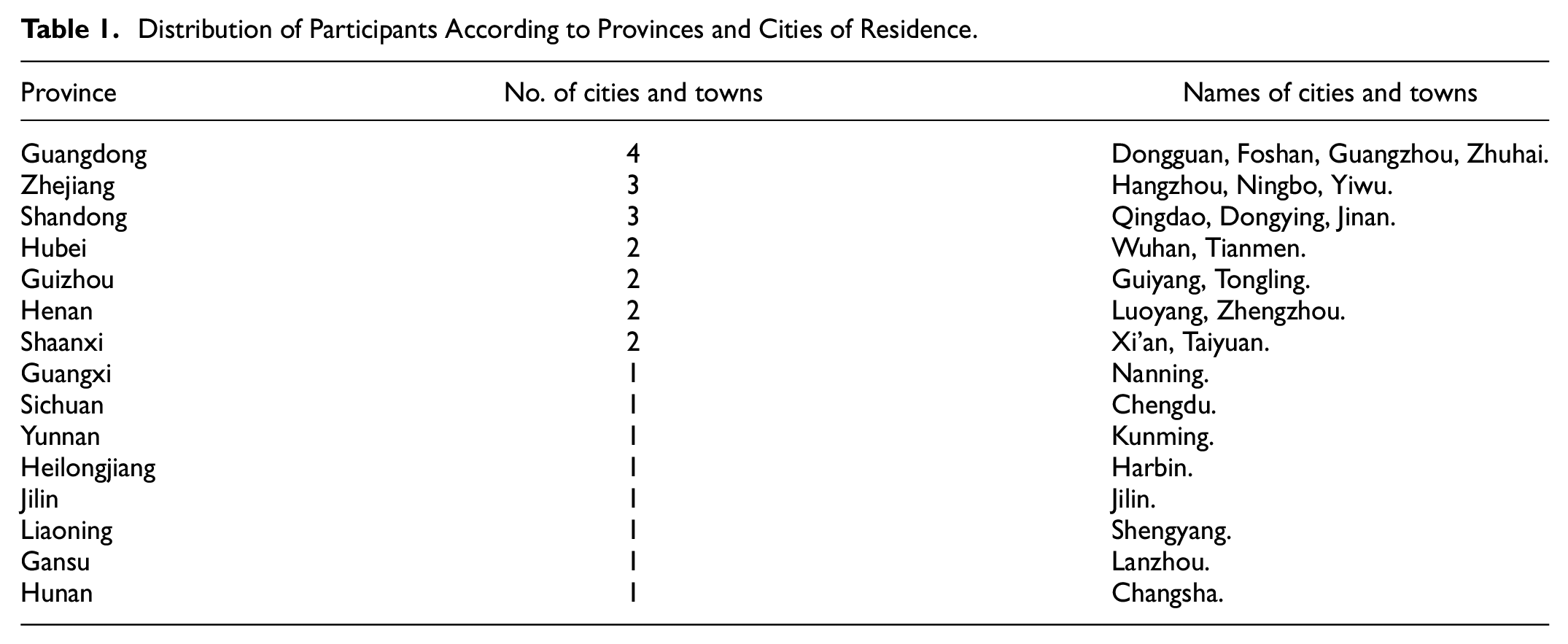
The 430 participants were dispersed in three municipalities (Shanghai, Beijing, and Shenzhen) and in 26 cities and towns located in 15 Chinese provinces, as outlined in Table 1 below.
Distribution of Participants According to Provinces and Cities of Residence.
Questionnaire
The questionnaire and interviews were conducted in China between May and June 2022 during Omicron-triggered lockdowns, travel restrictions, and a sharp increase in the search for pandemic information (Dyer, 2022). Information was disseminated principally on WeChat, the preferred government channel for citizens to learn about the spread of the disease, hard-hit areas, testing sites and dates, and almost all pandemic-related news. The questionnaire was in English, and participants provided their consent prior to completing the questions.
The questionnaire contained 12 main questions, including two that gathered statistical information on the participants’ gender, country of origin, and current location. In Participants answered five questions related to whether and how often they translated COVID-19-related IM and the type of messages (individual or group) IM they translated. They also answered five questions about their perception of the quality of machine-translated IM and their decision to follow COVID-19 protocols. The ten main questions contained multiple sub-questions, requiring participants to provide 49 different answers, which were analyzed to reach various findings. The survey contained multi-choice single and multi-select, opinion scale, order ranking, matrix, comment box, single box, and Likert scale questions that took an average of 43 seconds to complete.
Culture-Based Semi-Structured Interviews
The cultural dimension of the study focused on three elements: time, language, and integration. However, given that the questionnaire gathered information on the timing of pandemic-related IM, the semi-structured interviews concentrated on the language (tone) of the messages and the extent to which participants felt integrated into or alienated from the information dissemination process. In total, 15 participants (female n = 8, male n = 7) located in 11 cities were interviewed. Where interviews could not be arranged, the interviewees emailed their responses to the researcher. The interviewees discussed their perceptions regarding the timing and tone of the IMs and whether they felt integrated into the pandemic information mechanism. The average time for interviews, both video and audio, was approximately 16 minutes, given that specific and targeted questions were asked, leaving no room for unnecessary, lengthy, and time-consuming explanations.
Instruments
The survey was designed and launched on www.freeonlinesurveys.com, an online tool that facilitates creating, launching, and collecting of survey data. The tool generated a web link and QR code that were transmitted to survey participants via IM and email. The semi-structured interviews were conducted using Zoom and Tencent Meeting, two popular web-based meeting platforms, and a mobile phone equipped with a built-in voice recorder. The conversations were manually transcribed. Both the questionnaire data downloaded as a Microsoft Excel spreadsheet and the transcribed semi-structured interviews were analyzed to obtain the findings presented in the next section. The analyses were conducted using SPSS, the popular statistical analysis software, and the Microsoft Excel Analysis tool.
Data Analysis
While data from the questionnaire responses were quantitively analyzed, the semi-structured interview data were thematically analyzed to support our qualitative findings. In terms of reliability and validity, SPSS determined the questionnaire’s value for Cronbach’s Alpha to be α = .85, considerably high. Furthermore, the questionnaire results were downloaded onto a Microsoft Spreadsheet and analyzed using both MS Excel and SPSS to obtain answers to the research questions. While MS Excel was employed to calculate percentages and design charts, SPSS was utilized to calculate correlations, reliability, mean, and standard deviations. In addition, data from semi-structured interviews were manually transcribed into MS Word files, and a thematic analysis was conducted using NVivo to extract information that mainly answered Research Question 3. Precisely, culture-based information on the tone of IM and the degree of participants’ perceived involvement in the pandemic information dissemination process was identified and extracted. Some is presented as excerpts to support the findings.
Findings
There are three main findings based on the three main research questions.
Research Question 1: Did the Linguistic Minority Community Members Translate COVID-19 Messages Using the WeChat Built-in MT System?
A Significant Number of Participants Machine-Translated COVID-19 IM All the Time
Participants were requested, in the questionnaire, to indicate whether and how often they translated the pandemic-related IM they received via WeChat using the built-in MT system of the platform. They had to complete a Likert Scale comprising five items ranging from never (the lowest frequency) to all the time (the highest frequency). Our data analysis indicated that 355 (83%) of the respondents machine-translated their messages all the time, 20 (5%) machine-translated them most of the time, 30 (7%) translated some of the time, 6 (1%) translated them a few times, In comparison, 19 (4%) of the respondents never translated pandemic-related IM. The data analysis (M = 1.41, SD = 134.72), presented in Figure 2 below, proves that most members of the linguistic minority community used MT to access pandemic information.

Extent to which participants machine-translated the COVID-19-related IM they received via WeChat.
Our gender-based analysis indicated that more male (n = 184, i.e., 89%) than female (n = 171, i.e., 77%) participants machine-translated pandemic IM all the time. In contrast, more female (n = 11, i.e., 5%) than male participants machine-translated IM messages most of the time, as indicated in Figure 3 below.
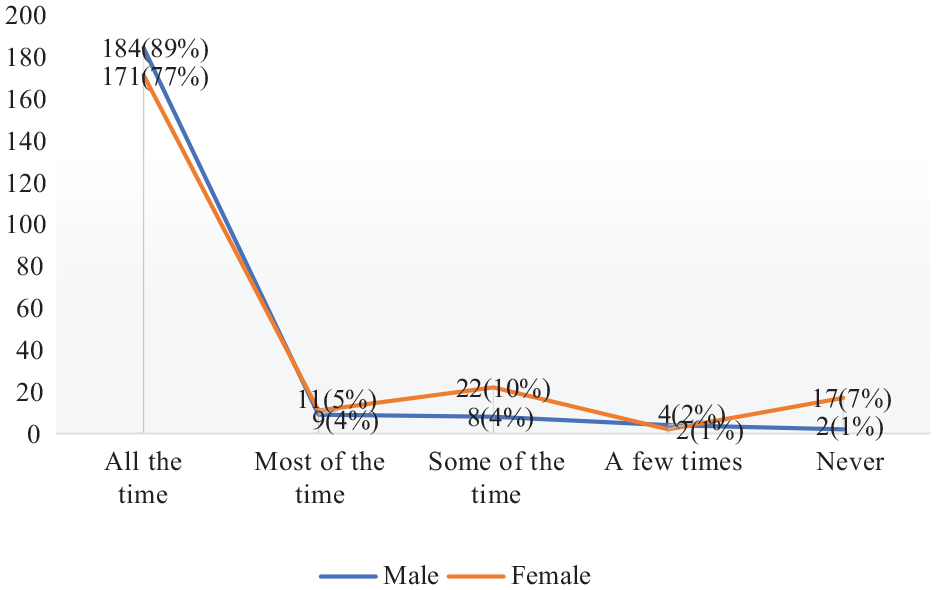
Translation of COVID-19 IM based on participants’ gender.
The data of male (M = 1.22, SD = 0.69) and female (M = 1.58, SD = 1.19) participants were further compared using an independent T-test computed on SPSS to establish the variance between the two genders. The results showed a p-value of .001, statistically significant, confirming the difference between male and female participants in terms of IM translation.
The Ability to Machine-Translate Pandemic-Related IM Influenced Participants’ Decision to Follow COVID-19 Protocols
We sought to understand the extent to which the participants’ ability to machine-translate pandemic-related IM facilitated compliance with COVID-19 prevention measures and protocols. This was informed by studies in Kenya (O’Brien & Cadwell, 2017) and the Tibetan regions of Sichuan province, China (Lha, 2020), where crucial information was translated into minority languages to “cross cultural barriers and develop trust during times of crisis” (Ahmad, 2021, p. 306). Therefore, we asked our participants to state how true (1 = totally untrue to 7 = totally true) IM translation influenced their decision to comply with pandemic protocols.
According to the data obtained (M = 1.67, SD = 116.53), 346 (i.e., 81%) of the respondents claimed it was totally true that their decision to comply with pandemic prevention measures and protocols depended on the ability to machine-translate IM they received via WeChat. In contrast, 25 (i.e., 6%) of the respondents believed it was totally untrue that their decision to comply with preventive measures and follow protocols was based on their ability to translate COVID-19 IM.
Furthermore, a Pearson correlation coefficient was computed in SPSS to assess the linear relationship between the extent to which IM translation influenced the decision to follow COVID-19 protocols.
As indicated in Table 2 above, there was a positive correlation between the two variables r(430) = .56, p = .00, therefore, significant at the .01 level. That means the ability to machine-translate IM considerably influenced participants’ decision to comply with pandemic prevention measures and protocols.
Correlation Between IM Translation and Participants’ Decision to Follow COVID-19 Protocols.

Correlation is significant at the .01 level (2-tailed).
Most Machine-Translated IMs were into English, Making This, by Far, the Most Dominant Language Combination
Participants received pandemic-related IM in Chinese, and we expected them to translate the IM into their respective native languages, at least those supported by the WeChat MT system. Therefore, participants were asked to list the target language(s) into which they translated pandemic-related messages they received via WeChat. Our data analysis indicated that the majority (n = 359, i.e., 84%) claimed they translated the IM from Chinese into English. As indicated in Figure 4 below, the other language combinations included Chinese to French (n = 66, i.e., 15%), Chinese to Spanish (n = 47, i.e., 11%), Chinese to Arabic (n = 38, i.e., 9%), Chinese to Portuguese (n = 20, i.e., 5%), Chinese to German (n = 19, i.e., 4%), Chinese to Russian (n = 17, i.e., 4%), Chinese to Japanese (n = 6, i.e., 1%), and Chinese to other languages—Greek, Korean, Urdu, and Bangla (n = 10, i.e., 2%).

Languages into which participants translated pandemic-related IM.
The data indicated that some participants translated pandemic-related IM into more than one language and that participants from non-English speaking countries also translated messages into English, their foreign language. For instance, 50 (83.3%) of the 66 participants who translated messages into French also translated them into English, while 25 (65.8%) of the 38 participants who translated their messages into Arabic also translated them into English. This finding corroborates other studies (Shen, 2020) that found English to be the lingua franca during the COVID-19 pandemic.
Personal and Group Messages were the Most Machine-Translated During Omicron-Triggered Lockdowns and Travel Restrictions
Participants were asked to identify which category of IM they translated the most. They were presented with five options—group messages, personal messages, COVID-19 news, WeChat mini-programs news and IM exchanges, and other sources. Our data analysis indicated that personal messages (89%) were the most machine-translated, followed by group notices (87%). In contrast, as presented in Figure 5 below, only 2% of the participants exclusively machine-translated COVID-19 news, and no participant machine-translated news and IM exchanges on mini-programs and other sources.

Category-based frequency of machine-translated COVID-19 information.
In the semi-structured interviews, we sought to better understand this phenomenon by asking participants why personal and group IMs were the most machine-translated and why COVID-19 news was not frequently translated.
In their responses, all 15 interviewees maintained that staying in touch with Chinese colleagues, students, friends, and business partners was necessary during the lockdowns. Another reason for staying connected was for emotional purposes, given that lockdowns and quarantine measures were a source of emotional stress. As interviewee No. 9 maintained, “Two things I was most interested in during this time, preserve my job and not get infected. So, I talked to colleagues a lot about work and also to know what was going on in their own districts. We kind of bonded even better during the pandemic.”
In contrast, 14 interviewees claimed they were mentally too exhausted to continue reading pandemic news. Interviewee No. 3 confirmed this assertion, stating, “I was sick of COVID news. The messages sent in my WeChat group contained already more than enough COVID information. Why would I go looking for more?”
Participants also Machine-Translated non-COVID-19-Related IMs
We also investigated the extent to which non-COVID-19 IM was translated by our participants. Therefore, we asked them to agree or disagree with the assertion that, besides pandemic-related IM, they also machine-translated other IM from friends, colleagues, and business partners. According to our data analysis (M = 1.35; SD = 137.22), in total 360 (84%) participants strongly agreed with the assertion, only 21 (5%) agreed, and 30 (7%) neither agreed nor disagreed with the assertion. In contrast, as presented in Figure 6 below, only 9 (2%) of the respondents disagreed, and 9 (2%) strongly disagreed with the assertion.

Extent to which participants translated non-COVID-19-related IM.
Furthermore, Pearson correlation was computed to assess the linear relationship between the frequency of pandemic and non-pandemic-related IM. There was a weak positive correlation between the two variables, r430 = .47, p = .001, which was also significant to the p = .01 level.
To understand which non-COVID-19 IMs were machine-translated and the rationale for the decision, we asked 5 of the 15 participants we interviewed. All five admitted that they needed to keep in touch with people within their social circle and network, including Chinese nationals who could not speak English. These were some friends from work, business partners, or colleagues from whom they needed work-related information. This finding aligns with studies foregrounding the cruciality of social connections and integration (Arroyo et al., 2021) during crises.
Research Question 2: What was the Participants’ Perception of the Quality of Machine-Translation IM?
Participants Understood Machine-Translated Messages “Most of the Time.”
Participants were asked to determine the extent to which they understood the meaning of IMs they machine-translated using the built-in WeChat MT system. They needed to choose whether they understood the messages perfectly, with little difficulty, with a lot of difficulty, barely understood, or did not understand at all. They were further requested to determine the frequency of each of the choices they made. The data indicated that 396 (92%) of the participants understood the messages with a little difficulty, while 34 (8%) had a lot of difficulty understanding the messages.
We then investigated how often (all the time, most of the time, sometimes, or a few times) participants encountered the abovementioned difficulties. Our analysis indicated that out of the 396 (92%) of the participants who had a little difficulty understanding machine-translated IM, 28 (7%) experienced “little difficulty”all the time, 350 (86%) participants experienced the “little difficulty”most of the time, 24 (6%) experienced it sometimes, 5 (1%) experienced it a few times, and no participant experienced it none of the time. The data, including the number of participants and percentages, are presented in Figure 7 below.
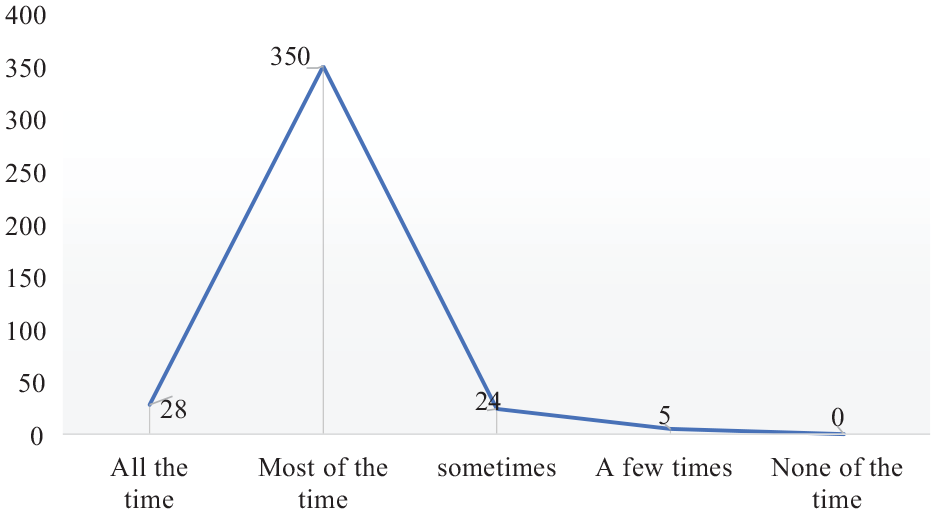
How often participants understood their translated IMs with a little difficulty
Furthermore, Pearson correlation coefficient was computed to assess the linear relationship between the participants’ frequency of machine-translated IM and the extent to which they understood the messages (with little difficulty). There was a positive correlation between the two variables, r430 = .41, p = .001, therefore, statistically significant at the 0.01 level.
Despite the Existence of Errors, Participants Favorably Rated the Output of Machine-Translated IM
There was a consensus that the MT errors did not significantly impede the comprehension of IMs. When asked to rate the quality of the WeChat messages they translated, most respondents (389, 90.5%) believed the quality was good, while 20 (4.7%) believed the quality was very good, and 21 (4.8%) perceived the quality to be somewhat good. No respondent considered the quality to be neither good nor poor, poor, nor very poor (See Figure 8).

Assessment of machine-translated IM translation quality.
Our semi-structured interview data also corroborated this finding, as 12 of the 15 interviewees maintained they understood the core message all the time. For instance, interviewee No. 12 maintained, “I always understood the essential message. I think I only needed a few words to know what they wanted me to do. There were also many numbers and things like days of the week, time, date, and apartment block numbers that made things easier for me.” In contrast, interviewee No. 6 maintained the MT output did not make much sense, stating that “No, I did not understand most of the messages. I had to send them to my student assistant to translate them for me. But sometimes messages came too late at night. I had to use machine translation. And it was a little tough.” This finding corroborates other studies (Nolte et al., 2022), highlighting how information seekers sometimes rely on quick references or gists to make important decisions.
Research Question 3: How did Participants Perceive the Pandemic-Related Information Dissemination Process from a Cultural Standpoint?
The Language Employed in Pandemic-Related IMs Lacked Courtesy and Empathy
Participants were asked, in the questionnaire, to agree, disagree, or remain neutral to the assertion that COVID-related IMs were courteous and empathetic. Our data analysis (M = 2.94, SD = 0.31) indicated that most respondents perceived COVID-19-related messages as lacking in courtesy and empathy. The data indicated that an overwhelming 327 (95%) of the respondents considered the messages not courteous. In contrast, 6 (2%) of the respondents believed the messages were empathetic enough, and 10 (3%) had no opinion.
Informed by this finding, we interviewed participants to further understand what they meant by lack of courtesy. According to the interviewees, the messages lacked lexical items that marked empathy and politeness. Specifically, there was a shortage of pronouns, adverbs, adjectives, and other indicators of compassion. For instance, Interviewee No. 7 maintained, “I understood the urgency of the situation, but if messages were a little more friendly, things would be much more bearable, and I’d probably feel less stressed.” For their part, Interviewee No. 11 stated “Understandably, the messages felt like orders, instead of like ‘We are in this together’ sort of situation. Maybe a little empathy would have helped things.”
When asked what in the messages would have been considered courteous or compassionate, the interviewees provided the words and expressions outlined in Table 3 below.
Perceived Expressions Likely to Increase Instant Messages’ Courtesy and Empathy.

IMs were Disseminated at an Inappropriate Time
Our semi-structured interview participants admitted that while most crisis information was transmitted during the day, a significant portion of the messages was transmitted after official hours and, occasionally, too late into the night after the recipients had long gone to bed. According to Interviewee No. 1, “There are quite a number of times I received messages long after I had gone to bed. To make sure I missed no emergencies, I set a special tone for COVID-19 messages. This won’t happen in my country, but I understood why they [i.e., local authorities responsible for COVID-19 messaging] did that.” Of the 15 interviewees, 14 (93%) believed pandemic-related IMs were transmitted a little into the night. In contrast, one (7%) respondent believed the transmission time was appropriate. It is noteworthy that despite their perceptions about IM timing, all participants acknowledged the urgency of the crisis and the need to disseminate information as rapidly as possible.
The finding of the semi-structured interviews was corroborated by data (M = 2.93, SD = 148.26) obtained after analyzing questionnaire responses. According to our analysis presented in Figure 9 below, 324 (94%) respondents believed the COVID-19 messages were sent a little too late into the night. In contrast, 9 (3%) respondents believed the messages were sent at the appropriate time and 10 (3%) had a neutral opinion.

Participant perception regarding the timing of COVID-19 messages (questionnaire).
In terms of gender-based variances, the data for female participants (M = 2.91, SD = .400) indicated that 149 (94%) believed the pandemic-related IMs were transmitted at an inappropriate time. In contrast, 7 (5%) of female participants were neutral and 2 (1%) believed they were sent at the appropriate time. For male participants, (M = 2.93, SD = .301) the data shows that 175 (94%) believed pandemic-related IMs were disseminated at the inappropriate time, while 3 (2%) and 7 (4%) remained neutral.
To confirm the data, a T-test was computed on SPSS software to determine the statistical differences between male and female participants’ perceptions of the timing of pandemic-related IMs. The results showed a p-value of .56, statistically insignificant, meaning no statistical difference was found between male and female participants’ perceptions of the timing of pandemic-related IMs.
Foreigners Did Not Feel Sufficiently Involved in the Crisis Information Dissemination Process
The overwhelming perception among the interviewees was that foreigners were not sufficiently involved in the pandemic information dissemination process. All 15 (100%) interviewees believed that if members of the linguistic minority community were involved in disseminating pandemic information, the process would have been more inclusive and given foreigners with a better sense of belonging. For instance, Interviewee No. 12 stated, “I think not involving us (foreigners) in the fight to stop COVID-19 has reinforced the impression among Chinese that foreigners are the ones spreading the virus. I would have been very happy to help in any way I could, especially by passing messages to people from my country or who speak my language.” According to interviewee No. 11, involving foreigners in the fight against the virus would serve as a cultural bridge between Chinese and foreigners who constitute the linguistic and cultural minority community.
We sought to understand from the interviewees how foreigners could have been involved in the fight against COVID-19, including how to disseminate related information. Some interviewees suggested that Chinese-language-speaking foreigners could be recruited to spread information to other foreigners in their smaller linguistic communities or translate information about lockdowns, vaccines, testing, and travel restrictions. Furthermore, they could take calls and questions from members of their respective linguistic communities and forward them to the local authorities for action. In other words, they could serve as the liaison between local authorities and foreigners living in specific communities, and volunteer in community-organized testing and vaccination events.
There was an Inadequate Feedback Mechanism for Members of the Linguistic Minority Community
There was consensus among those interviewed regarding the absence of a feedback mechanism or structure for those in the linguistic minority community to channel their concerns or obtain quick answers to questions. Participants felt such a structure was crucial, especially given that most foreigners relied on machine-translated messages, which were not always completely accurate. Interviewee No. 7 maintained, “In my country, there would be a number to call, an office to contact, or someone to reach out to when such important messages are sent out. Of course, recipients would like to ask questions. Maybe it was hard [to set up a feedback structure] in this case because it was an emergency; I don’t know.”
Despite the challenges, some interviewees found ways to ask questions or obtain further information. For instance, interviewee No. 10, a teacher, claimed, “My students have been phenomenal. I constantly ask them for help. In fact, they give me more help than the community guys.” Some interviewees with questions posted them in WeChat groups for members with knowledge of English to respond. Some interviewees explained that they received help from Chinese colleagues and friends. For instance, interviewee No. 11 maintained, “My Chinese friends helped me a lot. They were very willing to share the information they had with me. Sometimes, I didn’t even need to ask a question before I got an answer. I think I am blessed to have them.”
Discussion and Recommendations
The study demonstrated that, like Facebook, Twitter, and other social media platforms, WeChat contributed to breaking down linguistic barriers during the COVID-19 pandemic. In particular, the employment of the platform’s built-in MT system reinforced the role of MT in communication and aligned with related studies, including the development of French-Swahili MT system for crisis information management (Cadwell et al., 2019), the use of Facebook’s MT system to translate pandemic messages (Almahasees & Jaccomard, 2020), and Twitter’s automatic translation system to disseminate the messages of G7 leaders (Rufai & Bunce, 2020). The findings also align with research that has evaluated MT use within the healthcare context (Haddow et al. 2021), where the cross-linguistic sharing of information has culminated in a better understanding, diagnosis, and monitoring of diseases. Regarding MT development and output, it can be argued that MT output continues to improve, as errors tended not to impede comprehension. In particular, the study demonstrated that those in the linguistic minority community can depend on machine-translated IMs during a cascading crisis.
From a cultural perspective, the study illustrated some of the problems linguistic minorities confront during a crisis—alienation and the absence of a feedback structure to ask questions and raise concerns. In addition, the study underscores the importance of lexical choices in wording pandemic-related messages for recipients from different linguistic and cultural backgrounds. Therefore, based on our findings, we put forward recommendations likely to improve crisis messaging within multilingual and multicultural contexts:
(a) Involve some members of the linguistic minority community, for instance, international students and other members fluent in the majority language, at various levels of crisis communication. Their role could be to obtain crisis information from local authorities and transmit it to members within their respective communities, translate basic information, explain protocols and policies, and answer simple questions.
(b) Establish an adequate response or feedback mechanism to guarantee that questions, particularly from ethnic and linguistic minority communities, are answered promptly. Such a mechanism may constitute a broad framework within which multilingual individuals and groups representing various minorities are well defined, represented, and coordinated, as represented in Figure 10 below. In the mechanism, information flows from local authorities or the crisis management team through a feedback team to linguistic minority communities. Similarly, questions from linguistic minority communities are channeled back through the same medium.
In the mechanism, information flows from local authorities or the crisis management team through a feedback team to linguistic minority communities. Similarly, questions are channeled back through the same medium from linguistic minority communities.
(c) Employ courteous language and a softened tone that aligns with residents’ emotional state of mind when disseminating pandemic-related information. As research has demonstrated, emotional language can improve the population’s response to COVID-19 protocols, including during self-isolation and in hospital scenarios (Heffner et al., 2021; Monzani et al., 2021; Planchuelo et al., 2022).
(d) Put in place an “information dissemination schedule” to regulate the transmission of crisis information to the public. The schedule could consist of specific information release timeslots that take into consideration the cultural background of various community members. For instance, crucial crisis information could be transmitted in the morning, and reminders could be issued at regular intervals during the day. This is more so because regulating the flow of information during a pandemic is instrumental and falls within the health system adjustment framework (Leung et al., 2021) critical in managing crises and preventing the spread of diseases.
(e) Set up translation/interpretation units to provide multilingual information to those in linguistic minority communities. Translation units could bring together members of the different linguistics groups working as teams to ensure the uniformity of pandemic information, including creating terminologies that crisis information seekers require.

Crisis feedback mechanism for members of the linguistic minority community.
Conclusion
This study investigated the role of MT in crisis communication by assessing how foreigners in China, who constitute the linguistic minority, utilized the built-in neural MT translation system of WeChat to translate COVID-19-related IMs. The messages were mainly sent and received between May and June 2022 at the height of the Omicron outbreak that triggered extensive lockdowns, testing, social distancing, and travel restrictions in China. Informed by the information-seeking behavior theory, we sought to investigate whether and how often participants machine-translated COVID-19-related IMs, how they perceived the quality of translated IMs, and culturally, how they perceived pandemic-based information dissemination. A mixed methods approach, consisting ofanalyzing quantitative and qualitative data from a questionnaire and semi-structured interviews, was adopted. Findings indicated that most foreigners in China machine-translated pandemic-related IMs all the time, predominantly into English, even when English was no their native language. Furthermore, participants translated personal IMs more than group IMs, and their ability to translate IM significantly influenced their decision to comply with COVID-19 protocols. In terms of the quality of translated IMs, participants noticed errors, which, did not impede their understanding of the messages. Culturally, participants believed the content of pandemic-related IMs lacked courtesy and empathy and were often sent at inappropriate times. In addition, participants did not feel sufficiently involved in crisis information dissemination, and there was a lack of an efficient mechanism to channel feedback and concerns.
The study highlights the role of MT-based IM platforms in disseminating information during a crisis, thereby contributing to studies on the employment of MT during a crisis. Furthermore, the study demonstrates that IM translation could be relied upon during cascading crises where human translators may not be readily available. Regarding culture-related issues that may arise during such deployment, we propose recommendations to assist local authorities who intend to reach members of linguistic minority communities, especially in cosmopolitan cities and towns.
Limitations and Avenues for Further Research
The study’s main limitation is that real IMs were not collected and analyzed to reach more informed conclusions on the messaging time and language of the content. Furthermore, participants were based mostly in China’s big cities and towns, meaning that their responses reflected experiences lived in their respective localities, not necessarily the experience of foreigners in rural and smaller towns. Also, the study mostly analyzed data from foreigners who were not fluent in Chinese. That means their perceptions may not entirely represent all foreigners in China, especially those who speak Chinese fluently. These limitations could constitute avenues for further research on IM use in crisis scenarios.
Footnotes
Declaration of Conflicting Interests
The author(s) declared no potential conflicts of interest with respect to the research, authorship, and/or publication of this article.
Funding
The author(s) received no financial support for the research, authorship, and/or publication of this article.

Data Availability Statement
The data that support the findings of this study are available from the corresponding author upon reasonable request.