



Abstract
Chinese higher education institutions are facing an increasing threat of campus crises, especially the academic and sexual misconduct of faculty members, which have caused severe impacts on the reputation and development of universities and colleges. Crisis communication strategies are one of the critical measures for universities and colleges to eliminate or mitigate crises and maintain their reputation and growth. However, few studies are exploring the crisis communication strategies employed by Chinese universities and colleges in response to crises. This study employs quantitative content analysis to examine the crisis communication strategies utilized by Chinese higher education institutions in response to faculty academic misconduct and sexual misconduct crises. The study specifically focuses on the institutions’ responses on official platforms. Applying the Situational Crisis Communication Theory (SCCT) and Image Repair Theory (IRT) frameworks, this study examines the official statements released by Chinese colleges and universities in response to allegations made on official platforms such as Sina Weibo, WeChat, and official websites. Crises investigated belong to the preventable crisis type, which is defined by instances of organizational wrongdoing and concerns caused by human actions. The results reveal five commonly employed crisis communication strategies: corrective action, adjusting information, reminder, bolstering, and victimage, with a notable emphasis on adjusting information and corrective action being the most frequently utilized approach for academic and sexual misconduct crises. There are correlations between the type of crisis (academic and sexual misconduct events) and the application of specific crisis communication strategies (denial and excuse). One significant finding is the limited differentiation observed between crisis response strategies for academic and sexual misconduct crises within the Chinese context. IRT and SCCT have partial adaptability in the non-profit field of China’s higher education, among which IRT exhibits wider applicability than SSCT. This study contributes to crisis management teams and policymakers recognizing and adapting strategies based on academic and sexual misconduct events, promoting more effective crisis management and prevention measures.
Plain language summary
Chinese higher education institutions are facing an increasing threat of campus crises, especially the academic and sexual misconduct of faculty members, which has caused severe impacts on the reputation of universities and colleges. The analysis of crisis communication strategies in academic and sexual misconduct incidents highlights the interplay between communication theories, institutional responses, and the nuances of these crises. The application of strategies in situational crisis communication theory (SCCT) and image repair theory (IRT) implies that responses to these crises can rely on well-established frameworks. The broad applicability of certain general strategies highlights the need of theory, while differences in approach show the necessity for focused crisis management. Strategies like corrective action, adjusting information, reminder, bolstering, and victimage were notably prominent in handing the two types of events mentioned above, emphasizing their significance in crisis management. Moreover, the strategies employed in statements addressing various sorts of crises did not display any notable differences in adjusting information (SCCT), instructing information (SCCT), attack the accuser (SCCT/IRT), scapegoat (SCCT), compensation (SCCT/IRT), reminder (SCCT), ingratiation (SCCT), victimage (SCCT), defeasibility (IRT), bolstering (IRT), minimization (IRT), differentiation (IRT), and apologize (SCCT/IRT), totaling 13 items. However, the selected 54 statements based on the type of crisis displayed significant differences in denial (SCCT), excuse (SCCT), and totaling two items. IRT and SCCT have partial adaptability in the non-profit field of China’s higher education, among which IRT exhibits wider applicability than SSCT. This information enables policymakers to develop targeted and effective institutional policies and crisis response strategies for academic misconduct and sexual misconduct in educational settings.
Introduction
Due to the advancements in social media, the reputation management of organizations faces increasingly severe challenges (Baccarella et al., 2018). Whether due to adverse events or the spread of misinformation, an organization’s reputation can suffer significant harm (Ray & Bala, 2020). The proliferation of the internet has resulted in crises with diverse origins and rapid dissemination. Issues about higher education in China have become an enduring subject of extensive societal debate on online platforms, and discussions regarding these matters rapidly propagate across the internet (Motwani & Singh, 2020). Additionally, the number of students enrolled in Chinese higher education institutions has rapidly increased to 34.96 million, with graduates totaling 9.09 million by 2021 (Ministry of Education of China, 2021). This vast student body has increasingly engaged in online discussions about university topics, accelerating the development of crisis events (Y. Zhou & Wang, 2021). Furthermore, the instability caused by the COVID-19 pandemic has increased the likelihood of crises occurring (X. Zhang & Tian, 2022). Since 2021, Chinese colleges and universities have experienced a significant surge in crisis events, encompassing diverse aspects of educational management.
Among these crisis events, faculty academics and sexual misconduct have emerged as particularly attention-grabbing topics, evoking substantial emotional responses from the public (Jiang & Ren, 2022). Sexual misconduct includes sexual harassment, assault, grooming, sexual coercion, invitations, and promised resources in return for sexual access (Bull & Rye, 2018). Sexual harassment continues to be a prevalent issue on college campuses. For instance, a study by Wood et al. (2021) examined eight universities in the Southwest United States. The findings disclosed that 19% of students reported experiencing sexual harassment perpetrated by faculty or staff. Additionally, it was identified that 78% of the perpetrators in these faculty/staff sexual harassment cases were male (Wood et al., 2021). According to a 2018 survey conducted by Huang Zhansen, 59% of university students in China experienced sexual harassment during their time at university, with 6.3% of the perpetrators identified as school employees (Huang et al., 2019). The sexual misconduct crisis aligns with the concept of a wicked crisis, which refers to occurrences that are extremely difficult to solve and pose a significant threat, leaving even the most competent leaders at a loss for words and organizations struggling to find answers (Maier & Crist, 2017).
Globally, academic misconduct continues to be a rising concern in the field of higher education. The Office of Science and Technology Policy (OSTP, 2000) defines academic misconduct as research misconduct in the United States, which encompasses fabrication, falsification, or plagiarism. Traditionally, plagiarism has been the most prevalent form of academic misconduct encountered by universities (Birks et al., 2020). In the research conducted by Jiang Jing and Ren Juanjuan, it was noted that between 2019 and 2021, events involving academic misconduct accounted for 19% of the crisis incidents at Chinese universities that were widely disseminated on network platforms (Jiang & Ren, 2022). The reputation of Chinese higher education institutions has been severely challenged by a series of prominent faculty academic misconduct and sexual misconduct crises, leading to heightened concerns over their admission rates and long-term growth (Rooney & Smith, 2019).
In response to the potential damage inflicted on colleges and universities by negative public comments, these institutions have been compelled to issue official statements. To protect their organizational reputation (Dumulescu & Muţiu, 2021), colleges and universities in China consistently implement a corrective action strategy—specifically, dismissal—when dealing with cases of academic and sexual misconduct involving faculty members. A recent example of this crisis response approach occurred in April 2023. The China Academy of Art, through an official statement on Sina Weibo, acknowledged that one of its lecturers was implicated in the plagiarism of artworks. Subsequently, the lecturer was dismissed from their position, and the institution proactively addressed the public′’s concerns regarding the matter. Similarly, in May 2023, Sichuan University of Media and Communications publicly announced on Sina Weibo the dismissal of a lecturer, citing allegations of misconduct related to improper sexual behavior.
This study aims to quantitatively evaluate how Chinese higher education institutions fine-tune crisis communication strategies after academic and sexual misconduct occurrences. However, the suitable crisis communication strategies for these two types of crises, along with their similarities and differences, merit deeper exploration. Prior research has delved into crisis response strategies from various theoretical angles concerning specific incidents like the Pennsylvania State University staff sexual abuse scandal (Formentin et al., 2017) and the crisis at Ohio State University (Hanna & Morton, 2020). Additionally, current academic research increasingly focuses on examining the attitudes, views, and influencing factors of academic misconduct (Ahmed, 2018; Finchilescu & Cooper, 2018; Lindahl & Grace, 2018; Tindall & Curtis, 2020; Vieyra & Weaver, 2023). However, within the crisis communication field, particularly in the context of China, research dedicated to the comparative analysis of crisis communication strategies in addressing faculty sexual misconduct and academic misconduct is conspicuously lacking.
The main objective of this paper is to examine the similarities and differences in crisis communication strategies employed by universities and colleges in response to academic misconduct and sexual misconduct crises within the context of Chinese higher education. The research specifically aims to (1) examine the demographic characteristics of crises involving academic and sexual misconduct. (2) examine and contrast crisis response strategies used by colleges and universities in dealing with academic and sexual misconduct crises; (3) determine the similarities and differences in the crisis communication strategies employed by these institutions when confronted with academic and sexual misconduct problems, as represented in their official statements. (4) explore the relationships between crisis types (academic and sexual events) and crisis communication strategies implemented within China’s higher education landscape. In this regard, this study combines parts from SCCT, IRT, and relevant literature to investigate how higher education institutions handle crises using crisis communication strategies. Researchers analyzed the crisis communication strategies implemented by the higher education institutions concerned to identify similarities and differences from their official statements.
This research is essential on both theoretical and practical levels. Examining incidents of sexual misconduct among faculty members was based on the theoretical framework of situational crisis communication theory (SCCT) and image repair theory (IRT). The prevailing theoretical frameworks in this domain encompass SCCT, IRT, and the social-mediated crisis communication (SMCC) model (Kong & Chen, 2022). From a management standpoint, researchers analyzed two distinct Canadian institutions’ crisis communication strategies for resolving incidences of sexual harassment and assault based on IRT and SCCT (Works et al., 2021). The primary aim of SCCT is to reduce the potential damage to an organization’s reputation that may arise from crises. According to the theory, a crisis manager must possess a comprehensive understanding of the crisis scenario to assess the extent to which the crisis poses a threat to the organization’s reputation (Coombs, 2007). The IRT theory posits that the objective of post-crisis communication is to cultivate a positive perception to restore the organization’s reputation (Blaney et al., 2002). SCCT and IRT can help organizations address threats (Brown et al., 2020; Nair et al., 2019). From this perspective, our contribution lies in applying the frameworks of SCCT and IRT to examine crisis communication in the context of higher education in China.
This study has practical significance for crisis managers regarding online communication strategies to foster public trust and mitigate or eliminate reputational damage within firms following a crisis. Different crisis communication strategies result in public perceptions of their reputation (Nwogwugwu, 2018). From an organizational standpoint, the online crisis communication strategies adopted by the entities concerned substantially impact the repair of organizational reputation (Gwebu et al., 2018). This study will provide a clear understanding of the current state as well as unique features of crisis management in the Chinese educational sector. This will be achieved by conducting a comparative analysis of crisis communication strategies employed in incidents related to academic and sexual misconduct.
Literature Review
Image Repair Theory (IRT)
The “image repair theory” was developed by American researcher William Benoit (Benoit, 1997). The theory incorporates fundamental assumptions on image and communication. Communication is targeted, and one significant target is to maintain a favorable reputation (Frandsen & Johansen, 2020). It has a managerial focus, aiming to guide managers in crises to enhance or safeguard organizational reputation. The threats to the image encompass two distinct elements: blame and offensiveness (Benoit, 2014). Denial can counter allegations by either refuting the occurrence of the purported act or saying that the accused did not do the act. This can be further strengthened by offering a scapegoat, transferring the blame to another individual, collective, or institution. One can also acknowledge that the act took place but argue against its harmfulness, specifically focusing on the offensive aspect of an image threat. Responsibility-avoidance strategies focus on addressing the accused individual’s apparent blame. Strategies aimed at mitigating offensiveness focus on the perceived degree of harm caused by the action. Ultimately, someone who takes a defensive stance can admit their fault and the potential to offend, but can either seek forgiveness (mortification) or commit to resolving the issue (corrective action). A rhetoric can question accusations, dispute the offensive nature of something, or acknowledge their own mistakes. The theory posits that the specific manner in which a crisis is addressed will directly influence the reputation that an entity holds after the crisis has passed (Benoit, 1997). Benoit proposes a discourse communication strategy comprising five types: denial, evasion of responsibility, reduction of offensiveness, corrective action, and mortification. These strategies encompass a total of 14 sub-strategies (see Table 1).
Typology of Image Repair Strategies (Benoit, 1997).

Benoit extensively explores the application of image repair theory in real-life crisis communication, covering corporate, political, sports, entertainment, health care, higher education, and natural disasters (Arendt et al., 2017; Benoit, 2015; Frandsen & Johansen, 2020; Len-Ríos, 2010; Maiorescu, 2016). This theory primarily focuses on crisis communication and is widely employed in various domains to address reputation repair in crises. Benoit has demonstrated the effectiveness of this theory by applying it to a wide range of crises in the United States of America (Benoit, 2021; Frandsen & Johansen, 2020). The implementation of the Image Repair Theory in the cultural context of China has demonstrated certain signs simultaneously (E. Zhang & Benoit, 2009). Nonetheless, there remains a paucity of research on this theory within China’s higher education realm. To comprehensively evaluate the effectiveness of image repair strategies across cultures, conducting more studies from a non-United States of America perspective is imperative.
Organizational and individual settings are the two main ones where IRT can be useful (Parham, 2021). In corporate communication, IRT has highlighted weaknesses and deficiencies (Benoit, 1997, 2013; Benoit & Brinson, 1994; Benoit & Dorries, 1996). Due to their wider audience reach, greater resources, and higher liability, organizations often face a greater need for image repair following reputation attacks (Benoit, 1997, 2014). When confronted with a scandal, corporations must navigate the demands and expectations of legal teams, who may advocate for communication strategies that mitigate litigation risks (Z. Zhou et al., 2019). Non-profit Chinese higher educational institutions, much like corporations, encounter crises that require resolution and reputation management. Despite their non-profit status, these institutions face challenges that necessitate strategic communication to address reputation damage effectively (Sun & Lim, 2023).
Conducting case studies on the image repair attempts of the accused party in a specific scandal is a common method in the source-oriented approach to studying image repair (Frandsen & Johansen, 2020). Research in this area frequently makes use of methods like content analysis of statements in mass media sources like news articles or social media posts, rhetorical analysis of interviews and speeches delivered by the accused, or textual analysis of communication documents utilized by the accused (Benoit & Hanczor, 1994; Brinson & Benoit, 1999; Furgerson & Benoit, 2013; J. Zhang & Benoit, 2004). Some studies have utilized a quantitative approach to examine image repair strategies (Benoit & Drew, 1997; Blaney, 2015). Researchers have recently broadened its application to empirical studies, including quantitative content analysis (Len-Ríos, 2010)and experimental research (Coombs & Holladay, 2002). This study also aims to explore Chinese higher educational institutions’ organizational image repair strategies following crisis events through quantitative content analysis.
Situational Crisis Communication Theory (SCCT)
Coombs (2007) developed the Situational Crisis Communication Theory (SCCT) by conducting several experiments that examined the effectiveness of Benoit’s strategies for repairing damaged reputation and by incorporating principles from attribution theory (Coombs, 2004; Coombs & Holladay, 2010). The SCCT theory is a crucial element within crisis communication, wherein “crisis communication” refers to an organization’s actions during and after crisis events (Marsen, 2020). Effective communication after a crisis helps restore a positive public perception and mitigate potential harm to one’s reputation (Coombs & Holladay, 2005). SCCT constitutes a pivotal framework for managing reputations during and after a crisis (Marsen, 2020).
The SCCT takes a methodical approach to determining the crisis response strategies that can be implemented to achieve the highest possible level of reputational protection (Coombs, 2006). As a means of repairing reputations, mitigating unwanted impacts, and preventing detrimental behavioral goals, crisis response strategies are effectively utilized (Coombs, 2007). The study of crisis response strategies, which refers to the actions and statements made by management in the aftermath of a crisis, has been extensively researched in management (Egbon & Mgbame, 2020; Paydas Turan, 2022). The SCCT theory requires a theoretical connection to be established between situations of crisis and the strategies used to respond to those crises. Coombs delineated crisis response strategies for managers, emphasizing that an ethical base strategy for response involves instructing and adjusting information. Emphasizing ethical base strategies is advisable in low crisis responsibility attributions.
Primary repair solutions are essential in situations where there is a high level of crisis accountability. According to the SCCT framework, primary crisis responses can be classified into three categories: denial, diminish and rebuild. Complementing these primary responses is a secondary strategy called bolstering, which aims to enhance positive perceptions of reputation. While enhancing can cultivate positive feelings and elicit empathy for the organization, Coombs advises that it should be used in addition to primary responses rather than as a substitute (Coombs, 2007, 2022).
According to the research findings of multiple authors, scholars have identified a correlation between crisis types (Claeys et al., 2010) and crisis response strategies (Šontaitė-Petkevičienė, 2014). The SCCT framework offers a systematic approach to aligning crisis response messages with specific crises (Coombs & Holladay, 2002). According to Coombs’ findings, preventable crises necessitate a rebuilding strategy, encompassing compensation and apology strategies alongside primary and secondary response strategies (Coombs, 2006). As shown in Table 2, the SCCT framework makes use of ethical base response, primary crisis response strategies, and supplemental (secondary) crisis response strategies.
Typology of Crisis Response Strategies (Coombs, 2007, 2022).

Situational Crisis Communication Theory (SCCT) is a prescriptive theory in crisis communication research. It aims to predict the reactions of stakeholders to distinct crisis response strategies in various crisis circumstances (Ilyés, 2018). SCCT is a theoretical framework aimed at enhancing crisis communication for the mutual benefit of organizations and stakeholders (Frandsen & Johansen, 2020). The core question underpinning an evidence-based strategy is whether a particular intervention yields the intended outcome (Jin et al., 2020).
While SCCT evolved from academic study, its practical application has been well-documented (Coombs et al., 2020; Jin et al., 2018). The main purpose of SCCT is to specifically deal with corporate crises. SCCT functions across a broad spectrum of contexts, encompassing organizational and non-profit sectors(Clementson & Beatty, 2021; Haupt & Azevedo, 2021), health-related domains (Barlow et al., 2021; Uddin et al., 2021), corporate settings (Barbe et al., 2018; Cheng, 2018, p. 20; Tu et al., 2023), political arenas (Benoit & Sheafer, 2006; Liu et al., 2018), governmental institutions, and crises within the sports industry (Brown et al., 2020; Liu et al., 2018). While crisis communication theories are applicable in education, there is a scarcity of quantitative methodologies that examine the utilization of crisis strategies in higher educational institutions.
SCCT employs an experimental design and research methodology instead of the traditional case study approach that has been prevalent in crisis communication literature for an extended period (Clementson & Beatty, 2021; Coombs, 2007). SCCT does not utilize the case study methodology adopted by corporate apologia, impression management, and image repair. Instead, experimental and quasi-experimental approaches are employed to examine the correlations postulated in the theory and the corresponding guidelines it suggests (Heath & O’Hair, 2020). The empirical character of SCCT makes it a valuable contribution to crisis communications research (Brown et al., 2020). SCCT furnishes a framework guiding crisis managers in employing response strategies to safeguard reputations amidst a crisis, empirically testing an approach to reputation repair.
The Similarities and Differences Between SCCT and IRT
Organizations employ diverse ways to mitigate perceived reputational harm when engaging with stakeholders (Coombs & Holladay, 2002). Benoit (1995) and Coombs (2007), as well as an updated comprehensive list of crisis response strategies, provide a goal-oriented framework of crisis communication strategies (CCS) to assist organizations in repairing damaged images (Cheng, 2018). The crisis communication strategies outlined in Tables 1 and 2 exhibit resemblances between IRT and SCCT.
The two theories, SCCT and IRT, share some similarities. Firstly, SCCT transforms IRT’s strategies into four distinct stances: denial, diminishing, rebuilding, and bolstering (Coombs & Holladay, 2022). Within SCCT, deny crisis response strategies include attack the accuser, denial, and scapegoating. Similarly, IRT’s denial strategy comprises simple denial and shifting the blame. IRT’s reduction of offensiveness strategy parallels SCCT’s attack accuser strategy. Secondly, SCCT’s bolstering crisis response strategies—reminder, ingratiation, and victimage—show similarities with IRT’s bolstering strategy, particularly in the definition of the reminder strategy. Additionally, SCCT’s rebuild crisis response strategies, encompassing compensation and apology, resonate with IRT. Finally, SCCT’s diminish crisis response strategies include excuse strategy, comparable to IRT’s defeasibility and accident strategies (see Figure 1 for details).

Similarities and differences between IRT and SCCT’s crisis communication strategies, (Benoit, 1995, Coombs, 2007).
These two theories, SCCT and IRT, display some key differences. SCCT introduces base crisis response strategies, including instructing and adjusting information, along with bolstering strategies like ingratiation and victimage, as well as the justification strategy in diminish crisis response strategies. These components are not present in IRT, highlighting SCCT’s advancement. IRT, however, has unique strategies such as corrective action that are not evident in SCCT. Additionally, IRT’s evasion of responsibility strategy with provocation and good intentions, and reduction of offensiveness strategy with minimization, differentiation, and transcendence, further underline its distinctiveness (see Figure 1 for details).
These distinctions highlight the diverse emphases of these theories in addressing crisis communication. The goal of SCCT is to offer a wide range of fundamental crisis response strategies, allowing organizations to choose appropriate communication strategies flexibly based on varying circumstances. Conversely, IRT appears to focus on a meticulous analysis of specific strategies, notably the exploration of corrective action.
Crisis Communication in the Context of Chinese Higher Educational Institution
Crisis communication is also applicable in higher education, addressing incidents involving racial crises, health crises, academic misconduct, and sexual misconduct (Fortunato et al., 2018; Gigliotti, 2019; O’Shea et al., 2022). Some researchers suggest using case studies to examine higher education crises and aligning communication strategies with an organization’s mission, vision, and values (Fortunato et al., 2018). The researchers examined cases of academic and sexual misconduct among faculty, drawing significant public attention and leading to response strategies by higher education institutions. Scholars expand the scope of image repair strategies by focusing on Chinese universities(Jiang & Ren, 2022).
The current research also delves into crises involving events of sexual misconduct within higher education institutions (Eisenberg et al., 2021; White et al., 2019). Especially within the domain of crisis communication, there has been development in research concerning how higher education institutions manage crises related to sexual misconduct (Thelen & Robinson, 2019). The MeToo movement significantly increased awareness of sexual harassment within higher education (Clarke, 2022). Moreover, studies highlight how specific universities employ social media as a strategic tool for reconstructing their image after incidents involving sexual abuse scandals (Frederick et al., 2021). However, there has been a scarcity of research explicitly examining crisis communication strategies about incidents of faculty sexual misconduct.
Current academic research has focused more and more on examining attitudes and views of academic misconduct (Ahmed, 2018; Finchilescu & Cooper, 2018; Lindahl & Grace, 2018; Tindall & Curtis, 2020), often within specialized professional or disciplinary clusters, or in terms of gender bias (Bokosmaty et al., 2017; Jereb et al., 2018; Kiekkas et al., 2020). The application of academic misconduct policies and procedures lacks consistency, leading to a persistent and unresolved issue within the institution (Birks et al., 2020).
Existing research mostly focuses on analyzing the attitudes and perceptions of plagiarism in the context of academic misconduct, as seen from the viewpoints of both educators and students. These studies also explore the influencing factors contributing to instances of plagiarism (Bašić et al., 2019; Elshafei & Jahangir, 2020; Mukasa et al., 2023; Putra et al., 2023; Vieyra & Weaver, 2023). However, research on crisis communication related to academic misconduct remains relatively limited. Crisis communication traditionally adopts an organization-centered approach to safeguard an organization’s reputation (Coombs, 2022). Nevertheless, research exploring academic misconduct from the vantage point of organizational reputation within the crisis communication framework is severely constrained, particularly in the context of China.
Furthermore, there is a conspicuous paucity of studies examining faculty sexual and academic misconduct in Chinese colleges and universities and conducting comparative investigations regarding communication strategies. Given that faculty sexual misconduct and academic misconduct can profoundly impact the reputation of higher educational institutions, addressing the urgent imperative of devising effective crisis response strategies to repair damaged reputations remains a critical concern in need of substantial improvement.
The occurrence of academic and sexual misconduct events provides a unique chance to investigate the relationship between crisis communication and non-profit organizations. While traditional crisis communication has concentrated on how corporations preserve their reputation (Benoit & Drew, 1997; Coombs, 2007) and seek to regain public trust (Hearit, 1995), non-profit universities are also actively seeking effective ways to respond to the public, safeguard their image, and preserve their reputation. This study aims to investigate how colleges and universities navigate these challenges through crisis communication strategies and is guided by three research questions:
(1) What are the demographic characteristics of crises involving academic and sexual misconduct, including the gender and title of the violators involved, the nature and level of the institution, as well as the sources of statements and communication channels?
(2) What strategies do colleges and universities employ to defend their reputation as academic institutions during both academic and sexual misconduct crises?
(3) What are the similarities and differences between the crisis management techniques employed by higher education institutions in cases of academic misconduct and sexual misconduct?
Crisis Type and Crisis Communication Strategy in the Context of Chinese Higher Educational Institution
In an analysis of crises from the last decade, common categories were identified for American universities, including violence on campus, sex scandals, administrative malfeasance, cheating and admissions-related issues, hazing, and athletics issues (Downes, 2017). Chinese scholars have identified six types of university crisis events based on their characteristics and content (Jiang & Ren, 2022). These are enrollment management, educational safety, educational management, lecturer morals and ethics, student management, and academic misconduct. Different university crisis events elicit varying responses from the public, with the most noticeable differences observed in events related to lecturers’ misconduct and personal safety concerns (Jiang & Ren, 2022). Faculty misconduct encompasses academic and sexual misconduct (Makarova, 2019; Young & Wiley, 2021).
To optimize crisis response in a specific situation, a crisis manager must initially ascertain each of the types of crises described by SCCT (Coombs, 2007). These crises are classified based on the level of crisis responsibility associated with each type of crisis and are employed to define crises (Jin et al., 2020). There exist three different types of crises: victim, accidental, and preventable, and the corresponding crisis communication strategies (Coombs, 2022), as shown in Figure 2.

Crisis type and communication strategies (Coombs, 2007).
Preventable crises can be categorized into human-error product harm, human-error or disruption accidents, and management misconduct. Within the category of management misconduct, further subcategories exist organizational misdeed with no injuries and organizational misdeed with injuries (Coombs, 2006, 2007). According to Coombs (2007), faculty academic misconduct is categorized as an “organizational misdeed with no injuries,” while faculty sexual misconduct is classified as an “organizational misdeed with injuries.” In response to these two crises, Chinese universities have developed crisis communication strategies to minimize the damage to their reputation. To further explore this, the study poses the following RQ4:
(4) What are the relationships between crisis types (academic and sexual events) and crisis communication strategies implemented within the landscape of higher education in China?
Method
The study employs quantitative content analysis to examine the four aforementioned research questions. Specifically, manual content analysis will be utilized to examine the statements posted on the official Sina Weibo accounts, WeChat accounts, and websites of various colleges and universities. The current study explores the crisis communication strategies adopted by colleges and universities in China to mitigate the impact of academic and sexual crises on organizational reputation.
Data Collection
The research gathered statements released by colleges and universities in China between January 1, 2018, and July 20, 2023, encompassing a 5-year duration. This timeframe was purposefully chosen to concentrate on official statements, notices, or communications issued by these institutions in response to academic and sexual misconduct crisis incidents. Using these 5 years, the research ensures an adequate sample size and allows for analysis of relatively recent crisis events that remain fresh in the public’s minds. To obtain the necessary data for analysis, the study utilized a web crawler named Python, accessed from the official website (https://www.python.org/), to collect information from the Sina Weibo and WeChat platforms. Researchers conducted manual searches on the Baidu search engine to acquire comprehensive information using specific keywords to retrieve details related to the crisis event. Subsequently, they accessed the official websites of the respective colleges and universities involved in the crisis to obtain their corresponding crisis statements. This dual approach enabled the systematic retrieval of relevant crisis communication statements issued by Chinese higher education institutions during the specified time frame.
To be more precise, all statements from colleges and universities were gathered within the designated period. Second, statements about “academic and sexual misconduct” were targeted using keywords like “lecturer academic misconduct” (教师学术不端), “plagiarism” (剽窃), “fabrication” (造假); “lecturer sexual misconduct” (教师性行为不端), “sexual harassment” (性骚扰), “sexual violence” (性暴力), “crisis” (危机), “university” (大学), and “college” (学院). A manual review procedure was used to ensure the statements were pertinent to the two kinds of crises. Thirdly, three criteria were used to weed out postings: (1). statements that were not original (2). statements that were duplicates, and (3). statements that did not include crisis communication tactics. Finally, a total of 13 statements about “academic misconduct” and 37 statements on “sexual misconduct” were acquired. All 54 eligible statements above were included in the analysis and were not sampled, see Figure 3.

Data acquisition and preprocessing. Source(s): author’s compilation.
Coding Procedure
The study employed a deductive approach to thoroughly investigate and empirically test the crisis response strategies put forth by Situational Crisis Communication Theory (Coombs, 2007) and Image Repair Theory (Benoit, 1995) within the specific context of Chinese higher education institutions. Specifically, the crisis response strategies were classified into three aspects: instructing information, adjusting information, and reputation repair, as identified by Holladay (2009) and Sturges (1994). Additionally, the investigation evaluated four primary reputation-repair strategies: denial, diminish, rebuild, and bolstering, as outlined by Jin and Austin (2017). Moreover, Benoit’s image repair strategy, comprising five types of image restoration, namely denial, evasion of responsibility, reduction of offensiveness, corrective action, and mortification (Benoit, 1997), was also incorporated into the analysis. In the end, the study’s classification of crisis response strategies included 12 sub-strategies from the SCCT theory and 14 sub-strategies from the IRT theory.
This process involves four steps. Firstly, defining category boundaries in detail is essential, providing clear examples and explanations of the unit of analysis. Secondly, Coders are required to be given training in employing the coding instrument and comprehending the categorization scheme. Thirdly, a pilot study should be conducted to test the reliability of the coding instruments. Finally, the remaining texts were split in half and were separately coded by two coders.
Specifically, the unit of analysis is identified first. Rose et al. (2023) suggest that researchers should make an early decision regarding the unit of analysis to be used for classification during the coding process. The unit of analysis for this research was the individual statement issued by Chinese higher education institutions in response to academic and sexual misconduct crises. The second stage is creating the content category. Researchers utilized the IRT (Benoit, 1997) and SCCT (Coombs, 2007) theories to develop a coding category. Researchers provided accompanying examples and definitions, which can be seen in Tables 3 and 4. Training coders come next. This study used two coders.
Coding Scheme (Coombs, 2007).

Coding Scheme (Benoit, 1997).
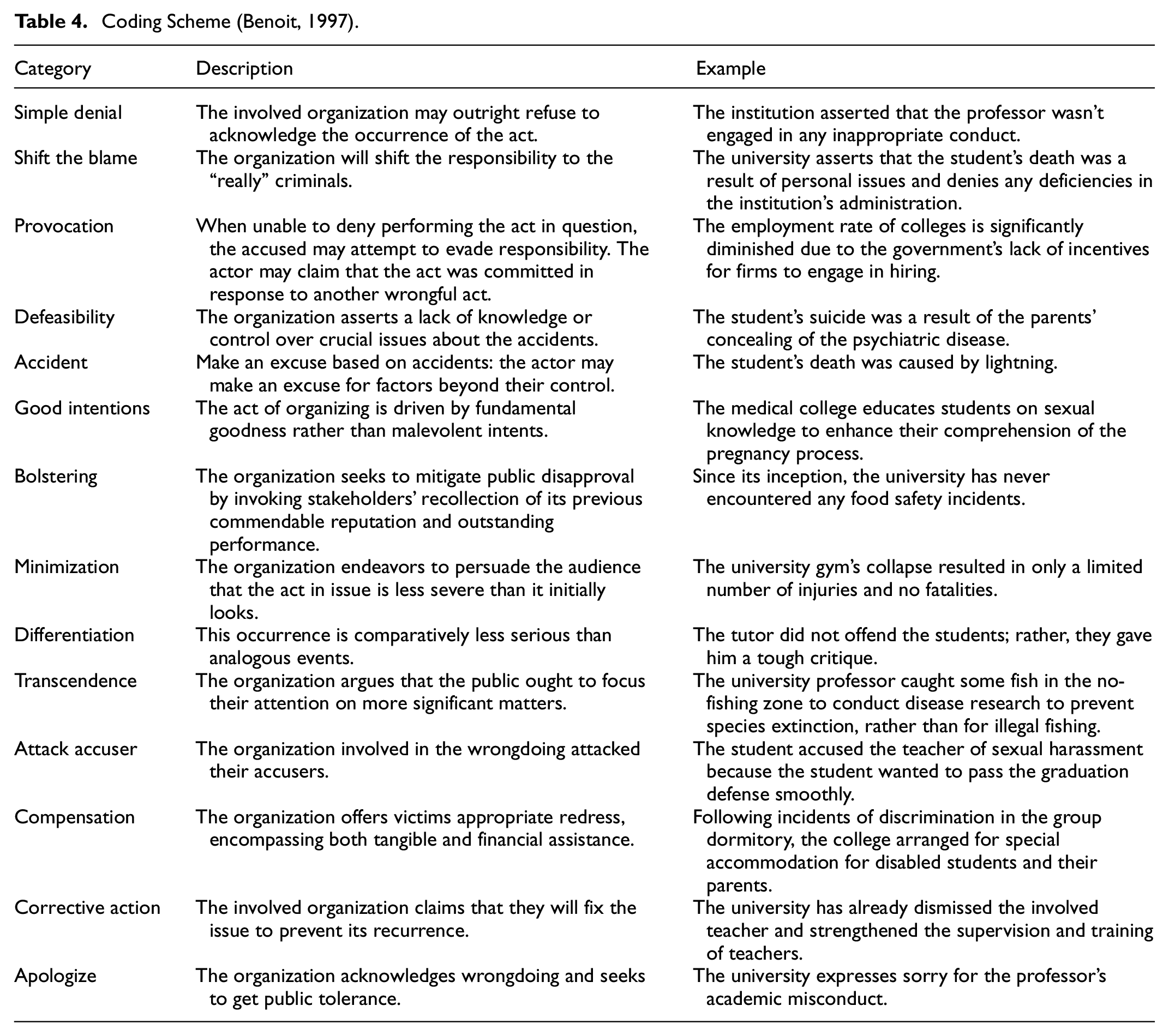
The first was the researcher, and the second was a mass communication doctorate candidate who was also a lecturer at a Chinese university. The coder was trained using the category system and coding instrument, with a concise explanation and examples provided for each unit of analysis to ensure a comprehensive understanding of the procedure. The intercoder reliability in communication research is often determined by taking 10% of the total sample size (Francis et al., 2010)). Therefore, a random selection of five statements, which accounts for 10% of the entire sample, was made to assess the intercoder reliability. For each of the 26 categories or variables, Krippendorff’s alpha values were shown to be more than or equal to .8(
Results
A descriptive analysis was carried out for each variable using the SPSS 25.0 version to set up the data outcomes. The dataset was subjected to descriptive analyses concerning crisis response strategies and demographic features. Seven factors were included in the comparative study of the demographic characteristics: “type of crisis,”“Statement sources,”“Gender of the violator,”“Title of Violator,”“Nature of Institution,”“Level of Institution,”“Communication Channel,” and “Amount of Statement.” Furthermore, a comparison study of the features of crisis response strategies using Tables 1 and 2’s categories (variables) was done. Finally, a chi-square test was conducted to examine the relationship between crisis types and crisis communication strategies.
Demographic Characteristics
The current analysis shows the demographic characteristics of crises about academic and sexual misconduct, specifically focusing on the gender and titles of the violators, the nature and level of the institutions involved, and the sources of statements and communication channels utilized. Between January 1, 2018, and July 20, 2023, there were 16 cases of academic misconduct and 46 cases of sexual misconduct that both garnered significant public attention. In the case of academic misconduct and sexual misconduct, three and five universities did not respond, respectively, thus obtaining a total of 54 statement texts, of which 13 in the case of academic misconduct (24.1%) and 41 in the case of sexual misconduct (75.9%), see Table 5.
Type of Crisis.
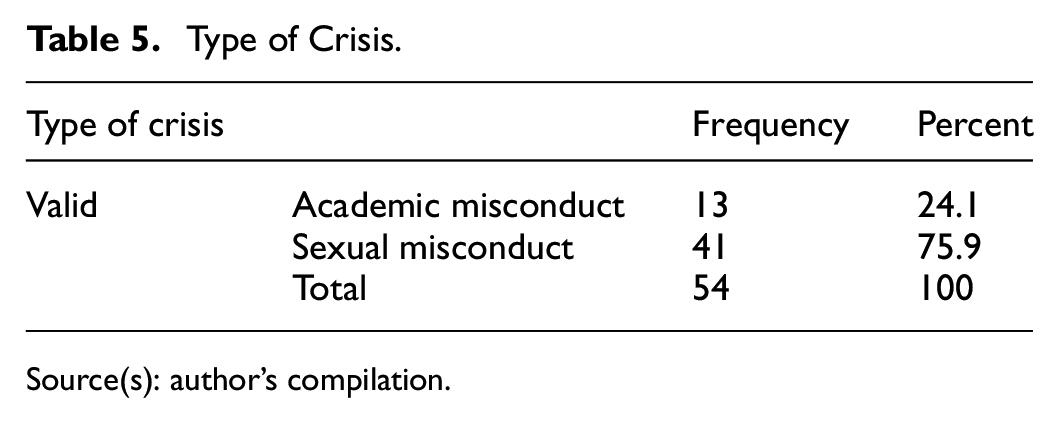
Source(s): author’s compilation.
From the perspective of the gender of the violator, in 54 cases, all were male, see Table 6. According to the offender’s title, 11 professors, one associate professor, and one lecturer made up 84.6%, 7.7%, and 7.7% of academic misconduct occurrences, respectively. Twenty-three professors, 13 associate professors, four lecturers, and one administrative staff member were involved in the sexual misconduct case, making up 56.1%, 31.7%, 9.8%, and 2.4% of the total staff members, respectively, see Table 7.
Gender of Violator.
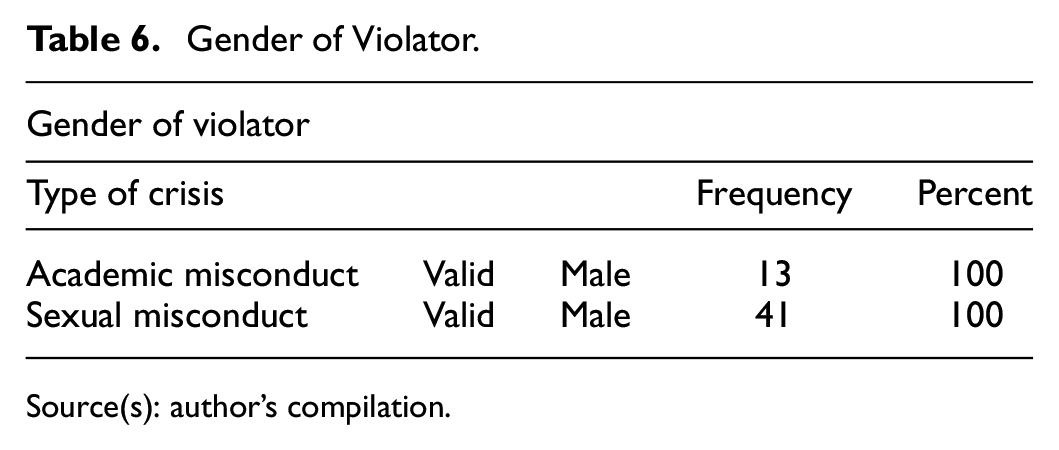
Source(s): author’s compilation.
Title of Violator.

Source(s): author’s compilation.
Based on the sources of statement release, 10 statements were released by the implicated institutions within incidents of academic misconduct. At the same time, three were issued by higher authorities, accounting for 76.9% and 23.1%, respectively. Meanwhile, in cases of sexual misconduct, 40 statements were self-released by the involved institutions, and one was issued by higher authorities, constituting 97.6% and 2.4%, respectively (Tables 8, 9). Refer to Table 10 for details. From the perspective of communication channels, within incidents of academic misconduct, five were communicated through official websites, and eight were communicated via official Sina Weibo accounts, accounting for 38.5% and 61.5%, respectively. Similarly, in cases of sexual misconduct, 13 were communicated through official websites, 26 through official Sina Weibo accounts, and 2 through official WeChat accounts, constituting 38.5%, 61.5%, and 4.9%, respectively. Refer to Table 11 for details.
Nature of Institution.

Source(s): author’s compilation.
Level of Institution.

Source(s): author’s compilation.
Statement Source.

Source(s): author’s compilation.
Communication Channel.
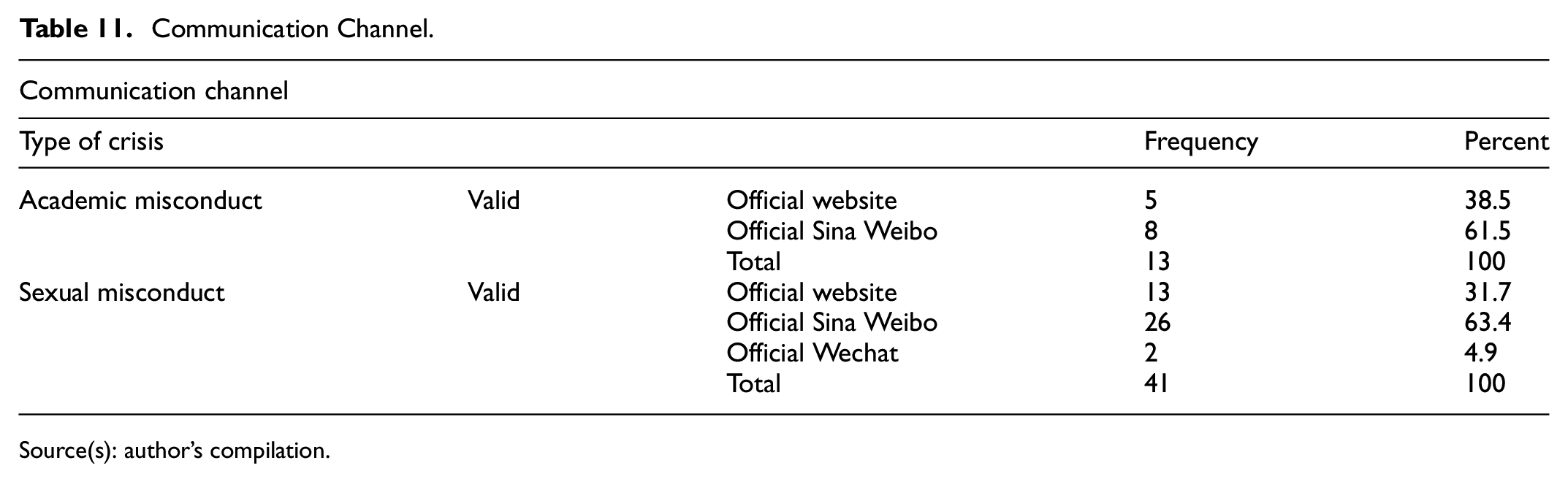
Source(s): author’s compilation.
Distribution of Strategies
In this paper, the sample of academic and sexual misconduct crises is separately analyzed, within the theoretical frameworks of SCCT (Situational Crisis Communication Theory) and IRT (Image Repair Theory). An overview of the crisis communication strategies utilized during incidents of academic and sexual misconduct from January 1, 2018, to July 20, 2023, is given in Table 12. Within the total of 54 statements, the utilization frequencies of various strategies are detailed as follows: the corrective action strategy was utilized 54 times, adjusting information 53 times, reminder 44 times, bolstering 43 times, and victimage 42 times. Additionally, the instructing information strategy was employed six times, excuse five times, compensation four times, and differentiation three times. The strategies of simple denial, scapegoat, and attack the accuser were each used twice, while minimization, defeasibility, and apologize were employed once. Notably, the remaining seven strategies were not utilized throughout the given period.
Crisis Communication Strategy in Academic and Sexual Misconduct Incidents.

Source(s): author’s compilation.
Note. Type of Crisis = academic misconduct and sexual misconduct.
Theoretically, the strategies employed derive from the SCCT and IRT. The SCCT encompasses 12 crisis communication strategies, of which 11 were utilized, resulting in a strategy utilization rate of 91.7%. On the other hand, the IRT comprises 14 crisis communication strategies, with eight strategies being utilized, resulting in a utilization rate of 57%. Among the top 5 most frequently used strategies, three originate from the SCCT, while two come from the IRT. Furthermore, among the eight most frequently used strategies, six stem from the SCCT, and two originate from the IRT, as depicted in Table 12.
Comparing Academic and Sexual Misconduct Crisis Strategies
Through manual comparison and analysis, this paper has revealed several similarities as well as differences between academic misconduct and sexual misconduct events. Concerning similarities, crisis communication strategies drawn from the SCCT and IRT theoretical frameworks were implemented in both incidents. These incident categories prominently utilized vital strategies such as corrective action, adjusting information, reminder, bolstering, and victimage. Notably, within these two categories, the strategy of Denial appeared only twice, while the strategy of apologize was employed only once.
The difference lies in the fact that academic misconduct cases, in some instances, utilized the denial and excuse strategy which were absent in sexual misconduct cases. Conversely, sexual misconduct cases involved the use of rebuilding strategies like the apologize strategy, whereas academic misconduct cases did not employ any such strategies. Additionally, sexual misconduct cases witnessed more instances of strategies related to SCCT’s rebuild crisis strategy, such as the ingratiation strategy, see Tables 13 and 14.
Crisis Communication Strategy in Academic Misconduct Incidents.

Source(s): author’s compilation.
Note. Type of crisis = academic misconduct.
Crisis Communication Strategy in Sexual Misconduct Incidents.

Source(s): author’s compilation.
Note. Type of crisis = sexual misconduct.
The Relationship Between Crisis Types and Crisis Communication Strategy
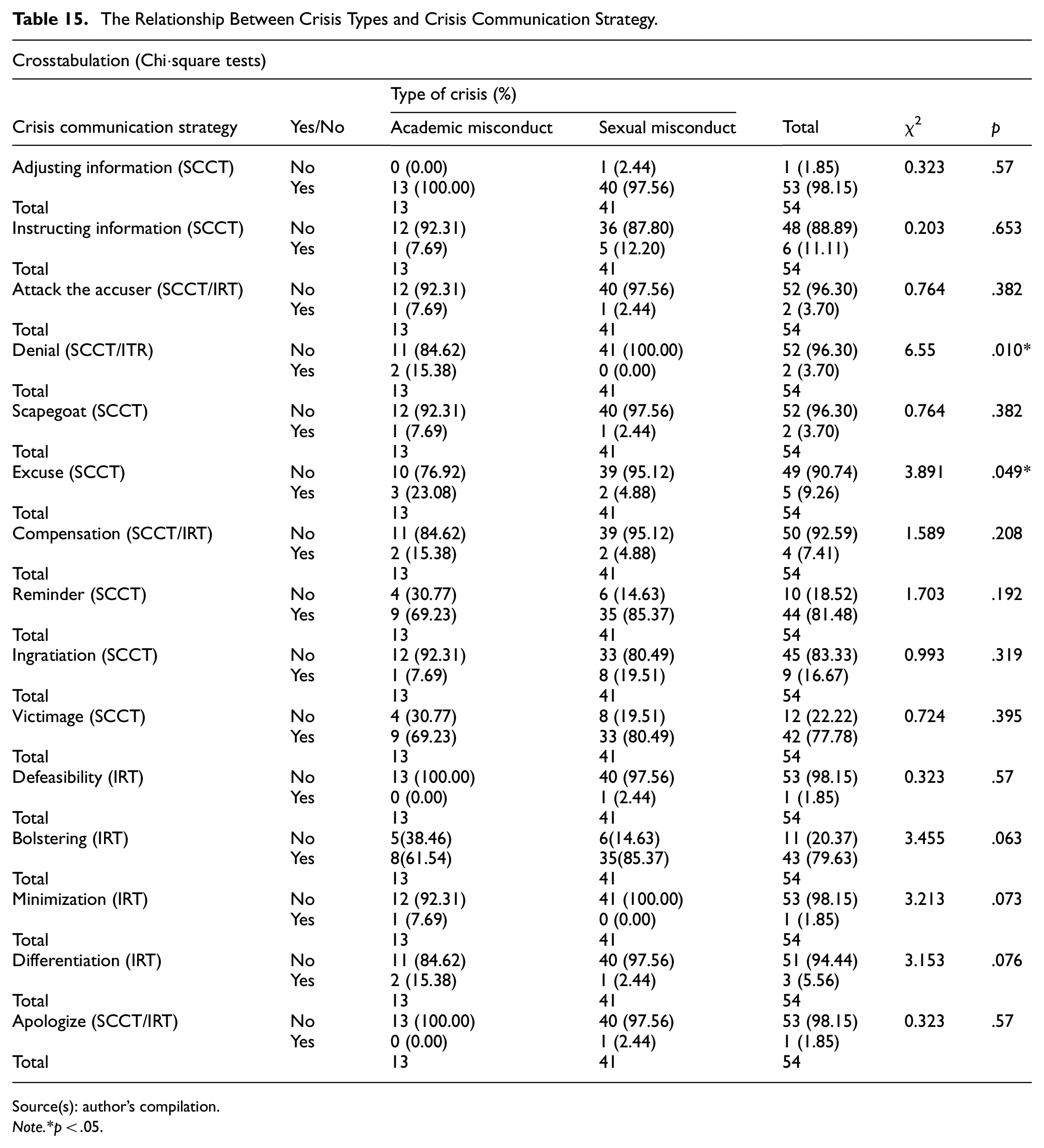
We finally examined the variables to determine if they demonstrate any relevant correlations. Using chi-square tests (cross-analysis), the study examined the differential relationships between crisis types and 15 crisis communication strategies (adjusting information (SCCT), instructing information (SCCT), attack the accuser (SCCT/IRT), denial (SCCT/IRT), scapegoat (SCCT), excuse (SCCT), compensation (SCCT/IRT), reminder (SCCT), ingratiation (SCCT), victimage (SCCT), defeasibility (IRT), bolstering (IRT), minimization (IRT), differentiation (IRT), apologize (SCCT/IRT)). The 15 crisis strategies involved two crisis events, while the remaining strategies were not implicated.
As shown in Table 15, the type of crisis showed a significant association with denial (SCCT) at a .05 level (χ2 = 6.550, p = .010 < .05). Percentage comparison revealed that the proportion of “No” responses for sexual misconduct was 100.00%, notably higher than the selection rate of 84.62% for academic misconduct. Similarly, the type of crisis exhibited a significant association with Excuse SCCT at a 0.05 level (χ2 = 3.891, p = .049 < .05). Percentage comparison revealed that the proportion of “No” responses for sexual misconduct was 95.12%, notably higher than the selection rate of 76.92% for academic misconduct. The other 13 items (adjusting information (SCCT), instructing information (SCCT), attack the accuser (SCCT/IRT), scapegoat (SCCT), compensation (SCCT/IRT), reminder (SCCT), ingratiation (SCCT), victimage (SCCT), defeasibility (IRT), bolstering (IRT), minimization (IRT), differentiation (IRT), apology (SCCT/IRT)) did not exhibit significance (p > .05). They displayed consistency and revealed no differences.
The Relationship Between Crisis Types and Crisis Communication Strategy.
Source(s): author’s compilation.
Note.*p < .05.
Discussions
The findings from our preliminary investigation enhance our understanding of the crisis events affecting China’s higher education institutions, highlighting a concerning pattern of misconduct within academic and institutional settings between January 2018 and July 2023. Notably, the prevalence of sexual misconduct cases significantly outweighed academic misconduct, drawing considerable public attention and indicating the urgency for comprehensive preventive measures. Since every identified offender was male, gender emerged as a critical determinant. This emphasizes how gender relations in these contexts need to be carefully examined. A more significant presence of senior faculty members, especially professors, was found in the distribution of titles among the offenders in both instances when it came to cases of academic and sexual misconduct. Such behaviors may be influenced by a hierarchical power dynamic, as indicated by this pattern.
The differences in these incidents between public and private institutions raise questions about organizational culture, accountability mechanisms, and the need for consistent enforcement of ethical standards regardless of institutional status (Ham & Kim, 2019). Institutions utilized diverse crisis communication strategies when issuing statements on misconduct events, with a majority opting to disseminate statements through official channels. Nevertheless, the dependence on platforms such as Sina Weibo for communication, particularly in instances of sexual misconduct, indicates the impact of social media in reshaping public opinion and organizational reactions (Malecki et al., 2021; Oh et al., 2021).
Multiple strategies should be employed in addressing these types of issues (Cheng, 2018). Prominent first endeavors encompass the creation of all-encompassing and friendly educational environments, offering comprehensive instruction on moral behavior and gender awareness, and establishment explicit procedures for reporting and resolving wrongdoing (Campbell et al., 2023). Furthermore, the objectives of diversifying communication channels and strategies should include enhancing accountability, transparency, and community engagement.
The findings of the study examining crisis communication strategies in cases of academic and sexual misconduct reveal notable similarities and differences. An analysis of crisis communication strategies in cases of academic and sexual misconduct in higher education institutions reveals the diverse methods used to effectively handle and resolve these crises. The findings demonstrate the utilization of a wide array of strategies, which differ in their compatibility with the theoretical frameworks of SCCT and IRT.
The primary application of crisis communication strategies, including corrective action, adjusting information, reminder, bolstering, and victimage, highlights their importance in addressing both academic and sexual misconduct occurrences (Frandsen & Johansen, 2020). These strategies, rooted in SCCT and IRT, indicate a shared reliance on established crisis communication frameworks to address the gravity of these situations. This partially clarifies the application of the SCCT and IRT in the realm of tertiary education in China.
However, a nuanced analysis reveals distinct differences between the handling of academic and sexual misconduct crises. In cases of academic misconduct, the use of denial and excuse strategies is not uncommon (Paydas Turan, 2022), whereas these strategies are notably absent in incidents involving sexual misconduct. The difference indicates a disparity in the perceived requirement or efficacy of particular strategies, depending on the circumstances of the issue being addressed. This aligns with previous research conclusions that generally discourage the use of Denial strategies due to their potential to generate significant negative sentiments (Frandsen & Johansen, 2020).
Conversely, sexual misconduct cases prominently featured rebuilding strategies such as the apology strategy, which were notably absent in academic misconduct incidents. The apology strategy is mentioned only once in both types of events, which is a departure from traditional findings. Its absence from crisis events at Chinese higher education institutions raises interesting considerations, as it has historically been thought to be the best strategy for eliciting positive public sentiments (Coombs, 2022). This disparity implies a greater emphasis on reconciliation, acknowledgment of fault, and efforts toward redressal in cases of sexual misconduct compared to academic misconduct. It also shows that SCCT and IRT theories need to be improved and perfected in the context of the Chinese cultural environment.
Apologies can expose an organization to legal risks, therefore, an organization may employ sympathetic strategies to minimize responsibility (Claeys & Opgenhaffen, 2021; Coombs, 2006; DiFonzo et al., 2020). Moreover, the increased utilization of SCCT’s rebuild crisis strategy, precisely the ingratiation strategy, in sexual misconduct incidents further highlights the distinct approaches taken to repair institutional image and regain public trust in the aftermath of such crises. However, it is advisable to issue an apology for serious organizational wrongdoings, as the organization may incur legal liabilities regardless of whether an apology is made. However, an apology may potentially mitigate the financial effects (Cui et al., 2018).
These findings highlight the significance of adapting crisis communication strategies based on the distinct characteristics and sensitivities of each type of incident. Although academic and sexual misconduct instances employ similar crisis communication strategies, the subtle distinctions highlight the necessity for a context-specific and adaptable approach to crisis management and communication within higher education institutions (Cheng & Lee, 2019; Wang & Laufer, 2020).
In summary, the study uncovers an intricate interaction of crisis communication strategies, utilizing well-established theoretical frameworks, while also emphasizing the need for subtle and context-specific methods in handling and reducing the negative effects of academic and sexual misconduct incidents on institutional reputation and public perception.
The results showed strong correlations between crisis type and the application of specific crisis communication strategies (Coombs, 2007). These findings emphasize the varying usage of denial and excuse strategies based on crisis type, suggesting that the choice of crisis response is influenced by the specific crisis. Strategies such as adjusting information (SCCT), instructing information (SCCT), attack the accuser (SCCT/IRT), scapegoat (SCCT), compensation (SCCT/IRT), reminder (SCCT), ingratiation (SCCT), victimage (SCCT), defeasibility (IRT), bolstering (IRT), minimization (IRT), differentiation (IRT), and apology (SCCT/IRT) were consistently used across different types of crises. This consistency suggests a uniform approach to implementing these strategies, regardless of the type of issue. These findings highlight the specific and deliberate use of denial and excuse strategies in both academic and sexual misconduct crises, indicating a personalized approach depending on the type of crisis. On the other hand, consistently applying the remaining strategies emphasizes their general relevance in resolving crises, thereby offering a detailed grasp of crisis communication strategies in the higher education field.
In terms of theoretical implications, the application of crisis communication strategies rooted in the SCCT and IRT frameworks has significantly enhanced the theoretical foundation of crisis communication (Marsen, 2020). This illustrates the applicability of SCCT and IRT theories in dealing with incidents of academic and sexual misconduct. However, the subtle differences in strategies for these 2 types of events highlight the need to expand the understanding of crisis communication theory. These differences emphasize the need for context-specific approaches within the crisis communication framework to effectively respond to the complexity of various crisis types.
In terms of practical implications, higher education institutions can prepare for a crisis by adopting communication strategies that are specifically tailored to the type of crisis. Such preplanning provides the crisis management team with the ability to identify and skillfully apply strategies that are specific to the unique nature of each type of crisis and are critical to improving the organization’s ability to respond to such critical events. This study highlights the importance of considering the complexity of crisis types when developing and implementing effective crisis communication strategies. This provides relevant guidance for crisis managers and educators in responding to crises within academic institutions. This information enables policymakers to develop targeted and effective institutional policies and crisis response strategies for academic misconduct and sexual misconduct in educational settings.
This study also has several limitations. Firstly, the study’s reliance on a specific timeframe (January 1, 2018, to July 20, 2023) and the focus on 13 academic misconduct and 41 sexual misconduct cases may limit the generalizability of the findings. A more extensive and diverse sample across a broader temporal scope could enhance a comprehensive understanding of crisis communication strategies in varied contexts.
Secondly, the study, grounded in crisis communication analysis, was limited in its ability to discern the depth and sentiment of audience engagement (Schoofs et al., 2019; Thelen & Robinson, 2019). The inability to distinguish between passive consumption and active contribution hinders a comprehensive understanding of stakeholders’ perceptions and reactions to academic and sexual misconduct incidents.
Conclusion
This paper, situated within Situational Crisis Communication Theory (SCCT) and Image Repair Theory (IRT), employs a comparative analysis to examine crisis communication strategies employed by Chinese universities in response to faculty sexual misconduct and academic misconduct. The demographic characteristics of both types of events exhibit minimal variation. Specifically, the primary violators in both cases are predominantly male professors, affiliated with publicly-funded institutions across various university levels. Furthermore, the events share similarities in their sources of statements, as well as a reliance on official Sina Weibo and university websites as communication channels.
The crisis communication strategies employed in response to these two types of events exhibit notable similarities. Strategies such as corrective action, adjusting information, reminder, bolstering, and victimage were prominently featured in handling both sexual misconduct and academic misconduct cases, underscoring their significance in crisis management. Among the strategies used most frequently, both “adjusting information”(SCCT) and “corrective action”(IRT) express the organization’s efforts to take measures to resolve issues, with “adjusting information” being one of the fundamental strategies recommended within the ethical base strategies of SCCT. As highly utilized strategies, both “reminder”(in SCCT) and “bolstering”(in IRT) express the organization’s commendation of past achievements to stakeholders. Notably, “reminder” is recommended by SCCT as a supplementary strategy within the rebuild strategy framework and is not advised for standalone use. Significantly, the victimage strategy, another supplementary strategy in SCCT, was also frequently employed. The presence of apology and compensation strategies, which are encompassed within both IRT and SCCT, considered paramount by SCCT, were rarely observed in Chinese universities’ statements regarding these events. Conversely, excuse and scapegoat strategies, discouraged by SCCT, were more prevalent than apology and compensation strategies.
Moreover, there exist distinct differences in the strategies adopted for these two types of events. The denial strategy, discouraged by SCCT, appeared in academic misconduct cases but was absent in sexual misconduct incidents. Conversely, the apology strategy was present in sexual misconduct responses but absent from academic misconduct statements. These observations highlight that, within the frameworks of both theories, Chinese universities demonstrate primarily similar crisis communication strategies while exhibiting nuanced differences based on the severity and public attention of each case. From a theoretical applicability perspective, SCCT offers tailored strategic guidance based on the event types, whereas IRT does not impose such restrictions, rendering IRT comparatively more versatile in its application.
Based on the frequently utilized strategies by Chinese universities, it is evident that they tend to favor acknowledging the crises and adopting corrective measures, exemplified by strategies such as adjusting information and corrective action. Additionally, they employ strategies that minimize offensiveness and mitigate reputational damage by highlighting past achievements, like bolstering and reminder strategies. Notably, the universities seem reluctant to employ strategies that involve assuming responsibility, such as compensation and apology, which significantly contrasts with the recommendations of both SCCT and IRT theories. This underscores the partial mismatch between the theories and the non-profit context of Chinese universities. The applicability of SCCT and IRT theories within this specific non-profit environment merits further in-depth exploration in future research. Furthermore, the correlation between the strategies of denial and excuse with the type of incident observed in these two cases begs whether this pattern extends to other types of events, necessitating further validation.
