



Abstract
The 2020 COVID-19 crisis forced universities to make a dramatic shift to emergency remote education (ERE). While the urgency of the pandemic is gone, schools continue implementing ERE, but more often on a short-notice, short-term basis in response to various situations. This research examines students’ suggestions for improving university transitions to ERE and applies them to post-pandemic use of ERE. Qualitative thematic analysis was used to analyze responses to an open-ended survey question answered by 2,751 students at a large Southeastern U.S. university. Responses identified main concerns as Grades and Grading (38%), Better University and Instructor Preparation (23%), Improved Learning Experience (18%), Meeting Student Needs (12%), and No Suggestions (9%). The study found that reducing the uncertainty students felt about ERE’s impact on grades, course content, class schedules, assignments, and communication with instructors would improve their online learning experience. Recommendations suggest preemptive steps universities can take to improve post-pandemic use of emergency remote education.
Plain Language Summary
Universities worldwide moved their academic programs to a fully online format for a period of time during the COVID-19 outbreak in 2020. However, they are continuing to use emergency remote education (ERE) for various reasons, typically for short periods of time. As a result, schools must stay attentive to how they implement ERE to ensure a smooth transition to online learning for students. This study asked students who experienced ERE during the pandemic for suggestions on ways universities could improve the move from face-to-face to online classes. Responses to an open-ended survey question revealed students’ concerns and recommendations centered around reducing levels of uncertainty related to grades and grading, better university and instructor preparation, improved learning experience, and meeting student needs. Based on these findings, this paper offers suggestions on actions universities can take preemptively to ensure effective post-pandemic use of emergency remote education.
Keywords
Introduction
Universities worldwide faced an urgent and unprecedented need to suddenly pivot to emergency remote education (ERE) in response to the spring 2020 COVID-19 pandemic. While the intensity of the pandemic has passed, the experience left a lasting impact on education. Online instruction was not a new concept in 2020, but was put to the test as never before. School administrators were faced with the dilemma of whether to suspend classes, shorten the semester, or call for totally online instruction. While all three scenarios became real, the primary result of the coronavirus on institutions of higher learning was the emergence of a phenomenon known as emergency remote education, alternately referred to as emergency remote learning (ERL), or emergency remote teaching (ERT). The idea of ERE was described by Hodges et al. (2020) as temporary instructional responsive teaching to a crisis, which differs significantly from pre-planned online learning.
Nearly overnight, classes had to be adapted for a virtual learning environment. This unexpected move to remote education was challenging for the vast majority of professors who had no, or very little, experience teaching online and had to modify course content, organization, and means of delivery using new or unfamiliar technology. For students, the conversion to ERE was difficult as well. They suddenly were confronted with significant changes to their classes that affected learning, assessment, and interaction with their professors and classmates, while coping with the impact of COVID-19 on their personal lives.
Following the sudden switch to online learning due to COVID-19 in 2020, scholars have increasingly embraced the study of ERE. This research is proving especially valuable because the pandemic spotlighted how to manage future unexpected moves to ERE, helping university administrators, professors, and students find new solutions by evaluating different approaches used and lessons learned (Ferri et al., 2020).
Post-Pandemic Use of ERE
Since 2020, universities have continued to use ERE, leveraging the knowledge, experience, and technical capabilities gained during the pandemic (Binkley, 2021). However, rather than making a quick move for long-term ERE, as was the case in 2020, schools may move classes online for shorter periods, as brief as a day, several days, or a few weeks for various reasons. Health concerns remain, though not with the same intensity and length of time as during the pandemic. In January 2022, more than 70 colleges started the semester online out of concern about an uptick in COVID-19 cases (Binkley, 2021). Among those schools, the University of Chicago, George Washington University, Wayne State University, Harvard University, and most University of California campuses conducted classes online for a limited time (Binkley, 2021). Fearing an outbreak of the omicron variant of COVID, Stanford University announced in advance plans to begin the 2022 winter quarter with classes online (Morgan, 2021) and was followed by at least four more California colleges (Watanabe & Shalby, 2022).
School administrators are implementing ERE for reasons beyond COVID-19, as well. For example, in January 2024, extreme cold forced the University of Iowa and Iowa State University to move classes online (Draisey, 2024). Several central Texas colleges (Menchaca, 2022) and the University of Missouri (McKinney, 2022) implemented ERE in response to dangerous winter conditions in 2022. In anticipation of Hurricane Ian, the University of Miami (Scouten, 2022), Georgia Southern University, and Savannah State University (Stirgus, 2022) were among the schools that preemptively decided to shift classes online. Safety and security matters led California State University Los Angeles (Sklar, 2024) and the University of Idaho (Wolfe & Levenson, 2022) to use remote learning. In response to challenges and pressures facing its students, faculty, and staff in fall 2023, the University of Maryland opted to move a day of classes online as part of its Thanksgiving break (Maryland Today, 2023).
Another change in the ERE landscape has come with the graduation of those in school at the peak of COVID-19 and the enrollment of new cohorts of students. Universities increasingly have students who did not go through the COVID-19 ERE experience while in college and may have limited or no exposure to a sudden change in learning modality. Consequently, the need for universities to maintain, update, and revisit policies and procedures to enhance their ERE readiness is as important as ever, even though the vivid memories of the pandemic days may have faded somewhat over time. Assuming that “we have done it before, so we can do it again,” without careful examination of the 2020 COVID-19 experience, could leave universities facing the same and/or new issues.
While considerable research has been done on emergency remote education during COVID-19, this study, unlike earlier work, adds a post-pandemic perspective on ways to improve the use of ERE. Since 2020, implementation of ERE by universities has continued for various reasons, generally for brief periods of time. This study applies learnings from analysis of survey comments by 2,751 students on their pandemic experience to this new era of ERE. Also, some findings differ from previous work, such as the overwhelmingly strong student concern about grades, while others reinforce earlier studies. Interpretation of results based on the Uncertainty Reduction Theory adds a distinctive theory-based dimension to the analysis and recommendations for universities.
Literature Review
Emergency Remote Education
The main difference between online learning and ERE is that online learning “results from careful instructional design and planning, requiring an investment in a whole ecosystem of learner supports that takes time to build” (Iglesias-Pradas et al., 2021, p. 119). ERE emerges as a “response to a crisis and entails a temporary shift of instructional delivery to an alternate delivery mode that involves the use of fully remote solutions for instruction that would otherwise be delivered in face-to-face, blended, or hybrid courses” (Iglesias-Pradas et al., 2021, p. 119).
The key objective of ERE is not to re-create an ongoing educational ecosystem but to provide temporary access to instruction and instructional support in a way that is quick to set up and is reliably available during an emergency or a crisis (Hodges et al., 2020). Understanding ERE this way differentiates it from traditional online courses, which usually take at least 6 to 9 months to prepare for delivery (Hodges et al., 2020). Face-to-face instructors were caught off-guard by the shift and found themselves struggling to deliver their courses in an unfamiliar instructional environment, having minimal time to convert their course content and teaching practices to an online delivery format (Petillion & McNeil, 2020). Students suddenly had to adapt to taking classes fully online and even scramble for things as basic as internet access (A. V. Alvarez, 2020).
Online education, including online teaching and learning, has been studied for decades (Hodges et al., 2020). Issues with traditional online learning include ineffective time management, lack of instant communication, and unclear instruction (Shagiakhmetova et al., 2022). While similar to online teaching in some ways, ERE comes with distinctive challenges to overcome (Ali, 2008). A study conducted by Whittle et al. (2020) identified an “inadvertent obfuscation of learning goals” by instructors focusing on the method of delivering instruction rather than learning goals (p. 315). This led to uncertainty around assessment for both teacher and student, resulting in unrealistic expectations in ERE environments (Whittle et al., 2020).
Uncertainty Reduction Theory
In a crisis that prompts a transition to ERE, both faculty and students encounter uncertainty and the need to adapt (Gelles et al., 2020). Uncertainty Reduction Theory (URT) was developed to explain how human communication is used to gain knowledge and create understanding (Berger & Calabrese, 1975). URT has been widely used to evaluate communication and to understand people’s behavior during times of difficulty (C. Son et al., 2020). This theory posits that people are uncomfortable with uncertainty and are motivated to reduce uncertainty about their behavior or the behavior of others through communication or interaction (J. Son et al., 2020). The authors propose that if an ERE shift happens again, URT could help faculty and administrators realize that for basic learning needs to be met, students also need to feel a measure of trust, and that “all will be OK” from their institution of higher learning. The information from this study can be used to help inform future situations in which communication plays a significant role in the student-professor-university relationship.
Adapting to Emergency Remote Education
The sudden shift to fully online instruction during COVID-19 has been the subject of considerable study, as educators and scholars worldwide seek to understand the pandemic’s impact on students and identify key learnings to improve ERE in the future (Stewart, 2021; Yang et al., 2023). The literature to date reflects different research methodologies, as well as different types of institutions, countries, student majors, and ERE implementation plans (Ahmad Shazli et al., 2023; Williamson et al., 2020). This expanding body of research provides a unique opportunity to learn from a wide range of global experiences of students, faculty, and university administrations during an ERE situation.
The abrupt move to ERE was problematic for students, faculty, and university administrators (Means & Neisler, 2021; Salimi et al., 2023; Spinks et al., 2023), many of whom had little or no experience with fully remote education (Chatziralli et al., 2021; Durrani & Ozawa, 2024). Uncertainties around class format, assignments, assessment, access to technology, and lack of personal contact created a difficult situation for students (Bhat et al., 2020; Bilgiç, 2021; Obermeier et al., 2022). Students felt a loss of community and emotional support after classes went remote (Minsun & Hickey, 2021). Despite their experience using computers and the internet, some students did not necessarily adapt easily to online education Paradeda and Santos (2022). In fact, Göl et al. (2023) found that digital distraction, a loss of focus tied to extensive use of digital technology, negatively affected students’ overall satisfaction and their perception of learning during the pandemic. Faced with academic changes, as well as personal concerns, students experienced heightened levels of stress (Elmer et al., 2020; MacIntyre et al., 2020; Morris et al., 2022; Obermeier et al., 2022; Obermeier et al., 2022; C. Son et al., 2020; Unger & Meiran, 2020), anxiety (Green et al., 2020; Xu & Wang, 2023), loneliness, and depression (Misirlis et al., 2020), which lowered motivation (Petillion & McNeil, 2020) and performance (Iglesias-Pradas et al., 2021). Students indicated that faculty should offer more flexible assignments, better testing procedures, more instructor engagement, and different grading systems in ERE situations (Gares et al., 2020; Petillion & McNeil, 2020; Shim & Lee, 2020). Consistent communication and more leniency with coursework were identified as ways professors could support student success (Gelles et al., 2020).
Similarly, instructors felt professional and personal pressures from dealing with the need to quickly redesign and adjust their classes, master new technologies and software, and adapt to teaching their students in a virtual format (A. J. Alvarez, 2022; MacIntyre et al., 2020; Tarpomanova & Slavova, 2024). During the 2020 pandemic, educators who were not familiar with online technology were especially challenged to construct course content and administer their classes (Abdalla, 2020; Latif & Alhamad, 2023). A review of empirical studies by Cook et al. (2023) documented the importance of digital competence among faculty in ERE situations. They emphasized the value of training teachers in advance of the need to adopt emergency remote teaching (ERT) and provided recommendations based on lessons learned during the pandemic. A sense of self-efficacy and the ability to use technology were found to have a positive impact not only on instructors’ skills, but also on students’ learning experience (Hershkovitz et al., 2023). Integrating use of different digital communication platforms, both learning management systems and social media, along with modifying course content benefited student learning (Jing et al., 2023). Faculty incorporating message boards, podcasts, and various free online resources enhanced student engagement and adaptation to ERE (Linnes et al., 2022; Olweny et al., 2023; Solares-Altamirano, 2023; Su et al., 2024). Faculty shared concerns about the mental well-being of their students (Cain et al., 2023), exacerbated by a loss of “social presence,” (Hussin et al., 2020, p. 42). Active and consistent instructor social interaction online helped maintain connectedness with students during COVID-19 (Conklin & Garrett Dikkers, 2021; Su et al., 2024).
Outside the U.S., technology-related problems such as unreliable internet connections, lack of computer equipment and software, and unstable online learning platforms were among the challenges teachers faced in nations with a less-developed digital infrastructure, such as the Philippines (Dio et al., 2023); Indonesia (Cahyadi et al., 2022); Turkey (Kamisli & Akinlar, 2023); Sri Lanka (Liyanagunawardena & Williams, 2021); Brazil and Portugal (Paiva & Jucá, 2023); and Ruwanda and Malaysia (Zamani & Mohamad, 2023). Students in Peru expressed frustration with their learning experience, noting issues with class materials, problems with laboratory work, and quality of instruction (Castro-Bedriñana et al., 2022). An Iraqi study, however, found internet connectivity to be a secondary issue during COVID-19 rather than a top concern as in previous research (Numan et al., 2022). Yet notably, international studies often revealed that similar challenges, such as learning process, communication, pedagogy, and personal well-being, were faced by institutions and students in both technologically advanced and developing countries (Dos Santos et al., 2023; Tulaskar & Turunen, 2022).
Administratively, universities had to make decisions that affected both faculty and the entire student body (Metzler et al., 2022). Many schools suspended classes and allowed up to 2 weeks for the transition to remote learning; others decided not to return to campus after their spring break. At the university where this study was conducted, the announced decision to move to ERE came 4 days (two school days and a weekend) before implementation. During COVID-19, some schools gave students the option to choose between pass/fail or a letter grade for their courses (Moody, 2020). Some university administrations took the position that expanding pass/fail options “gives students flexibility during the crisis and can mitigate their anxiety” (Burke, 2020, para. 7). Yet, shifting to a pass/fail grading system can have ramifications for students’ GPA (Burke, 2020). Certain pre-pandemic research, however, shows support for a pass/fail grading system. In one study, researchers found that moving to a pass/fail grading system had a positive impact on stress, mood, group cohesion, and test anxiety in medical students (Rohe et al., 2006). However, not all schools embraced pass/fail grading. For example, the university system in the state where this study took place prohibited institutions from offering pass/fail grading, citing the need to maintain high academic standards for assessment (Downey, 2020). There is also evidence that pass/fail grading decreases academic achievement (Gold et al., 2015).
Method
A qualitative research approach was used in this study and quantitative tabulation of responses helped assess relative strength of different responses. Data for analysis included responses to an open-ended question that was part of a larger survey (Pettigrew & Howes, 2023) distributed to students at a major public university in the U.S. Southeast between April 4 and April 18, 2020, following the shift to fully online learning due to COVID-19. The questionnaire was administered through a link to a web-based Qualtrics® survey distributed by communication professors to students enrolled in face-to-face and hybrid (face-to-face and online) classes affected by the move online. The university’s Institutional Review Board reviewed and approved the study and survey instrument, verifying they met ethical standards and accepted research practices for human subjects, on March 24, 2020. Participation was voluntary and anonymous. No personal identifying data was collected. Respondents received information on the survey, the purpose of the study, assurance of confidentiality, and were required to provide informed consent prior to proceeding.
Participants
The study used a convenience sample of freshman, sophomore, junior, and senior students enrolled in communication classes, augmented by a snowball sampling gathered by inviting these students to share the survey with others. Of the 3,742 students who completed the survey, 2,751 (73%) answered the open-ended question. The sample consisted of 1,599 (58.12%) females, 1,121 (40.75%) males, and 31 (1.13%) who preferred not to answer. Participants included freshmen (n = 770, 27.99%), sophomores (n = 774, 28.13%); juniors (n = 661, 24.03%), seniors (n = 517, 18.8%, and other (n = 29, 1.05%). Of the respondents, 45.4% had taken at least one fully online class and 20.2% had never taken a fully online or hybrid (part online, part face-to-face) class. The remaining 34.4% had taken at least one hybrid class. Table 1 shows the demographics of the participants.
Demographics of Respondents.

Data Analysis Process
This study focused on qualitative data analysis of student responses to the open-ended survey question, “What could the university do in the future to help facilitate a sudden change in instructional format?” The unrestricted responses to this question revealed insights from students, nearly all of whom believed ERE used during the pandemic had a negative impact on their education, their grades, and motivation to do classwork (Pettigrew & Howes, 2023). The question used was based on input from communication professors who disseminated the survey to students in their classes. A pilot test of 50 surveys indicated the open-ended question was understood by participants as intended and no modifications were needed.
Qualitative thematic analysis (Braun & Clarke, 2006) was applied to close examination of 3,085 suggestions from 2,751 students. (Some responses contained more than one suggestion.) Quantitative measurement of responses was used to compare the relative significance and ranking of different themes and subthemes. The six-step thematic analysis process developed by Braun and Clarke (2006) was adapted for this study (Lochmiller, 2021) to analyze data. Steps followed were (1) familiarization with the data to identify preliminary categories of interest; (2) creation of initial codes reflecting the content of responses; (3) close examination of codes to identify themes; (4) review and refinement of themes in relation to the data; (5) name, define, and describe themes based on content items; and (6) report results combining narrative and data analysis.
Data was first compiled into an Excel spreadsheet and Word document to manage three rounds of review for familiarization and preliminary categorization to identify repeated wording and note general subject areas. A word search process assisted with determining the number of times certain words and phrases appeared in the data set to create initial codes. With this information, 500 individual responses were analyzed against the preliminary set of codes. The data showed significant repetition of content terms and it was determined that a saturation point had been reached (Saunders et al., 2018). Next, using SPSS statistical software, each comment was coded based on subject and keywords or phrases. Initial codes were then reviewed and comments containing similar wording were grouped together as themes. In the next phase, comments within the themes were examined and individual comments were grouped and classified under subthemes. The subthemes were refined through a review process repeated twice to ensure clarity and distinction from each other. Based on the subthemes, themes were identified, named, and placed in broader categories for reporting results.
Approximately half of the data items were coded by each researcher working independently but in close consultation to address questions and ensure consistency in interpretation of comments and codes. In addition, 200 randomly selected responses were coded by both researchers and a comparison indicated 93% intercoder agreement, generally considered acceptable for research of this kind (Neuendorf, 2009). Differences were discussed and clarified; adjustments were made to the coding categories as needed.
Results
Qualitative thematic analysis found the 3,085 student suggestions to improve ERE fell into one of five categories: (1) Grades and Grading, (2) Better University and Instructor Preparation, (3) Improved Learning Experience, (4) Meeting Student Needs, and (5) No Suggestions. Under each category, comments were grouped by theme (e.g., Pass/Fail Grading, Instructor Readiness, Teaching Practices and Support for Students) and subthemes (e.g., move all grading to pass/fail, train professors in online instruction, give more specific assignment instructions, and show more understanding and compassion to students). The following review of results organizes findings by category, theme, and subtheme.
Category: Grades and Grading
The largest category of responses was Grades and Grading, consisting of 1,173, or 38.02% of all comments. The main theme was Pass/Fail Grading, mentioned by 922 students. A second theme, Modified Grading, was noted in 251 comments. Table 2 provides a breakout of the themes and the subthemes under the Grades and Grading category.
Category #1: Grades and Grading.

Theme: Pass/Fail Grading
Three subthemes were identified under Pass/Fail Grading: move all grading to pass/fail (845); give students the option of pass/fail grading (63); and do not adopt pass/fail grading (14). Most comments on pass/fail grading were brief, such as “Make classes pass/fail,”“Go to pass or fail,” and “Change grading to pass/fail format.” Others provided context and rationale for pass/fail grading: “Switch to a pass/fail grading system to help alleviate some of the stress,”“Pass/fail since we did not sign up for online classes,”“Pass/fail format due to grading discrepancies because teachers are doing online assignments for the first time,” and “Offer pass/fail grades to not impact a student’s GPA.” Another, though related, subtheme specified that students should be given a choice of going to pass/fail grades (63). “Offer OPTIONAL pass/fail system. Meaning students get to choose which classes they opt for pass/fail and which classes for regular grades,” a student wrote. Others offered, “I think an optional pass/fail would be appropriate” and “Make final grades the students’ choice. If they are happy with their letter grade then they can accept it or take a pass/fail grade.”
In contrast to the overwhelming support for pass/fail grading, 14 students expressed that grades should not be changed to pass/fail because they had “worked very hard to maintain or improve” their GPAs. One student firmly stated, “Do not do pass/fail, not even give it as an option. Students should not be less motivated to do their work.”
Theme: Modified Grading
Three subthemes emerged under Modified Grading, reflecting the academic challenges students experienced from the shift to ERE. These included being more flexible with grading (120); curving grades (98); and letting students keep the grade they had before the change to ERE (33). One respondent said instructors should be more lenient with grades because “most students struggle with online classes and may not perform as well as they would face-to-face.” Another commented, “This has been so difficult for all of us. If grades were curved, it would make up for the changes.” Others suggested giving students the choice of keeping the grade they had at the time of the move to ERE as their final grade.
Category: Better University and Instructor Preparation
The second-largest category, Better University and Instructor Preparation, represented 787 (25.51%) of all student comments. The themes in this category were University-Level Preparation (334); Instructor Readiness (299); and University Transition to ERE (154). Table 3 provides a breakout of the themes and the subthemes under the Better University and Instructor Preparation category.
Category #2: Better University and Instructor Preparation.

Theme: University-Level Preparation
The subthemes under University-Level Preparation included having a contingency plan in place to be more prepared (130); instituting uniform guidelines for ERE classes (84); altering the academic calendar by ending classes or pausing classes until fall 2020 (52); offering more flexibility and options to withdraw from classes without penalty (28); addressing how to conduct non-classroom courses (lab, studio, internships) in an online environment (25); and maintaining a face-to-face option for classes (15). Among the comments, one student said, “Put a university-wide contingency plan in place and let students know about it even if there’s no indication that it may be needed.” Others suggested that the university allow withdrawals without academic penalty from classes that were affected by the virus or offer something like a medical withdrawal for all students and let them retake the course at no cost. Fourteen students strongly expressed the need for options in place for courses in nontraditional classroom settings, such as science labs, drama, music, visual arts, and internships. As one person said, “SOMETHING for the art students! We are completely shut out. I have no way to get into the studio to complete my work.”
Theme: Instructor Readiness for ERE
Subthemes under Instructor Readiness for ERE were requests that professors be trained in online instruction (90); have online class plans already in place, even for face-to-face classes (88); have experience using the university’s learning management system (41); be better prepared, overall (56); and be tech savvy in using computers and digital technologies (24). Student observed that professors without prior experience teaching online were not ready for the sudden switch to remote learning. One person explained the need for better preparation, “Train all professors to facilitate online classes even if the professor doesn’t teach online courses.” Another said the university should “educate professors more on how to switch to online learning and how to adapt assignments accordingly.” Others suggested that teachers prepare lesson plans that could adapt easily to online use in an emergency situation. Another student said instructors’ lack of technical proficiency could be addressed with training to use learning management systems and other online teaching tools.
Theme: Transition to ERE
Two subthemes emerged under Transition to ERE: allow more time for students and faculty to adjust before launching an ERE environment (108); and implement a smoother transition process (46). Students advised against a “sudden change” from face-to-face to fully online classes. “Do it at a slower pace. I think with more time the transition could’ve been much smoother,” a student said. As a reminder of the pandemic’s impact beyond the classroom, one person wrote, “Allow more time for students to get their personal life situated first instead of just jumping in.”
Category: Improved Learning Experience
The third-largest category was students’ Improved Learning Experience, represented in 462 comments (14.98% of all responses). Two themes focused on assignment concerns (266) and teaching practices (196). Table 4 provides a breakout of the themes and the subthemes under the Improved Learning Experience category.
Category #3: Improved Learning Experience.

Theme: Assignment Concerns
Four subthemes were identified under the Assignment Concerns theme: lighten course workload (85); and be more flexible with deadlines for assignment submissions (72); don’t add additional assignments (62); and provide more leniency in classes (47). One student explained, “Decrease the amount of work/content as it is harder to do all this online.” Another commented, “Do not ask us to complete the same amount of work as in class when the same instruction is not being given.” Outside demands and pressures in personal lives also contributed to students’ requests for a lighter workload. Time-consuming responsibilities included job demands, childcare, and helping parents. Some thought that additional online work was being assigned as a substitute for face-to-face classes or to compensate for the loss of in-class time. “Tell professors that ‘online’ does not mean ‘more work,’” one student said. Several felt that instructors added assignments because they believed “students are at home and have more time on their hands.”
Two other subthemes focused on providing students with more flexibility in assignments, deadlines and test schedules, as well as being more lenient with classwork. Among the suggestions were open-ended deadlines for assignments and multiple chances to submit assignments. As one student wrote, “Be more lenient with the students. Some are forced to work to provide for their families and it’s taking time away from their studies. Personally, I struggle with online classes because I don’t have the discipline.” Students suggested faculty lessen their expectations of students for the semester due to a “decline in motivation and concentration once the change in instructional format occurred.”
Theme: Teaching Practices
Subthemes under Teaching Practices were conduct real-time lectures and meetings (72); give clearer, more specific instructions (37); modify face-to-face courses to an online format (32); ensure professors stay engaged and available (29); and provide recorded lectures (26). Students supported having a live, interactive connection with their professors and classmates. They expressed a preference for real-time classes held via Zoom, Microsoft Teams, or another streaming service. “Have EVERY professor do live online lectures,” a student said. While another observed, when classes do not meet live, “you basically have to learn everything yourself.”
Although more students favored live lectures, comments under another subtheme also indicated a demand for recorded lectures uploaded to the class website. “Require professors to make instructional videos for the day classes are assigned,” wrote one student. Another commented, “Pre-shot videos with the lessons help a lot as well as live video chats. These videos help explain the content in context. Just posting the PowerPoints for us to figure out on our own isn’t helpful.” One student said not having recorded lectures “really sets me back academically.” In an ERE situation, students urged instructors to stay actively engaged in their teaching, wanting “reliable professors who actually put effort into their online teaching.”
Two other subthemes called for providing more detailed assignment instructions and modifying content to work in an online format. In the absence of in-person contact, students emphasized the need for professors to be “more organized and clearer” with “more specific instructions and notifications on due dates.” They also wanted instructors to be “more in-depth about what they are expecting for assignments.” One student looked for “a more structured routine and a clear plan for what I need to do for each class for each day.” Another added that “it is OK for professors to change the original course schedules” to adapt to the new circumstances. Students were open to “revising syllabi in a way that will make the transition less stressful.” Other suggestions were to eliminate group projects, have no time limits on tests and no required use of a lockdown browser. They also suggested that big projects should be broken down into smaller parts with due dates scheduled throughout the semester, rather than at the end. Virtually all comments supported making course changes in response to a switch to ERE; only three individuals stated classes should not be altered because doing so would make things more difficult and confusing for students.
The subtheme of greater uniformity and consistency in teaching and the use of learning platforms reflected challenges students faced adapting to their professors’ quickly created online courses. They found it difficult to navigate the various course designs and different approaches to online learning. “What’s been a big part of my confusion is that my professors all used different ways of doing things,” a student commented. Another said, “It’s been chaotic trying to accommodate every teacher’s specific guideline for online classes.” To address this, students said the university should standardize how online courses are taught. This includes requiring that all professors use the same online learning platform and follow a common guideline for structuring course material.
Category: Meeting Student Needs
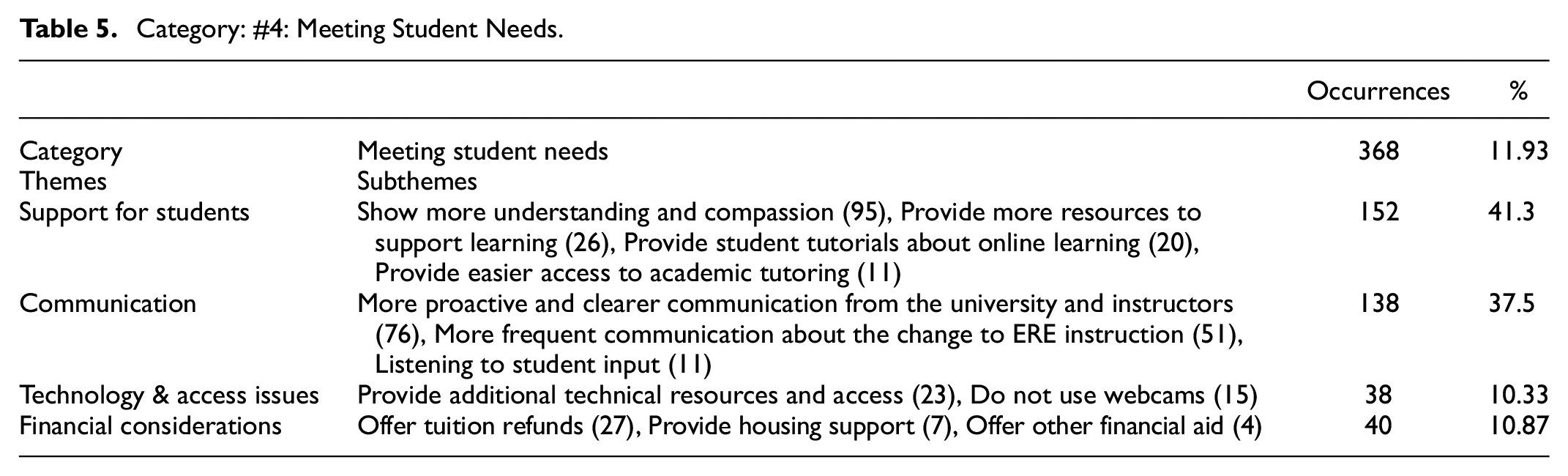
The category of Meeting Student Needs had 368 responses (11.86% of all comments) with themes of Support for Students (152); Communication (138); Technology (38); and Financial Support (38). Table 5 provides a breakout of the themes and the subthemes under the Meeting Student Needs category.
Category: #4: Meeting Student Needs.
Theme: Support for Students
The subthemes for Support for Students included offering more understanding and compassion (95); resources to support learning (26); student tutorials about online learning (20); and easier access to academic tutoring (11). Students asked professors and university administration to be more caring and considerate of students’ concerns in an ERE situation. Expressing a desire for more emotional support, a student said, “Instruct professors how to be more sympathetic and helpful during change—they have NO idea what some of us are going through or worried about.” Ten students specifically requested more mental health support.
Another subtheme was student desire for academic support for both their coursework and adjusting to online learning. As one student said, “Offering supplemental instruction to help struggling students would be helpful, especially in upper-level classes.” Students also asked for help on how to take online classes, one individual simply stating, “Teach us how to use an online class.” Other suggestions were to “give web seminars on how to change from face-to-face to online instruction” and have “online tutorials to help students with assignments.”
Theme: Technology Access Issues
The Technology Access Issues theme had 38 comments. Subthemes were to provide additional technical resources and access (23) and do not use webcams (15). Students emphasized the need to help those who did not have home internet access, computer equipment and necessary software. As one student wrote, “The university should have laptops/webcam/microphones for students to rent. There are many students who don’t have access to these things.” Webcam use was problematic for some. “Many students such as myself don’t have a webcam and being videotaped is awkward,” a student said.
Theme: Financial Considerations
A small number of comments (38) fell under the Financial Considerations theme (40). They centered on three subthemes: offer tuition refunds (27); provide support for housing (7); and offer other financial aid (4). Students recommended that universities refund tuition, as well as fees for parking, sports, meal plans, and other on-campus services. Other suggestions were to provide financial support for students who were required to move out of dormitories and financial aid, in general.
Theme: Communication
The Communication theme included subthemes of more proactive and clear communication from the university and instructors (76); more frequent communication about the change to ERE instruction (51); and listening to student input (11). Students stressed the importance of faculty and staff responsiveness and communication in an ERE situation. More frequent and timely communication from instructors would keep students better informed, they said. “Be quicker about relaying news and new plans instead of leaving us in the dark,” a student wrote. The importance of communication with professors was evident in comments such as “Make sure professors are staying connected with students” and “Require professors to communicate with students regularly.” Students believed limited communication from professors affected their learning. “I find most of my big problems to be errors in little to no communication,” a student wrote. Another subtheme noted students’ desire to have their voices heard and input considered in the planning and management of an ERE situation. One person said, “Listen to student opinions,” while another added, “Listen to what we want and work with us where we are.”
Category: No Suggestions
The category, No Suggestions included 295 students (9.56% of all comments) who stated they had no recommendations. Under the Reasons for No Suggestion theme were subthemes of not sure what could be done (96); do not know how to improve the transition (92); nothing more could be done (68); and the situation was managed well, so suggestions were not needed (39). Table 6 provides a breakout of the themes and the subthemes under the No Suggestions category.
Category #5: No Suggestions.

Discussion
This discussion section analyzes students’ survey comments on ways to improve the move to emergency remote education and relates findings to practical applications relevant to university use of ERE since COVID-19. The sudden change to ERE and the many unknowns surrounding the pandemic, not surprisingly, created a major disruption in students’ academic and personal lives, leading to high levels of uncertainty-related stress (MacIntyre et al., 2020; Xu & Wang, 2023). The Uncertainty Reduction Theory (J. Son et al., 2020) provides a framework to explain and understand students’ response to the pandemic situation. Going further, it can suggest approaches to limit and manage the negative impact of uncertainty (Hall et al., 2020). Under URT, individuals are motivated to reduce the cognitive discomfort of uncertainty by gaining information (Berger and Calabrese, 1975). It follows that communication can be an effective means to fill a knowledge void. In an academic environment, students’ reaction to uncertainty can have a negative effect on their motivation, engagement, and learning outcomes (Martin et al., 2013; Martin et al., 2023). However, communication and relationship development can mitigate levels of uncertainty (Berger & Calabrese, 1975). Consequently, identifying and addressing concerns could reduce unknowns and contribute to better student experience and performance (Brashers, 2001). The following discussion presents insights, implications, and recommendations for improving university transitions to ERE. The analysis reflects study results that grouped student comments into categories of Grades and Grading, Better University and Instructor Preparation, Improved Learning Experience, Meeting Student Needs, and No Suggestions.
Grades and Grading
The Grades and Grading category accounted for nearly 40% of student responses, clearly indicating that grading was a major source of uncertainty, with students questioning how course changes might negatively affect their GPAs. This result differed from other studies, which reported grades a concern, but not necessarily the main one. An explanation for this could be students were responding to the survey soon after the conversion to ERE, when the unknowns of the situation were highest and they lacked information that might have alleviated their anxiety about grades. The finding is consistent, however, with Cole et al. (2017), who stated grades and grading uncertainty prompted high levels of anxiety when students faced rapidly implemented course changes.
Better University and Instructor Preparation
A quarter of student responses centered on Better University and Instructor Preparation, making this an uncertainty source. Students emphasized preparedness strategies like contingency planning, instructor readiness to teach online, and more time to switch to ERE to facilitate a smoother transition. Faculty training could foster greater consistency in how courses are set up on the school learning management system, reducing student stress in adapting to varying structures of online classes. Such actions would lower student uncertainty, with supporting online learning research showing that instructor readiness along with course structure and organization strongly predict student satisfaction (Martin et al., 2018).
Improved Learning Experience
Approximately 15% of comments fell under the Improved Learning Experience category. Suggestions of lighter workloads, clear assignment guidelines, live lectures, and limiting changes to course structure and content would lessen uncertainties and stress, as reflected by Robson and Mills (2022). Students said assigning additional work to compensate for in-class learning actually proved counterproductive (Motz et al., 2021). While some online education research has shown students find the flexibility of asynchronous learning advantageous (Müller & Mildenberger, 2021), under ERE circumstances, students may especially value the structure of regularly scheduled classes and communication with professors and classmates. That said, students supported posting recorded lectures to class websites, and there was no opposition to doing both.
Meeting Student Needs
Suggestions related to Meeting Student Needs represented about 12% of comments, led by a desire for more understanding and compassionate communication from the university and faculty, which would help provide information and address unknowns and uncertainties. Prior research reinforces these findings, indicating that addressing student needs is critical since lack of support can limit online participation and achievement (Martin et al., 2018). Further, this study mirrors Lowenthal et al. (2017), who found that increased personal interaction with professors could reduce barriers to online engagement and promote student success. Unlike some research conducted in the U.S. and especially in other countries, this study showed low mention of needs for equipment and other technology resources, indicating technical issues were not a major contributor to uncertainty for students.
No Suggestions
Nearly 10% of students did not propose improvements to the transition process to emergency remote education. Their reasons varied, but uncertainty was inherent in the responses of students who said they were “unsure” of what could help, while others expressly stated that they did not know how the transition could be improved. Only 39 of 2,571 students felt the situation was handled well so no changes were needed. This small number of positive comments showed that nearly all students found some aspect of the ERE experience needed improvement. Despite best efforts of universities to manage the transition to fully online classes, students continued to encounter challenges (Lowenthal et al., 2017; Obermeier et al., 2022).
Implications and Recommendations
The sudden, unprecedented move to online learning necessitated by the outbreak of COVID-19 in 2020 created a situation filled with confusion and uncertainty for college students, as well as faculty and administrators. Several years have passed and the recency impact of the pandemic has diminished to some degree; however, universities continue to implement emergency remote education for various reasons, such as health concerns, inclement weather, and campus security (Binkley, 2021; Draisey, 2024; Menchaca, 2022). Additionally, with students in college during COVID-19 graduating and new students arriving on campus, universities must continually review and renew their preparations and readiness for implementing ERE. This study’s analysis of student recommendations on ways to improve the move to ERE during the pandemic offers valuable “lessons learned” that can be applied to post-pandemic use of emergency remote education. The following suggestions are intended to help reduce uncertainty for students and faculty through smooth, timely transitions to ERE, particularly under circumstances requiring quick decisions, often for a brief time period:
• Implement a management process that facilitates quick decision-making on moves to ERE so that students, faculty, and staff know the change is happening and have as much as possible to prepare, thereby eliminating what could be a major source of uncertainty. Having a core team of campus leaders who are readily available and regularly consulted on campus crises and other matters can smooth and speed up the process for making sound decisions.
• Include a contingency statement in all syllabi that outlines how a class would be conducted in case of a sudden move to a fully online format. Addressing some of the “unknowns” ahead of time would lessen uncertainty and help students adjust more easily to a change in modality. As appropriate to the course, alert students that there may be changes to assignments and deadlines, test dates, lecture format, office hours, and other aspects of the class. To address a top concern, let students know how, if at all, grading practices may be modified. Detail how their instructor will communicate with them and where they will find up-to-date information about the course.
• Establish online meeting spaces (such as Microsoft Teams and GroupMe) for classes and student organizations that can be activated quickly, as needed. Students could gather virtually to communicate with each other, share their experiences, exchange information, and, most importantly, stay connected with each other and their instructors.
• Use an artificial intelligence chatbot or similar technology to answer students’ general questions and offer information on specific needs, such as food and housing, transportation, health care, mental health resources, and technical assistance. A site on the university’s homepage could also provide this information.
• Maintain active online course sites for face-to-face classes and include at least one online assignment or other required activity early in the semester to give students experience using course technology, lessening the stress of adapting a sudden switch to ERE.
• Ensure that freshmen and transfer students, as well as new faculty, are familiar with online learning and the school’s learning management system by including instruction and practice as part of an orientation or introductory class.
• Conduct periodic informal in-person and virtual “best practices” workshops, webinars, and lunch-and-learns for faculty to foster ongoing learning and skills development in online teaching. Sharing faculty experiences with ERE, plus training in use of the university’s learning management system and other instructional technologies, would contribute to greater consistency in online course structures. This knowledge would help make instructors more comfortable teaching online, even if for a limited period of time.
Limitations and Future Research
As with all research, this study has several limitations. The timing of the survey, administered almost immediately after an abrupt move to ERE with only 4 days notice, may have influenced students’ responses. Their views may have changed as they adjusted to online learning. Also, students at universities with a slower transition to ERE may have had a different experience. The self-reporting nature of the survey design carries some inherent bias. This study uses relevant data collected during the 2020 COVID-19 crisis; however, future research could investigate how universities have applied past experience and are managing post-pandemic moves to short-notice, short-term emergency remote education.
Conclusion
While many universities have implemented changes based on their experiences during the 2020 pandemic, the need for preparedness for emergency remoted education continues as schools implement ERE in response to various immediate needs for a limited period of time. The more a university can reduce students’ stress-related uncertainty by preemptively addressing concerns, setting expectations, and communicating frequently, the better the transition will be for students. Student feedback underscores the value of offering alternative approaches to grades and grading, advance notice before shifting to online learning, flexibility in course schedules and requirements, and continued faculty training in online teaching. Other ways to enhance ERE include delivering classes in both synchronous and asynchronous formats, preparing face-to-face classes to be taught online, and easing course workloads. Finally, students asked for more communication, along with greater understanding and compassion, from the university and their professors. Institutions must stay attentive to emergency remote education despite having gained experience during COVID-19. Not only are schools continuing to use ERE for various purposes, but as time passes, fewer current students will have experienced the sudden shift to fully online learning during COVID-19. Universities that stay ready, regularly review policies and practices, and apply lessons learned will be better positioned to manage the ongoing post-pandemic use of emergency remote education.
Footnotes
Declaration of Conflicting Interests
The author(s) declared no potential conflicts of interest with respect to the research, authorship, and/or publication of this article.
Funding
The author(s) disclosed receipt of the following financial support for the research, authorship, and/or publication of this article: We received funding from the Kennesaw State University Faculty Open Access Publishing Fund to cover the processing fee.

Data Availability Statement
The datasets generated during and/or analyzed during the current study are available from the corresponding author on reasonable request