




Abstract
Despite several attempts made to analyze students’ socialization into academic discourse in relevant reviews, we still lack a topical study providing an overview of how students are apprenticed into academic communities through oral activities at post-secondary institutions. This study aims at contributing to a comprehensive overview of both theoretical and empirical studies in the field of academic discourse socialization (ADS). A systematic review approach was adopted due to the qualitative and quantitative research design and connections between theory and evidence. The material search of ADS literature published between 2000 and 2022 resulted in 72 studies in total. While the synthesis of theoretical studies reveal the extant definitions, categorization of characteristics and theoretical orientations, the empirical study findings compare differences in participants and contexts, research approaches, communication events, and academic outcomes. This review also discusses major areas of research concerning ADS, mainly types of socialization agents, students’ feedback, learners’ identity construction, and assessment of consequences of ADS. With limitations concluded, the review encourages further focused investigation into micro-macro connections, application of digital technologies, a wider range of participants, disciplines and contexts, multiple types of oral activities and perspectives, learners’ linguistic production as well as correlation of oral and written texts, and joint efforts from multiple sides.
Keywords
Introduction
Academic discourse socialization (hereafter, ADS) has been recognized as the capability to develop their academic competence and cognitive experience in social interaction in order to gain membership in academic communities (P. A. Duff, 2007). Communication and feedback from peers, instructors and other socialization agents have functioned as important means in students’ enculturation into the academic discourses. Participants learn to develop their academic repertoire in a new context, and their membership, therefore, would be translated into “an identity as a form of competence” (Wenger, 1998, p. 153; Wortham & Reyes, 2015, p. 17). Participants can make use of their identity and invoke their agency to either accommodate or resist the power structures within the new contexts (Esquinca, 2012; Haneda, 2009; Harklau, 2000; Morita, 2000, 2004).
One chapter written by Morita and Kobayashi in the Encyclopedia of Language and Education reviewed research on disciplinary socialization in mainstream content areas of undergraduate or graduate level courses. Two years later, the 2010 issue of Annual Review of Applied Linguistics contained a more comprehensive review article by Patria A. Duff concerning language socialization into academic communities. The article highlighted some major research on the socialization into oral, written, and online discourse and relevant social practices connected with each mode. Following on these earlier reviews, Kobayashi et al. (2017) wrote a selective review of L1 and L2 students’ language/literacy socialization in postsecondary contexts, discussing challenges related to students’ identity construction as well as renewing recent developments in scholarship and difficulties caused by complexities and hybridity of ADS. Then, P. Duff et al. (2019) adopted a narrower focus by highlighting ADS research conducted only at Canadian universities, reviewing research questions, methodological approaches, units of analysis and thematic foci in this field.
Concerning modes of discourse, researchers initially have conducted plenty of studies to examine students’ academic literacy socialization through focusing on academic writing (e.g., Prior, 1998; Spack, 1997). Until the early 1990s, the conceptual and methodological shift encouraged a closer examination of academic discourse due to its orality, intertexuality, and multivocality (P. A. Duff, 2007). The primary goal of research concerning the ADS of language learners is to gain a holistic understanding of how novices become apprenticed into the academic discourse, practices, and knowledge of their target community through their engagement in oral activities.
Even though the progress of the oral ADS literature has grown steadily to understand how interactions shape the learning trajectories of individuals and how they fit into larger systems of cultural meaning, it still received far less attention, being the most neglected in studies of academic discourse (P. A. Duff, 2010), and lagged behind the program development and enculturation efforts within post-secondary institutions. Most notably, it seems that ADS research still had competing views of some key concepts regarding ADS and was short of more robust qualitative research designs to document the outcomes of socialization process. Additionally, because academic oral activities are interactionally and cognitively complex and demanding, they constitute powerful and rich resources of discourse socialization and academic apprenticeship.
Given the importance of learners’ participation in oral activities for the successful completion of undergraduate or graduate courses and programs as well as for their enculturation into academic discourses and cultures, the growing trend of socioculturally situated studies on academic speaking deserve more attention in research primarily reviewing studies with respect to the ADS through spoken events at postsecondary educational institutions. Although all relevant and insightful, the above four reviews on the subject of language socialization in academic settings do not provide an exclusive overview of ADS research limited only to undergraduate and graduate students’ academic acculturation in oral activities. Therefore, some issues remain untouched, and could help map the extant ADS research. There is a need, hence, for an in-depth updated review of the literature regarding how learners acquire academic knowledge and linguistic competence through oral interaction during this culture transmission process in the global context.
A systematic review is conducted to document, analyze and synthesize as much academic literature concerned with ADS at undergraduate and graduate level as resources would allow. It is expected that this study demonstrates participants’ agency, aims and preferences in their oral negotiation and contention of identities and participation. The review also categorizes the ADS literature and describe the main aspects from the conceptual to empirical view. The overview of theoretical and empirical research indicates relevant factors involved in academic acculturation, which demonstrates differences in defining and analyzing ADS with theoretical framework as well as participants and contexts, research approaches, communication events, and academic outcomes in the fieldwork. It identifies main research areas and concludes with gaps that gained little attention. The research results are meaningful for exploring micro-macro connections or developing digital technologies applied in tracking or assessing language learners’ socialization into academic communities. Moreover, this overview will enable researchers to conduct methodological rigorous research on students from a wider range of linguistic, academic and culture backgrounds in various contexts and view socialization from different perspectives when designing class activities.
Relevant literature has been grown to include both the theoretical analysis and empirical research. The conceptual perspective facilitates a sufficient and all-round discussion about issues concerned in ADS research. The fieldwork makes full use of various sources of data to study learners’ negotiation of different demands, acquisition of capability and knowledge, and construction of new identities in an academic community. We need to figure out the theoretical definitions and analysis under certain frameworks in relevant literature to study learner’s discourse socialization in relation to oral activities. Moreover, how researchers carry out the fieldwork, and how they evaluate the academic outcomes based on learners’ engagement in communication events are also issues that remain to be addressed. Specifically, the process of this review began with the following research questions:
What kind of theoretical orientations are adopted in studies purporting to be researching under them as frameworks?
Which group of students would be chosen as participants?
What are the research contexts across the world?
Which research approach would be adopted, and what is the methodological strength and weakness?
What kind of communication events are involved to socialize students into the target academic community?
What academic outcomes on ADS literature has been carried out which may shed light on the future research?
The study consists of five sections, making an attempt to update the theoretical understandings and empirical investigations on this topic. Following the introduction, the second section illustrates the theoretical background, including the discussion of definitions and characteristics of ADS. In the third section, it begins with the introduction about the research methods selected for the review, and then steps in conducting this study. After a critical analysis of relevant literature, research results show several theoretical orientations drawn from theoretical studies as well as differences in student populations, research contexts, methodological and measurement issues, communication events, and academic outcomes from empirical studies. Finally, the fifth section discusses main areas of research and concludes with some limitations and recommendations for future research and teaching practice.
Theoretical Background
As a burgeoning area of research in applied linguistics, language socialization (LS) shed light on the process through which less established participant makes attempts to gain communicative knowledge and competence in order to participate appropriately, focusing on exploring the link between foreign language learning and sociocultural contexts (e.g., P. A. Duff, 1995; Poole, 1992; Willett, 1995). The core theoretical premise of LS research is that newcomers become socialized into the community through the use of language as well as participation in socio-cultural activities to gain linguistic competence (P. Duff & Talmy, 2011). Newcomers or novices are apprenticed linguistically, socially and culturally into the target communicative practices while their identities, stances and ideologies are associated with those cultures and norms (P. Duff & Doherty, 2015, p. 55). LS research has examined home, workplace, classroom and community settings in which participants learn their first language (L1) or foreign language (L2) and become apprenticed into the prevailing communication norms in a particular setting (e.g., P. Duff & Talmy, 2011; Ochs & Schieffelin, 2008).
Following this line of research, some studies capture multiple means by which LS takes place and interactions among participants in academic communities. L2 learners’ engagement in academic discourse is closely related to the notion of LS due to its involvement in negotiation process and mastery of disciplinary subcultures, sociocultural rules, and discourse conventions transmitted through language (P. A. Duff, 2002). However, as a form of language socialization, ADS examines the ideologies, social and cognitive processes and practices of newcomers, as well as competence, identity and power relations in academic-content courses at postsecondary educational institutions in particular (Kobayashi et al., 2017). The line of ADS research extends into much more complex and highly intertextual oral and written genres and registers associated with academia, examining how novices learn to participate in linguistic practices and social activities competently in order to become socialized into the academic discourse and practices constituting the target communities (Kobayashi, 2016).
According to P. A. Duff (2007a), ADS means the development of the capability to take part in new academic discourse communities resulting from the social interaction and cognitive experience. Swales (1990) explains the term discourse community as a group of members who pursue the same common goals and social conventions, operating in participatory mechanism by interacting with other members. A growing body of research examines post-secondary education, where students must learn enough oral classroom discourses so as to have good performance in new academic communities (P. A. Duff, 2007a; Morita, 2004). Through the socialization process, students not only develop identity, agency and voice in their disciplinary field, but also become more competent in how to speak and write in academic ways.
Apparently, the ambiguity surrounding the definition of ADS is further obscured by inconsistencies in key concepts like academic discourse, socialization, power, identity and agency. The concept of academic discourse is gradually evolving, associated with different genres and registers, with disciplinary linguistic and multimodal conventions. Moreover, theoretical argument has been raised about the notions of power and identity. Two conflictual perspectives on power in the pedagogical paradigm are summarized as the model of reproduction and resistance, which lead to different understandings of identity (Canagarajah, 1999). Reproductive approaches to power prefer to use a deterministic view regarding identity, while the resistance model shows that the identity construction is a multiple, conflictual, and unstable process.
The ADS paradigm offers a socioculturally informed analysis of course and transformation in academic settings. It entails some characteristics which are summarized as the following: (1) In the highly culturally, socially, and historically situated process, students learn to negotiate linguistic and academic needs as well as their personal roles, identities and competence for necessary dispositions so as to perform meaningful actions in socioculturally accepted ways within new communities (P. A. Duff, 2007a; Sah, 2019). (2) Socialization agents like teachers/ professors or peers can help ease or intensify the tensions arising from the dissonance between their expected and ascribed identities and positionalities (Lan, 2018). (3) Learners’ prior experiences and other experiences gained from the particular communities affected their efforts to expand their roles and identities in the reciprocal, emergent, co-constructed socialization process (Wang & Slater, 2016). (4) Learners are involved in the dynamic, contentious and unpredictable negotiation and co-construction of identities in ADS through exercising their agency and discretion to accept or reject certain revisions put forward by instructors (Haneda, 2009; Vickers, 2007).
Method
Systematic Literature Review
ADS research includes qualitative and quantitative study design, and needs to draw broad theoretical conclusions from the body of literature, as well as makes connection between theory and evidence, which make a systematic review very appropriate in this area. Therefore, this paper selected the systematic review approach to find an answer to research questions mentioned in the previous section. A systematic review is an overview of primary studies within a specific research area through the use of explicit and reproducible methods to identify, select, and evaluate relevant research, linking theory to evidence and evidence to theory (Siddaway et al., 2019). This approach makes an attempt to collate all relevant studies which meet defined eligibility criteria to answer research questions (Shamseer et al., 2015).
Systematic reviews establish selection criteria of inclusion and exclusion to assure a more robust means of clarifying the nature, quality and extent of evidence on a particular topic and more rigorous methodological scrutiny than other types of review. Their aim is to assess the range and quality of selected studies and use an updated literature search to inform new questions (Macaro et al., 2018). Due to the qualitative research design in a majority of ADS research, this review approach provides an thorough understanding of the qualitative aspect rather than bibliometric analysis dealing with a large amount of data or meta-analysis reporting on similar constructs/relationships and quantitative results. There are also other qualitative research synthesis like the narrative review collecting quantitative studies using diverse methodologies or meta-synthesis integrating only qualitative research on a particular topic (Chong & Plonsky, 2023). Compared with these two approaches, the systematic review approach logically fits the aims for reviewing studies examining different theoretical conceptualizations, or constructs.
As for the criterion of selecting and identifying relevant studies, we considered “citation method” for selecting relevant papers in a systematic review. In order to ensure the transparency and replicability to reduce bias in review findings, a team of reviewers carried out the research, and manual filtering was adopted in systematic reviews (Macaro, 2020). As to the systematic review process, we synthesized it into four phases as follows (Figure 1):

The paper selection and shifting process.
Paper Search
The search strategies were refined by changing different search terms like synonyms or other relevant words and evaluating the abstracts. In particular, the material search was conducted with a set of keywords like “academic discourse” used in combination with “socialization” and its variants. Some researchers framed very similar processes in terms of academic or disciplinary enculturation/acculturation (e.g.,: Casanave, 2002; Prior, 1998) to describe the same process as socialization. Hence, the search strings were constructed as “academic discourse” AND “socialization” OR “enculturation” OR “acculturation” to search all relevant studies as exhaustive as possible. Furthermore, the ADS research emerged from the 1990s, and there was only a few researches before 2000, so the data range of the papers selected in this review was limited between 2000 and 2022.
Additionally, to complete a comprehensive material search, two academic databases Scopus and Web of Science were chosen for their high scientific reputation of shortlisting a broad range of articles to be analyzed in systematic review. Due to a lack of well-designed, high-quality studies, the present study was open to all theoretically and empirically-based research on both undergraduate and graduate student populations published between 2000 and 2022 all over the world. Research that investigated other populations such as primary and secondary students and faculty members or other social settings like the workplace was beyond the scope of this review. The keyword search resulted in a total of 572 unique entries after excluding duplicate papers across two databases.
Selection Criteria
Some criteria were specified to select relevant research, and the searches were refined by setting the following inclusion criteria:
Research reporting on empirical data or focusing on theoretical analysis
Research in contexts where language learners attend academic-content courses
Research in which the participants pursue further studies at the undergraduate or graduate level
Research in an instructional setting where all of the participants acquire the academic discourse while socializing with other members of the community through oral interaction
Research designated as enculturation or acculturation into an academic community
Relevant studies published in book chapters, research articles, review papers, edited volumes, or unpublished doctoral theses from 2000 to 2022.
Studies were excluded for a full-text screening if they met one or more of the exclusion criteria:
Entitled as academic discourse socialization or enculturation but they were stressing academic writing, written discourse or literacy
Sociocultural perspectives to view second language acquisition
Conducting research on other subjects such as primary and secondary students and faculty members or other social settings like the workplace
Masters dissertations for their insufficient peer-review
Extracted as a part of a dissertation, conference proceedings, commentary, or any other unpublished studies.
Paper Screening
The next stage was to select all the relevant publications through defining three criteria for inclusion and exclusion of research articles as Table 1 showed the paper sifting process. The first criterion related to the title and abstract of the article to include any possible publications. After this evaluation, a total of 206 articles were included in the sample. The second criterion selected these articles according to the full text of the article. One hundred forty-five papers irrelevant on this topic have been excluded, reducing the number of samples to 61 articles. The third criterion referred to additional publications from the cited references of reviewed articles. Another 11 papers were found and selected as influential references in this research area, resulting in a finalized sample of 72 selected papers for the further analysis.
Paper Inclusion and Exclusion.

Selection Bias
In terms of the relevant literature, details were extracted from the full-text article. Reviewers coded potential articles as follows: author-year, country, respondents level and number, parameter, outcome measure and findings. The coding of the literature was carried out to make sure that all relevant research was chosen and every detail was documented. To emphasize the reliability and transparency of the coding process to minimize selection bias, the carefully selected literature was coded by another reviewer (Chong & Plonsky, 2023). Two reviewers read literature independently and filled in a data extraction template. Then they compared each template to figure out any differences. Quality evaluations (high, medium, or low) were conducted as to every study’s contribution to the research questions. The inter-rater reliability was high, with only a 5% disagreement rate. This shows a good agreement between coders, and the differences regarding whether to include an article or not were discussed and resolved to reach a consensus.
Results
General Trends of ADS Studies
From the glimpse of Figure 2 revealing the timelines of selected publications, the number of relevant articles has been trending upwards in these years. After 2000, the research on ADS began to grow with 11 articles published between 2000 and 2005. Yet, the growth was slow in this 6-year span with 1 to 3 articles per year. From the development trend of selected papers, it is apparent that 2006 is the tipping point in ADS literature when ADS has become a burgeoning research area among academic discourse research. For the 5-year time span, the ADS literature grew greatly with 22 publications between 2007 and 2011, during which the number of articles reached 3 to 6 every year. From 2012 to 2022, there was a declining and then growing trend in these 11 years with 39 publications in total. The rise and fall in number during the final phase (2012–2022) on the subject implied its concomitant degree of attention to ADS research. A general analysis of this growth indicated a continuous rise in scholarly attention of academic socialization in linguistic practices with the corresponding rise in relevant publications. It is apparent that ADS has gained traction and became an emerging research field on its own.

Paper distribution of time.
Categorization of the Selected Publication
Recent research has explored the role of academic socialization in the linguistic practices of L2 students from conceptual (e.g.,: P. A. Duff, 2007; P. Duff & Doherty, 2015) to empirical (e.g.,: Kobayashi, 2016; Yim, 2005) perspectives. For evaluating the role of socialization and academic outcomes in individual academic experiences, researchers assess not only language learners’ linguistic competence, but also their cultural knowledge, and interactive capability in order to become a full member of the academic community. Through various types of fieldwork and sources of data, studies document how novices negotiate their academic and linguistic demands, as well as the social contextual aspects of an academic community in addition to their prior experiences, goals, and multiple identities, resulting in the co-construction of participants’ identity and participation. As such, the present study is categorized into two types of literature reviews: theory-focused literature with regard to ADS, and empirical review specific to studies examining how language learners’ identities and participation are co-constructed and newly-built in new academic communities. The first review drew on the findings of theoretical sections of 72 studies, including theoretical essays and empirical studies that focused on the development of ADS in edited volumes, research articles, review papers, monographs, and doctoral dissertations published up to 2022.
The empirically based section of the article is the second literature review which drew from 60 journal articles, book chapters, and doctoral dissertations. The theoretical analysis of the selected papers provides a systematic and detailed overview of issues concerning ADS research. All empirical and theoretical studies contributing to a deeper understanding of ADS are presented in Tables 2 and 3.
Empirical Studies on ADS.
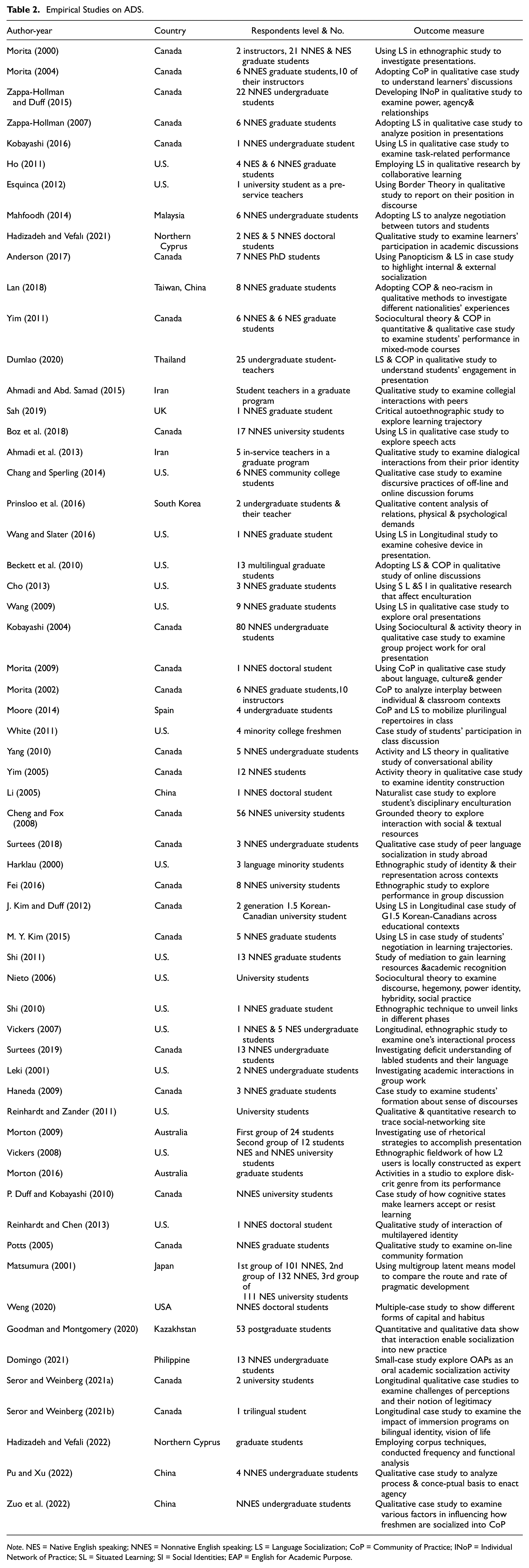
Note. NES = Native English speaking; NNES = Nonnative English speaking; LS = Language Socialization; CoP = Community of Practice; INoP = Individual Network of Practice; SL = Situated Learning; SI = Social Identities; EAP = English for Academic Purpose.
Theoretical Studies.

Conceptualizing Academic Discourse Socialization
ADS research views learning as developing the capability to participate in new discourse communities, construct the identity and voice in new culture, benefiting from social interaction and cognitive experiences (P. Duff & Kobayashi, 2010). The theoretical subsection put more emphasis on theoretical orientations illustrated in relevant studies.
Theoretical Orientations to Academic Discourse Socialization Studies
The theoretical frameworks of every ADS research determine the overall orientation of its analysis and strategies put forward to overcome challenges. Among the 72 studies selected, 62.5% employed various theories to conduct research on learners’ enculturation experiences, while 37.5% did not make use of any theory. In terms of 12 theories adopted by multiple studies, language socialization (LS) theory has been used as the most widely utilized theoretical framework (26.7%) regarding academic discourse socialization in second language learning contexts at higher education level (e.g., Domingo, 2021; Dumlao, 2020; Kobayashi, 2016; Morita, 2000). LS focuses on the nature of language-mediated social interactions and the role they play in socializing novices into target cultures and groups, in which they seek identities, competence and membership in new contexts (Schieffelin & Ochs, 1986; Vygotsky, 1987). Among several research articles that have successfully applied LS theory in post-secondary settings (e.g., Boz et al., 2018; Dumlao, 2020; Matsumura, 2001; Okuda & Anderson, 2018), Zappa-Hollman’s (2007) study framed in LS theory examined how to enact participants’ agency in resistance, adaptation or reaction in various ways to accelerate their enculturation in particular contexts. In line with previous studies on discourse socialization, Ho (2011)’s finding showed that inexperienced students would like to adopt an expert voice on oral topics to prevail over others in group activities.
Compared with studies characterized by obvious and static interactions, Morita’s (2000) study framed in LS theoretical orientation showed a more dynamic, moment-by-moment negotiations of participants’ dilemmatic identities, complex knowledge and skills. The LS theory, however, does not explicitly explain the process of how learners construct competence, identities and membership through interacting with other participants, presenting their ideas in academic discourses. Therefore, it is necessary to introduce other theories to explain how learners behave and construct their identity as a member of the academic community.
The community of practice (CoP) is the second widely applied theory (17.8%) in ADS research (e.g., Anderson, 2017; Morita, 2002, 2004, 2009; Weng, 2020). As a situated learning theory, CoP explores the socialization of learners with common interests in some domains, the co-construction of cultures, and the social influence of guided membership in target cultures (Wenger, 1998). For instance, P. Duff’s (2012) study indicated that novices, once treated as a legitimate group participant, will be more confident to gain social experience, knowledge and support from more experienced members through sustained participation in the same CoP, resulting in increased proficiency and participation in the target community. In turn, Anderson (2017) pointed out that in the process of newcomer’s socialization into academic groups, co-participants also gain experience from continuous socialization, which causes the enculturation to be bidirectional.
Different from the above sociolinguistic theories, a psycholinguistic theory named sociocultural theory (SCT) is adopted as the third widely utilized theory (8.9%) in an increasing number of L2 research (e.g., P. A. Duff, 2007a; Nieto, 2006; Swain & Lapkin, 2000). According to Lantolf and Thorne (2007), human mental functioning is regulated by language and other culturally constructed symbol systems, tools and particularly through private speech and inner speech. Personal interaction is a fundamental way of learning, providing scaffolding or regulation of people’s learning behavior and reasoning. Therefore, learning is a historically situated cognitive interaction which involves a variety of semiotic tools and artifacts of communities. Kobayashi’s (2003) study grounded in Vygotskian SCT theory viewed project work as a chance for students to become more fully competent speakers about academic culture through adequate interaction with community members. Moreover, P. A. Duff (2007a) explored the theoretical compatibility of Vygotskian SCT and LS, and then illustrated two current analytic approaches based on SCT, namely, indexicality in language learning and a community of practice orientation.
The frequency of adoption of other theories like activity theory, social network theory, Panopticism, etc., were very low, less than 5% among investigated studies. Apart from the utilization of diverse theories, Zappa-Hollman and Duff (2015) developed the notion of individual network of practice (INoP) based on community of practice (Wenger, 1998) and social network theory (Milroy, 1987) as a construct for making analysis on ADS. INoP puts the learner at the center of the language socialization and takes other participants into consideration who interact and take part in discourse process. Compared with macro-theoretical framework like LS and CoP, INoP attaches more importance to examine individual issues of agency, motivation, power connections and strength of relationships. INoP, moreover, are developed to examine the micro-interactions in linguistic practices while these interactions affect student linguistic proficiency and socialization in a particular situation over a longer time.
Except for making use of one particular theory as the framework, 17.7% studies adopted one central theoretical framework while drawing variously from other analytical perspectives (e.g., Dumlao, 2020; Kobayashi, 2016; Lan, 2018; Morita, 2004; Yim, 2011). To take Kobayashi’s (2016) study as an example, it drew primarily upon the LS theory, which stressed the role of language-mediated social activities in apprenticing novices into the target community. Meanwhile, Lave and Wenger’s (1991) situated learning theory indicated learning as a progressively responsible participation, and Lier’s (2004) ecological-semiotic perspective stressed increasingly effective ways to deal with problems resonate with the LS theory. Similarly, Anderson’s (2017) study drew on CoP and panopticism which is a theory of disciplinary control based on Jeremy Bentham’s Panopticon. It emphasized the real and imagined disciplinary powers that influence doctoral students’ performance, interaction, speaking and self-mediation within academic communities and how they are socialized from the periphery to the core position of the community.
Summary of Theoretically-Based Studies
After several attempts have been made to analyze ADS under different theoretical frameworks, even within a newly-developed concept, common features or similar aspects of ADS have been identified in theoretically-based studies. In the context of higher education, the majority of research has been qualitative or exploratory to explain students’ apprenticeship into academic and linguistic practice. Their participation is constantly co-constructed and renegotiated by other participants and the contexts at large. However, the external validity of theoretical orientations needs to be further examined. Promoting a theoretically valid and diverse conceptualization of ADS is to explore what it means to a wider range of university students and their ways to be socialized into academic communities.
Empirical Studies on Academic Discourse Socialization
An emergent line of field-based research have documented various kinds of conflicts, tensions and discrepancy that language learners might be confronted with when attempting to be socialized into the target culture. The following section is designed to analyze relevant empirical studies regarding how to prepare students academically in English for academic purposes courses and programs or English as a second language conducted between 2000 and 2022, revealing a changing trend in studies associated with the concept of ADS.
Participants and Contexts
Almost half of the empirical investigations reviewed (48.3%) were centered on graduate students subjects (e.g., Hadizadeh & Vefalı, 2021; Lan, 2018; Morita, 2000, 2004; Wang & Slater, 2016; Yim, 2011), and the other half (51.7%) have tracked the learning trajectories of undergraduate students (e.g., Chang & Sperling, 2014; Dumlao, 2020; Kobayashi, 2016; Mahfoodh, 2014). Except for only eight studies conducting research on both non-native English speaking (NNES) and native English speaking (NES) students, the majority of these studies (86.7%) focused on NNES students, who were international students making progress in expertise and adaptation in new communities. The literature in recent years has also expanded to include the research examining the changing participation and identities of specific student populations such as students taking online courses or participating in online communities (Beckett et al., 2010; Prinsloo et al., 2016; Yim, 2011), students using hybrid communication model (Chang & Sperling, 2014), exchange students (P. A. Duff, 2007a), student teachers in the final year of the undergraduate studies (Dumlao, 2020; Esquinca, 2012), and in-service teachers attending graduate programs (Ahmadi & Abd. Samad, 2015; Ahmadi et al., 2013).
A greater research interest ADS already had a strong precedent in North America (71.7%), the Canada (40.0%) in particular (e.g., Anderson, 2017; Boz et al., 2018; P. A. Duff, 2007a; Morita, 2000, 2004; Zappa-Hollman, 2007). The reason why ADS research is prominent in Canada can be figured out from the analysis of leading or prolific authors in this field. Considering the co-authorship of many publications, only the first author is taken into consideration in authors list. Meanwhile, the number of academic contributions is accounted according to the papers authors published as the first author. Notably, Patricia A. Duff from Canada is the leading author with eight publications on this topic in the 20-year time span, whose main scholarly interests are related to language socialization across a variety of bilingual and multilingual settings. Other prolific authors like Naoka Morita and Masaki Kobayashi publish 5 and 4 publications each, both of whom pursue PhD studies in the University of British Columbia. Among the selected 24 empirical studies published in Canada, the authors have either work duties or learning experiences in Canadian universities, which makes this topic quite prevailing there.
Only a few studies focused on university students’ discourse socialization in English as foreign language settings from non-Western parts of the world to provide a global coverage, such as Malaysia (Mahfoodh, 2014), China( Lan, 2018; Li, 2005; Pu & Xu, 2022; Zuo et al., 2022), Northern Cyprus (Hadizadeh & Vefali, 2022; Hadizadeh & Vefalı, 2021), Thailand (Dumlao, 2020), Iran (Ahmadi & Abd. Samad, 2015; Ahmadi et al., 2013), Spain (Moore, 2014), South Korea (Prinsloo et al., 2016), Japan (Matsumura, 2001), Kazakhstan (Goodman & Montgomery, 2020), and Philippine (Domingo, 2021). Even though researchers have made attempts to explore the aculturation into academic discourses of different student populations affiliated with post-secondary institutions all over the world, the potential generalizability of results for students in other contexts is somewhat questionable.
Apparently, the research of ADS in higher education has not been fully investigated and explored in English as foreign language contexts (P. A. Duff, 2010; Friedman, 2023). With more effective restruction efforts and promotional campaigns at postsecondary educational institutions in non-Western regions of the world, an increasing number of international students are attracted to such places for further study, so the student population of postsecondary institutions grows increasingly multilingual and multicultural. Undergraduate or graduate students are reported to be confronted with many cognitive and psychological challenges in their participation of the oral academic discourse (Morita, 2000). Besides, socialization into multilingual contexts stresses the multi-directionality of the academic enculturation process, among experts and novices, and socially-, cognitively-, and contingent nature of the apprenticeship (P. Duff & Anderson, 2015), which lead to a range of possible outcomes and pathways (Morita, 2009). Learners who have possessed linguistic, cultural and discursive repertoires may resist, selectively appropriate, or accept new behavior norms or values when learning a foreign language and negotiating membership into new communities. All these changes point to a need for more research in how learners are socialized into academic communities where English is the foreign language.
Research Approaches
Research methods ranged from the large-scale quantitative studies to the in-depth, longitudinal qualitative approach (e.g.,: case study, ethnographic approach, and narrative) and then, hybrid research employing both qualitative approach and quantitative analysis of L2 development. Early research regarding oral academic discourse primarily focused on oral communication needs of L2 students and how they perceived about in-class oral tasks through a questionnaire survey approach (Ferris & Tagg, 1996; Jones, 1999). Even though these large-scale survey offered representative suggestions for instructors’ organization and arrangement of oral tasks, they may not examine the interactional process between teachers and students and its situated nature as well (Morita, 2004). In consideration of this limitation, some L2 researchers chose to adopt qualitative approaches to provide rich account of oral ADS at tertiary level.
The majority of reviewed studies (93.3%) adopted a longitudinal, qualitative, multiple-case study with many kinds of data collected from various resources (e.g., Boz et al., 2018; Dumlao, 2020; Lan, 2018; Prinsloo et al., 2016; Séror & Weinberg, 2021a), while one conducted a critical autoethnographic study to reflect the researcher’s trajectory of English language learning experience abroad (Sah, 2019). These studies are conducive to adding to our theoretical understanding of different types of students’ enculturation into academic and linguistic practices. P. Duff and Anderson (2015) have summarized three general methodological types in language socialization studies: researchers’ direct observation, documentary analysis, researchers’ autobiographical narratives. As such, three categories of research approaches in ADS can be divided into: (1) researcher’s observation and written narratives or field notes of students’ interaction in class activities. (2) interviews with focal participants and instructors to understand their perception and expectation of students’ academic performance. (3) written documentary analysis such as course outline, written feedback, self-reports to have a micro-analysis of discourse in academic contexts. Yet, there are one quantitative study examining changes in students’ perceptions of social status and the impact of altered perceptions on pragmatic language use through multigroup latent means model (Matsumura, 2001).
Methodological strength of these qualitative studies include the use of a variety of methods to collect and analyze data (e.g., Anderson, 2017; Kobayashi, 2003; Morita, 2004; Zappa-Hollman & Duff, 2015), cross case comparison (Lan, 2018), prolonged research time in the field (Ahmadi et al., 2013; Sah, 2019), a holistic review of literature (Ho, 2011; Zappa-Hollman, 2007). Therefore, many qualitative studies have demonstrated accuracy and similarity in findings through providing rich account of results (P. A. Duff, 2007a; Okuda & Anderson, 2018), or participant observer (Zappa-Hollman, 2007).
However, some reviewed qualitative studies are considered to be methodologically flawed because they conducted research on a limited number of participants (Beckett et al., 2010; Mahfoodh, 2014), failed to provide sufficient empirical evidence to support conclusions or recommendations (Hadizadeh & Vefalı, 2021). The inductive analysis on data does have high internal validity but lack member checking, or efforts to show data reliability. Of greatest concern was a lack of comparison of different oral activities in various academic contexts (e.g., different disciplines or countries), or interrelation of oral and written discourse in academic settings in the majority of the reviewed studies (Morita, 2000, 2004).
With the goal of having a holistic and thorough understanding of participants’ cross cultural behavior, such understanding are made possible by hybrid research using mixed-methods adopted in four studies which are worth of mention due to their methodological integrity (Goodman & Montgomery, 2020; Kinginger, 2011; Reinhardt & Chen, 2013; Yim, 2011). Yim’s (2011) study combined quantitative analysis with qualitative multiple-case study through completing written questionnaires, two rounds of interviews with focal participants and instructors, classroom observations, examination of the BB texts and course documents like handouts and syllabi. Additionally, Reinhardt and Chen (2013) discussed the influence of in- and out-of-class interactional activities on students’ academic adaptation by choosing mixed-method study tracking the participant’s use of social networking sites, which are part of the academic discourse community cultivating the emotional and academic strength and proper behaviors.
Communication Events
Since social interaction contextualized within certain routine activities plays an important role in communicative competence and identities, practices of the new group, it is important to develop a typology of oral activities for university students to provide rich account of oral academic discourse in different institutions, which would enable making comparisons across contexts (P. A. Duff, 1995). Recent research began to address this gap by focusing on oral academic discourse development (Kobayashi, 2003; Morita, 2000, 2004; Robinson et al., 2001; Weissberg, 1993).
Eight kinds of interactional events involved primarily include oral academic presentations (OAP) (e.g., Domingo, 2021; P. Duff & Kobayashi, 2010; Dumlao, 2020; Kobayashi, 2003, 2006, 2016; Wang & Slater, 2016; Yang, 2010), small-group or class/team discussions (e.g., Hadizadeh & Vefali, 2022; Hadizadeh & Vefalı, 2021; Ho, 2011; Leki, 2001; Morita, 2000, 2004, 2009; Poole, 2010; Vickers, 2008), negotiation simulations (Shi, 2010; Shi, 2011), critique sessions in studios (Morton, 2016), teacher-student conversations (Ohta, 1995; Poole, 2010), literacy events/conferences (Boz et al., 2018), out-of-class activities (e.g., Fei, 2016; Kobayashi, 2003, 2004; Reinhardt & Zander, 2011; Shi, 2011; Surtees, 2018; Zappa-Hollman & Duff, 2015), digital interaction (e.g., Beckett et al., 2010; Chang & Sperling, 2014; Prinsloo et al., 2016; Ranta & Meckelborg, 2013). Various types of in- and out-of class activities offer various sources of data as to novice’s socialization into the preferences and norms established by the authority in academic surroundings.
The OAP was portrayed most frequently in studies (15.0%) as an instance of academic and linguistic apprenticeship during which participants seek familiarity and membership in their respective fields. The research has examined the OAP in higher education contexts not only from the perspective of textuality, register, but also concerning on identity and positionality (Kobayashi, 2003, 2006; Morita, 2000; Yang, 2010). Preparation before the presentation (Kobayashi, 2003), the presentation itself, observation of instructor’s feedback and other’ communication style, self-reflection (Yang, 2010) are steps to realize their familiarity with how to participate in the classroom culture and attempt to meet the course criteria.
Another most commonly utilized activity is the group discussion, occupying 15.0% ADS studies. In small-group discussions, instructors’ and learners’ participation and performance would have weighty consequences in academic and social aspects. The collaborative group discussion can also be an important means to build a social network where participants are able to engage actively in the disciplinary learning process within their classroom or team (Ahmadi & Abd. Samad, 2015; Vickers, 2008). Features of small-group discussion as academic socialization in linguistic practices are concluded from the analysis of the transcribed data: “participants construction of expert-novice identities, engagement in critical thinking and reasoning, and making intertextual connections” (Ho, 2011). However, small group work cannot guarantee equal participation since occupation of more powerful positions by their peers would exclude them from joining in the discussion (Leki, 2001).
Other studies (11.7%) began to explore the role of out-of-class activities in ADS, which is the second widely used activity. Students’ peer collaboration and social support out of the class took the mediational use of peer interaction into consideration (Kobayashi, 2003, 2004). Moreover, students’ informal interactions with other students connected by social networks gave them affective and academic support (Reinhardt & Zander, 2011; Zappa-Hollman & Duff, 2015). Also, P. Duff and Kobayashi (2010) investigated undergraduate students’ cooperation out of the class for preparation of their in-class tasks, which helped them earn recognition from teachers. All these preparation encouraged students to take a more active role in class participation (Morita, 2009). On the contrary, Zappa-Hollman (2007) and Shi (2011) reported cases that preparation outside of the class did not necessarily lead to satisfactory class performance or recognition. To be more specific, Fei’s (2016) study figured out the exclusion of students with different linguistic backgrounds in group planning work. Overall, students’ informal interactions outside the classroom for in-class tasks enabled them to communicate and engage effectively or ineffectively in group work, which is an important means for them to become experienced members in particular communities, though in some cases it is not optimum.
The investigation on how to use different modes of communication to socialize students into the target academic community remains to be a new research area (P. A. Duff, 2010; P. Duff et al., 2019). Digital interaction, as the third widely adopted activity (8.3%), has become ubiquitous in higher education, and its effects on learning experiences of students have been illuminated from different perspectives. What participants are doing in online academic communities (Potts, 2005; Yim, 2011), including online discussion forums (Chang & Sperling, 2014), instant messaging (Prinsloo et al., 2016), online graduate courses (Yim, 2005), social networking sites (Reinhardt & Chen, 2013), and online asynchronous discussions (Beckett et al., 2010; Potts, 2005; Yim, 2011), are important means to address academic assignments and adapt to the cultural norms of the group. Students treat them as a virtual community for academic and professional socialization and appropriation into linguistic practices. Yim (2005) suggested that the key lessons learnt from online education could be applied to conventional face-to-face classes, and the distinct norms, forms and ideologies of online discourse defines the nature of academic discourse more broadly and diverse (Yim, 2011). Online activities are treated as a communicative tool to create a sense of community among students from the personal domain to professional academic practice, which provide complementary opportunities for learning to facilitate their socialization into academic communities.
Other activities such as the teacher-student conversations, literacy events, etc., was seldomly employed in ADS studies (not exceeding 5%). The teacher-student conversations are portrayed as culturally structured mediums of expressions to promote the socialization of learners into L2 communicative norms. Teachers help students to interact with others beyond their current competence levels by scaffolding (Poole, 2010). Also, the literacy events–interaction with the written texts–impede or accelerate students’ access to the host culture and its discourse based on their response and reception of their feedback and its actual impact. The written work like written feedback plays a formative role in learners’ construction of affective stances, identities and access to preferred linguistic practices in target group (Lillis & Curry, 2006).
Academic Outcomes
The aforementioned studies have illustrated the distributed and complex nature of discourse socialization in academic communities, in which students make use of various resources to deal with challenges. Most notably, several studies (41.7%) have confirmed the positive relations between language-mediated social interactions and socialization into academic contexts (enculturation, academic adaptation) (e.g., Anderson, 2017; P. A. Duff, 2007a; Hadizadeh & Vefalı, 2021; Kobayashi, 2003; Mahfoodh, 2014). It is necessary to acknowledge the socially constructed nature of interaction and participation within classroom (Morita, 2004; Norton, 2001).
Apparently, Lan’s (2018) study revealed that the social interaction with host academic community members are key to international graduate students’ ADS. Also, Ahmadi and Abd. Samad (2015) implied that learners’ participation in language-mediated sociolcultural activities like group discussion plays an important role in students’ engagement and acquisition of the sociocultural, linguistic knowledge and practice rules. Conversely, Boz’s, Barrantes and Tweedie’s (2018) study indicated that low competency in social interaction with the target community and lack of engagement in campus activities restricted the language development and academic success. Moreover, Cheng and Fox (2008) indicated that even with linguistic, academic, and social support from multiple sources, students do not perceive all supports as positive in their academic enculturation. Anderson’s (2017) study showed that participants’ initially being adversely affected socializing experiences would turn out to be self-reflective and mostly positive in their subsequent reactions, which is conducive to attaining students’ academic success in linguistic practices. The confrontation, negotiation, and graduate integration of a variety of socio-cultural norms and systems show the complexity, multiplicity and fluidity innate in socialization process (Shi, 2010).
Additionally, current studies (31.7%) discuss the roles of impactful agents in individuals’ identity formation and socialization process (Ahmadi & Abd. Samad, 2015; Hadizadeh & Vefalı, 2021; Kobayashi, 2003; Lan, 2018; Morita, 2000; Surtees, 2018). Participants’ language socialization is largely affected by academic communication with more experienced members or novices who have similar goals and backgrounds. In terms of peer interaction, more proficient members of a group are crucial to socializing novices by implicitly or explicitly teaching them to think and act according to the values and traditions of the academic communities (P. Duff & Talmy, 2011, p. 98). In addition, instructors could encourage more experienced members to make contributions to the preparation and moderation of in-class activities (Beckett et al., 2010; Hadizadeh & Vefalı, 2021; Yim, 2011), or model oral activities at the beginning of the course to facilitate their understanding about expected performance (Yang, 2010). Newcomers also convey their communication needs to more experienced members who value newcomers who ask for language help and display willingness to improve linguistic compentence (Surtees, 2018). As such, the process of academic socialization in linguistic practice are portrayed as bidirectional or even multidirectional when multiple models of expertise exist at the same time (P. A. Duff, 2007a; P. Duff & Doherty, 2015).
Finally, the intertextuality between the oral performance and written work has been explored to some extent (68.3%), but “has yet to be more than minimally reflected” in applied linguistics research (Poole, 2010, p. 77). Morita (2000) claimed that the students’ oral presentations were based on written material, so they could be considered as literacy events in which written language plays an important role in the formation of participants’ interactions and interpretive strategies. Other researchers also claimed that they have extracted useful information from written documents or assignment for the evaluation of oral ADS for L2 students (Kobayashi, 2003, 2016; Morita, 2000; Okuda & Anderson, 2018; Zappa-Hollman, 2007). In turn, Kobayashi (2016) suggested that the presenter take down answers to the questions put forward by other classmates in their paper after the OAP, which was portrayed as a step toward writing task.
Summary of Strengths and Weaknesses of Empirical Studies
Overall, findings conducted between 2000 and 2022 have indicated a positive relationship of social interaction on participants’ ADS. Additionally, some studies have expanded our understanding of ADS through using multimodal communications to facilitate the process of socializing specific student groups into certain norms, practices and social networks, stressing the changing ways in which students’ investments and identities may be shaped. Recent work has begun to focus on “nontraditional” students who need to acquire academic discourse in the increasingly multicultural communities. Moreover, language learners, being multilinguals across countries, in addition to language learning practices, confirm their own identities and status from novice to expert, outsider to insider in new communities.
Nevertheless, the reviewed article also identifies some areas of methodological concern within relevant studies. The majority of research sites has been chosen in the North America, especially the Canada, while a few studies explore students’ socialization process in other academic communities. Second, many of the reviewed qualitative studies have failed to provide sufficient empirical evidence (a limited number of participants, a narrow focus on linguistic features, single type of activity, similar contexts) to support the conclusions. The inductive analysis made by researchers has high internal validity, but failed to demonstrate reliability due to a lack of member checking or method triangulation. Third, the interrelation of oral and written discourse in academic settings in the majority of the reviewed studies has been analyzed to some extent, but remains to be a promising area to explore more about how to facilitate ADS. Forth, many of the reviewed studies failed to take other variables into consideration such as insufficient support, incompetent linguistic ability, communicative incompetence and social inadaptation that might impact the enculturation of international students into the target culture.
Discussion
This study conducted a systematic review of selected publications to examine the body of literature on ADS. Research reviewed above has expanded understanding about the ADS and repertoire of language learning strategies, and four major areas of current research on ADS are summarized. More efforts need to be made for better understanding and accommodation of learners’ needs, as well as tapping their potential, and facilitating academic socialization in linguistic practice.
Main Areas of Research
One of these research areas concerns various types of socialization agents, playing mediation roles of scaffolding and support on students’ acquisition of language and tacit sociocultural knowledge. Cultural novices become apprenticed into their community by learning valued practices from more experienced members (Vickers, 2007), or gaining legitimacy and respect from peer collaboration (P. Duff & Kobayashi, 2010; Ho, 2011; Yang, 2010). Another form of apprenticeship happened in teacher-student classroom interactions (Poole, 2010), teacher’s modeling or instruction (Chang & Sperling, 2014; Morita, 2009), professors’ feedback on academic assignment or instructions in lectures and examinations (Mertz, 2007). They may also involve other forms of distributed support from within or outside the institution (P. Duff et al., 2019). Many researchers indicate that instructors as relative “experts” function as more effective socializing agents than others, assisting students in their active and meaningful participation in academic activities (Morita, 2004, 2009). Meanwhile, multiple linguistic resources (native language or dialects, rhetoric devices, lexical bundles) might serve as a scaffold for students’ completion of academic tasks, shedding light on the mediation function in foreign language learning (P. Duff & Kobayashi, 2010; Fei, 2016; Hadizadeh & Vefali, 2022; Kobayashi, 2004; Moore, 2014; Morton, 2009).
Another important area of current research deals with the issue of students’ feedback, either as internally generated form of discomfort as well as immediate identification with the linguistic and cultural practices, or externally afforded by instructors, peers or networks in identity construction among new target communities. Some studies suggested that NNESs, who perceive themselves as individuals with unique ideologies and learning trajectories, would better be multicompetent, legitimate, and full member of the target community, rather than weak and incompetent peripheral members (M. Y. Kim, 2015; Surtees, 2019). Meanwhile, co-constructed through interactions and social practices under current power structures and prevailing discourses, students’ anxiety or familiarity affected their experiences of socialization and how they are positioned by individual and institutional factors in each local setting (Leki, 2001; Shi, 2011). Fei’s (2016) study indicated that some discursive structures in universities would disadvantage newly-arrived multilingual speakers, which causes power imbalances and struggles between different groups in their group projects. Additionally, it is noted that the most valued components of oral academic discourse are often in the form of teacher’s feedback (P. A. Duff, 2010).
A third area of current research relates to the learners’ identity construction in tasks/events. Learners develop their identities through active devotion in single type of activity, or adoption of different learning strategies across events. Many studies have detailed how students made use of discursive practices in one speech event, leading to social marginalization or satisfactory agreement in academic communities (Shi, 2010). Furthermore, engagement across events enabled researchers to make cross-event analysis of students’ performance and interactions in oral activities, which provides a holistic and thorough understanding of their learning progress (Ahmadi et al., 2013; Kobayashi, 2016). In socialization process, acceptance or resistance of the support means the critical adoption of certain academic ideologies, attitudes, values and practices in ADS process, which embodies their agency in shaping identities, ideologies and practices (J. Kim & Duff, 2012; Morita, 2009; Reinhardt & Zander, 2011). Adoption of different learning strategies across events is vital to capture individual’s learning trajectories.
The fourth line of current research correlates with assessment of consequences of ADS. Oral communication skills presented in oral activities have been stressed and assessed more than before (e.g., P. Duff & Kobayashi, 2010), since it involves linguistic proficiency as well as culturally based knowledge in socially appropriate ways. The evaluation is based on participants’ social interaction skills and their acquired knowledge of academic discourse. Assessment tools also emerged as a means increasingly used in class activities. However, assessing the socialization outcomes is complicated due to its dependence on multiple values of a given academic community and individual’s personal goals (Morita & Kobayashi, 2008). Furthermore, exploring the universal aspects of ADS and more general aspects of communicative practice are potential areas that researchers seem to be less inclined.
Limitations
Since much research has been conducted at the class level, what influence will resources at the macro level like program leaders, deans or presidents impose on students’ ADS? Furthermore, significant events may push learners to master new social codes and discursive genres. However, few studies have marked this path of conducting research at macro and micro level of interaction within postsecondary institutions, like P. A. Duff’s (1995) early study of classroom discourse patterns affected by sociopolitical reforms of the post-Soviet era in Hungarian secondary school. In addition, it is still an untapped area to conduct research studying the use of digital technologies in mediating students’ apprenticeship from tracking network to assessment tools. Moreover, this review was limited by the choices made in types of students, disciplinary fields, research contexts, variety of oral activities, and points of view. Another limitation of this review is a lack of study in the linguistic productions of speech events and correlation of oral and written discourse in academic communities. Finally, identifying students’ needs can be difficult because of their multiple cultural and educational backgrounds, and therefore, strategies to best promote their apprenticeship remain unexplored.
Recommendations
First, we can conclude that more research requires a thorough investigation on students’ ADS at the collegial or institutional level. The ultimate goal is to figure out how macro level resources and power impact individual learning development. Moreover, sociopolitical events like Covid-19, as one big event in social contexts, would promote the online teaching and discussion as well, making great changes in how students socialize themselves into the virtual world without face-to-face contact on campus. The perspective, therefore, should be comparative, recognizing some aspects to be universal while others vary with different sociocultural events. More attention need to be paid to micro-macro connections in postsecondary institutions to show how institutional structures and social events intertwine with the daily learning of individuals.
Furthermore, digital technologies like visual representations tracking network or assessment tools are designed to provide rich accounts of complex and dynamic nature of network building and its influence on socialization and language acquisition. There is a need to track more closely the composition of connections and the progress within social networks, which are chances to have more knowledge about the impact of social networks on participants’ motivation, identities and agency, and provide assistance with efforts to develop such connections for those indeed. There is also a need for assessment tools, not only be used to evaluate the completion of academic tasks, but also be further developed to facilitate students’ involvement in technology-mediated tasks of ADS.
Beyond a strong connection between micro analysis and macro events concerning ADS perceived by different types of students at post-secondary institutions and promotion of digital tools, methodological rigorous research are needed to expand more types of students from a wider range of linguistic, academic and culture backgrounds (most NNESs were from Asia in relevant studies) as well as more disciplinary fields. In particular, for some non-traditional students like minority students, educators need to take the cultural implication of their demands into consideration, and conduct class activities in a culturally sensitive manner (White, 2011). Future research need to be conducted to explore how diverse backgrounds (cultural, academic, et al.) enable learners to acquire expertise, competence and identities in more effective ways.
There is also a need for contextualized interpretations of learners’ insiders’ voices and behaviors by triangulating multiple data sources in different contexts. Except for making more attempts to conduct research in different universities or countries, it is another attempt to follow one language learner’s learning trajectory across different educational settings, such as Harklau’s (2000) study contrasted prevalent institutional images about a language learner from the secondary school to the community college. Séror and Weinberg (2021a) also examined student’s linguistic development from high school language programs to a university-level immersion program designed to enhance levels of bilingualism. Chances are that more research will be conducted to explore representation of language learners from the university to the workplace or other graduate programs, analyzing how students’ identities are appropriated and recreated by students in one context and resisted by students in another. These efforts strengthen the link between papers with ethnographic study design to make broader theoretical conclusions. In short, an ethnographic study with diverse research sites may be a better choice to analyze participants’ discourse socialization and language acquisition.
Because language socialization took place through repeated experiences in gaining a variety of social roles in language-related activities that facilitate language acquisition and communicative interaction connected with these roles, the ADS research should go beyond the confines of only one task in a study. The examination of various types of oral activities or in different disciplines will enable comparison and insightful findings in academic settings, having students’ needs met or engaged in various interactional styles (Ahmadi et al., 2013). Taking a behind-the-scenes look at contingency across activities and contexts through the use of a variety of methods to allow for a consideration of etic and emic views (Kobayashi, 2004). Also, employing team-based projects promote an understanding of cases from multiple perspectives on various scales, and provide reflection on some controversial ideologies (P. A. Duff, 2019). On a practical level, assisting or scaffolding language learners’ comprehension and performance of class activities from faculty’s perspective would offer new insights for pedagogical intervention. Examining how instructors view students’ socialization and their own transformations is an attempt to meet various learners’ needs.
It is suggested to raise L2 learners’ awareness of the linguistic productions of speech events to facilitate their ADS. Paying more attention to linguistic features (e.g., semiotic modes, multiple voices) are another important means for language learners to self-monitor and improve their linguistic productions in oral academic discourse. In addition, written texts (e.g., syllabus, textbooks, writing assignment, etc.) are one of the data sources for studies concentrating on oral academic discourse (P. Duff et al., 2019). Active participation in oral events needs some literary skills like critical thinking and reading. The correlation and interaction of oral and written discourse in academic communities have been explored to some extent (Li, 2005; Morita, 2004; Okuda & Anderson, 2018; Zappa-Hollman, 2007; Zappa-Hollman & Duff, 2015), but remain to be a promising research area for the further understanding of ADS. “Cross-modality research” (Weissberg, 1993) may be novel ways to uncover the relationships between oral and written discourse in academic contexts.
With various challenges international students may face, more attention should be paid to students’ development of linguistic, sociocultural knowledge, affiliations, competencies and textual identities in new learning communities through appropriate scaffolding and mediation (Kim & Duff, 2012; Morita, 2009). Seminars, one-on-one tutorial services, or emancipatory classroom practices (Morita, 2002) would address the academic needs of graduate students in a given discipline. In addition, joining efforts from multiple sides like instructors, colleagues, and students as well as academic communities (universities and other sites for socialization into academic discourse) to form a supportive network could ease the tensions and difficulties arising from the diversified contexts and accommodate their specific needs.
Footnotes
Declaration of Conflicting Interests
The author(s) declared no potential conflicts of interest with respect to the research, authorship, and/or publication of this article.
Funding
The author(s) received no financial support for the research, authorship, and/or publication of this article.
