




Abstract
Drawing on Stimulus-Organism-Response (SOR) and Attitude-Behavior-Context (ABC) models, this study aims to propose a comprehensive theoretical framework, measuring the service delivery performance of Union Digital Center (UDC) on citizen satisfaction and use behavior by utilizing the extension of the SERVQUAL model with another two dimensions: “Information Quality” and “Service Availability.”“Value co-creation” is also used as a boundary condition in this integrated framework. This study is the first endeavor of the SERVQUAL model to explore the satisfaction of UDC users in Bangladesh with the role of user co-creation behavior. In doing so, a total of 411 data was collected from the users of UDC through a structured questionnaire. This study then utilized PLS-SEM, Mplus and PROCESS-Macro for hypothesis testing and other inferential statistics and found a significant impact of the exogenous variables (service availability, information quality, responsiveness, reliability, assurance, information quality empathy, and tangible) on satisfaction and use behavior. A moderated role of value co-creation was found in relationship between all the dimensions of service quality except information quality, assurance, and empathy. Thus, promoting value co-creation, meaning involving citizens in the service delivery process, would be a good strategy that may influence their attitude and further use. The findings of this study can be used as a theoretical basis, especially for improving the service quality and accelerating user satisfaction of digital centers in rural areas. Furthermore, this integrated framework can be applied to evaluate the digital service centers in other developing countries.
Introduction
Over the past two decades, governments across the world have significantly expanded and improved information and communication technologies (ICTs) by introducing numerous applications and initiatives, which have led to greater transparency within public sector entities and enhanced the efficiency of service delivery (Bindu et al., 2019; Choi & Chandler, 2020; Dwivedi et al., 2017; Ibrahimy et al., 2023; Y. Li & Shang, 2023; Musaad, 2023; R. Sharma & Mishra, 2017; S. K. Sharma et al., 2021). However, despite increased investment in e-government projects, governments face numerous challenges, as highlighted by Ojha and Pandey (2017), leading to citizens’ dissatisfaction and subsequent criticism (Patergiannaki & Pollalis, 2024), which scholars have extensively evaluated e-government services from the citizens’ standpoint (Alblooshi et al., 2023; Alkraiji & Ameen, 2022; Distel & Lindgren, 2023). In Bangladesh, the transition towards e-government significantly commenced around 2010, coinciding with the government’s decision to implement substantial changes at the grassroots level (Siddiquee, 2016). Before this period, Bangladesh’s government relied on manual methods to deliver services to citizens in rural areas, which were plagued by extensive delays, causing frustration among citizens due to prolonged resolution times for their issues. To address those challenges, the government embraced e-governance as the prime mechanism (Osman, 2016). Therefore, UDCs were established across the country, referred to as “one-stop information and service delivery outlets” at the smallest administrative level of local government to facilitate this transition in Bangladesh (Mamun et al., 2018), and it’s one of the most important channels for delivering public services in rural areas. Many developing countries need help to adequately address citizens demands within public institutions (Manda & Ben Dhaou, 2019; Sabani et al., 2023). In developing countries, individuals in rural and peri-urban areas often need help navigating traditional, bureaucratic, and conventional public service delivery systems. Accessing government services typically involves engaging numerous intermediaries, resulting in higher operation costs than required (Deichmann et al., 2016).
The main motive of delivering services to citizens through a top-down approach (Baroi & Alam, 2021). However, these approaches often need to pay more attention to the user’s (e.g., citizen) needs, leading to shortcomings in achieving desired objectives and maintaining advantages (Bertot et al., 2010). Hence, the top-down approach, the participatory design approach, has been proposed to meet citizens’ requirements for public services and enhance overall quality, reliability, usability, and security (da Silva & Neves, 2024). Through the proposed approach, a citizen can easily share their opinion based on the delivery of the service process, which leads to improved service quality and reliability of government services (Khan & Krishnan, 2021; Nawafleh & Khasawneh, 2024). This approach facilitates interaction among users and service providers, enhancing quality and satisfaction (Olphert & Damodaran, 2007). By enhancing knowledge and opinion exchange between users and service providers, the participatory approach effectively mitigates the shortcomings of the top-down approach. Therefore, the participatory approach proves more apt for enhancing citizen services, allowing individuals to express their opinions on received service, known as citizens’ co-creation behavior in service provision. Hence, co-creation is considered an active participation and collaboration between citizens and government in policy issues (de Jong et al., 2019; Vega-Vazquez et al., 2013).
As part of the participatory approach, the value of Co-creation, originally a concept emerging from the field of service management and the marketing literature (Osborne et al., 2016), has now gained widespread recognition and investigation across diverse domains, including e-government and public administration (Cordella & Paletti, 2017; Edelmann & Virkar, 2023; Osborne, 2018; Uppström & Lönn, 2017). “Co-creation” generally involves outside stakeholders (McBride et al., 2019, p. 88). It is designed to connect citizens, enabling the government to deliver effective and efficient public services and policies, enhance transparency, address societal challenges, and strengthen the connection between the public and the government. (Osborne et al., 2016; Toots et al., 2017). Within the public sector, co-creation is recognized as a powerful strategy for creating value for the public (McBride et al., 2019). It enables citizens to have significant experiences by involving them actively in the design and decision-making processes of public services. Although the co-creation of e-government services promises to meet citizens’ needs and promote transparency and cooperation in the design and delivery of public services, there is still a need to increase citizen engagement in these initiatives (Khan & Krishnan, 2021). While the government might play an essential role in facilitating citizen involvement in shaping and implementing e-government services (González-Zapata & Piccinin-Barbieri, 2021), the extent of participation largely hinges on how the government perceives citizens as mere customers or active participants (Khan & Krishnan, 2021; Khan et al., 2019). A top-down approach adopted by the government is unlikely to motivate citizen collaboration in e-government initiatives (Khan & Krishnan, 2021), whereas a bottom-up approach and viewing citizens as participants are more conducive to encouraging public participation. Service providers strive to deliver valuable services to effectively engage customers and leverage their services, necessitating identifying critical content development and evaluation components to enhance user involvement and participation (Layton et al., 2023; Naseri et al., 2023). Union Digital Centers (UDCs) in Bangladesh are platforms to promote this participatory approach at the local government level. These improvements contribute to the economic, social, and political dimensions of enlightening an inclusive information society, ultimately empowering citizens with greater authority and influence (Morales-Vargas et al., 2022; Ovi et al., 2024).
Although limited research exists on how citizen co-creation behavior might enhance UDC’s service quality, sustainability, and performance, several studies have explored different aspects of UDC operations. For example, Bakshi and Rahman (2016) conducted a cost-benefit analysis of four UDC services, while Begum and Khair (2017) investigated the institutional foundations of UDCs and the factors influencing their sustainability. Meanwhile, Saleheen (2015) evaluated the present state and future prospects of e-services offered by UDCs. Assessing the success or failure of UDCs, S. M. S. Hoque et al. (2019) found varying degrees of performance, with 3% classified as powerful, 66% as moderate, and 31% as weak, based on criteria such as revenue, service beneficiaries, entrepreneur gender distribution, dropout rates, and types of services offered. However, previous studies have predominantly focused on technical and supply-side aspects of e-government, often overlooking citizen participation behavior, particularly in feedback and comments on UDC e-service delivery at the local level (Sambasivan et al., 2010). Therefore, fostering citizen engagement and participation through a co-creation model in providing feedback on UDC service quality is essential for optimizing UDC performance and ensuring its effectiveness in serving the community. This study addresses this notable gap by evaluating e-government service quality performance based on user satisfaction with UDCs.
Furthermore, from a theoretical perspective, the existing studies exposed that there still needs to be more combination among the construct related to the various service quality dimensions with the use behavior of UDC in Bangladesh. Therefore, this research applies both in the Stimulus-Organism-Response (SOR) model and the Attitude-Context-Behavior (ABC) theory, where the SOR theory (Mehrabian & Russell, 1974) explains how the independent variables influence the dependent variable through the involvement of a mediating variable. As an independent variable of the various dimensions of service quality of UDC performs as “Stimuli” of this research, the mediator (satisfaction) is “Organism,” and the use behavior of the citizen of the dependent variable is “Response.” This study also applies the theory of ABC (Guagnano et al., 1995) that helps to examine the internal and external factors regarded as “Attitude” affecting the user “behavior.” The relationship between attitude and behavior is strong if the structural condition accelerates the behavior to an adequate level. Thus, this research also uses citizens’ value of co-creation behavior as a moderator between Service quality and satisfaction. The above-mentioned notable gaps in existing literature motivated the researchers to conduct this empirical analysis on UDC. Accordingly, the research questions for this study are: How do contextual factors of perceived service quality affect satisfaction directly? How does satisfaction appreciate the use behavior of UDC in Bangladesh, and how does citizen co-creation behavior contribute to improving UDC performance in terms of service quality and user satisfaction? So, the specific objectives of this study are: (1) to examine the direct impact of contextual factors of service quality on the use behavior of UDC services. (2) to evaluate whether the attitudinal factor of satisfaction mediates the relationship between these contextual factors and the use behavior of UDC services, and (3) to determine whether the user value co-creation moderated the relationship between perceived service quality and user satisfaction to enhance the performance of UDC services in Bangladesh. The main findings of this research expose some factors that affect citizen satisfaction and their use behavior. In summary, the main contribution of this study, both theoretically and practically, is in e-government research as well as its important impact on the readers insofar as well, especially in rural areas of developing countries. From the theoretical views, this study will provide a better understanding to assess the performance of the e-government services based on citizens’ opinions and feedback, as well as satisfaction. This study proposes a new perspective that arranges the comprehension of the performance of e-services for public services in rural areas in a structured way. The current research about perceived service quality, satisfaction, use behavior of UDC, and user value co-creation behavior using the S-O-R model and ABC theory has expanded greatly in a new dimension aimed to address the existing gaps in the e-government literature in Bangladesh. Two new constructs, information quality and service availability, are added to the existing service quality dimension of SERVQUAL, which will contribute theoretically to the current approach for future research in the field of e-government. From a practical perspective, this study could help the government, especially in public organizations like UDC and policymakers, improve e-government services. Similarly, it helps the government and policymakers take proper steps to effectively plan, design, develop, and implement particular e-services based on satisfaction and user feedback.
Theoretical Background and Hypotheses Development
This study is directed by two theories and an integrated model developed by prominent scholars. The SERVQUAL model measures the user’s expectations and perceptions of any services with the different modes of public services (Ong et al., 2023). It is commonly used to measure service quality and improve public service delivery (Piyasunthornsakul et al., 2022). Recent literature has further explored the development of the SERVQUAL model primarily consists of five dimensions that is Assurance (AR), Empathy (EM), Reliability (RL), Responsiveness, and Tangibility (TG) (Shi and Shang, 2020). These dimensions are considered independent variables in this study. This approach was also utilized by Basfirinci and Mitra (2014) and Saleh and Alyaseen (2022) to investigate the impact of service quality on citizen satisfaction. Consequently, citizen satisfaction is necessary for improving public services that influence the reuse of the service (Shah et al., 2020), recommendations of word-of-mouth (Suki, 2014), and also raising public service efficiency (Bilisik et al., 2019). Based on the five dimensions of the SERVQUAL model, AR, EM, RL, RS, and TG are treated as independent variables in this research. “Information quality,” drawn from the DeLone & McLean IS Success model, is an independent variable encompassing system and service quality. This study incorporated “Information quality” from DeLone and McLean (2003) and Ovi et al. (2024) service availability as an independent variable. Following Zhang (2009), “satisfaction” is considered both an independent and dependent variable. As a moderator, “value co-creation” influences all direct relationships proposed in the research model. Value co-creation involves the efforts of users and service providers to create service value and deliver desirable customer experiences (Anshu et al., 2022). This approach highlights the active participation of both customers and service providers in jointly developing and providing services that cater to customer needs and preferences.
This study utilizes all the above-mentioned variables under the SOR and ABC theory. The SOR model is a theoretical framework that explains how external environmental stimuli affect cognitive processes or emotions and subsequently influence future human behavior. (Mehrabian & Russell, 1974). SOR mainly examines when a person is exposed to any external stimulus (S), which affects an individual internal cognitive and emotional state of the organism (O) and psychological response (R) in different pathways that help and clarify how the organism plays the mediating role of this relationship (Islam & Rahman, 2017). The theory of SOR focuses on the three critical phases of human behavior: stimulus, organism, and response, which are closely related to each other; external causes reflect stimulus; intermediary link represents the body or organism; finally, the outcome of the direct or indirect interactions between the stimulus and the organism (Lin et al., 2023). Following the SOR theory, seven service quality dimensions of UDC, information quality (IQ), service availability (SA), Assurance (AR), Empathy (EM), Tangibility (TG), Responsiveness (RS), and Reliability (RL), that belongs to the category of “stimulus (S)” which may play a significant role on user satisfaction (SAT) that represent “organism (O)” category of SOR. The service quality dimensions can be considered external stimuli created by UDC’s services. For example, when a user engages with a UDC entrepreneur (service provider) who is polite and supportive, it raises a positive perception and experience of the service, possibly enhancing the user’s likelihood of reusing the service in the future, known as the “Response (R).” Similarly, when the UDC entrepreneur provides accurate information and responds effectively during service delivery, it can enhance the user’s perception of the overall service quality, in that way improving user satisfaction and influencing their use behavior positively. The SOR model has been extensively applied in numerous previous research studies, primarily focusing on marketing and consumer behavior. However, applying the SOR model was used in the context of the service quality of retail stores, where they used service quality as a stimulus of organic tea, tourism research, and electronic word-of-mouth (eWOM) (Haq et al., 2024; Nunthiphatprueksa, 2017; Tian et al., 2022). The framework of SOR has become one of the most used models that incorporates input, process, and output in a single model. Based on the theory of SOR, as already mentioned, this study considered the dimensions related to the service quality of UDC as the “stimulus” variable, user satisfaction as an “organism” variable, and the use behavior of UDC as a reaction or “response” variable.
On the other hand, the theory of Attitude-Behavior-Context (ABC) mainly predicts environmental and consumer behaviors in various situations or contexts. Guagnano et al. (1995) recommended this idea and explained that contextual features may help predict customers’ attitudes concerning presenting particular behaviors. Goh and Balaji (2016) explained that attitude cannot justify customer or user behavior. It suggests that the relationship between attitude and behavior is stronger when the structural condition accelerates the behavior to an adequate level. It does not extend far enough to include individuals with even the slightest favorable attitude toward participation (Anshu et al., 2022). This study evaluates service delivery performance on satisfaction and use behavior with the help of citizens’ value of co-creation behavior. When users use the UDC services, they can be easily projected to use the cognitive means by creating their views regarding the related service quality elements that may lead to an inclusive attitude towards behavior. Therefore, ABC theory has been utilized to explore the role of service quality in predicting use behavior through satisfaction with UDC service delivery (Guagnano et al., 1995).
Furthermore, this study incorporated value co-creation as a moderating factor in the conceptual model to examine the behavior of citizens utilizing it. It will aid in determining the possibility and extent of citizen or user involvement, which could help improve the service delivery of UDC and provide a mutually beneficial outcome for UDC’s entrepreneurs/ staff and citizens. These two foundational theories and frameworks shape the study’s objective to measure the perceived service quality and value co-creation in relation to customer satisfaction and usage behavior. This study mainly focuses on service quality dimensions based on SERVQUAL, considering contextual factors determining UDC’s use behavior and applying ABC theory. Moreover, attitude towards satisfaction as an organism factor also mediates the connection among the contextual/stimulus factors of service quality and use behavior (response). Applying the SOR model and ABC theory together will create a unique combination because the research elucidates how different service quality dimensions (stimuli) influence individuals’ behaviors (responses) by affecting user satisfaction (organism) while also considering the moderating effect of value co-creation (context). Applying the Attitude-Behavior-Context (ABC) theory with SOR in this study helps to enrich the understanding of how perceived service quality dimensions, user satisfaction, and use behavior interact in the context of Union Digital Centers (UDCs). According to this study, SOR clarifies how Perceived service quality dimensions function as stimuli that impact user satisfaction and use behavior. The SOR model proposes a successive pathway but does not profoundly explore how attitudes, behaviors, and external factors (e.g., co-creation or service quality dimensions) interact dynamically within the internal mechanism, and The ABC framework integrates the dynamic interplay between attitudes (A), behaviors (B), and contextual factors (C), providing a structured lens to examine the pathways in the Stimulus-Organism-Response (SOR) model presented in this study. It provides a better understanding of how users’ internal processes (the organism in the SOR model) are shaped by and contribute to their environment, making it more helpful in explaining value co-creation’s role in assessing service quality.
The present study added user value co-creation behavior as a moderator between contextual factors like service quality dimensions and satisfaction as an attitudinal/organism factor. Figure 1 represents and develops a research model and theoretical framework based on UDC service quality attributes. Figure 1 shows seven exogenous latent variables (Reliability, Responsiveness, Assurance, Empathy, Tangibles, Information quality, and service availability) and two endogenous latent variables (Satisfaction and use behavior). As far as the researcher knows, co-creation is the new variable added to SERVQUAL for the first time. Therefore, it would be an incredible innovation in e-government research, especially in e-service quality and satisfaction.

Research model.
From the SERVQUAL framework, assurance measures how well users feel their needs will be quickly met, building their trust and confidence (Sakyi, 2020). His study includes factors like time, distance, staff’s knowledge and skills, and their ability to provide services accordingly (Ong et al., 2023Sakyi, 2020). SOR asserts that assurance can influence satisfaction because when service providers meet these assurances as stimuli, users view the service as practical, which boosts service quality. Basfirinci and Mitra (2014) found that users always value assurance, which is crucial for evaluating a service. Assurance has played a crucial role in ensuring customer satisfaction in public service transactions (Chuenyindee et al., 2022; Tumsekcali et al., 2021). These studies reveal that assurance significantly impacts the users’ satisfaction level. Thus, the proposed hypothesis is
Hypothesis 1: Assurance directly and positively influences user satisfaction
Sakyi (2020) explained that empathy influences customers’ expectations for personal attention and care from service providers. Empathy refers to the service provider’s ability to realize and respectfully help customers in this study. Ocampo et al. (2019) found that customers value punctuality in operations the most, giving the highest importance to convenient operating hours over other aspects of empathy. Individualized attention, while appreciated, is less critical than operational convenience due to factors like employee availability, as noted in the same study. The combination of assurance and empathy significantly affects customer satisfaction (Hui Wen & Hilmi, 2011), which also supports the SOR theory. Empathy influences customer satisfaction (Alam & Mondal, 2019; Sam et al., 2018). Therefore, the following hypothesis is proposed
Hypothesis 2: Empathy directly and positively influences user satisfaction.
There is not enough personal contact between users and service providers, so, information provided by service providers of UDC is quite important. In 1992, DeLone and McLean proposed the D&M IS Success Model as a structured framework to understand the factors influencing satisfaction. Initially, they identified information quality as a key determinant for user satisfaction. Later refinements to the model incorporated service quality as an equally significant factor (Biswas & Roy, 2020; Nur Ullah & Biswas, 2024; Ong et al., 2023). According to UDC perspective, when entrepreneurs of UDC provide quality information to the service user, they may enhance the user’s overall experience, which leads to greater user satisfaction. Information quality refers to precise, trustworthy, and easily available information to users within digital centers (Gilbert et al., 2004). For example, when users receive reliable information regarding their service, they feel more satisfied with the service (Biswas et al., 2024). Biswas and Roy (2020) investigated UDCs and concluded that information quality enhances both overall satisfaction and satisfaction with specific attributes. Similarly, Ming et al. (2018) and Hossain et al. (2023) emphasize that user satisfaction is largely dependent on information quality. These studies illustrate that the attributes and accessibility of information play a critical role in influencing satisfaction levels and users’ willingness to utilize digital centers. Therefore, the hypothesis in this context can be formulated as follows:
Hypothesis 3: Information Quality directly and positively influences user satisfaction.
Reliability refers to the services provided with accuracy and dependability (Isa et al., 2020; Song et al., 2024) which includes keeping schedules, being efficient, and ensuring accurate transactions (Deveci et al., 2019) and Pantouvakis et al., 2010). Elements of reliability include smooth service experiences, skilled staff, error-free transactions, and prioritizing customer safety (Isa et al., 2020). Studies repeatedly highlight reliability as a crucial factor in evaluating service quality that ultimately affects the service satisfaction of the users (Soltanpour et al., 2020; Sultan & Simpson, 2000). Reliability serves as the basis of service quality and satisfaction, assisted by user preferences (Wan et al., 2016). Basfirinci and Mitra (2014) also state that reliability assessments consistently meet or exceed recommended standards. The proposed hypotheses in this regard are
Hypothesis 4: Reliability directly and positively influences user satisfaction
Responsiveness refers to the service provider’s ability to quickly and effectively assist users (Isa et al., 2020). It includes the capacity to promptly address users’ needs and concerns (Pantouvakis et al., 2010). Ong et al. (2023) explained that responsiveness involves staff being aware, attentive, and available to meet users’ needs. A clear example of service responsiveness is staff responding promptly to users’ inquiries (Bilisik et al., 2019). While responsiveness is often highlighted as a key factor in assessing service quality and satisfaction across various studies (Basfirinci & Mitra, 2014; Soltanpour et al., 2020), Tahanisaz and Shokuhyar (2020) argue that while it holds the lowest level of significance among the dimensions of service quality, it remains the most critical factor for service satisfaction. Accordingly, the following hypotheses are proposed:
Hypothesis 5: Responsiveness directly and positively influences user satisfaction.
Service availability greatly influences user satisfaction, which refers to how readily services are accessible when needed. Research consistently demonstrates that service availability significantly impacts satisfaction levels across various sectors. For example, Omar Ali et al. (2021) and Amin et al. (2019) found that the timely provision of amenities like dining, lodging, and recreational services positively affects customer happiness in the hospitality industry. Similarly, in e-commerce, J. Li et al. (2017) concluded that uninterrupted access to websites and services enhances user satisfaction. Tsai et al. (2020) discovered that easy access to medical services, including consultations and treatments, increases patient satisfaction in healthcare. These findings indicate that service availability improves user satisfaction across various industries by ensuring quick and reliable service access. So, service availability boosts user satisfaction in multiple industries by providing quick and reliable service access. Therefore, the proposed hypothesis is as follows
Hypothesis 6: Service availability directly and positively influences user satisfaction.
Tangibility refers to the physical aspects and environment where the service is provided, including equipment, setting, and surroundings (Bahia & Nantel, 2000; Bitner, 1992; Ong et al., 2023; Parasuraman et al., 1988). Ong et al. (2023), state that the focus is on cleanliness, equipment quality, hygiene standards, lighting conditions, and comfort. This dimension is a key element of the SERVQUAL model and is essential to effective service delivery and customer satisfaction (Parasuraman et al., 1988; Suki, 2014). For UDC services, tangibles include UDC cleanliness, room space, entrepreneur’s appearance, and other physical characteristics. Hence, the following hypotheses are suggested:
Hypothesis 7: Tangibility directly and positively influences user satisfaction
Generally, how satisfied citizens are with e-government services, reflecting their judgment of how well these services meet their expectations, is closely related to their perceived value and assessment of service quality. Moreover, satisfaction is crucial in predicting whether citizens will continue to use e-government services, as shown in many studies. Chatfield and AlAnazi (2013) and Biswas and Roy (2020) have emphasized that satisfaction is a key motivator for willingness to use future e-services. Similarly, Saha (2022) and Anam (2020) also found that a satisfied user is more motivated to reuse any service which indicates a positive influence of satisfaction on use behavior in the future. Satisfaction directly affects citizens’ intentions to keep using e-government services, while the quality of these services indirectly boosts reuse intentions by increasing satisfaction. Customer satisfaction significantly impacts the intention to use services again, meaning satisfied citizens are likely to choose these services. Respondents with similar needs will likely return to the UDC, highlighting the effect of satisfaction on use intention. Therefore, this study proposes the following hypothesis
Hypothesis 8: Satisfaction significantly and positively impacts the use behavior
Co-creation has been defined differently across various sectors and is associated with multiple collaborative activities, such as the co-creation of value, experiences, products, and knowledge (Ruiz-Alba et al., 2019). Grissemann and Stokburger-Sauer (2012) proposed a scale to evaluate co-creation, emphasizing that organizations can enhance operational efficiency and effectiveness in developing service offerings through co-creation. Leticia Santos-Vijande et al. (2013) discovered that organizations more inclined to participate in new service co-creation experience higher innovation rates, resulting in sustained engagement and improved performance. Yi and Gong (2013) viewed co-creation as customer participation and citizenship behavior, developing a scale to measure it. Vargo and Lusch (2004) suggested that consumers should be recognized as co-creators of value. According to Holbrook (1999), the degree of customer participation can vary, indicating that the level of participation moderates the impact of information quality, service availability, assurance, responsiveness, reliability, empathy, tangibility, and user satisfaction. Therefore, citizen involvement will likely affect the relationship between the attributes highlighted above and satisfaction (Biswas & Roy, 2020). By increasing citizens’ participation through value co-creation at UDC in the service process, citizens can get more information, effectively define their needs, provide more accurate business services, and promote citizens’ perceived quality and satisfaction, which enhances public value at the same time. Citizens are transitioning from passive recipients to active participants in public service delivery. The participation of citizens positively influences satisfaction with government services (Moon, 2018) and affects the performance of e-government services (Manoharan et al., 2023). A high degree of citizen involvement is essential not only for enhancing service quality but also for redesigning existing services to improve the satisfaction of UDC service users. Therefore, this study argues that the extent of citizen engagement in co-creating service design will significantly impact the satisfaction of service recipients. Therefore, this study proposes following hypothesis
Hypothesis 9: VCC positively moderate the positive relationship between (a) AR and SAT, (b) EM and SAT, (c) IQ and SAT, (d) RL and SAT, (e) RS and SAT, (f) SA and SAT, and (g) TG and SAT
Methods
Sample and Procedure
This study followed a quantitative research method, measuring quantity using numerical data. This study intends to test the hypothetical relationships among various constructs related to service quality, satisfaction, and use behavior of UDCs. A quantitative investigation is the best fit. This study’s target population is primarily UDC users living in rural Bangladesh. More specifically, the target population consisted of people who used UDC services. A total of 10 UDCs of 10 different Upazila (UPZs) of 10 different districts have been selected as the study area around eight divisions in Bangladesh to ensure diversity in data, so that a strong generalization can be drawn, and this represents the different geographical locations in Bangladesh. Recent research has demonstrated advancements in living standards, agricultural production, economic growth, and literacy rates compared to previous years (M. R. Hoque & Sorwar, 2015; Hossain, 2022; Saha, 2022). Consequently, this study focuses on exploring the impact of e-service delivery in facilitating this development. The interviewer interviewed a purposively rural population (Users of UDC) rather than non-users of UDC because of the probability of getting a more in-depth understanding and information in a specific context. This study predominantly utilized purposive sampling, a method that is both cost-effective and time-efficient, particularly suitable when a targeted group of individuals serves as key data sources closely aligned with the specific objectives of the research (Campbell et al., 2020; Ovi et al., 2024; Saunders, 2014). The reason for using a convenient sampling technique is due to limited funding opportunities and participants’ time scheduling constraints (Etikan et al., 2016). The sample size of this study was adopted based on the arguments of several studies. According to Yamane (1967), if the target population exceeds 100,000, a sample size of 400 is required to achieve a 95% confidence level. However, the number of people who belong to the union level in Bangladesh is more than 100,000. On the other hand, Memon et al. (2020), a sample size between 160 and 300 is suitable for multivariate numerical analysis methods like PLS-SEM and CB-SEM. Accordingly, the sample size for this study was set at 411.
Measures
The instruments, measurement constructs, and their items were adapted based on recent literature to ensure the reliability of the collected data, as drawing from established sources is essential for any research (Zhuang et al., 2022). A structured questionnaire was designed through a process of drafting, advisory discussions, piloting, and finalization. All latent variables were measured using a five-point Likert scale, ranging from “1 = Strongly Disagree” to “5 = Strongly Agree.” Items measuring Assurance (AR), Empathy (EM), Reliability (RL), Responsiveness (RS), and Tangibility (TG) were derived from the five-dimensional SERVQUAL model’s 22-item scale by Parasuraman et al. (1991) and were adapted based on studies by Ong et al. (2023) and Piyasunthornsakul et al. (2022). The Cronbach’s alpha values for the AR, EM, RL, RS, and TG scales were .879, .879, .906, .899, and .879, respectively. Information Quality (IQ) was assessed using a five-item scale adapted from Ming et al. (2018), achieving a Cronbach’s alpha of .898. Service Availability (SA) was evaluated with a five-item scale adapted from Khadiza and Ullah (2020) and Ovi et al. (2024), yielding a Cronbach’s alpha of .834. Use Behavior (UB) was measured through a six-item scale adapted from Zhao et al. (2012), with a Cronbach’s alpha of .873. Value Co-creation (VCC), utilized as a moderator for all direct relationships, was measured using a five-item scale adapted from Yi and Gong (2013), with a Cronbach’s alpha of .963.
Results
Demographic Profile
The demographic profile of this study shows that a significant portion of participants is 21 to 40 years old (51.18%). More than half of the participants are male (52%). The majority of participants hold bachelor’s degrees (28.2%), while a substantial portion reported having no income (30.6%) because they are within the group of unemployed individuals like retired, housewives, and students. The highest income range reported by respondents is between BDT 20,001 and 40,000 (23.6%), while 19.5% of participants have an income of BDT 10,001 to 20,000. Further demographic profile is provided in Table 1.
Demographic Profile of the Respondents (N = 411).
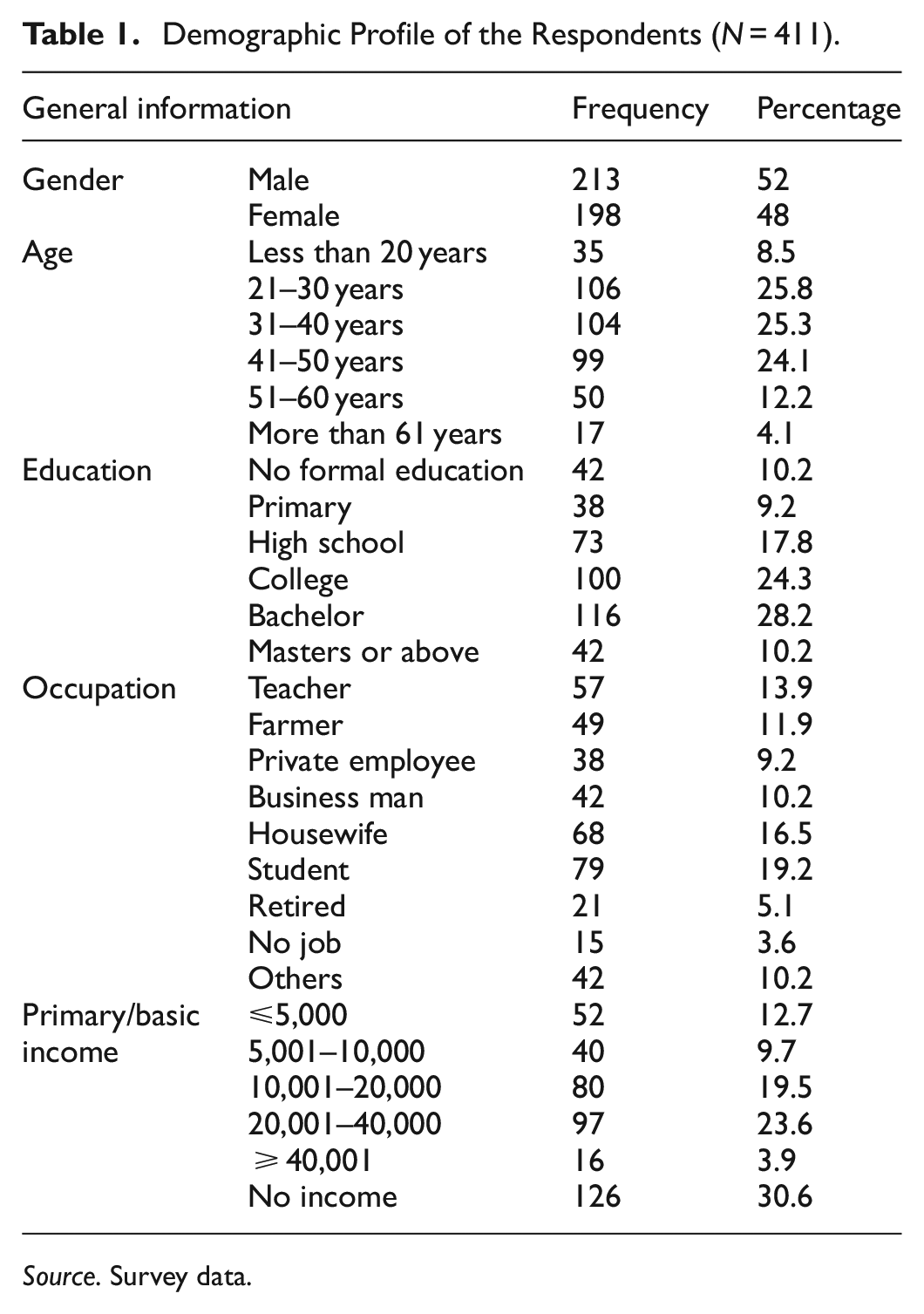
Source. Survey data.
Confirmatory Factor Analysis
We ran a series of CFA using Mplus (Muthén & Muthén, 2017) before running the structural model because we used all the renowned scales in measuring the variables. As our anticipation, we find a hypothesized ten-factor model fits: χ2 (1,067) = 1,394.073, p < .001, CFI = 0.975, TLI = 0.972, RMSEA = 0.027, SRMR = 0.037, that is more fitted compared to other alternative models (see Table 2). All fitting data are within the threshold (Browne & Cudeck, 1992; Hu & Bentler, 1999).
Comparison of Confirmatory Factor Analysis (CFA).

Source. M-plus output.
Note. RS = responsiveness; RL = reliability; AR = assurance; EM = empathy; TG = tangible; IQ = information quality; SA = service availability; VCC = value co-creation; SAT = satisfaction; UB = use behavior.
p < .001.
Test of Measurement Model
Partial least squares (PLS) analysis was performed using SmartPLS 4.0 to evaluate the measurement model of the constructs (McLeay et al., 2022; Ringle et al., 2022; Skourtis et al., 2018). Exploratory factor analysis (EFA) was also conducted to identify the dimensions of service quality and assess their applicability to e-government services (Y. Li & Shang, 2020). EFA was performed using principal component analysis with varimax rotation, applying a minimum factor loading threshold of 0.50. The appropriateness of the data for factor analysis was assessed using the Kaiser-Meyer-Olkin (KMO) measure of sampling adequacy (MSA) and Bartlett’s test of sphericity. The KMO value was 0.924, surpassing the acceptable threshold of 0.50 (Kaiser, 1974), confirming the appropriateness of the data for factor analysis.
Additionally, MSA values greater than 0.80 are considered highly appropriate for such analyses. Bartlett’s test of sphericity further confirmed the suitability of the correlation matrix, yielding a significant result of 13,586.761 (p < .001). This indicates significant correlations among components within the matrix. The factor solution derived from the analysis accounted for 69.962% of the total variance, highlighting the robustness of the factor structure and its explanatory power. For reflective measures, SMARTPLS 4 was utilized to compute the internal consistency coefficient of each measurement scale. A coefficient greater than 0.7 indicates reliability. When the number of items is less than six, a Cronbach’s alpha greater than .6 is considered acceptable. The Cronbach’s alpha values for AR, EM, IQ, RL, RS, SA, SAT, TG, UB, and VCC are .879, .879, .898, .906, .899, .832, .897, .879, .873, and .954, respectively. The findings demonstrate that the measurement scales for each construct exhibit high reliability and consistency with their respective items. Table 3 presents the measurement model of the constructs, including the factor loadings of the corresponding variables. The factor loadings for the service quality measurement instruments are more significant than 0.80, while those for items measuring satisfaction range from 0.773 to 0.849, and for use behavior, they vary from 0.714 to 0.829. Regarding value co-creation, it is higher than 0.90. Therefore, factor loadings exhibit that the cutoff result of 0.70 is acceptable after refining; all of the constructs here cross the recommended threshold value (Hair et al., 2021).
Construct Reliability and Validity.

Source. Author’s estimation.
Note. CR = composite reliability; AVE = average variance extracted.
Our study’s findings are robust, calculated with Composite Reliability (CR) and average variation extracted (AVE). Each latent variable demonstrates CR greater than 0.90 except service availability (0.877), which is also close to 0.90, and AVE exceeds 0.50. The cutoff value of 0.70 or more is acceptable for Cronbach’s alpha, and the composite reliability of each latent variable, and for the AVE cutoff score, 0.50 or more for all of the latent variables is acceptable (Hair et al., 2021). These robust findings indicate that all measurement items exhibit high quality, reliability, and convergent validity. Our study also analyzed discriminant validity and presented the correlation matrix in Table 3. The discriminant validity analysis shows that the square roots of the average variance extracted (AVE) for all variables exceed their correlation coefficients with other variables, as recommended by Fornell and Larcker (1981). The results suggest that the constructs can be easily distinguished from one another, thus, discriminant validity is established. This study also calculated the correlation between the total score of each variable and the scores of individual items (item-total correlation) to measure the instrument’s validity. The correlation coefficients for each item were statistically significant (p < .05), demonstrating the instrument’s validity for this study (see Figure 2). Additionally, we also assessed the inner model’s Variance Inflation Factor (VIF) values to check for Common Method Bias (CMB). The results indicated that all VIF scores were below the recommended threshold of 3.3, suggesting the model is free from common method bias (Kock, 2015). Consequently, the structural model’s hypothesis testing proceeded under the assumption that the measurement model was both reliable and valid (Table 4).

Item to total correlation.
Discriminant Validity of the Constructs.

Source. Author’s estimation.
Note: The diagonal bold values represent the square root of the average variance extracted (AVE) of the corresponding construct.
Test of Structural Model
Path analysis was conducted through Partial least squares (PLS) analysis performed using SmartPLS4.0 to examine the structural model of the constructs (McLeay et al., 2022; Ringle et al., 2022). The analysis focused on assessing the direct effects to evaluate the proposed hypotheses, as outlined in Table 5. Initially, the study examined the direct impact of Assurance (AR), Empathy (EM), Information Quality (IQ), Reliability (RL), Responsiveness (RS), Service Availability (SA), and Tangibility (TG) on Satisfaction (SAT). Subsequently, it investigated the direct effects of Satisfaction (SAT) on Use Behavior (UB). The study identified a robust and significant positive correlation between AR and SAT (β = .132, t = 2.483, p = .013), accepting hypothesis 1 (refer to Table 5). The path analysis indicated that EM directly influences SAT (β = .156, t = 3.160, p = .001), failing to reject the hypothesis 2. Hypothesis 3 suggested that Information Quality (IQ) positively impacts satisfaction (SAT). The path analysis revealed that IQ has a significant positive impact on the SAT (β = .083, t = 2.018, p = .044), indicating that the proposed hypothesis (H3) is also supported. Hypothesis 4 argues that there is a direct positive impact of Reliability (RL) on Satisfaction (SAT), and path analysis showed that RL positively influences SAT (β = .158, t = 3.056, p = .002), suggesting that we accept hypothesis 4. As hypothesis 5 proposed, Responsiveness (RS) has a direct impact on satisfaction (SAT), and this hypothesis is strongly supported by the data (β = .250, t = 4.665, p = .000), accepting hypothesis 5. Hypothesis 6 posited a positive relationship between Service Availability (SA) and Satisfaction (SAT). The analysis confirmed this hypothesis, revealing a significant positive relationship between SA and SAT (β = .089, t = 2.609, p = .009, accepting hypothesis 6. It was also proposed that tangibility (TG) directly impacts the satisfaction (SAT) in hypothesis 7. The data supported this hypothesis as it has statistical significance (β = .036, t = 2.534, p = .012), accepting hypothesis 7. Hypothesis 8, which suggested a positive association between Satisfaction (SAT) and Use Behavior (UB), was evaluated in this study. The path analysis indicated a statistically significant positive relationship between SAT and UB (β = .113, t = 8.265, p = .000), providing support for the acceptance of hypothesis 8. Therefore, all the direct paths (AR → SAT; EM → SAT; IQ → SAT; RL → SAT; RS → SAT; SA → SAT; TG → SAT; SAT → UB) are accepted as they have the statistical weights of t-statistics and p-value.
Hypothesis Testing (Direct Effect).

Source. Author’s estimation.
Note. β = beta coefficient; SE = standard error.
The study also examined the mediating role of Satisfaction (SAT) in the relationships between various constructs and Use Behavior (UB) (AR → UB; EM → UB; IQ → UB; RL → UB; RS → UB; SA → UB; TG → UB). The findings, as presented in Table 6, indicate a significant indirect effect of AR on UB through SAT (β = .083, t = 2.103, p < .001). The total effect of AR on UB was also significant (β = .107, t = 2.079, p < .001). However, with the inclusion of SAT as a mediator, the direct effect of AR on UB became insignificant (β = .024, t = 0.721, p > .001), indicating complete mediation by SAT. Similarly, the results show a significant indirect effect of EM on UB through SAT (β = .110, t = 3.145, p < .001). The total effect of EM on UB was significant (β = .122, t = 2.506, p < .001), while the direct effect of EM on UB became insignificant with SAT as a mediator (β = .011, t = 0.350, p > .001). This demonstrates complete mediation by SAT in the EM → UB relationship. Complete mediation by SAT was also observed in the relationships between RL → UB and SA → UB. Conversely, for IQ → UB, RS → UB, and TG → UB, significant indirect effects through SAT were found, but the direct effects remained significant. These findings suggest that SAT serves as a complementary partial mediator in the relationships between RS → UB and TG → UB, while functioning as a competitive partial mediator in the IQ → UB relationship.
Mediation Analysis.

Source. Author’s estimation.
Note. β = beta coefficient; SE = standard error.
Much literature has argued that Value Co-creation (VCC) significantly influences the relationships between various constructs as a moderator, as highlighted in the research model (Figure 1) presented above. The moderating effect analysis using Partial Least Squares (PLS) found that VCC is statistically significant in all the proposed hypotheses except for the link between AR-SAT, EM-SAT, and IQ-SAT, as presented in Table 7. This study has previously established a direct relationship between AR and SAT. An additional analysis of the moderating effect revealed a negative and significant moderating impact of VCC on the relationship between AR and SAT (β = −.136, t = −2.642, p < .008), which does not support H9a. The result shows that the relationship becomes weak with the involvement of VCC. It suggests that when customers perceive high assurance combined with value co-creation, it may create unrealistic expectations or lead to dissatisfaction if service delivery falls short. Similarly, the analysis of the moderating effect of VCC on the relationship between EM and SAT indicated a negative and statistically significant influence (β = −.136, t = −2.642, p < .008), thereby rejecting H9b. Empathy represents the service provider’s capacity to understand and meet customer needs. However, in the context of value co-creation, excessive emphasis on empathy might blur professional boundaries, slow down service processes, or lead to over-personalization, which could dilute the efficiency or consistency of service delivery. The model also proposed that VCC moderates the IQ-SAT relationship. However, this study disproved that the t-value of 1.407 indicates a weak effect, and the p-value of .150 indicates a 15% probability that the observed effect is due to random chance. Information Quality refers to the accuracy, applicability, and timeliness of the information delivered to customers. Its lack of a significant moderating effect might stem from its inherent role as a baseline expectation. Customers may perceive high-quality information as a prerequisite for engaging in value co-creation rather than a factor that enhances satisfaction. Therefore, this moderating effect is not statistically significant. VCC significantly influences the reliability (RL)-SAT relationship, with a t-value of 2.388 suggesting a moderately strong effect and a p-value of .017 indicating that the effect is statistically significant, providing substantial evidence supporting this argument. VCC plays an important moderating role in the Responsiveness (RS)-SAT relationship. The t-value of 2.666 demonstrates a significant moderating effect. At the same time, the p-value of .008, considerably lower than the standard threshold of 0.05, indicates only a 0.8% possibility that the observed effect occurred by random chance.
Moderating Effects.

Source. Author’s estimation.
Note. β = beta coefficient; SE = standard error, t = t-Statistics.
Additionally, the study also revealed that VCC significantly strengthens the positive relationship between service availability (SA) and satisfaction (SAT). A t-value of 3.733 indicates a robust moderating effect, while a p-value of 0 confirms a highly statistically significant impact. In the case of the tangibility (TG)-SAT relationship, VCC again plays a positive moderating role. The positive t-value of 2.745 and the low p-value of .006 suggest that value co-creation strengthens the positive relationship between tangibility and satisfaction. Therefore, hypotheses H9d, H9e, H9f, and H9g are supported, highlighting the strong moderating effect of VCC in e-government services. The moderation analysis summary is presented in Table 7.
This study further calculated moderated mediation analysis as presented in Table 8. Regarding the indirect effect of TG on UB, this study found that the indirect impact is 0.041, representing the magnitude of the mediation effect and suggesting that tangibility indirectly influences UB through SAT. Specifically, for each unit increase in TG, UB increases by 0.041 units via its effect on SAT when VCC is at a certain level. The confidence interval, spanning from 0.010 to 0.076, excludes 0, signifying that the indirect effect is statistically significant at the 0.05 level. This validates that SAT plays a significant mediating role in the relationship between TG and UB. This means that SAT has a significant mediation effect on the relationship between TG and UB. In the case of the indirect Effect of SA on the UB, this study found an indirect effect of 0.047, meaning that for each unit increase in SA, UB increases by 0.047 units via its effect on SAT, when VCC is at a certain level. Similarly, the confidence interval, ranging from 0.015 to 0.081 and not including 0, indicates a significant mediating effect of SAT on the relationship between SA and UB. In terms of calculating the indirect Effect of RL on UB, this study found that there is no 0 in the confidence interval. For each unit increase in RL, UB increases by 0.058 units as an indirect effect, where RL indirectly influences UB through SAT and VCC, which also play a moderating role. Regarding the indirect effect of RS on UB, this study found a significant moderated mediating effect: for each unit increase in responsiveness, use behavior increases by 0.051 units via its effect on satisfaction when value co-creation exists. Therefore, the moderated mediating impact of value co-creation in all cases is significant. Furthermore, the first-stage moderated mediation interaction plots (Hayes, 2022) are plotted using the PROCESS MACRO model 8, shown in Figures 3 to 6.
Result of Moderated Mediation.

Source. Author’s estimation.
Note. SE = standard error; LLCI = low level of confidence interval; ULCI = upper level of confidence interval.

First stage moderated mediation plots of (RL × VCC → SAT → UB).

First stage moderated mediation plots of (RS × VCC → SAT → UB).

First stage moderated mediation plots of (TG × VCC → SAT → UB).

First stage moderated mediation plots of (SA × VCC → SAT → UB).
Discussion
This study utilizes Structural Equation Modeling (SEM) through the partial least squares (PLS) approach to analyze and understand how different factors (like Assurance, Empathy, Information Quality, etc.) influence customer satisfaction and subsequent use behavior in the context of the Union Digital Centers (UDC) in Bangladesh. It examines the direct effects of these factors on satisfaction and satisfaction’s impact on use behavior and the moderating role of co-creation on the above-mentioned direct path relationships. The study also calculated the indirect effect of the constructs through moderated mediation analysis.
The study investigated the positive influence of assurance on customer satisfaction. The analysis validated this relationship as statistically significant, demonstrated by a high t-value and a p-value below the conventional .05 threshold, indicating a meaningful relationship. Thus, the level of assurance provided by UDC’s services significantly affects customer satisfaction. The finding infers a strong generalization as it is supported by the results (Chuenyindee et al., 2022; Sakyi, 2020; Tumsekcali et al., 2021). This study also examined whether empathy directly impacts UDC user satisfaction, as proposed in the second hypothesis. The analysis demonstrated a statistically significant association between empathy and satisfaction, suggesting that greater empathy is linked to increased customer satisfaction. This generalization is similar to the findings of the existing studies of Alam and Mondal (2019), Ong et al. (2023), Ocampo et al. (2019), and Sam et al. (2018), making it a stronger statement. It suggests that when a service or product demonstrates empathy towards the customer, it increases customer satisfaction. Hypothesis 3 proposes that IQ positively impacts customer satisfaction (SAT), suggesting that when the information provided by a service or product is of high quality, it leads to greater customer satisfaction. The study found that information quality has alsoa positively impact on customer satisfaction since the p-value associated with the relationship between IQ and satisfaction is .044. The results indicate that providing high-quality information enhance customer satisfaction. The finding is similar with the studies of Alshammari (2023), Surya Bahadur et al. (2024), Ming et al. (2018), and Shang et al. (2020).
Moreover, the study tested Hypothesis 4, which proposes a positive relationship between Reliability (RL) and Satisfaction (SAT). The path analysis revealed that Reliability has a significant favorable influence on Satisfaction. The statistical values provided, specifically “t = 3.392” and “p = .001,” indicate a strong and statistically significant relationship. The findings support the existing literature of Deveci et al. (2019), Isa et al. (2020), and Ong et al. (2023). Therefore, it is claimed that higher levels of reliability lead to greater customer satisfaction. Hypothesis 5 suggested a direct impact of responsiveness (RS) on satisfaction (SAT). The analysis provided strong support for this hypothesis, showing a statistically significant relationship between responsiveness and satisfaction. Aligned with the findings of Soltanpour et al. (2020) and Tahanisaz and Shokuhyar (2020), the results confirmed a highly significant association, resulting in the acceptance of Hypothesis 5. This result implies that better responsiveness leads to higher customer satisfaction. In the case of hypothesis 6, a positive relationship exists between Service Availability (SA) and Satisfaction (SAT), indicating that when a service is readily available to customers, it leads to higher levels of customer satisfaction. This study found the relationship statistically significant. Thus, there is a significant positive relationship between Service Availability and Satisfaction. This finding is also supported (Khadiza & Ullah, 2020; Ong et al., 2023). Therefore, higher levels of service availability contribute to increased customer satisfaction.
Furthermore, hypothesis 7 directed a positive impact of tangibility (TG) on satisfaction (SAT), arguing that tangible aspects of a product or service, such as its physical appearance or facilities, influence customer satisfaction. The study’s analysis confirmed this hypothesis by revealing a statistically significant relationship between Tangibility and Satisfaction. This result is also acknowledged (Hong et al., 2020; Shah et al., 2020; Shen et al., 2016). Therefore, greater levels of tangibility are linked to enhanced customer satisfaction. Regarding hypothesis 8, it suggested a link between customer satisfaction (SAT) and their behavior in using the product or service (UB). It proposed that customers use the product or service more frequently when satisfied. The study also identified a significant positive relationship between Satisfaction and Use Behavior, meaning that as customer satisfaction increases, their use behavior also tends to increase. The findings collide with the existing studies (Ong et al., 2023; Shang et al., 2020). Thus, satisfied customers are more likely to use the product or service repeatedly. Similarly, the study by Fredriksson (2020) Brazil’s Citizen Service Centers found that user satisfaction emerges as a critical predictor of use behavior.
The study further found a robust moderating role of value co-creation in e-governance services of UDCs. Value co-creation significantly moderates the relationship of assurance, empathy, reliability, responsiveness, service availability, and tangibility with satisfaction. Specifically, since the t-value is positive and the p-value is low in all mentioned relationships, it suggests that the presence of value co-creation strengthens the positive relationship between assurance, empathy, reliability, responsiveness, service availability, and tangibility and satisfaction, meaning that when value co-creation is higher, the positive impact of all the independent variables on customer satisfaction is more pronounced. Engaging customers in the co-creation process can enhance their perception of assurance, empathy, reliability, responsiveness, service availability, and tangibility, and, consequently, their overall satisfaction with the service. On the contrary, this study found a reverse moderating effect of value co-creation on the relationship between information quality and satisfaction. As value co-creation increases, the strength of this relationship decreases, indicating that it does not meaningfully alter the impact of information quality on customer satisfaction in this context. Service providers might consider focusing on other factors or areas where value co-creation has been shown to have a more significant impact.
Additionally, this study found a moderated mediation effect of satisfaction. The results indicate a significant moderated mediation effect, where tangibility, service availability, reliability, and responsiveness influence use behavior through satisfaction, and this mediation effect is moderated by value co-creation. The results highlight the importance of considering value co-creation when evaluating how tangibility, service availability, reliability, and responsiveness affect use behavior through customer satisfaction.
Research Implication
Theoretical Implications
Theoretically, this study integrates both SOR and ABC theory in the context of service delivery performance of UDC based on the service quality and satisfaction. Regarding the theoretical perspective, the applications of these theories will integrate both psychological and external factors that determine the behavior of the user. The study’s finding assures the appropriate use of the SOR model and ABC theory to use the behavior of UDC. Moreover, this research supports the attitude (satisfaction)-behavior (use behavior) relationship and the moderator of user value-concretion behavior. Additionally, the present study established a path of service quality factors that influence the use behavior of citizens through attitudinal factors such as mediation. According to the stimulus-organism-response (SOR) model, this path is supported. Furthermore, the combination of these two theories is rare in the field of e-government services research. Therefore, integrating and applying SOR and the ABC theory in government e-service delivery opens a new dimension for future research.
Besides, the integration of VCC as a moderator within the SERVQUAL model framework in this study holds significant theoretical implications, marking a novel advancement in understanding service quality and satisfaction dynamics. By incorporating VCC into the established SERVQUAL model, this research expands theoretical understanding by recognizing the interactive nature of service delivery processes. This integration acknowledges that provider-driven factors do not solely determine service quality and user satisfaction. However, the factors are co-created through collaborative interactions between service providers and users through the ABC theory, where value co-creation behavior may also influence attitudes like satisfaction. Moreover, this nexus enriches the conceptualization of service quality by acknowledging the active role of users in shaping their service experiences. This expansion moves beyond the traditional provider-centric view of service quality and offers a more comprehensive understanding, incorporating user perspectives and contributions. It opens the door to a more user-centric perspective in service research. It emphasizes the significance of understanding users’ roles, preferences, and contributions to service delivery, moving beyond traditional provider-driven approaches to service quality assessment.
Practical Implications
From a practical perspective, this research will provide recommendations and suggestions to public organizations like UDC and policymakers on improving the performance of e-government services. These suggestions can also help the government and policymakers take proper steps for sustainable planning, designing, developing, and implementing particular e-services based on the current performance of UDC and citizens’ feedback. This study may enable the local government to swiftly identify what actions need to be taken to ensure the sustainability of e-services at UDCs. The UDC will be better equipped to serve the needs of the people if the appropriate processes are put in place, which will assist in enhancing citizens’ living standards and more effectively contribute to national growth. All digital center producers and distributors, including business owners, are anticipated to be able to assess the value and scope of each e-service offered by UDCs, judge the caliber of these services, and align their objectives to make the best decisions for the development and provision of the desired e-services. The performance of UDCs and the service quality, satisfaction, and use behavior of the users will be improved by addressing the co-creation of citizens at UDCs through this research. The appropriate mechanisms can also be implemented to make UDCs more responsive to citizens’ needs.
Moreover, understanding the moderating role of value co-creation emphasizes the importance of collaborative efforts between service providers and users in shaping service effectiveness. Future research could explore various co-creation strategies to align service delivery with user preferences better and enhance overall satisfaction levels. By leveraging user feedback, service providers can iteratively refine service delivery processes and address gaps in tangibility, responsiveness, empathy, information quality, or service availability. Conducting longitudinal studies to track the evolution of user satisfaction over time provides deeper insights into the dynamics of user-provider interactions and satisfaction outcomes. Such research can inform strategic decision-making and help providers anticipate and adapt to evolving user needs and preferences, enhancing service delivery and increasing user satisfaction. Furthermore, this study can identify user-centric factors influencing concurrent e-service use, paving the way for future e-government research and aiding policymakers and e-government professionals in creating more effective policies and applications.
Limitations and Future Research
While this study holds significant theoretical and practical implications, particularly as one of the first inferential statistical studies of the UDC in Bangladesh, it is also essential to acknowledge the limitations posed by this study. Firstly, the study was confined to 10 selected UDCs with a sample size of 411, potentially limiting the generalizability of the findings as there are undefined UDC users across the country. Therefore, future research could explore the UDC with a larger and more diverse sample size in broader contexts. Secondly, excluding responses with substantial missing values may have omitted important information, and the study’s focus on 10 LVs and 49 MVs might have overlooked crucial variables like citizen trust dynamics, that is, trust in government and trust in e-government services. Future researchers could enrich their investigations by incorporating such variables into the theoretical framework. Thirdly, while the high factor loadings and Cronbach’s alpha values validate the reliability and validity of the constructs, it is essential to recognize certain limitations. Cronbach’s alpha relies on the assumption of one-dimensionality, which may not entirely reflect the complexity of the constructs.
Furthermore, future research should consider larger and more diverse samples to improve the generalizability of the results. Fourthly, while SEM was utilized for data analysis in this study, further data verification may be warranted for enhanced result accuracy. Future researchers could explore the use of advanced tools such as Machine Learning (ML). Finally, since this study was conducted solely in Bangladesh, its findings may be relevant to other developing countries with similar contexts but may not be directly applicable to developed nations. Future research could explore similar phenomena in other developing countries to broaden the understanding of UDC dynamics.
Conclusion
This study explores the relationship between perceived service quality dimensions, customer satisfaction, and use behavior in utilizing the services of UDCs in rural areas of Bangladesh. The inferior service quality of UDCs may influence the satisfaction of the users, which also affects the use behavior. This study indicates that UDC’s service quality significantly affects citizens’ satisfaction. The study findings indicated high customer satisfaction and perceived service quality levels, and the use behavior of UDC and VCC also plays a moderator role between PSQ and SAT. The findings also imply that enhancing service quality can boost citizen satisfaction, increasing their use of UDC services. Although assurance, empathy, reliability, responsiveness, service availability, and tangibility of PSQ have significantly influenced customer satisfaction at UDC in Bangladesh, at the same time, information quality does not have a notable impact. According to SOR, the findings demonstrate that higher customer satisfaction correlates with increased use behavior, emphasizing the pivotal importance of these factors in improving customer experiences. Moreover, value co-creation is crucial in strengthening the positive influence of most service attributes on service receiver satisfaction, emphasizing the significance of engaging customers in the co-creation process to enhance satisfaction levels.
Furthermore, the study identifies the moderated mediation effect of value co-creation, showing that tangibility, service availability, reliability, and responsiveness impact use behavior through user satisfaction. However, the association between information quality and satisfaction weakens with increased co-creation. These insights suggest that service providers should prioritize factors where co-creation significantly enhances customer satisfaction and engagement, ultimately fostering better usage rates of e-governance services at UDCs. Finally, this study contributes to the theory by integrating factors (i.e., information quality, service availability) into the traditional SERVQUAL model, which were retrieved from the qualitative exploration of end-users’ perspectives that were overlooked in the existing literature. This study offers an empirical contribution to existing service quality theories by applying the SERVQUAL model in a new context (Bangladesh) with a different sample (users). The findings will help academics, policymakers, and service providers to understand how end-users’ intentions to use are influenced by perceived service quality. The findings can inform the Bangladeshi government’s policy-making, especially in advancing digital services and improving grassroots governance efficiency. By optimizing the service quality of UDCs, it is possible to enhance service delivery performance and strengthen public trust and satisfaction with government services.
Footnotes
Acknowledgements
The authors would like to thank all of the participants of the survey for providing valuable information to help this study.

Funding
The author(s) received financial support for the research, authorship, and/or publication of this article. It was supported by Huazhong University of Science and Technology Double First-Class Funds (2025ZKIJD05).
Declaration of Conflicting Interests
The author(s) declared no potential conflicts of interest with respect to the research, authorship, and/or publication of this article.
Data Availability Statement
Data sharing not applicable to this article as no datasets were generated or analyzed during the current study.