




Abstract
In recent years, domestic and international airlines alike have been faced with a number of challenges, including economic recessions, rising oil prices, and competition from other convenient travel alternatives, which have caused Taiwan’s various airlines to face substantial financial difficulties. In this study, a questionnaire was administered to examine the service quality of the aviation industry and strategies for aviation industry management were proposed from the perspective of customer value co-creation. The analytic network process approach was employed to elucidate the interactive relationships between evaluation criteria from the managers’ perspective. The entropy method was used to compute the cognitive gap between customers and managers while identifying the strategic means of diminishing these cognitive differences. The analysis results indicated that a company’s understanding of its customers can be enhanced through a four-dimensional (Dialogue, Access, Risk assessment, and Transparency) interactive model. The primary value of the present study is that it combines customers’ concepts regarding value creation with their perceptions of service quality. By doing so, it offers guidance to airlines regarding service quality that can assist them in developing sustainable competitive advantages.
Introduction
The liberal regulations from the 1970s until 1980s of the global aviation market changed the strategies of aviation industry firms (Cento, 2009). This allowed them to improve their services and allowed customers to enjoy travel options as more and more airlines began to compete for the same routes (Martin et al., 2008). However, the COVID-19 pandemic has unleashed an unprecedented crisis on aviation companies around the world (Dunn, 2020). Counties worldwide have imposed travel bans, lockdowns, and stoppages as means of strengthening community containment measures, preventing the diseases from rapidly spreading, and safeguarding the effectiveness of national healthcare systems. In general, the tourism, hotel, and in particular, the aviation industry, have suffered the biggest blows. Based on data, over 60% of commercial aircraft in the world remain grounded (Hollinger, 2020). On the estimate of International Air Transport Association (IATA, 2020) for 2021, the aviation companies will lose up to US$314 billion in revenue from travelers, a 55% decline compared to 2020. As a result, many airline companies gradually shifted toward new business models that allow them to continue operations and generate income.
Most governments view the aviation industry as an important component of economic development (Zhang & Graham, 2020). Considerable research attention has been focused on the quality of travel services in recent years (Dwyer et al., 2004; Hudson et al., 2004; Ritchie & Crouch, 2000). When companies in the tourism industry, such as commercial airlines, seek to establish competitive advantages, one means by which they can do so is enhancing the quality of their customer service. Such enhancements can be made even though air travel is already the most reliable method of transportation for long-distance travelers (Graham et al., 2008).
Transportation and tourism are interdependent, as tourists must be transported to their destinations by some means of transportation (Prideaux, 2000). Accordingly, both transportation and tourism-related experiences typically account for a crucial part of the overall travel experience. Therefore, it is proven that the quality of service provided internally is relatively important. Meanwhile, of the various means of transportation, air travel is by far the most widely used and, therefore, the most important (Bieger & Wittmer, 2006). At the same time, travel by air typically entails a complication mix of services. This is because air services typically involve ground services, on-board catering, and other cabin services, among other procedures (Chiou & Chen, 2012).
From the 1970s to the 1980s, liberal regulation of the global aviation market changed the business strategies of companies within the aviation industry (Cento, 2009). Most importantly, customers enjoyed an increasing number of travel options as more and more airlines began to compete for the same routes (Martin et al., 2008).
Due to the COVID-19 pandemic, global passenger air traffic suffered drastic free falls, dropping from 4.5 billion in 2019 to 1.81 billion. As a result, many airline companies gradually shifted toward new business models that allow them to continue operations and generate income.
As a result, airlines began to shift their business strategies from focusing on ticket prices to focusing on utilizing marketing and service quality to obtain competitive advantages (Eldad, 2006). This fierce competition within the industry led many airlines to enhance their marketing capabilities, while improvements in service quality also came to be viewed as a key competitive advantage (Tiernan et al., 2008). Therefore, a new business model is important for the industry’s structure (Cento, 2009).
In the aviation industry in general, the quality of service that a company provides is seen as indicative of the company’s core competence (Karmarkar, 2004; Lusch et al., 2007). Depending on the quality of the interactions a company has with its customers, those customers may perceive the company as providing better services than competing companies (Grönroos, 2006; Zeithaml et al., 1996). Previously, a number of studies have conceived of this process of interactions as one of value co-creation. Market participants rely on and support each other in the integration of resources (Vargo & Lusch, 2008). In particular, the challenges of traditional business perspectives require managers to reconsider their capabilities with respect to providing service, particularly as that pertains to service-dominant (SD) logic (Vargo & Lusch, 2008) and the concept of value co-creation (Payne et al., 2008; Prahalad & Ramaswamy, 2004).
Prahalad et al. (2004) proposed the concept of value co-creation, which posits that in the future, competition among companies will revolve around a novel method of value creation that centers on an individual and value is jointly created by consumers and companies. From a traditional perspective, value is created by a company for a consumer through exchanges and transactions and a consumer does not create value; they are merely the users and consumers of value. Changes in the greater environment have transformed the role of a consumer drastically, as a consumer is no longer a passive buyer but rather an active participant (Prahalad et al., 2004). Value co-creation is of utmost importance to both a company and a consumer. Allowing customers to participate in value co-creation will help a company elevate its quality of service, reduce costs, increase the efficiency of its operations, and unearth new market opportunities. These benefits in turn shape a company’s competitive advantages and help it to distinguish itself from its competitors (Payne et al., 2008). By participating in value co-creation, customers would obtain products that are up to their satisfaction, gain a feeling of achievement, honor, or reward, as well as unique experiences gathered throughout the process. The benefits gained by consumers in turn affect a company in terms of increasing customer satisfaction, loyalty, and purchase intention (Grönroos, 2011).
The adverse impacts of COVID-19 on commercial activities, industry policies, and the global economy have gained much interest among researchers, governments, and policy managers. Despite the wealth of new studies on COVID-19 as well as the concomitant uncertainty that stymies the business of companies (Gostin & Wiley, 2020), there is a dearth of research on the sustainability of the greater environment. Owing to the effective preventive measures taken by the Taiwanese government against the pandemic, there is no widespread transfer of the disease in the country, and air travel remains the preferred choice among its citizens. Taiwan’s excellent aerospace manufacturing sector also boasts a decent aviation education system which has bolstered citizens’ confidence in Taiwanese airlines. Many researchers have mentioned that many people would want to fly after the pandemic has abated. Yet, in light of rising customer demand for air travel during the post-pandemic period, the means of generating consumer confidence in the Taiwanese aviation industry through the strategies employed by aviation companies has become a pressing issue.
Based on the perspective of customer value co-creation, this study redresses customers’ concerns toward the service quality of the aviation industry and also provides solutions for aviation company managers regarding customer-related issues. In practice, this study reduces the perception gap between customers and managers, as well as enabling managers to understand the directions and strategies for developments in the aviation industry. Aviation companies affected by the pandemic can undergo internal restructuring based on the recommendations of this study. As the pandemic wanes, they would be able to quickly attend customer demands.
Therefore, this study integrated the value co-creation of customers into the services provided by the aviation industry by gathering customers’ ideas through a customer value co-creation strategy. Through value co-creation, we were able to identify and verify the strategic direction of the aviation industry in order to make up for the lack of literature on the service quality of the industry.
Literature Review
Value Co-Creation
In an era dominated by advances in information technology and consumption experiences, value co-creation has emerged as a trend among businesses. Wikström (1996) proposed the notion that consumers participate in activities of value creation. According to the traditional goods-dominant logic, companies are always increasing the level of standardization of their goods such that product value can be created and their profits are maximized, and customers are merely passive recipients of these goods. Nowadays, customers have gradually shifted from passive recipients to active participants, and hence, modifications to business models must follow suit. Customer involvement in the process of value creation entails synchronous communications, interactions, and coordination with companies (Ramirez, 1999). To this end, companies not only focus on production and marketing, but also the means to link their products with their customers’ daily lives as well as to assist customers to combine their own resources with the resources provided by the company, thus creating new value (Čaić et al., 2018; Hein et al., 2019). Because customers change their role during the process of a product’s value creation, companies should give a reason why customers should invest their resources to assist the companies’ production processes and achieve value co-creation behaviors (Merz et al., 2018). The essence of value co-creation is the joint creation of experiential value, as consumer experiences are continuous processes while value co-creation pervades the entire process of consumption (Prahalad & Ramaswamy, 2004). Companies provide specific services that meets the needs of consumers, who thereby obtain unique experiential values pertaining to their consumption experiences (Prahalad & Ramaswamy, 2004). Value co-creation differs from the traditional mindset that companies are the sole creators of value. Indeed, interactive relationships between companies and consumers are vital to the creation of unique consumptions (Prahalad & Ramaswamy, 2004). Value co-creation refers to the interactive participation between a company and a consumer in the process of commercialization such that timely adjustments are made to meet the demands of both parties (Hoyer et al., 2010). Grönroos and Voima (2013) emphasized the importance of resource sharing and that the interaction and dialogue between a company and a consumer directly or indirectly result in value creation as well as co-creation behaviors.
Both service providers and recipients should be capable of co-creating value, under the premise that both parties are able to interact well with each another. Prahalad and Ramaswamy (2004) proposed the DART framework which consists of four major constituents of value co-creation—dialogue, access to information, transparency of information, and risk-benefit analysis. In addition, value is a distinctive product of situated experiences and can be regarded as the accumulation of consumer experience. Many scholars have conceptualized value from a holistic viewpoint and advocated a consumer-centric approach to assisting service providers in co-creating value with consumers (Prahalad & Ramaswamy, 2004).
In practice, many activities necessarily involve interactions. When engaging in co-creation, employees, customers, and family members create various interactions and relationships (Rihova et al., 2018), and at present, many companies achieve value co-creation by establishing good relationships with their customers. The information provided by customers, as well as their affective participation, can boost organizational innovation (Stamolampros et al., 2019). Hence, many companies are very willing to build relationships with their customers. Wong et al. (2019) revealed that customer participation behaviors have direct impacts on organizational performance.
Customers can provide their own knowledge, experiences, and skills, and participating companies can use their own original R&D, design, and production to enhance their goods and services, thereby co-creating improved goods and services that better meet customer demands. Value co-creation can also help companies discover new market opportunities, improve service quality, and enhance brand value so that consumers in the market can obtain better products from those companies. Zaborek and Mazur (2019) indicated that customer participation increases brand satisfaction, loyalty, trust, and perceived customization while reducing a company’s costs. Relatedly, customers can use the production process methods of the participating companies to impact such production and thus benefit from cooperating with the enterprises in building a foundation of value co-creation. As such, the entire value co-creation process can ultimately increase customer satisfaction, loyalty, and purchase intentions. Companies can also obtain unique experiences from their interactions and exchanges with customers. Meanwhile, it is difficult for competitors that do not engage in value co-creation to obtain these kinds of advantages, meaning that those companies that do engage in value co-creation can effectively utilize it to create new competitive advantages.
Ramirez (1999) suggested that customer involvement and vendor complementarity can create a relationship of value co-creation. Yuge et al. (2019) suggested that by integrating sustainable consumption and production with the co-creation of value in a sharing economy, enterprises, and customers can achieve win-win situations. Sigala (2018) proposed and analyzed a “learning with the market” approach for value co-creation with customers. In that study, a case study was evaluated based on the data collected from the relevant stakeholders (such as customers, employees, suppliers, and business partners). The study identified network structure (building networks with customers) as one of three criteria for generating social values. Aluri et al. (2019) used a dynamic learning system to achieve value co-creation with customers and examined the establishment of customers’ brand loyalties through customer engagement.
Prahalad and Ramaswamy (2002) used an interactive network of experiences to demonstrate that multiple organizations and individuals effectively work together to create experiences by engaging with each other in delivering two-way interactions that, in turn, form a foundation of true value. In a subsequent study, Prahalad and Ramaswamy (2004) explored the concepts and factor analysis of value creation from the interactions between customers and enterprises, which led them to propose the DART (dialogue, access, risk assessment, and transparency) model, through which enterprises and customers can be motivated to jointly create value to ensure the efficiency of value creation. To achieve the goal of creating value with customers, enterprises must establish four co-creation mechanisms: dialogue, access, risk assessment, and transparency. The four DART mechanisms for value creation do not work separately but, rather, through a combined effect of interaction that enhances the business-to-customer interactions and interdependence and helps build co-creation capabilities.
In the traditional enterprise-focused model, customers only passively accept the products or services provided by an enterprise. However, in a modern setting, customer participation enhances customers’ own future product-oriented autonomy. That is, the interactions and cooperation between an enterprise and its customers determine the product specifications to provide the effect of value co-creation. An enterprise’s success with future customers depends not only on continuous communication between the enterprise and its customers, but also on whether the enterprise can internalize the resources of both parties so as to provide more valuable services than its competitors, making the enterprise more competitive in order to gain the trust of more customers.
When faced with new demands from customers regarding products or services, enterprises must first respect the needs of their customers. During interactions, enterprises should actively seek opportunities to analyze and improve their products and services by obtaining a clearer picture of the actual desires of their potential customers. Enterprises should seek to create platforms for dialogue with customers that allow customers to communicate more easily with the enterprises. By doing so, companies can adjust the benefits of their goods and services according to the needs of their customers, make innovative improvements to their products so that customer needs and business practices are matched, and maximize the co-creation of value.
Dialogue: Dialogue between an enterprise and its customers can be used to promote interactions between the two parties, share important and sensitive business strategy information, and regularly review and exchange messages so that enterprise employees at different departmental levels can maintain good communications with one another and respond quickly to customers to build customer loyalty.
Access: The use of messaging platforms can allow enterprises to provide effective and immediate responses to customers, as well as to use consumer experiences to improve their products and services and, in turn, enhance customer loyalty.
Risk Assessment: Mutual assessment and sharing can help enterprises to avoid all levels of risk and set compensation mechanisms to reduce any losses incurred by risks.
Transparency: When the upstream and downstream messages are symmetrical, they are not easily concealed from each other, which can increase mutual trust and facilitate the formation of new business models and functions.
Dialogue not only promotes the sharing of information, but primarily endorses the enhancement of service quality by strengthening mutual understanding between companies and consumers. Good communication allows consumers to integrate their own ideas about value into the process of co-creation. Access challenges the notion that consumers can only savor a certain value through product ownership. Companies could gain more business opportunities if they shift their focus to the experiences gained by customers through various interactions instead of the experiences gained from owning a product. In Risk Assessment, once consumers are involved in value co-creation, they would want to learn more about the potential risks of a good or service, even though they may have to shoulder more responsibilities pertaining to the handling of these risks. Transparency is the basis on which mutual trust is built between an institution and an individual. In the DART model, each of the four components are interdependent and each of the subcomponents therein interact with and influence one another. Therefore, this study employed the analytic network process (ANP) approach for analysis in conjunction with the entropy method to compare between customers and companies and thereby identify the exact quality of aviation services.
Service Quality of the Aviation Industry
Parasuraman et al. (1985) were the first to introduce a model of service quality. In practice, the five-dimensional (tangibles, reliability, responsiveness, assurance, and empathy) SERVQUAL model developed by Parasuraman et al. (1988) is often used to measure customer satisfaction based on customer expectations as well as the gap between their actual perceptions and expectations. Pakdil and Aydlin (2007) adopted the SERVQUAL model to measure the service quality of the aviation industry from the viewpoints of international travelers. For decades, service quality has always been a focal point in business management (Caro & Garcia, 2008). In organizational activities that are at the employee and management levels, service quality is often regarded as a continuous and secure structure that includes the quality of performances across various aspects (Prayag, 2007). Chen and Chang (2005) suggested that the cleanliness of seats taken by customers is an important expression of service quality. Liou and Tzeng (2007) reported that handling customer complaints is substantially beneficial for preserving customer satisfaction. In addition, customers attach great importance to safety-related services in the aviation industry. Customer satisfaction is only gained when desirable safety-related services are provided, and such services also allow an aviation company to distinguish themselves from others in this intensely competitive industry (Chen, 2008).
In the face of fierce competition, airlines are increasingly focusing on customer service as a core aspect of their strategies, such as by making improvements to service quality to better target potential customers (Gursoy et al., 2005; O’Connell & Williams, 2005). Although lower prices may serve to attract customers, academics have long viewed service quality as another key determinant of customer purchase behavior (Chiou & Chen, 2012; Jou et al., 2008). As a result, airlines have long been committed to providing good service at reasonable prices, with market leaders typically being those that can do so effectively (Chang & Yeh, 2002; Prayag, 2007). Relatedly, a study by Gupta (2018) revealed that the three major attributes of airline service quality that customers value are tangibility, reliability, and security.
Service quality can be characterized in terms of how customers rate the service in question (Parasuraman et al., 1985). However, although this definition is often used in several service contexts, there are no integrated guidelines for measuring this construct (Lim & Tkaczynski, 2017). Nonetheless, the service quality of airlines in a variety of countries and regions, including Australia, China, Cyprus, Hong Kong, Iran, South Africa, Spain, and the United States, has been investigated in previous studies.
The quality of airline services is best studied under a variety of circumstances. Philip and Hazlett (1997) argue that, due to demographic factors, cultural differences, and travel purposes, no two passenger service experiences can be expected to be the same. Meanwhile, the past literature has also stated that significant differences exist among airlines in terms of both service quality and cultures. For example, a comparison of European and Asian passengers of the same airline indicated that passengers from Europe are less likely to evaluate airline service quality (Sultan & Simpson, 2000). Therefore, the present study conducted correlation research and analysis based on the related past literature and the Delphi method.
Studies from abroad have explored service quality in the aviation industry. Tsafarakis et al. (2018) used the Multicriteria Satisfaction Analysis (MUSA) method and verified that the service quality of the aviation industry includes the five criteria of Reliability, Employees, Management, Satisfaction, and Tangibles. Sun et al. (2018) adopted the innovative TOPSIS and VIKOR approaches to study the service quality of four aviation companies and revealed that “booking and ticketing service,” “check-in and boarding process,” “cabin service,” and “responsiveness” are the major factors that affect the quality of customer service. Rezaei et al. (2018) utilized the SERVQUAL model with cluster analysis and verified that service quality entails Tangibility, Reliability, Responsiveness, Assurance, and Empathy. Lin and Vlachos (2018) used the importance-performance-impact analysis (IPIA) to determine the interactivity between each criterion and analyzed customer satisfaction by examining the service qualities of four Chinese aviation companies. In Taiwan, studies on the service quality of the aviation industry include that of Chou (2012), in which the service quality of two airports, Kaohsiung International Airport and Taoyuan International Airport were analyzed through the fuzzy multi-criteria decision-making (MCDM) model and a questionnaire. The results indicated that the latter airport had superior service quality. Lu et al. (2018) measured the service quality of Taiwanese airlines via a sustainability-balanced scorecard and determined that service quality is measured based on five perspectives (financial, internal business processes, learning and growth, environmental, and social).
Many scholars have provided critical reviews of the SERVQUAL model developed by Parasuraman. For instance, Asubonteng et al. (1996) suggested that management should fully understand service quality at its core and measure it through calculations. To achieve customer satisfaction, management should truly understand service quality and response to customers’ feedback while standardizing such feedback. In service quality, validity and reliability are salient toward quality management and must be assessed in accordance with proportionality. A service is regarded as a process, and interactivity must be measured throughout the entire process of service transfer, while this process of service transfer as a whole is viewed as interaction quality (Swartz and Brown, 1989). Service quality and customer interactions or well-defined measurement criteria are pivotal for the aviation industry. Performing measurements from different perspectives and developing strategies on airline service quality are also imminent issues. Jiang and Zhang (2016) agreed that there is a scarcity of studies in this field. To this end, the objectives of this study are to examine the four components of value co-creation and to identify the marketing strategies of aviation companies based on the gap between the management and customers, thus making up for the limitations of the SERVQUAL model.
Research Design
The aviation industry enjoyed steady growth over the last few years mainly due to growing demand in global tourism and cargo operations. In many countries, the aviation industry has always been the backbone of the country’s economic income. The COVID-19 pandemic has fueled the global economic downturn and interrupted supply chains in the tourism market, causing aviation companies to incur major losses. This study redefined the service quality of the aviation industry through company-customer value co-creation. In the first stage, the components of service quality were determined through in-depth interviews with experts. In the second stage, a network analysis diagram was developed though the ANP approach. In the third stage, the entropy method was used to analyze the existing gap between customers and the managements of aviation companies. These two different approaches (as shown in Figure 1) could allow us to understand the differences in the customers’ and managements’ perspectives toward value co-creation, as well as developing strategies that assist in the speedy recovery of the aviation industry. Given that value co-creation is mainly produced when interdependent relationships between the component’s interactions are formed through interactions between companies and customers, hence, many uncertainties exist between each subcomponent. In this regard, the ANP and entropy approaches employed in this study are closer in line with actual conditions, and would reduce the customers’ psychological gap. In recent years, Aragonés-Beltrán et al. (2017) used the ANP approach to study the suppliers chosen by Spain’s national railway infrastructure company. Giannakis et al. (2020) used the ANP approach to choose solutions for achieving desirable performances in sustainability goals. Mohammadzadeh et al. (2018) identified the key factors that affect the Internet of Things through the ANP approach, while Munim et al. (2020) identified the ideal governance models for green port management. With regard to entropy methods, a recent study by Zhao et al. (2020) established 17 indicators for appraising the development of secondary energies through the four aspects of energy supply, energy consumption, level of electrification, and carbon emission, as well as using the entropy method to assess and analyze national energy development strategies. Gorgij et al. (2017) evaluated the quality of drinking water based on 21 groundwater samples and compared the differences between their results and the effective parameters of water quality. Wang et al. (2018) adopted an AHP-entropy method in which AHP was used to evaluate energy managers in terms of energy efficiency, safety monitoring, and response to demand, while the entropy method was used to assess customer feedback and obtain an accurate weight allocation sequence through objective and subjective approaches. The two methods used in this study are as follows:

Flow process of this study.
Analytic Network Process
The analytic network process (ANP) is a type of network hierarchy that makes allowances for more complicated interdependencies among network elements (Saaty, 1996). It constructs super matrices through dependencies. A super matrix is a kind of relative weight vector that modifies the relative weight for each matrix to yield a revised overall matrix. The choice of the ANP as a method for this research was mainly due to its suitability for providing solutions in complicated, multi-standard decision-making environments. The features of the ANP include the following (Saaty, 1999): (1) The ANP is based on the use of the AHP. (2) Different from the AHP, ANP analysis is based on the assumption of interdependence among factors. (3) The ANP deals with intra-cluster elements (internal dependencies) and interdependencies (external dependencies) among different clusters or elements. (4) Due to its loose network, the ANP does not require that the relationship between the upper and lower layers be considered for a given decision-making problem. (5) The structure of the ANP is non-linear, and it can handle the top-level to bottom-most network relationships and collect the results. (6) The ANP illustrates the actual performance of the problem being considered. (7) The ANP achieves cost control concepts by utilizing the logic of the control level or network level in handling different standards.
The structure of the ANP is based on the judgments made by decision makers. The relative importance between relevant elements within the same level are compared, and the targets of decision-making are analyzed from an integrated top-down order. For many real-life issues, the internal elements within each level is often dependent on the dominating effect exerted by low-level factors on high-level factors, that is, feedback mechanisms exist across the levels. This forms the network structure of a system. This study achieved a more precise order through the mutual feedback between the four components in the DART model of value co-creation. Hence, the ANP approach was used for analysis, while the entropy method was used for analyzing customers. The entropy method is commonly used in measuring uncertainties, as a greater entropy value indicates a greater random dispersion of data. When the entropy method is applied onto the measurement of the weights of different attributes, the greater dispersion and gap in the measured value of an attribute indicates that the attribute is informational and is allocated a larger weight. This study selected 32 customers for analysis, so as to understand the differences between companies and customers, thereby identifying the niches that lie within competitive environments.
The ANP process includes four main steps (Meade & Sarkis, 1999; Saaty, 1996):
Step 1: Issues involving problem building and model building should clearly illustrate and break down the imaging network system. Decision makers can use suitable analytical tools to identify decision-making factors.
Step 2: In contrast with the AHP, the ANP compares decision factors with the representatives of the other clusters to control the importance of criteria. There will be interdependencies between the clusters, and the impacts among pairs of elements and groups of elements must also be examined, as illustrated by the eigenvectors. For the inverse comparison,

where the matrix of the pairwise comparison is denoted by A, the eigenvector is denoted by w, and the largest eigenvalue of A is denoted by
Step 3: Supermatrix formation
The purpose of obtaining a supermatrix is to determine the order of precedence among the interdependencies of the system. To form a supermatrix, the columns of a matrix are filled in with the appropriate local vectors. It should be noted, however, that in reality, a supermatrix consists of a partitioned matrix, with each matrix representing the relation between two cluster systems. In the decision system, cluster

A supermatrix represents a three-hierarchy structure.
In the matrix shown below, the impact of the goal on the criteria is represented by the vector

If the elements are within the cluster or there is an interrelationship between the two clusters, any 0 in the matrix can be replaced. Because there are usually interrelationships between clusters within a network, there may be more than one extra column in a matrix. The supermatrix has to be adjusted such that each column within the matrix sums to unity.
Under Saaty’s approach, the relative importance of each cluster within the supermatrix is determined by utilizing a column cluster as the control cluster. That is, those row clusters in a given column cluster that have non-zero entries are compared based on their effects on the cluster of said column cluster. Using the pairwise comparison matrix for the row clusters in relation to the column cluster, an eigenvector is obtained, and that eigenvector, in turn, provides another eigenvector for each column cluster within the eigenvector. More specifically, all the elements of the column’s first cluster are multiplied by the first item in each cluster, after all the elements of the column’s second cluster are multiplied by the second item, and so forth. In this approach, the weighted result obtained for each column’s supermatrix cluster is called the weighted supermatrix and is also a stochastic.
Step 4: Selection of best alternatives:
If the supermatrix already contains the complete network at Step 3, it is possible to obtain the weights of the alternatives in a normalized supermatrix column. On the other hand, if only interrelated comprised clusters are contained in the supermatrix, additional alternatives must be calculated to obtain the overall priorities.
Entropy Method
In multiple-criteria decision-making (MCDM), there are many relative appraisal methods of processing company or government information. Since the bulk of evaluation items take into account the costs and benefits, the evaluation criteria of these two factors could be conflicting. Conflicts and trade-offs that exist between the evaluation criteria could result in biased evaluation results. An evaluation that involves a multitude of aspects could also lead to asymmetry and mutual conflicts between the evaluation criteria, thereby stymying the process of solutions that simultaneously achieve all criteria. Therefore, it is necessary to identify solutions that are able to handle conflicting or competing evaluation criteria. The compromise solution is an appropriate method of resolving conflicting sequences. Among MCDM methods, the objective weights of criteria are assessed through their entropy values. The relative weights computed through this method are obtained by using the evaluation data of each evaluation criterion in each solution. Since these weights do not involve manual and subjective factors, the entropy method is considered as an objective weighting method. The calculation process is as follows:
Step 1 Construct the evaluation matrix based on the raw data
The desired original matrix is constructed based on the raw data, in which n evaluation criteria are used to evaluate m samples

Step 2 Normalize the original matrix
Since the evaluation attributes in the raw data have different units, the evaluation matrix must be normalized so that each evaluation criterion has a congruent basis for making objective comparisons. In the equation below,

i = 0,1,2,3. . .,m
j = 0, 1, 2, 3,. . .n
Step 3 Calculate the entropy value of each evaluation criterion (

i = 1,2,. . .m;
j = 1,2,. . .n
Step 4 Calculate the weight (
The purpose of calculating the relative weight between each criterion is to measure the degree of certainty of the decision-making information that a criterion is able to transmit. Therefore, the uncertainty of each criterion’s transmission ability must be deducted before calculations can proceed. The degree of certainty of transmitting decision-making information is (1 −


i = 1,2,. . .,m; j = 1,2,. . .,n
In this study, 11 aviation company managers and 32 customers were analyzed. The strategies employed by the 11 managers were examined by means of ANP, while the customers’ perceptions were analyzed by means of the entropy method to diminish the differences between the perceptions of business managers and consumers, as well as to enhance the service quality. The main advantage of the ANP approach is that the customers’ cognitive gap for each criterion can be identified. Combining the ANP and entropy method describes the interactive relationship between each criterion.
Data Analysis and Results
The primary objective of this study was to develop a value co-creation approach for customers in the aviation industry. The study referred to the definition of the aviation industry, as well as past strategies of the industry, in developing a customer value co-creation framework. We also interviewed related units, in the hope of building the co-creation of customer value in the airline industry. This study used the survey method as a research method to explore the aviation industry and customer value co-creation frameworks. The following steps were performed in this analysis:
Step 1: Expert Group Design
This study used the customer co-creation interactive framework of Prahalad and Ramaswamy (2002) as its basis, combining that basis with the service characteristics of the aviation industry to explore the importance of customer service quality. This study also imported the concept of the DART model to investigate customer value co-creation. Therefore, aviation and tourism industry scholars and experts were set as the subjects of this study. The selected research subjects should possess one of the following characteristics: Each selected subject should work for (1) an airline operator, (2) other aviation development-related units, or (3) relevant government departments.
Following an analysis of the literature and consultation with airline industry experts, this study focused on four topics in its measurements, namely, dialogue, access, risk assessment, and transparency. This research invited 11 experts, including experts employed by schools, public departments, and companies in the aviation and tourism industries, to express their opinions. According to the four points of the DART model, 14 measurement questions were used to confirm the evaluation framework (see Table 1). According to Saaty (2006), in ANP, samples are mainly acquired through field experts and scholars, with the reasonable expert size being 5 to 15. Therefore, the sample size in this study is relatively reasonable.
Performance Aggregate Pairwise Comparison Matrix for Level 2.

Step 2: Model and Problem Construction
Based on the expert interviews and literature review, this study summarized a number of dimensions and questions. The experts reached an agreement and established a service quality model of the aviation industry (Figure 2) as the research framework. Therefore, a comprehensive understanding of the aviation industry could be obtained. The DART model is based on four assessment criteria and 14 sub-criteria, which are defined as follows:

ANP model for DART.
Dialogue
Value-added (SC1): Customers actively participate in company activities to increase service value.
Expressing of opinion (SC2): Encourage customers to express their opinion about the quality of service.
Share ideas (SC3): Encourage employees and customers to interact with each other to share their experiences.
Communication channel (SC4): We can use different communication channels to understand the quality of airline services.
Access
Service acceptance (SC5): Decide how to accept airline services.
Service experience (SC6): Companies can provide experience trips to allow customers different options.
Share process (SC7): Encourage customers to share their service process experiences.
Risk assessment
Risk assessment (SC8): Airlines provide advice to allow customers to assess risk.
Complete information (SC9): Airlines provide enough information to customers.
Accepting advice (SC10): Customers can accept the suggestions provided by airlines on how to avoid risk.
Transparency
Information transparency (SC11): Airlines can provide useful information to reduce the cognitive gaps perceived by customers.
Open information (SC12): Customers can obtain access to airline information.
Partner sharing (SC13): Customers can share information through partners
Information update (SC14): Website information is updated daily.
Step 3: Pairwise Comparison Matrix and Priority Vector
This study then determined the weights for levels 2 and 3 for a sample consisting of 18 individuals with the above characteristics, with each respondent assigning relative scores to the decision elements after performing a pairwise comparison of them. Using the geometric mean method, the relative scores assigned by the 11 experts were then aggregated. Table 1 shows the aggregate pairwise comparison matrix of the criteria, while Table 2 lists the eigenvectors for levels 2 and 3.
Inner Dependence Matrix for Criteria W22.

The procedure detailed in the previous section can be used to obtain the priorities for the criteria, W21. The criteria of the internal interdependency weights described in W33 are shown in Table 3.
Eigenvectors (Weights) of Levels 2 and 3.
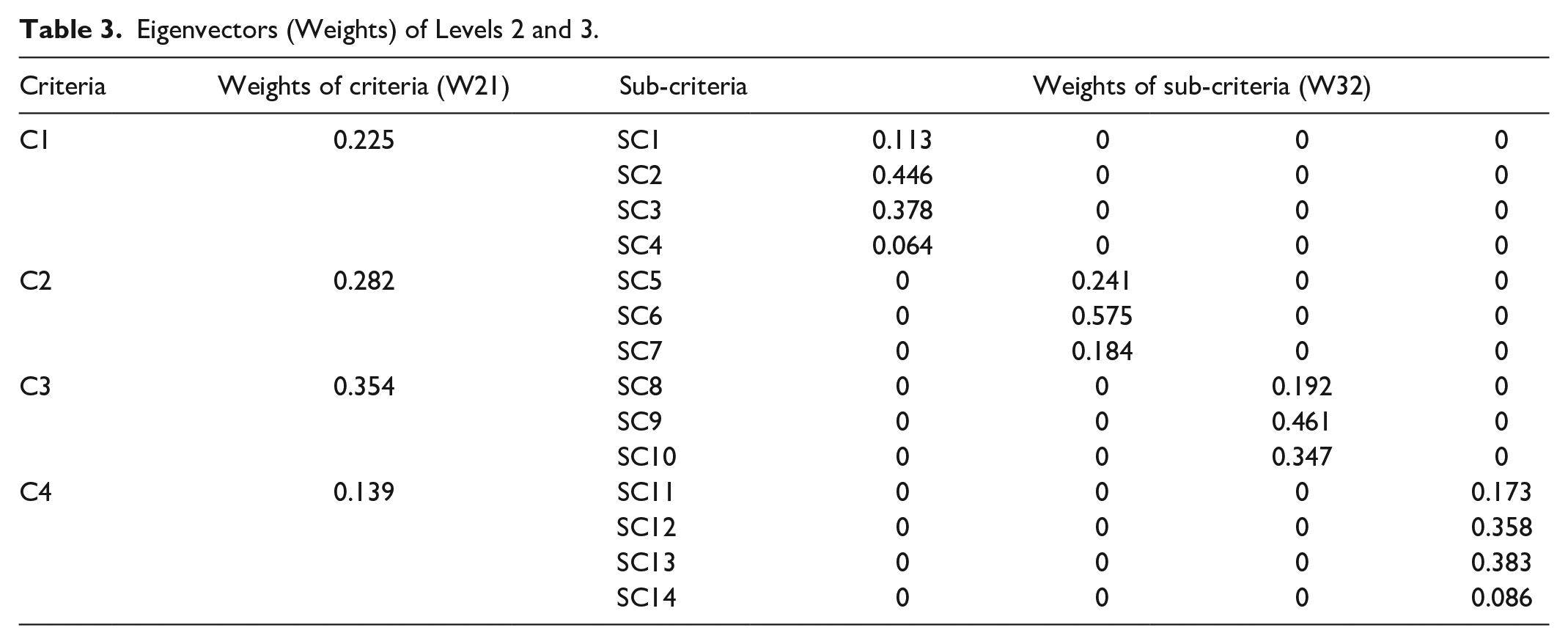
The weights for the four evaluative criteria, respectively, are 0.225 (C1), 0.282 (C2), 0.354 (C3), and 0.139 (C4). The eigenvectors for customer perspective (W32(c)), internal business process perspective (W32(i)), financial perspective (W32(f)), and learning and growth perspective (W32(l)) are organized into W32, a matrix that indicates the relative importance of the various sub-criteria vis-à-vis their upper level criteria.

This study obtained the interdependencies between the internal aspects and standards through a review of the pertinent literature and the aforementioned expert interviews. The matrix formed by the eigenvectors from the pairwise comparisons is W22, where 0 indicates independence between eigenvector criteria weights. In Table 4, W33 indicates that each sub-criterion has dependence.
Inner Dependence Matrix of Sub-Criteria, W33.

Step 4: Supermatrix Formation
The supermatrix indicates the dependencies among elements in the system. Among them, each submatrix is derived from a pairwise comparison. In this study, the derived supermatrix utilized all of the elements within the network. It illustrates the general form of supermatrices (as shown in Table 5). The supermatrix also contains interactions between clusters, and the total of each column does not necessarily equal 1. The supermatrix will improve the power toward convergence due to the normalized values that are entered into both the supermatrix itself and the column stochastic (Meade & Sarkis, 1998; Saaty, 1996). At present, the supermatrices have achieved convergence and obtained eigenvectors.
The Supermatrix.

Step 5: Selection of Best Alternatives
If the supermatrix yielded in Step 3 covers the complete network, that full coverage can be found in the columns from which the priority weights can be derived from normalized supermatrix alternatives. The overall criteria and sub-criteria weights will be standardized (see Table 6).
The Synthesized Results Obtained by the Supermatrix.

Discussion and Practical Implication
The present study consolidated variables based on previous studies on customer value co-creation in the aviation industry as well as interviews with industry experts. The consolidation of variables shed light on the crises currently faced by the industry and enabled us to develop solutions to help aviation companies overcome their challenges. Based on studies on customer value co-creation, we gained insights into customers’ opinions as well as their expectations of the industry. From the interviews, we understood the practical hardships faced by the industry. Based on both approaches, we proposed and analyzed the research variables. This study utilized a model that combines the ANP approach and the entropy method to examine the quality of service in the aviation industry as well as to investigate the overall differences from the perspectives of company managers and consumers. The quality of service of the aviation industry was measured via four different criteria, namely Dialogue (C1), Access (C2), Risk assessment (C3), and Transparency (C4). First, the ANP approach was used to examine the interactive relationships between the criteria. Then, the entropy method was used to identify the differences between the perspectives of consumers and companies, as well as to determine the means of improvement. Given that customers are users who understand each part of a service, company managers take on a more strategic-based approach to value co-creation, while customers take on a more practice-based approach. The results of this study have provided insights into the gap between the strategic and practical aspects such that value co-creation can truly be achieved.
The empirical results are discussed here. According to the ANP process, we can identify the interactive relationships between each criterion as well as the influential relationships between each sub-criterion. According to Figure 1, the risk criterion had the most weights allocated, which means that among the four criteria, companies and consumers express the greatest concern toward the risks of the aviation industry. Since the pandemic began, consumers have lost interest in traveling because the risk of infection is significantly higher in confined spaces. Consumers preferred to stay at home and refrained from taking public transportation. Therefore, in addition to providing a comfortable environment, airlines should also attend to the security and safety needs of passengers through measures such as providing masks and disinfecting seats.
The difference between the companies and the consumers was greatest in the Value added (SC1) sub-criterion under the Dialogue criterion. This shows that the remarkably large difference between the two parties is formed when companies perceived that the costs invested and services provided were not reciprocated in a similar fashion by the consumers. Therefore, companies should focus on refurbishing their infrastructure and amending the service quality of their staff to diminish the differences with their consumers. Service acceptance (SC5) is significantly the greatest sub-criterion under Access. While customers are enjoying the services provided by a company, they would also give their feedback to the staff. In this regard, customers must be able to obtain accurate information from a company’s website. The ongoing pandemic has forced many travelers to cancel their plans of flying overseas, and many companies are unable to convey accurate information in a timely manner, which reduced the customers’ trust in them. Therefore, airlines should not only post important up-to-date information on their websites, but should also inform consumers about cancelled or additional flights, so as to prevent overly large differences in relation to their expectations. In the Transparency criterion, the gap between consumers and company managers was greatest in the Information transparency (SC11) sub-criterion. In a market traditionally dominated by PC networks, mobile networks have gradually permeated human behaviors, and people have discovered that the information of air travel-related products have become increasingly transparent and open. When many aviation companies sell new products online, they would focus on their competitive advantages such as high information transparency and openness, avoid negative impacts, and think from the customer’s standpoint. In practice, aviation companies can properly plan the sales of their products through online and offline methods, invest more in constructing network platforms, expediting the search for partnerships for offline products, and protect customer information by concealing confidential information on tickets. These measures allow customers to obtain new information while ensuring the sustainable business of the companies.
Conclusion
The aviation industry plays a critical role in the ongoing social and economic development of Taiwan. In recent years, the establishment of successive low-cost airlines has primarily been based on using low prices as the incentive to attract customers, an approach which has given customers a particular overall impression of the aviation industry’s service quality. However, the civil aviation transport industry is a service industry that requires a high degree of expertise, capital, and manpower, and there is also intense competitive pressure among the various civil aviation operators. Therefore, determining how to lower or maintain operating costs without affecting flight safety and while still providing customers with satisfactory service quality has emerged as a key issue for civil airline operators. Moreover, many aviation companies have suffered losses or even went out of business due to the COVID-19 pandemic. Therefore, many scholars are responding to the urgency of finding the means to help these aviation companies earn revenue while recovering from the impacts of the pandemic.
This study integrated the value co-creation concept of customers into the aviation industry to make up for the previous lack of literature on the service quality of the industry. Through this research, it was found that the highest proportion of customers’ value co-creation comes in the area of risk assessment, showing that, consistent with the expert evaluations, customers are participating more and more in the co-creation of value. Customers will not relinquish their right to choose, but they will insist that airlines provide them with adequate information regarding the risks involved in travel; airlines must not only provide information but also provide appropriate methods to assist consumers in assessing personal and social risks associated with their products and services. In terms of the subcategories, we found that the highest value was in the sharing of ideas, meaning that customers hope to establish mutual trust by sharing their thoughts through interactions with a company, deepening the participation and willingness of both parties to act. Under the access category, the acceptance of service obtained the highest value, showing that, whereas aviation companies tended to focus in the past on the creation and provision of services to consumers, now consumers are increasingly turning their attention toward having long-awaited experiences. Therefore, customers hope that they can increase their understanding through experience. Under the transparency category, it was found that partner sharing had the highest value, indicating that consumers and aviation companies have asymmetric information status and that this has always been beneficial to the companies as the ubiquity of network asymmetry is disappearing. Information on products, technologies, and business systems is more readily available, and consumers can thus reduce information asymmetry through the sharing of information or resources with partners.
Among the four main criteria, Table 6 clearly shows that the cognitive gap between customers and managers was largest in Risk (C3), followed by Access (C2). This finding indicates that consumers remain fearful of the pandemic and hence, aviation companies should employ effective management approaches to lower their customers’ fear and boost their trust in the industry. For example, companies should think from the customer’s perspective and disinfect their aircraft or hand out personal protective equipment so that customers would feel that their needs are attended to. In the second part of the study, the entropy analysis clearly indicated that the criterion Access (C2) was assigned the highest weight value, which implies that customers should develop the concept that value is enjoyed when it is owned. Aviation companies should use interactive means to understand customers’ needs and achieve value co-creation while obtaining multiple business opportunities. In general, Table 6 shows that the companies and customers differed greatly in terms of Encouraging customers to express their opinions (SC2); Means of communication (SC4); Information transparency (SC11); and Updating information (SC14). The analysis results highlighted that the customers actively express their opinions and use different means of communication to express their demands. Yet, they are unsatisfied with the ways many aviation companies handle their feedback, which resulted in the cognitive gap between managers and consumers. From a management’s perspective, managers should convey the notion of value co-creation to their employees during their training and effectively improve their work attitudes. From a customer’s perspective, customers should understand from the information provided by company websites or staff about the procedure and attitudes of a company when they provide services to customers, so as to reduce the cognitive gap and prevent misunderstandings. Companies should constantly update information, especially for aviation companies in the wake of the pandemic; indeed, continuous updates on passenger and cargo flight information can reduce negativities toward the companies. In this study, the differences between two different groups of entities were analyzed by means of the ANP approach and the entropy method. Both methods significantly illustrated the cognitive gap between companies and customers, and marketing strategies were proposed based on these results.
The main contributions of this study are as follows:
The revision and analysis of airline service quality through, respectively, value co-creation with customers and the utilization of the Analytic Network Process.
The results in this study confirmed that a company’s core values (including values-in-exchange and values-in-use) were not single-handedly determined by the producer. They were determined, instead, through the process of selling products to customers.
In this study, the interactions between parties constitute the core of value co-creation. The overall risk, however, must be considered. Interactions with customers primarily involve the increased participation of customers to create value for both customers and a company. Interactions with co-creators primarily involves the integration of resources for mutual benefits.
Highlights
In this study, we were able to extract customers’ ideas by implementing strategies for value co-creation. Employing value co-creation with customers allows for the development and verification of strategic directions in the aviation industry.
The value co-creation process must include the shared goals and shared values developed by the creators and the co-creators. The DART model framework was applied to achieve the desired level of airline service quality.
Some limitations must be addressed in this study: 1. Large-scale sampling could not be achieved as the sample only consisted of 32 expert responses. This is because there are only a handful of Taiwanese aviation companies and there are only a few dozen executives collectively. 2. Causal relationships were not analyzed due to the use of ANP. Future studies can analyze the relationships between the factors through the Decision-Making Trial and Evaluation Laboratory (DEMATEL) approach.
Footnotes
Declaration of Conflicting Interests
The author(s) declared no potential conflicts of interest with respect to the research, authorship, and/or publication of this article.
Funding
The author(s) received no financial support for the research, authorship, and/or publication of this article.
