



Abstract
Despite the existing scholarship on the contrastive genre-based studies of research abstracts across contexts and cultures, this strand of research is underexplored in Vietnam. Motivated by this gap, this study aims to identify and compare the move structures and the linguistic realisations of English-medium economics abstracts published in two highly-ranked international and Vietnam-based journals. Drawing on the models by Santos and Hyland, each corpus of 20 research abstracts from The Quarterly Journal of Economics and VNU Journal of Science: Economics and Business was manually analysed, respectively. The genre analysis was performed at the macro level of move frequency, move length and move patterns and the micro level of verb tenses and aspects, voice, that-complement clauses, modals/semi-modals and self-mentions. The results show that both groups of economics researchers did not strictly conform to the linear Introduction-Purpose-Method-Product-Conclusion (IPMPrC) move sequence. They regarded Method and Product as obligatory moves and allocated the most textual space to the Product move. Linguistically, they favoured the present simple, active voice and that-complement clauses controlled by reporting verbs. Modal/semi-modal verbs and self-mention words were utilised in certain moves. Despite these similarities, there were some discrepancies in the move patterns and rhetorical strategies, indicating that international scholars structured their abstracts with greater rhetorical complexity and made more effort to express their authorial identity. The findings highlight the influences of disciplinary nature, discourse community and socio-cultural factors on research abstract writing, thus serving as a resource for ESP instructors, students and researchers to improve their genre awareness and academic writing skills.
Introduction
As the first and most-read part of a research article (RA), the abstract is regarded as an academic genre with specific functions, rhetorical structures and linguistic realisations. It serves as a summary of the study, a screening tool and roadmap for readers to decide whether to read the full article, and an indexing aid for professional writers (Huckin, 2001). Due to these important functions, the abstract has attracted significant attention in genre analysis studies. In the English for Specific Purposes (ESP) tradition, genre analysis refers to the study of situated linguistic behaviour in institutionalised academic and professional settings (Bhatia, 1997). This approach was originally developed by Swales (1981), who proposed a hierarchical model for analysing RA introductions called Create a Research Space (CARS). Genre analysis can be performed at the macro level of textual structure and the micro level of lexico-grammatical features. Regardless of the analytic frameworks applied (Bhatia, 1993; Hyland, 2000; Santos, 1996; Swales & Feak, 2004), abstracts are typically analysed in terms of moves and steps, where a move is a discoursal unit serving a coherent communicative function and is composed of smaller constituent elements called steps (Swales, 2004). At the micro level, genre analysis deals with the linguistic features that can distinguish the moves/steps. Despite their varying methodological perspectives, most researchers analyse selective features that they perceive as recurrent or important, such as verb tenses and voice (Ahmed, 2015; Hanidar, 2016; Li & Ge, 2009; Salager-Meyer, 1992), metadiscoursal devices (Gillaerts & Van de Velde, 2010; Hyland & Jiang, 2018; Hyland & Tse, 2004) and formulaic expressions (Cortes, 2013; Le & Harrington, 2015; Omidian et al., 2018) to explore the form-function relations between linguistic realisations and communicative purposes.
An investigation into the literature of contrastive genre analysis shows that researchers compared RA abstracts’ structural and linguistic features (i) in related or completely different disciplines or (ii) in a single discipline but across languages, author categories and contexts. Regarding the former strand, the disciplines investigated include applied linguistics and educational technology (Pho, 2008, 2013), environmental science and applied linguistics (Saeeaw & Tangkiengsirisin, 2014), dentistry subdisciplines (Alyousef, 2021a) as well as natural sciences, social sciences and humanities (W. Xiao et al., 2023). For the latter strand, researchers performed genre analysis of RA abstracts in English and other languages, such as French (Van Bonn & Swales, 2007), Italian (Diani, 2014) and Chinese (Duan & Wei, 2021), or among different author categories, such as native and non-native writers (Kafes, 2012; Sheldon, 2013; R. Xiao & Cao, 2013) as well as expert and novice researchers (Siriganjanavong, 2019; Sükan & Mohammadzadeh, 2022). In addition, there are a few comparative studies on abstracts from the context-dependent perspective. For example, Vathanalaoha and Tangkiengsirisin (2018) investigated Thai-based and international English-medium dental RA abstracts. They found that Thai writers tended to omit the Background move, preferring the Purpose-Methods-Results-Discussion pattern and the first-person plural pronoun ‘we’. In contrast, international scholars deemed the Background move essential in their abstracts, favoured the Background-Purpose-Methods-Results-Discussion pattern and avoided self-references and modalities. Similarly, Amnuai (2019) reported that while Thai-based abstracts in accounting typically followed a Purpose-Method-Product sequence, international ones were organised in the Introduction-Purpose-Method-Product order with twice the number of Introduction and Conclusion moves. Linguistically, both groups preferred the present simple tense in the active voice. In the same vein, Kurniawan and Sabila (2021) discovered that both Indonesian and internationally published abstracts adhered to a linear move pattern. However, in the former, the dominant move was Introduction with Introduction-Purpose-Method-Product as the recurring move sequence; meanwhile, the latter was characterised by the prevalent occurrence of the Conclusion move and the Purpose-Method-Product-Conclusion pattern. Their study did not examine lexico-grammatical features and differs from Vathanalaoha and Tangkiengsirisin’s (2018) and Amnuai’s (2019) findings, possibly due to variations in disciplines and contexts. Recently, Husein et al. (2022) observed that nursing abstracts in Indonesia and internationally show similar manifestations of the Method and Results move, with the linguistic realisations by using simple past tense. However, authors of international abstracts emphasised the research novelty more than their counterparts did by highlighting the gap in the existing literature and the significance of their study.
The reviewed studies present great insights into the variations of RA abstracts that stem from diverse factors such as disciplinary nature, language proficiency, conventions of research communities and sociocultural influences. Amnuai (2019) highlights that non-native and novice researchers often struggle with abstract writing due to limited awareness of the generic conventions within their communities. This underscores the importance of understanding both local and international writing norms so that researchers can adjust their research abstracts to meet the expectations of the targeted audience. While prior research has explored international and local contexts, such as Thailand (Amnuai, 2019; Vathanalaoha & Tangkiengsirisin, 2018) and Indonesia (Husein et al., 2022; Kurniawan & Sabila, 2021), the context of Vietnam remains underexplored. Given Vietnam’s unique socio-political, cultural and educational systems, comparative studies of research abstracts between Vietnam-based and international journals can shed light on how these factors influence academic writing practices and contribute to the existing scholarship on contrastive genre research. Moreover, in terms of disciplinary focus, genre investigations into research abstracts in Vietnam have been limited to fields such as agriculture (Zhang et al., 2012), applied linguistics (Cao, 2018), and linguistics and TESOL (Bui, 2022). Despite the pivotal role of economics in driving the country’s economic growth and global integration, this discipline has thus far received scant attention in comparative genre-based research. As noted by Ekelund and Hébert (2013), since economics represents a dynamic form of intellectual discourse rather than a fixed set of principles, meaningful participation in this discourse requires a strong mastery of textual strategies. Thus, it is important to explore how economics researchers mould their abstracts to follow the conventions of a specific community to increase the chance of their work being accepted and read. Lastly, regarding structural analysis of genre, most previous researchers scrutinised the move frequency and move sequence and neglected the textual space allocated to the move or move length. For the micro-level analysis, few studies examined the distribution of a broad set of linguistic features across moves (Pho, 2013). Motivated by research gaps, this study examines English-medium abstracts in international and Vietnam-based economics journals at both the macro and micro levels. It aims to uncover potential similarities and differences between economic abstracts across contexts, thus contributing to the scholarship that enhances the genre knowledge of students and academic writers by addressing the two research questions:
Methodology
Data Collection
Based on Scimago Journal Rankings (https://www.scimagojr.com/) and V-CitationGate (https://vcgate.vnu.edu.vn/), the journals with the highest impact factor scores in 2020 (the latest ones available at the onset of the study) in the international and Vietnam-based contexts were selected, namely The Quarterly Journal of Economics (https://academic.oup.com/qje) and VNU Journal of Science: Economics and Business (https://js.vnu.edu.vn/EAB), respectively. Since the impact factor is widely recognised as one of the key quality indices for scientific journals, it is assumed that peer-reviewed journals with high impact factor scores will represent well-constructed abstracts. To guarantee that the abstracts best reflect current writing practices and are not impacted by the time of publication, the study focused on original research abstracts published in 2021. In addition, because it is highly labour-intensive to analyse many abstracts manually, only 40 were randomly selected for in-depth analysis.
The international sample (IS) and the Vietnam-based sample (VS) have 20 research abstracts each (see Appendix). Vietnamese researchers wrote the VS abstracts, while the IS abstracts were written by scholars from diverse nationalities and targeted a broader international readership. All the selected abstracts follow a traditional unstructured format, presented as a single block paragraph under the heading ‘Abstract’, without distinct sub-headed sections. According to the manuscript submission guidelines of these journals, research abstracts should provide concise and factual summaries of the research purpose, findings and conclusions in a manner comprehensible to readers. As standalone texts, abstracts should also avoid references and uncommon or non-standard abbreviations. Table 1 provides the details of the samples.
Description of Journals and Abstracts Selected for Analysis.

Analytic Methods
After the abstracts were collected, they were put in Word files for manual analysis at both the macro and micro levels. For macro analysis, this study adapted the move models of Hyland (2000) and Santos (1996) to propose the analytic framework (see Table 2). These are among the most well-established models in genre analysis, making them a solid choice for investigating the textual aspects of research abstracts. It is worth noting that, unlike Santos’ model, the proposed framework does not further divide moves into sub-moves or steps. The reason is that the sub-division of moves in Santos’ model was primarily based on Swales (1990) CARS model for the RA introduction, which was not clearly distinguished (Pho, 2008). The present study adopted a function-oriented approach to mitigate potential reliability and validity issues linked to form-oriented methodology (Lu et al., 2021) and to ensure methodological rigour in identifying the typical linguistic features of each move (Pho, 2013). Move tags (I for Introduction, P for Purpose, M for Method, Pr for Product, and C for Conclusion) were assigned to text segments based on their communicative purposes (functions), irrespective of their linguistic forms. The coding unit was defined with maximum flexibility, encompassing sentences, clauses, phrases and even individual words. The probing questions were used during the move coding process. For instance, a text segment answering ‘How was the research implemented’ would be coded as the Method move.
Move Model of RA Abstracts Adapted From Hyland (2000) and Santos (1996).
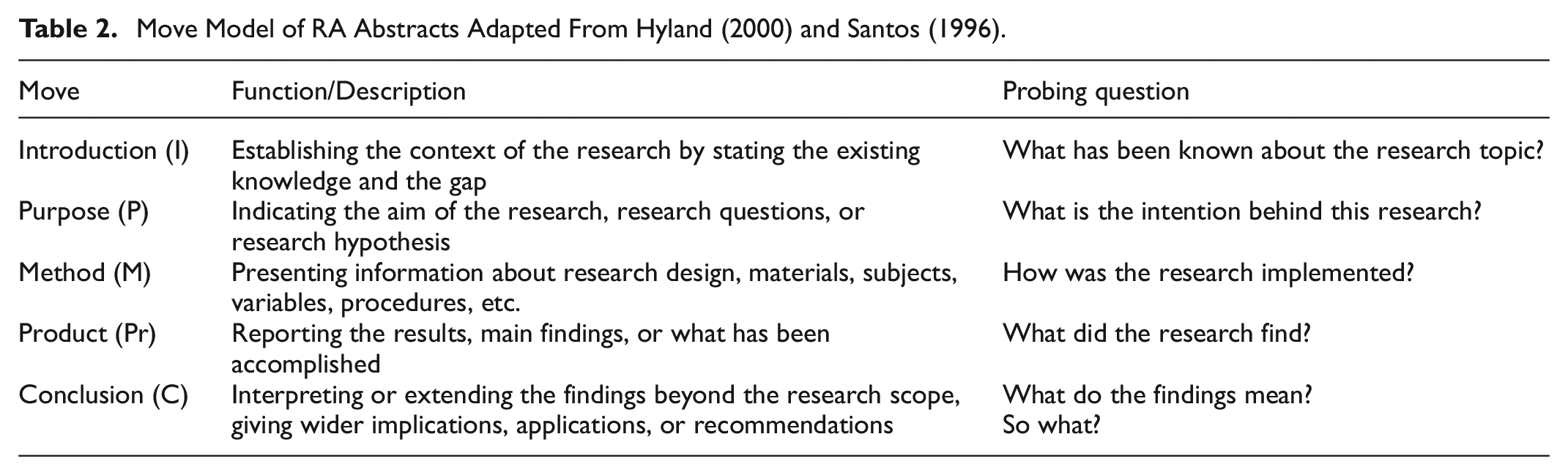
The macro level of analysis was performed in three aspects: move frequency, move length and move pattern. To determine move frequency, the researcher calculated the ratio of abstracts containing a specific move tag to the total number of abstracts. This approach can minimise the risk of a single text skewing the results due to an unusually high frequency of a specific move. Based on Swales (2004) criteria, a cut-off point (x) was used to categorise moves: obligatory (x = 100%), conventional (60% ≤x < 100%), optional (x < 60%). Admittedly, the 60% frequency cut-off was arbitrarily set as a potential measure of move stability (Kanoksilapatham, 2005), and a model with three categories instead of two would be deemed to be subtler. To measure the move length, the researcher calculated the ratio of a single move’s length (word count) to the total length of all the moves. As the study followed a five-move model, each move is expected to occupy 20% of text space. To detect the move pattern, the researcher counted the move sequences and categorised them into linear patterns (one that follows the expected order IPMPrC), semi-linear patterns (one that follows the IPMPrC order but has fewer than five moves), and non-linear patterns (one that violates the IPMPrC order). The move reiteration (a textual feature characterised by the repetition of one or more moves) and move embedding (the combination of one or more moves within a single sentence) were also scrutinised. In addition, emerging moves (if any) were closely examined and added to the move model if they occurred with approximately 50% regularity in the samples (Nwogu, 1997).
For the micro level of analysis, the researcher manually analysed verb tenses and aspects, voices, that-complement clauses, modals/semi-modals and self-mentions within each move. Tense is the linguistic indication of the time of an action (present or past), and aspect is the perspective under which an action is viewed (simple, progressive, perfect and perfect progressive). Following the common practice in the literature (e.g., Hanidar, 2016; Salager-Meyer, 1992), verb tenses and aspects in each move were identified based on finite verbs – the verbs that indicate grammatical tense and influence the agreement with the subject and the number. Voice indicates whether the subject is performing the action (active voice) or being affected by the action (passive voice). The grammatical voice was determined based on the finite or modal/semi-modal verbs. In addition, that-complement clause is a clause introduced by a complementiser ‘that’ and completes the meaning of the preceding verb, noun, or adjective. The complement clause with that-deletion (e.g., We find the average direct effect of a foreign multinational firm on its U.S. workers is a 7% increase in wages.) was also counted. Modal/semi-modal verbs are auxiliary verbs that express possibility/ability (e.g., can, may, could, might), obligation/necessity (e.g., should, must, need to, have to, ought to) and volition/prediction (e.g., will, shall, would). Self-mentions include first-person pronouns and their derived forms (e.g., I, me, my, mine, myself, we, us, our, ours, ourselves) and explicit self-referring words to the writer(s) (e.g., the researcher(s), the author(s), etc.). To illustrate how the linguistic analysis was performed, in the Product move, ‘We document three patterns that suggest that these grants may distort policy’, the finite verbs ‘document’ and ‘suggest’ indicate the present simple tense and aspect, the sentence is in active voice, ‘suggest that’ is a that-complement clause, the first-person pronoun ‘we’ functions as a self-mention word and ‘may’ is a modal verb indicating possibility.
Reliability and Validity
While the top-down genre analysis involves inevitable subjectivity and personal judgement, it can be minimised by inter-rater and intra-rater reliability. To test for inter-rater reliability, 20% of the samples (4 abstracts from each journal) were randomly assigned to a rater (coder) who specialised in Business English to validate the result. After clearly understanding the coding framework, the rater coded the abstracts independently. In cases of disagreement, the researcher engaged in discussions with the rater to clarify the coding criteria and reach a consensus. When consensus could not be reached, the researcher maintained their tagging decisions. The percent agreement rate between the two coders, considered the most suitable measure for determining the reliability of move coding in genre-based studies (Rau & Shih, 2021), was calculated. The inter-coder agreement was 90%, which was high enough to ensure the reliability of this study. For intra-rater reliability, the researcher closely read the abstracts and double-coded them 3 months after the first coding to detect any potential issues. In general, the two coding sessions yielded similar results, indicating that the analytic framework is sufficiently reliable with high intra-rater reliability ensured.
In addition, many researchers have discussed issues relating to the validity of move analysis (e.g., Barron, 2012; Bhatia, 1993; Dudley-Evans, 1994; Moreno & Swales, 2018). For instance, Dudley-Evans (1994) asked the questions of ‘how do we make decisions about the classification of moves?’ and ‘how can we be confident of the validity of the moves and move cycles?’ (p. 226). Such questions are all important, given the significance of validity as the touchstone of any research. In this study, the validity of the analysis was assured by the researcher’s detailed review of relevant literature and great efforts to ensure an adequate understanding of the analytic frameworks and the coding procedures.
Findings and Discussion
Rhetorical Moves
This section displays the results of the move analysis to answer the first research question. The move occurrence frequency, length and patterns are reported, analysed, and discussed with typical examples. At the end of each example, the abstract from which the example was taken is put in square brackets. For instance, [IS1] refers to abstract 1 from the international sample and [VS1] to abstract 1 from the Vietnam-based sample.
Move Frequency
As indicated in Table 3, all five moves, namely Introduction, Purpose, Method, Product, and Conclusion, appeared in both datasets, with the prevalence of the obligatory and conventional moves, and no emerging move was detected. The occurrence frequencies of Method and Product moves were similar. The Introduction move occured conventionally with a frequency of 60% of the Vietnam-based abstracts, while optionally with a frequency of 50% in the international ones. The Purpose move was an obligatory element, occurring in all international abstracts but conventional in Vietnam-based ones with a frequency of 90%.
Move Frequency and Ratio of Abstracts Containing Each Move.

Note. F = frequency; P = percentage.
The disparity in the status of these moves is attributed to the fact that although many research topics in the economics discipline have been well-explored internationally, they are under-explored in the Vietnam-based context. Therefore, economics researchers in Vietnam tended to regard the Introduction move as necessary to provide background information and persuade readers about the research’s originality. Conversely, rather than the Introduction move, international scholars began their abstracts by stating the research objectives in the Purpose move. According to Swales (1990), Purpose is among the most important moves of abstracts because all other rhetorical moves depend on the primary research aims or objectives. In the current study, international authors were more cognizant of the Purpose move’s essentiality than their Vietnam-based counterparts, as they often reported studies with many objectives or hypotheses. In addition, stating the research objectives clearly can increase the chance of their manuscripts or abstracts being accepted by the journals.
The Method and Product moves were regarded as obligatory elements with a frequency of 100% in both datasets. These findings echo the results of prior studies that reported the high frequencies of Method and Product moves in research abstracts (Pho, 2013). From the top-leading economics journals with high impact factors, international and Vietnam-based abstracts are expected to be meticulously written and represent the best in the respective discourse community. The high expectations from discourse community members and the limited textual space of abstracts force both groups of scholars to prioritise the rhetorical moves that contain the most salient information in their research articles. Hence, they invested most rhetorical efforts into the Method move to provide detailed descriptions of analytical procedures that enhance the research credibility and the Product move to showcase their research findings.
In addition, the Conclusion move was conventional in both samples, with a frequency of 65% and 70%, respectively. This finding supports Hyland’s (2004) remark that there is a rising trend of the Conclusion move to appear in the research abstracts. The conventional status of this move stresses the significance of research studies in economics. According to Schneider (2019), economics is an important field of study due to its impacts on the public policies and socio-economic developments of a country as well as the lives of people. Due to the significant roles of economic research, after reporting major results, both international and Vietnam-based authors tended to present a conclusion that explicitly highlights the values or implications of their findings, either to the discipline or the wider community.
To determine if there was any significant difference in the move frequencies between Vietnam-based and internationally published research abstracts, the chi-square test of independence was conducted with a p-value of .05. The chi-square test showed no statistically significant difference in terms of move frequencies between the two corpora, χ2 (4, N = 167) = 0.32, p = .98. This suggests that authors of both local and international economics journals followed the established norms and rules of their relevant discourse community when writing abstracts. The findings align with Saidi and Talebi’s (2021) study, which found no significant divergences in the move frequencies between locally and internationally published RA abstracts in the field of applied linguistics.
Move Length
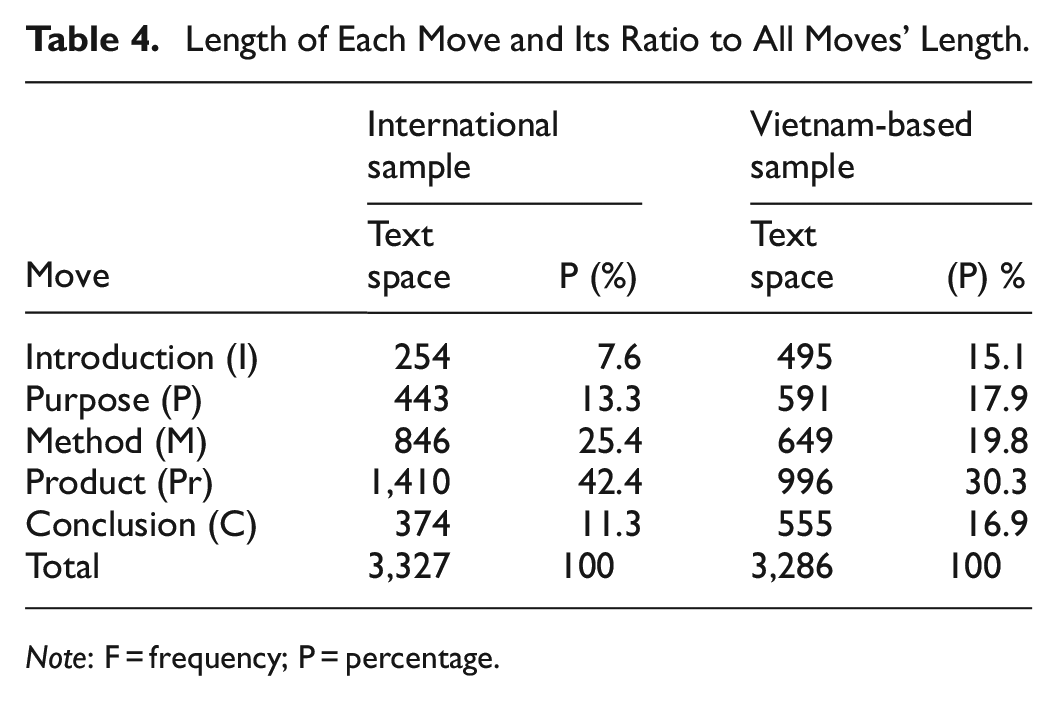
From Table 4, it is evident that when shaping the organisation of their abstracts, international and Vietnam-based scholars devoted most text space to the Product move, then the Method and Purpose moves, followed by the Conclusion move, and finally, the Introduction move. When the moves are arranged based on the large to small text space allotted, the order is Pr-M-P-C-I in both datasets. Specifically, the Product move, which achieved the obligatory status in terms of occurrence frequency, was the longest move, with 42.4% and 30.3% of textual space in the international and Vietnam-based samples, respectively. This aligns with the findings from prior research (e.g., Alyousef, 2021b; Tankó, 2017; Tseng, 2011) and indicates that the economics abstracts in this study are predominantly informative. Since these abstracts are derived from original research articles, it is sensible that the Product move that reports detailed research findings receives the most textual space. Both groups of authors seemed to be aware of this move’s vital role as the primary selling point for their research and inserted into it many details about the results to intrigue the relevant audience to read their whole articles.
Length of Each Move and Its Ratio to All Moves’ Length.
Note: F = frequency; P = percentage.
On another note, although Product was the longest move in the two groups of abstracts, it was longer in international abstracts than in Vietnam-based ones. The result gives support to the finding of El-Dakhs (2018) that English-medium abstracts published in more renowned journals tended to underscore the research findings more than other moves and more than those in less prestigious journals. This is because international abstracts are mainly written by scholars faced with more competition to get their research published in internationally recognised journals. As a result, unlike Vietnam-based counterparts who are more interested in specific research topics contextualised in their country, international writers strove to stand out by focusing more on the significant and relevant topics to the wider global community. Therefore, international abstracts are more likely to report relatively complex studies with more objectives and rich findings, accounting for more textual space given to Purpose and Product moves.
The move with the least textual space was Introduction, occupying only 7.6% and 15.1% of the total word counts in the international and Vietnam-based samples, respectively. The limited textual space given to this move in both datasets is due to the empirical nature of most economics abstracts and the textual space limit. To elaborate, instead of the Introduction move, researchers with empirical or experimental-based studies prioritise more important rhetorical moves that present the methodology, including participants, techniques, statistical procedures and findings. Moreover, as abstracts are restricted in terms of word count, reducing the textual space for the Introduction move – the move deemed not as essential as the Method and Product moves – helps both groups of authors conform to the brevity requirement of abstracts.
It is worth noting that despite occupying the least textual space in both samples, the length of the Introduction move in international abstracts was only half that in Vietnam-based ones. This supports the findings about move frequency that the Introduction move was an optional element in international abstracts, while it enjoyed the conventional status in Vietnam-based ones. The greater length allotted to the Introduction move by Vietnam-based scholars seems to result from the nature of economics research in Vietnam and the cultural factors. Since many research topics in economics have been well-explored in the international community but are still under-researched locally, Vietnam-based researchers need to equip the intended audience with sufficient basic and relevant knowledge of the research topics by the Introduction move. Moreover, Asian countries, including Vietnam, tend to cluster around the high-context culture continuum (Hall, 1976) and Vietnamese culture is characterised by relatively high collectivism within close-knit communities (Hofstede, 2001). Therefore, Vietnamese writers often employ a covert, indirect writing style, focusing on discussing points subtly rather than explicitly. In contrast, North American and European countries, rooted in individualistic and low-context cultures, emphasise explicit and direct communication, with writers responsible for delivering clear, straightforward messages. Similarly, R. B. Kaplan (1966) noted that Oriental thought patterns are represented by a circular, spiral line, reflecting an indirect rhetorical style, whereas Anglo-European thought patterns follow a vertical straight line with a downward arrow, symbolising linearity, directness, clarity, and logic. This cultural factor accounts for international scholars’ penchant to introduce their research more directly to align with Western academic styles.
Move Patterns
*Move Sequences
Table 5 shows seven variations of rhetorical move sequences in the manifestation of the organisation of research abstracts, ranging from three-move (3M) to nine-move (9M). The international sample had 19 move sequences in total, falling into all seven categories, while the Vietnam-based sample consisted of 15 move sequences and lacked 8M pattern.
Move Patterns of Economics Research Abstracts.

Note.+ means Embedded moves.
These findings markedly depart from those of Amnuai (2019), Kurniawan and Sabila (2021) and Vathanalaoha and Tangkiengsirisin (2018). In these studies, the abstracts consisted of two to five moves, contradicted by the great variations from 3M to 9M sequences found in the current study. The disparity indicates that strict conformity to the traditional five-move structure of the article abstract is probably fading away into obscurity (Rungnaphawet, 2016), at least in the economics communities in the current study. While norms and conventions somehow govern rhetorical structures, genres are dynamic constructs and subject to innovation and variations under the impacts of sociocultural practices (Bhatia, 2004). Discourse members can tactically negotiate, co-construct and individualise the structures and linguistic realisations of a genre (Hyland, 2012). Thus, the evolution of abstract structures reflects the broader trend of increased flexibility and adaptability in research abstract writing.
In addition, it is notable that international abstracts manifested more variations in move structures than Vietnam-based ones. The international sample had 19 move sequences, while the Vietnam-based one contained 15 sequences. The number of abstracts with more than five moves employed by international scholars was also greater than that by Vietnam-based ones. Specifically, there were eight international abstracts with more than five moves, with two abstracts featuring each 6M, 7M, 8M and 9M pattern, respectively. The Vietnam-based sample featured only four abstracts with more than five moves, including two 6M abstracts and one abstract structured in 7M and 9M patterns, respectively. The greater number of move variations used by international scholars is partly due to the more complex nature of research studies, which also accounts for more move reiterations discussed later.
The move sequences also reveal that the conventional linear IPMPrC structure, deemed to enhance the readability and simplify the readers’ comprehension process, did not frequently occur. While international scholars preferred to organise their abstracts in non-linear sequences, Vietnam-based ones favoured semi-linear structures. Out of 20 international abstracts, 14 were structured in the non-linear sequences, three in the semi-linear ones (i.e., PMPr, PMPrC), and three in the linear IPMPrC pattern. Out of 20 Vietnam-based abstracts, nine were structured in semi-linear sequences (i.e., PMPr, IMPrC, IPMPr, PMPrC), seven non-linear patterns, and four linear ones. The prevalent non-linear move patterns in international abstracts suggest a higher level of rhetorical individuality than that of the Vietnam-based ones, whose writers tended to follow the conventional move sequence. Inversely, the semi-linear sequences favoured by Vietnamese writers, to some extent, demonstrate ‘the inheritance of academic writing conventions’ that tend to be stabilised and even crystallised in a relatively closed discourse community (Yakhontova, 2006, p. 164) Unlike the global large-scale discourse community, the Vietnam-based one is rather closed and small-scale; thus, its members are more inclined to follow the prescribed conventions of abstract writing with or without realising it.
*Move Embeddings
While most rhetorical moves in both datasets are realised by a sentence or a series of sentences, there are cases where a move is in the form of a clause, either a finite or non-finite clause or a phrase. The international sample recorded 26 occurrences of move embeddings, while the Vietnam-based sample had fewer cases, with only 15 occurrences. The occurrences of move embeddings are not uncommon because abstracts are brief, condensed texts. Santos (1996) considered move embeddings a genre-specific convention that signals the author’s effort to compete for the attention of a busy readership, while Tankó (2016) viewed it as a rhetorical strategy to realise several communication goals per one syntactic unit. Recently, Saidi and Talebi (2021) remarked that in addition to a wide range of move patterns, Iranian and international authors omitted and combined some moves to account for the restricted textual space given to present a synopsis of their research.
A further look at the combined patterns in both datasets revealed that they primarily appeared with the Method move. The Method move was embedded in either the Purpose or Product move, resulting in three types of move embedding: Method + Purpose, Purpose + Method and Method + Product. Method + Purpose was the most popular among the three combined patterns, with 11 such combinations in the international sample and seven in the Vietnam-based one. The embedded moves Method + Purpose are illustrated in Example 1.
The fact that the Method move is more likely to be embedded than the other moves can be explained by the relative flexibility of the realisation of this move (Pho, 2008). For instance, the methods can be shown in a finite clause at the beginning of a sentence or in prepositional phrases functioning as constituent elements in the purpose or product moves. The finding differs from that of Kafes (2012), who found the Method move was presented concisely and separately in the structure of education abstracts. On further consideration, the combined pattern of rhetorical moves might result from the editorial guidelines of the brevity of the economics journals in this study.
*Move Reiterations
As observed in Table 6, move reiterations appeared in both datasets, with a greater extent of such rhetorical phenomenon in the international sample. There were 33 reiterated moves in international abstracts, three times as high as those in the Vietnam-based ones (11 occurrences). The move reiteration in international abstracts was spotted across four moves, that is, Purpose, Method, Product and Conclusion, while in Vietnam-based abstracts, the reiteration pattern was only detected in two moves, namely Purpose and Method.
Move Reiterations of Economics Research Abstracts.

These findings, together with relatively varied move structures and the non-linear move sequences employed by international authors, indicate that international abstracts are more rhetorically complicated than Vietnam-based ones. Justifiably, international abstracts mainly reported experimental studies with complex concepts, research processes, procedures, or findings, which accounts for more rhetorical moves being reiterated. By contrast, Vietnam-based abstracts often had fewer research objectives and findings, and the authors tended to present their study in a semi-linear and composite manner, most often the way it proceeds.
Linguistic Realisations of Moves
This section shows the results regarding the linguistic realisations of rhetorical moves, which respond to the second research question. Because the move length varies and some abstracts lack certain moves, the frequency of a specific move’s tenses and aspects, grammatical voice and that-complement clauses was shown relative to the total number of abstracts having that move and against its frequency counts in other moves. The occurrences of modal/semi-modal verbs and self-mentions across moves were counted and normalised per 1,000 words to make them comparable.
Verb Tenses and Aspects
Table 7 presents the tenses and aspects across five move-tags in relation to the total number of abstracts containing the move-tag where these linguistic features occurred. As observed, the tenses and aspects detected include present simple, present perfect, past simple, present progressive and past perfect. The present simple occurred the most frequently across five moves, followed by the past simple and the present perfect. The present progressive and the past perfect were the least frequently used in five Vietnam-based abstracts.
Tenses and Aspects Used Across Moves.

In both datasets, the simple present tense was predominantly used across nearly all five moves to serve various functions. Beyond the time-sense relationship, it indicates the authors’ perspectives on the relevance and universality of their research and the context where the discourse appears. According to Malcolm (1987), the present simple can realise the functions of stating the rhetorical intents, referring to the research itself, and emphasising that the research findings are contemporarily relevant to the community and can be contextualised with the current research issues. The predominant occurrence of present simple corroborates previous studies, which detected the high frequency of present simple in research abstracts (e.g., Alhuqbani, 2013; Al-Shujairi et al., 2016; Suntara & Usaha, 2013).
A closer investigation revealed no significant discrepancies between the two datasets except for the Introduction and Product move. Regarding the Introduction move, while international authors preferred the present simple, Vietnamese ones opted for the present perfect besides the present simple to state the existing knowledge and indicate the gaps. The present perfect can denote the meaning of hot news (J. P. Kaplan, 1995) and allow authors to critically evaluate the existing scholarship and underscore the relevance of their research. Examples 2 and 3 demonstrate the discrepancies in the verb tenses and aspects in the Introduction move. In Example 2, the international scholar presented the introduction using present simple, while in Example 3, their Vietnam-based writer favoured a combination of both present simple and present perfect.
For the Product move, besides the present simple, some international writers employed past simple, while their Vietnam-based counterparts opted for present perfect. This finding underpins the remark that ‘there appears to be considerable disciplinary and individual tense variation with sentences dealing with results’ (Swales & Feak, 2004, p. 283). In the current study, the employment of past simple by international writers to state the research findings is predictable. Pho (2008) noted that past simple gives the readers the feeling that the researchers are being impartial and merely reporting the research results, while Santos (1996) claimed that past simple signifies the narrower claim of the findings. Meanwhile, Vietnam-based researchers’ occasional use of present perfect in the Product move is rather unexpected. This is possibly due to their perceptions of tense and aspect usage, as presented in Example 4.
Grammatical Voice
Table 8 provides information on grammatical voice across five move-tags in relation to the total number of abstracts containing the move-tag where the voice was used. As can be seen, the two groups of research abstracts had some similarities and differences regarding voice usage. Specifically, active voice was preferred in most moves, while passive voice was not used frequently, except in the Product move in international abstracts and the Method move in Vietnam-based ones. The result supports previous research findings (e.g., Amnuai, 2019; Zhang et al., 2012) that active voice is more commonly used in RA abstracts. As remarked by Bennett (2009), while the passive voice and impersonal structures have traditionally been favoured in academic writing to convey objectivity, the active voice is growing in acceptance. By employing the active voice, both groups of researchers wanted to highlight the doers of the action and make their abstracts clearer and less prone to ambiguity.
Grammatical Voice Used Across Moves.

The most discernible dissimilarity in voice usage was in the Method and Product moves. Although the active voice was predominant in these moves, there were more occurrences of passive voice in the Method move of Vietnam-based abstracts than in international ones. The active voice implies that a particular action denoted by the verb is contingent upon its agent, or the agent is often held responsible for causing the action to happen. Meanwhile, the passive voice helps to highlight the research methods and findings and presents a focus on things rather than people. The thing-centeredness allows the authors to de-emphasise the discreteness of scientific experiments, reduces subjective interpretation of results and fosters collaboration among scientists by creating a common knowledge repository for scientific research (Ding, 2002). In the present study, the occasional use of passive voice in the Method move of Vietnam-based abstracts and the Product move of international ones indicate that some authors tended to reduce their responsibility by foregrounding the things, objects, or materials of their research.
That-Complement Clauses
Table 9 shows the instances of that-complement clauses across five move-tags in relation to the total number of abstracts containing the move-tag where that-complement clauses were employed. That-complement clauses were used in all moves in the international sample but only in the Introduction, Product and Conclusion moves in the Vietnam-based one. In both datasets, that-complement clauses primarily appeared in the Product move of 18 international abstracts and 12 Vietnam-based ones. The Conclusion move ranked second, with eight international and three Vietnam-based abstracts. The predominance of that-complement clauses in the Product and Conclusion moves can be ascribed to the authors’ intention to present information in a more formal and authoritative way, which can signal objectivity. The use of ‘that’ also reflects the promotional aspects of abstracts as a genre, which draws the potential readers’ attention to the abstract’s most essential elements so that they will continue to read the accompanying research paper. That-complement clauses indicate that the research findings presented or discussed are significant and applicable in the discipline (Amnuai, 2019).
That-Complement Clauses Used Across Moves.

In Table 10, the formulaic patterns of that-complement clauses indicate that both groups of authors favoured the Verb_that-clause construction, which is a more direct evaluative expression than Noun or Adjective_that-clause ones (Pho, 2013). According to Hyland and Jiang (2018), selecting a verb to open an evaluative space to comment on that-clause constructions is among the predominant features of academic writing. Moreover, verbal predicates allow researchers to fine-tune their judgements to express certainty or doubt about the propositional contents and emphasise a specific dimension of activity (Thompson & Yiyun, 1991).
Formulaic Patterns of That-Complement Clauses.

Note.‘X’ refers to the objects of research and their attributes; the number in the parenthesis indicates the instance of that-complement clause.
In terms of the differences, international economics writers used the first-person pronoun as the subjects of that-complement clauses, and the frequent reporting verbs were ‘find’, ‘show’, and ‘suggest’. Meanwhile, Vietnam-based scholars preferred that-complement constructions with impersonal subjects and mainly the reporting verb ‘show’ to express the logical and impersonal nature of their stance. A more diverse range of positive controlling words in that-complement clauses such as ‘find’, ‘show’, and ‘suggest’ implies that international authors put more effort into promoting their papers through the abstracts than their counterparts. Moreover, the short, unambiguous ‘I/We find/show/suggest that …’ helps international abstracts reduce the word count and be more direct, dynamic, and easy to follow than the commonly verbose statements such as ‘The research results showed that …’ and ‘Our main finding is that…’ in Vietnam-based abstracts. The divergence in the usage of that-complement clauses confirms that researchers across discourse communities can use different grammatical resources to convey their messages and realise their communicative purposes.
Modal/Semi-Modal Verbs
In this study, modal and semi-modal verbs were used with low frequency, with a total of 30 occurrences in both datasets. In international abstracts, the modal verbs detected are ‘can’ (seven occurrences), ‘may’ (six occurrences), ‘should’ (two occurrences), ‘could’, ‘might’, and ‘must’ (one occurrence each). In Vietnam-based abstracts, the modal and semi-modal verbs were ‘can’ and ‘will’ (three occurrences each), ‘could’ and ‘should’ (two occurrences each), and ‘might’ and ‘need to’ (one occurrence each). It is evident that ‘can’ was among the most used modal verbs in both datasets. Looking further into the meanings of ‘can’, this modal verb was used to express the possibility (e.g., it
Regarding the distributions of modal and semi-modal verbs across five moves, Table 11 shows that they were found in nearly all moves in both datasets but with low frequency, especially in the Method and Product moves. This implies that these two moves were presented as very factual and informational. The move with the highest frequency of modals/semi-modals was Conclusion (with 16.0 and 12.6 occurrences per 1,000 words in the international and Vietnam-based samples, respectively). The use of modal verbs makes the research conclusion sound less strong and definite, thus avoiding criticisms and being more acceptable to the audience.
Occurrences of Modals/Semi-Modals Across Moves.

Note. freq. = frequency; wds = words.
For the differences, international authors tended to employ more modal and semi-modal verbs in the Purpose move. The Purpose move with modal and semi-modal verbs is the rhetorical move where the authors present the hypotheses of their research studies or organise the discourse (i.e., to introduce what the authors will present in the research). Example 5 illustrates the use of the modal verb ‘should’ in the Purpose move.
Self-Mention Words
The self-reference words were detected in almost all moves in both datasets, totalling 98 occurrences. There were 84 occurrences of self-mention words in international abstracts, namely ‘we’ (59 occurrences), ‘our’ (15 occurrences), ‘I’ (nine occurrences) and ‘us’ (one occurrence). Meanwhile, Vietnam-based abstracts had fewer self-mentions, with a total of 14 occurrences, including ‘the author(s)’ (seven occurrences), ‘we’ (five occurrences), and ‘our’ (two occurrences). The occurrence of first-person pronouns in both datasets demonstrates that they have a place in academic texts and are a strategic resource to construct the writer’s identity and credible image.
It is noticeable that while international researchers preferred first-person pronouns such as ‘we’, ‘our’, and ‘I’, Vietnam-based authors used both third-person self-mention ‘the author(s)’ and the first-person plural pronoun ‘we’. The use of ‘we’, ‘our’, ‘I’, and ‘us’ in international abstracts shows a great degree of visibility and intrusion of the authors in the text to convey a subjective voice. By manifesting their presence in the text, the writers can establish a professional identity with high confidence towards the propositions and claims and ‘invite readers to orientate themselves to the discourse and engage in a dialogue’ (Hyland, 1998, p. 178). By contrast, the preference for the self-mention words ‘we’ and ‘the author(s)’ results from the fact that Vietnam is a collectivist-oriented society marked by close-knit and long-term relationships, high respect for in-group loyalty, harmony, and face-saving. Vietnamese authors may perceive academic discourse as a venue for announcing new knowledge and asserting the truth instead of negotiating claims and debating over assumptions. Therefore, they opted for a less explicit authorial presence in their abstracts to promote the research objectivity and construe themselves more as the representatives of some shared membership in the discourse community.
Regarding the distributions of self-mentions across five moves in the two datasets, Table 12 shows that no self-mention words appeared in the Introduction move. In contrast, the Method move contained the most self-reference words, with 39.0 and 7.7 occurrences per 1,000 words in the international and Vietnam-based abstracts, respectively. Examples 6 and 7 demonstrate some of the most common ways the self-mentions are used in the two samples.
Occurrences of Self-Mentions Across Moves.

Note. freq. = frequency; wds = words.
As observed, the IS7 writer employed first-person plural pronouns ‘we’ and ‘our’ in the move presenting the research methodology. This personal style helps realise multiple roles, including the researcher who describes the research process or experimental procedures, the writer who structures the abstract and orders the materials, and the arguer who negotiates knowledge claims and convinces the readers (Dahl, 2009). In contrast, by using the third-person self-reference ‘the author’, the VS17 writer was more concerned with strengthening the generalisation or objectivity of the research methods. This difference suggests that English language users can adjust their language choices to suit their communicative purposes within specific discourse communities.
Conclusion and Implications
Drawing on the ESP tradition of genre analysis, this study aims to investigate economics research abstracts published in Vietnamese-based and international journals. The macroanalysis of rhetorical moves, based on the synthesised model of Hyland (2000) and Santos (1996), revealed that all five moves were present in both datasets, with the Method and Product moves as obligatory and the Conclusion move as conventional. While both groups did not strictly follow the traditional linear IPMPrC move pattern and allocated similar textual space to moves, international authors exhibited greater rhetorical complexity with more move embeddings and reiterations. For the microanalysis of the moves’ linguistic realisations, both groups favoured present simple tense, active voice and Verb_that-clause constructions. However, while Vietnam-based economics researchers tended to prefer impersonal that-complement clauses with third-person references, their international counterparts opted for more personal constructions, particularly in the Product move. In addition, international writers employed more first-person self-mentions and modal/semi-modal verbs. The discrepancies show that international authors put more effort into expressing their identity, which is compatible with the macroanalysis finding that international abstracts were more rhetorically complicated and showed more authors’ individuality.
Despite its small scale, the study is expected to have theoretical contributions and practical implications. Drawing on the well-established genre analysis, it contributes to understanding how economics researchers in different discourse communities adapt their writing practices to structure the abstracts and realise the purposes of communication. The similarities and divergences in the structural and lexico-grammatical features of the two groups of abstracts add to the existing literature of contrastive genre research. It confirms that while abstract as an academic genre is governed by writing norms and conventions, it is a dynamic and ever-evolving entity. Textual and organisational patterns of abstracts are influenced by the sizes and expectations of each specific discourse community, the nature of the research studies and the society where discourse members are situated, or, broadly speaking, the socio-cultural factors. In addition to the theoretical contributions, the findings could lend themselves to practical implications. Specifically, the study provides a valuable resource for designing academic writing syllabi, materials, and genre-based activities. ESP instructors can guide students in understanding shared and distinct features of economics abstracts across contexts to better their genre awareness and academic writing skills. Furthermore, the study can help researchers, whether international or Vietnam-based, native or non-native, novice or seasoned, familiarise themselves with the rhetorical conventions of English-medium abstracts in international and Vietnamese journals in the field of economics. With the knowledge of generic conventions, they can structure their abstracts appropriately and express a suitable writer identity within each relevant discourse community. This contributes to their research papers being more likely to be accepted by well-recognised scholarly journals for publication, facilitating their entry and standing within their respective academic communities.
Notwithstanding its contributions, the current study is not without limitations. Firstly, the study constrains itself with the manual, qualitative analysis of a limited number of economics research abstracts. Though this allows for an in-depth exploration of the genre, it is only restricted to the highest-ranking economics journal in each context, making it not feasible to draw any firm, generalised conclusions about the abstract writing practices of all authors in other economics journals. This opens an avenue for future researchers to consider a larger corpus size to provide a more well-rounded and representative picture of rhetorical moves and linguistic devices employed by economics researchers across contexts. Secondly, regarding the features analysed, the study did not delve into the sub-moves/steps within each rhetorical move, and the lexico-grammatical features analysed were limited. Henceforth, ESP genre-based studies in the future can tackle these shortcomings by inspecting the constituent steps and more linguistic features such as reporting verbs, metadiscoursal devices, formulaic expressions or lexical bundles. Last but not least, the study did not provide a deep insight into the authors’ perceptions of the abstract writing process. Understanding how authors construct their abstracts, their knowledge of abstracts’ rhetorical structures and the challenges they face in writing research abstracts for publication in top-tier economics journals across different contexts can offer valuable insights for designing learning materials, courses and genre-based activities. Hence, it would be helpful for further studies to implement in-depth interviews, surveys, or think-aloud protocols to obtain the insiders’ insights into abstract writing practices in their relevant discourse communities.
Footnotes
Appendix: List of English-Medium Economics RA Abstracts Selected for Analysis
Acknowledgements
This article is adapted from the author’s graduation paper submitted in partial fulfilment of the requirements for the Bachelor’s degree in English (Honours) at the University of Languages and International Studies, Vietnam National University, Hanoi. The author extends his sincere gratitude to Ms Nguyen Thi Thuy Linh for her invaluable support and guidance as his supervisor. He also wishes to thank the anonymous reviewers and editor(s) for their constructive feedback and insightful suggestions.

Funding
The author received no financial support for the research, authorship, and/or publication of this article.
Declaration of Conflicting Interests
The author declared no potential conflicts of interest with respect to the research, authorship, and/or publication of this article.
Data Availability Statement
Data available upon request.