




Abstract
Whether L1 (first language) rhetorical transfer affects L2 (second language) writing remains a controversial issue. Based on Hyland’s move theory, this article focuses on the moves and the quality of wrap-up sentences in essay conclusions, exploring the impact of L1 rhetorical transfer. One hundred eighty-four expository essays written by Chinese college students were analyzed, as well as 20 English and 20 Chinese model essays. Besides, sentence-initial discourse markers in 100 Chinese model essays were collected and categorized to investigate why Chinese teachers and students favor certain English linking adverbials. The research results show that the Chinese students displayed their strategy use in Discourse Marker, Consolidation and Close, but the preference to certain sets of linking adverbials and Affirmation move can be attributed to the L1 rhetorical transfer at lexical level and text level. In this study, L1 rhetorical transfer has been found to go hand in hand with strategy use. For the students at tertiary level, strategy use might overweigh L1 rhetorical transfer.
Introduction
The conclusion of an argumentative essay usually reminds the readers of its central point and concludes the essay gracefully and naturally. Rosenwasser and Stephen (2011) asserted that the concluding part has social function of escorting the readers to go out of the essay. Conclusion is invariably stressed in writing instruction and examinations. For example, in the Test for English Majors Band 4 (TEM-4) and TEM-8 in China, a composition without a conclusion is regarded as incomplete and gets a lower score. Much research has been conducted on the moves and discourse markers in the conclusions of academic papers (Brunton, 2005; Dong, 1998; Paltridge, 2002; Yang & Allison, 2003). But there is a lack of published research on the conclusions of English as Foreign Language (EFL) essays. And, fewer studies in EFL argumentative essays have addressed such aspects as moves, L1 rhetorical transfer, and proficiency level. Thus, the goal of this study is to fill the gap.
Conclusions of English Argumentative Essays
Some studies analyze the concluding part in terms of moves. Bhatia (1993) contended that a move is designed for the realization of a specific goal and intention although the ultimate goal of this move is to fulfill discourse communication. Rosenwasser and Stephen (2011) proposed three moves in a concluding part: accomplishing a full circle by revisiting the way an essay begins, pursuing implications by reasoning from the focus of the essay to broader issues, and identifying limitations by acknowledging restrictions of method. Krusel (1992) divided conclusion into two moves: Internal Outcomes and External Outcomes. The former summarizes discourse content whereas the latter is an extension of the central idea. Analyzing 40 essays from newspapers, magazines, encyclopedia, travel books and atlases, management textbooks, and academic essays, Henry and Roseberry (1997) also proposed two moves in conclusion: Commitment to the Central Idea and Expansion.
All of those divisions can be dated back to Hyland (1990) who divided Conclusion into four moves: Discourse Marker, Consolidation, Affirmation, and Close. The first three moves correspond to “Commitment to the Central Idea” (Henry & Roseberry, 1997), “Internal Outcomes” (Krusel, 1992), and Rosenwasser and Stephen’s (2011) first move. Close is similar to Rosenwasser and Stephen’s last two moves, Krusel’s “External Outcomes” and Henry and Roseberry’s “Expan-sion.” Hyland’s classification is easier for researchers to identify the moves.
Discourse Marker is optional and the number of the expressions serving as discourse markers is limited. The frequently used expressions, such as in a word, in short, all in all, in conclusion, and in sum, signal the closing of an essay.
Consolidation is obligatory with its major function as referring “back to the content of the argument section to relate the themes of the argument stage with the proposition” (Hyland, 1990, p. 74) and gluing the thesis, the arguments, and the conclusion together. For example,
Thus the quality of the graduates is improved and the various sectors of the community are satisfied.
Affirmation restates the thesis of an essay and echoes the introduction. This move is also optional and flexible because it may appear before or after the Consolidation move. For example,
To sum up, I strongly advise that more money should be spent on the primary sector.
Close move provides a prospective focus, in contrast to the retrospective function of Affirmation and Consolidation. It looks forward to unstated aspects of the discussion by expanding the context, commenting on the problem under discussion, and provoking the readers to think. For example,
The future of the country will be jeopardized if nothing is done to improve this sector.
In this study, Hyland’s classification is adopted, with Consolidation and Affirmation regarded as wrap-up sentences that summarize the whole essay. Rosenwasser and Stephen (2011) also emphasized this part and they called it “culmination” (p. 187), to put it mundanely, bringing together things already said and ascending to one final statement. Although much has been discussed about the conclusion of an academic paper, related empirical studies on the conclusion of an EFL argumentative essay is scarce. As Hyland (2009) put it, “the essay is regarded as a key acculturation practice” (p. 132) for the EFL learners. In view of the importance of the conclusion of EFL argumentative essay, much research on this genre is needed.
L1 Rhetorical Transfer
Transfer occurs when learning in one context or with one set of materials influences performance in another context or another set of materials (James, 2014). Odlin (1989) defined transfer as the influence resulting from the similarities and differences between the target language and any other language that has been previously acquired. The transfer can be manifested as facilitation, avoidance, and overuse. L1 knowledge across all layers of language can influence L2 solutions at all levels (Ortega, 2009). But Ellis (1999) maintained that transfer is more conspicuous at lexical and text levels than at grammatical level. Accordingly, this article focuses on the two levels.
Rhetorical mode may also be reflected at lexical level, syntactic level, and text level. Kaplan (2001) first pointed out the transfer of L1 text organization into L2 English compositions. Subsequently, many studies have analyzed English articles written by native English speakers and the ESL learners. They have found that native English speakers are more direct and take a linear style in discourse composing whereas non-native English speakers such as Chinese, Japanese, Korean, and Indonesian students use a more indirect and circular style because of their L1 rhetorical modes (Hinkel, 1997, 2002; Lee, 2003; Matalene, 1985).
More studies have been carried out at the lexical level, especially linking adverbials. Mohamed-Sayidina (2010) analyzed 50 academic papers and stated that EFL Arab students transfer Arabic rhetorical modes of propositional development (realized by additive transition words) into their English compositions. The number of additive transition words is significantly greater than the number of adversative, temporal, or causative transitions. At the sentential level, the number of additive transitions is significantly greater than the number of adversative or causative transitions. Liu (2013) interviewed 10 L1 Chinese speakers and investigated the effect of L1 Chinese on the use of English discourse markers. The results showed that the L1 Chinese speakers using I think in medial or final position may have transferred from their L1 wo juede, that the use of yeah/yes may be transferred from the corresponding Chinese expression dui, and that ah was found to perform a clause-medial function.
However, other studies that focused on the rhetorical differences between L1 and L2 writings do not treat L1 rhetorical transfer as one of the causes. For example, Lei (2012) investigated the use of linking adverbials in the Chinese doctoral students’ academic writing. By comparing 20 applied linguistic doctoral dissertations and 120 published articles written by professionals, he reported that 33 linking adverbials were overused by the doctoral students, among which were the summative adverbials such as “therefore,” “to sum up,” “in a word,” “in summary,” and “so.” Meanwhile, 25 adverbials, especially adversative ones, were underused. The doctoral students relied more heavily on a limited set of linking adverbials than the professional writers. Leedham and Cai (2014) compared the Chinese and British students’ writing in U.K. universities and confirmed that a key area of difference was the Chinese students’ higher use of informal sentence-initial linking adverbials (e.g., besides, on the other hand). The researchers argued that the Chinese students were primed to use certain linking adverbials by the secondary school teaching materials and book-focused teaching approach (Milton & Hyland, 1999; Paquot, 2010). That is to say, it is strategy use instead of L1 rhetorical transfer that caused the Chinese student writers to use more linking adverbials. Whether L1 rhetorical transfer affects L2 writing remains a controversial issue and more studies are needed. In addition, up to date few studies have analyzed further why Chinese teachers and book writers select certain linking adverbials and why Chinese students prefer the limited set of linking adverbials to other forms. This article intends to address the gap, with the focus narrowed to essay conclusions.
Research Method
Research Questions
The impact of transfer might involve “efficacy (e.g., the quality of a student’s work), efficiency (e.g., the speed of a student’s work), or approach (e.g., the procedure a student uses)” (James, 2014, p. 2). In view of the significance of conclusion and the questions unanswered in previous studies, this article focuses on moves and quality of wrap-up sentences, exploring “approach” and “efficacy.” The following questions are raised:
Participants and Writing Task
Ninety-four undergraduates at three year levels participated in this study. All of them majored in English Language and Literature in the English department of a university in central China. “English Writing” was a compulsory course for English majors in the first 2 years in all the universities in China. In this study, both the first-year group (30 students) and the second-year group (31 students) were taking this course. Both the groups were the students of two classes taught by the same teacher, the author of this article. The third-year group (33 students) had already finished the writing course (once taught by the same teacher) when they participated in this study. They were the students of a Comprehensive English class, another compulsory course. All the participants had at least learned about English exposition. The participants of the same group had similar learning experience as they all entered the university right from high school.
In this study, they were asked to write two essays with prompts within 40 min. The essay prompts were modeled on such standardized tests as the TEM-4 and TEM-8 for the purpose of eliciting essays in the rhetorical mode of exposition. One essay had a restricted topic and the other had an open topic. Prompts of the two essays are as follows:
Write a composition of about 200 words on the following topic: Advantages of Shopping Online
Write a composition of about 200 words on the following topic: Students’ Evaluation of Teachers
The first-year group and the second-year group were asked to finish the two writing tasks in class as their course work. They would get feedback from the teacher later about the advantages and weak points of their essays and some suggestions for revision. The third-year group did the essay writing in their Comprehensive English class because they had no English Writing course and Comprehensive English also involved writing. The third-year students were preparing for TEM-8, and they were eager to get some feedback and suggestions for essay writing. So they were cooperative in this study. However, two students failed to hand in both the essays, thus excluding the them; the third-year group consisted of 31 students. Altogether 184 essays were collected.
Data Collection and Analysis
Data collection of the participants’ essays includes three aspects: presence of concluding paragraph, moves, and wrap-up sentences. Specific criteria have been established.
A. Presence of concluding paragraph
B. Moves (presence of a move gets 1 point; absence gets 0)
1. Discourse Marker:
Discourse markers may be of various types and there is no agreement as to how to identify them. But in this study only sentence-initial linking adverbials called “lexical teddy bears” by Hasselgren (1994, p. 237) are counted in, for the reason that those words are listed in the textbooks and reference materials and the impact of the teaching materials leads to the Chinese students’ high use of those linking adverbials (Leedham & Cai, 2014; Lei, 2012). Take for example, to sum up, in conclusion, in a word.
2. Affirmation:
It is the restatement of thesis. In the following example, the first sentence is Affirmation, which emphasizes the benefits of traveling abroad and echoes the thesis in the introduction.
All of this being said, traveling abroad, without doubt, is beneficial and helpful. Whether you want to have a rest or you intend to broaden your horizon, traveling abroad is a good choice. What are you waiting for, if both time and money permitting? I wager that you can gain a lot from it and will never regret making this decision.
3. Consolidation:
This move summarizes all the claims that support the thesis statement. In the above example, the sentence “Whether you want to have a rest or you intend to broaden your horizon, obviously, traveling abroad is a good choice” is Consolidation, which summarizes two claims in the essay. If Affirmation and Consolidation appear in the same sentence, both of the moves are counted in.
4. Close:
In this study, the sentences that cannot be categorized into the previous three moves are counted as Close.
C. Quality of wrap-up sentences
Wrap-up sentences consist of Affirmation and Consolidation, which summarize the whole essay. The quality of wrap-up sentences is investigated in terms of the two moves. The highest score of the quality is 5 and the lowest is 0. The following shows the specific criteria:
The presence of Affirmation wins 1 point. If there is any variation in words or syntactic structures different from the thesis statement, another 0.5 is added.
The presence of Consolidation wins 1 point. If there is any variation in words or syntactic structures different from the topic sentences, another 0.5 is added.
If either Affirmation or Consolidation can summarize the essay, 1 point is added. If both of the two moves can summarize the essay, still only 1 point is added. But if the sentences are only repetition of the thesis statement or the topic sentences, 0 point is added.
If Affirmation or Consolidation can not only summarize the essay but also bears no serious error at grammatical or lexical level, another 0.5 is added. Here serious errors mean those that hinder reading and comprehension. Spelling mistakes are neglected.
If Affirmation or Consolidation bears no errors and summarizes the essay at a higher level such as using metaphor and superordinates, another 0.5 is added.
To identify the impact of L1 rhetorical transfer, the conclusions of Chinese model essays were compared with those of the English counterparts. The English model essays were selected from two English writing textbooks published in China and available in many bookstores. They were College Writing Skills With Readings (Langan, 2011) and The College Writer (Kanar, 2011). In the former textbook, 14 expositions written by the English speaking students were selected, and in the latter 6 were included. To get the same number of Chinese model essays of the same genre written by Chinese counterparts, a Chinese essay book comprising 500 expository model essays was used, compiled by Jiangping Xiong (2011) for high school students to prepare for the National Matriculation Entrance Tests (NMET). The Chinese model essays were selected at random from the very beginning of the book, with every fifth essay used as the target essay for analysis. In addition, for the purpose of investigating, the Chinese frequently used discourse markers, the first 100 essays written on 24 topics were selected from Xiong’s book. In this study, only the sentence-initial discourse markers in the concluding parts were collected and categorized.
The author of this article identified the moves and evaluated the quality of wrap-up sentences for two times, with an interval of 2 months. The final score of each wrap-up sentence is the average of the two scores. Qualitative and quantitative analyses were used in data analysis. In quantitative analyses, non-parametric statistical comparisons were used because the move numbers and the scores of the wrap-up sentence quality were not normally distributed. Kruskal-Wallis tests were used as a measure of the differences among the three groups of participants. Wilcoxon Signed Rank tests were used for topic effect of the two essays. Mann-Whitney tests were used to compare the moves of English and Chinese model essays.
Research Results
Moves
In this study, nearly all the essays had concluding paragraphs, with an exception of one in the third-year group, one in the second-year group, and another one in the first-year group. The three groups displayed differences in the number of moves in Table 1. The total moves of the first-year group (158) reached the highest as well as their number of Discourse Marker (49). As for Affirmation, the three groups approximate in number. But it is a different case in Consolidation where the first-year group produced far less frequency than the other two groups. The last move Close was also characterized by the gap between the first-year group and the other two groups; however, the first-year group predominated in number. The frequencies of the moves can be sequenced as follows:
Statistics of the Moves.

p < .05. ***p < .001. Both the highest and the lowest numbers are bold-faced.
Total: Affirmation > Discourse Marker > Close > Consolidation
Third-year group: Affirmation > Discourse Marker > Consolidation > Close
Second-year group: Affirmation > Discourse Marker > Close = Consolidation
First-year group: Discourse Marker > Affirmation > Close > Consolidation
Table 1 also provides the percentages of moves in each group, and Figure 1 demonstrates the development tendency of each move. Close presents a clear tendency of decline, whereas Consolidation displays a rising tendency. However, Affirmation almost keeps a horizontal line. Discourse Marker has a V-shaped curved line. The three groups were compared in the mean frequency of each kind of moves and submitted to Kruskal-Wallis tests (k independent samples). All the moves except Affirmation had significant difference among the three groups. The results corroborate the tendencies in Figure 1 and provide an explanation for the even and smooth line of Affirmation.
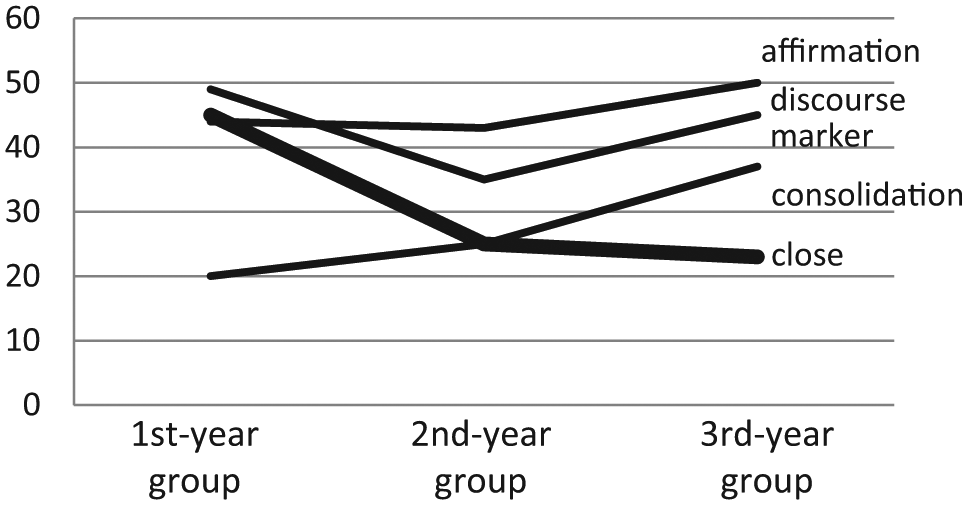
Development tendency of each move.
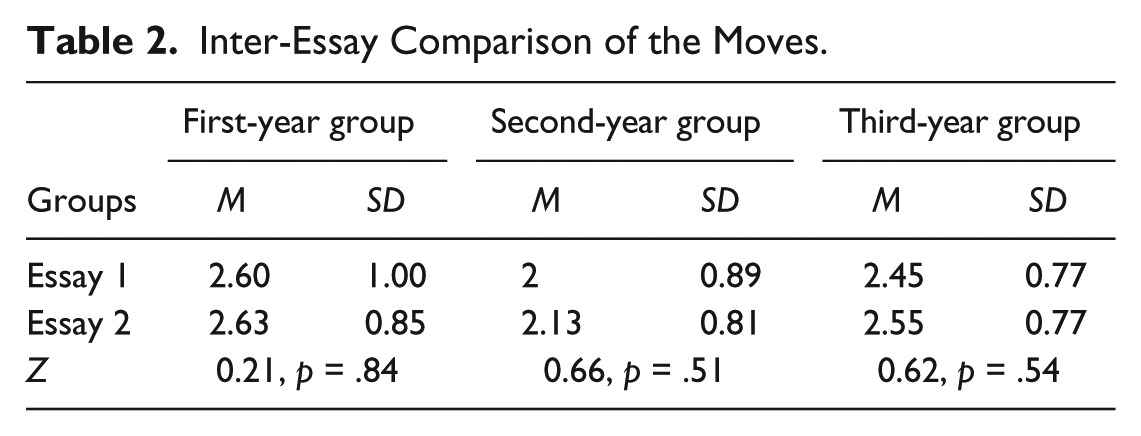
Table 2 shows the result of comparison of the total move numbers between the two essays. Each group demonstrates quite approximate mean move numbers in the two essays. The Wilcoxon Signed Rank tests show no significant difference between the two essays.
Inter-Essay Comparison of the Moves.
Three kinds of Close—appealing, solution, and prediction or expectation—are found in this study. Example 1 has a typical prediction Close. In Example 2, the second clause that is supposed to be a separate sentence is a typical pattern of appealing Close. The Close in Example 3 displays solution.
Example 1: In conclusion, I believe that shopping online is a general trend.
Example 2: Briefly, students’ evaluation is good for both,
Example 3: So, the starting point of Student Evaluation of Teachers is good, but it’s very hard to implement.
All the discourse markers used in the student essays except “above all” can be categorized into three groups:
Group 1 summarizing ideas: in a word, all in all, to sum up, in short, in summary, generally speaking, summarily
Group 2 expressing ideas: as far as I am concerned, in my view, in my opinion
Group 3 inferring results: in conclusion, to draw a conclusion, therefore, so
Each group has corresponding Chinese expressions that are common in Chinese essays, although in most cases, Chinese discourse markers are scarcely used. It is supported by the result of the analysis of the Chinese model essays. By analyzing the concluding parts, we found 21 essays carrying sentence-initial discourse markers in their concluding parts. Three Chinese discourse markers in five conclusions—“zong zhi (all in all, to sum up, in summary),” “zui hou yi ju hua (in a word),” and “zong de lai shuo (in a word)”—fall into the first group summarizing ideas. Another three discourse markers in five conclusions belong to the second group expressing ideas: “wo ren wei (I think),” “wo xiang xin (I believe),” and “wo xiang (I think).” The third group inferring results include four discourse markers appearing in 11 conclusions: “yin ci (therefore),” “suo yi (so),” “you ci ke jian (it follows from above that),” and “you ci kan lai (it follows from above that).” All these Chinese discourse markers can be matched with the English sentence-initial adverbials in the three groups found in the participants’ essays (Table 3).
Sentence-Initial Discourse Markers in Chinese Essays.

Table 4 shows frequency and percentage of each move in the English and the Chinese model essays. Percentage means the portion of each move against the 20 essays. Neither the English nor the Chinese essays carry many discourse markers in the conclusions. However, there’s great disparity in Affirmation and Consolidation between the two kinds of essays. But Close is lavishly used in both kinds of essays, especially in the Chinese model ones. Mann-Whitney tests (two independent samples) only show significant differences in Affirmation and Consolidation.
Comparison of Moves Between English and Chinese Model Essays.
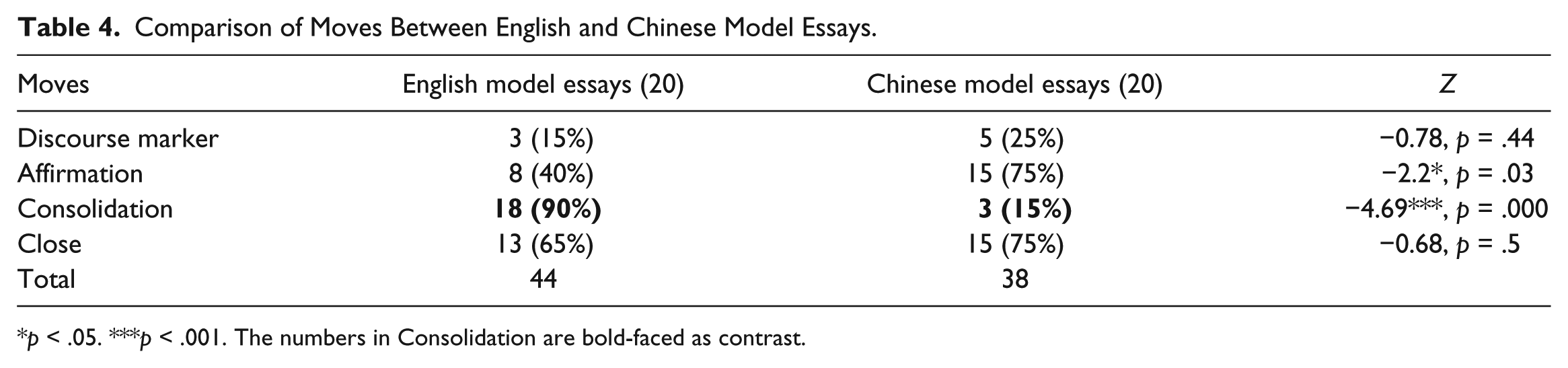
p < .05. ***p < .001. The numbers in Consolidation are bold-faced as contrast.
Wrap-Up Sentences
The wrap-up sentence quality of each group was compared between the two essays to test topic effect. None of the results of Wilcoxon Signed Rank tests was statistically significant (see Table 5). It can also be seen from Table 5 that the third-year group could write much better wrap-up sentences than the first-year group, with the second-year group in between. Kruskal-Wallis test (k independent samples) showed significant difference in both essays. No significant difference between the two essays was found by Wilcoxon Signed Rank tests. Displaying the developmental process of the Chinese EFL learners, the result corroborates and justifies our classification of the groups.
Comparisons of the Wrap-Up Sentence Quality of the Three Groups.
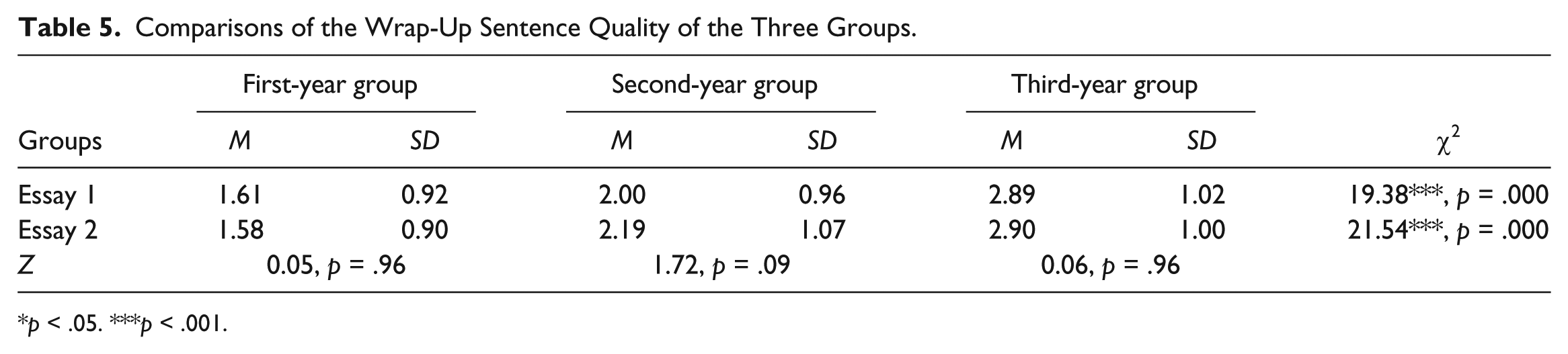
p < .05. ***p < .001.
Examples 4, 5, and 6 manifest the wrap-up sentences of different quality and the difference of developmental stages. “TS” in the examples means Topic Sentence. Example 4 has both Affirmation (1 point) and Consolidation (1 point). The words in the two moves differ from the three topic sentences (1 point). The moves, especially Consolidation can summarize the ideas in the essay (1 point). The writer used “go shopping both effectively and efficiently” to encapsulate the above three paragraphs. In fact, the summarization is at a higher level (0.5 point). There’s no syntactic or lexical error (0.5 point).
Example 4: (TS1) Firstly, the price of the goods is reasonable and acceptable . . .
(TS2) Secondly, shopping online is a time-saving alternative . . .
(TS3) Thirdly, it is convenient to us to shop online . . .
All in all,
Example (5) has only Consolidation (1 point) as wrap-up sentence, which can cover the ideas in the essay (0.5 point) with the wording totally different from the topic sentences (0.5 point) and without any syntactic or lexical error (0.5 point).
Example (5) (TS1) First, I think the biggest advantage is that it’s convenient . . .
(TS2) The second advantage is also very attractive, that is, the price is low . . .
(TS3) The third advantage is that there is no area and time limited when shopping on line . . .
Like Example (5), Example (6) has only Consolidation (1 point), which can barely summarize the ideas in the essay (0.5 point) because the second topic sentence is not clear enough (e.g., Shopping is no more than convenience). But there is much lexical repetition and an error—convenience. The whole conclusion is too simple in idea.
Example (6) (TS1) As the internet fast developing, the electronic commerce had already walk into everyone’s routine, especially for our young people, who always follows the fashion . . .
(TS2) Shopping is no more than convenience, it can help you save a lot of money as well . . .
So, as far as I am concerned,
Discussion
Discourse markers are not encouraged or widely used in Chinese model essays or in English model essays (see Table 4). However, more than half of the essays written by the participants in this study have this move. That cannot be attributed to L1 transfer. Instead, strategy use may be a causing factor. Because all the participants had learned English expository writing, the teachers’ instruction to help them pass the exams might impress them greatly. They tend to use such strategies to connect the paragraphs and add more words to their essays. Moreover, in Figure 1, Discourse Marker displays a V-shaped curved line. The second-year group displayed a decrease in this move. It is speculated that these participants might be tired of those “lexical teddy bears” and tried to reject them in writing. The third-year group was preparing for the TEM-8 test and was ready to take the strategy for examination, hence more Discourse Marker moves appeared in their writing.
In Discourse Marker move, linking adverbials are overused by the first-year group, which contributes to the highest total number of the moves (81.67%). The English linking adverbials used by the Chinese student writers have counterparts in the Chinese essays (see Table 3), and once the Chinese writers choose to use discourse markers in their Chinese conclusions, they almost always use those three-group sentence-initial adverbials. Many researchers attribute the high use of particular linking adverbials to the English teaching materials and book-focused teaching approach (Leedham & Cai, 2014; Milton & Hyland, 1999; Paquot, 2010). However, theirs might be a surficial reason. As must be emphasized, those Chinese equivalent adverbials are much more formal in style than the English adverbials. Even the teachers may not be fully aware of the difference. To illustrate, whereas “in a word” is viewed as an informal linking adverbial (Leedham & Cai, 2014), its Chinese equivalent jian yan zhi or zong zhi in many dictionaries (e.g., You Dao, one of the most popular web dictionaries with Chinese college students) is fairly formal due to its ancient style. The L1 rhetorical mode is so deeply rooted in the L1 writing that the three-group linking adverbials are recommended and emphasized by the teachers and preferred by the students. The concepts of the Chinese linking adverbials and their usage may be transferred into English. It can be followed that the L1 rhetorical mode “primed” the teachers and the students to select those three-group sentence-initial adverbials. For the less proficient student writers, it is much easier to transfer from L1 the concepts of those linking adverbials and memorize the English counterparts than to create ideas and to produce English sentences. Moreover, they prefer to clutter the text with too many linking adverbials so as to achieve surface logicality (Chen, 2006; Lei, 2012).
Although the high use of certain sets of linking adverbials is possibly L1 rhetorical transfer revealed at lexical level, at textual level, the reason why Affirmation is greatly embraced by the three groups may also be attributed to the Chinese inductive rhetorical mode (Connor, 1996; Hinkel, 2002; Kaplan, 2001; Lee, 2003), although Hyland (1990) just considered it as optional. Affirmation move corresponds to “putting forward the thesis” (Wang, 2006, p. 181) in Chinese argumentation, which is usually required of the concluding part but optional in the introduction. The comparison between the English and the Chinese model essays shows the great disparity in the use of Affirmation move. The Chinese model essay writers prefer this typical Chinese rhetorical mode. According to L1 transfer theory, “L1 knowledge can inhibit certain L2 choices and prime others, thus resulting in the underuse or overuse of certain L2 forms in spoken and written learner production” (Ortega, 2009, p. 41). The research result of the participants’ essays reveals that Affirmation is the obvious transfer of L1 rhetorical mode at all proficiency levels, because the participants’ knowledge about Affirmation in Chinese writing primed the high frequency in their English writing. Moreover, for the less proficient writers, Affirmation is easier to produce than Consolidation and Close, for they can at least repeat their thesis statements (if any in the introduction) to create final paragraphs and make their essays longer.
Consolidation was considered by Hyland (1990) as an obligatory move that is supported by the investigation of English model essays in this study (see Table 4). Ninety percent of the English model essays have such a move. However, Consolidation is rare in Chinese essays. Consolidation finds no position in Chinese writing. Any words referring back to the previous arguments are regarded as redundant and too explicit for the readers to explore the implication. What is absent in L1 possibly leads to underuse in L2 writing or speaking. It is not strange to find that the first-year group used much fewer Consolidation moves. Contrarily, as more proficient writers, the second-year group and especially the third-year group used more Consolidation moves. They were fully aware of the importance of Consolidation and were more skillful at using this move as a strategy to deal with examinations. The increase of the number indicated the rising awareness and practice of the writing strategy leading to typical English writing.
Close is another instance of strategy use. The typical types of Close such as appealing, solution, and expectation or prediction are greatly encouraged to utilize in Chinese essays and much importance is attached to florid, ornamental, and thought-provoking words (Wang, 2006; Xiong, 2011). Table 4 shows that not only the Chinese model essays but also the English ones favor this move. L2 learners tend to use a linguistic phenomenon existing in both L1 and L2 (Ortega, 2009). The first-year group found no difficulty applying Close in their English essays. Nevertheless, the L1 rhetorical transfer seemed mitigated in the second-year and the third-year groups. The number of Close was inversely proportional to the proficiency level. The more proficient the students were, the more they want to abandon it and find other challenging ways to end their essays. They might concentrate on improving the quality of Consolidation and Affirmation, thus the efficacy of their work may be their major concern. Therefore, strategy use played a more important role, which overweighed the transfer of L1 rhetorical mode.
Our speculation is supported by the result of comparison of wrap-up sentence quality among the three groups in Table 5. On one hand, the quality of wrap-up sentences requires recapitulating ability. The three groups displayed significant difference in the quality of wrap-up sentences, which increased with the proficiency level. The first-year group in this study had difficulty in substituting superordinate words for specific ideas and in using synonyms to avoid monotonous lexical repetition. Apart from that, their lack of ability to clearly convey ideas might be another cause of the inefficacy of recapitulation, as can be seen in Example 5.The causes of the first-year group’s poor ability of summarizing texts were different from those of the young native speakers of English who could not identify important text information (Brown & Day, 1983; Winograd, 1984). On the other hand, the more important cause may be strategy use. The second-year group and the third-year group allocated more attention to Affirmation and Consolidation so as to improve the unity and coherence of their essays. The third-year group, especially, had higher awareness of Consolidation and quality of the move.
Conclusion
With moves and wrap-up sentences as the major concern, this study has explored the developmental process of the Chinese EFL learners in terms of L1 rhetorical transfer at lexical level and text level. L1 rhetorical transfer is a complicated issue that cannot be studied regardless of other factors. L1 rhetorical transfer has been found to go hand in hand with strategy use in this study. The findings may be summarized as follows:
The Chinese students displayed their strategy use in Discourse Marker move because they used a far greater number of linking adverbials than the Chinese model essay writers. But the preference to certain sets of linking adverbials can be attributed to the L1 rhetorical transfer at lexical level. The students at all proficiency levels preferred to use Affirmation, which may be ascribed to L1 rhetorical transfer at text level. Consolidation, a typical English move, demonstrated an increasing tendency with the proficiency level improving, whereas Close displayed a decline although this move is encouraged in both English and Chinese essays. The two phenomena have little to do with L1 rhetorical transfer. Strategy use can be a major cause.
Strategy use can also be seen in the quality of wrap-up sentences. Consolidation move, which played a key role in the efficacy evaluation, was superior not only in quantity but also in quality in the essays of more proficient students. These students allocated more time and attention to the quality of wrap-up sentences at the cost of Close move. It can be seen that for the students at tertiary level, strategy use might overweigh L1 rhetorical transfer.
Although the current data cannot be conclusive about performance of all L1 Chinese EFL learners, the study is aimed at providing a suggestive picture of how Chinese rhetorical mode influences English expository writing. However, this study has some limitations. It can be noted that the line of Discourse Marker in Figure 1 is not smooth because the second-year group produced fewer linking adverbials in Discourse Marker move than the other two groups. Although there’s slight difference between the second-year and the third-year groups, yet some reasons might lie behind. Confined to text analysis, this study failed to identify the specific reasons. Text-based interviews would be useful in qualitative study and would be used in future studies in this area.
Footnotes
Declaration of Conflicting Interests
The author(s) declared no potential conflicts of interest with respect to the research, authorship, and/or publication of this article.
Funding
The author(s) received no financial support for the research and/or authorship of this article.