




Abstract
The research article (RA) abstract is the first section researchers read to determine its relevance to their interests. Researchers need to possess an implicit knowledge of the rhetorical move structure and organization of this section. Unlike most scientific disciplines, political science RA abstracts are unstructured, that is, with no headings (or moves), which makes it more challenging. To the best of our knowledge, the rhetorical move structure in high readership political science RA abstracts has not been researched. This study investigated (a) the rhetorical move structure in 120 political science RA abstracts from six high-impact journals, (b) the most common move patterns, and (c) the move(s) occupying most textual space. The findings indicated the lack of obligatory moves. A move structure model for writing a political science RA abstract is proposed, comprising four conventional moves (Introduction [I]–Purpose [P]–Methods [M]–Results [R]) and two optional step/move, namely, Research Gap step and Discussion [D] move. The results also showed that the first most frequent move pattern is I-P-M-R-D, followed by I-P-M-R and the I-P-R-D. The fact that an RA abstract summarizes the whole RA results in move embedding, particularly in the four moves, I-P-M-R. The findings revealed the importance of the Results move as it occupied nearly one third of text space. The results may contribute to the fields of discourse and genre studies. They may provide invaluable insights for novice political science researchers attempting to publish their work in high-ranking journals. The proposed move structure model can act as a guide for English for Academic Purposes (EAP)/English for Specific Purposes (ESP) tutors and political science authors.
Keywords
Introduction
Researchers need to be equipped with rhetorical knowledge and guidelines when it comes to writing a research article (RA) abstract as it is the first section researchers browse to determine whether to read the whole article and probably cite its content. A well-structured RA abstract may increase the likelihood that a manuscript passes the initial screening performed by a journal’s editor in chief. This skill emanates from being knowledgeable of the rhetorical move structure and organization of a discipline’s RA abstract. A “move” is “a discoursal or rhetorical unit that performs a coherent communicative function” (Swales, 2004, p. 228), whereas a “step” is a subunit that falls under a specific move. As writing an RA abstract may seem challenging for novice researchers and non-English-speaking authors apprenticing disciplinary academic writing, various models have been proposed for writing an RA abstract (Bhatia, 1993; Dos Santos, 1996; Hyland, 2004; Kanoksilapatham, 2013; Martín-Martín, 2003). These models acquaint scholars with the most commonly employed structural organization of an RA abstract in their field. For example, Kanoksilapatham (2013) proposed a five-move structure scheme for writing a civil engineering RA abstract: Background (B), Purpose (P), Method (M), Results (R), and Discussion (D).
Rhetorical move structure analyses of RA abstracts in various disciplines have proliferated enormously during the past three decades to investigate whether they converge with any of these models or not, such as linguistics (Can et al., 2016; Kaya & Yagiz, 2020; Khansari et al., 2016; Zand-Vakili & Kashani, 2012), literature (Tankó, 2017), business (Amnuai, 2019; Zanina, 2017), civil engineering (Kanoksilapatham, 2013), medicine (Salager-Meyer, 1990), zoology (Cross & Oppenheim, 2006), and dentistry (Alyousef, 2021; Shamsabadi et al., 2014; Vathanalaoha & Tangkiengsirisin, 2018). Samraj (2005), for example, employed Bhatia’s (1993) four-move pattern (P-M-R-Conclusion [C]) for linguistics discipline to investigate the move structure in 24 RA abstracts from two related disciplines, namely, Wildlife Behavior and Conservation Biology, and found that the move structure of abstracts varies between and across different disciplines. The lack of a common move pattern for RA abstracts from different academic disciplines is natural as each has its communicative purpose. Whereas the most frequently employed move structure in Can et al.’s (2016) study of 50 applied linguistics RA abstracts was P-M-R, it was I-P-M-R in Amnuai’s (2019) study of accounting, with the latter three moves being dominant as the “Introduction” move appeared in only 60% of the RA abstracts. This converges with Hyland’s (2004) claim that there is an increasing trend of using the Introduction move in RA abstracts. The “Introduction” and the “Discussion” moves in Can et al.’s (2016) study were not employed by about 50% of the authors. It was also found that the move sequence expected by current schemes was frequently violated.
Although the move structure in political science RA abstracts has been investigated by Paydari and Paramasivam (2019), the researchers neither investigated move length nor did they draw their data from high-impact journals; instead, the abstracts were drawn from Iranian journals. To provide insights for novice authors apprenticing disciplinary academic writing of RA abstracts, it is pertinent to investigate international journals with high-impact factors. Paydari and Paramasivam (2019) employed Hyland’s (2004) five-move pattern, I-P-M-R-C, in their analysis of 120 RA abstracts. Their findings revealed that Iranian political science RA abstracts did not conform to the conventional five-move pattern of I-P-M-R-C. Most of the RA abstracts had three-move and two-move patterns. Move 2 (Purpose) and Move 3 (Method) were considered obligatory, whereas Move 1 (Introduction), Move 4 (Product), and Move 5 (Conclusion) were employed by the writers as optional moves. Vathanalaoha and Tangkiengsirisin (2018) employed Kanoksilapatham’s (2013) five-move pattern in their study of international dental RA abstracts: B-P-M-R-D. The move sequence B-P-M-R-D was the most common in the international dental RA abstracts (48%). Vathanalaoha and Tangkiengsirisin (2018) state that “the inclusion of Background and Discussion moves is of significance for the academic discourse of dentistry” (p. 12).
Other scholars investigated textual space (or length) allocated for each move in an RA abstract (Alyousef, 2021; Can et al., 2016; Cross & Oppenheim, 2006; Rashidi & Meihami, 2018) to reveal disciplinary-specific variations or similarities. Most scholars (Rashidi & Meihami, 2018; Stoller & Robinson, 2013; Tankó, 2017) argue that the Results move is often the longest part of an RA abstract. Whereas Cross and Oppenheim’s (2006) and Can et al.’s (2016) studies of zoology and applied linguistics, respectively, revealed that the Methods’ move occupied the most text space, Alyousef’s (2021) study of dentistry RA abstracts showed that the Methods and Results moves are the dominant moves. Similar investigations of political science RA abstracts are lacking. Cross and Oppenheim (2006) argue that studies of features and structure of the well-formed RA abstract can provide scholars with “complement guidelines of abstract writing” (p. 430).
The reviewed literature indicates that not all disciplines share similar move structure and move length. It also indicates the lack of studies of move structure and move length in international political science RA abstracts from high-ranking journals. This study is significant because some political science researchers are not aware of the rhetorical move organization underlying this important section of the RA; therefore, they may experience difficulties in writing a coherent RA abstract or in managing the limited space provided. Ngai et al. (2018) argue that “understanding and observing the disciplinary rhetorical choices and communication conventions will allow scientists to align the abstracts of their studies with the expectations of the targeted audience” (p. 1). Researchers and scholars need to be cognizant of the internal organization of the discourse of the RA abstract of their community, including the rhetorical move structure, move sequence, and move length. This study aimed to investigate (a) the rhetorical move structure in political science RA abstracts, (b) the most frequent move patterns, and (c) the move(s) that occupied the most text space.
Method
Before presenting means for data collection and the procedures used in the analysis of move structure, a brief overview of the theoretical framework is provided.
Theoretical Framework: Move Structure Scheme
An initial analysis of the moves in 10 political science RA abstracts revealed that Kanoksilapatham’s (2013) five-move structure scheme for civil engineering RA abstracts was the most suitable because there were instances where the authors discussed and interpreted their findings (M5). Thus, Kanoksilapatham’s (2013) five-move pattern (B-P-M-R-D; Table 1) was adopted in this study to investigate the moves in the political science RA abstracts.
Kanoksilapatham’s (2013) B-P-M-R-D Move Structure Scheme for RA Abstracts.
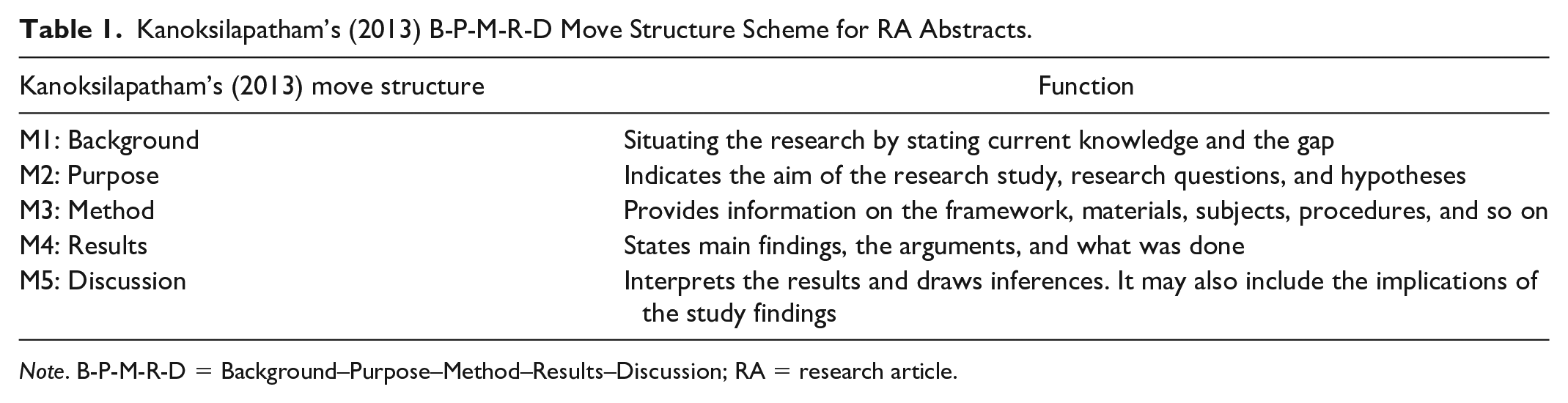
Note. B-P-M-R-D = Background–Purpose–Method–Results–Discussion; RA = research article.
Data
In this study, 20 RA abstracts from each of six political science journals were selected to examine the generic move structure and move length in the RA abstracts (Table 2). The six journals had high-impact factors as reported in the Journal Citation Reports Social Sciences Citation Index (SSCI) published in 2021 by Clarivate Analytics. A total of 120 RA abstracts (17,514 words) published during the years 2018–2020 were selected.
Summary of Key Features of the Data.

Note. RA = research article.
The decision to select 20 RA abstracts from each journal was deemed sufficient to provide invaluable insights for political science academic practice because more data yield more reliable findings. The data selection criterion of whether the RAs were written by native or non-native authors was not considered as the selected journals were listed in the Web of Science in its SSCI. The word limit for the RA abstract ranged from 150 to 300 words in length.
Procedures and Instrumentation
The RA abstracts were converted from “pdf” format into “text” format after being downloaded from databases. Then, they were checked manually for conversion accuracy and saved in a Word file. The moves were identified and coded manually based on the content of each move and its communicative purpose. Inter-coder reliability was conducted to ascertain whether the annotated move boundaries are set at a high level of agreement. Following Alyousef (2021), each move boundary was identified and marked by double slashes even if it occurred mid-sentence as the study was concerned with the communicative function of each move. This procedure accounts for instances where two moves are embedded in one sentence. Thus, the unit of analysis was the clause. Following Kanoksilapatham (2005), an arbitrary cutoff frequency of 60% was set to measure move stability in the RA abstracts. Thus, the frequency of each move was calculated manually to investigate whether this particular move is “essential” or not. A move is considered “conventional” if it occurs in 60% of the corpora (i.e., 120 RA abstracts) and “optional” (nonessential) if it occurs in less than 60%. An “obligatory” (or essential) move was defined as occurring in 100% of the corpora. The calculation of the number of words within a move-tag (or move length) was based on the ratio of a total move length to the total length of all the moves. The total word count (or text space) within a move-tag was divided by the total number of words for all the moves and then the result was multiplied by 100. As this study employed Kanoksilapatham’s (2013) five-move pattern (B-P-M-R-D), each move is supposed to use 20% of text space (100/5 = 20).
Results and Discussion
The next subsection attempts to answer Research Aim 1, that is, to investigate and discuss the prototypical rhetorical move structure realizations of political science RA abstracts.
The Rhetorical Move Structure of Political Science RA Abstracts
The findings indicated the lack of obligatory moves as none of them occurred in the 120 RA abstracts. A move structure model for political science RA abstracts was proposed, consisting of four conventional moves—I-P-M-R—and two optional step/move, namely, Research Gap step and the Discussion (D) move as they appeared in 63 out of the 120 RA abstracts (Table 3). The numbers represent the total number of abstracts that contained the move or step. As stated earlier, a step is a subunit that falls under a specific move. Two optional steps, Research Gap and Implications/Suggestions were added, respectively, under Moves 1 and 5. Kanoksilapatham’s (2013) five-move pattern (B-P-M-R-D) was revised to suit the requirements of this discipline.
Frequency of Move-Step Structure in 120 Political Science RA Abstracts.

Note. RA = research article.
The finding that a political science RA abstract includes four conventional moves I, P, M, and R and two optional step/move, namely, Research Gap and Discussion, contrasts with Hyland’s (2004) claim that the three moves P, M, and R moves are the most frequent moves in RA abstracts although he argues that there is an increasing trend of using the Introduction move in RA abstracts. Similarly, this finding contrasts with Dos Santos’s (1996) and Tseng’s (2011) studies of the move structure in applied linguistics RA abstracts, and which revealed that only the three moves, P-M-R, were more frequent than the other moves. The Implications/Suggestions step is optional as it appeared in 22 out of the 120 RA abstracts.
Move 1: Introduction
Move 1 is considered “conventional” in the political science discipline as its occurrence exceeded 60% of the investigated RA abstracts.
1. “To promote good governance, citizens can inform governments directly and routinely about the implementation of policies and the delivery of public services” (British Journal of Political Science, 2019).
2. “Australia cooperated extensively with the George W. Bush administration during the ‘war on terror’” (Australian Journal of Political Science, 2019).
3. “Many enduring questions in international relations theory focus on power relations, so it is important that scholars have a good measure of relative power” (American Journal of Political Science, 2019).
This indicates the importance of this move in the political science discipline. A total of 83 of the 120 authors provided context for their studies by situating their research. As this move did not appear in all the abstracts, it is a nonobligatory move that authors can choose when writing an abstract.
The Introduction move includes the Research Gap step, which is considered optional as its frequency was below 60% of the investigated RA abstracts. Although “the restricted length of the abstract rarely permits the luxury of including statements of what has not been done either by the authors or by other researchers” (Swales, 1990, p. 180), 63 authors out of 120 decided to point out the research gap in a concise manner to establish context for their study. Interestingly, four authors have preferred to merge the Research Gap with Move 1, using extension cohesive devices, such as “yet,” “but,” and “however.”
4. “Much political economy research examines how higher-level political representation of the constituent jurisdictions affects resource redistribution among the lower-level units in democracies [Move 1],
5. “Intergovernmental agreements between municipal and Indigenous governments are rapidly expanding in number and importance in Canada and the United States [Move 1],
As the authors are constrained by a word limit, they decided to merge the Research Gap with Move 1. Research gap is indicated by the use of phrases, such as “we know
Move 2: Purpose
This move is the second most frequently occurring move in the 120 political science RA abstracts, as it was employed by 107 out of the 120 authors.
6. “This article assesses the normative and positive claims regarding the consequences of biased media [Move 2] using a political agency framework that includes a strategic voter, polarized politicians, and news providers. [Move 3]” (American Journal of Political Science, 2019).
7. “This paper aims to test two types of legislative shirking in a new democracy, South Korea. Using the lame-duck sessions of the Korean National Assembly, we test whether a legislator shirks in voting participation and in voting decisions. [Move 2]” (Japanese Journal of Political Science, 2019).
There were 18 instances where the authors either embedded the Purpose move with the Methods move in one sentence or vice versa. Merging two moves or a move and a step is expected as an RA abstract previews key information in a full RA. Thus, this indicates the authors’ skill in writing a comprehensive RA abstract that summarizes the whole RA.
Move 3: Method
Move 3 is considered “conventional” in the political science discipline as its occurrence was 66.67% of the investigated RA abstracts (Table 3). This finding contrasts with Bhatia’s (1993) argument that, whereas the Methods’ move is rarely described and/or discussed in the introduction section of the RA, it is important in the RA abstract. One third (or 40) of the authors did not include this move in their RA abstracts. This is expected as research has shown that authors in the soft sciences place less emphasis on the methods move than those in the hard sciences (Hyland, 2008). As stated in the previous section, some authors embedded the Methods move with the Purpose move in one sentence or vice versa, as shown in Extract 8.
8. “Using candidate demographic data at the congressional level and measures of party support for primary candidates, [Move 3] we test whether parties discriminate against women and minority candidates in congressional primaries and also whether parties are strategic in their support of minority candidates in certain primaries. [Move 2]” (American Journal of Political Science, 2019).
9. “Interview data were interpreted using frameworks from the political science literature on delegation, including the principal-agent paradigm, models of bureaucratic strategy and the public service bargains approach. [Move 3]” (Australian Journal of Political Science, 2018).
The use of this move in two thirds of the investigated RA abstracts converges with the findings in Li and Pramoolsook’s (2015) study, which revealed that this move occurred in only 31% of the Management abstracts, whereas 44% of Marketing texts contained this move. Samraj’s (2005) study also indicated that this move occurred in 50% of the RA abstracts from two environmental science disciplines, Conservation Biology and Wildlife Behavior.
Move 4: Results
This move is the first most frequently occurring move in the 120 political science RA abstracts, as it was employed by 113 out of the 120 authors (94.17% Table 3). This finding converges with Paydari and Paramasivam’s (2019) study of political science RA abstracts in Iranian journals, which reported the low frequency of using this move (52%). It also contrasts with Shamsabadi et al.’s (2014) study of Esthetic and Restorative Dentistry RA abstracts, which indicated that this move was employed by 96% of the abstracts.
10. “Community nominations and public announcements did not increase reporting. However, responsiveness boosted participation over several months for reporters who had been recruited earliest and had been reporting longest, [Move 4] highlighting the critical role of timely government responsiveness in sustaining information flows from citizens. [Move 5]” (British Journal of Political Science, 2019).
11. “Based on time-series analyses of 522 parties contesting 357 elections in twenty-one established Western democracies between 1945 and 2011, [Move 3] the study finds that parties are
12. “Individuals assigned to treatment conditions instilling feelings of economic strain exhibit greater support for Islamist parties, and this support is causally mediated by an expectation of divine compensation in the hereafter [Move 4]” (American Journal of Political Science, 2019).
The results also showed that this move is embedded with either the preceding move (Methods) or the following one (Discussion) in some RA abstracts, as shown in Excerpts 10 and 11. There were also 12 instances of the use of the expression “more/less likely” in this move. This finding is in line with Omidian et al.’s (2018) argument that authors in the soft sciences tend to avoid overgeneralizations of their results. This move was both presented and discussed in light of the research purposes. For example, the purpose of the research study in Excerpt 12 was to investigate “the appeal of these [Islamist] parties’ religious nature to voters experiencing economic hardship.”
Move 5: Discussion
The Discussion move is not as frequently found in the investigated political science RA abstracts as the other traditional moves; it only appeared in about half of the RA abstracts. This move is considered “Optional” as its occurrence was below 60%.
13. “The study finds support for this argument from decades of American National Election Studies data and a new large dataset of decades of pooled individual-level Gallup survey responses [Move 5]” (British Journal of Political Science, 2020).
14. “Although voters are committed to opposition unity and democratic transition, that commitment is sensitive to the anticipated consequences of an opposition victory [Move 5]” (American Journal of Political Science, 2019).
The opening sentence of this move represents a prototypical instance of the Discussion move in most RA abstracts, rather than a Conclusion move, as it lacked concluding statements such as “to conclude,” “it was concluded,” and “in summary.” This finding diverges with Vathanalaoha and Tangkiengsirisin’s (2018) study, which showed that the Conclusion move was employed by most dental RA abstracts.
The Discussion move includes an “optional” concluding step that states implications and suggestions for further research because it occurred in only 18.34% of the investigated RA abstracts.
15. “Future studies may build on this finding to examine hybrid reform cases in a general European context. [M5S1: Suggestions]” (Japanese Journal of Political Science, 2019).
16. “These results have important implications for political representation and voters–elite linkages. [M5S1: Implications]” (British Journal of Political Science, 2019).
The authors provide their suggestions for future research studies and/or emphasize their contributions to the topic under study.
The next two subsections attempt to answer Research Aims 2 and 3, that is, to investigate the most frequently occurring move patterns and the move(s) that occupied the most text space in the political science RA abstracts.
The Most Frequent Move Patterns in Political Science RA Abstracts
Table 4 shows the three most frequent move patterns of rhetorical move structure of political science RA abstracts. The plus sign indicates that this move can be merged with the following move in one sentence.
The Three Most Frequent Move Patterns in the Corpora.

Note. += Merged Moves; I-P-M-R-D = Introduction–Purpose–Method–Results–Discussion; I-P-M-R = Introduction–Purpose–Method–Results; I-P-R-D = Introduction–Purpose–Results–Discussion.
The first most frequent move pattern is I-P-M-R-D, occurring in 24 out of the 120 political science RA abstracts. It should be noted here that the Methods’ move preceded the Purpose in six abstracts.
17. “Using data from four elections between 2006 and 2015, [M] this study focuses instead on why some Indigenous individuals vote and how they vote [P]” (Canadian Journal of Political Science, 2018).
The second most frequent pattern was the four-move pattern I-P-M-R, which occurred in 23 out of the 120 RA abstracts, with the Method move also preceding the Purpose in two abstracts. This four-move structure pattern converges with Amnuai’s (2019) study of accounting RA abstracts which revealed that the conventional move pattern was I-P-M-R, with the latter three moves being the dominant as their occurrence was in 80% or more of the investigated abstracts. The two most widely used patterns in the present study were also revealed in Can et al.’s (2016) study of the moves in RA abstracts in applied linguistics, which indicated that I-P-M-R-D pattern was the first, while I-P-M-R pattern was the second. Fifty-seven authors (Table 3) decided not to employ the Discussion move because they probably thought there is no room for this move. The third most frequently occurring move pattern was I-P-R-D.
To sum up, 62 out of the 120 political science authors employed one of the three-move patterns, I-P-M-R-D, I-P-M-R, or I-P-R-D, whereas the others employed various move patterns, such as I-M-R-D, I-M-P-R-D, P-M-R-D, I-M-R, P-M-R, and P-R. The occurrence of each of these various patterns, however, was below 10%. The findings of the most frequent move patterns in political science RA abstracts contrast with Paydari and Paramasivam’s (2019) study of political science RA abstracts in Iranian journals, which indicated that 60% of the RA abstracts included the two patterns I-P-M (33%) and P-M-R (27%), whereas only 7% of the abstracts employed the pattern I-P-M-R-C.
Move(s) Occupying the Most Text Space in Political Science RA Abstracts
The analysis of the length of each move aimed to investigate the move(s) occupying the most text space. Following Alyousef (2021), Research Gap and Implications/Suggestions were embedded with their relevant moves to avoid confounding the study results as annotating these separately is more useful when dealing with full-length RAs.
The findings revealed that the Results move occupied nearly one third of text space (Table 5), followed by the two moves Introduction and Purpose, which comprised, respectively, 22.67% and 20.77% of text space. Thus, most of the information in the political science RA abstracts was provided in the Results move, reflecting its importance in the discourse of political science research. In their study of zoology RA abstracts, Cross and Oppenheim (2006) argue that a conventional move uses up a minimum of 25% of the text space.
Move Length in the 120 Political Science RA Abstracts.

Note. RA = research article.
The move that provided the least information (or employed the least text space) was the Methods move. Unlike hard sciences, soft sciences do not usually require a large amount of text to describe several aspects related to methodology, such as software, tools, techniques, and statistical procedures. This finding contrasts with Cross and Oppenheim’s (2006) and Can et al.’s (2016) studies of, respectively, zoology and applied linguistics RA abstracts, which showed that the Methods’ move occupied the most text space.
Conclusion and Implications
The study has shown that genre analysis is capable of not only identifying the key features related to the rhetorical move structure of a text but also revealing variations among other disciplines. The findings indicated the lack of obligatory moves in political science RA abstracts. The proposed model for political science RA abstracts consists of the four conventional moves of I-P-M-R. Besides, there was evidence of move embedding in the four moves, I-P-M-R. The “Introduction” move includes an “optional” Research Gap “step.” The “Discussion” move is also “optional” as its occurrence was below 60% of the investigated RA abstracts. The “Discussion” move includes “optional” concluding “step” that states implications and suggestions for further research. Successful political science RA abstracts may include one of the following three-move patterns (a) I-P-M-R-D, (b) I-P-M-R, or (c) I-P-R-D as they occurred in more than 50% of the investigated political science RA abstracts. Although most of the writers followed one of these three patterns, the order of occurrence of the moves is not always fixed. The findings also revealed that most of the information in the political science RA abstracts was provided in the Results move, which occupied nearly one third of text space, followed by the two moves Introduction and Purpose, comprising, respectively, 22.67% and 20.77% of text space.
The findings may contribute to the fields of genre studies and English for Academic or Specific Purposes (EAP/ESP) courses. Tutors need to draw postgraduate students’ attention to the communicative function of each move/step in a political science RA abstract as well as the move structure and organization of the abstract. The results may also provide invaluable insights for novice political science scholars attempting to publish their research work in high-ranking journals once they are aware of the implicit rhetorical structuring and organization of a political science RA abstract. The proposed move structure model for the RA abstracts can act as a guide for novice political science authors.
Although these insights may assist political science scholars, the study findings are contingent on the representativeness of data size and on the period when the RAs were published, that is, 2018–2020. Further studies may investigate the key linguistic features associated with each move in a political science RA abstract, such as tense, modals, evaluative that, phrase frames, and metadiscourse features. Future studies can also investigate the move structure of different RA sections in the political science discipline.
Footnotes
Acknowledgements
The author is indebted to the two anonymous reviewers for their insightful and helpful comments. The author also wishes to express his gratitude to both the Deanship of Scientific Research at King Saud University and the Research Centre at the Faculty of Arts for funding this study. He also thanks RSSU at King Saud University for their technical support.
Declaration of Conflicting Interests
The author declared no potential conflicts of interest with respect to the research, authorship, and/or publication of this article.
Funding
The author(s) received no financial support for the research, authorship, and/or publication of this article.
