




Abstract
China’s total fertility rate has continued to decline, and the country entered an era of negative population growth starting from 2022. The decline in fertility rates and the extension of life expectancy have accelerated the pace of aging, increasing the burden of elderly care and presenting challenges to China’s economic development. Human capital is an important factor in improving labor productivity. There is skill complementarity between high-skilled and low-skilled labor, and the degree of matching between high-skilled and low-skilled labor is very important for economic growth. Against the backdrop of a declining fertility rate, it is an important topic to study whether human capital can mitigate the negative impact of aging on labor productivity. An econometric model was established using panel data from 31 regions in China from 2000 to 2020. This study reveal that different dimensions of human capital, such as human capital stock, high-skilled human capital, and labor force skill complementarity, can act as moderators in mitigating the negative consequences of aging. The findings indicate that human capital stock and high-skilled human capital play moderating roles across most regions, except for the central region. In contrast, labor force skill complementarity emerges as a significant moderator predominantly in the Eastern and Southern regions. Moreover, human capital stock and high-skilled human capital exhibit more pronounced effects in regions with lower aging levels. Conversely, labor force skill complementarity demonstrates greater moderating impact in regions characterized by higher levels of aging. This study highlights the complementary role of skills of low-skilled and high-skilled labor force when aging level deepens, which provides useful insights to solve the aging problem.
Introduction
China’s demographic structure is currently undergoing a transformation, with the demographic dividend steadily diminishing and economic development slowing down. In China, the proportion of elderly people aged 65 and above had already reached 7% by 2000, indicating the onset of an aging population. When this percentage reaches 14.2% by 2021, a deeply aged society is reached. China is not only aging more quickly than other nations, but it is also entering an aging society at a time when income levels are significantly lower than those in other nations. In the next decade or so, China’s aging rate will be even faster, and the size of its elderly population will be even larger. China is on the verge of facing an era of negative population growth, and it is crucial to study how to mitigate the negative impacts of aging on labor productivity in order to promote the enhancement of labor productivity and achieve sustainable economic development.
Aging will result in work-fore scarcity. The effective supply of labor can be increased through human capital, particularly high-skilled labor with strong learning and innovation capabilities. Human capital is an important factor in the growth of labor productivity. The University of California, Davis and the Groningen Growth and Development Center at the University of Groningen calculate a human capital index based on years of schooling and returns to education. China’s human capital index increased at a quicker rate from 2.395 in 2005 to 2.699 in 2019. Compared to other countries, China’s intergenerational human capital is growing at a rapid rate of 1.4% (Fang & Qiu, 2023). Furthermore, an increase in the number of highly skilled workers creates a corresponding need for low-skilled labor.
The importance of human capital stock in boosting labor productivity has been studied, but there have been little research on the relationship between aging and labor productivity that considers human capital structure and labor force skill complementarity. Thus, the two main questions of this paper are whether labor force skill complementarity, human capital stock, and high-skilled human capital can counteract the detrimental effects of aging on labor productivity, and whether the relative roles of these factors vary across different regions and aging stages. The paper’s marginal contributions are listed below. First, according to research questions, studies on the impact of human capital on labor productivity and economic growth mainly focus on human capital stock, or on the relative importance of high- and low-skilled human capital on labor productivity. The effect of skill-complementary division of labor on labor productivity has not been thoroughly examined in many research. Second, low-skilled labor is not taken into account in the literature on the issue of aging when investigating the mitigating effect of human capital, since it only starts with human capital stock. This research is a helpful resource for reducing the detrimental effects of aging and developing sensible population mobility strategies since it approaches the problem of aging from the perspective of the complementarity of the low-skilled labor force.
Literature Review and Theoretical Analysis
Literature Review
The Impact of Aging on Labor Productivity
The trend of aging affecting worker productivity is now inescapable (Li, 2019). However, the impact of aging on labor productivity varies by industry, region, and labor substitution elasticity (Prskawetz & Fent, 2007). Pessimists argue that the accelerated aging process is a major contributing factor to the reduction in productivity (Maestas et al., 2016). Aging populations tend to have lower levels of physical fitness, inventiveness, and learning compared to younger generations, which could lead to a decline in labor productivity (Zhou & Liu, 2016). Optimists, on the other hand, believe that economic growth will not be significantly impacted by the pace of aging until a certain point (Du & Feng, 2021). Aging might drive the development of labor-saving technologies, human capital, and advancing technology (Acemoglu & Restrepo, 2017). Some academics argue for a nonlinear relationship between labor productivity and aging (Qi & Yan, 2018). Aging has both short-term negative and positive impacts on labor productivity, but these effects are not apparent in long-term (Li, 2019). Aging negatively impacts labor productivity and exacerbates this negative impact, reducing labor allocation efficiency (Li, 2022) and lowers savings rates.
To achieve the second hundred-year goal and promote economic growth, it is essential to explore strategies for mitigating the adverse effects of aging on labor productivity. Existing literature has studied various aspects of aging, including urbanization (Chen & Song, 2013), adjustments to fertility policies (Wang, 2017), population migration (Chen & Wang, 2018), and retirement policies (Yan, 2018), all of which can increase the labor supply. Additionally, artificial intelligence (Chen et al., 2019) can alter labor demand, the development of aging industries can optimize the industrial structure, and improvements can be made to elderly care services, social security, and welfare. However, there is limited focus in these publications on how human capital might help address the challenges posed by aging.
The Impact of Human Capital on Labor Productivity
Human capital theory and endogenous growth models highlight the importance of human capital. The human capital level and the optimization and upgrading of human capital structure can significantly promote economic growth (Liu et al., 2018; Zhang, 2020). The labor force exhibits heterogeneity in terms of educational attainment, human capital accumulation, and their impact on economic expansion. Labor is categorized as high-skilled or low-skilled based on education levels. The ratio of highly skilled to low-skilled labor force relative to the total population reveals the composition of human capital. The ratio varies by region, reflecting interregional diversity. Cities often limit the influx of low-skilled labor during development, focusing instead on attracting skilled labor due to the negative externalities with population growth, such as traffic congestion and environmental pollution. This approach overlooks the role of low-skilled labor in basic service industries, potentially leading to welfare losses for individuals and society. Skill matching, which indicates the degree of matching between high- and low-skilled labor (Grossman & Maggi, 2000), determines the appropriateness of the labor force’s skill structure.
The productivity of skilled labor varies across different skill levels. An increase in the effective labor supply can enhance innovation capabilities, boss total factor productivity, and ultimately lead to higher labor productivity. This effect is especially pronounced when there is a larger pool of human capital, particularly if there is an increase in the proportion of highly skilled labor. Low-skilled labor may resist the influx of additional low-skilled labor due to job competition, while high-skilled labor tends to be less threatened by such immigration (Hainmueller & Hiscox, 2010). The arrival of low-skilled labor can potentially decrease the time high-skilled women spend on household chores while increasing their working hours (Cortes & Tessada, 2011), and it may also lead to an increasing in the fertility rate among the high-skilled labor force (Furtado & Hock,2010). Lowering the barriers to the mobility of labor and capital across different sectors and facilitating market-driven factor allocation can effectively stimulate manufacturing exports and enhance labor productivity (Wu & Guo, 2023).
High-skilled labor possesses a greater capacity for innovation, which can drive technological advancements, alter production methods, and enhance labor productivity. Consequently, the policies of major cities often prioritize attracting high-skilled labor while restricting the influx of low-skilled labor. This strategy overlooks the synergistic benefits between high and low-skilled labor. The complementary skills of laborers with varying levels of human capital can lead to more efficient resource allocation. An increase in the high-skilled labor can stimulate a higher derived demand for low-skilled labor. Conversely, a reduction in the number of low-skilled laborers can diminish the positive externalities associated with the concentration of high-skilled labor (Liang & Lu, 2015). The demand for basic service industries from high-skilled labor remains constant, and low-skilled labor retains a certain level of irreplaceability (Wang, 2021). Through specialization, high-skilled labor can concentrate on tasks such as R&D and innovation, thereby improving labor productivity. Meanwhile, low-skilled labor in basic service industries can enhance their own quality, reduce frictional unemployment, and increases labor productivity through human capital externalities and knowledge spillovers (Wu, 2020). Demographic shifts and aging reduce labor supply, leading to the Lewis inflection point, where the number of laborers transitioning from traditional to modern sectors declines, and labor allocation efficiency suffers. Human capital externalities affect both low- and high-skilled workers, and their complementary effects can enhance labor productivity and optimize allocation efficiency.
The Impact of Human Capital and Aging on Labor Productivity
China’s labor force has reached its peak in both absolute and relative terms and is now experiencing a decline, which negatively affects the labor force participation rate. To compensate for the reduced labor supply, the quality of the labor force is increasingly crucial for enhancing for labor productivity. On one hand, population aging will compel a shift towards capital and technology as substitutes for labor, which can foster the accumulation of human capital (Acemoglu & Restrepo, 2017). Moreover, as life expectancy increase, the payback period for human capital extends, and the return on education investment improves, which can elevate the human capital level of the younger generation (Liu & Lin, 2020), potentially leading to a second demographic dividend (Li & Yuan, 2020). On the other hand, aging can also escalate the financial burden of elderly care, intensify the cost of raising children, and consequently birth rate. This can divert resources away from education investment, hindering the buildup of human capital (Ehrlich & Kim, 2006). While aging is primarily a result of increased life expectancies and decreased fertility rates—factors that impact economic growth through the labor force—human capital is predominantly derived from investments in education and health (Mao & Li, 2021). Therefore, it is essential to investigate whether human capital can mitigate the adverse effects of aging on labor productivity by examining human capital in terms of its stock, the proportion of high-skilled human capital and labor skill complementarity, thereby promoting economic growth.
A review of the existing literature reveals that the issue of aging has garnered significant scholarly interest. However, there is a dearth of research that examines the problem from the perspective of human capital, particularly in terms of how the complementary skills within the labor force might mitigate the adverse impacts of aging. Enhancing labor mobility and optimizing resource allocation efficiency are crucial for boosting labor productivity.
Theoretical Analysis
The progression of aging leads to an older workforce, a decrease in labor supply, and a reduction in labor force participation rates. While older workers possess substantial experience, they often have weaker capabilities in innovation and technology adoption, which can hinder the application of scientific and technological achievements in production and other fields, negatively affecting labor productivity. In contrast, high-skilled labor exhibits stronger learning and innovation capabilities, which can facilitate technological progress and potentially reduce labor demand. By increasing the number of high-skilled workers, the labor supply shortage can be offset through enhancing the quality of labor force. Consequently, an increase in the stock of human capital and the quantity of high-skilled human capital can help to mitigate the negative effects of aging on labor productivity.
Economic operations necessitate a specialized division of labor among workers of varying skill levels. High-skilled laborers are typically involved in technology-intensive production activities, while low-skilled laborers contribute to the life service industry, ensuring both the smooth execution of production processes and the enhancement of living standards. High-skilled labor can influence production efficiency not only through knowledge spillovers but also by exerting human capital externalities on the efficiency of low-skilled labor. The low-skilled workforce, by providing services in basic industries, creates a conducive living and working environment in cities, which in turn attracts high-skilled labor. An increase in the number of low-skilled laborers enhances matching opportunities (Petrongolo & Pissarides, 2001), improves the quality of matches, and boosts the efficiency of labor market matching, leading to scale effects. As the level of economic development increases and the division of labor becomes more specialized, the demand for low-skilled labor also rises (Liang & Lu, 2015). However, due to industrial structure differences and regional carrying capacity limits, unchecked population growth can have adverse effects. A rational and complementary division of labor between high- and low-skilled laborers can stimulate economic growth (Han et al., 2023). Facilitating the exchange of ideas and skill learning among different skilled labor forces can increase knowledge production, enhance knowledge dissemination, improve learning efficiency, and create scale effects. Encouraging the free movement of labor between regions, coordinating the development of high-skilled labor, and leveraging the complementary effects of labor skills can improve labor force allocation efficiency, thereby enhancing labor productivity. Hence, the complementary skills of high- and low-skilled labor can help mitigate the negative impact of aging on labor productivity. Given the diverse regional resource endowments are varying levels of economic development and aging in China, the degree of aging and its impact on labor productivity may differ across regions. Consequently, the role and extent to which human capital can alleviate the negative effects of aging may exhibit regional heterogeneities.
Empirical Modeling
Econometric Modeling
First, verify whether human capital stock, high-skilled human capital and labor skill complementarity can mitigate the negative effects of aging, and add the cross-multiplication term to the basic regression to establish the measurement model:

where
Moreover, under the conditions of different human capital levels, aging may have different impacts on labor productivity. Therefore, the threshold panel model is established:

where the coefficient of the impact of aging on labor productivity is
Data Sources and Description of Variables
The explanatory variable is labor productivity. Labor productivity indicates the value created by a unit of labor in production activities, that is, the efficiency of production per unit of labor, expressed by dividing output by the amount of labor input (measured in 10,000 yuan per person). The amount of labor input is expressed by the total number of employed persons in each region.
The core explanatory variable is aging. Aging is chosen to be expressed as the number of people aged 65 and over as a proportion (%) of the total population, based on 2010 census data and all other sample survey data.
The moderating variable is human capital. The stock of human capital is measured by the average years of schooling, which is divided into five levels of education: no schooling, primary school, junior high school, senior high school, junior college, and above. The average years of education is calculated as the sum of the product of the five levels of education and the number of years of education in the total proportion of the employed population. High-skilled human capital is measured by the ratio of high-skilled labor force to the total population of the region, where high-skilled labor force is defined as the employed population with junior college education and above. The labor skill complementarity index reflects the degree of coordination between high- and low-skilled labor force, borrowing the concept of coupling coordination degree from physics and constructing a labor skill complementarity index representation (Zhu, 2021). This index measures the degree of synergistic development between high- and low-skilled labor force. The larger the skill complementarity index, the closer the connection and cooperation between high and low skill labor force, the higher the complementarity effect; conversely, the smaller the skill complementarity index, the more unreasonable proportion of structure between high and low skill labor forces, and the less coordinated the development. The construction process of labor skill complementary index is as follows:
Labor productivity is also affected by other factors, and to mitigate the problem of omitted variables, the following control variables are included in the measurement model: low birth rate, health level, per capita physical capital stock, urbanization rate, industrial structure, and R&D investment intensity. Low birth rate is chosen to be expressed as the ratio (%) of the number of people aged 0 to 14 to the total number of people. The health level is expressed in terms of the number of beds in medical institutions per capita (beds per thousand people). The urbanization rate is expressed as the proportion of urban population to the total permanent population of the region (%). Capital stock is still an important factor in economic development. The method of calculating physical capital refers to the literature of Zhang et al. (2004), according to the formula
Panel data of 31 provinces in China from 2000 to 2020 are selected for analysis. Provincial data are sourced from China Statistical Yearbook, Provincial Statistical Yearbook, China Population and Employment Statistical Yearbook, and China Labor Statistical Yearbook. Table 1 presents the descriptive statistics of each variable. The close proximity of the mean and median of all variables suggests that the data for each variable are nearly normally distributed, which better meets the conditions for apply econometric models.
Descriptive Statistics.

Table 2 presents the results of the cross-sectional dependence test conducted on panel data using the Pesaran CD test. The Pesaran CD test results show p-values all less than .01, indicating the rejection of the null hypothesis of cross-sectional independence.
Cross-Sectional Dependence Tests.

Further co-integration tests were conducted to examine whether there is a long-term equilibrium relationship between the variables. Using the Kao test, the results shown in Table 3 indicate that the p-value is less than .01, and the null hypothesis of the co-integration test for the relevant variables is rejected at the 5% significance level. The panel data used in the regression has a long-term equilibrium relationship.
Co-integration Test.

Moderating Effects of Human Capital on the Negative Impact of Aging
Moderating Effects of Human Capital
Benchmark Regression
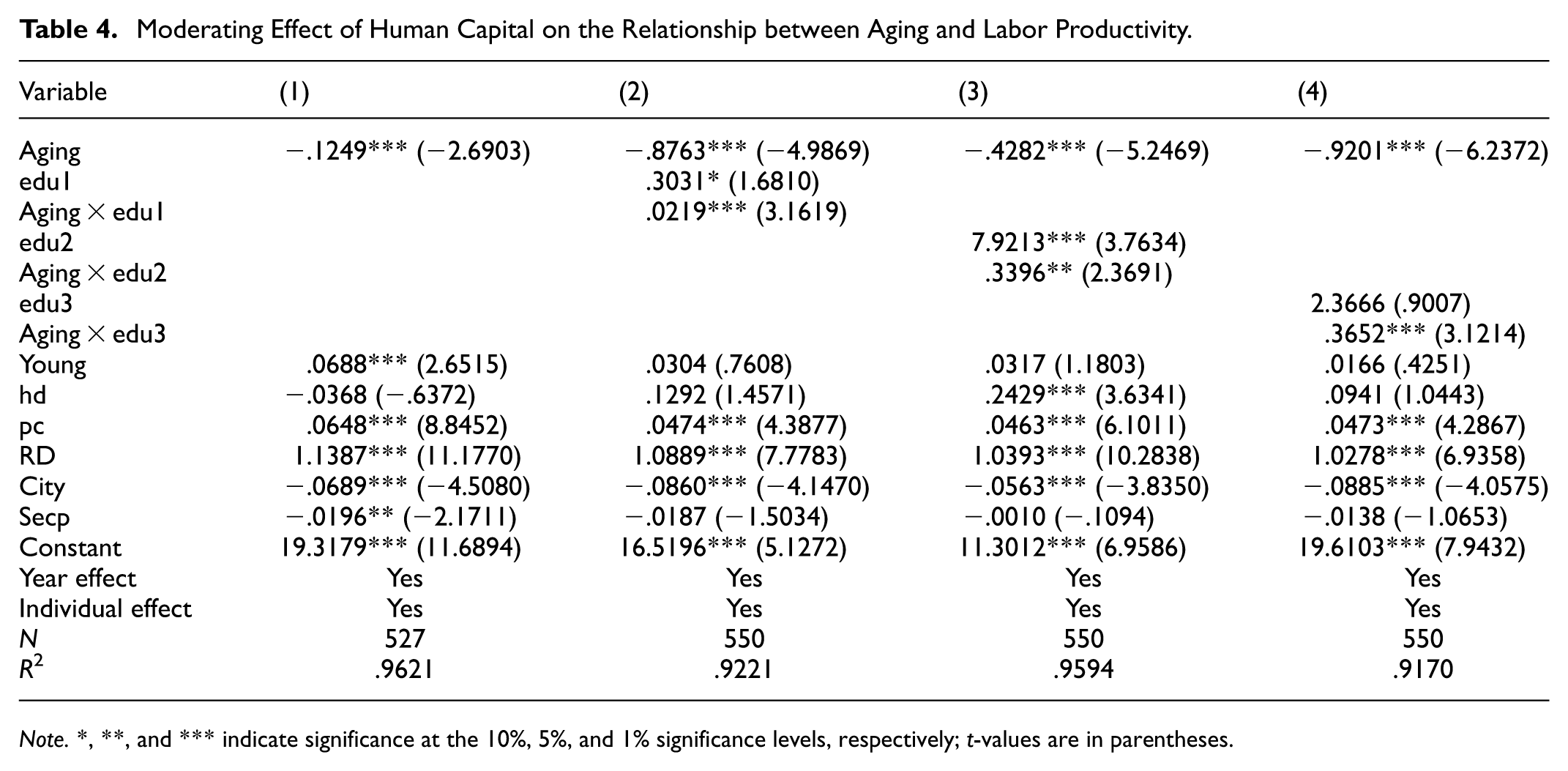
Equation 1 examines whether human capital can influence the relationship between aging and labor productivity, and potentially mitigate the negative effects of aging. The results are presented in Table 4. Aging has significant endogeneity. We choose the birth rate in the 1950s as an instrumental variable for aging. The regression outcomes for the relationship between aging and labor productivity are detailed in column (1) in Table 4. Aging has a significant inhibitory impact on labor productivity. As the aging process intensifies, the labor force reaches its peak and subsequently declines, negatively affecting economic growth. The escalating costs associated with an aging population may lead to a reduction in R&D spending and investment in human capital, which in turn hampers innovation, technological advancement, and the enhancement of labor productivity.
Moderating Effect of Human Capital on the Relationship between Aging and Labor Productivity.
Note.*, **, and *** indicate significance at the 10%, 5%, and 1% significance levels, respectively; t-values are in parentheses.
Columns (2) to (4) in Table 4 examines the influence of human capital stock, high-skilled human capital, and labor force skill complementarity on the relationship between aging and labor productivity. The findings indicate that aging continues to have a significantly negative effect on labor productivity, while human capital stock, high-skilled human capital, and labor force skill complementarity have a positive impact on labor productivity. The cross-multiplier terms of aging with average years of schooling, the share of highly skilled labor, and the labor force skill complementarity index all yield positive and significant coefficients at the 1% level, indicating that human capital stock, high-skilled human capital and labor force skill complementarity can mitigate the negative impact of aging on labor productivity. The reason for this is that enhancing the level of human capital stock, particularly by increasing the number of high-skilled labor, can significantly elevate the quality of the labor force, augment the supply of effective labor, and compensate for the labor shortage resulting from aging. Human capital also influences wage levels; thus, an increase in human capital can boost labor income and alleviate the dependency burden associated with aging. A higher human capital stock, especially a larger proportion of high-skilled labor, fosters innovation and technological advancement, thereby enhancing labor productivity. An increase in the labor force skills complementarity index signifies that high- and low-skilled labor develop in a synergistic manner and maintain a reasonable ratio. High-skilled labor can enhance the labor productivity of the low-skilled labor through knowledge spillovers and human capital externalities, while the low-skilled labor provides essential basic services and improves urban living standards, which aids in talent attraction and retention. By increasing the complementary index of labor force skills, labor can be reallocated across regions and industries, increasing labor productivity and mitigating the pressure of aging.
Robustness Test
To assess the robustness of the baseline regression model, we employed a variable substitution approach. The aged dependency ratio and the child dependency ratio were utilized as proxies for aging and low birth rates, respectively. The benchmark regression model was re-estimated, with the results presented in Table 5. Columns (1) to (3) in Table 5 represent the moderating influences of human capital stock, high-skilled human capital and labor force skill complementarity, respectively. The findings reveal that the interaction terms with aging are significantly positive across all columns, aligning with the estimates from Table 4. This consistency indicates that human capital stock, high-skilled human capital and labor force skill complementarity have a mitigating effect that can ameliorate the negative impact of aging on labor productivity, and thereby confirming the robustness of these results.
Robustness Test.

, **, and *** indicate significance at the 10%, 5%, and 1% significance levels, respectively; t-values are in parentheses.
The model may still suffer from the omitted variable problem. In 2016, China began to implement the universal two-child policy. The universal two-child policy directly increased the number of children and might indirectly affect aging. Therefore, the interaction term between the mean value of aging and the implementation time of the universal two-child policy is used as an instrumental variable to re-estimate the model, in order to address the endogeneity caused by the omitted variable problem. The regression results are shown in columns (4) to (6) of Table 5. The results in columns (4) to (6) of Table 5 are similar to those in Table 4, indicating that after considering the endogeneity issue brought about by the omitted variable, human capital stock, high-skilled human capital, and labor force skill complementarity can still alleviate the negative impact of aging on labor productivity.
Heterogeneity Analysis of Human Capital to Mitigate the Negative Effects of Aging
Regional Heterogeneity
Variations in economic development levels and geographical environment across different regions in China results in significant population movements and disparties in aging levels. Given these regional differences, it is practically significant to investigate whether human capital can offset the adverse effects of aging on labor productivity, considering regional heterogeneity. Drawing on economic geography principles, China’s 31 provinces are categorized into three regions: eastern, central and western, and further divided into southern and northern regions based on geographical location.
Table 6 presents the regional analysis of the moderating effect of human capital stock on the relationship between aging and labor productivity. The findings indicate that the interaction term between average years of schooling and aging is significantly positive in both the eastern and western regions, as well as in the southern and the northern regions, suggesting that human capital stock can ameliorate the negative impact of aging on labor productivity. The interaction term is not significant in the central region, implying no moderating effect of human capital stock there. Collectively, an increase in human capital stock is beneficial for enhancing the effective labor supply, improving labor productivity, and mitigating the negative effects of aging, with a moderating effect in both southern and northern regions. The eastern region, with its advanced economic development and a tertiary industry-dominated economy, boasts a higher human capital stock and a higher degree of marketization, providing an optimal environment for human capital to exert its influence, thus effectively mitigating the effects of aging. Although the western region has a lower average education level compared to the eastern region, it experiences a less severe aging issue and is rich in natural resources. With policy support, an increase in human capital stock can facilitate the rational use of these resources, stimulate economic growth, and alleviate the negative impact of aging.
Moderating Effects of Human Capital Stock.

, **, and *** indicate significance at the 10%, 5%, and 1% significance levels, respectively; t-values are in parentheses.
Table 7 delineates the regional analysis of the moderating influence of high-skilled human capital on the nexus between aging and labor productivity. The findings reveal that the interaction term between the proportion of high-skilled labor and aging is significantly positive across all regions, including the eastern, central and western regions, as well as the southern and northern region. This indicates that high-skilled human capital has the capacity to ameliorate the detrimental effects of aging on labor productivity. High-skilled human capital is instrumental in enhancing technological levels and fostering innovation, which in turn boosts production efficiency. The advancement and refinement of production technologies can, to a certain extent, substitute for labor, thereby reducing labor demand and mitigating the strain on labor supply. Therefore, high-skilled human capital plays a crucial role in odd setting the adverse impact of aging on labor productivity.
Moderating Effects of High-Skilled Human Capital.

, **, and *** indicate significance at the 10%, 5%, and 1% significance levels, respectively; t-values are in parentheses.
Table 8 presents the findings on the moderating effect of labor force skill complementarity on the relationship between aging and labor productivity, analyzed by subregion. The results indicate that the interaction between the labor skill complementarity index and aging is significantly positive in the eastern and southern regions, suggesting that labor skill complementarity can mitigate the negative impact of aging on labor productivity. However, in the central and western regions, as well as the northern region, the interaction terms of the labor skill complementarity index with aging are not significant, implying that there is no moderating effect of labor skill complementarity in these areas. The eastern region, with its advanced economic development, enhanced infrastructure, and abundant employment opportunities, attracts both high-skilled and low-skilled labor. The resulting human capital externalities boost labor productivity, which helps to counteract the negative effects of aging. In the southern region, where the degree of aging is notably higher than in the northern region, and the labor force skill complementarity index is higher, the region’s lesser exposure to the planned economy, coupled with its advantageous geographical location, rapid maritime transport development, early involvement in international trade, and a high degree of economic marketization, has led to a rational structure of high-skilled and low-skilled labor. This structure better leverages human capital externalities, enhancing the productivity of both high and low-skilled labor and thus mitigating the negative impact of aging. Labor force skill complementarity plays a significant role in alleviating the adverse effects of aging in these regions.
Moderating Effects of Labor Force Skill Complementarity.

, **, and *** indicate significance at the 10%, 5%, and 1% significance levels, respectively; t-values are in parentheses.
Heterogeneity in the Degree of Aging
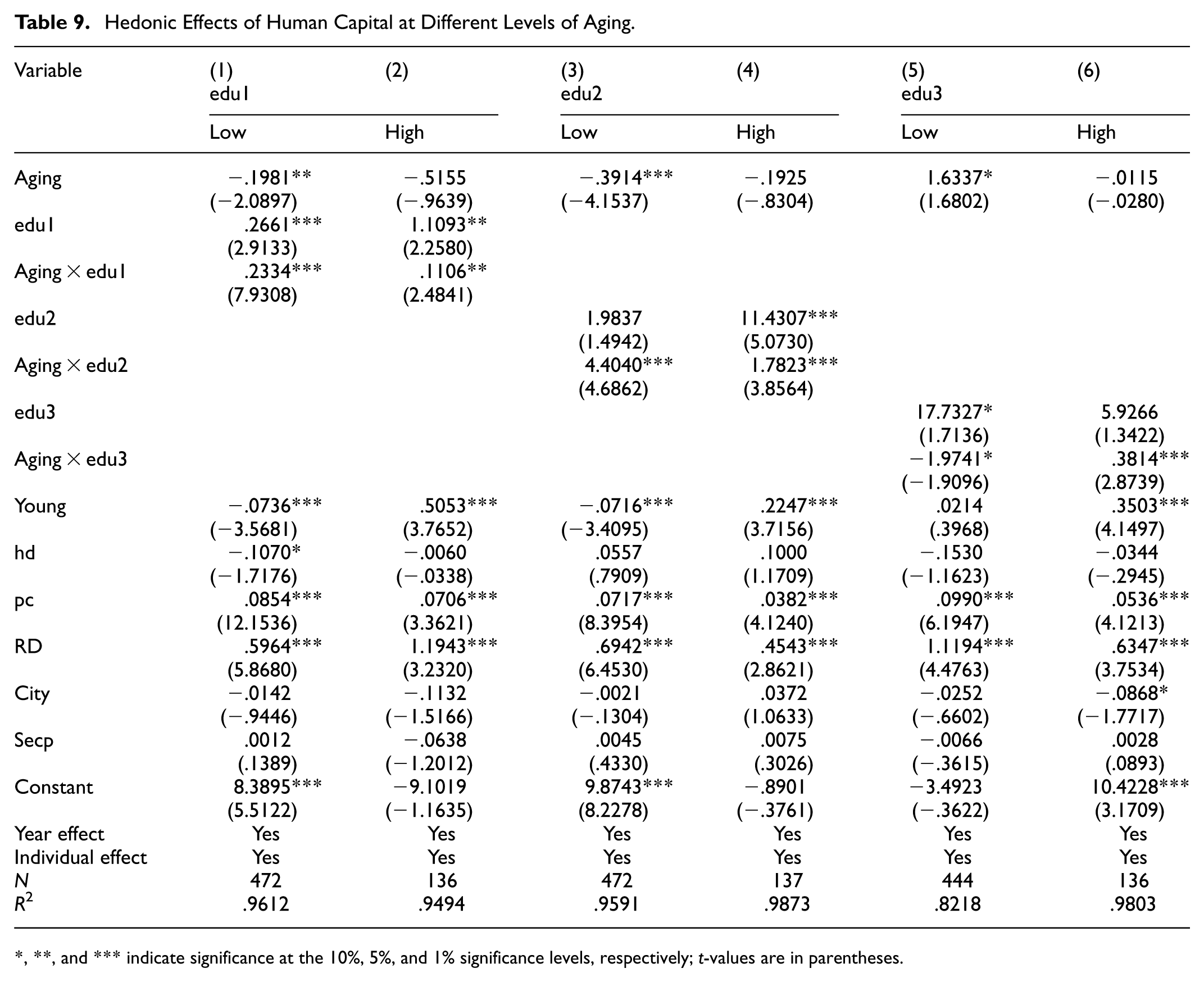
China’s aging population is growing at an accelerated rate, transitioning from an aging society to a moderately aging society within just two decades. The Blue Book of Health Industry: Report on the Development of China’s Health Industry anticipates that by 2050, the elderly population aged 60 and above in China’s will reach 483 million, accounting for 34.1% of the total population, with those aged 65 and above constituting 28.1%. Tis projection suggests that China will enter a super-aged society within the next decade or so. In 2022, the natural population growth rate ws −.6‰, marking the beginning of a negative trend, and the labor force population has started to decline, albeit from a large base. If the birth rate cannot be increase post-retirement, the aging level is expected to rise further. Given the significant population mobility and regional disparities in aging, it is of practical importance to study the role of human capital under varying degrees of aging to address more severe aging challenges in the future. The full sample is thus divided into a low aging group and a high aging group according to different aging levels.
Table 9 provides insights into the moderating effect of human capital stock on aging. Columns (1) and (2) in Table 9 demonstrate that the cross-multiplier terms between average years of schooling and aging are significantly positive in both the high and low aging groups, indicating that human capital stock can mitigate the negative effects of aging. Columns (3) and (4) are the moderating effects of high-skilled human capital on aging, and the results show that the cross-multiplier terms between the share of high-skilled labor force and aging are significant in both the high aging group and the low aging group, and that advanced human capital can have a significant mitigating effect on the negative effects of aging. Columns (5) and (6) are the moderating effect of labor force skill complementarity on aging, the results show that in the low aging group, the cross-multiplier terms of labor force skill complementarity index and aging are both significant and negative, and there is a negative moderating effect of labor force skill complementarity. The low degree of aging has not yet had a negative impact on labor productivity, and at this time it is more beneficial to increase high-skilled labor and enhance the stock of human capital to increase labor productivity. In the high aging group, the cross-multiplier terms of the labor force skill complementarity index and aging are all significant and positive, so labor force skill complementarity can mitigate the negative impact of aging and can play a positive moderating role in the high aging group. With high aging level and insufficient labor supply, the increase in the proportion of high-skilled labor force can enhance labor productivity, and also increase the consumption demand for basic services, provide employment opportunities for low-skilled labor force, guide the population to move reasonably, increase the low-skilled labor force, and play the effect of high and low-skilled labor force complementary effect, which can enhance the labor productivity and alleviate the negative impact of aging. Regardless of the level of aging, human capital stock and high-skilled human capital can mitigate the negative impact of aging on labor productivity. When the level of aging is high, increasing the degree of labor force skill complementarity and taking advantage of the complementary effects of high and low skilled labor force are more effective in mitigating the negative effects of aging.
Hedonic Effects of Human Capital at Different Levels of Aging.
, **, and *** indicate significance at the 10%, 5%, and 1% significance levels, respectively; t-values are in parentheses.
Threshold Effects of Human Capital
According to Equation 2, a threshold panel model regression is conducted with human capital stock, high-skilled human capital, and labor force skill complementarity as threshold variables to test the impact of aging on labor productivity under different levels of human capital.
Threshold panel model is used on the premise of the existence of threshold effect existence and the number of thresholds, Table 10 shows the results of human capital stock, high-skilled human capital and labor force skill complementary as threshold variables to test whether the threshold effect exists. After the threshold effect test, only a single threshold of the three threshold variables passes the threshold effect test at the 1% significance level. Therefore, a panel threshold model with a single threshold was selected to test Equation 2. The threshold value and its confidence interval are shown in Table 10.
Threshold Effect Test of Human Capital on Labor Productivity.

Columns (1) and (2) in Table 11 show the regression results when human capital stock and high-skilled human capital are the threshold variables, respectively. When human capital is less than the threshold value of 12.58 and the proportion of high-skilled labor force is less than .4320, that is, when the average years of education is lower and the proportion of high-skilled labor force is lower, aging has a negative impact on labor productivity; when it is greater than the threshold value, that is, when the average years of education is lower and the proportion of high-skilled labor force is higher, aging has a positive impact on labor productivity. When the share of labor force is higher, aging has a positive effect on labor productivity. The results show that human capital stock and high-skilled human capital can effectively mitigate the negative impact of aging.
Threshold Regression Results.

Note.*, **, and *** indicate significance at the 10%, 5%, and 1% significance levels, respectively; t-values are in parentheses.
Column (3) in Table 11 shows the regression results when labor skill complementarity is the threshold variable. The results show that when the labor force skill complementarity index is less than .6944, aging has a negative effect on labor productivity, but not significant; when the labor force skill complementarity index is higher than .6944, aging has a significant promotion effect on labor productivity. The results show that the labor force skill complementarity index reaches a certain level and the structure of the ratio of high and low skilled labor reaches a certain level before it can hedge the negative impact of aging, and this hedging effect gradually increases with the strengthening of the complementarity effect. According to the classification of Wang and Tang (2018), the labor force skill complementarity index is divided into [0, .2], [.2, .4], [.4, .5], [.5, .8], [.8, 1.0], and the five types of severe dysfunctions, moderate dysfunctions, basic dysfunctions, moderate coordination, and high coordination, respectively. The mean value of China’s labor skill complementarity index is .5144, and the median is .5118. Most of the time and regions’ labor skill complementarity indexes are in the [.4, .5] basic coordination interval and [.5, .6] moderate coordination interval, which are in the state of basic dysfunction. Most of the regional labor force skill complementarity index did not reach the threshold value of .6944, only Tianjin, Beijing and Shanghai reached above the threshold value in some years, while the maximum value of .7135 appeared in Beijing. However, except for the western region with a low degree of aging, the central region and the eastern region have a serious degree of aging and are developing rapidly, so improving the labor force skill complementary index to keep the structure of high and low skilled labor force at a moderate degree of coordination and to move towards a high degree of coordination can make up for the negative effects of aging and is conducive to the improvement of labor productivity.
Conclusions and Recommendations
China has already transitioned into an aging society, with the population peak from the 1960s baby boom now approaching retirement. Over the next decade, China is expected to experience a rapid acceleration in aging, potentially leading to a super-aging society. The decline in birth rates and the irreversible trend of aging suggest that demographic challenges have become significant barriers to economic growth. Addressing the demographic issue and finding strategies to mitigate the adverse effects of aging is a critical area that warrants in-depth exploration.
The empirical findings indicate that aging significantly diminishes labor productivity. However, human capital stock, high-skilled human capital and labor force skill complementarity can enhance labor productivity. There exists a moderating effect that can reduce the adverse effects of aging. Regarding regional disparities, human capital stock can effectively counteract the negative impact of aging on labor productivity in all regions except the central one. High-skilled human capital exerts a moderating effect across all regions. Labor skill complementarity mitigates the negative effects of aging only in the eastern and southern regions. In terms of varying degrees of aging, human capital stock and high-skilled human capital exhibit a moderating effect regardless of the level of aging, while labor force skill complementarity helps to alleviate the negative impact of aging particularly in regions with high aging levels.
Drawing from the above, the following conclusions can be inferred: Firstly, regions must prioritize investment in human capital, enhance the average years of schooling among the employed, and elevate the overall of human capital to address the challenges of labor supply insufficiency and the strain on pension systems due to aging. As China’s aging population continues to grow and develop at an accelerated pace, the issue of labor shortage is set to become increasingly severe. It is imperative to dismantle barriers to labor mobility, facilitate rational labor movement across regions, and enhance the complementary index of labor skills and the matching degree of labor skills. This can be achieved by expanding urban capacities rather than limiting the influx of low-skilled laborers. It is also crucial to maximize the external benefits of human capital and leverage the complementary effects of diverse labor skills to boost labor productivity.
Secondly, regarding sub-regional strategies, each region should concentrate on either the stock or the structure of human capital, tailored to their specific developmental conditions and strengths, to counteract the adverse effects of aging. To enhance labor productivity and mitigate the negative impacts of aging more effectively, the eastern region should prioritize the rational of high- and low-skilled labor force, elevate the index of labor skill complementarity, encourage the collaborative advancement of both skill levels, and attract a high-skilled labor force. Attention should also be given to the balance between high- to low-skilled labor, strengthening their interconnections and leveraging the externalities of human capital and the complementarity effects of labor skills. The central region should advance the modernization of human capital, increase the share of high skilled labor, boost innovation capabilities, stimulate economic growth, and alleviate the pressures of aging. The western region, characterized by a lower level of aging and slower economic growth, should focus on enhancing its human capital stock to narrow the gap with the central and eastern regions and foster economic growth. The northern region should further refine the market environment, value the role of low-skilled labor, and elevate the labor skill complementarity index to achieve a more rational ratio of high-skilled. Higher levels of human capital and the synergy between high-level human capital and labor force skills can drive economic growth. Each region should establish its own priority development objectives based on its unique developmental traits, aiming to increase labor productivity and foster balanced regional development.
Research on measures to counter the negative impacts of aging, to enhance labor productivity, is conducive to achieving sustainable economic growth in China, promoting balanced regional development, and realizing social stability. At the same time, the findings of this research also provide valuable experience for other developing countries in dealing with the challenges of an aging population.
Footnotes
Acknowledgements
We acknowledge the academic support from the Capital University of Economics and Business and National Academy of Innovation Strategy.

Ethical Considerations
This article does not contain any studies with human or animal participants.
Consent to Participate
Not applicable.
Consent for Publication
Not applicable.
Funding
The authors received no financial support for the research, authorship, and/or publication of this article.
Declaration of Conflicting Interests
The authors declared no potential conflicts of interest with respect to the research, authorship, and/or publication of this article.
Data Availability Statement
The datasets generated during and/or analyzed during the current study are available from the corresponding author on reasonable request.