




Abstract
Recent research has paid considerable attention to the role of university support in explaining student entrepreneurship, with several studies presenting empirical evidence of the moderating effects of individual traits on the relationship between university support and entrepreneurial intentions. However, the moderating effect of entrepreneurial capacity on this relationship has not been considered. This is particularly true in the Chinese context, where college students are reluctant to start businesses despite the substantial entrepreneurial support provided. Grounded in the theory of triadic reciprocal determinism, this study aimed to investigate the link between university support and entrepreneurial intention and examine the mediating role of students’ entrepreneurial capacity. Survey data were collected from 1,058 undergraduates in China’s Anhui Province and analyzed using structural equation modeling with partial least squares estimator. We found a positive but weak effect of university support on students’ entrepreneurial intentions, indicating that students are unlikely to obtain sufficient support directly from a wide range of university resources. However, university support significantly enhanced students’ entrepreneurial capacity, which, in turn, predicted students’ intention to create new enterprises. Our study also found that entrepreneurial capacity played an intermediary role between university support and students’ entrepreneurial intentions. These findings have several practical implications for policymakers and university administrators in terms of enhancing entrepreneurial support and students’ entrepreneurial intentions. This study contributes to the literature on student entrepreneurship in emerging economies.
Introduction
Entrepreneurship can effectively increase employment opportunities and alleviate employment pressure (Katz et al., 2016), and it has become a key avenue for development in both developed and emerging countries (Mathias et al., 2015). However, universities’ role in stimulating entrepreneurship among college students remains controversial. Many countries provide various forms of university support (US), such as entrepreneurship education (EE), incubators, and funds to enhance students’ entrepreneurial intentions (EIs; Cooke & Xiao, 2021; Martínez et al., 2017; Pittaway & Cope, 2007). Although EI serves as the starting point and driving force for actual entrepreneurial behavior in the future (Kautonen et al., 2013; Krueger et al., 2000), it represents a subjective psychological state indicating whether an individual will undertake entrepreneurial activity, and is difficult to improve directly through US (Maheshwari & Kha, 2022). Therefore, the pathways through which US affect EI have gradually attracted global attention.
In recent years, research on entrepreneurship among college students has made progress mainly in three areas. The first stream of papers advocates the importance of EE based on the theory of planned behavior, social cognitive theory, and entrepreneurial human capital theory (Fayolle & Gailly, 2015; Joensuu-Salo et al., 2015; Saptono et al., 2020). The second group of studies focuses on the impact of EE on EI. Some scholars have confirmed the significant and positive impact of EE on EI (Daniel, 2016; Handayati et al., 2020; Ni & Ye, 2018; Pittaway & Cope, 2007), whereas others have expressed the opposite view that EE has no impact at all or no direct impact on EI (Amjad et al., 2020; Nabi et al., 2018; von Graevenitz et al., 2010). The third stream of literature concerns the mediating factors between EE and EI. Such studies have considered various mediating factors at different levels, such as individual psychological traits, family background, and regional environment (Dohse & Walter, 2012; do Paço et al., 2015; Falck et al., 2012; Liñán & Santos, 2007; D. Wang et al., 2018).
Although the existing literature thoroughly discusses the relationship between EE and EI, entrepreneurship is a complex and dynamic process influenced by multiple factors, and university EE activities alone cannot encourage students to engage in entrepreneurship (Davey et al., 2016). Existing literature exploring the mechanisms of universities’ impact on students’ EI from perspectives other than EE remains scarce (Liu et al., 2022; Saeed et al., 2015). Sim et al. (2023) found that US in Malaysian universities did not directly affect students’ EI, but the entrepreneurial climate mediated the relationship between perceived support for business and conceptual development and EI. Brandão Farias et al. (2024) found a positive impact of entrepreneurial characteristics on EI but a negative moderating effect of perceived university support due to students’ negative evaluations of US. These studies failed to elucidate how universities can most effectively contribute to student entrepreneurship. Moreover, the willingness of individuals who have received university entrepreneurship support is also influenced by other mediating factors. Despite scholarly examination of the mediating role of a range of individual psychological traits in college students (Nowiński et al., 2019; Şahin et al., 2019; Sitaridis & Kitsios, 2022), has been less focus on their entrepreneurial capacity (EC). This factor is particularly valuable for countries with collectivist cultural values and a tendency to follow traditional career paths (Clarysse et al., 2011). Hence, for the socio-economic stability and development of emerging economies, exploring the relationships among US, EI and effective mediators is important.
Traditionally, China has placed more emphasis on organizational rather than individual student entrepreneurship. According to data from the Entrepreneurship Guidance Center of the Ministry of Human Resources and Social Security, nearly 12% of Chinese students have EI, but the actual rate of entrepreneurship is only 2%, which is significantly lower than 20% to 30% rates observed in developed Western countries (Chen et al., 2022). To address this dilemma, in 2012, the Ministry of Education required all higher education institutions to offer a two-credit entrepreneurship course for students. In 2014, the “Mass Entrepreneurship and Innovation Program” was implemented to stimulate entrepreneurial behavior among college students. Despite offering entrepreneurship courses and programs, students’ lack of entrepreneurial knowledge and business acumen has resulted in limited success in addressing their entrepreneurial needs and no significant improvement in the overall entrepreneurship rate. According to the “China Undergraduate Employment Report” and the “China Higher Vocational College Employment Report” released by the MyCOS’ research group, Chinese college students’ entrepreneurship rate was 2.3% in 2014 and increased slightly to 2.7% in 2019.
This study makes the following theoretical and practical contributions. First, in contrast to previous studies that focused only on university EE, we extended EE to the multiple entrepreneurial support initiatives universities offer, including educational support and concept and business development support. US is a multifaceted external environment and focusing on university EE support exclusively may result in underestimating universities’ role. In response to Liu et al.’s (2022) call for more research in developing countries, we included US as an environmental factor in triadic reciprocal determinism (TRD) with the expectation of contributing to the generalizability of the TRD model. Second, our study addresses the gap in the entrepreneurship literature by introducing individual characteristics such as EC as a conditioning factor. We investigated whether differences in EC amplify the role of US on EI to deepen our understanding of how different students benefit from US. The findings of the study will help university administrators understand and assess the effectiveness of current entrepreneurship support activities and policies in universities and provide new ideas for formulating more relevant entrepreneurship support policies in developing countries.
The remainder of the paper is structured as follows: Section 2 proposes research hypotheses based on a review of the existing literature, Section 3 describes the data and methods, Section 4 reports the findings of the study, Section 5 discusses the findings, and Section 6 concludes the study.
Literature Review and Research Hypotheses
Triadic Reciprocal Determinism
TRD views human behavior as shaped by the triadic interaction of the individual, the environment, and their behavior; it emphasizes that the environment, the individual, and individual’s behavior are causally interdependent and mutually determining (Bandura, 1983). Based on this theory, Jung et al. (2001) connected EE with entrepreneurial cognition, intention, and behavior in a chain relationship. Jung et al. (2001) pointed out EE’s facilitating effect on entrepreneurial cognition and showed that through entrepreneurial cognition, EI is effectively predicted, which then leads to entrepreneurial behavior.
In TRD, an individual’s confidence, attitudes, and abilities work together to influence their behavioral performance. Individuals’ behavior is susceptible to the external environment (Sun et al., 2023), and their characteristics change in response to changes in the social environment. Individual behavior ensues when individual factors reach a state of dynamic equilibrium with environmental factors. College students’ entrepreneurial behavior is the result of the joint action of individual factors and environmental factors. Individual factors such as EC and environmental factors such as US explain the mechanism of entrepreneurial behavior among college students from internal and external perspectives, respectively. Therefore, based on TRD theory, we constructed a conceptual model with three dimensions: environment (US), individual (EC), and effective predictor of entrepreneurial behavior (EI).
University Support and Entrepreneurial Intentions
As universities’ role in student entrepreneurship and employment has become more prominent, an increasing number of universities are providing necessary support for student entrepreneurial activities (An & Xu, 2021), such as supportive entrepreneurship policies, EE, and a favorable entrepreneurial environment. Kraaijenbrink et al. (2010) categorized US into educational support, concept development support, and business development support. Educational support provides the theoretical knowledge, information, and networking opportunities necessary for establishing new ventures (Nabi et al., 2018). Concept development support offers the awareness, motivation, methods, technologies, business ideas, resources, and business plans required during the early stages of entrepreneurship (Zhang et al., 2014). Finally, business development support provides potential entrepreneurs with in-depth evaluation, such as financial guidance, mentoring, (social) network support, internships, and even the opportunity to create a business plan, to help them establish their companies (Saeed et al., 2015).
Most of the literature on this topic has confirmed the positive correlation between US and EI. do Nguyen and Thu Nguyen (2023) pointed out that when universities provided active educational and concept development support measures, students experienced more positive feelings about entrepreneurship, which led to a desire to start a business, the confidence to do so, and even success in entrepreneurship. Liu et al. (2022) found that business development support helped to alleviate or overcome constraints that arose during the entrepreneurial process, enabling students to feel less intimidated by potential challenges in entrepreneurship. Trivedi (2016) found that students’ EI was enhanced by educational programs such as entrepreneurship courses, entrepreneurship programs and internships conducted by universities, as well as the provision of supportive entrepreneurial environments in Malaysia, Singapore, and India. Additionally, US for entrepreneurship can reflect a favorable organizational and social environment for entrepreneurship (Feldman, 1984), which can influence students’ perceptions and attitudes toward entrepreneurship. Students may develop a positive view of entrepreneurship and attempt it because of the value the university places on it. Entrialgo and Iglesias (2016) pointed out that EE in universities mitigated the relationship between subjective norms and perceived behavioral control and enhanced the relationship between subjective norms and entrepreneurial attitudes, which, in turn, affected students’ EI. Based on the above findings, we proposed the following hypothesis:
University Support and Entrepreneurial Capacity
EE in universities can cultivate skills, capacity, and qualities (Grivokostopoulou et al., 2019; Muñoz et al., 2020). Universities’ implementation of a range of entrepreneurship policies, education, and other supportive measures can stimulate students’ creativity, critical thinking, flexibility, and ability to transform changes into opportunities (Byabashaija & Katono, 2011), while also improving their entrepreneurial thinking (Cui et al., 2019). Handayati et al. (2020) suggested that the fundamental principle of US is to enable students to develop entrepreneurship-related understanding, attitudes, and abilities. Duval-Couetil et al. (2012) investigated the entrepreneurial attitudes and intentions of engineering graduates in the United States and found that university teaching activities, research, and other normative activities related to US helped to shape the students’ entrepreneurial behavior and cultivate their entrepreneurial thinking, intentions, and skills. However, US may have a negative moderating effect due to students’ negative evaluation of it (Brandão Farias et al., 2024).
EE in universities enhances students’ entrepreneurial skills, and if the university provides other targeted and specific entrepreneurial support, such support may further enhance students’ perception of the university’s commercial role (Kraaijenbrink et al., 2010) and promote the development of EC. Universities can impart entrepreneurial knowledge, information, and experience to students through various EE activities, such as courses and lectures (Nabi et al., 2018), thereby broadening their knowledge base and enhancing their innovative capabilities. Morris et al. (2013) found that appropriate EE also improved core entrepreneurial competencies such as resource utilization and opportunity identification. Universities can convey the entrepreneurial spirit and enhance self-actualization capabilities through activities such as on-site visits to businesses. Organizing entrepreneurial experience-sharing sessions can facilitate students’ communication and interaction with successful entrepreneurs, enabling them to gain entrepreneurial experience and advice and enhance their decision-making and analytical capabilities. Interactions with entrepreneurs may even lead to opportunities for future business collaborations, which may enhance students’ ability to identify such opportunities. In short, with the universities’ help, students can engage in entrepreneurial activities, thereby enhancing their ability to accumulate and utilize knowledge and resources (Solesvik, 2013). Based on the above research, we proposed the following hypothesis:
Entrepreneurial Capacity and Entrepreneurial Intentions
EC is the practical ability to put ideas into action and a key determinant of EI, thus affecting the launch, survival, and development of new ventures (RezaeiZadeh et al., 2017). Generally, the stronger an individual’s EC, the higher the probability of entrepreneurial success, and the more likely the student is to develop EI and start a business. Clarysse et al. (2011) stated that individuals need a specific understanding of entrepreneurship and the ability to identify entrepreneurial opportunities before starting a business; those scholars illustrated the positive impact of EC on EI through the characteristic of opportunity identification ability in EC. Shi et al. (2020) pointed out the need for entrepreneurs to possess innovative capabilities that will help them propose creative solutions through the integration of existing resources and the creation of innovative companies; those scholars emphasized the role of EC in terms of innovative capabilities. Conversely, Liñán (2008) showed that self-awareness in EC also affected individuals’ self-actualization and subjective norms, influencing their attitudes toward entrepreneurship and encouraging them to start a business.
Broadly, an individual’s ability to identify opportunities, innovate, analyze decision-making and manage risks as well as their awareness of EC, directly influence whether they will establish a company. Koellinger et al. (2007) argued that possessing adequate entrepreneurial knowledge, skills, and experience facilitate individuals in generating entrepreneurial decisions. Liñán (2008) confirmed that the extent to which individuals perceived their EC affected their entrepreneurial tendencies. Carpenter and Wilson (2022) found that an individual’s EC had an inestimable role in whether they would engage in entrepreneurial behavior. In addition, Teixeira et al. (2018) found that if individuals perceived themselves to have sufficient EC, their confidence and motivation were enhanced, leading to greater willingness to start a company. Based on the above research, we proposed the following hypothesis:
The Mediating Effect of Entrepreneurial Capacity
US can enhance students’ awareness of their EC. The disadvantage of insufficient entrepreneurial knowledge and experience can be compensated via universities’ entrepreneurship support measures and policies. Gilmartin et al. (2019) found that US cultivated individuals’ entrepreneurial thinking and skills, enabling them to develop their more entrepreneurship-related capabilities. This, in turn, enhances their EI and entrepreneurial possibilities, encouraging them to start businesses and become entrepreneurs. Furthermore, most students consider entrepreneurship desirable despite the uncertainty and potential risks because it creates new job opportunities and allows them to become their own boss (Duval-Couetil et al., 2012).
When universities actively provide educational and concept development support to allow students to gain more knowledge, ideas, technologies, methods, opportunities, and resources needed for entrepreneurship, students’ ability show an enhanced ability to identify opportunities, analyze markets, innovate, and make decisions (Subhadrammal et al., 2023; Zhang et al., 2014). As universities undertake more initiatives related to entrepreneurial business development, students should be encouraged to conduct in-depth evaluations and explorations of entrepreneurial opportunities. US can help potential entrepreneurs improve their EC and encourage them to engage in entrepreneurial behavior through educational activities, conceptual development, and business development initiatives. Based on the aforementioned research, students are more likely to start businesses when they develop the necessary capacity required for entrepreneurship. In particular, they have to identify and forecast potential business opportunities and expected profitability, and these skills are acquired by participating in supportive activities and measures offered by universities. Thus, we proposed the following hypothesis:
The conceptual model is shown in Figure 1.
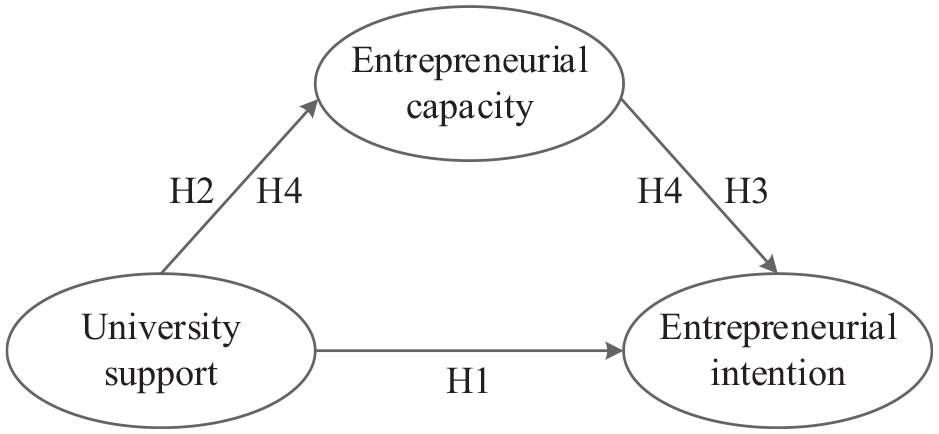
Theoretical framework.
Data and Methods
Data Collection
Before formally distributing the questionnaire, we administered a pilot survey at Anhui Normal University in March 2023, drawing on van Dam et al.’s (2010) and Weerakoon et al.’s (2020) methods. The pilot test preliminarily validated the relationships among US, EC, and EI and helped us refine the questionnaire. A total of 398 questionnaires were distributed during the pilot test, of which 285 were deemed valid. The Cronbach’s α coefficients for all questionnaire items ranged from .8 to .9, indicating good reliability of the questionnaire and its suitability for formal distribution.
Convenience sampling is widely used for questionnaire collection in entrepreneurship research (Nowiński et al., 2019). We used this technique to distribute the formal questionnaire between July and September 2023 at several universities in Anhui Province, China. The existing literature shows a spatial agglomeration phenomenon of entrepreneurship in China. Notably, the eastern region has the highest entrepreneurship rate, followed by the central region, with the western region having the lowest rate (Xu et al., 2021). Located in central China, Anhui Province reflects the country’s average level of entrepreneurship. The number of new enterprises per 10,000 inhabitants in Anhui Province in 2021 was 185.9, which was slightly below the national average of 204.4, ranking 14th among 31 provinces and municipalities (see https://mp.weixin.qq.com/s/A_7keq4yIX2REcF99aS_GQ). Therefore, data from Anhui Province represent the typical case for examining the relationship between US and EI in China.
The questionnaire was distributed through the website “www.wjx.cn.” All participants were informed of the purpose of the questionnaire survey and were asked to voluntarily complete it anonymously. Respondents were assured of the confidentiality of their personal information. Due to the large sample size and credible data source, we targeted 1,200 participants to obtain basic data (M. R. Khan et al., 2024). We received 1,338 completed questionnaires. After excluding incomplete, incoherent, and logically inconsistent responses, we obtained a final sample of 1,058 valid responses, resulting in an effective recovery rate of 70.07%.
Table 1 shows the participants’ demographic characteristics. Of the 1,058 college students, 386 (36.5%) were men and 672 (63.5%) were women; 274 were majoring in finance and management (25.9%), 424 in science and engineering (40.1%), and the remaining 360 in literature, history, philosophy, or arts (34.0%). Among them, 51.3% of the students were from rural areas, 26.6% were from towns, and 22.5% were from cities. Their parents were workers (28.15%), farmers (20.35%), self-employed individuals (17.6%), and employees of enterprises and institutions (15.75%). Most of the students’ parents had an educational background ending with junior high school (42.1%), followed by elementary school (25.85%) and high school (18.40%); only 13.65% had a college degree or above. Moreover, 35.6% of the students’ families had a monthly disposable income of less than RMB 3,000; 35.3% had an income between RMB 3,000 and RMB 5,000; and 29.0% had an income exceeding RMB 5,000. Furthermore, 45.0% of the students’ family members or relatives had entrepreneurial experience. The source and distribution of the study sample were reasonable, ensuring the universality and reliability of the research questions.
Demographic Characteristics of Participants.

Methods
To investigate the relationships among SU, EI, and EC in college students, we utilized a quantitative research method. Specifically, we conducted a questionnaire survey to collect students’ data. We developed scales for EI and EC, following Liñán and Chen (2009), in addition to a scale for US based on Kraaijenbrink et al. (2010) and Saeed et al. (2015). Specific information on SU, EI, and EC is presented in Table 2. The variables were measured on a 7-point Likert scale (1 = strongly disagree, 7 = strongly agree; M. R. Khan & Roy, 2023a). The questionnaire data were analyzed using SPSS 26 and Smart-PLS (v 4.0).
Coding Variables for Entrepreneurial Intention, University Support, and Entrepreneurial Capacity.

We employed partial least squares structural equation modeling (PLS-SEM) to test the hypotheses. Following M. R. Khan and Roy (2023b), we used exploratory and validation factor analysis techniques to explore and validate the models. We first assessed the external model’s reliability and validity. We used exploratory factor analysis to calculate the Kaiser-Meyer-Olkin (KMO) value, Cronbach’s α, and split-half reliability for each scale to test the questionnaire structure and its internal consistency and stability. We also conducted confirmatory factor analysis to determine the scales’ factor structure and assess their internal reliability and validity based on factor loading, composite reliability (CR), and average variance extracted (AVE). Then, we assessed the internal model’s collinearity, R2, size effects, and predictive relevance and used bootstrapping to determine the path coefficients between SU, EC, and students’ EI.
Results
External Model Assessment
We used construct validity, composite reliability, convergent validity, and discriminant validity to assess the model’s credibility and effectiveness. Table 3 displays the variables’ construct validity. The KMO measure exceeded 0.7, and the significance value for Bartlett’s test of sphericity was 0.000 (p < .05), indicating significant construct validity of and correlations among EI, SU, and EC (Kaiser & Rice, 1974).
KMO and Bartlett’s Test of Sphericity.

Table 4 shows the model’s composite reliability, convergent validity, and discriminant validity. Cronbach’s α and split-half reliability were used to test the variables’ internal consistency and stability (Bardhoshi & Erford, 2017). A questionnaire is generally considered to have high usability when the Cronbach’s α and split-half reliability coefficient exceed .8. The Cronbach’s α values of EI, SU, and EC were .930, .895, and .899, respectively, and the split-half reliability coefficients were .903, .859, and .814, respectively, all exceeding 0.8. This indicated high composite reliability and stability between variables, which allowed for further analysis.
Reliability and Validity Test Results.
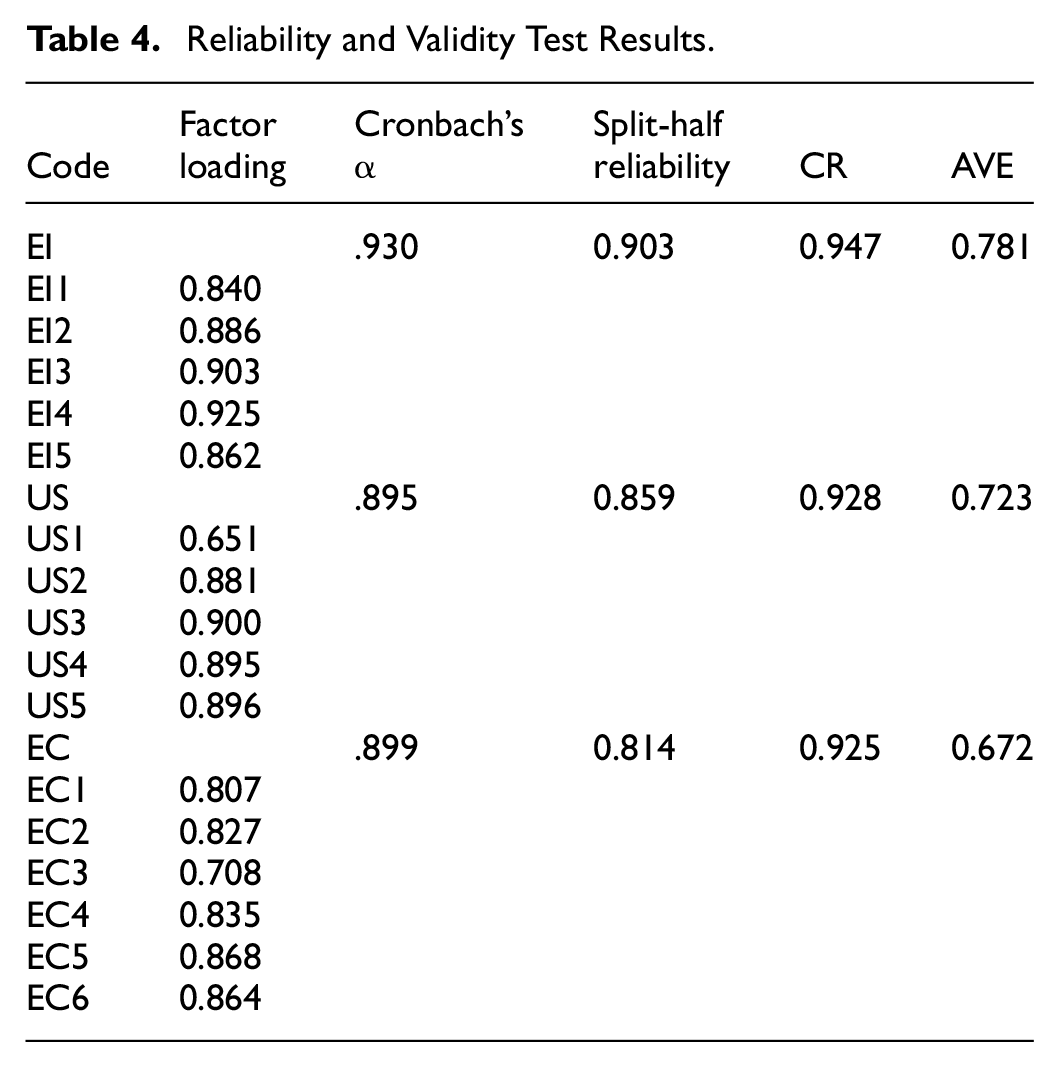
Factor loadings can be used to test variables’ convergent validity. All variables in Table 4 had loadings ranging from 0.651 to 0.925, that is, exceeding 0.6. Furthermore, they did not load onto two factors simultaneously, and there was no confounding of items between the factors. Therefore, the variables met the criteria for convergent validity and discriminant validity (Do Nguyen & Thu Nguyen, 2023; Hulland, 1999).
The CR test and AVE test were used to assess the model’s composite reliability and discriminant validity. Table 4 shows that the CR values of EI, US, and EC were 0.947, 0.928, and 0.925 respectively, which were all above 0.7, indicating that the scales passed the composite reliability test (Hair et al., 2013; Handayati et al., 2020). All AVE values exceeded 0.5, indicating that the scales also met the criterion of discriminant validity (Sarstedt, Ringle, Smith, et al., 2014).
Internal Model Assessment
After assessing the external model, we further assessed the internal model by completing five testing stages: collinearity, R2, effect size (f2), predictive relevance (Q2), and path coefficient (Sarstedt, Ringle, Smith, et al., 2014).
We used the collinearity test to detect whether the variables had high collinearity. This is usually determined by the variance inflation factor (VIF), which should be below 10 (O’brien, 2007). The results showed that the outer model variables’ VIF values were below 5.607, and those of the inner model variables were less than 1.963, indicating no serious collinearity issue among the variables.
We used R2 to measure the latent variables’ explanatory power on the observed variables. The results showed that the R2 of EI was .418, indicating that 41.8% of the variation in EI could be described by the US variable with a reliable predictive level. The R2 of EC was .491, meaning that US could explain 49.1% of the variation in EC with a moderate predictive level (Hair et al., 2011).
We used effect size (f2) to assess the magnitude of the effect of latent variables on the observed variables. An f2 above 0.02, 0.15, or 0.35 indicates a low, medium, or high effect, respectively (Hair et al., 2013). The results showed that the f2 of US on EC was 0.963, and that of US and EC on EI was 0.315, indicating a high effect size of the variables.
We used Q2 to assess the model’s prediction accuracy. A Q2 value above 0 indicates that the model has good predictive ability (Sarstedt, Ringle, Henseler, & Hair, 2014). The test results showed that the variables’Q2 values exceeded 0, indicating the model’s strong predictive ability.
Path Analysis
To assess the structural model, we performed a path analysis using PLS-SEM bootstrapping. Table 5 illustrates the path coefficients for the four types of relationships in the model, and Figure 2 shows the corresponding path relationships. Table 5 indicates that all relationships were significant at a level of at least 10%. The significant positive effect of US on EI was confirmed, thus supporting Hypothesis 1. The significant positive effect of US on EC was confirmed, supporting Hypothesis 2. Additionally, EC was found to have a significant positive effect on EI, supporting Hypothesis 3. Standardized path coefficients ranged from −1 to +1, indicating the direction and strength of the positive or negative relationships and effects between the latent variables. Regarding the coefficients, US had the most significant effect on EC, followed by EC on EI. In addition, EC played a mediating role in the effect of US on EI, supporting Hypothesis 4.
Summary of Hypothesis Test Results.

<10%, ***<1%.
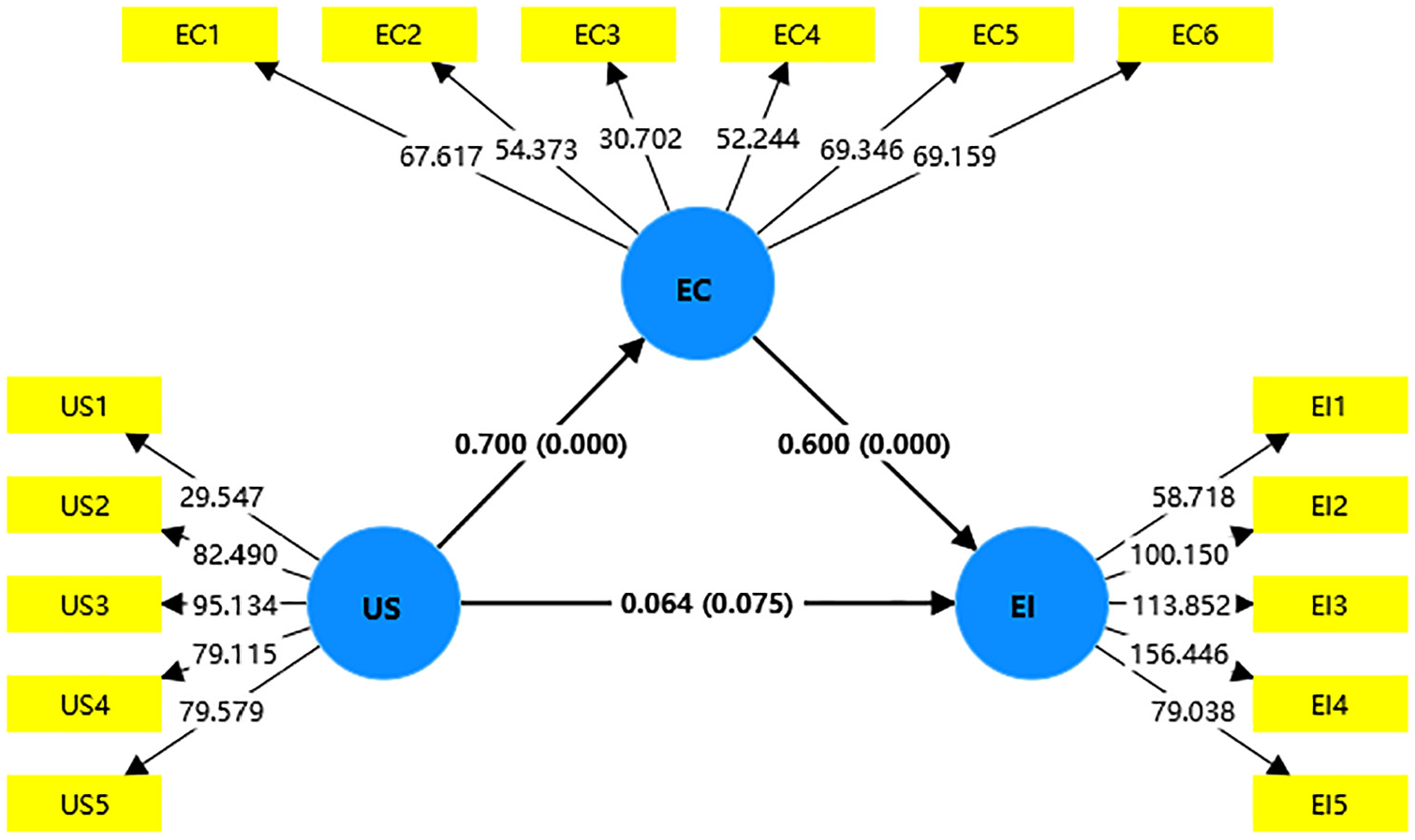
Path coefficients.
Discussion
Theoretical Implications
Our study confirmed the importance of US in enhancing the EI of college students; however, the direct effect of US on EI was weak. Over the past decade, the Chinese government has implemented a series of measures aimed at expanding universities’ third mission: fostering an entrepreneurial atmosphere to stimulate entrepreneurial activity among students. However, the existing literature suggests that the relationship between US and EI may be direct, indirect, or even unrelated. Our results affirmed the positive impact of US on EI. This finding differs from Sim et al.’s (2023) finding that perceived US had no direct effect on Malaysian college students’ EI. Our results are similar to those of Lu et al. (2021), who found a weak but positive effect of perceived US on Chinese college students’ EI. This weak effect suggests that college students are unlikely to receive sufficient support directly from a wide range of university resources. The reason for this predicament may be due to a disconnect between educational policies and objectives since Chinese universities provide little or no additional entrepreneurial support for students beyond the entrepreneurship courses the Ministry of Education requires (Lu et al., 2021; X. Wang et al., 2022).
Our study also confirmed that US has an important role in enhancing college students’ EC. US can impart entrepreneurial knowledge, ideas, and spirit, as well as the opportunities to meet face-to-face with successful entrepreneurs. In the process, college students can gain entrepreneurial experience and improve their opportunity recognition, understanding and entrepreneurial determination. Díaz-Casero et al. (2012) found that EE influenced EC through social norms, values, and entrepreneurial culture. Our study supports and extends Díaz-Casero et al.’s (2012) finding, but we found that in addition to EE, a wider range of US can also effectively improve EC. Our study also reinforces Do Nguyen and Thu Nguyen’s (2023) finding that educational support in the form of US improved students’ entrepreneurship-related comprehension, attitudes, and actions.
We also demonstrated that EC significantly affects students’ EI. Most of the existing studies on the relationship between EC and EI were based on cases conducted in developed countries, and the conclusions drawn from these cases do not directly explain student entrepreneurship in developing economies. The significant positive effect of EC on EI found in this study fills the research gap regarding the relationship between EC and EI in developing countries. Teixeira et al. (2018) identified a close relationship between personal EC and entrepreneurial ideas and entrepreneurial determination; the present study’s findings reinforce this view. Additionally, our findings enhance Hu et al.’s (2022) research on the role of EC on EI from a human resource perspective: EC is not only effective in predicting EI but also helps to investigate how EC drives students’ EI.
Finally, we found that EC mediated the relationship between US and EI, thus highlighting EC’s role in influencing this relationship. If a positive direct relationship exists between multiple variables, one of the variables may mediate between them (Baron & Kenny, 1986). The presence of this mediating effect suggests that environmental factors alone cannot predict EI and that these factors can indirectly influence EI through their effect on EC. This suggests that college students cannot develop EI simply by being “in school”; they need to have confidence in their EC to effectively utilize US and consider entrepreneurship as a future career (Subhadrammal et al., 2023). The mediating effect of EC is supported by research, which suggests that EE plays an important role in enhancing individual confidence and EC, ultimately promoting the development of EI (Do Nguyen & Thu Nguyen, 2023).
Practical Implications
The results have important practical implications. First, the weak influence of US on EI suggests that university administrators and policymakers should shift their focus from increasing the quantity of US to improving its quality. This is particularly important in the current context of the widespread introduction of entrepreneurship courses in universities and the extensive mobilization of students to engage in entrepreneurship-related activities. We do not intend to provide a one-size-fits-all solution for universities; instead, we suggest that universities take a bottom-up approach based on their characteristics to integrate education and entrepreneurship and create supportive structures to fill the gap in entrepreneurship support. For example, they can build multi-dimensional initiatives such as educational support and concept and business development support. Second, although EC—defined as the practical ability to put ideas into action—is partly influenced by genetic factors, such as opportunity identification ability (Clarysse et al., 2011), it also involves acquired factors, such as resource integration ability; the latter can be nurtured and developed through the wide range of support universities offer. This requires universities to pay due attention to the existing differences in students’ abilities and acknowledge the importance of knowledge and ability when encouraging entrepreneurship. For highly capable students, universities can provide platforms for entrepreneurial practice. After all, the main goal of US is not the number of businesses that are built but rather the cultivation and development of students’ cognition, skills, and abilities, which can help them achieve their goals when they are faced with various challenges in the future.
Conclusion
Research on university support and entrepreneurial intentions is gaining widespread attention. We investigated the relationships between US and students’ EC and EI by collecting data from 1,058 Chinese college students and using the PLS-SEM method in conjunction with the triadic reciprocal causation theory. We attempted to identify whether college students could benefit from the entrepreneurial support universities provide and whether students’ entrepreneurial capacity mediated this relationship. The results showed that US had a significant positive effect on both EC and EI, but its direct effect on EI was weak. This suggests that college students are unlikely to receive sufficient support directly from a wide range of university resources. However, our results showed a significant positive correlation between EC and EI, indicating that EC mediated the relationship between US and EI. This suggests that the extent to which students can benefit from US varies, as benefit are derived by influencing students’ EC, which, in turn, positively drives their EI.
Our study had shortcomings. First, we studied entrepreneurial intentions rather than actual entrepreneurial behavior. Although scholars have clearly established a positive correlation between entrepreneurial intention and entrepreneurial activities, there is still a gap between intention and actual behavior. Therefore, future research needs to focus more on actual entrepreneurial behavior. Second, our data were cross-sectional and representative of only 1,058 college students in one Chinese province; thus, care should be exercised when attempting to draw any conclusions or inferences from the survey results. Conducting longitudinal and comparative studies in the future would be helpful in better understanding the relationships among SU, EC, and EI.
Footnotes
Acknowledgements
We express our sincere gratitude to the participants who facilitated and supported the data collection process.

Ethics Considerations
This study did not involve any humans or animals for experimental purposes and is based on a survey-based opinion.
Consent to Participate
Respondents’ participation in this study was all voluntary. A total of 1338 participants accepted and voluntarily participated in the study after the authors assured them of anonymity and that their responses would only be used for academic purposes.
Funding
The author(s) disclosed receipt of the following financial support for the research, authorship, and/or publication of this article: This study was funded by the National Natural Science Foundation of China [Grant Numbers: 42201192], the MOE Project of Key Research Institute of Humanities and Social Sciences at Universities [Grant Numbers: 22JJDZS790302], the Scientific Research Foundation of Education Department of Anhui Province of China [Grant Numbers: SK2021A0090], the Natural Science Foundation of Anhui Province [Grant Numbers: 2208085MG180], the Key Project of Institute for Industrial System Modernization of Zhejiang University of Technology [Grant Numbers: 2024CYZD01].
Declaration of Conflicting Interests
The author(s) declared no potential conflicts of interest with respect to the research, authorship, and/or publication of this article.
Data Availability Statement
The datasets generated during and/or analyzed during the current study are available from the corresponding author on reasonable request.