




Abstract
United Nations Educational, Scientific and Cultural Organization (UNESCO) recognizes various historical sites as world heritage sites (WHSs). A historical heritage represents the cultural tradition of people, to whom it grants the essence of their diversity. In 2003, UNESCO expanded the area of cultural protection to include other heritage assets known as “intangible cultural heritage” (ICH). The Fiesta of the Patios celebrated in the city of Córdoba (Spain) was recognized as an ICH by UNESCO in 2012. The problem this research analyzes is studying and understanding whether the tourists who participate in an event registered as an ICH have the same motivations as the tourists who visit a specific WHS have. This research is thus to find out the segmentation of tourists who wish to discover ICHs using two models: Poria et al. and McKercher. On the basis of this segmentation, four groups of tourists of WHS were identified: alternative, cultural, emotional, and heritage. In addition, in this research, three motivational dimensions were detected when visitors decide to attend the Fiesta of the Patios: hedonic, cultural, and convenience.
Introduction
The cultural tradition of peoples develops with the slow passing of time and across generations. This puts us into different social groups, endowed with a special uniqueness and cultural richness. However, in the 21st century, globalization is imposing a standardization which, in part, moves away from the past, looking to impose the customs and behaviors of the societies which currently dominate the global economy. This represents an important threat to cultural diversity, especially in the area of intangible heritage, given its great fragility. Because of this, in 2003, the United Nations Educational, Scientific and Cultural Organization (UNESCO) expanded its area of protection to include other heritage assets, which are known as “intangible cultural heritage” (ICH). This new field of safekeeping accommodates cultural assets characterized by their intangibility, which include celebrations and festivities, representations, ancestral knowledge, customs, and so on, and are an integral part of a social group and, even, the people which it consists of, forming a historical legacy with an incalculable value (UNESCO, 2003).
The recognition of an ICH by UNESCO leads to the need for its protection and safeguarding as it is placed in an international sphere. However, at the same time, this distinction proves to be an important authenticity mark for the tourist sector which grants the heritage so registered a highlighted value of tourist attraction (Indera & Yahaya, 2016; Scott & Chhabra, 2017; Williams, 2016). Accordingly, UNESCO (2007) itself was aware of this and determined the need to reconcile tourist and economic interests which arise around these cultural assets, with the priority being its safekeeping. All of this is done through a sustainable management formula that allows for the maximum usage of the ICH by the local community which is home to it, without endangering its survival and authenticity. Because of this, the scientific analysis of different ICHs is essential, looking for, on one hand, its tourist usage and, on the other, protecting the historical, cultural, emotional, and scientific value that they have (Del Barrio et al., 2012). Ultimately, it is necessary to analyze the interrelations and synergies between tourism and ICHs (Sotiriadis, 2017).
Globalization is imposing the free circulation of goods, people, services, and capital on a global level. Because of all this, the modern cities of the 21st century are compelled to compete among each other to attract professionals, residents, and investors (Zenker & Martin, 2011). Many of them also specify this skill in the area of tourism, looking to be considered attractive tourist destinations by visitors (Hanna & Rowley, 2011). In these areas of competition, the concept of city branding becomes more relevant when providing a distinctive uniqueness and positioning (Dastgerdi & De Luca, 2019a). Accordingly, city branding is an essential construct in the global system of socioeconomic development, which connects image and identity and is innovative in the areas of marketing and communication (Popescu, 2017).
The analysis carried out in this research intends to contribute to a better understanding of tourists that participate in an event recognized as an ICH, taking into consideration that for different, recent pieces of research (among others, Cruz et al., 2020; López-Guzmán et al., 2018; López-Guzmán, Torres, et al., 2019), the motivations they present are similar to those recognized for tourists who visit a destination specifically recognized as a WHS. In other words, could WHSs and ICHs be related to tourism in the same way?
With this initial idea, the current research looks to advance the scientific knowledge regarding the relationship between tourism and heritage, in this case, an intangible one. For this, the main goal is to study the emotional perceptions of the tourists who participate in the ICH event called the Fiesta of the Patios celebrated in the city of Córdoba (Spain) and, on the basis of these emotional perceptions, to find out tourist segmentation. Through these perceptions, visitors can better understand the popular customs that developed around the courtyard, in which social relations of neighborhood and friendship were fostered. In this way, the emotional perception would lead them to participate in the need to protect the courtyard, making sure that their visit does not involve any alteration of its differentiating elements and respecting, among others, the rules of capacity and route that the authorities determine necessary for their safeguarding. Thus, it is very important to understand the emotional relationship of the tourist with the visited heritage, as in this way his feelings of protection toward it could be developed. This is a fundamental aspect that this research also aims to contribute.
Looking to achieve these goals, fieldwork was carried out on a sample of tourists who visited this Spanish city during the 2017 Fiesta of the Patios celebration, analyzing their motivations for attending it and the degree of satisfaction with the visit. The main innovation of this study is the application of two widely used models for the segmentation of tangible heritage tourism (such as a WHS) but, in this case, applied to an intangible heritage. This would imply the possibility of reinforcing an ICH as a tourist attraction in a specific destination on behalf of the public and private figures of the place where it is being held.
Although this research on tourism and intangible heritage is applied to a specific cultural event, its results, conclusions, and implications are wide-reaching, with the corresponding adaptations, for other ICHs recognized by UNESCO, especially those in Latin America. Accordingly, the ICOMOS International Committee on Intangible Cultural Heritage (ICICH)—an entity formed by a global network of specialists in cultural heritage of international renown—indicates the need for performing specific empirical studies that allow the creation of collective knowledge. Therefore, it can advance in the realm of managing ICH, as well as cooperative implementation of strategies for the preservation and evaluation of intangible heritage, that is, the sign of its common identity.
Literature Review
Tourism and Intangible Heritage
Historical legacy is built from the heritage that social groups determine as their own, being formed by the survival of unique customs that generations have recreated and maintained until today. Part of this cultural heritage is associated with assets of a tangible nature. However, another part has no physical form and is located in the sphere of intangibility, associated with celebrations, festivities, representations, and so on, whose updating is closely related to individuals and groups that keep them alive. But in reality, this distinction between the tangible and the intangible is an artificial creation, not recognized by the human communities that are home to them (Ahmad, 2006; Anh, 2017; Kurin, 2004, 2007), nor in the sociocultural structure where they come from (Bouchenaki, 2004; Van Zanten, 2004). In any case, the imposition of globalization is leading to the commercialization of all cultural assets which have an economic value in the tourist market. This is considered by some researchers as a form of democratization of culture through tourism, whereas for others, it means the loss of the essence of the symbolic and emotional value of our traditions (Greenop et al., 2016; West & Carrier, 2004).
The risks associated with an excessive tourist load for ICH have already been warned against by the UN World Tourism Organization (UNWTO), differentiating the appropriate management strategies for developed countries and developing countries. For developed countries, the special concern is to maintain the authenticity and the integrity of the intangible heritage. For their part, in developing countries, the main challenges may be in the equal economic operation of these intangible assets, and, undoubtedly, in the maintenance of reasonable levels of tourist exploitation (UNWTO, 2012). In any case, the UNWTO determines the need to perform research, endowed with the necessary scientific rigor, to analyze the effects that the international recommendations have regarding ICHs and offering guidelines for their sustainable tourist management (UNWTO, 2012).
Most of the scientific research has been WHSs, due, in part, to the difficulty that the analysis of an ICH involves (Vidal González, 2008). Among these studies, the research that stands out includes Schmitt (2008), who analyzed the oral transmission of the Jemaa el-Fnaa Square in Marrakech, Morocco; Aoyama (2009), who studied flamenco music as an ICH and its tourist attraction in the region of Andalusia, Spain; Schettini et al. (2011), who researched tango and its tourist potential in Buenos Aires, Argentina; Bille (2012), who analyzed the Bedouins of Petra and Wadi Rum in Jordan as an ICH and its tourism aspect as well as its synergy with the declaration of the city of Petra as a WHS; and, most recently, Bendix et al. (2016), who studied the efforts by UNESCO and different agents for the necessary coordination in local, regional, and national areas to preserve intangible heritage in Europe, Africa, the Caribbean, and China.
Tourist Segmentation
Tourists attracted to the culture and the heritage of a place have been the usual subject of the segmentation by different researchers (Chen & Huang, 2018). Thus, Silberberg (1995) proposes a segmentation of tourists who travel to a cultural destination based on their motivations for the visit, determining four groups or segments: accidental cultural tourists, adjunct cultural tourists, partial cultural tourists, and greatly cultural tourists. McKercher (2002) bases his segmentation of cultural tourism in relation to two dimensions: first, the importance of cultural heritage in choosing the destination, and second, the transcendence of the intensity of the experience has in the visit. Regarding the basis of these dimensions, McKercher proposes five segments of cultural tourists: the purposeful cultural tourist, the sightseeing cultural tourist, the casual cultural tourist, the incident cultural tourist, and the serendipitous cultural tourist. This segmentation is one of the most used models in the segmentation of cultural tourists, recently validated in the research conducted by Morita and Johnston (2018).
Another of the models, which has an important scientific recognition, is the proposal by Poria et al. (2003), in which the segmentation of the cultural tourist is based on the relationship that is developed between the tourist and the heritage destination. To this effect, the model proposes different segments of cultural tourists depending on the lesser or greater consideration of the heritage visited as part of the tourist’s own cultural heritage. According to this emotional perception of the heritage destination, the model proposes three segments of heritage tourists. The first segment includes visitors who come to a heritage destination that they believe has nothing to do with their own heritage. In the second segment, the tourists perceive the heritage visited as a part of their own cultural heritage. And finally, the third segment is composed of visitors who are not aware of any relationship between the heritage visited and their own.
Nguyen and Cheung (2014) indicated the need to discover the different segments of heritage tourists, their motivations, their perceptions, and their level of satisfaction with the visit to be able to organize appropriate strategies for an efficient management of heritage tourism in general and intangible heritage tourism in particular. This way, different management strategies may be applied according to the attraction that the tourists have for the heritage destination and for the cultural legacy (Saipradist & Staiff, 2008).
Recently, Shi et al. (2019) segmented the tourists according to their motivations for visiting a specific destination and four groups of visitors were established: pure escapees (motivated by escaping from a perceived mundane environment), authenticity seekers (motivated by learning about traditional history and culture), casual visitors (motivated by relaxation), and entertainment seekers (attracted to creative cultural activities).
In this research, we use a segmentation model of tourists based on the models of McKercher (2002) and Poria et al. (2003). In line with the literature review, the hypotheses to be examined would be the following:
Motivation
One of the key factors for the study of tourist behavior is the motivations which make them move (Albayrak & Caber, 2018). In this context, the decision regarding a specific place which tourists want to visit is shaped by different motivations. One of these, which increasingly have gained greater importance, is the cultural heritage of different tourist destinations (Correia et al., 2013). This is important as tourist flow makes one of the most important economic contributions to many destinations. This helps us to understand the strong competition among destinations, both within as well as across countries (Remoaldo et al., 2014). In any case, the tourist demand of a destination is also influenced by the involvement of the local community itself as well as by its promotion and the hospitality offered to tourists, without forgetting the importance of services that tourist managers may offer the traveler. Regarding this question, Vong and Ung (2012) determined four key aspects in an efficient management of a cultural destination: its historical and heritage legacy, the facilities and services the tourist can access easily, the interpretation of this heritage for its understanding, and, finally, the different cultural attractions the visitor can go to in the time frame at their disposal.
Vareiro et al. (2016) highlighted three motivational blocks which influence heritage tourists in choosing a specific cultural destination: historical legacy of and the accessibility to the heritage, shopping and entertainment facilities, and convenience and efficiency in the visit. In any case, the research regarding tourist’s motivations usually analyzes three alternative frameworks (Yolal et al., 2012): the pull–push model (Crompton, 1979; Dann, 1977), Iso-Ahola motivational theory (Iso-Ahola, 1982), and the travel career ladder model (Pearce & Lee, 2005). The pull–push model is the most widely used one in the research regarding the motivations of tourists who are attracted by the culture of a destination (Antón et al., 2017).
Some authors have studied authentic cultural experience as a relevant factor for visiting a heritage destination (Shi et al., 2019). However, the results show evidence that authentic cultural experience plays a secondary role in the scale of motivational preferences for the visitors. Based on the push–pull model of Dann (1977) and Crompton (1979), Shi et al. (2019) indicated one pull factor (learning traditional history and culture) and three push factors (escaping from a daily environment and enhancing kinship relationships, relaxation, and enjoyment) as determining motivational dimensions in the visit to a heritage destination. Similarly, they show evidence that more relevance for push factors in the motivational scale implies less transcendence of the authentic cultural experience of the destination as a factor to attract the tourist.
On the contrary, numerous studies highlight the role of city branding as a key determining factor in the motivation for visiting a destination (Dastgerdi & De Luca, 2018b). City branding has a psychosocial nature, derived from different experiences and opinions toward a specific place on the part of the local community and on the part of visitors (Herget et al., 2015). Therefore, it is fundamental to have momentum and a better dynamic for city branding for the sustainable development of every tourist destination (Dastgerdi & De Luca, 2019c).
On the basis of the scientific literature analyzed, the third hypothesis is
Satisfaction
Any destination wants tourists to be satisfied with their visit. In this respect, Tian-Cole and Cromption (2003) proposed two alternatives to study satisfaction. The first is needs-based and studies the intimate relationship that is between motivation and satisfaction. The second of these, the appraisal approach, focuses on the idea that satisfaction emanates from the comparative process of expectations and experiences.
Our research is based on the first of these conceptualizations, which considers the relationship between motivation and satisfaction (Albayrak & Caber, 2018). On the contrary, it is necessary to highlight that satisfaction has a cognitive component (Albayrak & Caber, 2018) and an emotional component (Del Bosque & San Martín, 2008). On the basis of this, the feelings expressed by tourists are a determining factor of the lived experience in the destination which, at the same time, comes from the enjoyment perceived and sensory pleasures (Decrop, 1999) as well as from the cultural motivation that the tourist has (López-Guzmán, Torres, et al., 2019).
The measurement of the level of satisfaction attained by the tourists during their visit is usually determined by the opinions of the quality perceived of those in the destination (Kozak, 2003; Prayag, 2008). Accordingly, getting an appropriate assessment in terms of a tourist’s satisfaction when they visit an important cultural heritage destination involves the recognition of its appropriate management. As such, the public and private agents responsible for its promotion and development should be extremely interested in achieving the growth of those variables that tourists value most in terms of satisfaction and, at the same time, work to reduce or eliminate the aspects which do not lead to satisfaction or even dissatisfaction in the visitors. All of this provides the destination an important element of sustainable competitiveness (Çoban, 2012). On the contrary, the measure of satisfaction is usually analyzed from a multidimensional or unidimensional viewpoint (Albayrak & Caber, 2018). In this research, the measurement is carried out using the unidimensional approach.
The experience of the tourist is a key concept for cultural tourism, heritage, and cultural services (De Rojas & Camarero, 2008). Therefore, different research analyzes the elements or attributes that condition the perception that tourists have of their experiences (Barnes et al., 2014; Cetin & Bilgihan, 2016; Hosany & Gilbert, 2010). Based on a qualitative study, Cetin and Bilgihan (2016) identified five constructs that determine the experiences of cultural tourists: interaction, local authentic clues, service, culture and heritage, and challenge.
In line with the literature review, the hypotheses would be the following:
Method
Questionnaire and Procedure
This research has its methodological base in the completion of a survey of a representative sample of visitors who attended the Fiesta of the Patios in the city of Córdoba. The questionnaire was based on other similar ones used in previous research regarding heritage tourism (Correia et al., 2013; Poria et al., 2003; Remoaldo et al., 2014). These research tools were adapted specifically for the geographical area and the heritage type to be studied. In this sense, first of all, a series of scale adjustments were performed to allow for the appropriateness of own idiosyncrasy of the tourist who visits a city such as Córdoba, which is recognized as a WHS in itself. Accordingly, it should be indicated that we are in the settlement with the greatest number of UNESCO declarations for a WHS: three of them are of a tangible nature (Mosque-Cathedral of Córdoba in 1984, Historic Centre of Córdoba in 1994, and Caliphate City of Medina Azahara in 2018) and one intangible (Fiesta of the Patios in 2012). On the contrary, an adaptation of the models was completed. As has been indicated previously, these models have been widely used in segmenting cultural tourists who visit places such as WHSs. This is achieved, on one hand, from an analysis focused on the study of the motivations of tourists and their experience during their visit to Hong Kong (McKercher, 2002) and, on the other, from the study of the relationships that were developed between the tourist and the heritage in the city of Jerusalem (Poria et al., 2003). Based on them, this study analyzes questions that are specifically related to cultural interest and emotional experience; aspects that are clearly focused on the intangible nature of the heritage being studied here.
In addition, to guarantee its suitability, a refinement process was performed beforehand in three stages: first, the survey was analyzed by a specialist in heritage tourism of intangible nature; second, it was reviewed by several tourist managers who participate in organizing this heritage event; and, finally, a pretest was developed for 50 tourists. During the refinement, the need to make some corrections was determined, which allowed for the availability of an appropriate questionnaire for the stated aims.
The sample of the tourists fulfilled two requirements: first, they were present in some of the different geographical areas of the city where the celebration of the Fiesta of the Patios took place; second, they had already visited, at least, two patios. These two requirements ensured that the sample had participated in the celebration of this ICH for a reasonable period of time and were already acquainted with it (Antón et al., 2017; Correia et al., 2013; Remoaldo et al., 2014). The surveyors who carried out the fieldwork comprised people who were somehow linked to the University of Córdoba (Spain) and who were trained in carrying out surveys.
The questionnaire had two main blocks. The first block, together with the information provided by the tourists regarding the characteristics of their journey, consisted of questions designed to obtain the necessary data to discover and analyze the motivations for attending this cultural event, the emotional perception emanating from the visit, the assessment of different aspects related to it (accessibility, care and cleanliness, state of preservation, safety, etc.), as well as the level of satisfaction attained. It was the main source of information for the current research. The questions in this block allowed us to complete a segmentation of the tourists who attend the Fiesta of the Patios and analyze the aspects specified here for each segment. In this way, the motivational dimension in participating in the Fiesta is analyzed on the basis of the answers obtained—using a Likert-type scale of 1 to 5—for the questions considered as being the most representative of the reasons for a trip to the city of Córdoba: attending cultural events, participating in the Fiesta of the Patios, discovering its cultural and historic wealth, tasting its gastronomy, disconnecting from routine daily life, the desire to discover new places, the closeness to home, the fame and reputation of the city as a tourist center, deepening the knowledge of the heritage, being a tourist-accessible destination within financial capacity, being another visit of a tourist itinerary, being a work visit, or, finally, visiting family or friends.
The emotional perception resulting from the participation in this ICH was in the answers to four questions: the way the visitor felt as being part of the cultural heritage, the degree of the emotion during the visit, its contribution to increasing the knowledge regarding the culture and traditions of the city, and its contribution in relaxing the visitor. The emotional experience together with the cultural motivation of the visitors to this ICH event consists an essential element in the research.
The level of visitors’ satisfaction is based on their answers according to the Likert-type scale to the questions considered most pertinent for a subsequent analysis: the answer that is more or less correct in choosing to participate in the Fiesta of the Patios and the degree of satisfaction after the visit.
The second block asked for sociodemographic such as age, gender, level of education, and occupation. The questionnaire contained both open and closed questions as well as answers measured on a Likert-type scale of five points. The survey was in three languages (Spanish, English, and French) and anonymity was assured to the participants. Completing the questionnaire did not take more than 10 min, which ensured the tourist’s interest in responding.
The fieldwork was carried out between May 2 and 14, 2017, coinciding with the celebration of this ICH. In total, 634 questionnaires were found valid for the research. The rejection rate was quite low and not significant in relation to any variable. A nonprobability sampling technique was used, which is usually used in this kind of research, where the people surveyed were present at a specific time and place (Finn et al., 2000). Although the surveyors were available to help in case of some difficulty in completing the survey, the participants were free to complete it in a manner that pleased them.
Sample and Sampling Error
The sample was selected based on certain criteria: visitors who attended the Fiesta of the Patios (ICH) in 2017, whether they stayed overnight in the city or not and visited other places or not. To determine the size of the sample, the data of visitors, provided by the City Council of Córdoba, consisting 133,000 visitors for this celebration from the previous year (2016) were utilized. On the basis of this information, and using it as a guideline, the sampling error for a confidence level of 95% would be ±3.9% if it refers to a simple random sample.
Data Analysis
To statistically tabulate and analyze the information collected through the survey, SPSS (v. 24) and AMOS (v. 24) computer programs were used. In addition, to check the reliability and validation of the details, different statistics such as Cronbach’s alpha are used. Together with Cronbach’s alpha, the internal consistency of the scales constructed for the determination of the motivational dimensions (hedonic, cultural, and convenience) was validated by means of an exploratory factor analysis (using the method of principal components with varimax rotation; SPSS v. 24 software) and a confirmatory factor analysis (with structural equations by means of the extraction model of maximum plausibility) of the model created in the exploratory study (AMOS v. 24 software). The results of the Bartlett sphericity test, Kaiser–Meyer–Olkin (KMO) and values of the measures of sampling adequacy (MSA) showed evidence regarding the viability of the exploratory factor analysis. For their part, the statistical meaning of the estimated parameters and the factor loads obtained in the confirmatory analysis, together with the viability of the goodness of fit indexes—goodness of fit index (GFI), adjusted goodness of fit index (AGFI), normed of fit index (NFI), comparative fit index (CFI), Tucker–Lewis index (TLI), and root mean square error of approximation (RMSEA)—allowed for the confirmation of the appropriateness of the motivational dimensions obtained in the exploratory analysis.
The technical multivariance for the grouping of cases (K-means clusters) was used to analyze the similarity among the responses to questionnaires. In addition, the technique for discriminating analysis was used to validate the grouping of the cases obtained in the analysis of clusters. On the contrary, using the groups or segments obtained, various statistics and measures of the association were applied. They provided the required information to study the possible association that already existed among variables from a table of bidimensional contingencies. Similarly, nonparametric statistical procedures were used (Kruskal–Wallis H test and Mann–Whitney U test), to analyze significant differences among the sample groups.
Results
Perception of Historical Heritage and Cultural Interest
To complete the segmentation of the tourists who visit the Fiesta of the Patios, a series of questions were formulated to evaluate the emotional experience (Poria et al., 2003) and the degree of cultural motivation in the decision to visit this place (McKercher, 2002). The cultural interest shows the extent to which the participation of the tourist in the Fiesta of the Patios is because of cultural motives or reasons. The emotional interest shows the degree of the tourist’s emotion during their participation in the Fiesta of the Patios and their strong or weak cultural connection with the intangible heritage they are visiting (i.e., their cultural identity).
Cronbach’s alpha (1951) of the final scale presents the score of .732, which indicates that there is an internal consistency among the items of the scale (see Table 1). Scholars such as Vallejo et al. (2003) established a minimum value of the coefficient as .5 if it is a basic study, such as this research, and .85 if it is a diagnostic study. In terms of the study to contrast the null hypothesis regarding all items of the scale with the same mean, the critical level (p) associated with Friedman’s χ2 test (407.059) was used. This is less than 0.001, which rejects the hypothesis that the means of the elements are the same.
Characterization From Perception Historical Heritage and Cultural Interest.

Source. Own elaboration.
Note. (*) The values in italics present significant differences in three of four of the means clusters. To be able to test for the significant differences between the different means, the Mann–Whitney U test was applied.
To complete the classification of tourists with similar characteristics, an analysis of nonhierarchical clusters was carried out. On the basis of maximization of the variance among the segments and minimization of the variance within each one of them, four clusters were detected. Thus, Kruskal–Wallis H test was conducted (1952). This test was preferred over analysis of variance (ANOVA) F statistic, as, in this way, there is no need to establish the idea of normality and the variances of the variables are the same. This indicates that the segmentation into four groups was the option that reported the best values for the Kruskal–Wallis test.
In Table 1, we can see the characterization of different segments from the means of the four items to measure the emotional experience of the heritage visited and from the two items that analyze the cultural motivation of the visitor. On the contrary, Mann–Whitney U test (1947) was applied to discover what mean of the different clusters differed from the other. In this way, the groups were named on the basis of Poria et al.’s (2003) model and that of McKercher (2002) as (a) alternative tourist, (b) cultural tourist, (c) emotional tourist, and (d) heritage tourist.
Alternative tourist (14.4%) makes up the first of the segments, which includes visitors whose cultural identity is not associated with the ICH they visit. In addition, it is the cluster with significant low or medium registers in each one of the items. The second segment, known as cultural tourist, is formed by 21.8% of the visitors surveyed and includes visitors with high cultural motivation but with an emotional experience that was not deep in relation to this ICH. Emotional tourist is the third segment (27.0%), characterized as having high registers in the items associated with the historical heritage value perceived and medium-low scores regarding their cultural motivation. The fourth segment is heritage tourist, representing 36.8% of those surveyed. This cluster presents high registers in relation to the emotional experience and the cultural motivation of the heritage visited. To verify the statistical significance of the segmentation completed, a discriminating analysis was performed. This analysis indicated that 95.1% of the respondents were correctly assigned to a segment.
In line with the literature (Bruner, 1996; Cheung, 1999; McKercher & du Cros, 2003; Poria et al., 2003, 2006; Silberberg, 1995; Urry, 1990), the results support the following hypothesis:
H1a: Tourists have deep emotional experiences when they attend the Fiesta of the Patios.
H2a: The cultural interest and the emotional experience of the participation in the Fiesta of the Patios differ among the tourists who are present.
Motivations for the Visit
As can be observed in Table 2, 13 items were established to analyze the relevance of different elements when choosing the destination to visit. For these items, a Likert-type scale of five points was applied (with 1 being little important and 5 being very important). Cronbach’s alpha of the final scale indicates the score of .765. This means that there is an internal consistency among the items of the scale. In addition, the means of the items are not the same, as the critical level (p) associated with Friedman’s χ2 statistical (2,677.061) is less than .001.
Motivational Dimensions to Visit the Fiesta of the Patios in Córdoba.

Source. Own elaboration.
The motives for which tourists decide to go to the Fiesta of the Patios are collected in three dimensions: hedonic, cultural, and convenience. Cronbach’s alpha for these dimensions indicates the level of reliability of the subscales. The most important motivational dimension for the visitors of this Cordovan destination is the hedonic dimension, followed by the cultural one. The results obtained indicate that the main reason to visit this destination is “To discover its cultural and historical wealth.” Other reasons that stand out are “To visit the Fiesta of the Patios,” “To break away from the daily routine,” and “To discover new places.” On the contrary, the motivational dimension has little importance. Therefore, the less-indicated motives by the respondents to decide to attend the Fiesta of the Patios are “Work or business trip (meeting, seminar, etc.)” and “To visit friends and relatives.”
Table 3 shows the significant differences in each one of the motivational dimensions. The heritage tourist group records the highest scores in all dimensions and is significantly prominent compared with the other clusters. In addition, it can be confirmed from the motivational perspective that the people surveyed decided to go to the Fiesta of the Patios to find new experiences and to learn more about the culture of the tourist destination. The alternative segment is a cluster that has the lowest number of registers in two of the three motivational areas. In this way, it can be seen that this segment is not clearly associated with any of the three dimensions and, as such, these are tourists who have other touring or psychosocial reasons that have not been identified in this research.
Motivation Analysis of Tourist Clusters.

Source. Own elaboration.
Note. (*) The values in italics present significant differences in three of four of the means clusters. To be able to test for the significant differences between the different means, the Mann–Whitney U test was applied.
In keeping with the core of Crompton’s (1979) motivational theory and the more recent, diverse research (Aziz et al., 2015; López-Guzmán, Torres, et al., 2019), the obtained results show that the motivations for participating in the Fiesta of the Patios are heterogeneous (H3a). Accordingly, in addition to cultural motivation, the tourists who participate in the celebration of this ICH indicate other types of motivations that we may include as a psychological or social type, which influence the tourist’s decision-making.
Satisfaction of the Visit
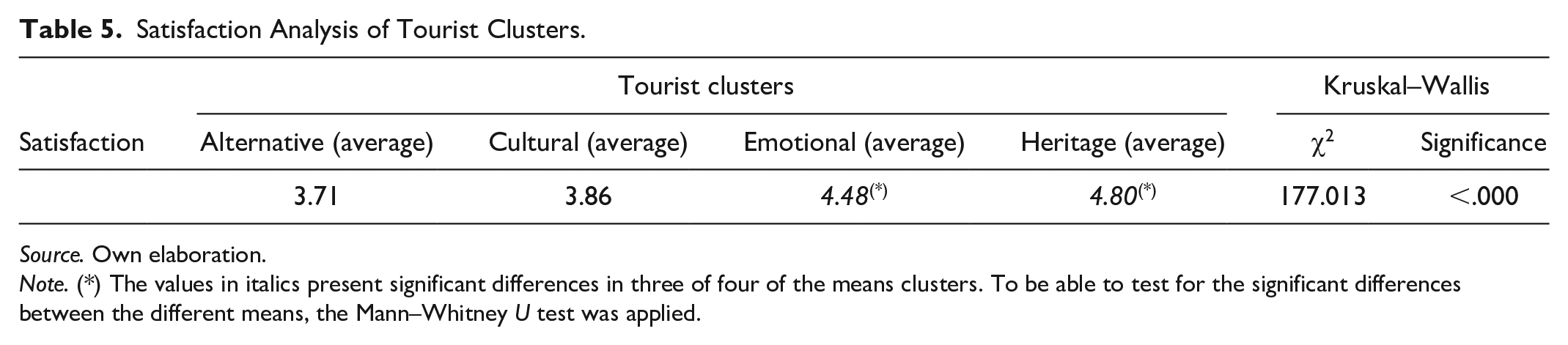
For the degree of satisfaction, respondents indicate a high mean on a Likert-type scale of five points, specifically 4.35. The results indicate that 52.9% the respondents were completely satisfied, and 33.4% were satisfied. Regarding the different segments, heritage tourists show the most satisfaction (81.4% were completely satisfied). On the contrary, the percentage of dissatisfied tourists was only 0.8%.
The analysis of the relationship between motivations for visiting a tourist destination and satisfaction is key to establish an appropriate tourist strategy. It is essential to identify which motives influence the satisfaction when the tourists participate in the Fiesta of the Patios. Results shown in Table 4 indicate that cultural reasons significantly affect the satisfaction.
Motivational Dimensions and Satisfaction of the Visit.

Source. Own elaboration.
Note. (**) The correlation is significant at the .01 level (bilateral).
Although the correlation values are not very high, it can be confirmed that the greater the presence of cultural motivations, the greater the satisfaction perceived by the visitor.
In line with the literature (Cronin et al., 2000; López-Guzmán, Gálvez et al., 2019; Romao et al., 2015; Yuksel et al., 2009), the results support H4a (Table 5).
Satisfaction Analysis of Tourist Clusters.
Source. Own elaboration.
Note. (*) The values in italics present significant differences in three of four of the means clusters. To be able to test for the significant differences between the different means, the Mann–Whitney U test was applied.
Discussion
Currently, not only are cultural assets characterized by their material heritage, but also include a great variety of manifestations and popular traditions that have been established in the collective memory of the people. This type of heritage is currently the result of economic valuation by the tourism sector, where the trade in heritage-related products is paying attention to the ICH. In this way, a new typology of heritage tourism is emerging characterized by its desire to discover the history and culture of the place visited through its traditions, such as celebrations and festivities, representations, ancestral knowledge.
Throughout the literature, researchers have studied the segmentation of the tourists of various heritage sites through the theory of cultural tourism. They have mainly focused on heritage sites and little attention has been paid to ICH. Our research on ICH offers findings that are of great relevance.
To discover the emotional perceptions of the tourists who participate in an event considered as an ICH and, specifically, to improve the tourist experience in general, this study offers a segmentation of tourists who participate in such events. The relevance of this finding lies in whether the institutions, both private and public, can adapt to the characteristics of tourists. It must be remembered that this is important, as with the inscription of the Fiesta of the Patios as an ICH, the city of Córdoba, which is, additionally, a WHS in itself, increases its tourist offer. As such, knowing its visitors better will help to satisfy their needs in a better way and, thus, this destination will be able to attract more tourists or even increase their loyalty to the city.
On the contrary, this study tried to test the findings of Poria et al. (2003) and McKercher (2002). The model used here, as has been previously indicated, is an adaptation of both their models in the context of an event of intangible heritage. Thus, on the basis of higher or lower cultural motivation and higher or lower emotional link of the tourists in relation to the heritage visited, the segmentation is applied. The classification of the visitors of tourist destinations declared as a WHS or ICH into different segments has been applied to previous research (e.g., Chen & Huang, 2018; McKercher, 2002; Poria et al., 2003; Silberberg, 1995).
In this research, like previous studies, it has been observed that tourists show different behaviors, such as the motivation when deciding to visit a place, regarding a heritage site, whether tangible or intangible. Similarly, a large part of the literature indicates that when tourists are segmented, one of the segments shows a great interest in the heritage, whereas there is another segment which has little interest in it. This clusters of tourists who present a higher interest in the heritage of the destination are given different names: greatly cultural tourists (Silberberg, 1995), absorptive tourists (Ramires et al., 2018), and, in this study, heritage tourists, or those tourists who visit a tourist destination because it is part of their heritage (Poria et al., 2006). In this research, a cluster has been detected which is called here “alternative tourist” and is identified by its little emotional link and cultural interest in the ICH they visit. In previous studies also this cluster type was detected and was called accidental cultural tourists (Silberberg, 1995) or casual tourists (McKercher & du Cros, 2003).
In this research, the methodology of Poria et al. (2003) was used, which analyzes the importance of the emotional perception of tourists, and a higher emotional perception of two visiting groups—emotional tourists and heritage tourists—in the city of Córdoba during the celebration of the Fiesta of the Patios in 2017 was studied. Based on the findings, it can be stated that the model by Poria et al. (2003) of the emotional perception of the tourists may be applied to a heritage site as well as to an ICH. This model is used in scientific literature. For example, Cruz et al. (2020) in an intangible heritage setting: the Holy Week processions in the city of Popayán (Colombia); López-Guzmán, Gálvez et al. (2019) in a WHS: the city of Lima (Peru); Pérez-Gálvez et al. (2019) in an Intangible Cultural Heritage of Humanity (ICH) Events: the Oruro Carnival (Bolivia).
On the contrary, with this study, we can say that the motives for a tourist in deciding to travel to an ICH destination are heterogeneous (Cruz et al., 2020; Pérez-Gálvez et al., 2019). These reasons have been classified into three dimensions: hedonic, cultural, and convenience. Previous research has determined the existence of different motivational dimensions while places with heritage inscriptions are visited (Almeida-Santana & Moreno-Gil, 2018; Nguyen & Cheung, 2014; Vareiro et al., 2016). The results are coherent with Poria et al. (2006) and Shi et al. (2019), whose research determines that the visitors in a heritage destination are not solely interested in cultural motivations but for other reasons as well.
In terms of satisfaction, this research presents findings which are consonant with previous studies (Cronin et al., 2000; Romao et al., 2015; Yuksel et al., 2009), in the way that the greater the emotional experience linked to the tangible or intangible heritage visited, the greater the level of tourist satisfaction. Recent research determines that the appropriate management of historic cities allows for the transfer of their cultural and heritage values to their visitors. The transfer of values contributes to greater satisfaction with the tourist experience (Dastgerdi & De Luca, 2019a). In any case, the organizers of the Fiesta of the Patios should pay attention to the possible lack of coherence between the brand personality being communicated and the one perceived (Masiello et al., 2020). The brand personality contributes to making an intangible phenomenon more tangible for the visitors of cultural events.
Conclusion
The recognition by UNESCO of a specific tradition, festivity, celebration, and so on, as an ICH is a determining factor in increasing tourist attraction and promotion of the registered event, as well as placing it in the international tourist market. However, all of this does not overlook the cultural heritage as of a people and, most of all, the need for its preservation and safekeeping. In any case, the tourist potential of heritage events, such as the Fiesta of the Patios, reinforces the need to conduct research that characterizes tourists who come to discover them, determining their motivation and satisfaction as well as the perception they have of their participation. With this, it is possible to improve the quality of the tourist offer related to such an ICH and, at the same time, increase its necessary sustainability.
For the research, a segmentation of the tourists was conducted on the basis of two widely used models in researching heritage tourism (Poria et al., 2003; McKercher, 2002). It is one of the first studies to use both models in unison and, additionally, for an intangible world heritage, which reinforces its innovative nature. In the study, four clusters of visitors of the Fiesta of the Patios were detected: alternative tourist, cultural tourist, emotional tourist, and heritage tourist. The heritage tourist stands out due to the challenge to show a greater emotional link and cultural interest in the cultural heritage visited.
The motives for which visitors attend this ICH event are grouped into three different categories: hedonic, cultural, and convenience. In relation to the tourist satisfaction level, this research allows for the contrast of the hypothesis: the degree of satisfaction because of the visit to the Fiesta of the Patios is conditioned to the higher or lower degree of emotional link derived from its visit.
This research did not only intend to advance the theoretical knowledge derived from the relationship between tourism and heritage but it also looked to provide a series of practical applications for the appropriate sufficient and sustainable management of this ICH. Thus, using better knowledge of tourist segments, of its emotional perception, motivation, and satisfaction, a better adaptation of the tourist offers to what visitors really demand is possible. This allows to generate loyalty in the tourists and potentiates the economic development of the local community, which hosts this event. In any case, the sustainability of an ICH should be the first consideration, as in this way the essence of what makes it unique for a heritage tourist is not lost. Accordingly, the promotional marketing strategies should worry about the creation of an attractive image for the destination which will place it among the main options in the decision of potential visitors (Dastgerdi & De Luca, 2018a; Martins, 2015).
In fact, this uniqueness is found in the floral decoration of an ephemeral nature and the sustainable use of natural resources. They deal with two aspects that need to be considered when it comes to being a courtyard that participates in the festival. In a society where consumerism continues to grow, celebrating a festival that revolves around respect for the environment and the responsible use of resources is fundamental as an example for newer generations, showing that it is possible to perform sustainable activities. Another of the practical implications that is found is the problem of clustering. Because of this, the analysis carried out is of great interest in attracting the segment that most interests the organizers of the event and finding a sustainable impact, following a lower level of mass tourism and, therefore, enabling the preservation of their identity.
The efficient medium- and long-term management of the destinations in which they develop ICH-recognized events and, additionally, come from emblematic cultural and historic environments (such as Córdoba), requires the obligation to go beyond simple tourist guidance, conceiving a new paradigm of economic and social sustainability for the visitors and the community itself. The excessive increase of pressure on the destination, something that is particularly applicable to cities with historic centers recognized by UNESCO, may cause their environmental, economic, and social structure to become unsustainable (Dastgerdi & De Luca, 2019b).
The main limits of this research are the lack of reliable official information regarding the profile of the visitors to this ICH as well as the short period of time during which it is celebrated. Also, as a future line of research, it is recommended that a study regarding city branding from the view of the local community and the visitors, whether domestic visitors or international tourists ones, is developed. With the involvement of these interest groups, a rewarding and constructive image and vision of the city of Córdoba would be provided, which would be key for the development of efficient policies for tourist planning.
Supplemental Material
sj-pdf-1-sgo-10.1177_2158244021994813 – Supplemental material for Segmentation of Tourists That Participate in a Cultural Event: The Fiesta of the Patios in Córdoba (Spain)
Supplemental material, sj-pdf-1-sgo-10.1177_2158244021994813 for Segmentation of Tourists That Participate in a Cultural Event: The Fiesta of the Patios in Córdoba (Spain) by Jaime Daniel Roldán Nogueras, Gema Gomez-Casero, Jesús Claudio Pérez Gálvez and Francisco González Santa Cruz in SAGE Open
Footnotes
Declaration of Conflicting Interests
The author(s) declared no potential conflicts of interest with respect to the research, authorship, and/or publication of this article.
Funding
The author(s) received no financial support for the research, authorship, and/or publication of this article.

Supplemental Material
Supplemental material for this article is available online.
References
Supplementary Material
Please find the following supplemental material available below.
For Open Access articles published under a Creative Commons License, all supplemental material carries the same license as the article it is associated with.
For non-Open Access articles published, all supplemental material carries a non-exclusive license, and permission requests for re-use of supplemental material or any part of supplemental material shall be sent directly to the copyright owner as specified in the copyright notice associated with the article.
