




Abstract
This study discusses the concepts of “the fear of missing out at work (W-FoMO)” and “smartphone use after work (SUW),” which shed light on the dark side of technology. The study attempts to determine whether W-FoMO affects psychological well-being (PWB) through SUW and “work-family conflict (WFC).” Hypotheses regarding the direct effects as well as the simple-mediation and serial-mediation roles were created with reference to the Conservation of Resources Theory (COR). Data were obtained from 287 female employees working in different sectors in Turkey. The analyses were carried out using the SPSS, AMOS, and Process MACRO software. The findings revealed that W-FoMO has a positive effect on PWB through SUW. The findings also indicate that W-FoMO has a negative indirect effect on PWB through WFC. Moreover, SUW and WFC had a serial mediation role in W-FoMO’s effect on PWB. Therefore, keeping smartphone use after work (SUW) at a reasonable level for female employees with W-FoMO may increase their well-being (PWB), but smartphone use after work at a level that would lead to WFC may decrease PWB. The study discusses the findings and makes theoretical/practical inferences about W-FoMO and its outcomes.
Keywords
Introduction
The development of information and communication technologies has not only made working life easier, but also brought along several undesirable negative outcomes for organizations and employees. This collection of negative phenomena that can potentially reduce employee well-being is referred to as the “dark side of technology” (Tarafdar & Stich, 2018). This dark side affects individuals in daily life as well as employees in work life to a great extent. The most prominent cognitive and emotional outcomes of the dark side of technology in employees are stress, work-family conflict, burnout, low job satisfaction, and low well-being (Marsh et al., 2022).
One such phenomenon pertaining to the dark side is “Fear of Missing Out (FoMO)” (Marsh et al., 2022). FoMO (Przybylski et al., 2013), defined as the fear of missing the rewarding experiences that others have, has attracted a lot of attention from researchers. Many studies conducted on young people and adolescents in particular have determined that there is a strong relationship between FoMO and well-being (Gupta & Sharma, 2021; Tandon et al., 2021). Although it is a common and current phenomenon, there is limited knowledge on the effects of FoMO in the workplace (Fridchay & Reizer, 2022). The results of a small number of studies conducted on General FoMO have revealed that the phenomenon may be suitable for the workplace and has the potential to affect employee attitudes and behaviors (Hoşgör et al., 2020; Rozgonjuk et al., 2020). Finally, FoMO was conceptualized as workplace FoMO (W-FoMO) from a workplace perspective and defined as “a widespread concern that one may miss out on valuable career opportunities while away or disconnected from work” (Budnick et al., 2020, p. 2). On the other hand, studies on the phenomenon (e.g., Budnick et al., 2020) have suggested that it is associated with work-related psychological (burnout) and behavioral (social media participation) outcomes. However, it has been observed that there is still uncertainty about what the effects of FoMO are in the workplace and how it is related to the various consequences of the dark side of technology. Therefore, this study focused on this concept and examined its outcomes. Therefore, it was tried to determine whether W-FoMO effects the psychological well-being of the employee and through which variables this effect is realized.
Since FoMO is characterized by a constant desire to stay connected, employees who experience W-FoMO feel compelled to be constantly informed about developments in the workplace (Elhai et al., 2018). This can lead to smartphones being used for this purpose, which is one of the ways to stay in touch with the workplace after work. However, the use of smartphones for work-related purposes after work (SUW) can prevent employees from distancing themselves from work, resting, and recovering their energy (Derks et al., 2014; Schlachter et al., 2018). It also makes it difficult for employees to devote enough time to family roles as it causes them to devote the time, they need for themselves and their families to their work, leading to work-family conflict (WFC; Santuzzi & Barber, 2018). For these reasons, the study presumed that W-FoMO could effect employee psychological well-being (PWB) through SUW and WFC, creating the research model accordingly. Therefore, in this study, the question “Through which variables and how does W-FoMO effect PWB?” was tried to be answered.
The current study predicts that W-FoMO will increase SUW, which will increase WFC, ultimately leading to a decrease in PWB. This study is expected to contribute to the literature in several ways. First of all, the current research focused on how FoMO emerges in work environments (W-FoMO) beyond the studies in the literature that generally focus on general social media use among younger individuals, and responded to calls for more studies on the concept (Budnick et al., 2020). Secondly, the research addressed the issues of technology use (SUW) and well-being (PWB), which are the most common outcome variables of FoMO research (Tandon et al., 2021), with the W-FoMO variable, which is seen as a gap in the literature and emerges with the reflection of technology on work life. In this context, investigating the effect of W-FoMO on SUW and PWB, it provided new information on how contemporary workplace dynamics affect employee health. By examining SUW as a mediating variable, the research also emphasized the potential effects of modern communication technologies on the employee. Additionally, the research added the concept of WFC to these variables and attempted to determine the relationships between them, especially among female employees. Therefore, it was aimed to expand the theoretical framework of W-FoMO, which is a relatively new concept in organizational psychology, on workplace stressors (such as WFC) and their psychological effects (such as PWB) specifically on female employees.
There are several reasons why especially female employees were taken into consideration in the research and data were obtained from female employees. Compared to males, females are more socially oriented and have more social relationship needs (Y. K. Lee et al., 2014). Females have higher levels of FoMO than males (Beyens et al., 2016; Elhai et al., 2018; Stead & Bibby, 2017), as FoMO indicates an outcome of an unmet need for social relationships (Przybylski et al., 2013). Females are also more likely to use smartphones for social purposes (Elhai et al., 2018; van Deursen et al., 2015). Therefore, both FoMO (ultimately W-FoMO) and smartphone use after work (i.e., SUW) are more common among female employees than male employees. On the other hand, gender is also decisive in terms of WFC, which is another concept discussed in the study (A. Adams & Golsch, 2022). Although similarities emerged in female and male roles after females joined the labor market (Ghislieri et al., 2017), females continued to be seen as the party with primary responsibility in childcare and domestic responsibilities (Bowen et al., 2018; Copur et al., 2010). Therefore, females tended to fulfill both their roles at work and their primary roles at home, and with the prevalence of their roles at work, their WFC was higher than males. On the other hand, in the research, there is the effect of culture on the preference of female employees. People are more likely to experience FoMO in collectivist cultures where interdependent self-construal is more dominant (Dogan, 2019). Additionally, in Eastern cultures with high power distance and more severe sexist characteristics, there are more responsibilities imposed on females within the family (Aycan, 2008). Therefore, the fact that the effect of these variables is more pronounced in female employees in Turkey, which represents a culture where the power distance is high and the collectivist aspect is predominant (Hofstede, 1983), has presented an opportunity to obtain more significant results.
In addition to the above, although some recent studies have addressed FoMO’s relationship with well-being (Roberts & David, 2020) and smartphone use (Elhai, Yang, Rozgonjuk, & Montag, 2020; Wolniewicz et al., 2020), these variables discussed in this study have not been examined together in any other. Unlike the literature, this study evaluated W-FoMO, SUW, WFC and PWB together, thus providing insight into whether W-FoMO is a variable that directly or indirectly affects employees. In today’s world where digital communication and remote work are widespread, it is very important to understand how W-FoMO affects employees. Because, employees increasingly feel the pressure to stay connected outside of work hours, which increases stress and reduces general well-being (Dettmers, 2017). In such an environment, determining the consequences of W-FoMO in organizations will provide useful information for creating healthier work environments. In this study, this information was provided, and thus, a more holistic perspective was obtained by addressing the dark side effects (W-FoMO and SUW) and negative consequences of technology (WFC and low PWB), which is seen as a deficiency in the literature, together.
The final contribution of the research was to the literature on well-being (PWB). PWB is an important source of concern for organizations (Rosado-Solomon et al., 2023) and has come to the fore, particularly with the development of positive psychology (Rodríguez-Muñoz & Sanz-Vergel, 2013). Determining the variables affecting other well-being indicators, including PWB, is important in terms of organizational life as well as private life. Because, according to the spillover effect, well-being at work can greatly affect well-being in private life (or vice versa; Heller et al., 2002). For this reason, in this study, the variables (i.e., W-FoMO and SUW) affecting well-being (and therefore PWB) and becoming more common in business life with technology were examined. In this context, the relationship between W-FoMO and PWB, which is not found in any research in the literature, was addressed for the first time in this study together with SUW and WFC. Therefore, the research contributed both by expanding what is known about the dark side of technology and by showing what should be done to alleviate the negative consequences of the dark side on organizations and employees.
Literature Review
The Fear of Missing Out (FoMO) at Work (W-FoMO)
The Fear of Missing Out (FoMO) is a common concern that others will benefit from social and satisfying experiences in one’s absence, leading to a need to constantly stay in contact with others based on this concern (Przybylski et al., 2013). FoMO contains two key components: cognitive and behavioral. While the cognitive aspect is related to the fear of missing something, the behavioral aspect refers to the steady desire to maintain social connections (Elhai, Yang, & Montag, 2020).
Previous research has shown that FoMO is associated with a variety of psychological and behavioral outcomes. The experience of FoMO is linked to different psychopathological symptoms such as stress, anxiety, depression (Baker et al., 2016; Elhai, Gallinari, Rozgonjuk, & Yang, 2020; Tsai et al., 2019), and sleep disorders (S. K. Adams et al., 2017; Scott & Woods, 2018). High FoMO negatively affects well-being by increasing negative emotions and decreasing life satisfaction (Błachnio & Przepiórka, 2018; Chai et al., 2019; Milyavskaya et al., 2018). Excessive smartphone and social media use, as well as alcohol use (Elhai, Yang, Rozgonjuk, & Montag, 2020; Franchina et al., 2018; Riordan et al., 2015) are also associated with different negative behavioral outcomes that can be addictive. Although it is perceived as an experience at the individual level, outcomes such as distraction (Riordan et al., 2020), loss of academic motivation (Alt, 2015), and fake news sharing (Talwar et al., 2020) suggest that the effects of FoMO are a social public health problem that exceeds individual boundaries (Scott & Woods, 2018; Tandon et al., 2021).
Although there has been a steady increase in research on FoMO, which has recently received considerable attention from scientists, most studies have focused on students and adolescents. There are limited studies on FoMO’s effects on the workplace and employees (e.g., Fridchay & Reizer, 2022; Tandon et al., 2021). Its prevalence and effectiveness in social life indicate that FoMO may have a similar effect in the workplace and that the concept should be further investigated in the organizational context. Studies conducted on employees based on general FoMO also support this claim (e.g., Hoşgör et al., 2020). For this reason, the study conceptualizes FoMO as the “fear of missing out at work or workplace FoMO (W-FoMO)” in order to better understand the mechanisms through which FoMO affects working individuals. Budnick et al. (2020) defined W-FoMO as an individual’s concern that they may miss valuable career opportunities while away from their job.
It can be said that W-FoMO has two interrelated components. The first is relational exclusion, which refers to employee concerns that their work relationships will be damaged. This concern arises because a wider network of relationships in work life allows for more career opportunities. The second component is knowledge exclusion, which refers to the fear of falling out of the knowledge loop in the workplace (Budnick et al., 2020). Because knowledge is a valuable resource for success in the workplace. Employees being distanced from relationships and knowledge has a significant effect on their well-being and success in work life (Yeboah, 2023). A limited number of studies (Budnick et al., 2020) suggest that workplace FoMO overlaps with similar concepts such as general FoMO and telepressure but is different from these structures. Studies indicate that workplace FoMO affects employee health and motivation and is associated with organizational outcomes such as job burnout and learning motivation (Budnick et al., 2020; Reinders, 2022).
The Relationship Between W-FoMO and Psychological Well-Being (PWB)
Psychological well-being (PWB) refers to success with a number of existential phenomena that include progressing toward goals, striving to develop, and being in quality relationships with others (Keyes et al., 2002). Since it provides the opportunity to use the individual’s existing potential effectively and in the best manner (Ryff & Singer, 2006), PWB leads to positive outcomes in both work life and personal life. High levels of PWB increase employee health, happiness, work performance, and passion while reducing stress levels (Akbolat et al., 2022; Kundi et al., 2021; Robertson et al., 2012).
One of the most popular frameworks used to understand and explain the impact of different factors on employee well-being is Hobfoll’s (2001) Conservation of Resources Theory (COR). COR suggests that individuals act to obtain, retain, and conserve resources that they deem valuable (Hobfoll, 2001). The value of these resources, which are categorized as objects, conditions, energy, and personal characteristics, varies by individual. Stress that occurs when resources are depleted leads to negative psychological outcomes. Resources have two important effects, which are the loss spiral and the gain spiral. According to the COR theory, those without resources are more vulnerable to resource loss, and the first loss entails future ones. Those who have resources are more skilled at gaining resources, and the first resource gain entails more gains. However, since loss is stronger than gain, the loss spiral occurs faster than the gain spiral (Hobfoll, 2001).
According to the COR theory, W-FoMO, a stress factor that requires effort to stay in touch with work all the time, can be seen as a loss of resources. Because W-FoMO consumes individuals’ limited resources such as time and energy, it can lead to feelings of tension and stress and reduce PWB, which is an important personal resource (Halbesleben et al., 2014). W-FoMO, which constantly directs employees to mentally make an effort for work when they need to rest, can prevent personal recovery (recovery, rest) after work by increasing the workload. Since W-FoMO implies concern by definition, it is not surprising that it leads to low well-being (Tanrikulu & Mouratidis, 2022). There are studies that examine FoMO’s relationship with different indicators of well-being such as mood, negative affection, depression, and life satisfaction (e.g., Błachnio & Przepiórka, 2018; Elhai, Rozgonjuk, Liu, & Yang, 2020; Przybylski et al., 2013) in non-work contexts. Additionally, Roberts and David (2020) suggested negative relationships between general FoMO and PWB, while Budnick et al. (2020) suggested negative relationships between W-FoMO and workplace well-being (job burnout). The following hypothesis can be developed based on these theoretical and empirical findings:
The Mediating Role of Smartphone Use After Work (SUW)
Rapid developments in information and communication technologies (the prevalence of smartphones) have changed the nature of work as well as the lives of employees outside of work. Apart from just making calls, smartphones have provided easier access to information and faster connection with others thanks to embedded applications (Derks & Bakker, 2014, p. 417). Thanks to the way they facilitate working at any time and place, they have enabled employees to work more flexibly and increased their productivity (Xie et al., 2018). Their functional features and convenience have popularized smartphone use after work. Today, many employees use their smartphones to continue their work and stay connected after official working hours (Derks & Bakker, 2014). Due to these developments, researchers have become increasingly interested in understanding the precursors and outcomes of SUW, which has become an integral part of modern work life (Zhang et al., 2023). However, studies have focused mainly on the outcomes of SUW (e.g., F. Cheung, 2022; Hu et al., 2022; J. C. Park et al., 2020), while research on its antecedents and mediating role is still limited (Y. L. F. Cheung et al., 2022).
In this study, it was thought that W-FoMO may affect PWB through SUW (mediator). FoMO is characterized by a drive to constantly stay connected (Przybylski et al., 2013). In W-FoMO, employees feel a need to be informed of work-related developments at any time and turn to SUW when they think that they need to maintain their work-related connections after work. From this perspective, W-FoMO can become the driving force behind SUW behavior due to a strong urge to stay connected. This effect may be stronger in female employees, who have higher social needs (Y. K. Lee et al., 2014). Coherent evidence on the close relationship between FoMO and smartphone use in non-business contexts (e.g., O’Brien et al., 2022; Servidio et al., 2021) supports that the relationship in question is logical. Therefore, W-FoMO is likely to increase work-related smartphone use outside working hours, which reduces an employee’s energy resources (Derks et al., 2014).
According to the effort compensation model (Meijman & Mulder, 1998), an employee needs to regularly renew and improve the energy resources they consume in order to cope with work demands and stress. The basic condition for a full recovery is to psychologically move away from work-related tasks or activities (Sonnentag et al., 2022). Inability to stay away from work psychologically inhibits the healing process and therefore the well-being of employees, creating a constant preoccupation with work-related problems (Büchler et al., 2020). Employees continue to be psychologically engaged in work due to smartphones, making psychological distancing even more difficult by bringing work-related stress factors to off-work hours (e.g., Derks et al., 2014; Kondrysova et al., 2022). SUW prevents individuals from moving away from work, depletes personal psychological resources, and reduces well-being (and therefore PWB) by preventing resources from being recovered after working hours (Zhang et al., 2023). Therefore, based on COR theory, it is likely that W-FoMO increases SUW (see Tandon et al., 2021) and SUW decreases the PWB of female employees because it leads to the expenditure of individual resources (e.g., time, and emotional resources) on continuous work-related activities and prevents the acquisition of new resources. In other words, it is possible that SUW mediates the relationship between W-FoMO and PWB. A study supporting this prediction (Gugushvili et al., 2020) has revealed that smartphone use can mediate the relationship between FoMO and emotional well-being. Therefore, it was predicted that W-FoMO may have a negative indirect effect on the PWB of female employees through SUW. Therefore, it was possible to develop the following hypothesis:
The Mediating Role of Work-Family Conflict (WFC)
Work-family conflict (WFC) refers to an individual’s demands from work preventing them from fulfilling their family responsibilities and expectations, and ultimately to a conflict between work and family roles (Greenhaus & Parasuraman, 1987). WFC typically results from one habitat stepping over the boundaries of another and competing time demands (Greenhaus & Beutell, 1985). WFC is an important variable in work life as well as in private life because it is associated with negative individual and organizational outcomes such as lower job satisfaction and psychological well-being, higher absenteeism and turnover intention, emotional exhaustion, loss of productivity, and deterioration in health (Bowen et al., 2018; Colombo & Ghislieri, 2011; Sirgy & Lee, 2018; Westrupp et al., 2016). It is thought that WFC, which has these results, may mediate the relationship between W-FoMO and PWB in this study.
Due to employees having limited resources (e.g., time, attention, and energy) to devote to work and non-work demands, high participation in work demands (meeting demands) requires a sacrifice of domestic aspects (Grawitch et al., 2010). FoMO makes people feel obliged to stay in touch with others and constantly be informed about their activities (Przybylski et al., 2013). For this reason, employees who experience W-FoMO have a constant desire to be in contact with work (Budnick et al., 2020). Making compromises from the time and attention they would normally spend for their families’ makes it difficult for them to fulfill their family roles satisfactorily. It results in spending resources on work tasks, leading to less time and energy being devoted to non-work-related goals (e.g., family, hobbies, and social goals). Therefore, employees’ inability to allocate resources correctly to meet the competing demands of work and family life leads to work-family conflict (Grawitch et al., 2010). Although there are no studies investigating this relationship (W-FoMO and WFC) in the literature, researchers have suggested that telepressure, which is a similar concept in that it requires constant contact with work after working hours, disrupts work-life balance (Barber et al., 2019; Y. Park et al., 2018).
WFC is a negative condition that threatens the mental resources of the individual, creates psychological tension and leads to a decrease in well-being (Matthews et al., 2014). This relationship between WFC and PWB can be explained within the context of COR theory. If an individual consumes a lot of resources in one area and does not have the opportunity to replenish them, this will likely be reflected in other areas and hurt the individual. WFC evokes a loss of resources (e.g., energy and time) with negative effects on well-being, resulting in the depletion of resources to face the next threat or loss. This situation leads to stress and threatens PWB (Neto et al., 2016). Empirical findings have proven WFC’s association with different indicators of well-being, such as depression, anxiety, and psychological tension, as well as higher levels of fatigue and lower sleep quality (e.g., French et al., 2018; Miller et al., 2022). Numerous studies specifically reveal WFC’s negative effect on PWB (e.g., Neto et al., 2016; Obrenovic et al., 2020).
To summarize the above explanations in the context of COR theory; within the scope of W-FoMO, even if the employee is out of work, his/her mind is constantly occupied with work and a resource loss occurs (Halbesleben et al., 2014). This loss prevents him/her from properly fulfilling his/her roles toward his/her family (WFC) and the loss of resources (such as energy and time) continues (Neto et al., 2016). Accordingly, with the increase in resource losses, the employee’s PWB decreases (Obrenovic et al., 2020). Therefore, W-FoMO affects PWB through WFC. Although there is no study in the literature on this subject, it has been observed that WFC mediates the relationship between PWB and similar concepts such as telepressure and technostress that technology has brought to work life (e.g., Page et al., 2021; Riglea et al., 2021). For these reasons, it was thought that WFC may play a mediating role in the relationship between W-FoMO and PWB, and the following hypothesis was developed:
The Series Mediation Role of SUW and WFC
In the study, SUW and WFC were not considered as simple mediators on the path from W-FoMO to PWB, but it was thought that there might be a serially mediated situation. SUW not only mediates the relationship between W-FoMO and PWB, but may also do so through WFC (e.g., Baumeister et al., 2021; Derks & Bakker, 2014; Schieman & Young, 2013). This relationship can also be explained within the context of COR’s loss spiral. People try to protect themselves from resource loss, but each loss facilitates a new loss, one loss follows another, and the individual falls into a spiral of loss that gradually consumes their resources (Hobfoll, 2001). This spiral of loss occurs as follows in the present study: W-FoMO creates a loss of resources that consumes employees’ energies by creating anxiety about being constantly connected to the work. Employees with high W-FoMO levels turn more to SUW to compensate for loss (e.g., social networks, knowledge). SUW, which blurs the temporal, physical and psychological boundaries between work and home spheres (J. C. Park et al., 2020), reduces employees’ resources necessary for their family roles, as it prevents employees from devoting the necessary time to their roles at home, thus causing WFC, which is a loss (Derks et al., 2015, 2016; Gadeyne et al., 2018). This prevents the employee’s recovery and reduces their PWB by creating psychological tension and stress. Considering that declines in well-being are linked to increases in FoMO (e.g., Oberst et al., 2017; Przybylski et al., 2013), this vicious circle is likely to continue. In summary, employees turning to SUW due to W-FoMO leads to WFC and reduces PWB. In this respect, it would be logical to develop the following hypothesis.
In line with these explanations and hypotheses, the research model in Figure 1 was created.

The research model. H2= W-FoMO -> SUW -> PWB. H3= W-FoMO -> WFC-> PWB. H4= W-FoMO -> SUW -> WFC -> PWB.
Method
Sample and Procedure
The research sample consisted of female employees working in different sectors. The reason for the sample consisting of female employees is that the variables used in the study would yield more significant results with such a sample. Because females’ FoMO levels and likelihood of using smartphones (i.e., SUW) are higher than those of males (Beyens et al., 2016; Elhai et al., 2018; van Deursen et al., 2015). On the other hand, since childcare and domestic responsibilities are primarily the responsibility of females (Bowen et al., 2018; Copur et al., 2010), they have higher WFC levels than males. For this reason, the participants were selected from female employees in a province of Turkey by convenience sampling method.
Since the representativeness of the target group is weak in the convenience sampling method, sample estimates may not reflect the actual effects in the target group. This method has limitations such as low generalizability of the results and weak power to detect differences between sociodemographic subgroups (Bornstein et al., 2013; Jager et al., 2017). However, it is still one of the most widely used methods in social science research for reasons such as allowing the examination of hard-to-reach populations, requiring less effort and expertise, saving time and providing low-cost advantages (Bornstein et al., 2013; Jeong et al., 2019; Penn et al., 2023). These reasons were also effective in this study. The questionnaires were sent to the identified female participants online in the Turkish language. The surveys included a disclaimer stating that participation was voluntary, and the data obtained from 287 female employees were fit for evaluation. 51.6% of these participants were unmarried and 57.1% worked in the public sector. In terms of education level, the majority of participants had a bachelor’s degree (51.6%) and only a tiny minority had a primary school level of education (4.9%). Most of the employees were between the ages of 26 to 35 (49.5%) with 1 to 3 years (25.4%) of work experience.
Measures
Findings
A normality test was performed for the data before performing the basic analyses. This test examined the Skewness and Kurtosis values. These values being between −2 and +2 indicates that there is a normal distribution (George & Mallery, 2016). The analysis findings revealed that the Skewness and Kurtosis values for W-FoMO (Skewness = −.446; Kurtosis = .116), SUW (Skewness = −.251; Kurtosis = −.409), WFC (Skewness = .110; Skewness = −.607) and PWB (Skewness = −.398; Kurtosis = .662) were between the reference values, ensuring normality. Other analyses made are presented below.
Findings on Scale Reliability and Validity
Reliability and validity analyses were carried out on the W-FoMO, SUW, WFC, and PWB scales used in the study. Confirmatory factor analysis was performed on the scales for discriminant validity. This validity analysis required the item factor loadings to be .40 and above (Hair et al., 2017). The “CMIN/DF, CFI, IFI, RMR, RMSEA” values were taken into account for the model fit of the scales. Therefore, the study made use of the maximum likelihood estimation method and carried out confirmatory factor analyses using the Amos 18.0 package software. The item factor load of a W-FoMO scale item (When I have a good time, it is important for me to share the details online [e.g., status updates]) was removed from the analysis due to it being below the reference value. All other items in the scales provided the referenced item factor loading (see Table 1).
The Reliability and Validity Analysis Findings.
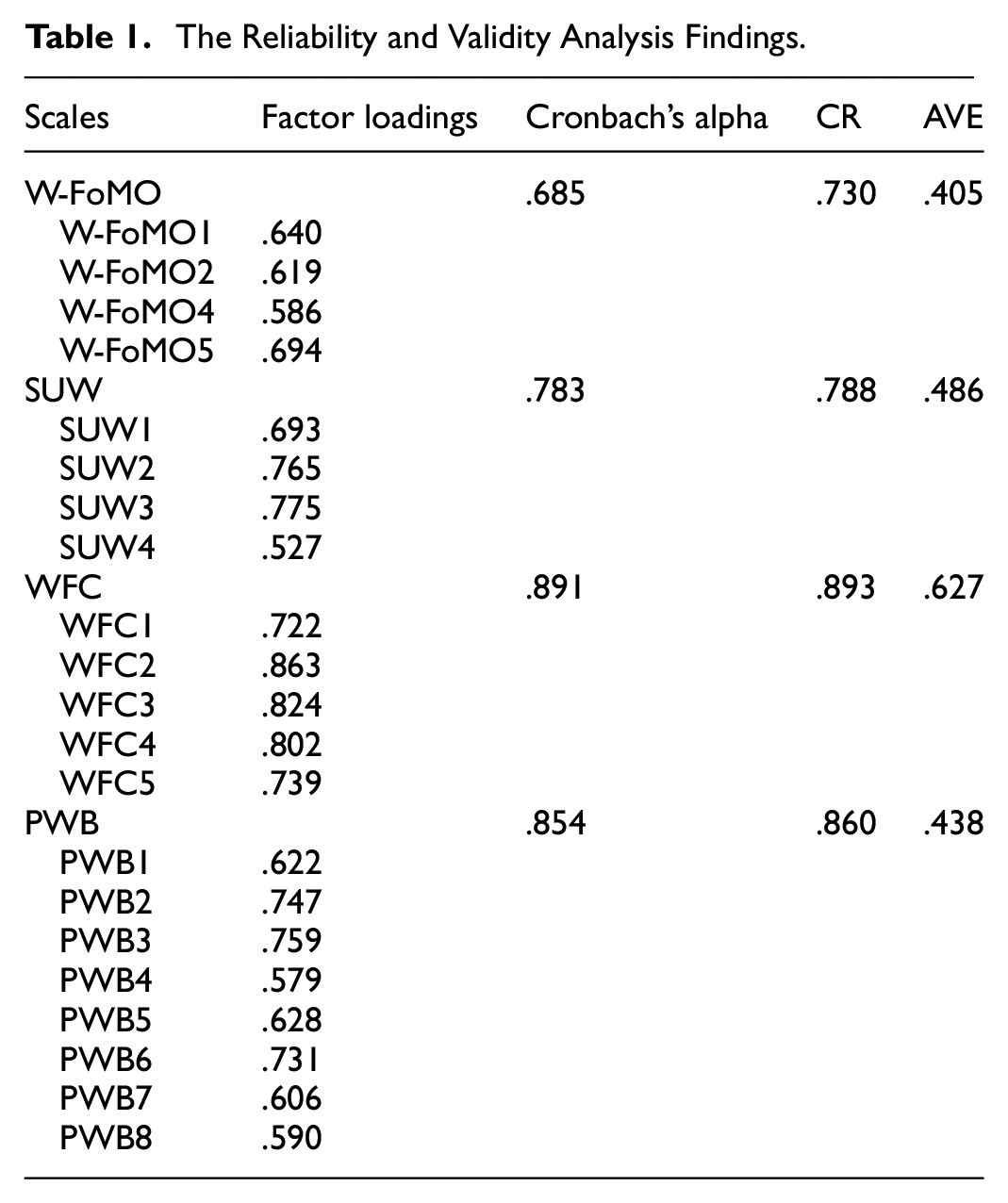
In the confirmatory factor analyses conducted in the research, model fit values were examined for “Research Model, Model 1, Model 2, Model 3, Model 4 and Model 5” respectively (see Table 2). The fit index values of the research model discussed in this study met the reference indices and had better index values than other models. The AVE (Average Variance Extracted) values of the scale were also examined for the convergent validity. Values above 0.40 were taken as reference for the AVE value (Fornell & Larcker, 1981; Tavares et al., 2019). The findings met the reference criteria (W-FoMO = .405, SUW = .486, WFC = .627, and PWB = .438), therefore meeting the conditions for validity (see Table 1).
Fit Indices of Measurement Models.

Note. n = 287; CMIN/DF = Relative Chi Square Index; CFI = Comparative Fit Index; IFI = Incremental Fit Index; RMR = Root Mean Square Residual; RMSEA = Root Mean Square Error of Approximation.
Three-factor model = W-FoMO and SUW combined into a single factor.
Three-factor model = W-FoMO and WFC combined into a single factor.
Three-factor model = SUW and WFC combined into a single factor.
Two-factor model = W-FoMO, SUW and PWB combined into a single factor.
All variables combined into a single factor.
The Cronbach Alpha and CR (Composite Reliability) values, which show internal consistency, were examined to determine the reliability of the scale. Values of .60 and above were taken as reference for these values (Hair et al., 2017), and the findings indicated that reliability was met (W-FoMO Cronbach alpha = .685, CR = .730; SUW Cronbach alpha = .783, CR = .788, WFC Cronbach alpha = .891, CR = .893 and PWB Cronbach alpha = .854, CR = .860; see Table 1).
In addition to the above reliability and validity analyses, it is also worth noting the findings regarding the Common Method Bias. Although different methods and tests are used regarding the common method bias, Harman’s single-factor test is among the most common (Podsakoff et al., 2003). All scale items underwent exploratory factor analysis, yielding a four-factor structure with eigenvalues greater than 1. Therefore, it was determined that the structure was not a single-factor one. On the other hand, the model fit index values of the single-factor structure did not meet the reference criteria in the confirmatory factor analysis (Table 2). The findings of both analyses indicated that there was no common method bias.
Inter-Variable Relationships
The study first determined the relationships between W-FoMO, SUW, WFC, and PWB with demographic variables. The correlation analysis findings regarding these relationships are presented in Table 3.
The Correlational Findings (n = 287).

p < .01. *p < .05.
The correlational findings regarding the variables indicated that there were positive relationships between W-FoMO and SUW (r = .484; p < .01), as well as W-FoMO and WFC (r = .244; p < .01). It was determined that there is a positive relationship between SUW and WFC (r = .255; p < .01) and between SUW and PWB (r = .176; p < .01). Examining the relationship between WFC and PWB revealed a negative relationship (r = −.190; p < .01). These significant relationships between the variables meant that hypothesis test analyses could be performed. The hypothesis tests were carried out using Hayes’ (2013) Model 6, which detects serial mediation, and the PROCESS Macro (for SPSS) software. The analysis involved a resampling number of 5,000 and a 95% confidence interval. The findings obtained for Model 6 are presented in Figure 2 and Table 4.

Hypotheses test results.
Serial Mediation Findings.

The findings in Figure 2 and Table 4 revealed that W-FoMO has no direct effect on PWB (b = 0.057; p = .276). H1 was therefore rejected. According to the findings, W-FoMO positively effects SUW (b = 0.560; p = .000) and WFC (b = 0.193; p = .016). While SUW’s effect on WFC (b = 0.189; p = .006) and PWB (b = 0.143; p = .002) was positive, WFC’s effect on PWB was negative (b = −0.169; p = .000).
In addition to the above direct effects, the findings revealed that W-FoMO effects PWB through SUW (indirect effect = 0.080; confidence interval [0.0319, 0.1357]). Therefore, SUW has a mediating role in W-FoMO’s effect on PWB. H2 was therefore accepted. The findings also revealed that W-FoMO effects PWB through WFC (indirect effect = −0.033; confidence interval [−0.0706, −0.0019]). H3 was therefore accepted. The findings regarding serial mediation indicate that W-FoMO has a serial effect on PWB through SUW and WFC (indirect effect = −0.018; confidence interval [−0.0371, −0.0031]). H4 was therefore supported. Therefore, W-FoMO increased SUW, which in turn increased WFC, and this increase in WFC led to a decrease in PWB.
The acceptance and rejection of the research hypotheses are summarized in Table 5.
The Status of Hypotheses.

Discussion
The present study has broadened our understanding of W-FoMO’s psychological and behavioral effects on employees. The study was conducted within the framework of COR theory on a sample of female employees from different sectors in Turkey, examining the direct and indirect effects of W-FoMO on SUW, WFC, and PWB. The study determined that W-FoMO does not have a direct effect on PWB, instead having separate and serial, that is, indirect effects on SUW and WFC. In other words, contrary to what was expected from the first finding, W-FoMO had no significant direct effect on PWB (H1). Although previous studies (Budnick et al., 2020) have suggested that W-FoMO is associated with workplace well-being, the present study revealed that the relationship between W-FoMO and PWB is not direct. This indicates that PWB contains a different and longer perspective than other well-being indicators (Kahneman et al., 1999).
Another finding was that W-FoMO affects SUW (H2), supporting the findings in the literature (e.g., Elhai, Yang, & Montag, 2020) and showing that female employees tend to use smartphones to maintain their connections with work outside of working hours. In addition, contrary to expectations, it was observed that SUW increased PWB (H5). This result can be attributed to the fact that smartphones provide convenience in meeting the social relationship needs of female employees, whose need for socialization is higher than male employees, and thus increase their PWB. Because, as stated by researchers, developing quality relationships with others is a sub-dimension of PWB (Keyes et al., 2002; Ryff & Singer, 2006). SUW’s effect on WFC (H4) was also in line with findings in the literature (Carlson et al., 2018; Derks et al., 2016; Leung & Zhang, 2017) as expected.
The findings obtained on WFC in the present study were in line with the expectations. The finding that W-FoMO increases WFC (H3) is quite important. Because the relationship between these variables had never been investigated before. However, this finding is in line with studies investigating the effect of technology’s similar side effects (e.g., technoinvasion) on WFC (Barber et al., 2019). Furthermore, the finding on the link between WFC and PWB (H6) is consistent with previous research suggesting that a higher degree of WFC would lead to a lower level of well-being (e.g., Neto et al., 2016). In line with the expectations, the findings of the mediation analyze indicated that SUW (H7) and WFC (H8) has a serial mediating role in the connection between W-FoMO and PWB, both separately and together (H9). The following theoretical and practical inferences were made based on the findings.
Theoretical Implications
The study’s findings have important theoretical implications for the effects of technology in work life and, in particular, the reflections of FoMO. Considering the prevalence of FoMO in daily life and the fact that adults devote a significant part of their lives to their work, it is important to reveal the effects of W-FoMO on employee well-being and family life. Budnick et al. (2020) showed W-FoMO’s relationship with workplace well-being and called for the relationship between W-FoMO and PWB to be investigated. The present study responded to this call by showing the mechanism behind the relationship between W-FoMO and PWB. Therefore, it clearly demonstrated FoMO’s reflections on work life and its effects on employees.
Previous studies have suggested that although FoMO is an intercultural phenomenon, it may have different effects in different countries (e.g., Dogan, 2019). Budnick et al. (2020) tested W-FoMO in American culture and called for research in different cultures. Because conducting research in different cultural structures with W-FoMO will deepen the understanding of the concept (Fridchay & Reizer, 2022). For this purpose, the present study was conducted on female employees in Turkey (Hofstede, 1983), where females’ family obligations are higher, there is a higher power distance, and the collectivist aspect is more pronounced, responding to the call to address the topic in different cultural samples.
Another implication of the study is in the context of COR theory, which is also frequently used in well-being research. COR theory focuses on how individuals should determine their resource strategies to increase their well-being. In line with our findings, when employees experience a lack of resources due to W-FoMO, they may turn to other resources such as SUW to compensate for the loss of resources. Thus, the lost resources can be compensated and they can experience more well-being. However, it is important to determine the limit correctly here. If SUW use reaches a level where individuals neglect their family roles, it can cause a new resource loss. Therefore, our results, consistent with the COR theory, emphasize the importance of determining the limit correctly in technology use to fully understand the effect of W-FoMO on employee well-being (PWB). With these results, our study is one of the rare studies that test the opposing effects of indirect pathways both in the W-FoMO literature and in studies on COR theory.
Another contribution of the study in the context of COR theory is that it helps to understand how modern workplace practices (i.e., SUW) lead to significant resource depletion in the relationship between W-FoMO and PWB. Employees’ use of smartphones after work extends work time into personal time, preventing resource replenishment. However, COR theory suggests that individuals should replenish their resources once they start to deplete. The persistence of SUW prevents this replenishment process, keeping employees mentally engaged in work-related activities and increasing resource consumption. This constant preoccupation prevents employees from disengaging from work-related stressors and recovering, further reducing PWB.
Finally, the findings in the study also supported the “loss spiral” view of the COR theory, that is, the cascading effects of resource consumption. According to the findings, W-FoMO and the SUW in which it results increased employee WFC and decreased their PWB. In other words, employees with high W-FoMO levels turned more toward SUW due to a fear of missing out on the developments in the workplace, and SUW in turn caused female employees to spend time on work outside of work, resulting in losses related to family roles (i.e., WFC). This situation created psychological tension and stress in female employees and decreased their PWB, namely again, it caused a loss of resources. In other words, in the context of COR theory, W-FoMO depleted the limited resources of female employees, such as time and energy. This led to a loss of resources as it created conflict between work and family roles, ultimately reducing their PWB. Therefore, it was seen that W-FoMO may represent a beginning according to the loss spiral perspective of COR theory.
In addition to the above theoretical implications, our findings also contribute to the existing literature by highlighting the mediating effects of the dark side effects of technology on employee well-being. Marsh et al. (2022) stated that the literature is weak in terms of determining what mediates between the dark side effects of technology and its consequences. The current study, which is an attempt to fill this gap, has been made and clues that can help reduce the negative consequences of the side effects of technology have been identified by creating mediating mechanisms. Therefore, it has been determined in this study from a holistic perspective that the dark side effects of technology (W-FoMO and SUW) have negative consequences (WFC and low PWB), which is an important deficiency in the literature.
Practical Implications
In addition to the theoretical contributions, the findings also allow for inferences to be made in order to help HR managers and employees reduce the negative impact of the dark side of technology. The present study’s results have shown that W-FoMO may be a key factor in predicting employee well-being in different ways. Uncovering the mechanisms that explain the relationship between W-FoMOand well-being (i.e., PWB) can provide important knowledge for a correct understanding of the problem and the development of possible interventions to prevent its harmful effects. W-FoMO is a state of anxiety that leads employees to stay connected to their work all the time, but smartphones reduce that anxiety and increase employee PWB. In other words, the use of smartphones can be considered as a solution (up to a certain point) to reduce the negative impact of potential tensions that employees may experience due to W-FoMO on their PWB. This has clearly shown that the solution to the problems brought by technology, again, seems to be technology. This result is also an important inference to broaden the understanding of the conditions under which technology is useful rather than harmful with its dark sides.
In previous studies, smartphones were mostly seen as a threat to employee well-being (e.g., S. Lee et al., 2021). For this reason, there are efforts to develop policies and legal regulations aimed at completely restricting the use of technology after work (e.g., shutting down e-mail servers; Schlachter et al., 2018). These limitations may prevent us from taking advantage of the opportunities that technology provides. As seen in this study, while W-FoMO can increase PWB through SUW, the same W-FoMO and SUW can damage PWB when it starts to restrict family responsibilities. As a result, it is necessary to look for ways to keep the opportunities that technology provides to employees and the organization at a reasonable level, rather than solely addressing the dark side and preventing it altogether (especially for female employees).
The fact that W-FoMO increases employee PWB through SUW actually indicates that FoMO, which is associated with negative outcomes in social life, can be beneficial for work life. W-FoMO may actually be an indicator of commitment and value to the organization (Budnick et al., 2020). It may be predicted that employees who do not want to stay and do not have any expectations from the organization will not experience anxiety related to missing developments in the organization. On the contrary, employees who are affiliated with the organization and have a plan to stay in this organization for many years will be more concerned about missing out on developments. This will be more apparent in female employees because, as mentioned earlier, females have higher FoMO levels than males (Beyens et al., 2016; Elhai et al., 2018; Stead & Bibby, 2017). This anxiety can be reduced through the use of smartphones and a positive output (PWB) can be obtained at a certain point (when the responsibilities for work and family roles are balanced and there is no WFC). Therefore, FoMO (and W-FoMO), which is referred to as the dark side, may not actually be as dark as previously thought.
Finally, managers should consider introducing regulatory and supportive policies to help employees manage their W-FoMO and work-related communications during off-work hours. In addition, care should be taken to ensure that these policies help employees manage demands for work and personal life. For example, they should have the sensibility to ensure that correspondence or emails in WhatsApp groups do not take place after a certain time in the evening (or at night). Thus, employees will be able to move away from work completely and move toward family roles after the specified time. In this regard, Budnick et al. (2020) showed that organizational norms supporting the family were associated with lower FoMO levels. For this reason, managers can be trained on “family-supportive supervisor behaviors.” This way, employees can feel that they can better manage the demands at home without the need to be constantly connected to the workplace through technology (Barber et al., 2019).
Conclusion
As a result, the reflections of FoMO on work life and its effects on female employees were clearly seen in the research. W-FoMO effected the PWB of female employees not directly but indirectly. When SUW and WFC played a mediating role, different indirect effects emerged. While W-FoMO increased employee welfare (PWB) through SUW, it decreased it through WFC. Moreover, the serial mediation roles of SUW and WFC were found to be significant. In other words, female employees who were afraid of missing the developments at work turned to SUW, which increased WFC and decreased PWB.
Limitations and Recommendations
In addition to the above-mentioned inferences and contributions, the study also has limitations. The first of these limitations is data being obtained cross-sectionally and only from female employees regardless of the sector. This prevented us from making inferences at the sector level. However, W-FoMO and WFC levels may differ across sectors. For this reason, future studies may benefit from taking into account sectoral differences and adding them to the model as a moderator variable. It is also a limitation that female employees were taken into consideration in the study, but analyses were not made according to married and single status. Although it is stated that marital status does not reveal any difference in the levels of work-family conflict (Akbolat et al., 2016; Seçgin & Selçuk, 2022) and PWB (Dündar & Demirli, 2018), this situation may change in a model with W-FoMO and SUW. Therefore, marital status can be considered as a moderator variable in future studies. Furthermore, although the present study is in response to a call by Budnick et al. (2020), who showed that W-FoMO is related to workplace well-being and called for the investigation of the relationship between W-FoMO and PWB, it is important to investigate other indicators related to employee well-being (such as job satisfaction) with W-FoMO. Therefore, it may be beneficial to examine W-FoMO together with other indicators of employee well-being and to work with different samples. In fact, incorporating variables that are likely to be moderators, such as peer support, personality, and culture, into models can help explore mechanisms related to the concept.
Footnotes

Funding
The author(s) received no financial support for the research, authorship, and/or publication of this article.
Declaration of Conflicting Interests
The author declared no potential conflicts of interest with respect to the research, authorship, and/or publication of this article.
Data Availability Statement
The data that support the findings of this study are available from the corresponding author upon reasonable request.