



Abstract
Few studies have explored how emotional expressions regarding various aspects affect review helpfulness despite having emotionally charged online reviews of various topics or aspects. The ultimate purpose of this study is to provide a comprehensive understanding of how different emotional expressions in online reviews influence their perceived helpfulness, specifically focusing on the moderating effect of restaurant type. To achieve this, we developed and empirically verified a research model using 85,117 online reviews collected from Yelp.com based on cue utilization theory. Specifically, it investigates the moderating effect of restaurant type on the relationship between emotional expression and review helpfulness in five aspects of online restaurant reviews (location, food, price, service, and ambiance). A BERT-based ABSA was performed to measure the emotional expression of each aspect of online restaurant reviews accurately, and a negative binomial regression model was used for the regression analysis. Emotional expressions regarding food and ambiance affected review helpfulness negatively. By contrast, services, prices, and locations affected review helpfulness positively. Negative reviews of food and ambiance were more helpful in luxury restaurants than in casual dining restaurants. In addition, a positive price evaluation had a more significant effect on review helpfulness for luxury restaurants than for casual-dining restaurants. Positive evaluations of service and location aspects significantly influence review helpfulness more in luxury restaurants than in casual-dining restaurants. Therefore, this study’s results can help restaurant practitioners to identify useful restaurant attributes and reduce information overload when potential consumers search for information.
Introduction
With the advancement of internet technology, electronic word-of-mouth (eWOM) has become one of the most important promotional tools that facilitate product sales and enhance corporate value (Hlee et al., 2019). Consequently, many scholars have investigated the role of e-WOM in various industries (Hlee et al., 2019; Ren & Hong, 2019). Notably, because of the intangible characteristics of the online booking, eWOM is becoming increasingly important (Hlee et al., 2019). Many studies have demonstrated that online booking consumers are significantly influenced by e-WOM when purchasing products (Mariani, 2020; Serra-Cantallops et al., 2020). Consequently, online review platforms encourage consumers to write purchase reviews of products to assist in their purchase decisions. However, as multiple reviews are generated for a single product, consumers face the problem of information overload—they can explore rich information, but the cognitive cost of information search increases dramatically (Hu & Krishen, 2019; Shengli & Fan, 2019). To overcome this problem, online review platforms provide review helpfulness voting systems that assist consumers in making effective purchase decisions at minimal cognitive costs (Hlee et al., 2019). Thus, consumers refer to helpful reviews to determine the trustworthiness of posted content when unfamiliar with a specific product (S. Yang et al., 2020).
Various studies have investigated the factors influencing review helpfulness, with most of these studies emphasizing the impact of review and reviewer factors on review helpfulness (Ren & Hong, 2019; S. Yang et al., 2021). Early studies found that factors such as review length (Hlee et al., 2019; Mudambi & Schuff, 2010), star ratings (Filieri et al., 2018; Salehan & Kim, 2016), and reviewer expertise (Hlee et al., 2019; Y. Wang et al., 2019) influenced review helpfulness significantly. Initial studies reported some controversy regarding the impact of these quantitative factors on consumer attitudes and purchasing behavior (X. Wang et al., 2019). Therefore, some scholars have focused on how review text influences review helpfulness. For example, semantic content factors such as the readability of online reviews (Fang et al., 2016), emotions (Ren & Hong, 2019), and similarity (S. Yang et al., 2020) have been found as essential factors affecting review helpfulness.
Empirical studies on semantic content that includes emotional expressions are becoming increasingly important in the research on persuasiveness of emotional appeal (Ren & Hong, 2019). Online reviews of various topics or aspects express emotions. However, as previous studies have focused only on the overall sentiment of reviews, they have failed to effectively utilize dense consumer reviews (Luo et al., 2020). Scholars argue that, when evaluating online reviews, investigating overall sentiments only without considering emotions from various aspects is insufficient (Akhtar et al., 2017; H. Li et al., 2023). Specifically, online restaurant reviews reflect consumers’ perceptions and experiences in various aspects (Hlee et al., 2019; W. G. Kim et al., 2016). Haghighi et al. (2012) argued that attributes such as food quality, service quality, dining environment, and price levels significantly affect consumer satisfaction, and restaurant managers require more investment and effort to satisfy consumers. Additionally, several studies have found that consumers value various attributes such as food, service, ambiance, price, and location differently when evaluating restaurant experiences (Mahmood & Khan, 2019; Ryu & Lee, 2017).
Therefore, the ultimate purpose of this study is to provide a comprehensive understanding of how emotional expressions related to various aspects of online reviews influence their perceived helpfulness, specifically focusing on the moderating effect of restaurant type. To achieve this, we investigate how emotional expressions related to various aspects of online restaurant reviews influence readers’ review evaluations. Specifically, aspect-level emotional expressions are defined as emotional scores for each aspect that consumers consider essential when evaluating restaurant experiences. In this study, an Aspect-Based Sentiment Analysis (ABSA) method using Bidirectional Encoder Representations from Transformers (BERT) was applied to measure review emotions at the aspect level with high accuracy. The ABSA method accurately and efficiently measures the sentiment scores for various aspects of a restaurant inherent in reviews, provides meaningful insights for the restaurant business, and has gained considerable attention (Song et al., 2019). Additionally, practitioners use customized business strategies and possess differentiated attributes to appeal to the target market based on the restaurant type (Hlee et al., 2019). Therefore, consumers evaluate types of restaurants based on different criteria (Hwang & Ok, 2013). Recently, with the growth of the luxury market, a study on the impact of luxury value on consumer behavior in the online booking has been actively conducted. To the best of our knowledge, no study examines the moderating effects of restaurant type (casual vs. luxury) on the relationship between emotions related to various restaurant aspects and perceived review helpfulness. Therefore, understanding review helpfulness based on restaurant type is essential. This study examined whether restaurant type moderates the relationship between aspect-level emotional expressions and review helpfulness. It investigated the following two research questions: (1) Do emotional expressions regarding various restaurant aspects in online reviews affect review helpfulness? (2) What role does restaurant type play in evaluating online reviews at different aspect levels?
This study contributes to the literature in the following ways. First, unlike previous studies that primarily examined the impact of overall emotional expressions on review helpfulness, this study explored the impact of emotional expressions regarding various aspects on review helpfulness. Second, this study proposes a methodology that applies the BERT-based ABSA method to accurately measure emotional expressions related to various aspects. Finally, this study analyzes how emotional expressions related to different aspects of online reviews affect review helpfulness. Additionally, it investigates whether emotional expressions have different effects depending on restaurant type.
Theoretical Background and Hypotheses Development
Online Review Helpfulness
Online reviews can reduce uncertainty regarding product information by allowing consumers to effectively explore the information necessary for making purchase decisions (Ren & Hong, 2019). Online reviews contain detailed and trustworthy information that can support consumers’ decision-making, enabling them to explore product information from various aspects. Such online reviews are widely used in various domains, such as online shopping and online booking, as they provide information based on consumers’ purchasing and usage experiences, thereby reducing consumers’ information uncertainty about a product (Hlee et al., 2019). According to Schuckert et al. (2015), online reviews are essential for establishing marketing, online sales, and corporate brand reputation strategies from a business perspective. Therefore, investigating the factors that influence the helpfulness and reliability of online reviews is essential, as they are crucial in consumers’ information exploration and business strategy formulation.
Previous studies have investigated the impact of review helpfulness from reviews and reviewers’ perspectives. For instance, many studies have found that review length positively affects review helpfulness (Choi & Leon, 2020; Hlee et al., 2019). As longer online reviews contain more information about a product and detailed descriptions of consumers’ purchasing experiences, consumers tend to perceive these reviews as more helpful (Y. Wang et al., 2019). Several studies have found that review ratings significantly affect review helpfulness (Mudambi & Schuff, 2010; Salehan & Kim, 2016). According to Susan and David (2010), consumers perceive reviews with extreme ratings as more helpful than neutral ones. Filieri et al. (2019) found that reviewer anonymity affects review helpfulness. However, these measurements involve relatively simple and superficial quantitative factors that can be measured directly using online review platforms (Qazi et al., 2016). According to Otterbacher (2009), review text should be the primary focus to gain better insights into how consumers process information while evaluating online reviews. Ludwig et al. (2013) suggested that exploring the semantic content of online reviews could provide novel insights into online consumer reviews. Emotional expression is an essential component of semantic content (X. Wang et al., 2019). With the increasing attention on emotional expressions embedded in online reviews, extensive studies have investigated the influence of emotions. A previous study on review helpfulness primarily focused on overall emotional expressions; however, as various aspects of emotions are embedded in online reviews, scholars have argued that understanding online reviews fully requires more than an investigation of overall emotions. Some studies have found that consumers value attributes of various aspects differently when evaluating restaurants (Mahmood & Khan, 2019). Therefore, this study conducted ABSA to examine the impact of emotional expressions embedded in reviews of various aspects of restaurants on review helpfulness.
Emotional Expression of Online Reviews
Consumers often describe their experiences of using products based on their emotions, attitudes, thoughts, or judgments (Xu et al., 2023). Emotions can be defined as evaluations of individual emotional changes, and the nature of emotion is divided into intrapersonal or interpersonal (Goldie, 2002). The intrapersonal dimension of emotions represents an individual’s internal affective experience, whereas the interpersonal dimension represents externally recognizable emotional expressions and individual interaction duals (Rafaeli & Sutton, 1991). From this perspective, online consumer reviews express the interpersonal aspects of emotions (M. Lee et al., 2017). In the interpersonal communication context, emotional signals from a sender can elicit automatic emotional responses that require limited cognitive resources from a receiver and can assist in forming attitudes and behaviors (Ludwig et al., 2013). This indicates that, when evaluating review helpfulness, online reviews that include affective cues convey consumers’ moods or attitudes (Ludwig et al., 2013).
Early studies investigated the overall emotions expressed in online reviews in both positive and negative dimensions. However, studies on the impact of positive and negative emotions on review helpfulness report conflicting results (Baek et al., 2014). Baek et al. (2014) argued that negative reviews are more effective and persuasive than positive ones. Furthermore, some scholars have discovered that negative emotions due to losses are more intense than positive ones due to gains. Therefore, when exploring information, consumers tend to focus more on negative opinions to minimize potential losses (Cenfetelli & Schwarz, 2011). Conversely, J. Kim and Gupta (2012) reported conflicting results, stating that positive reviews influence review helpfulness more significantly than do negative reviews. This indicates that consumers perceive negative reviews as more personal and less informative than positive reviews.
Most early studies overlooked emotional complexity regarding review helpfulness thus reported conflicting results. Most studies assumed that emotions regarding online reviews could be positive or negative overall. Despite this assumption, sufficient evidence indicates that consumer choices do not always align with simple valence. A subsequent study investigated the impact of emotions embedded in online reviews on review helpfulness by measuring emotions using a multidimensional approach. For example, Yin et al. (2014) discovered that anxiety affects review helpfulness more significantly than does anger. Felbermayr and Nanopoulos (2016) argued that trust, joy, and expectations are the most crucial emotional dimensions in online reviews. Ren and Hong (2019) found that three individual emotions (sadness, fear, and anger) influence review helpfulness and these effects are more pronounced in experience products than in search products.
Both approaches proposed in previous studies have enhanced our understanding of review helpfulness, but these studies have primarily focused on the overall emotions in online reviews. However, the potential influence of emotions embedded in online reviews for multiple topics or aspects on perceived helpfulness has yet to be noticed (Luo et al., 2020). Some scholars have recently used the ABSA method on online reviews to understand emotions across various aspects. For example, Akhtar et al. (2017) investigated consumers’ perceptions of diverse hotel attributes by applying the ABSA method to online reviews. Similarly, H. Li et al. (2023) proposed a methodology for predicting restaurant survival through the ABSA method on individual online reviews, examining various restaurant attributes. However, studies have yet to explore the impact of emotions on multiple topics or aspects when evaluating online reviews. In other words, the dense information in consumer reviews has yet to be fully utilized to understand online reviews. Notably, online restaurant reviews express consumers’ perceptions and experiences in various forms, and particular aspects such as food quality, location, and service are considered essential attributes in evaluating restaurant experiences (Hlee et al., 2019). Mahmood and Khan (2019) found that consumers assign different weights to aspects of various attributes, including food, service, ambiance, price, and location, when evaluating restaurant experiences. Additionally, Haghighi et al. (2012) argued that the quality of food, services, environments, and price levels significantly affect consumer satisfaction, requiring substantial effort and investment to maintain satisfied consumers. This study investigates the impact of emotions embedded in multiple aspects of online restaurant reviews on review helpfulness. To achieve this, the study first performed ABSA on individual online reviews to calculate emotion scores for various restaurant aspects. It then examines how the emotions associated with each aspect of a restaurant affect review helpfulness. This study is among the first to adopt ABSA to accurately measure emotions embedded in online reviews across various aspects of restaurants and explore their impact on review helpfulness.
Cue Utilization Theory and Restaurant Experience
The most important aspect of the restaurant experience is measuring consumers’ perceived quality of restaurants. Experience includes the involvement of or exposure to objects or events and the knowledge or observations about them (Hyun, 2010). In the context of restaurants, experience includes knowledge or observations of restaurant attributes based on dining experiences. Consequently, various studies have proposed factors for evaluating restaurant experiences, including food quality, service, location, ambiance, beverage menu, price, and music; many studies on food quality, price, service, location, and ambiance have been conducted (Ha & Jang, 2010; Jang & Namkung, 2009). According to cue utilization theory, consumers consider various intrinsic and extrinsic cues when evaluating the quality of products (Steenkamp, 1990). Intrinsic cues refer to a product’s physical attributes, such as ingredients and flavors in food (M. Lee & Lou, 1995), while extrinsic cues relate to factors like price, brand, and place of purchase, which are external but still influence perceptions (Zeithaml, 1988). The theory has been enhanced in recent years by integrating it with advancements in understanding consumer behavior in digital environments. For instance, recent studies have applied cue utilization theory to online review contexts, highlighting how both intrinsic cues (e.g., detailed descriptions of food quality) and extrinsic cues (e.g., price information, reviewer expertise) play crucial roles in shaping consumer perceptions of review helpfulness (Filieri et al., 2018). This integration underscores the evolving nature of cue utilization theory as it adapts to modern digital landscapes, providing a robust framework for analyzing how various cues in online reviews impact consumer decision-making. In the restaurant industry, intrinsic cues refer to the internal quality or physical attributes directly related to a restaurant, such as food quality, ambiance, and service (Iofrida et al., 2022). By contrast, the critical extrinsic cues used to evaluate the quality of products in restaurants include factors such as food origin, restaurant environment, name, and price (Riva et al., 2022). According to cue utilization theory, intrinsic cues often have a greater impact on product quality judgments than extrinsic cue (Szybillo & Jacoby, 1974). This aligns with the findings of previous empirical studies in the context of restaurants, which found that food quality, service, and ambiance attributes are the main reasons why consumers choose restaurants (Namkung & Jang, 2008; Ryu & Han, 2010).
Intrinsic Cue
Food quality has generally been considered a fundamental factor in the overall restaurant experience and is essential for affecting consumer satisfaction and behavioral intentions (Hlee et al., 2019). Numerous previous studies have identified food as one of the most critical factors consumers consider when evaluating restaurants (Naderi et al., 2018). Han et al. (2009) found that positive emotions toward food in a restaurant context significantly influence satisfaction. Other studies have confirmed that, even with good service and low prices, if consumers are dissatisfied with the food quality, their overall restaurant experience is perceived negatively (Pantelidis, 2010). More recent studies continue to support these findings, demonstrating that food quality remains a pivotal factor in consumer satisfaction and the overall dining experience (Liu et al., 2020). Therefore, many scholars emphasize that food quality is crucial in determining consumer satisfaction when evaluating restaurants.
Review helpfulness refers to consumers’ evaluation of the potential value of the information included in reviews. According to negativity bias theory, consumers perceive negative reviews as more valuable for avoiding uncertainty about products because they provide more detailed information about quality than positive reviews do (Baek et al., 2014). Recent studies have further validated this theory, showing that negative reviews are more frequently used to inform purchasing decisions in the context of food services (Le & Ha, 2021). Given the importance of food quality in assessing restaurant standards, consumers find negative emotional expressions related to food quality more helpful in evaluating restaurants. Based on negativity bias theory, this study proposes that positive emotional expressions are perceived as less helpful than negative emotional expressions. Thus, this study proposes the following hypothesis:
Studies have shown that the ambiance of a restaurant is crucial, as it affects consumer satisfaction as an essential intrinsic cue (Iofrida et al., 2022). Kotler (1973) defined ambiance as an effort to design a purchasing environment by generating specific emotional effects on consumers during their decision-making processes. Therefore, ambiance is also utilized as one of the elements in SERVQUAL, a widely used tool for measuring perceived service quality from a marketing perspective (Parasuraman et al., 1988). Consequently, many scholars have studied the relationship between emotional effects induced by ambiance and consumer behavior (Donovan et al., 1994). Ryu and Jang (2008) found that restaurant ambiance affected consumers’ emotional responses and behavioral intentions after dining. Furthermore, Liu and Jang (2009) found that ambiance attributes such as environmental cleanliness, interior design and decor, and well-groomed and courteous staff affect consumers’ satisfaction with restaurants. Heung and Gu (2012) confirmed that ambiance attributes such as view, lighting, interior design, temperature, and fragrance influence consumer satisfaction and behavior. More recent studies emphasize ambiance’s critical role in shaping consumer perceptions and experiences, particularly in online booking contexts (Shahid & Paul, 2022). Thus, ambiance has been identified as essential for consumers to predict restaurant quality.
Review helpfulness is determined by consumers’ assessment of the information’s potential value. The negativity bias theory suggests that consumers are more likely to focus on reviews containing negative emotional expressions rather than positive ones (Baek et al., 2014). This theory is further supported by recent studies showing that negative reviews, especially those highlighting ambiance, have a stronger influence on consumer decision-making (Varga & Albuquerque, 2024). In other words, consumers may perceive that negative emotional expressions about ambiance provide more information about restaurant quality. This study proposes that positive emotional expressions regarding ambiance are perceived as less helpful than negative emotional expressions. Based on this, we propose the following hypothesis:
A restaurant’s service quality is also essential when judging its quality as an intrinsic cue. Service quality has been defined in various ways. Bitner et al. (1994) defined it as consumers’ overall impression of relative inferiority or superiority, and Oliver (2010) defined it by comparing consumer expectations of a service and perceptions of the company providing the service. For restaurants, service is among the most critical factors, including restaurant experience and the overall service level of the staff (Ha & Jang, 2010). Many scholars have argued that restaurant service quality significantly affects consumer satisfaction and behavioral intentions (Thielemann et al., 2018). Ladhari et al. (2008) found that service quality influences consumer emotions and behavioral intentions after dining. Furthermore, Liu and Jang (2009) found that consistent and friendly employee service significantly influences consumer satisfaction and behavioral intentions. Conversely, H. Li et al. (2020) demonstrated that consumers react negatively to service failures, especially with unresponsive or impolite staff, and that reviews expressing such dissatisfaction are often perceived as more helpful. Recent studies continue to highlight the importance of service quality in shaping consumer perceptions and experiences in the online booking (Vargas-Calderón et al., 2021). Consequently, service quality is considered essential when evaluating restaurant quality.
Review helpfulness pertains to consumers’ assessment of the potential value of information contained within reviews. In accordance with negativity bias theory, consumers exhibit a greater propensity to be attentive to negative signals rather than positive ones when maintaining a neutral stance (Baek et al., 2014). Recent findings provide additional support for this theory, showing that negative reviews, especially those highlighting issues with service quality, have a strong impact on consumer decision-making (Le & Ha, 2021). In other words, consumers may perceive negative emotional expressions about a service as more helpful for evaluating restaurant quality. This study proposes that positive emotional expressions regarding service are perceived as less helpful than negative emotional expressions. Based on this, we propose the following hypothesis:
Extrinsic Cue
Other than the three quality attributes of restaurants examined above, price also significantly affects consumer satisfaction. Price is defined as the cost of obtaining a product and is used as an extrinsic cue related to consumer expectations of product quality (Dodds et al., 1991). According to Bornemann and Homburg (2011), when consumers have little experience with a product, they rely on prices to infer their quality. Reasonable price levels are essential factors that influence consumer satisfaction and trust (Andaleeb & Caskey, 2007). Conversely, perceived price unfairness leads to negative consumer behavioral responses, causing negative reviews (Liu & Jang, 2009). Furthermore, Abrate et al. (2021) found that price can have two distinct effects as a quality predictor cue: expectancy disconfirmation and placebo effect, with expectancy disconfirmation having a more significant impact than the placebo effect. This indicates that the inconsistency between the perceived prior price and posterior value levels significantly affects consumers, highlighting the importance of a reasonable price level. Additionally, through empirical analysis, Chua et al. (2020) found that a reasonable price level is essential for consumer when selecting a restaurant. Recent studies have reinforced the importance of price in shaping consumer satisfaction and perceived value in the online booking (Konuk, 2019). Therefore, consumers consider price information as necessary when choosing a restaurant.
Review helpfulness refers to consumers’ evaluation of the potential value of the information included in reviews. According to negativity bias theory, consumers are more likely to focus on negative information, especially when it comes to price, as it directly impacts their financial decisions (Baek et al., 2014). Recent research supports this theory, demonstrating that negative reviews regarding price are particularly influential in consumer decision-making processes (Wen et al., 2020). Moreover, positive reviews that affirm reasonable pricing can help validate consumer expectations. Based on this, we propose the following hypothesis:
Restaurant location is a determining factor for consumers in terms of convenience in receiving services and attracting many consumers (Tzeng et al., 2002), and it is another extrinsic cue that affects consumer behavior and satisfaction (Iofrida et al., 2022). In the restaurant industry, location is considered a strategic success factor in maintaining competitiveness (Smith, 1983). Several previous studies have selected location as a predictive factor to investigate its impact on consumer behavior and satisfaction (Zhao & Liu, 2023). Accordingly, Melia (2010) further highlighted that well-developed location infrastructure, such as ample parking, easy accessibility, and proximity to urban centers, can provide a sustainable competitive advantage. Moreover, several studies have confirmed that strategic restaurant locations provide convenience to consumers and play a significant role in consumer decision making (Y. Yang et al., 2017). Recent studies continue to underline the critical importance of location in influencing consumer satisfaction and competitive positioning in the online booking (Buhalis et al., 2020). In other words, a convenient location is essential when consumers are selecting a restaurant, and positive opinions from prior consumers included in reviews indicate satisfaction with the restaurant’s location. Based on this, we propose the following hypothesis:
The Moderating Effect of Restaurant Type
Restaurants are classified into various types (Bujisic et al., 2014). Each type employs differentiation strategies to appeal to specific target markets by offering unique attributes (Ha & Jang, 2013). For example, Muller and Woods (1994) categorized restaurants into quick-service, midscale, moderately upscale, upscale, and business dining based on factors such as concept clarity, price and value, targeted menu profiles, site selection, and convenience. Consequently, consumer expectations and evaluations of restaurants by type (Hanks et al., 2017; Hwang & Ok, 2013). Understanding these consumer preferences is essential for evaluating restaurant quality.
Generally, consumers expect luxury restaurants to exhibit specific attributes, such as high prices, luxury cuisine, elegant ambiance, and high-quality service (J. H. Lee & Hwang, 2011). A. Chen et al. (2015) defined luxury restaurants as full-service establishments with meticulous attention to ambiance, food, beverages, and overall quality. Therefore, when evaluating luxury restaurants, consumers place higher importance on food, ambiance, and service quality. This indicates that consumers have elevated expectations for these aspects in luxury restaurants compared to casual dining establishments.
Expectation disconfirmation theory explains that negative disconfirmation occurs when the perceived outcome is lower than prior expectations (Oliver, 2010). This theory is particularly relevant to luxury restaurants, where high expectations are more likely to lead to negative disconfirmation if the experience does not meet these expectations. Consequently, negative reviews provide valuable information during the purchasing decision-making process by highlighting potential areas where expectations might not be met. Recent studies underscore the importance of managing consumer expectations to minimize negative disconfirmation, especially in luxury dining settings (Peng et al., 2020). Based on this theory, negative emotional expressions about food, ambiance, and service are likely to be perceived as more helpful by consumers intending to visit luxury restaurants. Based on this, we propose the following hypothesis:
Njite et al. (2008) found that price is the least essential attribute for consumers when selecting luxury restaurants, suggesting that consumers are prepared to pay higher prices for a premium dining experience. Jeong and Jang (2019) found that consumers are willing to pay a 10% premium for food prepared with organic ingredients in luxury restaurants. Similarly, Baldwin (2018) found that consumers are willing to pay premium prices for luxury dining experiences in Hong Kong.
According to expectation disconfirmation theory, positive disconfirmation occurs when the perceived value exceeds the prior price, leading to increased consumer satisfaction (Ryu & Han, 2011). As restaurants become more luxurious, consumers are willing to pay premium prices, and positive evaluations of these prices enhance their expectations and satisfaction. Recent studies continue to highlight the significance of positive disconfirmation in enhancing consumer satisfaction in luxury dining contexts (Peng et al., 2020). Based on this, we propose the following hypothesis:
Consumers in the low-cost restaurant segment prioritize economic factors, whereas those in the luxury segment place greater importance on emotional experiences (Ha & Jang, 2013). Kincaid et al. (2010) found that accessibility and convenience are crucial for consumer restaurant selection in the casual dining segment. In contrast Yim et al. (2014) found that food costs are higher in restaurants located close to downtown areas or those with parking facilities, a common feature of luxury restaurants.
Luxury restaurants often provide amenities such as convenient parking access and valet services. Therefore, consumers visiting casual dining restaurants might not expect these conveniences, making positive evaluations of these aspects particularly helpful. Recent research indicates that the importance of location and convenience varies significantly between luxury and casual dining experiences (Richardson et al., 2019). Based on this, we propose the following hypothesis:
Based on this theoretical background and the research hypotheses, this study proposes a research model to investigate the impact of various aspect-level emotional expressions embedded in online restaurant reviews on review helpfulness (Figure 1). This study’s objectives are, first, to investigate the impact of aspect-level emotional expressions embedded in online restaurant reviews on review helpfulness and, second, to determine whether restaurant type moderates the relationship between aspect-level emotional expression and review helpfulness.

Research model.
Research Methodology
Data Collection
Online reviews of restaurants in New York City (NYC), a popular tourist destination in the United States, were collected from Yelp.com. Yelp.com is one of the most widely used online platforms in the online booking sector and provides a vast repository of user-generated reviews that offer comprehensive restaurant information (H. Li et al., 2023). NYC attracts over 60 million tourists annually, establishing it as a major tourism hub where the demand for dining services significantly drives the growth of the local restaurant industry and creates a distinct pattern of dining preferences among diverse customer segments (Baxter Media, 2023). NYC’s restaurant landscape, comprising over 49,510 establishments, is characterized by a multicultural and multinational dining scene that includes a wide array of cuisines and dining styles (National Restaurant Association, 2023). This diversity makes it an ideal location to study the various aspects of restaurant reviews and their impact on perceived helpfulness. An automated web crawling algorithm was developed using Python to collect the online review data. This process yielded a raw dataset comprising 116,540 online reviews from 188 restaurants in New York City, uploaded between January 2008 and September 2022. To provide a visual representation of the study area, a map of New York City highlighting the locations of the sampled restaurants is included (Figure 2). The data collection was completed in February 2023. Some reviews were excluded from the final sample due to missing relevant restaurant information.

Map of restaurants in New York City.
This study examines whether restaurant type (casual vs. luxury) moderates the impact of aspect-level emotions on review helpfulness. Restaurants were classified based on their average food prices, which were determined using Yelp’s pricing categories (Yu & Margolin, 2021). On Yelp, restaurants are categorized by price using dollar signs: one dollar sign ($) indicates inexpensive restaurants, two dollar signs ($) indicate moderately priced restaurants, three dollar signs ($) indicate pricey restaurants and four dollar signs ($$) indicate costly restaurants (Yu & Margolin, 2021). For this study, casual restaurants were defined as those with an average price range of $11 to $30, as indicated by two dollar signs ($). This price range typically represents the cost of a main course. Luxury restaurants were defined as those with an average price of $61 or higher, as indicated by four dollar signs ($), which can represent the cost of a full three-course meal. These categorizations are based on the average price per person for a typical meal, including an appetizer, main course, and dessert (Hlee et al., 2019; Yu & Margolin, 2021).
After filtering the data to ensure relevant information and balancing the sample by including an equal proportion of reviews from casual and luxury restaurants, the final sample comprised 85,117 online reviews. This balanced dataset allowed for a robust analysis of the relationship between emotional expressions in reviews and perceived helpfulness, with restaurant type as a moderating variable.
Measurement
The variables used in this study were collected from Yelp.com, as shown in Figure 3. Detailed descriptions of the variables are presented in Table 1. The dependent variable (review helpfulness) was measured using the voting system option on the website, whereas the emotional scores for the independent variables (food, service, price, ambiance, and location) were measured using the ABSA method. The moderating variable (restaurant type) was a binary variable, with 1 indicating casual restaurants and 0 indicating luxury restaurants. Additionally, this study controlled for star rating, number of photos, review length, reviewer expertise, average restaurant rating, and total number of restaurant reviews.
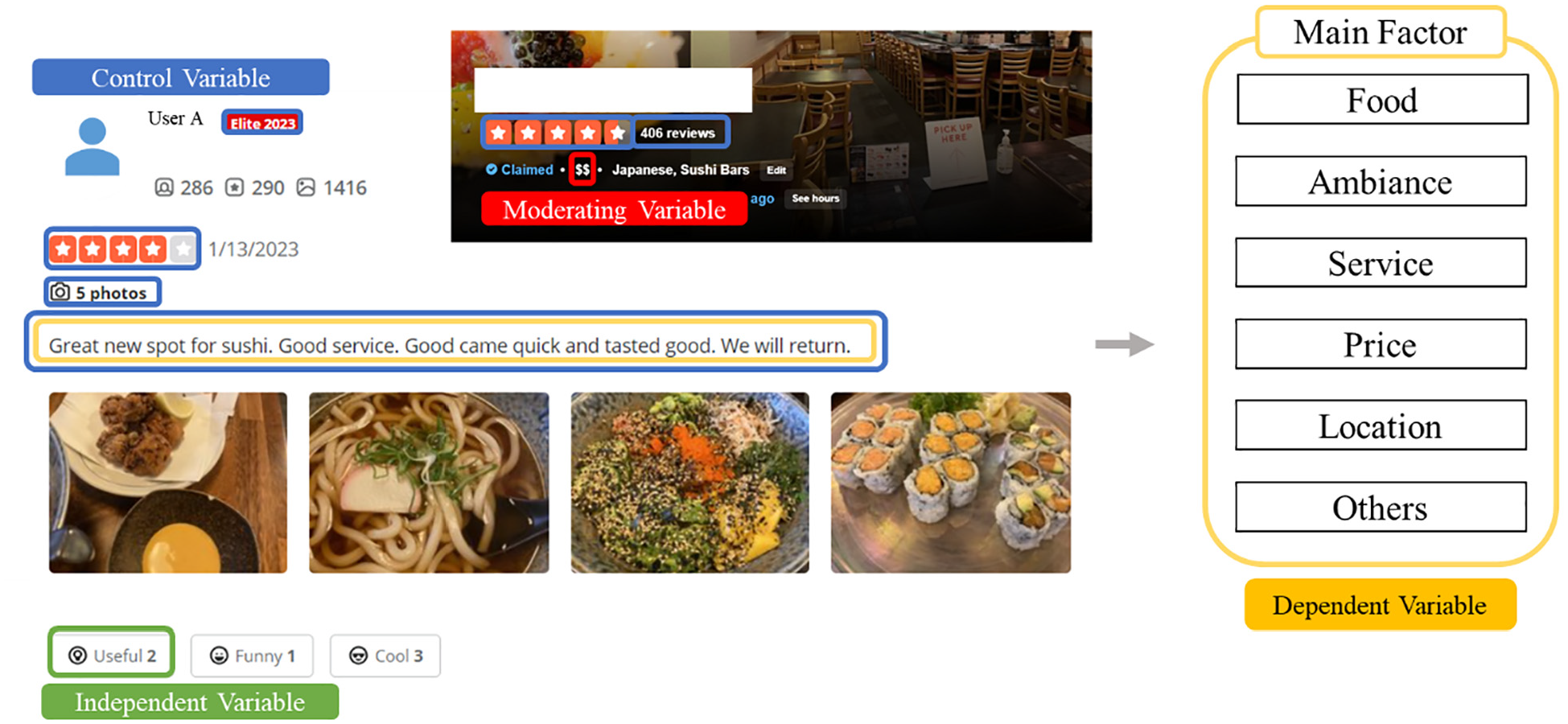
Illustration of the data variables.
Operationalization of variables.

Dependent Variable
Online e-commerce websites have introduced a review helpfulness voting system, allowing consumers to evaluate the reviews they explore. Such review helpfulness information significantly influences consumers’ decision-making when purchasing in the online shopping environment. Many studies have measured review helpfulness information based on the number of votes received by a specific review (Hlee et al., 2019; M. Lee et al., 2017). Based on these previous studies, the current study validates the research model using the number of votes for review helpfulness as the dependent variable.
Explanatory Variable
The ABSA method used in this study aims to measure emotional expressions related to various aspects of online restaurant reviews with high accuracy (Devlin et al., 2018). The ABSA method used in this study is illustrated in Figure 4. This approach allows granular sentiment analysis by breaking down reviews into specific aspects, such as food, service, price, ambiance, and location, and evaluating the sentiment associated with each aspect.

Sentiment calculation based on ABSA.
The ABSA process began with data pre-processing, where online reviews were collected and cleaned. This step involves removing irrelevant information, such as HTML tags and special characters, and normalizing the text to prepare it for further analysis. Following preprocessing, the reviews were analyzed to identify and extract keywords related to five key aspects: food, service, price, ambiance, and location (X. Li et al., 2019). For this purpose, a pre-trained BERT model was employed (X. Li et al., 2019). The BERT model is particularly effective for understanding the context of each word within the review text, which is crucial for accurate aspect extraction (Alamoudi & Alghamdi, 2021).
Once these aspects were identified, the next step was sentiment classification. The sentiments for each aspect were classified as positive, negative, or neutral. This classification was achieved by fine-tuning the BERT-based model on a domain-specific dataset, ensuring that sentiment analysis was contextually accurate for restaurant reviews. The sentiment scores for each aspect were then calculated using a composite score, considering the intensity and frequency of sentiment words associated with each aspect (Alamoudi & Alghamdi, 2021; Mikolov et al., 2013. The final sentiment score for each aspect was determined using the following formula:

Where
To validate the accuracy of the ABSA model, it was tested using the Semantic Evaluation (SemEval) dataset, which is commonly used for benchmarking sentiment analysis models in the restaurant domain. As shown in Table 2, the model achieved an accuracy of over 80%, indicating its reliability in capturing sentiments at the aspect level.
The Performance of Aspect Based Sentiment Analysis.

In terms of implementation, the ABSA method leverages the capabilities of BERT, which is known for its superior performance in natural language processing tasks. The model was pretrained on a large corpus of text and further fine-tuned on restaurant-specific data to enhance accuracy. Additionally, aspect-level sentiment scores were calculated using the Word2Vec method to ensure the semantic representation of words (Mikolov et al., 2013). This involves identifying words similar to predefined keywords for each aspect, thereby capturing a broader range of sentiment expressions.
Moderating Variable
Following the research strategy used in previous studies to classify restaurants, we categorized them into casual and luxury categories (Hlee et al., 2019; Yu & Margolin, 2021). Casual restaurants are characterized by a casual atmosphere and reasonable prices, typically ranging from $11 to $30. By contrast, luxury restaurants offer an elegant ambiance and relatively higher prices, starting at $61 and above. This study classified the moderating variable as follows: restaurants with average food prices ranging from $11 to $30 were coded as 0 (casual restaurants), whereas restaurants with $61 or higher were coded as 1 (luxury restaurants).
Control Variables
Many studies have proposed various factors that affect review helpfulness. This study controlled for confounding factors to measure the model effectively.
Review ratings: Review ratings refer to a consumer’s rating value in each review, typically measured on a scale of 1 to 5 stars. These ratings reflect the consumer’s overall satisfaction with their restaurant experience. Previous studies have identified review ratings as an essential predictor of review helpfulness because they quantitatively represent the perceived quality of the restaurant (Mudambi & Schuff, 2010).
Number of photos: The number of photos denotes the total number of images included in each review. These images provide visual evidence of the dining experience and enhance the informativeness of the review. Attached photos significantly impact review helpfulness by enriching the information provided (C. Li et al., 2021).
Review length: Review length is defined as the total number of words contained in a review. Research has found that longer reviews, which use more words, deliver more detailed information and insights about the dining experience to consumers (Mudambi & Schuff, 2010).
Reviewer expertise: Reviewer expertise indicates the level of experience and credibility of a reviewer. This study measures reviewer expertise using the elite badge, a widely adopted indicator in previous studies. The elite badge is a dummy variable indicating whether the Yelp platform has recognized a reviewer as an elite reviewer. Reviewer expertise has been shown to positively influence the reliability and helpfulness of reviews (Baek et al., 2014).
Restaurant rating: Restaurant rating refers to the overall rating given to a restaurant based on the aggregation of individual review ratings. This rating provides a general measure of the restaurant’s quality as perceived by consumers. Many previous studies have demonstrated that average ratings are crucial in consumers’ decision-making processes as they indicate overall satisfaction with the restaurant (M. Lee et al., 2017).
Number of restaurant reviews: The number of restaurant reviews indicates the total number of reviews a restaurant has received. A higher number of reviews typically reflects greater popularity and usage of the restaurant (M. Lee et al., 2017).
Model Specification
The dependent variable in this study is a non-negative count variable with a minimum value of 0, given the nature of the vote count for review helpfulness. Consequently, the variance of the dependent variable (review helpfulness) is greater than the mean because many reviews have a vote count of 0 (variance = 7.873, mean = 0.99). Therefore, most previous studies on online review helpfulness have employed a negative binomial regression model (Guo & Zhou, 2017; Zhou et al., 2023). Indeed, the negative binomial regression model is considered a more suitable approach than the Poisson regression analysis because the dependent variable follows a skewed distribution rather than a normal distribution (Fang et al., 2016; X. Wang et al., 2019). Therefore, this study adopted a negative binomial regression model. The estimated model was as follows:

Data Analysis and Results
Hypotheses Testing
The basic statistics and correlation analysis results for the online reviews used in this study are presented in Tables 3 and 4, respectively. Additionally, the variance inflation factor (VIF) was calculated using multicollinearity tests to examine the correlation between variables, resulting in values ranging from 1.00 to 1.73 (see Table 5). This indicates that the model used in this study does not suffer from multicollinearity. The results of the negative binomial regression analysis of the proposed research model are presented in Table 6.
Descriptive Statistics.

Variable Correlations.

The Result of VIF.
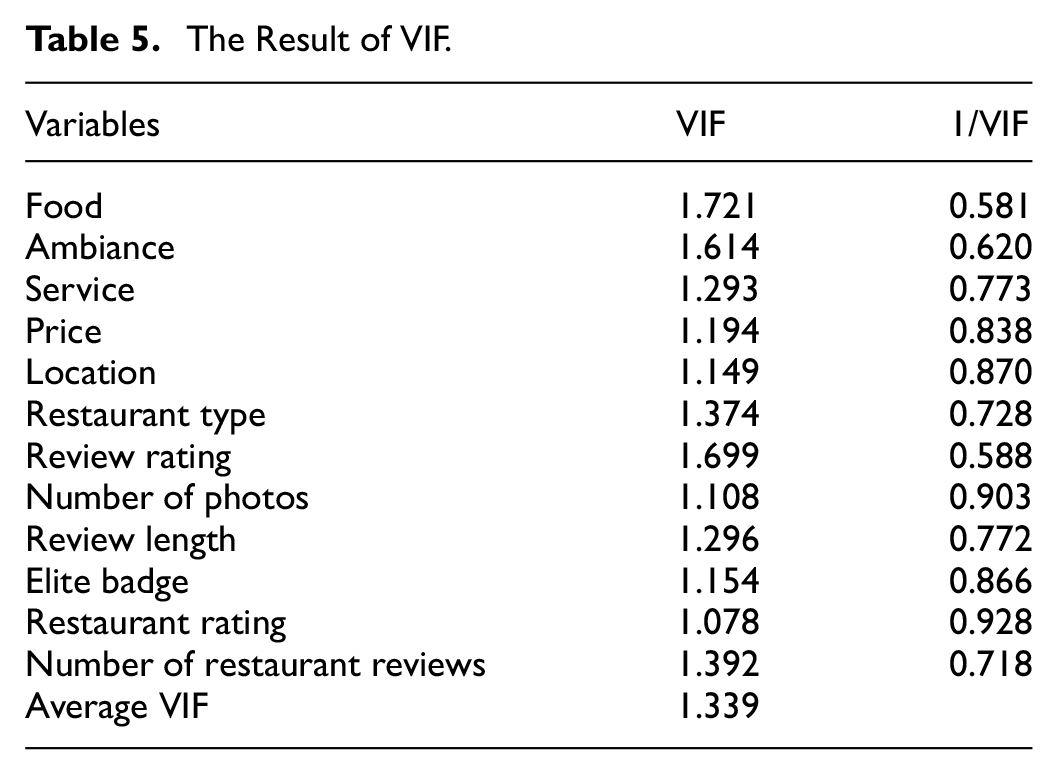
Negative Binomial Regression Results.
p < .05. **p < .01. ***p < .001.
This study assumes that the emotional expression of intrinsic cues related to food quality, ambiance, and service aspects negatively affects review helpfulness. Model 2 was used to test the presented hypotheses, and the results indicated that food quality (β = −.057, p < .01) and ambiance (β = −.043, p < .001) had a negative effect on review helpfulness. However, the services have a positive effect on review helpfulness. Therefore, while H1 and H2 are supported, H3 is not. Regarding extrinsic cues, this study assumes that emotional expressions related to price and location aspects would positively affect review helpfulness. Through hypothesis testing using Model 2, the results have shown that price (β = .071, p < .01) and location (β = .026, p < .001) affected review helpfulness positively. Thus, H4 and H5 are supported.
Model 4 found that restaurant type strengthens and significantly negatively influences the impacts of emotional expressions related to food quality (β = −.036, p < .001) and ambiance (β = −.029, p < .001) on review helpfulness. This indicates that negative evaluations of food quality and ambiance impact review helpfulness in luxury restaurants more than in casual-dining restaurants. This study assumes that restaurant type strengthens the impact of emotional expressions related to service on review helpfulness. However, restaurant type weakens and significantly negatively influences the impact of emotional expressions related to service (β = −.038, p < .001) on review helpfulness. This indicates that positive service evaluations significantly affect review helpfulness in casual dining restaurants more than in luxury restaurants. Additionally, restaurant type strengthens and significantly positively influences the impact of emotional expressions related to price (β = .023, p < .001) on review helpfulness. These results indicate that a positive price evaluation has a more significant impact on review helpfulness for luxury restaurants than for casual-dining restaurants. Conversely, the restaurant type weakens and significantly negatively influences the impact of emotional expressions related to location (β = −.045, p < .001) on review helpfulness. These results indicate that positive evaluations of location have a more significant impact on review helpfulness for casual dining restaurants than for luxury restaurants. Therefore, H6a, H6b, H6d, and H6e were supported, whereas H6c was.
Robustness Checking
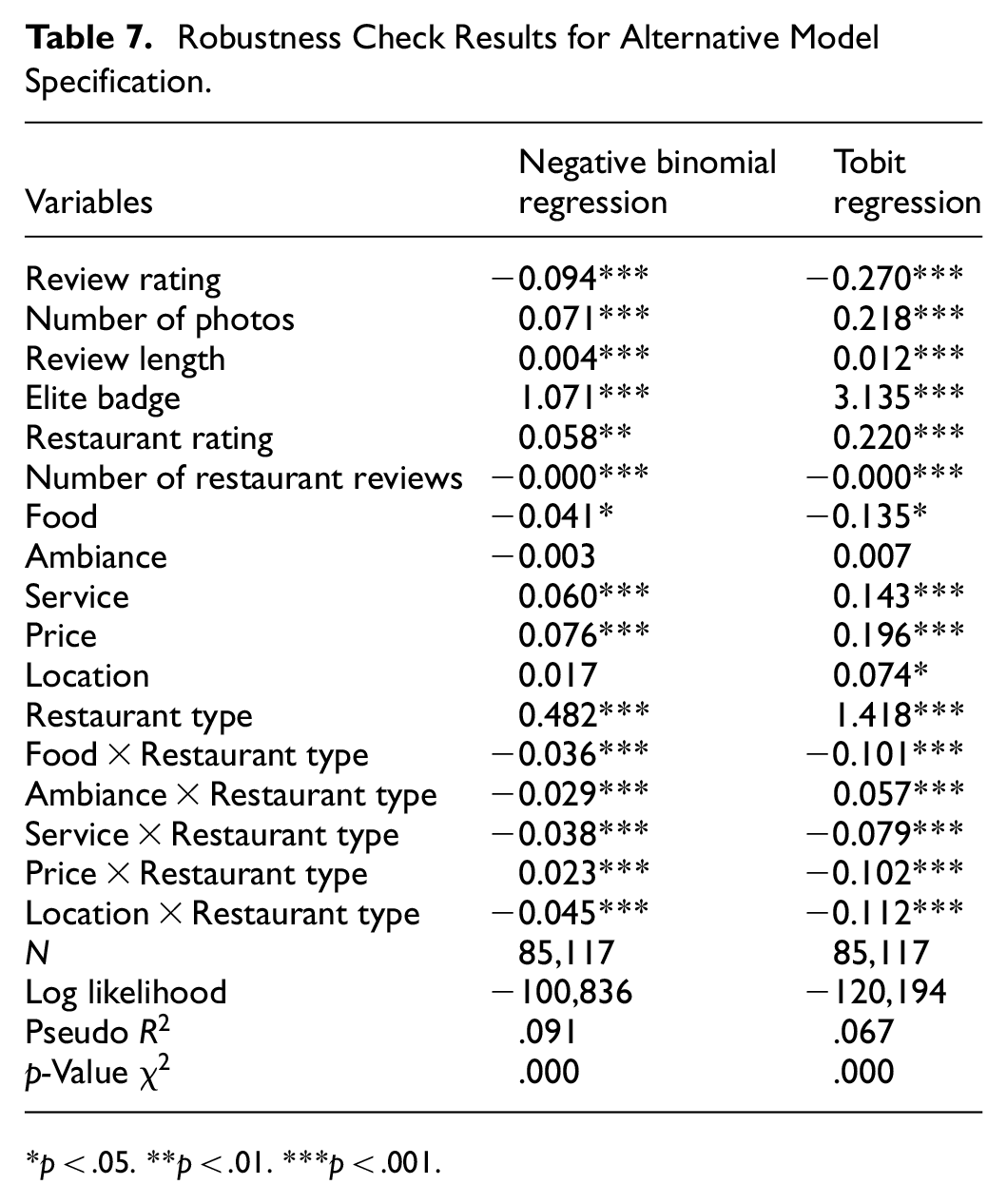
A Tobit regression analysis, which is commonly used in various studies, was used to validate the robustness of the proposed model (S. Yang et al., 2021). Tobit regression analysis is more effective than the least squares method when the dependent variable is truncated or when a selection bias exists (Yao et al., 2020). Table 7 presents the results of the Tobit regression analysis of the proposed research model. According to the results, the directionality of the remaining coefficients is consistent with the negative binomial regression analysis results except for the interaction effects between location and ambiance and between price and restaurant type. Therefore, the proposed research model is robust.
Robustness Check Results for Alternative Model Specification.
p < .05. **p < .01. ***p < .001.
Discussion and Conclusion
In previous studies on online review helpfulness, scholars primarily focused on capturing the overall emotions of reviews to understand emotional expressions. However, it is essential to evaluate the various aspects embedded in reviews individually, as consumers may assign different weights to each aspect. This study utilizes the ABSA method to examine how emotional expressions related to various aspects of restaurants affect review helpfulness. We conducted an empirical analysis using 85,117 online reviews obtained from Yelp.com and employed a negative binomial regression to evaluate the proposed research model. The main findings of this study are as follows:
First, emotional expressions regarding food quality and ambiance negatively affect review helpfulness. This aligns with Liu and Jang (2009), who revealed that food quality and ambiance are crucial attributes affecting consumer satisfaction. According to negativity bias theory, negative information is perceived as more influential, making negative reviews related to food quality and ambiance more helpful to consumers.
Second, emotional expressions related to services positively affect review helpfulness. Negative emotional expressions about service can provide negative information about the service provider, leading to online incivility. Online incivility, defined as rude or aggressive comments made by one individual to another using the internet (Anderson et al., 2014), can reduce reviewer credibility (S. Wang, 2020). Thus, negative expressions regarding service do not negatively affect review helpfulness.
Third, emotional expressions related to price and location positively affect review helpfulness. This finding aligns with Ismagilova et al. (2020), who confirmed that consumers’ positive perceptions of price fairness enhance review helpfulness. Additionally, strategic location selection for restaurants is extensively supported by many studies (L.-F. Chen & Tsai, 2016; J. Wang & Yan, 2017).
Regarding the moderating effect of restaurant type, negative emotional expressions related to food and ambiance significantly affect review helpfulness for luxury restaurants more than for casual dining restaurants. Consumers generally perceive the physical environment, service, and food quality as differentiating factors in luxury restaurants compared to other dining experiences. Meng and Elliott (2008) found that consumers have higher expectations for the physical environment and food quality in luxury restaurants. These higher expectations lead to greater uncertainty, and consumers prefer more helpful reviews to reduce this uncertainty. Thus, negative emotional expressions related to food and ambiance are considered more valuable when expectations are higher.
Contrary to our hypothesis, the study found that positive emotional expressions regarding service weakened the effect on review helpfulness for luxury restaurants more than for casual dining restaurants. Meng and Elliott (2008) found that friendliness, promptness, and courteous staff services are crucial in enhancing consumer satisfaction in luxury restaurants. Consequently, luxury restaurant managers invest more in training their staff, and consumers expect high-quality services. Conversely, casual dining restaurants offer reasonably priced food in a relaxed ambiance, and consumers expect relatively high-quality services at a reasonable price (Ha & Jang, 2013). Therefore, positive emotional expressions regarding service are more helpful in casual dining restaurants than in luxury ones.
Positive evaluations of price have a more substantial impact on the assessment of review helpfulness in luxury restaurants compared to casual dining restaurants. Consumers willing to pay higher prices for luxury dining anticipate greater benefits, and positive reviews from those who received more value for their money reinforce this expectation. Therefore, positive price evaluations are likely enhanced in luxury restaurants.
Lastly, positive evaluations regarding location have a weaker impact on the assessment of review helpfulness in luxury restaurants than in casual dining restaurants. This finding aligns with Ha and Jang (2012), who revealed that consumers of casual dining restaurants prioritize convenient locations, while luxury restaurant consumers prioritize superior quality. Ahmad et al. (2014) identified convenient locations as the most critical factor for consumers choosing casual dining restaurants. Thus, positive opinions about the location are more helpful to consumers intending to visit casual dining restaurants than luxury ones.
Theoretical Implications
This study’s results provide several theoretical implications. First, this study represents an initial attempt to apply ABSA to online restaurant reviews to evaluate review helpfulness at the aspect level. While many scholars have investigated various factors that affect review helpfulness, research examining the potential impact of different aspect levels of review information is limited. Unlike previous studies that focused on the overall emotions in online reviews, this study explored the effect of emotional expressions regarding specific aspects of restaurants on review helpfulness. The findings indicate that consumers weigh different aspects of restaurant experiences differently when evaluating reviews. This comprehensive consideration of various aspects can better explain consumers’ review-evaluation behavior and contributes to the literature on review helpfulness by validating the impact of aspect-level emotional expressions.
Second, this study extends the application of the cue utilization theory, which has commonly been used to explain consumer purchasing behavior (Kukar-Kinney & Xia, 2017), to the context of online restaurant reviews. By considering both intrinsic cues related to product-specific attributes and extrinsic cues unrelated to the product’s physical attributes, this study demonstrates that consumers evaluate restaurant experiences using information at each aspect level. The results confirm that the cue utilization theory is a valid theoretical basis for explaining how consumers assess online restaurant reviews.
Third, this study addresses the gap in the literature regarding the moderating effect of restaurant type on review helpfulness across various aspects of online restaurant reviews. While previous studies have examined the moderating effect of restaurant type on overall online reviews, they have rarely investigated its impact on review helpfulness at the aspect level. The results show that consumers who intend to visit casual dining restaurants have different attitudes toward reviews compared to those interested in luxury restaurants. This indicates that consumers have different expectations for various aspects depending on the restaurant type. The study verifies the moderating effect of restaurant type and provides a reference for future research by highlighting the importance of considering various aspects in online restaurant reviews.
Finally, this study contributes to the methodology of calculating emotion scores for various aspects in online restaurant reviews using a BERT-based ABSA model. A three-step analytical framework was presented to measure emotional scores at the aspect level, recognizing that consumers may use a variety of keywords to express their experiences. For example, instead of directly referring to “food,” consumers might use keywords such as “pasta,”“chocolate,” and “chicken.” To accurately capture these expressions, this study applied the Word2vec technique to extract similar words, providing a novel methodology for efficiently identifying critical keywords at the aspect level. This approach enhances the evaluation of review helpfulness and expands the scope of online review research (Alamoudi & Alghamdi, 2021).
Practical Implications
First, this study provides valuable insights into the relative importance of various aspects in online review evaluations. Restaurant managers can leverage these findings to identify which aspects consumers prioritize when evaluating their dining experiences. Given that the significance of each aspect varies by restaurant type, managers should focus on the most impactful aspects to enhance review helpfulness. By addressing these key areas, managers can offer personalized services that better meet consumer needs, ultimately improving consumer satisfaction and business performance.
Second, the ABSA model developed in this study allows for the straightforward measurement of emotional scores at the aspect level. Understanding consumers’ restaurant experiences is vital for the sustainable development of businesses in the restaurant industry (W.-K. Chen et al., 2020). By using the proposed algorithm, restaurant managers can gain a holistic view of consumer experiences across various dimensions. This comprehensive understanding enables them to develop tailored strategies that address specific consumer preferences and enhance overall service quality.
Third, this study successfully identified critical keywords for each aspect that consumers focus on when evaluating online reviews. Consumers consider multiple aspects when assessing online restaurant reviews (Mahmood & Khan, 2019; Ryu & Lee, 2017). The ABSA model helps quickly pinpoint these critical keywords, which can be used to refine the design of online review platforms. By highlighting these key terms, online review websites can make it easier for consumers to find relevant information, thus facilitating more efficient decision-making.
Limitations and Future Research
This study has several limitations that should be addressed in future research. First, the proposed research model was evaluated using online restaurant reviews. Therefore, caution is needed when generalizing these findings to other industries. To mitigate this limitation, future research should collect and analyze online consumer reviews from various industries. This approach would provide broader insights and allow for systematic comparisons, enhancing the generalizability of the research findings.
Second, this study only uses online restaurant reviews collected from New York City. While the restaurant industry has unique regional characteristics, consumers worldwide use online review platforms. Thus, the results obtained in this study may be applicable to other regions. Future research should include data from different geographic areas to validate and extend the generalizability of the findings.
Third, this study does not account for the potential impact of fake reviews. Fake reviews can be systematically generated on online review platforms to artificially boost a company’s reputation and attract consumers (Barbado et al., 2019). The presence of fake reviews in the dataset poses a risk of bias, potentially affecting the reliability of the results. Future research should develop and implement methods to identify and exclude fake reviews, thereby enhancing the accuracy and credibility of the findings.
Footnotes

Author Contributions
Conceptualization, J.L.; methodology, D.J., and D.K.; data curation, D.J., and D.K.; writing—original draft preparation, D.J., and J.Y.; writing—review and editing, J.L. and J.Y.; supervision, J.Y. All authors have read and agreed to the published version of the manuscript.
Funding
The author(s) disclosed receipt of the following financial support for the research, authorship, and/or publication of this article: The present research is supported by the Research Grant of Kwangwoon University in 2022.
Declaration of Conflicting Interests
The author(s) declared no potential conflicts of interest with respect to the research, authorship, and/or publication of this article.
Data Availability Statement
Data sharing not applicable to this article as no datasets were generated or analyzed during the current study.