




Abstract
With the rapid development of digital technology, entrepreneurial universities, as key platforms for transforming scientific achievements and fostering academic entrepreneurship among faculty, must strategically leverage the opportunities presented by the digital revolution to achieve high-level development. This study conducts a bibliometric analysis of relevant literature on entrepreneurial universities, identifying three key themes in the context of the digital revolution: entrepreneurship education, entrepreneurial behavior, and academic entrepreneurship. Utilizing a BERT-integrated LDA model, the research delves into the knowledge structures within these themes, elucidating strategies for capitalizing on digital opportunities in entrepreneurial university construction. By linking entrepreneurial universities with the digital revolution, this study provides theoretical insights on how these institutions can proactively harness digital opportunities for high-quality development in their future endeavors.
Introduction
Entrepreneurial University (EU) plays a critical role in the transformation of academic research into practical applications, fostering collaborative innovation among government, industry, academia, and research sectors. This pivotal function, frequently termed “The Third Mission” of universities, has captured significant interest across academic, policy-making, and business domains (Anjum et al., 2023; Compagnucci & Spigarelli, 2020; D’Este & Perkmann, 2011; Guerrero et al., 2016; Tuunainen, 2005). Defined as institutions primarily dedicated to nurturing entrepreneurial talent, undertaking research with commercial potential, and directly engaging in the creation of high-tech enterprises, EUs are distinguished by their multifaceted roles and contributions (Buera et al., 2011; Guerrero et al., 2015; Perkmann et al., 2013). The EU model is characterized by several essential features: it leverages the strengths of research-intensive institutions (Liyanagunawardena et al., 2013); promotes the formation of project-driven and interdisciplinary research entities (Ramarajan & Reid, 2013); provides robust institutional frameworks to support technology transfer (Wennberg et al., 2011); facilitates seamless integration of industry-university-research collaborations (Brocke & Lippe, 2015); ensures access to diversified funding streams (Hiatt et al., 2018), and fosters a pervasive entrepreneurial culture (Spigel & Harrison, 2018). By incorporating these elements, EUs not only drive innovation and economic development but also redefine the traditional roles of higher education institutions, positioning them as key players in the global knowledge economy.
In parallel, it is essential to recognize the rapid development of digital technologies such as AI, blockchain, cloud computing, and big data, which are reshaping society on a global scale (Chu & Wu, 2023; Reuter & Floyd, 2024). Digitalization provides compelling innovation opportunities for innovators, creators, and entrepreneurs (Autio et al., 2018; Yoo et al., 2012). In the realm of academia, the transformative impact of digital technologies, particularly AI, cannot be overlooked. These advancements have the potential to revolutionize education, research, and “The Third Mission,” leveraging generative capabilities across various activities (Abreu et al., 2016; Centobelli et al., 2019; Iorio et al., 2017). Regarding the latter, digital technologies have significantly influenced various activities within innovation and entrepreneurship education (Beliaeva et al., 2019). Notable examples include crowdfunding platforms like Indiegogo (Li et al., 2017), startup incubators such as Startup Blink (Tracey et al., 2018), entrepreneurial simulation platforms like Sim Venture (Westgren & Wuebker, 2019), and online entrepreneurial communities like Startup Grind (Le Roux & Nagel, 2018). By integrating these digital tools and platforms, entrepreneurial education can harness the power of technology to enhance learning experiences, foster innovation, and cultivate a dynamic entrepreneurial ecosystem. These advancements not only provide students with practical skills and real-world experience but also position them at the forefront of the digital economy, ready to tackle contemporary challenges and opportunities.
Educational digitalization leverages new technological tools to rapidly and efficiently consolidate dispersed high-quality educational resources, enabling their dissemination and sharing across institutions, regions, and countries, thereby overcoming temporal and spatial limitations (Misirli & Ergulec, 2021). In response to the emerging concept of digital academic entrepreneurship, EUs are seizing the opportunities presented by digitalization by cultivating a culture of innovation and entrepreneurship. This initiative includes the establishment of innovation and entrepreneurship centers, which actively encourage students and faculty to participate in entrepreneurial activities and technological development. By integrating these digital initiatives, EUs not only enhance their educational offerings but also significantly contribute to the broader socioeconomic landscape. This strategic embrace of digitalization positions these institutions at the forefront of academic and entrepreneurial innovation, driving forward the next generation of entrepreneurial leaders and technological advancements.
To date, the question of how EUs can effectively harness the opportunities presented by the digital revolution and ultimately transform academic achievements into tangible productivity remains unresolved. Following Secundo et al.’s (2020) systematic review of digital academic entrepreneurship, we posit that the challenge of how entrepreneurial universities, underpinned by academic entrepreneurship, can fully leverage the opportunities of the digital revolution is both intricate and multifaceted. We seek to understand this phenomenon from various angles, aiming to foster the development of EUs by introducing new perspectives, dimensions, and theories, thereby contributing to academia, practice, and policy-making. The disruptive innovations brought about by next-generation artificial intelligence technologies, such as ChatGPT-4 and Sora, have significantly challenged the development processes of EUs. It is imperative to systematically review the historical evolution of EUs within the context of the digital revolution to provide new insights and directions for their future development. By adopting this approach, we hope to offer a comprehensive framework that can guide the strategic development of EUs, ensuring they remain at the forefront of academic and technological innovation. This framework will not only enhance the universities’ ability to convert academic research into real-world applications but also support their role as pivotal players in the global knowledge economy.
Despite the existence of separate systematic literature reviews on EU construction (Coşkun et al., 2022), university and technology transfer (O’Shea et al., 2005), digital innovation (Cheng et al., 2023), and digital transformation (Vial, 2019), there remains a significant gap in research that examines the construction of EUs from a holistic and systematic perspective within the context of the digital revolution. This study initially conducts a comprehensive, in-depth systematic review of research within the field of entrepreneurial universities. By organizing highly cited reviews, it is found that in the current process of building EUs, although new forms such as crowdsourced research and 5G edge computing teaching have emerged in certain dimensions like academic entrepreneurship and entrepreneurship education, there is a lack of a review that examines how EUs embrace digital opportunities from an overall perspective. Therefore, this study starts from the overall perspective of EUs and systematically reviews the process of how they embrace digital opportunities from three angles: entrepreneurship behavior, entrepreneurship education, and academic entrepreneurship. This not only enriches the theoretical research on EUs but also provides feasible practical insights for their high-quality development.
The structure of the paper is as follows: Following introduction, Section “Literature Review” presents a comprehensive, in-depth, and systematic literature review on the theme of the opportunities brought by the digital revolution to entrepreneurial universities. Section “Methodology” introduces the research questions and provides a detailed account of the research methodology employed in this study. Sections “Bibliometric Analysis” and “Topic Modeling Analysis,” respectively, utilize bibliometrics and machine learning methods to conduct an in-depth analysis of the current situation and process of entrepreneurial universities embracing digital opportunities. Finally, in Section “Conclusion,” we discuss the research findings and point out the directions for future research.
Literature Review
The concept of the Entrepreneurial University represents a structural transformation undertaken by higher education institutions to adapt to the knowledge economy and societal demands. Its core characteristics lie in achieving organizational innovation through knowledge capitalization, government-industry-academia collaboration, and resource diversification. The “Triple Helix” theory proposed by Etzkowitz (1984) was the first to position universities as innovation agents on par with governments and enterprises, emphasizing their entrepreneurial role in regional economic development. Subsequently, Clark (1998), through case studies of five European universities, distilled five key transformational elements of the entrepreneurial university: Strengthen the leadership core, expand the development periphery, diversify funding sources, activate the academic heartland, and cultivate an entrepreneurial culture. The construction of an entrepreneurial university is multidimensional. Guerrero and Urbano (2012) pointed out that entrepreneurial universities not only need to promote Academic Entrepreneurship but also must restructure organizational systems to support the commercialization of knowledge. A meta-analysis by Rothaermel et al. (2007) indicated that the effectiveness of Technology Transfer Offices (TTOs), intellectual property policies, and incubator development are key indicators for measuring a university’s entrepreneurial capacity. In recent years, research trends on entrepreneurial universities have gradually shifted from a singular focus on economic value creation to a dual orientation of economic value and social responsibility, emphasizing the role of universities as think tanks in solving social problems in the digital age (Abreu & Grinevich, 2024; Starostina et al., 2023).
Digitalization catalyzes systemic transformations in EUs across various stages, reshaping learning environments, educational resources, faculty and student competencies, teaching methods, and assessment practices (Guerrero & Pugh, 2022; Nambisan, 2017; Rippa & Secundo, 2019). The integration of digital elements within university ecosystems fosters diverse phenomena, each with distinct characteristics and socioeconomic impacts, thus creating new trajectories and competitive advantages for EUs (Dalmarco et al., 2018; Forliano et al., 2021; Kotha et al., 2013). With the organizational transformations triggered by Generated Artificial Intelligence (GAI), various construction dimensions of the entrepreneurial university have also given rise to new business forms such as digital IP, crowdsourced research (e.g., GitHub), and 5G edge computing-based teaching.
Reviewing previous review studies on entrepreneurial universities, Table 1 summarizes the highly cited review articles (citations >100) corresponding to each of the five important dimensions of the entrepreneurial university, as well as the potential opportunities that may exist in the digital age. These articles were identified in the SCI and SSCI databases of the Web of Science Core Collection, based on the criteria of having publications in JCR Q1 journals or the existence of review articles, to check whether these areas have been sufficiently explored. This provides stronger evidence for identifying research gaps and formulating research questions.
Literature Summary of Entrepreneurship University in Digital Era.

Through the review of typical literature on entrepreneurial universities, it is found that the current research on academic entrepreneurship and innovation ecosystems exhibits significant technological iteration lag. Although existing frameworks have systematically explored traditional pathways such as technology transfer, case studies, and joint laboratories (Kuratko, 2005; Perkmann et al., 2013; Yang et al., 2018), there is a structural research gap in the innovation paradigm empowered by digital technology. Specifically, there is a lack of institutionalization of digital intellectual property rights, and new governance protocols such as NFT conversion and blockchain data sharing have not yet been established; The depth of technology embedding is insufficient, and there is a lack of theoretical modeling for mechanisms such as GAI’s business simulation, API driven real-time resource matching, DAO agile decision-making, etc; The social value dimension is imbalanced, and digital inclusive innovation and SDG quantitative evaluation have not yet been integrated into mainstream analytical frameworks (Cheah & Ho, 2019; Welter, 2011). These gaps reveal the explanatory limitations of traditional theories in the Web 3.0 environment, and there is an urgent need to build interdisciplinary digital innovation mechanisms that integrate cutting-edge elements such as industrial metaverse collaboration and algorithm governance and achieve technology institutional co-evolution through the development of institutional infrastructure such as smart contract standards and digital impact indicators. The field urgently needs to break through the research paradigm of one-way technology adaptation and shift towards the reconstruction of the digital entrepreneurship ecosystem from the perspective of complex systems.
Methodology
Research methods serve the research questions, and research questions serve the research purpose. Given that this study aims to explore how entrepreneurial universities can embrace digital opportunities, we propose the following two research questions:
What is the research status of entrepreneurial universities?
How can entrepreneurial universities embrace the benefits brought by the digital revolution?
To address these research questions, we follow the research paradigm outlined by Mustak et al. (2021) in their study of AI in marketing.
Data Collection
This paper employs a structured literature review (SLR) approach to analyze the state of the art on the investigated topic (Day et al., 2014; Liberati et al., 2009; Sharma et al., 2023). According to Massaro et al. (2016), SLR is a rigorous and relevant approach that produces knowledge, helping to determine the research status, themes, and future research directions in a particular area. “SLR can avoid repetitive research that does not substantively advance knowledge, guide the planning of new research to significantly promote knowledge development, and support claims of novelty when comparing new and old knowledge” (Paul et al., 2021). We refer to the SPAR-4-SLR and PRISMA paradigms for the review process, collecting data on our research topic—how entrepreneurial universities embrace digital opportunities—from the SCI and SSCI databases in the Web of Science Core Collection. Regarding database selection, Olawumi and Chan (2018) compared and evaluated multiple databases, noting that the Web of Science (WoS) platform covers the most relevant journals within various core journal publishers. WoS is a digital bibliometric platform recognized by scholars for its high-quality standards. It provides a comprehensive set of metadata necessary for analysis, including abstracts, references, citation counts, and author affiliations. Therefore, we chose the Thomson ISI WoS Core Collection database as our data source, with the retrieval date set as July 20, 2024.
Given that academic entrepreneurship is the essential characteristic of an entrepreneurial university, we first refer to Coşkun et al. (2022) on entrepreneurial universities and Secundo et al. (2020) on digital academic entrepreneurship. Using “Entrepreneurial University” OR “Academy Entrepreneurship” as search terms, we performed a Topic (TS) search. The retrieved literature was sorted by citation count, and each author independently reviewed the top 20 most cited papers. This process ensured the comprehensiveness of our search terms for the concept of entrepreneurial universities, including “entrepreneurial university,”“academy entrepreneurship,”“university entrepreneurial mission,”“entrepreneurial education,”“entrepreneurial academics,” and “academic entrepreneurs.” During the specific search process, we used these terms as keywords and indexed them using Title as the search field. Due to the diverse and rich connotations of entrepreneurial universities, we did not restrict the research fields. We limited the document type to articles or review articles, ensuring they were peer-reviewed and published in English. This resulted in a total of 723 documents related to entrepreneurial universities. Figure 1 further reports the detailed process of data acquisition and cleaning, as well as screening in this study.

Procedure of data collection and refinement.
Data Analysis
Bibliometric Analysis
To address the first research question, which aims to clarify the current state of research on entrepreneurial universities, we adopted bibliometrics as our research method. Bibliometrics is a quantitative approach to analyzing academic publications, designed to uncover patterns, trends, and relationships in scientific research activities (Zupic & Čater, 2015). By employing statistical and mathematical methods, bibliometrics analyzes literature data to assess the impact, development trends, and research hotspots of scientific studies (Durieux & Gevenois, 2010). This method is widely used in academic evaluation, research management, scientific policy-making, and the allocation of academic resources (Donthu et al., 2020; Ellegaard & Wallin, 2015; Vogel and Güttel, 2013).
The core methods of bibliometrics include citation analysis, co-occurrence analysis, and co-authorship analysis. Citation analysis examines the relationships between documents by counting the number of times a document is cited and identifying the sources of these citations, thereby revealing the key publications and influential researchers in a field (Pilkington & Meredith, 2009). Co-word analysis, on the other hand, involves analyzing the keywords or subject terms in documents to uncover research hotspots and the evolution of themes within a research area (Linnenluecke et al., 2020). Co-authorship analysis focuses on the collaborative relationships among researchers, analyzing co-authorship networks to understand patterns of academic collaboration and interdisciplinary interactions (Donthu et al., 2021).
The primary data sources for bibliometrics include academic databases such as Web of Science, Scopus, and Google Scholar (Archambault et al., 2009). These databases provide a wealth of literature records and citation data, forming the foundation for bibliometric analysis. Commonly used analytical tools include VOSviewer, which is used for constructing and visualizing scientific knowledge maps, aiding researchers in understanding the relationships between documents and the structure of the field (Van Eck & Waltman, 2010). CiteSpace focuses on the visualization of citation networks, revealing the flow of knowledge and the evolutionary processes within scientific domains (Chen, 2006). Bibliometrix, an R-based bibliometric analysis tool, offers comprehensive data processing and analysis functionalities (Aria & Cuccurullo, 2017).
This study employs VOSviewer software to conduct co-citation analysis of authors, journals, and documents in the research on entrepreneurial universities. VOSviewer was chosen for its excellent visualization capabilities, presenting analysis results in the form of knowledge maps (Yu et al., 2020). Additionally, following established research practices, this study uses CiteSpace for keyword co-occurrence analysis. The rationale for using CiteSpace lies in its highly integrated, code-driven environment and efficient data processing capabilities (Liu et al., 2015).
Topic Modeling Analysis
To address the second research question, which aims to clarify how entrepreneurial universities can fully embrace the technological benefits brought by the digital revolution, we adopted topic modeling as our analytical method. Topic modeling is a text mining technique used to automatically identify and extract hidden thematic structures from large collections of documents (Nikolenko et al., 2017). By analyzing word co-occurrence patterns, it reveals the main themes and concepts within a corpus of documents, facilitating the understanding and organization of large-scale textual data (Griffiths et al., 2004). Topic modeling has widespread applications in fields such as strategic management, organizational behavior, and marketing (Bouncken & Kraus, 2013; Furman & Teodoridis, 2020; Skarmeas & Leonidou, 2013).
The most commonly used topic modeling algorithm is Latent Dirichlet Allocation (LDA). LDA assumes that each document is generated by a mixture of several topics, and each topic is composed of a mixture of words. Through iterative calculations, the algorithm estimates the document-topic distributions and the topic-word distributions, thereby determining the thematic composition of each document and identifying the significant words for each topic (Blei et al., 2003). The practical implementation process includes steps such as text preprocessing, word embedding, text vectorization, determining the optimal number of topics, topic modeling, and visualizing the output results. Python is commonly used for programming these steps (Pedregosa et al., 2011).
The advantages of LDA lie in its ability to automatically process large-scale text data, extracting hidden thematic structures, thereby providing deep understanding and insights. This method is flexible and scalable, applicable to various types of text data, and can be combined with other analytical methods (Andrzejewski et al., 2009; Jacobi et al., 2016). However, LDA also has some drawbacks, including the subjectivity in interpreting topics, the complexity of selecting key parameters, potential poor performance when dealing with sparse data, and high computational resource demands when processing large datasets (Jelodar et al., 2019; Maier et al., 2018).
Since the bag-of-words model in LDA cannot capture semantic relationships between contexts, we improved LDA by incorporating BERT during the text vectorization process, as suggested by Xie et al. (2020). This pre-trained language model based on the Transformer architecture can capture subtle differences in word meanings in different contexts through bidirectional contextual learning. Furthermore, the selection of the number of topics directly determines the micro-foundation of topic modeling. Following the approach of O’Callaghan et al. (2015), we used topic coherence as a measure to determine the optimal number of topics. By visualizing the distribution of topic coherence across different numbers of topics, we identified the optimal number of topics as the one corresponding to the peak of the curve, which was then used for our topic modeling.
Bibliometric Analysis
Co-citation Network Analysis
In this part, in order to comprehensively depict the research status of entrepreneurial universities as much as possible, this study employs bibliometric methods to conduct co-citation network analysis on authors, journals, and documents. The research indicates that the majority of studies on entrepreneurial universities are based on the Theory of Planned Behavior proposed by Ajzen, and are published in journals in the fields of business, innovation, and education. Moreover, through co-citation network analysis, it can be found that the main components of research on entrepreneurial universities roughly include entrepreneurship behavior, entrepreneurship education, and academic entrepreneurship.
Author Co-citation Analysis
The author co-citation network, established through author co-citation analysis, offers valuable insights into the leading scholars in the field of EUs and their contributions. Frequent co-citations of an author’s work signify greater recognition in the field. As illustrated in Figure 2 and detailed in Table 2, we employed VOSviewer software to map the author co-citation network. Each node in the network represents an author, and the links between nodes indicate co-citation relationships. Larger nodes denote more significant contributions by the authors to the field. For example, Ajzen’s Theory of Planned Behavior is extensively cited in EU research, serving as the theoretical cornerstone for establishing EUs and refining entrepreneurial education systems (Åstebro et al., 2014). According to Ajzen’s theory, academic entrepreneurship is a result of individuals’ deliberate choices, driven by a series of subjective psychological motivations stemming from economic factors. Building on this, Fayolle, another pivotal figure in the field, innovatively integrated Ajzen’s Theory of Planned Behavior into entrepreneurial education, demonstrating that entrepreneurial education programs positively impact students’ entrepreneurial intentions (Fayolle et al., 2006). Hence, it is reasonable to consider academic entrepreneurship and entrepreneurial behavior as central research themes in the study of EUs. In this field, scholars such as Etzkowitz, Liñán, and Shane have also made remarkable contributions to advancing our understanding of EUs.

Author co-citation network.
Top 10 Co-citation Authors.

Note. TLS = Total Link strength.
Journal Co-citation Analysis
Papers published in high-impact journals tend to exert greater influence compared to those published elsewhere. Journal co-citation analysis is a valuable tool for researchers to understand the internal structure and knowledge system of a particular discipline or research field. By examining journals that are frequently co-cited, researchers can identify the core and peripheral journals within a field, thereby unveiling its disciplinary structure. As illustrated in Figure 3 and detailed in Table 3, we utilized bibliometric mapping to depict the highly cited journals in the field of entrepreneurial universities. The top three journals are Research Policy, Journal of Business Venturing, and Entrepreneurship Theory and Practice. These core journals highlight that research in the field of entrepreneurial universities predominantly focuses on public management, business management, and entrepreneurship management. Additionally, other notable journals such as The Journal of Technology Transfer, Small Business Economics, and Education and Training also play significant roles in disseminating research within this domain.

Journal co-citation network.
Top 10 Journals Publishing the Citing References.

Note. TLS = Total Link strength.
Document Co-citation Analysis
The primary role of co-citation analysis is to help us identify current research hotspots within different areas of EU studies, allowing us to pinpoint the most valuable articles. The more frequently an article is cited, the more influential it becomes within the field. Highly cited papers provide a historical perspective on scientific progress and signify recognition of key contributions to the advancement of knowledge. We utilized bibliometric mapping to visualize the co-cited literature in this domain, as illustrated in Figure 4 and detailed in Table 4. Ajzen's introduction of the Theory of Planned Behavior into entrepreneurial education research has been foundational. Liñán and Chen (2009), employing Ajzen’s theory, developed the Entrepreneurial Intention Questionnaire, underscoring the significant influence of cultural factors on entrepreneurial motivation. Additionally, two articles published in the Journal of Business Venturing demonstrated that predicting entrepreneurial motivation based on the Theory of Planned Behavior and Shapero's Model of the Entrepreneurial Event necessitates a greater focus on the effects of entrepreneurial culture and entrepreneurial emotion (Krueger et al., 2000; Souitaris et al., 2007). These findings also confirm that entrepreneurial behavior is a pivotal theme within the research field of EUs.
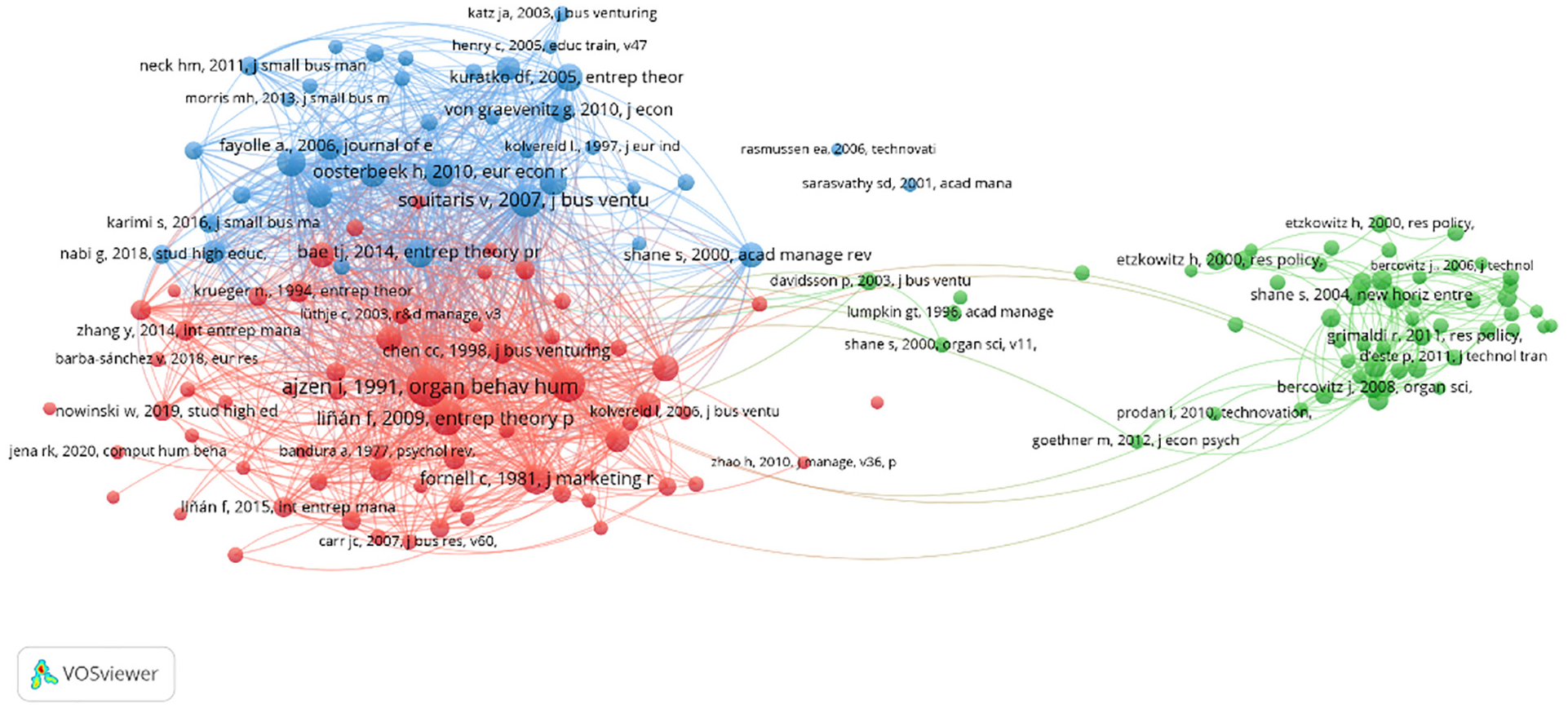
Document co-citation network.
Top References with the Most Citation Counts.

Co-occurrence Analysis
In this part, building upon the three research themes of entrepreneurial universities roughly proposed in the co - citation analysis, we further employ co-occurrence analysis. Specifically, we utilize Citespace software to conduct co-occurrence network analysis and keyword clustering analysis on the keywords in the literature of entrepreneurial universities. Comprehensive research findings indicate that the research themes of entrepreneurial universities can be categorized into three parts: entrepreneurship behavior, entrepreneurship education, and academic entrepreneurship.
Keyword Co-occurrence Analysis
In keyword co-occurrence analysis, we employ two common metrics—Frequency and Centrality—to examine the co-occurrence network. Frequency indicates how often a keyword appears, while Centrality quantifies the importance of nodes within the network. Betweenness centrality, which measures the proportion of shortest paths passing through a given node, is used as the centrality metric. Figure 4 displays the keyword co-occurrence network in the entrepreneurial university research domain, highlighting keywords with more than five occurrences. The size of each node is proportional to the keyword's frequency.
As shown in Figure 5 and Table 5, keywords such as “impact,”“entrepreneurship education,”“innovation,” and “performance” occupy central positions in the network, with the highest frequencies (174, 154, 101, and 59 times, respectively). These keywords form the basis for several other research topics. Keywords like “self-efficacy,”“entrepreneurial intention,”“students,” and “academic entrepreneurship” also have high citation rates, revealing significant research areas within entrepreneurial universities. The “Year” column indicates the first appearance of each keyword in the selected documents, shedding light on the evolution of key themes in the field. Table 4 lists hot topics across various disciplinary perspectives, including education, business strategy, business management, and innovation management. The centrality values in Table 4 highlight the importance of key terms over the research period, providing core insights into entrepreneurial university studies. “Behavior” ranks first with a centrality of 0.26, followed by “academic entrepreneurship,”“growth,” and “biotechnology,” with centralities of 0.21, 0.16, and 0.16, respectively. These relatively high centrality values indicate converging research themes and active collaboration in areas related to these keywords.

Keyword co-occurrence networks.
Top 10 Keywords with Highest Frequency and Centrality, Respectively.

In summary, current research in the entrepreneurial university field focuses on academic entrepreneurship, entrepreneurial behavior, and entrepreneurship education. This includes exploring the impact of entrepreneurial motivation on entrepreneurial behavior and the intersection of academic entrepreneurship with entrepreneurial education. Based on Figure 4, Table 4, and co-citation analysis, we propose that “academic entrepreneurship,”“entrepreneurial behavior,” and “entrepreneurship education” are the three prominent keywords in entrepreneurial university research.
Keyword Clustering Analysis
After conducting a co-occurrence analysis of keywords to deeply analyze the current research status of entrepreneurial universities, we employed the keyword clustering feature of Citespace software. This approach aids in revealing the similarities and interconnections between documents, thereby illustrating the knowledge structure and thematic distribution within the field. By performing keyword clustering analysis using title words within the entrepreneurial university domain, we identified 16 clusters. These clusters represent 16 distinct themes in the entrepreneurial university field. Table 6 lists the number of elements in each major homogenous cluster. All clusters contain seven or more documents and exhibit good silhouettes, indicating they can be labeled by noun phrases from the keywords of the articles cited within each cluster (Chen et al., 2010). All clusters in Table 6 have good silhouette scores (≥0.65), which is not only an indicator of their homogeneity but also a measure of the quality of the cluster configurations. CiteSpace allows for the identification of the core of thematic clusters. We utilized the Log-Likelihood Ratio (LLR) method to name the clustering themes because LLR can identify keywords that are significantly representative within a cluster. These keywords appear with much higher frequency in specific clusters compared to a random distribution, making the labels more representative and interpretative. As illustrated in Figure 6, due to the high overlap ratio between each theme, we further manually consolidated the sixteen automatically generated themes from Citespace into three research topics based on co-citation analysis and keyword co-occurrence analysis, as shown in Table 6.
Keyword Clustering Distribution.


Keyword clustering network.
We consolidated Cluster 1, Cluster 3, Cluster 10, Cluster 13, and Cluster 15 into the theme of academic entrepreneurship. Academic entrepreneurship refers to the process by which scholars transform their research outcomes into tangible productivity, engaging in commercial activities through their scientific findings (Massa & Testa, 2008). According to previous reviews on academic entrepreneurship, terms such as academic entrepreneurship, entrepreneurial academics, academic scientists, management scholarship, and academic spin-off can be used as search keywords for systematic literature reviews or meta-analyses in this field (Hayter et al., 2018; Walsh et al., 2021). The inclusion of institutional entrepreneur under the dimension of academic entrepreneurship is justified because this field focuses on the relationship between academic culture and commercial logic, which aligns with the essence of academic entrepreneurship (Berman et al., 2012; Duan & Zong, 2023; Zhuo et al., 2018).
We consolidated Cluster 5, Cluster 6, Cluster 7, Cluster 9, and Cluster 12 under the theme of entrepreneurship behavior. These clusters primarily describe entrepreneurship psychology, entrepreneurship intention, and entrepreneurship orientation. Notable research includes Rakićević et al. (2022), which used STEM students to measure entrepreneurship readiness through entrepreneurial intention and perceived ability to entrepreneurship, exploring the impact of the entrepreneurial environment. This study highlights the close connection between entrepreneurial intention, motivation, and psychology. Using Ajzen’s Theory of Planned Behavior, which posits that behavior is determined by intention, influenced by attitude, subjective norms, and perceived control, we categorize entrepreneurship orientation under attitude. Entrepreneurial motivation reflects a positive attitude and drive towards entrepreneurship. Entrepreneurial intention is the core concept, directly influencing behavior. Psychological factors like self-efficacy and resilience affect perceived control, thus influencing intention. Figure 5 shows significant overlap among themes. For clarity and theoretical integration, we group these themes under entrepreneurship behavior, providing a foundation for cultivating entrepreneurial talent.
We consolidated the remaining clusters (Cluster 0, Cluster 2, Cluster 4, Cluster 8, Cluster 14) under the topic of entrepreneurship education. In the development of entrepreneurial universities, entrepreneurship education plays a crucial role in enhancing students’ overall competencies, stimulating entrepreneurial intentions and motivations, and cultivating entrepreneurial thinking. CiteSpace can automatically generate representative literature for each cluster. By reviewing the representative literature under this topic, we find that entrepreneurship education, as a holistic concept, encompasses multiple sub-themes, each exploring different influencing factors and outcomes of entrepreneurial behavior in depth. For example, research on entrepreneurial self-efficacy and alertness focuses on individuals' confidence and alertness in the entrepreneurial process, which are critical psychological factors for entrepreneurial success (Otache et al., 2021). Research on personal education emphasizes the role of individual traits in entrepreneurship education, studying how personalized educational methods can enhance students' entrepreneurial motivation and capabilities (Silva et al., 2021). Although these sub-themes independently explore various aspects of entrepreneurship education, together they form an integrated framework that comprehensively addresses how different educational modes can enhance various influencing factors and outcomes of entrepreneurial behavior. Therefore, we have named these clusters under the overarching theme of entrepreneurship education.
Topic Modeling Analysis
Through the use of bibliometric analysis, we have gained an initial understanding of the current state of research on how entrepreneurial universities embrace digital opportunities. The research indicates that the field of entrepreneurial university construction encompasses three main themes: academic entrepreneurship, entrepreneurship education, and entrepreneurship. However, bibliometric analysis can only provide a preliminary understanding of the research status within a field and is insufficient for quantitatively analyzing the various research directions within it. Therefore, we have employed thematic analysis for a more in-depth examination.
Text Pre-processing
During the process of topic extraction, we first referred to Maier et al. (2018) and utilized the NLTK library in Python for part-of-speech tagging, lemmatization, stemming, and filtering out stop words and meaningless characters, thus defining the text preprocessing function. Subsequently, we applied this text preprocessing function to the abstracts of 723 collected documents. Following Tan et al. (2021), we employed both BERT and LDA for text vectorization. The rationale behind this approach is that BERT focuses on local contextual relationships, while LDA emphasizes the global thematic structure. Combining these methods allows us to account for both local and global information, enhancing the accuracy of text analysis. By integrating these two methods for text vectorization, we generate more comprehensive and precise input data, thereby improving the performance and interpretability of downstream models. Next, we applied UMAP for dimensionality reduction on the combined text vectors. The choice of UMAP is due to its ability to preserve both global and local data structures, offering superior computational efficiency and model interpretability compared to PCA and t-SNE. Finally, we utilized the classic K-means clustering algorithm, setting the number of clusters to three, to cluster the dimensionally reduced text vectors. The results were visualized using Matplotlib and Seaborn, as shown in Figure 7, and the clustering information was output. This analysis allows us to understand how the field of entrepreneurial universities embraces the opportunities brought by the digital era within the three research themes: academic entrepreneurship, entrepreneurship education, and entrepreneurship behavior.

Visualization of UMAP.
Result Analysis of Topic Modeling
Integrating the three major research topics of entrepreneurial universities derived from bibliometric analysis, this study employs machine learning algorithms to address the research question of how entrepreneurial universities can embrace the opportunities brought by the digital age. Specifically, it uses BERT-LDA as the word embedding training model, UMAP as the dimensionality reduction algorithm, and K-means as the clustering algorithm to conduct topic modeling analysis on the cleaned data of 723 literature. After the topic modeling, this research delves into the process of how the three research topics under the study of entrepreneurial universities can embrace digital opportunities and proposes potential future research directions and questions.
Cluster 0: Entrepreneurship Behavior
In the field of entrepreneurship behavior, scholars have been particularly focused on the mechanisms influencing entrepreneurial behavior motivations through factors such as digital academic entrepreneurship, face-to-face social networks, and gamifying online entrepreneurship education (Garcez et al., 2023; Pérez-Fernández et al., 2020; Xin and Ma, 2023). For instance, with the disruptive innovation brought by digital technology in the entrepreneurial domain, virtual and real social networks have a direct impact on entrepreneurship intention. This aligns with entrepreneurship research that examines how the environment influences cognition and ultimately affects entrepreneurial spirit. Additionally, it suggests that in the construction of entrepreneurial universities, administrators can use digital technologies such as virtual reality (VR) and augmented reality (AR) to continuously create realistic entrepreneurial environments for students, thereby further enhancing their entrepreneurial abilities (Dong and Tu, 2021; Lesinskis et al., 2023). Moreover, according to the word cloud shown in Figure 8, entrepreneurship attitude, entrepreneurship efficacy, and entrepreneurship roles are also key focuses in the field of entrepreneurship behavior within the context of constructing entrepreneurial universities in the digital era.

Word-cloud of entrepreneurship behavior.
Cluster 1: Entrepreneurship Education
In the field of entrepreneurship education, scholars have been focusing on the impact mechanisms of digital transformation in education driven by new-generation digital technologies such as information technology, cloud computing, and 5G Fog Computing (Liu et al., 2021; Sitaridis and Kitsios, 2022; Xu and Song, 2022). For instance, by analyzing the integration of industrial education with university education and the entrepreneurship education reforms utilizing the latest 5G Fog Computing technology, it has been found that the industry-university collaborative entrepreneurship education system reforms effectively address current employment issues and contribute to the development of integrated models of new technology and entrepreneurship education (Jing, 2022; Yang, 2022). As technological innovations from universities are continually translated into practical productivity, in the construction of entrepreneurial universities, university educators use generative artificial intelligence to simulate real business scenarios, applying theoretical knowledge to practical situations, thereby continuously shaping students' entrepreneurial abilities and enhancing the effectiveness of entrepreneurship education. Moreover, according to the word cloud shown in Figure 9, topics such as relationship management, business knowledge, and online learning platforms are also key focuses within the theme of entrepreneurship education in the context of digital entrepreneurial university research.

Word-cloud of entrepreneurship education.
Cluster 2: Academic Entrepreneurship
In the field of academic entrepreneurship, scholars have been focusing on the process mechanisms by which university faculty use digital products such as digital learning platforms, virtual servers, and online laboratories to transfer academic results to the market, promoting their commercialization and social application (Galati et al., 2020; Linzalone et al., 2020; Sousa et al., 2019). For instance, by differentiating the functional requirements for the development of digital learning platforms that support knowledge transfer activities between academia and industry, studies have found that digital products, represented by digital learning platforms, can significantly enhance the interaction between academia and the commercial sector, thereby promoting the translation of academic results. In the construction of entrepreneurial universities, digital technology is not only a lever for new business growth but also an opportunity to review certain organizational processes within the university, such as those involving patent production, technology transfer activities, derivative creation, and all aspects considered in the field of academic entrepreneurship (Attuquayefio et al., 2024; Siegel & Wright, 2015). Moreover, according to the word cloud shown in Figure 10, the maker movement, entrepreneurial ecosystems, and the application of digital technology in innovation and entrepreneurship are also important themes of focus within the dimension of academic entrepreneurship in the context of building entrepreneurial universities.
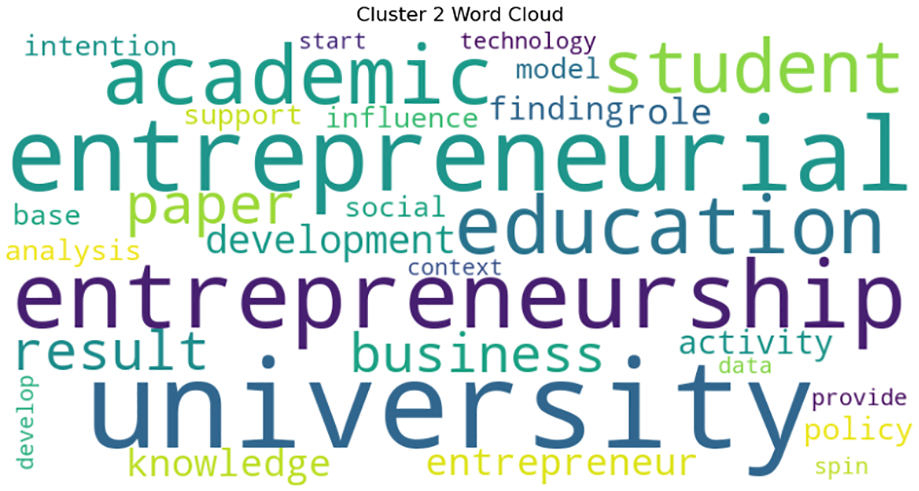
Word-cloud of academic entrepreneurship.
Conclusion
Discussion of Findings
This study, by integrating the perspectives of bibliometric analysis and topic modeling, systematically reveals the core research topics and their integration pathways of entrepreneurial universities against the backdrop of the digital revolution, thereby addressing the research question. Specifically, the bibliometric analysis indicates that research on entrepreneurial universities focuses on three major themes: “academic entrepreneurship,”“entrepreneurial education,” and “entrepreneurial behavior.” Among these, Ajzen’s Theory of Planned Behavior (TPB) and Etzkowitz’s Triple Helix Model serve as the theoretical foundations. The distribution of high-frequency keywords (such as “innovation” and “performance”) and core journals (such as Research Policy) suggests that the field has long been concerned with the balance between the economic value creation and social responsibility of universities. However, the impact of digital technology on traditional theoretical frameworks has not been fully explored. Topic modeling further reveals how digital technology is embedded in the three major themes:
Firstly, in the field of entrepreneurial behavior, VR/AR technology enhances students’ entrepreneurial efficacy by simulating real entrepreneurial environments. Yet, the mechanisms by which specific factors such as the scale and diversity of virtual social networks affect entrepreneurial intention remain to be verified. Secondly, in the field of entrepreneurial education, 5G edge computing and generative AI (e.g., ChatGPT-4) have reshaped teaching scenarios. However, the differences in entrepreneurial opportunity acquisition between virtual and real social networks (e.g., in traditional manufacturing versus tech startup industries) have not been systematically compared. Lastly, in the field of academic entrepreneurship, digital learning platforms and virtual laboratories have significantly improved the efficiency of academic entrepreneurship (Secundo et al., 2020). However, the governance mechanisms for digital intellectual property (such as NFT-ized research outcomes) still need to be refined.
These findings not only validate the multidimensional characteristics of entrepreneurial universities described in existing literature (Guerrero et al., 2016) but also reveal how digital technology reconstructs the entrepreneurial ecosystem through the “technology-organization-individual” pathway, echoing Nambisan’s (2017) theory of the digital entrepreneurship ecosystem. However, current research pays insufficient attention to interdisciplinary differences (e.g., between science/engineering and humanities/social sciences) and industry-specific characteristics, and there is an urgent need for theoretical expansion.
Recommendations for Future Research
Future research can be further explored in the following directions: Firstly, at the theoretical level, it is necessary to develop an interdisciplinary theoretical framework for digital academic entrepreneurship, with particular attention to the unique pathways of digital academic entrepreneurship in the humanities and social sciences. Integrating the Theory of Planned Behavior with digital technology adoption models (such as the Unified Theory of Acceptance and Use of Technology) can help explain the interactive impact of virtual and real social networks on entrepreneurial intention. Secondly, at the practical level, comparisons should be made regarding the role differences of virtual and real social networks in entrepreneurial resource acquisition across different industries (such as manufacturing and finance), and industry - tailored optimization strategies should be designed. The application of blockchain technology in digital intellectual property management should be explored to build a decentralized mechanism for academic achievements rights confirmation and transaction. Lastly, at the methodological level, mixed - methods approaches (such as social network analysis and experimental methods) can be adopted to quantify the impact of virtual social network parameters (such as node centrality) on entrepreneurial behavior. Longitudinal studies should be introduced to track the long - term effects of digital technology on the organizational changes of entrepreneurial universities. This study is limited by the database coverage and the subjectivity of literature screening. In the future, conclusions can be strengthened through multi - source data (such as patent databases and social media texts), and more operational digitalization guidelines can be provided for policymakers.
To sum up, this study aims at the three research themes of how EUs embrace digital opportunities, and puts forward some problems that need to be considered and solved by the theoretical and practical circles for each theme, so as to clarify the research direction of future scholars.
Cluster 0: Entrepreneurship Behavior
How do the extent and manner in which face-to-face social networks and virtual social networks influence entrepreneurial intention differ in the entrepreneurial environment of various industries? How can these two types of social networks be optimized according to industry characteristics to enhance entrepreneurial intention?
Which specific factors in virtual social networks (such as network size, diversity of network members, frequency of information exchange, etc.) have a greater impact on entrepreneurial intention? And how do these factors interact with those in face-to-face social networks?
Cluster 1: Entrepreneurship Education
How do the sources of entrepreneurial opportunities provided by face-to-face interactions (such as local business gatherings, industry-specific conferences in traditional manufacturing) compare with those from virtual networks (like online forums for tech - startup ideas) in terms of quality and quantity?
The role of different types of social networks in entrepreneurial resource acquisition in various industries. In the financial industry, how effective are face - to - face connections with potential investors (such as through private banking events) compared to virtual networks (like online investment-matching platforms) in obtaining financial resources?
Cluster 2: Academic Entrepreneurship
How do different factors of digital academic entrepreneurship (such as the degree of application of digital technology, the digital integration of academic resources, etc.) respectively affect the behavioral motivation of entrepreneurs? Is there an interaction between these factors, and if so, how does it affect them?
Is there a difference in the impact of digital academic entrepreneurship on entrepreneurial behavioral motivation across different academic disciplines? For example, in the fields of science and engineering and humanities and social sciences, which specific aspects of digital academic entrepreneurship have a more significant role in stimulating entrepreneurial behavioral motivation?
Footnotes
Acknowledgements
We would like to thank our colleagues from the School of Economics & Management at Nanjing Tech University for their invaluable support and insights throughout this research.
Ethical Approval and Informed Consent Statements
This study did not involve any human participants or animals.
Funding
The authors disclosed receipt of the following financial support for the research, authorship, and/or publication of this article: This work was supported by the Major Project of Philosophy and Social Science Research in Jiangsu Universities: Research on the Innovation and Entrepreneurship Education Ecosystem of Local Entrepreneurial Universities (2020SJZDA113) and the Ministry of Education Humanities and Social Science Research Planning Fund Project: Research on the Teaching Quality Assurance Mechanism of First-Class Courses (21YJA880089).
Declaration of Conflicting Interests
The authors declared no potential conflicts of interest with respect to the research, authorship, and/or publication of this article.
Data Availability Statement
The datasets generated during and/or analyzed during the current study are available from the corresponding author on reasonable request.