




Abstract
Environmental sustainability orientation (ESO) is critical to leading sustainable business practices, so it has become a promising and attractive topic for green sustainable development. However, how to coordinate the forces of government, consumers, competitors, and managers to drive firms to adopt ESO is an important theoretical and practical issue to be further studied. Based on stakeholder theory, we develop a configurational framework and propose that high ESO is contingent upon the coordination among perceived policy pressure, consumer pressure, competitive pressure, and manager commitment. By using fuzzy set qualitative comparative analysis (fsQCA) in 127 cases, we reveal that single antecedent condition of stakeholder is difficult to form high ESO and identify them into three different pathways. The results further indicate that there is an asymmetric relationship between the three high ESO paths and the two non-high ESO paths, that is, the relationship between “high ESO” and “non-high ESO” is not either/or. The study highlights the theoretical significance of ESO based on the configuration of multiple antecedents among different stakeholders, which makes up the gap of the traditional statistical analysis on the interpretation of ESO. We also provide implications for the government and enterprises to promote the formation of ESO.
Plain language summary
Keywords
Introduction
Environmental sustainability has been the “anthem” of many academics and proactivity practitioners since the early 1990s (Danso, Adomako, Amankwah-Amoah, et al., 2019). After 2020, with the outbreak of COVID-19, the food crisis, resource exhaustion, carbon emissions, and other issues have once again set off a global wave of ecological and environmental protection, which shows that the traditional management model can no longer adequately solve environmental problems (Yong et al., 2022). Firms are unlikely to return to the traditional economic paradigm in which the pursuit of profit maximization is the sole goal of firms (Rehman et al., 2022; Sarkis, 2001). Businesses and markets will inevitably be limited and dependent on ecosystems, and wise firms will choose environment-related strategies to shape competitive advantage (Hart, 1995). Therefore, increasingly, enterprises are reformulating strategies and allocating their resources and capabilities to guide and convey their green mission and actions. As an important business principle guiding environmental practices, environmental sustainability orientation (ESO) is considered a firm-level strategic tendency that pushes firms to consider, engage in, and commit to environmental activities, processes, and programs (Danso, Adomako, Amankwah-Amoah, et al., 2019; Roxas et al., 2017; Roxas & Coetzer, 2012) to mitigate the negative impact of business on nature.
With the increasing improvement of regulations and consumer awareness of environmental protection, on the one hand, the pressure on firms to strengthen the protection of the natural environment will not stop. Only by integrating environmental issues into the strategic level can firms gain sustainable competitive advantage. On the other hand, due to the dual externalities of environmental management and the characteristics of high investment costs and risks (A. B. Jaffe et al., 2005), some firms lack the motivation to choose ESO. This means that the firm faces both opportunities and challenges in adopting ESO. Therefore, how to coordinate and solve the above conflicts and paradoxes, and how to drive an increasing number of firms to integrate ESO into their daily business strategies, has become one of the core issues in the field of environmental management. Unfortunately, existing studies mainly focus on the impact of ESO on firm performance (Andersén, 2022; Danso, Adomako, Amankwah-Amoah, et al., 2019; Rehman et al., 2022), while a few focus on the antecedent variables of ESO (e.g., Amankwah-Amoah et al., 2019; Danso, Adomako, Lartey, et al., 2019; Roxas & Coetzer, 2012). Moreover, the traditional statistical analysis that only considers a single factor or several independent antecedent conditions has limited explanatory power, which is also not conducive to the cultivation and incentive of eco-friendly enterprises. In addition, ESO selection is a complex strategic management decision, and it is of more theoretical and practical significance to explore the complex impact of different key factor combinations on ESO from a holistic perspective. However, the synergistic effect of multiple factors on the driving force of ESO very limited or no insights.
Institutional theory and stakeholder theory are two key theories to explain the antecedents of environmental strategy adopted by firms, but the former focuses on the influence of the external institutional environment, while the latter emphasizes not only the external stakeholders, but also the driving role of internal stakeholders (Brulhart et al., 2019). In general, firms develop and demonstrate their ESO by integrating environmental concerns into their culture, decision-making, strategies, and business operations, and by interacting with stakeholders (Linnenluecke & Griffiths, 2010; Roxas & Coetzer, 2012; Zwetsloot & van Marrewijk, 2004). Therefore, underpinned by stakeholder theory, we primarily investigate the following questions: (1) What are the key stakeholder factors driving the formation of ESO? (2) How to coordinate the configuration of the stakeholder factors to drive high ESO?
This study contributes to extant literature in two main ways. First, based on the stakeholder theory, we identify four external factors (i.e., coercive and incentive policy pressure, consumer pressure, competitive pressure) and one internal environmental factor (i.e., manager commitment) to enrich the research on ESO. Second, scholars have leaned toward qualitative methods to verify the net effect of GPO (Andersén, 2022; Danso, Adomako, Lartey, et al., 2019; Roxas & Coetzer, 2012), however, our study grasps the complexity of ESO in more depth by exploring its multidimensional nature. Drawing on the configuration theory and employing fsQCA method, we deeply analyze the collaborative path of ESO driven by multiple combinations of five antecedents, which can address the limitations of traditional empirical analysis. Finally, this study reveals how developing countries, represented by China, drive the formation of ESO for manufacturing enterprises from different stakeholder perspectives. In essence, this study is relevant as the global is seeking to positively progress to sustainable development.
Next, we review the relevant literature and research framework of ESO and stakeholder theory framework. The next section introduces the fsQCA method and processes. Then we analysis and present the results. Lastly, we summarize the results, discuss the theoretical and managerial implications of the study, identify its shortcomings and directions for further research.
Literature Review
Environmental Sustainability Orientation
Since the launch of the United Nations sustainable development goals (SDGs), research on corporate sustainability and strategic orientation toward sustainable development has been increasing (Khizar et al., 2022). Recently, the volume of empirical studies examining environmental sustainability orientation (ESO)—also referred to as environmental orientation, sustainable orientation, or eco-sustainability orientation—has grown exponentially. ESO has emerged as a critical priority in business management, emphasizing that corporate activities must consider both organizational interests and environmental sustainability (Khizar et al., 2024; Roxas et al., 2017). The concept of environmental sustainability was first proposed by World Bank researchers, who adopted the term “environmentally responsible development” (World Bank, 1992). Then, Goodland (1995) formally put forward the construct of “environmental sustainability,” that is, the strategy emphasizing the indefinite maintenance of global life support systems, including the aim of improving human welfare by protecting material sources and minimizing waste, while preventing harm to humanity. With the rapid development of industrialization, accompanied by environmental pollution and significant energy consumption, the voice of enterprises for environmental sustainability is getting stronger and stronger. As a result, companies are increasingly incorporating environmental sustainability into their business decisions. Previous research has established that ESO can be valuable strategic assets for firms, reflecting the integration of environmental and social values and practices into firms’ business strategy (Roxas et al., 2017; Xie et al., 2024). Therefore, ESO is also known as environmental orientation or sustainability orientation. As a company-level strategic posture and orientation, ESO reflects the firm’s tendency of conducting business, planning, and practicing activities in an environmentally sustainable manner (Danso, Adomako, Amankwah-Amoah, et al., 2019; Danso, Adomako, Lartey, et al., 2019; Roxas & Coetzer, 2012). ESO has expanded the scope of business objectives, particularly those aimed at minimizing negative impacts on the natural environment (Roxas & Coetzer, 2012).
For purpose of this study, ESO is defined as the overall proactive strategic posture in which the firm integrates environmental concerns and practices into its strategic, tactical, and operational activities, reflecting its orientation of knowledge, practice, and commitment to environmentally sustainable management (Roxas et al., 2017; Zhang & Teng, 2023). Compared to nonenvironmentally oriented counterparts, enterprises that pursue environmental sustainability aim to satisfy more collective needs (Roma et al., 2023). As a result, firms with higher ESO levels are more likely to institutionalize a range of measures and actions aimed at reducing their negative impact on the natural environment in their overall strategic structures, processes, and activities. The existing literature provides profound insights for this study. However, some literature mainly focuses on its concept, dimensions, and measurement (Andersén, 2022; Roxas & Coetzer, 2012), while others focus on its relationship with performance results (Andersén, 2022; Danso, Adomako, Amankwah-Amoah, et al., 2019; Rehman et al., 2022; Roma et al., 2023), which have not paid enough attention to the multiple causal complexities that affect ESO. For instance, Roma et al. (2023) examined the effects of new ventures’ ESO on the crowdfunding performance. Danso, Adomako, Amankwah-Amoah, et al. (2019) examined the relationship between stakeholder integration and financial performance is mediated by ESO. Roxas and Coetzer (2012) examined the effect of institutional environment and managerial attitudes on ESO of small firms. In other words, the academic pays insufficient attention to the antecedent variables that affect ESO, and most of them stay at the level of the impact of a single factor on ESO (Amankwah-Amoah et al., 2019; Danso, Adomako, Lartey, et al., 2019; Roxas et al., 2017). However, how to drive firms to adopt ESO is of great significance for the environment, firms, and social development. Therefore, this study focuses on exploring the antecedents that drive ESO and how to coordinate configurations to generate high ESO.
Stakeholder Theory and Environmental Sustainability Orientation
Stakeholder refer to the groups that can influence or be influenced by the achievement of organizational goals (Freeman, 1984). However, due to the wide range of “groups,” there is currently no consensus on the composition of stakeholders with different emphases (Derry, 2012). Freeman (1984) proposed that to effectively allocate and manage scarce resources, it is necessary to distinguish between primary and secondary stakeholders, which has been widely discussed and applied. Mitchell et al. (1997) advocated prioritizing stakeholders on three key attributes: power, legitimacy, and urgency. The fundamental principles of stakeholder theory indicate that stakeholders are crucial to the success of a business as they influence its long-term strategic goals (Freeman, 1984). The threat posed by environmental mismanagement by various stakeholders may motivate firms to improve their corporate environmental practices (Buysse & Verbeke, 2003). Therefore, in the process of strategy decision and execution, firms must systematically consider stakeholder issues to respond sensitively to their environment (Freeman, 1984; Theodoulidis et al., 2017).
The choice of corporate environmental strategy is inherently complex. Research is ambiguous as to which stakeholders are most important for ESO. As for the primary stakeholders, it is reported that government, customers, and competitors are the main factors affecting the direction of corporate behavior (Dubey et al., 2015). Freeman et al. (1995) classified the adoption of green activities by enterprises into four categories based on their level of environmental sensitivity: legal, market, stakeholder, and activist. Among them, the first three categories are mainly driven by external factors, and the last type is driven by internal factors. Specifically, the legal type is to avoid the punishment of environmental laws and regulations, the market type is to respond to customers who prefer the eco-friendly, the stakeholder type is to meet the environmental protection needs of competitors, suppliers, communities and other stakeholders, and the activist type is affected by the firm deep internal drive. Similarly, Banerjee et al. (2003) identified four important antecedents that drive corporate environmentalism: public concern, regulatory force, competitive advantage, and top management commitment, that is, stakeholders including the public, regulators, competitors, and managers. As ESO also reflects the implementation of environmentalism by firms, based on the stakeholder theory and referring to the studies of Freeman et al. (1995) and Banerjee et al. (2003), this study argues that the government, the public, competitors, and managers are the key external and internal stakeholders that driving firms to choose ESO. The representative conditional variables are selected from these aspects, specific driving factors are analyzed as follows.
Government
As a regulator, government departments have the power to restrict, supervise and force corporate behavior and activities, that is, to require firms to comply with laws and policies through command and control (Sarkis, 2001), which is not available to other stakeholders. Therefore, the coercive and incentive policy pressure issued by government departments is generally regarded as the basis and premise for driving firms’ environmental protection actions (Banerjee et al., 2003; Schilke, 2018), and also an effective mechanism to drive firms to be environmentally responsible (York & Venkataraman, 2010).
Public
The public has a wide range, including consumers, communities, media and other stakeholders. The tendency of firms for environmental protection is related to pressure from the public, especially from consumers. This is because consumers are more likely to boycott or ostracize irresponsible businesses than to support responsible ones (York & Venkataraman, 2010). Generally speaking, consumers are more dominant in the business process, and consumers’ environmental protection pressure often reflects the market demand for related products, so we believe that public pressure is more transmitted to the focus firms through consumer pressure.
Competitors
When more firms in the industry pursue differentiation and choose to adopt proactive environmental strategies, demonstration effects and first-mover advantages will be formed in terms of environmental sustainability. This means that the competition of similar products in the market is more intense, and obviously will pose a kind of imposed pressure and imitation pressure on corporate environmental strategy and management. Therefore, pressure from competitors increases the perceived importance of adopting environmental strategies and management such as ESO (Dupire & M’Zali, 2016).
Managers
The commitment of managers is a powerful internal force that can promote corporate environmentalism (Banerjee et al., 2003). Previous literature has shown that managers, especially top managers, are also key internal stakeholders and are directly responsible for the survival and continued success of the firm (Clarkson, 1995). Manager commitment not only motivates them to adopt an environmentally responsible orientation, but also motivates organizations to formulate strategies or conduct business in a proactive and eco-friendly manner, and provide resources and support (Mittal & Dhar, 2016; Sharma, 2000). Therefore, manager commitment is also an important driver of firms ESO (Roxas & Coetzer, 2012).
Construction of Theoretical Framework
Policy Pressure and ESO
As the regulator, the government mainly shapes the eco-friendly attitude of firms through coercive policy and incentive policy (Grewal & Dharwadkar, 2002; A. Jaffe et al., 2002). First, the coercive policy pressure forces firms to choose ESO with its compulsory force. Coercive policy refers to the coercive force that the government imposes restrictions directly through authority and orders and indirectly through regulations and rules (Grewal & Dharwadkar, 2002). Explicit punishments are necessary for proactive environmentalism (King & Lenox, 2000). On the one hand, coercive policies can reduce the impact on the environment by setting environment-related standards in advance or requiring firms to use pollution control technologies, as well as evaluating the extent to which firms comply with the policy. On the other hand, governments can impose fines on firms that violate environmental protection policies, or even ask them to close down. Therefore, to meet the requirements of laws and regulations and avoid economic penalties, firms may actively or passively transition to ESO.
Second, incentive policy pressure induces firms to adopt ESO with potential advantages. Incentive policy refers to incentives provided in the form of subsidies, taxes, tariffs, or other preferences, aimed at influencing the values, beliefs, attitudes, and behaviors of firms (Grewal & Dharwadkar, 2002). The formulation of relevant incentive policies not only provides a market signal indicating that firms can access a wide range of resources, but also can help the firms partially compensate for the increase in costs caused by green sustainability. In addition, these policy incentives related to creating sustainable business activities help knowledge and technology flow within the industry, reducing the resulting uncertainty. Therefore, the higher the incentive policy pressure, the more it can drive firms to tend toward eco-friendly strategic choices (Ng et al., 2022).
Consumer Pressure and ESO
Consumers use purchase choices or boycotts to pressure firms to protect the environment. Therefore, consumer pressure is another core driving force for firms to adopt ESO. As green awareness grows, more and more consumers either reward or intend to reward firms that address environmental issues in their business and marketing practices, as well as punish firms that ignore environmental requirements (Banerjee, 2001). Therefore, the environmental pressure from consumers provides both constraints and opportunities for ESO. On the one hand, consumers may boycott unethical and environmentally unfriendly companies (Eiadat et al., 2008), and those who do not engage in green production or practices may quickly be disadvantaged or even eliminated from the market. On the other hand, the environmental pressure from consumers also reflects consumers’ demand for eco-friendly products or services. The higher the green demand, the more uncertainty can be reduced in the market prospects of business activities. By adopting the ESO strategy, consumer satisfaction and corporate reputation will be improved due to spillover effects, thereby further enhancing the enthusiasm of firms for environmental sustainability.
Competitive Pressure and ESO
Competitive pressure mainly comes from peers, and firms will closely monitor the relevant strategic changes of their competitors and adjust their strategies (Y. N. Li & Ye, 2011). If a key competitor wins more consumer favor and government resources through green products or practices, other companies will also take action to imitate and follow (Carter & Rogers, 2008). Therefore, in the process of competing for resources and markets, more and more green-related practices by competitors will prompt firms to adopt similar green strategies. In other words, in the context of the rising trend of environmental protection, those enterprises under strong competitive pressure will follow their competitors to develop ESO and carry out green-related activities to obtain a good green market image and shares. Therefore, the greater the environmental pressure from competitors, the more firms are able to adopt ESO.
Manager Commitment and ESO
Manager commitment reflects the level of emphasis placed by top managers on environmental protection and their efforts in green development (Xing et al., 2019). Environmental commitment is a basic prerequisite for promoting environmental behavior and taking action within firms (Keogh & Polonsky, 1998). When managers have environmental commitment and a sense of social responsibility for green environmental protection, they are more likely to choose positive environmental strategies and integrate ecological goals into the development goals of enterprises (Banerjee et al., 2003; Bhatia, 2021). Compared to managers with lower environmental concerns, managers with high environmental concerns spend more time and resources on environmental initiatives (Naffziger et al., 2003). Therefore, the higher the level of manager commitment, the more likely they are to adopt ESO.
Based on the above analysis, this article draws on stakeholder theory and selects coercive policy pressure, incentive policy pressure, consumer pressure, competitive pressure, and manager commitment as antecedents from a configuration perspective. It constructs a theoretical framework for the combined synergistic impact of ESO from different stakeholder factors. Figure 1 shows the conceptual model of the study.
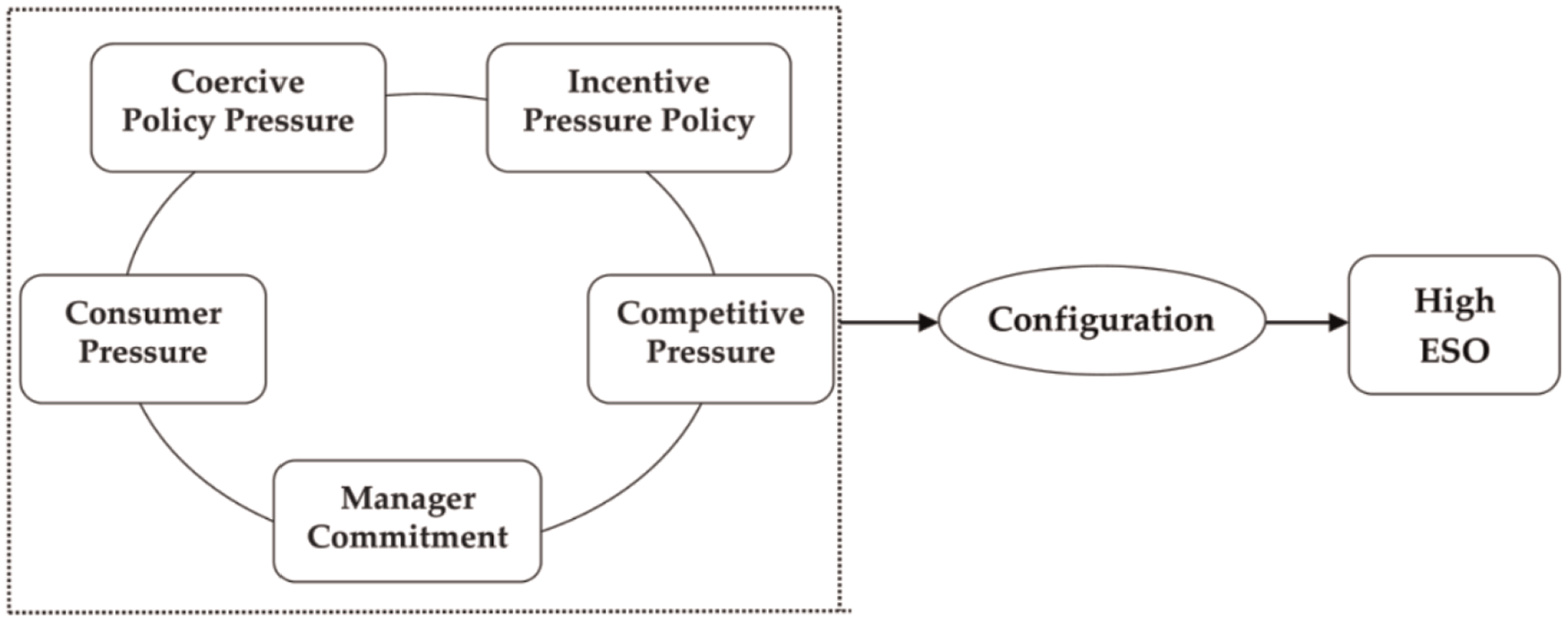
The framework of this research.
Methods
Fuzzy Set Qualitative Comparative Analysis (fsQCA)
From the perspective of research, traditional correlation analysis and regression analysis mainly focus on the “net effect,” and its basic assumption is that the antecedent conditions are independent of each other and there is a one-way linear relationship with the result. However, ESO is related to the strategic posture or strategic transformation, and the antecedents driving firms to adopt ESO are inevitably complex and the result of comprehensive consideration of multiple factors.
Based on the perspective of configuration, qualitative comparative analysis (QCA) believes that the generation of certain social phenomena is complex, multiple, and non-linear (Ragin, 2008). It pays attention to the synergistic influence of the combination of multiple influencing factors on the results (Fiss, 2011; Juntunen et al., 2019). Therefore, this method provides ideas and methods for what we focus on. In addition, considering that the antecedent and outcome concerned in this study are continuous variables, fuzzy set qualitative comparative analysis (fsQCA) can better avoid information loss in the process of data conversion and improve measurement accuracy (Ragin, 2008). It views causality in terms of necessity and sufficiency relations between sets, and it also allows for equifinality which means that the antecedent causal conditions can combine to multiple equally effective configurations to achieve the same outcome (Misangyi et al., 2017; Ragin, 2008). Therefore, we using the fsQCA 3.0 software to analysis.
Measurement
Both domestic and foreign maturity scales were used to measure antecedent conditions and outcome variables in this study. For foreign maturity scales, we modified them by Chinese-English translation until the two translations showed no substantial difference in the meaning of the scales. Specifically, first of all, referring to the study of A. Jaffe et al. (2002), policy pressure is divided into two types: coercive policy pressure and incentive policy pressure. Coercive policy pressure was measured by four items, mainly including laws, regulations, and other relevant provisions. Incentive policy pressure was measured by three items: taxation, finance, and other relevant provisions. Secondly, based on Y. N. Li and Ye’s (2011) research on green environmental protection in the Chinese context, consumer pressure is measured through two items. Thirdly, we used three items adopted from Y. N. Li and Ye (2011) for measuring competitive pressure. Fourthly, referring to the study of Banerjee et al. (2003), three items are used to measure manager commitment. Finally, we used 17 items adopted from Roxas et al. (2017) and Danso, Adomako, Amankwah-Amoah, et al. (2019), Danso, Adomako, Lartey, et al. (2019) for measuring ESO from three dimensions: firm environmental sustainability knowledge, firm environmental sustainability practice, and firm environmental sustainability commitment. All items were measured on a 7-point Likert scale where 1 = strongly disagree, … 7 = strongly agree. Details of constructs and scale items are presented in the Appendix.
Data Collection
This study focuses on Chinese manufacturing firms for the following reasons: Firstly, China is in a critical period of manufacturing transformation. With the proposed action plan of “Made in China 2025,”“Carbon Peak and Carbon Neutrality”, “Green Manufacturing” and other related concepts and goals, green sustainability has become the necessary path for the development of Chinese manufacturing firms in the new era. Secondly, the manufacturing industry is highly dependent on natural resources, some manufacturing industries with high energy consumption, high emissions and high pollution are often the culprits of environmental deterioration. Finally, the manufacturing industry is increasingly affected by policy and consumer environmental pressure, so a comprehensive analysis of how to drive manufacturing firms to adopt ESO can obtain more general and significant research conclusions.
We selected senior managers as the survey subjects, such as CEOs, general managers, R&D managers, environmental department managers, etc., to ensure that respondents can accurately evaluate the relevant environmental pressure, values, strategic orientation, and other situations faced by firms. In addition, we selected six provinces that reflect different degrees of industrialization and economic development for the questionnaire survey. Specifically, Liaoning and Jilin provinces are located in Northeast China, with a large number of heavy industrial enterprises, but their economic development is slow; Zhejiang and Shandong provinces are located in East China, with developed manufacturing industries, high levels of marketization and economic development; Henan Province is located in the central region of China, reflecting the average level of economic development; Sichuan Province is located in southwest China, reflecting a relatively low level of economic and manufacturing development. We distributed questionnaires through two channels: First, relying on the platform of Jilin University, we distributed questionnaires to MBA students studying in the Business School of Jilin University; Second, based on personal and team social networks, questionnaires were distributed to managers in six provinces. The formal survey was conducted from November 2021 to June 2022, with a total of 200 questionnaires issued. In the end, we collected 127 valid questionnaires, with an effective rate of 63.5%. The descriptive statistical analysis of the case is shown in Table 1.
Characteristics of the Case (N = 127).

Calibration
Calibration is a key process in the QCA approach, which is to calibrate the antecedents and outcome variables of the study to reflect the membership of each variable in the set of the case (Dabić et al., 2023). In this study, all variables were scored using seven-point Likert scales. Thus, calibration requires the transformation of the interval scale measures into fuzzy-set membership scores, which can range from 0 (full exclusion from a set) to 1 (full inclusion; Ragin, 2008; Silva et al., 2021). The thresholds of calibration are derived from existing theory and researcher’s prior knowledge (Ragin, 2008). Therefore, according to the relationship between the measurement scale and the actual distribution of the sample, and referring to previous studies (Fiss, 2011; Li et al., 2023; Misangyi et al., 2017), this study takes the maximum value, the mean value and the minimum value after the mean as the qualitative anchor points of full membership (i.e., 1), crossover point (i.e., 0.5), and non-membership (i.e., 0; Ragin, 2008). The specific calibration parameters are shown in Table 2.
Calibration of Conditions and Outcome.

Analysis and Results
Analysis of Necessary Conditions
Before configuration analysis, it is necessary to examine whether any single condition is necessary for the outcome to occur (Khizar et al., 2024). Consistency is the main criterion for testing the necessary conditions, and when the consistency is higher than 0.9, the antecedent is the necessary condition for the outcome (Fiss, 2011; Ragin, 2008). As shown in Table 3, the consistency of all individual antecedent conditions is lower than the threshold of 0.9, indicating that none of the five antecedent conditions is necessary for high ESO. It is further indicated that ESO is affected by multi-variable linkage and collaboration, and the fsQCA method is suitable for exploring the causes of high-level ESO in firms.
Necessary Condition Analysis.

Sufficiency Analysis of Conditional Configuration
To explore the configuration for achieving high ESO, we use fsQCA 3.0 to analyze the sufficient conditions of the case. Given that no single condition explained the ESO, we adopted the guidelines set by Rihoux and Ragin (2009) and Schneider and Wagemann (2010) as follow: The analysis of sufficient conditions for the outcome starts with the construction of a truth table, which encompasses all logically possible combinations of causal conditions. Therefore, we construct a truth table that sets the case frequency number to 3, retaining over 82% of cases, which is much higher than the threshold of 75% (Rihoux & Ragin, 2009; Schneider & Wagemann, 2010). Then, we followed the suggestions of Ragin (2008) and Schneider and Wagemann (2010) with the raw consist threshold set to 0.8 and the PRI consist threshold above 0.75. By applying these thresholds, the truth table configurations were reduced to simplified combinations using the truth table algorithm for the result run later (Ragin, 2008).
Finally, the fsQCA generates three solutions: complex solution, parsimonious solution, and intermediate solution (Ragin, 2008). Specifically, the condition that both intermediate solution and parsimonious solution appear is the core condition, indicating a strong causal relationship with the outcome. The condition that only appears in the intermediate solution is the peripheral condition, indicating an auxiliary contribution to the interpretation of the outcome (Fiss, 2011; Ragin, 2008). The results of causal conditions configuration of high and non-high ESO are shown in Table 4.
Configurations Sufficient for ESO.


Note.  core conditions presence;
  peripheral conditions presence;
  core conditions absence;
  peripheral conditions absence; A blank space indicates “don’t care.”
High ESO Configurations
As shown in Table 4, there are three configurations for high ESO (solutions H1, H2, and H3), namely configuration H1, H2, and H3. The consistency of the three configuration paths is 0.981, 0.974, and 0.982 respectively, and the overall solution consistency is 0.962. All the values are higher than the acceptable threshold level of 0.8 (Rihoux & Ragin, 2009), which indicates that the three configurations are sufficient conditions for high ESO, and further indicates that the antecedents for firms to adopt ESO are multiple and have equivalence. In the generated configuration path, the overall solution coverage is 0.860, indicating that the solution has a strong empirical correlation, and the three paths explain the main reasons for the formation of high ESO. To better compare the differences between different configuration paths, we focus on the core condition and intermediate solutions and summarize the three paths. The specific analysis is as follows.
Pathway H1 (Coercive Policy Pressure × Consumer Pressure × Manager Commitment) shows that high manager commitment plays a central role, while coercive policy pressure and consumer pressure play an auxiliary role. This path indicates that when managers have a high commitment to the environment and perceive that both the government and consumers have certain requirements for environmental protection, firms tend to develop a high ESO strategic tendency. Managers’ environmental commitment reflects their attitudes toward the environment, values, and beliefs on how to treat environmental issues (Reynolds, 2013). By adopting ESO, firms cannot only comply with government regulations and meet the environmental needs of consumers but also be in line with managers’ personal values. Under the dual promotion of coercive policy pressure and consumer pressure, the tendency to transform commitment into strategic action will strengthen, and the possibility of firms choosing ESO as a strategic posture will also increase.
Pathway H2 (Coercive Policy Pressure × Competitive Pressure × Manager Commitment) shows that high manager commitment plays a central role, while coercive policy pressure and competitive pressure play an auxiliary role. Similar to path H1, path H2 also produces a high level of ESO due to the influence of external environmental pressure under the high manager commitment. The difference between the two is that the latter is mainly affected by the competitors. In other words, under the high coercive policy pressure, more and more manufacturing enterprises have joined in green process innovation and green production innovation. This aligns with the findings of Khizar et al. (2024), who indicates that the adoption of ESO not only adheres to environmental regulations but also enables competition with industry rivals for market share in the realm of environmental protection. Those competitors who implement ESO gain access to more market and government resources and realize first-mover and differentiation advantages. The greater these advantages, the more likely it is that firms will follow their competitors’ ESO practices, especially if managers commit to environmental sustainability.
Pathway H3 (Consumer Pressure × Competitive Pressure × Manager Commitment) shows that high manager commitment plays a central role, while consumer pressure and competitive pressure plays an auxiliary role. It shows that regardless of whether firms can perceive the penalty or incentive pressure in environmental protection, high ESO will occur when external consumers have high green demand and environmental awareness, and when major competitors have attracted customers and gained relative competitive advantages by implementing ESO. In other words, consumer pressure on environmental protection reflects high environmental awareness that can be transformed into green demand, and first-mover competitors can use it to succeed in the market. In the case of high manager commitment, driven by the dual environmental pressure of consumers and competitors in the external market, firms are more likely to choose ESO.
There is little difference in interpretation rates among the three paths. The coverage of path H2 is the highest, with the raw coverage of 0.764 and the unique coverage of 0.055. Path H3 has the lowest coverage, with the raw coverage of 0.734, and the unique coverage of 0.040. The core or peripheral conditions of each path are multiple, which further validates the emphasis in this study that ESO is driven by internal and external key stakeholder force, and it is difficult for a single factor to fully describe the real situation of a firm’s choice of ESO.
Non-high ESO Configurations
We also supplement the analysis of the antecedent mechanism of non-high ESO, and the results show that there are two pathways. Path NH1(∼Coercive Policy Pressure × ∼Consumer Pressure × ∼Competitive Pressure × ∼Manager Commitment) shows that enterprises with core condition coercive policy pressure and consumer pressure absent, and peripheral condition competitive pressure and manager commitment absent, their ESO will not be high. It indicates that the presence or absence of incentive policy pressure is not related to non-high ESO when managers’ environmental commitment is poor, and they neither perceive policy punishment nor consumer environmental pressure. In other words, when green sustainability does not rise to legitimacy and internal and external stakeholders do not pay attention to environmental issues, firms will not consider environmental factors in the process of strategy formulation and adoption. Therefore, when external coercive policy pressure, consumer pressure, competition pressure, and internal managers’ environmental commitment are insufficient, even if the government has formulated strong incentive policies, high ESO cannot be formed.
The configuration NH2 (∼Incentive Policy Pressure × ∼Consumer Pressure × ∼Competitive Pressure × Manager Commitment) shows that the peripheral conditions of incentive policy pressure, consumer pressure, and competitive pressure are all absent, and then the formation of ESO is inhibited. Different from path NH1, NH2 shows that when firms perceive that the current environmental policy incentives are insufficient, as well as external consumer environmental protection pressure and competitive pressure are not high, even if managers have a high commitment to environmental protection, they cannot be transformed into formal corporate strategic orientation.
Robustness Test
Given that QCA is a set theory method, we used the method of adjusting the consistency threshold for the robustness test (Schneider & Wagemann, 2012). Referring to the study of Ordanini et al. (2014), we increased the consistency threshold by 0.05, that is, 0.85 instead of 0.80, and used a stricter threshold to conduct the sufficiency analysis of the configuration again. After adjusting the threshold, the configuration results remain unchanged, so the research results in this study have strong robustness.
Conclusions and Discussion
Conclusions
Based on stakeholder theory, this study explains the complex reasons why firms choose ESO from the perspective of configuration. The main conclusions are as follows: First, the formation of ESO is affected by factors at multiple levels. Any single condition among the five antecedent conditions discussed in this paper cannot constitute the necessary conditions for the formation of ESO, but the linkage effect of multiple antecedent conditions is required. Second, different from regression analysis, which emphasizes the net effect of a single factor on the results, we find that the path leading to high ESO is no single, but there are three different paths (Coercive Policy Pressure × Consumer Pressure × Manager Commitment; Coercive Policy Pressure × Competitive Pressure × Manager Commitment; and Consumer Pressure × Competitive Pressure × Manager Commitment) that are equivalent. Among them, manager commitment plays a core role, and there is a substitution and synergy relationship between coercive policy pressure, consumer pressure, and competitive pressure. Third, there is an asymmetric relationship between the three high ESO configuration paths and the two non-high ESO configuration paths, that is, the high ESO mode is not the opposite of the non-high ESO mode. This holistic discussion of the combined effect of numerous antecedents not only enriches theoretical research but also provides effective guidance for driving more firms to adopt ESO. The specific analysis is as follows.
Theoretical Contributions
Existing studies primarily examine the influence mechanism of a single antecedent variable on ESO and its relationship with firm performance (Andersén, 2022; Danso, Adomako, Amankwah-Amoah, et al., 2019; Rehman et al., 2022; Roma et al., 2023; Roxas & Coetzer, 2017), while emphasizing the net effects among influencing factors. However, these studies have not adequately considered the linkage effects of multiple stakeholder factors within dynamic complex environments, nor have they addressed the interactions between various antecedent variables. This study discusses the synergistic effect of antecedent conditions from a holistic perspective, further enriching the ESO literature. This study lays claim to four contributions. Specifically, first, we innovatively introduce the fsQCA method and combines stakeholder theory and configuration theory to provide a new perspective and method for understanding the driving mechanism of ESO. Second, the results show that manager commitment is not a necessary condition for ESO formation, but it plays a central role in all three paths. Therefore, manager commitment is of great significance in promoting firms to build a high-level ESO. Third, the high ESO paths show that the presence of incentive policy pressure is not related to high ESO, but non-high ESO is related to insufficient incentive policy pressure (path NH2). Interestingly, according Herzberg’s two-factor theory, the incentive policy pressure is not a motivation factor, but is a hygiene factor (Maddox, 1981). Finally, the paths shown in the results of this study are composed of external environmental conditions and internal factors of the firm, echoing the views of Banerjee et al. (2003) and Reynolds (2013), that is, the choice of environmental strategy in a complex social environment is driven by the comprehensive consideration of internal and external forces.
Managerial Implications
The research findings of this study can provide a more comprehensive understanding of the driving forces of firm ESO, and also provide practical insights for cultivating and encouraging more enterprises to choose environmental strategies. The following countermeasures and suggestions are put forward for managers: (1) The establishment of agreements or targets—such as the Paris Climate Agreement, Kyoto Protocol, 2030 Agenda, and carbon peaking and carbon neutrality goals—has unequivocally increased pressure from both government entities and consumers regarding environmental protection. Managers should treat green sustainability from a strategic perspective, and pay attention to the linkage between internal and external factors, so as to avoid the problem of sluggish response to green strategy. (2) Enterprises should actively respond to external policy pressure and competitive pressure, and take the initiative to participate in the green market competition which avoids being satisfied with the status quo and losing competitive advantage. (3) Enterprises could guide managers to deepen their awareness of green sustainability and farsightedness, and continuously improve their commitment to the environment through green training, green learning, and other means.
The following countermeasures and suggestions are put forward for policymakers: (1) Since China incorporated ecological civilization into the constitution in 2018, the environmental policies of regional governments have been very different, and the intensity of implementation has also been quite different. The path H1, H2, and NH2 show that coercive policy pressure is an important pressure source for enterprises to respond to green strategy, and incentive policy pressure cannot directly lead to a high level of ESO. However, the non-high ESO is related to the lack of incentive policies. Therefore, local governments should improve environmental policies and strengthen supervision of firm ecological practices, while not neglecting the motivation-hygiene factors such as tax breaks and financial support. (2) The coordination of external consumers and competitors also plays a core role in the formation of ESO, such as the results shown in path 3. Therefore, government departments should guide enterprises in the region to actively participate in market competition, while strengthening the green consumption atmosphere and encouraging enterprises to green production and operation. (3) All paths suggest that manager commitment is a central condition, government departments should continue to promote green development strategies and improve managers’ environmental awareness and initiative. For example, government departments should vigorously promote green concepts (such as the “two-carbon” goals issued by the Chinese government), strengthen the development of product standards to guide consumer awareness and demand for green products, thereby forcing managers to strengthen their commitment to the environment.
Limitations and Further Research
There are some limitations in this study. First, the internal stakeholder factors in this paper only consider manager commitment to the environment, and future research can be further refined or expanded. Future studies can be based on different theories and extended analysis for a wider range of variables. For example, the adoption of ESO strategy has high requirements on the firm’s resources, technical resources or redundant resources can alleviate the resource constraints in the implementation of green strategy (Esfahbodi et al., 2023; He et al., 2023; Roma et al., 2023). Therefore, future studies can be based on the resource-based view to explore the role of resources such as digital technology, green information systems, social relations, and innovation ability as antecedent conditions. Second, in the era of rapid changes in green technology, environmental policy, and consumer demand, etc., this study analyzes cross-sectional data obtained from the questionnaire survey, which does not reflect the dynamism, and the results may have a time-lag effect. In the future, the “two-dimensional” perspective of time and space can be combined with panel data and dynamic QCA methods to further explore whether the paths of high and non-high ESO will be different, so as to study the configuration theory and its evolution more comprehensively. Third, although this study has achieved a large scope of coverage and collected as many questionnaires as possible to enhance the overall homogeneity and heterogeneity of cases, it is difficult to grasp the details of each case and pay insufficient attention to specific cases. In the future, comprehensive and in-depth mining and analysis of typical cases can be considered by combining grounded theory and other methods.
Footnotes
Appendix
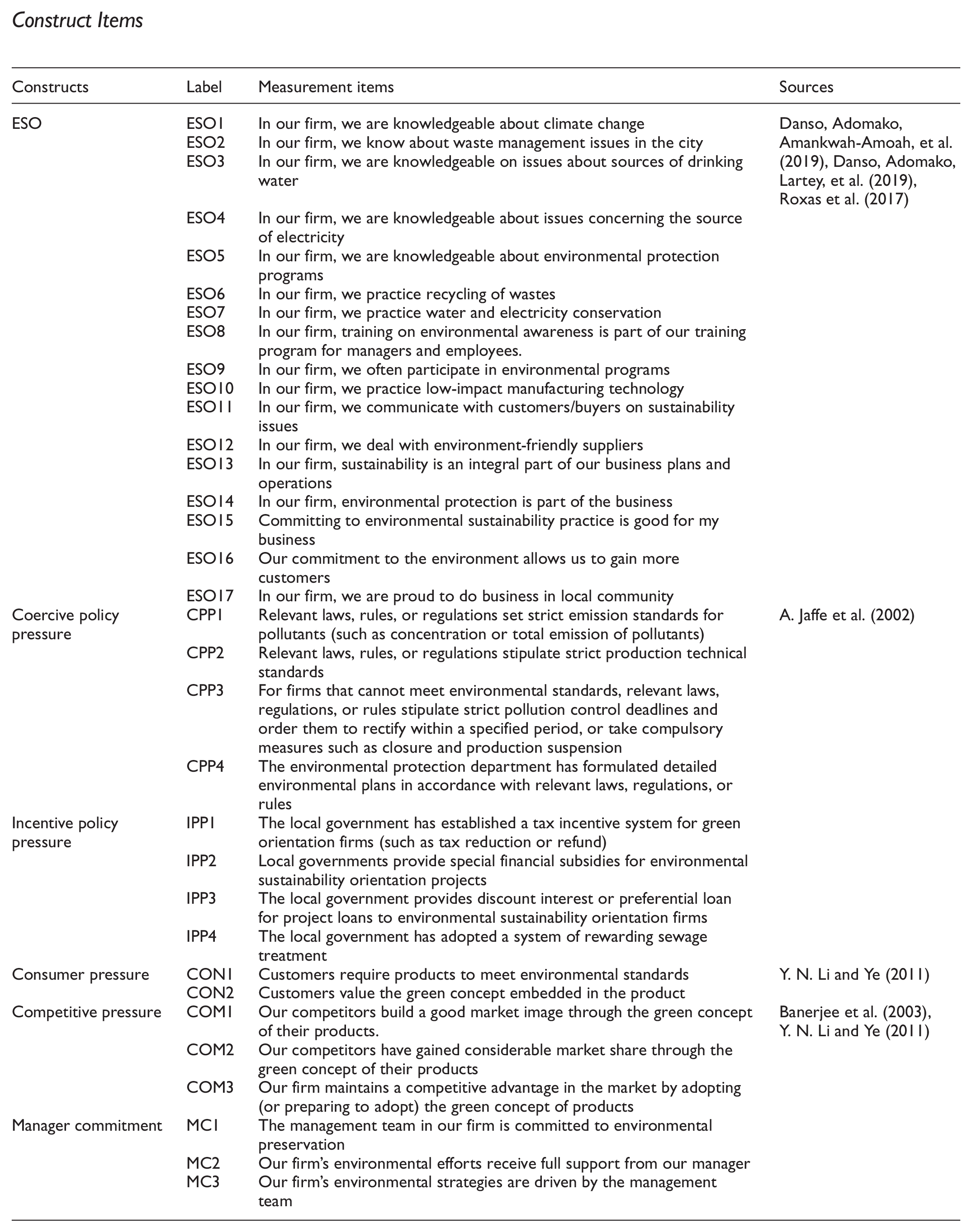
| Constructs | Label | Measurement items | Sources |
|---|---|---|---|
| ESO | ESO1 | In our firm, we are knowledgeable about climate change | Danso, Adomako, Amankwah-Amoah, et al. (2019), Danso, Adomako, Lartey, et al. (2019), Roxas et al. (2017) |
| ESO2 | In our firm, we know about waste management issues in the city | ||
| ESO3 | In our firm, we are knowledgeable on issues about sources of drinking water | ||
| ESO4 | In our firm, we are knowledgeable about issues concerning the source of electricity | ||
| ESO5 | In our firm, we are knowledgeable about environmental protection programs | ||
| ESO6 | In our firm, we practice recycling of wastes | ||
| ESO7 | In our firm, we practice water and electricity conservation | ||
| ESO8 | In our firm, training on environmental awareness is part of our training program for managers and employees. | ||
| ESO9 | In our firm, we often participate in environmental programs | ||
| ESO10 | In our firm, we practice low-impact manufacturing technology | ||
| ESO11 | In our firm, we communicate with customers/buyers on sustainability issues | ||
| ESO12 | In our firm, we deal with environment-friendly suppliers | ||
| ESO13 | In our firm, sustainability is an integral part of our business plans and operations | ||
| ESO14 | In our firm, environmental protection is part of the business | ||
| ESO15 | Committing to environmental sustainability practice is good for my business | ||
| ESO16 | Our commitment to the environment allows us to gain more customers | ||
| ESO17 | In our firm, we are proud to do business in local community | ||
| Coercive policy pressure | CPP1 | Relevant laws, rules, or regulations set strict emission standards for pollutants (such as concentration or total emission of pollutants) | A. Jaffe et al. (2002) |
| CPP2 | Relevant laws, rules, or regulations stipulate strict production technical standards | ||
| CPP3 | For firms that cannot meet environmental standards, relevant laws, regulations, or rules stipulate strict pollution control deadlines and order them to rectify within a specified period, or take compulsory measures such as closure and production suspension | ||
| CPP4 | The environmental protection department has formulated detailed environmental plans in accordance with relevant laws, regulations, or rules | ||
| Incentive policy pressure | IPP1 | The local government has established a tax incentive system for green orientation firms (such as tax reduction or refund) | |
| IPP2 | Local governments provide special financial subsidies for environmental sustainability orientation projects | ||
| IPP3 | The local government provides discount interest or preferential loan for project loans to environmental sustainability orientation firms | ||
| IPP4 | The local government has adopted a system of rewarding sewage treatment | ||
| Consumer pressure | CON1 | Customers require products to meet environmental standards | Y. N. Li and Ye (2011) |
| CON2 | Customers value the green concept embedded in the product | ||
| Competitive pressure | COM1 | Our competitors build a good market image through the green concept of their products. | Banerjee et al. (2003), Y. N. Li and Ye (2011) |
| COM2 | Our competitors have gained considerable market share through the green concept of their products | ||
| COM3 | Our firm maintains a competitive advantage in the market by adopting (or preparing to adopt) the green concept of products | ||
| Manager commitment | MC1 | The management team in our firm is committed to environmental preservation | |
| MC2 | Our firm’s environmental efforts receive full support from our manager | ||
| MC3 | Our firm’s environmental strategies are driven by the management team |
Acknowledgements
We would like to thank the Scientific Research Project of the Department of Education of Jilin Province and the Jilin Province Social Science Foundation of China for supporting this research.

Ethical Considerations
Not applicable.
Funding
The author(s) disclosed receipt of the following financial support for the research, authorship, and/or publication of this article: This research was supported by the Scientific Research Project of the Department of Education of Jilin Province of China “Rural Entrepreneurship Solutions to Elderly Care Challenges in Jilin’s Countryside” (grant JJKH20240758SK), the Jilin Province Social Science Foundation of China (grant 2023C51), the Jilin Province Social Science Foundation of China (grant 2023C55), and the Scientific Research Project of the Department of Education of Jilin Province of China (grant JJKH20240759SK).
Declaration of Conflicting Interests
The author(s) declared no potential conflicts of interest with respect to the research, authorship, and/or publication of this article.
Data Availability Statement
The data that support the findings of this study are available from the corresponding author upon reasonable request.