




Abstract
The present research is aimed at analyzing and evaluating the influence of key stakeholders on sustainability marketing strategies (SMSs) of multi-industry Indian companies. The study objective is achieved in several phases, including development of typology of SMS of Indian companies, identification and classification of stakeholders, and evaluation of influence of various stakeholders on SMS of Indian companies. To achieve these objectives, data were collected from Business Standard 1,000 companies through email survey, and 153 complete responses were received. Empirical evidence shows that most of the Indian companies are either undecided about or uninterested in adopting sustainability marketing (SM) practices, or are not showing their interest in adopting sustainability. Findings further reveal that stakeholders exert environmental, social, and economic pressures on Indian companies; managers of Indian companies feel considerable pressure from environmental stakeholders for adopting SMS, while the pressure from social and economic stakeholders is comparatively less. The study will help managers manage stakeholders effectively while formulating SMSs.
Keywords
Introduction
Over the years, sustainability marketing (SM) and related issues have gained considerable attention from academics and practitioners (Belz & Schmidt-Riediger, 2010; Hult, 2011). The concept of SM was first introduced in the Brundtland Report (1987) named “Our Common Future,” which defined sustainable development as “development that meets the needs of current generations without compromising the ability of future generations to meet their own needs.” This report has shifted the focus of companies toward sustainability to such an extent that they are realizing that sustainability is the need of hour. Consequently, sustainability issues are becoming a vital part of marketing agenda too (Charter, Peattie, Ottman, & Polonsky, 2006).
According to Belz and Peattie (2009), SM is defined as “building and maintaining sustainable relationships with customers, the social environment and the natural environment.” It is clear from this definition that the scope of SM is not limited to economic issues alone; it includes environmental and social issues also (Obermiller, Burke, & Atwood, 2008). Moreover, SM also emphasizes building and maintaining long-lasting relationships with customers. While referring to marketing strategy, Slater and Olson (2001) stated, “marketing strategy deals with decisions related to market segmentation and targeting, and the designing of positioning strategy based on marketing mix.” Similarly, sustainability marketing strategy (SMS) also deals with decisions related to sustainability-based market segmentation and targeting, and designing positioning strategy for bringing sustainability in the marketing mix.
Here, the question arises—why are companies adopting sustainability in marketing strategy? Past research suggests that companies did not incorporate sustainability in marketing on their own; rather, they were influenced by stakeholders to do so (Belz & Schmidt-Riediger, 2010; Obermiller et al., 2008). Freeman’s (1984) definition of stakeholder also supports this view: “Stakeholder is any group or individual who can affect, or is affected by the achievement of a corporation’s purpose.” It can thus be said that stakeholders are key influencers of company strategy (Frooman, 1999) and force companies to include sustainability in their marketing agenda (Belz & Schmidt-Riediger, 2010).
While several studies have in the past tried to observe stakeholder influence on areas related to SMS, most have concentrated on green or social marketing. Thus, there is a need to conduct studies with a wider perspective on sustainability (Andres, Salinas, & Vallejo, 2009; Grundey & Zaharia, 2008; Johri & Sahasakmontri, 1998; Kumar et al., 2013; R. H. Walker & Hanson, 1998). Furthermore, there is a scarcity of research on SM, and very few studies have been found that are truly dedicated to the subject (Crittenden et al., 2011; Peattie, 1999, 2001; Peattie & Crane, 2005). Also, there has hardly been any application of stakeholder theory to the field of SM (Hult, Mena, Ferrell, & Ferrell, 2011; Polonsky, 1995; Rivera-Camino, 2007). In addition, it has been found that although most of the past studies have considered customers as key stakeholders of organizations, a relatively lesser number of studies have been carried out considering multiple stakeholders (Brennan & Binney, 2008; Carlos, Rosell, & Moisander, 2008; Crittenden et al., 2011; Cronin, Smith, Gleim, Ramirez, & Martinez, 2011; Fisk, 1998; Hildebrand, Sen, & Bhattacharya, 2011; Mitchell, Wooliscroft, & Higham, 2010; Rivera-Camino, 2007; Vaaland, Heide, & Gronhaug, 2008; R. H. Walker & Hanson, 1998). As a result, Smith, Drumwright, and Gentile (2010) have called it a “new marketing myopia.”
In India, companies’ interest in SM is rising, but very limited literature is available on the subject (Kumar et al., 2013). Moreover, Indian companies are adopting SM practices at varying levels under stakeholder influence (Nair & Menon, 2008). Thus, the aim of the present research is to assess stakeholders’ influence on SMS of Indian companies. To accomplish this task, the research problem has been organized in the form of three research objectives: (a) to develop typology of SMS for Indian companies, (b) to introduce a classification scheme for categorizing key stakeholders in reference to SM, and (c) to analyze and evaluate the influence of key stakeholders on SMS.
Theoretical Framework and Research Hypotheses
Establishing a theoretical foundation is the first step toward proposing a conceptual framework. Setting up a theoretical foundation involves theory verification that is confirmatory in nature or theory building that is exploratory in nature. The present study is exploratory as well as descriptive in nature. After an extensive review of literature on SM in relation with stakeholders, a conceptual framework has been proposed, which includes discussion on typology of SMS, stakeholder theory approach to SMS, and influence of stakeholders on SMS. Hypotheses are proposed after a detailed discussion on each area.
Typology of SMS
Companies have different approaches toward sustainability, and they formulate their marketing strategies differently (Belz & Schmidt-Riediger, 2010; Rivera-Camino, 2007). Therefore, companies have to be categorized according to some criteria keeping in mind their efforts toward SM. Several typologies have been introduced in SM and strategy literature with the passage of time as shown in Table 1. However, there are some landmark studies in this area, and the typology proposed by Miles and Snow (1978) is one of them. This typology is oriented toward business environment and the study categorizes the strategies of companies into four groups—reactor, defender, analyzer, and prospector.
Various Typologies Related to SMS.

Note. SMS = sustainability marketing strategy; SM = sustainability marketing.
McDaniel and Kolari (1987) and O. C. Walker and Ruekert (1987) also proposed typologies similar to the typology of Miles and Snow (1978). However, their studies mainly focus on three strategies given by Miles and Snow (1978)—defender, analyzer, and prospector. Vazquez-Brust, Liston-Heyes, Plaza-Ubeda, and Burgos-Jimenez (2010) also followed three strategies of Miles and Snow (1978)—defensive, reactive, and proactive. Zeithaml and Zeithaml (1984) considered the environmental management and marketing perspective, and developed typology based on three strategies—independent, cooperative, and strategic maneuvering. Some researchers have also developed the social strategy literature to introduce similar typologies. As far as corporate social responsibility (CSR) strategy-based literature is concerned, Carroll (1979) and Wartick and Cochran (1985) first defined five levels of CSR—economic, legal, ethical, discretionary, and total social responsibility, and then proposed a similar typology by classifying companies into four groups according to their strategies—reactive, defensive, accommodative, and proactive.
Hunt and Auster (1990) extended the framework given by Miles and Snow (1978), and came up with five environmental management strategies—beginner, fire fighter, concerned citizen, pragmatist, and proactivist. Roome (1992) also worked in a similar direction and introduced five strategies of companies in an effort to develop environmental management strategies—non-compliance, compliance, compliance plus, commercial and environmental excellence, and leading edge. According to Henriques and Sadorsky (1999), commercial and environmental excellence and leading edge categories proposed by Roome (1992), and pragmatist and proactivist proposed by Hunt and Auster (1990), are nothing but an integral part of proactive strategies. Hence, the typologies given by Hunt and Auster (1990) and Roome (1992) are extensions of studies carried out by Miles and Snow (1978) and Carroll (1979).
Keeping in mind the resources-based view of firms, Hart (1995) also came up with environmental management typology, that is, end-of-pipe approach, pollution prevention, product stewardship, and sustainable development. Buysse and Verbeke (2003) followed Hart (1995) to introduce three strategies related to environment management—reactive strategy, pollution prevention, and environmental leadership. Other researchers have also worked on environmental management strategy literature to introduce their respective typologies and segregate companies on the basis of their efforts toward sustainability, for example, Azzone, Bianchi, Mauri, and Noci (1997); Winn and Angell (2000); Isaak (2002); Sprengel and Busch (2011); and so forth.
Specifically speaking about typologies related to green marketing and SMS, Mcdaniel and Rylander (1993) came up with two simple green marketing–based strategies—defensive and assertive. In an effort to organize green marketing literature, Crane (2000) elaborated on this approach and developed four strategies on the basis of green marketing efforts of companies—passive greening, muted greening, niche greening, and collaborative greening. Menon and Menon (1997) also discussed the enviropreneurial marketing strategies at three levels—functional or tactical level, quasi-strategic level, and strategic level. Polonsky and Rosenberger (2001) supported this approach and Rivera-Camino (2007) adopted the typology to analyze green marketing strategies in light of stakeholder influence.
In the present study, companies are classified on the basis of typology given by Belz and Schmidt-Riediger (2010) because of two reasons: First, this typology focuses specifically on the area of SM, and second, this is the only typology available in SM literature. Thus, the aim and scope of the present study match with those of the study by Belz and Schmidt-Riediger (2010). According to this typology, companies are classified into four groups on the basis of their SM efforts—performers, followers, indecisives, and passives. Performers are supposed to adopt highest levels of SM, followers are companies that adopt SM after performers, “indecisives” are companies unable to decide whether to adopt SM, and “passives” are companies not interested in adopting SM.
Stakeholder Theory Approach to SM
Stakeholder Identification
Stakeholder identification means recognizing key stakeholders of the organization who affect and get affected during the achievement of objectives of the organization (Freeman, 1984). However, it is not easy to identify key stakeholders, and stakeholder identification has always remained a challenging task for researchers (Kaler, 2002). Most of the past research has relied on prior literature to identify key stakeholders. Nevertheless, a few researchers argued that managers know their key stakeholders well because they have to formulate strategies to deal with them (Yang & Rivers, 2009). Even managers were asked to identify their key stakeholders in past studies (Polonsky & Ottman, 1998a, 1998b; Polonsky, Rosenberger, & Ottman, 1998; Rueda-Manzanares, Aragon-Correa, & Sharma, 2008). Bearing in mind both approaches, the present study identifies stakeholders on the basis of past research and expert opinion (Kumar et al., 2016). In the process, 14 stakeholders relevant to SM were identified with the help of marketing experts and practitioners (customers, suppliers and distributors, financial institutions, shareholders, non-governmental organizations [NGOs], communities, mass media, top management, employees, trade unions, scientific communities, competitors, government, and regulators).
Stakeholder Classification
Stakeholder classification deals with classifying stakeholders in different categories according to their common interest or influence (Buysse & Verbeke, 2003). Broadly speaking, there are two types of stakeholder classification schemes—generic and relative. Stakeholder classification schemes inspired from past research, and are based on the assumption that a particular stakeholder classification is universally accepted in all areas, are known as generic classifications. Table 2 shows some of the generic classification schemes introduced by researchers. These landmark studies not only advanced the stakeholder theory but also led researchers to focus on this dimension (Laplume, Sonpar, & Litz, 2008). Freeman (1984) triggered research in this area and used business environment approach to classify key stakeholders. This stakeholder classification scheme was further amended by Clarkson (1995) who classified stakeholders as “primary” and “secondary” stakeholders. Although other stakeholder classification schemes have also been introduced by Savage, Nix, Whitehead, and Blair (1991), Goodpaster (1991), Rowley (1997), and so forth, the stakeholder classification scheme given by Mitchell, Agle, and Wood (1997) has been the most accepted in literature (Neville, Bell, & Whitwell, 2011).
Generic Stakeholder Classification Schemes.

The above-mentioned generic stakeholder classification schemes have been adopted and amended in SM and related literature also. For example, Buysse and Verbeke (2003) and Raghubir, Roberts, Lemon, and Winer (2010) extended the stakeholder classification scheme of Freeman (1984) according to the need of their study. Cronin et al. (2011) and Kirchoff, Koch, and Nichols (2011) suggested using primary- and secondary-stakeholder-based classification in their respective literature reviews. Various researchers such as Harvey and Schaefer (2001); Cespedes-Lorente, Burgos-Jimenez, and Alvarez-Gil (2003); Peloza and Papania (2008); Mishra and Suar (2010b); Paloviita and Luoma-aho (2010); Clifton and Amran (2011); and Sedereviciute and Valentini (2011) relied on stakeholder classification scheme given by Mitchell et al. (1997).
Some researchers have introduced their own stakeholder classification schemes called relative stakeholder classification schemes based on specific study areas assuming that stakeholders are not common in all study areas (Rivera-Camino, 2007). Table 3 shows the different stakeholder classification schemes proposed by different researchers in the field of environmental, social, and SM and strategy literature. Some of these stakeholder classification schemes are empirically validated while others are theoretically proposed. It has been seen that most of these studies were carried out in the area of environmental marketing and strategy, and only a handful studies specifically touched the subject of SM and strategy in relation with stakeholders (Hult et al., 2011; Laplume et al., 2008).
Relative Stakeholder Classification Schemes.

Mitchell et al. (1997) argued that managers who do not prioritize and classify stakeholders according to their interests cannot realize their importance. Hence, it has always remained interestingly important how managers classify their stakeholders in relation to SMS in different business environments and organizational settings (Buysse & Verbeke, 2003; Rivera-Camino, 2007; Rowley, 1997). Although several generic and relative stakeholder classification schemes have been introduced, there is no consensus on the appropriate stakeholder classification scheme. It is also observed that past researchers have used three approaches to classify key stakeholders: first, using a generic stakeholder classification scheme; second, modifying or improving existing stakeholder classification schemes to introduce a relative stakeholder classification scheme; and third, introducing entirely new stakeholder classification scheme (Kumar et al., 2016). Thus, the question now is how should managers classify their stakeholders in relation to SM—should they adopt generic stakeholder classification, or introduce relative stakeholder classification? So, the related hypotheses are as follows:
Stakeholders’ Influence on SMS
Stakeholder management is a vital task that managers have to perform to keep their organizations profitable (Clarkson, 1995). However, it is not easy to manage stakeholders as they have complicated relationships with organizations due to their different expectations and interests (Freeman, 1984). Thus, managers have to keep an eye on real and desired status of stakeholders for effective strategy formulation (Polonsky & Rosenberger, 2001). It further means that the organizations perceive influence from stakeholders and direct managers to formulate strategies proactively.
Past literature discusses the managerial perception of stakeholders’ influence in formulating proactive sustainability strategies. Initially, Aragon-Correa (1998) studied the influence of firm-related factors to evaluate proactive strategies of companies but did not take into consideration stakeholder influence while examining the environmental strategies of Spanish companies. Later, Henriques and Sadorsky (1999) carried out a similar study and held stakeholders responsible for the adoption of different environmental strategies by Canadian companies. Buysse and Verbeke (2003) evaluated managerial perception of stakeholder influence on environmental strategies in companies operating in Belgium. They held other factors (such as country-specific characteristics) over stakeholders responsible for adoption of environmental strategies. Cespedes-Lorente et al. (2003) concentrated on the Spanish hotel industry to analyze managerial perception of stakeholder influence and found that powerful stakeholders pressurized companies to adopt environmental practices. Bremmers, Omta, Kemp, and Haverkamp (2007) worked in a similar direction studying stakeholder influence in the Dutch agro-food industry and reported that primary stakeholders exerted more pressure than secondary stakeholders to implement environmental management strategies. Murillo-Luna, Garces-Ayerbe, and Rivera-Torres (2008) empirically examined and evaluated managerial perception of stakeholder influence on different responses to environmental strategies. Darnall, Henriques, and Sadorsky (2010) analyzed environmental strategies considering effect of size of company and managerial perception of stakeholder influence and suggested both variables important.
Delmas and Toffel (2004) supported the view that stakeholders influenced companies to go beyond environmental compliance. Similar findings have been observed in green and social marketing literature. Rivera-Camino (2007) examined association of stakeholders with green marketing strategies of Spanish companies and found that stakeholders did have an impact on green marketing strategies. Maignan and Ferrell (2004) and Maignan, Ferrell, and Ferrell (2005) also talked about the importance of stakeholder management in relation to social marketing, and considered stakeholders vital components of marketing strategies. Vazquez-Brust et al. (2010) combined environmental strategies along with CSR initiatives to observe managerial perception of stakeholder influence and revealed that while stakeholders influenced strategies, CSR also played an important role in implementing environmental management.
Henriques and Sharma (2005) and Sharma and Henriques (2005) investigated managerial perception of stakeholder influence from a broader perspective of sustainability in the Canadian forestry industry and observed that stakeholders influenced, and were influenced by, sustainability strategies of companies. Belz and Schmidt-Riediger (2010) evaluated managerial perception of stakeholder influence on SMS in the German food industry. They considered stakeholders’ influence an important reason to formulate SMS. It can be said that stakeholders influence companies to formulate and execute different SMS (Nair & Ndubisi, 2011).
Frooman (1999) argued that influence of stakeholders could be determined only after establishing the interdependence of an organization and the stakeholders. This implies that managers of every organization are free to perceive the influence of stakeholders, and managerial perception of stakeholder influence will vary depending on the management’s commitment toward sustainability issues (Buysse & Verbeke, 2003; Henriques & Sadorsky, 1999; Vazquez-Brust et al., 2010). For example, managers may prefer to formulate and implement marketing strategies other than SMS when under economic pressure (Rivera-Camino, 2007). It is clear that managerial perception of stakeholder influence will not be same for different companies and stakeholder influence may or may not encourage SM practices in companies (Bremmers et al., 2007). Hence, managers of different companies would perceive stakeholder influence differently, and their level of SMS efforts will also differ. The following is thus hypothesized:
Research Method
Very few studies have been carried out that are directly linked to the field of SM, and existing studies on SM and strategy are not sufficient to design the methodology of the present research, which is why studies on environmental marketing and strategy have also been taken into consideration. The present research methodology is designed considering previous studies given in Table 4. The present research follows the research methodologies of Henriques and Sadorsky (1999), Buysse and Verbeke (2003), Rivera-Camino (2007), and Belz and Schmidt-Riediger (2010). All of these studies are cross-sectional and based on survey. Therefore, the present study also follows the survey approach. It is noteworthy that survey data may be prone to common method variance (bias), non-response bias, social desirability bias, and lack of generalizability. After addressing all these limitations, the present research is designed to understand existing qualitative literature from complimentary viewpoint in Indian context.
Brief Review of Past Research Methodologies.
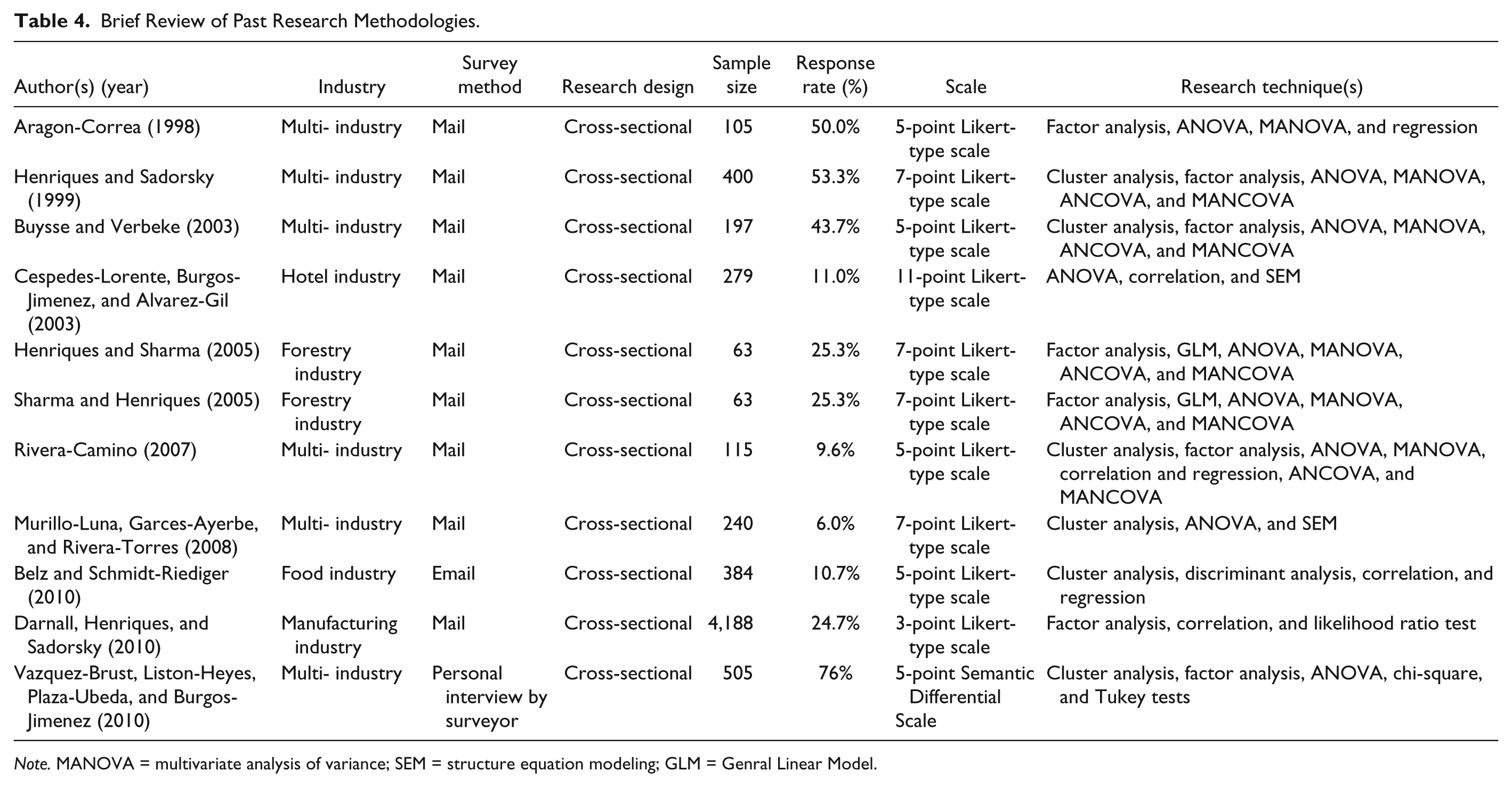
Note. MANOVA = multivariate analysis of variance; SEM = structure equation modeling; GLM = Genral Linear Model.
Instrument Development
Research on SMS is still in nascent stages, and the field is yet to be explored; very few studies specifically cover SMS (Crittenden et al., 2011; Kumar et al., 2013; Peattie, 1999, 2001; Peattie & Crane, 2005). However, there are some studies that have been carried out in the area of green or environmental marketing. Therefore, in the present research, SM practices have been identified from both green marketing and SM and strategy literature (Andres et al., 2009; Andres, Salinas, & Vallejo, 2011; Banerjee, 2001; Belz & Schmidt-Riediger, 2010; Buysse & Verbeke, 2003; Henriques & Sadorsky, 1999; Henriques & Sharma, 2005; Peattie, 1999; Polonsky & Rosenberger, 2001; Rex & Baumann, 2007; Rivera-Camino, 2007; Wong, Turner, & Stoneman, 1996). Some of these items have been modified from green to SM according to the requirements of the study after consultation with marketing experts and practitioners. This way, 11 practices are finalized to study SMS (shown in Table 5).
Identified SM Practices.

Note. SM = sustainability marketing.
During pilot testing, Cronbach’s alpha for SM practices was found to be .958. The split-half reliabilities of first six practices (SM1, SM2, SM3, SM4, SM5, and SM6) and last five practices (SM7, SM8, SM9, SM10, and SM11) came out to be .938 and .891, respectively. Results of exploratory factor analysis reveal a single-factor solution with eigenvalue 7.756 explaining 70.509% of variance in the data. The Kaiser-Meyer-Olkin (KMO) measure of sampling adequacy (0.957) indicates sufficient inter-correlations, and Barlett’s test of sphericity was also found significant (χ2 = 1,460.76, p = .000 < .01). Hence, the scale developed for the study is found reliable and valid.
Sample
To achieve the objectives of the study, exploratory and cross-sectional descriptive research design has been employed. The target population is 1,048 companies given in an annual magazine published by Business Standard newspaper, also known as BS 1000 companies (Business Standard, 2012). Moreover, Kapoor and Sandhu (2010) and Mishra and Suar (2010a) have reported in their study that the sustainability performance results in improved financial performance of Indian companies. Therefore, it is assumed that the companies that are doing financially well in India are quite sincere toward adopting sustainability. Thus, a non-probabilistic judgmental sampling has been used for conducting the present research.
Marketing managers linked with corporate marketing strategies have been considered respondents. Yang and Rivers (2009) also suggested analyzing stakeholder influence through managerial perception as managers formulate their strategies by taking into account stakeholder pressures. For the same reason, many studies have incorporated managerial perception of stakeholder influence instead of contacting each stakeholder group (Belz & Schmidt-Riediger, 2010; Buysse & Verbeke, 2003; Henriques & Sadorsky, 1999; Rivera-Camino, 2007). Prowess database of Center for Monitoring Indian Economy (CMIE) has been used to retrieve contact details of the target population.
The questionnaire including 11 SM practices and 14 stakeholders was emailed to managers of Indian companies chosen for the survey (See Appendix). Responses were measured on a 5-point Likert-type rating scale. The structured questionnaire was sent through a web link developed on Google docs, and data were collected over a period of 4 months. To assess non-response bias, first 10 and last 10 responses are subjected to paired sample t test. Results showed that there was no significant difference in early and late responses in case of any item. Thus, there was no response bias in early and late responses. After four follow-ups, a sample of 153 valid responses was received, yielding a response rate of 14.5%.
Analysis and Results
SM Typology of Indian Companies
To test H1.1 and H1.2, SM practices were subjected to k means cluster analysis or quick clustering (Belz & Schmidt-Riediger, 2010; Buysse & Verbeke, 2003; Henriques & Sadorsky, 1999; Rivera-Camino, 2007). The k means cluster requires inputting the value of k, that is, number of clusters. As discussed in literature, responses were clustered into four categories given by Belz and Schmidt-Riediger (2010): performers, followers, indecisives, and passives. This means that Indian companies are segregated into four strategies according to their level of adoption of SM practices.
Before clustering the responses of companies, all 11 SM practices were standardized to give equal weights (Rivera-Camino, 2007). Results of cluster analysis yielded four clusters as shown in Table 6. Positive cluster values show adoption of SM practices while negative values show lack of adoption of SM practices (Rivera-Camino, 2007). Thus, positive cluster values were obtained for “performers,” “followers,” and “indecisives.” However, negative cluster values were obtained for “passives.”
SMS Clusters.

Note. SMS = sustainability marketing strategy; SM = sustainability marketing.
Figure 1 shows four levels of SMS adoption in Indian companies on the basis of responses of managers with respect to 11 SM practices. While each practice successfully classified SMS clusters, ANOVA test was used to check the relative importance of each SM practice to cluster solution (Belz & Schmidt-Riediger, 2010; Rivera-Camino, 2007). For each SM practice, the ANOVA F values were found significant (p < .05). This means that every SM practice successfully contributes toward segregating SMS of Indian companies.

Response of managers toward SM.
Results (as shown in Figure 2) revealed that only eight (5%) Indian companies fell into the category of “performers,” which means that very few Indian companies adopt high levels of SM practices. Sixteen (10%) Indian companies fell in the category of “followers” implying that these firms follow “performers” and adopt SM practices. It was further observed that 56 (37%) Indian companies were hesitant to adopt SM practices, while nearly half—73 (48%) Indian companies—were passive toward SM practice adoption.

SM typology of Indian companies.
To verify the results of cluster analysis, discriminant analysis was applied (Belz & Schmidt-Riediger, 2010). Here, discriminant analysis was used to evaluate the discriminatory power of cluster analysis. The clustering variable was used as the grouping variable to carry out discriminant analysis. To assess the model fit, Wilks’ lambda statistic for first discriminating function was considered. Results revealed Wilks’ lambda statistic to be statistically significant (p = .000, i.e., p < .05) at the value of .025. This shows that only 2.5% of variance is not explained by the difference among clustered groups. It was further observed that 98.7% of the responses were correctly classified from which the function was built. Thus, these results not only ensure the stability of clusters, but also ascertain the quality of cluster analysis.
Stakeholder Classification in Reference to SM
Exploratory factor analysis was used to test Hypotheses 1.1 and 1.2. The analysis was carried out to achieve two objectives—first, to reduce the independent variables, and second, to introduce a stakeholder classification scheme in relation to SM. All 14 stakeholders were entered in principal component analysis. Each of the stakeholders was found to have initial communalities more than 0.5. Furthermore, following varimax rotation, three factors were extracted having eigenvalues greater than one (i.e., 4.62, 2.70, and 1.82). These factors accounted for 65.3% of variance (as shown in Table 7). The KMO measure of sampling adequacy was found to be 0.799, which is greater than 0.60. The Barlett’s test of sphericity was also found significant (χ2 = 1,204.9, p = .000 < .01), which ensures sufficient inter-correlations between variables. All stakeholders had factor loadings of more than 0.4 (Hair et al., 2009). Thus, no stakeholder was deleted from the study (except top management due to cross loading).
Factor Loadings of Stakeholder Influences.
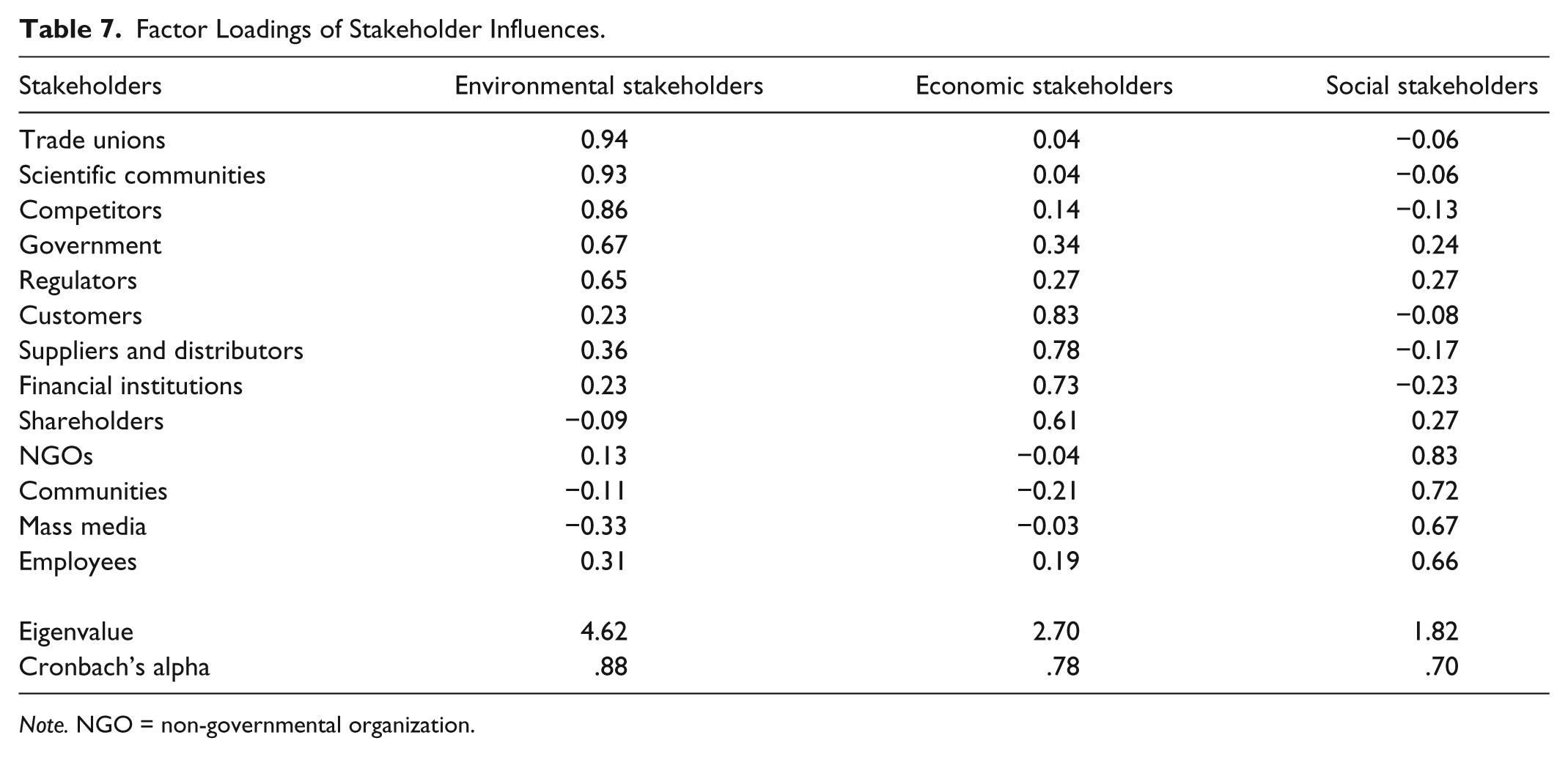
Note. NGO = non-governmental organization.
Reliability values for all the three factors were also calculated to test stability of factors (Buysse & Verbeke, 2003; Rivera-Camino, 2007; Vazquez-Brust et al., 2010). It was further found that all the three factors had Cronbach’s alpha value more than .70, which assures stability of constructs. However, this classification scheme did not match with previous stakeholder classification schemes. The three factors obtained after factor analysis were named environmental stakeholders, economic stakeholders, and social stakeholders. In simple words, stakeholders influence Indian companies to adopt environment management systems, economic legitimacy, and social legitimacy.
The present stakeholder classification scheme is very similar to the relative stakeholder scheme proposed by Kumar et al. (2016) after rigorous review of stakeholder classification schemes in relation to SM. This stakeholder classification scheme is also found to be unique and different from the previous classifications. Past literature has considered either one or two dimensions of sustainability to classify stakeholders. No study has used all three dimensions of sustainability to classify stakeholders. Thus, a new relative classification scheme has been introduced in relation to SM on the basis of managerial perception of influence of stakeholders. The scheme leads to rejection of Hypothesis 1.1, and Hypothesis 1.2 is tentatively accepted, which means that Indian managers classify stakeholders into relative classification scheme while formulating SMS.
Managerial Perception of Stakeholders’ Influence on SMS
To test Hypotheses 2.1 and 2.2, a three-step procedure similar to that of Rivera-Camino (2007), was followed. The first two steps deal with the relationship between stakeholders and SMS, and the third step deals with validation of the direction of relationship. With the first step, ANOVA is carried out to analyze the relationship between the individual stakeholder and SMS clusters. Table 8 shows descriptive statistics and results of ANOVA test. The descriptive statistics show that performers perceive highest influence from all stakeholders, followers perceive lesser influence than performers, indecisives perceive lesser influence of stakeholders than followers, and passives perceive least influence among all stakeholders. But it is noticed that passives feel more pressure to adopt sustainability than followers, and followers perceive more pressure than indecisives in case of two stakeholders—mass media and employees. This may be because passives and indecisives are concerned with their image and do not want media to damage their reputation (Henriques & Sadorsky, 1999; Maignan et al., 2005). Furthermore, passives and indecisives perceive high pressure from those employees, who are more aware of sustainability issues (Buysse & Verbeke, 2003; Knox, Maklan, & French, 2005; Maignan et al., 2005).
Influence of Individual Stakeholders Under Different SMS.
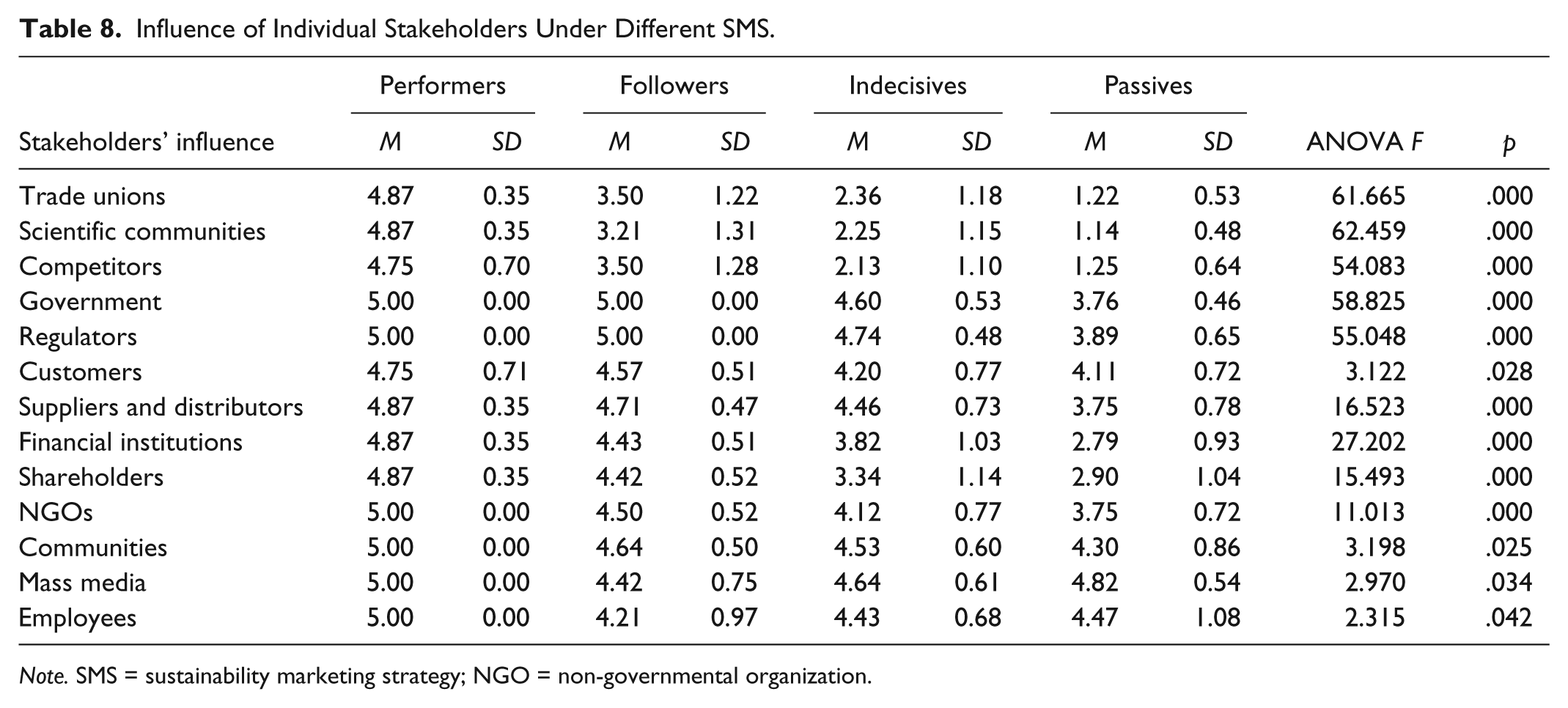
Note. SMS = sustainability marketing strategy; NGO = non-governmental organization.
Test results further revealed 10 stakeholders, namely, trade unions, scientific communities, competitors, government, regulators, suppliers and distributors, financial institutions, shareholders, NGOs, and top management, to possess high F values and be highly significant at the .01 level of significance. The other four stakeholders—customers, communities, mass media, and employees—were found to be significant at .05 level of significance. Thus, each stakeholder was significantly associated with SM clusters and included for further analysis.
The second step deals with MANOVA to analyze the linkage between stakeholder groups (classified stakeholders) and SMS clusters. This step is carried out to avoid biased linkages between individual stakeholders and SMS clusters as individual stakeholders may be interrelated (Rivera-Camino, 2007). All stakeholder groups—environmental stakeholders, economic stakeholders, and social stakeholders—were found highly significant at the .01 level of significance (as shown in Table 9). Thus, stakeholder groups had significant association with SMS clusters. The Wilks’ lambda statistic was found to be .119, which shows that the differences in SMS were associated with almost 88% of variation in perceived influence of stakeholder groups in the absence of control variables.
Influence of Stakeholder Groups Under Different SMS.

Note. SMS = sustainability marketing strategy.
The third step deals with evaluation of managerial perception of influence of stakeholder groups on SMS. So, the independent variables (three stakeholder groups) and dependent variables (SM practices) were entered using forced entry or simultaneous regression method. Details of the overall model summary and multiple regression output are shown in Table 10. The Durbin–Watson index was 1.839, which lies within the range 1.50 to 2.50, suggesting that there was no autocorrelation problem in the data. Furthermore, each variable had a tolerance value of more than 0.10 and Variance Inflation Factor (VIF) of less than 10, which indicates that the model had no serious multicollinearity problem (Hair et al., 2009). The model summary also indicates that there is a statistically significant relationship between stakeholder groups and SMS.
Regressions Results (n = 153).
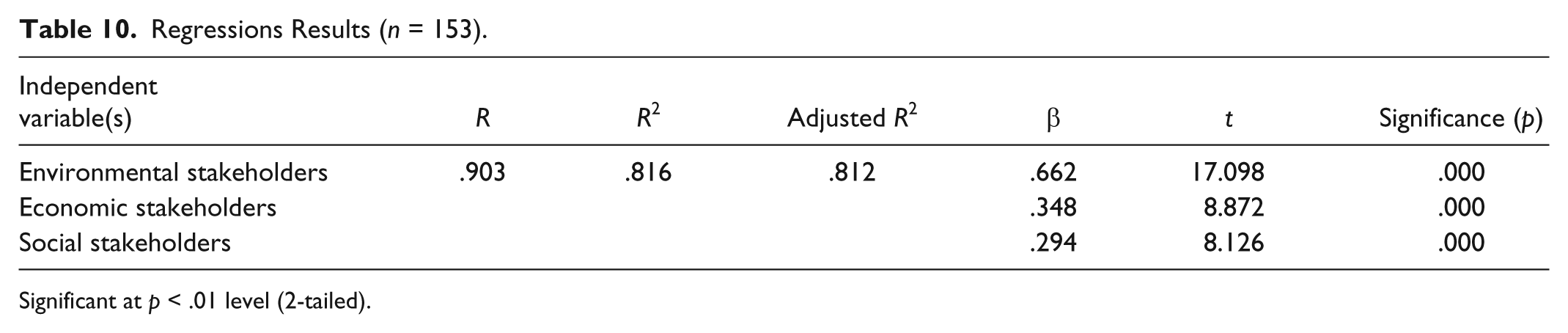
Significant at p < .01 level (2-tailed).
Coefficient of determination (R2) was found to be .816, which implies that 81.6% of variance in level of adoption of SMS can be explained by perceived influence of the three stakeholder groups. This establishes that stakeholder groups significantly accounted for 81.6% variability in level of adoption of SM practices. The proposed model was also found to be adequate as the F statistics, F(3, 149) = 220.407, were significant at 1% level (p = .000 < .01). This indicates that the overall model is statistically significant and a positive relationship exists between stakeholder groups and level of adoption of SM practices.
Results of multiple regression analysis include the standardized beta coefficients and significant t value, which are tabulated and presented in Table 10. Results of t statistic show that all stakeholder groups influence level of adoption of SM practices significantly. Results also indicate that all the three stakeholder groups, namely, environmental stakeholders, economic stakeholders, and social stakeholders, are positively associated with level of adoption of SM practices. Thus, the analysis validates H2.1, that is, level of perceived influence of stakeholders is positively associated with adoption of SM practices.
The individual model variable reveals that environmental stakeholders (β = .662, p < .01), economic stakeholders (β = .356, p < .01), and social stakeholders (β = .294, p < .01) are directly involved in the adoption of SM practices. It has also been found that Indian mangers perceive high influence from environmental stakeholders to adopt SM practices as compared with economic stakeholders and environmental stakeholders.
Discussion
The present research has attempted to analyze and evaluate managerial perception of stakeholder influence on SMS of Indian companies. For this purpose, the study categorized Indian companies according to their level of adoption of SM, identified and classified key stakeholders in relation to SM, and analyzed and evaluated managerial perception of stakeholder influence on SMS of Indian companies after introducing the control variables.
To achieve the first objective, Indian companies were segregated according to their SM efforts using SM typology given by Belz and Schmidt-Riediger (2010). Most Indian companies were found to have a reactive attitude toward adoption of SM practices. The second objective dealt with introduction of generic or relative stakeholder classification scheme in relation with SM. Data analysis revealed that managers identified their stakeholders in a relative classification scheme (economic stakeholders, social stakeholders, and environmental stakeholders).
The final objective involved analyzing and evaluating managerial perception of influence of stakeholders. Results revealed that all 13 stakeholders were significantly associated with differences in levels of SM adoption. Similarly, the stakeholders groups (environmental stakeholders, economic stakeholders, and social stakeholders) were also found to have significant association with SM clusters. Thus, Indian managers perceived influence of identified stakeholders and their respective stakeholder groups to adopt the different SMS in absence of control variables.
Managerial perception of influence of stakeholder groups was found to be positively associated with the level of adoption of SM practices. Furthermore, managers of Indian companies were found to perceive high influence from environmental stakeholders as compared with social and economic stakeholders. Social stakeholders were found to exert least pressure on SMS of Indian companies. It seems that managers of Indian companies perceive high influence of environmental stakeholders to adopt environmental marketing practices. However, pressures from environmental stakeholders may push Indian managers to follow environmental management policies and strategies. This further means that most of Indian companies may limit themselves to adopt pollution prevention reactive strategy given by Hart (1995).
As managers perceive high influence from environmental stakeholders to work toward environmental sustainability, it may drive companies to achieve environmental sustainability in products and processes. Companies may also have to invest substantially for attaining this goal. It was observed that the attitude of Indian companies is reactive, which is probably why they perceive comparatively lesser influence from economic stakeholders. Moreover, managers have perceived least influence from social stakeholders; therefore steps may be taken to empower social stakeholders.
Conclusion
SM is a new area that warrants further exploration. The present study gives vital information to extend the research further. A significant research contribution of the present study is the proposed model to measure the influence of stakeholders on SMS of Indian companies belonging to various sectors (shown in Figure 3). The findings of the study provide an in-depth understanding of the influence of stakeholders on the level of adoption of SM practices by Indian companies. Such understanding will help academics, managers, and marketing practitioners about SMS. Limitations of the present study and future research directions in the area of SM have also been discussed.

Model for assessing influence of stakeholders on SMS.
Theoretical and Managerial Implications
Review of literature on SM gave detailed information of research conducted in this field, which will not only help in getting in touch with present issues in the field but also assist researchers to explore the field further. The scale used in the study was tested for reliability and validity, and can be used in empirical research in the context of other developed and developing countries. The techniques employed in the study will provide researchers a path to accomplish research objectives of their studies. In addition, the research contributes to organizational theory by considering company- and industry-related information in analyzing the influence of stakeholders on SMS.
The research also contributes to stakeholder theory. The present study identifies and classifies stakeholders from SM perspective, an attempt that has not been made before. The article introduces a new classification scheme for stakeholders influencing SM practices in companies. The idea of proposing a new classification scheme will motivate researchers to perform further research considering different perspectives.
This study considers multiple stakeholders who will help managers manage various stakeholders while formulating SMS. The research may also help managers meet the expectations of multiple stakeholders better than competitors. Therefore, managers may be able to formulate effective SMS by identifying and classifying key stakeholders according to their varying interests.
Limitations of the Present Research
Sometimes, certain unavoidable limitations arise while performing research. First, there may always be the possibility of losing relevant content from literature. Although a sufficient number of research papers were found for review, some related papers might have been left out resulting in incomplete results. Furthermore, the scope of research is limited to SMS not overall strategy. The effect of situational factors has also not been considered in the current investigation, which may have an impact on the perceived influence of stakeholders on companies.
To make the data manageable, the study selected companies from BS 1000 magazine, which included 1,048 companies operating in India. This list contains large Indian companies only. Therefore, the results may not be generalized for small- and medium-sized Indian companies. In addition, data were collected through a web-generated instrument, which has some limitations too. As web does not reveal the identity of the person, the instrument can be filled by any person in the organization mentioning him or her as the targeted element.
Total 47 sectors participated in the present research but companies from some particular sectors responded more than companies of other sectors, which may have caused biased results. Also, some sectors may be more responsible for pollution than other sectors; therefore, they may perceive different influences from different stakeholders. Because the adoption of SM practices is also affected by nature and type of business, it may have resulted in bias in opinion of managers regarding influence of stakeholders. Moreover, different companies may have different end customers—B2C, B2R, B2G, and B2B (business to customers, business to retailers, business to government, and business to business). This may also lead to bias in stakeholder influence on SMS.
Scope for Future Research
The present research is based on cross-sectional research design and does not study how the influence of stakeholders varies with time. Therefore, future studies may be based on longitudinal research design to observe the dynamic relationships of stakeholders with companies adopting SMS. Also, the present research has considered only one marketing manager from each company to analyze and evaluate the influence of stakeholders. But there may be more than one person linked with corporate marketing strategies of the company. Future research may be carried out considering more than one respondent from a company.
The present research is based on a composite scale of 11 SM practices. The SM scale can be extended to explore the field in a better way. This would help in assessing the influence of stakeholders on each SM practice. The study has considered multiple sectors and industries. In future, this study can be replicated in other countries and industry-specific studies may also be carried out.
It was found that most of the companies had a reactive approach toward adoption of SM practices. Therefore, it will be interesting to explore the enablers and barriers to adopting SMS in an emerging economy. However, cluster analysis does not seem to be a good approach to segregate companies on the basis of their SM efforts. Future research may use some other methodology such as structure equation modeling (SEM), which will further help in validation of the model.
Companies were found to perceive more environmental pressures than social pressures. Therefore, a comparative study may be carried out in future to explore the difference in environmental and social marketing orientation of Indian companies. Moreover, the visibility (size) of the company, which is measured in terms of annual sales, has been found to affect stakeholder influence significantly. Future studies may investigate the link between SM performance and financial performance in light of stakeholder pressures.
The present research is carried out on large Indian companies. Future studies may be carried out on small- and medium-sized companies to analyze managerial perception of stakeholders’ influence on SMS. The present article may also be extended to analyze the influence of stakeholders on corporate sustainability strategies.
Footnotes
Appendix
Declaration of Conflicting Interests
The author(s) declared no potential conflicts of interest with respect to the research, authorship, and/or publication of this article.
Funding
The author(s) received no financial support for the research and/or authorship of this article.