



Abstract
By merging the theory of planned behavior and social cognitive theory, in this study an attempt is made to identify the cognitive and environmental factors that influence the entrepreneurial intentions of female university science, technology, engineering and mathematics (STEM) students in Andalusia, Spain. The data were obtained from a cross-sectional survey, carried out in 2022, of female students studying for a degree in product engineering. A variance-based structural equation model was estimated by applying partial least squares. The results showed that the cognitive factors of attitude toward behavior and perceived behavioral control positively influenced female STEM students’ entrepreneurial intentions, while subjective norms do not. Of the environmental factors, only closer valuation positively impacted on their predisposition to become entrepreneurs. Attitude toward behavior is the key driving factor of entrepreneurship intentions among female engineering students. For predisposition toward entrepreneurship to provide more advantages than disadvantages, several issues must be addressed. Students who have a close circle of family and friends who believe in entrepreneurship have a stronger disposition toward self-employment, have greater confidence in their ability to be successful and receive greater social approval. The image of entrepreneurship must be improved, thereby promoting entrepreneurial intentions within educational contexts, not only among university students but, also, among young people in general. Female engineering students do not need the approval of their family and friends to want to start a business. Future research might undertake longitudinal and cross-cultural analyses.
Keywords
Introduction
The role of women in society has significantly evolved all over the world. Women have become, over the last decades, a key factor in the economy of industrialized countries as their involvement and impact on the job world has significantly increased (Eib & Siegert, 2019); evidence of this is the growing number of female entrepreneurs. It is, therefore, important to study gender as a factor affecting entrepreneurship (Ozkazanc-Pan & Clark Muntean, 2018).
The gender gap is an interesting and controversial topic in labor economics and management studies (Ilie et al., 2021; Patterson et al., 2021). In 2021, entrepreneurial activity in Spain recovered to levels similar to those that existed prior to the COVID-19 health crisis (Fernández Laviada et al., 2023). It is, also, noteworthy that women’s entrepreneurship initiatives (5.6%) exceed men’s initiatives (5.4%) for companies that have been around for 3 years or less, although women admit to a greater fear of failure and perceive fewer opportunities exist (Fernández Laviada et al., 2023). Nevertheless, the percentage of women engaging in technology-related entrepreneurship is still far below that of men (Fernández Laviada et al., 2023). What reasons might explain the lower percentage of female entrepreneurs among the population which took technology-focused degrees? While extensive scientific literature has examined the factors that influence entrepreneurship, in general (Fayolle & Liñán, 2014), and among women, in particular (Borham et al., 2023; Cardella et al., 2020), few studies have addressed these factors, specifically among young female students in technology-related degree programs.
Reviews (Kuckertz & Brändle, 2022; Maheshwari et al., 2022) of entrepreneurship among higher education students have identified seven key factors, cognitive, personality, environmental, social, educational, contextual and demographic.
The theory of planned behavior (TPB; Ajzen, 1991) is, by far, the theory most widely used in entrepreneurship-focused studies to explain the impact of these factors on entrepreneurial intentions (in general, and among students, in particular). The results have emphasized that intention is a direct antecedent of behavior (Maheshwari et al., 2022). The entrepreneurial intention model (Boyd & Vozikis, 1994) has been applied in various contexts; social learning theory (Bandura, 1997), which argues that environmental stimuli have a major impact on behaviors; social cognitive theory (Bandura, 1986), which argues that human behavior is influenced by environmental, behavioral and cognitive factors; and the entrepreneurial event model (Shapero & Sokol, 1982), which proposes that people’s entrepreneurial intentions are driven by perceived desirability, perceived feasibility and propensity to act, similar concepts to those used in the TPB.
Various studies have examined, based on gender, the antecedents of entrepreneurial intentions among university students, and the attitudes that prompt them to become entrepreneurs (Diaz Bretones & Radrigán, 2018; Ndofirepi et al., 2018; Rodríguez Gutiérrez et al., 2018). These studies have shown that, as men have more confidence, a higher percentage of them start their own businesses than do women (Diaz Bretones & Radrigán, 2018; Ndofirepi et al., 2018; Vlad, 2020). Other studies have argued that male university students are motivated by the prospect of entrepreneurial success to undertake new ventures, while women choose to launch new businesses out of necessity (Almobaireek & Manolova, 2013; Rodríguez Gutiérrez et al., 2018). To foster an entrepreneurial spirit among women, it is important to highlight successful female entrepreneur role models (Laguía et al., 2022).
In STEM and other disciplines, it has been recognized that entrepreneurship-focused training is necessary to motivate entrepreneurship in women (Law & Breznik, 2017). STEM education offers female entrepreneurs benefits that can increase their chances of success. On the one hand, it provides skills and expertise in fast-growing areas, for example, artificial intelligence and robotics, which is vital for innovation and competitiveness (Gupta et al., 2019). On the other hand, it fosters innovation and creativity, essential qualities for entrepreneurial success; this can help women challenge gender stereotypes in male-dominated industries (Nair, 2020).
Women’s entrepreneurship enriches society, helps achieve gender equality and improves business outcomes (Ferri et al., 2018). From this viewpoint, studying women’s entrepreneurial intentions can be important for societal development (De Vita et al., 2014; Ferri et al., 2018). This is especially relevant in the case of female university students in the STEM field (Law & Breznik, 2017), as technology-based companies are experiencing the greatest growth and creating the most value. There is, overall, a lower incidence of female than male student participation in entrepreneurial education programs in technological disciplines (Petridou et al., 2009). It is, therefore, important to understand the factors that affect university students’ attitudes toward entrepreneurship (Ferri et al., 2018; Iffländer et al., 2018; Vega-Gómez et al., 2019).
This study has several objectives. The first, given the very small number of specific investigations into the topic, is to contribute to the scientific literature by identifying the cognitive factors that influence the entrepreneurial intentions of women studying STEM topics in Spain (drawing on the theory of planned behavior; Ajzen, 1991). The second is to identify the impact of environmental factors on these cognitive factors and on entrepreneurial intentions (drawing on social cognitive theory; Bandura, 2001). These relationships have not previously been analyzed in the context of female engineering students. The third is to examine, as a novelty, the moderating role of a student’s professional experience in the relationships of the proposed model. To achieve these objectives, the following research questions are posed:
RQ1: How do the cognitive factors of attitude toward behavior (AT), perceived behavioral control (PBC) and subjective norms (SN) influence the entrepreneurial intentions of female engineering students?
RQ2: How do the environmental factors of closer valuation and social valuation influence the entrepreneurial intentions of female engineering students?
RQ3: How do environmental factors influence cognitive factors in the context of female engineering students?
RQ4: How does the professional experience of female engineering students moderate the relationships between the factors under analysis and entrepreneurial intentions?
The remainder of this work is structured as follows: Section Two reviews the relevant scientific literature and establishes the hypotheses and the theoretical model; Section Three explains the methodology used in the work; Section Four presents the results obtained; Section Five provides a discussion and conclusions.
Literature Review
Entrepreneurial intention is a mindset that drives individuals to create their own ventures, rather than to work for others (Karimi et al., 2016). It manifests as a “self-recognized conviction” among those aspiring to initiate new business endeavors, playing a pivotal role in the entrepreneurial process (Farrukh et al., 2018; Liñán et al., 2011).
Various cognitive-based models of entrepreneurship have been used to explain the phenomenon, including social cognitive theory (Bandura, 1986) and the theory of planned behavior (Ajzen, 1991). The present study addresses the factors in these two theories that have been said to influence entrepreneurial intentions, that is, cognitive factors and environmental factors.
Cognitive Factors in Female Students’ Entrepreneurial Intentions
The theory of planned behavior (TPB) proposes that entrepreneurs base their decisions to start new businesses on three cognitive factors, attitude toward behavior, perceived behavioral control and subjective norms (Ajzen, 1991).
The Influence of Attitude Toward Behavior on Female Students’ Entrepreneurial Intentions
In the field of undergraduate students’ entrepreneurship, the concept of attitude toward behavior refers to a person’s predisposition to carry out entrepreneurial behaviors. This attitude is based on the person’s expectations of him or herself and his or her capacity for entrepreneurship, as well as his or her assessment of the results that could be obtained by carrying out entrepreneurial actions (Ajzen, 1991; Enkel & Bader, 2016). This is an important part of the desirability antecedent of entrepreneurial intentions and reflects the appeal, to the individual, of becoming an entrepreneur (Kyvik, 2018). In the theory of planned behavior this variable is fundamental to entrepreneurial intentions. While it might be feasible for the individual to become an entrepreneur, and (s)he might have social support, if (s)he lacks the desire to become an entrepreneur, this automatically implies (s)he has less intention to do so (Morales-Alonso, Pablo-Lerchundi, & Vargas-Perez, 2016). Numerous higher education-based studies have indicated that attitude toward behavior has a positive influence on entrepreneurial intentions (Gird & Bagraim, 2008; Liñán et al., 2011; Lortie & Castogiovanni, 2015; Malebana, 2014).
Gomes et al. (2022) argued that the attitude (AT) of female university students has a positive impact on their entrepreneurial intentions (EI), and Law and Breznik (2017) concluded the same with engineering students from Hong Kong. Similarly, Law and Breznik (2017) showed that AT is the most important cognitive factor in the development of entrepreneurial intentions in female engineering students.
Therefore, we propose the following hypothesis:
H1a. Attitude toward behavior has a positive influence on the entrepreneurial intentions of female university students in the STEM field.
The Influence of Perceived Behavioral Control (PBC) on Female Students’ Entrepreneurial Intentions
Behavioral control refers to a person’s perception of his or her ability to perform a given behavior, that is, in the context of this study, his/her belief that (s)he can easily become an entrepreneur (Ajzen, 1991). In the context of entrepreneurship, when individuals have a high degree of perceived control over their behaviors, this strengthens their intentions to take the steps necessary to achieve their entrepreneurial goals. Therefore, based on the theory of planned behavior, there is consensus in the scientific community that perceived behavioral control positively influences the entrepreneurial intentions of students in higher education (Karimi et al., 2013; Liñán et al., 2011; Morales-Alonso, Pablo-Lerchundi, & Vargas-Perez, 2016) and, in particular, of female university students (Ferri et al., 2018; Gomes et al., 2022). In addition, these studies concluded that PBC is the most important antecedent of females students’ entrepreneurial intentions. Thus, the following hypothesis is proposed:
H1b. Perceived behavioral control has a positive influence on the entrepreneurial intentions of female university students in the STEM field.
Influence of Subjective Norms on Female Students’ Entrepreneurial Intentions, Attitude Toward Behavior and Perceived Behavioral Control
In the context of entrepreneurship, the theory of planned behavior defines subjective norms as an individual’s perceptions of the expectations that others have in relation to his/her entrepreneurial behaviors (Ajzen, 1991; Lortie et al., 2017). That is, these norms shape the individual’s interpretation of what is expected of him or her by relevant people in his or her social environment. If these subjective norms support/promote entrepreneurial activities, the probability of individuals becoming entrepreneurs increases as a function of the intensity of their motivations to meet the expectations of their referents. Various higher education-based studies have found that a positive relationship exists between PBC and entrepreneurial intentions (Rueda Barrios et al., 2021; Shah et al., 2020). Other authors have concurred with this finding, particularly among female university students (Bagheri & Lope Pihie, 2014; Gomes et al., 2022). However, Kobylińska (2022) concluded that the impact of subjective norms on entrepreneurial intentions is not significant.
In addition, some studies have identified that subjective norms have a direct impact on attitude toward entrepreneurial behaviors among university students (Bazkiaei et al., 2021; Liñán et al., 2011; Santos et al., 2016), and among female students, in particular, in higher education (Bouarir et al., 2023; Gomes et al., 2022). Other authors, examining university students, have concluded that subjective norms have a positive influence on perceived behavioral control (Gieure et al., 2019; Liñán et al., 2013; Vuković et al., 2017): others have found the same with specific reference to female university students (Bouarir et al., 2023; Gomes et al., 2022)
Based on these points, the following hypotheses are proposed:
H1c. Subjective norms have a positive impact on the attitude toward behavior of female university students in the STEM field.
H1d. Subjective norms have a positive influence on the perceived behavioral control of female university students in the STEM field.
H1e. Subjective norms have a positive influence on the entrepreneurial intentions of female university students in the STEM field.
Environmental Factors and Female Students’ Entrepreneurship
Social cognitive theory (Bandura, 1986) posits that the surroundings in which individuals interact socially have a significant impact on shaping their thinking processes and actions. Essentially, the theory suggests that how individuals think and behave stems from their participation in social activities, interactions with others and communication with their environment.
The impact of their social environment on entrepreneurs’ attitudes and behaviors can occur at both macro and micro levels (Alshagawi & Ghaleb, 2023; Morris & Schindehutte, 2005). At the micro level, individuals’ attitudes and behaviors can be significantly influenced by their immediate social surroundings, such as family, friends and acquaintances (closer valuation). At the macrosocial environment level, common social values and culture norms (social valuation) have a crucial role in shaping entrepreneurial attitudes and behaviors (Liñán et al., 2011).
Influence of Closer Valuation on Female Students’ Entrepreneurial Intentions, Attitude Toward Behavior, Perceived Behavioral Control and Subjective Norms
The sociocultural context exerts a significant influence on people’s attitudes and actions. Bandura (2001) argued that their social context shapes how individuals perceive and respond to their environments (De Carolis & Saparito, 2006). For example, taking the context of the present study, the interest of prospective entrepreneurs in starting businesses is shaped by how society values entrepreneurship, and the social image of entrepreneurs. This perception can either stimulate or discourage their interest in entrepreneurship (Liñán, 2008; Morris & Schindehutte, 2005).
Close connections with family or friends, closer valuation, play a vital role in shaping students’ entrepreneurial intentions (Amofah & Saladrigues, 2020; J. Lopes et al., 2020; Martins & Perez, 2020). Gomes et al. (2022) concluded that closer valuation had a direct, positive influence on the entrepreneurial intentions of female university students in Portugal.
Empirical research has shown that the closer valuation of entrepreneurship is positively related to the entrepreneurial attitude of students in higher education (Alshagawi & Ghaleb, 2023; Liñán et al., 2011; J. M. Lopes et al., 2023; Santos et al., 2016), and specifically among female university students (Gomes et al., 2022).
Other authors have concluded that CV has a positive influence on the perceived behavioral control of university students (Alshagawi & Ghaleb, 2023; Liñán et al., 2011; Santos et al., 2016).
In addition, in the scientific literature discussing social cognitive theory, in the context of university students, it has been established that closer valuation has a positive influence on subjective norms (Alshagawi & Ghaleb, 2023; Liñán, 2008; J. M. Lopes et al., 2023; Santos et al., 2016). This relationship has been shown to pertain, also, in particular, among female students (Gomes et al., 2022).
Hence, in this study it is hypothesized:
H2a. Closer valuation has a positive influence on the attitude toward behavior of female university students in the STEM field.
H2b. Closer valuation of female university students in the STEM field has a positive influence on subjective norms.
H2c. Closer valuation of female university students in the STEM field has a positive influence on their entrepreneurial intentions.
H2d. Closer valuation of female university students in the STEM field has a positive influence on their perceived behavioral control.
The Influence of Social Valuation on Female Students’ Entrepreneurial Intentions, Attitude Toward Behavior, Perceived Behavioral Control and Subjective Norms
Social valuation, in the context of the present study, refers to society’s perceptions of entrepreneurship, which reflect shared cultural values and norms (Liñán et al., 2011). Liñán (2008) argued that social status and the valuation associated with entrepreneurship significantly influence entrepreneurial attitudes and actions. The predominant values in a society impact the development of the individual’s characteristics and, therefore, in this context, his/her willingness to become an entrepreneur (Liñán, 2008). When prospective entrepreneurs perceive social support for entrepreneurship, their attitudes are positively influenced toward undertaking an entrepreneurial role (Liñán et al., 2011; Santos et al., 2016).
Several authors have indicated that entrepreneurs need the social support of external stakeholders (government, agencies, among others), and the role must be perceived as desirable within a constructed system of social norms and values (Arroyo-Barrigüete et al., 2023; Prochotta et al., 2022). However, this support and social legitimacy are not present in Spanish society, for various reasons. On one hand, the media portrays a negative image of entrepreneurship, which has outraged the Spanish Confederation of Employers (Confederación Española de Organizaciones Empresariales, 2023). On the other hand, while institutional public support for entrepreneurship is crucial, it does not yet meet the expectations of entrepreneurs (Aparicio et al., 2022).
Few studies have analyzed the direct influence of social valuation (SV) on students’ entrepreneurial intentions; moreover, their authors do not agree on whether the relationship is positive or negative. Examining undergraduate sports’ students, da Costa et al. (2023) concluded that social valuation has a negative influence on entrepreneurial intentions. In addition, Gomes et al. (2022) argued that this relationship was not significant among female management students. In contrast, Bagheri and Lope Pihie (2014) found that the relationship was direct and positive in the case of female Iranian university students.
Several studies, examining university students, have demonstrated that a positive relationship exists between the social valuation of entrepreneurship and attitude toward behavior (AT; Alshagawi & Ghaleb, 2023; Liñán et al., 2013; Santos et al., 2016).
The relationship between social valuation and perceived behavioral control has been shown to be positive among students in higher education (Alshagawi & Ghaleb, 2023; Liñán et al., 2011; J. M. Lopes et al., 2023; Vuković et al., 2017), and among women studying at university (Gomes et al., 2022).
Similarly, some authors have found that a positive relationship exists between social valuation and the individual’s confidence that (s)he can become an entrepreneur (SN; Alshagawi & Ghaleb, 2023; Liñán, 2008; J. Lopes et al., 2020; J. M. Lopes et al., 2023; Santos et al., 2016), and specifically among female students in higher education (Bagheri & Lope Pihie, 2014; Gomes et al., 2022).
Thus:
H2e. The social valuation of female university students in the STEM field has a positive influence on subjective norms.
H2f. The social valuation of female university students in the STEM field has a positive influence on perceived behavioral control.
H2g. The social valuation of female university students in the STEM field has a negative influence on the entrepreneurial intentions of women in higher education.
H2h. The social valuation of female university students in the STEM field has a positive influence on attitude toward behavior.
Previous Work Experience as Moderator of the Relationships Between the Factors Under Analysis and Entrepreneurial Intentions
Work experience has been used in the scientific literature as a moderator of the correlation between entrepreneurial intentions and various antecedents, such as cultural intelligence (Jannesari, 2022), autonomy (Tufa et al., 2021) and entrepreneurship education (Wu et al., 2022). Drawing on the TPB, the framework used in the present study, some researchers have examined the moderating role of work experience in the relationships between cognitive variables and entrepreneurial intentions (Sommer & Haug, 2011). As the authors of the present study have been unable to identify any works in the scientific literature that specifically address environmental factors, we deem it appropriate to propose the following hypotheses in an exploratory manner:
H3a. Previous work experience moderates the influence of perceived behavioral control on the entrepreneurial intentions of women in higher education.
H3b. Previous work experience moderates the influence of subjective norms on the entrepreneurial intentions of women in higher education.
H3c. Previous work experience moderates the influence of attitude toward behavior on the entrepreneurial intentions of women in higher education.
H3d. Previous work experience moderates the influence of social valuation on the entrepreneurial intentions of women in higher education.
H3e. Previous work experience moderates the influence of closer valuation on the entrepreneurial intentions of women in higher education.
Methodology
The present study employs a quantitative approach, using a theoretical model tested from an explanatory-predictive perspective (Henseler, 2018).
Data Collection and Participants
Female students undertaking the Industrial Design Engineering Degree program (GIDI) in Andalusia (Spain) was the target population. Andalusia was chosen because the authors are based there: it is the most populous region of Spain, with 17.9% of the population (Instituto Nacional de Estadística, 2021). The GIDI degree was selected because it is the engineering program with the highest percentage of female participation in Andalusia. The cross-sectional data was collected between April and December 2022. An online questionnaire was sent to the student distribution list of the degree, inviting all female students enrolled to participate (248). The survey was voluntary, anonymous and complied with the ethical research standards of the Declaration of Helsinki. After eliminating outliers, 118 responses were obtained, which represented 47.58% of the population. Using G-Power software (Faul et al., 2009) for an endogenous variable with five antecedents, medium effects of 0.15, a minimum statistical power of 0.80, and a significance level of .05, the acceptable sample size was calculated as being 92; the sample used in the present study, 118, is larger. The women had a mean age of 21.47 years, and 54.24% had previous work experience.
Measures
The model’s constructs were measured using a reflective scale validated in previous studies, adapted to the context of the research. Attitude to behavior (three items), perceived behavioral control (four items) and subjective norms (three items) were measured used the scales developed by Zhang et al. (2015). For the two constructs social valuation (two items) and closer valuation (three items), the work of Liñán et al. (2013) was followed. A 7-point Likert scale (1 strongly disagree, and 7, strongly agree) was applied. Table 1, in the Results section, includes a description of the indicators. Excessive kurtosis values are indicative that the distribution is not normal for some indicators.
Assessment of Outer Models.

Source. Own design, based on Ringle et al. (2022).
Note. AT = attitude toward behavior; CV = closer valuation; EI = entrepreneur intention; PBC = perceived behavioral control, SN = subjective norms, SV = social valuation. There is no missing data. Besides, referring to discriminant criterion. The square roots of average variance extracted (AVE) are located on diagonal. Over diagonal HTMT correlations ratio and under diagonal construct’s inter-correlations.
Analytical Procedure Data
The technique used for the estimation was partial least squares-structural equation modeling (PLS-SEM), with SmartPLS v4 software (Ringle et al., 2022). This technique is recommended when a population is small (Hair et al., 2017) and when the indicators do not follow a normal distribution. To achieve the established objectives, two models were developed, introducing the work experience indicator as a moderating variable (Model 1). After finding that this indicator did not moderate any relationship, Model 2 was developed (see Figure 1).

Proposed models.
Results
The software estimated the measurement model and the structural model and assessed their evaluation measures against the recommendations of experts in the field (Benitez et al., 2020; Hair et al., 2019).
Common Method Bias
Before testing the hypotheses, a check was made as to whether any common method bias (CMB) existed in the model. Harman’s one-factor test, as recommended by Podsakoff et al. (2003), was used. The results show that this factor explained 45.73% of the variance. The value was less than 50%, so it can be concluded that CMB is not a problem in this study.
Measurement Model
The evaluation of a measurement model with reflective relationships between indicators and constructs involves the analysis of indicator reliability. In this study this was achieved by examining the outer loadings and assessing internal consistency reliability using Cronbach’s alpha (CA) and composite reliability rho_C (CR rho_C); convergent validity was assessed through average variance extracted (AVE) and, finally, discriminant validity.
The loading analysis eliminated an indicator of attitude toward behavior, converting AT to a single-item construct. The outer loadings exceeded the recommended 0.707 threshold (Hair et al., 2019). Similarly, the AVE and CR values exceeded the minimum recommended values of 0.5 (Fornell & Larcker, 1981) and 0.7 (Nunnally & Bernstein, 1994), respectively (Table 1).
In addition, Fornell-Larker’s criterion and Henseler-Ringle-Sarstedt’s criterion were used to assess discriminant validity. For the first criterion, the square roots of the AVE values ranged between 0.876 and 0.915 (Fornell & Larcker, 1981), thus meeting the criteria established by these authors. The heterotrait-monotrait ratio (HTMT ratio; Henseler et al., 2015) values ranged between 0.170 and 0.869 (Table 1), thus, they did not exceed the recommended maximum of 0.90.
Structural Model
Some academics argue that global fit indexes or tests should be used with PLS-SEM (Henseler et al., 2016), while others disagree (Chin et al., 2020). The software computed that the results of several global-fit indexes (the standardized root mean square residual, SRMR, the unweighted least squares discrepancy, dULS, and the geodesic discrepancy, dG) were non-significant (p > .05). Based on these results, it must be concluded that the model is exploratory in nature.
The internal model was evaluated following recommendations from specialists in PLS-SEM (Hair et al., 2017, 2019). This evaluation requires analyzing whether there is severe collinearity, the model’s explanatory and predictive power (by determining the coefficient, R2, and the Q2 predictive coefficients) and the significance and relevance of the path coefficients (among other actions).
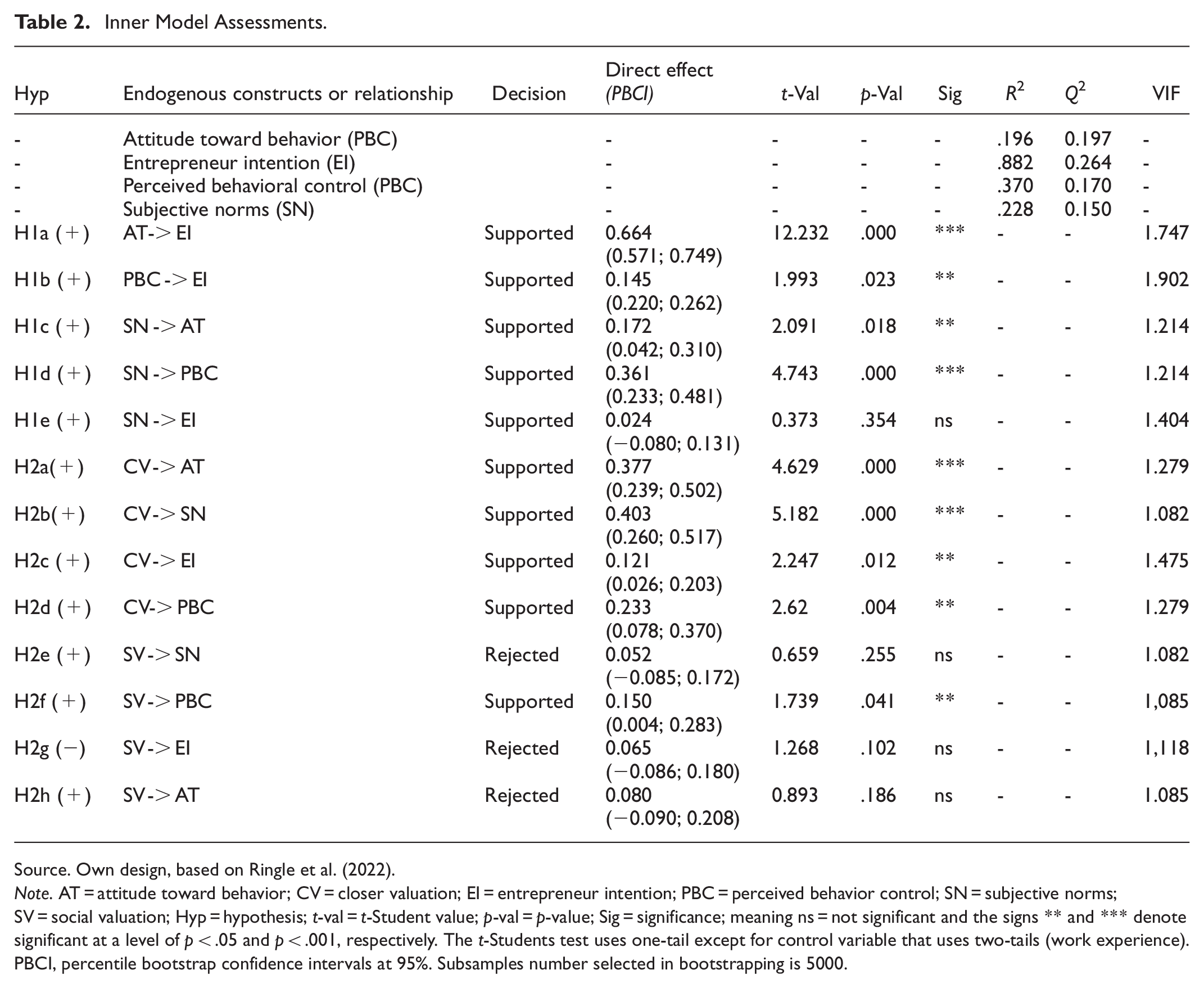
The values of the variance inflation factors (VIF) between the constructs ranged between 1.082 and 1.902, which complies with the VIF ≤ 3.3 recommendation (Kock & Lynn, 2012; Table 2), so multicollinearity is not a major problem in this study. R2 measures the explanatory capacity of the model. In the case of the final endogenous latent variable, entrepreneurial intentions returned a value of 0.735, which is regarded as substantial. For the other endogenous antecedents, R2 returned the following values: attitude toward behavior (β_AT -> EI = 0.664, p < .001) and perceived behavioral control (β_PBC -> EI = 0.145, p < .05). The effect of subjective norms on entrepreneurial intentions was not significant (β_SN -> EI = 0.024, ns). The Q2 values were all above zero (Table 2). At Figure 2 is the nomogram of the estimated model.
Inner Model Assessments.
Source. Own design, based on Ringle et al. (2022).
Note. AT = attitude toward behavior; CV = closer valuation; EI = entrepreneur intention; PBC = perceived behavior control; SN = subjective norms; SV = social valuation; Hyp = hypothesis; t-val = t-Student value; p-val = p-value; Sig = significance; meaning ns = not significant and the signs ** and *** denote significant at a level of p < .05 and p < .001, respectively. The t-Students test uses one-tail except for control variable that uses two-tails (work experience). PBCI, percentile bootstrap confidence intervals at 95%. Subsamples number selected in bootstrapping is 5000.

The estimated model.
Table 2 includes the results of the tests of the proposed relationships. The empirical evidence supports most of the hypotheses, with a significance level of at least 5%, except for hypotheses H1e, H2e, H2g and H2h, which had non-significant path coefficients. Regarding direct effects, AT was the construct with the highest significance, followed by BCP and CV.
Predictive assessment (PLS-predict) was not applied in the study, as it requires a sample of at least 300 participants.
Conclusions
Discussion and Theoretical Implications
The present study, drawing on the theory of planned behavior, increases knowledge of the most important cognitive factors affecting female students’ entrepreneurship in a specific STEM discipline (GIDI). Attitude toward behavior had a positive influence on the entrepreneurial intentions of the female STEM students analyzed. This result is consistent with higher education-based studies in the scientific literature which drew on the theory of planned behavior (Liñán et al., 2011; Malebana, 2014), including examinations into female university students (Gomes et al., 2022) and female STEM students (Law & Breznik, 2017). In addition, AT was shown to be the most important cognitive variable for igniting the entrepreneurial spirit in women. This result is consistent with the conclusions of Law and Breznik (2017) in their examination of engineering students, and Gomes et al. (2022) examining female management students. However, this finding differs from those of other authors (Ferri et al., 2018) who found that perceived behavioral control was the best predictor of women’s entrepreneurship. This may be due to the specific characteristics of engineering studies; among female engineering students a natural predisposition to entrepreneurship (attitude toward behavior) is more important for evoking entrepreneurial intentions than having the confidence they can be successful entrepreneurs.
Perceived behavioral control was found to have a positive impact on the entrepreneurial intentions of female engineering students. This result is important because it confirms the findings of other authors who applied the theory of planned behavior to students in higher education (Kobylińska, 2022), to female university students (Ferri et al., 2018; Gomes et al., 2022) and to STEM students of both sexes (Morales-Alonso, Pablo-Lerchundi, & Núñez-Del-Río, 2016). In addition, it confirms that those students who are more confident that they can be successful entrepreneurs in the near future will develop stronger entrepreneurial intentions.
The results of the study also showed, as did Kobylińska (2022), that the impact of the third cognitive factor analyzed, subjective norms, on the entrepreneurial intentions of university students, is not significant. It should be noted, however, that other authors have concluded that this relationship is positive among students in higher education (Bouarir et al., 2023; Shah et al., 2020) and, in particular, among female students (Gomes et al., 2022). This difference could be because female engineering students attach less importance to the expectations of others about their entrepreneurial capacities than do students taking other degrees.
Moreover, the present study concluded that the relationship between subjective norms and attitude toward behavior is positive. This finding is consistent with those of other authors examining students in higher education (Bazkiaei et al., 2021; Santos et al., 2016) and, in particular, female university students (Bouarir et al., 2023), although, to the best of the authors’ knowledge, no previous studies have examined this relationship in the context of female STEM students. Therefore, the present study is the first to conclude that subjective norms influence attitude toward behavior among female STEM students. This represents a significant advance in the scientific literature related to the theory of planned behavior. Similarly, this study confirmed that subjective norms influence perceived behavioral control, a relationship previously proposed by various authors: with university students, Liñán et al. (2013) and Vuković et al. (2017), and female students, Gomes et al. (2022).
Regarding the environmental factors featured in social cognitive theory, the relationship between social valuation and university students’ entrepreneurial intentions receives particular attention in the scientific literature, given that there is no consensus on the issue in academia.
In the present study it was concluded that social valuation does not have a direct influence on entrepreneurial intentions, which is consistent with Gomes et al. (2022). This result differs from the findings of Bagheri and Lope Pihie (2014), examining female university students, who concluded that this relationship was positive. In contrast, da Costa et al. (2023) found that social valuation had a negative influence on entrepreneurial intentions. That there is no significant relationship between SV and AT in Spain and Portugal could be because societal perceptions of entrepreneurship differ between the Iberian Peninsula and other countries studied. Regarding the Spanish context, the requirements needed to become an entrepreneur (e.g., legal/administrative), and shared cultural values related to self-employment, could be the key reasons why this relationship is not significant (Aparicio et al., 2022; Arroyo-Barrigüete et al., 2023).
The other environmental factor analyzed, closer valuation, was shown to have a positive influence on the entrepreneurial intentions of female engineering students. This result is in line with other studies examining university students (Amofah & Saladrigues, 2020; Liñán et al., 2013). None of these studies differentiated by gender, making the results of the present study relevant for broadening specific knowledge regarding the factors that drive women’s entrepreneurial intentions.
The scientific literature concludes that environmental factors (closer valuation and social valuation) positively influence subjective norms in the context of university students (J. Lopes et al., 2020) and female students (Bagheri & Lope Pihie, 2014). In the present study it was not found that social valuation, in the context of entrepreneurial culture in Spain, had a significant influence on subjective norms. This finding poses a new challenge for academia and demands a specific analysis of the relationship between SV and SN in both the realm of female university students and in STEM, where there is still, apart from the present study, a lack of empirical evidence. However, it has been found that closer valuation does influence subjective norms in the context of female students (Gomes et al., 2022). That this relationship exists is logical, given that family members’ and friends’ positive appreciation of entrepreneurship will condition students’ expectations of entrepreneurial success.
Similarly, in the present study it was found that social valuation did not influence attitude toward entrepreneurial behaviors. This result differs from those of other studies (Alshagawi & Ghaleb, 2023; Liñán et al., 2013; Santos et al., 2016) which found the relationship to be positive among university students. Among Spanish female STEM students this could be because attitude is influenced by other variables, for example, subjective norms and closer valuation, variables that affect, as shown in this study, attitude toward entrepreneurial behaviors. The difference may also be explained by the nature of the studies themselves, given that this research analyzes students taking an industrial design engineering degree which does not include any specific subjects on entrepreneurship, as compared to Liñán et al. (2013), who analyzed students taking a business degree containing specific modules on company formation.
Furthermore, in the present study it was concluded that SV has a positive influence on the PBC of university students (Alshagawi & Ghaleb, 2023; Liñán et al., 2011; J. M. Lopes et al., 2023; Vuković et al., 2017) and female higher education students (Gomes et al., 2022). This finding expands the scope of study of this relationship to female engineering students.
In addition, the present study has demonstrated the influence of closer valuation on perceived behavioral control, showing that family and friends’ appreciation of entrepreneurship is fundamental for female engineering students’ belief they can be successful entrepreneurs (PBC). This finding aligns with previous studies that analyzed other university disciplines, without gender distinction (Alshagawi & Ghaleb, 2023; Liñán et al., 2013; J. M. Lopes et al., 2023; Santos et al., 2016).
Finally, in the present study it was concluded that previous work experience had no moderating effect in any of the relationships between environmental and cognitive factors and entrepreneurial intentions. This finding differs from that of Sommer and Haug (2011), who did find that work experience had a moderating role in the relationship between cognitive factors and entrepreneurial intentions. It will be important to continue analyzing the moderating role of this variable in future studies, especially in the relationship between environmental factors and female entrepreneurship.
In summary, the present study contributes toward the literature on female entrepreneurial intentions by developing and testing a model that combines the theory of planned behavior and social cognitive theory. Furthermore, this research expands the scope of study to STEM students, identifying the factors that influence entrepreneurial intentions among engineering students. The only cognitive factor not found to influence entrepreneurial intentions was subjective norms. This may be because female engineering students attach less importance to the expectations of others about their entrepreneurial capacities than do students taking other degrees. Regarding environmental factors, closer valuation was found to be the most important variable, as it was seen to influence both entrepreneurial intentions and all the cognitive factors considered. This demonstrates the importance of close familial influence in the proposed model.
Managerial and Practical Implications
The present study also offers important proposals for practitioners. Attitude toward behavior is the key factor in entrepreneurship intentions among female engineering students. For this predisposition to entrepreneurship to provide more advantages than disadvantages, several issues must be addressed. One is the work-family balance; this must be addressed to encourage entrepreneurship among female engineers. There should be more support offered, for example, by establishing agreements with care centers for children, the elderly and other dependents. Another possibility would be to provide workplace childcare centers.
Furthermore, it is of the utmost importance that young women see the positive side of entrepreneurship: economic independence, personal fulfillment, decision-making power, contribution to society, etc. Similarly, to promote perceived behavioral control, theoretical and practical training should be actively supported through business incubators, integrating entrepreneurship subjects into engineering programs. Another general recommendation is to integrate educational entrepreneurship programs into all university studies, as suggested by Morales-Alonso, Pablo-Lerchundi, and Vargas-Perez (2016). This kind of program should be promoted in other educational areas/subjects; this would promote the development of more independent individuals able to thrive in a self-employment environment, regardless of gender.
Moreover, better access to financing should be promoted, perhaps through providing specific credit lines for the collective of entrepreneurs, and legislation should be passed to reduce taxes and bureaucratic procedures.
In addition to improving families’ and friends’ acceptance of entrepreneurship, it would be advantageous to promote a more positive image of entrepreneurship in the media and social networks, which in turn might improve attitudes toward behavior and perceived behavioral control. Furthermore, support from educational and governmental institutions would help promote families’ and friends’ endorsement of female students who choose to become entrepreneurs.
It was shown in the present study that women who study engineering do not need the approval of their close circle to become entrepreneurs, thus they demonstrated more independence than the results of research from other studies would suggest.
Closer valuation had a positive influence on social norms; consequently, students with a close circle of family and friends who believe in entrepreneurship will receive the support of these groups in their quest to become entrepreneurs. This supports the practical proposals of studies that go more in-depth into the importance of the passing on of entrepreneurial values from family/close connections (Morales-Alonso, Pablo-Lerchundi, & Vargas-Perez, 2016). Consequently, if individuals have family and friends who are self-employed, they will receive more support to become entrepreneurs, that is, their entrepreneurial intentions will be indirectly influenced through AT and PBC.
Social valuation is the weakest construct in the proposed entrepreneurship model; it did not significantly influence entrepreneurial intentions (H2g), subjective norms (H2e) or attitude toward behavior (H2h). This could be because SV very much depends on a country’s economic situation and, therefore, the results must be analyzed in the specific context (Santos et al., 2016). Public administrations should make it a priority to modify their social policies to take into account the social valuation of entrepreneurship to promote a positive attitude toward entrepreneurship, and to combat the reluctance of family and friends to encourage students to take entrepreneurial opportunities.
Conversely, social valuation has a positive influence on female students’ confidence that they can become entrepreneurs. It is, therefore, important to highlight the achievements of successful female entrepreneurs, use them as examples and encourage them to actively participate in mentoring young people with entrepreneurial intentions, sharing their experience and knowledge. We also recommend that female entrepreneurs should be encouraged to participate in business associations.
Public administrations must take concrete actions to reinforce and expand the roles of women in entrepreneurship and innovation ecosystems and take a more active role as investors and facilitators of business start-up initiatives. Actions should be taken to improve the image of entrepreneurship, promoting entrepreneurial intentions within the educational context, not only among university students, but also among young people in general. Programs and the resources used to support female entrepreneurs should take into account their diversity and backgrounds to improve their access to entrepreneurial opportunities. In short, if women fail in entrepreneurship in industries that provide greater added value (such as technology-based companies), the gender imbalance in Spain will only increase. Measures such as personal income, decision-making capacity and representation in business associations will continue to reflect societal inequality.
Limitations and Future Lines of Research
This study has limitations that open avenues for future research. First, the data were obtained from a cross-sectional survey. Future research might analyze the relationships over time, using longitudinal data. Second, the data were collected in Spain. It would be interesting to evaluate the proposed model in other cultural contexts. Third, the sample was only of engineering students; future research might gather data from women studying other STEM disciplines.
We think it is important that examinations are made not only of entrepreneurial intentions; the actual entrepreneurship behaviors of these women should be examined after they complete their STEM studies. It would also be interesting to analyze determinants of entrepreneurial intentions, in the context of STEM students, not included in the present study, such as personality, social, educational, contextual and demographic factors.
Footnotes

Ethical Considerations
All procedures performed in studies involving human participants were in accordance with the ethical standards of the institutional and/or national research committee and with the 1964 Helsinki Declaration and its later amendments or comparable ethical standards. The study was approved by the Ethical Committee of Experimentation of University of Malaga-CEUMA- (No. 112-2023-H).
Funding
The author(s) disclosed receipt of the following financial support for the research, authorship, and/or publication of this article: This research will be funded for open access charge by the University of Malaga/CBUA in case of acceptance and publication. The authors gratefully acknowledge the financial support from the Chair of Innovation and Smart Management (University of Malaga & Airzone) and from the Research Group SEJ-314 (PAIDI).
Declaration of Conflicting Interests
The author(s) declared no potential conflicts of interest with respect to the research, authorship, and/or publication of this article.
Data Availability
The data that support the findings of this study are available upon request from the authors.