



Abstract
Migrant workers returning home to start businesses has played a strong supporting role in promoting regional poverty alleviation and rural revitalization. How to enhance return migrants’ entrepreneurial intention is of vital importance. Using survey data on return migrants from many places in China, this article analyzes the mechanism of entrepreneurial resilience, perception of entrepreneurial opportunity and entrepreneurial intention, and the moderating effect of entrepreneurial atmosphere. The results show that entrepreneurial resilience has a significant positive impact on entrepreneurial intention; entrepreneurial opportunity perception plays a partial mediating role between entrepreneurial resilience and entrepreneurial intention. In addition, entrepreneurial atmosphere negatively moderates the relationship between entrepreneurial resilience and entrepreneurial intention, and between entrepreneurial resilience and perception of entrepreneurial opportunity. Therefore, we suggest that while creating a good entrepreneurial atmosphere, local governments at all levels in China must also pay attention to avoiding excessive intervention that aggravates the vulnerability of return migrants to entrepreneurship.
Keywords
Introduction
In China, workers whose household registration is in the countryside and who have been engaged in non-agricultural sector in urban areas for 6 months or more are generally referred to as migrant workers. Return migrants are migrant workers who return to villages, townships, or counties where their hometown is based. The sudden onslaught of COVID-19 has wreaked havoc on global industrial and supply chains. Labor-intensive industries at the lower end of these chains are the worst affected, resulting in the reduction of related jobs, and this is also the industry field where migrant workers are concentrated (Wei & Lu, 2020). By the end of May 2020, under the influence of COVID-19, more than 8 million migrant workers have returned to their hometowns in China (Ministry of Agriculture and Rural Affairs, 2020). Many of these migrant workers have been stranded at home because they lost their jobs in the cities. At the same time, the pandemic has also caused migrant workers to worry about the high risk of contracting the virus and threats to their health, which has reduced their willingness to return to work to a certain extent and choose to stay in rural areas (Deng, 2020). Under the dual influence of the macroeconomic environment and personal willingness factors, the scale of migrant workers’ return to their hometowns has further expanded, and the employment pressure brought about by them has become an urgent problem to be solved. Entrepreneurship, as an important means of stimulating rural economic growth, plays a positive role in stabilizing the employment of returning migrant workers, guaranteeing the basic income of migrant workers after returning home, and contributing to local effort in poverty alleviation and prevention. In a macro sense, promoting entrepreneurship in rural areas is an effective means to consolidating China’s achievements in poverty alleviation and in rural revitalization as the country ushers in a new development period marked by the implementation of the 14th five-year plan. Therefore, how to enhance entrepreneurial intention and improve the quality of entrepreneurship to create better jobs through entrepreneurship are the important issues that Chinese society still need to pay attention to in the new development period.
Entrepreneurial intention refers to would-be entrepreneurs’ attitude about whether to engage in entrepreneurial activities, and their cognition about whether entrepreneurial behavior is feasible and befits their personal situation (Krueger, 2000). As for return migrants, their entrepreneurial intention reflects their attitude and commitment to identifying, pursuing, evaluating, and exploiting existing resources and opportunities after they had been working in urban areas for more than 6 months and returned to villages, townships, and counties of origin. Entrepreneurial intention is an important index which can be used to evaluate potential entrepreneurs’ attitude toward entrepreneurial activities and predict whether they will exhibit entrepreneurial behavior by assessing their subjective attitude to engage in entrepreneurial activities (Krueger et al., 2000). Only those who have strong entrepreneurial intention will be devoted to entrepreneurial activities (Krueger, 1993). Therefore, it is safe to say that increasing return migrants’ entrepreneurial intention is of great practical significance for promoting return migrants to achieve employment and increase income through entrepreneurship, promoting local economic and social development and revitalizing rural areas. Existing research on factors affecting entrepreneurial intention focuses on external environment and individuals (Palmer et al., 2021; Werner et al., 2014), with the latter concentrating on the influence of human capital (e.g., entrepreneurs’ educational background and work experience) and psychological traits (e.g., self-esteem, innovation, discipline, self-efficacy, and sense of accomplishment) (Gast et al., 2017). As a new perspective to measure the personal characteristics of entrepreneurs, entrepreneurial resilience has a good predictive role in entrepreneurial activities in a high-uncertain environment (X. E. Zhang & Li, 2020), and thus receiving a growing scholarly interest.
The word “resilience” is derived from a Latin verb “resilire,” meaning the ability to rebound, return to original state, or retreat, without being pushed or broken. Originally defined by physics and engineering, the concept of resilience has been widely adopted by researchers in fields like sociology, psychology, ecology, disaster management, and organizational science. Scholars in psychology have reached a consensus that resilience is a psychological characteristic that enables individuals to overcome difficulties, cope with pressure, complete tasks and adapt to certain circumstances, and preparing people to start up their own business. Klundert (1986) was the first to introduce resilience into the field of entrepreneurship which is receiving a growing interest from academics. Entrepreneurial resilience can be viewed through two perspectives, namely, trait and process. From the perspective of trait, entrepreneurial resilience is a personality trait about how individuals manage to beat the odds, and slowly bounce back to stability, which combines factors such as optimism, flexibility, self-confidence, resourcefulness, and innovation (X. E. Zhang & Li, 2020). Therefore, it means that the trait perspective is a static one. That is, the research focus is on how the combination of entrepreneurs’ personality traits influences their response to unfavorable circumstances, not on the evolution of such traits. From the perspective of process, entrepreneurial resilience explains the ongoing interaction between entrepreneurs and the environment (Cooper et al., 2013). To be more specific, this perspective explains that rather than uniform and spontaneous, resilience is malleable and fluctuates with the environment (Tusaie & Dyer, 2004). By managing pressure and hardship arising from adverse experiences, entrepreneurs can have more entrepreneurial resilience (Song, 2019). This study combines the two perspectives and maintains that entrepreneurial resilience of return migrants is both a personality trait and a dynamic process. To be more specific, entrepreneurial resilience indicates whether returnees will adjust themselves to cope with difficulties, obstacles, and distractions that come along with entrepreneurial activities, and whether they will seek a way out by finding resources and creating necessary conditions. As a trait and a process, entrepreneurial resilience enhances returnees’ belief, confidence, and other positive emotions, protects them from being affected by negative environment, and preserves their entrepreneurial intention until their goal is reached.
Entrepreneurial opportunity is the core component of entrepreneurship (Shane & Venkataraman, 2000), suggesting possibilities of how entrepreneurs leverage resources to meet market needs and create value (Schumpeter, 1934). The perception of entrepreneurial opportunity is also an important part of the entrepreneurial process (Shane & Venkataraman, 2000), and a decisive factor of the formation of entrepreneurial intention (R. A. Baron & Ensley, 2006). At the same time, the development of entrepreneurial activities is closely related to the support and restrictive conditions in a certain area. As an important part of entrepreneurial context, entrepreneurial atmosphere reflects the complex interaction between individuals and their entrepreneurial context. Due to the entrepreneurial atmosphere is heterogeneous to a certain extent, the introduction of entrepreneurial atmosphere is of great significance for understanding when, how, and why entrepreneurial behavior occurs and who will participate in it (Lin, 2012; Welter, 2011).
Compared with other entrepreneurial groups, return migrants’ education level is not high, their overall quality is low, and their knowledge and skills related to entrepreneurship are relatively limited, which puts them in a relatively weak position for entrepreneurship, and further leads to more limited entrepreneurial opportunities and resources that they can obtain and use, as well as relatively more entrepreneurial difficulties. At the same time, COVID-19 continues to deal a serious blow to a large number of start-ups, and discourages people from entering into entrepreneurship. Under these circumstances, how to enable return migrants who are not fully prepared to be entrepreneurs to overcome difficulties, and enhance their confidence and intention in entrepreneurship, the research on entrepreneurial intention from the perspective of entrepreneurial resilience is becoming more and more important (Rui & Fang, 2017). However, present studies on the formation of entrepreneurial intention from the perspective of entrepreneurial resilience is not enough, and the research on return migrants is even rarer, resulting in inadequate understanding of how entrepreneurial resilience influences entrepreneurial intention. Based on the theories of planned behavior and triadic reciprocal determinism, this paper starts from entrepreneurial resilience, an individual psychological trait of entrepreneurs, and introduces perception of entrepreneurial opportunity and entrepreneurial atmosphere that have an important impact on entrepreneurial intention as mediating and moderating variables to construct a theoretical model of entrepreneurial resilience affecting entrepreneurial intention, explore the formation path of the entrepreneurial intention of return migrants under different entrepreneurial atmospheres, so as to address the following issues: (1) How does entrepreneurial resilience affect entrepreneurial intention? (2) What role does the perception of entrepreneurial opportunity play in the process of entrepreneurial resilience influencing entrepreneurial intention? (3) Will the above influence and role change with different entrepreneurial atmospheres?
By clarifying the mechanism and effect of entrepreneurial resilience on the entrepreneurial intention of return migrants, and the impact of entrepreneurial resilience and entrepreneurial opportunity perception on entrepreneurial intention under different entrepreneurial atmospheres, this paper not only deepens understanding about entrepreneurial resilience in the Chinese context, but also provides theoretical and practical underpinnings for decision makers about how to adjust the entrepreneurial atmosphere appropriately, strengthen return migrants’ entrepreneurial resilience and the ability to identify opportunities and then enhancing their entrepreneurial intention.
Theoretical Background and Hypotheses Development
The theory of planned behavior inspires us that the most immediate factor of human behavior is behavioral intention which has three core components. First, attitude toward performing a specific behavior, namely, the “attitude” held by an individual toward a particular behavior. It is a kind of pre-determined position about what they like or dislike for a certain object. It can also be said to be a positive or negative evaluation of an individual performing a certain behavior. Attitude can be explored through two aspects: salient beliefs and outcome evaluation (Fishbein & Ajzen, 1975). Second, subjective norm. It is the attitude that the individual perceives from other important individuals or groups toward a particular behavior, and the degree to which the individual follows this attitude. This component also includes an individual’s perceived pressure from others when he or she is performing a certain behavior (Duan & Jiang, 2008). In other words, such perception is about whether peers and people of importance to the person think he or she should engage in the behavior. Third, perceived behavioral control. This refers to a person’s perception of the ease or difficulty of doing something. This component covers both internal and external control, with the former including individuals’ shortcomings, skills, abilities, or emotions, and the latter consisting of information, opportunities, dependence on others, and obstacles to overcome (Ajzen, 1991).
In recent years, migrant workers’ enthusiasm to return home to start a business has increased. On the one hand, it is because of the pull from their hometown, including the desire of migrant workers to return to their hometowns, and the needs of taking care of their families. On the other hand, it is also their choice after repeatedly weighing the pros and cons of returning home to start a business. However, due to the inherent vulnerability of migrant workers, return migrants not only rely on the experience, funds, and social relationships they have accumulated when they go out to work, but also rely on the support of relatives and friends from their hometowns when they start a business in their hometowns (Wang et al., 2020). The degree of support they perceived from their relatives and friends in their hometown and the demonstration effect of entrepreneurs in their hometowns will affect their entrepreneurial decision-making. Judging from the current practice of migrant workers returning to their hometowns to start businesses, most of them start their own businesses by themselves. This requires them to objectively evaluate the favorable conditions and major obstacles of themselves and the external environment, as well as comprehensive consideration of the convenience and possibility of identifying and obtaining opportunities, solving various difficulties, and taking risks by themselves. From this point of view, the formation of the entrepreneurial intention of return migrants will inevitably be affected by their own attitude toward entrepreneurship, whether they can identify or obtain opportunities, the attitude of their relatives and friends in their hometowns to their entrepreneurship, and their own determination and ability to solve difficulties.
In addition, Bandura’s triadic reciprocal determinism sheds light on individual behavior which is determined by an interplay between individuals, their behavior, and the environment they are in. Entrepreneurial intention of return migrants is no exception, reflecting an interplay between returnees and their surrounding environment. To be more specific, individual factors include returnees’ entrepreneurial resilience and perception of entrepreneurial opportunities. Entrepreneurial atmosphere in their hometown is an important factor indicating the environment. These three factors lead to the formation of entrepreneurial intention. Therefore, this paper analyzes the mechanism of entrepreneurial resilience, perception of entrepreneurial opportunity, entrepreneurial atmosphere and entrepreneurial intention of return migrants, and proposes research hypotheses.
Return Migrants’ Entrepreneurial Resilience and Entrepreneurial Intention
Entrepreneurial resilience is a core component that explains entrepreneurial behavior, which can not only help entrepreneurs overcome unknown adversity and adapt to uncertainty, but also help entrepreneurs recover and grow from failure (Hao et al., 2020). Studies have shown that entrepreneurs often find themselves in an unfamiliar territory which threatens business survival and put them under long-term, enormous pressure, a sure recipe for psychological problems (Duchek, 2018). The antidote is resilience which produces positive emotions, and builds a strong line of defense against negative feelings like anger, fear, anxiety, and sadness (Fredrickson et al., 2003). From this point of view, entrepreneurial resilience emphasizes the consciousness of coping process and the unconsciousness of defense mechanism, which is a personal adaptation mechanism to adapt to various situations. Especially in adversity, resilience shows a good regulatory role (Yulita, 2020), which can prevent, mitigate, or overcome the harmful effects of adversity (Ayala & Manzano, 2011, 2014; Markman & Baron, 2003). To sum up, resilience is the key to entrepreneurial success. The study of Bullough and Renko (2013) shows that individual resilience affects cognition, which in turn exerts an influence over entrepreneurial intention. An environment as highly unpredictable as war is a case in point. Entrepreneurial resilience negatively moderates the negative relationship between risk perception and entrepreneurial intention. Individuals with high entrepreneurial resilience are endowed with more positive psychological cues and greater fortitude, which means that when dealing with critical issues and setbacks, they show remarkable adaptability, and can endure psychological pressure coming along with perceived high risks and uncertainties, thus undermining the influence of risk perception over entrepreneurial intention (Bullough et al., 2014).
The situation can be more precarious for return migrants, because the entrepreneurial environment in their hometown is relatively poor. They need to face an unfavorable environment where entrepreneurial resources are relatively scarce, resources and support available are relatively limited, so they will encounter more difficulties and obstacles when starting a business, and entrepreneurial risks are relatively higher. All of these will bring huge psychological pressure to returning migrant workers, and affect their judgment and choice of entrepreneurial decision-making (He, 2020). Nevertheless, the situation can be different from case to case. From the perspective of individual action tendency, compared with individuals with low resilience, return migrants with high entrepreneurial resilience are less likely to be discouraged by the challenges of an unfavorable environment, and have a higher tendency to act (Bullough et al., 2014). They can make good self-adjustments in unfavorable environments, strengthen the desirability and feasibility of entrepreneurial behavior, and then have higher entrepreneurial intension and take entrepreneurial actions. On this basis, we hypothesize:
The Mediating Effect of Return Migrants’ Perception of Entrepreneurial Opportunity
Perception of entrepreneurial opportunity is the judgment of potential entrepreneurs or real entrepreneurs on the profitable business opportunities brought by the unmet needs of the market (Vidal-Suñé & López, 2013). This evaluation process is important for potential entrepreneurs who combine their own strengths with perceived opportunities, and translate ideas into a business venture (Renko et al., 2012). Perception of entrepreneurial opportunity comes first in entrepreneurial activities, acting as an important antecedent variable for potential entrepreneurs to form entrepreneurial intention (W. L. Liu et al., 2011). Throughout the entrepreneurial process, entrepreneurs need to be able to perceive opportunities keenly and invest a lot of energy to continuously seek new opportunities and new ideas in the environment that have not been noticed by others (X. E. Zhang & Wang, 2020). Thus, two virtuous cycles are created: The stronger the ability of potential entrepreneurs to perceive opportunities, the more opportunities they identify, the stronger their entrepreneurial intention (W. L. Liu et al., 2011); the more entrepreneurial opportunities they perceive, the greater the likelihood of entrepreneurial activities (Krueger et al., 2000). The perception of entrepreneurial opportunity of return migrants is their judgment on business opportunities in their hometown that can bring benefits to them. It is also a manifestation of the comprehensive ability of return migrants to rationally collect and obtain information, evaluate the market, and integrate resources in the process of discovering opportunities (Shi et al., 2016; X. R. Yang & Zou, 2018). Like other potential entrepreneurs, return migrants will not start the entrepreneurial process until they perceive a clear entrepreneurial opportunity. On this basis, we hypothesize:
Perception of entrepreneurial opportunity is influenced by both rational assessment and irrational factors like emotion and passion (H. Zhang et al., 2020). The way entrepreneurs thinks and the cognition they possess determines their ability to identify and capture entrepreneurial opportunities based on their own intuitive judgment and cognitive abilities when facing an uncertain entrepreneurial environment (J. Chen & Xing, 2018). Prior studies have proved that instead of flinching from uncertainties, business owners with high entrepreneurial resilience remain level-headed, seek an efficient solution to get things done, and are sensitive to signals about entrepreneurial opportunities (Rui & Fang, 2017). They are fully prepared to the unexpected, think strategically rather than resisting change, and reinvent themselves periodically to adapt to the business environment where the only constant is change (Fatoki, 2018). For return migrants, they face much more challenges. Many of them are not well educated, which means that they have limited access to knowledge and information. To make things worse, their social networks are based mainly on geographical proximity and family ties. All this undermines their ability to see and seize entrepreneurial opportunities (Han et al., 2020). Nevertheless, there is a silver lining. Born and bred in poverty, they are no strangers to hardships, building resilience along the way. And the higher the entrepreneurial resilience, the stronger their adaptability to face difficulties and challenges (X. E. Zhang & Li, 2020), which in turn will have a positive impact on entrepreneurial activities, enabling them more likely to succeed in their business. Moreover, the higher the probability of entrepreneurship that the return migrants expect to succeed in their business, the stronger their willingness to start a business (R. X. Wu & He, 2018). On this basis, we hypothesize:
Existing studies have tested the relationship between the perception of entrepreneurial opportunity and entrepreneurial resilience, and the relationship between perception of entrepreneurial opportunity and entrepreneurial intention. However, there are few literatures on the mechanism of perception of entrepreneurial opportunity between entrepreneurial resilience and entrepreneurial intention. Potential entrepreneurs with high entrepreneurial resilience often exhibit characteristics such as confidence, optimism, acceptance of change, and adaptability, which are consistent with the entrepreneurial spirit required by potential entrepreneurs when exploring entrepreneurial opportunities. In other words, entrepreneurial intention is closely linked with entrepreneurial resilience and the perception of entrepreneurial opportunity. It is worth noting that entrepreneurial resilience, as an individual’s psychological factor, plays a more profound role. It helps to promote other personal traits related to entrepreneurship, such as entrepreneurial behavior tendency and entrepreneurial cognitive ability (Song, 2019). Therefore, entrepreneurial resilience works through perception of entrepreneurial opportunity to influence entrepreneurial intention. Like other potential entrepreneurs, return migrants with high entrepreneurial resilience can maintain positive emotions in adversity and continuously improve their cognitive abilities, so as to be able to cope with various pressures and difficulties in entrepreneurial activities and generate new opportunities and new ideas from them. In the end, their entrepreneurial intention and entrepreneurial confidence will be enhanced. On this basis, we hypothesize:
The Moderating Effect of Entrepreneurial Atmosphere
Academics are still divided on how to define entrepreneurial atmosphere. They fall into two groups. One maintains that the atmosphere is related to social culture perceived by organizations or communities in a certain area. The other examines the atmosphere in the framework of entrepreneurial environment. Technically speaking, though influenced by external environment, entrepreneurial atmosphere is more about collective consciousness of a community, including its culture, customs, established practices, values, and preferences (S. L. Jiang, 2006). In this sense, entrepreneurial atmosphere is a barometer of how people in a certain area assess the value of entrepreneurship, what social norms entrepreneurs need to follow, and what attitude and views adopted by communities in a region toward entrepreneurship and entrepreneurial activities (J. Y. Jiang & Guo, 2012). According to the theory of ethnocentrism, different social groups will examine each other, resulting in in-group cultural preferences and out-group cultural prejudice (X. L. Chen, 2019). This means that entrepreneurial culture in a certain region exerts an influence on entrepreneurs’ beliefs, motivations, and behaviors, thereby amplifying or reducing the impact of institutions and economy on entrepreneurial activities (Hayton & Cacciotti, 2013). This difference in entrepreneurial atmosphere will cause differences in the entrepreneurial intention and entrepreneurial impulse of ethnic group members, the degree of social attention to entrepreneurial activities, the public’s evaluation and attitude toward entrepreneurial activities, and the way of social collaboration in entrepreneurial activities (Y. G. Wu & Rong, 2011). Specific to this research, the entrepreneurial atmosphere refers to the economic and cultural atmosphere within the entrepreneurial region of return migrants’ hometown, in which return migrants feel how local people encourage, tolerate, and support entrepreneurial activities, and how collective will holds sway in the region (Feng, 2018).
The entrepreneurial role models in hometown and attitude of local residents toward entrepreneurship will affect return migrants’ thinking and behavior, develop their characteristics and abilities, shape their perception of entrepreneurial activities, and thereby affect their entrepreneurial intention (J. Y. Jiang & Guo, 2012). Social support theory maintains that group support can mitigate negative influences of pressure and setbacks on entrepreneurs. Social group support as a protective factor can undermines negative influences on entrepreneurs, builds their resilience, and promotes their psychological wellness (Ozbay et al., 2007). As a result, entrepreneurs who achieve career growth in a supportive atmosphere have better resilience in the face of adversity (Duchek, 2018). At the same time, this kind of supportive atmosphere can easily create social convergence pressure, increase individual entrepreneurial confidence and interest, change the risk appetite of potential local entrepreneurs, making them actively respond to entrepreneurial dilemmas, and then stimulating their enthusiasm for entrepreneurial activities (Y. G. Wu & Rong, 2011). Research done by X. L. Chen (2019) shows that widening urban-rural gap and the weakening of the rural social and cultural subjectivity perpetuate unfavorable entrepreneurial atmosphere in rural areas and discourage migrant workers to return home and take the entrepreneurial path. It can be seen that the strong entrepreneurial atmosphere in rural areas helps strengthen the positive influence of entrepreneurial resilience on return migrants’ entrepreneurial intention. On this basis, we hypothesize:
The essence of entrepreneurial activities is to grasp business opportunities under incomplete information, which requires entrepreneurs to have the ability to understand market dynamics and make decisions under various uncertain conditions. This kind of ability is not only related to the entrepreneur’s innate factors, but also influenced by acquired factors (Zahra et al., 1999). As mentioned earlier, entrepreneurial resilience is not only an innate personality trait, but also a dynamic process. The psychological intervention model proposed by Luthans et al. (2007) emphasizes that entrepreneurial resilience is a psychological capital which can be increased through experience, risk avoidance, and attitude change. Entrepreneurial activities are more frequent in regions with a strong entrepreneurial atmosphere, and therefore have accumulated more entrepreneurial knowledge and experience, which can provide a priori reference for ethnic group members. By comparing previous experience to avoid risks and reduce the uncertainty of entrepreneurial activities, the ability and possibility of ethnic group members to perceive and utilize opportunities can be improved (Y. G. Wu & Rong, 2011). Therefore, entrepreneurial atmosphere, as the entrepreneurial attitude and values of ethnic group members in a certain region, can profoundly affect the relationship between entrepreneurial resilience and entrepreneurial intention of return migrants. On this basis, we hypothesize:
Based on the above hypotheses, the theoretical model established in this paper is shown in Figure 1.

Research model.
Methodology
Sample and Data Collection
This research focuses on return migrants and take into account two aspects to conduct a sound assessment. First, according to intensity of entrepreneurial activities across the country announced by the National Development and Reform Commission, combined with the annual reports released by the National Bureau of Statistics about the output and flow of migrant workers over the years, this paper selects provinces where entrepreneurship is relatively active in the eastern China (e.g., Beijing, Tianjin, Hebei, Zhejiang, Jiangsu, and Shandong) and provinces where entrepreneurial activities are relatively quiet in the western (e.g., Shaanxi, Guizhou, Gansu, and Sichuan) to conduct a questionnaire survey. Second, continuous and widespread flow of migrant workers necessitates the collection of multiple sources of information to ensure the validity and representativeness of the sample. We collected official reports about the return migrants in relevant regions through multiple channels so as to confirm the counties with relatively high return flow of migrant workers in the selected provinces for investigation. Furthermore, migrant workers were randomly sampled through the local human resources and social security departments.
The survey was conducted in two stages. First, in 2019, return migrants in Beijing were surveyed to examine their entrepreneurial intention and 200 questionnaires were accepted. Based on this initial analysis, we improved the questionnaire. Second, we went to the above-mentioned provinces to conduct in-depth interviews and questionnaire surveys. This process lasts for about 7 months. By the end of 2020, we surveyed 451 migrant workers, and 396 questionnaires had been accepted.
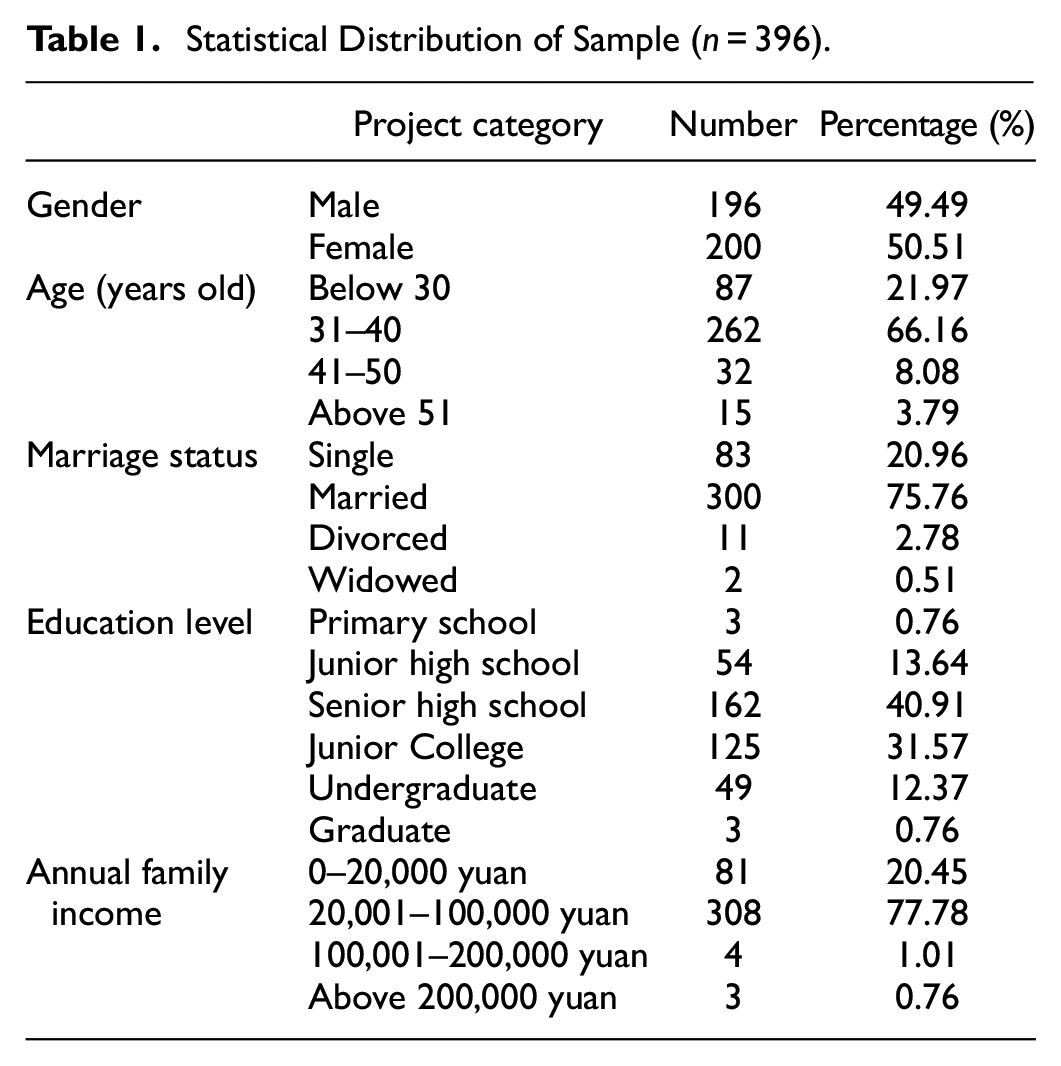
Statistical distribution of sample is shown in Table 1. Out of the total number of respondents, men accounted for 49.49% and women accounted for 50.51%. Most of the respondents were 31 to 40 years old, accounting for 66.16%, followed by respondents aged 30 years and under, accounting for 21.97%. The proportion of the two age groups reached 88.13%, indicating that the respondents are mainly the new-generation return migrants. In addition, the proportion of married respondents was the highest, at 75.76%, and most of the respondents had a high school education or below, accounting for 55.31%. The education level of return migrants has increased compared with before, but it is still at a lower level. Finally, the proportion of respondents with an annual family income of less than 100,000 yuan is 98.23%, which means that the annual family income of return migrants is not high.
Statistical Distribution of Sample (n = 396).
Measurement Instruments
Entrepreneurial Resilience (ER)
We refer to the scales of Connor and Davidson (2003) and Yu and Zhang (2007) to measure the entrepreneurial resilience of return migrants from the three aspects of adaptation to changes, confidence, and optimism. The three items that measure entrepreneurial resilience are “To live a fulfilling life, I always take my initiative to seek change,”“I have confidence to address most problems in my work and life,”“Entrepreneurial failure will not deal a fatal blow to me.”
Perception of Entrepreneurial Opportunity (OP)
The scale of the perception of entrepreneurial opportunity has different versions, which are all developed by researchers according to their own research fields. We developed our scale on the basis of scales developed by Kaish and Gilad (1991) and Shi et al. (2016). The three items that measure the perception of entrepreneurial opportunity are “I can spot opportunities in work and life to build a profitable business,”“I collect business information through multiple channels,” and “I am good at synergizing resources to get things done.”
Entrepreneurial Atmosphere (EA)
As mentioned earlier, entrepreneurial atmosphere reflects social norms such as attitude adopted by local community toward entrepreneurship. The scales developed by J. Y. Jiang and Guo (2012) is used in this paper. The three items used to measure entrepreneurial atmosphere are “I have successful entrepreneurs nearby to emulate,”“Local people are friendly and respectful of entrepreneurs,” and “Local people are tolerant of entrepreneurial failures.”
Entrepreneurial Intention (EI)
There are two types of methods to measure entrepreneurial intention: one is to measure through a question “whether there is a willingness to start a business,” the answer can be “yes” or “no.” The other is to measure the degree of intention through a Likert scale. Considering that the question lacks depth, we incorporated items designed by Peterman and Kennedy (2003), and Liňán and Chen (2009) into the survey. There are three items to measure entrepreneurial intention, including “I’ve been thinking a lot about starting a business,”“I’m committed to starting a business in the future,” and “I’ve been fully prepared to start a business.”
Control Variables
Based on prior studies suggesting that gender, age, education level, annual family income, and local economic development have an influence on returnees’ entrepreneurial intention, this paper also chose the five aspects as control variables to increase the validity of research results. Special mention should be made to local economic development which is assessed by per capita GDP in 2018 in the hometown of the surveyed subject. After sorting per capita GDP in order, quartile method was used into a sequence of “lower,”“low,”“high,” and “higher.”
All variables except control variables in this study were assessed using the 5-point Likert-type scale (where 1 = strongly disagree and 5 = strongly agree).
Scale Validity and Reliability
The reliability and validity of the scale are shown in Table 2. Generally speaking, Cronbach’s α exceeding .6 indicates that the reliability of the variable is within an acceptable range, and exceeding .7 indicates that the reliability of the variable is good. The minimum value of Cronbach’s α in Table 2 is .636, which is within an acceptable range. Moreover, the average variance extracted (AVE) for each variables exceed the required .5 threshold and composite reliability (CR) for all constructs exceeded .6, indicating that the convergent validity of each variable is good.
The Validity and Reliability Test Results of Variables.

We built a competitive model to facilitate a discriminant validity test. Table 3 shows that all fit indices of the four-factor model are better than those of the competitive model and in line with minimum judgment, indicating that the four-factor model is sound for its good discriminant validity. At the same time, Table 4 indicates that the correlation coefficient between variables is less than the square root of the AVE value, indicating that discriminant validity is supported as well.
Results of Discriminant Validity Test.

Descriptive Statistics and Correlations.

Note. The figures in parentheses given in bold are the square root of the AVE.
p < .05. **p < .01.
Results
Descriptive Statistics and Correlations
As shown in Table 4, entrepreneurial resilience is significantly positively correlated with entrepreneurial intention (r = .443, p
Common Method Bias
Since all data for variables were collected through questionnaires, common method bias (CMB) is inevitable. In order to control for common method bias, we used a two-step approach. First, in designing the questionnaire, we included reverse scoring questions, disrupted the order of the items, and allowed anonymous filling. Second, the collected data were analyzed using Harman’s single-factor test. This was done by loading all the independent and dependent variables into an exploratory factor analysis. The test resulted in three components with an eigenvalue exceeding 1 and a first factor that explained 36.38% of the variance, well below the recommended threshold of 50% (Podsakoff et al., 2003). Common method bias was therefore assumed not to be a threat in this study.
Regression Results
We use hierarchical regression method to test the hypotheses, Table 5 is the results of hierarchical regression. Hypothesis 1 predicts that entrepreneurial resilience has a significant positive impact on entrepreneurial intention. Models 1 in Table 5 provides statistical support for this hypothesis at the significant level of p
Results of Regression Analysis.

Note. Unstandardized coefficients are reported.
p < .05. **p < .01. ***p < .001.
Hypothesis 2 predicts that the perception of entrepreneurial opportunity of return migrants has a significant positive impact on entrepreneurial intention. The coefficients of the variable in the reported results of Model 2 in Table 5 have the expected sign and are significant at p
Hypothesis 3 assumes that the entrepreneurial resilience of return migrants has a significant positive impact on the perception of entrepreneurial opportunity. The reported regression result of Model 5 in Table 5 supports the Hypothesis 3 at p
Hypothesis 4 argues that the perception of entrepreneurial opportunity of return migrants mediates the relationship between entrepreneurial resilience and entrepreneurial intention. According to R. M. Baron and Kenny (1986), the test of mediation effect usually includes the following four steps:(1) testing the relationship between the independent variable and the dependent variable; (2) testing the relationship between the independent variable and the mediating variable; (3) testing the relationship among independent variable, mediating variable and dependent variable; and (4) if the effect of independent variable on the dependent variable is not significant while the effect of mediating variable on the dependent variable is significant in step (3), indicating that the mediation effect is full. If the effects of independent variable and mediating variable on the dependent variable are both significant, and the effect of independent variable on the dependent variable in step (3) less than the effect in step (1), indicating that the mediation effect is partial. The Model 3 in Table 5 shows that the effects of independent variable (ER) and mediating variable (OP) are significant. Contrasting Model 1 and Model 3, it is found that the effect of entrepreneurial resilience to entrepreneurial intention drops to 0.290, indicating that the perception of entrepreneurial opportunity plays a partial mediating role between entrepreneurial resilience and entrepreneurial intention, and Hypothesis 4 is supported.
Hypotheses 5 and 6 contend that the entrepreneurial atmosphere moderates the relationship between return migrants’ entrepreneurial resilience and entrepreneurial intention, and the relationship between return migrants’ entrepreneurial resilience and the perception of entrepreneurial opportunity. It can be seen from Model 4 and Model 6 that the interaction variable (ER×EA) has a significant negative impact on entrepreneurial intention (b = −0.152, p < .001; ΔR2 = .063, p < .001) and the perception of entrepreneurial opportunity (b = −0.070, p < .05; ΔR2 = .047, p < .001). Therefore, the Hypotheses 5 and 6 are accepted.
The simple slope analysis result of Figure 2a shows that the positive impact of entrepreneurial resilience on entrepreneurial intention increases under a low entrepreneurial atmosphere (M
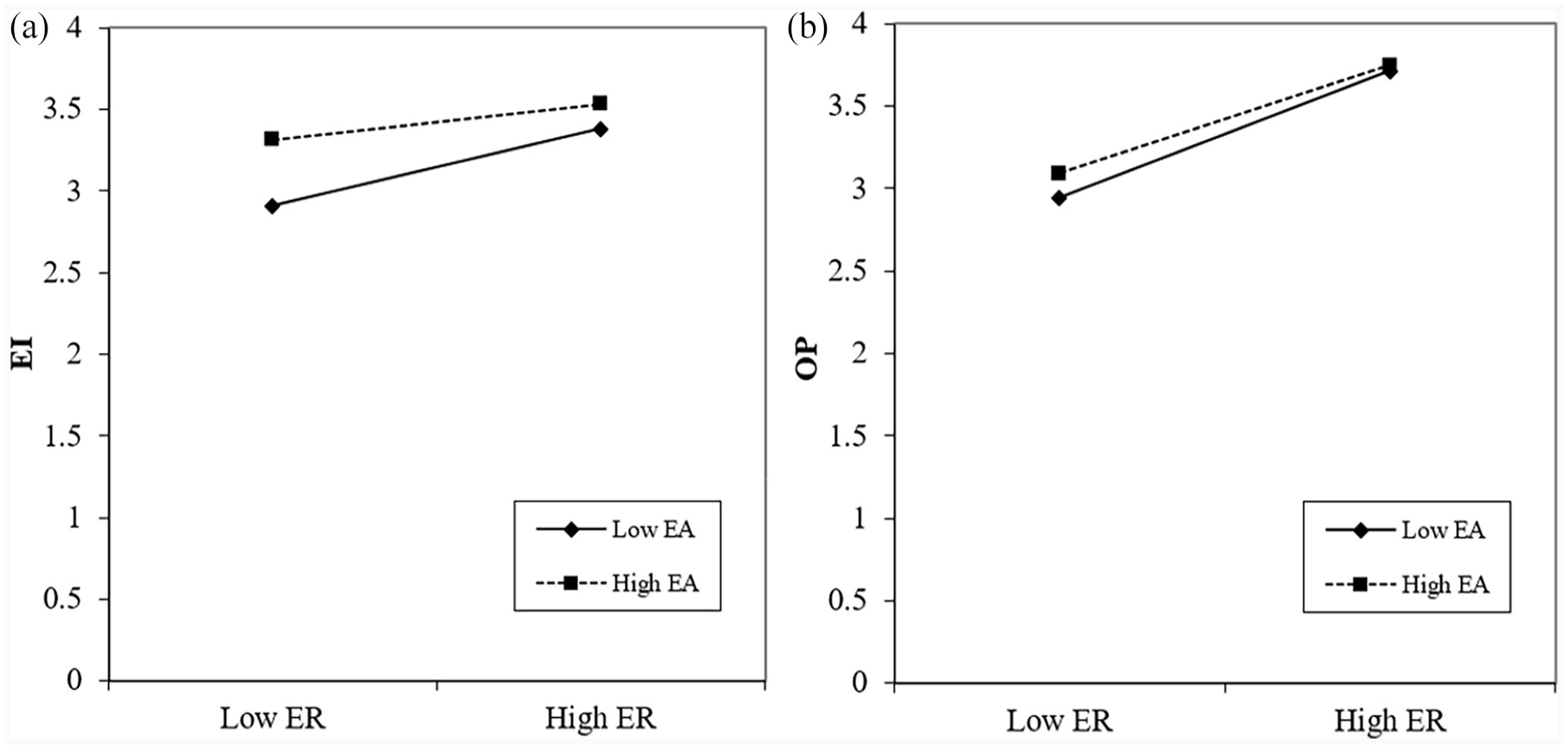
The moderating effect of entrepreneurial atmosphere. (a) The moderating effect of entrepreneurial atmosphere on the relationship between entrepreneurial resilience and entrepreneurial intention. (b) The moderating effect of entrepreneurial atmosphere on the relationship between entrepreneurial resilience and the perception of entrepreneurial opportunity.
Discussion
This article takes the return migrants in China as the research objective, and introduces the perception of entrepreneurial opportunity and entrepreneurial atmosphere as mediating and moderating variables to explores the influence mechanism of entrepreneurial resilience on entrepreneurial intention. This study not only verifies the importance of entrepreneurial resilience in enhancing entrepreneurial intention and the moderating effect of entrepreneurial atmosphere, but also enriches the research on entrepreneurial resilience in the context of China and expands the formation path of migrant workers’ entrepreneurial intention. This study provides a possible solution for return migrants, a vulnerable group, to engage in entrepreneurial activities with scarce resources as well.
First, entrepreneurial resilience has a significant positive impact on entrepreneurial intention. The former makes its influence felt in three aspects: the initiative to seek change, the confidence to deal with complex issues, and the optimism in times of adversity. The results of this study are consistent with those of Bullough and Renko (2013) and Bullough et al. (2014). Although the research objectives of these two studies are entrepreneurs who do business in high-risk areas such as Afghanistan and individuals who start business ventures in the aftermath of the financial crisis, however, the research on the return migrants in this paper also shows the same characteristics. Descriptive statistical analysis of the sample data shows that return migrants who have strong entrepreneurial intention have an entrepreneurial resilience score of 3.88, which is significantly higher than those with weak entrepreneurial intention, as evidenced by the score of 4.0 indicating confidence. The second dimension is optimism with a score of 3.83. The dimension of adaptation to changes has a score of 3.81, indicating that return migrants who are devoted to entrepreneurship are resilient, and brimming with confidence that they can control events and influence the outcome of situations in which they find themselves in. When conducting field research, we found that the majority of the return migrants chose villages, townships, and counties to open new local ventures. About 31% of them are located at the county seat, 19.6% in townships, and 21.8% in villages. This choice is fraught with risks. Because starting a business in these locations, return migrants will face a more severe entrepreneurial environment, with relatively scarce entrepreneurial resources, and more factors hindering the success of entrepreneurship, leading to greater difficulties for them. In this case, resilience is the winning formula, because it can precisely motivate return migrants to overcome numerous difficulties. Psychological traits of return migrants like the initiative to seek change, confidence, and optimism are important antecedent variables of entrepreneurial intention, which can enhance their entrepreneurial confidence and stimulate their entrepreneurial intentions.
Second, the perception of entrepreneurial opportunity plays a mediating role between entrepreneurial resilience and intention. The existing research on the relationship between the perception of entrepreneurial opportunity and entrepreneurial intention is mainly divided into two types. The first kind focuses on the interplay between external environment and behavioral process. Academics found that the more opportunities spotted by potential entrepreneurs, the stronger their entrepreneurial intentions. The second kind adopts the perspective of internal perception. The ability to perceive entrepreneurial opportunity, rather than opportunity itself, determines whether potential entrepreneurs take entrepreneurial action (Shi et al., 2016). The more perceptive an individual is, the more likely he or she will take entrepreneurial action. Both views assert that the perception of entrepreneurial opportunity can directly affect the intention and realization of entrepreneurship. The higher the perceived level of entrepreneurial opportunity, the stronger the intention to be a real entrepreneur.
This study shows that the perspective of internal perception can be adopted to ascertain the positive influence of entrepreneurial resilience on entrepreneurial intention through the perception of entrepreneurial opportunity. Having analyzed descriptive statistics from the scale for the perception of entrepreneurial opportunity, we found that items describing “I can spot opportunities in work and life to build a profitable business,” and “I am good at synergizing resources to get things done” have low scores, while the item “I collect business information through multiple channels” has the highest score. These items speak volumes about the fact that return migrants lack perception and initiative to seek entrepreneurial opportunities. Such inability is attributed to their inadequate education and low-skill jobs. In terms of sample distribution, 55.3% of the return migrants have high school diploma or below. Therefore, they have little choice but make a living in low-end service and manufacturing industries. Lack of access to high-quality education and fulfilling job does not prepare them to update skill sets, think out of box, and see and seize opportunities. However, this research shows that they are good at using the social relationships around them to gather entrepreneurial information, an intuitive approach taken by all humans to seek information from others to know how the wider world works (Ozgen & Baron, 2007). Therefore, the source of information is of paramount importance. Unfortunately, the return migrants build social networks around relatives, friends, and former colleagues, most of whom share similar educational background and work experience, and are unable to provide much-needed information and resources that can empower the migrants to spot opportunities and start a business. Having said that, we can still have a dose of optimism, because information is not the sole factor for business success. Entrepreneurs also need to maintain continuous attention, energy, and have the courage to take risks, be willing to innovate and forge ahead, confident, and eclectic entrepreneurial spirit during the entrepreneurial process. This is consistent with the characteristics of confidence, optimism, acceptance of change, and adaptability shown by entrepreneurial resilience, which is constantly evolving and changing under the influence of individual traits, organization, and external environment (F. Liu et al., 2020). The return migrants’ entrepreneurial resilience is at a relatively high level, indicating that they are confident, optimistic, and willing to embrace changes to overcome the limitations imposed by upbringing and social connections. These valuable traits enable them to improve their ability to perceive and explore entrepreneurial opportunities, thereby enhancing their perception of entrepreneurial opportunities. Therefore, return migrants’ entrepreneurial resilience is a reliable predictor of the perception of entrepreneurial opportunity. At the same time, prior studies have shown that the perception of entrepreneurial opportunity has a significant positive impact on the formation of entrepreneurial intention (J. Y. Jiang et al., 2014; X. E. Zhang & Zhang, 2015). To sum up, entrepreneurial resilience affects entrepreneurial intention through the perception of entrepreneurial opportunity, namely, the perception of entrepreneurial opportunity mediates the relationship between the resilience and intention.
Third, entrepreneurial atmosphere negatively moderates the relationship between entrepreneurial resilience and intention, and between entrepreneurial resilience and the perception of entrepreneurial opportunity. On the one hand, entrepreneurial resilience and atmosphere are psychological capital and external factor that affect individuals’ access to business resources. These two factors act in a similar way influencing entrepreneurial intention and the perception of entrepreneurial opportunity. In fact, the role of entrepreneurial resilience and entrepreneurial atmosphere can be substituted for each other when improving return migrants’ entrepreneurial intention or their perception of entrepreneurial opportunity. In terms of age, the sample has a distinctive feature: 88.13% of them were born in the 1980s, the new-generation return migrants by definition. Compared to their parents (i.e., old-generation return migrants), new-generation return migrants are more educated and have the characteristics of openness, optimism, and self-confidence among young people (Q. Yang & Yao, 2011), allowing them to constantly interact with others and the world around them (Strydom et al., 2020, 2021). As a result, they are better at imitating and learning, and they are in a much better position to access resources from the external environment to enter into entrepreneurship. They are luckier if they were born and bred in areas where entrepreneurial atmosphere is strong and entrepreneurial activities are intense, which means that financial and information resources are abundant and role models are ready to be mentors. The favorable entrepreneurial atmosphere sharpens the perception of entrepreneurial opportunity of the return migrants, enhances their ability to control market fluctuations, decreases uncertainty brought by entrepreneurial activities, and improves their confidence and enthusiasm for entrepreneurship, which eventually increase their entrepreneurial intention. It also means that return migrants do not have to exert their own initiative to address challenges. But, of course, the favorable situation can undermine the positive effect of entrepreneurial resilience on entrepreneurial intention and the perception of entrepreneurial opportunity.
On the other hand, regions with a strong entrepreneurial atmosphere tend to have a better institutional environment. A good institutional environment can attract more investment, support more industries and jobs (Gui & Chen, 2012), which means return migrants have more alternative forms of decent employment. For those with high entrepreneurial resilience, they have more social capital, and are more employable. As a result, entrepreneurship is less attractive to them. To sum up, entrepreneurial atmosphere have a substitution effect, weakening the impact of entrepreneurial resilience on the perception of entrepreneurial opportunity, and entrepreneurial willingness.
In contrast, in areas with poor entrepreneurial atmosphere, relatives, friends, and former coworkers around the return migrants lack recognition of entrepreneurial activities and innovative ideas, it is more difficult for return migrants to obtain information on entrepreneurial opportunities, and their entrepreneurial enthusiasm is inhibited (Han et al., 2020), making entrepreneurial resilience more important. As shown earlier, institutional environment in these entrepreneur-inhospitable areas is not good enough to create few jobs befitting return migrants. Most of them lack access to salaried employment, thus having to seek opportunities through entrepreneurship (Cao, 2019). For those with high entrepreneurial resilience, adverse circumstances motivate them to start their own businesses, thus magnifying the impact of entrepreneurial resilience on entrepreneurial intention and the perception of entrepreneurial opportunity. Judging from the entrepreneurial reality of return migrants reflected in the sample, the entrepreneurial atmosphere of the entrepreneurial environment where they are located is poor, and they are not highly supported and recognized by the society and institutional environment from their hometowns. Given the substitution effect of entrepreneurial resilience and atmosphere, entrepreneurial resilience is critical to the formation of return migrants’ entrepreneurial intention. Therefore, it is crucial to cultivate the return migrants’ entrepreneurial resilience of confidence, optimism, acceptance of change, and adaptability. Because entrepreneurial resilience can maximize the initiative of return migrants. And in areas with a poor entrepreneurial atmosphere, it will have a more profound impact on improving return migrants’ entrepreneurial intention and the perception of entrepreneurial opportunity.
Managerial Implications and Suggestions for Future Research
Managerial Implications
Providing More Entrepreneur-Oriented Public Services for Return Migrants
Three-pronged efforts can be made. The first program is to offer counseling services and training sessions about entrepreneurship to heighten return migrants’ awareness that personality traits hold the key to sound decision making and ongoing business success. This is especially true in current context where unpredictability and fluidity dominate the scene. To survive and thrive, entrepreneurs must be optimistic and confident, and adapt to and even seek changes, so as to overcome all kinds of hurdles. But character building should not be a personal struggle. Local governments can provide counseling services and entrepreneurial training sessions for return migrants. Such programs can not only expose returnees to road blocks lying ahead, but also inspire them to use the power of positive thinking and right methods to overcome difficulties and find a viable business model. The second initiative is to provide better information service. Our research shows that the perception of entrepreneurial opportunity significantly mediates the formation of entrepreneurial intention. Easier access to information allows returnees to make more informed choices, find available resources, break road blocks caused by scarce resources, raise expectations for entrepreneurial success, and have more confidence and intention to enter into entrepreneurship. Concrete actions include the building of a digital platform about entrepreneurial information and resources and the timely interaction of entrepreneurial-related information on the platform. The third initiative is to provide mentoring programs to help return migrants find the right projects, which can avoid one-size-fits-all, simplistic approach that leads to business failures.
Creating an Enabling Environment to Foster Entrepreneurial Atmosphere
Although our study shows that entrepreneurial atmosphere negatively moderates the relationships between entrepreneurial resilience and the perception of entrepreneurial opportunity, and between entrepreneurial resilience and entrepreneurial intention, however, as analyzed previously, this is related to the entrepreneurial environment in which the return migrants are located. From the perspective of theory and practice, optimizing the entrepreneurial environment and creating a good entrepreneurial atmosphere are still very important for improving the entrepreneurial intention and success rate of return migrants. This research suggests the following two steps be taken. First, decision makers can launch extensive publicity campaigns to praise role models, and foster a culture where people tolerate failure and encourage learning by doing. Extraordinary entrepreneurs should be given commemoration, material benefits, and policy support, sending a message to local communities that entrepreneurs deserve respect and admiration. Second, local authorities need to strengthen the pertinence and rationality of supporting policies. On the one hand, each region should take into account both local realities and specific needs of returnee entrepreneurs. The government should make policies to shore up weak links, provide more support for entrepreneurs to weather difficult period in the later stage of entrepreneurship, and keep alignment with the latest developments to reduce losses and negative influence of business failures. On the other hand, given that entrepreneurial atmosphere has a partial substitution effect on entrepreneurial resilience, local governments should strike a delicate balance between improving business environment and giving too much support to return migrants, lest they rely on external support, becoming too weak to tackle challenges and recover from losses. Therefore, a risk sharing mechanism involving government, community, and entrepreneurs is necessary. This mechanism should be supported by a whole set of systems including assistance, risk compensation, and psychological counseling, so as to lessen burden and diffuse risk associated with entrepreneurial failures, enhance return migrants’ ability and confidence to cope with difficulties and risk, and increase entrepreneurial intention.
Limitations and Suggestions for Future Research
First, although the survey samples in this article cover many provinces in China, there are still many provinces and regions that are not covered. And in the face of the growing number of migrant workers returning to their hometowns, the sample size is limited. Future research should extend the investigation to areas not covered to further test the research results of this article.
Second, the data collection of key variables in the survey adopted a subjective evaluation method. Although it is more consistent with the processing methods of existing research and is also a choice under specific circumstances, it still needs to pay attention to the collection of objective data. Future research should focus on combining objective data with subjective evaluation in the quantification of key variables to reflect the reality more objectively.
Third, entrepreneurial intention is a prelude to entrepreneurial activities, and a significant predictor of entrepreneurial behavior. Our research on the formation of entrepreneurial intention is not the ultimate goal. Our ultimate goal is to further transform entrepreneurial intention into actual entrepreneurial behavior. As a positive psychological element, entrepreneurial resilience helps individuals overcome negative feelings and achieve growth (Duchek, 2018). It not only affects the formation of entrepreneurial intention, but also affects follow-up entrepreneurial activities (Lafuente et al., 2019), and the eventual success (Hao et al., 2020). What’s more, entrepreneurial resilience keeps evolving with people and the environment. Therefore, we advise that future research should examine the mechanism of entrepreneurial resilience influencing entrepreneurial behavior based on the perspective of the entire process of entrepreneurial activities, so as to reveal the role and underlying law of entrepreneurial resilience in different links of entrepreneurial activities. Future research also needs to combine the reality of migrant workers to start a business, and explore how to adjust the internal and external environment of entrepreneurship, so as to play the positive role of entrepreneurial resilience in promoting the realization and success of entrepreneurship, and then improving the entrepreneurial efficiency of return migrants.
Footnotes
Acknowledgements
We acknowledge the support of human resources and social security departments in the survey areas.
Declaration of Conflicting Interests
The author(s) declared no potential conflicts of interest with respect to the research, authorship, and/or publication of this article.
Funding
The author(s) disclosed receipt of the following financial support for the research, authorship, and/or publication of this article: This research was funded by the National Social Science Foundation of China, grant number 19ZDA150 and the Research Project of Beijing Union University, grant number XP202009.

Data Availability Statement
The data is not available due to the agreement made with respondents to not release the data.