




Abstract
The aim of this study was to identify the most used teaching and learning activities in asynchronous, synchronous and/or face-to-face modes in blended courses, according to the degree of student engagement, and to describe the complementarity between these activities. The ICAP model was used to classify these activities. A total of 24 teachers, from 2 universities, all teaching blended courses (blended, blended online and blended synchronous courses), took part in the study. Data was collected via semi-structured interviews lasting about 60 min. Results reveal the diversity of passive, active and interactive teaching and learning activities used by teachers in blended courses. More specifically, in asynchronous mode, teachers mainly use passive and active activities, while in synchronous and/or face-to-face modes, teachers mainly use interactive and active activities. The results also highlight the complementarity between activities carried out in asynchronous mode and those carried out in synchronous and/or face-to-face modes. When asked about their choice of activities in each mode, teachers gave several reasons, each more relevant one than the other.
Keywords
Introduction
The rapid evolution of digital technology has had a considerable impact on society over the last 10 years. Higher education has benefited from this evolution, and, among other things, new course modalities have emerged, including blended courses. The experimentation with these courses has been widely documented by American universities (such as the University of Central Florida and Pennsylvania State University) and Canadian universities (such as the University of Ottawa and Université Laval), as well as by professional organizations (such as EDUCAUSE and the Online Learning Consortium). Today, blended courses, in their various forms, are increasingly popular in North America (Boelens, De Wever, & Voet, 2017; Boelens, Voet, & De Wever, 2018; Johnson, 2019; Seaman et al., 2018; Siemens et al., 2015). In 2018, around 78% of higher education institutions in Canada were using blended courses, and this proportion will grow in the coming years (Donovan et al., 2019), a trend mirrored in other parts of the world. For example, Australian public universities have experienced a 37.1% increase in enrollment over the past 6 years, starting from 2018 (Fan et al., 2024). During the Covid-19 pandemic, the use of blended courses grew exponentially, allowing higher education institutions to implement health measures such as social distancing while continuing to provide pedagogical activities across various disciplines, including those that predominantly used face-to-face (F2F) courses, such as chemistry (Lo et al., 2021), surgery (García Vazquez et al., 2020), and dentistry (Al-Fodeh et al., 2021). Popular with students (Al-Fodeh et al., 2021), these blended courses could become “the new normal” in higher education in the years to come (Ashour et al., 2021; Cesco et al., 2021).
In terms of learning outcomes and student satisfaction, blended courses are considered equivalent to, or even better than F2F courses, as evidenced by several meta-analyses (Bernard et al., 2014; Means et al., 2013; Spanjers et al., 2015; Vo et al., 2017) and literature reviews (Bidari & Hafeez, 2023; Müller & Mildenberger, 2021; Owston et al., 2013; Owston & York, 2018; Spanjers et al., 2015). These courses are perceived as the best of both worlds, combining the benefits and interactions of F2F or synchronous (SYN) courses with the accessibility and flexibility of asynchronous (ASYN) online courses (Adi Badiozaman et al., 2024; Lakhal & Bélisle, 2020). As such, they offer a wide range of possibilities for activities that can improve student learning beyond what would be possible in F2F or ASYN online courses (Garrison & Kanuka, 2004; Garrison & Vaughan, 2008; Graham, 2013; Vaughan, 2014).
Teaching and learning activities carried out asynchronously, synchronously and/or F2F should be thoughtfully planned to complement each other (Garrison & Vaughan, 2008; McGee & Reis, 2012). Digital tools, which facilitate active and collaborative learning experiences while increasing flexibility (Norberg et al., 2011; Vaughan, 2014), can be used to make case studies, tutorials, self-assessment exercises or simulations accessible to students online (Vaughan, 2007). Additionally, these tools enable peer self-assessments, blogs, podcasts, wikis, and more (Serrano et al., 2019). As a result, students gain more control over their learning, particularly in ASYN activities of blended courses (Boelens et al., 2017; Serrano et al., 2019; Taylor et al., 2018).
During SYN and/or F2F meetings, authors recommend that teachers use active methods and move from a teaching-centered approach to one focused on student learning (Simonson et al., 2019; Vaughan, 2007). With this approach, coupled with the possibilities offered by digital tools, blended courses have the potential to increase students’ cognitive engagement and achievement of high-level learning objectives (Bidari & Hafeez, 2023; Halverson & Graham, 2019; McGee & Reis, 2012; Norberg et al., 2011; Vaughan, 2007, 2014).
By combining ASYN, SYN, and/or F2F activities and using digital tools, teachers of blended courses must choose from a wide range of teaching and learning activities. However, little has been written about the pedagogical activities used in blended courses (Choy & Lee, 2020), especially those that increase students’ cognitive engagement and the achievement of high-level learning objectives (Heilporn et al., 2021b). Given the increasing use of blended courses in recent years, due to the Covid-19 pandemic and beyond, it is essential to provide teachers with support in this area.
This study aims to answer the following research question: What teaching and learning activities used in blended courses in higher education increase students’ cognitive engagement? The degree of students’ cognitive engagement will be defined using the Interactive, Constructive, Active, Passive (ICAP; Chi, 2009; Chi & Wylie, 2014; Chi et al., 2018) model. The use of the ICAP model is relevant because results of this study will guide teachers of blended courses in selecting pedagogical activities based on the degree of cognitive engagement of their students and the nature of the learning desired in their courses (Choy & Lee, 2020).
Literature Review
As mentioned earlier, very little research has focused on the teaching and learning activities used in blended courses to increase students’ cognitive engagement. The relevant studies are presented in the following paragraphs and summarized in Table 1.
Literature Review on Teaching and Learning Activities Promoting Student Engagement in Blended Courses.

In research carried out by Choy and Lee (2020) with 13 university teachers implementing blended courses based on the ICAP model, results from semi-structured interviews revealed that five types of teaching and learning activities were used. In ASYN mode, teachers used video clips, quizzes and discussion forums, while in the F2F mode, content was presented through lectures, seminars and laboratory activities. The results of this study also revealed that teachers mainly used passive and active activities in ASYN mode, while interactive and active activities were used in F2F teaching. However, the study did not report the reasons behind the activity choices made by the university teachers.
Cundell and Sheepy (2018) conducted research on a blended course for students preparing for a career in university teaching. One of the aims of this study was to determine whether the teaching and learning activities used were effective and had an impact on student engagement. Results from student responses (n = 59) to an online questionnaire revealed that the most effective and engaging teaching and learning activities, ranked in descending order, were participating in discussion forums, peer feedback, watching video clips, exploring websites, reading documents, watching interactive video clips and answering quizzes.
In a study by Czaplinski and Fielding (2020), conducted with medical students (n = 35) in a blended course, results obtained from an online and paper questionnaire revealed that teacher presentations followed by F2F collaborative activities and concept mapping were perceived as more beneficial for student engagement. Simulations and viewing of online video clips were also perceived as positively affecting student engagement.
According to the semi-structured interview analysis of a study by Heilporn et al. (2021b), which involved teachers (n = 20) of blended courses in higher education, active and interactive activities along with the use of digital tools, increased student engagement. Specifically, in ASYN mode, teachers identified watching video clips, playing games, answering quizzes, and participating in discussion forums as the best teaching and learning activities to improve student engagement. In SYN and/or F2F mode, problem-solving, case studies, role-playing, debates and team or large-group discussions were found to positively impact student engagement. The results of this study also emphasized the complementarity between ASYN and SYN and/or F2F teaching and learning activities, using a unified course structure, highlighting the importance of explicitly demonstrating this complementarity to students.
Heilporn and Lakhal (2021a) conducted a study with business administration teachers (n = 8) of blended courses. Using semi-structured interviews and content analysis of course platforms, the results revealed that these teachers use quizzes, participation in discussion forums, viewing video clips, and reading news articles to foster student engagement. In SYN and/or F2F mode, these teachers favored active and collaborative activities linked to business practice for similar reasons. Regarding the complementarity between ASYN and SYN and/or F2F teaching and learning activities, some teachers have provided no explanation, while others designed ASYN activities for content transmission, which were integrated into SYN and/or F2F activities.
In recent research by Heilporn et al. (2022), the authors evaluated whether strategies used in blended courses influenced student engagement. A total of 482 students from disciplines of engineering, social sciences, natural sciences and business administration completed an online questionnaire. Structural equation analyses revealed that active and collaborative teaching and learning activities—such as problem solving, simulations, experiments, team and large-group discussions, and debates, as well as co-construction activities (feedback on other students’ contributions)—had a positive effect on the emotional and cognitive engagement of engineering and business administration students. However, no effect was reported on the emotional and cognitive engagement of students in natural and social sciences.
Research by Zhu et al. (2021) in a blended higher education course investigated the most effective teaching and learning activities used in this course as perceived by students (n = 6). Results of semi-structured interviews revealed that these activities are ranked in descending order of effectiveness: F2F lectures, F2F discussions, F2F text analysis, F2F peer feedback, guest speakers, teacher feedback on OneDrive, reflective journaling, online debates and weekly announcements. Students particularly appreciated the opportunities for immediate F2F interaction and feedback.
Considering this literature review, it is obvious that most previous research has relied on semi-structured interviews as a data collection method, with participant samples showing good diversity (e.g., university teachers from various disciplines). These choices allow a better understanding of multidisciplinary teaching and learning activities in higher education to foster student engagement. However, we note that (1) few teaching and learning activities have been identified by these studies; (2) only Choy and Lee’s (2020) study used the ICAP model to classify teaching and learning activities; (3) few studies have focused on the complementarity between teaching and learning activities used in the various modes of blended courses.
To advance knowledge on this subject, our research aims to:
Identify the most teaching and learning activities used in ASYN, SYN, and/or F2F modes in blended courses, according to the degree of student engagement (ICAP model).
Describe the complementarity between these activities in ASYN, SYN, and/or F2F modes.
Conceptual Framework
To conduct this research, the conceptual framework presents the key concepts and models of this study, namely blended courses, teaching and learning activities and the ICAP model (Chi, 2009; Chi & Wylie, 2014; Chi et al., 2018), which will serve as the basis for classifying these activities.
Blended Courses
It is generally accepted that blended courses refer to a combination of F2F and ASYN online teaching and learning activities. However, advances in information and communication technologies (ICT) over the past 30 years have led to new forms of blended courses (Lakhal & Bélisle, 2020). Blended online courses or blended SYN courses enable activities that traditionally take place in the classroom to occur online in a SYN mode, replacing F2F classroom sessions with virtual online sessions for all or some students (Lakhal & Bélisle, 2020). Blended online courses combine SYN and ASYN online teaching and learning activities (Power, 2008), offering students greater location flexibility compared to traditional blended courses by including virtual online sessions, while maintaining the possibility for SYN interactions. Additionally, blended synchronous courses, also known as SYN virtual hybrids, SYN online hybrids (Raes et al., 2020), SYN learning in distributed environments (Wang & Huang, 2018), simultaneous bimodality (Collin et al., 2016), or comodality, accommodate both distance and F2F students within the same course by providing SYN activities simultaneously in both physical and virtual classrooms. Beyond enabling real-time interactions between students and teachers, SYN sessions can be recorded for later viewing by those who were unable to attend.
Teaching and Learning Activities According to the ICAP Model
Teaching and learning activities, also known as teaching and learning methods, involve actions performed by teacher or students to achieve the pedagogical objectives outlined in a course. These activities, or instructional tasks, are selected by teachers based on intended learning outcomes (Chi & Wylie, 2014) and often classified into teaching-centered and learning-centered activities (Chi et al., 2018). In teaching-centered activities, teachers serve as the main source of information and knowledge, playing a significant role in students’ learning. In this context, teachers are regarded as content experts and the sole holders of knowledge, with students in a passive role as knowledge recipients. These activities are considered passive activities. In contrasts, learning-centered activities encourage active student involvement, with teachers offering supervision and support to guide the learning process (Stes & Van Petegem, 2011). This approach engages students actively in course activities (Bonwell & Sutherland, 1996; King, 1993). These teaching and learning activities are said to be active activities.
According to several authors, active learning requires students to be cognitively and meaningfully engaged with the teaching and learning activities and the course content (Chi & Wylie, 2014; Chi et al., 2018; Hadi Mogavi et al., 2021). This cognitive engagement can vary in intensity, and teachers can select teaching and learning activities that foster different levels of engagement, based on the course’s pedagogical objectives and desired learning outcomes. The ICAP model (Chi, 2009; Chi & Wylie, 2014; Chi et al., 2018) identifies these engagement levels and provides a classification that goes beyond the basic passive-active dichotomy. The ICAP model outlines four levels of activity, ranked from the highest to the lowest level of engagement: interactive activities (I), constructive activities (C), active activities (A) and passive activities (P). The learning outcomes achieved by each type of activity also range from the deepest learning in interactive activities to surface learning in passive activities (I > C > A > P).
Passive Teaching and Learning Activities
In passive activities, students receive course content without engaging actively; for example, by listening to a lecture, watching videos, or reading a text without taking notes. During these activities, students memorize and store new knowledge in isolation, without connecting it to their previous knowledge. As a result, students may only be able to recall the information, leading to a minimal understanding of the content.
Active Teaching and Learning Activities
In active activities, students will be more cognitively engaged than in passive ones. These activities involve students taking actions or manipulating course information without generating new knowledge. Examples of active activities include taking notes during a lecture, pausing a video to replay specific sections, or highlighting key text passages. During active activities, students integrate newly acquired knowledge with prior knowledge. This process leads to a surface-level understanding of the information, allowing students to apply their new knowledge to similar situations presented in the course.
Constructive Teaching and Learning Activities
In constructive activities, students generate or produce new knowledge. For an activity to be considered constructive, it must result in new ideas, information or outcomes that extend beyond the content provided and were not previously known. In these activities, students are more cognitively engaged than in active ones. Examples of constructive activities include building a concepts network, self-reflection, comparing cases, integrating two or more texts, making plans, drawing analogies, or predictions based on existing information. Through these activities, students not only integrate new knowledge with prior knowledge, but also infer additional knowledge by combining and building on what they know. This deeper learning enables students to transfer knowledge effectively to new cases or situations.
Interactive Teaching and Learning Activities
Interactive activities involve dialogue and interaction between students. For these activities to qualify as interactive, two conditions must be met: (a) each student must be constructive, producing new knowledge beyond course content and the input of others, and (b) all participants should contribute frequently and equitably to the generation of new knowledge. In interactive activities, the mutual exchange of knowledge—whether the form of ideas, information or other contributions—leads to new knowledge that none of the students could generate independently. As a result, interactive activities engage students more deeply in learning than constructive ones. Examples of interactive activities include defending and arguing a position within a pair or team, debating with peers on a given topic, and discussing similarities and differences between two cases. Through interactive activities, each student develops new knowledge by combining their own knowledge with iterative dialogue and exchange with others, resulting in the co-construction of new knowledge and deep learning.
Figure 1 illustrates teaching and learning activities based on the level of student engagement. Interactive mode of engagement encompasses the constructive mode, which, in turn, includes the active mode, ultimately encompassing the passive mode.

Teaching and learning activities categorized by student engagement level according to the ICAP model.
Method
Participants
To provide a comprehensive overview of the teaching and learning activities used in blended courses, this study recruited teachers (lecturers, teaching assistants, and professors) from various disciplines and university levels (Undergraduate, master’s, and doctoral) at large and a medium-sized university in Quebec, Canada. The diversity of data sources strengthened the study external validity (Merriam & Tisdell, 2015).
To recruit study participants, we enlisted pedagogical advisors at teaching and learning centers of both universities to identify teachers with an interest in teaching and learning who had taught at least two blended courses. More than 100 teachers from both universities were invited to participate via e-mail. A total of 24 teachers—equally divided between the two universities—voluntarily agreed to participate in the study. The demographic characteristics of these teachers and details about the courses selected for this research are presented in Table 2 and Appendix A.
Characteristics of Teacher Demographic and Blended Courses.

Instrument and Data Collection
Two ethical certifications (Reference Numbers 1 and 2) were obtained from the universities where data collection took place. All participants signed a consent form to participate in a semi-structured interview. To address our research objectives, we developed an interview guide. In addition to introductory questions (general demographics, experience in higher education, and the number of blended courses taught) and concluding prompts, the guide included five open-ended questions designed as benchmarks to encourage participants to speak freely. Sub-questions were also included to prompt participants as needed (Merriam & Tisdell, 2015). Questions and sub-questions focused on teaching and learning activities, as well as digital tools used in F2F, SYN, and ASYN modes. Participants were asked to describe these activities in a specific blended course and to explain their choices in relation to the targeted learning outcomes. They were also asked to explain how they ensured the complementarity between ASYN and SYN and/or F2F activities.
The clarity and relevance of the interview guide were reviewed by members of the research team and directors of the teaching and learning centers at both universities. A pre-test of the guide was conducted to ensure that it would collect sufficient information to meet the research objectives. Semi-structured interviews took place over four sessions, in the summer and fall of 2020, and in the winter and summer of 2021. Each interview lasted approximately 60 min, conducted online and recorded using Microsoft Teams.
Analysis
Interviews were fully transcribed, and the verbatims were analyzed using a general inductive approach (Miles et al., 2020; Thomas, 2006) and coded using NVivo 12 software. A thematic analysis was used (Paillé & Mucchielli, 2021). Data coding was performed by two research assistants, who identified extracts related to the teaching and learning activities mentioned by the participants. They categorized these activities into ASYN and SYN and/or F2F activities. The initial intercoder reliability (Cohen’s kappa) was .48. During the coding process, the research assistants discussed and agreed on the names of the activities, reaching an intercoder reliability of .88. Any remaining disagreements were then resolved by the principal researcher. By the end of this first coding phase, a total of 69 activities were identified. Following a reduction process, several terms used by participants were consolidated when they described activities of a similar nature, despite slight variation in wording. This refinement resulted in 27 ASYN activities and 32 SYN and/or F2F activities. To examine complementarity between ASYN and SYN and/or F2F activities, the reasons provided by teachers were categorized according to themes that emerged from the analysis.
Results
The Most Teaching and Learning Activities Used in ASYN, SYN and/or F2F Mode in Blended Courses, by ICAP Model
The most teaching and learning activities used in blended courses, in ASYN, SYN, and/or F2F modes, according to the ICAP model, are presented in Table 3. This table also shows objectives of these activities, digital media used to carry them out, number of participants who named them and number of related extracts.
The Most Teaching and Learning Activities Used in Blended Courses, in ASYN, SYN, and/or F2F Modes, According to the ICAP Model, their Objectives and Digital Supports.

Asynchronous Teaching and Learning Activities
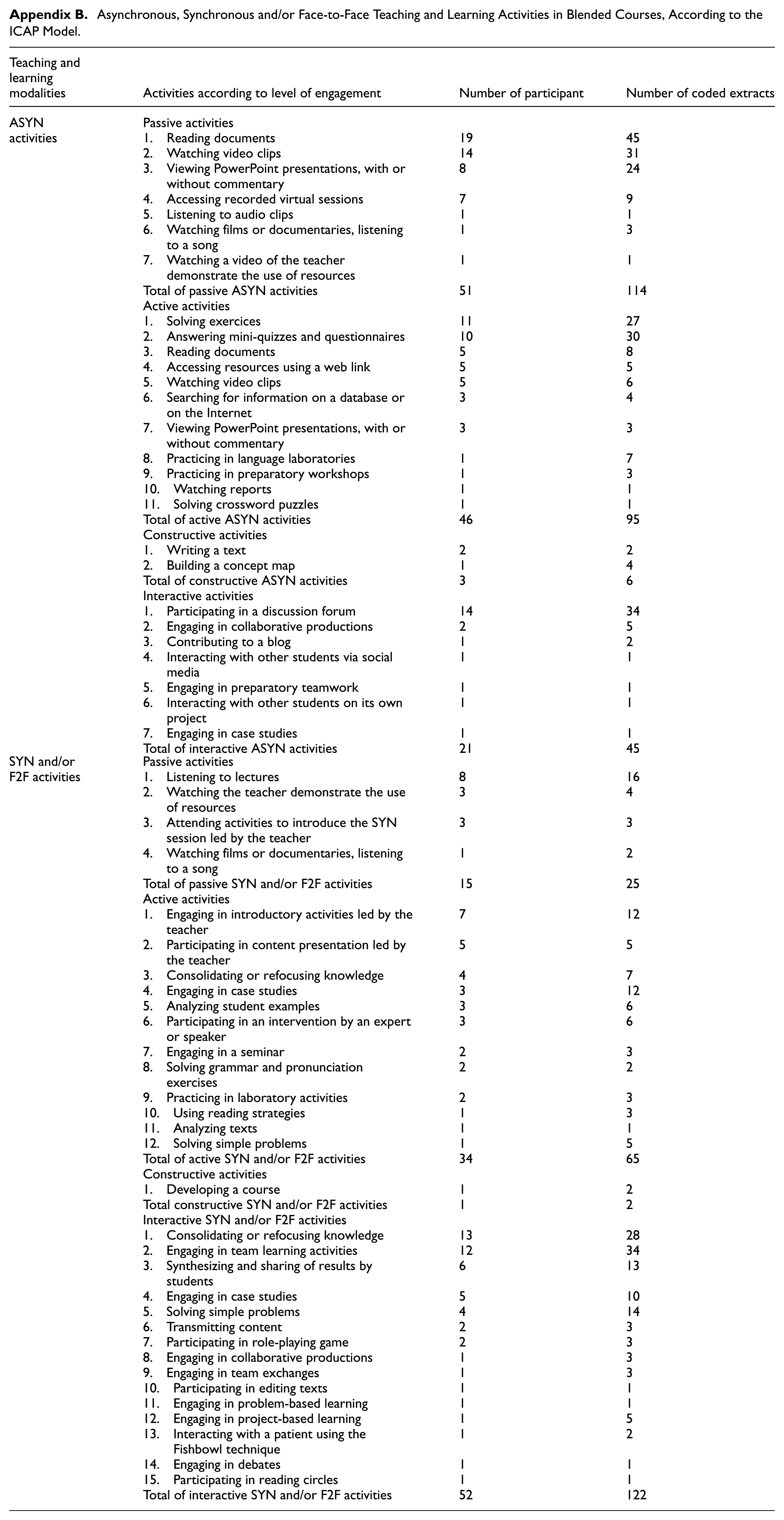
For ASYN teaching and learning activities, coding identified 7 passive, 11 active, 2 constructive, and 7 interactive activities (see Appendix B). These results demonstrate a diversity of activities across different modes of student engagement, except for the constructive mode, which has a limited number of activities.
Among the passive ASYN activities, the most frequently used in blended courses, according to the teachers surveyed, are reading documents (n = 19), watching video clips (n = 14), viewing PowerPoint presentations (n = 8), and accessing recorded virtual sessions (n = 7; see Table 3). The primary purpose of reading documents, such as PDF files of books or articles shared via the course website, is to prepare students for SYN and/or F2F sessions. By reading excerpts from books or articles with a reading intention, students become familiar with the themes in advance, enabling them to participate and contribute effectively during SYN and/or F2F sessions.
There are no readings assigned during the [SYN] session; all readings are completed beforehand, with specific reading intentions in mind, and I refer to these readings during the session. The students are aware of this. When I ask them to read a text, they understand that it will be addressed during the SYN session (P3).
The purpose of watching video clips shared via the course website is to convey content or explain specific themes or concepts that will be covered during the subsequent SYN and/or F2F sessions. When possible, some teachers include a section in the video to foster a sense of human connection. Depending on the objective, participants try to limit video’ duration between 1 and 30 min in length.
A course currently teaching on exotic destinations in tourism, we cover a mix of history, geography, economics, and politics—all the background to help students understand why people travel to these areas and what they can expect there. Since most students don’t know much about these regions, one of their ASYN activities is to watch videos I post to give them a feel for what these destinations are like (P1). Human contact is really important to me, so I wanted them to be able to see me even asynchronously. So that’s why the videos are short; I even put the video length on the Moodle platform to encourage them by letting them know it won’t take too long (P9).
The purpose of viewing PowerPoint presentations, created using Microsoft PowerPoint and Screen-O-Matic, is to convey content. These presentations allow students to study course concepts at their own pace, and to review material as many times as they wish. When recording these presentations, teachers communicate the material both orally and visually, sometimes with the addition of their webcam image. They can also add annotations or highlight important aspects of the content. These presentations often cover the same material as a SYN or F2F session. However, narrated presentations are typically kept to a maximum of 15 min.
They can check their understanding and then listen to presentation 2, 3 or even 4 times if they didn’t quite get it the first time. That’s a huge advantage you don’t get in the classroom (P24). So it’s really just the slides we present and explain as if we were in class. We show the presentation, you hear my voice, and you can see my stylus writing comments and circling what’s important (P24).
Finally, the purpose of viewing recorded virtual sessions, created using Microsoft Teams or Zoom, is to deliver course content. These sessions involve recording SYN sessions and making them available online on the course website. Passive listening to these recordings provides students with access to session content if they were absent or wish to review the material for study purposes.
Then, during the meeting, I record it so they can go back and listen to any segments they want to review (…). If they miss something, they can always listen to the recording again (P3).
Regarding active ASYN activities, solving exercises (n = 11), answering mini-quizzes and questionnaires (n = 10) are among the most common activities in blended courses (see Table 3). By solving exercises available on the course portal, Moodle or in databases, students reinforce the content studied in the course and prepare for upcoming SYN or F2F sessions.
I’d put together a bank of exercises, and tell them, “For these directed exercise sessions, do exercises X to Y, and then I’ll go over them again with you, either synchronously F2F, or synchronously remote.” (…) They also had certain exercises to complete on their own, so they’d be prepared for the sessions and could ask the right questions during the guided exercise sessions. (P19)
In some cases, these exercises are completed alongside viewing a video capsule, during which students are asked to pause the video, complete the exercise and then return to the capsule. Teachers typically provide a solution sheet so that students can check their answers.
Each week or theme has a list of exercises in one file, and then in another file, you’ll find the solutions to those exercises. Not just answers, but full solutions (P12).
Mini quizzes and questionnaires are used to check students’ understanding of concepts studied in the course or to prepare them for upcoming discussions in SYN or F2F sessions. These activities may be either mandatory or optional and may or may not include feedback when the answer is incorrect. Some teachers only grant access to next module of the course once quizzes and questionnaires have been completed by students, allowing them to control the pace of student learning. Additionally, these activities provide teachers with feedback on students’ understanding and help identify content that may need reinforcement in SYN or F2F sessions.
At the end of each module, I have quizzes. They’re not graded, but they’re mandatory to unlock the next module. They’re exercises, so I check if they’ve understood the material up to that point. If I notice they haven’t quite gotten it, I’ll suggest something like: “Would you like more exercises?”; “Would you like to do a session together?” I keep track of their progress (P9).
Finally, participation in a discussion forum (n = 14) is the most used interactive ASYN activity (see Table 3). Discussion forums provide a virtual space that can take various forms: answering questions and/or expressing opinions on a given topic, exchanging thoughts about a specific course-related theme (which may vary each week) or about reading, helping each other (e.g., sharing resources), and identifying questions to be addressed during SYN and/or F2F session. Some teachers assign points for participation in discussion forums and make this activity compulsory, while others leave it optional.
We’ve really set up the idea of a discussion forum to give students a space, during the week between classes, to share their perspectives and interpretations of the readings. They can also help each other with some of their questions and identify issues they’d like to bring up with the teacher in the next class or discuss in more depth (P6). One of the goals of this course is to understand how global events can affect tourism. So, what I do is use the forum in Moodle, and for 10 weeks, the students have to follow the news. They need to find articles related to the regions we’re discussing and post them articles in the forum (…). Another student will summarize the article, and another will provide an analysis. By the end of the session, if they do everything, the students will have 30 different articles (P1).
Synchronous or Face-to-Face Teaching and Learning Activities
Table 3 presents the most teaching and learning activities used in SYN and/or F2F modes in blended courses, along with their objectives and technological support for implementation. This coding identified 4 passive activities, 12 active activities, 1 constructive activity and 15 interactive activities (Appendix B). Similar to ASYN activities, these results demonstrate a variety of activities supporting each mode of engagement, except for the constructive mode, where activities are limited. Half of the active and interactive activities reported were mentioned by only one or two participants.
Among passive SYN and/or F2F activities, the most frequently used was listening to lectures (n = 8; see Table 3). This activity allows the teacher to introduce the course, for example, during the first session. In SYN online mode, using platforms like Adobe Connect, Teams and Zoom, participants reported trying to limit these sessions to 45 min, whereas similar sessions in F2F mode could extend for a full class period.
For active SYN and/or F2F activities, introductory activities led by the teacher (n = 7) were among the most commonly used (see Table 3). These activities are designed to start the session and ensure students are ready to learn. Teachers may go around the room to greet students or check in on how they are doing. These activities can also include brief reviews of modules studied asynchronously.
I always start my meetings with “How are you?” We take 5–10 min to talk about how the module went, what was difficult, and so on, and also check in on how things are going in their professional and personal lives, etc. (P18)
In terms of interactive SYN and/or F2F activities, knowledge consolidation or reframing (n = 13) and team learning activities (n = 12) are among the most frequently used by teachers in blended courses (see Table 3). Knowledge consolidation or reframing allows teachers to ensure that students have understood concepts, revisit key topics, and answer any questions. When used F2F, knowledge consolidation or reframing takes the form of a discussion that allows teachers to assess students’ understanding and as needed, clarify, reinforce, or expand on it. In SYN mode, students can be invited to share their thoughts orally or in writing, for example, by creating diagrams in OneNote. This approach enables the teacher to provide feedback on understanding and stimulate discussion.
Students could come to the virtual board, describe their state of mind a bit, draw a diagram, and then I could react to that, saying things like, “No, no, what you didn’t understand was this part; this element is correct, but that one isn’t.” They could interact with me directly on the sheet, almost instantaneously, using One Note (P19).
The Wooclap tool, an interactive question-and-answer platform, can also be used to present questions (multiple choice, short answer, essay) for students to answer via their laptop, smartphone or tablet. This activity can be carried out with the whole group or in small teams.
Team learning activities, which are interactive, are generally based on a case or a problem that students must solve by reflecting on various aspects. For SYN sessions, students receive specific instructions and are then placed in fixed or random work teams in separate channels (Microsoft Teams) or groups (Adobe Connect). The teacher can provide a structured template for the activity, sharing it with the channels either before or during the teamwork session. When conducted F2F, students gathered in groups while the teacher moves around to answer questions and provide additional information. This type of activity often ends with a group-wide review and validation of the work completed.
In my course we learn how to conduct a satisfaction study. They have to create a questionnaire or survey before coming to class. When we meet in class, they break into small groups to criticize each other’s questionnaire, as respectfully as possible, but it always goes really well. Then, we have a plenary session to say where we ask, “What did you notice in the other teams’ questionnaires? What can we improve?” Thant’s usually how it works. We start with small- group work, then come back together for a plenary session (P8). We give them a case to work on in teams and ask them to come up with a solution. And of course, the case is designed so that they can apply everything they’ve worked on independently (P15).
Complementarity Between Teaching and Learning Activities in Asynchronous, Synchronous and/or Face-to-Face Modes
Looking at the total number of teachers who reported using each activity in blended courses (Appendix B), in ASYN mode, teachers mainly use passive activities (n = 51), followed by active (n = 46), interactive (n = 21), and constructive (n = 3) activities. In SYN and/or F2F mode, teachers primarily use interactive activities (n = 52), followed by active activities (n = 34), passive activities (n = 15), and constructive activities (n = 1). When asked about complementarity between teaching and learning activities in ASYN, SYN and/or F2F modes, participants reported various justifications. Firstly, several participants (n = 9) admitted that teaching and learning activities carried out asynchronously are preparatory to SYN and/or F2F activities:
They independently acquire all the theoretical knowledge asynchronously, on their own. Then, the SYN sessions are reserved for application, interaction, case studies, and discussions. In short, this is the principle of flipped pedagogy (P7).
Other participants (n = 4) say they use the difficulties and needs of support students to determine which activities are to be carried out asynchronously and which are to be carried out synchronously and/or F2F.
There are certain tasks that can be done asynchronously and don’t necessarily require our support. For example, reading or watching videos can be done independently. It’s really about determining what’s essential to do together and what makes sense to handle online (P3).
Some participants (n = 3) indicate that it is the nature of activities that will dictate whether they are carried out asynchronously or synchronously and/or F2F. For some (n = 2), activities that replace knowledge acquisition can be carried out asynchronously. In the same way, only the application must be done synchronously for another participant. All other activities can be carried out asynchronously.
Apart from doing hands-on activities as if they were in a real setting, I don’t see much reason for meeting synchronously (P8). Any part that I felt could be delivered as a lecture, where simply listening to me was sufficient, I reserved for ASYN classes as much as possible. They don’t need to be there at the same time just to listen to me. The idea was really that if we’re all committing to being there together at the same time, it has to be worth it (P20).
Other participants (n = 2) explained that learning objectives play a central role in choices they make. For example, according to one participant
It always depends on the objectives I’m working toward (…). I start by considering what activities I want to do with them and what I want them to accomplish. Then, I decide which parts are best done in class and which can be done outside of class, and I organize it all on the portal (P16).
Other participants (n = 2) spoke of the common thread, continuity and coherence between ASYN and SYN and/or F2F activities.
It’s really about emphasizing the importance of continuity (…). By “continuity,” I mean both continuity in learning and in lesson planning. This involves looking at the coherence between the concepts covered (…), ensuring an organized introduction of concepts, and fostering integration so there’s a consistent learning progression (…). We can see this consistency between ASYN and SYN learning as students progress through the course (P6).
One participant relies on Garrison and Archer’s (2000) Community of Inquiry model for decision-making, to optimize teaching, social and cognitive presence:
With Garisson’s model, when we follow the steps, everything basically falls into place automatically (…). By following this model in our planning and keeping it in mind for all planned activities, the cognitive, social and teaching elements come together(…). When I follow that model, it works (P1).
In short, these various reasons clearly demonstrate the importance of complementarity in supporting student engagement and learning: “It’s a whole, in the end. You can’t have one without the other” (P5).
Discussion
This study aimed to identify the most teaching and learning activities used in ASYN, SYN, and/or F2F modes in blended courses, according to the degree of student engagement based on the ICAP model (Chi, 2009; Chi & Wylie, 2014; Chi et al., 2018) and to describe the complementarity between these activities. Through data collection from a large sample of teachers from various disciplines who use blended courses (blended, blended online, and blended SYN courses) at undergraduate and graduate levels across two universities, this study revealed the diversity of teaching and learning activities employed, particularly regarding passive, active and interactive activities.
Regarding constructive activities, there is very little diversity, regardless of whether they are implemented in ASYN, SYN, and/or F2F modes. The implementation of these activities may require extensive explanations to ensure that students can complete them appropriately, as well as additional time for grading. Consequently, teachers often choose to have students engage in more complex activities in teams, thereby reducing the time investment required from both teachers and students. Furthermore, considering that interactive activities have the potential to foster a sense of belonging, teachers view them as an opportunity to enhance student engagement while providing high-level cognitive learning opportunities. In contrast, constructive activities could prove discouraging due to their demanding nature if they were undertaken individually.
In ASYN mode, 7 passive activities, 11 active activities, 2 constructive activities and 7 interactive activities were identified. In SYN and/or F2F modes, the study identified 4 passive activities, 12 active activities, 1 constructive activity and 15 interactive activities (Appendix B).
More specifically, the results indicate that in ASYN mode, teachers predominantly use passive activities (e.g., reading documents, watching video clips, PowerPoint presentations, and recorded virtual sessions) and active activities (solving exercises, answering mini-quizzes, and questionnaires). Despite some diversity, these findings suggest that the range of digital tools available is not yet being used to its full potential. Some authors highlighted the lack of digital literacy and teachers’ training on digital tools, the absence of students’ autonomy and the inadequate digital infrastructures (Ashraf et al., 2022). Examples proposed by Vaughan (2007), such as online tutorials, self-assessment exercises or simulations, and by Serrano et al. (2019), such as peer assessments, blogs, podcasts and wikis, remain underutilized. A recent systematic review by Bizami et al. (2023) highlights possible uses of available tools to develop various student capabilities (e.g., communication, agentivity, critical and reflective thinking, creativity, connectivity, and collaboration). Leveraging such tools could potentially foster students’ cognitive engagement by integrating more constructive activities into blended courses. For instance, students could be tasked with producing a reflective critique on the relevance of certain digital tools for their learning.
In SYN and/or F2F modes, teachers primarily use interactive activities (e.g., consolidating or refocusing knowledge and team learning activities) and active activities (e.g., session introductions led by the teacher). This aligns with recommendations to adopt active methods and to move from a teaching-centered to student-centered approaches, as promoted by some authors (Simonson et al., 2019; Vaughan, 2007). However, many of these activities rely on the same digital platforms (e.g., Microsoft Teams or Adobe Connect), suggesting limited familiarity or mastery of digital tools beyond those commonly available in academic settings. Additionally, for half of the active or interactive activities, only one or two participants reported using them (Appendix B). This suggests that variety within a single blended course may be limited. Less frequently used activities require more time to design and implement (e.g., project-based learning) as compared to commonly used activities (e.g., knowledge reframing), which may explain their lower adoption. Some authors suggest that time is a significant factor influencing teachers’ choice of technology-enabled activities (Francom, 2020; Hsu, 2016).
Finally, the results of this study reveal the complementarity between activities conducted asynchronously with those carried out in SYN and/or F2F mode. When asked about their choices, teachers indicate that ASYN teaching and learning activities often serve as preparatory to SYN and/or F2F activities. Others reported using students’ difficulties and support needs to determine which activities should occur synchronously and/or F2F, or asynchronously. Additional reasons cited include the nature of the activities, the learning objectives of the course, and ensuring coherence across activities. These findings align with recommendations emphasizing the importance of thoughtfully planning ASYN, SYN, and/or F2F teaching and learning activities to complement one another effectively (Heilporn et al., 2021b; Garrison & Vaughan, 2008; McGee & Reis, 2012).
Theoretical models, such as Garrison and Archer’s (2000), could be more widely adopted to guide teachers in the decision-making process for implementation of blended courses. The findings of this study suggest that teachers seek to maximize présences as defined by the Community of Inquiry (CoI) framework in blended courses by focusing SYN and/or F2F sessions on interactive activities (student-teacher and student-student interactions), while also incorporating ASYN activities that foster peer-to-peer activities. Moreover, the higher number of interactive activities in SYN and/or F2F modes can also be understood through the CoI framework. SYN and/or F2F activities better support teaching and social présences, thereby fostering a context conducive to the construction of knowledge (cognitive presence). In contrast, ASYN activities are more easily structured (e.g., through clear instructions and concrete tasks), which tends to promote primarily passive or active learner engagement.
A recent systematic review presents a conceptual model of blended learning, informed by the CoI framework, which identifies 16 categories of barriers faced by students, teachers, and institutions in implementing these courses (Sareen & Mandal, 2024). Addressing these barriers is crucial for ensuring the success of blended learning initiatives. Furthermore, recent studies (e.g., Dumford & Miller, 2018) and books (e.g., Caulfield, 2023) provide a more comprehensive understanding of the benefits and limitations of various course modalities, including blended courses, enabling teachers to make more informed choices. Teachers would also benefit from collaborating, notably through forums and learning communities, just as they offer to their students, to benefit from collective experience.
Conclusion
The aim of this study was to identify teaching and learning activities used in blended courses, according to the degree of student engagement (based on the ICAP model), and to describe the complementarity between these activities. Previous studies on the subject have identified only a limited number of teaching and learning activities in blended courses. Moreover, few have explored the complementarity between activities used in ASYN, SYN and/or F2F modes within blended courses. This study has revealed a wide range of activities classified by degree of student engagement, along with the rationale behind their selection in different modes and their complementarity. These findings offer practitioners practical insights and recommendations based on teachers’ experiences to guide the selection of activities in blended courses. They can also support higher education institutions in designing targeted interventions aligned with the desired level of student engagement within programs and professional development initiatives. Furthermore, the results may inform stakeholders as they engage in a collective process of identifying and adopting pedagogical activities suitable for ASYN, SYN, and/or F2F modes of instruction. The proposed list can be further enriched by drawing on existing practices or digital tools available in local contexts. A collaborative approach—implemented, for example, at the departmental level—could help ensure that students are exposed to a variety of learning activities (passive, active, constructive, and interactive) throughout their program, without placing an excessive workload on any single teacher. Teaching and learning centers could also adapt these activities to the specific contexts of faculties and departments, taking into account the forms of blended courses and digital tools already in use. According to several authors, blended courses have the potential to increase students’ cognitive engagement and facilitate the achievement of higher order learning objectives through the opportunities provided by digital tools (Halverson & Graham, 2019; McGee & Reis, 2012; Norberg et al., 2011; Vaughan, 2007, 2014). This study demonstrates that a variety of teaching and learning activities are available to university students, enabling different levels of their cognitive engagement in the blended courses they take. By combining the advantages of F2F instruction with those of ASYN learning, blended courses present a viable solution for improving accessibility and persistence in higher education (Lakhal & Bélisle, 2020).
Looking ahead, it is reasonable to expect that practices will be optimized in the coming years through collaboration and shared experiences, leading to a more comprehensive offering of blended courses that cater to a broader range of student learning styles. While challenges remain, the use of technological tools continues to serve as a pathway for promoting the values of equity and inclusion emphasized in contemporary educational trends (Utaminingsih et al., 2023).
Limitations and Future Research
Although this study contributes to knowledge in an emerging field, certain limitations should be acknowledged. First, the participants were drawn from only two Quebec universities and self-reported a certain level of expertise in digital tools. Consequently, their experiences may not represent the broader university community. It would have been interesting to explore how the use of various pedagogical activities varies according to participants’ comfort with technology. Secondly, examining course outlines could have added depth to the analysis by ensuring the completeness of the activities reported by the teachers and providing a clearer understanding of their prevalence and coherence within the blended course structure. The results presented here are thus limited by the respondents’ ability to accurately recall and report on their teaching practices in blended courses. Thirdly, this study presents a potential recruitment bias. Participants were identified by teaching-development advisors as teachers who are interested in pedagogy and have taught at least two blended courses, which likely results in over-representation of higher digital fluency and pedagogical engagement. Results of this study might have differed if all teachers of blended courses at both universities had been randomly invited to participate. Fourthly, the participants in this study were teachers of blended courses. The teaching and learning activities identified in this study were designed to engage students to various degrees. However, it is unclear whether these levels of engagement were achieved by their students. To complement this study, it would be valuable to present these activities to students and ask them to assess the extent to which these activities were engaging for them.
Footnotes
Appendix
Asynchronous, Synchronous and/or Face-to-Face Teaching and Learning Activities in Blended Courses, According to the ICAP Model.
| Teaching and learning modalities | Activities according to level of engagement | Number of participant | Number of coded extracts |
|---|---|---|---|
| ASYN activities | Passive activities | ||
| 1. Reading documents | 19 | 45 | |
| 2. Watching video clips | 14 | 31 | |
| 3. Viewing PowerPoint presentations, with or without commentary | 8 | 24 | |
| 4. Accessing recorded virtual sessions | 7 | 9 | |
| 5. Listening to audio clips | 1 | 1 | |
| 6. Watching films or documentaries, listening to a song | 1 | 3 | |
| 7. Watching a video of the teacher demonstrate the use of resources | 1 | 1 | |
| Total of passive ASYN activities | 51 | 114 | |
| Active activities | |||
| 1. Solving exercices | 11 | 27 | |
| 2. Answering mini-quizzes and questionnaires | 10 | 30 | |
| 3. Reading documents | 5 | 8 | |
| 4. Accessing resources using a web link | 5 | 5 | |
| 5. Watching video clips | 5 | 6 | |
| 6. Searching for information on a database or on the Internet | 3 | 4 | |
| 7. Viewing PowerPoint presentations, with or without commentary | 3 | 3 | |
| 8. Practicing in language laboratories | 1 | 7 | |
| 9. Practicing in preparatory workshops | 1 | 3 | |
| 10. Watching reports | 1 | 1 | |
| 11. Solving crossword puzzles | 1 | 1 | |
| Total of active ASYN activities | 46 | 95 | |
| Constructive activities | |||
| 1. Writing a text | 2 | 2 | |
| 2. Building a concept map | 1 | 4 | |
| Total of constructive ASYN activities | 3 | 6 | |
| Interactive activities | |||
| 1. Participating in a discussion forum | 14 | 34 | |
| 2. Engaging in collaborative productions | 2 | 5 | |
| 3. Contributing to a blog | 1 | 2 | |
| 4. Interacting with other students via social media | 1 | 1 | |
| 5. Engaging in preparatory teamwork | 1 | 1 | |
| 6. Interacting with other students on its own project | 1 | 1 | |
| 7. Engaging in case studies | 1 | 1 | |
| Total of interactive ASYN activities | 21 | 45 | |
| SYN and/or F2F activities | Passive activities | ||
| 1. Listening to lectures | 8 | 16 | |
| 2. Watching the teacher demonstrate the use of resources | 3 | 4 | |
| 3. Attending activities to introduce the SYN session led by the teacher | 3 | 3 | |
| 4. Watching films or documentaries, listening to a song | 1 | 2 | |
| Total of passive SYN and/or F2F activities | 15 | 25 | |
| Active activities | |||
| 1. Engaging in introductory activities led by the teacher | 7 | 12 | |
| 2. Participating in content presentation led by the teacher | 5 | 5 | |
| 3. Consolidating or refocusing knowledge | 4 | 7 | |
| 4. Engaging in case studies | 3 | 12 | |
| 5. Analyzing student examples | 3 | 6 | |
| 6. Participating in an intervention by an expert or speaker | 3 | 6 | |
| 7. Engaging in a seminar | 2 | 3 | |
| 8. Solving grammar and pronunciation exercises | 2 | 2 | |
| 9. Practicing in laboratory activities | 2 | 3 | |
| 10. Using reading strategies | 1 | 3 | |
| 11. Analyzing texts | 1 | 1 | |
| 12. Solving simple problems | 1 | 5 | |
| Total of active SYN and/or F2F activities | 34 | 65 | |
| Constructive activities | |||
| 1. Developing a course | 1 | 2 | |
| Total constructive SYN and/or F2F activities | 1 | 2 | |
| Interactive SYN and/or F2F activities | |||
| 1. Consolidating or refocusing knowledge | 13 | 28 | |
| 2. Engaging in team learning activities | 12 | 34 | |
| 3. Synthesizing and sharing of results by students | 6 | 13 | |
| 4. Engaging in case studies | 5 | 10 | |
| 5. Solving simple problems | 4 | 14 | |
| 6. Transmitting content | 2 | 3 | |
| 7. Participating in role-playing game | 2 | 3 | |
| 8. Engaging in collaborative productions | 1 | 3 | |
| 9. Engaging in team exchanges | 1 | 3 | |
| 10. Participating in editing texts | 1 | 1 | |
| 11. Engaging in problem-based learning | 1 | 1 | |
| 12. Engaging in project-based learning | 1 | 5 | |
| 13. Interacting with a patient using the Fishbowl technique | 1 | 2 | |
| 14. Engaging in debates | 1 | 1 | |
| 15. Participating in reading circles | 1 | 1 | |
| Total of interactive SYN and/or F2F activities | 52 | 122 | |

Ethical Considerations
Two ethical certifications (CER-ESS-2019-2308 and UL-2020-020) were obtained from the universities where data collection took place.
Consent to Participate
All participants signed a consent form before participating in the research.
Funding
The authors disclosed receipt of the following financial support for the research, authorship, and/or publication of this article: This study was funded by the Government of Canada, Social Sciences and Humanities Research Council of Canada 435-2019-0628.
Declaration of Conflicting Interests
The authors declared no potential conflicts of interest with respect to the research, authorship, and/or publication of this article.
Data Availability Statement
The datasets used and/or analyzed during the current study are available from the corresponding author on reasonable request.*