




Abstract
This paper tests the ‘productivity paradox’ with a new approach, investigating the impact of not only computerisation but also knowledge factors on productivity. The paper applies the two-step GMM system model for 2007 to 2011, the period strongly reformed in science and technology in an emerging country like Vietnam. There are mixed findings, ‘productivity paradox’ depends on the kind of knowledge factors and firm attributes. Human capital is a knowledge factor which has positive and sustainable power on labour productivity. In general, business model innovation has the strongest impact on productivity, for small-sized or FDI firms. ‘Productivity paradox’ in terms of computerisation appears for large-sized firms. Computerisation should be boosted for small and medium-sized. Small-sized, medium-sized, or foreign invested firms should invest more in innovation and development. ‘Productivity paradox’ depends on the interaction effect between human capital efficiency and computerisation.
Keywords
Introduction
Labour productivity improvements play a vital role in a firm’s business strategy and an increase in productivity is deemed to bring profits for firms (Ghosal & Nair-Reichert, 2009) and increase firm survival (N. T. Nguyen, 2022). However, the ‘productivity paradox’ appeared when Solow (1987) stated ‘you can see the computer are everywhere but in the productivity statistics’. It is a phenomenon where increased investment in information technology results in decreased labour productivity, that has not yet unravelled because research on the correlation between technology investment and labour productivity has revealed inconsistent findings (Boadi et al., 2022; Hall et al., 2013; Hitt & Brynjolfsson, 1996; Mahmood & Mann, 1993; Sriram & Stump, 2004; Weill, 1992).
The advanced economies have created awareness that the effects of knowledge on labour productivity are even more important than previously thought (Romer, 1986; Stehr & Weingart, 2000). It gives opportunities to research ‘productivity paradox’ as a broader concept, through effects of knowledge factors, rather than just computerisation. In addition, making knowledge productive, instead of making manual work productive, is much more important (Tsapenko & Yurevich, 2014). This change is associated with the emergence of the knowledge-based economy, which requires high-quality workers (Baldwin & Gellatly, 1998).
Research on ‘productivity paradox’ has been primarily focused on developed versus emerging countries (Fragkandreas, 2021). Vietnam is a fitting example among developing countries to examine the ‘productivity paradox’ because it is a typical emerging market with rapid economic growth (Le & Tran, 2021; Meyer & Nguyen, 2005).
This study focuses on the important milestone of Vietnam joining the WTO in 2007, and the period 2007 to 2011 which witnessed a strong reform in innovation and technology, especially with Vietnam’s national scientific and technological goal (MOST, 2007; Zhang et al., 2014). However, the growth rate of firm labour productivity levelled off, and the period 2007 to 2011 was one of productivity stagnation (VEPR, 2021).
Therefore, this paper aims to test the existence of the ‘productivity paradox’, examine how knowledge factors affect firm productivity, and how these effects change after controlling internal and external factors.
This paper offers several contributions. First, this study contributes to literature review of productivity paradox, with a new approach to scrutinise the ‘productivity paradox’ by investigating knowledge factors which include: (i) information technology (IT) facilities; (ii) knowledge capital: structural capital (NATO), and human capital (Labour quality, Human capital efficiency and experience). Second, this study investigates how the power of knowledge capital on higher labour productivity changes after controlling internal, external variables and interaction effects. This research is one of the first research which controls firm social contribution issues, including firm social contributions. Third, this research investigates how the impact of knowledge on firm productivity differs among various sizes and ownerships.
The research focuses on the following research questions:
- Q 1: Does Productivity paradox happen to Vietnamese enterprises?
- Q 2: How do the effects of Knowledge factors on labour productivity of Vietnamese enterprises depend on firm attributes and environmental factors?
- Q 3: Are there interaction effects of contextual factors on the relationship between IT facilities and labour productivity?
- Q 4: Do effects of firm knowledge on labour productivity change at different cohorts of firm size?
- Q 5: Do the effects of firm knowledge on labour productivity change at different cohorts of firm ownership?
The rest of the paper is organised as follows. Section 2 reviews literature and presents research hypotheses. Section 3 describes the model, variables and data. Section 4 shows the empirical results and discussion. The conclusion and policy implications are discussed in the last section.
Literature Review and Research Hypotheses
The ‘productivity paradox’ was first mentioned by Solow (1987) and expressed with the evidence of ‘the sharp drop in productivity’ that ‘roughly coincided with the rapid increase in the use of IT’ (Brynjolfsson, 1993) in the US. The mid-1980s to the mid-1990s did not find significant effects of IT investments on productivity, while the period from the mid-1990s till now has uncovered contradictory findings that IT investments contribute to productivity improvements (Boadi et al., 2022; Loukis et al., 2009). Meanwhile, other research indicates that IT investments do not have a positive or significant effect on productivity (Loveman, 1994; Menon & Lee, 2000; Obermaier & Schweikl, 2019; Roach, 1987; Strassmann, 1997). In contrast, there is evidence that technology is an efficient tool for coordinating information-processing capability improvement and boosting firm productivity (Brynjolfsson & Hitt, 1995; Kengatharan, 2019; Kobelsky et al., 2008; Kudyba & Vitaliano, 2003; Malone et al., 1989; N. T. Nguyen, 2011).
Drawing on the foundational insights of Chesbrough et al. (2006), organisations have embraced open innovation as a pivotal strategy, aiming to harness external technological knowledge and resources. This strategic shift is underscored by the findings of Ahmed et al. (2018), who not only highlight the capacity of open innovation to facilitate the creation of novel ideas but also emphasise its crucial role in promoting innovation by tapping into the intellectual and mental capabilities of employees, as noted by Del Vecchio et al. (2018) Nguyen and Nghiem (2023), and Hagedoorn and Zobel (2015). Furthermore, Saebi and Foss (2015) accentuate the operational advantages linked to open innovation, such as expedited access to scientific resources and technological knowledge. This accelerated access, in turn, leads to heightened innovation, cost-effectiveness and an augmented economic value – a testament to the transformative impact of technological knowledge on both innovation processes and overall productivity.
Recently, Y. Zhang et al. (2024) reveal a significant correlation between city-level robot exposure and heightened productivity among Chinese firms operating in industries characterised by high levels of task replaceability. Notably, extensive exposure to robotics technology serves as an incentive for these firms to enhance innovation performance and invest in human capital. Further exploration into the heterogeneous effects of robot exposure uncovers that the positive productivity impact is more pronounced in cities with greater absorptive capacity, industries facing lower competition and firms possessing stronger political connections. Conversely, evidence suggests that firms with low task replaceability experience a reduction in productivity following robot exposure, potentially attributed to the effects of resource reallocation.
For the case of Vietnam, the business sector had an extremely important role with huge contribution to the remarkable changes in economic structure and economic growth (Baughn et al., 2004; N. H. Nguyen & Ngo, 2021) and was the largest contributor to the development of the economy. Nevertheless, firm labour productivity faced a big challenge during the period 2007 to 2011 with serious stagnation (VEPR, 2021). In addition, Vietnamese firms faced an extraordinary increase in the rate of failure during 2007 to 2011. This failure rate was more than 12%, four-fold the normal rate, in 2011 (GSO, 2013). In 2011, the total productivity factor (TFP) was at the lowest rate (17.2%) for the period 2001 to 2015 (Mai, 2018).
- Hypothesis 1: ‘Productivity paradox’ happens to Vietnamese enterprises.
The recent transition from manufacturing-based economies to knowledge-based economies (Baily et al., 1992; Cañibano et al., 2000; Phale et al., 2021) has given us an new perspective on the ‘productivity paradox’. A knowledge-based economy ‘is what you get when firms bring together powerful computers and well-educated minds to create wealth’ (Brinkley, 2006, p. 3). Davenport (1997) stated that the typical technological basis of a knowledge-based economy has created an outstanding demand for high-quality workers to advance the technologies. In addition, Hadad (2017) argues that investments in IT, high-technology industries, and highly skilled workers, are fundamental factors of knowledge-based economy. Besides, Stehr and Weingart (2000) shed new light on the ties between ‘‘productivity paradox’’ and knowledge, that knowledge is one of the most important sources of firm growth and competitiveness. Šlogar (2021) declared that firm performance will depend on the knowledge acquired through organisational learning.
‘Productivity paradox’ research traditionally included investigating variables such as: information technology (IT) facilities (Clarke et al., 2011), R&D or innovation investment (Ugur & Vivarelli, 2021), innovative product or process (Baum et al., 2017; O. A. Peters et al., 2017), technological innovation (B. Peters et al., 2018; Tello, 2015), Information and Communications Technology investment (Aboal & Tacsir, 2018; Bartelsman et al., 2017; Hall et al., 2013), and patents (Spender & Grant, 1996).
The existence of ‘productivity paradox’ may be explained by the dual characteristics of knowledge capital (Dedrick et al., 2003). On the one hand, knowledge capital is likely to improve the processing information capability, enabling firms to react more promptly and effectively to uncertainty, and lowering the unpredictability of productivity. On the other hand, knowledge capital is unstable and at risk of faulty implementation (Kobelsky et al., 2008). In addition, the impact of knowledge capital was highly conditional on other firm attributes such as ownership diversification and firm size (Kobelsky et al., 2008).
Knowledge capital is considered one of the main drivers of firm productivity (Edvinsson, 1997; Marr et al., 2003; Marrocu et al., 2011; Nahapiet & Ghoshal, 1998; Nesta, 2008). Knowledge capital includes human capital, structural capital and relational capital (LaFayette et al., 2019; Sawarjuwono & Kadir, 2003). Business model is one type of a firm’s structural capital. A firm’s knowledge-sharing, which could be represented by business model, is vital to the long-term performance of a business (Ceci et al., 2021). In addition, human capital, the ‘extent of professionalism’ (Vergauwen et al., 2007), could be accrued in two ways: experience and education (Gunawan & Ramadhani, 2018). Human capital is acquired with work experience (Colombelli et al., 2013) as well as congenital, experiential and interorganisational learning (Bruneel et al., 2010; Clarysse et al., 2009). In addition, this research investigates the interaction effects between computerisation and human efficiency, between computerisation and manufacturing industry, and between computerisation and innovation investment.
- Hypothesis 2: The effects of Knowledge factors on labour productivity of Vietnamese enterprises depend on firm attributes and environmental factors.
Human capital efficiency (an internal factor) will affect the efficiency of working tools, including computers and Industrial environments (an external factor) will influence the role of computer usage; thus, there are interactions of internal and external factors (Davidsson, 2004). Following Kobelsky et al. (2008), this paper investigates how the effects of computerisation on labour productivity depend on the contextual moderation effect of innovation and development investment, human capital efficiency and industrial sector. This paper examines whether there are interaction effects of contextual factors on the relationship between IT facilities and labour productivity.
Hypothesis 3: There are interaction effects of contextual factors on the relationship between IT facilities and labour productivity.
Additionally, many empirical studies confirm that firm size is positively related to labour productivity, including Fallahi et al. (2010), Van Biesebroeck (2005) and Snagdross and Briggs (1996) for developing countries; Leung et al. (2008), Baldwin and Gu (2003), and Van Ark and Monnikhof (1996) for developed countries. Large firm size offers capacity to produce at a large scale and the ability to make use of economic scale. Firm size could be measured by sales divided by labour (Papadogonas & Voulgaris, 2005) and there is evidence that labour productivity depends positively on firm size (Fallahi et al., 2010). Thus, this paper tests whether the effects of knowledge factors on productivity are consistent among firms of varied sizes.
Hypothesis 4: The effects of firm knowledge on labour productivity change at different cohorts of firm size.
Based on the recent contributions to the literature on productivity dispersion among firms, firm heterogeneity implies that not all firms have the same capability to transfer knowledge factors into productivity gains. This research tested whether the relationship between labour productivity and knowledge factors is heterogeneous across diverse groups of firms (ownership cohort: domestic owned, state-owned, and foreign owned). In addition, the presence of a ‘productivity paradox’ in some research might be due to industrial differences or sectoral shifts in the structure of the economy, for example, the economy shifts away from state sectors towards private sectors (Gordon, 1999; Spithoven, 2003). This study examines whether the effects of knowledge factors on productivity are consistent among firms from different cohorts of ownership.
Hypothesis 5: The effects of firm knowledge on labour productivity change at different cohorts of firm ownership.
Methodology
Research Model
Romer’s endogenous growth model (1990) holds that the output is determined not only by material capital but also by the knowledge factors, particularly knowledge capital, that society accumulates. The applied model in this research is driven from a theoretical framework based on Romer’s endogenous growth model (1990) augmented with knowledge-based factors, following Griliches (1998), Pakes and Griliches (1980) and Kobelsky et al. (2008). The functional form of human capital as in Lucas (1988), Romer (1990), and Mankiw et al. (1992) has also been added.
The initial analytical function, a Cobb-Douglas production function, includes observable production inputs (physical capital, knowledge-based capital, labour and human capital) and an unobserved measure of efficiency assumed to be factor-neutral:

While:
- A is a constant and
- L and C are standard input factors, that is, labour and physical capital, respectively.
- K denotes knowledge-based capital.
- H represents human capital.
-
The log-linear production function derived from Equation 1 is as follows:

While:
Similar to Aral et al. (2006), productivity in this research is labour productivity because it is more responsible to IT investment changes (Triplett, 1999) and it facilitates comparability with previous research (Aral et al., 2006; Doms et al., 2003; Hu & Quan, 2005; Kraemer & Dedrick, 1994).
Equation 2 is modified for productivity function (productivity is measured as output per employee) as follows:


Assuming constant returns to scale

Following the literature on IT, productivity and the model introduced by Brynjolfsson and Hitt (1996), continuously developed by Aral et al. (2006), this research has a new approach by evaluating not only IT application but also other knowledge factors. Similar to Hopenhayn (1992), Melitz (2003), and Syverson (2011), differences in productivity among firms could be mostly explained based on a firm’s selection, learning-by-doing, experience, innovative efforts, investment in quality managerial capital (e.g., Business model innovation – NATO), as well as the environment factors such as market structure which could be presented by HHI.
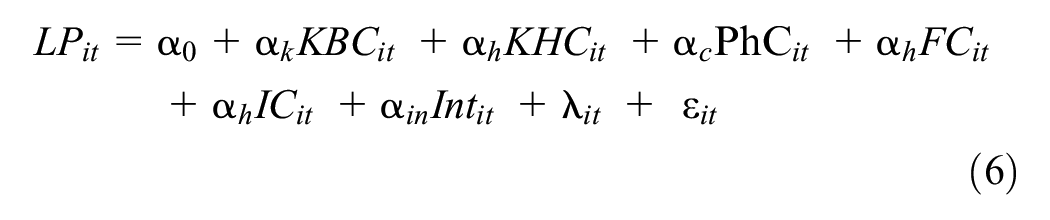
In addition, the effects of knowledge factors are controlled with industrial context and interaction between computer use and other relevant factors. To investigate the interaction effects, the multiplicative term,
While:
-
-
-
- Control factors:
- Firm attributes:
+
+
The first hypothesis is that ‘productivity paradox’ happens to Vietnamese enterprises, meaning that coefficients of knowledge–based factors have a negative value. While
Finally, based on the recent contributions to the literature on productivity dispersion among firms, a firm’s heterogeneity implies that not all firms have the same capability to transfer applying knowledge factors into productivity gains. We tested whether the relationship between labour productivity and knowledge factors is heterogeneous across diverse groups of firms (ownership cohort: domestic owned, state-owned and foreign-owned; firm-size cohort: small, medium-sized, and large).
Econometric Methodology
This research employs two-step system generalised method of moments (GMM) models which were firstly introduced by Arellano and Bond (1991), then revised by Arellano and Bover (1995), and finally developed by Blundell and Bond (1998). In addition, the two-step GMM system could solve some problems while other available methods could not. For example, regressors are not completely exogenous, and the idiosyncratic disturbances, μit, might involve serial correlation and heteroskedasticity. GMM model is most suitable for small T-and-large N data set while unit-root tests usually require a long time (T) horizon, thus it is more suitable for this study than the model developed by Zaman (2023). The advantages of the two-step GMM system is its ability to solve various problems, including endogeneity, serial correlation and heteroskedasticity. This research applied the robust option of the two-step system GMM to provide the best estimations because unobservable firm-specific effects have removed by employing first-difference equations (Amornkitvikai & Pholphirul, 2023). Moreover, another key advantage of the GMM system method is increasing efficiency when variables in the level equation will be instrumented by their first differences. The efficient estimations satisfy the Arellano-Bond test to not reject the hypothesis of no autocorrelation, and the Hansen test to not reject the over-identifying restriction problem (Blundell & Bond, 1998). The estimations of two-step system GMM are based on the syntax developed by Roodman (2006).
Variables
In this study, the dependent variable of interest is labour productivity which is measured by total sales divided by the number of workers, because it is more responsive to IT investment changes, and more sensitive to any change of human capital (Triplett, 1999). In addition, it scales the outputs of firms to comparable ones in all industries (Aral et al., 2006; Carreira & Teixeira, 2009; Doms et al., 2003; Kraemer & Dedrick, 1994; Triplett, 1999).
Independent variables are determined in line with theory and literature, see Table 1. This study investigates knowledge factors in main groups: (i) information technology facilities (computer using) and investment capital for machinery, equipment and repair (following Bresnahan, 1999; Gurbaxani & Whang, 1991; Malone et al., 1989); (ii) knowledge capital: human capital (Labour quality, Human capital efficiency and experience) and structural capita (Business model innovation - NATO) (following Barkhordari et al., 2019; Hadad, 2017). This paper investigates not only mainly IT application (as most of the traditional research of ‘productivity paradox’ does) but also other knowledge factors due to the advantage of knowledge economy (KE) compared with the traditional economy. The KE focuses on information and technology – unlimited resources – instead of scarcity of resources, which is mainly mentioned in a traditional economy (Dalkir, 2013; Edvinsson, 2002; Hadad, 2017).
Variables.

Source. Authors.
In term of knowledge factors, human capital is one of the pillars of a knowledge-based economy (Hadad, 2017). Labour quality is one of the fundamental factors of human capital (Hadad, 2017) as well as a key factor of productivity in international comparison (Mitchell, 1968). Following Wakelin (1998), to measure the labour quality, our study uses the ratio of the total earnings of employees and the number of employees earning average wage.
In addition, a major organisational factor – business model innovation – is identified as a possible explanation for Solow productivity paradox (Wannakrairoj & Velu, 2021). Business model innovation is evaluated as it reflects the change in the net asset turnover ratio (NATO), the asset utilisation and efficiency in using property and equipment, and measures working capital management (Soliman, 2008; M. Zhang et al., 2021).
Besides, the more experience, the more knowledge a firm accumulates. Thus firm experience is an important variable when studying productivity because new entrants are more productive than earlier entrants (Jensen et al., 2001). Capital deepening, as mentioned by Sakamoto (2018), is a source of labour productivity. In addition, returns on capital depend on asset management (Komonen et al., 2006), and usage efficiency of assets increases uptime, and prevents production interruptions, leading to improvement in productivity (Langemeier, 2018). This paper investigates effects of fixed assets per employee on labour productivity.
In addition, this study contributes to the literature of ‘productivity paradox’ by investigating the effect of social security. High social security insurance contributions encourage enterprises to upgrade human resource allocation efficiency and labour efficiency, leading to technological efficiency improvement and higher labour productivity (M. Zhang et al., 2021). In addition, this research sheds new light on the effect of production tax on labour productivity because this tax affects firms’ decisions in production modes, thereby changing firm productivity (Martin & Trannoy, 2019).
Additionally, this study controls industrial factors in which Market structure is identified as one of the factors associated with patterns of productivity growth and affected significantly firm survival (N. T. Nguyen, 2016; Rodríguez-Castelán et al., 2020). Therefore, market competitiveness, Herfindahl-Hirschman Index (HHI), the dummy variables for manufacturing and services industries are controlled because industrial typical characteristics affect firm labour productivity (Dong et al., 2022).
For the robustness check, additional control variables were also used to verify the findings. This study employed variable of ratio of female employees per total employees which could influence labour productivity (similar to Aguilar et al., 2015; Ali et al., 2016; Hoogendoorn et al., 2013) and asset depreciation (measured by fixed-asset depreciation rate) which could affect multi-factor productivity (Baldwin et al., 2015).
Variables with financial values are deflated with the annual consumer price index (CPI). Variables including labour quality, labour productivity, innovation and development investment, capital deepening and Firm’s Social security contribution are converted into logarithmic form.
Data
This paper extracted data from the National Census which is annually conducted by Vietnam General Statistics Organization (GSO) and the World Bank. The advantage of this survey is that it provides the most comprehensive characteristics set of firms operating in all sectors throughout Vietnam’s economy. The data employed is for the period 2007 to 2011, represents a critical phase of economic transformation that continues to shape Vietnam’s innovation landscape. This period marked a significant institutional reform for enterprises and knowledge development in Vietnam. Moreover, firms experienced serious difficulties during this period, especially in 2011 with the highest exiting rate of firms (GSO, 2013). In addition, our choice of the 2007 to 2011 dataset was due to its completeness and consistency in variable definitions, which are crucial for the robustness of our econometric model. While we fully acknowledge the availability of more recent data from the Vietnamese General Statistical Office (GSO), we have thoroughly examined the updated datasets and found that key variables in our model are no longer consistently available due to changes in the questionnaire structure and data collection methodology. These modifications make it challenging to maintain the comparability and integrity of the analysis over time. Given this issue, we explored alternative approaches, including different data sources and methodological adjustments, but these did not yield a reliable solution that aligns with the study’s objectives. Therefore, we found that using the 2007 to 2011 dataset remains the most rigorous approach for addressing our research question. Importantly, the economic mechanisms and policy implications derived from our study remain highly relevant, as they provide fundamental insights into the long-term effects of government knowledge expenditure on economic growth – an issue that continues to be of significant interest to both academia and policymakers. Therefore, this paper focuses on evaluating how knowledge affects labour productivity in an emerging country like Vietnam for the period 2007 to 2011. In addition, our study still offers valuable insights into the relationship between knowledge factors, firm attributes, and productivity dynamics in emerging markets.
For the data used, we omitted all observations with negative or missing values for the number of employees, capital, earnings, sales, and fixed assets. Finally, unbalanced panel data was obtained from 40,541 observations with statistical information in Table 2.
Statistics of Sample.

Source. Authors.
Note. 40,541 Observations.
Empirical Results and Discussion
The main purpose of this section is to examine whether there is a ‘productivity paradox’ for Vietnamese firms, how knowledge factors affect labour productivity and how these effects change under different contexts. Therefore, the empirical part includes three sections. First, the effects of knowledge factors on labour productivity are analysed for the whole sample. For comparison with earlier research, the effect of IT facilities (computer usage) on productivity is investigated. Other knowledge factors, including labour quality, human capital efficiency, investment in innovation and development, business model innovation and experience are necessary for deeper investigation to determine if the ‘productivity paradox’ exists. In addition, how these effects change under different contexts and conditions of firms and industrial features will also be investigated. The interaction effects are analysed to understand how the effect of computerisation changes under moderating effects of human capital, innovation and development investment and different industrial environments. Finally, this section tests the last hypothesis that the ‘productivity paradox’ may be changed due to differences of various cohorts of firm size and ownership.
In all models, the validity of the instrumental variables was assessed using the Hansen test. Additionally, the AR(2) test confirm there is not the presence of second-order correlation. Both second-order autocorrelation in second differences (AR2) and Hansen-J-statistics are statistically insignificant, meaning valid instrumental variables. These statistical tests support the proper specification of the two-step system GMM. Furthermore, the diagnostic tests confirm the robustness of the two-step system GMM estimation and the unbiased nature of the standard errors. Wald statistics show that the models are significant. Consequently, the estimated coefficients and statistics are reliable in all models.
Effects of Knowledge Factors on Labour Productivity
This section focuses on the effect of knowledge factors on labour productivity, and how these effects change under different contexts (see Table 3). In model 4, we examine Computer per capita, Labour quality, Human capital efficiency, innovation and development investment and Business model innovation (NATO), all of which are extremely important for Vietnamese firms to improve their labour productivity. These results are similar to Hall et al. (2013), Ghosal and Nair-Reichert (2009), Aral et al. (2006) and Doms et al. (2003) and answer the hypothesis 1 as well as the question 1 that the ‘productivity paradox’ does not exist for Vietnamese enterprises.
Effects of Knowledge Factors on Productivity.

Source. Authors.
Note. The table provides the results of the two-step system GMM estimator. (*), (**), (***) express statistical significance at least at the 5%, 1%, and 0.1% levels, respectively; Standard errors in parentheses; ‘Wald chi-squ. test’ is a test of the null hypothesis that all parameters are zero; ‘Hansen test’ inspects the null hypothesis of the over-identifying restrictions, the probability obtained is higher to .05, the used instruments in the estimation are valid, and therefore overidentification doesn’t exit; ‘Arellano-Bond test AR (2)’ examines of the null hypothesis of no second order serial correlation t-values are robust to heteroskedasticity, the probability obtained is higher to .05. All models are regressed with time dummy variables. We do not report these variables here.
Similar to Elish and Elshamy (2017) and Mesagan and Vo (2024), it could be stated that human capital (labour quality and Human capital efficiency) is an extremely important determinant of labour productivity. Insufficient labour quality and an employee’s limited capacity to fluently use IT applications will not improve labour productivity, and can even increase production costs (wasting time, technical problems, etc.).
Regarding innovation and development investment, with main components of investment portfolio of equipment and fixed asset for production, the results provide evidence that labour productivity is supported by this investment. As Enshassi et al. (2007) explained, labour productivity depends on the type of equipment, that is, more modern equipment characterised a higher productivity rate than the older equipment. Similarly, Bekr (2016) found that one of the major factors decreasing the labour productivity is inefficient equipment. In addition, investment in innovation help to increase firm productivity and efficiency (Amornkitvikai & Pholphirul, 2023).
Besides, this paper found that business model innovation (presented by the net asset turnover ratio, NATO, a novel approach of evaluating business model innovation developed by Wannakrairoj & Velu, 2021) has the strongest positive effect on labour productivity for the case of Vietnam. With the explanation that a major improvement in the NATO may have resulted from a fundamental innovation in the firm’s business model, the findings confirm that business innovation enhances labour productivity in Vietnam, similar to Wannakrairoj and Velu (2021).
In term of experience, the multivariate analyses indicate a significant and positive effect of firm experience on labour productivity because the maturer firms has more experience and become more productive, similar to Coad et al. (2016) and Chor et al. (2021).
Particularly, there is more evidence that the effects of knowledge factors on labour productivity significantly depend on the contextual factors. The sign of ‘productivity paradox’ in Model (1) with the negative coefficient of Computer per employee (−0.7003) has disappeared when that coefficient changes to positive one after controlling firms’ features in the Model 2 and particularly bigger one after controlling interaction effects in the Model 4 (0.3661). These results also confirm the hypothesis
In terms of Capital deepening, this research found that the more capital intensive, the higher labour productivity. In addition, the research sheds new light on the effects of social issues. These are rarely mentioned, including firm’s insurance, trade union contribution and production tax. The empirical analysis means that the more production taxes firms contributed the higher labour productivity, different to Martin and Trannoy (2019) indicating that production taxes could penalise their productivity.
Looking at industrial factors in detail, the empirical result indicates that market concentration is one of the largest contributors to the productivity dispersion, similar to Cusolito and Maloney (2018) and Rodríguez-Castelán et al. (2020). For Vietnamese firms, the negative significant effect of market concentration (with coefficient of −1.2930) is stronger than the IT’s effect (with coefficient of 0.3661).
Additionally, in the case that other things are equal, commercial sectors seem more productive than manufacturing ones. In addition, the research takes advantage of national firm-level census data to analyse the extent to which market concentration explains the labour-productivity stagnation in Vietnam.
Similar to Orlikowski and Iacono (2001) and Kobelsky et al. (2008), the hypothesis 3 ‘There are interaction effects of contextual factors on the relationship between IT facilities and labour productivity’ is confirmed, that is also the answer for the question 3. The effects of knowledge factors on labour productivity are moderated by interaction effects (see model 4), presenting with the significant coefficients of Computer-Manufacturing interaction and Computer-Inn. & Dev. inv. Interaction. Especially, under the interaction effects, the effect of Computer per employee and Inn. & Dev. Investment become significantly stronger (0.3661 and 0.0772, respectively).
Effects of Knowledge Factors on Labour Productivity at Different Cohorts of Firm Size
This section investigates how different are effects of knowledge factors on labour productivity among different cohorts of firm size. Models 1, 2, 3, are for small (firms with fewer than 10 employees), medium (firms with more than 10 and fewer 200 employees), large-sized firms (firms with more than 200 employees), respectively (see Table 4).
Effects of Knowledge Factors on Productivity of Vietnamese Enterprises by Cohorts of Firm Size – GMM System.

Source. Authors.
Note. The table provides the results of the two-step system GMM estimator. (*), (**), (***) express statistical significance at least at the 5%, 1%, and 0.1% levels, respectively; Standard errors in parentheses; ‘Wald chi-squ. test’ is a test of the null hypothesis that all parameters are zero; ‘Hansen test’ inspects the null hypothesis of the over-identifying restrictions, the probability obtained is higher to .05, the used instruments in the estimation are valid, and therefore overidentification doesn’t exit; ‘Arellano-Bond test AR (2)’ examines of the null hypothesis of no second order serial correlation t-values are robust to heteroskedasticity, the probability obtained is higher to .05. All models are regressed with time dummy variables. We do not report these variables here.
In terms of knowledge factors, the results partly confirm the hypothesis 4 as well as the question 4 ‘The effects of firm knowledge on labour productivity change at different cohorts of firm size’, depending on the kinds of knowledge factors . Labour quality and Human capital efficiency have the same significant and positive effects for all cohorts of firm size, and the strongest effects belong to large-sized firms. Besides, similar to Yusuf (2013), the impact of the human capital efficiency on labour productivity depends on firm size, large-sized and small-sized ones rank the first and the second in supporting labour productivity, respectively. While there are differences among different firm sizes for other knowledge factors. The smaller the firm’s size, the higher effect of Computer per employee is. Computer per employee and Inn. & Dev. Investment significantly supports labour productivity for small and medium-sized firms, not for large-sized ones. The more experience the better labour productivity for small and large-sized firms, while NATO only benefits for small ones.
In terms of the effects of firm attributes, there are strong differences among various cohorts of firm size. Capital deepening supports labour productivity most for the case of medium-sized sized firms. If workers are more accessible to machinery and tools, they can deliver more outputs or increased labour productivity and it is significantly right for the case of medium sized firms in Vietnam. Capital deepening implies an increase in the ratio of the capital stock to the labour’s worked hours. Changes in labour productivity are attributed to various potential causes, including shifts in the use of capital, consistent with the idea that more productive firms become more capital-intensive.
About industrial factors, market concentration seems most serious for the medium-sized firms, which suggests specific policies for vulnerable firms.
Effects of Knowledge Factors on Labour Productivity at Different Cohorts of Firm Ownership
This section investigates how different effects of knowledge factors on labour productivity among different firm ownerships, including private, FDI and State-owned firms (see Table 5) . The results confirm hypothesis 5 as well as the question 5 ‘The effects of firm knowledge on labour productivity change at different cohorts of firm ownership’. The effects of Inn. & Dev. Investment is only significant for FDI firms because these firms are better in advanced technologies and more efficient in investing in R&D (Do, 2021). However, the results show the consistently positive effects of Labour quality (strongest for state-owned firms) for all ownerships. While Human capital efficiency (strongest for private-owned firms) is significant and positive for small and large-sized firms while Business model innovation – NATO (strongest for FDI-owned firms) is significant and positive for medium and large -sized ones.
Effects of Knowledge Factors on Productivity for Vietnamese Enterprises by Cohort of Firm-Ownerships – GMM System.

Source. Authors.
Note. The table provides the results of the two-step system GMM estimator. (*), (**), (***) express statistical significance at least at the 5%, 1%, and 0.1% levels, respectively; Standard errors in parentheses; ‘Wald chi-squ. test’ is a test of the null hypothesis that all parameters are zero; ‘Hansen test’ inspects the null hypothesis of the over-identifying restrictions, the probability obtained is higher to .05, the used instruments in the estimation are valid, and therefore overidentification doesn’t exit; ‘Arellano-Bond test AR (2)’ examines of the null hypothesis of no second order serial correlation t-values are robust to heteroskedasticity, the probability obtained is higher to .05. All models are regressed with time dummy variables. We do not report these variables here.
About firm attributes, capital deepening is only significantly positive for private firms. It is suitable because Vietnamese firms usually face difficulties in accessing capital. While higher Ratio of Social Insurance paid employees will bring higher labour productivity for FDI firms. This may express the advantage of FDI firms in high quality management with standardised Social Insurance for employees.
In terms of industrial factors, HHI is most harmful for private firms. In addition, only private and state-owned firms in the manufacturing industry will have higher labour productivity. These results may imply the lower competitiveness of these ownerships leading to more sensitive to high HHI as well as sector effects. However, firms in the services industry usually has strongly higher labour productivity. For interaction effects, interestingly, Human capital support the effect of computers for FDI firms and operating in Manufacturing industry enhances the effect of computers for FDI and private firms (strongest for FDI firms).
Robustness Test
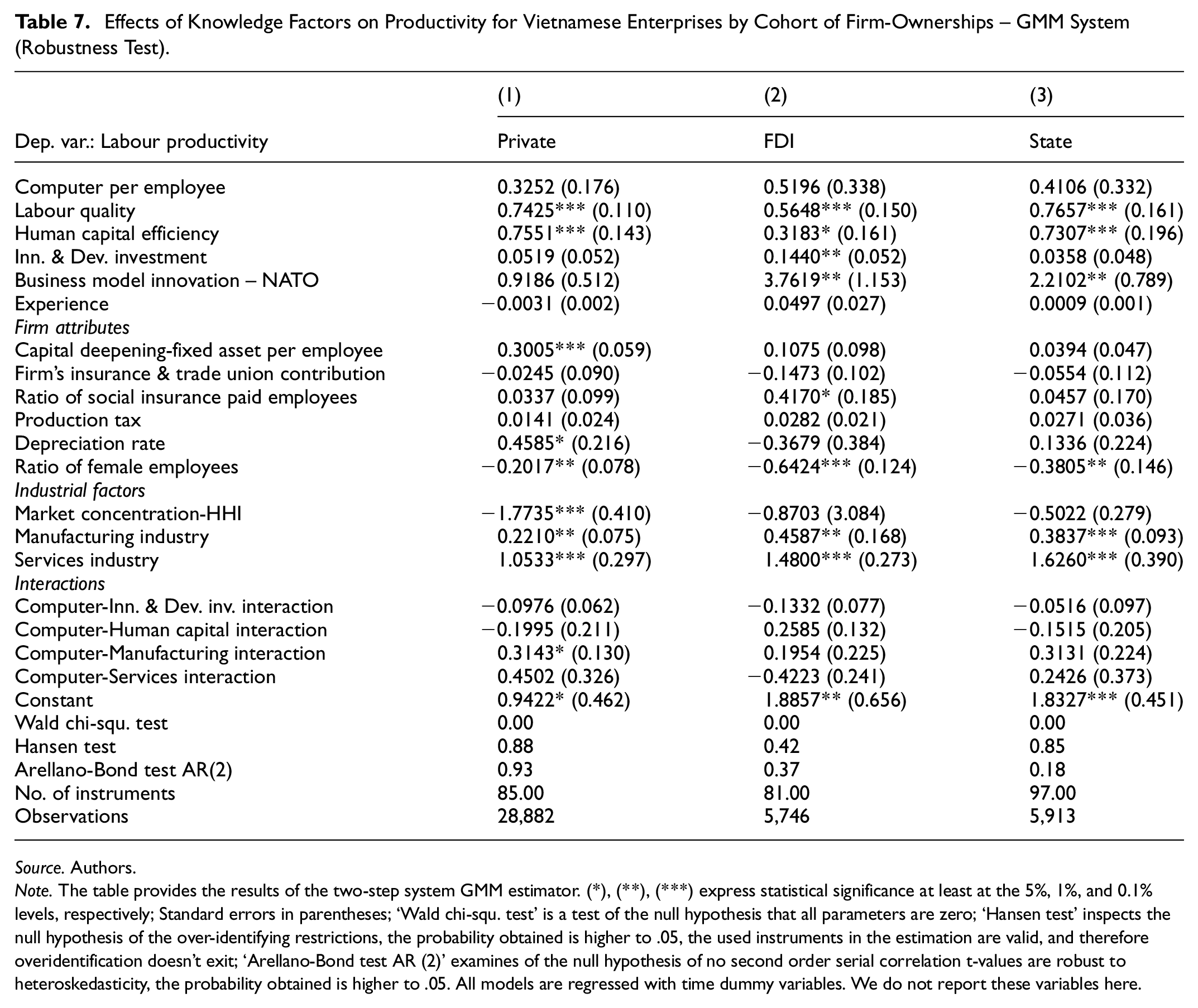
To further assess the robustness of the regression estimates, this study incorporates additional control variables related to firm characteristics to conduct robustness checks, including Depreciation Rate and Ratio of female employees per total employees. Based on this approach, dynamic panel data models (Tables 3–5) were re-estimated, and the results are presented in Tables 6 and 7.
Effects of Knowledge Factors on Productivity of Vietnamese Enterprises for Whole Sample and by Cohorts of Firm Size – GMM System (Robustness Test).

Source. Authors.
Note. The table provides the results of the two-step system GMM estimator. (*), (**), (***) express statistical significance at least at the 5%, 1%, and 0.1% levels, respectively; Standard errors in parentheses; ‘Wald chi-squ. test’ is a test of the null hypothesis that all parameters are zero; ‘Hansen test’ inspects the null hypothesis of the over-identifying restrictions, the probability obtained is higher to .05, the used instruments in the estimation are valid, and therefore overidentification doesn’t exit; ‘Arellano-Bond test AR (2)’ examines of the null hypothesis of no second order serial correlation t-values are robust to heteroskedasticity, the probability obtained is higher to .05. All models are regressed with time dummy variables. We do not report these variables here.
Effects of Knowledge Factors on Productivity for Vietnamese Enterprises by Cohort of Firm-Ownerships – GMM System (Robustness Test).
Source. Authors.
Note. The table provides the results of the two-step system GMM estimator. (*), (**), (***) express statistical significance at least at the 5%, 1%, and 0.1% levels, respectively; Standard errors in parentheses; ‘Wald chi-squ. test’ is a test of the null hypothesis that all parameters are zero; ‘Hansen test’ inspects the null hypothesis of the over-identifying restrictions, the probability obtained is higher to .05, the used instruments in the estimation are valid, and therefore overidentification doesn’t exit; ‘Arellano-Bond test AR (2)’ examines of the null hypothesis of no second order serial correlation t-values are robust to heteroskedasticity, the probability obtained is higher to .05. All models are regressed with time dummy variables. We do not report these variables here.
A comparison of the regression results in Tables 6 and 7 with those in previous tables reveals no substantial changes in the magnitude, direction, or statistical significance of the coefficients for both the core independent variables and the control variables. In addition, the results of Hansen tests and Arellano-Bond test AR (2) confirm that the used instruments in the estimation are valid, overidentification doesn’t exit, the errors term are not serially correlated. These findings confirm the robustness of the study’s conclusions.
Conclusions
Responding to calls for further study on the ‘productivity paradox’ (Brynjolfsson, 1993; Hardy et al., 2021), the research has contributed to the literature on ‘productivity paradox’ by investigating ‘knowledge’– a broader approach than only ‘IT application’ and the findings imply that generally there is no ‘productivity paradox’ for an emerging economy like Vietnam in the period 2007 to 2011. Labour quality is two of the most important determinants of labour productivity for all cases, even at different size-levels and ownerships. Besides, Business model innovation supports highly supported labour productivity for whole firms, and significantly for small-sized ones. The findings suggest firms should enhance investment in knowledge development, especially in labour quality and NATO.
This study contributes empirical results of the change of the power of knowledge capital on labour productivity after controlling internal, external variables and interaction effects, particularly effects of sizes and ownerships. These findings are valuable in terms of highlighting the conditions under which the paradox appears or diminishes, offering a more comprehensive understanding of its mechanisms (similar to M. H. Nguyen & Bui, 2022; Rupika & Chandan, 2024). Computerisation should be boosted for small and medium-sized firms. Firms might be partners with universities, vocational schools and private training providers to offer affordable or subsidised digital skills training. Small and medium-sized FDI firms should pay high attention to investment in innovation and development. For instance, establishing dedicated R&D departments or partnering with local universities can foster innovation. The effects of knowledge factors on labour productivity significantly depend on contextual factors. Effects of IT application are moderated by internal (Human capital efficiency, Inn. & Dev. Investment) and external factors (Manufacturing and services industries) for the case of Vietnamese firms. Firms in the manufacturing and service sectors, should focus on upskilling their workforce through targeted training programmes. This finding suggests firms and policy makers amend policies corresponding to specific firm and industrial features to promote knowledge factors’ effectiveness. In addition, the research sheds new light on the effects of firm contribution factors, noticeably, firms should pay attention more in increasing Ratio of Social Insurance paid employees, especially for FDI firms.
Noticeably, medium-sized, or private firms suffer the significant risk from market concentration. This implies the government should have policies based on firm size and ownership to minimise negative impacts from market concentration. The findings also suggest the services industry is the potential industry to contribute most to national labour productivity improvement.
About different ownerships, Computerisation should be enhanced for small-sized and medium sized firms, while Inn. & Dev. Investment should be paid more attention to med-sized firms). Besides, FDI firms should focus on improving Human capital and firms in Manufacturing industry should enhance computerisation because their interaction supports the effect of the computer.
This paper has some limitations and missing gaps: (i) The IT application in this paper is measured only by the number of computers, not patents or patents and intellectual property, due to limitation of data; (ii) The study is unable to control the scientific employees who have important roles in efficiency of IT application; (iii) more contextual moderators of internal and external factors should be further investigated; (iv) The study should contribute more to the concept of the paradox of productivity based on its essence, the excessive accumulation of high-tech talents or the excessive cultivation of high-tech talents leading to the failure of the scale of high-tech industry to accommodate such a large amount of human capital accumulation is not the paradox of productivity; (v) Finally, the research has not studied the matching degree between human capital and industrial upgrading, it should be addressed with more comprehensive data in further research; (vi) Data availability for consistent variable set (especially in terms of knowledge variables) is in fairly short period (from 2011, most of these knowledge variables are excluded in the questionnaires).
Footnotes

Funding
The author(s) received no financial support for the research, authorship, and/or publication of this article.
Declaration of Conflicting Interests
The author(s) declared no potential conflicts of interest with respect to the research, authorship, and/or publication of this article.
Data Availability
Data sharing not applicable to this article as no datasets were generated or analysed during the current study.