




Abstract
Many studies on IT investment in companies have been conducted in the past, but our team combined them by summarizing the latest research. Compared to previous work, we revise a larger universe of firm IT investment, focus on more recent IT investment researches, refine the focus of current researchers pay attention to and address the problem of insufficient reference for enterprise practice. Through a review of the literature to synthesize the understanding of IT investment to (i) IT investment performance, (ii) IT adoption decision, (iii) IT governance, and (iv) IT labor (worker), we could highlight the research gaps that we encountered. Finally, based on the current research conclusions, we give practical suggestions from the early, middle and late stages of IT investment. This study contributes to the growing amount of literature on IT investment, both academically and practically.
Plain language summary
Through a review of the literature to synthesize the understanding of IT investment to (i) IT investment performance, (ii) IT adoption decision, (iii) IT governance, and (iv) IT labor (worker), we could highlight the research gaps that we encountered. Finally, based on the current research conclusions, we give practical suggestions from the early, middle and late stages of IT investment.
Introduction
As business process digitalization becomes more essential in explaining company performance, Information technology (IT) investment and implementation is becoming more and more important, which also attracted academic attention (Tambe et al., 2020). According to the Society for Information Management (SIM), IT spending as a percentage of revenue was 5.9% in 2022, up slightly from 2021 but close to the 10-year average of 5.7%. However, 74.6% of organizations reported increasing IT headcount, a 10-year high and up from 63.6% in 2021 (Johnson et al., 2023). At the same time, IT will become the focus of business investment in the foreseeable future. On the one hand, IT is considered to be an important means to face the future competition of enterprises (S. Han et al., 2019; Xin & Choudhary, 2019), on the other hand, scientific and technological advancements have resulted in an increasing number of new technologies, such as 5G, cloud computing, the Internet of Things, artificial intelligence, and so on. These new ITs are facing new problems and challenges for enterprises (X. T. Li, 2021), and we need to review and study them again.
Firm IT investment usually refers to the investment made by enterprises in information technology during the process of information construction, in order to build the required information systems, equip infrastructure and so on. Improving enterprise performance and efficiency is the goal of businesses’ IT investments (Johnson et al., 2023; Xin & Choudhary, 2019). The theoretical basis for the positive returns that firm IT investment can bring to firms is mainly Resource-Based Theory (Barney, 1996), Complementary Principle (Stieglitz & Heine, 2007), and Contingency Theory (Van de Ven & Drazin, 1984). The Resource-Based Theory states that businesses maximize information technology resources in accordance with their own requirements, which boosts performance. From the standpoint of Complementary Principle Theory, complementing enterprise resources, including IT resources, can achieve continuous growth in enterprise value. The Contingency Theory suggests that different enterprises have different internal resources and external conditions, which require specific analysis of specific situations. There is no unified and optimal method to improve enterprise performance.
The reasons of firms to allocate significant parts of their capital budgets toward IT are execute digital strategies and digital transformation (Xue et al., 2021). These digital strategies and digital transformations are considered to be important methods for companies to face future competition and development. However, in the process of enterprise informatization, all kinds of old problems have not been solved, and all kinds of new problems have emerged. In the past, enterprise IT investment has been facing problems such as large investment amount, long investment implementation time, high failure risk rate, and difficulty in business integration, even in recent years (Ilmudeen et al., 2023). With the rapid growth of science and technology, new problems of enterprise IT investment continue to appear, such as the adoption decision of new technology (Dong et al., 2021; Havakhor et al., 2022), IT labor training (Tambe et al., 2020), the integration of technology and business (Saldanha et al., 2020), etc. The challenges faced by these enterprises’ IT investment are the focus of future research in academia and practice.
Problem Statement: Although the significant amount of investment in IT over the last few decades, academic research has also contributed in a different way to our understanding of these investment (Orozco et al., 2022). Even in recent years, academia is still arguing about whether enterprise IT investment has brought corresponding performance to the enterprise (Acar et al., 2017; Khuntia et al., 2018; J. W. Liu et al., 2021). For the surface of the debate on IT investment performance, it is necessary to in-depth study the causes and solutions of this “productivity paradox.” At the same time, new issues in IT investment have also received attention from researchers, such as insufficient IT investment (Kathuria et al., 2023), IT and data security (W. W. Li et al., 2023) and IT and competition (Iacovone et al., 2023). On the one hand, there is a lack of existing synthesis studies on enterprise IT investment in response to the increasing number of firm IT investment researches. On the other hand, with the development and use of IT, new issues in business management have emerged that need to be addressed by researchers.
Study’s Contributions: The principal objective of this paper is to provide an overview of significant research on enterprise IT investment since the 21st century, to examine the challenges confronting enterprise IT investment in the contemporary era, and to suggest avenues for future research. This work offers three major contributions to the literature. First, we summarize the research on enterprise IT investment in the 21st century, and comb the new findings of IT research in more detail. At present, there are new changes in the research scope, research content, research data and research methods of enterprise IT investment, which need to be summarized. Second, various new information technologies and applications have appeared in the new era, which have brought new problems to enterprises, but related research is still insufficient. Through the analysis of the latest research, we can understand the lack of research. Third, we discuss the future study direction of corporate IT investment research and the focus of practice that need to be paid attention to when the business environment changes a lot. This study adds to understanding the body of literature concerning IT investment research at the firm level. The rest of the article is organized as follows: The second part of the paper sets out the reasons for undertaking an overview of IT investments and the methodology that has been employed. Part III considers the existence of the “IT productivity paradox.” Part IV provides a summary of the issues relating to IT adoption, IT management and the IT workforce. Part V offers a summary of the issues that should be addressed in an organization’s IT practices. Finally, the paper concludes with an analysis of the gaps in the current research and the conclusions that can be drawn from this paper.
Why Revisit the IT Investment Research and the Method
Given the unprecedented level of investment in IT over the last few decades, significant research has been conducted to investigate the impact of IT investment on firm performance and “IT productivity paradox.” The reason, on the one hand, is scholars have not formed a unified opinion about IT investment performance. On the other hand, as computers advanced rapidly, a plethora of new IT-related products and services emerged. This leads to new choices for enterprise IT investment, which brings new IT performance problems. Although there are many studies on enterprise IT investment, few of them summarize and refine the shortcomings of existing research. Specifically, it includes the following three points about the reasons to revisit the existing IT investment research.
Firstly, the existing research reviews (Dedrick et al., 2003; Hajli et al., 2015; Khallaf et al., 2017; Kohli & Devaraj, 2003) on IT investment are all about “IT investment performance” or “IT investment paradox.” The summary scope is relatively narrow and cannot fully reflect the overall situation of IT investment research. Although the research and debate on IT investment performance has a long history, there are many other contents in IT investment research, such as the IT investment decision-making, which have been ignored by the existing review research. Compared to previous work, we revise a larger universe of firm IT investment, focus on more recent IT investment researches, refine the focus of current researchers pay attention to and address the problem of insufficient reference for enterprise practice.
Secondly, with the rapid development of computer and science and technology, a variety of new products and services have emerged, which has brought new problems and challenges to enterprises. These new technologies, for example, 5G, Internet of things (IoT), and artificial intelligence (AI), also bring new research problems to researchers, such as integration of IT and enterprise (Saldanha et al., 2020) or IT labor (Avgar et al., 2018). Because the development of information technology has become more and more complex, and its use in enterprises has become more and more extensive, this has brought new challenges to the recruitment, training, and cooperation of employees. However, these new problems faced by enterprise IT investment in the new era and new environment have not been sorted out by researchers, which will cause some trouble for future research.
Thirdly, numerous studies have previously addressed strategies to enhance enterprise IT investment performance, yet most of the studies only give relevant research conclusions, which leads to insufficient reference in enterprise practice. For example, many studies have confirmed that the background of enterprise managers (Turedi, 2020) or social networks (Gangopadhyay & Nilakantan, 2021) can affect the performance of IT performance, but they do not have corresponding suggestions to enterprises. The lack of summary of these enterprise practices makes it difficult for the existing research conclusions to form guidance for enterprise practice. Through the summary of the latest literature, this study forms the IT investment suggestions of enterprise practice, which is of great significance to enterprise practice.
Data Generation and Methods: This study uses literature research method to review the latest IT investment-related research. This study used “IT investment” and “information technology investment” as keywords to search the Web of Science and Google Scholar databases, and we mainly focus on the relevant research on enterprise IT investment in the past 10 years (2010–2023). By complete reading of each piece of relevant literature one by one, we found the current focus of enterprise IT investment research, namely IT adoption decision, IT governance and IT labor. And then this study summarizes the existing research deficiencies and the key points that enterprise practice needs to pay attention to. Figure 1 is the research framework of this paper. Just like the flow of the figure, we first introduced the reasons for conducting IT investment review, and there are three aspects to explain. Then, we reviewed the latest IT investment related research, including two aspects, which are research on the phenomenon of “IT productivity paradox” in the past 10 years, as well as other research on IT investment that scholars are concerned about. At last is how to do in the future. It also contains two aspects, that is, academic research and corporate practices need to be addressed and focused on in the future IT investment.

Research framework.
The Existence of IT Productivity Paradox
Many researchers have revisited the IT productivity paradox on multiple occasions during the last several decades (Darrnizal & Ranti, 2016; Dow et al., 2017). Since the computer was invented and applied to the production and operation of enterprises, the discussion regarding the use of information technology in businesses has not stopped. The focus of the debate is whether the IT investment and implementation of the enterprise has brought the desired benefits to the enterprise. Different scholars in various countries use different data and different methods to conduct research on IT investment performance, and draw different research conclusions. With more and more methods and indicators, more researchers began to join this debate (Dong & Yang, 2015; Reeson & Rudd, 2016). However, the only constant is that the phenomenon of “IT productivity paradox” has always existed, even in the current business environment. In this part of the research, we summarize the research on IT investment performance in recent 10 years to confirm our conclusion.
During the past 40 years, information technology (IT) is thought to have had a tremendous impact on the global economy (Jin & Cho, 2015), leading to a change from a manufacturing to an information economy, and a lot of research also supports this view (J. M. Liu & Wu, 2018; Seo et al., 2012; Sin et al., 2015). For example, Dahiya and Mathew (2016) find a favorable association between IT assets and IT infrastructure performance, which has a good impact on E-Government performance. The researchers T. K. Liu et al. (2014) built empirical results using firm-level manufacturing data from Taiwan, demonstrating that IT investment had a considerable beneficial influence on productivity. Using the data of IT investment by Korean enterprises, Suh et al.’s (2013) study also indicate that right-directional IT investment has been critical to the success of Korean IT enterprises.
At the same time, a handful of studies (Beccalli, 2007; Thakurta & Deb, 2018) examining the influence of IT investments in firms indicate limited or no associations between IT spending and firm performance. For example, using panel data on IT investment choices and outcomes, Gangopadhyay and Nilakantan (2021) find a bank’s IT investment does not correlate with the lagged profitability of other banks, which aligns with the existence of the IT productivity paradox. What results usually obtained from the IT investment research is mixed (Chang & Gurbaxani, 2012; Ji et al., 2020; Rasheed & Rasheed, 2015), which means that the firm performance after IT investment according to different constraints. Using 165 firm data, Rasheed and Rasheed (2015) indicate that firm IT investment performance depend on the type of industry and the type of supply chain function being supported. This difference in the results shows that there are still controversies in the research on IT investment performance, and there is no unified convincing conclusion.
Table 1 is the research about IT investment on firm performance in the past 10 years. From these latest research conclusions, the paradox of IT investment performance still exists, and the number of negative results is almost the same as that of positive results. That is to say, for IT investment, we need to continue to deeply study its impact on enterprises and the reasons for the “IT productivity paradox.” From the data source of Table 1, we can see that most of the IT performance research data still comes from developed countries, especially the United States. This is consistent with the previous research conclusions of J. K. Kim et al. (2009). This situation shows that the research on IT investment performance for more than 10 years is still dominated by developed countries, and the research on developing countries is relatively insufficient. The main reason is that the infrastructure in developed countries is more complete, so the data is comprehensive, and there are more researchers in developed countries.
Research About IT Investment on Firm Performance.

From our research summary over the past 10 years, it can be seen that the research methods of IT investment performance are mainly divided into two types: econometric models and non-statistical econometric models (e.g., event study and case study). However, from the performance indicators selected by the researchers, it can be known that compared with the previous indicators, which were mainly financial and stock market indicators, the current indicator selection is more extensive. This shows that in the face of the complexity of IT investment, current researchers begin to pay more attention to the changes in all aspects of enterprises. When it comes to the industry type, more research has contributed to the research on IT investment performance of banks (Darrnizal & Ranti, 2016; Gangopadhyay & Nilakantan, 2021) and hospitals (Gholami et al., 2015; J. Lee & Choi, 2019; Qi & Han, 2020).
Given the amazing amount of investment in IT that has occurred over the last few decades, significant research has been dedicated toward determining the causes of the IT investment paradox (G. Kim et al., 2015; J. W. Liu et al., 2021; Sabherwal & Jeyaraj, 2015). According to Hajli et al. (2015), there are four factors lead to the “IT productivity paradox”: measurement errors or mismeasurement; time lags or diffusion lags (M. Campbell, 2012; H. Lee et al., 2016); mismanagement and income distribution. At the same time, many scholars believe that the differences of enterprises (e.g., business background: Xu et al., 2016; or industry: Banerjee, 2015) lead to the different application effects of IT. For example, the findings of G. Kim et al.’s (2015) study suggest that some of the origins of the IT productivity paradox may be found at the industry level, as the relationship between extreme levels of IT-investment and extreme levels of technical efficiency appear to work differently in sufficiently distinct businesses. Although there are many studies on the causes of the “IT productivity paradox,” there is still no consensus conclusion.
What Other IT Investment Research Scholars Are Focus On?
Undoubtedly, in the research of corporate IT investment, the largest amount of research is on corporate performance. This is because the long research history of IT investment performance with no unified conclusion. However, with the increasing importance and complexity of corporate IT investment, scholars have begun to pay attention to other aspects of IT investment in firms. Through combing the latest research literature, we find that IT adoption decision; IT governance (IT-business consistency; Butler, 2022) and IT labor are the three most important categories in IT investment research. Among these researches, IT investment decision-making is the most researched, which mainly includes two parts: IT investment performance evaluation and IT decision-making model. The research on IT governance is the fastest-growing type of research, which mainly emphasizes the coordination of it and enterprise operation to improve enterprise performance. The research on IT labor is the latest, which mainly studies the impact of enterprise employees on IT investment performance. Figure 2 is the current status of IT investment research.

Current status of IT investment research.
IT Adoption Decision
In the IT adoption decision research, scholars mainly focus on IT investment evaluation and IT decision-making. And, IT investment evaluation is mainly to evaluate the input and output of IT investment, and the purpose of that is also to serve IT investment decision-making. Therefore, this study takes IT investment evaluation as part of IT investment decision-making.
Information technology investment decision making is one of the significant issues in IT investment. Since the IT investment evaluation is not just based on direct and tangible factors and many other intangible and indirect qualitative criteria influence this evaluation. According to Nasher et al. (2011), there are two different approaches in evaluation methods with their own advantages and disadvantages (see Table 2): tangible methods such as Discounted Cash Flow, Net Present Value, Information Economics (Berghout & Tan, 2013), etc. and intangible methods such as Value Analysis, Multi Objective, Multi Criteria (Frisk et al., 2015), Critical Success Factors, etc. For example, Frisk et al. propose a method for managers to improve IS investment evaluation by shifting their focus from traditional analytic tools towards a design attitude that seeks to develop multi-criteria IS evaluation approach based on contextual experience and prior knowledge (Frisk et al., 2015). At the same time, Return on Investment (ROI), and Cost Benefit Analysis (CBA) are focus on tangible. While Multi Criteria Decision Making (MCDM) focus on intangible. To get an accurate outcome, the approach must justify both tangible and immaterial components. Information Economics (IE) and Real Options Analysis (ROA) focus on both tangible and intangible (Purwita & Subriadi, 2019).
IT Investments Evaluation Methodologies.
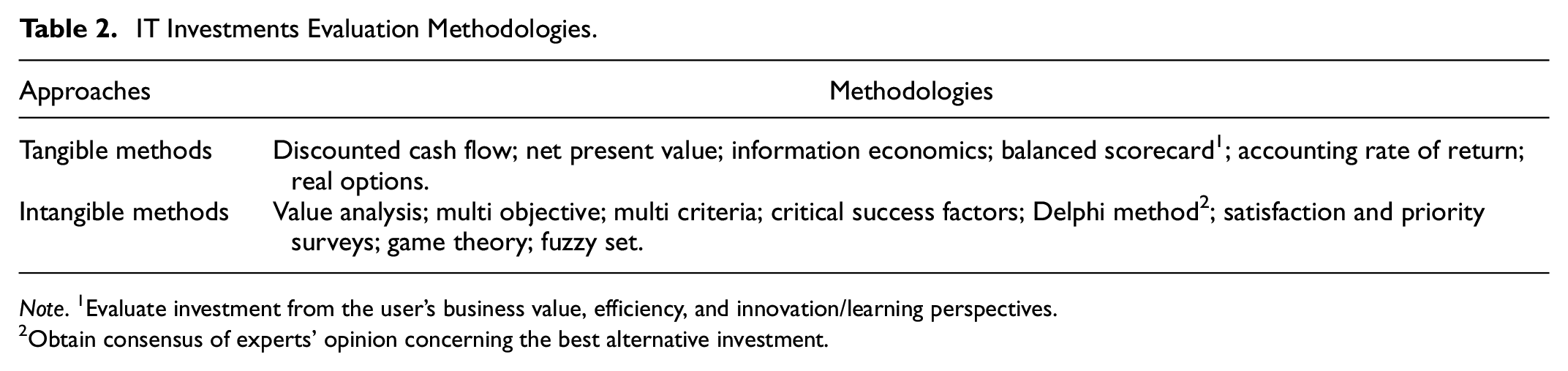
Note. 1Evaluate investment from the user’s business value, efficiency, and innovation/learning perspectives.
Obtain consensus of experts’ opinion concerning the best alternative investment.
On the other hand, IT investment decision-making is a significant research topic. The research aims to identify the indicators of the decision-making model based on influencing factors (Arora & Rahman, 2016; Ravichandran et al., 2009), and then form the decision-making model to guide the enterprise’s IT investment decision-making. Arora and Rahman (2016) explained the importance of investment intensity; investment focus, parts of the business where these investments should be concentrated and timing of investment to IT adoption decision. S. Han et al.’s (2019) study shed insight on the motivations and drivers of IT investment decisions, demonstrating that these decisions are influenced by both economic and legitimacy considerations, such as complying to institutional norms. In the process of IT investment and construction, the cooperation of various departments in the enterprise has proven to be very important (Fukuzawa et al., 2022). Table 3 shows the related research about IT decision-making models.
Research About IT Decision-Making Models.

Note. 1No means no description of the application enterprise in the paper.
Various strategies and technologies have been used to develop an IT decision-making model and guide the implementation process of IT investment: (1) economic (Ryan et al., 2002; Muller et al., 2016), (2) strategic (Pendharkar, 2010) and (3) operational approaches (van den Berg et al., 2019) are popular, but (4) analytic approaches (Nfuka & Rusu, 2013), and the (5) associated tools and techniques (F. Ahmad et al., 2013) are becoming more and more popular in IT investment projects. For example, based on ITIM and Cobit5, Ningsih et al. (2013) designed a IT model by ITIM maturity assessment; mapping ITIM activity to Cobit5 activity/key practice; defined related goals and metric; and then create government institution strategic map, objectives, Key Performance Indicators (KPI), and strategic initiative. Based on two case studies, Jokonya (2015) suggest that Technology Acceptance Model (TAM) has a potential to improve IT adoption success in organizations and TAM is relevant during IT adoption in organizations.
IT Governance
Considering the critical roles that information technology plays in organizations, IT governance has garnered increased attention in both study and practice. Nowadays, IT governance is considered by business managers to be a vital way to ensure performance of IT investment and improve organizational performance (Wang et al., 2022). However, there is no unified concept of IT Governance in academia. According to Weill and Vitale (2001), IT governance refers to a company’s comprehensive procedure for delegating IT decision-making authority and monitoring IT investment performance. Bowen et al. (2007) believe that IT governance is the duty of executives and the board of directors, and it includes the leadership, organizational structures, and processes that ensure the enterprise’s IT supports and expands its business plan and goals. In J. Campbell et al.’s (2010) opinion, IT governance is defined as the system of relationships, procedures, and mechanisms used to design, direct, and regulate IT strategy and resource allocation in order to meet a business’s goals and objectives. It is a collection of formal processes aimed at balancing the risk and return components of IT investment in order to constantly deliver value to the firm.
Enterprise Managers and IT Governance
The involvement of enterprise managers in IT governance has a significant impact on business and company performance, according to the IT investment literature. Manager and IT governance study has looked into the impact manager practices have on business efficiency and the way managers make IT choices regarding investments (Turedi & Zhu, 2019). Our extant work on corporate manager participation in IT governance can be divided into two categories: normative and descriptive (Jewer & McKay, 2012). Normative research gives recommendations for the role of manager in IT governance, while descriptive research looks into how managers actually participate in governance of IT. Table 4 shows the recent references about enterprise managers and IT governance in two categories.
Normative and Descriptive Research in IT Governance.
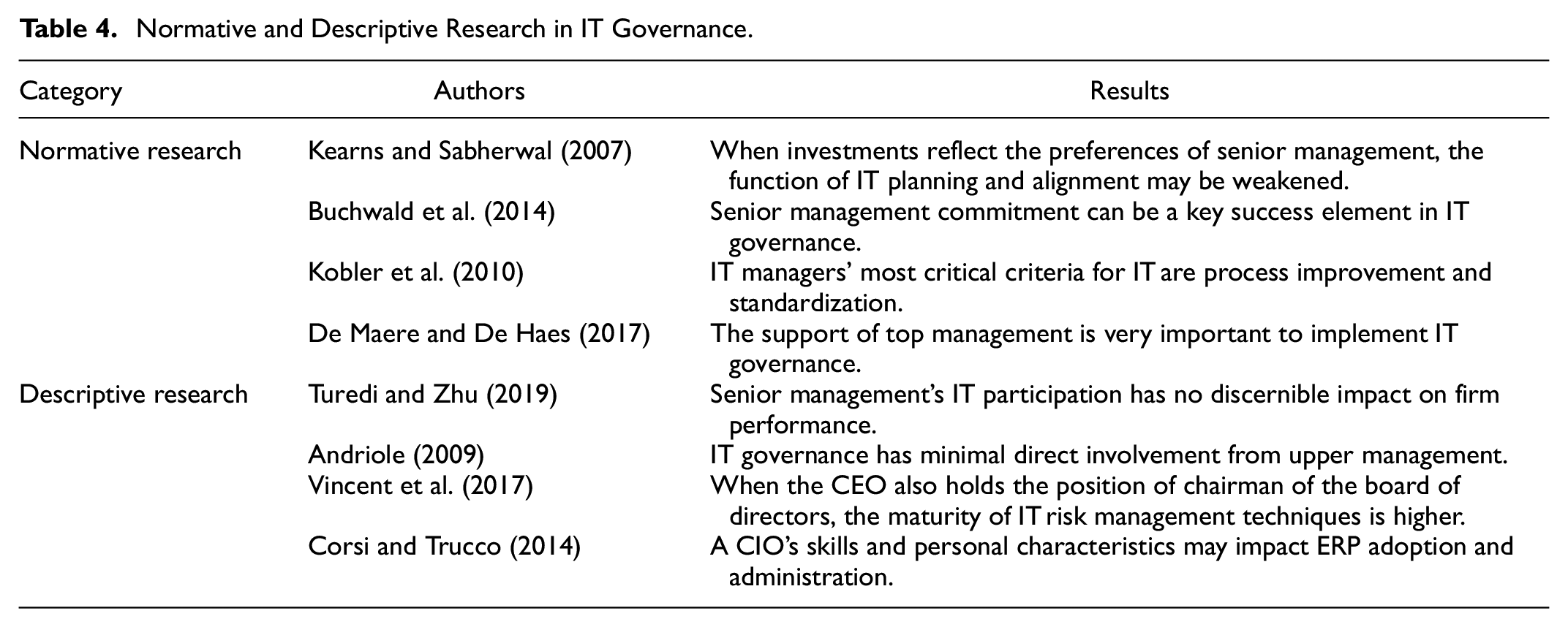
Firm managers play a critical role in the organization, as they are responsible for determining IT strategies and their implementation (Zhang et al., 2023). In the normative research of IT governance, many studies have confirmed that the behavior, attitudes of corporate managers or project participation can affect corporate IT plans or IT performance (Ilmudeen, 2022). At the same time, in the descriptive research, some studies have shown that the characteristics of business managers or IT participation will not have an effect on IT plans, even have a negative impact. Such results show that the effect of corporate managers’ participation in corporate IT investment and implementation still needs further demonstration.
Enterprise Business and IT Governance
This part of the research mainly emphasizes how to coordinate the relationship between IT and corporate business to improve corporate efficiency. By summarizing the literature, we divide the research on enterprise IT investment and business into two categories: static IT business perspective research and dynamic IT business perspective research. The static IT business research mainly discusses the relationship between IT investment and business (Sabherwal et al., 2019), as well as the impact of the relationship on enterprise performance (Ilmudeen, 2021). The dynamic IT business study focuses primarily on how to adjust of investments in IT, enterprise business or both to improve enterprise efficiency (Saldanha et al., 2020).
Static research emphasizes a single and direct connection. Prior studies suggests that the importance of business-IT relationships and alignment should be investigated further. Similarly, experts stated that additional empirical research using either mediation or a moderator model is required to evaluate if IT delivers business value directly or indirectly via company variables (Cao et al., 2011). Using multibusiness firm sample, Ryu et al. (2020) discovered an adverse correlation between IT investment and IT relatedness, however the correlation between IT relatedness and IT governance decision-making structure increases as the IT governance structure becomes more centralized. Iizuka et al. (2011) propose a framework for effective IT investment that considers business-IT alignment and organization.
Meanwhile, IT-business alignment is recognized as a dynamic capability influencing the IT lifecycle at critical junctures, supporting the suggestion by Schilke et al. (2018) to investigate the temporal aspects of such capabilities. The expression of dynamic capabilities refers to the strategic procedures that businesses employ to develop and change operational routines in order to improve performance (Zollo & Winter, 2002). Research across diverse areas within management has illuminated key aspects of dynamic capabilities, including replication and innovation, marketing orientation and marketing capabilities, organizational restructuring and reconfiguration, and Enterprise architecture (EA; Tamm et al., 2022). Drawing on dynamic capabilities theory, Saldanha et al. (2020) concluded that when IT investment levels are higher, firms that emphasize IT change alignment or IT delivery alignment generate more revenue than those that focus on IT investment planning alignment. In contrast, when IT investment levels are low, firms that prioritize IT investment planning alignment outperform those that prioritize IT delivery alignment or IT change alignment.
IT Labor
Compared with other IT investment research, the research of IT labor (worker) has been carried out relatively late. The main reason is that as information technology becomes more and more complex and novel, it becomes more difficult for IT labor to learn and operate. On the one hand, existing research explores its impact on IT from the personal level of IT worker characteristics, background or training. On the other hand, there are also studies that focus on the impact of the interaction between IT worker within the enterprise or the flow of IT worker between enterprises on the enterprise. Because technical know-how and specific implementation skills are frequently incorporated in the IT workforce, IT personnel are uniquely positioned to promote the adoption of these approaches. Working closely with operations technology allows IT staff to better comprehend overall firm-wide procedures and identify new IT-related innovations for the company (L. Wu et al., 2018). Table 5 shows the results of related research of IT labor.
Individual and Group Research in IT Labor.

Existing research shows that the characteristics and abilities of enterprise IT labors can have an impact on enterprise IT performance. The interaction and mobility of enterprise labors can also enable enterprises to obtain new skills or benefits. Based on the research conclusions, companies can form corresponding management measures. Thatcher et al. (2002) suggest that managers may mitigate the influence of external markets on IT workers’ intention to leave by building positive job views and attitudes toward the business. Ahuja et al. (2007) suggest that the context of the IT worker matters to turnover intention, and work-family conflict is a major source of stress for IT road warriors since they must balance personal and professional responsibilities while working at distant client sites during the week. At the same time, the mobility of technical IT workers can explain the productivity advantages of some companies (Tambe & Hitt, 2014).
How to Improve IT Investment Performance in Enterprise Practice
In general, firms and organizations use information technology to gain a competitive advantage and improve company performance. A large number of studies have also confirmed that effective of IT governance leads to boost performance of firms in regard to profitability. Realizing that many firms and organizations haven’t succeeded to improve their IT performance. One of the reasons is that the current research only shows the research conclusions, but does not give specific IT investment and implementation recommendations. This has led to a disconnect between research and practice, resulting in insufficient reference for corporate practice. By summarizing the previous literature, this research gives specific suggestions from the early, mid and late stages of enterprise IT investment to improve the efficiency of IT investment. In fact, there are a lot of researches on IT investment performance. This research divides IT investment into three stages from the enterprise level: the pre-planning stage, the mid-term implementation stage, and the post-performance maintenance stage to summarize the considerations of corporate practice.
Early-Term of IT Investment
In the early stage of IT investment (IT investment planning), existing research focuses on planning and controlling the enterprise to deal with the changes and challenges brought about by IT investment and implementation. The internal capabilities, risk management and investment strategy formulation of enterprises are the most concerned in the early-term of IT investment.
Internal Capabilities Test
Many investigations have shown that the introduction of new investment in information technology or information system (IT/IS) are profoundly affecting the processes, work environment, structures and strategies of an organization (Salleh et al., 2011). This is due to the fact that new IT/IS will lies in changing the mode of production and operation of enterprises or the people system. The resistance to change might occur due to lack of creating a sense of need and urgency for change among the employee and consequently might lead to the IT/IS project failure. Therefore, to reduce the resistance to change among the employee, it is essential that an enterprise needs to assess its preparedness for change prior to implementing new IT/IS solutions by analyzing its internal capabilities. A failure to assess enterprise readiness prior the IT/IS implementation may result in mangers spending more time dealing with the resistance to change or even worst may result in IT/IS failure. Therefore, it is very important to test the internal pressure of the enterprise to deal with changes before IT investment.
IT Risk Management
Each step of firm IT investment and implementation has enabled the companies to continue to expand into new markets, generate better products and services, and reduce the expenses associated with those creations. These advancements have not been without risk. Companies confront risks such as dependency on technology, product expenditure and high fixed costs, security concerns, and the need for more qualified labor. According to Bayrak (2018), the risks faced by enterprise IT investment include initial and maintenance cost, complexity, reliance on IT, security liability and skilled workforce. At the same time, any improper handling of risks may result in the failure of the company’s huge investment in IT. Therefore, enterprises should do a good job in risk management before IT investment (Wilkin et al., 2016).
Investment Strategy (Objective)
Firms have various objectives for IT investments. Firms that see IT as a more important part of their business strategy establish more specific IT investment objectives (Ali et al., 2022). The classification system presented by Tallon et al. (2000) categorizes organizations into four groups based on the focus of their IT investment objectives: (i) unfocused, (ii) operation-focused, (iii) market-focused, and (iv) dual-focused. Dual-focused businesses view IT as a strategic investment that has a substantial impact on their operational effectiveness and market position. These businesses rely on successful IT investment strategies to create business value. At the same time, managers should be aware of the strategic application of IS planning in order to gain a competitive advantage in enterprise competition. Senior executives should select the proper IT infrastructure (based on their business strategy and organizational structure) to ensure that business strategy and organizational structure align (Kitsios & Kamariotou, 2019).
Mid-Term of IT Investment
In the stage of enterprise IT implementation, scholars pay more attention to the relationship between IT and enterprises to improve the success rate of IT investment and implementation. For example, coordinating the relationship between IT and business and formulating a reasonable IT implementation framework are important research contents.
IT-Business Alignment
Numerous studies have agreed on the significance of IT-business alignment in enhancing business performance (Rai et al., 2015). The synergistic combination of e-commerce resources with other firms resources and capabilities is the key to the successful implementation of IT (Yang et al., 2015). In the process of IT investment, coordinating the enterprise’s business to adapt to the use of new technologies can improve the enterprise’s IT performance. Based on qualitative primary data, Tarafdar and Qrunfleh (2010) show that routines and processes for tactical IT-business alignment can be encapsulated in six aspects (Communication, Governance, Skill, Sourcing, IT Professionals, and Projects) that lead to four outcomes (Implementation of planned applications, Execution of IT-enabled aspects of business strategy, Enhanced credibility of the IT department and increased business value derived from IT initiatives).
IT Governance Framework
Successful achievement of benefits necessitates a continuous commitment to and focus on the benefits, rather than the technology, across a system’s creation, execution, and operation (Ashurst et al., 2008). Therefore, IT governance also runs through the whole process of IT investment and implementation. A substantial amount of studies have confirmed that in the process of IT implementation, enterprise managers formulate a reasonable IT governance framework is the key to ensure the implementation. For example, even with stringent budget constraints, a collection of diverse and detailed candidate IT investment projects could still yield a more effective IT portfolio. In essence, the diversity and granularity of candidates for constructing the IT portfolio can have a positive influence on its performance, despite potential negative effects from budget limitations (Tu et al., 2020).
Late-Term of IT Investment
There are relatively few papers focus on late-term of IT investment, so the corresponding reference is also relatively few. The focus of research after IT investment is to maintain and improve the IT investment performance that has been achieved. Enterprise teamwork and IT application management are the key content after IT investment.
Enterprise Teamwork
Each individual has a unique capability or expertise and uses his individual skill to achieve a common goal of the team efficiently, attaining satisfaction among members of the team. It is therefore a challenge for management or team leaders to manage the teamwork to achieve the goal of the IT project. When information technology has been applied to enterprises, the use of information technology has grown into an essential content. And the employees of the enterprise, as the people who directly operate and use the enterprise IT, are crucial to the effect that IT can produce in the enterprise. Existing research shows that when companies are investing in IT, they need to train their employees and collaborate in teams to optimize the performance of IT investments.
Strengthen IT Application Management
Existing research shows that after the implementation of IT investment, managers need to continue to strengthen enterprise management to improve enterprise performance (Ali et al., 2015). Enterprise knowledge management, enterprise culture and employees still play an essential role throughout the use of enterprise IT (Mulyani et al., 2017), which requires enterprise managers to strengthen management. According to Saldanha et al. (2020), firms that prioritize IT-business alignment in the later stages of the IT lifecycle, such as the IT delivery and change stages, have a better ability to convert their IT investment into revenue than those that do so earlier in the IT lifecycle, such as the IT investment planning stage. Enhancing the flow of IT staff is also an important source of obtaining corporate IT capabilities (Tambe et al., 2012). Therefore, corporate managers must strengthen management in terms of employees, corporate culture, and knowledge management to maintain IT performance in the late-term of IT investment.
Insufficient Research and Discussions
The Shortcomings of the Existing Research
Since computers were applied to enterprises, information technology investment and corresponding research have been receiving extensive attention, even in recent years. In the 21st century, we have seen an increase in studies on the relationship between company’s IT investments and different results. Through review the literature to synthesize the knowledge of IT investment to (i) IT investment performance, (ii) IT adoption decision, (iii) IT governance, and (iv) IT labor (worker), we could highlight the research gaps that we encountered. The shortcomings of the existing research are as follows.
(1) Insufficient research on the differential performance of IT investment and its reasons: There is no doubt that, there are lots of studies about firm IT investment performance, using various data, methods and indicators. In order to explore the “IT productivity paradox,” scholars have proposed various explanations and solutions. However, there are still few papers on performance differences under the heterogeneity of enterprises in IT investment performance research. The existing research focuses on one type of enterprise, but we do not know the difference between enterprises in different countries, regions or industries when facing IT investment. At the same time, the reasons for this difference also need to be further explored. The study on the differences in IT investment success has practical significance for enterprise practice and deep understanding of “IT productivity paradox.”
(2) Insufficient research on performance management measures in the later stage of IT investment: In the existing IT investment performance research, there are many pre- and mid-term researches on IT investment, and the research conclusions formed are also instructive for corporate practice. However, there is little research on performance management after the implementation of IT investment, that is, how to maintain or increase the IT performance achieved by enterprises. For example, faced with the application of new information technology, how should companies adjust their strategies, production goals, and employees to improve firm competitiveness? The lack of research after IT applied to enterprises leads to the lack of integrity of the current IT investment research.
(3) Insufficient research on IT investment failure: Of course, failure is not welcome anywhere. However, because of the high failure rate of IT investment, IT investment research requires failure cases and summary (Choudhary et al., 2022). Existing literature is discussing how to improve the IT performance of enterprises, even descriptive IT investment research also serves for enterprise performance. So far, there are many failure cases of IT investment and implementation in enterprise practice, but there is very little research focus on these failures. By studying the failure of IT investment, we can better serve enterprise practice. I believe that more relevant research will focus on the failure of enterprise IT investment in the future.
(4) Insufficient research on periodic and integrity firm IT investment: Despite the extensive literature on IT governance, business alignment, and IT business performance, few studies theorize or experimentally evaluate the stage in the IT lifecycle and IT life integrity, where IT investment is more influential and accurate in firms. Prior study has called for research into how IT investment impact firm benefit or how to improve the IT investment performance in single stage of IT investment. However, IT investment in firms is a dynamic periodic process (i.e., IT investment planning, IT delivery, or IT change stage), in which firms should achieve new resource configurations by integrating, reconfiguring, gaining, or releasing resources to match IT investment and implement. This kind of dynamic and complete enterprise IT investment process research is still insufficient.
(5) Insufficient research on IT labor (worker) governance: In comparison, the research on corporate IT labors is a relatively late study content in IT investment research. The research content is mainly focused on the impact of employee personal characteristics or employee group interaction on the corporate IT process. However, the existing research lacks the content of IT labor governance or incentive, for example, how to select the appropriate IT staff or improve the enthusiasm of IT staff through management, IT training or assessment. Because of the complexity and coordination of information technology, there is a high requirement for cooperation among people in the enterprise, which needs to arouse the attention of researchers.
Discussions
Nowadays, most organizations’ capital expenditures include major investments in information technology (IT). At the same time, research on enterprise IT investment has always been an important direction of IS research, especially in today of the increasingly important digital transformation of enterprises. Although research attention has currently been focused on whether and how companies profit from these investments and other related research, little attention has been devoted to organize and summarize these latest studies, for understanding what have been done, what we missed and what we should do in the future.
The purpose of this research, therefore, is to review the pertinent studies on enterprise IT investment since the 21st century, explore the problems faced by enterprise IT investment in the new era, and point out the direction for future research. Compared to previous work, we focus on a larger universe of firm IT investment, focus on more recent literature and address the issue of new changes faced in the future research and firm practice. Meanwhile, this study establishes that although the general acknowledgment by most researchers of the positive impact of IT investment on enterprises, the “IT productivity paradox” still exists, even in the most recent past. Further discussion is needed on the research of enterprise IT investment and its performance.
Conclusions and Limitations
Although the ongoing research on IT investment and its impact on firm performance, the requirements for effective IT investment are changing due to changes in the conditions and circumstances of many companies, such as diversified organization types etc. Facing these new changes, a great number of studies began to focus on the new problems faced by enterprise IT investment. The major goal of this study is to summarize the relevant research on enterprise IT investment since the 21st century, explore the problems faced by enterprise IT investment in the new era, and point out the direction for future research. Through review the literature to synthesize the knowledge of IT investment to (i) IT investment performance, (ii) IT adoption decision, (iii) IT governance, and (iv) IT labor (worker), we could highlight the research gaps that we came across.
According to our literature summary, (i) the differential performance of IT investment and its reasons, (ii) performance management measures in the later stage of IT investment, (iii) IT investment failure, (iv) periodic and integrity firm IT investment, and (v) IT labor (worker) governance can be the research direction of enterprise IT investment in the future. Specifically, given the state of the field of IT performance differences, future research could focus on the effects of intra-firm heterogeneity and external firm heterogeneity on differences in firms’ IT investment performance. Given the state of the IT performance management field, future research should focus on how organizations can improve their IT governance capabilities in order to leverage the value of their enterprise IT in the later stages of the completion of their IT investments. Furthermore, in light of the considerable number of current failures in enterprise IT investments, it is to be expected that there will be a greater number of case studies of failed enterprise IT investments in the future. At the same time, given the state of the IT labor field, future research should also focus more on the impact of corporate IT investments on employees, such as employee health, work intensity, and career mobility.
Finally, based on the current research conclusions, we give practical suggestions from the early, middle and late stages of IT investment. Our research can be considered as a phased result of enterprise IT investment research and practice.
This research provides a review of the literature of IT investment in firms, specifically prior work in relation to (i) IT investment performance, (ii) IT adoption decision, (iii) IT governance, and (iv) IT labor. There are several limitations in this research. First, we searched the Web of Science Core Collection database with only the keyword IT investment, which may have overlooked several papers on technology investment. Second, this research outline recommendations for research specific to three stages of IT investment. However, how to conduct these studies, what types of settings such research should take place, what types of methods and data might be suitable for this type of research and how it may help close the gap between theory and practice, are not discussed in depth. Third, this research gives specific suggestions from the early, mid and late stages of IT investment in enterprise practice according to the recent research conclusions; as a result, premature generalization errors may occur.
Footnotes
Declaration of Conflicting Interests
The author(s) declared no potential conflicts of interest with respect to the research, authorship, and/or publication of this article.
Funding
The author(s) disclosed receipt of the following financial support for the research, authorship, and/or publication of this article: This work was supported by the National Natural Science Foundation of China under Grant No. 72201117; 72302111; 72025101.

Data Availability Statement
Data sharing not applicable to this article as no datasets were generated or analyzed during the current study.