



Abstract
Threats to organizational identity are particularly salient in temporary organizations because of the tenuous nature of its identity, however, little is known about how organizational identity is created and maintained in such organizations. This paper was developed to address this gap by conducting a qualitative case study at the Stronger Christchurch Infrastructure Rebuild Team (SCIRT), a temporary organization established in the aftermath of the February 2011 Christchurch earthquake in New Zealand. Multiple data sources, including semi-structured interviews, field observations, and organizational documents, were gathered and analyzed using a phronetic iterative approach. The analysis highlights that the definite lifespan of SCIRT necessitates an immediate intervention imperative to prevent identity threats from derailing its operation. The study identified five successive identity work campaigns SCIRT senior managers undertook to counter a series of internal and external threats to its identity and operational success, involving recursive interactions between managers’ sensegiving and employees’ sensemaking of such sensegiving. In particular, it illustrated how a legacy organizational identity emerged during SCIRT’s terminating stage and continued evolving even after its disestablishment. It demonstrates how temporary operation complicates identity work and the development of a legacy identity after the death of an organization. The study contributes an instructive case study to the scant literature on identity work in an increasingly important type of temporary organization.
Keywords
Organizational identity depicts how organizational members define “who we are as an organization” (Whetten, 2006, p. 220). It is a self-defining construct (Whetten, 2006) inculcated collectively through organizational leaders’ sensegiving actions (Ravasi & Schultz, 2006). Identity work refers to “constitutive processes” (Watson, 2008, p. 129) that actors intentionally engage in to create, express, modify, and maintain the sense of who they are (Brown et al., 2021; Kyratsis et al., 2017; Sveningsson & Alvesson, 2003; Watson, 2016). Despite the extensive literature on identity work in organizations (e.g., Basque & Langley, 2018; Brown, 2022; Chreim et al., 2020; Kreiner & Murphy, 2016; Suddaby et al., 2016; Tracey & Phillips, 2016), scant attention has been paid to identity work in temporary organizations (TO), especially those established in uncertain environments following natural disasters.
Catastrophic natural disasters create complex and uncertain conditions of scale, necessitating collaborative action that is coordinated across diverse agencies in a limited timeframe (Lahiri et al., 2021). The requirement and expectation of speed recovery have prompted considerable interest in temporary operation among academics and management practitioners. This type of organizing poses unique management challenges that make achieving optimal coordinated action difficult in a predefined period of time because it requires participating parties to subjugate their individual organization’s interests and downplay their unique identities to undertake time-bound recovery projects (Bharosa et al., 2012). Therefore, constituting a shared organizational identity is critical because it defines an organization (Ellis & Ybema, 2010) for members and external stakeholders.
However, developing this shared identity is challenging when organizations form a temporary collaboration (Jacobsson & Hällgren, 2016) to undertake time-bound recovery projects (Bharosa et al., 2012) because the definite lifespan can work against employees’ efforts in creating a sense of shared identity. Given the rising request of temporary organizations to deal with urgent tasks (such as response and recovery from natural disasters), it is critical to examine how a temporary organization creates, develops, and maintains a coherent organizational identity during its definite lifespan to ensure operational success (Anzel, 2022; Iftikhar & Sergeeva, 2024; Liang, 2024). However, the mechanism of identity work in temporary organizations has not been well explored in contemporary scholarship, and practitioners need theoretical perspectives to inform their practice when they get involved in temporary operations (Bakker et al., 2016; Sergeeva & Roehrich, 2018; Sergeeva & Winch, 2021). To this end, this study was developed to investigate how organizational identity was formed and sustained in a temporary organization by conducting a qualitative case study at the Stronger Christchurch Infrastructure Rebuild Team (SCIRT). SCIRT was formed in the aftermath of the February 2011 Christchurch earthquakes in New Zealand to repair the city’s horizontal infrastructure. Its lifespan was punctuated by continuous internal and external threats to its coherence and existence.
This article explored the identity work senior managers initiated to develop a coherent SCIRT organizational identity. This interpretive case study identified sensegiving at the heart of organizational identity work and the sensemaking employees undertook in response to this sensegiving with a particular focus on managers’ final identity work campaign titled “finishing strong.” In particular, the study articulates how organizational identity work campaign incorporates legacy organizational identity, a type of identity work that seeks to define “who we were as an organization” (Gerstrøm, 2015, p. 90) after the death of an organization. In SCIRT, this legacy identity work was undertaken in the final months of its operation in conjunction with identity work designed to prevent the disintegration of SCIRT organizational identity before its rebuild mission was completed. By focusing on identity work campaigns, this paper contributes a unique case study to the organizational identity work literature, one that reveals the dynamics and complexity of organizational identity work in a type of temporary organization that is becoming more necessary as the frequency and magnitude of natural disasters increase worldwide (Kalkman & de Waard, 2017; Moe & Pathranarakul, 2006) and how a legacy identity (Sasaki, 2017) is produced and developed after an organization ceases operation.
This paper is organized as follows. First, it reviews the key literature on temporary organization, organizational identity, and identity work, then explains the methodology and research case in SCIRT. The findings, which provide original insights into how managers conduct identity work across the entire lifespan of SCIRT, are presented and discussed. The article closes by discussing the study’s contributions to the literature on identity research, practical significance for practitioners, limitations, and suggestions for future research.
Theoretical Background
Temporary Organization
A temporary organization (TO) is defined as “a temporally bounded group of interdependent organizational actors, formed to complete a complex task” (Burke & Morley, 2016, p. 1237). Featured by a pre-determined termination point, TOs last for a limited duration and get disbanded once their task is achieved (Beck & Plowman, 2014; Sydow & Braun, 2017)so While TOs take a wide range of forms, from short-lived project teams to temporary multi-organizations (Sergeeva & Roehrich, 2018), these are collectively characterized as the “organizational equivalent of a one-night stand” (Meyerson et al., 1996, p.167) because they are formed to complete a complicated task in a defined lifespan and then disintegrate (Bakker et al., 2016). For example, temporary collaboration is commonly formed in the aftermath of natural disasters to address the urgent need to restore public services for the communities affected, which makes the disaster response and recovery work highly time-bound and focused on clearly defined outcomes (Curnin & O'Hara, 2019; Song et al., 2024). From this perspective, temporary collaborations engaged in disaster recovery work are typically TOs.
The expanding TO literature (e.g., Sergeeva & Roehrich, 2018; Sydow & Braun, 2017) reflects their variety and flexibility but also recognizes that they can pose management challenges because their ephemeral nature creates a sense of organizational identity (Anzel, 2022; Beck & Plowman, 2014; Nyameke, 2023) and their members struggle with the identity of this unconventional organizational form (Chandna, 2022). A coherent organizational identity is imperative to create and sustain an organization (Lawrence & Suddaby, 2006 ; Schultz & Hernes, 2013), especially in TOs (Iftikhar & Sergeeva, 2024). Despite recognizing the significance of the identity issue in TOs (Chandna, 2022), few studies have examined how an organizational identity emerges and develops in TOs.
Organizational Identity and Identity Work
Albert and Whetten (1985) define organizational identity as members’ shared beliefs of the central, distinctive, and enduring attributes of their organization. Not only is organizational identity a self-defining construct (Whetten, 2006) through organizational leaders’ sensegiving actions (Ravasi & Schultz, 2006), but also a social construction via organizational memebers’ sensemaking activities (Schultz et al., 2012). Sensemaking embraces both sensegiving by the senior managers and sensemaking responses by employees, which are not only coupled but also mutually constitute each other (Kraft et al., 2018 ) and are central to (re)constructing organizational identity (Gioia et al., 2010; Gioia & Patvardhan, 2012). From a processual perspective, organizational identity is in an evolving process of organizational members’ negotiating, interpreting, and (re)constructing their sense of “we-ness” in the context of shared experiences (Gioia & Hamilton, 2016) and in response to opportunities, challenges or threats to an organization’s operation environment (Langley et al., 2013 ), especially during significant organizational events, like a founding member’s departure or when an organization experiences rapid development (Albert & Whetten, 1985).
The review suggests organizational identity research has focused largely on “who we are” as an organization (e.g., Chreim et al., 2020; Corley & Gioia, 2004; Schultz & Hernes, 2013; Whetten, 2006) in ongoing organizations but seldom addressed identity in declining and/or dying organizations, although some studies have addressed time-bound organizations (Gerstrøm, 2015; Walsh & Bartunek, 2012; Walsh & Glynn, 2008). Members of a dying or terminated organization survive its termination and bring an organizational legacy to the next organization they work for (Gerstrøm, 2015; Walsh & Bartunek, 2012). This draws attention to legacy organizational identity (Eury et al., 2018; Lawrence et al., 2011; Walsh & Glynn, 2008; Wood & Caldas, 2009), which refers to “who we were as an organization” (Gerstrøm, 2015, p. 90). Interestingly, Gerstrøm (2015) found that members of a bank that went bankrupt produced a coherent narrative (i.e., a legacy organizational identity narrative) that played a critical role when members subsequently performed in a new organizational context. The literature does not provide any example of how a legacy organizational identity is established when the terminated organization was purposefully set up as a temporary organization. This is the gap in the literature that this study addressed.
Pratt (2012) argues that viewing identity as enduring over time suggests that there are always some “effort and process” (p. 25) invested that enable it to endure. This observation prompted considerations about activities that actively create and sustain organizational identity, which is theorized as organizational identity work (Basque & Langley, 2018; Chreim et al., 2020; Kreiner & Murphy, 2016; Suddaby et al., 2016; Tracey & Phillips, 2016). Identity work refers to “constitutive processes” (Watson, 2008, p. 129) that actors intentionally engage in to create, express, modify, and maintain the sense of who they are (Brown et al., 2021; Chreim et al., 2020; Kyratsis et al., 2017; Watson, 2016). Scholars also use identity construction referring to identity work (Kjaergaard et al., 2011; Kreiner & Murphy, 2016). Identity work can be achieved at both the individual (Sveningsson & Alvesson, 2003; Watson, 2008) and organizational level (Fachin & Langley, 2024; Kreiner & Murphy, 2016; Suddaby et al., 2016). Organizational identity work combines both individual and collective efforts by organizational members to create, develop, and strengthen the sense of who they are as a specific organization (Basque & Langley, 2018). However, rather than accentuating individuals as the core to sustaining or modifying identity, organizational identity work gives prominence to the agency itself and typically refers to how managers communicate organizational identity using discourses and/or materials (Anteby & Molnár, 2012; Kreiner et al., 2015; Kreiner & Murphy, 2016).
A plethora of studies examine strategies for undertaking organizational identity work (Chreim et al., 2020; Ravasi et al., 2018; Suddaby et al., 2016). For instance, Basque and Langley (2018) discuss how the founder figure is utilized in organizational identity construction, Suddaby et al. (2016) highlight how rhetorical history is used to instill a sense of organizational identity and identification, while Chreim et al. (2020) show how authoritative texts can be employed to reinforce counter-institutional identity. Others like Cappetta and Gioia (2006) turn their attention to how symbolic artifacts (i.e., products and firm artifacts) construct fine fashion companies’ identity and image through sensemaking and sensegiving processes. Baruch (2006) provides another example of how material is enlisted in identity work in his exploration of the use of logos on business cards in UK universities. Similarly, researchers like Schultz et al. (2006) reveal the use of identity artifacts like logos/brands in constituting the identity of LEGO.
While the identity issue is challenging in TOs as this type of organizing has become increasingly prevalent (Chandna, 2022), scant literature is available to illustrate how organizational identity is formulated and sustained in TOs, especially during times of threats. Additionally, very little research addresses what happens to an organization’s identity when it ceases operation (Gerstrøm, 2015). The issue observed from the literature is particularly critical because it not only begs a theoretical explanation of identity work in TOs but also creates a need for practitioners whose management strategies and tactics are guided by emerging theoretical perspectives when they get involved in temporary organizations and organizing. Therefore, this study chose to investigate how organizational identity work was conducted across the entire lifespan of a temporary organization when it was confronted with internal and/or external threats to its identity and operation.
Methodology
Research Setting in SCIRT
When a major 6.3 magnitude (Richter scale) earthquake and subsequent aftershocks struck in February 2011, Christchurch, New Zealand, the city’s horizontal infrastructure was seriously damaged. The massive scale of the rebuilding work made it necessary for five of the country’s largest construction firms and three public agencies to join forces to create a temporary collaboration held together by an alliance agreement (Stronger Christchurch Infrastructure Rebuild team [SCIRT], 2011a), the Stronger Christchurch Infrastructure Rebuild Team (i.e., SCIRT) was founded as a result. SCIRT was given a task to accomplish the repair within 5 years. SCIRT consisted of four levels of management, including a board, a management team, an integrated services team, and five delivery teams drawn from the five construction organizations. SCIRT was disestablished in April 2017 after achieving its recovery mission.
SCIRT was ideal for this study for three reasons. First, a sense of “we-ness” (i.e., SCIRT organizational identity) did not emerge organically. Its senior managers took deliberate actions to create and maintain a unified identity in its limited lifetime Second, SCIRT was a TO from the outset: it had to complete its infrastructure recovery task within a predefined timeframe. Third, it operated in a challenging and uncertain post-disaster environment that produced threats to effective identity work and operational viability. As such, not only did SCIRT provide the opportunity to study organizational identity work, but also observed the emergence of a legacy organizational identity after its disestablishment. The study asked, how was a coherent organizational identity fostered, developed and maintained in SCIRT, one that supported operational effectiveness across destabilizing events and circumstances?
The literature suggested this study was in uncharted water, so rather than constructing a pre-emptive conceptual framework from the extant literature, an interpretive approach was employed (Tracy, 2020). This approach assumes a subjective ontology is most appropriate when a study (1) seeks to investigate participants’ sense of their experience and (2) is exploratory and therefore suited to an inductive methodology. Accordingly, a qualitative case study (Gehman et al., 2018) was conducted at SCIRT. This method involved the author spending 5 months in the field as an independent observer of everyday practice, particularly during the declining stage of SCIRT. Being in the field made accessing documents and participants’ accounts of organizational identity work easier, particularly during the busiest periods of the recovery work. It also made possible an inductive process (Azungah, 2018), whereby the analysis was informed by the living process of organizational identity work rather than a pre-emptive conceptual framework.
Data Collection
Before commencing the study, ethics approval was gained from the author’s institution. The author was guided by the gatekeeper of SCIRT (a senior manager) to gain access to SCIRT staff, workplace, and documents. The data for this article were gathered from semi-structured interviews, organizational documents, artifacts, and non-participation observations. Multiple data sources (shown in Table 1) allowed a form of triangulation to check the defensibility of the emerging understandings (Natow, 2020). This helped to ensure that findings were not only trustworthy but also revealed the dynamic, complex, and messy process of organizational identity work in a temporary organization and how members made sense of it in this organization’s definite lifetime. To illustrate, semi-structured interviews provided in-depth, firsthand insights from participants and offered subjective perspectives that captured personal experiences and interpretations of identity work in SCIRT’s lifetime. Document analysis allowed the author to examine written materials, reports or archival data and provided a more objective and stable source of evidence. Complementarily, field observation added a real-time, contextual layer by directly observing the workplace settings and interactions between employees and managers in the natural environment of SCIRT. Combining these data sources allowed the opportunity to cross-check findings, reduce bias, and construct a more comprehensive understanding of the identity work in a TO like SCIRT, ensuring the study’s trustworthiness.
Data Sources.
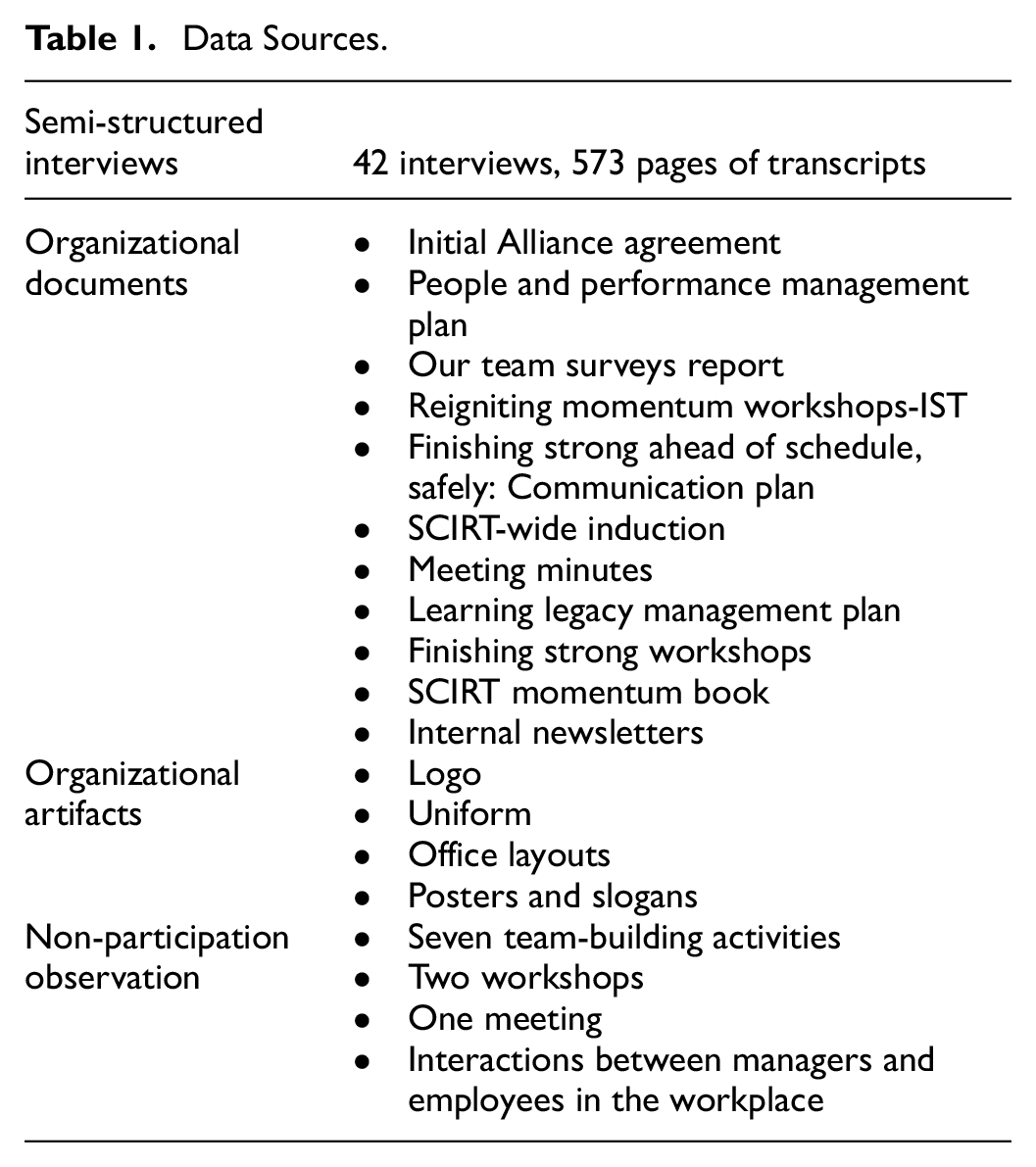
Organizational identity forms through sensegiving and sensemaking processes (Stigliani & Elsbach, 2018). Accordingly, participants were chosen from all of the managerial levels of SCIRT to navigate the interactions between managers’ sensegiving and members’ sensemaking activities of organizational identity work in SCIRT. Various sampling strategies were used to recruit participants, including convenience sampling, purposeful random sampling, and snowball sampling (Patton, 2002). Before their participation, all participants provided informed consent in written forms. Forty-two open-ended semi-structured interviews were conducted between September 2016 and March 2017, each lasting between 40 and 60 min. In some cases, the interviews went as long as 90 min. Each participant was assigned a codename from S1 to S42 respectively to protect their identity. During the interviews, participants were invited to provide their accounts of identity work in SCIRT over time and how they developed and maintained a sense of SCIRT identity in the wake of various challenging events and circumstances, especially when SCIRT was winding down. Interviews were recorded and fully transcribed. A total of 573 single-spaced pages of transcripts were produced. As the transcripts were read, memos were created to record the emerging codes and the relationships between them.
With the support of the gatekeeper, more than 10 organizational documents that were judged relevant to the study were shared with the author. Those documents spanned from the initial establishment of SCIRT in 2011 to its disestablishment in 2017, including management plans, team survey reports, meeting minutes, and induction materials. Internal newsletters published between 2012 and 2017 were also examined for evidence of identity work in SCIRT’s lifelong operation. Complementary to interviews, these documents enabled the author to comprehend the significant changing events SCIRT faced across its entire lifespan and how it officially responded to sustain its organizational identity through those disrupting circumstances.
The non-participation observation was conducted from October 2016 to March 2017. The observations focused on team-building activities, meetings, workshops, and artifacts to understand the interactions between managers and employees and how artifacts were deployed purposively to develop and construct a coherent organizational identity within SCIRT. Field notes were written while observing seven team-building activities, two inductive workshops, and one management meeting. Artifacts including the SCIRT logo, posters, slogans, work-related images adorning the walls, SCIRT clothing were photographed to record how artifacts were implicated in identity work. As a result, the author captured the material evidence of identity work in SCIRT, especially in its terminating stage.
Data Analysis
This study adopted a phronectic iterative approach to data analysis (Tracy, 2020). . Before the analysis, the interview transcripts and fieldnotes were cleaned to remove any identifying information that would potentially reveal participants’ identities. In particular, participants from the board and management team were combined as senior managers owing to the limited number of members in the two teams. The analysis incorporated three interrelated but distinctive levels, first-level descriptive coding, second-level of analytic coding, and third-level synthesizing activities (Tracy, 2020).
First, as data were collected, they were scrutinized for evidence of how SCIRT organizational identity was created, developed, and sustained over time, special attention was paid to how identity work was conducted when SCIRT ceased operation after accomplishing its recovery mission. Significant internal and/or external threats to SCIRT identity were reported by participants and clarified in the documents collected, so care was taken to identify the sensegiving actions of senior managers in response to these threats. Then, these data were compared with the data on how employees made sense of these responses. An iterative process of coding evidence of identity work in tandem with data collection led to a collection of codes referring to aspects of organizational identity work and the mechanisms, both observed and reported, that captured how participants accounted for these. As evidence confirming a series of identity work campaigns emerged, the analysis started focusing more closely on managers’ sensegiving activities and employees’ sensemaking of such sensegiving.
That SCIRT was created as a TO was repeated by interviewees and clearly emphasized in the official documents (SCIRT, 2011a, 2011b, 2015, 2016a, 2017). This inspired a temporal perspective to the analysis and organizing emerging findings. Particular attention was given to the interaction between identity work and the participants’ sense of it as SCIRT developed its preordained identity as a temporary organization. This approach further highlighted the significance and logic of managers’ concerted periods of identity work. Organizational documents and materials that expressed or embodied managers’ rationale or provided mechanisms for deliberate sensegiving were evaluated alongside data on how employees made sense of the campaigns within an uncertain post-disaster operating environment. The analysis became finer as it focused on the mechanisms senior managers strategically employed in identity work campaigns to influence employees’ sense of organizational identity. It was at this point that a learning legacy program was identified during document analysis (SCIRT, 2016c), which prompted the exploration of managers’ sensegiving and employees’ sensemaking around the final identity work campaign. At the final stage, the synthesizing activities were taken. To specify, the author systematically examined the emerging themes from the first two levels’ analysis and the author’s critical reflection to the data analysis captured in analytic memos, then explored the relationships between the themes in relation to the research question. Eventually, the analysis identified five notable identity work campaigns that supported the creation of a coherent SCIRT identity that was subsequently revamped, sustained, and finally transferred into a legacy organizational identity. The five campaigns were given names: (1) “aligning with SCIRT,” (2) “lifting SCIRT,” (3) “breakthrough thinking of SCIRT,” (4) “reigniting SCIRT,” and (5) “finishing strong.”
A summary of the key findings was shared with participants for member checking and feedback. One senior manager commented that SCIRT organizational identity did not come naturally because it did not have a past. It was very challenging to sustain its identity because SCIRT did not have a future neither, being created as a tempoaray organization. SCIRT organizational identity was intentionally produced, developed, and sustained through purposively designed activities and taking into consideration employees’ reactions through a laborious process. On that account, organizational identity work in SCIRT was never an easy process. It involved ongoing efforts of managers and employees, especially when its operation was threatened by internal and/or external challenges or changing events in its entire lifespan that went beyond the control of SCIRT. Inspired by the comment received, it was judged as appropriate and logical to present the key findings from a temporal perspective by identifying identity threats and illustrating the recursive interactions between managers’ sensegiving of identity work campaigns and employees’ sensemaking of the sensegiving. The following sections present the findings with a focus on those linked to “finishing strong” and the creation of a legacy organizational identity that became a key objective when SCIRT was terminated. These are organized into stages in the lifespan of SCIRT, each with an embedded identity work campaign.
Findings
Albert and Whetten (1985) argue that identity becomes more salient during significant organizational changes when an organization (1) is established; (2) loses its core leadership; (3) achieves its raison d’etre; (4) evolves rapidly; (5) changes its operating protocols; and (6) experiences retrenchment in the organizational size and numbers of employees. In its five-and-a-half-year lifespan, SCIRT was consistently confronted with challenges like these, including rapid growth during the establishment phase, budget cuts to the entire rebuild program, the loss of its founding leader, reduction in employee numbers, and its pre-planned disestablishment when its rebuilding mission was accomplished. These challenges constituted threats to the process of maintaining a coherent and distinctive organizational identity across its definite lifespan. As a consequence, senior managers intervened and embarked on a series of identity work campaigns. The findings strongly advised that these campaigns involved creating organizational materials and social activities that embodied a sense of common purpose, shared practices, and community. Visual mapping (Gehman et al., 2018; Langley, 1999) was employed to represent the key findings (in Figure 1), particularly the interdependence between challenging internal and/or external events and identity work campaigns. It captures how SCIRT identity work evolved over time, especially when SCIRT was winding down, and how a legacy identity was created in the wake of a diminishing organizational identity.
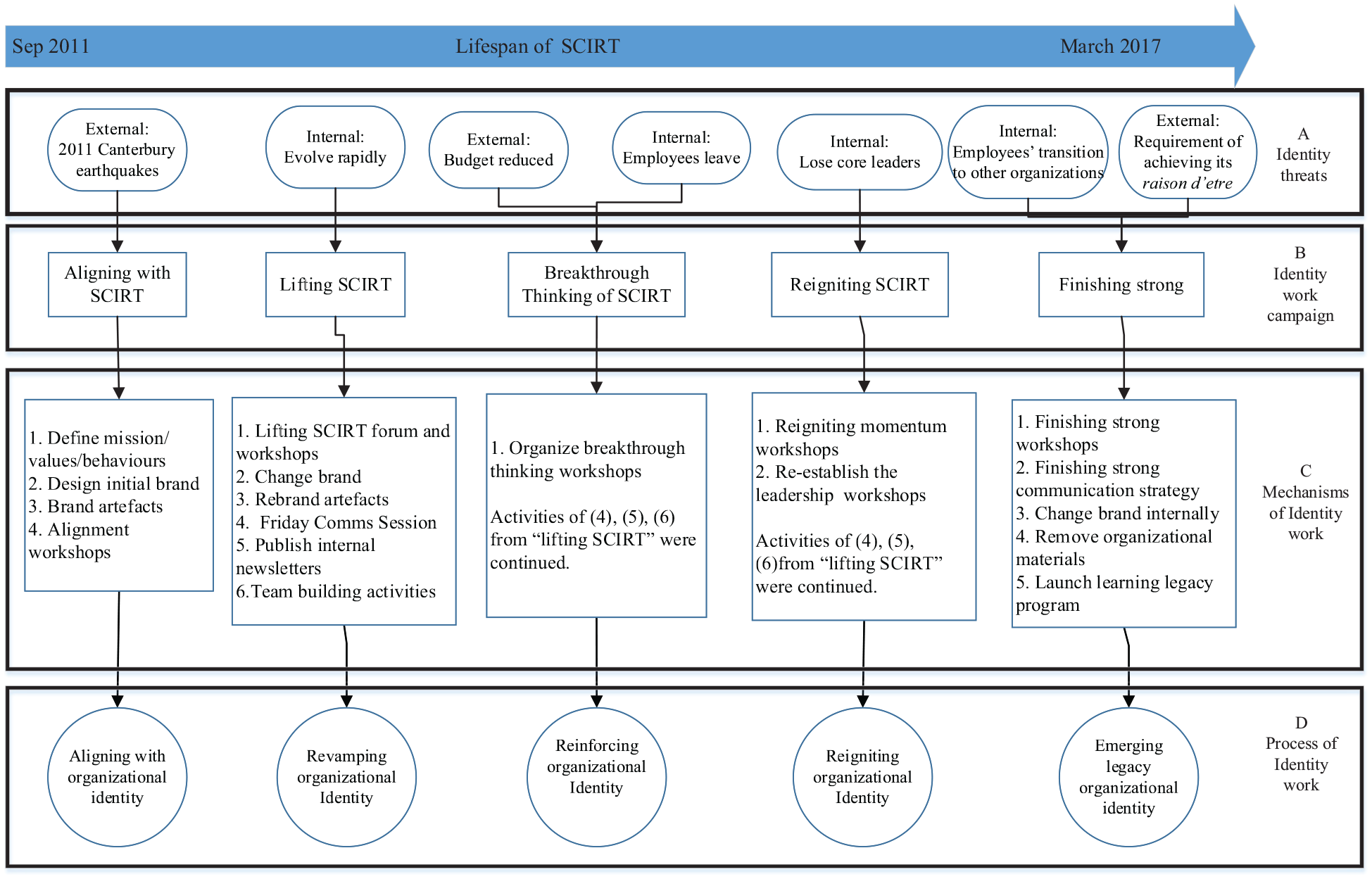
Visual map of findings.
The horizontal time scale represents the lifespan of SCIRT as a temporary organization. Box A contains oval shapes indicating those internal challenges and external threats across SCIRT’s development that triggered senior managers to take strategic actions to sustain a coherent organizational identity in SCIRT. Box B represents senior managers’ five identity work campaigns: “aligning with SCIRT,”“lifting SCIRT,”“breakthrough thinking of SCIRT,”“reigniting SCIRT,” and “finishing strong.” The large squares in Box C capture sensegiving mechanisms integral to the identity work in these campaigns. Vertically, identity-threatening factors corresponding to strategic identity work are presented with an emphasis on SCIRT’s terminal stage when a legacy organizational identity emerges. The circles in Box D show a trajectory of identity work in a temporary organization like SCIRT. The following section explains these significant findings in detail.
Aligning With SCIRT
SCIRT was established in a complex and uncertain post-disaster environment, bringing together both public agencies and business organizations who seconded their staff to work in SCIRT. No organizational identity existed in SCIRT when it was freshly formed in the aftermath of the 2011 Christchurch earquakes. Employees initially identified with their home organization and focused on their own interests. The diversity across contributing organizations and the heterogeneity of work disciplines made coordination difficult. SCIRT senior managers concluded that a collective mission and a coherent organizational identity were crucial to its operation and success. Such views are consistent with Whetten’s (2006) claim that an organizational identity must emerge to allow collaboration among performing parties. Evidenced from the analysis of one document (SCIRT, 2016a), SCIRT’s initial identity was produced by discussion, negotiation, and compromise during managerial workshops and team meetings. What emerged from those workshops incorporated SCIRT’s mission statement: “Creating resilient infrastructure that gives people security and confidence in the future of Christchurch” (SCIRT, 2016a, p. 2). This was confirmed and resonated by one senior manager: “It really defined who we are. We had to create unity out of many people and this was that beacon around which everybody could identify with.” (S41)
Employees were encouraged to take the view that they were required to work collaboratively to achieve SCIRT’s mission. However, employees did not actively align themselves with senior managers’ attempts to establish a coherent organizational identity. Initially, they continued to identify with their home organization. Senior managers responded to this state of affairs by organizing intensive workshops that focused on establishing operational guidelines to get employees’ behavior aligned with SCIRT’ emerging organizational identity. Supplementary to the findings from interviews, docment analysis and photographed artifacts strongly indicated that management plans (SCIRT, 2011b), a SCIRT logo, and other SCIRT branded artifacts (e.g., clothing and business cards) were developed by the management to promote employees’ sense of an emerging SCIRT identity.
Lifting SCIRT
“Lifting SCIRT,” which took place when SCIRT experienced rapid growth, became an example of identity change (Gioia et al., 2013; Gioia & Hamilton, 2016), where the meaning associated with an organization’s identity claims alters (Corley, 2004; Corley & Gioia, 2004). SCIRT quickly expanded into a wide collaboration involving a range of subcontractors and consulting companies. At this stage, there was no clear interpretation of what SCIRT was as a TO. Employees, especially those from consulting firms, found themselves in a state of “identity ambivalence” because they had no reason to change their alignment with their home organization’s identity, despite their role in SCIRT. In response, senior managers set out to reframe SCIRT organizational identity as: “One team made up of many smaller teams: clients, integrated services team, delivery teams, other contractors and suppliers—we are in this together. We are all SCIRT.” (SCIRT, 2016a). This statement was written into SCIRT official documents, illustrated in various team meetings, made into posters hanging on the walls, and explained in every SCIRT induction, including the one the author attended.
The senior management team deliberately arranged “lifting SCIRT” forums, workshops, and conversations with employees, renewed the SCIRT logo, and rebranded organizational materials including documents, uniforms, stationaries, and other artifacts. The main theme was “collectively, we are stronger,” which aimed to foster a shared understanding of the SCIRT identity and encourage inclusive language (e.g., using we instead they when referring to SCIRT) and behaviors that communicated a collective sense of SCIRT. During document anlaysis, it was found that an internal newsletter was created which promulgated the mindset and values at the heart of this desired SCIRT identity. Additionally, based on participants’ retrospective accounts of their experience with SCIRT identity work, mangers facilitated a variety of regular team-building activities to support a collaborative working environment. Team members were mobilized to participate in these activities and also take responsibility for organizing social events like hiking trips and sports championships. Senior management instituted an open communication session titled the “Friday Communications Session,” which became known as Friday Comms. All staff were encouraged to join this semi-formal management-led gathering held at 10.00 am every Friday to discuss the core values of SCIRT, share information, plan forthcoming events, and tell stories about how they were enacting the SCIRT identity. however, initially, employees did not respond positively to this top-down initiative. One employee commented: “I’m not sold on it. I think it’s happy-clappy [sic] and you would find it in a gospel church. Sometimes I sat and listened to the content of Friday Comms and I’d think it’s almost like being in high school or preschool. And I don’t know why, I think it almost feels forced.” (S30)
Attendance became compulsory in response to such sensemaking, but over time compulsion was no longer necessary as Friday Comms became a valued part of organizational life. As one senior manager recalled in one team meeting which the author joined: “I remember the classic picture of him [one senior manager] sitting at the front counter at the reception, making sure nobody was going out the door. That [Friday Comms] created the environment. Six months later, everybody loved that sharing. That [Friday Comms] became a part of who we were.” (SCIRT, 2016b)
These examined how employees made sense of managers’ sensegiving of SCIRT identity and how managers responded to employees’ sensemaking via revised sensegiving activities, which formulated the iterative interaction between sensemaking and sensegiving of organizational identity construction.
Breakthrough
While SCIRT was actively progressing its projects, its funding organizations reduced the program budget to NZD 2.2 billion from an original NZD 2.5 billion (SCIRT, 2017). This necessitated adjustments to project designs and estimates even though most of these had been completed. With SCIRT under pressure to achieve the same rebuild mission with less funding, a pessimistic atmosphere emerged as concerns were raised about whether the mission statement was still possible, which was recalled by many participants and identified as a threat to SCIRT operation. Some employees were unable to adjust to this atmosphere and left. After discussing the possibility of changing the SCIRT mission statement, the senior management team decided to retain the original identity claim and declared that the organization was still the same SCIRT in the wake of changing work philosophy. Senior managers then developed a series of “breaking through” workshops to reset employees’ mindsets toward the budget cut, which was evidenced by the result of document analysis (SCIRT, 2014a). The importance of these workshops was explained by one manager: “The change [of the budget] in 2013 was the reason for SCIRT to do breaking-through workshops at that time. We had those ones because we were [making] this whole change in philosophy and it did affect a lot of people who felt that we weren’t doing the right job. So we had the breakthrough workshops [to remind people of who they are and doing the right thing].” (S25)
Employees were encouraged to to converse with their managers in both SCIRT and their home organization and actively share their “breakthrough thinking” stories about how they adjusted to the emerging situation in Friday Comms. Many stories were published in the internal newsletter. A lot of social clubs like yoga and cycling were also promoted to embody the sense of being one team in SCIRT. Not only does what went on during this period of strategic identity work clearly illustrate the argument that organizational identity emerges from a “laborious process” (Melucci, 1995, p. 50) as sensemaking about organizational identity responds to changes in the context in which organizations operate, but it is consistent with Gioia et al.’s (2010) view that changes in organizations’ internal and external environments influence organizational identity formation.
Reigniting SCIRT
After the “breakthrough” campaign, SCIRT was well-positioned to achieve its recovery mission. However, more challenges to the stability of its organizational identity occurred when, unexpectedly, in late 2014, the key identity architects in the senior management team departed. The reorganized management approached the SCIRT identity differently, taking a task-oriented rather than people-focused approach. Additionally, newcomers to the management team had not experienced the challenges of founding, lifting, and promoting SCIRT and did not share the same mindset about sustaining a strong SCIRT identity. These internal circumstances triggered an identity crisis that required another identity work campaign as one manager noted: “We responded to the breakthrough challenge … and a few other leaderships changed as well, we were conscious to do something to reignite the energy, but also to give confidence to people that the change of leadership wasn’t going to be a negative change.” (S41)
This finding shows that when the internal environment changes and poses a threat to an organization’s operation, especially if the change involves the loss of core identity architects, members start to question claims about “who they are and what they want to do” (Gioia & Hamilton, 2016). For example, one worker commented: “He [previous leader] would always come out to see us, chat with us, talk to us every day. Whereas we don’t see him [new leader] at all, hardly. That’s been a big change. That’s totally different.” (S17)
The restructured management team recognized the challenge of the leadership change to organizational cohesion. It embarked on another identity work campaign to try to maintain the SCIRT identity. Various workshops (SCIRT, 2014c) promoting the theme of “agile and shared leadership for a strong second half” were undertaken. Eight half-day “reigniting momentum” workshops were held to reconnect employees to SCIRT’s mission statement. These allowed the new managers to introduce themselves, clarify their roles, restate SCIRT’s mission statement, mindset, and values, and realign behaviors with these. Individuals and teams were motivated to refocus their enthusiasm for SCIRT actively. The staff engagement survey (SCIRT, 2014b) that was administered following this campaign confirmed its success—employees had indeed been motivated by the “reignite SCIRT” workshops.
Finishing Strong
When SCIRT moved into its last months, employees’ attention gravitated toward identifying new professional opportunities or rekindling links within their home organizations. In particular, those employees who joined SCIRT on fixed-term employment contracts with their home organization became anxious about their post-SCIRT career development. SCIRT activities that had been integral to maintaining its culture and identity became subordinate to considerations about career development post-SCIRT. Engagement in workplace communication and social activities diminished, and employees started leaving for new jobs. These phenomena were observed in the author’s last 2 months of fieldwork. In particular, the field notes highlighted that SCIRT artifacts started being removed from the workplace, reflecting Walsh and Glynn’s (2008) finding that artifacts get discarded when an organization is declining. Senior managers acknowledged the threat of a diminishing SCIRT organizational identity to its final stage of operation. Responding to this challenge, a communication campaign was designed, aiming at “finishing strong, ahead of schedule, safely” (abbreviated to “finishing strong”) and upholding a the declining organizational identity until SCIRT ceased operation. The final identity work campaign was evidenced by the interviews, field observation, and document analysis (SCIRT, 2015).
Workshops were the intervention of choice, and “finishing strong” workshops (SCIRT, 2016d) were organized to engage remaining employees with what remained of the recovery mission. At the same time, the human resources (HR) team began actively assisting with employees’ career planning in post-SCIRT. However, the continuous loss of key employees inevitably diluted the impact of the “finishing strong” campaign, and some employees refused to engage. Below are typical examples of how these employees made sense of the final identity work campaign: “For me and my team, we probably don’t [get] very much motivated by that. It didn’t motivate us because I guess we were going out there doing our work. … It was a good idea to try to motivate people and finish strong. I don’t think the result happened. I don’t think we got anywhere with finishing strong.” (S40) “Personally, I’ve never quite taken to that concept of finishing strong. Finishing strong is kind of irrelevant for me. I never quite grappled with that one to understand it as such. It doesn’t have a real meaning to me. It was a bit of an abstract thing. Finishing strong! What does that mean? Does it mean that I run faster?” (S20)
Particularly when key HR staff who had been encouraging other employees to stay and finish strong started leaving, many employees reported feeling discouraged. One employee was very disappointed with the inconsistency: “Everyone is thinking about what they are going to do after SCIRT, including the people from HR… They were leaving. They have not stayed until the end.” (S29)
However, the identity work at SCIRT did not vanish along with its disestablishment. The document anlaysis indicated that a learning legacy program (SCIRT, 2016c) was at its most intense in the terminating stage of SCIRT and continued after it was disbanded. This program documented SCIRT’s achievements, strategies, and tactics used to collaborate more than 25 contributing organizations in an uncertain and dynamic post-disaster recovery environment for predefined outcomes in its five and half years’ operation. Employees were encouraged to contribute to this program by sharing their experiences and perspectives of working in SCIRT. Completing this program allowed SCIRT employees to contribute to how this TO would be evaluated and ensure that its lessons and knowledge are shared for the good of future disaster rebuild management and routine management. As one employee explained: “There are going to be opportunities when you can do something differently and I think that’s where that learning legacy is going to benefit so many businesses as a result because it’s not only going to cover what are the legacies, what are the things you have done well, but also how we can do something differently. If anybody else is ever in that position like we were in, then they can learn from that opportunity.” (S27)
Key SCIRT management plans and stories of contributing parties were documented on a website (htttp://scirtlearninglegacy.org.nz). Notably, a total of more than 3,000 employees went from SCIRT to other organizations where they will have opportunities to distribute and apply knowledge gained during their time in SCIRT. Many former employees maintain a considerable network post-SCIRT, socializing with each other, sharing new career opportunities, and reflecting on how they apply SCIRT experiences in new work situations. They are ensuring SCIRT’s identity is alive and negotiated—still in a state of becoming (Tsoukas & Chia, 2002). One participant highly appreciated this program: “It seems to me that everybody is in good spirits and that makes me think that it has been a really successful organization and the connections that you build with other design teams are quite cool. That can carry on through my work at [the new organization].” (S18)
The author attended these gatherings, listening to their nostalgic reflections about SCIRT and witnessing how they shared new experiences and job opportunities to support each other. As one senior manager said: “The shirt is still there in my closet…I always identify myself with the SCIRT program. And I will still contact some of the SCIRT people. As a leader, you always get to carry the responsibility for keeping the culture kind of things, keep the experience, the team member experience.” (S41)
To summarize, as SCIRT entered its final weeks, employees became more preoccupied with their career development than unraveling SCIRT. Worried that the shift in employees’ mindsets would undermine the final thrust to complete the schedule of work, the senior managers organized a series of “finishing strong” workshops, changed the logo internally, released “finishing strong” newsletters, and introduced the “learning legacy program”—a program designed to document SCIRT’s contribution to recovery work. After its disestablishment, former SCIRT employees have continued organizing informal gatherings where they discussed their post-SCIRT life and how to apply the SCIRT legacy to their new careers. The sense they expressed was that the learning legacy program and ongoing informal interaction after the death of SCIRT not only benefited their careers and social lives but also constituted a legacy organizational identity that defined “who we were as SCIRT” (S19). Socializing after SCIRT’s termination provided a transitional space for former members to transfer organizational identity into a personal sense of legacy identity that became a resource as they moved to their new organization.
Discussion
This study investigated how managers of a TO conducted deliberate sensegiving campaigns to develop and sustain a coherent organizational identity that overcame the operational threats to its limited lifespan. The finding that employees actively engaged in the legacy identity work as the organization disintegrated around them and that many, including managers, chose to continue engaging with their ex-colleagues after its disestablishment suggests a legacy organizational identity was developed and maintained. The following section discusses what was learned from managerial identity work campaigns and the emergency of a legacy identity.
Organizational Identity Work
It argues that maintaining organizational identity coherency in TO requires more than incremental identity work. Episodes of intensive identity work are considered critical to counter the effects of major destabilizing events (e.g., the departure of the founding CEO, facing the termination of its lifespan), primarily involving iterative interaction of managers’ sensegiving and employees’ sensemaking of such sensegiving (Gioia & Patvardhan, 2012; Kreiner et al., 2015). When threats to identity coherence were identified, senior managers responded with carefully designed sensegiving campaigns to foster a collective sense of organizational identity among employees. This finding is supported by previous research claiming organizational identity is the combination of sensegiving and sensemaking (Gioia et al., 2010; Gioia & Patvardhan, 2012; Kreiner et al., 2015; Stigliani & Elsbach, 2018). Recent pioneering studies show this process involves mechanisms such as historical resources (Basque & Langley, 2018; Ravasi et al., 2018; Suddaby et al., 2016), authoritative texts (Chreim et al., 2020), stigmatization (Tracey & Phillips, 2016), and discursive resources (e.g., Beech, 2008; McInnes & Corlett, 2012). By contrast, this case study suggests it was the sophisticated deployment of organizational artifacts and social interactions employed that mattered in the process of identity work in a TO. Managers sought to (re)shape the organizational identity using orchestrated socializing events (e.g., workshops, team-building activities, and regular meetings) and purposefully designed and utilized organizational artifacts (e.g., clothing, posters, photo boards, and reports) that worked in concert to constitute organizational identity in a TO.
Through deliberately structured workshops and meetings, members of a TO were encouraged to see themselves as a collective bound together by common goals that had to be completed within a definite period. Attending team-building events, members interacted with each other, developed comradeship, and shared risks and opportunities. These activities facilitated ongoing social interaction. Through these, organizational identity was developed and sustained over time, and they also provided the foundations for a legacy organizational identity, the sense of who they were that persisted once the TO ceased operation.
In addition to interactions, branded materials like the logo, wall posters, and uniforms were integral to the identity work. However, it was noticed that employees did not always respond positively to these initially. They negotiated compromises for when and how they used these materials. Interestingly, during the terminating stage, the meaning attached to these materials changed from representing a (once) vital and engaging organizational identity to a symbol of a dying organizational identity. When this became apparent, managers removed many artifacts. Posters were replaced by new ones associated with a new organization that would soon move into the office space. Employees started wearing uniforms displaying their home/new organization’s insignia. These “transitioning behaviors” eased the adjustments required as organizational identity lost its salience. These findings suggest that materiality provides a sensory anchor that, when aligned with the workspaces in an organization, sustains organizational identity.
Emergence of a Legacy Organizational Identity
The study revealed that senior managers considered a coherent organizational identity was not only desirable but also their responsibility during the limited operational life of SCIRT and after its disestablishment. While senior managers initiated the identity work campaigns, employees became most engaged in sustaining a legacy identity after SCIRT ceased operation. This supports the proposition that when an organization dies, its employees become aware of “what organizational elements are most important to them” (Walsh & Bartunek, 2012, p. 94). In SCIRT’s case, senior managers sought to ensure a legacy identity was documented, but employees’ post-SCIRT social activities kept the legacy identity alive. While managers initiated organizational identity work, employees actively contributed to the evolution of the SCIRT identity from “who we are” to “who we were,” that is, legacy organizational identity (Eury et al., 2018; Gerstrøm, 2015; Lawrence et al., 2011; Walsh & Glynn, 2008; Wood & Caldas, 2009).
Extending Walsh and Glynn’s (2008) discussion that a legacy identity carried forward can reveal what identity elements are valued as “central and distinctive” (p. 263), this study demonstrated how a legacy identity was developed and maintained among former members after an organization ceased operation. The organization dies, but its former members still engage in re-membering (Suddaby et al., 2016) who they were and the organization that made a legacy identity possible. This phenomenon was well captured by a legacy program as part of the final identity work campaign, which constituted a space for re-membering organizational identity in the past and the transition to a new organizational identity in the future. This post-operational stage of organizational identity work is rarely discussed in the existing literature. In this regard, the study suggests that “after-death” organizational identity work in TOs could be a valuable focus for further study.
Conclusion
This study examined organizational identity work in a unique but increasingly more necessary type of organization, temporary organization created to repair widespread infrastructure damaged by a natural disaster (Kalkman & de Waard, 2017; Moe & Pathranarakul, 2006). The findings demonstrate how identity work is a work of process that often requires senior managers’ interventions to maintain a coherent identity in the wake of major threats. By focusing on the process of continually “becoming itself,” the study provided a micro-level description of the sensegiving strategies embedded in managers’ identity work and insights into how their envisaged organizational identity (Van Knippenberg, 2016) and identity work campaigns influenced employees’ sensemaking of their organization’s identity over its entire lifespan, and the re-remembering (Suddaby et al., 2016) that continued into its post-operational legacy era. Moreover, the study suggested organizational identity was expressed through regular social interaction and the purposeful use of organizational artifacts, and that both evolved across the TO’s entire lifespan. The study provided the opportunity to observe how a legacy identity emerged in the dying stage of a TO through a learning legacy program that provided a transitional space for former employees to memorize “who they were” and carry this into their new organization.
It is believed that this study has provided rich insights to inspire further research on managers’ identity work campaigns and the factors that allow these to be successful and draw attention to the life of a terminated organization’s legacy identity. These insights extend Tsoukas and Chia’s (2002) characterization of organizations as continually being in a state of becoming. This study has well captured this point by illustrating how a TO requires identity work campaigns to create and maintain a sense of coherency (Fortin & Oliver, 2016; Kourti et al., 2018) across its entire lifespan and how its organizational identity evolves into a legacy organizational identity. Moreover, this study demonstrates that this evolution does not necessarily end when a TO ceases operating because the sense of “who we were,” a legacy identity (Walsh & Glynn, 2008), continues evolving too.
Managerial Implication
The findings that identity work campaigns primarily utilize organizational artifacts and socializing events can significantly inform and enhance management practices, especially when managers get involved in temporary organizations or organizing. The study can serve as a valuable framework for identity-building and help future temporary organizations quickly establish a sense of shared purposes and identity. Temporary projects or initiatives often unite diverse teams for a limited duration, managers can create a cohesive identity that helps team members feel connected to the project’s goals by leveraging organizational artifacts, such as project logos, symbols, or branded materials. Socializing events, like kick-off meetings or team-building activities, would further enhance this shared identity by fostering relationships and establishing trust within the team. For managers involved in temporary organizing, these tools help align team members, enhance collaboration, and maintain focus on shared objectives, ultimately contributing to the success of short-term endeavors.
Finding a legacy organizational identity after a temporary organization dissolves is significant for managerial practices, it invites senior managers to build what will be left behind upon the accomplishment of their temporary operation. When a temporary organization leaves behind a strong identity, it creates lasting cultural and symbolic imprints even after its formal end. This legacy, if constructed, can foster a sense of pride and belonging among former team members who would carry forward the learned values, processes, and collaborative spirit into their future careers, like what has been happening to former SCIRT employees in post-SCIRT era. It will also influence how future management handle similar situations and provide inspiration for best practices. Recognizing and utilizing this legacy can help managers to enhance continuity, providing a reference point for onboarding new teams or launching new initiatives.
Limitations
The limitations of this study centered on the “temporariness” of SCIRT. First, the study commenced as SCIRT entered its final stage of operation. Therefore, being in the field for its entire lifespan was not feasible. Real-time data were only collected during the “finishing strong” campaign. This limitation, however, was offset by the wealth of documents and participants’ retrospective accounts detailing SCIRT’s establishment and earlier identity work campaigns, which enabled the opportunity to identify and explain the other identity work campaigns. Further studies where an ethnographic study can be undertaken across the entire lifespan of a TO are needed to examine how employees modify, resist, and redirect managers’ identity work interventions.
Second, this study investigated identity work in one TO. A single case was chosen because it provided the opportunity to study identity work in a TO where it is assumed identity work would be needed to mobilize contributors around a common mission in a predefined timeframe. This means that, while it addresses a highly original case, its findings do not provide a basis for generalization. Although generalization was not the aim of the study, the author has provided “sufficient contextual information” and a “thick description of the phenomenon under investigation” (Shenton, 2004, pp. 69–70). Doing so allows the potential of the study’s findings to be applied in other similar cases involving temporary organizations and organizing, which improves the generalizability of the findings.
Directions for Future Research
The identity work campaigns distributed across the lifespan of a TO in response to the threats it encountered contribute new insights to the literature on organizational identity, particularly in relation to how identity work is orchestrated across the lifespan of a TO and after its disestablishment when a legacy organizational identity is constituted. For example, the loss of prominent leaders introduced uncertainty about the future management style and required the new managers to reflect on how they would approach their leadership. Then, an identity work campaign is used to regain stability and confidence in the organization, which is consistent with this approach. This coupling of leadership and identity work is consistent with Carroll and Levy’s (2010) view of leadership development as a form of organizational identity construction.
There is an opportunity for future research to explore this link between organizational identity work and leadership development. Certainly, Boehm et al. (2015) would agree that leaders have the potential to promote organizational identity, and Van Knippenberg (2016) proposes that leadership might shape an envisioned organizational identity through leaders’ sensegiving during organizational change. The findings of this study demonstrated how this could happen in practice, with each campaign involving recursive circles of top-down sensegiving mechanisms by managers and bottom-up sensemaking by employees. It is recommended that further research explores how an organization’s legacy identity changes when there are no more top-down identity work campaigns.
Footnotes
Acknowledgements
The study was conducted when I was pursuing a doctoral study at the University of Canterbury in New Zealand under the supervision of the late Professor Colleen E. Mills. Her support to my PhD journey is greatly acknowledged and appreciated. This paper was written during my employment at Nelson Marlborough Institute of Technology in New Zealand. An early version of this paper was presented at the 72nd Annual International Communication Association Conference in 2022.

Ethical Considerations
This study was approved by the Human Ethics Committee of the University of Canterbury (Ethical Clearance Reference Number: HEC 2016/33/LR-PS) on June 13th, 2016. All participants provided written informed consent prior to participating.
Funding
The author(s) disclosed receipt of the following financial support for the research, authorship, and/or publication of this article: Nelson Marlborough Institute of Technology pays for APC of this article.
Conflicting Interests
The author declared no potential conflicts of interest with respect to the research, authorship, and/or publication of this article.
Data Availability
Data sharing not applicable to this article as no datasets were generated or analyzed during the current study.