




Abstract
The aim was to investigate the links between work-related identification, conceptualized, and operationalized as the work-related self (WS), and the “good soldier syndrome” (organizational citizenship behavior [OCB]). More precisely, we investigated the relationships between emotional and cognitive components of WS and OCB dimensions of altruism, conscientiousness, courtesy, civic virtue, and sportsmanship. A total of 147 subjects working within the Swedish public sector participated in this study. As hypothesized, WS significantly predicted OCB. A positive association was found between the emotional component of WS and OCB dimensions of altruism, conscientiousness, and civic virtue. This suggests that the “good soldier syndrome” might be, to some extent, accounted for by the psychological mechanisms of work bonding, especially, highlighting the importance of the emotional component of work-related identification.
Keywords
Introduction
Our aim was to (a) theoretically suggest an individual personal (autobiographical) memory framework for the work-related identification (operationalized as work-related self [WS]) and (b) empirically test the association between WS and organizational citizenship behavior (OCB). This was done because “OCBs are of considerable value to organizations as well as to individuals themselves” (Chiaburu & Byrne, 2009, p. 201), indicating a link between these two important work-related phenomena; an issue that has poorly been addressed by previous research.
Organizational Citizenship Behavior
A voluntary, extra-role behavior that is not recognized by formal procedures and rules but that contributes to social and effective organizational functioning is the “good soldier syndrome” (Borman & Motowidlo, 1993; Organ, 1988, 1997; Organ & Ryan, 1995); the organizational citizenship behavior (OCB). Several taxonomies of OCB and OCB-like behaviors have, since Organ (1977) and his colleagues (Bateman & Organ, 1983; Smith, Organ, & Near, 1983), been identified and discussed (P. M. Podsakoff, MacKenzie, Paine, & Bachrach, 2000). Most of the scholars, however, define the phenomenon of OCB as a latent variable comprising five dimensions of altruism (“Is always ready to lend a helping hand to those around him or her”), conscientiousness (“Believes in giving an honest day’s work for an honest day’s pay”), sportsmanship (“Always finds right with what the organization is doing”), courtesy (“Is mindful of how his or her behavior affects other people’s jobs”), and civic virtue (“Attends functions that are not compulsory, but help the company image”).
It has been shown that these dimensions relate reliably to each other, that they are the same across cross-cultural samples (Lam, Hui, & Law, 1999) and that they relate similarly to the most common predictors of job satisfaction, organizational commitment, fairness, trait conscientiousness, and leader support (Dimitriades, 2007; LePine, Erez, & Johnson, 2002). Furthermore, relatively robust relationships between the perceptions of justice at work and OCB have been indicated, mostly explained by the social exchange theories (see Greenberg & Colquitt, 2005, for a review). In the Greenberg (1993) words, “people will be behave altruistically toward the organization in which they work if they believe they have been fairly treated by that organization” (p. 250). OCB has also been shown to negatively relate with psychological contract breach (Zhao, Wayne, Glibkowski, & Bravo, 2007) and positively with social exchange (Kuvaas & Dysvik, 2009). It has been reported that this “good soldier syndrome” might as well relate with both individual and organizational outcomes (see N. P. Podsakoff, Whiting, Podsakoff, & Blume, 2009, for a meta-analysis) such as managerial ratings of employee performance, reward allocation decisions, variety of withdrawal-related criteria (individual level), as well as productivity, efficiency, reduced costs, customer satisfaction, and unit-level turnover (organizational level).
Moreover, employee’s positive bond with the organization has been indicated to lead to OCB (Rousseau, 1998). In the words of Norman, Avey, Nimnicht, and Graber Pigeon (2010), “those who. . . identified highly with their organization reported engaging in the highest frequency of organizational citizenship behavior–organizations (OCBO) as compared with those who did not identify with their organizations” (p. 387). However, the relationship between work-related identification and OCB has been sparsely explored by the previous research. The phenomenon of work bonding is related to self-concept and self-enhancement (Pratt, 1998) and is positively associated with work-related behaviors, attitudes, and satisfaction (Ashforth & Mael, 1989; Haslam, 2001; Hogg & Terry, 2000). For that reason, it should also be linked to OCB because “citizenship” per se is a type of identification; an antecedent to the work-related voluntary, extra-role behavior. Finkelstein and Penner (2004) and van Dick, Grojean, Christ, and Wieseke (2006) indeed tried to relate these two work-related constructs but only within a social (identity theory) perspective (Norman et al., 2010); thus, not including an individual, personal memory account of the self and identity (Conway, Singer, & Tagini, 2004; Klein, German, Cosmides, & Gabriel, 2004) and its relation to occupational work (Knez, 2016; Nordhall, Knez, and Saboonchi, 2018).
Work-Related Identification
Identity involves two categories of personal and social identity. We define, perceive, and interpret ourselves as individuals and as members of different groups. This suggests that we, compare with animals, differentiate ourselves from others (Markowitsch & Staniloiu, 2011), to preserve our uniqueness (memories and thoughts in my head are mine), our individuality, and its memories (Brewer, 1991). We are also social beings, striving for diverse social contexts (we psychologists, Swedes, musicians) that include different collective selves with accompanying stories and memories (Brewer & Gardner, 1996).
Organized labor is fundamental for who we think we are and our definitions of the meaning of life (Grant, 2008; Hackman & Oldham, 1976; Heine, Proulx, & Vohs, 2006; Rosso, Dekas, & Wrzesniewski, 2010; Schwartz, 1999; Wrzesniewski, Dutton, & Debebe, 2003), as well as our health (Ashforth & Mael, 1989; Fine, 1996; Gini, 1998; Paul & Moser, 2009). For that reason, we strive for different types of work-related relationships and groupings (Ashforth & Mael, 1989; Becker, Billings, Eveleth, & Gilbert, 1996; Reichers, 1985). These types of identifications are labeled as professional, workgroup, and organizational identity (Cappelli, 2000; Causer & Jones, 1996; Day, Kington, Stobart, & Sammons, 2006; Johnson et al., 2006; Pate, Beaumont, & Pryce, 2009). When they are positive (Bartel & Dutton, 2001; Gecas, 1982; Turner, 1982), these work alliances may, for example, improve our well-being (Caza & Wilson, 2009), career (Ibarra, 1999), and creativity (Cheng, Sanchez-Burks, & Lee, 2008). In other words, “The more involved one is with the job, the more difficult it is to dissociate oneself . . . from that job” (Rosso et al., 2010, p. 97).
Work-related self
Previous research has shown that self-construction involves cognitive processes of coherence, correspondence, reflection, agency, and mental temporality (Conway, 2005; James, 1890/1950; Klein et al., 2004; Knez, 2017; Knez, Ljunglöf, Arshamian, & Willander, 2017), and an emotional process of attachment/belonging/closeness (Knez, 2014; Knez, Butler, et al., 2018; Knez & Eliasson, 2017, Knez, Ode Sang, Gunnarsson, & Hedblom, 2018) that interplay with different contexts, such as physical places (Knez, 2014) and occupational work (H. L. Williams, Conway, & Cohen, 2008; Knez, 2016; Knez & Nordhall, 2017; Nordhall & Knez, 2018; Nordhall et al., 2018). In agreement with previous findings showing that cognition (Conway, 2005; Klein et al., 2004) and emotion play a crucial role in identity (Burke & Stets, 2009; King, Hicks, Krull, & Del Gaiso, 2006) and work-related identification (Edwards, 2005), Knez (2016) included both employees’ thoughts and feelings (Rosenberg, 1979) in a model of work-related self (WS); a personal work-related identification.
This model (see Figure 1) includes two basic psychological elements grounding the psychological person–work bonding; also, corresponding to one of the first vocational psychologist’s, Hugo Münsterberg’s, model of vocation (probably and partly inspired by William James) comprising the components of feeling and thinking (e.g., Porfeli, 2009): (a) Emotion component including the process of work-related attachment/closeness/belonging and (b) Cognition component involving the processes of work-related coherence, correspondence, reflection, agency, and mental temporality. Time is additionally included in this model due to its relation to occupational work (Goodman, Lawrence, Ancona, & Tushman, 2001; Rosso et al., 2010) and identity, which “. . . depends, in a fundamental way, on our capacity to represent the self as a psychological coherent entity persisting through time” (Klein, Loftus, & Kihlstrom, 2002, p. 353). Correspondingly, Kant (1787/1929) and Klein (2014) defined time as one of the necessities for human experience and knowledge acquisition, and the feeling of being the “same” across time.

Work-related self, involving a causal link from occupational work across time to work-related emotion (attachment/belonging/closeness) and cognition (coherence, correspondence, reflection, agency, and mental temporality) components.
This theoretical account captures the basic psychological links between the self and its occupational work; “an individual work identity” (Walsh & Gordon, 2008). WS’s main function is to organize and emit personal experiences based on the context of occupational work across time. In other words, WS guides personal reminiscence and self-knowing consciousness related to the self’s topic of occupational work (Conway, 2005; H. L. Williams et al., 2008). This autobiographical, cognitive, and emotional knowledge base is distributed across declarative memory as impersonal (occupational work as a concept) and personal (my occupational work) information (Bluck, Alea, Habermas, & Rubin, 2005; Klein et al., 2004). The two psychological components, of emotion and cognition, that form WS incorporate the self-formation processes of attachment/closeness/belonging, coherence, correspondence, reflection, agency, and mental temporality (Conway, 2005; Conway et al., 2004; James, 1890/1950; Klein et al., 2004; Knez, 2014), accounting for the context-specific self of WS (Knez, 2016; McConnell, 2011).
Present Study and Hypotheses
Given the literature review above and the theoretical account of the work-related self, the general objective of this study was to empirically test the association between WS and OCB; more precisely, to investigate relationships between emotional and cognitive components of WS and OCB dimensions of altruism, conscientiousness, courtesy, civic virtue, and sportsmanship.
We hypothesized a positive association between WS and OCB. In line with Knez (2014, 2016), Nordhall and Knez (2017), Nordhall et al. (2018), and that some of the work-related behaviors are more related to affect than cognition (Weiss & Cropanzano, 1996), we predicted that Emotion (component of WS)-OCB compared with Cognition (component of WS)-OCB association would be stronger because previous research has indicated that emotion may enhance memory processes of retention and recall (Canli, Zhao Brewer, Gabrielli, & Cahill, 2000; Phelps, 2006), associate with OCB (Lee & Allen, 2002; Spector & Fox, 2002), and precede cognition in work-related identification (Knez, 2016; Nordhall & Knez, 2018). Generally speaking, all this is also in line with M. D. Johnson, Morgeson, and Hekman (2012) conclusion that very little research has examined cognitive and emotional constructs of work-related identity.
Corresponding tentatively to the controversy of the OCB phenomenon (see, for example, LePine et al., 2002; Meyer, Stanley, Hersovitch, & Topolnytsky, 2002, for detail discussions) matching a latent (the five dimensions reflect the OCB; hence, dimensions are conceptually related) or an aggregate (each one of the five dimensions reflects a separate part of the OCB; hence, dimensions are conceptually unrelated) construct model, we performed regression analyses including (a) WS as predictor and OCB as criterion variable at index level (dimensions are related, meaning that they can be represented by an index) and (b) WS (predictor) and OCB (criterion) at variable level (two and five dimensions respectively representing WS and OCB).
More precisely, we investigated following three types of relationships between WS and OCB: (a) a general association between WS (predictor, index score) and OCB (criterion variable, index score); (b) associations between emotion and cognition components of WS (predictors) and OCB (criterion variable, index score); and (c) associations between emotion and cognition components of WS (predictors) and each of the five OCB dimensions of altruism, conscientiousness, sportsmanship, courtesy, and civic virtue (criterion variables), respectively.
Method
Participants
A total of 147 subjects working within the Swedish public sector participated in the study. They worked with municipal administration, classified as civil servants. Respondents were recruited randomly from two municipalities. Their mean age was 49 years, 79% were women and 21% men. Of the respondents, 56% had worked less than 10 years and 44% more than 10 years within the public sector.
Measures
OCB measure
We used the P. M. Podsakoff, MacKenzie, Moorman, and Fetter (1990) version of this measure, also applied in several other studies (e.g., Bell & Menguc, 2002; Lam et al., 1999). It includes 24 statements measuring the five dimensions of OCB: altruism, conscientiousness, courtesy, sportsmanship, and civic virtue; with a Cronbach’s alpha of .76. Participants were asked to respond to statements on a 7-point Likert-type-scale ranging from 1 (completely disagree) to 7 (completely agree). According to, for example, L. J. Williams and Anderson (1991), dimensions of altruism and courtesy might be more directed to individuals (organizational citizenship behavior–individuals [OCBI]), and dimensions of conscientiousness, sportsmanship, and civic virtue might be more directed toward organizations (OCBO; Coleman & Borman, 2000; Hoffman, Blair, Meriac, & Woehr, 2007; L. J. Williams and Anderson, 1991).
WS measure
This measure was suggested by Knez (2016), based on Knez (2014). It includes 10 statements measuring the six work-related self-processes of the following: attachment/closeness/belonging (five statements: “I know my work very well”; “I miss it when I’m not there”; “I have strong ties to my work”; “I am proud of my work”; “It is a part of me”), coherence (“I have had a personal contact with my work over a long period”), correspondence (“There is a link between my work and my current life”), temporality/mental time (“I can travel back and forth in time mentally to my work when I think about it”), reflection (“I can reflect on the memories of my work”), and agency (“Thoughts about my work are part of me”), with a Cronbach’s alpha value of .86. Participants were asked to respond to statements on a 7-point Likert-type-scale ranging from 1 (completely disagree) to 7 (completely agree). Nordhall and Knez (2018) have also recently reported construct validity statistics for this measure, indicating an acceptable data fit of root mean square error approximation (RMSEA) = .08 (Byrne, 2016).
Results
In line with the three hypotheses/regression analyses (see “Present Study and Hypotheses” section), first, we report statistics for the general link between WS (predictor, index score) and OCB (criterion variable, index score); second, we report the links between emotion and cognition components of WS (predictors) and OCB (criterion variable, index score); and, third, the links between emotion and cognition components of WS (predictors) and each of the five OCB dimensions of altruism, conscientiousness, sportsmanship, courtesy, and civic virtue (criterion variables).
General Link Between WS and OCB
As can be seen in Table 1 and Figure 2, WS was shown to predict OCB, accounting for 24% of variance explained.
Relation Between WS (index) and OCB (index).
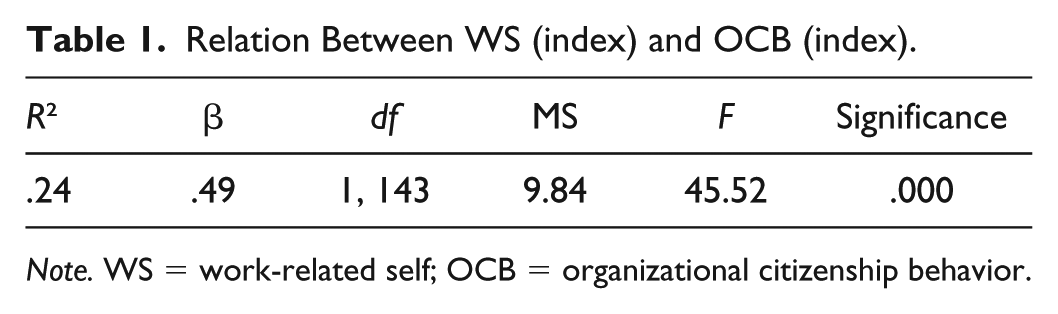
Note. WS = work-related self; OCB = organizational citizenship behavior.

Mean regression line between WS (index) and OCB (index).
Links Between Components of WS and OCB
The emotion component of WS was shown to significantly predict OCB, accounting for 29% of variance explained (see Table 2 and Figure 3), whereas no significant link between cognitive component of WS and OCB was reported (p = .64).
Relation Between WS (Emotion) and OCB (Index).

Note. WS = work-related self; OCB = organizational citizenship behavior.

Mean regression line between WS (emotion component) and OCB (index).
Links Between Components of WS and OCB Dimensions
At this detailed level of analysis (see Table 3 and Figure 4), the emotion component of WS was shown to be positively associated with OCB dimensions of altruism (R2 = .12), conscientiousness (R2 = .17), and strongest with civic virtue (R2 = .31). However, no significant relation was found for courtesy (p = .07) and sportsmanship (p = .15).
Relations Between WS (Emotion) and OCB (Altruism, Conscientiousness, Civic Virtue).

Note. WS = work-related self; OCB = organizational citizenship behavior.

Mean regression line between WS (emotion component) and OCB (altruism, conscientiousness, and civic virtue, respectively).
Discussion
Given that work identification is positively associated with different work-related behaviors and satisfaction (Ashforth & Mael, 1989; Haslam, 2001; Hogg & Terry, 2000), we hypothesized that this would also be the case for OCB because OCB as a phenomenon is a type of identification denoting a work-related “citizenship.” Since previous research on the link between work identification and OCB has mainly been addressed by social identity theory scholars (e.g., van Dick et al., 2006; Finkelstein & Penner, 2004), we proposed a personal memory framework (Conway et al., 2004; Knez, 2014; Klein et al., 2004) for the relationship between the person (the self) and her or his work, accounting for the links between personal work-related identification, conceptualized and operationalized as WS (Knez, 2016) and OCB.
We, furthermore, predicted that the Emotion (component of WS)-OCB compared with the Cognition (component of WS)-OCB relationship would be stronger because emotion may boost memory processes (Canli et al., 2000; Phelps, 2006), precede cognition in a context-specific self (Knez, 2014, 2016), and associate with OCBI (Lee & Allen, 2002). In line with our hypotheses, WS did indeed predict OCB, accounting for 24% of variance explained. Emotion compared with the cognition component of WS was also shown to link significantly with OCB, accounting for 29% of variance.
All this suggests that the “good soldier syndrome” might be, to some extent, accounted for by the autobiographical mechanisms of work bonding (Knez, 2016). Further that this relationship in particular yields the emotion component of WS, implying employee attachment and closeness to the occupational work (R. E. Johnson & Jackson, 2009; Meyer & Allen, 1991), as well as that emotion compared with cognition might more strongly associated with OCB at an individual level (Lee & Allen, 2002). In line with the research on the link between positive emotion and helping behavior (e.g., Salovery, Mayer, & Rosenhamn, 1991), Spector and Fox (2002) also suggested that positive emotion would “increase the likelihood of OCB.”
The emotional component of WS was furthermore shown to positively associate with OCB dimensions of altruism which is more directed to individuals (OCBI; e.g., L. J. Williams & Anderson, 1991) and conscientiousness and civic virtue which are more directed toward organization (OCBO; e.g., Coleman & Borman, 2000; Hoffman et al., 2007; L. J. Williams & Anderson, 1991). This may contradict some of the previous empirical work on the links between work-related emotion and cognition and OCB. For example, Lee and Allen (2002) showed that work-related emotion contributes more to predict OCBI, whereas work-related cognition contributes more to predict OCBO.
However, compared with the present study which operationalized and used measures related to a personal memory account of work-related identification (Knez, 2016), Lee and Allen (2002) operationalized and measured emotion as “job affect” (Positive and Negative Affect Schedule [PANAS] measure; Watson & Clark, 1988) and cognition as “a comprehensive set of job characteristics” (job cognition scale; Brief & Roberson, 1989) related to types of job justice (Niehoff & Moorman, 1993). Accordingly, the present study and Lee and Allen (2002) have measured fairly dissimilar aspects of work-related emotions and cognitions and therefore are not comparable.
Given that some work-related behaviors are more related to emotion than others (Spector & Fox, 2002; Weiss & Cropanzano, 1996) and that the individual work identity of WS guides personal reminiscence and self-knowing consciousness of occupational work (Knez, 2016), we might consequently conclude that increasing attachment/closeness/belonging (emotion component of WS) to their work, the employees might increase their OCB, especially, altruistic (OCBI), conscientiousness and civic virtue (OCBO) behaviors.
Finally, two principal limitations of the present study are reasonable to recognize. First, the results are based on cross-sectional data; thus, lacking random assignment. Comparing with an experimental design, this means that absolute conclusions about the causations are not appropriate. According to Campbell and Stanley (1963, p. 34; see also Shadish, Cook, & Campbell, 2002, for this discussion), however, there are “many natural social settings in which the researcher can introduce something like experimental design . . . even though researcher lacks the full control over the scheduling of experimental stimuli.” Second, we did not include any demographic and/or socioeconomic variables in our analyses because the objective was to investigate general relationships between WS and OCB (see, for example, Knez, Ode Sang, et al., 2018, for the discussion about “general relationships”).
Conclusion
All this suggests, in effect, that when increasing their emotional component of WS, the employees might increase the “good soldier syndrome,” that is, behaviors such as helping or assisting other employees (altruism), going beyond the employer’s requirements (conscientiousness), and speaking positively about, and supporting, their organization (civic virtue). As a final point, speaking of OCB as a latent or an aggregate construct model, our results are tentatively in accordance with the conclusions of LePine, Erez, and Johnson (2002): “although we found some evidence to support the latent definition of OCB, there are reasons to consider the aggregate model as a viable alternative” (p. 62).
Footnotes
Declaration of Conflicting Interests
The author(s) declared no potential conflicts of interest with respect to the research, authorship, and/or publication of this article.
Funding
The author(s) received no financial support for the research, authorship, and/or publication of this article.
