




Abstract
Although the negative effects of employee overtime have received academic attention, the relationship between overtime work and social workers’ turnover intention and its underlying mechanisms have been less studied. Hence, this study examined the mediating effect of organizational identity in the relationship between overtime work and turnover intention, and the moderating effect of income in the relationship between overtime work or organizational identity and turnover intention. Using the Process method, this study examined a sample of 5,427 participants in the CSWLS, and the results showed that overtime work positively influenced social workers’ turnover intention. The moderated mediation analysis found that organizational identity mediating the relationship, and individual income negatively moderated the relationship between overtime work or organizational identity and turnover intention. These findings suggest that social work agencies need to reduce the number of overtime shifts, create a positive organizational climate and increase income to reduce social workers’ turnover intention.
Keywords
Introduction
Overtime work has many negative effects on the physical and mental health of workers and the development of industries, yet it is still widespread in labor markets around the world. According to surveys, 15% of workers in EU member countries work more than 48 hr per week, with 56% of workers in Turkey needing to work overtime every week (Y. Chen et al., 2020). In the US, more than 25% of workers report working more than 40 hr per week (Jacobs & Gerson, 2004). Compared to most countries, Chinese employees work longer hours of overtime, which is indeed more severe than in the countries mentioned above, and overtime work has developed into a cultural phenomenon in China (Y. Chen et al., 2020). Although the Chinese legislature published the labor Law in 2008, there are still loopholes in the enforcement of the law, and overtime work is still common. The widespread adoption and promotion of the “996” working system (i.e., working from 9 a.m. to 9 p.m., 6 days a week) in China reflect the prevalence of an overtime culture, which is directly related to the competitive environment and traditional culture in China (Liu & Chen, 2023). During the COVID-19 pandemic, practitioners generally faced more severe overtime work and emotional exhaustion (Owens et al., 2023). In China, overtime has become the norm as public service workers are faced with heavy workloads due to the strong mobilizing power of the state and society (L. Wang & Liu, 2022).
Past studies on the phenomena of overtime work have concentrated on two primary areas. The first is the impact of overtime work on workers’ emotions and health. Some studies have shown that working overtime raises worker stress, causes psychological distress and sleep disorders, as well as impairs cognitive function (Härmä, 2006; Min et al., 2021; Yu & Leka, 2022). Second, research has studied strategies to lessen the detrimental impacts of overtime work. Some research has demonstrated that overtime work does not lead to emotional exhaustion in workers when it is seen as pleasurable and beneficial (Oerlemans et al., 2014). Among these, improving income and increasing autonomy are considered to be the most effective approaches to lessen the adverse consequences of overtime work. Gains in revenue greatly alleviate fatigue induced by overtime work, and the challenging tasks tackled during overtime work also reduce the negative effects of overtime to some extent (Beckers et al., 2008). Additionally, workers’ autonomy over their leisure time can potentially lessen the detrimental impacts of overtime (Yan & Qi, 2022). The preceding research shows the reality that overtime work has a multifaceted influence on workers.
Although there has been a long-time discussion on overtime work among social workers in China, there is still a lack of quantitative research on the mechanisms influencing overtime work and turnover intention (Jiang et al., 2023). This is not conducive to reducing social workers’ burnout and enhancing the professionalism of social work. Social work is one of those emotional labors that may require more emotional effort than other professions and is more prone to job burnout (H. Li et al., 2023; Moesby-Jensen & Nielsen, 2014). Existing research also suggests that social workers face emotional challenges in their work and are prone to vicarious trauma and low job satisfaction outcomes (Roh et al., 2016; Zielińska & Kanasz, 2017). In other words, overtime work may have more serious negative impacts on social workers and should be evaluated as a different group from other workers. Previous research has also focused more on the job burnout of overtime work and less on the influence of overtime work on turnover intention, which may tend to overlook the impact of overtime work on professional behavior (Jiang et al., 2023).
Thus, this study investigated the relationship between social workers’ overtime work and turnover intention, as well as examined the influencing mechanisms. This study aimed to expand on the research regarding the link between overtime and turnover intention by analyzing the relationship using social workers as a research subject. Additionally, this study investigated the mechanism behind the overtime phenomenon on turnover intention and found that organizational identity mediates this association, while individual income moderates it. This study, on the one hand, can make up for the lack of attention paid to social workers’ overtime work and turnover intention, and on the other hand, it may offer valuable suggestions for reducing the workload of social workers and their turnover intention, which can help to promote the building of the social worker workforce.
Literature Review
Overtime Work and Turnover Intention
The core idea of the effort recovery model (ER model) is that expenditure of effort at work is inevitably associated with an acute load response (e.g., increased heart rate, increased blood pressure, fatigue) and that the key to recovery is disengagement from work (both physical and psychological dimensions) and withdrawal from any exposure to demand (Meijman & Mulder, 1998). Some research pointed to incomplete recovery situations being divided into time-based incomplete recovery and strain-based incomplete recovery (Yu & Leka, 2022). Time-based incomplete recovery mainly refers to the lack of time for the worker to recover energetically, while strain-based incomplete recovery refers to the lower quality of recovery due to other factors. The model identifies long working hours as the main cause of the negative effect (Yan & Qi, 2022). Overtime work is a behavior triggered by internal or external factors that cause employees to work longer than the statutory working hours (Jiang et al., 2023). According to the effort recovery model, working overtime necessarily increases the physical or psychological pressure on workers, leading to a condition of job burnout, which is detrimental to the long-term development of employees (Nijp et al., 2012). The model also shows that a break from the overtime environment, that is, reduced working overtime or time off, can help workers recover from the detrimental impacts of overtime work (Geurts & Sonnentag, 2006). This is reinforced by actual data that demonstrates that working long hours can be physically and emotionally harmful to workers (Barck-Holst et al., 2017; Schleupner & Kühnel, 2021). Several studies have shown a positive association between overtime work and psychological stress levels (Bakker & Demerouti, 2017; K. Chen et al., 2021). More importantly, the adverse impacts of working overtime do not only have a negative influence on employees themselves but also on their families and social inclusion. Research has indicated that overtime can blur work-family boundaries, which would have a negative impact on child-rearing and the sustainability of marital relationships (Kalliath et al., 2020; Lambert et al., 2006). Chen et al. have also proposed that overtime has a negative effect on workers’ social inclusion (Y. Chen et al., 2020).
Some studies have concentrated more on the relationship between overtime work and workers’ physical and mental health, and less on their professional development. In addition to the physical and mental impact of overtime work on workers, the effort recovery model also implies that it impacts workers’ evaluations of their jobs. Turnover intention is a significant determinant of career progression (Obeng et al., 2021; Ucar et al., 2021). High turnover intention reflects workers’ discontent with their current employment, which in turn affects job performance (Mo et al., 2022). Research has indicated that long working hours can contribute to an increase in workers’ turnover intention (Taylor, 2018). Numerous studies have found that excessive social work turnover rates affect individual career development, organizational costs, and the effectiveness of service delivery (Cho & Song, 2017; Zheng et al., 2021).
However, previous studies have focused more on the negative impacts of overtime in other professions, and the existing studies could not respond to the impacts and mechanisms of impacts of overtime work in social workers. From the effort recovery model, overtime work may have a more serious negative influence on Chinese social workers. On the one hand, workers in Asia, especially in China, confront more potential for overtime work compared to those in Europe and the US (Tsai et al., 2016). This is mostly relevant to the Chinese environment and Chinese culture. With the world’s greatest population and relatively tight resources per capita, workers need to continually compete in order not to be eliminated from the job or society, and working overtime has become a tool of competition for workers. At the same time, the Chinese culture is marked by the quality of “hard effort and endurance,” which directly or indirectly pushes workers to internalize overtime work as a behavioral representation of “hard work,” therefore driving them to pursue longer working hours.
On the other hand, social work is an emotional labor, which demands a lot of emotional effort (Moesby-Jensen & Nielsen, 2014). A study found three categories of emotional labor in social workers, shutting down their own emotions, postponing their own emotions, and emotional deviation (Moesby-Jensen & Nielsen, 2014). The repetitive, tedious and long-term features of social workers’ practice in China have led to an increase in the degree of emotional labor and a deepening of burnout (e.g., emotional exhaustion, depersonalization, decreased personal accomplishment), which in turn has contributed to turnover behavior (Jiang et al., 2023; Roh et al., 2016; Y. Wang et al., 2021). It is worth noting that a study has discovered that since the COVID-19 pandemic, social workers have been working more overtime work at home and the family-work conflict appears to be more acute, which may have increased social workers’ turnover intention (Schiff et al., 2021). Hence, hypothesis 1 is as follows.
Organizational Identity as a Mediator
The effort recovery model implies that overtime work might lead to an emotional loss for workers, which in turn affects the worker’s perception of the occupation (Lee et al., 2016). Nevertheless, this view ignores the role of organizational and worker interaction factors. Organizational factors deeply impact social workers’ overtime behavior (Abdelmoteleb, 2019). For example, the management system and organizational culture of the organization may have an impact on social workers’ overtime work or turnover. Organizational identity indicates the extent to which personnel identifies with the management system and organizational culture of the organization. Some studies have demonstrated that organizational support helps to strengthen social workers’ organizational identity, and stronger organizational identity can effectively reduce social workers’ turnover intention (Hu & Shi, 2022; H. Li & Mo, 2022).
Meanwhile, excessive work may decrease social workers’ organizational identity. The effort recovery model suggests that the negative impacts of labor require people to take a vacation from the work environment to recover (Geurts & Sonnentag, 2006). Overtime work makes it harder for people to withdraw from the work environment and they feel physically and mentally weary (Barck-Holst et al., 2017). This exhaustion makes it difficult for workers to connect with the company and so strengthens their sense of identity. Some research has revealed that job burnout in social workers leads to a decline in professional identity, which in turn increases turnover intention (Van der Heijden et al., 2019; E. Wang et al., 2020). This implicitly shows that overtime work may be harmful to social workers’ organizational identity (Abdelmoteleb, 2019). Notably, existing research has found that organizational identity or organizational factors may play a mediating role in other variables and turnover intention (H. Zhang et al., 2023). One study found that the organizational identity factor in job efficacy played a mediating role between career choice motivation and turnover intention (Q. Li & Shi, 2023). Although the relationship between organizational identity in overtime work and turnover intention is not sorted out, this study can be based on the above research that organizational identity plays a mediating effect. Consequently, hypothesis 2 is as follows.
Individual Income as a Moderator
The effort recovery model regards overtime work as a negative activity, or that the negative effects of working overtime exceed the positive effects (Yan & Qi, 2022). Yet, an increasing amount of proof demonstrates that the harmful consequences of overtime work can be controlled by many circumstances (Eschleman et al., 2014). Overtime work does not increase exhaustion when it is believed to be joyful and beneficial (Oerlemans et al., 2014). Of these, individual income and autonomy are the major elements that attenuate the negative effects of working overtime, with personal income playing a more fundamental effect (H. Kim & Stoner, 2008). According to neoclassical labor supply theory, overtime work is considered as an act of enhancing the value of one’s endowment (Luo & Zhou, 2019). That is, overtime work might be seen as one of the ways in which workers seek material or immaterial goals. Additionally, money may be able to play a mediating function between working overtime and turnover intention. Tham has revealed that social workers may cope with severe workloads by minimizing the number of short breaks and meetings (Tham, 2021). At the same time, several studies have revealed that burnout levels are higher among low-income workers who work overtime and are more severe in the event of involuntary overtime (Beckers et al., 2008; Van Der Hulst & Geurts, 2001). It has also been found that higher-income workers have better levels of job satisfaction, which can counteract some of the consequences of overtime work (Acker, 2018; Judge et al., 2010).
It is worth mentioning that individual income also moderates the association between organizational identity and turnover intention. Research has indicated that social workers have a higher tendency to leave due to a lack of identification with the field and that low remuneration is a key reason (Fakunmoju et al., 2010; E. Wang et al., 2020). According to the job demands-resources theory, personal income is an important resource that has a good influence on recovering social workers’ energies (H. Li & Mo, 2022). At the same time, the “rational man” concept in economics implies that a salary increase can raise the motivation of social workers and strengthen their identification with the organization. In other words, a rise in personal income can improve social workers’ organizational identity and hence limit their propensity to leave. Empirical studies have also found a possible moderating effect of personal income on the relationship between organizational factors and turnover intention, with lower-income social workers being more likely to have turnover intention (Despard, 2023; H. Li & Mo, 2022; Song et al., 2020). Consequently, based on the preceding analysis, Hypothesis 3 and Hypothesis 4 are as follows.
Based on these hypotheses, a visual representation was provided in Figure 1.

Moderated mediation model.
Materials and Methods
Participants and Procedures
This study used data from the Chinese Social Work Longitudinal Study 2019 (CSWLS2019) conducted by the East University of Science and Technology (Yuan et al., 2021). Multi-stage random sampling method was conducted to recruit social workers from 56 cities in China Mainland. As current Chinese social work organizations are mainly located in large and medium-sized cities, the coverage of this survey is based on large and medium-sized cities, including 56 cities in 22 provinces (excluding Hong Kong, Macao, and Taiwan), 4 autonomous regions and 4 municipalities directly under the central government. These cities can be divided into three independently inferred sub-samples: the large city sample, the Yangtze River Delta sample and the Pearl River Delta sample. In terms of sampling method, the survey specifically used two-stage random sampling. The first stage of sampling was to match the size of the sample cities to the number of social work organizations sampled, using a random sampling method. The second stage of sampling was to match the size of the social work with the number of social workers drawn, and the number of social workers in the sampled social work organizations was matched to the size of the organizations’ staff by systematic sampling. The survey designee distributed paper questionnaires to the selected agencies or social workers, and all participants provided written consent. The sample size is 5,965. 5,427 respondents without missing values for the key variables, such as overtime work, turnover intention, organizational identity, individual income, and socio-demographic variables, were included in the final analyses.
Measures
Overtime Work
Measurement of overtime work revised from Jiang et al. (2023). Overtime work was measured by asking the question of whether overtime work existed in social work, with 1 indicating working overtime and 0 representing the absence of overtime.
Turnover Intention
The turnover intention which refers to the deliberate idea of leaving the organization is one of the best predictors of turnover (T. K. Kim et al., 2012; H. Kim & Stoner, 2008). Therefore, turnover intention was measured by the following three items: “In the next 6 months, I intend to leave this organization,”“In the next 3 years, I intend to leave this organization,” and “Occasionally, I think about leaving this organization.” Each item was rated on a 5-point Likert scale, ranging from 1 (“strongly disagree”) to 5 (“strongly agree”). The scores of three items were combined to yield the scores of turnover intention. A higher value indicates a greater level of turnover intention. The Cronbach’s alpha for this measure was 0.785.
Organizational Identity
A seven-item organizational identity scale was used (Su & Ng, 2019). Example items for this scale included: “I feel like we are co-owners of the organization” and “The organization is keen staff even in tough times.” All items were scored on a four-point frequency scale, ranging from 1 (“strongly disagree”) to 4 (“I have a strong feeling about this”). Seven items were combined into one factor with high internal consistency and reliability (Cronbach’s alpha = 0.844). A higher value indicates a greater level of organizational identity.
Individual Income
Li and Mo used monthly income to measure individual income (H. Li & Mo, 2022). Therefore, this study used the monthly income of social workers as the measure of income. In the questionnaire, an item was asked about the respondents’ monthly salary. Considering the possible nonlinear effects, the monthly income was taken in logarithmic terms.
Control Variables
Control variables include gender, age, marital status, education attainment, and year of service, as these factors had been reported as associated with turnover intention among social workers (Jia & Li, 2022; W. Lin & Deng, 2019; H. Zhang et al., 2022). Gender was coded as a dummy variable with 1 representing male. Age was conducted in years. Marital status was grouped into two categories: married and not married (including single, divorced and widow). Education attainment is a five-category variable (secondary school and under = 1, high school or polytechnic school = 2, junior college = 3, undergraduate degree = 4, graduate degree and above = 5). A question was asked about the respondents’ years of service as the measure of “years of service.”
Analytical Procedure
Data analysis was performed using STATA 17 and R. First, descriptive analyses and bivariate correlations were conducted on the main variables. Second, a test of multi-collinearity was done for all variables using the variance inflation factors (VIFs). All VIFs ranged from 1.02 to 1.50; hence, multicollinearity was not a problem. Third, the moderated mediation model was tested via the bruceR package in R with its PROCESS function. 2000 Markov Chain Monte Carlo (mcmc) samples and 95% confidence intervals were specified to test the indirect effects and conditional direct effects. Finally, the multilevel random intercept models were applied to consider the relevance within the geographical regions of China. The multilevel models contained two levels—the individual and the geographical level, in which China was divided into four regions (Area4)—Eastern, Northeastern, Central, and Western regions. To check the robustness of the results, the Appendix Table A1 and Table A2 show two alternative models. The first set of models treat Area4 as a control variable instead, and the second change Area4 into a seven-category regional variable (Area7—South China, Central China, East China, North China, Northeast China, Northwest China, and Southwest China) as the measurement of geographical level.
Result
Descriptive Statistics and Correlation Analysis
Of the 5,427 respondents in the study, 4,305 (79.27%) were female and 1,125 (20.73%) were male. 2,839 (52.27%) were unmarried and 2589 (47.71%) were married. Their average age was 30.35 (SD = 7.78) and their average logarithm of income was 8.17 (SD = 0.40). Their average years of service in social work was 3.47 (SD = 3.43). In total, 56.69% of them had an educational level of undergraduate degree and above. Table 1 lists more details on the sample profile.
Description of Sample.

Table 2 presented the correlational matrix of variables. It can be found most of the control variables were significantly correlated with some of the study variables. And these results offered a preliminary basis for further examining the mediating and moderating hypotheses.
Correlation Matrix of Variables.

p < 0.05;.**p < 0.01. ***p < 0.001.
Moderated Mediation Effect Analysis
Table 3 presented the regression results after using the bruceR package in R. Hypothesis 1 was to predict a positive association between overtime work and turnover intention. The results in Table 3 reveal that working overtime was positively associated with social workers’ turnover intention (B = 0.358, p < .001). Hypothesis 1 was consequently supported. Hypothesis 2 suggests that organizational identity mediates the relationship between overtime work and turnover intention. The results showed that overtime work significantly influenced organizational identity (B = −0.599, p < .001), while organizational identity negatively influenced turnover intention (B = −0.190, p < .001). Similarly, according to the mediation test of PROCESS, overtime work influences turnover intention through organizational identity (B = 0.477, CI [0.287, 0.663]). Thus, hypothesis 2 was supported.
Regression Analysis Results.

Note. (1) The baseline the variables Gender, Marital and Education Level are Female, Unmarried, and Level 1 (Secondary School and Under); (2) Standard errors in parentheses; (3) *p < 0.05; **p < 0.01; ***p < 0.001.
Hypothesis 3 suggests that individual income moderates the association between overtime work and turnover intention. The interaction term between individual income and overtime work had a negative and significant influence on turnover intention (B = −0.448, p < .05), demonstrating that income plays a negatively moderating role between overtime work and turnover intention. Thus, Hypothesis 3 is supported.
Hypothesis 4 indicates that individual income moderates the association between organizational identity and turnover intention. The interaction term between individual income and organizational identity showed a negative and significant effect on turnover intention (B = −0.044, p < .05), suggesting that income plays a negative moderating role between organizational identity and turnover intention. Thus, Hypothesis 4 is supported.
Figures 2 and 3 show Johnson-Neyman interval charts for low and high (±1 standard deviation [SD]) levels of individual income (as a natural logarithm) of social workers. The J-N technique addresses the relationship between the predictor-outcome effect and the moderator, which can be displayed in a regression line with the effect regressed on the moderator (H. Lin, 2020). Figures 2 and 3 show Johnson-Neyman interval charts for low and high (±1 standard deviation [SD]) levels of individual income (as a natural logarithm) of social workers, which the range of observed values is (5.30, 9.62). As shown in Figure 2, the range in which the moderating effect of salary level is significant is 5.30 to 8.40, which means that when the salary level of social workers is lower than 4,447 yuan, individual income is able to enhance the negative effect of organizational identity on turnover intention. In Figure 3, the range interval where the moderating effect of salary level is truly significant is 5.76 to 9.62, which indicates that the salary level can reduce the positive effect of overtime work on turnover intention when the income of social workers is higher than 317 yuan. These results are consistent with the results of the simple slopes test provided by the bruceR package (Tables 4–6). The results show that except for the X→Y path where the average income level plus one standard deviation does not pass the statistical test, all the others pass the test, which suggests that the moderated effects in our moderated mediated effects are robust.

The moderation of individual income on turnover intention by overtime work.

The moderation of individual income on turnover intention by organizational identity.
Simple Slopes Test: Conditional Direct Effects of X on Y.

Note. Path: “ Overtime work ” (X) ==> “ Turnover intention ” (Y).
Simple Slopes Test: Conditional Direct Effects of M on Y.

Note. Path: “Organizational identity ” (M) ==> “Turnover intention” (Y)
Simple Slopes Test: Conditional Direct Effects of X Through M on Y.

Note. Indirect Path: “ Overtime work ” (X) => “ Organizational identity ” (M) => “ Turnover intention” (Y).

Figure 4 illustrates the findings of this model. The results of the robustness test indicate that the results of the main model are robust and trustworthy(Table 7).

Moderated mediation model with path coefficients.
Regression Models for Robustness (Area7 as Level 2 Measurement).
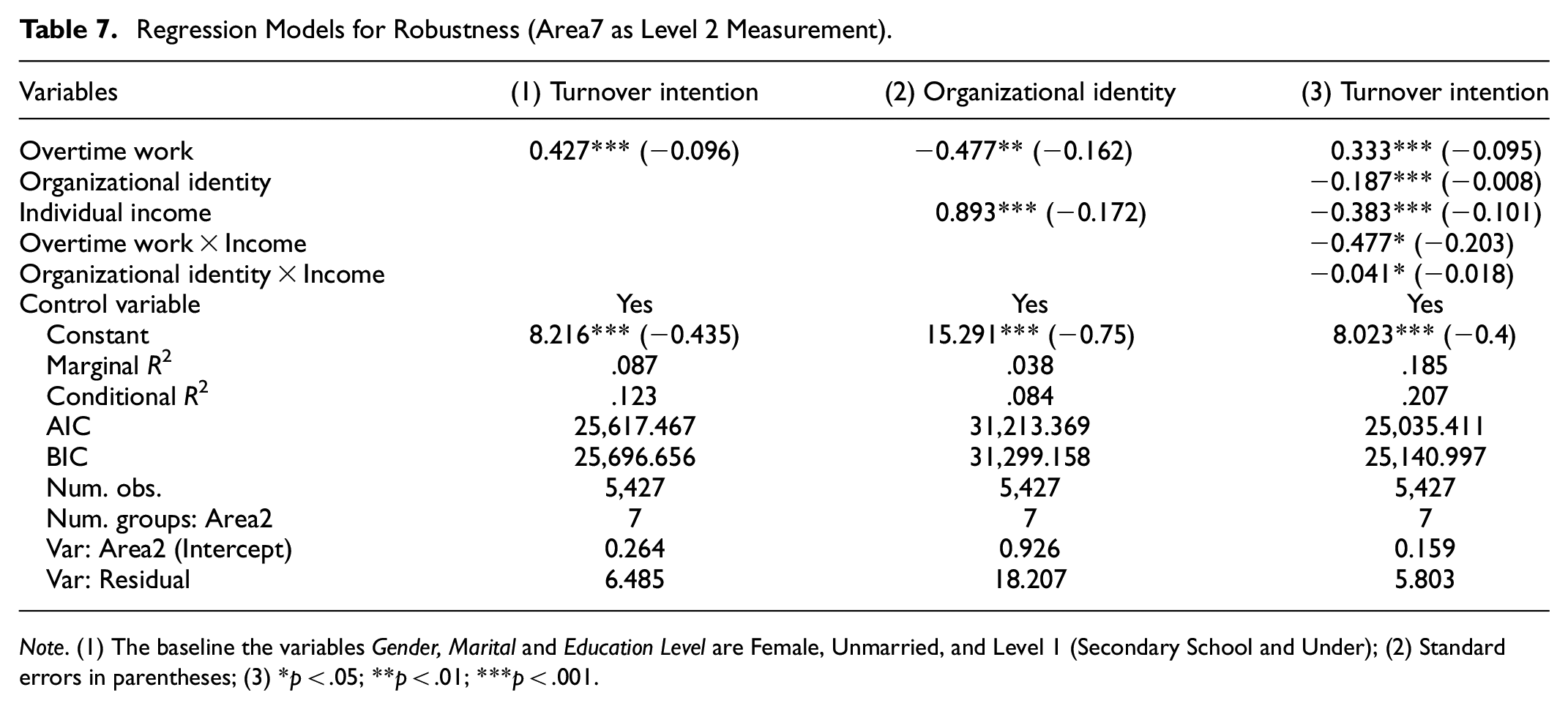
Note. (1) The baseline the variables Gender, Marital and Education Level are Female, Unmarried, and Level 1 (Secondary School and Under); (2) Standard errors in parentheses; (3) *p < .05; **p < .01; ***p < .001.
The estimation of demographic variables shows that female social workers have stronger organizational identification (B = 1.105, p < .001), with years of service (B = 0.063, p < .01) and age (B = 0.044, p < .001) showing a significant positive correlation with organizational identification and no effect of marital status. In contrast, married (B = −0.496, p < .001) and elder (B = −0.056, p < .001) social workers have weaker turnover intention, and the effects of gender and years of service on turnover intention disappear due to the addition of mediating and moderating effects.
Discussion
This study examined the relationship between overtime work and turnover intention amongst Chinese social workers, in particular the mediating role of organizational identity and the moderating effect of individual income.
Firstly, in line with the findings of others, this study revealed that working overtime significantly and positively affected turnover intentions (Jiang et al., 2023; Taylor, 2018). This study confirms the resource recovery theory, which argues that overtime work is more of an energy or emotional drain and is not beneficial to professional progress (Geurts & Sonnentag, 2006; Nijp et al., 2012; Yang et al., 2023). Moreover, as social work is an emotional labor kind of career, it requires a lot of emotional energy from clients, and overtime work takes away their time and space for emotional recovery, which may further worsen the amount of job burnout (Turtiainen et al., 2022; B. Zhang et al., 2024). At the same time, the outcomes of this study do not support the assumption that overtime work has a persistent positive effect (Oerlemans et al., 2014). The cause for this may be related to the Chinese view of labor. The traditional Chinese virtue of hard effort and hardship, coupled with the competitive pressures of contemporary culture, has created an “involuted” work condition. Social workers may work overtime more involuntarily, as a reluctance to cope with the increasing competitive pressures of society. Moreover, the moral constraint of hard work leads to social workers often having to bear the negative emotional energy of working overtime without a reasonable outlet for it, further restricting the beneficial impacts of overtime.
Second, consistent with expectations, the findings imply that organizational identity plays a mediating role in the connection between overtime work and turnover intention. Prior research has shown that overtime work produces emotional exhaustion, which leads to an increase in social workers’ turnover intention (Abdelmoteleb, 2019; Q. Li & Shi, 2023). The present study builds on this basis by including organizational identity, a product of the interaction between social workers and the organization, into the study. At the same time, the effort recovery theory focuses more on the psychological characteristics of individuals and frequently ignores the function of organizational identity. The results of this study imply that there may be not only the effect of job burnout but also the meso-level effects of working overtime. In other words, the findings of prior studies that attributed social workers’ turnover intention to emotional exhaustion may be biased, as turnover intention is also influenced by the organizational context (Barck-Holst et al., 2017). Lately, the influence of organizational elements on social workers’ turnover intention has gained some attention (H. Li et al., 2023; Q. Li & Shi, 2023). For example, some studies have found that organizational support considerably reduces social workers’ turnover intention, while others have found that the type of organization influences social workers’ turnover intention (H. Li & Mo, 2022; E. Wang et al., 2020; Y. Wang et al., 2021).
Additionally, individual income moderates the association between overtime work and turnover intention, and the relationship between organizational identity and turnover intention. This finding is broadly consistent with past research (Beckers et al., 2008; Judge et al., 2010; Van Der Hulst & Geurts, 2001). According to job demands-resources theory, income is viewed as a resource that might operate as a compensation mechanism in social work to compensate for the emotional drain of overtime work. It has also been proposed that pecuniary incentives can lead to higher job or life satisfaction, which would lessen workers’ turnover intention and also enhance identification with the agency. Conversely, some research holds the opposite perspective, suggesting that there is no substantial association between wealth and job satisfaction or that there is a negative path of influence (Adams & Beehr, 1998; Clark et al., 2008). This shows that the link between personal income and job satisfaction may not be linear, or that there is a threshold effect of income on job satisfaction. This is subject to further investigation and analysis.
This study also verified that some socio-demographic factors had an impact on turnover intention. Firstly, age had a negative effect on turnover intentions. This is consistent with some studies (Jiang et al., 2023; H. Zhang et al., 2022). Secondly, in line with previous research, married social workers have a lower turnover intention (H. Li & Mo, 2022; W. Lin & Deng, 2019). Also, social workers with higher education levels are more likely to turnover because they have more job opportunities (Abu-Bader, 2000). Finally, gender and years of social service were not significantly associated with turnover intention, which is inconsistent with prior studies (H. Li & Mo, 2022).
In summary, on the one hand, these findings incorporate social workers’ turnover intention and organizational identity into the analysis of the model through an empirical modification of the effort recovery model. On the other hand, the findings contribute to the literature on both social work and overtime work.
Limitations
There are some limitations to this study. First, the cross-sectional design adopted in this study cannot fully infer the causal relationship between overtime work and turnover intention. Further research can use a tracking design to provide more causal linkages between overtime work and turnover intention. Second, due to data limitations, this study did not further classify the types of turnover intention. Turnover intention can be divided into willingness to leave the organization and willingness to leave the profession. Future research could analyze the impact of overtime on both types of turnover intention. Third, this study did not examine the effect of overtime hours on turnover intention and future studies could continue to examine the effect of overtime hours on turnover intention.
Practical Implications
There are three important practical implications for social workers and social work agencies. Firstly, social work agencies try to reduce the workload of social workers as much as possible and reduce the amount of overtime social workers have to work. Overtime work may lead to turnover intention, which is not beneficial to the quality of services provided by the clients, nor to the long-term development of the agency, as well as the steady development of the social work profession. The tremendous burden of social workers leads them to work overtime, and the integration of work and life puts them in a condition of job burnout, which may also damage the family ties of married social workers. Especially during the COVID-19 pandemic, social workers needed to sacrifice some of their time flexibility to cope with heavy workloads, resulting in high levels of burnout and turnover intention (He et al., 2022). By rationalizing work schedules and reducing the number of overtime hours, social workers’ burnout can be alleviated to a certain extent (Jiang et al., 2023; Peinado & Anderson, 2020).
Secondly, social work agencies and supervisors can develop a positive organizational culture and increase the organizational identity of social workers. Organizational identity can dramatically diminish social workers’ turnover intention. On the one hand, the agency may be able to strengthen social workers’ identification with the organization by putting up a more compassionate structure and providing frequent organizational support for social workers. One study noted that the effect of interventions at the organizational level was greater than that of interventions on social worker characteristics (Webb & Carpenter, 2011). On the other hand, supervisors can be concerned about the problems faced by frontline social workers, give solid emotional support, detect the psychological state of social workers, and respond in a timely manner.
Finally, proper compensation increases or material incentives can assist lessening the negative impact of overtime work and reduce turnover intention. Previous research has found that an increase in income can reduce job burnout and turnover intention of social workers (H. Li & Mo, 2022). Hence, the agencies can give a certain amount of material allowance to social workers who work overtime, and in the daily management, a work incentive system can be set up, such as giving salary incentives to workers who have worked for a certain number of years, or giving bonuses to workers who have won awards or received relevant certificates.
Conclusion
This study found that overtime work negatively influences Chinese social workers’ turnover intention, and that organizational identification plays a mediating role. At the same time, personal income significantly moderates the relationship between working overtime and turnover intention and between organizational identification and turnover intention. The above findings support the effort recovery model and enrich the theoretical implications of the model by incorporating organizational identity factors into the model. On this basis, this study suggests that social work organizations can adopt measures such as reducing the frequency of overtime work, creating a good organizational climate, and increasing income to reduce social workers’ turnover intention. It is also hoped that this study will provide a basis for the relationship between overtime work and turnover intention among social workers.
Footnotes
Appendix
Regression Models for Robustness (Area7 as Level 2 Measurement).

| Variables | (1) Turnover intention | (2) Organizational identity | (3) Turnover intention |
|---|---|---|---|
| Overtime work | 0.427*** (−0.096) | −0.477** (−0.162) | 0.333*** (−0.095) |
| Organizational identity | −0.187*** (−0.008) | ||
| Individual income | 0.893*** (−0.172) | −0.383*** (−0.101) | |
| Overtime work × Income | −0.477* (−0.203) | ||
| Organizational identity × Income | −0.041* (−0.018) | ||
| Gender | −0.221* (−0.086) | 1.095*** (−0.144) | 0.019 (−0.082) |
| Marital | −0.567*** (−0.084) | 0.268 (−0.14) | −0.496*** (−0.079) |
| Years of service | −0.028* (−0.012) | 0.066** (−0.021) | 0.008 (−0.012) |
| Age | −0.060*** (−0.006) | 0.036*** (−0.01) | −0.055*** (−0.006) |
| Education level | |||
| Level 2 | −0.606 (−0.403) | 0.429 (−0.675) | −0.502 (−0.381) |
| Level 3 | −0.538 (−0.392) | 0.193 (−0.658) | −0.419 (−0.372) |
| Level 4 | −0.135 (−0.392) | 0.025 (−0.66) | 0.031 (−0.373) |
| Level 5 | 0.108 (−0.41) | 0.682 (−0.691) | 0.473 (−0.39) |
| Constant | 8.216*** (−0.435) | 15.291*** (−0.75) | 8.023*** (−0.4) |
| Marginal R2 | .087 | .038 | .185 |
| Conditional R2 | .123 | .084 | .207 |
| AIC | 25,617.467 | 31,213.369 | 25,035.411 |
| BIC | 25,696.656 | 31,299.158 | 25,140.997 |
| Num. obs. | 5,427 | 5,427 | 5,427 |
| Num. groups: Area2 | 7 | 7 | 7 |
| Var: Area2 (Intercept) | 0.264 | 0.926 | 0.159 |
| Var: Residual | 6.485 | 18.207 | 5.803 |
Note. (1) The baseline the variables Gender, Marital and Education Level are Female, Unmarried, and Level 1 (Secondary School and Under); (2) Standard errors in parentheses; (3) *p < .05; **p < .01; ***p < .001.
Declaration of Conflicting Interests
The author(s) declared no potential conflicts of interest with respect to the research, authorship, and/or publication of this article.
Funding
The author(s) disclosed receipt of the following financial support for the research, authorship, and/or publication of this article: The work was supported by the Guangdong Social Science Youth Foundation, Guangdong Planning Office of Philosophy and Social Science (No. GD22YZZ01).

Data Availability
The data-set used for this manuscript belongs to the CSWLS2019.