



Abstract
This study examines how parents’ perceived value influences the parent-teacher relationship in Taiwanese preschools, with service quality and social media use serving as mediating factors. A questionnaire-based survey was conducted, and data were analyzed using partial least squares structural equation modeling (PLS-SEM) to test both the measurement and structural models. The results confirm the proposed hypotheses and show that perceived value significantly shapes the parent-teacher relationship. In addition, service quality and social media use were found to fully mediate the relationship between perceived value and parent-teacher interaction. This study presents a comprehensive model of the factors influencing parent-teacher relationship in Taiwanese preschools. By highlighting the role of service quality and social media as mediators, the findings highlight the importance of improving communication and service delivery to enhance parent-teacher collaboration and ultimately foster stronger preschool partnerships. This study explores parents’ consideration of how perceived value affects the parent-teacher relationship in Taiwanese preschools, including service quality and social media use as mediating factors. Using a robust analytical framework, particularly partial least squares, we rigorously tested the measurement and structural models in the questionnaire. Our results confirm the hypotheses and reveal complex dynamics in Taiwanese preschool education. Our findings highlight the role of perceived value in shaping parents’ views of the parent-teacher relationship. Supported by a multiple mediation model, service quality and social media use act as mediators, indicating that perceived value significantly influences the parent-teacher relationship through full mediation. The study provides a comprehensive model for understanding and improving parent-teacher interactions, highlighting the benefits of improving communication, service delivery, and overall satisfaction. Insights from this research aim to improve preschool partnerships, foster a more collaborative environment, and increase educational services for the benefit of both parents and preschool educators.
Plain language summary
This study explores parents’ consideration of how perceived value affects the parent-teacher relationship in Taiwanese preschools, including service quality and social media use as mediating factors. Using a robust analytical framework, particularly partial least squares, we rigorously tested the measurement and structural models in the questionnaire. Our results confirm the hypotheses and reveal complex dynamics in Taiwanese preschool education. Our findings highlight the role of perceived value in shaping parents’ views of the parent-teacher relationship. Supported by a multiple mediation model, service quality and social media use act as mediators, indicating that perceived value significantly influences the parent-teacher relationship through full mediation. The study provides a comprehensive model for understanding and improving parent-teacher interactions, highlighting the benefits of improving communication, service delivery, and overall satisfaction. Insights from this research aim to improve preschool partnerships, foster a more collaborative environment, and increase educational services for the benefit of both parents and preschool educators.
Introduction
A strong parent-teacher relationship is essential for improving the quality of preschool education (Purtell et al., 2022). Such relationships enable preschool teachers to customize educare services to meet parents’ needs (Dýrfjörð et al., 2024) and help preschools implement effective strategies to improve pedagogical and administrative efficiency. Central to this relationship are interactions that build trust and facilitate communication, as both parents and teachers share responsibility for assessing and supporting children’s learning (Ren & Fan, 2021).
This collaborative partnership, characterized by shared power and goals, relies on effective communication to ensure balanced interactions (Then & Pohlmann-Rother, 2023). By building strong relationships, parents and teachers can work together to address each child’s unique needs, foster a positive classroom environment, and support holistic development (Zulauf-McCurdy & Zinsser, 2021). Such strong relationships also increase the accuracy of understanding a child’s behavior and learning strategies, ultimately improving the quality and effectiveness of preschool.
To promote high-quality early care and education practices, it is important to assess parents’ perceptions of the preschool experience. Perceived value, defined as parents’ subjective assessment of the advantages and disadvantages of preschool practices (McIsaac et al., 2023), is essential. This concept involves balancing perceived benefits with expectations and includes dimensions such as features, quality, effort, and cost (Shaw & Sergueeva, 2019). Positive parent-teacher relationship engagement fosters open communication and sustained collaboration.
In addition to perceived value, the effectiveness of preschool settings is influenced by service quality. Service quality reflects how well agencies meet or exceed the expectations of service recipients, including accessibility, safety, effectiveness, efficiency, and client-centeredness (Bucke et al., 2020). For early childhood education, this means meeting the expectations of children, parents, teachers, and administrators (Arslan et al., 2022). High service quality promotes greater parental involvement and trust in the educational environment.
Social media also plays a key role in improving parent-teacher relationship. Active engagement on social media platforms allows parents and teachers to access information, share updates, and participate in discussions related to parenting and education (Hsiao, 2021). This interactive engagement facilitates the exchange of information and promotes a more informed and supportive partnership between parents and preschool teachers (Tariq et al., 2022).
Taiwanese preschool parents attach great importance to interaction and partnership with preschool teachers. To foster this relationship, preschool teachers use various online and offline tools to demonstrate genuine concern for young children’s development and family support. Preschools also organize parenting activities to deepen parents’ connection with their young children and increase parenting efficiency. While previous research has primarily examined the dynamics and effectiveness of parent-teacher communication, there has been less focus on the perceived value of services and the quality of interactions. Furthermore, the role of social media in shaping and influencing this important relationship remains underexplored.
This research addresses a significant gap by exploring the differential relationships within the educational landscape, specifically focusing on how perceived value and service quality interact to influence parent-teacher relationship. While existing studies have examined the separate effects of perceived value and service quality on educational evaluations, there is limited research on how these factors jointly influence parental perceptions in Taiwanese preschools. Moreover, the role of social media as a mediator in this interaction remains underexplored in this context. By examining how social media use affects communication channels and information dissemination, this study aims to provide a comprehensive understanding of how these dynamics shape Taiwanese preschool parents’ evaluations of childcare services.
Understanding the influence of perceived value on parent-teacher relationship among Taiwanese preschool parents is essential for strengthening educational partnerships. This study examines how service quality and social media use mediate this relationship and provides a detailed framework for evaluating and improving parent-teacher interactions. The findings will provide valuable insights for improving early childhood education services by refining communication, service delivery, and overall satisfaction, ultimately fostering a more enriching educational environment.
Theoretical Background
Perceived Value
Perceived value is the overall assessment by potential consumers, determined through a trade-off between perceived benefits and expectations (Y. Wang et al., 2019). Customers perceive value for money when they believe the benefits outweigh the costs, leading to more positive attitudes toward the perceived value of these products (Ahn & Lee, 2019).
Perceived value directly reflects how product quality affects customer satisfaction, behavioral intention, and service quality, and plays a critical role in shaping consumer decisions (Tran & Le, 2020). It influences consumer attitudes and purchase intentions, emphasizing the importance of products with high preference and relevance. Utilizing specialized skills and obtaining prior approval from consumers improves their attitudes and advertising effectiveness (T. T. C. Lin & Bautista, 2020).
Embedded in the concept of perceived value is a comprehensive understanding of value that includes not only immediate functional improvements but also long-term strategic benefits (Mustak, 2019). By highlighting the subjective nature of value outcomes, it underscores the intricacies of creating perceived value and the significance of acknowledging perceptual differences between customers and providers. Effective resource integration and interaction processes between customer and provider organizations can facilitate the development and implementation of efficient resource integration and interaction processes.
Influencing consumer decisions and engagement are multifaceted dimensions of perceived value that include emotional, quality, social, and price values (Tu et al., 2021). Customer trust and the prioritization of personalization, along with the perceived usefulness of specific products, can shape ongoing relationships with consumers (Aw et al., 2019). Generally, perceived value significantly influences customer relationships across industries, affecting decisions, trust, and satisfaction (Yang et al., 2020). Strategic understanding and management of perceived value are crucial for managers and policymakers aiming to promote sustainable consumption, enhance services, and foster brand loyalty.
The concept of perceived value has considerable influence on parents’ decision-making strategies and cognitive trade-offs within the educational environment (Hong et al., 2022). This includes cognitive and emotional evaluations shaped by personal experiences and interactions, pertaining to the preschool’s efficacy in fostering their young children’s development. Moreover, it incorporates individual parental perspectives, recognizing the impact of their unique backgrounds, beliefs, and interactions with the program.
When parents perceive high value in school practices, it positively impacts their understanding of the benefits and worthiness of those practices (Chen et al., 2021). This subjective assessment involves considering the advantages, quality, and utility of pedagogical approaches, encompassing both intrinsic attributes and external factors such as social influence.
Parent-Teacher Relationship
A positive parent-teacher relationship benefits both children and parents. Collaborative support between parents and teachers is crucial for fostering children’s emotional and social development (Acar et al., 2021). Parent-teacher relationship encompasses the complex dynamics and interactions between parents and teachers in the educational context (Erdreich, 2023). It involves recognizing and understanding each other’s roles and perspectives, emphasizing practical collaboration in the educational process.
Parent-teacher relationship includes the frequency and depth of communication, the establishment of mutual trust, and joint efforts between parents and teachers to reach a consensus on children’s behaviors and academic performance. In early childhood education, this relationship is defined as the dynamic and interactive connection between parents and teachers, involving reciprocal communication, agreement, and support, as perceived and experienced by both parties (Jeon et al., 2021). It covers the quality of interactions, shared child-rearing beliefs, and communication styles within the context of early childhood education (Jeon et al., 2020).
Preschool emphasizes a balanced approach in the parent-teacher relationship, combining relational engagement and a didactic curriculum. This not only helps teachers foster emotional adjustment and secure relationships but also underscores the significance of parental preparation and active involvement during the preschool transition (Soe et al., 2023). A positive parent-teacher relationship correlates with enhanced child adjustment and better preschool outcomes (Weisberger & Ziv, 2023). In the complicated network of family dynamics, the relationship between parents and young children and its impact on interactions with preschool teachers significantly shapes the well-being and developmental pathways of young children in early childhood education settings.
Service Quality
Service quality encompasses the thorough evaluation and measurement of various dimensions and experiences offered during events, including activities, programs, complementary services, and the overall event experience (Sousa et al., 2023). It serves as a precursor to consumer satisfaction. Investing in staff training and diversity not only positively influences operational performance but also provides actionable insights for managers to improve overall service quality.
Service quality is measured by evaluating key characteristics that assess the perceived quality of services (Tseng et al., 2020). This involves comparing recipients’ expectations with their actual experiences, with the goal of optimizing service delivery, ensuring recipient satisfaction, and fostering continuous improvement in the service sector.
In terms of service quality, it includes various aspects of the physical environment, educational settings, school management, and the overall quality rating and improvement system. Positive service experiences are influenced by the significance of interpersonal communication and information provision (McArdle, 2019). Service quality isn’t limited to the physical attributes of institutions but also extends to the effectiveness of educational services, school management, and continuous improvement systems.
The positive service alliance between providers and recipients is nurtured through supportive interactions marked by open and nonjudgmental dialog. These interactions highlight the importance of timely, truthful, and supportive communication, addressing expectations, and providing reassurance. Ultimately, such mechanisms can help improve overall service outcomes.
Social Media Use
Adolescents engage with social media platforms to varying extents and patterns, encompassing time spent, frequency of use, and interaction nature (Sampasa-Kanyinga et al., 2020). They participate in activities like posting, liking, sharing content, and communicating with peers on these platforms. Parents and teachers heavily rely on social media for information and support (Charmaraman et al., 2022).
Individuals use social media when they engage with online platforms created for social interaction, communication, and content sharing (Dredge & Schreurs, 2020). This includes a wide range of activities, going beyond just the frequency and duration of engagement. It also involves considering the nature of the content shared and the purposes behind its usage. The widespread use of social media platforms has brought about significant changes in how people globally connect and interact. It has also transformed the evolving dynamics of human communication and relationships.
When employed for seeking social support, enhancing existing friendships, and boosting social self-esteem, social media can yield positive effects (Venta et al., 2019). Studying the impact of social media use on interpersonal skills requires the examination of several elements, including online social skills, motivators, and individual characteristics. Understanding the dynamics of how these factors interact contributes to a comprehensive understanding of the relationship between social media use and its impact on interpersonal skills.
Research Hypotheses
Association Between Perceived Value and Parent-Teacher Relationship
The link between perceived value and the parent-teacher relationship is strengthened by advocating a comprehensive examination of the impact of socioeconomic factors on parents’ perceptions of the value of education (Wolf, 2020). This underscores the need for a nuanced understanding of the contextual factors that influence the dynamics between parents, teachers, and the educational environment. Enhancing the quality of communication between teachers and parents emerges as a key factor in improving the educational experience for young children, emphasizing the interconnectedness of perceived value, parents’ understanding of their responsibilities, and the overall excellence of the parent-teacher dynamic (Sheridan et al., 2019).
Given the above, parents’ readiness to financially support educational practices is closely linked to how they perceive the value. If they see a high value in the school’s methods, they are more likely to invest in their child’s education. This not only affects their financial decisions but also establishes a connection between the perceived value and the level of commitment parents demonstrate in supporting educational initiatives. It shapes how parents assess and prioritize educational practices, influencing their financial decisions, and, as a result, their degree of involvement and backing for the school’s initiatives. This leads to the following hypothesis:
H1: Perceived value positively influences the parent-teacher relationship.
The Mediating Role of Service Quality
The satisfaction of recipients and the importance of a positive service environment underscore the need for a supportive and collaborative relationship between providers and stakeholders (C. Y. Lin et al., 2021). To enhance parental satisfaction with service quality, we must grasp how parents perceive the value of the assistance provided by service providers (Wilkins & Forrester, 2021). This involves not only addressing children’s specific needs but also ensuring that parents feel their concerns and preferences are taken into account. It also requires a comprehensive evaluation of the services offered and the implementation of changes aligning with parental expectations (Seo & Um, 2023). The relationship between perceived value and service quality underscores the importance of dimensions that directly affect customer satisfaction (Espinoza et al., 2019). This highlights the importance of professional services that not only meet clients’ needs but also contribute to a holistic and high level of service quality within service institutions.
In the context of education, service quality pertains to how well educational institutions meet the expectations and needs of their students (Latif et al., 2019). This involves providing quality education through competent faculty, reliable services, positive attitudes, accessible facilities, and a strong curriculum, ultimately fostering student satisfaction, personality development, and successful academic and career outcomes (Stribbell & Duangekanong, 2022b). Service quality assessment provides school administrators with a reliable metric to measure the quality of services provided to parents, thereby influencing their satisfaction and likelihood to recommend the educational institution.
Parents considering service quality emphasize that providing positive experiences significantly affects the school’s reputation and fosters friendly parent-teacher relationship (Stribbell & Duangekanong, 2022a). School leaders should prioritize enhancing parent satisfaction, improving service quality, and establishing brand trust (Dimitriu & Warlop, 2022). These enhancements can positively influence the school’s overall success, underscoring the significance of fostering positive connections between parents and teachers for a flourishing educational environment.
By prioritizing improved service quality and fortifying the teacher-parent alliance, educational institutions can positively impact parental perceptions, ultimately enhancing the connection between the parent brand and the educational institution (Su & Kunkel, 2019). The synergy between high-quality services in school programs and a positive parent-teacher relationship constitutes a holistic approach to nurturing students’ academic performance and overall development.
Based on the information provided, parents’ views on their young children’s education are closely linked to the quality of preschool services, which, in turn, affects their interaction with teachers. Improving service quality plays a crucial role in developing holistic educational experiences and fostering effective partnerships for preschool parents. This leads to the following hypothesis:
H2: Service quality acts as a mediator between perceived value and parent-teacher relationship.
The Mediating Role of Social Media Use
The customer’s perceived value is influenced by interpersonal competence. This implies that individual traits and the specific nature of one-on-one relationships contribute to perceived value in the context of social commerce (Elisa et al., 2022). The link between interpersonal competence and social media use indicates that in online social interaction, individuals use social networking sites for self-presentation and maintaining interpersonal relationships.
Social media platforms can elevate users’ perceived value through effective management practices, including upgrading platform functions, innovating content marketing, and addressing users’ entertainment and information needs (Q. Wang et al., 2021). Recognized for its ability to directly enhance social connections by increasing perceived value, this tool also has the indirect ability to strengthen social connections by fostering a deep sense of belonging, reducing feelings of isolation, and facilitating interpersonal relationships.
In the landscape of digital interaction, social media platforms play a pivotal role in enhancing the perceived value of users, cultivating social connections, and providing valuable insights into user behavior in a social context (Uzir et al., 2020). The level of engagement with social media significantly shapes the interplay between product quality and customer satisfaction. Users with lower engagement levels rely on social media for information, while those with higher engagement prioritize product quality. Utilizing social media is essential for companies to uphold customer relationships, counteract misinformation, and improve customer satisfaction.
A majority of professionals view social media as beneficial for promoting healthy behaviors, encouraging community engagement, and supporting preventive care (Yoon et al., 2021). In conclusion, this study highlights the intricate interplay between perceived value, social media utilization, and the parent-teacher relationship. It unveils generational disparities and stresses the importance of tailoring social media strategies to specific educational areas within the context of early childhood education.
Our focus is to offer valuable perspectives on the evolving dynamics of parent-teacher relationship in preschool settings. We highlight the possible mediating effects of contemporary communication platforms on both the perceived value and quality of educational experiences. This leads to the following hypothesis:
H3: Social media use acts as a mediator between perceived value and parent-teacher relationship.
Theoretical Model
This study examines the impact of perceived value on the parent-teacher relationship among Taiwanese preschool parents, focusing on the mediating roles of service quality and social media use. Previous research highlights the importance of understanding the socioeconomic factors that influence parents’ perceptions of educational value and their impact on parent-teacher dynamics. Effective communication between parents and teachers, influenced by perceived value, is critical to improving the educational experience of young children. We hypothesize that perceived value will positively influence the parent-teacher relationship (H1), and that service quality will mediate this relationship (H2). Parents’ financial support and commitment to their young children’s education are closely related to their perceived value, which influences their involvement and support for educational initiatives.
In addition, the study examines how social media use mediates the relationship between perceived value and the parent-teacher relationship. Social media has been recognized for its role in fostering community engagement and supporting educational efforts, and by investigating this, we aim to uncover how contemporary communication platforms affect the perceived value and quality of educational experiences in preschool settings. We hypothesize that social media use will mediate the relationship between perceived value and the parent-teacher relationship (H3). This research will provide valuable insights into the evolving dynamics of parent-teacher interactions and the role of modern communication tools in early childhood education. The theoretical model of this study is shown in Figure 1.

Theoretical model.
Methods
Sample Characteristics
We initially selected 600 samples to gage the attitudes of Taiwanese preschool parents toward the parent-teacher relationship and related influencing factors. The sample size design was informed by statistical considerations and the researchers’ prior experiences. After excluding missing and incomplete survey data, we ended up with a valid sample size of 519 preschool parents, achieving an 86.5% response rate. The surveyed population was predominantly female (57%), with the remaining 43% being male. In terms of age, the largest segment fell between 40 and 49 years old (45%), followed by 30 to 39 years old (40%). Regarding education, 60% of respondents held college or university degrees, 30% had high school or specialist degrees, and 10% held graduate degrees or higher. Concerning preschool patterns, 65% received private preschool services, while 35% utilized public or non-profit preschool services. Occupation-wise, 44% worked in the service industry, 35% in commerce, and 25% in technology. Family size distribution showed that 75% of respondents had one child, while 25% had two children. The characteristics of the sampled individuals closely mirrored those of the overall population of Taiwanese preschool parents.
Measurement Instrument
Following the hypothesized model, we employed a questionnaire to gather sample data. The questionnaire adhered to the reflective principle in designing observed items aimed at investigating the perceptions of Taiwanese preschool parents regarding the connections among perceived value, parent-teacher relationships, service quality, and social media use. The “Perceived Value and Parent-Teacher Relationship Survey” (PVPTR) was developed in Chinese explicitly for this study. Survey items were formulated based on literature exploration and theoretical reflections, then further revised by three experts in the research fields of early childhood education, information technology, or educational administration.
The PVPTR consists of four factors: perceived value, parent-teacher relationship, service quality, and social media use. The initial questionnaire comprised 22 observed items, with each latent factor comprising five or six items. The Likert scale is employed to gage preschool parents’ agreement or disagreement with the survey, where a score of 5 signifies the strongest agreement and a score of 1 indicates the strongest disagreement. The subsequent paragraphs provide descriptions of the four latent factors in PVPTR.
Perceived Value (PV) is the assessment of preschool parents’ perspectives on the overall benefits and expectations associated with preschool services. This includes educational performance, quality, effort, and cost. The identified items for perceived value are based on and derived from previous research (Ahn & Lee, 2019; Shaw & Sergueeva, 2019; Tran & Le, 2020). Examples include “The preschool activities provide valuable learning experiences for my child,”“I am satisfied with the variety of educational resources available to my child at the preschool,”“The preschool offers opportunities for parental involvement in my child’s education,” and “I believe the preschool curriculum is well-designed and beneficial for my child’s development.”
Parent-Teacher Relationship (PTR) is the evaluation of preschool parents’ views on the quality of interactions, shared child-rearing beliefs, and communication styles within the context of early childhood education. The identified items for the parent-teacher relationship are based on and derived from previous research (Jeon et al., 2020, 2021; Then & Pohlmann-Rother, 2023). Examples include “The preschool effectively communicates with me about my child’s progress,”“I am encouraged to actively participate in my child’s learning experiences,”“The preschool provides various channels for communication,” and “I feel valued and respected as a parent by the preschool staff.”
Service Quality (SQ) is the evaluation of preschool parents’ views on the comprehensive assessment of dimensions and experiences in preschool settings, encompassing activities, programs, complementary services, and overall experiences. The identified items for service quality are based on and derived from previous research (Bucke et al., 2020; McArdle, 2019; Sousa et al., 2023). Examples include “The preschool provides a safe and secure environment for my child,”“The preschool staff is friendly and approachable,”“I find contentment in the personalized attention my child receives,” and “My satisfaction extends to the overall excellence of the instruction provided within the preschool.”
Social Media Use (SMU) is the evaluation of preschool parents’ views on their active engagement and interaction on various online platforms specifically designed for social interaction, communication, and content sharing related to preschool practices. The identified items for social media use are based on and derived from previous research (Charmaraman et al., 2022; Dredge & Schreurs, 2020; Venta et al., 2019). Examples include “Social media helps me stay connected with my child’s preschool activities and events,”“Social media provides valuable resources for supporting my child’s early education,”“Social media is a useful tool for fostering communication between parents and preschool teachers,” and “Social media helps me connect with other parents for educational support and advice.”
Data Analysis
Using partial least squares as our analytical approach, we evaluated the proposed model by examining the effects of multiple mediating roles (Hair et al., 2017). We used SmartPLS 3 (Ringle et al., 2015) to process the survey data collected in the PVPTR. To ensure the reliability and validity of the latent factors and observed items, we conducted confirmatory factor analysis on the raw survey data. Factor loadings for each item were estimated through 5,000 bootstrap resamples, and their statistical significance was rigorously examined. To maintain the consistency of the measurement model in the PVPTR, we presented metrics such as Cronbach’s α, Rho_A, CR (composite reliability), and AVE (average variance extracted). To determine the discriminant validity of the PVPTR, we used Fornell-Larcker and Heterotrait-Monotrait Ratio (HTMT) assessments.
Next, we examined multicollinearity within the PVPTR using variance inflation factor (VIF) analysis. In the structural model, we assessed the hypothesized paths of R2, Adj. R2, Q2, and SRMR (standardized root mean square residual). In addition, we calculated f2 values (effect sizes) to clarify the impact of each latent factor. Multiple mediation analyses, supported by 5,000 bootstrap resampling, facilitated examination of the estimates and significance of total, direct, and indirect effects.
Following the theoretical requirements of multiple mediation analysis (Nitzl et al., 2016; Zhao et al., 2010), we examined whether the mediation effect reached statistical significance. If so, we proceeded to assess the statistical significance of the direct effect. A full mediation effect was considered when the direct effect did not reach statistical significance, whereas a partial mediation effect was considered when statistical significance was reached. In addition, we conducted a comparative analysis of the different mediating effects within this hypothesized model.
Results
Evaluation of the Measurement Model
The validation process for the PVPTR survey data included a rigorous confirmatory factor analysis in which items with factor loadings below 0.700 were systematically eliminated. This refinement process resulted in a streamlined set of 16 items within the PVPTR framework, down from the original 22 items. The calculated means for the retained 16 items ranged from 3.840 to 4.457, with corresponding standard deviations ranging from 0.509 to 0.885. Evaluation of the skewness and kurtosis values for the PVPTR items revealed a range of −1.689 to 0.149 and −1.506 to 3.621, respectively, with compliance with the standard requirements.
Table 1 provides a comprehensive overview of each item, showing standardized factor loadings ranging from 0.730 to 0.949. Using a bootstrapping approach with 5,000 resamples, the t values associated with these standardized factor loadings consistently exceeded 3.29, indicating their statistical significance. This rigorous validation process enhances the reliability and validity of the PVPTR survey data, providing a foundation for subsequent analyses and interpretations in the field of educational research.
Mean, SD, Skewness, Kurtosis, and Factor Loading.

p < .001.
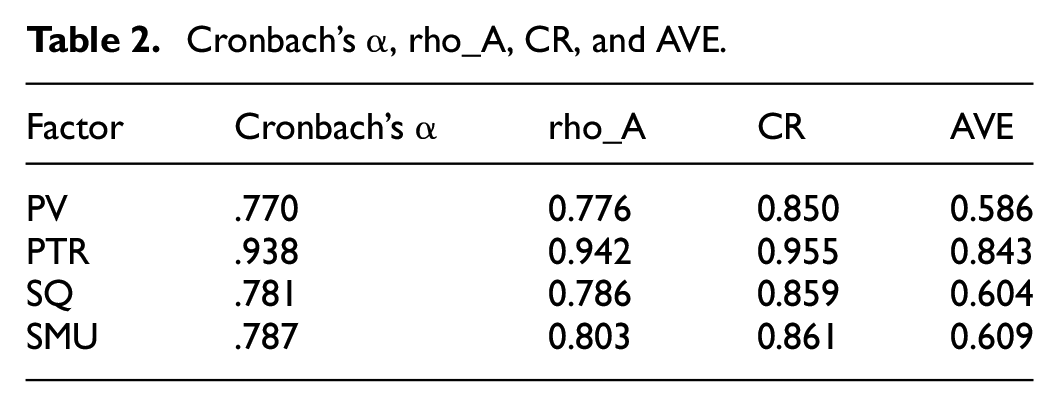
In the framework of the PVPTR, Table 2 presents the results of key metrics such as Cronbach’s α, Rho_A, CR (composite reliability), and AVE (average variance extracted). The values ranged from 0.770 to 0.938, 0.776 to 0.803, 0.850 to 0.955, and 0.586 to 0.843, respectively. These results confirm satisfactory levels of validity and reliability within the parameters assessed.
Cronbach’s α, rho_A, CR, and AVE.
To assess discriminant validity in our study, we used Fornell-Larcker analysis. In Table 3, the diagonal entries represent the square root of the Average Variance Extracted (AVE) for the two latent factors, providing a comprehensive assessment of discriminant validity. Below the diagonal are the correlation coefficients. Importantly, the correlations between the factors in the PVPTR ranged from 0.419 to 0.614. Significantly, the square roots of the AVE exceeded the correlation coefficients between each latent factor, ranging from .766 to .918. Thus, the discriminant validity of the PVPTR demonstrated a reasonably high level of reliability.
The Results of Fornell-Larcker Criterion.

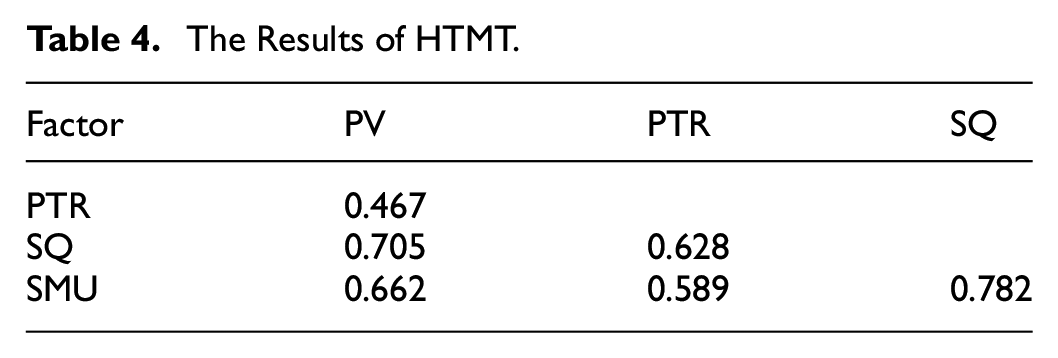
The effectiveness of the HTMT metric in measuring the discriminant validity of the PVPTR is demonstrated by the results presented in Table 4. Notably, the calculated HTMT values, which range from 0.467 to 0.782, are consistently below the established threshold of 0.85. This evidence confirms the internal and external consistency of the PVPTR. Latent factor testing reveals acceptable levels of convergent validity, discriminant validity, and reliability in the measures associated with the PVPTR.
The Results of HTMT.
Evaluation of the Structural Model
The examination of collinearity within the latent factors of the PVPTR revealed VIF values ranging from 1.000 to 1.833. Notably, all values remained below 5, indicating minimal impact of multicollinearity among the latent factors. Table 5 presents the PLS evaluation of the quality of the structural model. The R2 estimates ranged from .319 to .354, while the Adj. R2 statistics ranged from .218 to .350. The Q2 statistic, ranging from 0.189 to 0.293, was used to confirm structural validity. The SRMR estimate of 0.101 indicated that the model fit was considered acceptable for the sample data collected in the PVPTR.
The Results of Structural Model.

Figure 2 illustrates the standardized regression coefficients and explained variance measures. The perceived value construct has a significant impact, explaining 33.2% of the variability in service quality with a standardized regression coefficient of 0.577. Similarly, the perceived value construct explains 31.9% of the variability in social media use, with a standardized regression coefficient of 0.565. When perceived value, service quality, and social media use are considered together, they collectively explain 35.4% of the variability in parent-teacher relationships, with standardized regression coefficients of 0.072, 0.341, and 0.267, respectively.
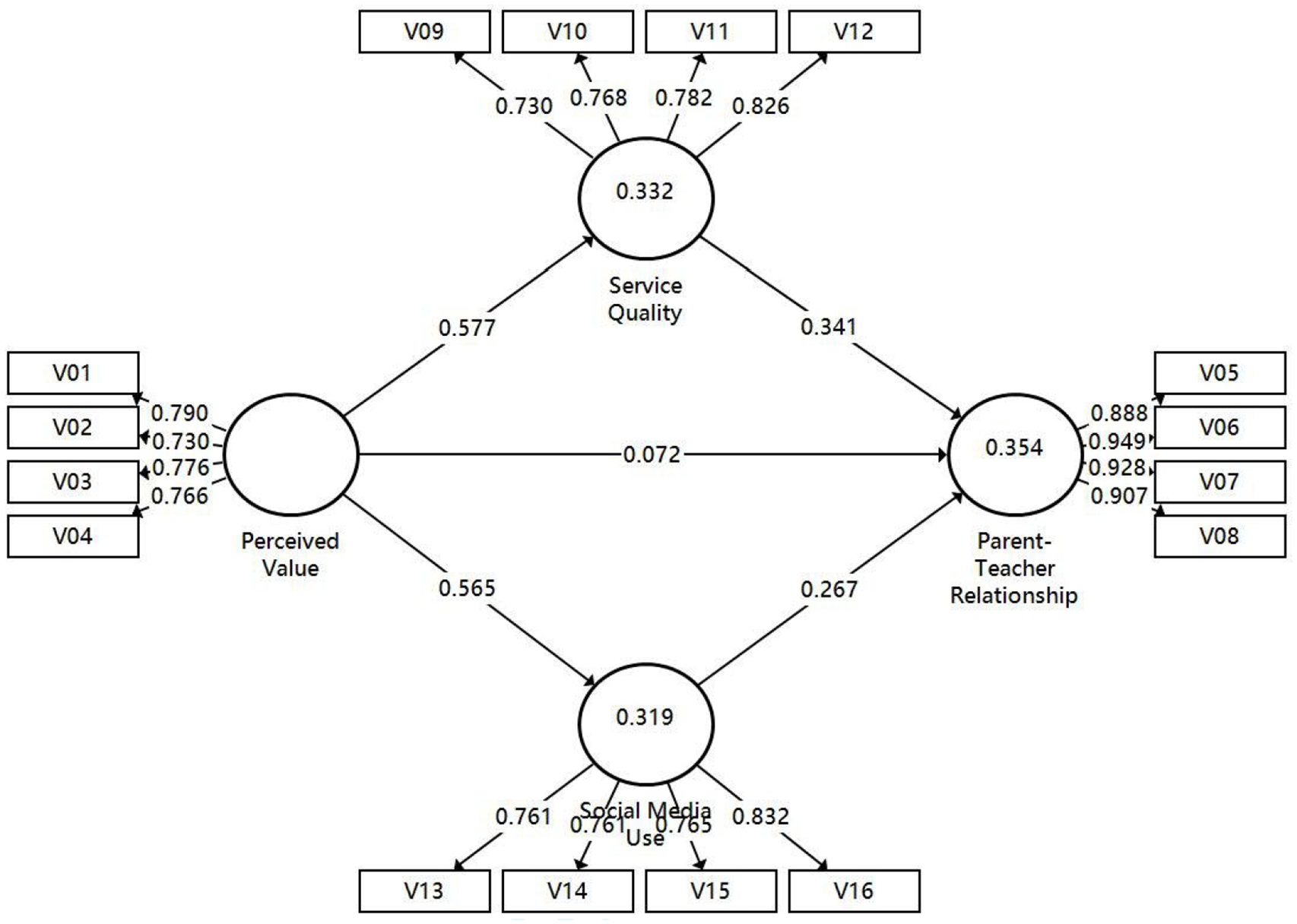
Structural model.
To determine the statistical significance of these results, we used the bootstrap technique, performing 5,000 resampling iterations. The results indicate that all t-statistics exceed 1.96, except for the relationship between perceived value and parent-teacher relationship, indicating statistical significance at a threshold of p < .05.
Using the PVPTR dataset, we determined effect sizes for latent factors, which ranged from 0.005 to 0.498 (see Table 6). Thresholds of 0.005, 0.01, and 0.025 were set for weak, moderate, and strong effects, respectively (Aguinis et al., 2005). Our analysis of the f2 values in the context of the PVPTR showed that the latent factors had a reasonable degree of predictive relevance, with most falling in the moderate to high range.
The Results of Effect Size.

Evaluation of Multiple Mediating Model
In the results presented (see Table 7), the total effect of PV on PTR resulted in a coefficient of 0.419 (t = 12.000), confirming the validity of H1 without the mediators SQ and SMU. However, when SQ and SMU were included as mediators in the PV-PTR relationship, the direct effect of PV on PTR decreased to 0.072 (t = 1.613). This result suggests full mediation of the relationship between PV and PTR by SQ and SMU. To rigorously assess the significance of these results, a bootstrapping technique with 5,000 resamples was used to compute the standard error for each path coefficient in the multiple mediator model.
The Results of Multiple Mediating Analysis.

In line with the above observations, the indirect effects of SQ and SMU in the PV-PTR relationship were individually estimated to be 0.197 and 0.151, respectively. Statistical evaluation based on percentile and bias-corrected bootstrap 95% confidence intervals provided support for both H2 and H3. This support was underscored by the fact that the calculated indirect effects did not encompass zero, thus confirming the fully mediating roles of SQ and SMU in this theoretical framework.
The difference between M1 and M2 was 0.046. Using a bootstrapping approach with 5,000 resamples, our analysis revealed that the 95% confidence intervals of the percentile and bias-corrected bootstrap included zero. These results suggest that the mediating effects of the two pathways do not show a statistically significant difference in the context of this relationship.
In summary, Hypothesis 1 proposed that perceived value positively affects parent-teacher relationship, which was supported by the results. Hypotheses 2 and 3 proposed that service quality and social media use, respectively, mediate the relationship between perceived value and parent-teacher relationship. The results show that while perceived value has a direct effect on parent-teacher relationship, this effect is significantly reduced when both service quality and social media use are considered, indicating that these factors fully mediate the relationship. Both service quality and social media use individually play critical roles in this mediation process, although their effects are not significantly different from each other. This emphasizes the importance of both service quality and social media use in understanding how perceived value affects parent-teacher relationship.
Discussions
This study examines how perceived value affects the parent-teacher relationship among Taiwanese preschool parents, with service quality and social media use as mediating factors. The hypothesized model, based on theoretical considerations, proposes a multifaceted approach to understanding parent-teacher dynamics. Using the analytical framework of partial least squares, we systematically analyzed both the measurement and structural models inherent in the PVPTR. Confirming H1 through H3, our findings delve into the intricate dynamics of the parent-teacher relationship in the context of Taiwanese preschool education, focusing on the mediating roles of service quality and social media use in influencing perceived value.
The emphasis on perceived value implies that subjective evaluations of preschool practices can influence preschool parents’ considerations of the parent-teacher relationship. Confirming the multiple mediation model, the inclusion of service quality and social media use suggests that perceived value positively influences the parent-teacher relationship through the mechanism of full mediation. Overall, the study suggests a nuanced understanding of the factors that shape the parent-teacher relationship by integrating subjective evaluations, service quality experiences, and online communication platforms and applications.
Theoretical Reflections
Theoretically, the concept of perceived value suggests that Taiwanese preschool parents’ perceptions of the benefits derived from their young children’s preschool experiences profoundly shape their relationships with teachers. The value of this study lies in examining the multiple mediating roles of service quality and social media use. As the above literature review indicates, service quality mediates parental satisfaction by shaping expectations through staff interaction, educational services, and school management in Taiwanese preschools (Bucke et al., 2020; Sousa et al., 2023). Positive service quality promotes effective parent-teacher relationship, matches institutional services with parental needs and expectations, and increases overall satisfaction (C. Y. Lin et al., 2021; McArdle, 2019).
Service quality, a key factor in educational institutions, can act as a mediator, translating perceived value into tangible experiences. In addition, the inclusion of social media as a mediator recognizes the evolving landscape of parent-teacher communication. In the digital age, it is important to understand how social media use influences perceived value and subsequently impacts the parent-teacher relationship. This theoretical framework of the multiple mediation model suggests a multidimensional understanding of the multiple dynamics that shape parent-teacher interactions for parents in the Taiwanese preschool context.
Perceived value is central to Taiwanese preschool parents, involving a trade-off between perceived benefits and costs. This subjective evaluation influences parental satisfaction, trust, and decision-making in selecting preschool programs, reflecting the balance between quality, benefits, and personal expectations (Chen et al., 2021; Hong et al., 2022). Based on the findings, perceived value has important practical implications for various stakeholders, especially parents, teachers, and policymakers. We recommend that preschools actively communicate the value they provide, emphasizing immediate functional improvements and long-term strategic benefits. Preschool administrators can use effective communication strategies to demonstrate the multifaceted nature of perceived value, which includes emotional, quality, social, and price values.
Practical Implications
Practically, preschools should foster a collaborative partnership between parents and teachers, using strategies such as promoting effective communication channels, building mutual trust, and encouraging joint efforts in shaping young children’s behavior and academic performance. In addition, preschools should be sensitive to the diverse backgrounds, beliefs, and interactions of parents, recognizing the subjective nature of valued outcomes. Strategies to improve communication between teachers and parents should take these perceptual differences into account, with the goal of improving the overall quality of the parent-teacher relationship.
Given the importance of service quality in shaping both parents’ and young children’s experiences and overall parental satisfaction with preschool services, we suggest that preschool administrators invest in staff training and diversity. This investment not only positively impacts operational performance, but also provides managers with actionable insights to improve overall service quality. Preschools should consider critical factors and their mechanisms related to educational quality, school management, and a commitment to continuous improvement. They should use effective communication with a focus on managing expectations and providing reassurance as critical elements in building a strong alliance.
To increase parental satisfaction with the quality of services, early childhood educators should understand how parents perceive the value of the support provided. This includes not only responding to children’s specific needs, but also ensuring that parents feel that their concerns and preferences are being addressed. Moreover, assessing service quality becomes a benchmark for preschool administrators to measure parental satisfaction and influence their willingness to recommend the school. This underscores the practical importance of regularly assessing and improving service quality in preschools.
According to the above literature reviews, social media use increases perceived value by fostering social connections and providing support (Uzir et al., 2020; Q. Wang et al., 2021). Taiwanese preschool parents use it for educational support and community engagement, linking active use to higher perceived value and satisfaction (Hsiao, 2021; Yoon et al., 2021). The results also indicate that social media use acts as a mediator between perceived value and the parent-teacher relationship, highlighting the need for strategic and intentional use of social media in early childhood education. We recommend that preschools establish friendly and multifunctional social media platforms as important channels for disseminating educational information, sharing updates on a young children’s progress, and facilitating communication between parents and teachers.
Active engagement on these platforms is critical to ensure that the information shared is accurate, timely, and relevant. Preschool teachers can use these platforms to share insights into daily activities, offer tips for learning at home, and foster a sense of community among parents. In addition, we suggest that preschools assist or educate parents in finding online communities where they can share experiences, seek advice, and build a support network. Preschools may consider facilitating or supporting such online communities to create a more comprehensive support system for parents.
Limitations and Future Research Recommendations
Limitations of this study include the lack of a detailed examination of the specific components that influence parents’ perceptions of preschool education and how different aspects of preschool practices and teacher interactions affect these perceptions. In addition, it does not address the variability in the impact of different social media platforms, content types, and frequency of engagement on parent-teacher relationship. Future research on parent-teacher relationships in preschool education can explore several promising directions. There’s a need for a thorough examination of the specific components that contribute to the perceived value of preschool education. Analyzing how parents evaluate and interpret different aspects of preschool practices, curriculum, and teacher interactions can provide nuanced insights into the factors that influence their perceptions. Researchers can explore the impact of different social media communication channels on parent-teacher interactions, understanding the most effective platforms, responsive content types, and frequency of engagement to inform strategies for improving communication and collaboration.
The focus on Taiwanese preschool parents, which may limit the generalizability of the findings to other cultural contexts, is also a limitation of the study. The singular focus on this demographic group may not account for cultural variations in parent-teacher relationship. It is essential to explore the cultural nuances that shape parent-teacher relationships. The current study focuses on Taiwanese preschool parents, and extending the research to different cultural contexts may reveal whether observed dynamics hold across societies or whether adjustments are needed to accommodate unique cultural expectations. Researchers suggest using qualitative methods such as interviews or observations to gather diverse opinions from parents in different regions or cultures. Field studies can provide more in-depth research data and enrich the understanding of these issues from a cultural diversity perspective.
Other limitations of this study include its narrow focus on short-term outcomes, insufficient exploration of latent factors, and lack of diverse theoretical frameworks. Additionally, it does not examine the scalability and replicability of successful parent-teacher relationship models across educational contexts, which limits its applicability to broader interventions. In addition, studying the long-term effects of strong parent-teacher relationships on the academic and socio-emotional development of preschool children could provide valuable insights. Understanding how these relationships affect children over time strengthens the case for investing in collaborative partnerships between parents and teachers. Future research should conduct a more comprehensive investigation by exploring additional survey items, latent factors, mediators, and hypotheses rooted in different theoretical frameworks that address these issues. The scalability and replicability of successful parent-teacher relationship models can be explored to identify best practices and determine their applicability across educational settings to guide interventions aimed at improving interactions on a broader scale.
A substantial limitation of this study is its framing of preschool education in Taiwan as a consumer-oriented service, which may not be consistent with the broader understanding of education as a developmental and caring responsibility for young children. This approach may reduce the multifaceted complexities of early childhood education to functional aspects, which may reduce its educational and developmental significance. Future research should reconsider this consumer-centered perspective and instead adopt a more holistic educational framework that emphasizes the role of preschools in fostering young children’s growth, learning, and socialization. In addition, studies should explore alternative frameworks that reflect the broader value of education, particularly in the context of the Taiwanese early childhood education system. This shift could provide richer insights and more appropriate interpretations of the role of preschool education.
Conclusion
The study examines how perceived value influences the parent-teacher relationship among Taiwanese preschool parents, highlighting the mediating roles of service quality and social media use. It finds that while perceived value has a direct effect on the parent-teacher relationship, this effect is significantly reduced when service quality and social media use are taken into account, suggesting that these factors fully mediate the relationship. This indicates the importance of both service quality and social media in shaping how perceived value affects parent-teacher interactions in Taiwanese preschools. For Taiwanese preschools, the study highlights the need to enhance both service quality and social media engagement in order to improve parent-teacher relationship. Future research could benefit from examining specific components of perceived value, the impact of different social media platforms, and cultural differences to further enrich our understanding of parent-teacher dynamics in this context.
Footnotes

Ethical Considerations
All procedures performed in studies involving human participants were in accordance with the ethical standards of the institutional and/or national research committee and with the 1964 Helsinki Declaration and its later amendments or comparable ethical standards.
Informed Consent
Informed consent was obtained from all individual participants involved in the study.
Funding
The author(s) received no financial support for the research, authorship, and/or publication of this article.
Declaration of Conflicting Interests
The author(s) declared no potential conflicts of interest with respect to the research, authorship, and/or publication of this article.
Data Availability
Data sharing not applicable to this article as no datasets were generated or analyzed during the current study.