



Abstract
Parent-teacher relationships are known to promote positive outcomes for young children in early childhood education; however, parents and teachers face barriers to forming quality relationships. To better understand how to support parents and teachers in forming quality relationships, the present systematic review sought to identify existing interventions designed to promote quality parent-teacher relationships in early childhood education. Systematic search and data extraction identified peer-reviewed manuscripts describing interventions that included components to increase parent-teacher relationships in early childhood education. Each included manuscript was evaluated to answer the following questions: (1) how is the social process between parents and teachers conceptualized?, (2) what strategies were used to improve this social process?, and (3) what outcomes are associated with improving this social process? Nine out of the 1,992 nonduplicate screened manuscripts met inclusion criteria. Results indicate a small body of research focused solely on interventions designed to improve parent-teacher relationships. Included interventions were limited in their conceptualization of the social process between parents and teachers, strategies to improve it, and associated outcomes assessed. Additional research is needed to understand low-cost and highly feasible interventions that promote quality parent-teacher relationships in early childhood education.
Plain Language Summary
We conducted a review of literature describing interventions to promote parent-teacher relationships in early care and education settings. We investigated each included intervention for how they define the parent-teacher relationship, how they promoted it, and what outcomes were associated with changes in the parent-teacher relationship. Findings indicate that more work needs to be focused on specifically improving parent-teacher relationships in early care and education settings.
Quality parent-teacher relationships have been known to promote positive outcomes for young children (Cox, 2005; Epstein, 2001; Knopf & Swick, 2007). Especially in early childhood education (ECE), parent-teacher relationships can support young children’s social, emotional, and academic development (Barnard, 2004; Lawson, 2003) placing children on a path to success well into adulthood (Heckman, 2006; Melhuish et al., 2008). Although parent-teacher relationships are known to promote positive child outcomes, parents and teachers face barriers to forming quality relationships. This is especially true of racially and ethnically minoritized (REM) families who may face barriers ranging from structural racism to individual racial bias from teachers (see Authors, under review [Blinded]). As REM children and families make up the largest part of ECE enrollment, and these families may face unique barriers to engagement, it is imperative that we evaluate current interventions focused on promoting parent-teacher relationships to ensure that they are equitable and meet the needs of all families.
Parent-Teacher Relationships in ECE
Parents and teachers play a vital role in supporting young children’s social-emotional, and academic development (Sheridan et al., 2019). Although parent-teacher relationships are important at all stages of a child’s education, this may be particularly true during the early childhood years (Knopf & Swick, 2007; Lang et al., 2016). During early childhood, not only are children developing skills for formal education, but parents, maybe more importantly, are developing their own schemas regarding the role they play in their child’s education (Baker et al., 2016; Hoover-Dempsey et al., 2005). In other words, parents are learning how to interact and develop relationships with teachers and their child’s school, which may in turn impact their child’s developmental and academic progress (Baker et al., 2016; Hoover-Dempsey et al., 2005). Thus, early positive relationships between parents and teachers may be seen as a potential intervention factor to promote long-term positive outcomes for young children (Christenson & Havsy, 2004; Christenson & Sheridan, 2001; Ma et al., 2015). Considering the long-term impact that parent-teacher relationships have on child development, it is imperative that parents and teachers receive the necessary strategies and tools needed to build and foster a quality relationship (Baker et al., 2016; Christenson & Sheridan, 2001; Ma et al., 2015). The present systematic review seeks to assess the current state of the literature focused on interventions to improve parent-teacher relationships in ECE. This work can result in a useful guide for specific actionable practices for supporting parents and teachers and a way to guide future intervention efforts.
Efforts to Support Parents and Teachers in Forming Relationships
Many early childhood organizations have referenced a need for best practices around promoting quality parent-teacher relationships. For example, the National Association for the Education of Young Children (2009), a nonprofit association in the U.S., encourages establishing partnerships between families and teachers, placing an emphasis on coordinating care between school and home. Further, ECE frameworks and interventions that focus on promoting social-emotional outcomes for young children (e.g., Incredible Years, Webster-Stratton et al., 2011; Pyramid Model Practice, Fox et al., 2003) have described parent-teacher relationships as a facilitator of child outcomes. However, many of these efforts fail to provide parents and teachers with concrete strategies for promoting quality relationships (Chambers & Norton, 2016; Gartrell, 2012; Halgunseth et al., 2009). Research indicates that failure to support parents and teachers in forming quality relationships contributes to long-term negative outcomes for children and families (Herman & Reinke, 2017; Zulauf-McCurdy & Zinsser, 2021). Therefore, the current study seeks to provide a single location for understanding what practices have been studied for promoting parent-teacher relationships.
The Parent-Teacher Relationship as a Social Process
We situate the current systematic review in line with Tseng and Seidman’s (2007) systems framework for understanding social settings for youth. Tseng and Seidman (2007) argue that improving the daily social processes within settings, such as schools, has the potential to affect the largest number of children. For the current study, we position the interactions between parents and teachers within the school setting as a key social process through which child outcomes can be improved. Following the Preferred Reporting Items for Systematic Reviews and Meta-Analysis (PRISMA; Moher et al., 2009) the present systematic review aims at identifying interventions for parent-teacher relationships in ECE. In line with Tseng and Seidman’s (2007) theory, the present study has three research questions: (1) how is the social process between parents and teachers conceptualized?, (2) what strategies are used to improve these social processes?, and (3) what outcomes are associated with improving social processes between parents and teachers?
Method and Analysis Process
Search Strategy
For the present systematic review, the PRISMA guidelines were followed (Moher et al., 2009). However, since the social process between parents and teachers may not always be strictly defined in a quantitative manner (as individual parents and teachers view their relationship differently, see Gross et al., 2020), the present review also incorporated qualitative or mixed method studies in our inclusion criteria. A search process of multiple-stages was utilized to identify potential studies to be included in this review. First, the following bibliographic databases were searched: PsycINFO, ERIC, MEDLINE (PubMed), Web of Science (SCI and SSCI), and Academic Search Complete. Three categories of search terms were identified: early childhood population (preschool, early childhood, pre-k), parent-teacher component (parent-teacher, family-teacher, home-teacher, parent-school, family-school, home-school), and relationship terms (partnership, collaboration, involvement, relationship, communication, bond). Filters were implemented to limit articles found during the electronic search to only those that were written in English and were published in a peer-reviewed journal. This first step was conducted in October 2020.
Following the electronic database search, snowball methods were used to detect additional studies (Greenhalgh & Peacock, 2005). The snowball search involved two processes: a backward search, which reviewed the references lists of articles from the electronic search, and a forward search utilizing Google Scholar to locate articles that had cited articles found in the electronic search. The snowball search was conducted in December 2020.
Study Selection
Prior to abstract screening, the authors met to discuss the Population, Intervention, Comparison, Outcomes and Study (PICOS; Amir-Behghadami & Janati, 2020) framework and to determine the criteria for abstract inclusion. During this meeting, both the first and second author (the coders) also practiced applying screening criteria to several abstracts and discussed any resulting confusion. Once the list of potentially relevant studies was compiled, duplicates, non-English, and non-peer-reviewed articles were removed. Next, all titles and abstracts were reviewed by the two coders to determine if the articles met the following four pre-determined inclusion criteria: (1) includes current educators serving children between the ages of 3 to 5 years and/or parents of children ages 3 to 5 years old (therefore pre-service teachers was excluded); (2) set within a school-based or group-based (e.g., childcare) setting (therefore home-based and clinic based interventions were excluded); (3) contains an intervention; and (4) includes at least one component of the intervention that promotes parent-teacher relationships or at least one outcome measure or indicator related to the parent-teacher relationships.
Data Extraction Procedures
The final step involved two authors extracting data from the articles included in the analysis set (n = 9). Codes were developed following the methods, units, treatments, outcomes, and setting framework (UTOS; Cronbach & Shapiro, 1982). One manuscript was randomly selected for an inter-rater reliability probe, and any disagreements upon initial coding were discussed. The first and second author then systematically extracted data from each included manuscript (dual-coded) for study design, intervention details (name, target, format, length/frequency), setting/center type, sample size and demographics of included participants, definition of the social process, strategies used to intervene, and outcomes associated with the intervention. As the first and second author both extracted data from all manuscripts separately they met with the fourth author to resolve any disagreements of data through discussion.
Review Process
Figure 1 shows the study selection using the PRISMA flow diagram (Moher et al., 2009). The initial electronic article search yielded 847 records. The snowball search yielded an additional 1,145 records for a total of 1,992 original records for initial screening. After title and abstract screening, 53 records remained, for which the full text of each article was screened. Nine manuscripts met the eligibility criteria and were included in this review. Throughout this paper, and in the tables, we refer to the individual studies included in our analysis by the intervention name. Full citations for included manuscripts are included in the reference section and marked with an asterisk.

CONSORT diagram. Inclusion criteria: (1) current educators serving children ages 3–5 years old and/or parents of children ages 3–5 years old, (2) school-based or group-based setting, (3) contains an intervention, and (4) at least one component of the intervention that promotes parent-teacher relationship or at least one outcome measure or indicator related to the parent-teacher relationship.
Results
What Interventions Were Identified?
The nine manuscripts included eight unique interventions, with two slight variations of the same intervention (Getting Ready Intervention). The elements of these interventions are described in detail in Table 1 and discussed below.
Study Characteristics.

Note. RCT = randomized control trial; P = parent; T = teacher; C = consultant; P-T = parent-teacher dyadic component; P-C = parent-consultant dyadic component; T-C = teacher-consultant dyadic component; P-T-C = parent-teacher-consultant triad component; PK = preschool.
E-Portfolios
Beaumont-Bates (2017) explored the ability of e-portfolios to assist teachers in supporting and promoting a partnership between themselves, young children, and their families. E-portfolios sought to support families in engaging in collaborative partnerships with their children’s teachers.
Behavioral-Community Approach
Evans and Okifuji (1992) explored a home visiting protocol (developed and led by a home visitor) that incorporated brief behavior therapy strategies and strategies to strengthen communication between parents and teachers.
Getting Ready Intervention
Two manuscripts described variations of the Getting Ready Intervention. Sheridan et al. (2011) described the Getting Ready Intervention with a focus on literacy skills within Head Start populations while Kuhn et al. (2017) focused on the intervention for young children with challenging behavior. Getting Ready includes coaching strategies which support the partnership between teachers, parents, and children. Parents, teachers, and outside coaches are involved in collaborative problem-solving process as a way to identify desired outcomes for children, plan behavioral strategies to meet desired outcomes, implement plans, and come to decisions about strategy effectiveness based on data.
Daily Report-Card
LeBel et al. (2013) described the daily report card (DRC) as an intervention package involving home-school communication to decrease disruptive behavior. Specific intervention targets (behaviors) chosen by teachers were reinforced during the day (e.g., positive praise).
The Companion Curriculum
Mendez (2010) described the companion curriculum (TCC) as a program to enhance children’s school readiness by increasing parent involvement and strengthening the parent–teacher relationship. In this intervention, teachers were seen as the agents of change. Specific strategies of included: (1) staff training on strategies for promoting family engagement, (2) Family Corners which provide a culturally relevant and visible area for adults, (3) educational activities for families to promote playful adult–child interactions, and (4) monthly workshops for parents.
Photo-Sharing
Miller (2018) described a photo-sharing activity as a vehicle to create higher quality parent–teacher relationships. Parents were asked to photograph learning-related activities at home over the course of a week. Teachers were trained by the research team on the photo-sharing process. Once the photographs were developed, teachers scheduled a meeting with the parents to conduct an interview about the photographs.
The National Center for Early Development and Learning’s Kindergarten Transition Intervention
Pianta et al. (2001) described the focus of this intervention as enhancing collaboration among key participants to improve a child’s transition to kindergarten. Each family was allocated a family worker after admission into preschool, whose role was to coordinate the intervention. The family worker also helped foster relations between the child’s preschool and kindergarten teachers. The assigned family worker followed each family as the child entered kindergarten to ensure continuity. It should be noted that the Kindergarten Transition Intervention occurred only within the context of a unique program specifically designed for children in which the transition to kindergarten was expected to be challenging. To be eligible for the program, children had to meet specific eligibility criteria (based on developmental, behavioral, and/or financial need).
Conjoint Behavioral Consultation
Sheridan et al. (2011) described Conjoint Behavioral Consultation (CBC) as an ecological model of service delivery that brings together parents and educators to collaboratively address shared concerns for a child.
How Is the Social Process Between Parents and Teachers Conceptualized?
There were several ways that the social process between parents and teachers was conceptualized within the context of the interventions (see Table 2). The most common way was defining it as communication between parents and teachers. For example, the DRC, E-portfolios, and Photo Sharing process conceptualized parent-teacher relationships as conversations and sharing of materials between parents and teachers, often in relation to intervention materials. Specifically, the DRC conceptualized relationships as having teachers and parents complete the DRC separately, without any face-to-face communication. For the E-portfolios, relationships were conceptualized as the communication within the platform between parents and teachers; no face-to-face communication was needed. In the photo sharing activity, the relation was defined as teachers learning more about the child’s home life and family through the meetings about the photos.
Definitions and Measures of Parent-Teacher Relationships.
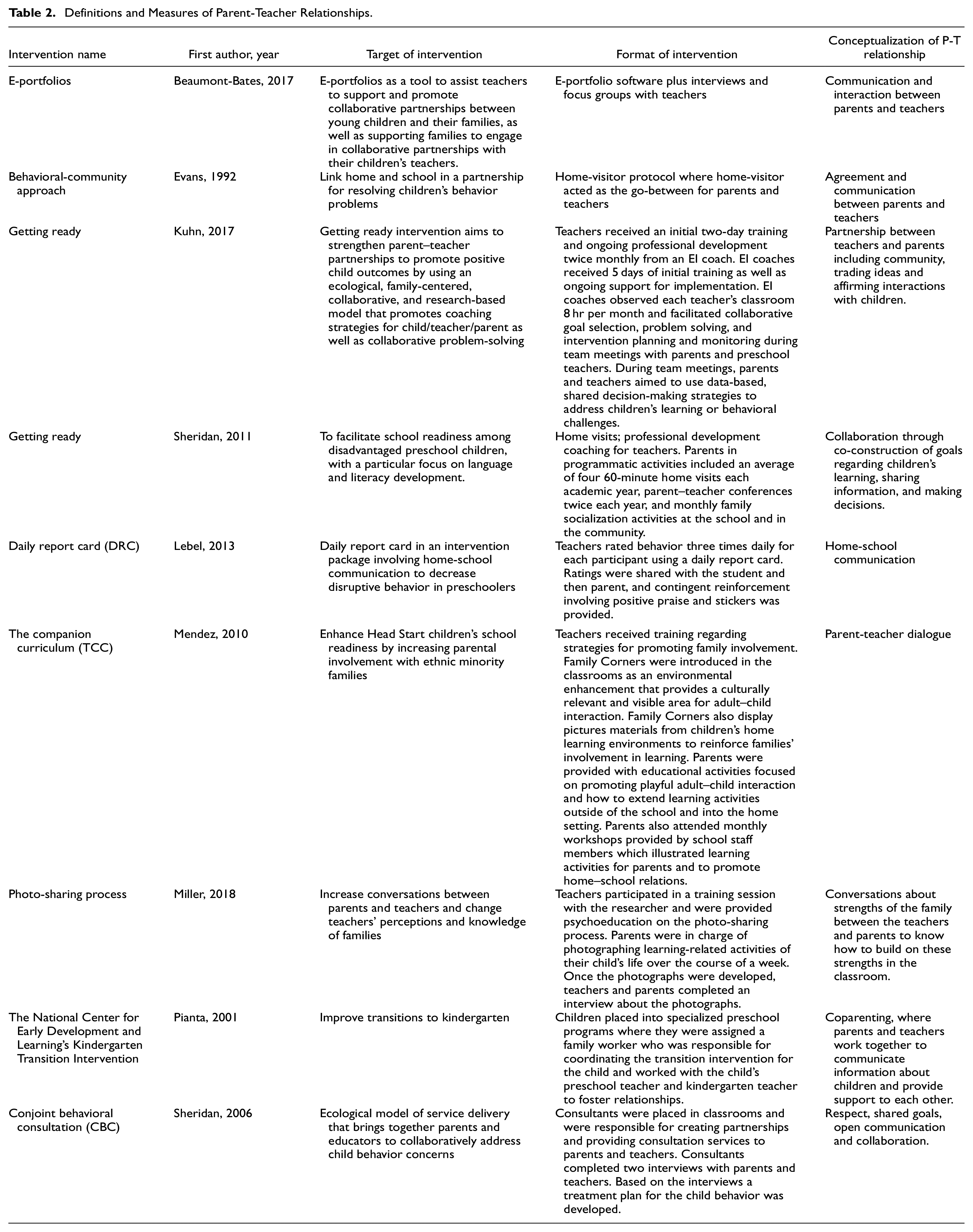
The Behavioral Community Approach conceptualized parent-teacher relations as parents and teachers working together on a behavior plan. In this intervention, trained professionals played the role of communicating with parents and teachers separately. Similarly, TCC, CBC, and the National Center for Early Development Interventions conceptualized parent-teacher relationships as having shared goals and decision-making regarding children’s learning and development. The Getting Ready Intervention conceptualized relationships as regular, constructive communication, mutual respect and trust, and collaboration.
What Strategies Were Used to Improve the Social Process?
Our second research question was related to what strategies were used within the interventions to improve parent-teacher relationships. Table 2 provides a detailed description of strategies within each intervention. Majority of interventions utilized a treatment plan for child behavior that had a component of building relationships between parents and teachers (CBC, DRC, Behavioral Community Approach, Getting Ready Intervention, and National Center for Early Development). These interventions were largely focused on child behavior but as part of changing the child behavior they tried to facilitate agreement and collaboration between parents and teachers.
Three interventions used software or a physical object to promote relationships (E-Portfolios, Photo Sharing process, TCC). For example, the E-portfolios intervention used an electronic tool to assist teachers in promoting collaborative partnerships between themselves, young children, and their families (Beaumont-Bates, 2017). Whereas the Photo-sharing process encouraged families to take pictures of home-based learning with their child to share with their child’s teacher who then used the photos to construct a conversation with families (Miller, 2018). Lastly, the Companion Curriculum established Family Corners in classrooms to promote adult–child interactions. Family Corners also reinforced family involvement by showcasing pictures and materials from the children’s learning environments at home (Mendez, 2010).
Two interventions included home-visits (Behavioral Community Approach and Getting Ready Intervention). For example, the Getting Ready Intervention included an average of four 60-minute home visits each academic year, where the Head Start teacher, parent, and child were present. During the home-visits, teachers learned to interact with parents by affirming the parents’ competence in supporting or advancing children’s abilities, giving parents the opportunity to reflect and share ideas related to their child’s learning needs and interests, and providing feedback and in vivo suggestions to draw the parents’ attention to their own actions (Sheridan et al., 2011).
The final set of strategies used to promote parent-teacher relationships was education and direct training. For example, the core component of TCC is to train teachers to provide professional development to parents regarding educational themes, active learning opportunities for adults and children, and parent–teacher dialogue and relationship formation (Mendez, 2010). Whereas the Getting Ready Intervention includes professional development for teachers to support their competence and confidence in interacting with parents. Professional development for teachers was conducted via face-to-face training and coaching and consisted of understanding the Getting Ready strategies as well as their ability to integrate important family-centered practices into instruction (Sheridan et al., 2011).
Of note, in four interventions, a consultant (defined as an Early Intervention coach, family worker, trained consultant, or home visitor) played a role in implementing strategies and facilitating relationships between parents and teachers (Getting Ready; The National Center for Early Development and Learning’s Kindergarten Transition Intervention; Conjoint Behavioral Consultation; Behavioral-Community Approach). Three of them outlined how the consultant facilitated all conversations and interactions between parents and teachers (Getting Ready; Conjoint Behavioral Consultation; Behavioral-Community Approach) and that parents and teachers never had individual interactions of their own without the consultant present.
What Outcomes Are Associated with Improving the Social Process Between Parents and Teachers?
Across all included interventions, outcomes assessed were either child and parent-level outcomes or outcomes related to the parent-teacher relation. All reported outcomes are included in Table 3. Overall, the reporting of outcomes associated with the social process was very limited. A few interventions focused solely on child outcomes such as improved child behavior and pre-academic skills. Of the studies that assessed changes in parent-teacher relationships, most focused on communication as an outcome.
Intervention Outcomes.

Note. ns = non-significant; P = parent; T = teacher; P-T = parent-teacher.
Discussion
The present investigation sought to systematically evaluate interventions in ECE focused on improving parent-teacher relationships. Despite a thorough systematic review, only nine peer-reviewed manuscripts were identified covering eight unique interventions. Among these manuscripts, there was no clear consensus on strategies to improve the social process between parents and teachers. Further, there was no direct and replicated linkage between strategies and outcomes. Below we discuss the findings in terms of what the ECE field has learned to date and necessary future directions for the study of parent-teacher relationships.
The present review identified a dearth of studies specifically focused on improving the social process between parents and teachers. This may in part be due to the difficulty of improving social processes between parents and teachers in ECE. Further, the present review indicates that even among existing interventions, there was no consensus regarding the conceptualization of the social process between parents and teachers. In fact, within specific interventions, parent–teacher relationships were often conceptualized as one trait (e.g. communication) rather than a collection of traits forming an overall social process (e.g., communication, trust, comfort). This lack of depth in conceptualizing the parent-teacher relation may have a trickle down effect limiting the strategies chosen to promote this relation and therefore the associated outcomes.
Of the conceptualizations of the social process, studies included in this review tended to be consistent with previous research outlining the importance of communication or joining (Smith et al., 2022). For example, some interventions described communication between parents and teachers as enough to constitute a parent-teacher relation. Whereas others described collaboration or joining together on the child’s behavior as the main aspect of a relationship. Recent research in ECE has outlined how early and open communication between parents and teachers may support a teacher’s ability to understand, sympathize, and predict child behavior in the classroom (Martin et al., 2018; Zulauf & Zinsser, 2019; Zulauf-McCurdy & Zinsser, 2021). This research emphasizes the need to establish communication prior to teachers having concerns about child behavior. Only two included interventions in the present review sought to promote relationships prior to child behavioral concerns. The remainder focused on how to improve social processes as a part of improving child behavior. Future research is needed to examine the potential differential effectiveness of promoting quality relationships between parents and teachers prior to child behavioral concerns.
Our small, but diverse sample of interventions demonstrated improvements in child outcomes. This finding may indicate that improving social processes between parents and teachers is enough to improve child behavior. Consistent with prior research (see Smith et al., 2022 for review), it may also indicate that the relation between parents and teachers is a factor that impacts teachers’ ratings of child behavior. Future studies are needed to better understand the mechanism in which improvements solely applied to the parent-teacher relationship can generate progress in child behavior and academic outcomes.
Of note, within the included studies there was a lack of specifically empowering parents in forming relationships with their child’s teacher. This is concerning as many parents, especially those from REM backgrounds, face barriers to getting involved in their child’s school (e.g., differing cultural beliefs, implicit bias from schools, and language barriers). Attending to REM families is especially important because data shows racially and ethnically minoritized families report having fewer close relationships with their preschool programs and teachers than White families (Mendez, 2010). Because much of what we consider “relationships” comes from a White perspective, there is a need to re conceptualize parent-teacher relationships by elevating the cultural strengths and parental practices of REM families. While doing this, it will be important to find ways to support parents in promoting positive relationships with teachers.
Further, several interventions included consultants as the driver of relationships between parents and teachers. Due to the limited body of research, it is unclear at this time whether the interventions with consultants had stronger effects on outcomes compared to other interventions. Although these interventions offer promise, the ECE workforce may be ill-equipped to implement and sustain these types of interventions. Further, a previous meta-analysis found that interventions that rely on additional outside personnel coming into schools to facilitate parent-teacher relationships resulted in overall small effect sizes (Smith et al., 2022). In the present review, included interventions reported positive effects on the child behavior outcomes but inconsistent findings between parent and teacher ratings of improvements in their relationship (with some studies reporting only parent-rated improvement and others only teacher-rated improvement). This inconsistency in outcomes may be a result of the degree to which the consultant mediated within the parent-teacher relationship. Although consultants may not be feasible in all ECE settings, these studies may offer insight into ways parents and teachers can improve their relationship. Specifically, these articles utilized the consultant as someone who established meetings between parents and teachers to engage them in communication around child behavior. Although the consultant was included in the parent-teacher meeting, it may be possible to equip parents and teachers with skills to meet and promote communication and collaboration around child behavior concerns.
The current systematic review indicates that efforts to identify feasible and low-burden interventions that provide direct support to parents and teachers are still needed. When designing or evaluating an intervention, one should consider the degree to which the intervention is feasible and sustainable within ECE settings. The “gap” between a research-controlled intervention and how an intervention acts in the real-world is problematic, as the resources invested in the development and evaluation of interventions do not translate into large-scale impact on child outcomes (Proctor et al, 2009). Several factors may influence how an intervention is implemented and sustained in ECE following a controlled research study. These factors may include the limited availability of resources, and stress and burnout expressed by teachers, who are underprepared and underpaid (Schonert-Reichl et al, 2015; Whitaker et al., 2013). Other common barriers to teacher adherence to an intervention may include competing responsibilities, logistical barriers, lack of parent engagement, and insufficient support (Langley et al., 2010; Lyon et al., 2011, 2014). Further, as many parents may be juggling multiple demands, such as work and caring for additional children and family members, it is important to find interventions that will not place extra undue burden on parents.
Limitations
The present systematic review was not without limitations. As with any review (Bartolucci & Hillegass, 2010), this study was subject to publication bias, otherwise known as the “file-drawer” problem. It is likely that additional interventions, including pilot studies, have been conducted, but are unpublished potentially due to small sample sizes and/or insignificant results. Further, although a thorough search approach was used across multiple databases and with a “snowballing” approach to further search for articles, only nine articles were identified limiting the conclusions that can be drawn from this review. We also explicitly limited our sample to teachers currently working with children, excluding pre-service training and limited interventions to those occurring within school-settings, thus excluding clinic-based interventions. It should also be noted that interventions had to be published in peer-reviewed journals excluding white papers, policy briefs, and dissertations.
Conclusion
The present systematic review of parent-teacher interventions in ECE identified and described a small body of peer-reviewed literature. Despite the emphasis on parent-teacher relationships in both everyday educational practice and policy, the present systematic review highlights the need for more work focused on identifying and implementing feasible strategies to support parents and teachers in forming positive relationships. The approaches included in this review represent a thin literature base, leaving room for both replication across settings, with larger and more diverse samples, and new rigorous methodology to continue to inform interventions that improve the parent-teacher relationship.
Footnotes
Declaration of Conflicting Interests
The author(s) declared no potential conflicts of interest with respect to the research, authorship, and/or publication of this article.
Funding
The author(s) disclosed receipt of the following financial support for the research, authorship, and/or publication of this article: We are grateful for funding from the Institute of Education Sciences (R305B170021).

Data Availability Statement
Data sharing not applicable to this article as no datasets were generated or analyzed during the current study.